


Abstract
The undrained shear strength of clay is an important index for the calculation of the bearing capacity of the foundation soil, the calculation of the soil pressure of the foundation pit, and the analysis of the slope stability. Therefore, the purpose of this paper is to conduct a comprehensive study of the combined use of machine learning with clay theoretical equations to estimate it. Under the Bayesian framework, the CatBoost algorithm (CatBoost–Bayesian) based on Bayesian optimization algorithm was developed to obtain the feature importance level of soil parameters affecting the undrained shear strength of clay, so as to adaptively couple the theoretical equation of undrained shear strength of consolidated clay, which was derived from the modified Cambridge model. Then, the theoretical equation of undrained shear strength of the isotropically consolidated clay was established from the critical state of the clay parameters. Finally, it was illustrated and verified using the experimental samples of Finnish clay. The results indicate that the theoretical equation established by the overconsolidation ratio and effective overburden pressure parameters can well estimate the undrained shear strength of isotropically consolidated clays, and the parameter uncertainty can be considered explicitly and rigorously.
1. Introduction
The composition and physical and mechanical properties of clayey soil are important indexes in geotechnical engineering, among which the undrained shear strength index of clay is the most important index for calculation of the bearing capacity of foundation soil, calculation of the soil pressure of the foundation pit, and analysis of slope stability. Cross plate shear tests in the field, direct shear tests in the laboratory, triaxial compression tests, and other such direct measurement methods are time-consuming and expensive [1]. To evaluate through indirect methods, theoretical derivation and empirical methods are effective methods. Based on many experiments, Mesri and Ladd et al., respectively, proposed empirical equations for the undrained shear strength of clay [2,3]. Jiang Shuihua et al. simulated the uncertainty of soil parameters and proposed an effective non-stationary random field model for undrained shear strength parameters [4]. Indirect methods also include measurements obtained from dilatometer tests (DMT) based on empirical equations [5,6].
The application of machine learning in the field of geotechnical engineering has gradually become a research hotspot, including slope stability testing, TBM performance evaluation, rockburst vibration estimation, and pile foundation evaluation, etc., and has been proposed, expanded upon and applied by many researchers [7,8,9,10]. The emergence of artificial intelligence techniques holds great potential for solving soil parameter estimation problems involving complex soil–structure interactions [11,12,13]. However, compared with other directions in the field of geotechnical engineering, research devoted to soil parameter estimation is still very limited. The CatBoost algorithm can effectively solve gradient offset and prediction offset problems, improving the accuracy and generalization ability of the calculation [14]. Therefore, it has been widely used in crop evapotranspiration estimation in hydrology, data-driven seismic performance evaluation of corroded RC columns in civil engineering, and groundwater salinity prediction in multi-layer coastal aquifers in geotechnical engineering [14,15,16,17,18].
Moreover, the combination of Bayesian optimization with machine learning algorithms is still relatively rare, and Zhang et al. use extreme gradient boosting and random forest based on Bayesian optimization in geotechnical engineering to effectively capture the relationship between undrained shear strength and various fundamental soil parameters [19]. Ho et al. used the good performance of Bayesian, functional, and meta-ensemble machine learning models to generate land subsidence susceptibility (LSS) maps [20]. The Cambridge model and modified Cambridge model are two elastic–plastic constitutive models commonly used in geotechnical engineering to describe the shear properties of soils [21]. They are typical of the constitutive relationships of soils under undrained conditions. The Cambridge model describes the shear properties of soils under circular stress paths, while the modified Cambridge model modifies the stress paths in the plastic potential function to better describe the shear properties of soils under non-circular stress paths [22].
Under the Bayesian framework, the CatBoost algorithm (CatBoost–Bayesian) based on a Bayesian optimization algorithm was developed to obtain the feature importance level of soil parameters affecting the undrained shear strength of clay by using the experimental samples of Finnish clay, so as to adaptively couple the theoretical equation of undrained shear strength of consolidated clay, which was derived from the modified Cambridge model. Then, the theoretical equation of undrained shear strength of isotropically consolidated clay was established from the critical state of clay parameters. Finally, this paper analyzed the uncertainty of the parameters of the equation and verified the rationality of the calculation results. The rest of this study was arranged as follows. In Section 2, the CatBoost algorithm, the principle of Bayesian optimization algorithm based on random forest and K-fold cross-validation, as well as the theoretical equation derived from the revised Cambridge model, and the selection of quantitative evaluation indicators are introduced, respectively. The Finnish clay database used for training and validating the CatBoost–Bayesian hybrid model and theoretical equations is presented in Section 3, and a sensitivity analysis of different types of clay was performed to show the results of the importance of clay parameters. Finally, various verifications of the calculation results of the undrained shear strength theoretical equation of isotropically consolidated clay were carried out, and the results of the similar mixed model of CatBoost–Bayesian were compared and analyzed. Section 4 discusses the conclusions of this study, followed by references.
2. Materials and Methods
2.1. CatBoost Algorithm
The CatBoost algorithm was developed by researchers and engineers at Yandex, the largest Russian search engine company, in 2017, and opened source code in April [14,23]. It is the latest algorithm in the open-source field in the world today, and surpasses the XGBoost algorithm and the LightGBM algorithm in terms of performance. The name comes from “Category” and “Boosting”, and belongs to the family of Boosting algorithms. The CatBoost algorithm is an improvement in the framework of the GBDT algorithm. It effectively solves the problem of gradient bias and prediction shift, avoids the occurrence of overfitting, and improves calculation accuracy and generalization ability (Figure 1). The details are as follows.
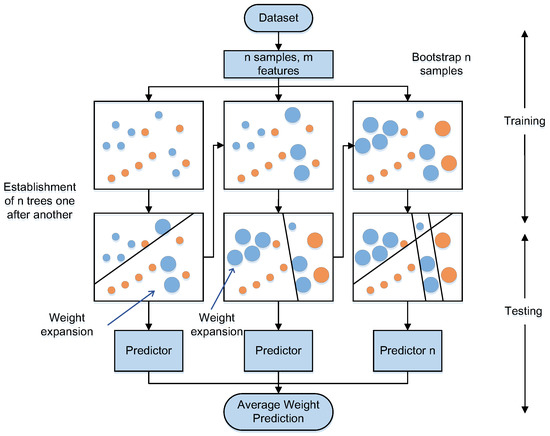
Figure 1.
The structure of the CatBoost algorithm.
- The CatBoost algorithm can handle categorical features in GBDT features better, and the simplest way is to use the average value of the corresponding labels to replace them. In the decision tree, the label average value will be used as the criterion for node splitting. This method is known as greedy target-based statistics, or greedy TS. However, this method has obvious drawbacks, so greedy TS is improved by adding prior distribution terms to reduce the effect of noise and low frequency categorical data on the data distribution [14,23].
- 2.
- The prediction shift is caused by the gradient bias. To overcome this problem, CatBoost proposes a new algorithm called ordered boosting (Algorithm 1).
| Algorithm 1: Ordered boosting pseudo-code algorithm |
| input: |
| random permutation of |
| for |
| for to do |
| for to do |
| for to do |
| learn model |
From the Algorithm 1, denotes a sample, denotes a separate model, and model is obtained by training with a training set that does not contain sample .
2.2. Bayesian Optimization Algorithm (SMAC) and k-Fold Cross-Validation
Hyperparameter optimization is a combinatorial optimization problem that cannot be optimized by gradient descent as general parameters. Evaluating a set of hyperparameter problems often involves issues such as resource allocation and efficiency. The simpler hyperparameter optimization methods include manual search, grid search, and random search. In this study, we used the currently popular adaptive hyperparameter search method of Bayesian optimization [24,25,26]. Based on the combinations of hyperparameters that were already tested, this method can predict the next combination that is more likely to bring the greatest benefit. This study is implemented using the optuna automatic hyperparameter optimization framework.
SMBO stands for sequential model-based optimization. The so-called serialization refers to the optimization by iterative method one trial at a time. SMBO is a specific implementation form of Bayesian optimization.
SMAC, proposed by Hutter et al. [27], stands for sequential model-based optimization for general algorithm configuration; the model originates from the random forest model. The random forest (RF) algorithm is a combination of the Bootstrap Aggregating algorithm proposed by Breiman in 1996 and the stochastic subspace algorithm proposed by Ho [28] in 1998. SMAC was initially designed to remove some of the limitations of SMBO to make it applicable to general algorithm configuration problems with many classification parameters and benchmark sets of instances, and to solve the case in which the parameter type cannot be discrete in the Gaussian regression process.
During the process of model training, the problem of data overfitting often occurs. The model can match the training data well, but cannot predict the data outside the training set well. This affects the accuracy of the final evaluation results.
K-fold cross-validation (CV) is widely used as a criterion for model selection [29], and was originally created to reduce the computational cost of leave-one-out cross-validation (LOOCV) [30]. It divides a dataset into K equal samples, of which K-1 samples are used to build the model for training, and the remaining 1 sample is used for validation. During this K-time iteration, each part of K is successively assigned as validation data.
Jung [31] proposed a new method of choosing K-fold to ensure K = ln(n) and guarantee simultaneously. After verifying the feasibility of it, where n denotes a data point and d denotes the number of parameters (in this study, n = 202, d = 12, K = 5.3), and combining it with Pham [32] method, K was setted to 5. Therefore, this study used a five-fold cross-validation method for validation (Figure 2).
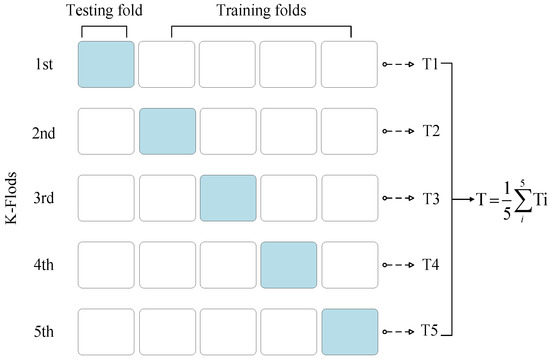
Figure 2.
Five-fold cross-validation.
To reduce the reliance on empirical rules and inefficient brute force search, Bayesian optimization methods are applied to determine the appropriate model hyperparameters for the CatBoost algorithm (CatBoost–Bayesian). With appropriate model hyperparameters, the CatBoost–Bayesian hybrid model is able to provide a data-driven ranking of clay feature importance and properly uncover the intrinsic linkage of soil parameter essences; however, it cannot give full interpretability. To address this issue, the clay feature importance is adaptively coupled with the theoretical equations derived from the modified Cambridge model to estimate the undrained shear strength of isotropically consolidated clay under a Bayesian probabilistic framework, taking into account the parameter and model uncertainties, which are explained in detail in Section 2.3 and Section 2.4.
2.3. Theoretical Equation
Deriving the undrained shear strength ratio from the soil intrinsic relationship is a common method for solving soil strength. Based on the Cambridge model, Ohta et al. [33] proposed the undrained shear strength derivation equation under the condition of triaxial ( is the coefficient of earth pressure at rest) consolidation.
where OCA is the overconsolidated state of anisotropic clay, NCA is the normally consolidated state of anisotropic clay, the overconsolidation ratio is , , is the slope of the swelling lines described by the effective overburden pressure, and is the slope of the anisotropical normally consolidated soil compression curve:
where is the slope of the swelling lines described by the effective average stress, is the effective average vertical pressure in the anisotropical normally consolidated state, and is the effective average overburden pressure. is the void ratio, and is the initial void ratio.
Substitute and into Equation (5), to obtain the following:
where is the coefficient of earth pressure at rest in the soil in the overconsolidated state, is the coefficient of earth pressure at rest in the soil in the normally consolidated state, and the undrained shear strength ratio of the normally consolidated soil is
where , , is the critical state stress ratio, , is generalized shear stress, , is the average principal stress, and . When and , the ratio of undrained shear strength of the isotropical normally consolidated state and isotropically overconsolidated state clay is obtained, respectively.
where OCI is the overconsolidated state of isotropic clay, and NCI is the normally consolidated state of isotropic clay. Based on the experimental results of isotropic consolidation and swelling tests, Karube [34] proposed an empirical equation .
From Equations (8) and (9), the equations for calculating the undrained shear strength of the isotropical normally consolidated and isotropically overconsolidated clays can be obtained.
In the Cambridge model, in isotropically consolidated clays, , [35].The initial void ratio can be solved by equation [36]. Ladd [37] proposed an empirical equation for computing the undrained shear strength of clay based on the results of indoor and outdoor tests and examples of foundation failure.
where is under normal consolidation conditions, is the strength growth index, and is affected by or according to the critical state theory [21].
2.4. Bayesian Perspective of Unified Undrained Shear Strength Equation
Unlike classical statistics, which is based on the frequentist approach, the CatBoost–Bayesian hybrid model is based on Bayesian statistics and machine learning. The CatBoost–Bayesian hybrid model uses Bayesian theory to combine engineering judgment and empirical prior knowledge with data to derive posterior distributions. In geotechnical analysis and prediction, engineers usually consider data from multiple sources [38]. This study updates the intrinsic model parameters (posterior distribution) with information from laboratory experimental data, field test data, and engineering experience [39]. Considering the differences in soil area and experimental methods, according to Equations (7)–(12), the effective overlying pressure is used together, and are converted by the correction coefficient to complete the unification of the undrained shear strength equations of isotropic normal consolidation and isotropic overconsolidation, derived from the constitutive model.
where represents the constitutive model parameter, , , , and is a Gaussian random variable with mean =0 and standard deviation = 0.215 [40]. Conditional probability theory is used to update the posterior probability density function (PDF) based on prior information and laboratory test data of random variables. The calculation is as follows:
where K is the normalization constant; is the prior distribution of the key constitutive parameter , and is the likelihood function reflecting the probability relationship between of the laboratory test (site test) and constitutive model parameters.
2.4.1. Prior Distribution
Information about model parameters is usually limited given laboratory/field tests. Therefore, non-informative prior knowledge is used in this study. Assuming that a single random variable is independent, the prior distribution is equal to the product of the prior distributions of all constitutive model parameters. In order that there is no preference for any value in the possible range of parameters, uniform prior distribution is usually used. Uniform prior distribution is used to reflect the knowledge state of the model parameters in the Bayesian framework [41], expressed as
where is the number of constitutive model parameters, and , , and are the lower and upper limits of and respectively.
2.4.2. Likelihood Function
The likelihood function reflects the degree of consistency between constitutive model parameter A and the statistical characteristics of laboratory test/field test b, which can be expressed by multivariate normal distribution function [42]:
where N is the number of laboratory tests/field tests. and are the mean and standard deviation of respectively, and is the value estimated by the parameters of the constitutive model. With the continuous development of the field of geotechnical engineering driven by data, it is less difficult to obtain prior information than in previous engineering practices. In order to obtain updated posterior , Markov chain Monte Carlo simulation (MCMC) is used to obtain discrete samples based on prior distribution and likelihood function simulation [43,44]. The basic idea of MCMC simulation is to repeatedly extract samples from the target distribution by converging with the Markov chain of the target distribution.
2.4.3. Uncertainty Analysis of the Unified Constitutive Model
The uncertainty of the undrained shear strength equations of isotropic normal consolidation and isotropic overconsolidation after updating the constitutive model parameters is studied by using a first-order approximation method. The mean value and standard deviation of a can be approximated as [45,46]
2.5. Quantitative Evaluation Indicators
, , , and , the evaluation indicators used in this study, are commonly used to evaluate the prediction performance of the regression model, where and explain the variance score of the regression model, and their values take the range of [0,1]; values closer to 1 indicate that the independent variable is more able to explain the variance change in the dependent variable, and smaller values indicate the opposite [47,48,49].
indicates the average value of the square root of the error of the fitted data and the original data corresponding to the sample points; assesses the degree of closeness between the prediction results and the real dataset. The smaller the value of these two, the better the fitting effect. The statistical indicators are computed as follows:
where denotes the true value of the undrained shear strength of the clay sample, denotes the predicted value of the undrained shear strength of the sample clay, denotes the value of the undrained shear strength of the clay sample, and denotes the number of the clay sample. The coefficient of variation (COV) is commonly used in engineering to perform an analysis of variance, showing the variability of a sample population relative to the sample mean.
where represents the standard deviation of the undrained shear strength of the sample clay, and represents the mean undrained shear strength of the sample clay.
3. Results and Discussion
A comprehensive study of the use of the CatBoost–Bayesian hybrid model with clay-corrected theoretical equations to estimate clay undrained shear strength values is shown in Figure 3.
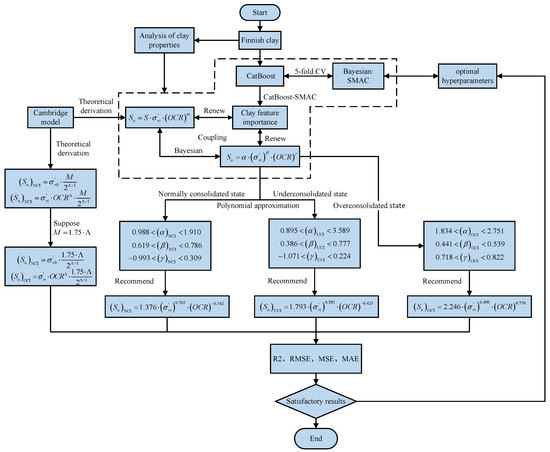
Figure 3.
Flow chart of CatBoost–Bayesian adaptively coupled modified theoretical equations.
3.1. Properties of Clays and the Database
The data used in this study were derived from the FI-CLAY/14/856 dataset in the TC304 database, made up of laboratory test data of clay parameters in 33 regions in Finland [50,51]. In this study, 11 parameters of 202 Finnish clay samples were selected for research, including organic content (), clay content (), void ratio (), natural water content (), liquid limit (), plastic limit (), effective overburden pressure (), preconsolidation pressure (), overconsolidation ratio (), compression index (), sensitivity (), and undrained shear strength (); the statistical results of this data set are as follows (Table 1 [51], Figure 4).

Table 1.
Statistical analysis of dataset.
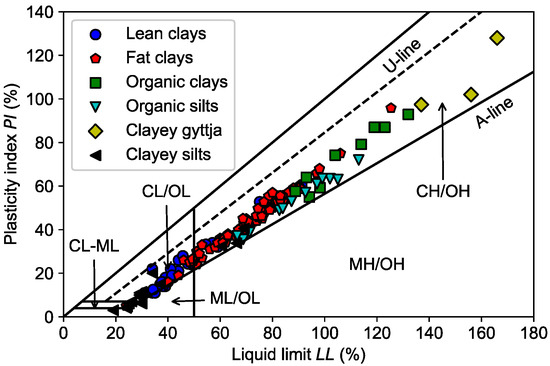
Figure 4.
Plasticity chart and different soil types.
Figure 5 shows the normal distribution and fitting effect of organic content (), clay content (), void ratio (), natural water content (), liquid limit (), plastic limit (), effective overburden pressure (), preconsolidation pressure (), overconsolidation ratio (), compression index (), and undrained shear strength (), and an analysis of the abnormal value of clay undrained shear strength.
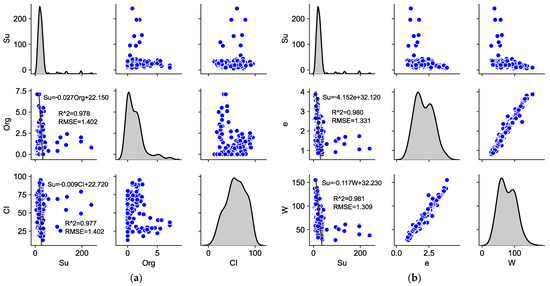
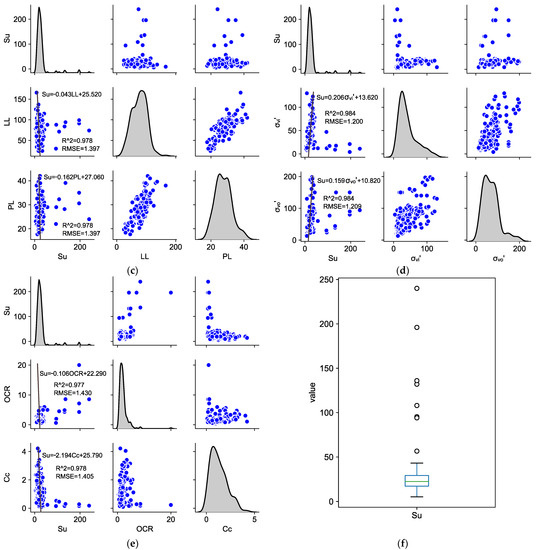
Figure 5.
Visualization of normal distribution of 11 clay parameters. (a) Fitted relationship of , , . (b) Fitted relationship of , , . (c) Fitted relationship of , , . (d) Fitted relationship of , , . (e) Fitted relationship of , , . (f) abnormal value analysis.
Considering the abnormal value of clay undrained shear strength to reduce its influence on the fitting, a simple linear fitting can be performed to obtain the empirical equation of clay undrained shear strength parameters (Figure 5). It could be observed that between the single parameters of clay, the linear relationship is obvious, but the fitting error is large. At the same time, the empirical equation could not be verified. There is a certain particularity, and the constitutive relationship of the clay could not be obtained. Therefore, further research on the relationship between the multi-parameters of the clay is needed.
3.2. Feature Importance of CatBoost–Bayesian Hybrid Model
The CatBoost algorithm (CatBoost–Bayesian hybrid model) was optimized using the Bayesian optimization algorithm under the five-fold cross-validation, and the optimal hyperparameters of the CatBoost algorithm were obtained (Table 2); this study was carried out under the optimal parameters to avoid the excessive model fit, and was beneficial to the CatBoost–Bayesian hybrid model’s adaptively coupled modified theoretical equations for stable estimation of the undrained shear strength of clay. Through the CatBoost–Bayesian hybrid model, an importance ranking of soil parameters that affect the undrained shear strength of clay was obtained.
Table 2.
CatBoost optimal hyperparameters.
When the CatBoost–Bayesian hybrid model was used to estimate the undrained shear strength of clay, the feature importance of the model input parameters to the hybrid model under five-fold cross-validation was obtained, and it was explained whether the input parameters contribute positively (positive correlation) or negatively (negative correlation). Each point in the graph represents a data point from the training set. The color represents the value of the feature parameter; red represents the sample with a higher value of the feature parameter, and blue represents the sample with a lower value of the feature parameter. The length of the horizontal line represents the importance of the estimation of the undrained shear strength of the clay.
It can be seen from the whole that the overconsolidation ratio () is the most important parameter for estimating the undrained shear strength of clay, followed by preconsolidation pressure (), effective overburden pressure (), etc. The effective overburden pressure () increases and the undrained shear strength depends on the consolidation stress before shearing, that is, the research status of the preconsolidation pressure () [52,53,54]. The void ratio () and clay content () features are the least important. At the same time, the characteristic variables significantly show that the compression index () makes a negative contribution to the computed value of the drainage shear strength, while the preconsolidation pressure () and the overconsolidation ratio () make a positive contribution to the computed value of the drainage shear strength (Figure 6). The model’s interpretability method is expected to help geotechnical engineers in the selection of soil parameters in practical engineering. However, the CatBoost–Bayesian hybrid model is still a black-box model, which finds it difficult to explain the internal mechanism of the model and the feature importance; therefore, the combination of the feature importance results with the theoretical equations derived from the constitutive model can provide a reference for geotechnical analysis.
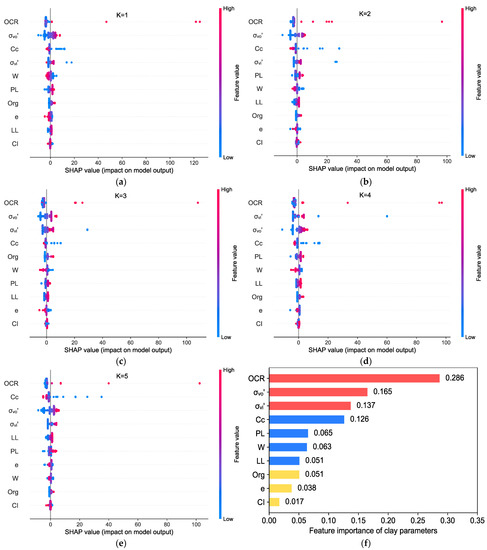
Figure 6.
Clay parameter importance ranking of CatBoost–Bayesian. (a) Feature importance analysis of K = 1. (b) Feature importance analysis of K = 2. (c) Feature importance analysis of K = 3. (d) Feature importance analysis of K = 4. (e) Feature importance analysis of K = 5. (f) Feature importance ranking.
3.3. Estimation of Clay Undrained Shear Strength
3.3.1. Uncertainty Analysis of Equation Parameters
Under the Bayesian framework, the CatBoost algorithm (CatBoost–Bayesian) based on a Bayesian optimization algorithm was developed to obtain the feature importance level of soil parameters affecting the undrained shear strength of clay, so as to adaptively couple the theoretical equation of undrained shear strength of consolidated clay, which was derived from the modified Cambridge model; then, the theoretical equation of undrained shear strength of isotropically consolidated clay was established from the critical state of the overconsolidation ratio () and overburden effective pressure ().
Considering the constitutive relation of clay, the calculation results of the established undrained shear strength theoretical equation of isotropically overconsolidated clay were used for inversion calculation. The equation parameter of the clay in the overconsolidated state is affected by , , and the equation constant parameter is affected by the plasticity index, . For the measured parameters of clay that are difficult to obtain, it is recommended that when the clay depth is , the calculation parameters of undrained shear strength should be computed according to the following recommended values , ; the value range of the correction coefficient of is , and the average value is . The theoretical equation is . This results in a stable estimate of the undrained shear strength of isotropically consolidated clays (Figure 7a,d).
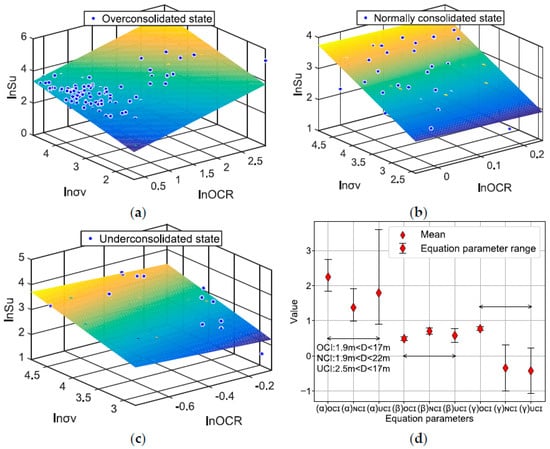
Figure 7.
Limit state functions of clay with different consolidation. (a) Limit state function of overconsolidated clay. (b) Limit state function of normally consolidated clay. (c) Limit state function of underconsolidated clay. (d) Parameter analysis of equation of state for different consolidations.
In the normally consolidated state, the fitting parameter ranges were , , and in this study (Figure 7d). There is a relatively stable estimation result when the clay depth is . Therefore, for the calculation of the parameters of undrained shear strength, it is recommended to take the means , and (Figure 6b).
In the underconsolidated state, the parameter ranges , , and were fitted in this study (Figure 7d). When the clay depth was , the undrained shear strength has a relatively stable estimation result. It is recommended to take the means , and for calculation (Figure 7c). The underconsolidated state of clay is the result of the interaction between the strength characteristics of the soil itself and excess pore water pressure, and its undrained shear resistance exhibits structural properties [55]. Therefore, it cannot be verified by the previous results, and it needs to be verified by the relationship between the measured value and the estimated value.
where UCI is the underconsolidated state of isotropic clay.
It can be seen from the whole that the estimated undrained shear strength of clay is affected by the clay depth () in different consolidation states, which is in line with the actual situation to a certain extent. Asaoka, Guo, and Jiang et al. verified that the undrained shear strength of clay exhibits an obvious linear trend along the depth, through cross-plate shear tests [56,57].
3.3.2. Verification of the Feasibility of the Theoretical Equation
The Bayesian framework concept is an effective means of correcting the original judgments using the new information collected. Based on the new information of the and ofthe Finnish clay database, as well as the test index, priori equations are corrected so that the generated posterior equations are more realistic and have fewer errors. The mean and standard deviation of are also calculated to verify the distribution form of the posterior equation.
The form of the probability distribution of for the posterior equation was performed to verify the rationality of the Bayesian framework. By testing, the posterior equation estimated the undrained shear strength with small standard deviation and low variability (Figure 8).
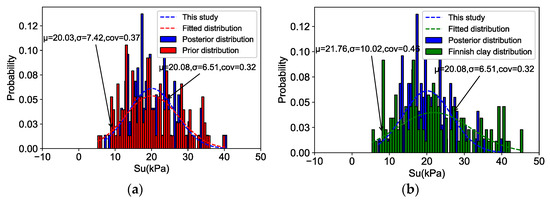
Figure 8.
Test of probability distribution of undrained shear strength. (a) Test of prior and posterior probability distribution. (b) Test of Finnish clay and posterior probability distribution.
The results visualized in Figure 9 were computed by the theoretical equation mentioned above. The measured and theoretically computed values of the undrained shear strength of clay were compared, in which the abscissa is the measured value, and the ordinate is the theoretical computed value. For the underconsolidated state of clay (Figure 9a), since there was no previous result to verify, Equation (10) of Ohta and Wang et al. was selected to better estimate the undrained shear strength of clay. The theoretically computed value is in good agreement with the measured value. For the normally consolidated state of clay (Figure 9b), the theoretically computed results in this study are slightly larger or smaller than the measured values; meanwhile, for the overconsolidated state of clay (Figure 9c), the theoretically computed results in this study are in good agreement with the measured values, and the computed values of Ohta and Wang et al. are obviously larger. It is found that the values in the underconsolidated state, the normally consolidated state and the overconsolidated state are 0.88, 0.91 and 0.97, respectively.
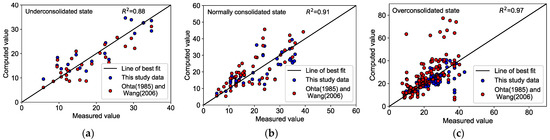
Figure 9.
Comparison between the theoretically computed and measured values of . (a) . (b) . (c) .
Under the double logarithmic coordinate, the undrained strength ratio , corrected by and the overconsolidation ratio both show an obvious linear relationship, which verifies the theory proposed by our predecessors. increases linearly with the increase in in the overconsolidated state (Figure 10a), and decreases linearly with the increase in in the underconsolidated state and normally consolidated state (Figure 10b). The reliability of the theoretical equation proposed in this study is further verified. It is not difficult to find that the gap between the theoretical computed value and the experimental point in this study is significantly smaller than the gap between the theoretically computed value and the measured value studied by Ohta and Wang et al. (Figure 10a).
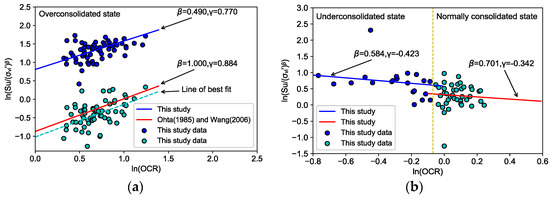
Figure 10.
The relationship between and . (a) Overconsolidated state. (b) Underconsolidated and normally consolidated state.
This study found that has a stable estimation result when the clay depth is , and has stable estimation result when the clay depth is . When the clay depth is , the estimated value of fluctuates greatly. The smaller the compressibility index () value, the lower the compressibility of the soil, and the value of the low compressibility soil is generally less than 0.2. When the depth is less than 1.9 m, the clay in this study is in a state of low compressibility; at the same time, the natural water content is low and the degree of looseness is high, so it is not conducive to estimating the undrained shear strength of the clay. It may be seen from the feature importance ranking of the CatBoost–Bayesian hybrid model that the natural water content () and the compression index () are important parameters of clay, which can explain the large error in the estimation of by the theoretical equation (Figure 11). Combined with the analysis of the geological tectonic environment, it is because the deposition time of the upper part of the clay depth is relatively short, which is affected by long-term evaporation and water loss. The lower clay has a long deposition time and is affected by the rise and fall in the groundwater level for a long time, which is equivalent to continuous loading and unloading, and finally shows the overconsolidation characteristics and the abrupt change of the clay properties. Therefore, the computed value of the theoretical equation should be much smaller than the measured value.
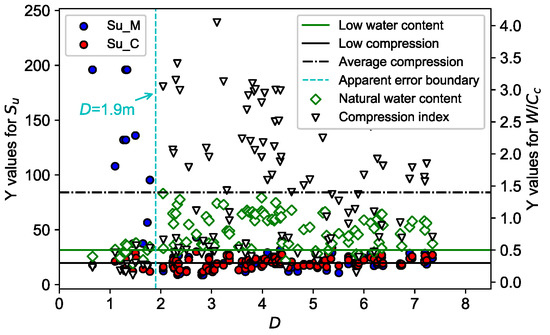
Figure 11.
Error analysis of undrained shear strength of clay.
3.3.3. Comparative Analysis of Estimation Results
Considering the effect of clay depth (), the combination of the feature importance of the CatBoost–Bayesian hybrid model and the calculation of the theoretical equation derived from the modified Cambridge model can well estimate the undrained shear strength of clay, and the theoretical computed value is in good agreement with the measured value (Figure 12a,b). The computed average properties of the clay at different consolidation states were , , , . This indicated that the uncertainty of the theoretical equation is significantly reduced when the overconsolidation ratio was combined with the preconsolidation pressure or the effective overburden pressure.
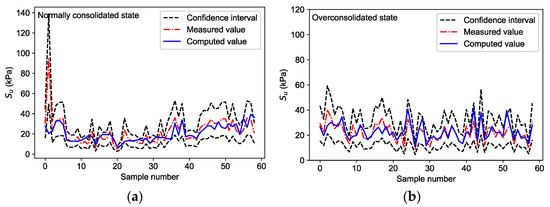
Figure 12.
Comparison of computed results. (a) Recommended equation: . (b) Recommended equation: .
The computed results of the test set of the CatBoost–Bayesian hybrid model under five-fold cross-validation are within the 95% confidence interval, and the computed average performance is training set , , , ; test set , , , . Only a very small number of undrained shear strength estimates at K3 in the test set exceed the 95% confidence interval, proving the reliability of the computed results [58]. In the five-fold cross-validation, there is a gap between the computed value of a small amount of undrained shear strength and the real value, which leads to the large value of and , and the fitting effect is not significant enough (Figure 13a–d).
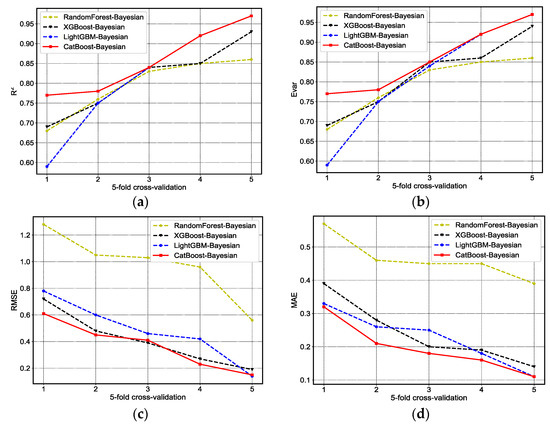
Figure 13.
Comparison of quantitative evaluation indicators. (a) . (b) . (c) . (d) .
As shown in Figure 14, UCI_, NCI_, and OCI_ demonstrate the performance of CatBoost–Bayesian hybrid model for estimating the undrained shear strength of clay in different consolidation states of clay, as well as the overall CatBoost–Bayesian hybrid model performance, which is subsequently compared with LightGBM-Bayesian, XGBoost-Bayesian hybrid model for comparison. The training and test set performance evaluations are shown in Table 3.
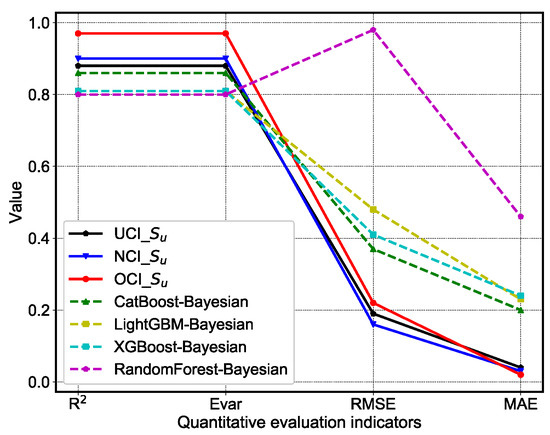
Figure 14.
Estimation performance visualization.
Table 3.
Estimation performance comparison of four hybrid models.
and curves explaining the variance score of the model, the CatBoost–Bayesian hybrid model has the strongest ability to explain the variance in the undrained shear strength under five-fold cross-validation, which could explain almost 86% of the 202 undrained shear strengths of clay. The sample variability shows that the hybrid model has a better effect; and evaluate the closeness of the predicted clay undrained shear strength to its experimental value, and the smaller the value, the better the model fitting effect. It could be observed that the estimated results for clays in different isotropically consolidated states could explain almost 92% of the 202 sample variability in the undrained shear strength of clays. The and of this study are all lower than other intelligent mixed models, and the results show that the combination of CatBoost–Bayesian feature importance and theoretical formula has the best fitting effect (Figure 14).
The estimated performance results in Table 3 show that the theoretical equations of UCI_Su, NCI_Su and OCI_Su derived by combining the CatBoost–Bayesian importance parameters are better than other models in different consolidation states of clay. Among the models of the same type, the estimation performance of the CatBoost–Bayesian hybrid model in the training set and test set is better than other models.
4. Conclusions
Unlike the extensive traditional study of transformation models based on empirical evidence, data-driven ensemble learning methods combined with traditional empirical models have received limited research attention in geotechnical engineering. Moreover, the comprehensive use of Bayesian theory for probabilistic characterization of soil parameter uncertainties and algorithmic optimization problems has not been fully leveraged in a systematic and coherent manner. To address the above challenges, the following study has been conducted. Under the Bayesian framework, the CatBoost algorithm (CatBoost–Bayesian) based on Bayesian optimization algorithm was developed to obtain the feature importance level of soil parameters affecting the undrained shear strength of clay, so as to adaptively couple the theoretical equation of undrained shear strength of consolidated clay, which was derived from the modified Cambridge model, and then the theoretical equation of undrained shear strength of isotropically consolidated clay was established from the critical state of clay parameters, and the calculation results were verified later.
- 1.
- From the feature importance ranking of the CatBoost–Bayesian hybrid model, parameters with high importance and ease of measurement were selected; the overconsolidation ratio () and the effective overburden pressure () could reasonably explain the model and indirectly estimate the undrained shear strength of the clay.
- 2.
- The equation parameter of the clay in the overconsolidated state was affected by , and the equation parameter was affected by the plasticity index, . For the measured parameters of clay that were difficult to obtain, it was recommended that when the clay depth is , the calculation parameters of undrained shear strength should be computed according to the following recommended values , and . The theoretical equation was .
- 3.
- When the undrained shear strength of clay in the normally consolidated state was estimated at a depth of , the recommended theoretical equation was ; when the undrained shear strength of clay in the underconsolidated state was estimated at a depth of , the recommended theoretical equation was .
- 4.
- Compared with the calculation results of Ohta and Wang et al., it was found that the theoretical equation in this study can well estimate the undrained shear strength of isotropically consolidated clay. When the clay depth is , the huge fluctuation of the estimated value of is mainly due to the long-term influence of evaporative water loss in the upper part of the clay.
- 5.
- The CatBoost–Bayesian hybrid model could excavate the intrinsic relationship of the soil parameters, but it could not give a comprehensive interpretability. The undrained shear strength of isotropic clays was estimated and is to a certain extent interpretable by the CatBoost–Bayesian hybrid model feature importance, adaptively coupled to the theoretical equation derived from the modified Cambridge model. Comparing the results of the CatBoost–Bayesian hybrid model and its similar hybrid models, this study ensured that the average reaches 0.92, the average and were 0.19 and 0.03, respectively, and the overall performance was good.
Author Contributions
Conceptualization, H.Y. and Z.L.; methodology, H.Y. and Z.L.; writing—original draft preparation, H.Y. and Y.L.; writing—review and editing, Y.L., H.W. and N.H.; funding acquisition, Z.L. All authors have read and agreed to the published version of the manuscript.
Funding
This study was supported by the National Natural Science Foundation of China (41867039), Guangxi Key Laboratory of Geomechanics and Geotechnical Engineering (20-Y-XT-03), and the Foundation Project of South China Mine Geological Environment Technology Innovation Center (CXZX2020002).
Institutional Review Board Statement
Not applicable.
Informed Consent Statement
Not applicable.
Data Availability Statement
The datasets generated during and/or analyzed during the current study are available from the corresponding author on reasonable request.
Acknowledgments
The authors acknowledge the members of ISSMGE-TC304 for developing the database 304 dB. Thanks to Monica Löfman and Leena Korkiala-Tanttu for contributing this data to make this study possible.
Conflicts of Interest
The authors declare no conflict of interest.
References
- Motaghedi, H.; Eslami, A. Analytical Approach for Determination of Soil Shear Strength Parameters from CPT and CPTu Data. Arabian J. Sci. Eng. 2014, 39, 4363–4376. [Google Scholar] [CrossRef]
- Ladd, C.C.; Foott, R. New Design Procedure for Stability of Soft Clays. J. Geotech. Eng. Div. 1974, 100, 763–786. [Google Scholar] [CrossRef]
- Mesri, G. Discussion of “New design procedure for stability of soft clays”. J. Geotech. Eng. Div. 1975, 101, 409–412. [Google Scholar] [CrossRef]
- Jiang, S.H.; Zeng, S.H.; Yang, J.H.; Yao, C.; Huang, J.S.; Zhou, C.B. Slope Reliability Analysis by Simulation of Non-Stationary Random Field of Undrained Shear Strength. Yantu Lixue 2018, 39, 1071–1081. (In Chinese). Available online: http://ytlx.whrsm.ac.cn/EN/10.16285/j.rsm.2016.0609 (accessed on 20 May 2022).
- Marchetti, S.; Monaco, P.; Totani, G.; Calabrese, M. The Flat Dilatometer Test (DMT) in Soil Investigation; ISSMGE TC 16 Report; ISSMGE: London, UK, 2001; pp. 1–26. [Google Scholar]
- Robertson, P.K. Soil Behavior Type Using the DMT. In Proceedings of the 3rd International Flat Dilatometer Conference, Roma, Italy, 14–16 June 2015; pp. 14–16. Available online: https://www.cpt-robertson.com/PublicationsPDF/Robertson%20DMT15%202015.pdf (accessed on 20 May 2022).
- Nguyen, H.; Bui, X.-N.; Tran, Q.-H.; Mai, N.-L. A New Soft Computing Model for Estimating and Controlling Blast-Produced Ground Vibration Based on Hierarchical K-Means Clustering and Cubist Algorithms. Appl. Soft Comput. 2019, 77, 376–386. [Google Scholar] [CrossRef]
- Xu, H.; Zhou, J.; Asteris, P.G.; Armaghani, D.J.; Tahir, M.M. Supervised Machine Learning Techniques to the Prediction of Tunnel Boring Machine Penetration Rate. Appl. Sci. 2019, 9, 3715. [Google Scholar] [CrossRef]
- Zhou, J.; Li, E.; Yang, S.; Wang, M.; Shi, X.; Yao, S.; Mitri, H.S. Slope Stability Prediction for Circular Mode Failure Using Gradient Boosting Machine Approach Based on an Updated Database of Case Histories. Saf. Sci. 2019, 118, 505–518. [Google Scholar] [CrossRef]
- Jiao, P.; Alavi, A.H. Artificial Intelligence in Seismology: Advent, Performance and Future Trends. Geosci. Front. 2020, 11, 739–744. [Google Scholar] [CrossRef]
- Cui, K.; Jing, X. Research on Prediction Model of Geotechnical Parameters Based on BP Neural Network. Neural. Comput. Appl. 2019, 31, 8205–8215. [Google Scholar] [CrossRef]
- Tran, Q.A.; Ho, L.S.; Le, H.V.; Prakash, I.; Pham, B.T. Estimation of the Undrained Shear Strength of Sensitive Clays Using Optimized Inference Intelligence System. Neural. Comput. Appl. 2022, 34, 7835–7849. [Google Scholar] [CrossRef]
- Jong, S.; Ong, D.; Oh, E. State-of-the-Art Review of Geotechnical-Driven Artificial Intelligence Techniques in Underground Soil-Structure Interaction. Tunn. Undergr. Space Technol. 2021, 113, 103946. [Google Scholar] [CrossRef]
- Dorogush, A.V.; Ershov, V.; Gulin, A. CatBoost: Gradient Boosting with Categorical Features Support. arXiv 2018, arXiv:1810.11363. [Google Scholar]
- Tran, D.A.; Tsujimura, M.; Ha, N.T.; Van Binh, D.; Dang, T.D.; Doan, Q.-V.; Bui, D.T.; Ngoc, T.A.; Thuc, P.T.B.; Pham, T.D.; et al. Evaluating the Predictive Power of Different Machine Learning Algorithms for Groundwater Salinity Prediction of Multi-Layer Coastal Aquifers in the Mekong Delta, Vietnam. Ecol. Indic. 2021, 127, 107790. [Google Scholar] [CrossRef]
- Xu, J.-G.; Hong, W.; Zhang, J.; Hou, S.-T.; Wu, G. Seismic Performance Assessment of Corroded RC Columns Based on Data-Driven Machine-Learning Approach. Eng. Struct. 2022, 255, 113936. [Google Scholar] [CrossRef]
- Huang, G.; Wu, L.; Ma, X.; Zhang, W.; Fan, J.; Yu, X.; Zeng, W.; Zhou, H. Evaluation of CatBoost Method for Prediction of Reference Evapotranspiration in Humid Regions. J. Hydrol. 2019, 574, 1029–1041. [Google Scholar] [CrossRef]
- Zhang, Y.X.; Zhao, Z.G.; Zheng, J.H. CatBoost: A New Approach for Estimating Daily Reference Crop Evapotranspiration in Arid and Semi-Arid Regions of Northern China. J. Hydrol. 2020, 588, 125087. [Google Scholar] [CrossRef]
- Zhang, W.; Wu, C.; Zhong, H.; Li, Y.; Wang, L. Prediction of Undrained Shear Strength Using Extreme Gradient Boosting and Random Forest Based on Bayesian Optimization. Geosci. Front 2021, 12, 469–477. [Google Scholar] [CrossRef]
- Oh, H.-J.; Syifa, M.; Lee, C.-W.; Lee, S. Land Subsidence Susceptibility Mapping Using Bayesian, Functional, and Meta-Ensemble Machine Learning Models. Appl. Sci. 2019, 9, 1248. [Google Scholar] [CrossRef]
- Roscoe, K.H.; Burland, J.B. On the Generalised Stress-Strain Behaviour of “wet” Clay. Eng. Plast. 1968, 535–609. Available online: https://trid.trb.org/view/124868 (accessed on 20 May 2022).
- Wang, L.; Ye, S.; Shen, K.; Hu, Y. Undrained Shear Strength of K0 Consolidated Soft Clays. Chin. J. Geotech. Eng. 2006, 28, 971–977. [Google Scholar] [CrossRef]
- Prokhorenkova, L.; Gusev, G.; Vorobev, A.; Dorogush, A.V.; Gulin, A. CatBoost: Unbiased Boosting with Categorical Features. In Advances in Neural Information Processing Systems; Curran Associates, Inc.: Dutchess County, NY, USA, 2018; Volume 31. [Google Scholar]
- Mockus, J. The Application of Bayesian Methods for Seeking the Extremum. J. Glob. Optim. 1998, 2, 117. Available online: https://cir.nii.ac.jp/crid/137057611871035611 (accessed on 20 May 2022).
- Katakami, S.; Sakamoto, H.; Okada, M. Bayesian Hyperparameter Estimation Using Gaussian Process and Bayesian Optimization. J. Phys. Soc. Jpn. 2019, 88, 074001. [Google Scholar] [CrossRef]
- Lindauer, M.; Eggensperger, K.; Feurer, M.; Biedenkapp, A.; Deng, D.; Benjamins, C.; Ruhkopf, T.; Sass, R.; Hutter, F. SMAC3: A Versatile Bayesian Optimization Package for Hyperparameter Optimization. J. Mach. Learn. Res. 2022, 23, 1–9. [Google Scholar] [CrossRef]
- Hutter, F.; Hoos, H.H.; Leyton-Brown, K. Sequential Model-Based Optimization for General Algorithm Configuration. In Proceedings of the Learning and Intelligent Optimization: 5th International Conference, LION 5, Rome, Italy, 17–21 January 2011. [Google Scholar] [CrossRef]
- Breiman, L. Random Forests. Mach Learn 2001, 45, 5–32. [Google Scholar] [CrossRef]
- Geisser, S. The Predictive Sample Reuse Method with Applications. J. Am. Stat. Assoc. 1975, 70, 320–328. [Google Scholar] [CrossRef]
- Stone, M. Cross-Validatory Choice and Assessment of Statistical Predictions (with Discussion). J. R. Stat. Soc. B 1976, 38, 102. [Google Scholar] [CrossRef]
- Jung, Y. Multiple Predicting K-Fold Cross-Validation for Model Selection. J. Nonparametr. Stat. 2018, 30, 197–215. [Google Scholar] [CrossRef]
- Pham, B.T.; Qi, C.; Ho, L.S.; Nguyen-Thoi, T.; Al-Ansari, N.; Nguyen, M.D.; Nguyen, H.D.; Ly, H.-B.; Le, H.V.; Prakash, I. A Novel Hybrid Soft Computing Model Using Random Forest and Particle Swarm Optimization for Estimation of Undrained Shear Strength of Soil. Sustainability 2020, 12, 2218. [Google Scholar] [CrossRef]
- Ohta, H.; Nishihara, A. Anisotropy of Undrained Shear Strength of Clays under Axi-Symmetric Loading Conditions. Soils Found. 1985, 25, 73–86. [Google Scholar] [CrossRef]
- Karube, D. Nonstandard Triaxial Testing Method and Its Problems. Proceedings of the 20th Symposium of the International Society for Rock Mechanics, JSSMFE. 1975, pp. 45–60. Available online: https://cir.nii.ac.jp/crid/1572261549455735296 (accessed on 20 May 2022).
- He, P.; Wang, W.; Xu, Z. Empirical Correlations of Compression Index and Swelling Index for Shanghai Clay. Yantu Lixue 2018, 39, 1–10. (In Chinese) [Google Scholar] [CrossRef]
- Azzouz, A.S.; Krizek, R.J.; Corotis, R.B. Regression Analysis of Soil Compressibility. Soils Found. 1976, 16, 19–29. [Google Scholar] [CrossRef]
- Ladd, C.C. Stability Evaluation during Staged Construction. J. Geotech. Eng. 1991, 117, 540–615. [Google Scholar] [CrossRef]
- Zhang, J. Bayesian Method: A Natural Tool for Processing Geotechnical Information; TC205/TC304 Discussion Groups; ISSMGE: London, UK, 2016. [Google Scholar]
- Fu, Y.; Ma, C.; Bian, Y.; Lv, G.; Hu, Y.; Wang, C. Stochastic Mechanics-Based Bayesian Method Calibrating the Constitutive Parameters of the Unified Model for Clay and Sand with CPTU Data. Acta Geotech. 2022, 17, 4577–4598. [Google Scholar] [CrossRef]
- Cao, Z.; Wang, Y. Bayesian Model Comparison and Characterization of Undrained Shear Strength. J. Geotech. Geoenviron. Eng. 2014, 140, 04014018. [Google Scholar] [CrossRef]
- Zhao, Z.; Duan, W.; Cai, G.; Wu, M.; Liu, S. CPT-Based Fully Probabilistic Seismic Liquefaction Potential Assessment to Reduce Uncertainty: Integrating XGBoost Algorithm with Bayesian Theorem. Comput. Geotech. 2022, 149, 104868. [Google Scholar] [CrossRef]
- Juang, C.H.; Zhang, J. Bayesian Methods for Geotechnical Applications—A Practical Guide; ASCE: Reston, VA, USA, 2017; pp. 215–246. [Google Scholar] [CrossRef]
- Guan, Z.; Wang, Y. SPT-Based Probabilistic Evaluation of Soil Liquefaction Potential Considering Design Life of Civil Infrastructures. Comput. Geotech. 2022, 148, 104807. [Google Scholar] [CrossRef]
- Guan, Z.; Wang, Y. CPT-Based Probabilistic Liquefaction Assessment Considering Soil Spatial Variability, Interpolation Uncertainty and Model Uncertainty. Comput. Geotech. 2022, 141, 104504. [Google Scholar] [CrossRef]
- Juang, C.H.; Ching, J.; Ku, C.-S.; Hsieh, Y.-H. Unified CPTu-Based Probabilistic Model for Assessing Probability of Liquefaction of Sand and Clay. Geotechnique 2012, 62, 877–892. [Google Scholar] [CrossRef]
- Ku, C.-S.; Juang, C.H.; Chang, C.-W.; Ching, J. Probabilistic Version of the Robertson and Wride Method for Liquefaction Evaluation: Development and Application. Can. Geotech. J. 2012, 49, 27–44. [Google Scholar] [CrossRef]
- Draper, N.R.; Smith, H. Applied Regression Analysis; John Wiley & Sons: Hoboken, NJ, USA, 1998; Volume 326. [Google Scholar] [CrossRef]
- Huang, J.-C.; Ko, K.-M.; Shu, M.-H.; Hsu, B.-M. Application and Comparison of Several Machine Learning Algorithms and Their Integration Models in Regression Problems. Neural. Comput. Appl. 2020, 32, 5461–5469. [Google Scholar] [CrossRef]
- Zhang, R.; Li, Y.; Goh, A.T.; Zhang, W.; Chen, Z. Analysis of Ground Surface Settlement in Anisotropic Clays Using Extreme Gradient Boosting and Random Forest Regression Models. J. Rock Mech. Geotech. Eng. 2021, 13, 1478–1484. [Google Scholar] [CrossRef]
- FI-CLAY/14/856 Finland Clays. Available online: http://140.112.12.21/issmge/tc304.htm (accessed on 15 June 2022).
- Löfman, M.S.; Korkiala-Tanttu, L.K. Transformation Models for the Compressibility Properties of Finnish Clays Using a Multivariate Database. Georisk 2022, 16, 330–346. [Google Scholar] [CrossRef]
- Rutledge, P.C. Cooperative Triaxial Shear Research Program of the Corps of Engineers. 1947. Available online: https://trid.trb.org/view/119101 (accessed on 20 May 2022).
- Jamiolkowski, M.; Ladd, C.C.; Germaine, J.T.; Lancellotta, R. New developments in field and laboratory testing of soils. In Proceedings of the XI the International Conference on Soil Mechanics & Foundation Engineering, San Francisco, CA, USA, 12–16 August 1985. [Google Scholar]
- Yuchun, C. A Comparison of Simplified Calculation Methods of Undrained Shear Strength of Soft Clays after Consolidation. China. Civil. Eng. 2014, 47, 107–116. (In Chinese) [Google Scholar] [CrossRef]
- Qiao, Y.F.; Lu, X.B.; Huang, J.; Ding, W.Q. Simplified calculation method for lateral pressure at rest in the under-consolidation stratum. Yantu Lixue 2020, 41, 3722–3729. (In Chinese). Available online: http://ytlx.whrsm.ac.cn/CN/10.16285/j.rsm.2020.0124 (accessed on 20 May 2022).
- Asaoka, A.; A-Grivas, D. Spatial Variability of the Undrained Strength of Clays. J. Geotech. Eng. Div. 1982, 108, 743–756. [Google Scholar] [CrossRef]
- Xiao-qing, G.; Bin, Z.; Jin-chao, L. Others Experimental Study of Undrained Shear Strength and Cyclic Degradation Behaviors of Marine Clay in Pearl River Estuary. Yantu Lixue 2016, 37, 1005–1012. (In Chinese). Available online: http://ytlx.whrsm.ac.cn/CN/10.16285/j.rsm.2016.04.013 (accessed on 20 May 2022).
- Ching, J.; Arroyo, M.; Chen, J.; Jorge, C.; Lansivaara, T.; Li, D.; Mayne, P.; Phoon, K.; Prakoso, W.; Uzielli, M. Transformation Models and Multivariate Soil Databases. In Final Report of Joint TC205/TC304 Working Group on “Discussion of Statistical/Reliability Methods for Eurocodes”; International Society for Soil Mechanics and Geotechnical Engineering (ISSMGE): London, UK, 2017; p. 372. [Google Scholar]
Disclaimer/Publisher’s Note: The statements, opinions and data contained in all publications are solely those of the individual author(s) and contributor(s) and not of MDPI and/or the editor(s). MDPI and/or the editor(s) disclaim responsibility for any injury to people or property resulting from any ideas, methods, instructions or products referred to in the content. |
© 2023 by the authors. Licensee MDPI, Basel, Switzerland. This article is an open access article distributed under the terms and conditions of the Creative Commons Attribution (CC BY) license (https://creativecommons.org/licenses/by/4.0/).