Correction: Schubert et al. Microencapsulation of Bacteriophages for the Delivery to and Modulation of the Human Gut Microbiota through Milk and Cereal Products. Appl. Sci. 2022, 12, 6299

 and
and Reference
- Schubert, C.; Fischer, S.; Dorsch, K.; Teßmer, L.; Hinrichs, J.; Atamer, Z. Microencapsulation of Bacteriophages for the Delivery to and Modulation of the Human Gut Microbiota through Milk and Cereal Products. Appl. Sci. 2022, 12, 6299. [Google Scholar] [CrossRef]
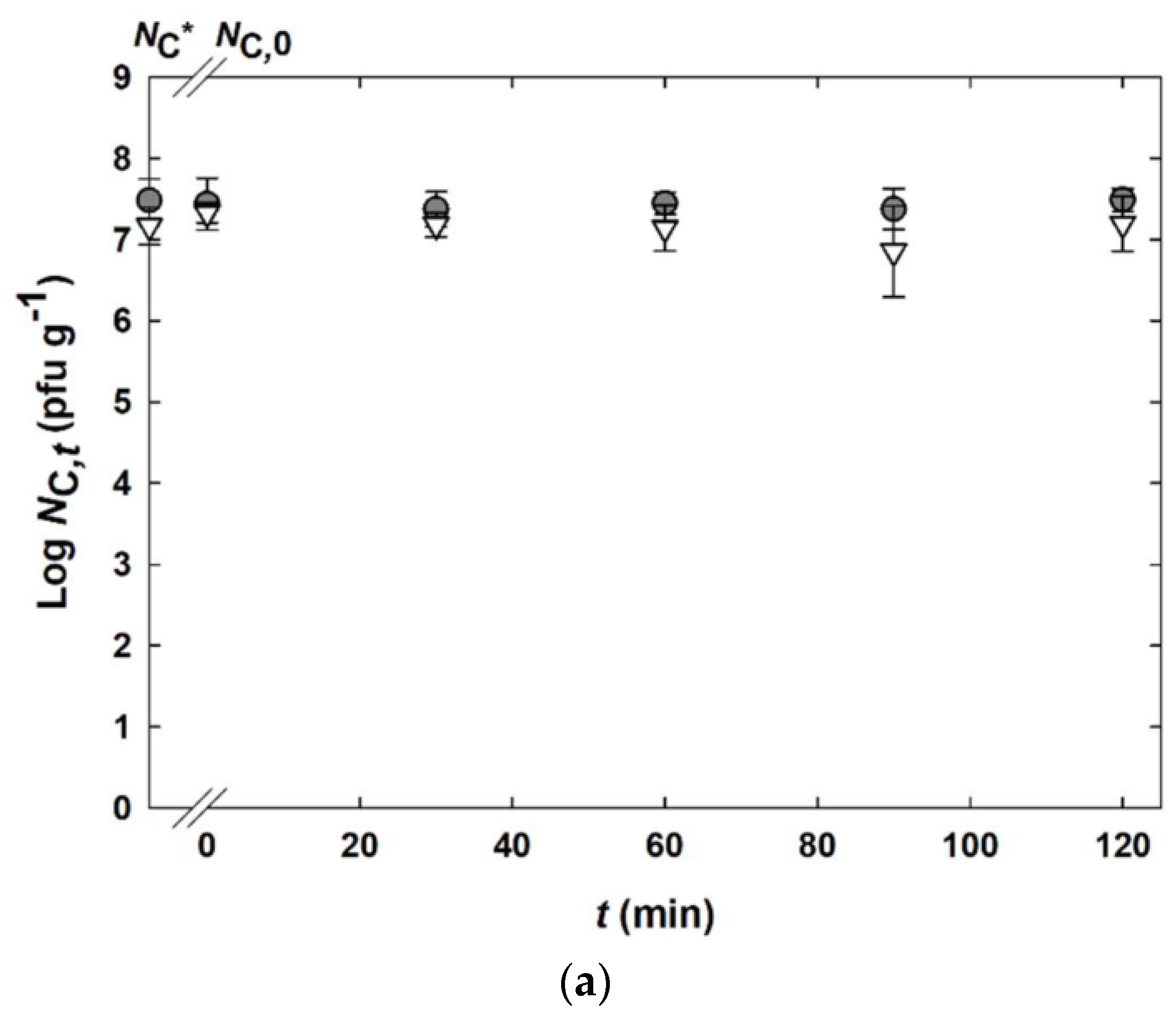
 ) or alginate and whey protein isolate (
 ). (a) Incubation in simulated gastric fluid (SGF). Results are given as bacteriophage titer of solid capsules (NC in pfu g–1).
) or alginate and whey protein isolate (). (a) Incubation in simulated gastric fluid (SGF). Results are given as bacteriophage titer of solid capsules (NC in pfu g–1).
). (a) Incubation in simulated gastric fluid (SGF). Results are given as bacteriophage titer of solid capsules (NC in pfu g–1).
) or alginate and whey protein isolate (). (a) Incubation in simulated gastric fluid (SGF). Results are given as bacteriophage titer of solid capsules (NC in pfu g–1).

| Capsules Characteristics | Alginate + Micellar Casein Capsules | Alginate + Whey Protein Isolate Capsules |
|---|---|---|
| Humidity (%) | 8.70 ± 0.86 | 9.43 ± 0.32 |
| Water activity (–) | 0.15 ± 0.03 | n.d. * |
| Particle diameter d10,3 (µm) | 3.6 ± 1.2 | 5.1 ± 0.4 |
| Particle diameter d50,3 (µm) | 8.9 ± 0.7 | 12.0 ± 1.9 |
| Particle diameter d90,3 (µm) | 17.5 ± 4.4 | 46.2 ± 2.9 |
| Encapsulation efficiency (%) | 4.2 ± 2.1 ** | 3.6 ± 2.1 *** |
| Bacteriophage titer (pfu g−1) | (3.4 ± 1.7) × 107 | (1.6 ± 0.9) × 107 |
Disclaimer/Publisher’s Note: The statements, opinions and data contained in all publications are solely those of the individual author(s) and contributor(s) and not of MDPI and/or the editor(s). MDPI and/or the editor(s) disclaim responsibility for any injury to people or property resulting from any ideas, methods, instructions or products referred to in the content. |
© 2023 by the authors. Licensee MDPI, Basel, Switzerland. This article is an open access article distributed under the terms and conditions of the Creative Commons Attribution (CC BY) license (https://creativecommons.org/licenses/by/4.0/).
Share and Cite
Schubert, C.; Fischer, S.; Dorsch, K.; Teßmer, L.; Hinrichs, J.; Atamer, Z. Correction: Schubert et al. Microencapsulation of Bacteriophages for the Delivery to and Modulation of the Human Gut Microbiota through Milk and Cereal Products. Appl. Sci. 2022, 12, 6299. Appl. Sci. 2023, 13, 5305. https://doi.org/10.3390/app13095305
Schubert C, Fischer S, Dorsch K, Teßmer L, Hinrichs J, Atamer Z. Correction: Schubert et al. Microencapsulation of Bacteriophages for the Delivery to and Modulation of the Human Gut Microbiota through Milk and Cereal Products. Appl. Sci. 2022, 12, 6299. Applied Sciences. 2023; 13(9):5305. https://doi.org/10.3390/app13095305
Chicago/Turabian StyleSchubert, Christina, Sabina Fischer, Kathrin Dorsch, Lutz Teßmer, Jörg Hinrichs, and Zeynep Atamer. 2023. "Correction: Schubert et al. Microencapsulation of Bacteriophages for the Delivery to and Modulation of the Human Gut Microbiota through Milk and Cereal Products. Appl. Sci. 2022, 12, 6299" Applied Sciences 13, no. 9: 5305. https://doi.org/10.3390/app13095305
APA StyleSchubert, C., Fischer, S., Dorsch, K., Teßmer, L., Hinrichs, J., & Atamer, Z. (2023). Correction: Schubert et al. Microencapsulation of Bacteriophages for the Delivery to and Modulation of the Human Gut Microbiota through Milk and Cereal Products. Appl. Sci. 2022, 12, 6299. Applied Sciences, 13(9), 5305. https://doi.org/10.3390/app13095305