


The Effectiveness of Pelvic Floor Muscle Exercise with Biofeedback in Women with Urinary Incontinence: A Systematic Review


 , ,
, ,  , and
, and
Abstract
1. Introduction
2. Materials and Methods
2.1. Study Design
2.2. Search Strategy
2.3. Inclusion and Exclusion Criteria
- RCTs published in English and in full text;
- The sample of the studies had to include women over 18 years old;
- Women had to have stress urinary incontinence (SUI) or urge urinary incontinence (UUI) or mixed incontinence (MUI) of any severity;
- PFM exercises combined with BF were part of the therapeutic intervention for at least one (experimental) group and were compared with a control group, which followed PFM exercises alone (without BF).
- Studies including men;
- Women who in the past had undergone surgery for their incontinence problem;
- The control group followed a placebo or no intervention or any other kind of ‘passive’ intervention (such as booklets and guides);
- PFM exercises with the combination of BF were part of the intervention in both the experimental and control groups.
2.4. Methodological Quality
2.5. Participants
2.6. Intervention
2.7. Outcome Measures
3. Results
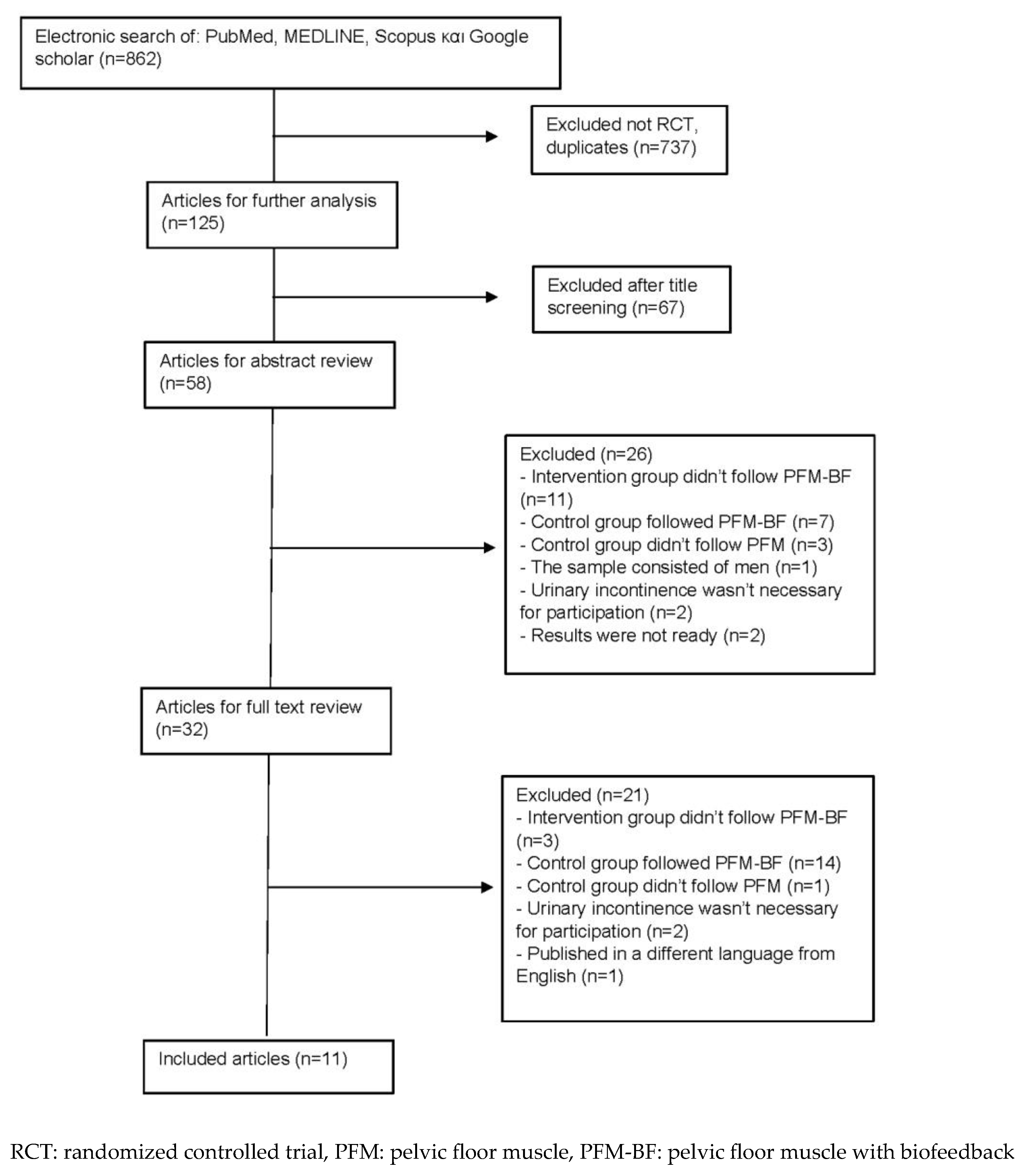
3.1. Search and Selection
3.2. Methodological Quality
3.3. Participants
3.4. Biofeedback Mode
3.5. Intervention
3.6. Primary Outcome
3.7. Secondary Outcomes
3.7.1. Severity of Incontinence
3.7.2. Other Muscular Parameters
3.7.3. Quality of Life
3.7.4. Social Life
3.7.5. Adherence
3.7.6. Satisfaction from Therapy
4. Discussion
4.1. Clinical Implications
4.2. Limitations and Future Considerations
5. Conclusions
Author Contributions
Funding
Data Availability Statement
Conflicts of Interest
References
- Abrams, P.; Andersson, K.E.; Birder, L.; Brubaker, L.; Cardozo, L.; Chapple, C.; Cottenden, A.; Davila, W.; de Ridder, D.; Dmochowski, R.; et al. Fourth international consultation on incontinence recommendations of the international scientific committee: Evaluation and treatment of urinary incontinence, pelvic organ prolapse, and fecal incontinence. Neurourol. Urodyn. 2010, 29, 213–240. [Google Scholar] [CrossRef] [PubMed]
- Norton, P.; Brubaker, L. Urinary incontinence in women. Lancet 2006, 367, 57–67. [Google Scholar] [CrossRef] [PubMed]
- Derewiecki, T.; Mroczek, M.; Majcher, P.; Chrusciel, P. Importance of urinary incontinence problem among women over 40 years of age. Hygeia Publ. Health 2015, 50, 219–225. [Google Scholar]
- Zygmunt, R.; Koziol, S.; Hladki, W.; Golec, J. The influence of physiotherapy on incontinence in women. Emerg. Duty 2017, 10, 77–83. [Google Scholar]
- Klimaszewska, K. The social aspects of urinary incontinence of women. Pielęg XXI Wieku 2017, 16, 57–61. [Google Scholar] [CrossRef]
- Saboia, D.M.; Firmiano, M.L.V.; Bezerra, K.d.C.; Neto, J.A.V.; Oriá, M.O.B.; Vasconcelos, C.T.M. Impact of urinary incontinence types on women’s quality of life. Rev. Esc. Enferm. USP 2017, 51, e03266. [Google Scholar] [CrossRef] [PubMed]
- Lukacz, E.S.; Santiago-Lastra, Y.; Albo, M.E.; Brubaker, L. Urinary Incontinence in Women: A Review. JAMA 2017, 318, 1592–1604. [Google Scholar] [CrossRef]
- National Institute for Health Clinical Excellence. Urinary Incontinence: The Management of Urinary Incontinence in Women; Clinical Guideline; NICE: London, UK, 2006; Volume 40. [Google Scholar]
- Curillo-Aguirre, C.A.; Gea-Izquierdo, E. Effectiveness of pelvic floor muscle training on quality of life in women with urinary incontinence: A systematic review and meta-analysis. Medicina 2023, 59, 1004. [Google Scholar] [CrossRef]
- Dumoulin, C.; Hay-Smith, J.; Habée-Séguin, G.M.; Mercier, J. Pelvic floor muscle training versus no treatment, or inactive control treatments, for urinary incontinence in women: A short version Cochrane systematic review with meta-analysis. Neurourol. Urodyn. 2014, 34, 300–308. [Google Scholar] [CrossRef]
- Tosun, O.C.; Solmaz, U.; Ekin, A.; Tosun, G.; Gezer, C.; Ergenoglu, A.M.; Yeniel, A.O.; Mat, E.; Malkoc, M.; Askar, N. Assessment of the effect of pelvic floor exercises on pelvic floor muscle strength using ultrasonography in patients with urinary incontinence: A prospective randomized controlled trial. J. Phys. Ther. Sci. 2016, 28, 360–365. [Google Scholar] [CrossRef]
- Kopańska, M.; Torices, S.; Czech, J.; Koziara, W.; Toborek, M.; Dobrek, L. Urinary incontinence in women: Biofeedback as an innovative treatment method. Ther. Adv. Urol. 2020, 12, 1756287220934359. [Google Scholar] [CrossRef] [PubMed]
- Frank, D.L.; Khorshid, L.; Kiffer, J.F.; Moravec, C.S.; McKee, M.G. Biofeedback in medicine: Who, when, why and how? Ment. Health Fam. Med. 2010, 7, 85–91. [Google Scholar] [PubMed]
- Giggins, O.M.; Persson, U.M.; Caulfield, B. Biofeedback in rehabilitation. J. NeuroEng. Rehabil. 2013, 10, 60. [Google Scholar] [CrossRef] [PubMed]
- Newman, D.K.; Wein, A.J. Managing and Treating Urinary Incontinence, 2nd ed.; Health Professions Press: Baltimore, MD, USA, 2009; pp. 245–306. [Google Scholar]
- Capelini, M.V.; Riccetto, C.L.; Dambros, M.; Tamanini, J.T.; Herrmann, V.; Muller, V. Pelvic floor exercises with biofeedback for stress urinary incontinence. Int. Braz. J. Urol. 2006, 32, 462–469. [Google Scholar] [CrossRef] [PubMed]
- Chmielewska, D.; Stania, M.; Kucab–Klich, K.; Błaszczak, E.; Kwaśna, K.; Smykla, A.; Hudziak, D.; Dolibog, P. Electromyographic characteristics of pelvic floor muscles in women with stress urinary incontinence following sEMG-assisted biofeedback training and Pilates exercises. PLoS ONE 2019, 14, e0225647. [Google Scholar] [CrossRef] [PubMed]
- Dannecker, C.; Wolf, V.; Raab, R.; Hepp, H.; Anthuber, C. EMG-biofeedback assisted pelvic floor muscle training is an effective therapy of stress urinary or mixed incontinence: A 7-year experience with 390 patients. Arch. Gyn. Obstet. 2005, 273, 93–97. [Google Scholar] [CrossRef] [PubMed]
- Lee, H.N.; Lee, S.Y.; Lee, Y.S.; Han, J.Y.; Choo, M.S.; Lee, K.S. Pelvic floor muscle training using an extracorporeal biofeedback device for female stress urinary incontinence. Int. Urogynecol. J. 2012, 24, 831–838. [Google Scholar] [CrossRef]
- Rett, M.T.; Simoes, J.A.; Herrmann, V.; Pinto, C.L.; Marques, A.A.; Morais, S.S. Management of Stress Urinary Incontinence with Surface Electromyography–Assisted Biofeedback in Women of Reproductive Age. Phys. Ther. 2007, 87, 136–142. [Google Scholar] [CrossRef]
- Nunes, E.F.C.; Sampaio, L.M.M.; Biasotto-Gonzalez, D.A.; Nagano, R.C.d.R.; Politti, F. Biofeedback for pelvic floor muscle training in women with stress urinary incontinence: A systematic review with meta-analysis. Physiotherapy 2018, 105, 10–23. [Google Scholar] [CrossRef]
- Moher, D.; Liberati, A.; Tetzlaff, J.; Altman, D.G. Preferred reporting items for systematic reviews and meta-analyses: The PRISMA statement. Int. J. Surg. 2010, 8, 336–341. [Google Scholar] [CrossRef]
- Maher, C.G.; Sherrington, C.; Herbert, R.D.; Moseley, A.M.; Elkins, M. Reliability of the PEDro Scale for Rating Quality of Randomized Controlled Trials. Phys. Ther. 2003, 83, 713–721. [Google Scholar] [CrossRef] [PubMed]
- Schmidt, A.P.; Sanches, P.R.S.; Silva, D.P.; Ramos, J.G.L.; Nohama, P. A new pelvic muscle trainer for the treatment of urinary incontinence. Int. J. Gynecol. Obstet. 2009, 105, 218–222. [Google Scholar] [CrossRef] [PubMed]
- Hirakawa, T.; Suzuki, S.; Kato, K.; Gotoh, M.; Yoshikawa, Y. Randomized controlled trial of pelvic floor muscle training with or without biofeedback for urinary incontinence. Int. Urogynecol. J. 2013, 24, 1347–1354. [Google Scholar] [CrossRef] [PubMed]
- Manonai, J.; Kamthaworn, S.; Petsarb, K.; Wattanayingcharoenchai, R. Development of a pelvic floor muscle strength ecaluation device. J. Med. Assoc. Thai 2015, 98, 219–225. [Google Scholar] [PubMed]
- Ong, T.A.; Khong, S.Y.; Ng, K.L.; Ting, J.R.S.; Kamal, N.; Yeoh, W.S.; Yap, N.Y.; Razack, A.H. Using the Vibrance Kegel Device With Pelvic Floor Muscle Exercise for Stress Urinary Incontinence: A Randomized Controlled Pilot Study. Urology 2015, 86, 487–491. [Google Scholar] [CrossRef] [PubMed]
- Özlü, A.; Yıldız, N.; Öztekin, Ö. Comparison of the efficacy of perineal and intravaginal biofeedback assisted pelvic floor muscle exercises in women with urodynamic stress urinary incontinence. Neurourol. Urodyn. 2017, 36, 2132–2141. [Google Scholar] [CrossRef]
- Bertotto, A.; Schvartzman, R.; Uchôa, S.; Wender, M.C.O. Effect of electromyographic biofeedback as an add-on to pelvic floor muscle exercises on neuromuscular outcomes and quality of life in postmenopausal women with stress urinary incontinence: A randomized controlled trial. Neurourol. Urodyn. 2017, 36, 2142–2147. [Google Scholar] [CrossRef]
- Fitz, F.F.; Stüpp, L.; da Costa, T.F.; Bortolini, M.A.T.; Girão, M.J.B.C.; Castro, R.A. Outpatient biofeedback in addition to home pelvic floor muscle training for stress urinary incontinence: A randomized controlled trial. Neurourol. Urodyn. 2017, 36, 2034–2043. [Google Scholar] [CrossRef]
- Hagen, S.; Elders, A.; Stratton, S.; Sergenson, N.; Bugge, C.; Dean, S.; Hay-Smith, J.; Kilonzo, M.; Dimitrova, M.; Abdel-Fattah, M.; et al. Effectiveness of pelvic floor muscle training with and without electromyographic biofeedback for urinary incontinence in women: Multicentre randomised controlled trial. BMJ 2020, 371, m3719. [Google Scholar] [CrossRef]
- Sigurdardottir, T.; Steingrimsdottir, T.; Geirsson, R.T.; Halldorsson, T.I.; Aspelund, T.; Bø, K. Can postpartum pelvic floor muscle training reduce urinary and anal incontinence? An assessor-blinded randomized controlled trial. Am. J. Obstet. Gynecol. 2020, in press. [CrossRef]
- Weinstein, M.M.; Collins, S.; Quiroz, L.; Anger, J.T.; Paraiso, M.F.R.; DeLong, J.; Richter, H.E. Multicenter randomized controlled trial of pelvic floor muscle training with a motion-based digital therapeutic device versus pelvic floor muscle training alone for treatment of stress-predominant urinary incontinence. Female Pelvic Med. Reconstr. Surg. 2021, 28, 1–6. [Google Scholar] [CrossRef] [PubMed]
- Kannan, P.; Cheing, G.L.Y.; Fung, B.K.Y.; Li, J.; Leung, W.C.; Chung, R.C.K.; Cheung, T.W.; Lam, L.K.; Lee, W.Y.; Wong, W.C.; et al. Effectiveness of pelvic floor muscle training alone or combined with either a novel biofeedback device or conventional biofeedback for improving stress urinary incontinence: A randomized controlled pilot trial. Contemp. Clin. Trials 2022, 123, 106991. [Google Scholar] [CrossRef] [PubMed]
- Stamey, T.A. Endoscopic suspension of the vesical neck for urinary incontinence. Surg. Gynecol. Obstet. 1973, 28, 762–764. [Google Scholar] [CrossRef] [PubMed]
- Fitz, F.F.; Resende, A.P.M.; Stupp, L.; Costa, T.F.; Sartori, M.G.F.; Girao, M.J.B.C.; Castro, R.A. Effect the adding of biofeedback to the training of the pelvic floor muscles to treatment of stress urinary incontinence. Rev. Bras. Ginecol. Obstet. 2012, 34, 505–510. [Google Scholar] [CrossRef] [PubMed][Green Version]
- Özengin, N.; Bakar, Y.; Özdemir, C.; Duran, B. The comparison of EMG- biofeedback and extracorporeal magnetic innervation treatments in women with urinary incontinence. Clin. Exp. Obstet. Gynecol. 2016, 43, 550–554. [Google Scholar] [CrossRef]
- Bø, K.; Kvarstein, B.; Hagen, R.R.; Larsen, S. Pelvic floor muscle exercise for the treatment of female stress urinary incontinence: II. Validity of vaginal pressure measurements of pelvic floor muscle strength and the necessity of supplementary methods for control of correct contraction. Neurourol. Urodyn. 1990, 9, 479–487. [Google Scholar] [CrossRef]
- Bump, R.C.; Hurt, W.G.; Fantl, J.A.; Wyman, J.F. Assessment of Kegel pelvic muscle exercise performance after brief verbal instruction. Am. J. Obstet. Gynecol. 1991, 165, 322–329. [Google Scholar] [CrossRef]
- Herderschee, R.; Hay-Smith, E.J.; Herbison, G.P.; Roovers, J.P.; Heineman, M.J. Feedback or biofeedback to augment pelvic floor muscle training for urinary incontinence in women. Cochrane Database Syst. Rev. 2011, in press. [Google Scholar] [CrossRef]
- Knorst, M.R.; Resende, T.L.; Santos, T.G.; Goldim, J.R. The effect of outpatient physical therapy intervention on pelvic floor muscles in women with urinary incontinence. Braz. J. Phys. Ther. 2013, 17, 442–449. [Google Scholar] [CrossRef]
- Bø, K. Pelvic floor muscle training is effective in treatment of female stress urinary incontinence, but how does it work? Int. Urogynecol. J. Pelvic Floor. Dysfunct. 2004, 15, 76–84. [Google Scholar] [CrossRef]
- Newman, D.K. Pelvic Floor Muscle Rehabilitation Using Biofeedback. Urol. Nurs. 2014, 34, 193. [Google Scholar] [CrossRef] [PubMed]
- Kaya, S.; Akbayrak, T.; Gursen, C.; Beksac, S. Short-term effect of adding pelvic floor muscle training to bladder training for female urinary incontinence: A randomized controlled trial. Int. Urogynecol. J. 2014, 26, 285–293. [Google Scholar] [CrossRef] [PubMed]
- Fitz, F.F.; Resende, A.P.; Stüpp, L.; Sartori, M.G.F.; Girao, M.J.B.C.; Castro, R.A. Biofeedback for the treatment of female pelvic floor muscle dysfunction: A systematic review and meta-analysis. Int. Urogynecol. J. 2012, 23, 1495–1516. [Google Scholar] [CrossRef] [PubMed]
- Miller, J.M.; Ashton-Miller, J.A.; DeLancey, J.O. A pelvic muscle precontraction can reduce cough-related urine loss in selected women with mild SUI. J. Am. Geriatr. Soc. 1998, 46, 870–874. [Google Scholar] [CrossRef]
- Price, N.; Dawood, R.; Jackson, S.R. Pelvic floor exercise for urinary incontinence: A systematic literature review. Maturitas 2010, 67, 309–315. [Google Scholar] [CrossRef] [PubMed]
- Goulart, F.; Vasconcelos, K.S.; de Souza, M.R.; Pontes, P.B. Physical therapy for facial paralysis using the biofeedback. Acta Fisiátr. 2002, 9, 134–140. [Google Scholar] [CrossRef]
- Capelini, M.V.; Riccetto, C.L.; Palma, P.C. Treatment of stress urinary incontinence with biofeedback: Objective analysis and impact on quality of life. Rev. Bras. Ginecol. Obstet. 2005, 27, 230. [Google Scholar] [CrossRef]
- National Guideline Alliance UK. Urinary Incontinence and Pelvic Organ Prolapse in Women: Management. 2019. Available online: www.nice.ork.uk/guidance/ng123 (accessed on 24 August 2023).
- Bø, K.; Herbert, R. There is not yet strong evidence that exercises regimens other than pelvic floor muscle training can reduce stress urinary incontinence in women: A systematic review. J. Physiother. 2013, 59, 159–168. [Google Scholar] [CrossRef]
- Hay-Smith, E.J.C.; Herderschee, R.; Dumoulin, C.; Herbison, P.G. Comparisons of approaches to pelvic floor muscle training for urinary incontinence in women. Cochrane Database Syst. Rev. 2015, 48, 689–705. [Google Scholar] [CrossRef]
- Burns, P.A.; Pranikoff, Κ.; Nochajski, T.H.; Hadley, E.C.; Levy, K.J.; Ory, M.G. A comparison of effectiveness of biofeedback and pelvic muscle exercise treatment of stress incontinence in older community-dwelling women. J. Gerontol. 1993, 48, M167–M174. [Google Scholar]
- Berghmans, L.C.M.; Frederiks, C.M.A.; de Bie, R.A.; Weil, E.H.J.; Smeets, L.W.H.; vam Waalwijk vam Doorm, E.S.C.; Jankinegt, R.A. Efficacy of biofeedback, when included with pelvic floor muscle exercise treatment, for genuine stress incontinence. Neurourol. Urodyn. 1996, 15, 37–52. [Google Scholar] [CrossRef]
- Mørkved, S.; Bø, K.; Fjortoft, T. Effect of adding biofeedback to pelvic floor muscle training to treat urodynamic stress incontinence. Obstet. Gynecol. 2002, 100, 730–739. [Google Scholar] [PubMed]

| Νumber | Key Words |
|---|---|
| 1 | «urinary incontinence» OR «stress incontinence» OR «urge incontinence» OR «mixed incontinence» |
| 2 | «woman» OR «women» |
| 3 | «pelvic floor muscle exercise» OR «pelvic floor exercises» OR «pelvic floor muscle training» OR «Kegel exercise» |
| 4 | «biofeedback» OR «biofeedback training» |
| 5 | «muscle strength» OR «muscle contraction» OR «PAD test», OR «quality of life» OR «social interaction» OR «patients satisfaction» OR «personal satisfaction» OR «symptoms severity» OR «incontinence severity» OR «adherence» |
| Final search: | Combined search Numbers 1 and 2 and 3 and 4 and 5 |
| PEDro Criteria * | Score | ||||||||||
|---|---|---|---|---|---|---|---|---|---|---|---|
| Study | 1 | 2 | 3 | 4 | 5 | 6 | 7 | 8 | 9 | 10 | |
| 1 Schmidt et al. [24] | 1 | 0 | 1 | 0 | 0 | 1 | 1 | 0 | 0 | 1 | 5/10 |
| 2 Hirakawa et al. [25] | 1 | 1 | 1 | 0 | 0 | 0 | 0 | 1 | 1 | 1 | 6/10 |
| 3 Manonai et al. [26] | 1 | 1 | 1 | 0 | 0 | 1 | 1 | 1 | 1 | 1 | 8/10 |
| 4 Ong et al. [27] | 1 | 0 | 1 | 0 | 0 | 0 | 1 | 0 | 1 | 1 | 5/10 |
| 5 Özlü et al. [28] | 1 | 0 | 1 | 0 | 0 | 1 | 1 | 0 | 1 | 1 | 6/10 |
| 6 Bertotto et al. [29] | 1 | 1 | 1 | 0 | 0 | 0 | 1 | 0 | 1 | 1 | 6/10 |
| 7 Fitz et al. [30] | 1 | 1 | 1 | 0 | 0 | 0 | 0 | 1 | 1 | 1 | 6/10 |
| 8 Hagen et al. [31] | 1 | 0 | 1 | 0 | 0 | 0 | 0 | 1 | 1 | 1 | 5/10 |
| 9 Sigurdardottir et al. [32] | 1 | 0 | 1 | 0 | 0 | 1 | 1 | 0 | 1 | 1 | 6/10 |
| 10 Weinstein et al. [33] | 1 | 0 | 1 | 0 | 0 | 1 | 0 | 1 | 1 | 1 | 6/10 |
| 11 Kannan et al. [34] | 1 | 0 | 1 | 0 | 0 | 1 | 1 | 1 | 1 | 1 | 7/10 |
| ………… | Mean score: 6 | ||||||||||
| Study | Study’s Purpose | Sample (Drop Out) | Intervention | Duration, Frequency and Intensity of Intervention | Outcomes | Evaluation/Reassessment | Results |
|---|---|---|---|---|---|---|---|
| 1. Schmidt et al. [24] | To compare three conservative PFM exercise programs using a new home device | 32 (0) A:11 B:10 C:11 Women 30 years old and over SUI or MUI | Discerption of the pelvic musculature and anatomical position A: PFM exercise using a device that showed the exercises B: PFM exercise and BF C: PFM exercise and electrical stimulation After 12 weeks, they continued the exercise without the device for three months | 12 weeks Rapid contractions (2 s of contractions and 4s of rest) followed by slow contractions (4 s contraction and 4 s of rest). This was repeated three times with a rest interval | Muscle strength (perineometer) Episodes of urine loss (diaries) Subjective assessment of improvement Quality of life (KHQ) Compliance (ratio between the number of sessions stored and the number of treatment days) and performance (ratio between the number of contractions effectively executed and the total contractions recommended) with treatment | At baseline After the intervention (12 weeks) Reassessment after 3 months | Improvement in muscle strength in all groups (p < 0.05). Time to reach peak force was not significantly different in any of the three groups from baseline (p > 0.05) Urinary incontinence episodes decreased in all groups (p < 0.05) Decrease in subjective perception of the impact of incontinence during the treatment period (p < 0.05) Improvement in KHQ in all groups (p < 0.05) Compliance to treatment was approximately 75% in groups B and C and 84% in group A. Compliance with treatment was not significantly different between groups. Regarding the performance to treatment in group B, this was 81%; in group C, it was 71% and in group A 51% (significant difference between groups A and B) |
| 2. Hirakawa et al. [25] | To investigate the effect of PFM exercises with or without BF on incontinence symptoms and QoL and to assess whether there were other effects on PFM | 46 (7) A: 23 (4) B: 23 (3) Japanese women with SUI An episode of urine loss more than once a week | Information about PFM anatomy, muscle localization and function A: PFM exercise with EMG BF (from home) B: Home PFM exercise | 12 weeks/twice a day A total of 10 maximal contractions with 5 s hold and 10 s relaxation, followed by 10 rapid maximal contractions with 2 s hold and 4 s relaxation. This was performed twice with a rest interval | Muscle strength (perineometer) Subjective symptoms (ICIQ-SF) Urinary incontinence (voiding diary, 1 h pad test) Quality of life (KHQ) Adherence (exercise diaries) | At baseline After intervention (12 weeks) | Improvement in muscle strength in both groups (p < 0.01). Group A had better results than group B, but without across-group significance (p > 0.05) The frequency of leakage, its quantity and occurrence on a daily basis and the ICIQ-SF score decreased significantly in both groups (p < 0.05) Incontinence episodes reduced in group B (p < 0.05). In group A, they decreased, but not significantly (p > 0.05). The frequency of micturition, the leakage volume and the number of pads did not change significantly in both groups (p > 0.05) Improvement in KHQ (incontinence impact, role limitations, physical limitations, emotions and incontinence severity) in both groups (p < 0.05). Social limitations and personal relationships improved in group A (p < 0.05) Between the groups, there was no statistically significant difference for any parameter (p > 0.05) Adherence was lower in group A (52%) than in B (74.4%) |
| 3. Manonai et al. [26] | To validate the developed for PFM strength evaluation device and to explore if this device in combination with PFM exercise had an effect on symptoms, QoL and PFM strength | 61 (2) A: 29 (1) B: 32 (1) Women with SUI An episode of leakage more than one time a week | A: PFM exercise with a sphygmomanometer BF and verbal information about PFM anatomy, muscle localization and function B:PFM exercise | 16 weeks, three times/day Maximal contractions for at least 5 s with 10 s relaxation for 5–10 min, followed by 3–5 rapid maximal contractions of 2 s and 4 s relaxation Group A: 15′ biofeedback once | Muscle strength (perineometer) Symptoms severity (patient- based three-point symptom severity scale and the Stamey grading system [35] Muscle contractions (measuring from electromyography abdominal contractions) Quality of life (I-QOL) Adherence (exercise diary) | At baseline Reassessment at 8 weeks (only for muscle strength and contraction) After intervention (16th week) | Improvement in strength in both groups at 8th and 16th weeks (p < 0.05). Between-group difference was not significant (p > 0.05) For symptoms severity, 69.6% from group A and 78.2% from group B stated an improvement (p > 0.05) The percentage of women performing the exercise correctly (without abdominal contractions) was significantly higher in group A than group B at 16 weeks (p < 0.05) I-QOL improved in both groups (p < 0.05). The subscales, of avoidance and limiting behaviors, physiological impacts and social embarrassment improved (p < 0.05). Between-group comparisons were not significant (p > 0.05) Adherence to therapy was lower in group B (56.2%) than group A (68.9%) |
| 4. Ong et al. [27] | To evaluate the effect of PFM exercise with the use of a new vibrance Kegel device for BF and to compare it with PFM exercises alone | 40 (3) A: 19 (3) B: 21 Women with SUI | A: PFM exercise and encouragement to perform PFM exercise at home B: PFM exercise with biofeedback and encouragement to perform PFM exercise with BF at home | 16 weeks 20′ Endurance: Slow velocity maximal contractions for 3–10 s, followed by 3–10 s relaxation Speed: Quick, moderate strong contractions for 2 s followed by 2 s relaxation 3–5 sets of each type, for 10 contractions in a row or until fatigue | Muscle strength (modified Oxford scale) Total urinary score (APFQ) Subjective cure (unchanged or improvement/and if they consider them self-continent) Social life (APFQ) | At baseline Reassessment at 4 weeks After intervention (16th week) | Improvement in muscle strength in both groups at 16 weeks in comparison to baseline and to the 4th week (p < 0.05). Muscle strength statistically improved in group B compared to group A at 4 and 16 weeks (p < 0.05) Improvement in urinary incontinence in both groups at 16 weeks in comparison to baseline and to the 4th week (p < 0.05). Statistically significantly better results were found in group B compared to group A at the 4th week (p < 0,05). At the 16th week, the difference was not important (p > 0.05) Subjective cure was not statistically different between groups at the 16th week (p < 0.05) There was no statistically significant difference between groups in social life and bothersome score at 4th and 16th weeks (p > 0.05) |
| 5. Özlü et al. [28] | To examine the effectiveness of intravaginal pressure BF and perineal EMG BF in combination with PFM exercise | 53 (2) A: 18 (1) B: 17 C: 18 (1) Women over 18 years old Mild and moderate severity SUI (urine loss during specific activities) PFM muscle strength score: 3/5 and over | Information about anatomy and contraction of the muscles A: Home PFM exercise without supervision B: Home PFM exercise and PFM exercise with intravaginal pressure BF with supervision at the hospital C: Home PFM exercise and PFM exercise with EMG perineal BF with supervision at the hospital | 8 weeks Home program: First 2 weeks: 5 s contraction with 10 s relaxation, 2 sets of 5 repetitions every day 2–4 weeks: 10 s contraction with 20 s relaxation, 2 sets of 10 repetitions every day 4–8 weeks: 10 s contraction with 20 s relaxation, 3 sets of 10 repetitions every day (lying, siting and standing) Hospital program: 3 times/a week 20 min 40 cycles of 10 s and 20 s relaxation | Muscle strength (perineometer) Severity of incontinence, treatment success (1 h pad test) Quality of life (IIQ-7) Social life (SAI) Satisfaction (Likert scale 1–3) Level of discomfort of application (VAS) | Baseline Reassessment at 4 weeks After intervention (8th week) | Statistically significant improvements in all variables at the 4th and the 8th weeks in all groups (p < 0.05) Between the 4th and 8th weeks, significant improvements in muscle strength, social life and QoL in group B and C (p < 0.05) The 8th week, group B and C had better results from group A (control) concerning the severity of incontinence, muscle strength, social life and satisfaction to therapy (p < 0.05) Success to treatment was more important in groups B and C compared to group A at the 4th and 8th weeks (p < 0.05) Between groups B and C, there were no significant differences in the variables besides the level of discomfort, which was higher in group B at the 4th week (p < 0.05). This level of discomfort decreased the 8th week compared to the 4th week (p < 0.05) |
| 6. Bertotto et al. [29] | To compare PFM exercise to PFM exercise with EMG BF in muscle strength, myoelectric activity, precontraction and QoL | 49 (4) A: 16 (1) B: 17 (1) C: 16 (2) Postmenopausal women 50–65 years old with SUI | A: PFM exercise (instructions for home rehabilitation) B:PFM exercise and EMG BF (instructions for home rehabilitation) C: No intervention | 4 weeks 20 min, 2 times/a week—8 sessions 1.6–10 s contraction with 6–10 s relaxation, 6–10 rep., 1–2 sets 2. 2 s contraction with 4 s relaxation, 10 rep., 1–3 sets 3. 3–5 s contraction, 6–10 s relaxation time, 8–10 rep., 1–2 sets Home program: 2 times/a week | Muscle strength (modified Oxford scale) Precontraction, initial EMG baseline (μV), final EMG baseline (μV), duration of endurance contraction (s), maximum voluntary contraction (μV), (EMG assessment) Quality of life (ICIQ-SF) | Before intervention After intervention (4th week) | Muscle strength improvement in groups A and B (p < 0.0001). Group A and B had better results from group C (p < 0.001). Group B had better results than group A (p < 0.05) Only in group A was there a significant increase in the initial EMG baseline (μV) (p < 0.05) and also the period of rest from the analysis between the final and initial EMG baseline decreased significantly (p < 0.05). Between groups A and B, there was no important difference (p < 0.05) Both groups A and B had an improvement in precontraction, maximum voluntary contraction and the duration of endurance contraction (p < 0.001). Group B had better results from group A (p < 0.05) QoL improved in groups A and B (p < 0.001). In the between-group comparisons, results were not significant (p > 0.05) |
| 7. Fitz et al. [30] | To examine if outpatient BF with PFM added as home exercise increased the frequency of home exercise after 3 supervised months. Secondly, to extend the evaluation in a long term 9-month follow up | 72 (12) A: 35 (5). Additionally, 5 people were lost to follow up B: 37 (7) Additionally, 6 people were lost to follow up Women with SUI or/and MUI | A: PFM exercise with manometric-based BF at the hospital and PFM exercise at home B: PFM exercise at the hospital and at home | 3 months (after 3 months, they followed PFM exercise at home for 6 months) 24 sessions, 40 min 2 times/week 1 set of 10 rep Home program: daily 3 sets of 10 rep, 1–10 s contractions depending on the initial assessment followed by twice as much resting time and followed by fast twitch contractions (time of which was evaluated in a similar way) | PFM strength (manometer), PFM function (modified Oxford scale) and vaginal palpation and visual observation for the evaluation of PFM contraction Severity and cure of SUI (modified 20 min pad test) Subjective cure of SUI (by asking them) Quality of life (I-QOL) Adherence (exercise diary) Satisfaction (desire to participate in a different group) | Before intervention After intervention (3 moths) Reassessment at 9 months | In both groups, there was a significant improvement in PFM function and PFM strength at 3 and 9 months (p < 0.005). Between the groups, the difference was not significant (p > 0.05) In both groups, there was a significant reduction in mean episodes of urine loss per week (p < 0.05). Between-group comparisons were not statistically different at 3 and 9 months (p > 0.05) Concerning an objective cure, both groups showed similar improvements at 3 and 9 months. The subjective cure was better in group A at 3 months (three times better from group B, p < 0.05). This difference was not shown at 9 months There was a significant improvement in QoL at 3 months in all domains (avoidance and limiting behavior, psychosocial impacts and social embarrassment) in both groups (p < 0.05), but between-group comparisons were not significant (p > 0.05). This improvement remained in both groups at 9 months Both groups showed great adherence to exercise program (p < 0.05) without significant differences across groups (p > 0.05). Adherence to the hospital was low and between the groups there was no difference (p > 0.05). At 3 months, 85.7% in group A and 81.1% in group B showed adherence. This reduced significantly at 9 moths, whereas 51.4% in group A and 48.6% in group B showed adherence at 9 months (p < 0.005) In both groups, women did not desire to receive a different treatment after asking them at 3 and 9 months (p > 0.05) |
| 8. Hagen et al. [31] | To evaluate the effect of PFM exercise with or without BF | 600 (7) A: 300 (5) B: 300 (2) A 6-month PFM assessment A: 154 B: 167 A 6-month questionnaire A: 221 B: 223 A 12-month questionnaire A: 250 B: 254 A 24-month questionnaire A: 230 B: 238 Women with SUI or MUI | A: PFM exercise with EMG BF under supervision and PFM exercise with EMG BF at home B: PFM exercise under superstition and PFM exercise at home | Six sessions (weeks 0,1,3,6,10 and 15) One session lasting 60 m and the rest five lasting 30 m Home program: three sets everyday | Muscle strength-contraction endurance–fatigue (modified Oxford scale) Severity of incontinence (ICIQ-SF) Cure or improvement (ICIQ-SF and PGII) Adherence (exercise diary and questions) Quality of life (ICIQ-SF and EuroQol) | Before intervention, at 6, 12 and 24 months | At 6 months, 13 women (8.5%) in group A and 10 (6%) in group B had maximum contraction strength with no statistically significant difference between groups (p > 0.05). Additionally, there was no difference between groups for contraction endurance and the number of repetitions to muscle fatigue (p > 0.05) There was no significant difference between the groups for ICIQ-SF at any period (p > 0.05) There was no significant difference between the groups for PGII at the 24-month evaluation (p > 0.05). A total of 41% in group A and 38.1% in group B stated that their symptoms were a lot better. Between the groups, the frequency of incontinence was not significantly different (30.3% in group A and 3.4% in group B) (p > 0.05) Quality of life was similar between groups (p > 0.05) There was an improvement in quality of life in both groups but it was not significant Mean scores of adherence were similar between the groups. In total, 67.1% in group A and 64.4% in group B participated in four or more sessions. |
| 9. Sigurdardottir et al. [32] | To examine the effects of individualized physical-therapist-guided PFM exercise on incontinence and related muscle strength and endurance | 84 (4) A: 41 (3) B: 43 (1) Women early postpartum (first child) SUI, MUI and UUI | A: PFM exercise with EMG BF under supervision and PFM exercise from home B: Directions on how to contract PFM correctly and encouragement to follow home exercise program | 12 sessions, 45–60 min for approximately 4 months 10 close-to-maximum contractions of 7 s and 10s rest in between. For the first two sessions, two sets and after three if it was possible. At the 8th and 9th sessions, they added three rapid contractions at the end of each contraction At home: 10 close-to-maximum contractions, three sets a day and use of the “knack” | Muscle strength (perineometer) Bothersome incontinence (APFQ) Endurance (perineometer) Adherence to therapy (exercise diary) | Before the intervention (9 weeks after childbirth) After intervention (6 months after childbirth) Reassessment at 12 months after childbirth | In group A and group B, there was an improvement in muscle strength without mentioning if it was significant. After intervention, group A had better results from group B (p < 0.005). At reassessment, this difference was significant (p < 0.05) Significantly better improvement in incontinence was shown in group A compared to group B after the intervention (p < 0.05) (57% had incontinence in group A and 82% in group B). In reassessment, this difference was not significant (p > 0.05) (A:76%; B:81%). Bothersome incontinence reduced more in group A than in group B (p = 0.005) (27% had bothersome incontinence in group A and 60% in group B). At reassessment, this difference was not important (A: 45%; B: 41%) Endurance improved in both groups. After intervention, there was a significant difference in endurance between groups in favor of group A (p = 0.01). At reassessment, the difference remained significant (p < 0.005) Adherence was shown at 33%. In group B, 19% exercised three or more times a week. After the intervention until the reassessment, 14% exercised three or more times, whereas in group A, it was 26% |
| 10. Weinstein et al. [33] | To examine whether the use of an intravaginal motion-based digital therapeutic device during PFM exercise was superior to PFM exercise alone in women with SUI | 77 (16) A: 37 (8) B: 40 (8) Women with SUI or MUI (predominant SUI) | A: PFM exercise with an intravaginal motion-based digital therapeutic device B: PFM exercise | 8 weeks A: 5 rep., 15 s, followed by a 15 s rest. Two times/day for 2.5 min per session B: 10 rep per set. Three times/day | Cure or improvement (PGII) Severity of incontinence (UDI-6, 3-day bladder diary) Quality of life (PFIQ-7) Adherence (self-report of performing 80%—digitally assessed) | Before the intervention Reassessment at 4 weeks After intervention (8th week) | Significant improvement in PGI-I scores in both groups (p < 0.05). There was no significant difference between the groups at 8 weeks (p > 0.05) Significant improvement in UDI-6 scores in both groups at 8 weeks (p < 0.05). Only in group A the minimum important difference was reached from the 4th week. Between the groups, there was no significant difference at 8 weeks (p > 0.05) Median SUI episodes according to the 3-day bladder diary showed improvement was superior in group A compared to group B PFIQ-7 scores showed significant improvement in both groups (p < 0.05). Between groups, group A had significantly better improvements compared to group B (p < 0.05) Self-reported adherence of performing 80% at 4 weeks was 68% in group A and 60% in group B. At 8 weeks, group A and group B showed 97% self-reported adherence. Although, according to the digital assessment, at 4 weeks, group A’s adherence was at 35% and 28% at 8 weeks |
| 11. Kannan et al. [34] | To compare the PFM exercise adherence and effectiveness of the PelviSense devise, the vaginal probe-based device and the PFM without BF in women with SUI | 51 (5) A: 17 B: 17 (5) C: 17 Women with SUI | A: PelviSense-assisted PFM exercise B: Vaginal probe-based-assisted PFM exercise C: PFM exercise | Supervised: For 4 weeks, once per week, 45 min, eight contractions for each PFM exercise (total 24 contractions) and each contraction was held for 5–6 s, followed with a 10 s relaxation Unsupervised: After the supervised training, unsupervised home exercise for 24 weeks (with or without the device). At least eight contractions, three times a day, for 5 days/week | Adherence (a tool designed to quantify adherence 0–10-point scale) Severity of incontinence (ICIQ-SF, 1 h pad test) Muscle strength (MOS) | Before the intervention After the supervised intervention 4 weeks Reassessment at 12 weeks At the end of the unsupervised intervention (24 weeks) | After 24 weeks, in group A, 18% showed high adherence (score of 8–10), 71% moderate (score of 3–7) and 11% low (score 0–2). None of the participants in group B and C showed high adherence. In group B, 34% showed moderate adherence and 66% low. In group C, 59% showed moderate adherence and 41% low There was an improvement in ISIQ-SF, 1-pad test and MOS in all of the groups According to the 1 h pad test results, group A had significant better results from group B and group C (p < 0.05) at 24 weeks. Group C had significant better results from group B (p < 0.05) ICIQ-SF scores were significant better in group A compared to groups B and C (p < 0.05) at 24 weeks. Groups B and C showed no significant difference (p > 0.05) MOS showed that muscle strength had significant improvement in group A compared to groups B and C (p < 0.05) at 24 weeks. Between groups B and C, there was no statistically significant difference (p > 0.05) |
Disclaimer/Publisher’s Note: The statements, opinions and data contained in all publications are solely those of the individual author(s) and contributor(s) and not of MDPI and/or the editor(s). MDPI and/or the editor(s) disclaim responsibility for any injury to people or property resulting from any ideas, methods, instructions or products referred to in the content. |
© 2023 by the authors. Licensee MDPI, Basel, Switzerland. This article is an open access article distributed under the terms and conditions of the Creative Commons Attribution (CC BY) license (https://creativecommons.org/licenses/by/4.0/).
Share and Cite
Matsi, A.E.; Billis, E.; Lampropoulou, S.; Xergia, S.A.; Tsekoura, M.; Fousekis, K. The Effectiveness of Pelvic Floor Muscle Exercise with Biofeedback in Women with Urinary Incontinence: A Systematic Review. Appl. Sci. 2023, 13, 12743. https://doi.org/10.3390/app132312743
Matsi AE, Billis E, Lampropoulou S, Xergia SA, Tsekoura M, Fousekis K. The Effectiveness of Pelvic Floor Muscle Exercise with Biofeedback in Women with Urinary Incontinence: A Systematic Review. Applied Sciences. 2023; 13(23):12743. https://doi.org/10.3390/app132312743
Chicago/Turabian StyleMatsi, Aikaterini Evangelia, Evdokia Billis, Sofia Lampropoulou, Sofia A. Xergia, Maria Tsekoura, and Konstantinos Fousekis. 2023. "The Effectiveness of Pelvic Floor Muscle Exercise with Biofeedback in Women with Urinary Incontinence: A Systematic Review" Applied Sciences 13, no. 23: 12743. https://doi.org/10.3390/app132312743
APA StyleMatsi, A. E., Billis, E., Lampropoulou, S., Xergia, S. A., Tsekoura, M., & Fousekis, K. (2023). The Effectiveness of Pelvic Floor Muscle Exercise with Biofeedback in Women with Urinary Incontinence: A Systematic Review. Applied Sciences, 13(23), 12743. https://doi.org/10.3390/app132312743

