


Abstract
The ratio of students with a multicultural background relative to the total number of students in South Korea is consistently going up due to the increasing number of multicultural students and decreasing school age population. Yet, the low level of digitalization in multicultural households requires an effort to address digital divide. This paper, accordingly, held an SW (software) and AI (artificial intelligence) camp on four occasions to 314 multicultural students living in Jeju and observed how the perception of participating students changed on SW and AI. The education camp was organized after analyzing the limitations of existing multicultural education and computer education as well as their issues. To validate effects of the education, a paired sample t-test before and after education and an independent sample t-test were carried out to make an analysis by education period and analyze education effect by background variables. Furthermore, text network analysis on short answers was made for an in-depth analysis of research results. It shows the research participants’ awareness of SW · AI changing for the positive post-camp in most sub-elements. However, self-efficacy of jobs related to SW · AI, which was one of the sub-elements, was lower post-camp than in pre-camp in a few cases. Since the average score of this particular element is noticeably lower than other average scores and research participants were not evenly distributed by grade, further improvement is warranted in follow-up research.
1. Introduction
In the ever-evolving landscape of the Fourth Industrial Revolution, the rapid advancement of science and technology, particularly in the fields of software (SW) and artificial intelligence (AI), has reshaped various facets of modern life [1]. As the influence of SW · AI pervades every sector, fostering a digitally literate and AI-aware society has become an imperative goal for educational institutions worldwide. The importance of SW · AI education is underscored by its potential to equip individuals with the essential skills and knowledge required to navigate the complexities of the digital age effectively [2]. Moreover, nurturing a deep understanding of SW · AI principles empowers learners to harness the transformative capabilities of these technologies in innovative and responsible ways.
Among the diverse demographics that stand to benefit from SW · AI education, multicultural students, representing an increasingly significant portion of many societies, warrant special attention. For these students, who may face unique challenges stemming from language barriers, cultural differences, and socioeconomic disparities, SW · AI education can serve as a powerful tool for promoting inclusion, empowerment, and socio-economic mobility [3].
The overall digitalization level of marriage migrants is only 90.2%, while that of the general public is 100, as suggested by a survey on digitalization by class in 2022. In particular, the digital IT competency of marriage migrants was only 86.3% [4]. A marriage immigrant refers to a foreign national (an individual without South Korean citizenship who resides in South Korea with a lawful purpose) who is either married to a South Korean citizen or is in a marital relationship with one. These individuals represent core members of multicultural families and wield significant influence over their children’s education. In today’s world, digital competency, which covers software and artificial intelligence, has become one of the basic competencies for all citizens to build in order to prepare for the future society where intelligent IT will play a critical role [5]. This makes education on digital competency without leaving anyone behind an imperative, but that does not seem to be the case for marriage migrants whose digital IT competency is lower than that of the general public; thus, there is concern for their children who are multicultural students [6]. There is a need for multicultural students to develop an understanding of SW · AI and enhance their competency in utilizing them.
In 2022, multicultural students in elementary and secondary school represented 3.28% of all students in Jeju Island, which is the largest island in South Korea, and the percentage has risen substantially in the past five years [7]. It is a region with a high ratio of multicultural students compared to the total population nationwide. Accordingly, this study opened an SW · AI education camp for multicultural students in Jeju Island and analyzed the change in perceptions to SW · AI by targets who took part in the education, in order to discuss the impact of this education. In doing so, this paper aims at adding diversity to the research on multicultural education and expanding the universality of education on digital competency. Moving beyond the confines of simplistic cultural experiential education, we aim to equip multicultural students with foundational skills of digital literacy, facilitating their effective integration as members of society. Given that the majority population in South Korea consists of a single ethnicity, our aspiration is to introduce a fresh perspective to the currently underdeveloped multicultural education.
2. Related Background Research
2.1. Education for Multicultural Students
Multicultural education applies to students coming from different cultural backgrounds [8,9]. Culture encompasses a wide range of concepts including ethnicity and nationality, language, religion, class, and exceptionality. A multicultural household, in general, is defined as a household whose members have diverse cultural backgrounds in terms of nationality and language [10]. Multicultural education started in the 1960s with the goal to raise awareness of racial and gender discrimination in the United States. Since then, the scope has broadened to cover understanding different cultures [11]. In essence, multicultural education refers to an educational approach that ensures that students from diverse cultural backgrounds receive equal educational opportunities without discrimination, while also enhancing the general populace’s understanding of racial and cultural diversity [12]. Canada adopted English and French as official languages after being the first country in the world to declare multiculturalism as its national policy in 1971. Since then, it has added the ideals of multiculturalism to the regular education curriculum, and forming bonds and unity among students of different cultural backgrounds has become a major national agenda [13]. The United States provides multicultural education to keep the discriminatory issues that arise from diversity to a minimum and to build the ability to live together with people of different backgrounds [14]. Australia saw multiracialism and multiculturalism pick up speed after eliminating White Australia policy, which was recognized as the established culture, and accepting immigration in full throttle. Today, the curriculum on anti-racial discrimination and languages other than English, which requires all students up to the 10th grade to select one of nine languages including Chinese, French, and German as a second language, is being driven as a government initiative [15].
South Korea, which is a mono-ethnic society marked by racial, linguistic, and cultural homogeneity, defines multicultural households as families made up of marriage migrants and naturalized citizens or those who acquired Korean citizenship upon birth [16]. The concept of a multicultural student covers children from an international marriage, children born in South Korea, children who moved to South Korea after being born elsewhere, and children of foreign households. “Children born in South Korea” refers to those who have a Korean parent married to a foreign spouse. Children who moved to South Korea after being born elsewhere are from international marriage households, and children of foreign households are those born from foreign parents living in South Korea. This indicates that there are multicultural households and students in South Korea, where the perception on a single ethnicity is traditionally strongly focused on the heterogeneity of race and ethnicity [16]. Yet, the reality is that multicultural education in South Korea still leans heavily on Korean language and Korean culture [11]. Improving linguistic competency and Korean cultural understanding does matter, but helping multicultural students play a proper role in the community as mature members of society and enjoy fair education opportunities matters more. In the context of research assessing the efficacy of multicultural education, Lee (2016) explored the differences in perceptions of multicultural education and multicultural self-efficacy based on the participants’ gender and grade level [17].
2.2. Importance of SW · AI Education for Elementary and Secondary Students
SW · AI education may seem like it is necessary only for those who majored in computer science or whose job has to do with IT, but there is a consensus among experts that the rapid digital transformation centered around IoT, big data, mobile, AI, and other intelligent IT is making SW · AI education necessary to build basic competency for living in today’s world [18,19,20]. Education on coding, which is a frequent in SW · AI education, can help students grasp mathematical concepts and scientific approaches. Logical thinking and computing thinking from coding can sharpen problem-solving skills at the same time [21]. In 2017, the U.S. Department of Labor stated that approximately 65% of elementary school students will likely grow up to have a job that is non-existent, and most of such new jobs will require IT competency founded on digital understanding [22]. In the end, having knowledge of SW and AI will play a central role in helping students prepare themselves for a new job without being controlled by AI.
The U.S. Computer Science Teachers Association (CSTA) announced K–12 Computer Science Standards early on in 2011, for use by state governments, which support understanding of the basic concepts of computer science, proactive learning, creativity/inquiry-based learning, and links with social science, language, math, science, and other subjects [23]. Such websites as Code.org, a non-profit organization, actively provide coding education. The United Kingdom has included computing as part of the basic mandatory curriculum in all elementary and secondary schools since 2014 to ensure that all students have access to program education, which covers algorithms, programming, and debugging [24]. As part of the curriculum, the UK is supporting students’ efforts to improve digital literacy by teaching machine learning based on IBM’s AI Watson and distributing Machine Learning for Kids, which is a student-friendly AI learning resource. China is implementing AI education as per the National AI Development Plan unveiled in 2017 [25]. In 2018, it developed an AI textbook applicable for K1~K12 and even for vocational training for the first time in the world and is now running a pilot school on AI education. As for South Korea, the government revised the curriculum for elementary and secondary schools in 2015, which was announced in September of the same year. The revised curriculum made SW education in elementary schools mandatory for 17 h from 2019 and 34 h or more on a phased basis for secondary schools from 2018 [26]. The South Korean government put forth a digital education policy for the entire population to make sure there is no class abandoned by the digital divide. In particular, in 2022, the Ministry of Education, 17 education offices in different cities and provinces, and the Korea Foundation for the Advancement of Science and Creativity jointly launched the Digital New SW · AI camp on a nationwide basis. Lecturers with specialty in education and computer science and technology are either visiting schools or holding free education camps in certain locations to help K1~K12 students learn coding and IT [27]. The above examples indicate the efforts that digitally advanced countries and others are exerting to teach SW and AI to students from a young age.
3. Methodology
3.1. Research Design and Procedure
The research procedure in this paper is based on five stages. The first stage is the design of the Digital New SW · AI camp for which lecturers were scouted for large-scale education, education contents were devised, and students were attracted. Students in the camp were all subjects of research. The venue for the camp was identified, too. The second stage is pre-testing. No process to develop research tools was needed since they were all provided by the Korean Foundation for the Advancement of Science and Creativity, which operates the education camp as the organizer. With the research tools provided, all participating students were distributed surveys prior to the camp. The third stage is the education camp, which was divided into four rounds due to scheduling issues and to accommodate the students. All four rounds were held in January and February 2023. The fourth stage is the distribution of test paper to all participating students that is identical to the one used pre-camp. The fifth stage is statistical analysis based on test results collected online and analysis of the results from qualitative research. Figure 1 is the schematization of research procedures.

Figure 1.
Research procedure.
3.2. Research Instrument
This paper surveyed SW · AI perception to validate the effectiveness of the Digital New SW · AI camp held in Jeju Island. The research tool was designed with multiple choice questions that can be measured with a five-stage Likert scale and short-answer questions for in-depth research. The five sub-domains the making up multiple choice questions include six questions on level of awareness of SW · AI, five questions on the self-efficacy of SW · AI learning, five questions on interest in SW · AI, seven questions on interest in jobs related to SW · AI, and five questions on the self-efficacy of jobs related to SW · AI. The short-answer questions are organized into two sub-domains on feelings towards SW · AI and the concept of SW · AI. The reliability of the research tool is Cronbach’s α = 0.961 for the pre-test. Upon closer examination, the Cronbach’s α for awareness level of SW · AI was 0.802, for self-efficacy of learning SW · AI was 0.857, for interest in SW · AI was 0.903, for interest in SW · AI-related jobs was 0.894, and for self-efficacy of jobs related to SW · AI was 0.887. For the post-survey, the overall Cronbach’s α was 0.954. Specifically, the Cronbach’s α values were as follows: 0.899 for level of awareness of SW · AI, 0.899 for self-efficacy of learning SW · AI, 0.901 for interest in SW · AI, 0.879 for interest in jobs related to SW · AI, and 0.913 for self-efficacy of jobs related to SW · AI. Since the allowable standard for reliability in social science is 0.6 and above, this research tool has earned validation for reliability [28]. The research tool used in this paper is shown in Table 1.

Table 1.
Research instrument.
3.3. Participants
Participants in the study directly applied to the Digital New SW · AI camp after seeing data promoted online throughout Jeju Island and the Ministry of Education of the Republic of Korea. Research targets are 314 multicultural students enrolled in elementary, secondary, and high schools in Jeju Island, Republic of Korea, who took part in the camp held on the island in 2023. We notified them in advance that their data could be used for research. They participated in the camp that was held four times, and responses from 254 students who faithfully participated in the survey were used for analysis. Table 2 shows the characteristics of the research targets who joined the four rounds of education camp.
Table 2.
Participants of the study.
3.4. Data Collection and Analysis
The research was designed with the goal to verify the effectiveness of the camp by observing how participants’ perception of SW and AI changed after taking part in the Digital New SW · AI camp. For this, they were asked to respond to identical surveys before and after the camp. The survey was structured in Google Forms for data collection. Each student was subject to an online test via their own digital devices. IBM SPSS Statistics 24.0 was used as the test result analysis tool, and the significance level for statistical analysis was 5% based on which significance was determined.
Responses to the survey were either in multiple-choice or in short-answer questions, of which the former relied on quantitative research methodology for analysis. Average and standard deviations were calculated for the pre-test and post-test results, and difference in the score of the same group was analyzed through pre–post matching sample t-test. Moreover, an independent sample t-test was performed to check the differences in the post-test analysis results by gender and school grade, which are background variables. For these analytical results, degrees of freedom and Cohen’s d values were calculated to determine the effect size. Cohen’s d values are interpreted as: 0.2 represents a small effect size, up to 0.5 is a medium effect size, up to 0.8 is a large effect size, and up to 1.5 is a very large effect size [29]. For analysis on short-answer questions, text network analysis, which is a text mining analysis method, was carried out to understand the array structure of concepts in the text and its implications. To this end, data pre-processing work such as checking typos, eliminating stop words, and treating synonyms was preceded. Key words in answers in the short-answer questions were identified via term frequency–inverse document frequency (TF-IDF), while latent Dirichlet allocation (LDA) topic modeling was conducted to extract groups of words with similar meaning, which were then visualized. The tool used for text mining was Textom.
4. Results
4.1. Academic Camp Design
Four rounds of camps were planned from 28 January 2023 to 26 February 2023 with identical programs. It was a one-night, two-day program held in a hotel in Jeju Island. The education programs covered a wide range of technological principles and theories on sensor technology, aerospace technology, etc., to let students have a grasp of the key principles of information technology rather than following past SW · AI education programs that were too preoccupied with coding and therefore not suitable for understanding the technological principles. The curriculum for the camp was collaboratively designed by experts in informational education at the professorial level, research-level specialists in informational education, instructor-level experts in multicultural education, and professors specializing in primary education in South Korea. Moreover, the camp sought to overcome the limitations of preceding research in that all four rounds provided education on basic competency to help multicultural students enhance their digital literacy and prepare for the future as opposed to multicultural education dominated by Korean language education.
Furthermore, students were given a chance to implement technological principles taught in the camp by converging coding education that utilized Scratch and Entry, which are education programming languages. This suggests constructivism whereby students constructed knowledge and its meaning through hands-on experience [30]. Maker education and Fame Lab by the team allowed multicultural students to accept unfamiliar digital technologies with interest. The camp education timeline is shown in Table 3.
Table 3.
Academic camp schedule.
The research designed education programs including inventing a vehicle collision prevention device using AI and sensors, manipulating robots based on learning a programming language, and making a small satellite with a can and manipulating drones, among others. The education program is described in detail in Table 4. Meanwhile, lecturers were composed of university professors, instructors, teachers, and doctoral-level researchers, which represent the efforts to guarantee quality of education.
Table 4.
Educational programs.
4.2. Changes in Awareness before and after SW · AI Training
4.2.1. Level of Awareness of SW · AI
In all camps, students’ average score on their level of awareness of SW and AI went up post-camp vs. pre-camp. The pre-camp score was the lowest in the fourth camp (mean = 3.30, standard deviation = 0.923), while it was highest in the first camp (mean = 3.56, standard deviation = 1.030). The fourth camp also had the lowest recorded score post-camp (mean = 3.48, standard deviation = 0.992), while the second camp recorded the highest score post-camp (mean = 3.66, standard deviation = 0.933). This shows that students with lower awareness levels prior to the camp did not show a higher level even after the camp was compared to other camps. In the second, third, and fourth camps, students’ awareness of SW and AI showed a statistically significant increase (p < 0.05). However, as the values for Cohen’s d were all below 0.2, the effect sizes can be interpreted as being not large. T-test results of students’ awareness level of SW and AI pre-camp and post-camp are shown in Table 5.
Table 5.
Pre-camp and post-camp t-test results of SW · AI awareness level.
4.2.2. Self-Efficacy of SW · AI Learning
Changes in self-efficacy, which is a key factor determining education camp participants’ confidence with SW and AI learning, were observed and compared pre-camp and post-camp. According to the analysis, self-efficacy of SW · AI learning went up across the four rounds of camp. The fourth camp recorded the lowest average pre-camp score (mean = 3.06, standard deviation = 0.905), while it was the highest in the second camp (mean = 3.36, standard deviation = 0.930). The lowest average post-camp score was also the fourth camp (mean = 3.29, standard deviation = 1.010), while it was the highest in the third camp (mean = 3.53, standard deviation = 1.034). The fourth camp showed the lowest pre-camp and post-camp scores, but the improvement was statistically significant (p < 0.001). The results for third camp whose post-camp score was the highest were also statistically significant (p < 0.001). Additionally, the scores of the students who participated in the first and second camps also demonstrated a statistically significant improvement (p < 0.01). Upon examining the Cohen’s d values, we can observe that, for the third and fourth camps, the values lie between 0.2 and 0.5, indicating a medium effect size (p = 0.000, Cohen’s d = 0.254. The pre-camp and post-camp t-test results of self-efficacy of SW · AI learning in the four rounds are shown in Table 6.
Table 6.
Pre-camp and post-camp t-test results of self-efficacy of SW · AI learning.
4.2.3. Interest in SW · AI Learning
Interest in SW · AI learning is a key element of sustaining the efforts to learn SW and AI. The analysis on interest in SW · AI learning pre-camp and post-camp showed that the interest improved post-camp across all four rounds. The average pre-camp score was the lowest in the fourth camp (mean = 3.04, standard deviation = 0.908), while the highest was in the second camp (mean = 3.49, standard deviation = 1.031). The lowest average post-camp score was in the fourth camp (mean = 3.29, standard deviation = 0.935), and the highest was in the third camp (mean = 3.72, standard deviation = 1.088). Additionally, the interest in SW · AI learning among students who participated in all the camps significantly increased (p < 0.05), with the third camp showing the most statistically significant improvement (p < 0.001). Upon examining the Cohen’s d values, the third camp indeed displayed a medium effect size (p = 0.000, Cohen’s d = 0.400), while the fourth camp demonstrated a small effect size (p = 0.001, Cohen’s d = 0.230). The pre-camp and post-camp t-test results on interest in SW · AI learning in the four rounds are shown in Table 7.
Table 7.
Pre-camp and post-camp t-test results on interest in SW · AI learning.
4.2.4. Interest in Jobs Related to SW · AI
Since the education camp targeted multicultural students, a sizable share of students had no interest in jobs related to SW or AI, even though some did show keen interest in computers or IT. Not everyone has to have jobs related to SW · AI in today’s intelligent IT society but having an interest in them should deserve attention since future jobs will probably be affected by high-tech evolutions. Analysis suggests higher interest in related jobs from students across the four camps. The fourth camp showed the lowest interest pre-camp (mean = 3.04, standard deviation = 0.870), while second camp showed the highest level of interest (mean = 3.30, standard deviation = 1.060). The fourth camp, again, showed the lowest interest post-camp (mean = 3.15, standard deviation = 0.989), while the highest was the third camp (mean = 3.48, standard deviation = 1.060). Only the analysis results of students in the third camp were statistically significant (p < 0.001). Consequently, the third camp displayed a small effect size (p = 0.000, Cohen’s d = 0.200). The pre-camp and post-camp t-test results on interest in jobs related to SW · AI in the four rounds are shown in Table 8.
Table 8.
Pre-camp and post-camp t-test results on interest in jobs related to SW · AI.
4.2.5. Self-Efficacy of Jobs Related to SW · AI
Efficacy is an indicator of how well a student can perform his/her job that is related to SW · AI in the future. The analysis shows that the average post-camp score of students in the second camp dropped compared to the average pre-camp score, while it was the opposite for first, third, and fourth camp students. The average pre-camp score was the lowest in the first camp (mean = 2.64, standard deviation = 1.133), while it was the highest in the second camp (mean = 2.94, standard deviation = 1.033). Conversely, the average post-camp score was the lowest in the first camp (mean = 2.83, standard deviation = 1.179) and the highest in third camp (mean = 2.96, standard deviation = 1.206). Out of all the survey results on SW · AI awareness level, this was the only factor whose average score did not exceed three. However, both the first and third camps showed statistically significant improvement from pre- to post-camp (p < 0.01). Among them, the first camp displayed a small effect size (p = 0.000, Cohen’s d = 0.211). The pre-camp and post-camp t-test results of efficacy of jobs related to SW · AI in the four rounds are shown in Table 9.
Table 9.
Pre-camp and post-camp t-test results of self-efficacy of jobs related to SW · AI.
4.2.6. Feelings on SW · AI
Short-answer questions were analyzed pre-camp and post-camp in order to check changes in camp participants’ feelings on SW and AI. As a starter, TF-IDF analysis was carried out based on thoughts students shared pre-camp. Meaningless words prior to data analysis were removed, and words with similar meaning were modified into a single word to enhance accuracy of data processing. Words with high TF-IDF in the response analysis results pre-camp were in the order of “fun”, “interest”, “expect”, “hard”, and “happy”. Negative words such as “don’t know”, “annoy”, “tough”, and “sad” were also high in rank. By contrast, words in the post-camp response analysis results were in the order of “interest”, “fun”, “happy”, “exciting”, and “hard”, which indicate that the top five words were more or less similar. Out of the negative words discovered to be high in rank pre-camp, only two (hard and annoy) were in the post-camp results. The pre-camp and post-camp results of students’ feelings toward SW · AI analyzed via TF-IDF in the four rounds are shown in Table 10.
Table 10.
Pre-camp and post-camp changes in feelings toward SW · AI (TF-IDF).
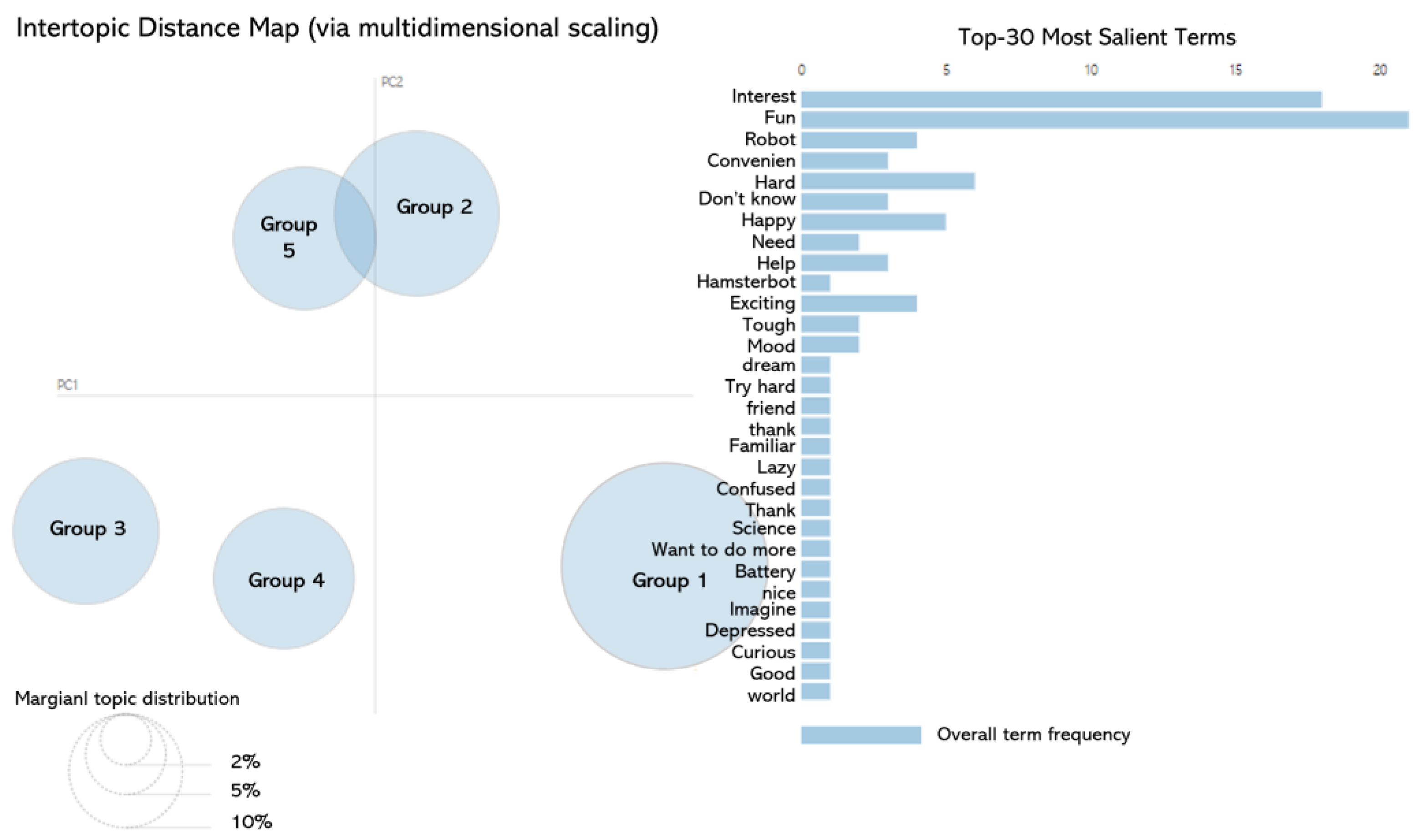
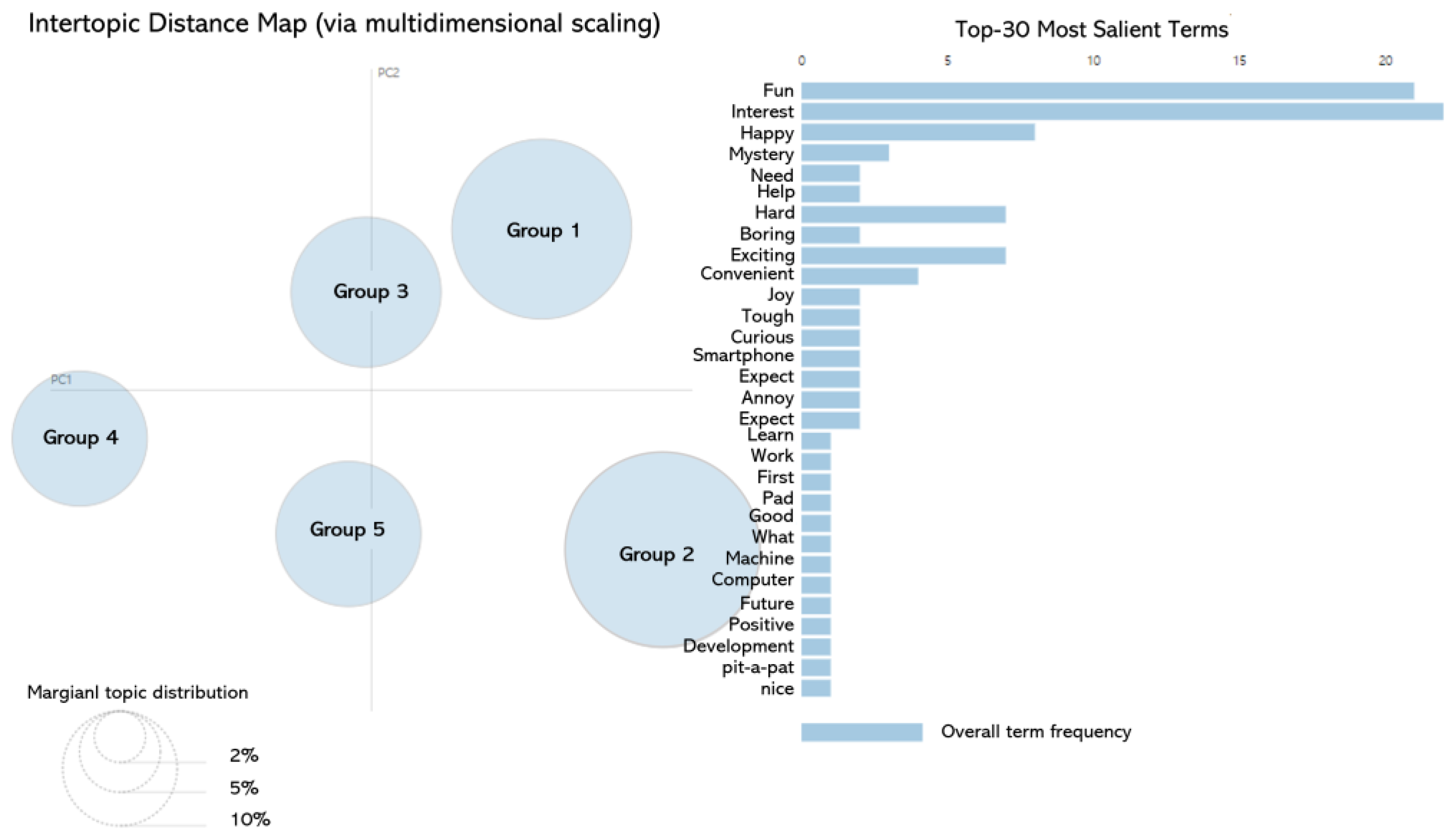
Students’ pre-camp and post-camp responses were analyzed via LDA topic modeling. Words were classified into five groups after numerous attempts, and the λ value was one. Analysis of the pre-camp responses included negative words in Groups 1, 3, 4, and 5. Analysis of the post-camp responses included negative words in Groups 2, 3, and 5 and “boring”, which is a negative word that was not in the higher-ranked words in the TF-IDF analysis included in Group 5. The pre-camp and post-camp results of students’ feelings toward SW · AI analyzed via TF-IDF in the four rounds are shown in Table 11.
Table 11.
Pre-camp and post-camp changes in feelings toward SW · AI (LDA topic modeling).
Figure 2 is a schematized analysis of students’ feelings on SW · AI pre-camp via LDA topic modeling. Group 1 was made up of high-frequency words, which reflects the biggest topic size of Group 1, and the main result of the pre-camp response. The overlapping of words in Group 2 and Group 5 suggests poor feasibility of differentiation. Figure 3 schematizes the LDA topic modeling analysis results of feelings on SW · AI post-camp. The topic size of Group 1 and Group 2 appears to be the same, and there is no overlapping group. The distance between topic groups appears to be similar pre-camp and post-camp. The value of “interest” and “fun” is higher than other words in both pre-camp and post-camp, and a portion of “fun” was much higher post-camp.
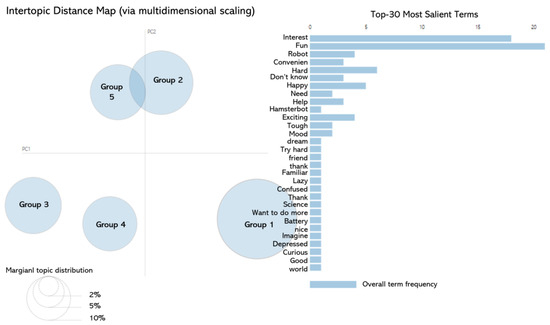
Figure 2.
Schematization of feelings on SW · AI pre-camp (LDA topic modeling).
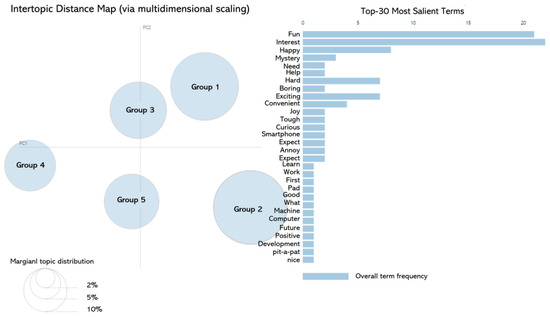
Figure 3.
Schematization of feelings on SW · AI post-camp (LDA topic modeling).
Interestingly, prior to the commencement of the camp, many participants expressed a lack of interest in SW and AI, often perceiving them as complex and tedious subjects. However, post-camp feedback revealed a noticeable shift in their perspectives, with numerous participants discovering the intriguing aspects of SW and AI and subsequently expressing a heightened level of interest.
4.2.7. Conception of SW · AI
Students’ responses to their conception of SW · AI were analyzed by period to compare how it changed pre-camp and post-camp. TF-IDF analysis was performed first, just like the analysis on feelings towards SW · AI. Moreover, data pre-processing on stop words and synonyms was performed to enhance accuracy of analysis as a precedent. Responses were in the order of “AI”, “robot”, “computer”, “coding”, and “future” based on pre-camp analysis, most of which are concepts related to computers. “Fun” being mentioned by some suggests that students have a positive perception, although they do not have an accurate grasp of the concept. Analysis post-camp shows responses in the order of “AI”, “robot”, “computer”, “machine”, and “future”, which suggests that high-frequency words were similar pre-camp and post-camp. Responses on what students have learned in the education camp show that the students paid deep attention to education contents. The pre-camp and post-camp results of TF-IDF analysis on changes in students’ conception of SW · AI are shown in Table 12.
Table 12.
Pre-camp and post-camp changes in conception of SW · AI (TF-IDF).
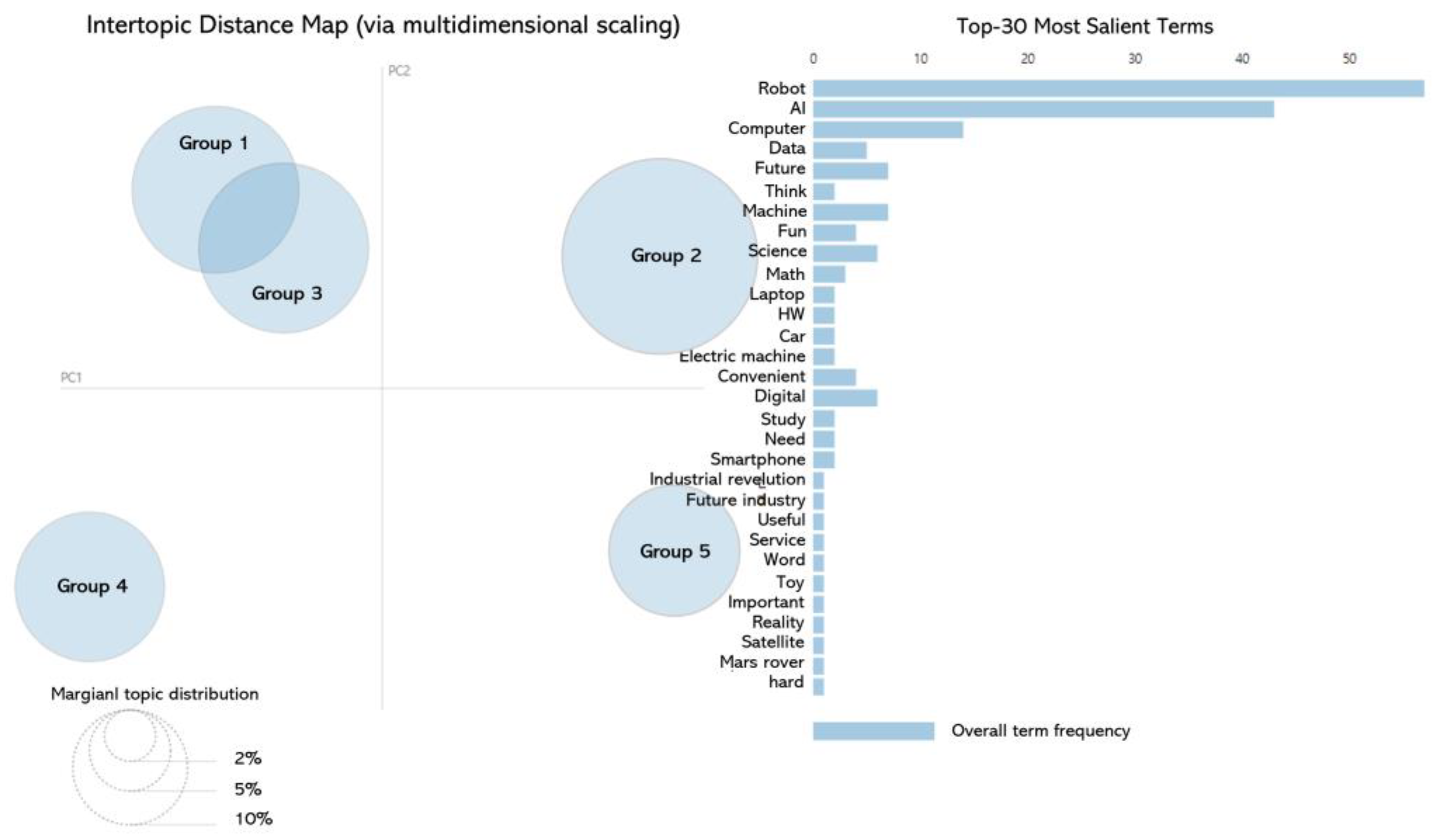
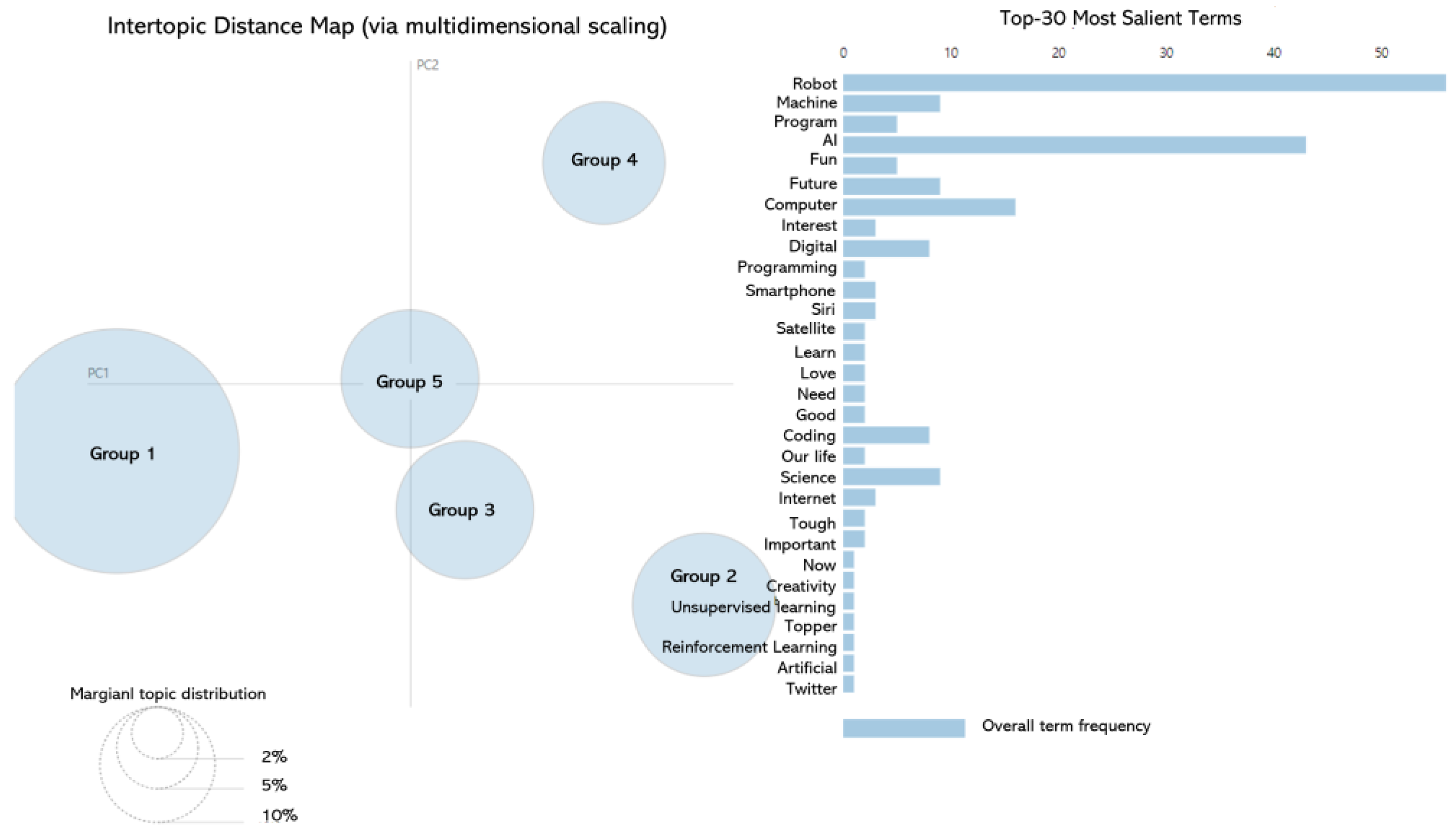
Changes in conception of SW · AI pre-camp and post-camp were analyzed via LDA topic modeling, and it was divided into five topics. The results of response analysis of SW · AI conception pre-camp showed that “AI” and “robot” were included in all groups. “Computer” and “future” were also included in the majority of groups. “AI” was included in all groups and “robot” in all groups except Group 3 based on the analysis results of the post-camp response. “Future” was also in Groups 1, 2, and 4. The pre-camp and post-camp analysis results of changes in SW · AI conception based on LDA topic modeling are shown in Table 13.
Table 13.
Pre-camp and post-camp changes in conception of SW · AI (LDA topic modeling).
The results of LDA topic modeling can be clearly classified through schematization. As shown in Figure 4, Group 2’s topic was relatively big pre-camp. This indicates that words in Group 2 functioned as key words in the responses. Big overlap in Group 1 and Group 3 means there were similar words without a clear distinction of themes. On the other hand, Figure 5 is a schematization of post-camp responses. Post-camp, the size of Group 1 is considerably bigger than in other groups when comparing with Figure 4 In post-camp responses, words in Group 1 constituted a significant portion of the responses. Topics did not overlap, but Group 3 and Group 5 are very close, which means low discriminant validity.
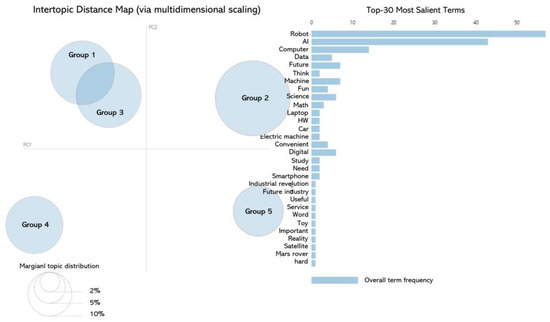
Figure 4.
SW · AI concept schematization pre-camp (LDA topic modeling).
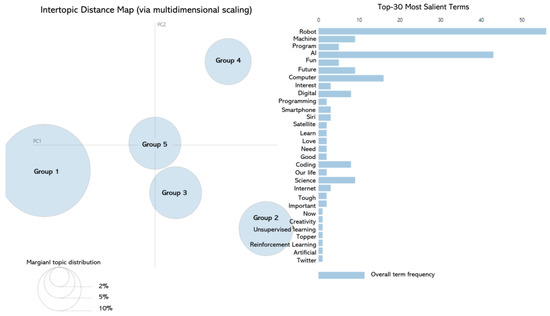
Figure 5.
SW · AI concept schematization post-camp (LDA topic modeling).
Prior to the commencement of the camp, when questioned about SW and AI, a significant number of students often responded either by merely mentioning SW and AI themselves or by providing emotionally driven answers unrelated to the actual concepts of SW and AI. However, post-camp, a discernible shift in their responses was observed, tending more towards detailed conceptual understandings. One student, reflecting on their experience, remarked, “Having only heard about AI before, the opportunity offered by the camp to practically create and engage with it was immensely rewarding. This experience deepened my understanding of both SW and AI.”
4.3. Effect of SW · AI Training by Background Variable
4.3.1. Difference in Perception towards SW · AI by Gender
Whether there was a difference in average score on awareness level towards SW · AI by gender among students participating in the education camp was analyzed. The average score exceeded three across camps. In the first and third camps, the male participants had a higher average, while in the second and fourth camps, the female participants scored higher on average. Notably, the first and fourth camps showed statistically significant differences at the level of p < 0.001. Furthermore, the first camp exhibited a small effect size (p = 0.000, Cohen’s d = 0.202), while the fourth camp demonstrated a medium effect size (p = 0.000, Cohen’s d = 0.309). The t-test results on perception of SW · AI by gender are shown in Table 14.
Table 14.
T-test results on perception of SW · AI by gender.
4.3.2. Difference in Perception towards SW · AI by Grade
Whether grade, which is another background variable of participants to the research, caused any difference in perception towards SW · AI was analyzed. In the second, third, and fourth camps, the average scores were higher among secondary school students than elementary school students. In all the camps, there was a statistically significant difference in scores between elementary and secondary school students (p < 0.05). However, given the large discrepancies in sample sizes and the fact that, except for the second camp, the Cohen’s d values did not exceed 0.2, it is challenging to assert that there was a substantial difference. The t-test results on perception towards SW · AI by grade are shown in Table 15.
Table 15.
T-test results on perception of SW · AI by grade.
5. Conclusions and Recommendations
Multicultural education can help migrants and their children to actively engage themselves in the community they live in and be an integral part of society. This can facilitate social integration based on mutual respect and understanding [31]. Those with a multicultural background may face challenges in building basic skills they can learn in the communities they belong to due to the language barrier or the individual environment they are in. Against this backdrop, this research launched an education camp for multicultural students whose population is growing in Jeju Island, which is the biggest island in South Korea, to enhance their digital literacy and analyze the effectiveness of the camp. To this end, this paper looked at the changes in camp participants’ perception toward SW · AI pre-camp and post-camp and gave a detailed analysis by splitting it into awareness levels of SW · AI, self-efficacy and interest in SW · AI learning, interest in jobs related to SW · AI, self-efficacy of related jobs and feelings toward SW · AI, and their conception. Moreover, any difference in the awareness level post-camp by gender and grade was gauged by analyzing differences.
The key research results are as follows. First, education camps were provided in four rounds for two days, each with the same education contents to different research targets. The program tried to maximize the benefits of constructivist learning by leveraging experience-based education and introduced new themes other than learning Korean culture by analyzing problems identified in existing multicultural education and computer education. In addition to coding education, convergent education on aerospace science, invention, and math was provided to the students. Second, students’ average scores post-camp went up across elements other than self-efficacy of jobs related to SW · AI, which indicates that the education camp proposed in this paper was effective for multicultural students. Third, while there were statistically significant differences in educational effects based on gender and school grade, the Cohen’s d values indicated little to no effect size. Nonetheless, future research should address this, giving careful consideration to gender and school grade when modifying educational content, ensuring that all students benefit equally from the education. Fourth, the average score of students’ perception went up more in the third camp compared to the other camps. In particular, students in the third camp showed the highest levels of self-efficacy, interest in SW · AI learning, and interest in jobs related to SW · AI. The proportion of elementary school students who participated in the third camp was significantly higher compared to the other camps. Ultimately, it can be inferred that the elementary students, who had limited prior knowledge about SW or AI before participating in the camp, experienced an enhanced level of awareness after their participation. Students in fourth camp showed the lowest pre-camp scores in most elements, but self-efficacy of SW · AI learning and interest in SW · AI learning showed statistically significant improvement, which indicates effective education even though the average pre-camp perception of SW · AI was low. Furthermore, upon examining the participants’ perceptions of SW and AI pre- and post-intervention, we observed statistically significant results across all sub-factors. The majority of the camps demonstrated these significant outcomes. Nevertheless, there were instances in certain camps where the results did not achieve statistical significance. For example, in the first camp related to awareness of SW and AI, although scores improved post-intervention compared to the baseline, they did not attain statistical significance. Consequently, in order to host more effective camps in the future, there appears to be a need for meticulous refinement of the educational content and a more balanced recruitment of participants. Fifth, short-answer questions on feelings towards SW · AI and the concept pointed to negative opinions and “don’t know” in higher frequency pre-camp, but they became more positive post-camp, which suggests that the education camp contributed to creating a more positive perception towards SW · AI among multicultural students.
However, this paper is limited in how the research targets are distributed. In other words, most of the students participating in the education camp were elementary school students, since the nature of education in South Korea demands that higher-grade students spend the majority of their time preparing for exams to earn university admission. That the education camps were filled with diverse activities also limited participants to elementary school students. Hence, future research needs to organize education camps in a way that they will have a good balance of K1~K12 students based on grade. Furthermore, the term multicultural student encompasses children of international marriages, those born in South Korea, those born abroad but relocated to South Korea, as well as children from foreign households. However, due to requests from both the participating multicultural families and the students themselves, we were unable to distinctly categorize these groups. Many participants and their parents were reluctant to overtly highlight their participation based on their multicultural background. Consequently, the inability to analyze results for the distinct groups of multicultural students represents a limitation of this research. It would be beneficial for future research to delve into the psychological factors explaining why students labeled as “multicultural” are hesitant to prominently disclose this designation and why they prefer not to be distinctly categorized.
Meanwhile, there was a perception among some students in the education camp that AI and machine learning are more difficult than what they had originally thought, which is demonstrated by the fact that self-efficacy scores on jobs related to SW · AI were lower post-camp than pre-camp, in one case.
At the same time, the self-efficacy scores on jobs related to SW · AI were no higher than three in all camps. This calls for the need to make improvements in the element of concern in future research. For example, inviting a lecturer whose job involves SW · AI and having him/her share interesting stories and answer students’ questions could be one good solution to alleviate students’ fears.
Through this paper, several implications can be provided. Firstly, there is a need for enhancing digital literacy in multicultural education. This paper offers a way to adjust the direction of multicultural education and explore methods to increase understanding of digital technologies. Secondly, as the educational program exhibited a positive impact on students’ perceptions of SW and AI, educational institutions and policymakers can refer to this when designing tailored education programs for multicultural students. Thirdly, considering that some students displayed lower self-confidence regarding careers in the fields of SW and AI after the camp, it is essential to explore alternative approaches to enhancing students’ confidence in this domain. Fourthly, the SW · AI education camp proposed in this paper for multicultural students can demonstrate a role beyond knowledge dissemination, showcasing its potential to actively involve these students in their local communities and assume crucial societal roles.
Author Contributions
Conceptualization, N.P.; methodology, J.K.; validation, E.C., J.K. and N.P.; formal analysis, E.C. and J.K.; investigation, J.K.; resources, N.P.; data curation, E.C.; writing—original draft preparation, E.C.; writing—review and editing, E.C.; visualization, J.K.; supervision, N.P.; project administration, N.P.; funding acquisition, N.P. All authors have read and agreed to the published version of the manuscript.
Funding
This work was supported by the Ministry of Education of the Republic of Korea and the National Research Foundation of Korea (NRF-2022S1A5C2A04092269). And, this work was supported by Electronics and Telecommunications Research Institute (ETRI) grant funded by the Korean government. [23ZD1160, Regional Industry ICT Convergence Technology Advancement and Support Project in Daegu-GyeongBuk (Mobility)].
Institutional Review Board Statement
This study was conducted in accordance with the Declaration of Helsinki.
Informed Consent Statement
Informed consent was obtained from all subjects involved in the study.
Data Availability Statement
The data presented in this study are available on request from the corresponding author. The data are not publicly available due to a confidentiality agreement.
Conflicts of Interest
The authors declare no conflict of interest.
References
- Goel, A.K. Using AI to teach AI: Lessons from an online AI class. AI Mag. 2017, 38, 48–58. [Google Scholar] [CrossRef]
- Choi, E.; Park, N. Demonstration of gamification in education for understanding artificial intelligence principles at elementary school level. EEO 2021, 20, 709–715. [Google Scholar] [CrossRef]
- Tsai, C.-W.; Ma, Y.-W.; Chang, Y.-C.; Lai, Y.-H. Integrating multiculturalism into artificial intelligence-assisted programming lessons: Examining inter-ethnicity differences in learning expectancy, motivation, and effectiveness. Front. Psychol. 2022, 13, 868698. [Google Scholar] [CrossRef] [PubMed]
- Ministry of Education (South Korea). Available online: https://www.nia.or.kr/site/nia_kor/ex/bbs/View.do?cbIdx=81623&bcIdx=25353&parentSeq=25353 (accessed on 23 March 2023).
- Sá, M.J.; Santos, A.I.; Serpa, S.; Ferreira, C.M. Digital literacy in digital society 5.0: Some challenges. Acad. J. Interdiscip. Stud. 2021, 10, 1–9. [Google Scholar] [CrossRef]
- Tohara, A.J.T.; Shuhidan, S.M.; Bahry, F.D.; Nordin, M.N. Exploring digital literacy strategies for students with special educational needs in the digital age. TURCOMAT 2021, 12, 3345–3358. [Google Scholar] [CrossRef]
- Ministry of Education (South Korea). Available online: https://www.moe.go.kr/boardCnts/viewRenew.do?boardID=316&boardSeq=90662&lev=0&searchType=null&statusYN=W&page=1&s=moe&m=0302&opType=N (accessed on 13 April 2023).
- Banks, J.A. Multicultural education: Historical development, dimensions, and practice. Rev. Res. Educ. 2021, 19, 3–49. [Google Scholar] [CrossRef]
- Kang, S.W. Multicultural education and the rights to education of migrant children in South Korea. Educ. Rev. 2010, 62, 287–300. [Google Scholar] [CrossRef]
- Kim, J.; Yang, S.-B.; Torneo, A. Marriage immigration and multicultural families: Public policies and their implications for the Philippines and South Korea. APP 2014, 6, 97–119. [Google Scholar] [CrossRef]
- Oh, H. A Study on the Improvement Plan of Korea’s Multicultural Education with Foreign Case Analysis: With a Focus on the Cases of FRANCE and Canada. Master’s Thesis, Hankuk University of Foreign Studies, Seoul, Republic of Korea, 2015. [Google Scholar]
- Banks, J.A. An Introduction to Multicultural Education, 5th ed.; Pearson: London, UK, 2013; pp. 12–35. [Google Scholar]
- Jeon, M.; Kim, D.H. A study on the policy of multicultural education in Canada: Focused on equity and diversity education in Ontario. Contemp. Soc. Multicult. 2019, 9, 37–56. [Google Scholar] [CrossRef]
- Sleeter, C.; Grant, C. An analysis of multicultural education in the United States. Harv. Educ. Rev. 1987, 57, 421–445. [Google Scholar] [CrossRef]
- Sutton, M. The globalization of multicultural education. Indiana J. Glob. Leg. Stud. 2005, 12, 97–108. [Google Scholar] [CrossRef]
- Kim, J.H.; Hwang, K.S.; Song, M.S. A mononationalism and multiculturalism in Korea. Soc. Sci. Res. Rev. 2019, 35, 177–202. [Google Scholar] [CrossRef]
- Lee, E.H. A study on pre-service teachers’ perceptions and teaching efficiency to increase teaching competency in multicultural education. Teach. Educ. Res. 2016, 55, 120–133. [Google Scholar] [CrossRef]
- Yadav, A.; Gretter, S.; Hambrusch, S.; Sands, P. Expanding computer science education in schools: Understanding teacher experiences and challenges, Comput. Sci. Educ. 2016, 26, 235–254. [Google Scholar] [CrossRef]
- Santos, A.I.; Serpa, S. The importance of promoting digital literacy in higher education. Int. J. Soc. Sci. Stud. 2017, 5, 90–93. [Google Scholar] [CrossRef]
- Guilherme, A. AI and education: The importance of teacher and student relations. AI Soc. 2019, 34, 47–54. [Google Scholar] [CrossRef]
- Barr, V.; Stephenson, C. Bringing computational thinking to K-12: What is involved and what is the role of the computer science education community? ACM Inroads. 2011, 2, 48–54. [Google Scholar] [CrossRef]
- U.S. Department of Labor Blog. Available online: https://blog.dol.gov/tag/future-of-work (accessed on 13 April 2023).
- Stephenson, C.; Cooper, S.; Owens, B.B.; Gal-Ezer, J. The new CSTA K–12 computer science standards. In Proceedings of the 17th ACM Annual Conference on Innovation and Technology in Computer Science Education, Haifa, Israel, 3–5 July 2012. [Google Scholar] [CrossRef]
- Brown, N.C.C.; Kölling, M.; Crick, T.; Peyton-Jones, S.; Humphreys, S.; Sentence, S. Bringing computer science back into schools: Lessons from the UK. In Proceedings of the 44th ACM Technical Symposium on Computer Science Education, Denver, CO, USA, 6–9 March 2013. [Google Scholar] [CrossRef]
- Yang, X. Accelerated move for AI education in China. ECNU Rev. Educ. 2019, 2, 347–352. [Google Scholar] [CrossRef]
- Korea Education and Research Information Service. Available online: https://www.keris.or.kr/main/na/ntt/selectNttInfo.do?mi=1244&nttSn=37201&bbsId=110 (accessed on 2 February 2023).
- Digital New SW∙AI Camp. Available online: https://newsac.co.kr/ (accessed on 2 February 2023).
- Cronbach, L.J. Coefficient alpha and the internal structure of tests. Psychometrika 1951, 16, 297–334. [Google Scholar] [CrossRef]
- Cohen, J. Teaching for the 21st century. Educ. Leadersh. 1998, 67, 8–14. [Google Scholar]
- Jones, M.G.; Brader-Araje, L. The impact of constructivism on education: Language, discourse, and meaning. Am. Commun. J. 2002, 5. [Google Scholar]
- Kumagai, A.; Lypson, M.L. Beyond cultural competence: Critical consciousness, social justice, and multicultural education. Acad. Med. 2009, 84, 782–787. [Google Scholar] [CrossRef]

Disclaimer/Publisher’s Note: The statements, opinions and data contained in all publications are solely those of the individual author(s) and contributor(s) and not of MDPI and/or the editor(s). MDPI and/or the editor(s) disclaim responsibility for any injury to people or property resulting from any ideas, methods, instructions or products referred to in the content. |
© 2023 by the authors. Licensee MDPI, Basel, Switzerland. This article is an open access article distributed under the terms and conditions of the Creative Commons Attribution (CC BY) license (https://creativecommons.org/licenses/by/4.0/).