


Abstract
There has emerged substantial research in addressing single-view 3D reconstruction and the majority of the state-of-the-art implicit methods employ CNNs as the backbone network. On the other hand, transformers have shown remarkable performance in many vision tasks. However, it is still unknown whether transformers are suitable for single-view implicit 3D reconstruction. In this paper, we propose the first end-to-end single-view 3D reconstruction network based on the Pyramid Vision Transformer (PVT), called -Net, which disentangles the reconstruction of an implicit field into the reconstruction of topological structures and the recovery of surface details to achieve high-fidelity shape reconstruction. -Net uses a Pyramid Vision Transformer encoder to extract multi-scale hierarchical local features and a global vector of the input single image, which are fed into three separate decoders. A coarse shape decoder reconstructs a coarse implicit field based on the global vector, a deformation decoder iteratively refines the coarse implicit field using the pixel-aligned local features to obtain a deformed implicit field through multiple implicit field deformation blocks (IFDBs), and a surface detail decoder predicts an enhanced displacement field using the local features with hybrid attention modules (HAMs). The final output is a fusion of the deformed implicit field and the enhanced displacement field, with four loss terms applied to reconstruct the coarse implicit field, structure details through a novel deformation loss, overall shape after fusion, and surface details via a Laplacian loss. The quantitative results obtained from the ShapeNet dataset validate the exceptional performance of -Net. Notably, -Net-L stands out as the top-performing variant, exhibiting the highest mean IoU, CD, EMD, ECD-3D, and ECD-2D scores, reaching impressive values of 61.1, 7.26, 2.51, 6.08, and 1.84, respectively. The extensive experimental evaluations consistently demonstrate the state-of-the-art capabilities of -Net in terms of reconstructing topological structures and recovering surface details, all while maintaining competitive inference time.
1. Introduction
Single-view 3D reconstruction aims to reconstruct object shapes from single-view RGB images, which are widely used in areas such as robotics, VR, and autonomous driving. However, single-view 3D reconstruction faces challenges that stem from its intrinsic ill-posed nature. A large number of single-view 3D reconstruction approaches have been presented recently. Among them, deep-learning-based methods [1,2,3,4,5,6,7,8,9,10,11,12,13,14,15,16,17,18,19,20,21,22,23,24,25,26,27,28,29,30,31,32,33,34,35] have yielded more advanced results. Shape representations in deep-learning-based approaches can be classified into explicit [1,2,3,4,5,6,7,8,9,10,11,12,13,14,15,16,17] and implicit [18,19,20,21,22,23,24,25,26,27,28,29,30,31,32,33,34,35] representations, and the latter ones are independent of memories and resolutions, which can significantly improve the reconstruction performance.
The main ideas of the earlier data-driven implicit approaches [18,19,20,21,22] are to learn latent vectors of the input images and the neural networks are applied to fit the mapping relationship from the query points to a implicit scalar field. For example, DeepSDF [18] introduces latent codes that are able to represent similar objects and output signed distance functions (SDFs) approximating object shapes in combination with query point coordinates. IM-Net [19] encodes a single input image to extract a latent vector, which is then decoded together with the query point coordinates to generate an implicit scalar field value representing the spatial relationship between the point and the object shape. Occupancy Network [20] encodes different types of inputs into embeddings while converting query points into point features, and the decoder incorporates all the information and outputs a real number to indicate the occupancy probability of the query point. Littwin et al. [21] use the encoding vector of the input image as the weight matrix in an MLP for binary classification of query points, resulting in the generation of an implicit field. These methods can only reconstruct the coarse shape but fail to reproduce the details of the object. Rather than predicting a single global implicit field, PQ-NET [23] outputs a SDF for each intrinsic structure of the object and fuses these implicit fields to generate the final SDF, producing more promising reconstruction results.
Recently, several novel CNN-based models have been proposed [24,25,26,27,28,29]. DISN [24] fuses global and local features of the input image with point features of query points to obtain the fused SDF. MDISN [25] deforms a randomly generated SDF based on local feature variations at the layer level to approximate the ground-truth SDF. Ladybird [26] considers pixel-aligned local features of query points and their symmetry points, combining them with global features to output the SDF. Ray-ONet [27] integrates global features, local features, and scaling parameters to estimate the occupancy probability of spatial query points along rays, reducing complexity and improving performance compared to Occupancy Network [20]. Peng et al. [28] merge global and local features extracted by an encoder, incorporate query points via linear interpolation, and use subsequent networks to predict occupancy values. In contrast to earlier works [18,19,20,21,22,23], such methods [24,25,26,27,28] can better capture structure details and recover finer shapes owing to the integration of local features. However, details at the surface level such as depth, which are equally critical for visual perception, are still poorly reconstructed. IM-Net [29] focuses on recovering surface details, which often produces promising surface features, yet is unable to reconstruct the correct topological structures. Furthermore, previous CNN-based approaches [24,25,26,27,28,29] often encounter two inherent limitations associated with the convolutional layer. Firstly, convolutional kernels treat all pixels equally, resulting in inefficiency when processing images. This uniform treatment fails to capture the varying importance and dependencies of different pixels within an image. Secondly, due to the local nature of convolution, long-range pixel relationships are not effectively modeled. As a result, crucial contextual information may be overlooked, hindering the ability to fully understand and exploit the complex dependencies and interactions between pixels across the entire image. The PIFu series [30,31,32] incorporates pixel-aligned local features and depth information into their paradigm, with a primary focus on human reconstruction.
With the advent of the works like ViT [36] and DeiT [37], transformers have obtained considerable attention in computer vision recently. Transformer-based vision models have achieved state-of-the-art performance in several downstream tasks, such as DETR [38] for object detection, SwinIR [39] for image restoration, Segmenter [40] for semantic segmentation, and MViTv2 [41] for image classification. While transformers have demonstrated preliminary success in many tasks including explicit 3D reconstruction [1,2,3,4,5,42], whether they could be successfully employed to improve implicit 3D reconstruction is still unknown.
To address the limitations of existing implicit methods that struggle to simultaneously reconstruct the topological structure and surface details of objects, -Net is proposed in this paper. Our approach utilizes transformers, specifically Pyramid Vision Transformer (PVT), to enable end-to-end single-view implicit 3D reconstruction. By leveraging PVT, we aim to mitigate the negative impacts of underlying convolutional layers in CNN-based methods, allowing for comprehensive reconstruction of both topological structures and surface details from a single image. For an input image, local features and a global vector are extracted using a pre-trained Pyramid Vision Transformer encoder [43]. Subsequently, a coarse shape decoder reconstructs a coarse implicit field based on the global vector. A deformation decoder, incorporating symmetry priors that provide extra knowledge about the object shape, predicts a deformed implicit field with finer-grained structure details using pixel-aligned local features and multiple implicit field deformation blocks (IFDBs). Finally, a surface detail decoder equipped with hybrid attention modules [44] (HAMs) constructs an enhanced displacement field, enabling the recovery of enhanced surface details from the local features. In order to facilitate the learning of the implicit field deformation function, IFDB offers a lightweight and effective approach. It refines the coarse implicit field by leveraging information from query points and pixel-aligned local features at neighboring scales. Through simple iterations, multiple IFDBs efficiently fit the deformation function, enabling the generation of the deformed implicit field that captures the finer topological structure of the object. In contrast to CBAM [45], HAM is a more novel and parameter-efficient module that significantly improves surface detail recovery performance. The output of the proposed -Net is a fusion of the deformed implicit field and the enhanced displacement field together. The main contributions of this paper include:
- A Pyramid-Vision-Transformer-based -Net is proposed for end-to-end single-view implicit 3D reconstruction, which disentangles implicit field reconstruction into accurate topological structures and enhanced surface details with competitive inference time. To our knowledge, it is the first method to utilize transformers for single-view implicit 3D reconstruction. Experimental results show superior performance in both overall reconstruction and detail recovery.
- The finer topological structural details of the object are achieved through iterative refinement of the coarse implicit field using multiple IFDBs. IFDB deforms the implicit field from coarse to fine based on query point and pixel-aligned local feature variations at continuous scales. -Net also enhances surface detail representation at spatial and channel levels.
- A novel loss function consisting of four terms is proposed, where coarse shape loss and overall shape loss allow the reconstruction of the coarse shape and the overall shape after fusion, and novel deformation loss and Laplacian loss enable -Net to reconstruct structure details and recover surface details, respectively.
2. Related Works
Since the proposed -Net is a single-view 3D reconstruction network based on the Pyramid Vision Transformer, in this section, we review some related works as follows.
2.1. Shape Representations
The shape of an object can be represented by voxels [1,2,3,4,5,6,7,8,9,10], point clouds [11,12,13,14], meshes [15,16,17], and implicit functions [18,19,20,21,22,23,24,25,26,27,28,29,30,31,32,33,34,35]. In this paper, with respect to shape representations, we choose implicit functions, as they can process arbitrary topologies and support multi-resolution representations in comparison to others.
2.2. Implicit Methods for Single-View 3D Reconstruction
Since the object shapes in this work are represented with implicit functions, this section focuses on reviewing the implicit methods for single-view 3D reconstruction.
There are mainly two popular forms of data in deep-learning-based single-view implicit 3D reconstructions: occupancy probability and SDF. Specifically, the implicit models learn the scalar value of each query point under the supervision of the ground-truth occupancy probability or SDF. Earlier implicit methods, such as Occupancy Network [20] and IM-Net [19], tend to adopt a straightforward idea. There, the latent vectors of the input image are firstly extracted via an image encoder, and are subsequently combined with the features or coordinates of the query points for the MLP inputs, and then the occupancy probability or SDF for each query point can be predicted. Recently, a few novel CNN-based implicit 3D reconstruction models [24,25,26,27,28,29] have been proposed that take into account local features, resulting in more promising reconstruction performance.
The most relevant works to ours are DISN [24], MDISN [25], and IM-Net [29]. Specifically, both DISN and MDISN predict the camera parameters of the input image to extract local features corresponding to each query point. In DISN, query point features are concatenated with global and local features. Two concatenated features are decoded to obtain two predicted values, which are summed to derive the final SDF. MDISN deforms the randomly generated SDF for each query point from coarse resolutions to fine ones depending on the variation of local features. IM-Net predicts the camera pose and decomposes the reconstruction of the object’s implicit field into two parts: the reconstruction of coarse shapes and the recovery of details. DISN and MDISN achieve better experimental results than earlier approaches, yielding shapes with more structure details. However, they still fail to recover the surface details of an object. While IM-Net is capable of recovering good surface details, it often results in poor topological structures. Although a variant of IM-Net, called IM-Net, uses both global and local features in the basic decoder, it still struggles to reconstruct a satisfactory shape and even produces blurry surface details.
Compared to DISN, MDISN and IM-Net, -Net is the first to employ a transformer to solve single-view implicit 3D reconstruction, which alleviates the negative effects brought by convolution in CNN-based models. This paper proposes a novel paradigm that disentangles the reconstruction of an object into reconstruction of more accurate topological structures and enhanced surface details. The finer-grained topological structure details and enhanced surface details are obtained through iterative refinement of the coarse implicit field using the multiple IFDBs, as well as enhancement of the surface detail features in both spatial and channel dimensions using HAMs, as shown in Figure 1. The core difference lies in the construction of individual specific loss terms for all learned fields, including the coarse implicit field, deformed implicit field, and enhanced displacement field. This disentanglement of the deformed implicit field, which contains most of the topological structures, from the enhanced displacement field allows for better learning, resulting in the recovery of enhanced surface details. Actually, a novel deformation loss for learning structure details from ground truth is introduced in our combined loss function, while the surface details can be learned from ground-truth normal maps by applying a Laplacian loss. Extensive qualitative and quantitative comparisons conducted in the experimental Section 4 unequivocally demonstrate the remarkable capabilities of our proposed -Net. In stark contrast to the limitations observed in DISN and MDISN, where surface detail recovery of objects is lacking, -Net successfully overcomes this challenge. The reconstructed results exhibit significantly improved surface detail fidelity, showcasing the effectiveness and superiority of our approach. Furthermore, our model solves the problem of IM-Net and its variant IM-Net, which reconstruct the wrong topological structures. -Net is capable of generating visually attractive and high-quality 3D shapes.
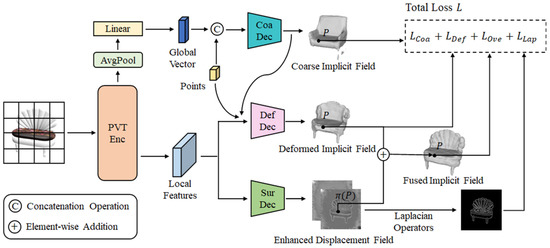
Figure 1.
The overall pipeline of the proposed -Net, where P is a 3D query point and represents the operation of projecting a 3D spatial query point to an image. PVT Enc means Pyramid Vision Transformer encoder. Coa Dec, Def Dec, and Sur Dec denote Coarse Shape Decoder, Deformation Decoder, and Surface Detail Decoder, respectively. -Net first extracts a global vector and the local features of the input image via a Pyramid Vision Transformer encoder. The global vector is used in a coarse shape decoder to predict a coarse implicit field, which is then iteratively refined by a deformation decoder to obtain a deformed implicit field with finer structure details using multiple implicit field deformation blocks (IFDBs). A surface detail decoder with hybrid attention modules (HAMs) uses local features to recover an enhanced displacement field. The final output of -Net is a fusion of the deformed implicit field and the enhanced displacement field. Four combined loss terms are applied to reconstruct the coarse implicit field, structure details, overall shape, and surface details.
2.3. Laplacian Operators
Laplacian operators are frequently used to extract local variations in images and 3D shapes. Further, Laplacian pyramids have so far been used extensively in neural models for super-resolution image reconstruction [46,47] and generation [48] by extracting multi-scale structures from images. Li et al. [49] propose a Laplacian loss for image synthesis, which effectively preserves image details and eliminates artifacts. Recently, there have been some works on single-view 3D reconstruction using Laplacian operators. Wang et al. [17] apply Laplacian loss to meshes by minimizing the loss between Laplacian coordinates before and after surface mesh deformation. Liu et al. [50] smooth the surface via a Laplacian regularization, but it is prone to lose the surface details of the object. IM-Net [29] takes the disentangled detail information as a displacement field, which recovers the surface details well with Laplacian loss. In this work, we follow and improve IM-Net regarding Laplacian loss. The key difference is that, in our acquisition of the displacement field, the feature representation of surface details is enhanced using HAM [44], which effectively overcomes the lack of surface details in IM-Net.
2.4. Transformers in Computer Vision
Transformers [51] originate from natural language processing whose core component is multi-head self-attention. Recently, transformers have received much attention in computer vision and have made a profound impact. For a comprehensive review of transformers in vision, the readers are referred to [52]. For applications in vision, transformers have achieved state-of-the-art performance in object detection [38], image classification [36], image restoration [39], and multi-view 3D reconstruction [2]. In this work, a Pyramid Vision Transformer [43] is used to extract multi-scale hierarchical local features and a global vector. PVT inherits the advantages of CNNs and transformers in that it can extract multi-scale hierarchical local features from images without inductive bias. Ablation studies also demonstrate that, when the Pyramid Vision Transformer is used as an encoder for -Net, fewer artifacts and better performance can be achieved compared to ResNet18 [53].
3. Methodology
3.1. Overview
In this work, we aim at reconstructing high-fidelity 3D shapes with topological structures and surface details by means of a network that models the signed distance function () defined as g, given a single RGB image of the object and any spatial query point . The network outputs the signed distance function values . The training data pair for -Net to learn the implicit function is made up of single-view images of the object, spatial query points, and their corresponding ground-truth SDF values, viz. .
-Net disentangles the SDF of the shape T into the deformed implicit field with structure details and the enhanced displacement field that allows the surface details of the object to be reestablished. The pipeline of -Net is shown in Figure 1. -Net extracts image features with a Pyramid Vision Transformer encoder followed by three decoders reconstructing the coarse implicit field, the deformed implicit field, and the enhanced displacement field, respectively. Then the latter two scalar fields are fused to get the final SDF. Finally, the iso-surface with can be extracted using Marching Cubes [54] for visualization.
The following sections describe in detail how -Net disentangles the implicit field, network architecture, and loss function.
3.2. Disentanglement Method
The variations of the detailed information around the surface of the object (i.e., surface details) affect the Laplacian of the SDF [55]. Inspired by this, the surface details of an object can be detected through Laplacian operators and the remaining topological structures can be reconstructed according to an appropriate loss function, thus disentangling the implicit field reconstruction into topological structure reconstruction and surface detail recovery. As shown in Figure 2, the ground-truth SDF is disentangled into the deformed implicit field with structure details and the enhanced displacement field containing surface details of the object. The most similar work to ours is IM-Net [29], which only disentangles the ground-truth SDF into the sum of a coarse implicit field and a displacement field. Unlike IM-Net, our disentangled deformed implicit field is based on the coarse implicit field, where the deformed implicit field contains most of the topological structures. Given a query point P, our disentanglement solution can be denoted as:
where denotes the ground-truth SDF, , , and represent the enhanced displacement field with surface details, the deformed implicit field containing most of topological structures, and the coarse implicit field, respectively, and f defines the deformation function from to .
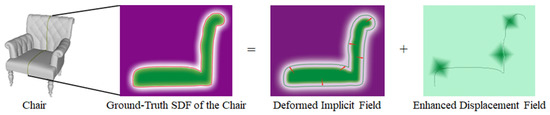
Figure 2.
An illustrative description of our disentanglement. -Net disentangles the ground-truth SDF of the chair into a deformed implicit field and an enhanced displacement field (visible surface), where the deformed implicit field is obtained by refining the coarse implicit field of the object. The red arrows in the deformed implicit field represent the deformation function f from the coarse implicit field (green part) to the deformed implicit field (containing most of the topological structures of the object).
Actually, we can suppose that the shape embedded in the deformed implicit field is smooth and the reconstructed shape from the deformed implicit field can only approximate the object surface. Therefore, the surface details can be further represented with the enhanced displacement field. As the enhanced displacement field is attached onto the smooth deformed implicit field near the iso-surface of the object, the Laplacian of the enhanced displacement field is approximately equal to the Laplacian of :
In order to accelerate the network training, Laplacian for only the sampling points, whose minimum distance to the object shape T is less than a predefined threshold , will be taken into consideration.
Motivated by the works [29,31,56] related to inference on the visible and invisible surfaces of objects, the forward and backward displacement maps are introduced for the visible and occluded parts of the object, respectively. Our forward displacement map recovers the visible surface details of the object based on a Laplacian loss and the backward displacement map is used to fine-tune the deformed implicit field, further compensating for unreconstructed structure details and fixing incorrect topological structures. In short, we have
where and represent the forward and backward displacement maps, respectively. is the projection of P on the single-view image. is the point set which consists of points close to the visible surface of the object.
Indeed, 3D displacement fields are more direct and are also defined in 3D space. However, displacement maps are applied instead of 3D displacement fields because they enable alignment of the input image with the details, making it possible to calculate the Laplacian loss term. Additionally, it is more intuitive for us to observe the detailed information of the object in the displacement maps.
3.3. Network Architecture
The proposed -Net contains four main components: Pyramid Vision Transformer encoder, coarse shape decoder, deformation decoder, and surface detail decoder.
Based on the Pyramid Vision Transformer encoder, two variants of -Net are designed: -Net-T with lower computation complexity and -Net-L with higher computation complexity, and the latter achieves more pleasing reconstruction results. -Net-T and -Net-L differ only in encoders, and they share the same architecture for the other parts.
3.3.1. Pyramid Vision Transformer Encoder
In this work, a Pyramid Vision Transformer [43] is used as an encoder for image feature extraction, which consists of four stages. Each of these stages is composed of a patch embedding layer and transformer encoder layers extracting multi-scale local features. In the stage, the patch embedding layer partitions the input into a total of patches, assuming that the size of each patch after partition is . Then, these patches are flattened, followed by a linear projection to the corresponding dimension of the current stage. After that, embedded patches are reshaped to , where the width and the height are scaled by a factor of , and later fed into transformer encoder layers together with the position embeddings. In this way, the image features with different scales can be generated at different stages.
In addition, one of the core components of transformer encoder layers in the Pyramid Vision Transformer [43] is Spatial-Reduction Attention () that can extract high-resolution features without too much computation complexity. The input of SRA is a query vector Q, a key vector K, and a value vector V. It differs from the standard MSA only in that an extra spatial reduction is performed on K and V before the standard multi-head self-attention. The spatial reduction can be described as:
where indicates the input to be reduced, is a hyperparameter that represents the reduction factor of the stage, denotes layer normalization, means the operation of transforming the input X into a sequence , and represents the linear projection function for changing the size of S to .
In our implementation, two pre-trained models of the Pyramid Vision Transformer [43] are used, PVT-Tiny and PVT-Large, as encoders for -Net-T and -Net-L, respectively. The dimensions of local features for all stages of PVT-Tiny and PVT-Large are 64, 128, 320, and 512. The Pyramid Vision Transformer encoder finally outputs local features at four scales denoted as and a global vector z of the input single-view image.
3.3.2. Coarse Shape Decoder
Inspired by IM-Net [19], implicit 3D reconstruction is by nature a classification problem and we use for nonlinear activation of the to fit the of the object’s coarse shape. Specifically, the global vector z and the query point P are concatenated together as the input, and the coarse implicit field will be output through the :
However, the coarse implicit field is merely capable of approximating the coarse shape of the object, and unable to reconstruct the structure details and recover the surface details. Therefore, a deformation decoder and a surface detail decoder can be applied to learn details of structure and surface of the object, respectively.
3.3.3. Deformation Decoder
The deformation function f can be learnt via the deformation decoder, as illustrated in Figure 3. The deformation decoder firstly unifies the multi-scale local features through a bilinear interpolation and then retrieves the local features for the query point P at all scales in a pixel-aligned manner. Let be the projection of P on the image. Following the similar idea of Ladybird [26], two pixel-aligned local features and are provided for P. Specifically, and are extracted from the projection of P and its self-reflecting symmetric point on , respectively, which are then concatenated as the final pixel-aligned local feature of P. Finally, the continuous pixel-aligned local feature pairs are used to refine the coarse implicit field through the core lightweight components of the deformation decoder, i.e., implicit field deformation block (IFDB). There exist three IFDBs in our implementation of the deformation decoder and the last one generates the deformed implicit field (see Algorithm 1):
where and stand for the intermediate implicit field at P and the state code generated by the IFDB, respectively, in particular, = .
| Algorithm 1 Deformation |
| Input: coarse implicit field , multi-scale local features , query point P and its projection p on the image |
| Output: deformed implicit field |
|
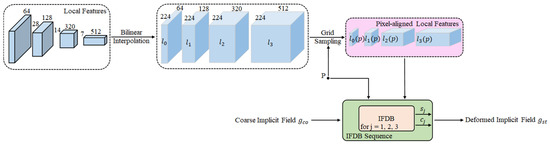
Figure 3.
Architecture of the deformation decoder, where and represent the intermediate implicit field and the state code of the IFDB output, respectively.
Pixel-aligned local feature pairs not only enable the deformed implicit field to reconstruct the finer-grained topological structure details aligned with the image, but also guarantee that the surface details can be correctly recovered using the surface detail decoder. This is achieved by incorporating additional information about the query point and its symmetry point in the object shape into the features.
Implicit Field Deformation Block
It is known that the local features with larger scale tend to produce an overall shape, while the ones with smaller scale can keep fine-grained structure details. The IFDB takes advantage of this characteristic, which can be seen in Figure 4. To ensure a smooth implicit field deformation, IFDB deforms the input implicit field according to the variations of the pixel-aligned local features between adjacent scales. Moreover, a state code is used to record all the information of the current implicit field deformation, which will be updated at the end of each IFDB for the next IFDB. In contrast, the coordinates of the query points are input into the deformation module instead of inputting point features in MDISN [25], and our policy performs better than the latter.
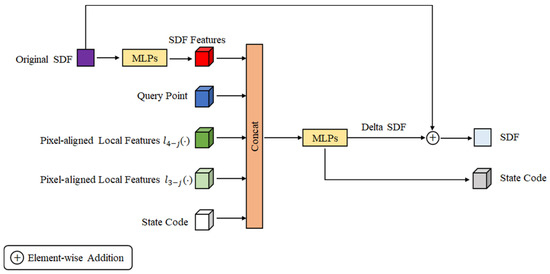
Figure 4.
Illustrations of the IFDB, where Concat means concatenation operation.
3.3.4. Surface Detail Decoder
In order to recover the enhanced displacement field with surface details, a surface detail decoder is applied to recover the detailed displacement maps of an object. As demonstrated in Figure 5, a surface detail decoder takes as input all local features that are extracted by the hybrid attention module [44] (HAM) consisting of spatial and channel attention to enhance the feature representation of surface details. Then, a convolution layer and a activation layer are employed to decrease the channels, followed by an upsampling and a convolution layer. After that, the outputs of the convolution are element-wise accumulated into the features of the next scale. After repeating the above workflow three times, the features are upsampled twice to keep the consistent size with the input image, followed by a series of convolution and HAM layers. Finally, the enhanced forward and backward displacement maps are output through a convolution layer.
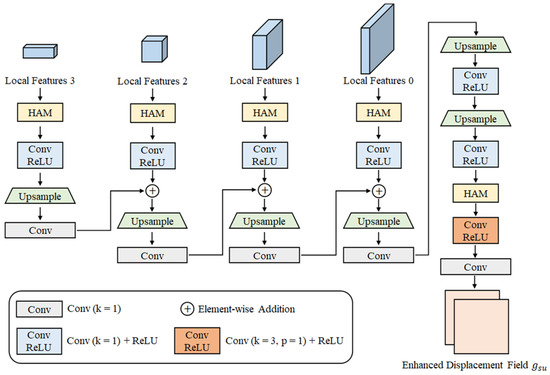
Figure 5.
Architecture of the surface detail decoder.
According to Equation (4), if P is near the visible surface, the deformed implicit field of P is added to the forward displacement map at p. Conversely, it is added to the backward one.
In our implementation, the gradient of the SDF on each query point is derived using a central difference approximation. In the case that the direction of the gradient is approaching the viewpoint orientation and the ground-truth SDF is less than a specific threshold, the point is considered as being close to the visible surface. Otherwise, the point is treated as being near the invisible surface. Moreover, a similar network to DISN [24] for estimating the camera parameters is also trained. It should be pointed out that the camera parameters and the gradients derived from the ground-truth SDF used in training are the ground truth, and the predicted values are used in testing.
3.4. Loss Function and Sampling Strategy
The total loss function of -Net consists of four components , where , , , and represent the coarse shape loss, deformation loss, overall shape loss, and Laplacian loss, respectively. More specifically, -norm-based is used to minimize the distance between the coarse implicit field and the ground-truth SDF , and -norm-based is employed to minimize the distance between the fused implicit field g and , which can regularize the enhanced displacement field:
The structure details are evaluated through a novel deformation loss . Since the deformation decoder iteratively refines , the intermediate implicit field s generated by all IFDBs, and the deformed implicit field are all taken into consideration, and their -distances to are accumulated through a weighted summation:
where represents the query point, N denotes the number of query points, M indicates the number of intermediate implicit fields, the intermediate implicit field is defined as , stands for the weight assigned to in the deformation loss, specifically, and is the weight of the deformed implicit field .
is the -distance between the Laplacian of the forward displacement map and the Laplacian of . As these two Laplacians are not in the same space, the forward displacement map is a 2D image, whereas is in 3D space. This problem is addressed using the Laplacian of with respect to the projected points on the image. Suppose denotes the projection of on the image and represents the coordinates of in the camera coordinate system. Similar to IM-Net [29], Laplacian loss can be formulated as:
The Laplacian of the forward displacement map is:
In case is close to the visible surface of an object, is the unit normal from the ground-truth normal map, equivalent to the gradient of the with respect to as:
Then, the Laplacian of can be defined as:
To enhance the fidelity of the reconstructed object and capture richer small-scale details, -Net employs a weighted sampling strategy similar to IM-Net [29]. This strategy assumes dense sampling of the object, where the density of each sampling point is determined by the number of surrounding sampling points within a specified radius. Inside and outside the object, a clipping policy defines compact sample densities. These densities, along with the same samples, serve as sampling weights during the training of -Net. The effectiveness of the weighted sampling strategy in reconstructing small-scale details is demonstrated through ablation studies.
4. Experiment Results and Discussion
In Section 4.1, the utilized datasets and evaluation metrics are described, while in Section 4.2, the implementation details are outlined. Section 4.3 presents a qualitative and quantitative comparison of -Net with state-of-the-art methods for single-view implicit 3D reconstruction. Ablation studies are conducted in Section 4.4 to assess the impact of different factors, and the computational complexity of various methods is analyzed in Section 4.5. Examples showcasing the proposed applications are demonstrated in Section 4.6 and the influence of different camera sensors on -Net is discussed in Section 4.7.
4.1. Dataset and Metrics
-Net was trained and tested on a subset of ShapeNet [57], which comprises 13 classes and approximately 44,000 3D models. These models underwent pre-processing using the method proposed by DISN [24] to generate point coordinate–SDF pairs, as well as RGB images and normal maps from 36 random views at a resolution of . For the experiments, we adhered to the official training/validation/testing split.
For the overall quality of the reconstruction, intersection of union (IoU), Chamfer distance (CD) and earth mover distance [58] (EMD) are computed. Moreover, the edge Chamfer distance [59] of the reconstructed shape (ECD-3D) and the edge Chamfer distance in the image [29] (ECD-2D) are used to measure the recovered detail information. The specific definitions of all the above evaluation metrics are as follows:
IoU is used to measure the similarity between the reconstructed object and the ground truth, defined as
where and denote two point clouds, and denotes the operation that converts a point cloud into a voxel grid.
CD is a commonly used metric for measuring the distance between two point clouds, denoted as , , defined as
EMD is a metric frequently used to measure the distance between two point clouds, denoted as , , by considering the distribution problem. It can be defined as
where represents a bijection between the two point clouds.
ECD-3D is a metric calculated as the Chamfer distance (CD) between the edge points on the ground-truth object and the reconstructed object. The “edgeness” property of each sampled point from a 3D object is defined as
where represents the set of neighboring points of , and and denote the unit normal vectors at points and , respectively.
In our implementation, we consider a set of 10 neighbouring points () for each point and we evaluate the edge feature recovery using points with an “edgeness” property () value below 0.8.
ECD-2D represents the Chamfer distance (CD) between edge pixels on the rendered images. In our implementation, we utilize the Canny operator to extract the edges from the rendered normal map of the reconstructed object, which has a resolution of , in order to obtain the edge pixels.
4.2. Implementation Details
In -Net, an RGB image of size is used as input, and the model outputs signed distance values of the query points. The iso-surface mesh is visualized using Marching Cubes with a resolution of . The network is implemented in Pytorch [60] and the training parameters are set as follows: batch_size of 16, Adam optimizer [61] with a learning rate of , = 0.9, = 0.999, and weight decay of . During training, 2048 query points are randomly selected based on the weighted sampling strategy for loss calculation and back propagation. The experiments were conducted using PyCharm Community Edition, and the training of -Net was performed on two Nvidia RTX 3090 graphics cards, taking 1 to 3 days, depending on the specific settings. The hyperparameters , , and in the deformation loss term of the network loss function were fixed at 0.5, 0.25, and 0.25, respectively. The value of at 0.5 was chosen to emphasize the influence of the deformed implicit field on the final reconstruction results. The training process involved 500 epochs and the learning rate was adaptively optimized using the Adam optimizer as described above. Further details on the implementation can be found in Appendix A.
4.3. Comparison with SOTA Approaches
Our comparison concentrates on the implicit models that have achieved state-of-the-art results to date, mainly including IM-Net [19], MDISN [25], DISN [24], IM-Net [29], and its variant IM-Net. IM-Net is similar to the coarse shape decoder of -Net, and MDISN and IM-Net are the corresponding baselines for the deformation decoder and the surface detail decoder, respectively. Moreover, DISN is by far the most excellent single-view implicit 3D reconstruction method with respect to geometric details. For comparative fairness, the above networks were all trained and tested based on the same benchmarks.
Table 1 presents the quantitative comparison of all the aforementioned methods on ShapeNet. The results indicate that -Net-T and -Net-L outperform other methods in most object categories, demonstrating significantly higher mean values for each evaluation metric across 13 object categories compared to the other methods. Notably, -Net-L achieves state-of-the-art quantitative results on ShapeNet, with an IoU of 61.1, CD of 7.26, EMD of 2.51, ECD-3D of 6.08, and ECD-2D of 1.84. When compared to DISN, -Net-L exhibits a 7% increase in mean IoU, and a 34%, 12%, 12%, and 26% decrease in mean CD, EMD, ECD-3D, and ECD-2D, respectively. These quantitative results demonstrate that both -Net-T and -Net-L excel not only in overall shape (topological structure) but also in recovering edge details (surface details). It is important to note that -Net may not achieve the best performance in every category, which could be attributed to the the network being trained on all categories of ShapeNet. The network’s sensitivity to the quantity and diversity of models within a single category may result in slightly inferior reconstruction results for categories with fewer models or predominantly similar models, such as phones.

Table 1.
Quantitative comparison of all methods for single-view 3D reconstructions on ShapeNet. Evaluation metrics include IoU (%, the larger the better), CD (, the smaller the better), EMD (, the smaller the better), ECD-3D (, the smaller the better), and ECD-2D (the smaller the better). CD and EMD are calculated on 2048 sample points. ECD-3D is computed on 20K points. ECD-2D is calculated on the normal maps with a resolution of . Top scores are highlighted in bold and underlined, while the italic one is the second.
The qualitative comparison of different methods is presented in Figure 6. From the figure, it is evident that IM-Net can only reconstruct the coarse shape of the object, resulting in a loss of significant topological structure details (such as holes of the sofa backrest and handles of the table drawers) as well as surface details (e.g., chair backrest). Compared to IM-Net, DISN performs better in rebuilding topological structures and surface details, although the results may contain geometric noise leading to blurry surfaces (e.g., sofa backrest surface). However, DISN struggles in recovering details at small scales (bottom and backrest of the chair).
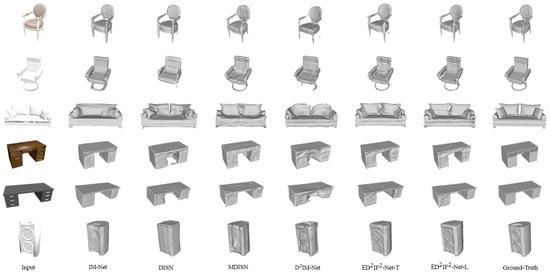
Figure 6.
Qualitative comparison of various methods for single-view 3D reconstruction on ShapeNet.
While MDISN can reconstruct more detailed topological structures, it fails to recover surface details and even introduces shape distortions to the object (e.g., speaker and table). On the other hand, IM-Net shows promise in surface detail recovery but often produces incorrect topological structures for highly curved shapes (e.g., armrests and bottom of the chair) and introduces numerous artifacts (such as the table).
In contrast, both -Net-T and -Net-L are able to reconstruct more visually appealing qualitative results. These methods enable the reconstruction of more complex topologies (e.g., holes in sofa backrests, handles of table drawers) and capture finer small-scale surface details (e.g., chair backrests). These findings align with the quantitative comparison in Table 1 and validate that -Net can effectively generate high-fidelity 3D shapes with accurate topological structure and surface details.
4.4. Ablation Studies
To validate the effectiveness of the individual components of -Net and the loss functions, extensive qualitative and quantitative ablation studies were carried out. All the networks used in the ablation studies were trained and tested on the chair class of ShapeNet. To be specific, the following network options were designed:
- Option 1: In this option, we keep the original encoder PVT in the network, plus the coarse shape decoder (CSD) and a random sampling strategy, and the loss function is applied. It can be seen from Figure 7 that the coarse shape decoder and the random sampling strategy can only reconstruct the coarse shape with few structure details and no surface details. It is consistent with the quantitative results in Table 2.
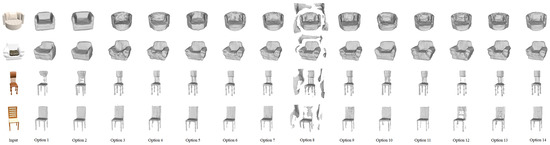 Figure 7. Visualization of the qualitative ablation studies of -Net-T. It is best viewed magnified on the screen.
Table 2. Quantitative comparison for ablation studies, where ✓indicates the component or loss term used by the option. Evaluation metrics remain IoU (%), CD (), EMD (), ECD-3D (), and ECD-2D. Top scores are highlighted in bold and underlined.
Figure 7. Visualization of the qualitative ablation studies of -Net-T. It is best viewed magnified on the screen.
Table 2. Quantitative comparison for ablation studies, where ✓indicates the component or loss term used by the option. Evaluation metrics remain IoU (%), CD (), EMD (), ECD-3D (), and ECD-2D. Top scores are highlighted in bold and underlined. - Option 2: On the basis of the first option, the network is trained with weighted sampling (WS). It can be found from Figure 7 that WS enables the network to reconstruct more details, especially at small scales.
- Option 3: In this option, we still use PVT as the encoder. However, we try to directly initialize a random signed distance value for each query point and iteratively refine it in the deformation decoder (DD). Then, the network is trained only constrained by deformation loss with WS. It can be observed from Figure 7 that the network without the coarse implicit field reconstructs awful surfaces and topologies. Moreover, quite a few surface artifacts emerge due to the absence of the coarse implicit field near the shape.
- Option 4: With this option, CSD together with the DD serve as the decoders and only with WS is used for the loss estimation. It can be seen in Figure 7 that such a network creates fewer shape artifacts and distortions, but it still fails to reconstruct a full shape of the structure, which is attributed to the fact that the loss function takes no account of the intermediate implicit fields generated in the iterative deformation.
- Option 5: Based on the previous options, and are applied to train the CSD and the DD, respectively. WS is also used here. From Figure 7, it is illustrated that the network with this option is capable of reconstructing more accurate topological structures and producing a smoother shape.
- Option 6: In this option, the surface detail decoder in -Net with WS cancels the prediction of the backward displacement map and the deformed implicit field is only fused with the forward displacement map. The surface detail decoder in this case is represented as SDD_S and the normal case is denoted as SDD_N. It can be noticed from Figure 7 that, without the backward displacement map, the surface details of the results may be incorrectly reconstructed and distortions may occur at the structural level, possibly owing to the lack of the backward displacement map, which prevents fine-tuning.
- Option 7: Only the of the standard -Net loss functions is removed and the rest remains unchanged. It can be noted from Figure 7 that, in this case, the surface details of the reconstruction cannot be clearly recovered and may produce distortions.
- Option 8: The encoder in -Net-T is replaced with ResNet18, keeping the rest of the settings fixed. The reconstruction results are shown in Figure 7 and it can be noticed that there exist plenty of artifacts, which may be caused by ResNet18 being slightly inferior to PVT in terms of feature extraction, proving that PVT is optimal for -Net.
- Option 9: When this option is selected, all HAMs in the SDD_N of the standard -Net are removed and the rest of the network settings remain fixed. As shown in Figure 7, the surface details of the reconstructed objects become unclear without the HAM, which is consistent with the quantitative results in Table 2, demonstrating that the variant leads to an increase in ECD-3D and ECD-2D. These results confirm the effectiveness of HAMs in enhancing surface details.
- Option 10: We remove the DD from the standard -Net and exclude the term from the loss function to create a variant pipeline similar to IM-Net. As shown in Figure 7, the shapes reconstructed by this variant are not comparable to the ones reconstructed by the standard -Net. It is worth noting that the quantitative comparisons in Table 1 and Table 2 show that, although the variant (marked in orange) has slightly lower performance than the standard -Net to some extent, it still outperforms IM-Net, which confirms the superiority of our network pipeline.
- Option 11: To further validate the effectiveness of the deformation decoder (DD) and deformation loss in reconstructing finer topological structures, we add the DD to the network of option 10 while keeping the other settings unchanged. As shown in Figure 7, this variant generally reconstructs object shapes with more detailed topological structures compared to option 10. This further demonstrates the contribution of the DD in reconstructing finer topological structures of objects. However, it is worth noting that the variant still struggles to generate visually appealing object shapes compared to the standard -Net. This observation emphasizes the importance of the deformation loss in the reconstruction process.
- Option 12: To further demonstrate the superiority of the proposed method in feature extraction, we replace the PVT-Tiny and PVT-Large image encoders in the standard -Net-T and -Net-L with DeiT-Tiny and DeiT-Base [37], respectively, while keeping the other settings unchanged. The qualitative results are presented in Figure 7. It can be observed that when the image encoders of -Net-T and -Net-L are replaced by DeiT-Tiny and DeiT-Base, respectively, the network tends to reconstruct inferior results, which exhibit poor topological structure and surface details. This further confirms the effectiveness of -Net in feature extraction.
- Option 13: To further validate the effectiveness of HAM in the surface detail decoder for enhancing surface detail representation, all HAMs in the surface detail decoder of the standard model are replaced with CBAMs [45], while keeping the other settings unchanged. The qualitative reconstruction results are depicted in Figure 7. In comparison to the standard -Net, the variant encounters challenges in capturing and recovering clear surface details of the object, resulting in the presence of artifacts around the shape. This option further demonstrates that HAM is more effective than CBAM in enhancing the capability of -Net to handle surface details.
- Option 14: The standard -Net proposed in this paper, including all components and the loss function with WS.
The visualization and quantitative results of the ablation studies are presented in Figure 7 and Table 2, respectively.
Overall, the weighted sampling strategy enables the network to reconstruct small-scale details effectively. Additionally, the deformation decoder, which refines the coarse implicit field, plays a crucial role in capturing the object’s topology. The deformation decoder performs optimally when trained with the deformation loss term , while the coarse shape decoder benefits from the . The deformed implicit field, derived from the deformation decoder, serves as a solid foundation for reconstructing the object’s surface, which is further fused with the forward displacement map generated by the surface detail decoder trained by to recover the surface details of the object. Moreover, the backward displacement map from the surface detail decoder compensates for the deformed implicit field, ensuring the correct topology reconstruction. Furthermore, compared to using ResNet18 as an encoder, the standard -Net achieves higher-fidelity results. Importantly, the presence of the deformation decoder and the utilization of the deformation loss term contribute to the reconstruction of -Net with finer topological structures. Furthermore, the PVT architecture, which generates multi-scale hierarchical local features, is more suitable as an image encoder for -Net compared to other conventional transformers such as DeiT. Lastly, in the surface detail decoder, the HAM module proves to be more effective in improving the model’s performance in recovering surface details and ensuring the reconstruction of a correct topological structure compared to CBAM.
The proposed -Net is inherently superior to IM-Net. Specifically, -Net significantly improves the network’s ability to extract features by using PVT instead of ResNet18. Moreover, -Net iteratively refines the coarse implicit field via the deformation decoder with to reconstruct finer topological structure details of the object, and employs HAM to enhance surface details instead of predicting only the coarse implicit field and the ordinary displacement field as in IM-Net. Finally, when the deformation decoder with in the standard -Net are abolished, the quantitative results achieved by the network still outperform IM-Net.
4.5. Computational Complexity
In addition to the qualitative and quantitative experiments described above, we also provide the computational complexity of the various methods in Table 3, specifically in terms of training time and inference time. To ensure a fair comparison, all models were trained and tested using the same settings.
Table 3.
Training time and inference time. All training times as well as inference times are obtained with the same settings, where the inference times are tested with a batch_size of 1.
As shown in the table, -Net-T achieves the fastest training speed, with a training time of 47 h. Similarly, -Net-L has a relatively shorter training time of 66 h compared to most other models. In terms of inference time, both -Net-T and -Net-L outperform other methods, with inference times of 97.64 ms and 144.09 ms, respectively.
The above comparison of computational complexity highlights the advantages of the proposed -Net in terms of faster training speed and shorter inference time.
4.6. Applications
4.6.1. Test on Online Product Images
-Net, after being trained on the rendered RGB images, allows for further testing of online product images without ground-truth shapes. The qualitative reconstruction results of -Net for online product images are presented in Figure 8. This application demonstrates the generalization capability of -Net.
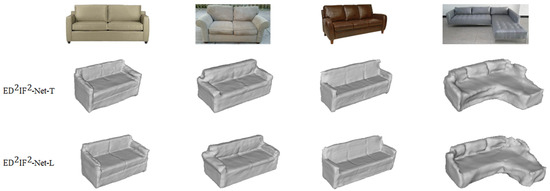
Figure 8.
Examples of reconstruction from online images through -Net.
4.6.2. Surface Detail Transfer
Surface detail transfer is defined as the fusion of the disentangled enhanced displacement field of a source object with the deformed implicit field of another target object. In this application, the specified surface details can be transferred and Figure 9 shows examples of surface detail transfer between different objects.
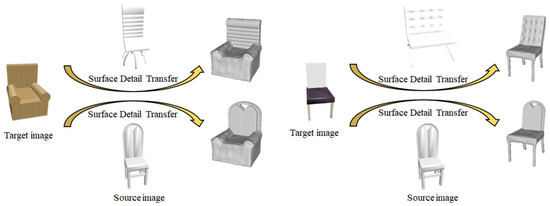
Figure 9.
Two examples of surface detail transfer using -Net, where the backrest details of the source chair are transferred.
4.6.3. Pasting a Logo
We propose that a logo can be pasted on the target object image and then the modified image is used to generate a model with the logo. Figure 10 shows examples of pasting a logo on a model.

Figure 10.
Examples about pasting a logo using -Net.
Actually, IM-Net [29] provides similar applications. A quantitative comparison of the different applications of IM-Net and -Net is shown in Table 4. It should be noted that, as there are no ground-truth models for the generated objects, the corresponding ground-truth models are created for the shown generated objects by traditional manual modeling, and the mean values of various evaluation metrics obtained by both IM-Net and -Net are computed. It can be observed from Table 4 that the proposed -Net achieves more promising performance compared to IM-Net in downstream applications, where -Net-L reaches state-of-the-art performance in these applications, further illustrating the superiority of -Net over IM-Net.
Table 4.
Quantitative results of IM-Net and -Net for various applications. Evaluation metrics also include IoU (%), CD (), EMD (), ECD-3D (), and ECD-2D. The best results for each application are highlighted in bold and underlined, while the italic one is the second.
4.7. Discussion about the Effects of Camera Sensor Type on -Net
In the previous experiments and applications, the images utilized were acquired using a standard camera sensor model, which allowed for capturing images without significant distortion. However, in various industries such as drone aerial photography, security surveillance, and automotive, wide-angle and fisheye imaging sensors are extensively employed. These sensors typically have a field of view (FOV) greater than 100 degrees, which is considerably larger compared to standard camera sensors. Hence, in this section, we primarily focus on discussing the effects of images captured by wide-angle and fisheye imaging sensors on the performance of -Net.
There are existing works [62,63,64] that utilize images captured by wide-angle or fisheye sensors for 3D reconstruction and other related tasks. For instance, Ma et al. [62] proposed a specific model for fisheye sensors and introduced sparse and dense multi-view 3D reconstruction methods based on this model. Strecha et al. [63] performed 3D reconstruction using images captured by fisheye sensors and standard lens models, respectively, employing the Pix4Dmapper software. Kakani et al. [64] proposed a self-calibration method for wide-angle and fisheye cameras to correct the captured images, allowing for their utilization in 3D reconstruction and other tasks.
In general, wide-angle sensors can capture images with a larger field of view compared to standard lenses, but they often introduce perspective distortion. This distortion can alter the shape of objects in the image, making it challenging for -Net trained on images acquired from the standard lens model to reconstruct high-fidelity object shapes. On the other hand, fisheye camera sensors can capture images with an extremely wide field of view but introduce barrel distortion, which causes even more severe distortion of objects in the image. Consequently, -Net faces difficulties in reconstructing accurate object shapes from such distorted images.
To mitigate the effects of perspective distortion and barrel distortion caused by wide-angle and fisheye camera sensors on -Net, pre-processing techniques such as camera calibration [64] and image correction [65] can be employed to reduce the degree of image distortion. Another approach is to consider training -Net on publicly available datasets of images captured by wide-angle sensor models and fisheye sensor models, enabling the network to learn about the different distortions using its powerful feature extraction and learning capabilities.
5. Limitations and Future Works
The proposed method has two main limitations. Firstly, although the surface detail decoder enhances surface information, some reconstructed object shapes, such as the speaker in Figure 6, lack prominent surface detail. This limitation may be attributed to the introduction of redundant local features during the implicit field deformation procedure. To address this, future studies should explore adaptive neglect of unnecessary local features as an attractive direction for improvement. Secondly, while -Net outperforms similar methods in terms of inference speed and performance, it is not specifically designed for real-time 3D reconstruction. This may pose challenges for systems that require real-time reconstruction. To tackle this issue, we plan to leverage a sparse sphere rendering algorithm [33,66] to accelerate inference speed. Additionally, we aim to explore more advanced transformers, such as Swin Transformer V2 [67], to enhance the feature extraction capability of -Net.
In future work, we will optimize the proposed framework for embedded platforms, considering the following aspects: (1) reducing model parameters and computational complexity by minimizing the number of layers in the Pyramid Vision Transformer or reducing the number of channels in the deformation decoder’s convolutional layer while maintaining performance; (2) improving the readout speed of implicit fields and displacement fields by utilizing more efficient data structures, such as hash tables, for data storage; (3) optimizing the training and prediction process through techniques such as distillation [68]; (4) deploying the framework on native embedded platforms to reduce communication and latency.
6. Conclusions
In this paper, we introduce -Net, the first single-view 3D reconstruction network based on the Pyramid Vision Transformer. Our network disentangles objects’ implicit fields into deformed implicit fields and enhanced displacement fields. IFDBs refine the coarse implicit fields by analyzing pixel-aligned local features across scales, capturing finer topological structure details in the deformed implicit fields. Moreover, we enhance the displacement fields in both spatial and channel dimensions to preserve surface details.
By employing a novel deformation loss and Laplacian loss, -Net achieves high-fidelity reconstruction, capturing both the structure and surface details of objects. On the ShapeNet dataset, -Net delivers superior performance, with -Net-L achieving the best mean IoU, CD, EMD, ECD-3D, and ECD-2D values of 61.1, 7.26, 2.51, 6.08, and 1.84, respectively.
Compared to other methods, -Net excels in reconstructing finer topological structures while preserving enhanced surface details. It overcomes the limitations of alternative approaches that may compromise surface details or yield incorrect topology, resulting in higher-quality reconstructions.
Our research represents a significant milestone in single-view implicit 3D reconstruction. We propose the first transformer-based single-view implicit 3D reconstruction network, opening up new possibilities for solving such tasks using transformers. -Net achieves state-of-the-art performance on the ShapeNet dataset while maintaining competitive inference time. The proposed IFDB and deformation loss can be readily applied to future works, enabling better reconstruction results in single-view implicit 3D reconstruction. The disentangled deformed implicit fields and enhanced displacement fields in our network benefit downstream applications, including surface detail transfer and pasting a logo. Furthermore, our framework can be optimized for embedded platforms, shedding new light on industrial applications such as VR/AR. Beyond real-time rendering challenges, the framework holds promise for industries such as robotics and autonomous driving.
Author Contributions
Conceptualization, X.Z.; methodology, X.Z. and X.Y. (Xinsheng Yao); software, X.Y. (Xinsheng Yao); validation, X.Z. and X.Y. (Xinsheng Yao); formal analysis, J.Z. (Junjie Zhang), M.Z., L.Y., X.Y. (Xiaosong Yang), J.Z. (Jianjun Zhang) and H.Z.; investigation, X.Y. (Xinsheng Yao); resources, X.Z.; data curation, X.Y. (Xinsheng Yao); writing—original draft preparation, X.Y. (Xinsheng Yao); writing—review and editing, X.Z., X.Y. (Xinsheng Yao), J.Z. (Junjie Zhang), M.Z., L.Y., X.Y. (Xiaosong Yang), J.Z. (Jianjun Zhang) and H.Z.; visualization, X.Y. (Xinsheng Yao); supervision, X.Z.; project administration, D.Z.; funding acquisition, X.Z. All authors have read and agreed to the published version of the manuscript.
Funding
This research received no external funding.
Institutional Review Board Statement
Not applicable.
Informed Consent Statement
Not applicable.
Data Availability Statement
The ShapeNet dataset and the Online Products dataset used in this study are available at https://shapenet.org (accessed on 25 May 2023) and ftp://cs.stanford.edu/cs/cvgl/Stanford_Online_Products.zip (accessed on 25 May 2023).
Acknowledgments
Our code is built on top of IM-Net and MDISN, and we are very grateful to their authors for their crucial support of the open source release of the code.
Conflicts of Interest
The authors declare no conflict of interest.
Abbreviations
All the abbreviations in the manuscript and their respective explanations are as follows:
| CNN | Convolutional Neural Network |
| MLP | Multi-Layer Perceptron |
| PVT | Pyramid Vision Transformer |
| IFDB | Implicit Field Deformation Block |
| HAM | Hybrid Attention Module |
| SDF | Signed Distance Function |
| SRA | Spatial-Reduction Attention |
| SOTA | State Of The Art |
| IoU | Intersection of Union |
| CD | Chamfer Distance |
| EMD | Earth Mover Distance |
| ECD-3D | Edge Chamfer Distance of the reconstructed shape |
| ECD-2D | Edge Chamfer Distance in the image |
| FOV | Field of View |
| CSD | Coarse Shape Decoder |
| WS | Weighted Sampling |
| DD | Deformation Decoder |
| SDD_N | Normal Surface Detail Decoder |
| SDD_S | Surface Detail Decoder predicting only a single forward displacement map |
Appendix A. Implementation Details
The implementation details mentioned in Section 4.2 of the main text are explained here.
Appendix A.1. Advantages of Utilizing a 224 × 224 RGB Image as Input
The reasons for choosing an RGB image with a resolution of as the network input are as follows:
- Dataset compatibility: The majority of images in existing publicly available 3D reconstruction datasets are based on a resolution of . Therefore, selecting RGB images with a resolution of as input ensures better alignment with the dataset, leading to improved training efficacy of the network.
- Resource constraints: Higher resolution images as input increase computational and memory requirements, resulting in longer training times and higher hardware demands. By opting for RGB images with a resolution of as input, computational resource consumption is reduced while maintaining higher performance levels.
- Information preservation: 3D reconstruction involves processing and analyzing input images to extract relevant features. By choosing RGB images with a resolution of as input, more detailed information can be preserved, resulting in enhanced 3D reconstruction performance.
Appendix A.2. Analysis of Parameter Settings
Appendix A.2.1. Setting Batch_Size as 16
Setting a smaller value for ’batch_size’ can yield the following advantages:
- Reduced memory consumption: A smaller batch_size leads to decreased memory usage since fewer data samples need to be stored per batch. This enables a larger number of batches to fit within the available memory, facilitating efficient training and inference processes.
- Improved model stability: A smaller batch_size enhances the stability of the model by introducing greater randomness in the samples within each batch. This randomization can help mitigate the risk of overfitting, resulting in a more robust and generalizable model.
- Improved tuning effectiveness: A smaller batch_size allows for faster observation of the model’s training progress. This expedited feedback loop enables quicker adjustments and fine-tuning of hyperparameters.
Furthermore, the model’s performance was compared for various batch_sizes and the corresponding quantitative results are displayed in Figure A1. It should be noted that -Net-L was not trained with a batch_size of 32 due to memory limitations. From the figure, it can be observed that both -Net-T and -Net-L achieve the best performance when the batch_size is set to 16. However, it is worth noting that these models also exhibit the highest memory utilization among the tested batch_sizes.

Figure A1.
Performance comparison of models with different batch_size; other settings remain fixed. Evaluation metrics include IoU, CD, EMD, ECD-3D, and ECD-2D.
Figure A1.
Performance comparison of models with different batch_size; other settings remain fixed. Evaluation metrics include IoU, CD, EMD, ECD-3D, and ECD-2D.

Appendix A.2.2. Setting Learning Rate as 5 × 10⁻⁵
The learning rate should be carefully selected in conjunction with the batch_size to achieve optimal performance. -Net is trained using different learning rates for a batch_size of 16. We consider three main learning rates: , , and , and compare the performance of the models trained with these different learning rates. Figure A2 illustrates the performance of -Net-T and -Net-L under different learning rates. It can be observed that the optimal model performance is achieved with a learning rate of and a batch_size of 16.

Figure A2.
Performance of the models with different learning rates is compared with batch_size set to 16 and other settings kept fixed. Evaluation metrics are IoU, CD, EMD, ECD-3D, and ECD-2D.
Figure A2.
Performance of the models with different learning rates is compared with batch_size set to 16 and other settings kept fixed. Evaluation metrics are IoU, CD, EMD, ECD-3D, and ECD-2D.

Appendix A.2.3. Reasons for Other Settings
The Adam optimizer is a widely used algorithm for adaptive learning rate optimization. It combines the benefits of RMSProp and Adagrad [69] with bias correction, effectively addressing issues such as gradient disappearance and explosion. Adam offers advantages such as self-adaptive learning rate, fast convergence, robustness, and efficient memory consumption. In our experiments, we adopt the default settings of the Adam optimizer, specifically = 0.9 and = 0.999. This configuration has demonstrated excellent performance across a wide range of experiments.
Weight decay is a technique that mitigates model complexity by introducing a penalty term to the loss function, thereby enhancing the model’s generalization capability. A weight decay value of has shown consistent effectiveness across numerous models. Additionally, this value strikes a balance as it effectively combats overfitting without significantly compromising model performance. Hence, a weight decay of is considered a suitable and reasonable choice in our experiments.
The choice of sampling 2048 query points strikes a balance between computational efficiency and model performance. When the number of query points is small, the network may struggle to acquire sufficient knowledge, resulting in poor reconstruction performance. Conversely, an excessively large number of query points significantly increases computational costs and slows down network training. Previous studies [24,25,26,29] have validated that 2048 query points offer an appropriate compromise. This number ensures that the network captures ample information while maintaining manageable computational overhead.
References
- Zai, S.; Zhao, M.; Yiran, X.; Yunpu, M.; Roger, W. 3D-RETR: End-to-End Single and Multi-View3D Reconstruction with Transformers. In Proceedings of the British Machine Vision Conference (BMVC), Virtual, 22–25 November 2021; British Machine Vision Association: Durham, UK, 2021; p. 405. [Google Scholar]
- Peng, K.; Islam, R.; Quarles, J.; Desai, K. Tmvnet: Using transformers for multi-view voxel-based 3d reconstruction. In Proceedings of the IEEE/CVF Conference on Computer Vision and Pattern Recognition (CVPR), IEEE, New Orleans, LA, USA, 18–24 June 2022; pp. 222–230. [Google Scholar]
- Yagubbayli, F.; Tonioni, A.; Tombari, F. LegoFormer: Transformers for Block-by-Block Multi-view 3D Reconstruction. arXiv 2021, arXiv:2106.12102. [Google Scholar]
- Tiong, L.C.O.; Sigmund, D.; Teoh, A.B.J. 3D-C2FT: Coarse-to-fine Transformer for Multi-view 3D Reconstruction. In Proceedings of the Asian Conference on Computer Vision (ACCV), AFCV, Macau, China, 4–8 December 2022; pp. 1438–1454. [Google Scholar]
- Li, X.; Kuang, P. 3D-VRVT: 3D Voxel Reconstruction from A Single Image with Vision Transformer. In Proceedings of the 2021 International Conference on Culture-Oriented Science & Technology (ICCST), IEEE, Beijing, China, 18–21 November 2021; pp. 343–348. [Google Scholar]
- Xie, H.; Yao, H.; Sun, X.; Zhou, S.; Zhang, S. Pix2Vox: Context-aware 3D Reconstruction from Single and Multi-view Images. In Proceedings of the IEEE/CVF International Conference on Computer Vision (ICCV), IEEE, Seoul, Republic of Korea, 27 October–2 November 2019; pp. 2690–2698. [Google Scholar]
- Choy, C.B.; Xu, D.; Gwak, J.; Chen, K.; Savarese, S. 3D-R2N2: A Unified Approach for Single and Multi-view 3D Object Reconstruction. In Proceedings of the European Conference on Computer Vision (ECCV), Amsterdam, The Netherlands, 11–14 October 2016; pp. 628–644. [Google Scholar]
- Sun, Y.; Liu, Z.; Wang, Y.; Sarma, S.E. Im2Avatar: Colorful 3D Reconstruction from a Single Image. arXiv 2018, arXiv:1804.06375. [Google Scholar]
- Tatarchenko, M.; Dosovitskiy, A.; Brox, T. Octree Generating Networks: Efficient Convolutional Architectures for High-resolution 3D Outputs. In Proceedings of the IEEE/CVF International Conference on Computer Vision (ICCV), IEEE, Venice, Italy, 22–29 October 2017; pp. 2107–2115. [Google Scholar]
- Wu, J.; Wang, Y.; Xue, T.; Sun, X.; Freeman, W.T.; Tenenbaum, J.B. MarrNet: 3D Shape Reconstruction via 2.5D Sketches. In Advances in Neural Information Processing Systems (NeurIPS); Curran Associates, Inc.: Red Hook, NY, USA, 2017. [Google Scholar]
- Fan, H.; Su, H.; Guibas, L.J. A point set generation network for 3d object reconstruction from a single image. In Proceedings of the IEEE/CVF Conference on Computer Vision and Pattern Recognition (CVPR), IEEE, Honolulu, HI, USA, 21–26 July 2017; pp. 605–613. [Google Scholar]
- Lun, Z.; Gadelha, M.; Kalogerakis, E.; Maji, S.; Wang, R. 3D Shape Reconstruction from Sketches via Multi-view Convolutional Networks. In Proceedings of the 2017 International Conference on 3D Vision (3DV), IEEE, Qingdao, China, 10–12 October 2017; pp. 67–77. [Google Scholar]
- Kurenkov, A.; Ji, J.; Garg, A.; Mehta, V.; Gwak, J.; Choy, C.; Savarese, S. DeformNet: Free-Form Deformation Network for 3D Shape Reconstruction from a Single Image. In Proceedings of the 2018 IEEE Winter Conference on Applications of Computer Vision (WACV), IEEE, Lake Tahoe, NV, USA, 12–15 March 2018; pp. 858–866. [Google Scholar]
- Lin, C.H.; Kong, C.; Lucey, S. Learning efficient point cloud generation for dense 3d object reconstruction. In Proceedings of the AAAI Conference on Artificial Intelligence, New Orleans, LA, USA, 2–7 February 2018; Association for the Advancement of Artificial Intelligence: Washington, DC, USA, 2018. [Google Scholar]
- Kar, A.; Tulsiani, S.; Carreira, J.; Malik, J. Category-specific object reconstruction from a single image. In Proceedings of the IEEE/CVF Conference on Computer Vision and Pattern Recognition (CVPR), IEEE, Boston, MA, USA, 7–12 June 2015; pp. 1966–1974. [Google Scholar]
- Li, X.; Liu, S.; Kim, K.; De Mello, S.; Jampani, V.; Yang, M.H.; Kautz, J. Self-supervised single-view 3d reconstruction via semantic consistency. In Proceedings of the European Conference on Computer Vision (ECCV), Virtual, 23–28 August 2020; pp. 677–693. [Google Scholar]
- Wang, N.; Zhang, Y.; Li, Z.; Fu, Y.; Liu, W.; Jiang, Y.G. Pixel2Mesh: Generating 3D Mesh Models from Single RGB Images. In Proceedings of the European Conference on Computer Vision (ECCV), Munich, Germany, 8–14 September 2018; pp. 55–71. [Google Scholar]
- Park, J.J.; Florence, P.; Straub, J.; Newcombe, R.; Lovegrove, S. DeepSDF: Learning Continuous Signed Distance Functions for Shape Representation. In Proceedings of the IEEE/CVF Conference on Computer Vision and Pattern Recognition (CVPR), IEEE, Long Beach, CA, USA, 15–20 June 2019; pp. 165–174. [Google Scholar]
- Chen, Z.; Zhang, H. Learning Implicit Fields for Generative Shape Modeling. In Proceedings of the IEEE/CVF Conference on Computer Vision and Pattern Recognition (CVPR), IEEE, Long Beach, CA, USA, 15–20 June 2019; pp. 5932–5941. [Google Scholar]
- Mescheder, L.; Oechsle, M.; Niemeyer, M.; Nowozin, S.; Geiger, A. Occupancy Networks: Learning 3D Reconstruction in Function Space. In Proceedings of the IEEE/CVF Conference on Computer Vision and Pattern Recognition (CVPR), IEEE, Long Beach, CA, USA, 15–20 June 2019; pp. 4460–4470. [Google Scholar]
- Littwin, G.; Wolf, L. Deep Meta Functionals for Shape Representation. In Proceedings of the IEEE/CVF International Conference on Computer Vision (ICCV), IEEE, Seoul, Republic of Korea, 27 October–2 November 2019; pp. 1824–1833. [Google Scholar]
- Michalkiewicz, M.; Pontes, J.K.; Jack, D.; Baktashmotlagh, M.; Eriksson, A. Deep level sets: Implicit surface representations for 3d shape inference. arXiv 2019, arXiv:1901.06802. [Google Scholar]
- Wu, R.; Zhuang, Y.; Xu, K.; Zhang, H.; Chen, B. PQ-NET: A Generative Part Seq2Seq Network for 3D Shapes. In Proceedings of the IEEE/CVF Conference on Computer Vision and Pattern Recognition (CVPR), IEEE, Seattle, WA, USA, 13–19 June 2020; pp. 829–838. [Google Scholar]
- Xu, Q.; Wang, W.; Ceylan, D.; Mech, R.; Neumann, U. DISN: Deep implicit surface network for high-quality single-view 3D reconstruction. In Advances in Neural Information Processing Systems (NeurIPS); Curran Associates, Inc.: Red Hook, NY, USA, 2019; pp. 492–502. [Google Scholar]
- Wang, Y.; Zhuang, Y.; Liu, Y.; Chen, B. MDISN: Learning multiscale deformed implicit fields from single images. Vis. Inform. 2022, 6, 41–49. [Google Scholar] [CrossRef]
- Xu, Y.; Fan, T.; Yuan, Y.; Singh, G. Ladybird: Quasi-monte carlo sampling for deep implicit field based 3d reconstruction with symmetry. In Proceedings of the European Conference on Computer Vision (ECCV), Virtual, 23–28 August 2020; pp. 248–263. [Google Scholar]
- Bian, W.; Wang, Z.; Li, K.; Prisacariu, V.A. Ray-ONet: Efficient 3D Reconstruction From A Single RGB Image. In Proceedings of the British Machine Vision Conference (BMVC), British Machine Vision Association, Virtual, 22–25 November 2021. [Google Scholar]
- Peng, S.; Niemeyer, M.; Mescheder, L.; Pollefeys, M.; Geiger, A. Convolutional Occupancy Networks. In Proceedings of the European Conference on Computer Vision (ECCV), Virtual, 23–28 August 2020; pp. 523–540. [Google Scholar]
- Li, M.; Zhang, H. d2im-net: Learning detail disentangled implicit fields from single images. In Proceedings of the IEEE/CVF Conference on Computer Vision and Pattern Recognition (CVPR), IEEE, Nashville, TN, USA, 20–25 June 2021; pp. 10246–10255. [Google Scholar]
- Saito, S.; Huang, Z.; Natsume, R.; Morishima, S.; Kanazawa, A.; Li, H. PIFu: Pixel-Aligned Implicit Function for High-Resolution Clothed Human Digitization. In Proceedings of the IEEE/CVF International Conference on Computer Vision (ICCV), IEEE, Seoul, Republic of Korea, 27 October–2 November 2019; pp. 2304–2314. [Google Scholar]
- Saito, S.; Simon, T.; Saragih, J.; Joo, H. Pifuhd: Multi-level pixel-aligned implicit function for high-resolution 3d human digitization. In Proceedings of the IEEE/CVF Conference on Computer Vision and Pattern Recognition (CVPR), IEEE, Seattle, WA, USA, 13–19 June 2020; pp. 84–93. [Google Scholar]
- He, T.; Collomosse, J.; Jin, H.; Soatto, S. Geo-PIFu: Geometry and Pixel Aligned Implicit Functions for Single-view Human Reconstruction. In Advances in Neural Information Processing Systems (NeurIPS); Curran Associates, Inc.: Red Hook, NY, USA, 2020; pp. 9276–9287. [Google Scholar]
- Takikawa, T.; Litalien, J.; Yin, K.; Kreis, K.; Loop, C.; Nowrouzezahrai, D.; Jacobson, A.; McGuire, M.; Fidler, S. Neural Geometric Level of Detail: Real-time Rendering with Implicit 3D Shapes. In Proceedings of the IEEE/CVF Conference on Computer Vision and Pattern Recognition (CVPR), IEEE, Nashville, TN, USA, 20–25 June 2021; pp. 11358–11367. [Google Scholar]
- Deng, Y.; Yang, J.; Tong, X. Deformed Implicit Field: Modeling 3D Shapes with Learned Dense Correspondence. In Proceedings of the IEEE/CVF Conference on Computer Vision and Pattern Recognition (CVPR), IEEE, Nashville, TN, USA, 20–25 June 2021; pp. 10286–10296. [Google Scholar]
- Yang, M.; Wen, Y.; Chen, W.; Chen, Y.; Jia, K. Deep optimized priors for 3d shape modeling and reconstruction. In Proceedings of the IEEE/CVF Conference on Computer Vision and Pattern Recognition (CVPR), IEEE, Nashville, TN, USA, 20–25 June 2021; pp. 3269–3278. [Google Scholar]
- Dosovitskiy, A.; Beyer, L.; Kolesnikov, A.; Weissenborn, D.; Zhai, X.; Unterthiner, T.; Dehghani, M.; Minderer, M.; Heigold, G.; Gelly, S.; et al. An image is worth 16x16 words: Transformers for image recognition at scale. In Proceedings of the 9th International Conference on Learning Representations (ICLR), Vienna, Austria, 3–7 May 2021. [Google Scholar]
- Touvron, H.; Cord, M.; Douze, M.; Massa, F.; Sablayrolles, A.; Jegou, H. Training data-efficient image transformers & distillation through attention. In Proceedings of the International Conference on Machine Learning (ICML), Virtual, 18–24 July 2021; pp. 10347–10357. [Google Scholar]
- Carion, N.; Massa, F.; Synnaeve, G.; Usunier, N.; Kirillov, A.; Zagoruyko, S. End-to-end object detection with transformers. In Proceedings of the European Conference on Computer Vision (ECCV), Virtual, 23–28 August 2020; pp. 213–229. [Google Scholar]
- Liang, J.; Cao, J.; Sun, G.; Zhang, K.; Van Gool, L.; Timofte, R. SwinIR: Image Restoration Using Swin Transformer. In Proceedings of the IEEE/CVF International Conference on Computer Vision (ICCV), IEEE, Montreal, BC, Canada, 11–17 October 2021; pp. 1833–1844. [Google Scholar]
- Strudel, R.; Garcia, R.; Laptev, I.; Schmid, C. Segmenter: Transformer for semantic segmentation. In Proceedings of the IEEE/CVF International Conference on Computer Vision (ICCV), IEEE, Montreal, BC, Canada, 11–17 October 2021; pp. 7242–7252. [Google Scholar]
- Li, Y.; Wu, C.Y.; Fan, H.; Mangalam, K.; Xiong, B.; Malik, J.; Feichtenhofer, C. MViTv2: Improved multiscale vision transformers for classification and detection. In Proceedings of the IEEE/CVF Conference on Computer Vision and Pattern Recognition (CVPR), IEEE, New Orleans, LA, USA, 18–24 June 2022; pp. 4804–4814. [Google Scholar]
- Wang, D.; Cui, X.; Chen, X.; Zou, Z.; Shi, T.; Salcudean, S.; Wang, Z.J.; Ward, R. Multi-view 3d reconstruction with transformers. In Proceedings of the IEEE/CVF International Conference on Computer Vision (ICCV), IEEE, Montreal, BC, Canada, 11–17 October 2021; pp. 5722–5731. [Google Scholar]
- Wang, W.; Xie, E.; Li, X.; Fan, D.P.; Song, K.; Liang, D.; Lu, T.; Luo, P.; Shao, L. Pyramid Vision Transformer: A Versatile Backbone for Dense Prediction Without Convolutions. In Proceedings of the IEEE/CVF International Conference on Computer Vision (ICCV), IEEE, Montreal, BC, Canada, 11–17 October 2021; pp. 568–578. [Google Scholar]
- Li, G.; Fang, Q.; Zha, L.; Gao, X.; Zheng, N. HAM: Hybrid attention module in deep convolutional neural networks for image classification. Pattern Recognit. 2022, 129, 108785. [Google Scholar] [CrossRef]
- Woo, S.; Park, J.; Lee, J.Y.; Kweon, I.S. Cbam: Convolutional block attention module. In Proceedings of the European Conference on Computer Vision (ECCV), Munich, Germany, 8–14 September 2018; pp. 3–19. [Google Scholar]
- Lai, W.S.; Huang, J.B.; Ahuja, N.; Yang, M.H. Deep Laplacian Pyramid Networks for Fast and Accurate Super-Resolution. In Proceedings of the IEEE/CVF Conference on Computer Vision and Pattern Recognition (CVPR), IEEE, Honolulu, HI, USA, 21–26 July 2017; pp. 624–632. [Google Scholar]
- Tang, Y.; Gong, W.; Chen, X.; Li, W. Deep inception-residual Laplacian pyramid networks for accurate single-image super-resolution. IEEE Trans. Neural Netw. Learn. Syst. 2019, 31, 1514–1528. [Google Scholar] [CrossRef]
- Denton, E.L.; Chintala, S.; Szlam, A.; Fergus, R. Deep generative image models using a laplacian pyramid of adversarial networks. In Advances in Neural Information Processing Systems (NeurIPS); Curran Associates, Inc.: Red Hook, NY, USA, 2015. [Google Scholar]
- Li, S.; Xu, X.; Nie, L.; Chua, T.S. Laplacian-Steered Neural Style Transfer. In Proceedings of the 25th ACM international conference on Multimedia. Association for Computing Machinery, Mountain View, CA, USA, 23–27 October 2017; pp. 1716–1724. [Google Scholar]
- Liu, S.; Li, T.; Chen, W.; Li, H. Soft Rasterizer: A Differentiable Renderer for Image-based 3D Reasoning. In Proceedings of the IEEE/CVF International Conference on Computer Vision (ICCV), IEEE, Seoul, Republic of Korea, 27 October–2 November 2019; pp. 7708–7717. [Google Scholar]
- Vaswani, A.; Shazeer, N.; Parmar, N.; Uszkoreit, J.; Jones, L.; Gomez, A.N.; Kaiser, Ł.; Polosukhin, I. Attention is all you need. In Advances in Neural Information Processing Systems (NeurIPS); Curran Associates, Inc.: Red Hook, NY, USA, 2017; pp. 6000–6010. [Google Scholar]
- Khan, S.; Naseer, M.; Hayat, M.; Zamir, S.W.; Khan, F.S.; Shah, M. Transformers in vision: A survey. ACM Comput. Surv. (CSUR) 2022, 54, 1–41. [Google Scholar] [CrossRef]
- He, K.; Zhang, X.; Ren, S.; Sun, J. Deep residual learning for image recognition. In Proceedings of the IEEE/CVF Conference on Computer Vision and Pattern Recognition (CVPR), IEEE, Las Vegas, NV, USA, 27–30 June 2016; pp. 770–778. [Google Scholar]
- Lorensen, W.E.; Cline, H.E. Marching cubes: A high resolution 3D surface construction algorithm. ACM Siggraph Comput. Graph. 1987, 21, 163–169. [Google Scholar] [CrossRef]
- Esedog, S.; Ruuth, S.; Tsai, R. Diffusion generated motion using signed distance functions. J. Comput. Phys. 2010, 229, 1017–1042. [Google Scholar] [CrossRef]
- Yao, Y.; Schertler, N.; Rosales, E.; Rhodin, H.; Sigal, L.; Sheffer, A. Front2back: Single view 3d shape reconstruction via front to back prediction. In Proceedings of the IEEE/CVF Conference on Computer Vision and Pattern Recognition (CVPR), IEEE, Seattle, WA, USA, 13–19 June 2020; pp. 531–540. [Google Scholar]
- Chang, A.X.; Funkhouser, T.; Guibas, L.; Hanrahan, P.; Huang, Q.; Li, Z.; Savarese, S.; Savva, M.; Song, S.; Su, H.; et al. Shapenet: An information-rich 3d model repository. arXiv 2015, arXiv:1512.03012. [Google Scholar]
- Remelli, E.; Lukoianov, A.; Richter, S.; Guillard, B.; Bagautdinov, T.; Baque, P.; Fua, P. MeshSDF: Differentiable Iso-Surface Extraction. In Advances in Neural Information Processing Systems (NeurIPS); Larochelle, H., Ranzato, M., Hadsell, R., Balcan, M.F., Lin, H., Eds.; Curran Associates, Inc.: Red Hook, NY, USA, 2020; pp. 22468–22478. [Google Scholar]
- Chen, Z.; Tagliasacchi, A.; Zhang, H. Bsp-net: Generating compact meshes via binary space partitioning. In Proceedings of the IEEE/CVF Conference on Computer Vision and Pattern Recognition (CVPR), IEEE, Seattle, WA, USA, 13–19 June 2020; pp. 45–54. [Google Scholar]
- Paszke, A.; Gross, S.; Massa, F.; Lerer, A.; Bradbury, J.; Chanan, G.; Killeen, T.; Lin, Z.; Gimelshein, N.; Antiga, L.; et al. Pytorch: An imperative style, high-performance deep learning library. In Advances in Neural Information Processing Systems (NeurIPS); Curran Associates, Inc.: Red Hook, NY, USA, 2019. [Google Scholar]
- Kingma, D.P.; Ba, J. Adam: A method for stochastic optimization. In Proceedings of the 3rd International Conference on Learning Representations (ICLR), San Diego, CA, USA, 7–9 May 2015. [Google Scholar]
- Ma, C.; Shi, L.; Huang, H.; Yan, M. 3d reconstruction from full-view fisheye camera. arXiv 2015, arXiv:1506.06273. [Google Scholar]
- Strecha, C.; Zoller, R.; Rutishauser, S.; Brot, B.; Schneider-Zapp, K.; Chovancova, V.; Krull, M.; Glassey, L. Quality assessment of 3D reconstruction using fisheye and perspective sensors. ISPRS Ann. Photogramm. Remote Sens. Spat. Inf. Sci. 2015, 2, 215. [Google Scholar] [CrossRef]
- Kakani, V.; Kim, H.; Kumbham, M.; Park, D.; Jin, C.B.; Nguyen, V.H. Feasible Self-Calibration of Larger Field-of-View (FOV) Camera Sensors for the Advanced Driver-Assistance System (ADAS). Sensors 2019, 19, 3369. [Google Scholar] [CrossRef]
- Fan, J.; Zhang, J.; Maybank, S.J.; Tao, D. Wide-angle image rectification: A survey. Int. J. Comput. Vis. 2022, 130, 747–776. [Google Scholar] [CrossRef]
- Hart, J.C. Sphere tracing: A geometric method for the antialiased ray tracing of implicit surfaces. Vis. Comput. 1996, 12, 527–545. [Google Scholar] [CrossRef]
- Liu, Z.; Hu, H.; Lin, Y.; Yao, Z.; Xie, Z.; Wei, Y.; Ning, J.; Cao, Y.; Zhang, Z.; Dong, L.; et al. Swin Transformer V2: Scaling Up Capacity and Resolution. In Proceedings of the IEEE/CVF Conference on Computer Vision and Pattern Recognition (CVPR), IEEE, New Orleans, LA, USA, 18–24June 2022; pp. 12009–12019. [Google Scholar]
- Alkhulaifi, A.; Alsahli, F.; Ahmad, I. Knowledge distillation in deep learning and its applications. PeerJ Comput. Sci. 2021, 7, e474. [Google Scholar] [CrossRef]
- Duchi, J.; Hazan, E.; Singer, Y. Adaptive subgradient methods for online learning and stochastic optimization. J. Mach. Learn. Res. 2011, 12, 2121–2159. [Google Scholar]
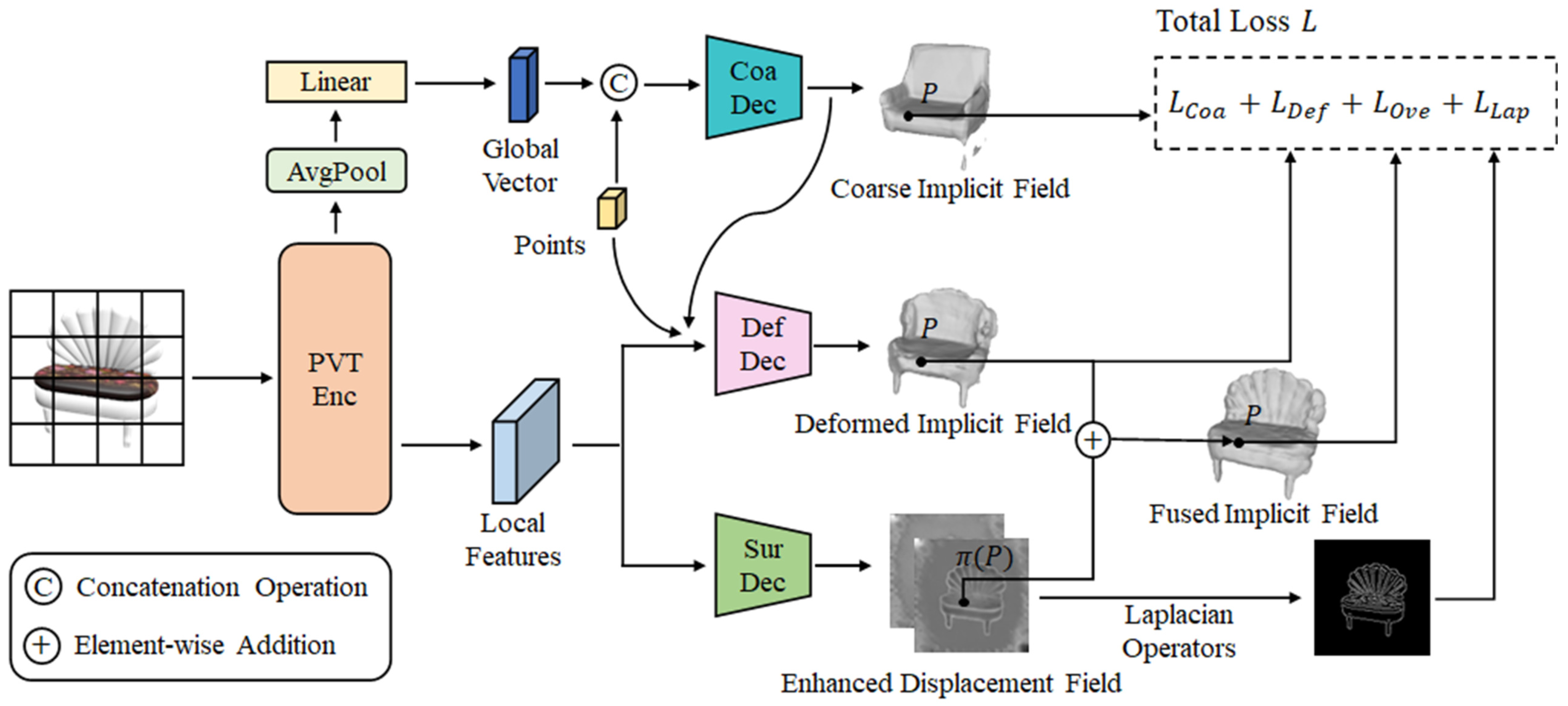
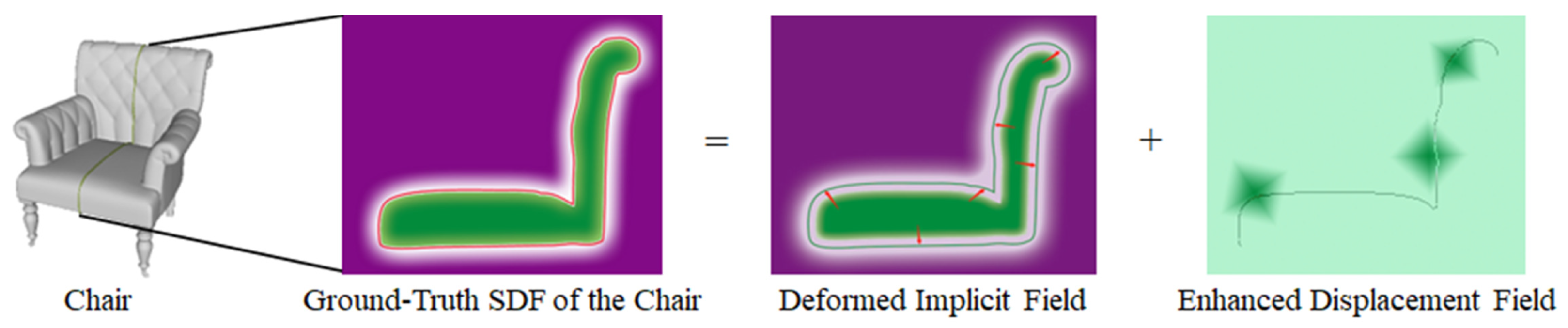
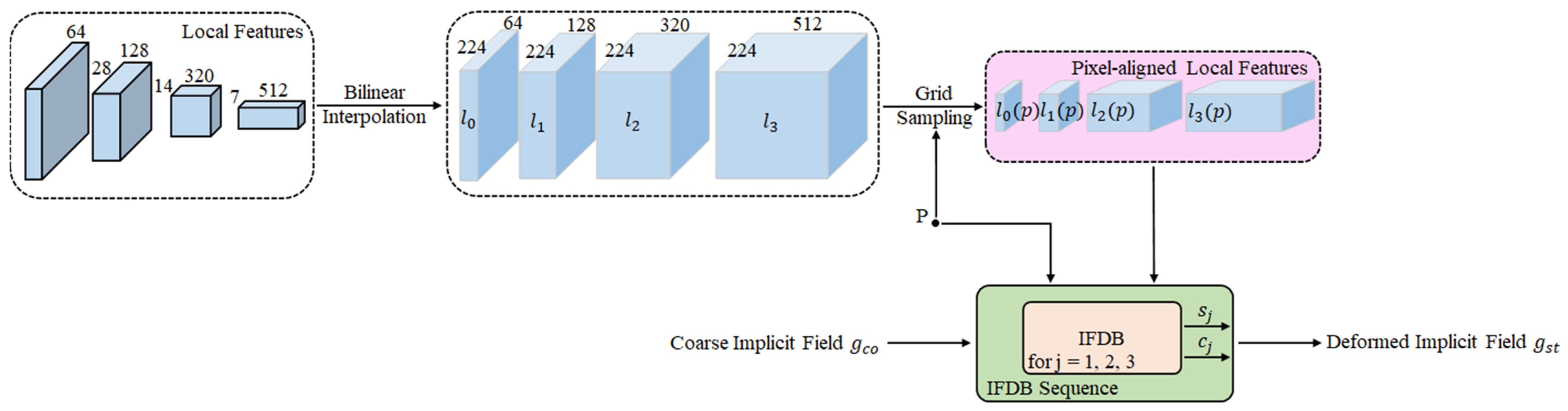
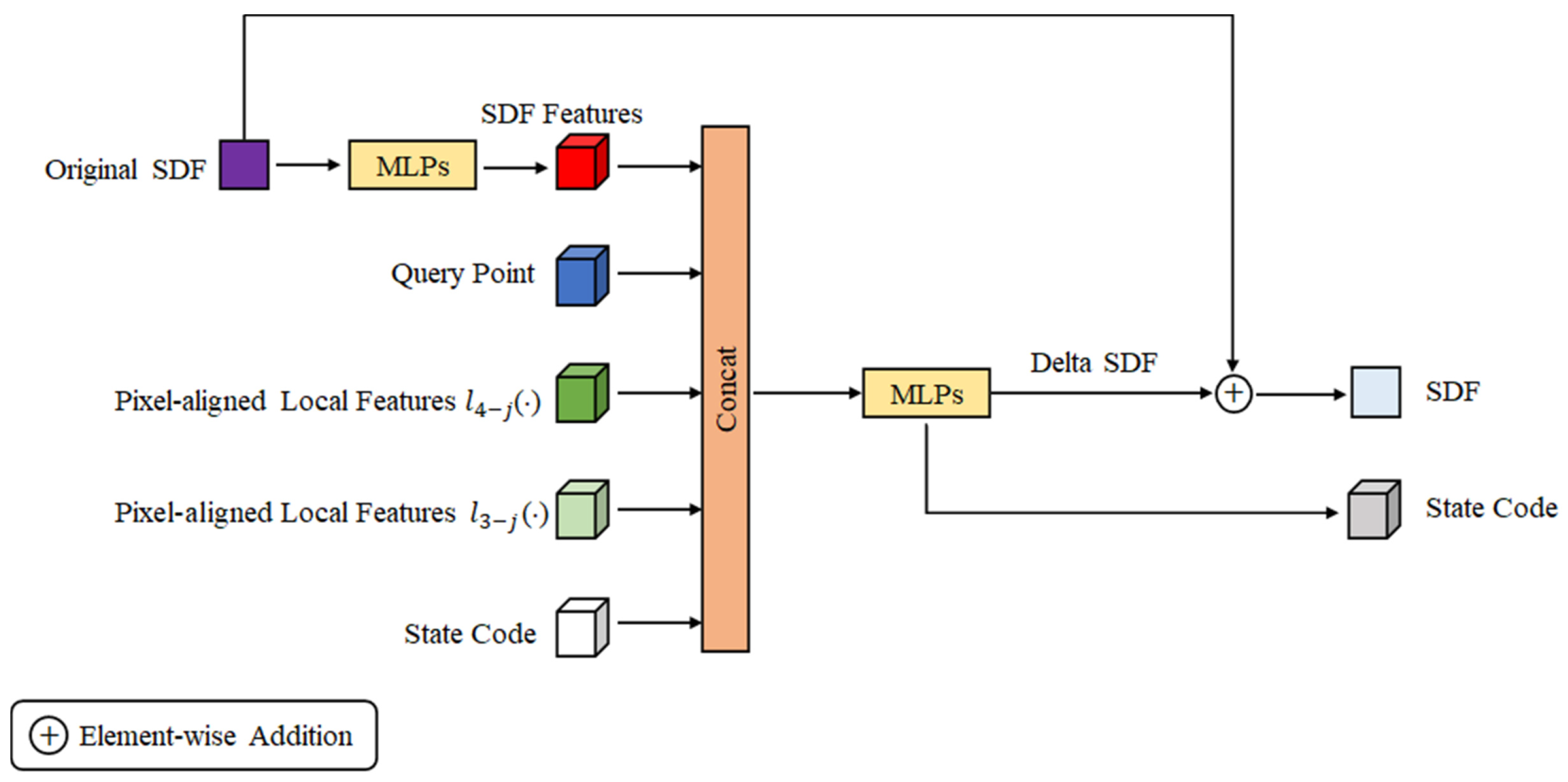
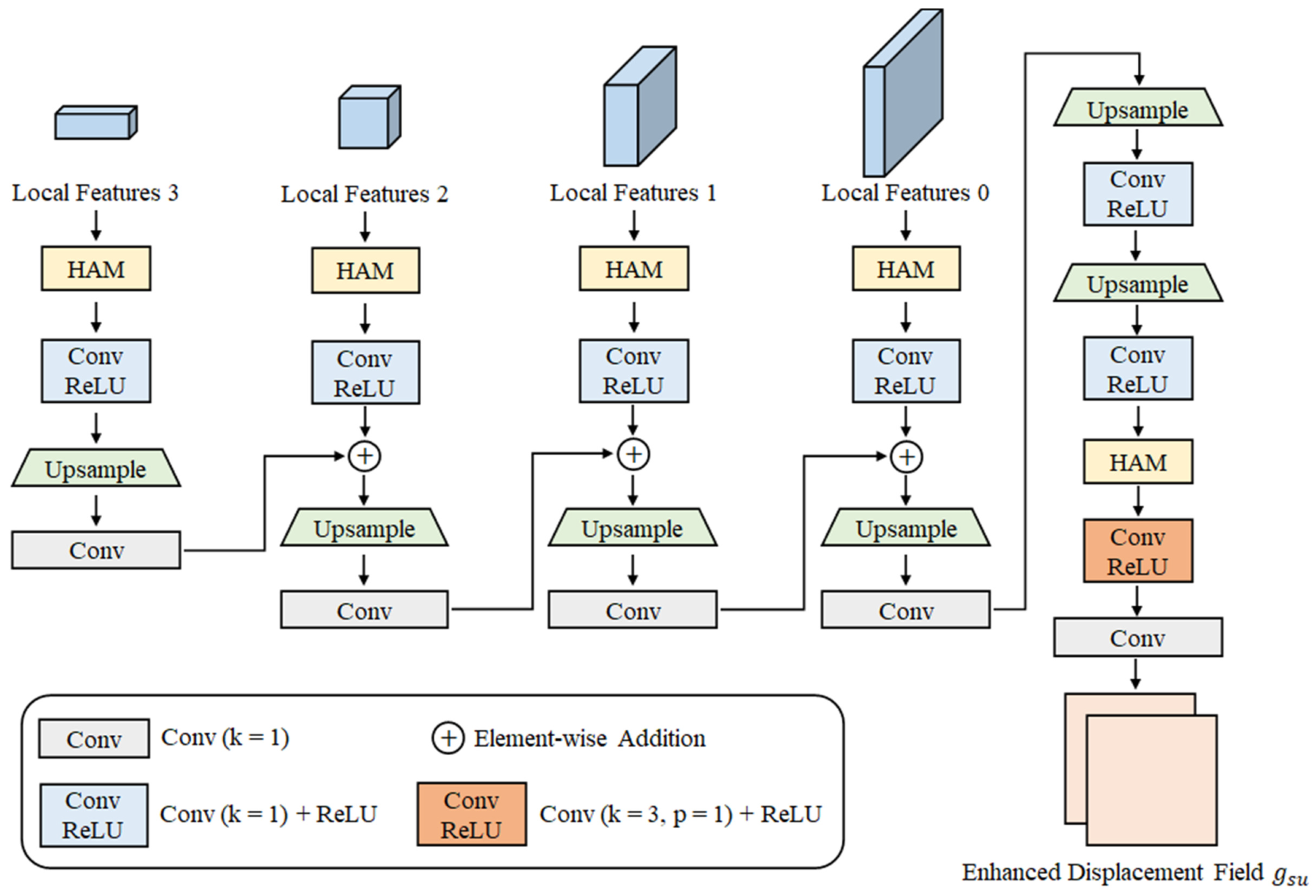
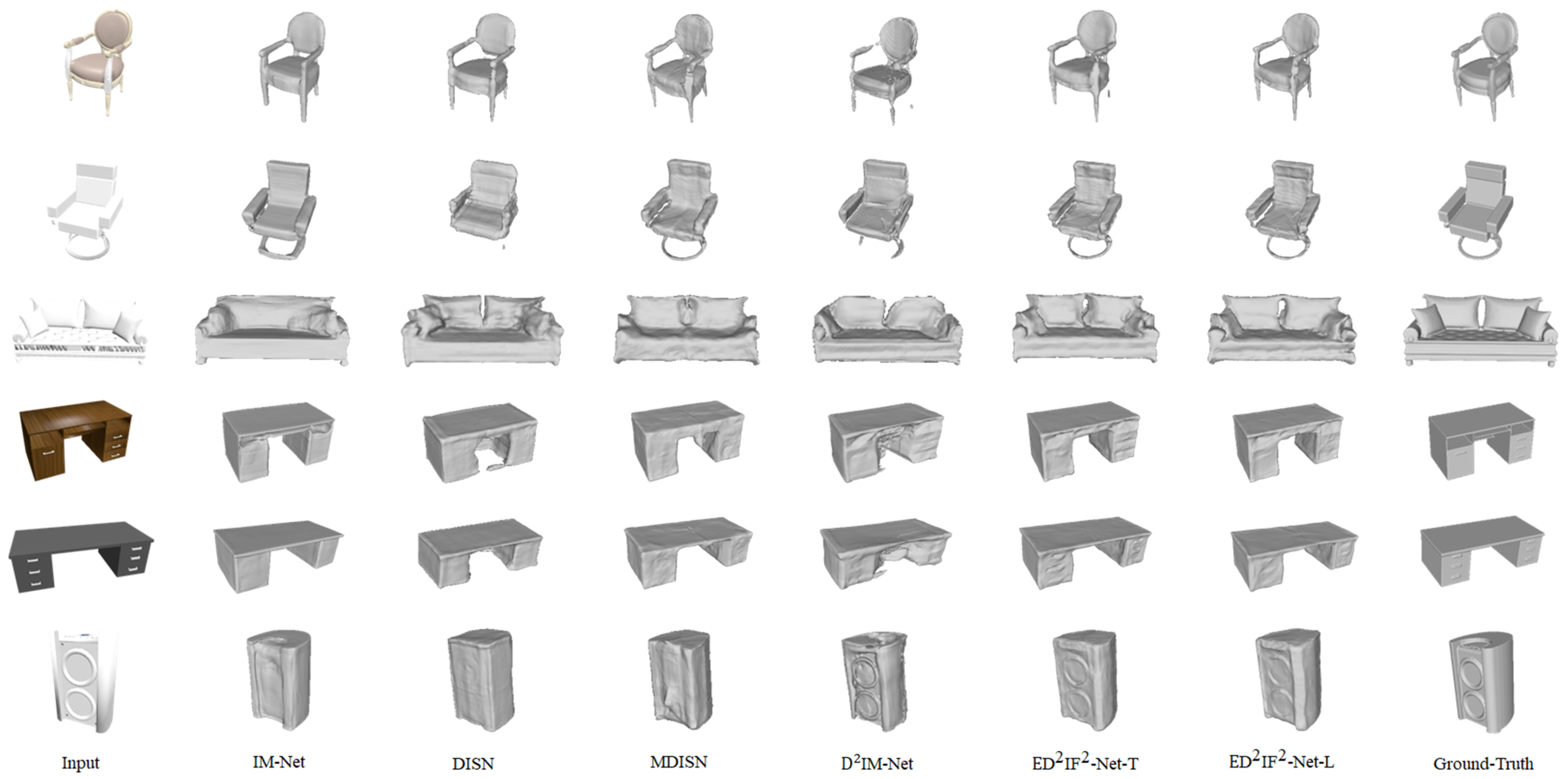
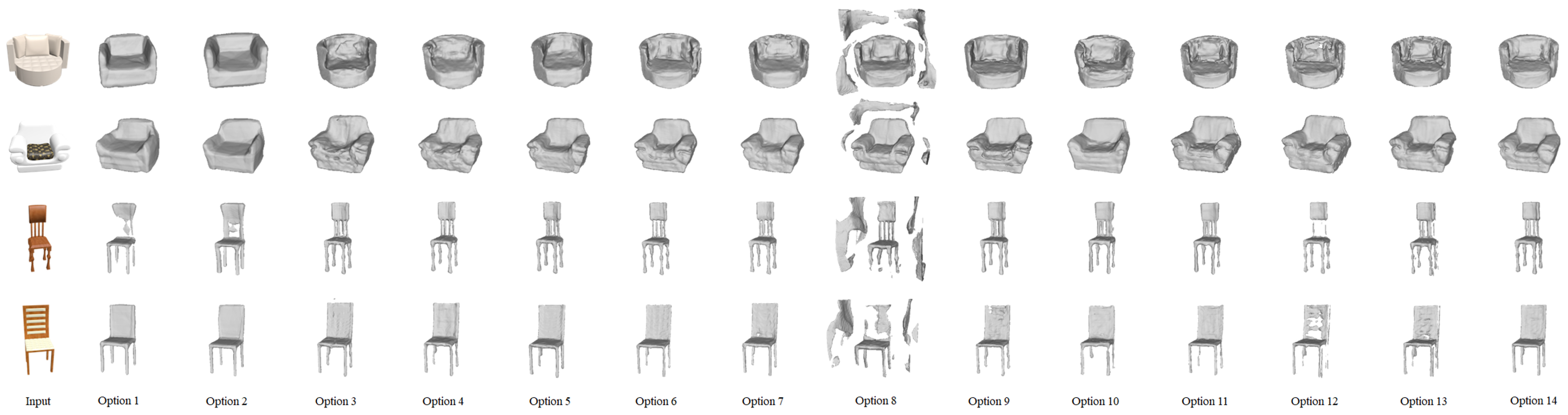
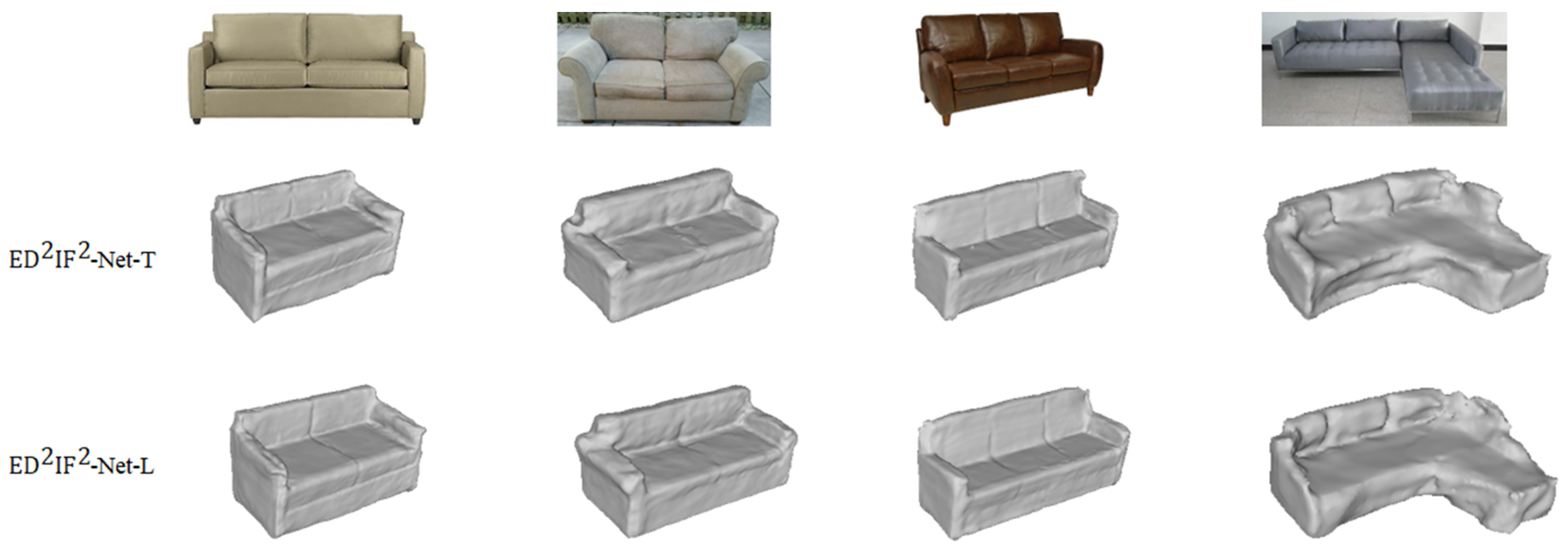
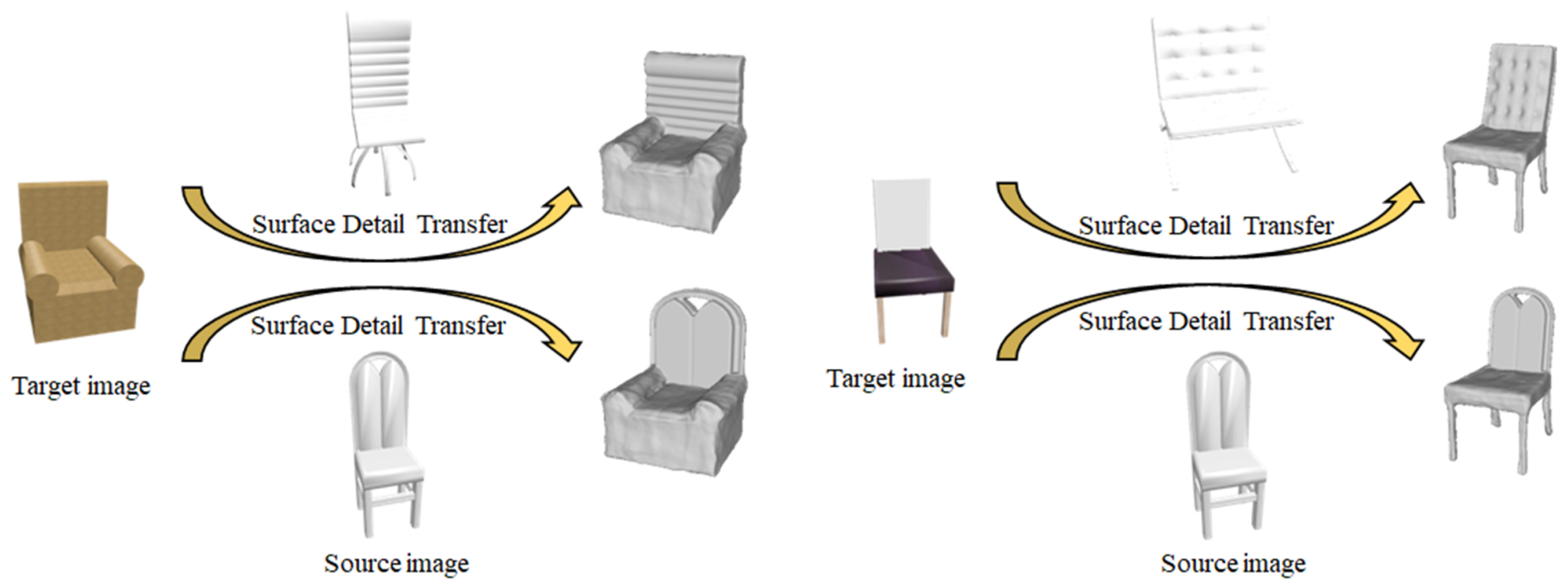

Disclaimer/Publisher’s Note: The statements, opinions and data contained in all publications are solely those of the individual author(s) and contributor(s) and not of MDPI and/or the editor(s). MDPI and/or the editor(s) disclaim responsibility for any injury to people or property resulting from any ideas, methods, instructions or products referred to in the content. |
© 2023 by the authors. Licensee MDPI, Basel, Switzerland. This article is an open access article distributed under the terms and conditions of the Creative Commons Attribution (CC BY) license (https://creativecommons.org/licenses/by/4.0/).