1. Introduction
In the past two decades, small fixed-wing UAVs have been widely applied in military and civil fields, such as anti-terrorism reconnaissance, communication relay, land surveying and mapping, forest fire prevention, power inspection, and so on [
1]. One important function of the autopilot is that it can give the UAV the ability to fly over the target area according to the predefined path [
2]. The methods for realizing the objective can be classified into two categories: trajectory tracking and path following. Path following is to make the UAV fly along the geometric path at any feasible speed. Trajectory tracking requires the UAV to converge and follow a time-parameterized path [
3]. It requires the autopilot to produce the velocity command, which is critical for the small fixed-wing UAV [
4].
Various approaches have been proposed in the literature for path following. Two main categories are linear-control-based approaches and nonlinear-control-based approaches. The linear path following control methods mainly include PID and LQR techniques. The structure of a PID-based path following controller is simple and easy to implement [
5], but the selection of control parameters mostly depends on the experience of the designers [
6]. the controller’s ability to resist unmodeled parts and external disturbances is poor [
7]. The LQR-based method is usually applied to follow a straight-line and circular paths. The LQR-based path following approach requires a suitable linear model, which includes the dynamic characteristics of the system and the differential equation of the heading error [
8]. It should be pointed out that the heading error must be small enough to meet the linearization conditions [
9]. Otherwise, the linear model will not match the actual characteristics, and the controller will fail.
The nonlinear path following control methods mainly include the intelligent control techniques, nonlinear model predictive control (NMPC), and the Lyapunov-stability-theory-based methods. In the aspect of intelligent control techniques, Cancemi et al. applied the Takagi–Sugeno fuzzy technique to produce the desired heading to follow the predefined waypoints [
10]. Back et al. applied the convolutional neural networks to produce the head direction control and lateral offset [
11]. By combining the above two control quantities linearly, the yaw rate command was generated to guide the UAV to follow the desired path. Zhang et al. [
12] used the deep reinforcement learning approach to generate the desired heading command, where a specific reward function was designed for minimizing the cross-track error of the path following problem. The simulations with the above intelligent techniques have been presented to show their effectiveness. However, the stability of the relative controllers has not been proved.
Considering the input and state constraints of the UAV, the NMPC technique is usually applied to solve the path following problems by combining the dynamics of the UAV and the path following error. In the early stage of applying NMPC, the methods have satisfactory path-following performance [
13,
14], but they do not consider the stability of the relative closed-loop system. Hamada et al. applied the NMPC technique to produce the lateral guidance law by using the continuation/generalized minimum residual method with an extended Kalman filter [
15]. In [
16], Yang et al. applied the NMPC technique to generate the heading rate command to first follow the straight-line path. By varying the control horizon depending upon the path curvature profile, an adaptive NMPC algorithm was presented to follow the continuous curvature path [
17]. The conditions that can assure the closed-loop stability of the corresponding system were obtained. However, this method presents higher requirements for the calculation of the optimization problems, especially when the control horizon increases.
Other nonlinear path following controllers are mainly based on the Lyapunov stability theory. Kothari et al. applied the pure pursuit and line-of-sight (PLOS) method to realize following in a straight-line [
18]. By using the virtual target point, Park et al. [
19] developed a nonlinear path-following guidance law, which can follow both straight-line and circular paths. The use of heading guidance generated from vector fields is a candidate for UAVs to implement path following [
2]. Nelson et al. combined the techniques of vector field and sliding mode to generate the straight-line and circular paths following control law [
20]. Farì et al. presented an adaptive vector field control law which can compensate for the lack of knowledge of the wind vector and for the presence of unmodelled course angle dynamics [
21]. Zhao et al. developed a curved-path following controller approach with the combination of the vector field and the input-to-state stability theorem [
22]. Liang et al. designed a saturated course rate controller based on a combined vector field, which combined a conservative vector field and a solenoidal vector field [
23,
24]. The theory of nested saturations is an alternative approach which can be used to deal with the input constraints [
3]. Zhao et al. developed a curved-path following control scheme with the control constraints by using the theory of nested saturations [
3]. Beard et al. designed the guidance strategies for following the straight-lines and orbits in wind by using the nested saturations technique. The strategies have considered the roll angle and flight path constraints [
25]. While designing the guidance law for path following by using the kinematic and dynamic models of the UAV, the backstepping technique can be applied to design the virtual control to meet the requirements step by step, finally designing the real control law. By using the backstepping and parameter adaptation techniques, Jung et al. have developed the roll angle command, which can follow the flyable smooth path [
26]. Flores et al. have designed a path following controller by introducing a virtual particle moving along the geometric path that is represented by parameterized smooth functions. The error kinematic model in the Frenet–Serret frame, together with the roll dynamics, is used to generate the guidance law [
27]. Furthermore, the wind disturbances, which are estimated by using the arbitrary-order exact robust differentiator, are considered to improve robustness [
28].
The nonlinear controllers designed using the Lyapunov stability theory are very attractive, both in theory and experiment. Nevertheless, in the process of designing this kind of controller, the control parameters are generally fixed to ensure the stability of the corresponding closed-loop nonlinear system. In fact, the values of the control parameters have a very important impact on the path-following performance, which is mainly reflected in the convergence speed, overshoot, following error, and so on. If the above controller parameters change within a certain range, the corresponding stability proof process will no longer be applicable. Therefore, designing a stable path following controller based on the Lyapunov stability theory, where its corresponding control parameters can be adjusted in real time to adapt to different initial conditions and dynamics, is vital to improve the path-following performance of a UAV.
In our previous works [
29], a PD-like nonlinear guidance law was presented to guide the fixed-wing UAV toward the predefined straight-line path. To achieve better path-following performance, one of the control parameters was tuned by fuzzy logic. However, the other control parameter is still fixed; therefore, it cannot give the UAV a better path-following performance. In this study, the PD-like nonlinear guidance law is extended to follow a class of horizontal paths. Both of the control parameters are designed adaptively to improve the path-following performance.
The main contributions of this study are summarized as follows: First, a Lyapunov-stability-based guidance law for following a class of horizontal paths is presented by using Barbalat’s lemma, where the ground speed of the UAV is time-varying and bounded. Second, both of the control parameters of the guidance law for following the straight-line and circular paths are designed adaptively. The rules of the time-varying P-like parameter are designed to make it adapt to this different initial flight states, whereas the rules of the time-varying D-like parameter are designed based on the fuzzy logic technique. In this case, the stability of corresponding nonautonomous nonlinear system is also guaranteed. To the best of our knowledge, this the first time that all of the control parameters of the guidance law used are time-varying and adaptive. Third, the control results were compared with the methods when the parameter was fixed, which illustrates the effectiveness and better performance of the proposed control strategies.
The remainder of this paper is organized as follows. The equations of the problem description are listed in
Section 2. In
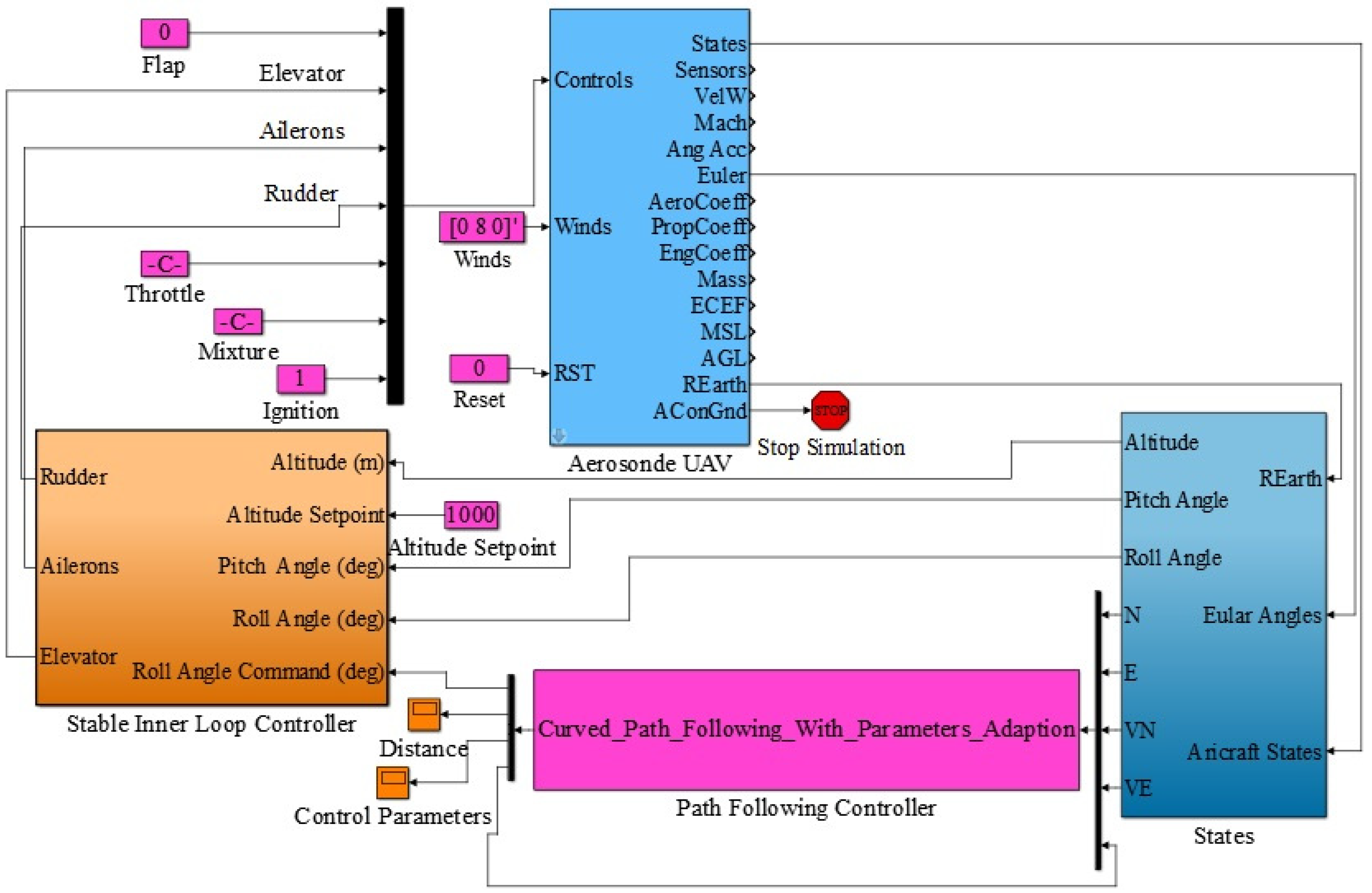
Section 3, a guidance strategy for a class of horizontal path following is derived. The influence of the parameters on the dynamic characteristics of the relative nonlinear system is also analyzed. The detailed rules of the time-varying P-like parameter and the fuzzy logic controller for optimizing the D-like parameter are also presented. The simulation results obtained using an Aerosonde UAV in Matlab/Simulink are given in
Section 4, and some concluding remarks are summarized in
Section 5.
2. Problem Formulation
A small fixed wing UAV equipped with autopilot can realize the stable feedback control of altitude, attitude, and airspeed. In this case, these states converge with the desired response to their commanded values. In typical application fields such as mapping and searching, the airspeed and altitude remain unchanged using a zero climb rate under the control of the autopilot so that the UAV works in the safe flight envelope [
25]. The following kinematic model in the horizontal plane can describes the motion of the fixed-wing UAV:
where
,
, and
denote the inertial position and speed of the UAV in a 2D inertial frame, respectively.
and
represent the
and
components of the wind velocity
.
and
denote the airspeed and heading, respectively.
is the course of the UAV.
is the course rate command of the UAV. When the fixed-wing UAV is flying, the speed
will always be positive. Thus, the following assumption is adopted.
Assumption 1. The speedand its derivativeare both bounded, and, whereandare all positive constants.
Definition 1. (Horizontal Path). Let
be an implicit expression of a reference path, whereis a twice continuously differentiable function.
Definition 2. (
Level Set)
. A level set of a functionis the set, where is a given constant.
Following [
30], the value
when the UAV is in
is used as the distance value. Given that the gradient of
is not zero on the path, the value of
can represent the position of the UAV relative to the desired path. If
, it means that the UAV is on the path.
Let
and
be the first-order partial derivatives of
, and the gradient modules of
is
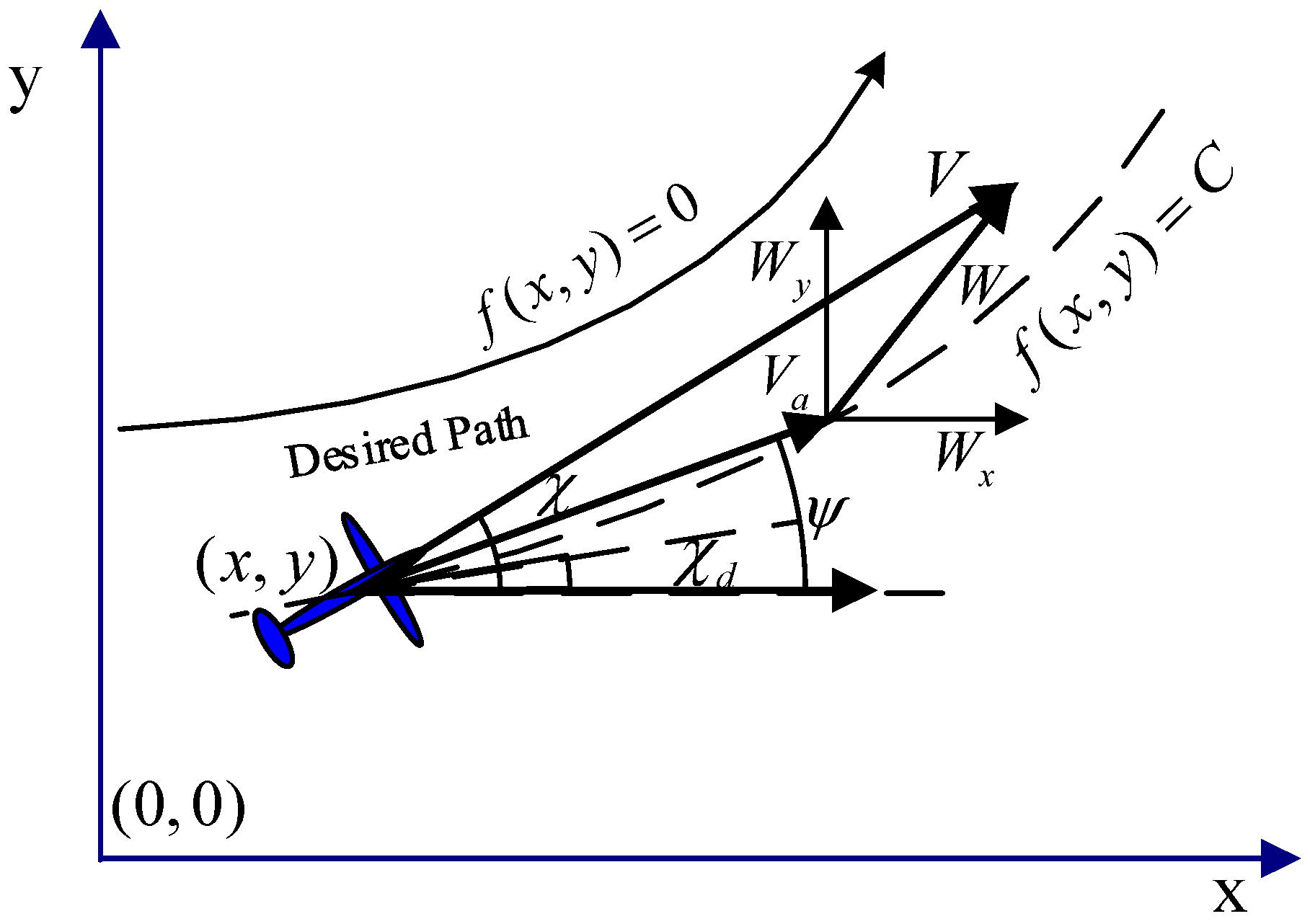
. As shown in
Figure 1, the vector
represents the desired orientation along the level path. The desired orientation
can be given as
For some given , the value of may be zero in some points . If the UAV’s initial position is at these points, the guidance to be designed below will fail, and the UAV will lose control. In the following, the safe flying area for the UAV is defined as , where is a positive constant.
Assumption 2. ,
, , , and are bounded in any bounded domain .
The virtual distance error
is introduced as
By differentiating Equation (3) with respect to time, we obtain
Let the course angle error
be defined as
The error kinematics model suitable for control purposes is summarized as
The Equations (3) and (5) show that if the UAV is flying along the desired path with the right direction, then , and . Thus, the purpose of this study is that, based on the error kinematics model (7), the designed feedback control law should make the errors and converge to zero.
3. Controller Design
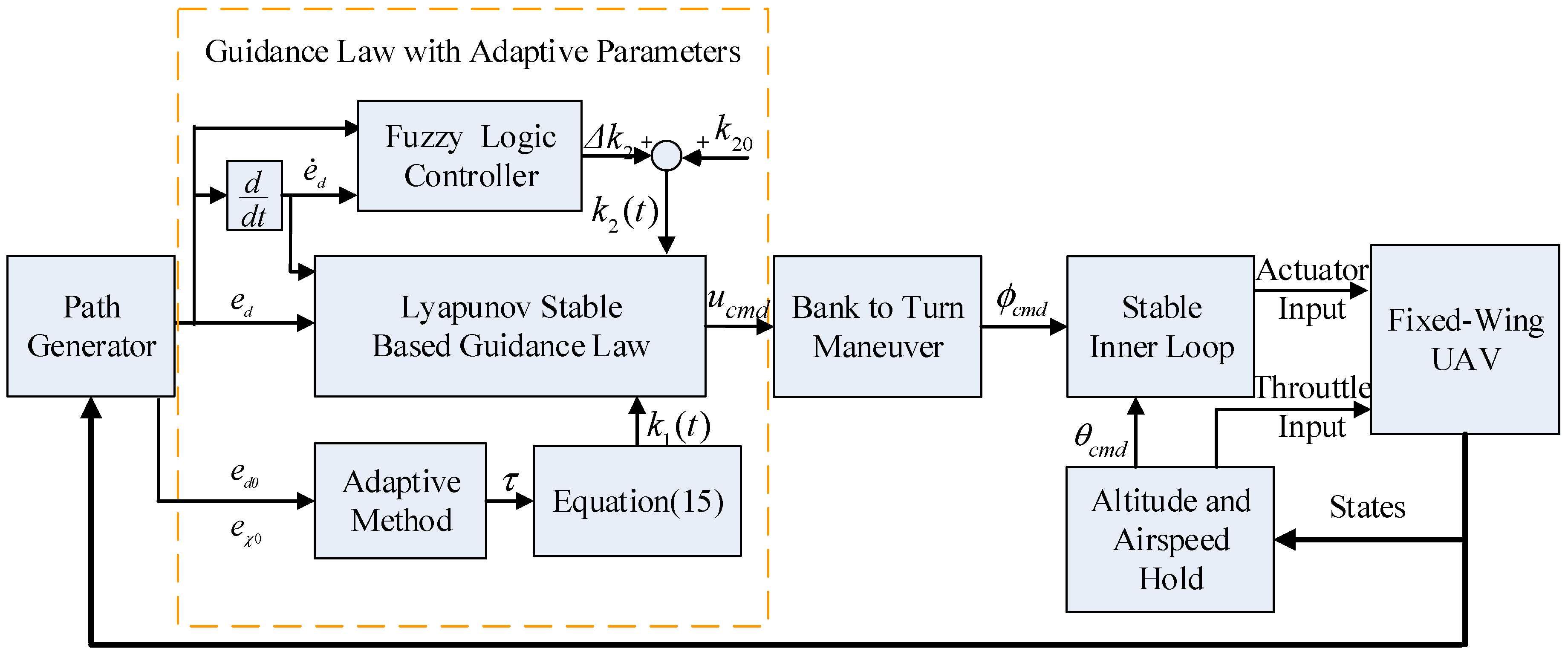
In this section, first, a stable kinematic control law for the course rate command with fixed control parameters is derived based on the nonautonomous systems. Second, the analysis of the control parameters is presented. Third, the nonautonomous systems which will be used to describe the adaptive path following is presented, and the relative control law is designed based on the Lyapunov stability theory. Additionally, the method of parameters adaptation is also described. The sketch of the solution to the curved-path following controller with parameters adaptation is shown in
Figure 2.
3.1. Kinematic Controller Design with Fixed Control Parameters
Theorem 1. Considering the kinematic error model of the UAV described in Equation (7), the following control law,
whereandare all positive constants, is the saturation function defined aswithan arbitrary given positive constant, asymptotically drivesandtowards zero. Proof of Theorem 1. Substitute
shown as Equation (8) into Equation (7), then
Define the domain
, where
is a positive constant, and let
, Equation (9) can be rewritten as
where
It can be found that
is a locally Lipschitz map from the domain
into
with
Assumptions 1 and
2 adopted.
is the only equilibrium point for (11) in
. Let
be a candidate Lyapunov function given as:
Therefore,
. Moreover, if
. If
,
; thus
in
. The time derivative of
U(x) along the trajectory of (9) is
It can be found that
is negative semidefinite. Since
,
,
,
,
, and
are bounded and
, one can derive that
is bounded. It can be found from (12) that
is lower bounded. Since
,
, and their derivatives are all bounded, by (13)
is negative semidefinite and uniformly continuous in time. By Barbalat’s lemma [
31],
as
. Moreover, it has
, and
as in (11). Since
is bounded, it follows that
tends to a finite limit
as
. Since
as
, and
in (11) is uniformly continuous, it derives that
as
. Hence, it follows that
and
. Therefore, the kinematic control law (8) can asymptotically drive
and
toward zero. □
3.2. Figures, Tables and Schemes
For a given initial state of the nonlinear system (9), The behaviors of and are affected by the two control parameters and . In order to study how the parameters will affect the dynamics of the nonlinear system (9), the straight-line and circular paths are chosen for case analysis. The function of a given straight-line path can be expressed as , where and . The function of a given circular path can be described as , where and represent the center and radius of the circle, respectively. With the functions of the straight-line and circular paths described above, the values of the corresponding gradient modulus are all .
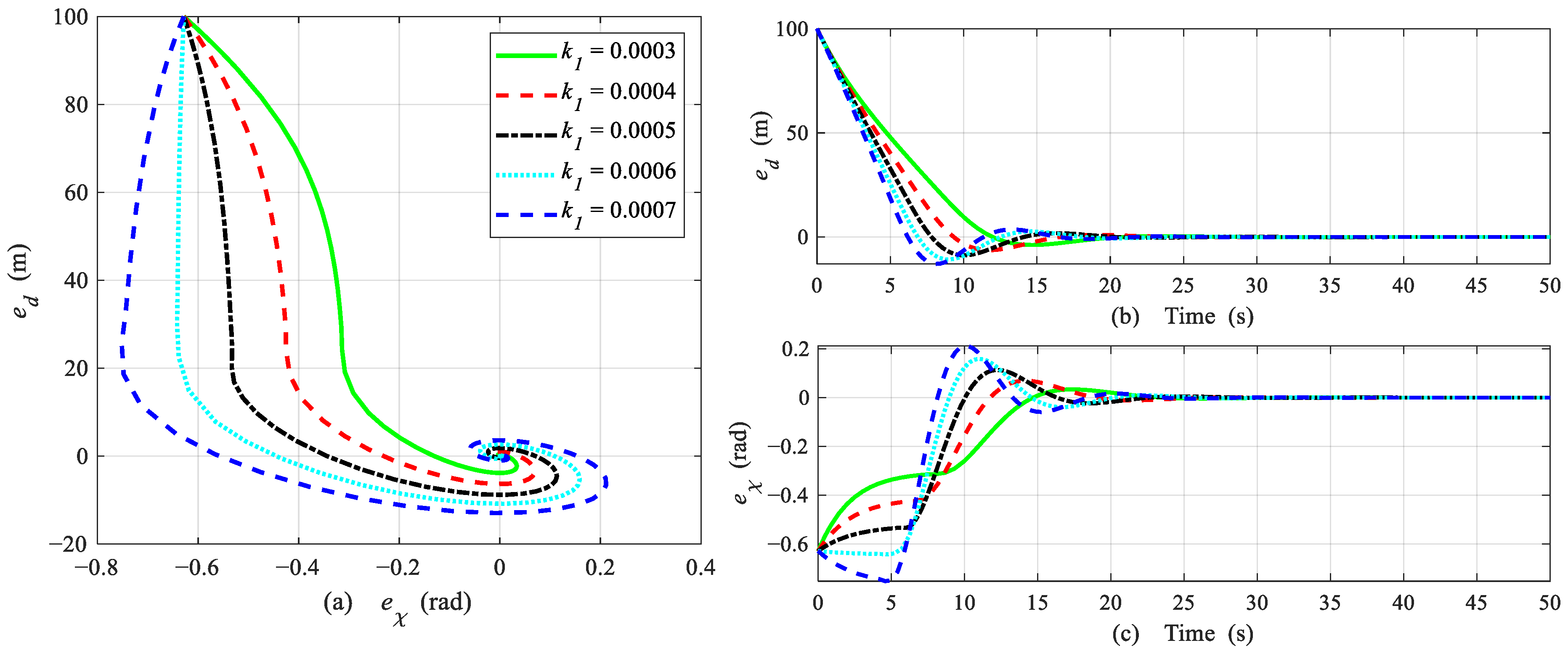
Figure 3a shows the different trajectories of the nonlinear system (9) with
,
V, and
, but under five different values of parameter
. The trajectories of
and
are shown in
Figure 3b,c, respectively. The parameter
directly affects the dynamic characteristics of the two states
and
. With larger value of
the rise times of the two states
and
are all shorter, but the corresponding overshoots and oscillation amplitudes become larger. The smaller or larger value of the parameter
, the faster the convergence speed of the two states.
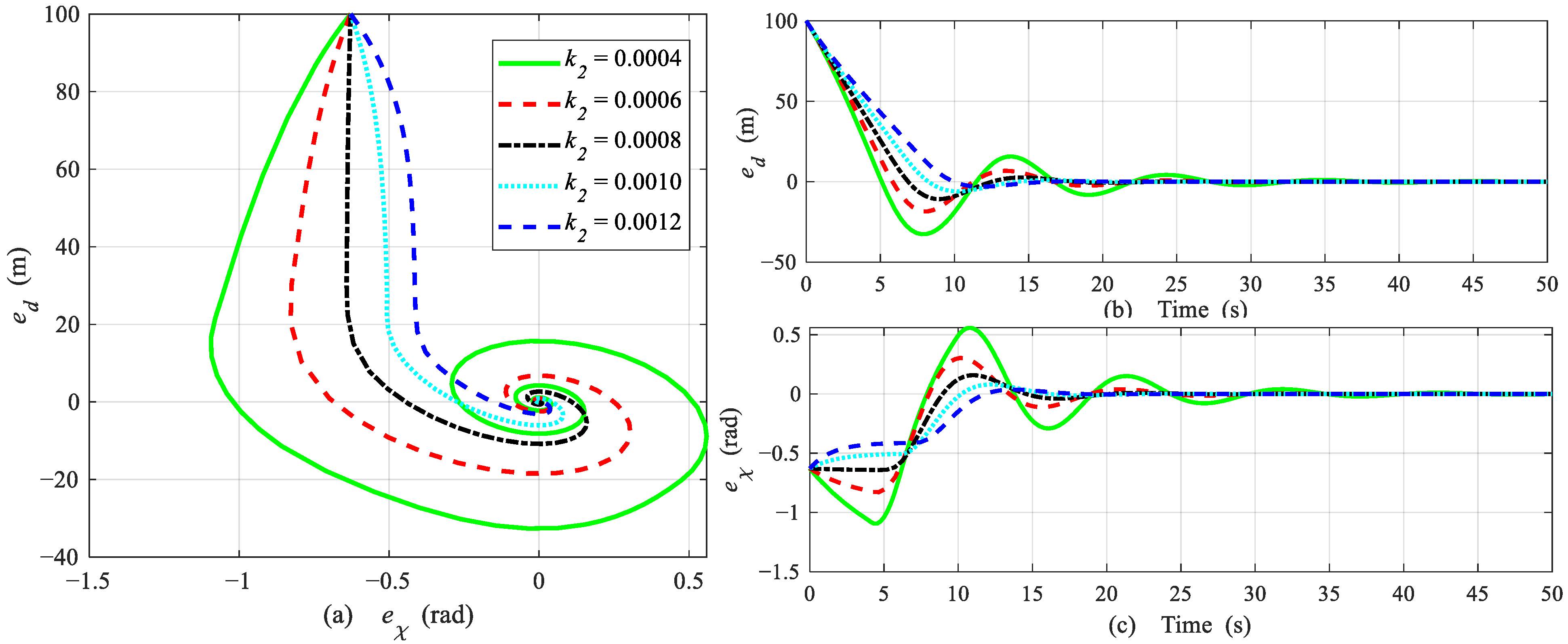
Figure 4a shows the different trajectories of the nonlinear system (9), with
,
V, and
, but under five different values of
. The trajectories of
and
are shown in
Figure 4b,c, respectively. It can be seen that the parameter
significantly influences the dynamics of
and
. With a larger value of
, the overshoots of
and
will both be smaller. The smaller value of
will lead to a larger oscillation amplitude and more oscillation times of
and
. With the increase of
, the rise times of
and
are both longer. Equation (9) shows that the dynamics of
is a nonlinear combination of the variable
and its differential, which is similar to a PD controller. The term
can predict the error trend and correct the error in advance. Thus, the parameter
cannot blindly pursue a large value, but should take an appropriate value.
3.3. Kinematic Controller Design with Time-Variable Control Parameters
The analysis of
Section 3.2 shows that the two parameters
and
will both affect the guidance performance of a UAV. Reviewing the proof process of Theorem 1, as long as the parameter
is always greater than a positive value, the stability of the relative nonlinear system (9) can be guaranteed. At the same time, we hope that for each flight path, under different initial distances and relative course angles, the parameter
can also adapt to the different initial flight states, where the resulting overshoot is small and the convergence speed is fast, whereby the stability of the whole system can also be guaranteed.
In the following, in order to achieve better path-following performance with smaller overshoot and faster convergence speed, a modified control law is introduced as:
where
,
,
are both positive constants with
, and
, are both positive constants with
,
is a positive constant.
Equation (15) shows that the parameter is time-varying. For each given path, the parameter changes from the maximum value to the minimum value over time . This parameter change mechanism can meet the need to use a large value of to make the UAV fly to the target path quickly when the vehicle is far from the target path. When the UAV is close to the target path, the value of becomes smaller, which will reduce the overshoot. The time constant plays an adjusting role in this process. When following the control of each target path, the time constant should be set according to the initial states of the UAV relative to the target path, i.e., the initial distance and relative course angles.
When
, it follows that
and
. Thus,
Theorem 2. Considering the kinematic error model of the UAV described in Equation (7), the control law ucmd(t) shown as (14) will asymptotically drive ed andtowards zero.
Proof of Theorem 2. Substitute
shown as (14) into Equation (7), the corresponding nonautonomous nonlinear system can be shown as:
where
It can be found that is piecewise continuous in t and locally Lipschitz in on . Moreover, , . Thus, is the only equilibrium point for the nonlinear system .
By choosing the candidate Lyapunov function
as
The derivative of
along the trajectories of (19) is given by
Furthermore, with the results shown as Equations (16) and (17), it can be derived that
It can be found that
is a continuous positive semidefinite function on
,
and
are both continuous positive definite on
. It can be found from (22) and (23) that
is lower bounded. Since
,
, and their derivatives are all bounded, by (21)
is negative semidefinite and uniformly continuous in time. By Barbalat’s lemma (p. 323, [
31]),
as
. Moreover, it has
, and
as in (19). Since
is bounded, it follows that
tends to a finite limit
as
. Since
as
, and
in (19) is uniformly continuous, it derives that
as
. Hence, it follows that
and
. Therefore, the kinematic control law (14) can asymptotically drive
and
toward zero. □
3.4. The Adaptive Design of and
In this subsection, the control parameters and are designed adaptively to improve the path-following performance. Since a given smooth path on the plane can be approximated by a certain number of straight lines and arc segments, the following research focuses on the straight-line and circular paths.
Assumption 3. For each straight-line or circular path to be followed, the distance between the UAV and the target path is within 300 m, and the corresponding course angle deviation is within 90 degrees. Thus, the variation ranges of the initial values of the statesandareand, respectively.
As shown in Equation (13), the dynamics of the parameter is determined by the parameter . The adaptive design of is transformed into the optimal design of parameter . In this study, the time constant is selected by analyzing the dynamic response of Equation (9) under different initial conditions. and are chosen as 0.00025 and 0.0001, respectively. The objective is to establish the relationship between the time constant and the initial values of the states and based on Equation (9), when , . In the following, the initial values of the states and are denoted as and for convenience.
Since the analytical solution of the nonlinear Equation (9) cannot be obtained, the numerical method is applied to study its dynamic characteristics. By discretizing the value range of according to equal intervals of length 30, 21 values of are obtained. Similarly, 19 values of the state are obtained by discretizing its value range according to equal intervals of length . Thus, 399 pairs of (are obtained through combination. Under each initial state condition (, the state trajectories of the nonlinear system (9) with and , can be calculated by the fourth order Runge–Kutta algorithm.
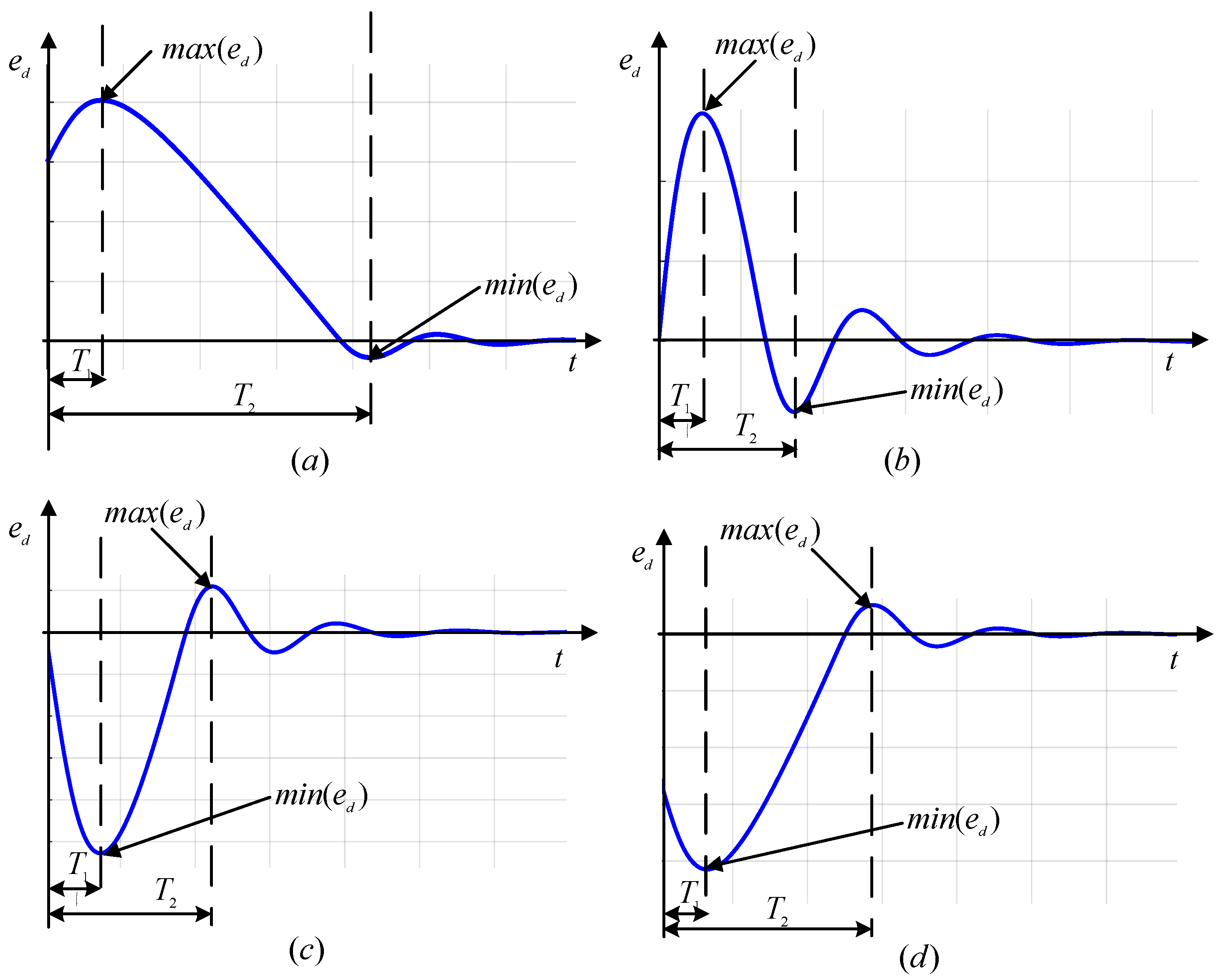
There are four typical trajectories of
under different initial state conditions (
, which can be seen in
Figure 5. As shown in
Figure 5a,b, if
, the time length
is defined as the length of time it takes for the state
to get the maximum value from its initial value. If
, the time length
is defined as the length of time it takes for the state
to get the minimum value from its initial value.
Figure 5c,d shows that, if
, the time length
is defined as the length of time it takes for the state
to get the minimum value from its initial value. If
, the time length
is defined as the length of time it takes for the state
to get the maximum value from its initial value.
In this study, the empirical relationship between the time constant
and the two parameters
and
are selected by analyzing the dynamic trajectory as
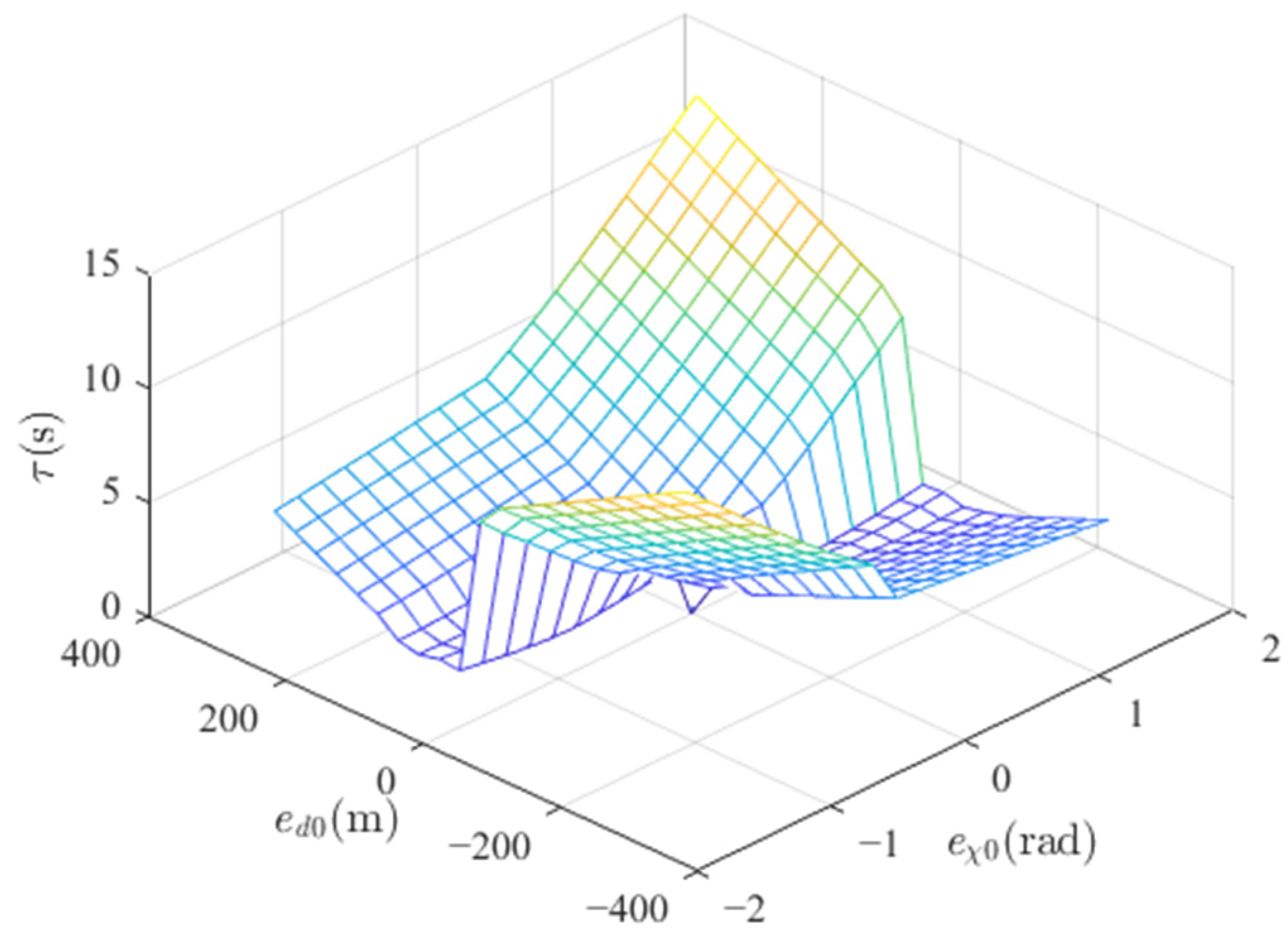
At this time, the discrete relationship between the time constant
and 399 pairs of (
can be obtained, as can be seen in
Figure 6. When following each desired path, the initial state of the UAV will be calculated, and then the corresponding time constant
required to follow this path can be obtained by using the bilinear interpolation method.
According to the analysis shown in
Section 3.2, the value of
k2 should be adjusted adaptively in a certain range near the appropriate value. Additionally, the dynamics of
is a nonlinear combination of the variable
and its differential, which is similar to a PD controller. The method of applying fuzzy logic to a linear PD controller is adopted to the adaptive design of parameter
. In this study, the adaptive parameter
can be calculated around the given nominal value
by a fuzzy logic controller as
where
is the output of the fuzzy logic controller.
While designing the fuzzy logic controllers, the value of
is defined by the fuzzy rules described in
Table 1, based on
and
. The terms NB, NM, NS, Z, PS, PM, and PB stand for negative big, negative medium, negative small, zero, positive small, positive medium, and positive big, respectively.
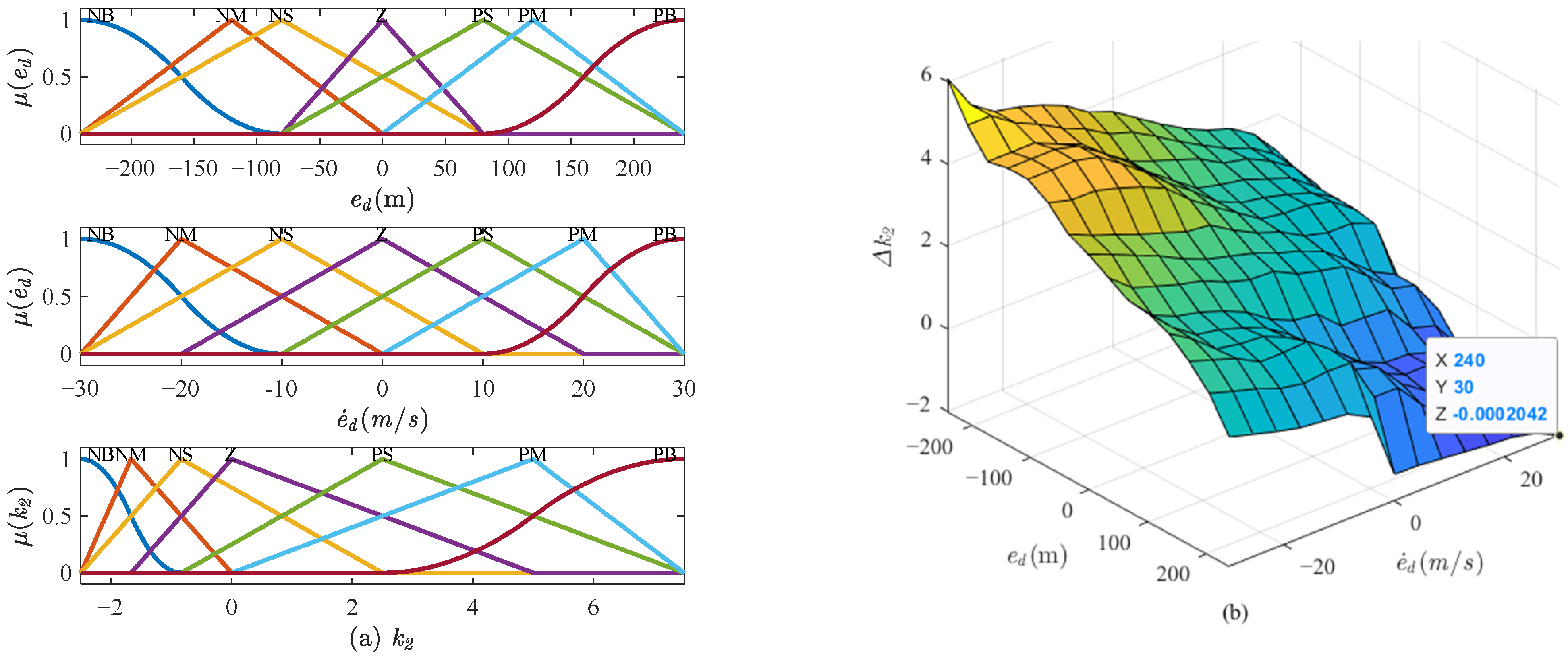
Figure 7a shows the triangular, Z-shaped, and S-shaped membership functions used for the fuzzification of the inputs
and
, and the output
. The universe of discourse of
,
, and
are given as [−240, 240], [−30, 30], and [−0.00025, 0.00075], respectively.
Figure 7b shows the input-output surface for the fuzzy logic controller among
,
, and
. The minimum value of
is −0.0002042. In this study, the parameter
is chosen as 0.0008. Then,
is always positive with
.
5. Conclusions
This paper has considered the problem of horizontal curved-path following using fixed-wing UAV. The guidance strategies are derived using a kinematic model of the aircraft and using the Lyapunov stability theory. The control parameters in the guidance law are time-varying and adaptive to the initial states and dynamics of the corresponding nonlinear system. The rules of the time-varying P-like parameter are designed by using an exponential equation shown as (15), where its corresponding parameter is determined by using the fourth order Runge–Kutta algorithm and the bilinear interpolation method. The rules of the time-varying D-like parameter are designed based on the fuzzy logic technique. The stability of the corresponding nonautonomous nonlinear system is also guaranteed. Finally, we have demonstrated the effectiveness of the proposed strategies in a Matlab/Simulink simulation environment with an Aerosonde model. For the given square and circular paths, the method using the adaptive parameters can make the UAV fly more accurately on the target path based on the performance indexes LOPPF and LOPCPF. In the sense of path following, the proposed method provides a methodology that will be applied to realize the better path following of unmanned systems, including aerial, underwater, and ground-based robots.
In the actual flight process, the roll angle command is bounded, which should be considered in the parameter design of the controller. At the same time, if the bank angle command tracking control response of the UAV is very fast, the method described in this paper will be effective. If its response takes a certain time, the closed-loop roll dynamics must be considered in the design of controller. The closed-loop roll dynamics can be expressed as a first-order system. The follow-up research work will further design the path following controller by using the backstepping technique.
In the future, the closed-loop roll dynamics of the bank angle presented by a first-order system with the unmodeled parts will be used to generate the bank angle command in order to make the vehicle follow the predefined path more precisely. The method to estimate the disturbance described in [
28] will also be considered to design a robust controller.