Abstract
As most of the community discovery methods are researched by static thought, some community discovery algorithms cannot represent the whole dynamic network change process efficiently. This paper proposes a novel dynamic community discovery method (Phylogenetic Planted Partition Model, PPPM) for phylogenetic evolution. Firstly, the time dimension is introduced into the typical migration partition model, and all states are treated as variables, and the observation equation is constructed. Secondly, this paper takes the observation equation of the whole dynamic social network as the constraint between variables and the error function. Then, the quadratic form of the error function is minimized. Thirdly, the Levenberg–Marquardt (L–M) method is used to calculate the gradient of the error function, and the iteration is carried out. Finally, simulation experiments are carried out under the experimental environment of artificial networks and real networks. The experimental results show that: compared with FaceNet, SBM + MLE, CLBM, and PisCES, the proposed PPPM model improves accuracy by 5% and 3%, respectively. It is proven that the proposed PPPM method is robust, reasonable, and effective. This method can also be applied to the general social networking community discovery field.
1. Introduction
1.1. Background
Complex network analysis is an interdisciplinary research field which can be applied in a lot of areas such as computer science [1,2] and social, biological and physical sciences [3,4,5], and it is capturing the attention of many scholars. A complex network is a simple graph defined as a set of nodes connected by a set of edges. Nodes can represent individuals or organizations. Edges are relational ties between two nodes, e.g., friendship relationships between two social users. Graphs are one of the most important and powerful data structures. Complex network analysis and modeling can be used to reveal patterns of social interaction, to study recommendation systems, or protein complexes and protein functional modules. By far the most basic tasks in complex networks are node identification, link prediction, and information dissemination. These tasks have received extensive research and attention. In addition, community structure discovery is also one of the most important tasks; it is usually defined as identifying tightly connected subgraphs from a complex network. Because communities help to reveal the structure–function relationship of the network, it has been studied extensively. For example, communities within cancer networks mark key pathways associated with cancer progression [6], and the communities in the multi-layer transportation network correspond to common practices, which provides clues for airline management [7]. Therefore, a great deal of work has been carried out in the discovery of communities in the network [8,9,10]. A lot of work has been proposed for community discovery, existing algorithms either optimize predefined quantitative functions or acquire potential feature matrices for community detection. Typical methods include modularization-based methods [11], model-based methods [12,13] and random-walk-based methods [14,15,16]. S. Fortunato et al. [17,18] have conducted a comprehensive survey.
However, all these methods assume that the target network is static and ignore the timeliness of the network. In reality, many networks from society and nature are dynamic, meaning that the network structure changes over time; that is, it performs the dynamic network. More specifically, in a dynamic network, nodes may appear or disappear over time, and links between two nodes may also appear or disappear. For example, interpersonal relations often change due to individual behavior [19]. For another example, tumor cell migration leads to metastasis, which is crucial for the diagnosis and treatment of tumors [20]. Therefore, it is worthwhile to track how a community evolves in a dynamic network (also known as a dynamic or evolutionary community).
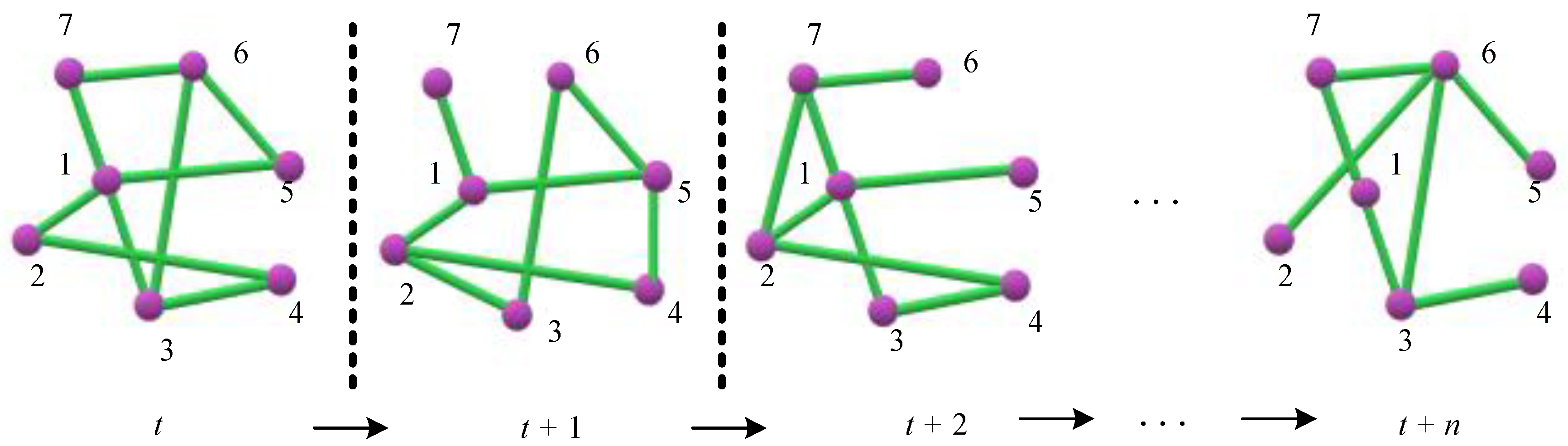
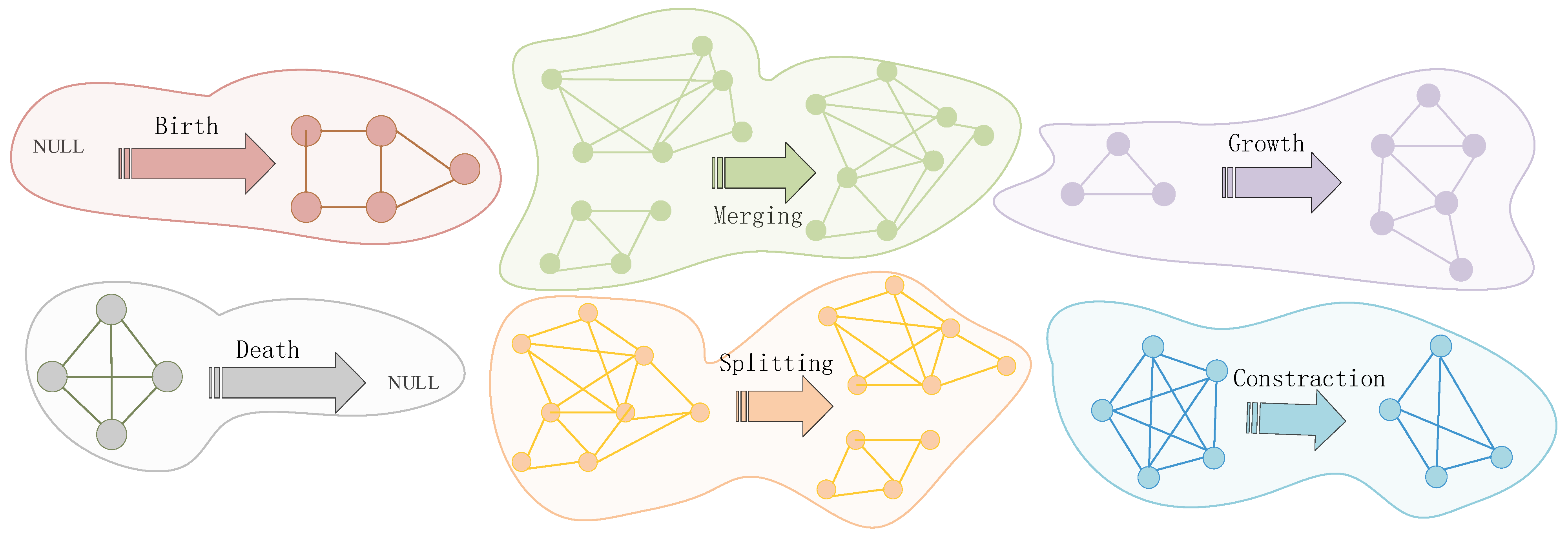
For dynamic network modeling, the most widely used method is to introduce explicit smoothing frameworks, which quantifies the similarity between snapshots in two subsequent steps by introducing the Temporal Smoothed Framework (TSF). Various TSF-based algorithms have been proposed to evolve the community by extending the static community discovery algorithm. For example, for topological connectivity, the Kim-Han algorithm [21] found dynamic communities by optimizing modularity, and the DYNMOGA method [22] is presented for the multi-objective genetic algorithm to simultaneously optimize clustering accuracy and clustering drift. Regarding matrix decomposition, the ESPC method [23] is used with matrix spectrum, the ECKF method [24] is proposed by using kernel ENMF, and the Se-NMF method [25] is used by a semi-supervised strategy to develop community testing. The Gr-NMF method [26] is adopted by graph-regularized NMF for community discovery in evolution. In the probabilistic model: FaceNet method [27] is researched by using Maximum a Posteriori (MAP) estimate, DSBM method [28] adopted the Bayesian method to obtain the evolving community by extending the random block model. According to the existing literature [29], there are six evolutionary events in the community (as shown in Figure 1), including birth, death, growth, contraction, merging, and splitting. Sometimes, a seventh event is added to these, i.e., continuing. Finally, an eight event was proposed by Cazabet and Amblard [30] and it is resurgence. A generic dynamic community discovery algorithm does not necessarily have to handle all these events, which can be differently managed in different works [31].
Figure 1.
6 evolutionary events in dynamic communities.
1.2. Motivation
While much work has been carried out to address the problem of dynamic community discovery, there are still some issues that need to be addressed.
Firstly, most existing dynamic network models assume that it is a hidden Markov structure, in this structure, when the current network state is given, a network snapshot at any given time is conditionally independent for all previous snapshots. This approach may not be flexible enough to replicate some of the observations in real network data.
Secondly, the dynamic system is used by filters, even for Gaussian distributions. However, after a nonlinear transformation, Gaussian terms are lost. Mean and covariance are the only measures computed by the filter. This is the result of a nonlinear transformation approximated by Gauss, and therefore this approximation may be poor.
Finally, how to combine the information of the community structure available at the previous moment with the information available at the current moment is an important question. In the traditional hidden Markov dynamic Bayesian network model, the probability of an edge appearing in a dynamic network is realized by the estimated state.
Therefore, this paper proposes a phylogenetic planted partition method, which uses the graph optimization strategy to continuously discover the evolving communities.
1.3. Our Work and Contributes
The main contributions of this paper can be summarized as follows:
- (1)
- The time dimension is introduced into the typical stochastic block-model, and all states in the whole dynamic network system are treated as variables, and the observation equation is taken as the constraint between variables to construct an error function about the whole dynamic network system.
- (2)
- By adopting the graph-based optimization strategy, the constraints in the entire motion trajectory can be considered once. In the linearization process, only the Jacobian matrix is calculated, and the calculation process is also relative to the entire motion trajectory. Therefore, the entire system evolution process is transformed into the nonlinear system optimization process.
- (3)
- In natural ecosystems, inspired by the evolutionary thinking of species populations and combined with the typical probability model of stochastic block-model in community discovery, a phylogenetic planted partition method (PPPM) for dynamic community discovery is proposed.
- (4)
- The proposed PPPM method in the two scenarios of artificial network and the real network is verified by experiments, which proves that the performance of the novel method is better than the four state-of-the-art methods (FaceNet, SBM + MLE, CLBM, and PisCES).
1.4. Organization
The remainder of this paper is structured as follows: In Section 2, related work is discussed; Section 3 introduces the proposed model in detail, describes the proposed PPPM method, and gives the derivation process. In Section 4, the experimental results of the novel PPPM method in the artificial dynamic network and real dynamic network are presented, and then compared with other existing models. Finally, in Section 5, some conclusions are given and future directions are discussed.
2. Related Work
According to the research of Aynaud et al. [32], the dynamic community discovery algorithms can be divided into four categories: coupling network, two-stage algorithm, evolutionary clustering, and probability model. However, Hartmann et al. [33] believed that all existing dynamic community discovery methods can be identified as online or offline methods. Rossetti and Cazabet [31] proposed a new survey on community detection in dynamic networks, which proposed the unique functions and challenges of dynamic community discovery algorithms.
The first kind of coupled network-based algorithm firstly builds the network by fusing edges at different times. Then, the classical static community detection algorithm is used to find the communities in the coupled network. For example, Agarwal et al. [34] discovered the ongoing events in the microblog message flow by adding edges between vertex instances at different times to build the coupling network, in which the dynamic community corresponds to the community in the built network. Because coupled networks cannot fully describe the dynamic characteristics of networks, these algorithms have been shown to accurately discover only short-cycle communities. To overcome this problem, the second kind of two-stage algorithm separated the community detection from the community dynamic, avoiding the coupling of the dynamic network.
Specifically, these algorithms used static community detection algorithms to find the community each time and then connected the community the next two times to extract the evolving community. Typical algorithms included GraphScope [35] and TRMMC [36] coupled networks and two-stage algorithms that detected dynamic communities in a dynamic network by simply extending static community detection methods and detecting dynamic communities in each operation dynamic network or static community. In general, these algorithms can achieve better performance in the case of weak network dynamics. In this case, the dynamic update method can accurately identify the dynamic community without running the community detection algorithm each time, and only need to update the previously discovered community. However, the accuracy of these algorithms is low.
The third type of dynamic community discovery method is related to clustering evolutionary, which is proposed by Chakrabarti et al. [37]. They extracted the implicit community structure in each snapshot, which is one of the most widely used methods for dynamic community discovery. The evolutionary clustering algorithm adopted the assumption of time smoothness. The community structure will not change much over a continuous-time slice. This time smoothing method can be used to overcome the randomness. Compared with other algorithms, the evolutionary community discovery algorithm aims to discover a smooth sequence of communities in a series of network snapshots (as can be seen in Figure 2). The overall objective function of the evolutionary algorithm can be decomposed into two parts: Snapshot Cost (CS) and Temporal Cost (CT) [38].
Figure 2.
The series of network snapshots.
Among them, CS measures the adaptability of the community structure and network at the time , while CT measures how similar the two community structures (the community structure is acquired at the time to the structure is obtained at previous time ). The parameter is for balancing the importance between and . By introducing different object functions based on modularity, normalization of mutual information and spectrum clustering et al., this framework has been used in much of the literature [39,40] to discover communities in dynamic networks.
Folino and Pizzuti [39] formalized the dynamic community discovery algorithm as a multi-objective optimization problem, which maximized the clustering accuracy of the current time step and minimized the clustering drift from one time step to one successive time step. Ma and Dong [40] proposed two evolutionary non-negative matrix decomposition (ENMF) frameworks and proved the equivalence relation between evolutionary module density and evolutionary spectrum clustering. In addition, they introduced a semi-supervised approach, which is called sE-NMF, that incorporated prior information into the ENMF.
Chi et al. [23] extended this idea with two frameworks of evolutionary spectral clustering, which are defined as Preserving Cluster Quality (PCQ) and Preserving Cluster Membership (PCM). Both frameworks have proposed the optimization and correction cost functions, but they differ in how to define the CT. In the PCQ framework, the CT is the cost of the clustering results at the time applied to the similarity matrix at the time . In PCM, the CT is defined as a measure of the distance between the clustering results at the time and . In the PCQ:
where and represent the adjacency matrix at the time and , respectively.
Finally, the membership of community members can be obtained by calculating the eigenvector of Formula (3).
After the above work, an evolutionary community discovery algorithm is proposed to try to optimize the modified cost function in the definition. Since the user definition of snapshot and CT of community discovery results varies with community discovery algorithms, the aim of the above work is to solve the problem of how to select the parameter , which can determine how much weight to assign to previous data or community discovery results.
Xu et al. [41] proposed an adaptive evolutionary clustering algorithm, using the following smooth approximation matrix to better estimate the network state.
where the parameter controls the rate of forgetting past information, so it is also defined as a forgetting factor.
Ma et al. [26] proposed a non-negative matrix decomposition for co-regularization evolution to identify dynamic communities under a time-smoothing framework.
where and are regularized parameters.
In recent years, researchers have proposed some excellent techniques to improve the performance of dynamic community discovery algorithms. In the probability model, the researchers have put forward an innovative model, and this paper puts forward a new dynamic model, which is suitable for dynamic Bayesian networks, namely the system evolution partition transplantation model. In this method, the model parameters are tracked by using the graph of optimization strategy. Table 1 compares some recent representative dynamic social network discovery algorithms based on a probability model.
Table 1.
Comparison of our work with previous model literatures.
3. Meterials
3.1. Formal Definition
In this paper, a novel phylogenetic planted partition model is defined for temporal social networks by the following definitions:
Definition 1.
A social network can be represented by a graph, , on a set of nodes, , and a set of edges, . Nodes and edges are represented by an adjacency matrix , where represents the existence of an edge from node to node , and represents the absence of an edge. This paper assumes the network is a directed graph, which is generally and has no self-loop, namely .
Definition 2.
The positive integerrepresents the number of nodes, andis the probability vector on(is the number of network communities).is a symmetric matrix whose element isbetween [0,1].is defined under the Stochastic Block-Mode (SBM). is adimensional random vector; it is independent and identically distributed under. Let the community setdenotes the division of into communities. In this paper, we use the symbols and to indicate two generic communities, and , where and are the two nodes of a simple graph of vertices, which respectively belong to (i.e., ) and (i.e., ) at time . Nodes and are connected according to a probability , independently from the other node pairs. Therefore, the probability distribution of [50] is as follows, where .
where represents the observed value of the number of edges in the partition, which can be expressed as ; represents the probability value of the number of edges in the partition, which can be expressed as follows.
Equation (8) can be rewritten by:
Definition 3.
Define an evolutionary sequence of discrete time steps for social network (dynamic Bayesian network); the nodes and edges may appear or disappear with time. The temporal social networks can be expressed as, where, superscriptrepresents the time step,and, respectively, in the time step arecollection of nodes and edges. Letrepresent the sequence of adjacency matrix on the node-set sequence, and letrepresent the sequence of community member membership vectors of the node. For this dynamic social network, the probability distribution of edges can be defined as:
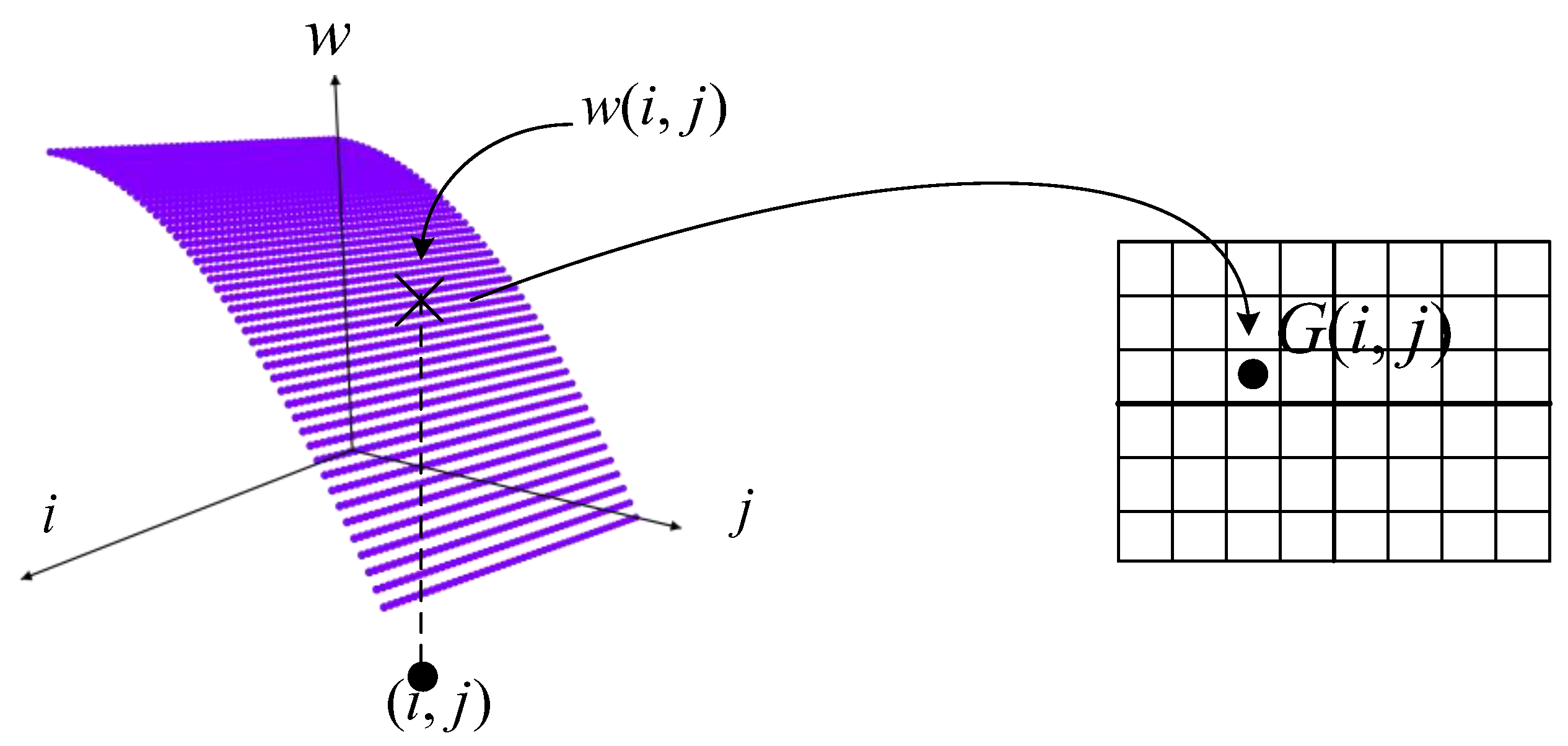
For any pair of nodes and at and , s.t. . Namely, there is an edge from node to the node at the time and is Independent Identically Distributed (IID). The same is true for . The mapping process of random sampling and probability allocation is shown in Figure 3.
Figure 3.
Randomly sample and allocate with probability , .
Figure 3 shows the hypothesis of this paper. There are only two possibilities for random events: existence or non-existence of edges. In this paper, we randomly sample and allocate , with probability , . Each term of the adjacency matrix is independent. Therefore, Equation (10) can be rewritten as the likelihood form with parameter .
where and are, respectively, denoted as follows:
3.2. A Migration Partitioning Model for Phylogenetic Evolution
The proposed dynamic community discovery method can track the status of the target over time to discover community results. Therefore, this paper constructs an observation model, which can be described by
where is an independent Gaussian noise matrix with zero mean and variance . This matrix reflects the transient variations caused by noise. In this paper, we assume that are independent of each other.
In the dynamic system model, expresses the set of observed values, and represents the state of the sequence of observed values that generate noise in the dynamic system. This paper refines the final model by modeling the evolution of specified states over time. Because is a probability between , and this paper deals with in logarithmic form, that is, , then a time-series dynamic observation model of system evolution can be constructed as follows:
where denotes the state transition model, represents the vector metric representation of matrix , implies the process noise, is a random vector with zero mean and is the covariance matrix. According to the vectorization expression of and observation noise , the observation model (15) can be rewritten as:
The logical activation function is handled by the Sigmod function, which is:
This paper assumes that the initial state of the dynamic system obeys the Gaussian distribution, namely, . The nonlinear optimization problem in the time-series dynamic observation model of system evolution is constructed in this paper, which is the problem of calculating the Maximum a Posteriori (MAP) of , while for Gaussian distributions, the maximization problem can be translated into the negative logarithm problem of minimizing the target probability . Therefore, Equation (12) is converted into the following logarithmic likelihood:
The following error function will be constructed:
Then, minimize the quadratic form of the error function:
Finally, make the first-order expansion of :
where is the derivative of with respect to , which is actually a matrix of , which is also Jacobian. The derivative problem can be turned into a recursive approximation problem; therefore, L–M method is adopted in this paper to determine the step size , the L–M method avoids the non-singular and morbid state properties of the coefficient matrix of linear equations and can provide a more stable and accurate increment . In the previous methods, as the approximate second-order Taylor expansion adopted in the GaUSs-Newton method could only have a good approximation effect near the expansion point, a trust-region is added to . It should be noted that the trust-region should not be so large that the approximation is inaccurate. The approximate value in the trust region is considered to be valid; when it is outside of this region, the approximation might go wrong. The scope of the trust region is determined by the difference between the approximate model and the actual function. Determine rules: if the differences are small, let the scope be as large as possible; if the difference is large, narrow the approximation. Therefore, Equation (22) is used to judge whether the Taylor approximation is good enough or not.
where the numerator is the decreasing value of the actual function, and the denominator is the decreasing value of the approximate model. If is close to 1, then the approximation is good. If is too small, meaning that the actual reduced value is far less than the approximate reduced value, then the approximate result is considered to be poor and the approximate range needs to be narrowed. On the contrary, when is large, it means that the actual decline is larger than expected, and the approximate range can be enlarged.
Because the temporal dynamic observation model of system evolution constructed is nonlinear and is not easy to obtain, this paper intends to adopt an iterative method (if there is an extreme value, then convergence to approximation) to converge the approximation. The steps are shown in Algorithm 1.
where the limiting condition is the radius of the trust region. In Equation (21), the incremental range is limited to a sphere of radius , which is seen as an ellipsoid after multiplying by . is taken as a non-negative diagonal matrix, usually with the square root of the diagonal element , and it is equivalent to directly constraining in the ball.
where is the Lagrange multiplier. Finally, this paper needs to obtain the gradient by solving the objective function (23). Since it is an optimization problem with inequality constraints, the Lagrange multiplier is used in this paper to transform the objective function into an unconstrained optimization problem. Additionally, then the target function is transformed.
| Algorithm 1: Main procedure of the iterative method |
| 1. Given an initial value , radius and parameter k |
| 2. for the k-th iteration, solving: , s. t. |
| 3. Compute |
| 4. if |
| 5. |
| 6. else if |
| 7. |
| 8. |
| 9. if convergence |
| 10. break |
| 11. end |
Let us expand out the square of the target function of (23).
Then, solve the derivative of in Equation (24) and set it to zero:
The following equations are obtained:
Let , the right-hand side of the equation be defined as , and the equation can be simplified as follows:
In the initial time step of the algorithm, the proposed PPPM method is initialized with the spectral clustering algorithm; that is, the initial estimation of community is generated at the time . The advantage of using the spectral clustering algorithm as the initialization algorithm here is that it can prevent the local search from falling into poor local maximum in the initial time step. The main procedure of the proposed PPPM method can be shown in Algorithm 2.
| Algorithm 2: The main procedure of PPPM |
| Input:, k//dynamic networks and the number of communities Output://the community 1. at |
| 2. Initialize by using spectral clustering applied on |
| 3. at |
| 4. if iteration max iteration//hill-climbing algorithm |
| 5. //negative Log of the best adjacent case till to a constant |
| 6. //currently being traversing case |
| 7. for to do//traverse all adjacent solutions |
| 8. for to ; s.t. do |
| 9. //change community of a node |
| 10. compute using Equations (15)–(17) |
| 11. compute Log using (18) |
| 12. if then//current case is the best case |
| 13. |
| 14. //refresh community of current node |
| 15. if then//the best adjacent case is better than the current best case |
| 16. |
| 17. else//achieve a minimum |
| 18. break |
| 19. end |
| 20. end |
| 21. return |
4. Results
In order to prove the rationality of the novel proposed method, four algorithms are compared, namely FaceNet [27], SBM + MLE [48], CLBM [49], and PisCES [51]. Firstly, FaceNet was chosen because it was the first proposed dynamic web community discovery algorithm that could be compared as a baseline; secondly, SBM + MLE and CLBM were used because they are the latest proposed probabilistic model-based algorithms; finally, PisCES is also a recently proposed non-probabilistic model algorithm. In this paper, the indicators of the following two evaluation models are adopted.
- (1)
- Adjust Rand Index (ARI), , if the value of ARI is closer to 1, it means better results.where represents the expected value of and denotes the maximum value of .
- (2)
- Mean-squared errors (MSE), the smaller the value, the smaller the error, that is, the better the result.where is the real data, expresses the fitting data, and implies the number of samples.
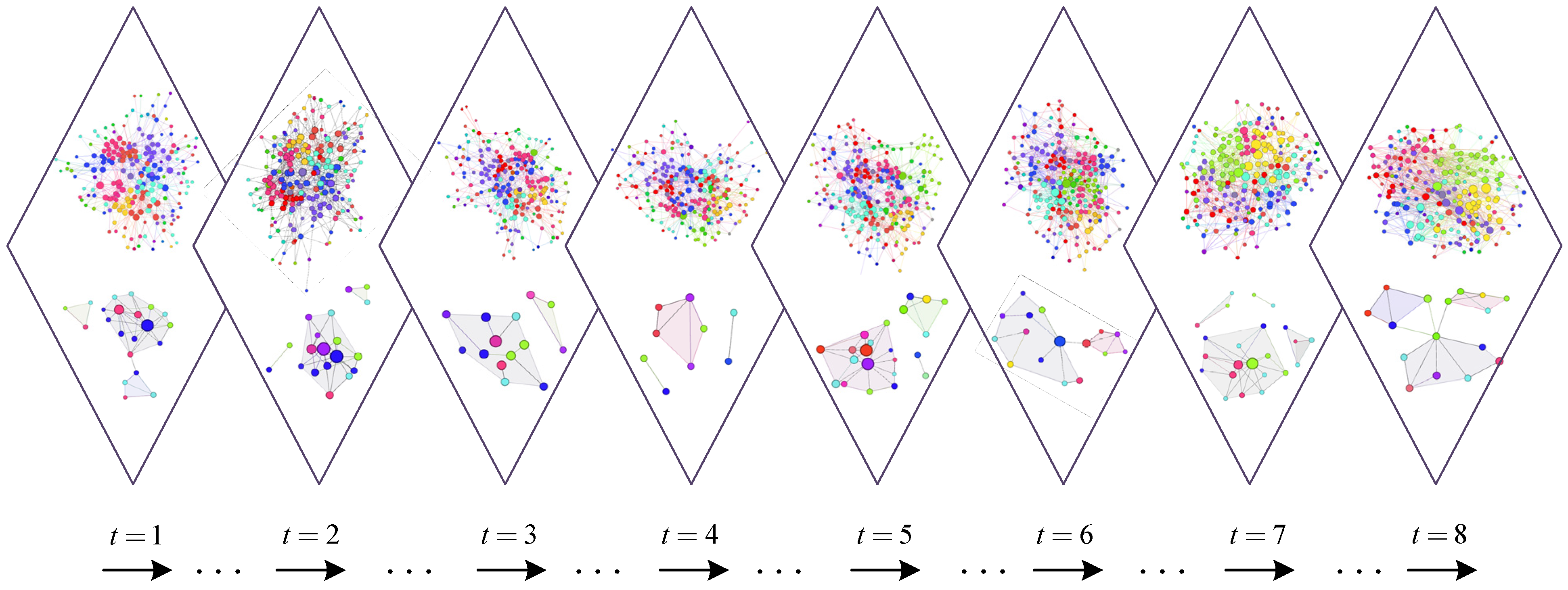
Figure 4 can simulate the evolution process of an artificial dynamic network over time. The network consists of 156 nodes and 614 edges, and a total of eight time steps are set.
Figure 4.
The simulation of the evolution process of an artificial dynamic network.
In Figure 4, there are eight rhombic blocks, and the whole dynamic social network can be represented by the evolution of these eight rhombic blocks over time. The upper part represents the dynamic network of a time step, the lower part denotes the community where the current time step may exist, and the lower part is composed of the nodes with the highest degree of nodes of each color in the network absorbing nearby nodes to form larger nodes. (Absorption rule: connected with the node with the greatest degree and with the same color). For example, in the lower half , there are three submodules, each of which represents a possible community. More specifically, each submodule can be composed of nodes of different colors and sizes, and each color can represent nodes with the same characteristics in the dynamic social network. it can be seen that the community structure of dynamic social networks is phylogenetic over time.
4.1. Synthetic Networks
The artificial network is generated in this paper, which consists of 128 nodes, initially divided into four communities, where each community has 32 nodes. At the initial time step, the edge probability of the system evolution migration partition is set as and ( and ). The initial covariance is set to the identity matrix . The state vector G evolves according to the Gaussian random walk model, namely in Equation (15). This paper generates 25 and 50 time steps. At each time step, nodes are randomly selected to leave their communities and randomly assigned to one of the other three communities. Table 2 statistically compares the proposed PPPM method with the average ARI experimental results of multiple parameters of four representative models in an artificial network environment.
Table 2.
The results of the proposed PPPM and representative model on the Mean ARI (synthetic data).
In Table 2, bold font indicates that the result is the best. It can be clearly seen that the proposed PPPM method has the best performance under all parameters. It can be calculated that the average performance of the novel method is improved by 0.05 compared with the other four best models.
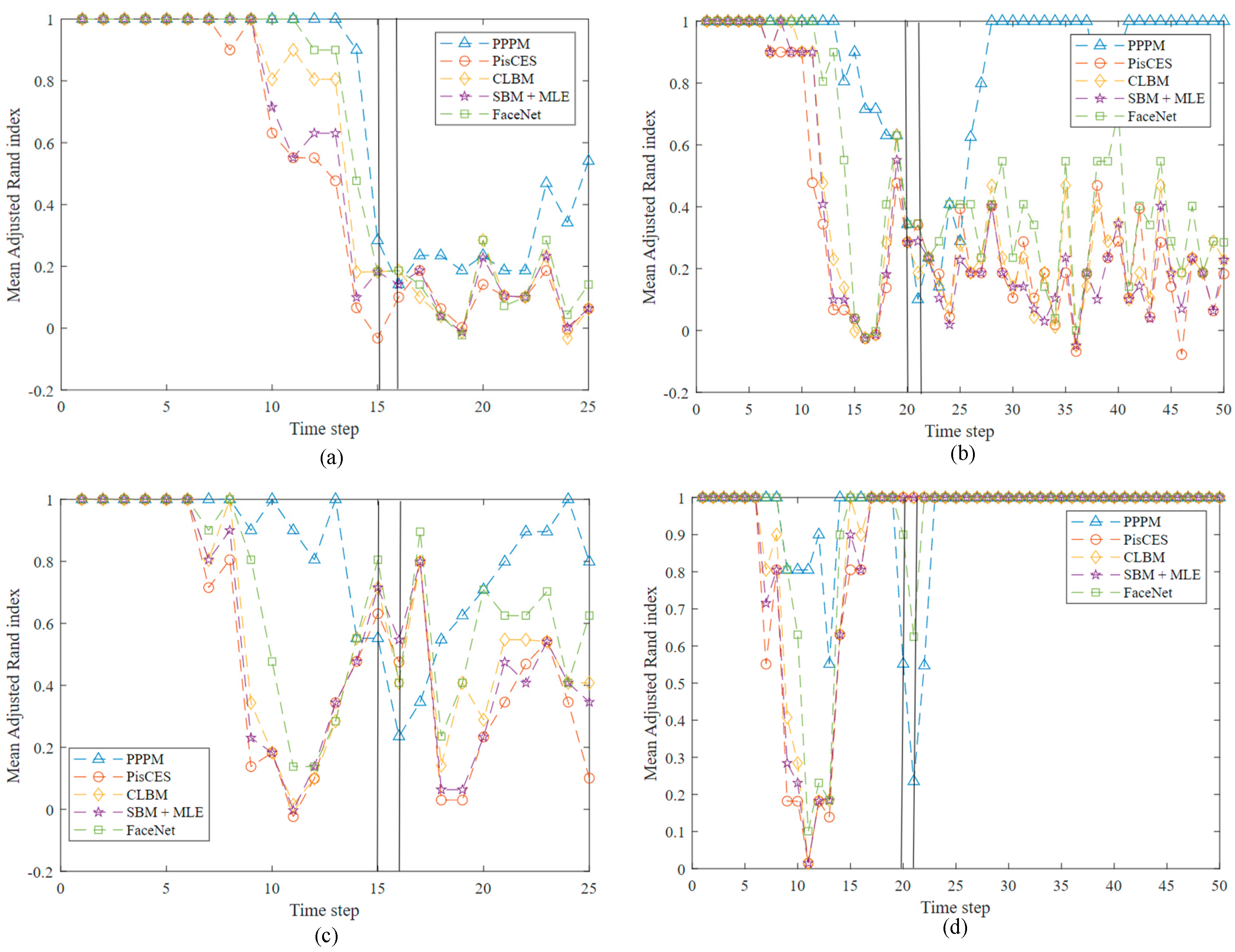
Figure 5 shows the comparison of average ARI results between the proposed method and four representative models in an artificial network environment.
Figure 5.
Comparison of the proposed model with 4 different models on Mean ARI (synthetic network). (a) indicates that the time step is 25 and the randomly selected parameter is 10%, (b) indicates that the time step is 50 and the randomly selected parameter is 10%, (c) indicates that the time step is 25 and the randomly selected parameter is 20%, (d) indicates that the time step is 50 and the randomly selected parameter is 20%.
As shown in Figure 5a, 25 time steps are generated by the artificial network. On each time step, the randomly selected parameter is set to 10%. In this experiment, the parameters of the noise item are changed at the 15th time step (the left line) and set back to the original state at the 16th time step (the right line). It is evident that in the 15th time step, the only two models with SBM and PPPM + MLE line charts show the correct change in trend, i.e., a downward trend, and the proposed PPPM method declines faster, and the increasing trend of PisPCES, CLBM, and FaceNet are unaffected and keep the previous state, after the 16th time step, which also can obviously show that compared with the other four kinds of models, the novel method callback trend is more obvious. This indicates that the proposed novel method has a more consistent response to noise terms.
In Figure 5b, the artificial network generates 50 time steps, randomly selects parameters and sets them to 10%, changes the parameters of the noise item at the 20th time step (the left line), and sets them back to the original state at the 21st time step (the right line). It is evident that in the 20th time step, the only two models with PPPM and CLBM line charts show the correct change trend, i.e., a downward trend, and PPPM declines faster, and PisPCES and FaceNet are on the rise, with SBM CLBM + MLE remaining unaffected and they to keep the previous state, after the 16th time step, which also can obviously show that compared with the other four kinds of models, PPPM callback trend is more apparent in terms of reverting to the previous state, which shows that this paper proposed the model of response that is more consistent in noise.
In Figure 5c, the artificial network generates 25 time steps, randomly selects parameters and sets them to 20%, changes the parameters of the noise item at the 15th time step (the left line), and sets them back to the original state at the 16th time step (the right line). It is obvious that at the 15th time step, the line graph of all models shows the correct trend of change, namely the downward trend. It is worth noting that the downward trend of PPPM is the most obvious. After the 16th time step, it is also obvious that compared with the other four models, the proposed novel method has a more obvious callback trend, which also indicates that the novel method has a more consistent response to the noise term.
Figure 5d shows that the artificial network generates 50 time steps, randomly selects the parameters and sets them to 20%, changes the parameters of the noise item at the 20th time step (the left line), and sets them back to the original state at the 21st time step (the right line). It is evident that in the 20th time step, only two models with PPPM and FaceNet line charts show the correct change trend downward trend, and PPPM decline faster, while the remaining three kinds of model, CLBM, SBM + MLE, PisPCES, are not affected, and keep the previous state; after the 16th time step, PPPM and FaceNet all can to go back to the previous state, which demonstrates that the proposed method has a more consistent response in noise.
In conclusion, in the artificial network, this paper proposed a dynamic community-found PPPM method compared with the other four kinds of a typical model. The model is tested in the perturbation parameter test (the noise is changed in a particular time step). The prediction accuracy of the model index (ARI) increased by 5% on average, and the experimental results show that the proposed model is robust.
4.2. Real-World Networks
4.2.1. MIT Reality Mining
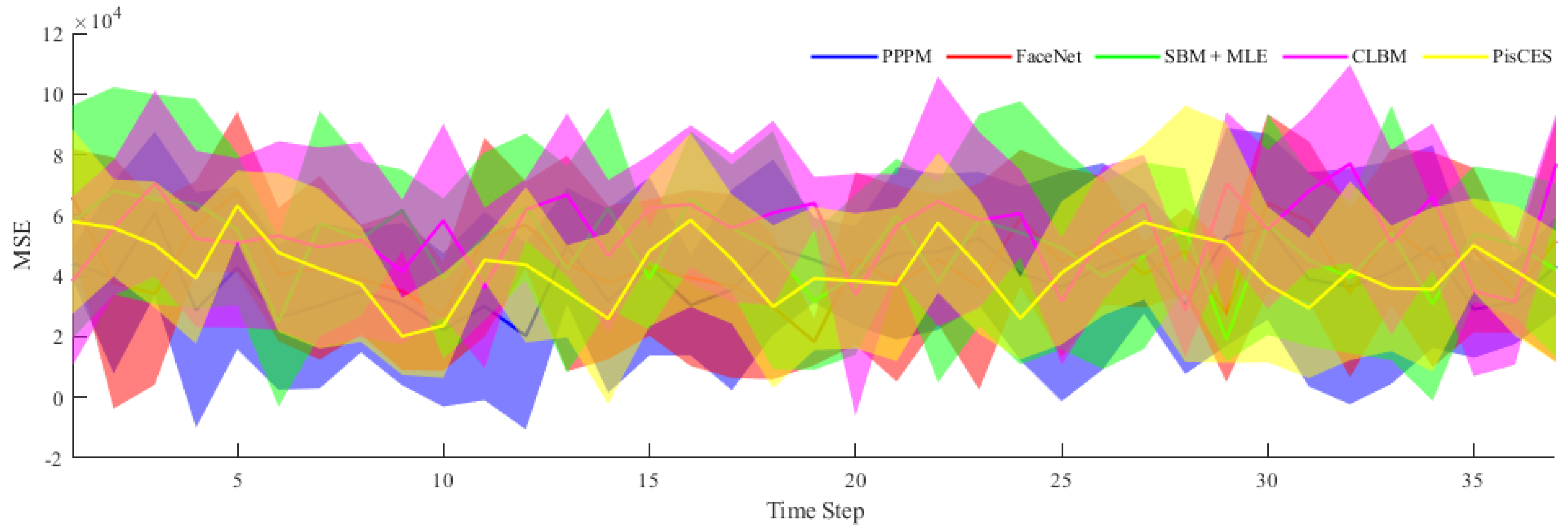
This experiment is conducted on the MIT dataset [52]. The dataset is collected by recording the mobile phone activity of 94 students and employees over a year. The dataset built a dynamic network based on physical distance, which is measured by scanning nearby Bluetooth devices every 5 min. Data collected near the beginning and end of experiments with low participation rates are excluded in this experiment. Each time step corresponds to one week, so there are 37 time steps between August 2004 and May 2005. Figure 6 shows the mean-variance error results of the proposed novel method and four representative models under the artificial network.
Figure 6.
Comparison of the proposed method with 4 different models on MSE (synthetic network).
Figure 6 shows that, under the MSE evaluation index, the smaller the error, the better the result; that is, the closer the model image is to the x-axis. Obviously, compared with other colors (the other four models), the image with blue color (the proposed method in this paper) is closer to the x-axis; that is, the proposed PPPM method has a lower MSE value and a smaller error. Table 3 compares the average ARI results of the proposed method with those of the four representative models in the real network (MIT reality mining) environment.
Table 3.
The results of the proposed PPPM method and representative model on the Mean ARI (real data).
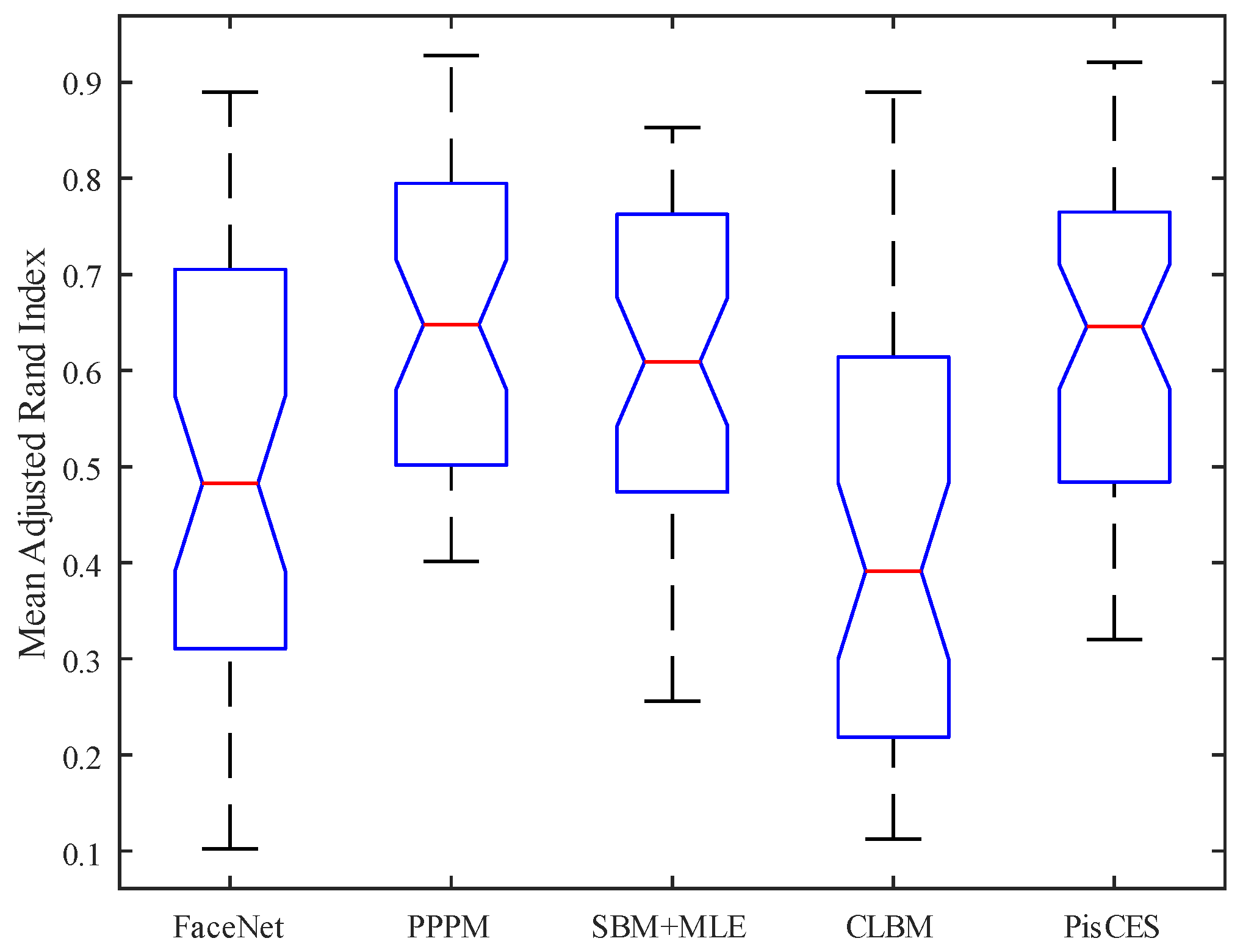
In Table 3, the bold font shows that the result is the best, you can clearly see that the proposed PPPM in all parameters (the maximum value; the first 75% of the value; the median; the first 25% of the value; minimum value) cases are the best and clear, the average performance of PPPM performance (median) than the best model is increased by 3% in the other four. Figure 7 shows the comparison of MARI values on the MIT dataset between the proposed method and four state-of-the-art models.
Figure 7.
Comparison of the proposed model with 4 different models on MARI (reality network).
In Figure 7, the upper and lower edges of each box in the boxplot represent 25% and 75% values, respectively, and the middle red line denotes the median. It is obvious that PPPM, SEM + MLE, and the three boxes perform better than the other two model boxes. Among the three models with better performance, the PPPM box position is slightly higher than that of SEM + MLE and PisCES boxes, and the median value is also slightly higher than that of SEM + MLE and PisCES models. In conclusion, compared with the other four representative models in the real network, the proposed dynamic community PPPM method performs better under the two evaluation indexes of prediction accuracy and error.
4.2.2. Enron Email Data
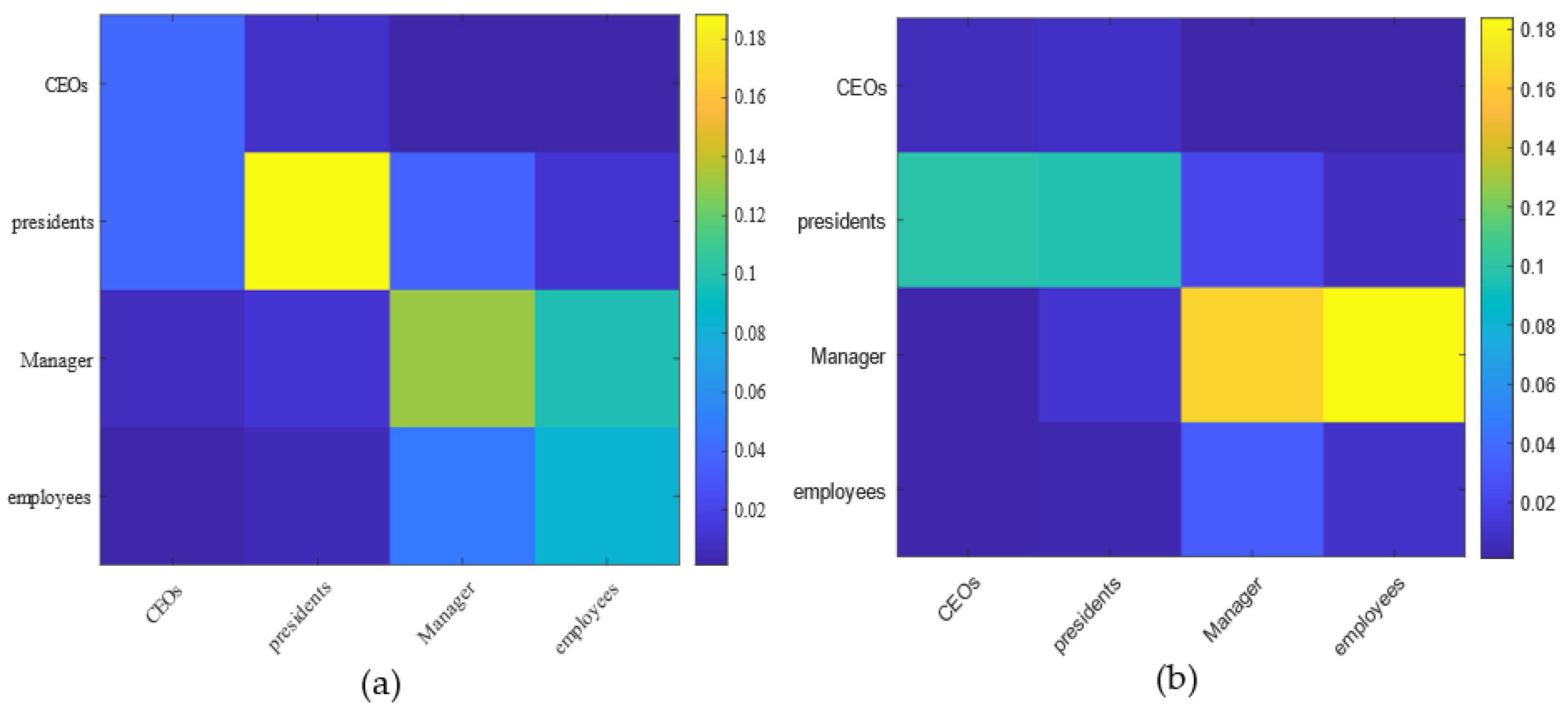
The experiment is conducted on the dynamic social network, which is built by Enron [53], and it consisted of about 500,000 emails between 184 Enron employees from 1998 to 2002. The directional edge between the employee and the time point occurs if at least one email is sent within the first week. Each time step corresponds to an interval of 1 week. This dataset does not distinguish between emails sent to “recipients,” “CC” or “BCC.” In addition to email dataset, most employee roles (such as CEO, president, manager, employee) exist within the company and they are used as known communities. The first 56 weeks and the last 13 weeks are filtered because only a few emails are sent. Figure 8 compares the estimated community probability between a normal week and an event week. The higher the probability, the higher the community activity. Both the x-axis and the y-axis denote the estimated communities, and the color blocks on the diagonals express the activity within each community, and the color blocks of the diagonals imply the activity between each community.
Figure 8.
The comparison of community probability in normal week and event week. (a) indicates the normal week(week 59), (b) indicates the event week (the 89 weeks when CEO Jeffrey resigns).
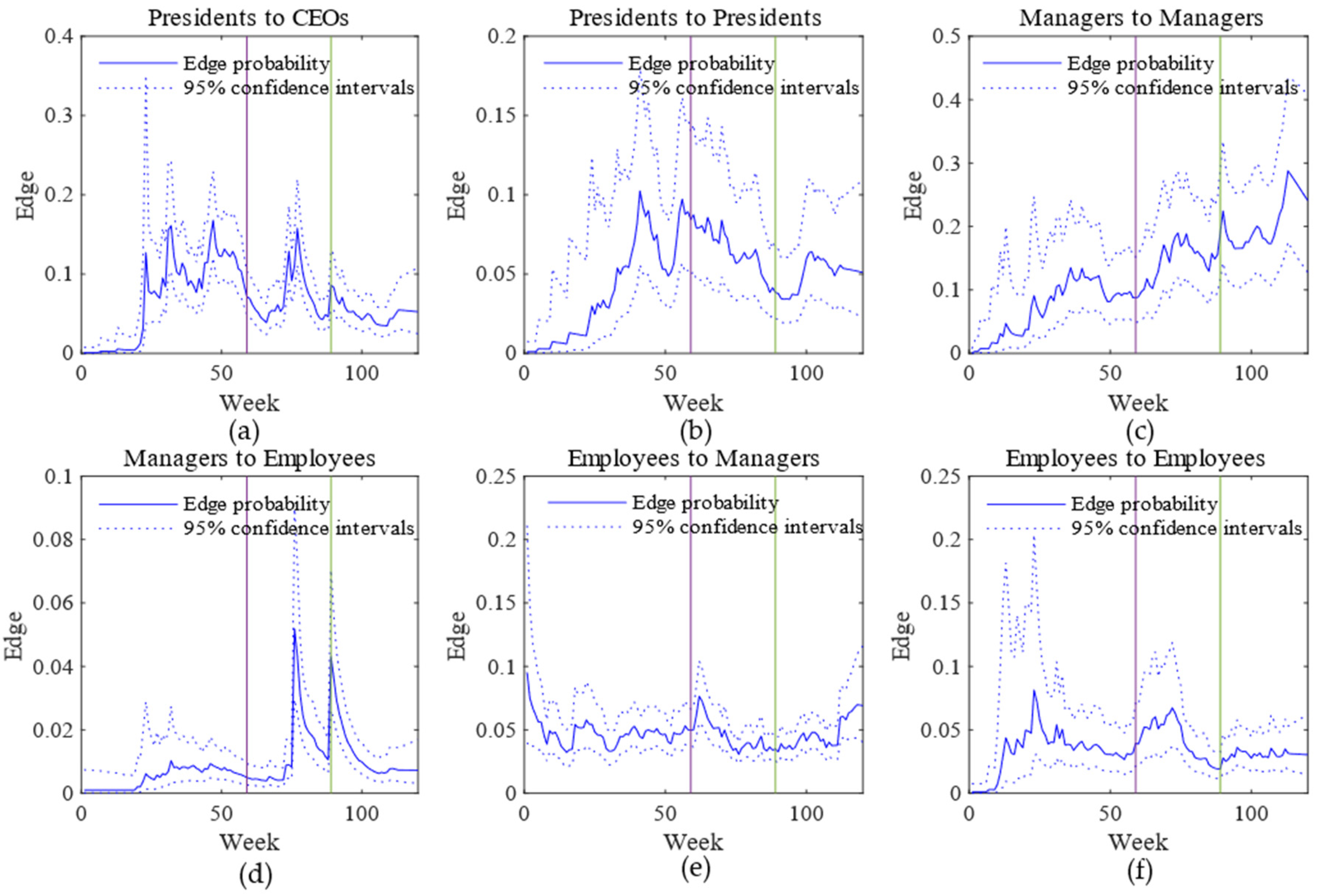
As shown in Figure 8a, in a normal week (week 59), the president community is the most active, followed by managers and employees, and the CEO community is the least active. It is also worth noting that from the color block distribution of managers and employees, the two communities may merge into one large community. This phenomenon can be reflected in the fact that communication between department managers and employees is usually close, and managers and employees are more likely to get along with each other. As shown in Figure 8b, in the event week (the 89 weeks when CEO Jeffrey resigns), the most active community is that of the managers, followed by president community, and the brightest color block is the managers to the employee community. This is reflected in the fact that in real life when CEOs resign, the discussion is most intense among managers because it is directly related to their personal interests. Discussions between managers and employees also proliferate for the same simple reason that it is indirectly related to the employees’ personal interests. Figure 9 reveals the estimated edge connections between communities in Enron’s email network under the proposed dynamic community’s discovery approach PPPM and shows a 95% confidence interval (note: the lines on the left and right of the figure are for weeks 59 and 89, respectively).
Figure 9.
Probability of edges between communities on the Enron mail. (a–f) are the edge probabilities between different roles.
As shown in Figure 9a, it is the edge probability of presidents to CEOs; it can be seen that the presidents to CEOs edge probability increased slightly at week 59 (normal) and 89 (Jeffrey CEO resigned), which corresponds to presidents to CEOs activity (increased) from Figure 8a,b. Figure 9b shows the side probability within the president community. In the 59th and 89th weeks, the side probability inside the community shows a downward trend. This also corresponds to the active state (decreased activity) within the president community from Figure 8a,b. Figure 9c,d show the side probabilities between managers and the manager community and between the managers and the employee community, respectively. It can be seen that in the 59th and 89th weeks, the changing trend of the side probabilities of these two communities is consistent with that in Figure 9a.
Similarly, this change also corresponds to the changes in active state between managers and manager community and the employee community (increased activity) from Figure 8a,b. Figure 9e shows the edge probability between the employees and the manager community. It is not difficult to see that there is no obvious trend of change in week 59 and 89. Similarly, this situation also corresponds to the consistent change in the active state between the employees and the manager community from Figure 8a,b (there is no significant change in the activity). Finally, Figure 9f shows the edge probability between employees and the employee community. In week 59 and 89, similarly, the changing trend of edge probability of these two communities is consistent with the change in Figure 9b; namely, it displays the downward trend. At the same time, it also corresponds to the consistent change in active state between employees and the employee community from Figure 8a,b (decreased activity).
To sum up, the proposed PPPM method can well reflect some phenomena existing in the real network, and the probability estimated by the novel method can make relatively consistent predictions with the advance of time and the occurrence of specific events.
5. Conclusions
The proposed model has practical theoretical and practical significance to mine and it also simulates deeper hidden information that is present in dynamic social networks. At present, the dynamic social network community discovery method cannot effectively represent the entire dynamic network evolution process. Therefore, inspired by the evolution theory of natural biosensors, this paper proposes a community discovery method based on phylogenetic planted partition. Firstly, the time dimension is added to the transplant partition model, all states in the whole dynamic network system are treated as variables, the observation equation is used as a constraint between variables, and an error function about the whole dynamic network system is constructed. Then, the quadratic form of the error function is minimized, which can abstract the observation results of the network more realistically. Secondly, a graph optimization strategy is used to consider the constraints in the whole motion trajectory at one time, and the Jacobian matrix is calculated during the linearization process. Because the calculation process is relative to the whole motion trajectory, the whole system evolution process is transformed into a nonlinear system optimization process. The gradient of the error function is obtained by using the L–M method, and then the iteration is carried out according to the direction of the gradient; finally, the proposed method is compared with four state-of-the-art representative models under two scenarios of artificial network and real network. The experimental results show that the PPPM method has better performance than the other four representative models in building a dynamic network model and mining dynamic network hidden information.
Next, this paper will consider how to integrate the multi-layer model mechanism into the proposed model and will study dynamic network hiding information with multi-layer information in future research.
Author Contributions
Conceptualization, X.L. and N.D.; methodology, N.D.; software, N.D.; formal analysis, N.D.; writing—original draft preparation, N.D.; writing—review and editing, G.F., P.D.M. and A.F.; visualization, N.D.; supervision, X.L.; project administration, X.L.; funding acquisition, X.L. All authors have read and agreed to the published version of the manuscript.
Funding
This work was supported in part by National Social Science Fund of China (17XXW004), Science and Technology Research Project of Chongqing Municipal Education Commission (KJZD-K202001101), Humanities and Social Sciences Research Project of Chongqing Municipal Education Commission (20SKGH166),Postgraduate Innovation Fund of Chongqing University of Technology (ycx20192060), Chongqing Postgraduate Research Innovation Project CYS20343, Chongqing Ba-nan District Science and Technology Bureau Science and Technology Talents Special Project (2020.58), General Project of Chongqing Natural Science Foundation (cstc2021jcyj-msxmX0162), 2021 National Education Examination Research Project (GJK2021028).
Institutional Review Board Statement
Not applicable.
Informed Consent Statement
Not applicable.
Data Availability Statement
Conflicts of Interest
The authors declare no conflict of interest.
References
- Newman, M.E. The structure and function of complex networks. SIAM Rev. 2003, 45, 167–256. [Google Scholar] [CrossRef] [Green Version]
- Dakiche, N.; Benbouzid, F.T.; Slimani, Y.; Benatchba, K. Tracking community evolution in social networks: A survey. Inf. Process. Manag. 2018, 56, 1084–1102. [Google Scholar] [CrossRef]
- Girvan, M.; Newman, M.E. Community structure in social and biological networks. Proc. Natl. Acad. Sci. USA 2002, 99, 7821–7826. [Google Scholar] [CrossRef] [PubMed] [Green Version]
- Guruharsha, K.; Rual, J.F.; Zhai, B.; Mintseris, J.; Vaidya, P.; Vaidya, N.; Beekman, C.; Wong, C.; Rhee, D.Y.; Cenaj, O. A protein complex network of Drosophila melanogaster. Cell 2011, 147, 690–703. [Google Scholar] [CrossRef] [Green Version]
- Pagani, G.A.; Aiello, M. The power grid as a complex network: A survey. Physica A 2013, 392, 2688–2700. [Google Scholar] [CrossRef] [Green Version]
- Sanchez, F.; Mina, M. Oncogenic signaling pathways in the cancer genome atlas. Cell 2018, 173, 321–337. [Google Scholar] [CrossRef] [Green Version]
- Baccaletti, S.; Bianconi, G.; Criado, R. The structure and dynamics of multilayer networks. Phys. Rep. 2010, 544, 1–122. [Google Scholar] [CrossRef] [Green Version]
- Ma, X.; Sun, P.; Zhang, Z. An integrative framework for protein interaction and methylation data to discover epigenetic modules, IEEE/ACM Trans. Comput. Biot. Bioinf. 2019, 16, 1855–1866. [Google Scholar]
- Ma, X.; Dong, D.; Wang, Q. Community detection in multi-layer networks using joint nonnegative matrix factorization. IEEE Trans. Knowl. Data Eng. 2019, 31, 273–286. [Google Scholar] [CrossRef]
- Huang, Z.; Rege, X. Detecting community in attributed networks by dynamically exploring node attributes and topological structure. Knowl. Based Syst. 2020, 196, 105760. [Google Scholar] [CrossRef]
- Džamić, D.; Aloise, D.; Mladenović, N. Ascent–descent variable neighborhood decomposition search for community detection by modularity maximization. Ann. Oper. Res. 2019, 272, 273–287. [Google Scholar] [CrossRef]
- Karrer, B.; Newman, M.E. Stochastic blockmodels and community structure in networks. Phys. Rev. E 2011, 83, 016107. [Google Scholar] [CrossRef] [PubMed] [Green Version]
- Wen, Y.M.; Huang, L.; Wang, C.D.; Lin, K.Y. Direction recovery in undirected social networks based on community structure and popularity. Inform. Sci. 2019, 473, 31–43. [Google Scholar] [CrossRef]
- He, D.; Feng, Z.; Jin, D.; Wang, X.; Zhang, W. Joint identification of network communities and semantics via integrative modeling of network topologies and node contents. In Proceedings of the Thirty-First AAAI Conference on Artificial Intelligence, San Francisco, CA, USA, 4–9 February 2017; pp. 116–124. [Google Scholar]
- Airoldi, E.M.; Blei, D.M.; Fienberg, S.E.; Xing, E.P. Mixed membership stochastic blockmodels. J. Mach. Learn. Res. 2008, 9, 1981–2014. [Google Scholar]
- Qiao, M.; Yu, J.; Bian, W.; Li, Q.; Tao, D. Improving Stochastic Block Models by Incorporating Power-Law Degree Characteristic; IJCAI: Melbourne, Australia, 2017; pp. 2620–2626. [Google Scholar]
- Fortunato, S. Community detection in graphs. Phys. Rep. 2010, 486, 75–174. [Google Scholar] [CrossRef] [Green Version]
- Fortunato, S.; Hric, D. Community detection in networks: A user guide. Phys. Rep. 2016, 659, 1–44. [Google Scholar] [CrossRef] [Green Version]
- Rand, D.; Christakis, N. Dynamic social networks promote cooperation in experiments with humans. Proc. Natl. Acad. Sci. USA 2011, 108, 19193–19198. [Google Scholar] [CrossRef] [Green Version]
- Chiang, A.; Massagie, J. Molecular basis of metastasis. N. Engl. J. Med. 2008, 359, 927–932. [Google Scholar] [CrossRef] [Green Version]
- Kim, M.; Han, J. A particle-and-density based evolutionary clustering method for dynamic networks. Proc. VLDB Endow. 2009, 2, 622–633. [Google Scholar] [CrossRef] [Green Version]
- Folino, F.; Pizzuti, C. An evolutionary multi-objective approach for community discovery in dynamic networks. IEEE Trans. Knowl. Data Eng. 2014, 26, 1838–1852. [Google Scholar] [CrossRef]
- Chi, Y.; Song, X.; Zhou, D.; Hino, K.; Tseng, B.L. On evolutionary spectral clustering. ACM Trans. Knowl. Data Discov. 2009, 3, 1–30. [Google Scholar] [CrossRef]
- Wang, L.; Rege, M. Low-rank kernel matrix factorization for large-scale evolutionary clustering. IEEE Trans. Knowl. Data Eng. 2012, 24, 1036–1050. [Google Scholar] [CrossRef]
- Ma, X.; Dong, D. Evolutionary nonnegative matrix factorization algorithms for community detection in dynamic networks. IEEE Trans. Knowl. Data Eng. 2017, 29, 1045–1058. [Google Scholar] [CrossRef]
- Ma, X.; Zhang, B.; Ma, C.; Ma, Z. Co-regularized Nonnegative Matrix Factorization for Evolving Community Detection in Dynamic Networks. Inf. Sci. 2020, 528, 265–279. [Google Scholar] [CrossRef]
- Lin, Y.; Zhu, S. Analyzing communities and their evolutions in dynamic social networks. ACM Trans. Knowl. Discov. Data 2009, 3, 1–31. [Google Scholar] [CrossRef]
- Yang, T.; Chi, Y. Detecting communities and their evolutions in dynamic social networks-a bayesian approach. Mach. Learn. 2011, 82, 157–189. [Google Scholar] [CrossRef] [Green Version]
- Palla, G.; Barabási, A.L.; Vicsek, T. Quantifying social group evolution. Nature 2007, 446, 664–667. [Google Scholar] [CrossRef] [Green Version]
- Cazabet, R.; Amblard, F. Dynamic Community Detection. In Encyclopedia of Social Network Analysis and Mining; Springer: New York, NY, USA, 2014; pp. 404–414. [Google Scholar]
- Rossetti, G.; Cazabet, R. Community Discovery in Dynamic Networks: A Survey. ACM Comput. Surv. 2017, 51, 1–37. [Google Scholar] [CrossRef] [Green Version]
- Aynaud, T.; Fleury, E.; Guillarme. Communities in evolving networks: Definitions, detection, and analysis techniques. In Dynamics on and of Complex Networks; Springer: New York, NY, USA, 2013; Volume 2, pp. 159–200. [Google Scholar]
- Hartmann, T.; Kappes, A.; Wagner, D. Clustering Evolving Networks. In Algorithm Engineering; Springer: New York, NY, USA, 2016; Volume 9220, pp. 280–329. [Google Scholar]
- Agarwal, M.; Ramamritham, K.; Bhide, M. Real time discovery of dense clusters in highly dynamic graphs: Identifying real world events in highly. dynamic environments. Proc. VLDB Endow. 2012, 5, 980–991. [Google Scholar] [CrossRef]
- Tang, L.; Liu, H. Identifying evolving groups in dynamic multimode networks. IEEE Trans. Knowl. Data Eng. 2012, 24, 72–85. [Google Scholar] [CrossRef] [Green Version]
- Sun, J.; Faloutsos, C. Graphscope: Parameter-free of large time evolving-graph. In Proceedings of the 13th Conference on Knowledge Discovery Data Mining, New York, NY, USA, 12–15 August 2007; pp. 687–696. [Google Scholar]
- Chakrabarti, D.; Kumar, R.; Tomkins, A. Evolutionary clustering. In Proceedings of the 12th ACM SIGKDD International Conference on Knowledge Discovery and Data Mining, New York, NY, USA, 20–23 August 2006; pp. 554–560. [Google Scholar]
- Chi, Y.; Song, X.D.; Zhou, D.Y.; Koji, H.; Belle, L.T. Evolutionary spectral clustering by incorporating temporal smoothness. In Proceedings of the 13th ACM SIGKDD International Conference on Knowledge Discovery and Data Mining, New York, NY, USA, 12–15 August 2007; pp. 153–162. [Google Scholar]
- Folino, F.; Pizzuti, C. Multiobjective evolutionary community detection for dynamic networks. In Proceedings of the Conference on Genetic and Evolutionary Computation, Oregon, Portland, 7–11 July 2010; pp. 535–536. [Google Scholar]
- Gong, M.G.; Zhang, L.J.; Ma, J.J. Community detection in dynamic social networks based on multi-objective immune algorithm. J. Comput. Sci. Technol. 2012, 27, 455–467. [Google Scholar] [CrossRef]
- Xu, K.S.; Kliger, M.; Hero, A.O., III. Adaptive evolutionary clustering. Data Min. Knowl. Discov. 2014, 28, 304–336. [Google Scholar] [CrossRef] [Green Version]
- Han, Q.; Kevin, X.; Edoardo, A. Consistent estimation of dynamic and multilayer block models. In Proceedings of the 32th International Conference on Machine Learning, Lille, France, 6–11 July 2015; pp. 1511–1520. [Google Scholar]
- Kevin, X. Stochastic block transition models for dynamic networks. In Proceedings of the 18th International Conference on Artificial Intelligence and Statistics, San Diego, California, USA, 9–12 May 2015; pp. 1079–1087. [Google Scholar]
- Zhang, X.; Moore, C.; Newman, M.E.J. Random graph models for dynamic networks. Eur. Phys. J. B 2017, 90, 1–14. [Google Scholar] [CrossRef]
- Amir, G.; Pan, Z.; Aaron, C.; Cristopher, M.; Leto, P. Detectability Thresholds and Optimal Algorithms for Community Structure in Dynamic Networks. Phys. Rev. X 2016, 6, 031005. [Google Scholar]
- Sharmodeep, B.; Shirshendu, C. Spectral clustering for multiple dissociative sparse networks. arXiv 2017, arXiv:1805.10594. [Google Scholar]
- Paolo, B.; Fabrizio, L.; Piero, M.; Daniele, T. Detectability thresholds in networks with dynamic link and community structure. arXiv 2017, arXiv:1701.05804. [Google Scholar]
- Mehrnaz, A.; Theja, T. Block-Structure Based Time-Series Models for Graph Sequences. arXiv 2018, arXiv:1804.08796. [Google Scholar]
- Étienne, G.; Anthony, C.; Mustapha, L.; Hanane, A.; Loïc, G. Conditional Latent Block Model: A Multivariate Time Series Clustering Approach for Autonomous Driving Validation. arXiv 2020, arXiv:2008.00946. [Google Scholar]
- Emmanuel, A. Community Detection and Stochastic Block Models: Recent Developments. J. Mach. Learn. Res. 2017, 18, 1–86. [Google Scholar]
- Liu, F.; Choi, D. Global spectral clustering in dynamic networks. Proc. Natl. Acad. Sci. USA 2018, 115, 927–932. [Google Scholar] [CrossRef] [PubMed] [Green Version]
- Eagle, N.; Pentland, A.S.; Lazer, D. Inferring friendship network structure by using mobile phone data. Proc. Natl. Acad. Sci. USA 2009, 106, 15274–15278. [Google Scholar] [CrossRef] [PubMed] [Green Version]
- Klimt, B.; Yang, Y. The enron corpus: A new dataset for email classification research. In Proceedings of the European Conference on Machine Learning, Pisa, Italy, 20–24 September 2004; Springer: Berlin, Germany, 2004; pp. 217–226. [Google Scholar]
Publisher’s Note: MDPI stays neutral with regard to jurisdictional claims in published maps and institutional affiliations. |
© 2022 by the authors. Licensee MDPI, Basel, Switzerland. This article is an open access article distributed under the terms and conditions of the Creative Commons Attribution (CC BY) license (https://creativecommons.org/licenses/by/4.0/).