


Abstract
The use of Ground Source Heat Pumps (GSHPs) has grown exponentially around the world over recent decades. The GSHP represents an alternative device to electric heating systems and oil boilers. Additionally, it requires a lower power consumption and less maintenance than combustion-based heating systems. Moreover, the CO emissions produced by a GSHP are lower than other systems based on burning oil, gas, or biomass. However, the main obstacle for the widespread use of GSHPs is the high cost of Ground Heat Exchanger (GHE) installation, a technology that exhibits low thermodynamic efficiencies. Over the past decade, some studies have been conducted to improve heat transfer in GHE pipes using traditional working fluids, creating new pipe materials or designing new heat exchanger configurations. The main contribution of this paper is a summarization of the outcomes of theoretical, numerical and experimental studies to improve heat transfer in GHEs using nanotechnology. Additionally, the development of new fluids (nanofluids) and new materials (nanoparticles and nanocomposites) applied to heat exchanger pipes and the designs and configurations of GHEs are highlighted. As a result, the present review provides a perspective for future research regarding the use of nanotechnology to reduce the costs involved in GHE for GSHP improvement.
1. Introduction
GSHPs are considered to be the best available technology for the air conditioning of residential or commercial spaces [1]. A GSHP is defined as a heating and/or cooling system designed to transfer heat to or from the ground, groundwater, or a surface water as a heat source or sink. A GSHP uses these different energy sources all the time, without any intermittent availability, as a heat source (in the winter) or a heat sink (in the summer). The principal advantages of this technology are the high electrical efficiency, low maintenance, reduction in fossil resources and low-carbon emissions. Attempts have also been undertaken to use water in such a way to minimize the pipe network length [2,3].
The GSHP has three main components. The first component is the GHE, which uses the subsoil as an energy source. The GHE moves fluid using a pump to transfer heat to the space to be conditioned as a source (heating in winter) or a heat sink (cooling in summer) through a pipe network buried under the subsoil (horizontal or vertical). Second, the heat pump (HP) raises the heat collected to a useful temperature, and transfers it to the space to be conditioned. Finally, the third component is a distribution system composed of a duct-work as an air-forced duct system.
Typically, a GHE uses a pipe network with different configurations to capture and/or dissipate heat from the ground, pond or lake (see Figure 1). This paper reviews the main developments in using GSHP pipes as a GHE and the new fluids used to improve the heat exchange.
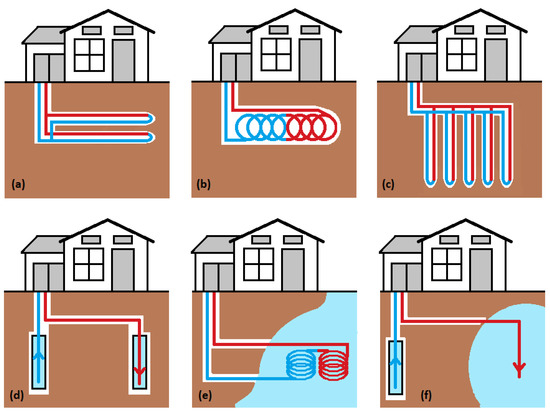
Figure 1.
Different configurations of Ground Heat Exchanger: (a) closed horizontal loop, (b) closed slinky loop, (c) closed vertical loop, (d) open wells loop, (e) closed water loop and (f) open-circuit well and surface body.
The most used and available material for pipes in the GHE is high-density polyethylene (HDPE). HDPE has a low thermal conductivity, affecting the heat transfer between the ground and the space to be conditioned. This implies an increased GHE installation cost. Therefore, the installation of GSHPs becomes expensive due to the high costs of the GHE and its pipes, as mentioned by [4]. The vertical GHEs installed in boreholes are more expensive than horizontal installations in trenches. The first alternative was the use of thermally enhanced grout to improve thermal conductivity. For example, in [5], a thermally enhanced grout is used that reduces borehole thermal resistance. It minimizes the length and the number of boreholes for the GHE, reducing the installation costs.
Recently, researchers have striven to develop technologies to improve heat transfer in GSHP systems. This can be achieved by (1) increasing the thermal conductivity of the soil, improving the properties of the pipe material; (2) using different fluids; and/or (3) modifying a geometrical GHE’s configurations pipes. A new research area to solve these problems is the use of nanotechnology for different purposes.
Nanotechnology is defined as an applied science, capable of manipulating matter on an atomic and molecular scale to solve different problems [6]. It has been used in many fields such as engineering, computing, and medicine. Nowadays, nanotechnology is deployed in distinct energy applications such as fuel cell, hydrogen, nuclear, photovoltaic, tidal, wind and geothermic technologies. An exhaustive review of these applications (including theoretical and experimental works) of nanotechnology in renewable energy systems can be found in [7].
In nanotechnology, a particle is defined as a small object that behaves as a whole unit with respect to its transport and properties. Nanoparticles are particles between 1 and 100 nanometers (nm) in size with a surrounding interfacial layer. The interfacial layer is an integral part of nanoscale matter, affecting all of its properties. The interfacial layer typically consists of ions and inorganic and organic molecules. This paper will discuss two important aspects of nanotechnology in the sector of geothermic technologies for GSHP: nanomaterials and nanofluids.
On the one hand, scientists have not unanimously settled on a precise definition of nanomaterials, but agree that nanomaterials are identified by their very small size, around a few nanometers. These nanosized particles differ from coarser particles in their tendency to form agglomerates which are macroscopically perceived as one particle [6]. On the other hand, a nanofluid is a nanotechnology-based colloidal dispersion prepared to disperse some nanoparticles in conventional liquids. These advanced fluids have the capacity to enhance the performance of the conventional heat transfer fluids according to [8].
The design of new heat exchanger configurations is an important aspect to improve energy capture. This presents a multivariate problem, requiring the use of computer tools to simulate the heat exchanger before it is manufactured. Additionally, the simulation analyzes the behavior of certain mixtures of fluids and materials in order to develop an optimized design.
Some similar reviews analyzing the nanotechnology in GHSP have been biased, in that they have only focused on specific aspects. For example, the work of [9] presents a review only covering nanofluids. The authors of [10] reported a review about the improvements in the thermal properties of a fluid, with the soil and the material individually affecting the heat exchanger in the geothermal energy pipes. The research work of [11] presents some experimental studies in the laboratory using nanofluids. Finally, in [7], all the possible applications of nanotechnology to any renewable sources addressing the GSHP as a subclass are reported. All these works are relevant. However, they are focused on some particular research focus. A global vision involving all the main aspects of the GSHP technology for the researchers is omitted. A more integral and complete review that summarizes the principal nanomaterials and nanofluids approaches in a single article could therefore be useful.
Thus, the main contributions of this work are summarized in the following points:
- This paper presents an analysis of theoretical, numerical, and experimental studies, conducted in recent years, addressing the use of nanotechnology to improve heat transfer in a GSHP.
- To the best of our knowledge, a similar integral review has not been published in the literature.
- This work breaks down research on nanofluids and nanomaterials in the composition, designs, and configurations of heat pipes, including the software used to simulate these systems with the objective to enhance the heat transfer efficiency and reduce the installation cost of GHE.
- This review presents some tables to visualize the main contributions of the reviewed works. The methods or models found in the literature are highlighted in these tables.
- A summary of all these works is presented, including a reflection and discussion of the future trends of nanotechnology applied to GHE pipes for GSHP systems.
- Finally, this review clarity to several areas, and can not only be beneficial to those working in nanotechnology, but rather to members of the general public who may be interested in these issues.
2. Literature Review
This review searched and analyzed the available literature on the development of new nanofluids, composed of a fluid (commonly oil or water) and nanoparticles, and new materials (nanoparticles and nanocomposites) which enhance the heat transfer efficiency of heat pipes.
The next sections summarize the most important points as determined by the researchers. Most of the works aimed to improve the heat transfer applied in the GHE. The works are classified into two principal groups: (1) those using nanofluids as a heat-carrying fluid and (2) those modifying the HDPE with nanomaterials. Each group includes research based on theoretical and numerical simulations, as well as experimental works.
2.1. Nanofluids
2.1.1. Theoretical and Numerical Simulations
Several theoretical models based on differential equations have been reported in the literature to simulate the thermodynamic behaviour of GSHPs [12]. The main goal of these mathematical models is to determine the heat temperature carried by the fluid along the pipe from the borehole under certain operating conditions. For example, based on the transient heat conduction in the borehole, the temperature distribution of the ground might be obtained by solving the following partial differential equation:
where T stands for the ground temperature distribution at a distance r, represents the borehole radius, q is the heating rate per length of the source, t is the time, is the initial temperature of the ground, and and are the thermal conductivity and diffusivity of the ground. Some numerical methods are commonly used to solve the previous equations. However, additional models are required to improve the approximations of the heat temperature carried by the fluid along the pipe, as in [12]. Moreover, such models must consider the GSHP fluid properties to obtain accurate results to optimize the GHSP performance.
Therefore, nanofluids are attractive in the effort to achieve higher efficiencies and reduce the system size. The volumetric concentrations of nanofluids in the range from 0.1% to 1% can result in a reduction in the borehole thermal resistance. Additionally, they can reduce the borehole length depending on the kind of nanofluid.
For example, with a 1% concentration of Cu, graphite, Ag, and CuO, the reductions in the length of boreholes were , , and , respectively [13]. The authors who found this discussed and compared different papers focused on nanofluids used in geothermal systems to improve heat transfer. They concluded that a heat transfer enhancement is dependent on several factors, including the type of nanofluid, concentration, and system specification. Thus, the reduction in the heat exchanger sizes and the borehole sizes used in the geothermal-based system affect the efficiency of the system.
The application of nanofluids in heat pipes, due to their superior thermophysical properties, was addressed in [14]. This work summarizes and provides the outcomes of experimental and theoretical studies of some nanofluids as working fluids in heat pipes, such as metals (Cu, Ag, and Gold, etc.) and metal-oxides (Al2O3, CuO, MgO, ZnO, TiO2, Fe2O3, and SiO2, etc.) to obtain an enhanced thermal performance. The results include the calculations of thermal efficiency, thermal resistance, the effective thermal conductivity, surface temperature gradient and the convective heat transfer coefficient in the evaporator and condenser section. Different configurations of heat pipes were reported according to different sizes and shapes related to the application requirements, integrating summaries and tables. In conclusion, the heat transfer mechanisms depend on the type of heat pipe, the characteristics of the nanofluids, the design and operating parameters of the heat pipes, etc.
An important drawback in the vertical GHE is the existence of possible nanoparticle sedimentation when the system remains static. To solve this, the paper [15] carried out numerical simulations with nanoparticles of Al2O3-water and Fe3O4-water at constant temperature (C) to visualize the sedimentation inside the exchanger. When the fluid is static, the nanoparticles accumulate after many hours of sedimentation. This can be averted by a high-speed flow, a pulsed flow, or by optimizing the geometry of the bottom borehole. This work simulates important data, such as the effects of soil temperature, the Reynolds number, the effect of the size, type, the concentration of the nanoparticles, the suspension stability of composites, gravity, the effects of a pulsed flow, the borehole geometry and the turbulent eddy diffusivity.
The recent report in [16] shows that the heat transfer characteristics of current fluids are greatly improved by suspending nanosized solid particles with diameters of less than 100 nm. Recent research of nanofluids has analyzed the convective heat transfer rate, thermal achievement rate, viscosity, surface tension, friction factor, environmental impact, thermo-physical properties, the effect of fluid temperature, inlet velocity, the use of a surfactant to achieve a better stability of nanofluids, particle size, and the volume concentration effects, for instance, [17,18,19]. Several types of nanoparticles have been widely studied by researchers. Thus, the suspension of small amounts of nanoparticles of oxides (AlO, CuO, TiO, FeO, SiO, etc.), metals (Cu and Ag), and carbon nanotubes (CNTs) in traditional base fluids (water, ethylene glycol, propylene glycol, engine oil, etc.) have increased thermal conductivity [16].
On the other hand, some works study the relevance of the physical properties of a nanofluid. The work [20] presents an approach using nanofluids in geothermal energy applications as working fluids to extract more energy from reservoirs and for space heating/cooling and industrial applications. In this research, a sensitivity analysis was performed to demonstrate the importance of the fluid viscosity and the heat capacity in geothermal energy production. The potential to apply nanofluids as working fluids in abandoned oil wells converted into double-pipe heat exchangers is studied, taking advantage of the significant improvement in the heat transfer of nanofluids. This research remarks on the importance of the thermophysical properties of nanofluids; for example, the viscosity and specific heat capacity and the fluid circulation rate improve the performance and the cost-efficient production of geothermal energy.
A study of the effects of the AlO-water nanofluid, as the heat transfer fluid, to reduce the length of a vertical GHE in a GSHP is presented in [21]. The authors used an innovative nanofluid which was engineered by dispersing solid nanoparticles in conventional heat transfer fluids. They evaluated the impact of the optimized thermophysical properties of nanofluids, such as the thermal conductivity and viscosity, which play prominent roles in convection heat transfer, both of which are optimized by using the Multi-Objective Flower Pollination Algorithm (MOFPA). The bore length computation with an AlO-water mix reduced the borehole length by 1.3% more than when just using water. Another important result revealed that the use of tubes and grout reduces the bore length due to their thermal resistances.
Some applications of nanorefrigerants and nanolubricants, mainly in air conditioning and heat pumps, were realized in [22]. The physical-thermal properties of suspended nanoparticles in refrigerants and lubricating oils of refrigeration systems were reviewed, classifying them into six topics: studies related to the AlO, CuO, TiO, CNT, and Cu nanoparticles and studies related to other nanoparticles (/polyester mixtures with SiO, CuO, POE and other mixtures with NiFeO). The solubility of the mineral-based nanorefrigeration oil (MNRO) in different fluids, , , , and was experimentally investigated. The conclusion of this work is that nanorefrigerants have a much higher and stronger temperature dependence on thermal conductivity at very low particle concentrations than conventional refrigerants. Additionally, the effect of carbon nanotubes (CNTs) enhances heat transfer.
In [7] is presented an exhaustive review of theoretical and experimental works related to the use of nanotechnology in renewable energy systems (solar, hydrogen, wind, biomass, geothermal and tidal energies). This review includes works for all renewable energies, with the use of nanofluids, nanomaterials, and nanoparticles. In the case of geothermal energy, different applications with nanotechnology were addressed, with two of them being highlighted. The first to be addressed was the use of nanofluids to cool fluids inside pipes exposed to high temperatures, using nanofluids to cool sensors and electronic devices in drilling machines and GHE depending on temperature (low, medium or high), and district heating applications using networks piped hot water to heat many buildings in entire communities. Second, the authors noted that nanofluids can be used as a working fluid to extract energy from the ground and process it in a power plant system or produce large amounts of working energy.
Similarly, the paper [23] summarizes works with the use of suspended nanoparticles to enhance the heat transfer characteristics into the heat pipes. The researchers found new opportunities with the use of nanofluids, e.g., to improve the thermal efficiency and reduce the thermal resistance of the heat pipe. This work summaries experimental and theoretical studies of some of the preparation methods, processes and heat transfer characteristics of nanofluids. The thermal performance of the nanofluid heat pipe was superior to that of the conventional working fluid, usually water.
A preliminary evaluation of the potential of nanofluids that guarantee the vertical temperature of the heat carrier in the borehole was performed in [24], using the mathematical model in [25]. Some assumptions were imposed on the model, for example, the variations of temperature with depth, the heat conduction in the vertical direction within the pipe wall, the grout, the borehole thermal resistance between the pipe and the borehole wall, and the ground. The objective was to know which nanoparticle leads to the best performance in the borehole heat exchanger, showing the properties and comparative cost of various nanoparticles. The best thermal performance was found with Cu, followed by graphite, SiO, and Ag. On the other hand, AlO and CuO were the worst choices. The mixes tested using CuO, AlO, Ag, SiO, Al, graphite and Cu with a volumetric concentration of 1% allowed reductions in the borehole length to , , , , , and %, respectively. Therefore, the cost of GHE increases using nanofluids depending on the shape and size of the particles, plus the energy consumption of the circulation pump due to the increased pressure drop. However, this cost is marginal compared to the costs of nanoparticles due to the low value of the mass flow rate.
The results of numerical simulations for the application of the CuO-water and AlO-water nanofluids, as the working fluids of a geothermal GHE, were reported in [26]. The simulations were compared with literature data. The Reynolds Averaged Navier–Stokes (RANS) equations with the shear stress transport (SST) k- turbulence model were numerically solved to represent the flow and the physical properties of the nanofluids using the available correlations. Fluent software and the SIMPLEC algorithms were used for the coupling between pressure and velocity, and the finite volume method on collocated cells was applied to discretize the RANS equations. In the same research, some studies of the influences of natural factors in the analytical method, such as groundwater flow on heat pump design, was presented to obtain the temperature distribution along the heat exchanger. Additionally, the modeling and optimization of a novel combined cooling, heating, and power (CCHP) cycle driven by geothermal and solar energies using the CuO-water nanofluid are presented. The results show that the CuO-water nanofluid allows a higher heat extraction than the alumina-water nanofluid, but at the cost of higher pressure losses and pumping powers.
A numerical solution to optimize MgO-water nanofluids to reduce the cost and increase the heat transfer coefficient is analyzed in [27]. The optimization was performed by the non-dominated sorting genetic algorithm (NSGA-II), which has a significant capability to achieve an optimal response. For this purpose, the solid volume fraction (), Reynolds number (Re) and the diameter of nanoparticles (Dp) were selected as the optimization variables. Thus, to reach the heat transfer coefficient of 280 W/mK, the cost is equal to USD 355 per liter in the first generation and USD 218 per liter in the last generation (total population of 50 members and repetition of 15 times) according to the Pareto diagram. This result proves that theoretically the optimization has been able to reduce the cost by up to 38%.
The work of [28] presents some numerical and theoretical studies of heat transfer applied to rotating machines that convert electrical energy into mechanical energy or vice versa, using the CuO- (ethylene glycol) nanofluid under different conditions inside the heat pipe. The properties of nanofluids were implemented in a wide range of numerical models, using experimental data to study the effects of the mass of the fluid to be inserted in the pipe, the speed of rotation of the machine, and the size and concentration of nanoparticles to evaluate the performance of heat transfer. A new methodology based on Particle Swarm Optimization (PSO) in MATLAB© was presented to solve the equations (flow of nanofluids inside the heat pipe) and the heat transfer equation. The authors give the thermo-physical properties of pure CuO and pure at the reference temperature and the thermophysical properties of the CuO- nanofluid. The heat transfer through the heat pipe depends on various factors such as the input nanofluid mass, the rotation speed of the heat pipe, nanoparticle size and nanoparticle concentration.
Recent studies found, by using numerical simulations, several novel phenomena such as a radiative effect for an electrically conductive Williamson nanofluid [29]; a radiative effect for a Casson nanofluid with solar thermal radiation [30]; variability in the viscosity and conductivity of hybrid nanofluids [31]; and heat transfer in a magneto two-phase nanofluid enclosed in an adiabatic rotating cylinder [32]. All of these have potential applications in GSHPs.
A summary of the results reported by the previous researchers using theoretical and numerical simulations, classified by the type of applied nanofluid and its application, is shown in Table 1 and Table 2.

Table 1.
Summary of theoretical and numerical studies on heat exchanger pipes using nanofluids.
Table 2.
Summary of theoretical and numerical studies on heat exchanger pipes using nanofluids (Continuation).
2.1.2. Experimental Work
An experimental study was presented in [11] using AlO/ethylene glycol-water (EG-water) nanofluids applied to a spiral and U-type GHEs. The GSHP system was used to heat a 21 m room located in Sivas Cumhuriyet University Campus, Turkey, where normally the weather is cold. The authors addressed the improvement of thermal conductivity only in AlO nanofluids, but these studies do not provide test results related to the use of nanofluids in the specific system of GHEs or GSHPs. Other studies show that nanofluids have better heat transfer properties than base fluids under constant heat flow. Their effects have been investigated in many areas, such as radiators, heat exchangers and electronic devices. Researchers have described the experimental setup, including the heat load calculation, the trench depth and GHE design based on the ASHRAE book, using a 25% EG ratio of the fluid to prevent freezing. The experiments showed that a concentration of % nanofluid in the U-type heat exchanger increased the performance by 19% compared to glycol-water and by % compared to the nanofluid with a concentration of %. The nanofluid with a concentration of % increased the heat transfer rate by up to 2% in a U-type GHE and % in a spiral GHE according to the unit pipe length heat exchange rates.
The thermal performances and economic efficiencies of different nanofluids (Ag, MgO, and ), comparing the price, the efficiencies and the benefices, to improve the heat transfer are addressed in [33]. The experiments compared the relative thermal conductivity and the relative viscosity of -water, -water, Ag-water and MgO-water. The -water nanofluid showed higher relative thermal conductivity ( vol.%) and relative viscosity than the other nanofluids. Some factors influenced the thermal conductivity of nanofluids, e.g., the method of nanofluid production (single and two stage), the type of surfactant, sonication rate, the device of characteristic measurement, nanoparticle size and shape. The thermal efficiency of carbon nanofluids is slightly better than that of oxide nanofluids, although their price is several times higher. For this reason, the authors state that the use of nanofluids for heat transfer is not profitable and can only be used in high-tech and high-profit industries.
The existence of two different methods (one- and two-step methods) useful for the preparation of nanofluids is explained in [34]. The authors noted that thermal conductivity and viscosity are important parameters to study the potential for heat transfer enhancement. They presented experimental and theoretical studies affecting thermal conductivity, for example, particle type, charge, size, and shape, including environmental parameters such as the base fluid, concentration, temperature, and dwell time. In summary, the material type has a great effect on the thermal conductivity of nanofluids such as graphene, , Au, Ag, etc., which are more conductive than the TiO, , and SiO nanofluids. However, it appears that the type of material has little effect on the viscosity of nanofluids. Most of the results reveal that the viscosity and thermal conductivity increase as the particle load increases [34].
Olson [35] patented a nanofluid to increase heat transfer, introducing nanoparticles into the GHE (propylene glycol or a heat transfer oil). The inventor improved the thermal conductivity by 40% or more, achieved with only a % nanoparticle concentration. These nanofluids are quite different from conventional two-phase flow mixtures because it is recommended to use a new parameter for nanofluids, the so-called Mouromtseff number (Mo), which is a function of the viscosity (), the conductivity thermal (), density () and specific heat (Cp). The improved heat transfer reduced the installation cost because the circulation loop can be smaller and the pumping cost is also less expensive.
An experimental study in a closed loop of cold water with a storage tank is presented in [36]. An electrical heater controlled by adjusting the voltage and a cooling coil immersed inside a storage tank using a refrigerant (R11) with a mixture of titanium nanoparticles sized 21 nm were implemented. The aim of this research was to improve the efficiency of the heat transfer inside the pipe. The authors prepared five mixtures of different nanofluid concentrations using an ultrasonic homogenizer. The experiments were conducted with different work conditions and the experimental device was designed in a modular form using various heat fluxes.
A summary of the results reported by the previous researchers with experimental work given in Table 3.
Table 3.
Summary of experimental studies on heat exchanger pipes using nanofluids.
2.2. Nanomaterials
2.2.1. Theoretical and Numerical Simulations
The research in [37] focused on the advantages and disadvantages of fillers, commonly used as thermally conductive polymer composites (metallic, ceramic, carbon nanotube, and graphite) applied to HDPE. The acceptable thermal conductivity used in modeling was found to demonstrate its effect on tubing to reduce the GHE well length in a GSHP system. The best model choice was to use low-temperature in situ expandable graphite filler added to the HDPE polymer (LTEG/HDPE composite). This produces a composite filled with 20 vol % of LTEG with acceptable thermal and rheological properties with a thermal conductivity filled (WmK), 10 wt% of LTEG. The length of the GHE was reduced to near to 10% of the total borehole pipe. They recommended the use of LTEG as a suitable filler to add to the HDPE polymer. Additionally, additional work on the performance of the mechanical properties of the hydrostatic design basis is proposed.
The performances of different GHE configurations (single U-pipe, double U-pipe, and coaxial) are compared in [4]. This work was carried out with standard HDPE pipes and thermally enhanced polymers pipes with inorganic nanomaterial fillers. The main goal was to evaluate the economic benefits of thermally enhanced (TE) pipes by comparing sizing calculations and 10-year hourly simulations for some configurations. The Ground Loop Heat Exchanger Professional (GLHEPro©) was used for calculations using a synthetic heat load profile as input, a medium heat dominated office building located in the US in the Colorado climate zone. This study demonstrates that the use of TE pipes instead of standard HDPE pipes allows a reduction in the borehole thermal resistance of between and %, a reduction in the total GHE length of between and % and a reduction in the construction cost of between and %. GSHP fitted with TE pipes can be a financially feasible and environmentally beneficial solution, even though the current typical commercial cost of TE pipes is almost twice that of conventional HDPE pipes. The authors proposed to work with the development of a tool to quickly and easily carry out size, performance and cost comparison analyses for a wide range of situations to present a more accurate and realistic view of the advantages and disadvantages of using TE pipes in the construction of GHE.
A new idea to improve the thermal conductivity of HDPE pipes, which are resistant to oxidation but have low thermal conductivity and are used in many land source applications, was presented by [38]. The computational analysis presents a new fabrication composed of HDPE with aluminum wires that are distributed circumferentially and equally in the thickness of the pipe. Using a finite volume method and FORTRAN, a model comparing the pure HDPE and the new material was developed. The results shows an enhancement in the equivalent thermal conductivity of the composite by almost 25% for the 2 mm aluminum wires, and 150% for the 3 mm wires depending on the number of wires. Similarly, in [39] is realized research on the effect of adding aluminum powder to an HDPE with different volumetric concentrations. A numerical model shows that the thermal conductivity of the composite was less than 10% by volume, while [40] proposed a model using an aluminum nitride-HDPE mix, increasing the thermal conductivity.
A review is given in [10] on the enhancement of the thermal properties of individual components affecting the heat exchanger between the heat carrier fluid and the ground applied in geothermal energy piles. Some geometrical modifications and the application of nanofluids as a heat carrier fluid are presented. Additionally, modifications of the pipe material (the heat extracted/rejected in the ground using HDPE pipes) and the concrete mixture are carried out to reduce the total pile thermal resistance. This was achieved using a geometrical optimization in different pipe configurations. Thus, reducing the number of pipes and their arrangement improves the thermal behavior of the GHE. The authors mentioned that Versaprofiles (an HDPE pipe manufacturer for geothermal applications) developed an HDPE pipe for borehole heat exchangers, known as the GEOperforms, with a thermal conductivity 75% higher than the conventional HDPE pipe.
In a similar work, several types of heat pipes classified into three groups, sintered, groove and mesh types, were presented, [41]. The authors reviewed various types of heat pipes for different applications such as ground source heat pumps, thermal diodes, rotating heat pipes, etc. They included a review of nanotechnology applications in heat pipes using nanoparticles and introduce a new term, “nanobubbles”. In this case, no research work has been conducted so far on the applications of nanobubbles to improve heat pipes, only theoretical research, as a recent study phenomenon. As a conclusion, they claim that the technology and the science using nanoparticles in heat pipes is still in the initial stages.
In [42], the performances of different configurations of vertical coaxial exchangers are modeled. These configurations are tested using a thermally improved HDPE pipe, applying carbon nanoparticles to the outside. This enhances the thermal conductivity of 0.7 W/m-K, corresponding to a 75% higher than ordinary HDPE. The GLHEPro© and the Earth Energy Design (EED©) programs were used for the simulation. The thermal resistance of the well decreased and the thermal mass of the water contained in the coaxial exchange increased. GHE coaxial configurations helped reduce the total well length by up to 23%.
The review [43] introduced a new interdisciplinary theory: nanothermodynamics. This is an extension of the classic thermodynamics theory to the nanometer scale. It serves as a bridge between macroscopic and nanoscopic systems. The focus and emphasis are placed on the use of nanothermodynamics models to find the size-dependent thermal stability, magnetic properties, photoelectric behaviors, thermoelectric phenomena, mechanical properties, electrical properties, volume expansion coefficient, mass density, and energies of nanomaterials. It is desirable to predict the macroscopic, mesoscopic, and nanoscopic properties of materials. This work presents a complete comparison of different materials evaluating the thermal stability, enthalpies, magnetic and mechanical properties, thermal and electrical conductivity, diffusivity, photoelectric behaviors, relativity permittivity, and other parameters.
The thermal conductivity of and their polymer nanocomposites offers new possibilities to improve TC in several applications, including power electronics, electric motors, and generators, heat exchangers, among others; this is reviewed in [44]. Some papers using CNT-HDPE were reported. The crystallinity of the polymer strongly affects its TC, which roughly varies from 0.2 W/mK, for amorphous polymers such as polymethyl-methacrylate (PMMA) or polystyrene (PS), to 0.5 W/mK, for highly crystalline polymers such as HDPE. The use of the different nanoparticles in HDPE filled with 7% expanded graphite of nanometric size has a TC of 1.59 W/mK, double that of the microcomposites which have a size of 0.78 W/mK at the same volumetric content. The conclusion was that the unusually high thermal conductivity makes CNT the most promising candidate material for thermoconductive composites. However, the thermal conductivities of polymer CNT nanocomposites are relatively low compared to expectations for the intrinsic thermal conductivity of CNTs.
Another work that addresses the improvement of thermal properties in piles is found in [45]. This paper found that the values for the heat rejected for U- and double-shaped pipes configurations were 53.81 W/m and 68.71 W/m, respectively, in an energy pile system of air conditioning for buildings such as offices and houses. The main objective was to reduce the cost of GHE. The average COP for heating was quite high, , and the seasonal primary energy reduction rate compared to a typical air conditioning system reached %. The authors of [46] used single and double U-tubes for application with HDPE pipes in boreholes and foundation piles. With the same flow rate with an inlet temperature of C for the heat reject mode and C for heat extract mode, the heat transfer values of the double U-pipes were about 50% and 45%, respectively, greater than those of a single U-pipe.
The summary of results reported by the previous works in theoretical and numerical simulations of nanomaterials is given in Table 4.
Table 4.
Summary of theoretical and numerical studies on heat exchanger pipes using nanomaterials.
2.2.2. Experimental Work
Experimental work is one of the least explored types of research due to the cost of test benches for GSHP. In [48], the mixed fabrication of HDPE and graphite nanopaletes at different filler concentrations is studied, analyzing the thermal, mechanical, and electrical properties of nanocomposites. The addition of Graphene Nanoplatelets (GNPs) has a significant effect on the thermal conductivity of HDPE, as mentioned in [49,50,51,52]. These works used fillers, such as graphite and carbon nanotubes, due to their ability to add thermal and electrical properties to HDPE composites by increasing Young’s modulus. The best result was at 40 wt% of GNPs with HDPE, the of composite increases at 1.32 W/mK and Young’s modulus reached 1330 MPa, while the pure HDPE values were 0.36 W/mK with 821 MPa. The GNPs greatly reduced the electrical resistivity of pure HDPE to for mixed -HDPE.
The work in [53] prepared nanocomposites and hybrid nanocomposites based on high-density polyethylene (HDPE) as a matrix reinforced with an alternate and possible combination of nanodiamonds (NDs), Multi-Walled Carbon Nanotubes (MWCNTs) and GNPs. This work evaluated the nanomechanical behavior of HDPE by the addition of nanofillers. The hybrid filled with ND and GNP exhibited superior surface properties. Exceptional toughness, a high elastic modulus, high fracture toughness, a low coefficient of friction, and excellent thermal conductivity can be achieved using ND. The HDPE/ND/GNP combination would improve the quasi-static and dynamic properties.
Experimental results of the form-stable phase change materials (FSPCM) are presented in [54]. Due to high thermal energy storage capacity and thermal conductivity, the FSPCM was manufactured by adding expanded graphite (EG) to stearyl alcohol (SAL) and HDPE mixtures. In the composites, HDPE was used to prevent SAL leakage and EG was not only a support material like HDPE, but also a promoter of thermal conductivity. The thermal conductivity of FSPCM underwent a 3% EG increase up to 0.6698 W(mK), while the thermal conductivity of FSPCM without EG was only 0.1966 W(mK). Finally, the thermal properties, chemical stability, and the microstructure of the FSPCM were presented. The addition of EG could provide a considerable thermal energy storage capacity and a high thermal conductivity for latent heat storage. A similar work is found in [55], where the thermal properties of phase change materials (PCMs) using mixes with cetyl alcohol (CtA), HDPE, and carbon fiber (CF) are measured. The experiment was divided into groups of 8 mixtures with temperatures around 5–100 C. The TC with 5 wt% CF + HDPE + CtA were W(mK) and W(mK) (liquid and solid states) compared with HDPE, W(mK) liquid and W(mK) solid state.
In [51], the researchers carry out a series of studies improving the thermal conductivity of the form-stable phase change materials (FSPCM) using palmitic acid (PA) and high-density polyethylene (HDPE) modified by graphene nanoplatelets (GNP). The authors conducted a miscellaneous analysis of the different compositions: FT-IR, XRD, microstructure, thermal energy store properties, thermal reliability, leakage and thermal conductivity. They concluded that the PA is dispersed uniformly into the network structure of the HDPE and the PA-HDPE composite is attached to the broad surface of the GNP. The thermal conductivity of FSPCM increased to 0.8219 W(mK), which is almost times that of pure FSPCM when the GNP mass fraction is 4%.
As a variant of the previous work, the authors presented an improved the thermal conductivity of FSPCM with two types of nanopowders with a high thermal conductivity [52], using Nano–AlO (NAO) and nanographite (NG) as nanoparticles. NG and NAO were added into the FSPCM to improve the thermal conductivity using myristic acid (MA) as a solid–liquid phase change material (PCM) and the HDPE. The FSPCM can be a solution to overcome the defect of storing and releasing latent thermal energy. A field emission scanning electron microscope (FESEM) showed that the mass fraction of the MA in the MA/HDPE composite was less than 70%. The thermal conductivity of the FSPCM can increase from 0.2038 W(mK) to 0.3972 W(mK) (NAO) and 0.4503 W(mK) (NG) at C when the mass fraction of nanoadditives is 12%. Additionally, at C the value can increase from 0.1918 W(mK) to 0.3471 W(mK) (NAO) and 0.3923 W(mK) (NG).
An important result was found in [56]. The reinforcement effect depends on the shape and the dimension of the carbon-based nanofillers. They mixed HDPE with graphene nanosheets (GNs), and HDPE with multi-walled carbon nanotubes (MWCNTs) nanocomposites at filler loadings (, 1 and 3 wt%). The material, graphene synthesis, nanocomposites preparators, characterization techniques of material and methods, and the structural, morphological, rheological, mechanical, and thermal properties of the mixtures were reported. In this last property, the result was the HDPE nanocomposite containing wt.% GNs shows an increase of C in 5% (weight loss of 5% for neat HDPE) compared to neat HDPE. The HDPE/MWCNTs exhibits a smaller increase of C at the same content, concluding that the addition of nanofillers leads to a notable improvement in the thermal stability of HDPE.
In [57] is patented a pipe with enhanced thermal conductivity for geothermal applications (GreenGeopipe). The thermal properties of HDPE material can be enhanced using different types of thermally conductive fillers, for example, metallic oxide, non-oxides, and graphite. The latter is a material that has shown promise in improving the thermal properties of HDPE material. Different studies showed the graphite is a good material applied to HDPE material. For instance, [58] experimentally analyzes the thermal and electrical conductivity, mechanical properties, elongation at break, and stress at break of HDPE/graphite and LDPE/graphite composites. The percolation concentration (defined as the increase in electrical conductivity with a particular filler concentration) exhibits a non-linear increase of 11 vol% for both compounds with increasing graphite content and thermal conductivity comparison of filled HDPE vs. filled LDPE was higher due to the higher degree of crystallinity of HDPE.
In the pioneering study [59], the authors used GEOperforms HDPE pipes to test the thermal performance of the installed wells and the experimental results of the thermal response tests showed that the equivalent thermal resistance of the well was 17% lower. Simulations consider a vertical pipe thermal conductivity of 0.41 W/m/C (conventional HDPE) and 0.71 W/m/C (GEOperform) and the results showed a reduction in borehole lengths of around 10% with respect to a conventional HDPE pipe. In addition, the heat dissipated by the GEOperforms test with a single well was 25% higher (2300 W) compared to the HDPE pipe.
In [60], through differential scanning calorimetry (DSC) and thermomechanical analyzer (TMA) tests, the authors investigated the thermal and mechanical properties of the HDPE-CaCO nanocomposite mixture to improve the poor thermal properties of HDPE polymer and polypropylene (PP). The principal composition, 10% CaCO nanocomposite, was added to HDPE. The results of the tests showed that the addition of nanosized calcium carbonate to HDPE increased the heat capacity, sensible heat and crystallinity index. The dimensional stability of HDPE increases as the nanometer size of calcium carbonate leads to a lower thermal expansion and compressibility coefficient than plain HDPE.
In the work [61], an experimental technique using carbon nanotubes (CNTs) reinforced with the specific volumetric fraction of CNT to improve mechanical and tribological properties, especially to improve the stiffness, wear resistance and rigidity of the HDPE composite material using injection molding, is reported. The results showed that the melting point and oxidation temperature of the composites are not affected by the addition of CNTs. However, its crystallinity seems to increase. By increasing the volume fraction of CNTs, the properties of the material improve considerably.
In the work [62], the researchers reported that some mechanical properties of HDPE, like all polymers, are very sensitive to the service temperature. In general, all polymers at temperatures significantly below their glass transition temperatures (Tg) undergo brittle fracture. Thus, an increase in mechanical properties results in variations in the material properties. These are tested using different materials such as HDPE, nanodiamonds, multi-walled carbon nanotubes and graphite nanoplatelets. A quasi-static nanoindentation test was used to evaluate the mechanical properties of hardness, plasticity, the tensile modulus of the pure HDPE and different HDPEs with nanocomposites. The authors conclude that the filled hybrid of nanodiamonds and Graphite Nanoplatelets had higher surface properties. For this reason, HDPE, nanodiamonds and graphite nanoplatelets could improve the quasi-static and dynamic properties of materials.
In [63], two different configurations of graphite were used. One had a different distribution of particle sizes and the other had a different specific surface to improve the diffusivity and thermal and electrical conductivity of HDPE. The authors reported the graphite characterization, thermal conductivity and diffusivity, Young’s modulus of elasticity, elongation, the stress at break, and the electrical conductivity of HDPE/graphite composites. The latter showed that the different types of graphite have a different influence on the percolation concentration of the composites.
A summary of the previous results of experimental works related to nanomaterials is given in Table 5.
Table 5.
Summary of experimental studies on heat exchanger pipes using nanomaterials.
3. Discussion
Nanotechnology is a technological innovation whose use has grown in recent years in different energy sectors (solar, fuel cells, hydrogen, nuclear, photovoltaic, and wind). This technology is currently applied in various areas of geothermal energy. One of these technologies, Geothermal Heat Pumps (GSHP), is known as the best available technology for energy-efficient air conditioning systems to condition residential or commercial spaces to provide space heating and cooling. Currently, GSHPs are used in 54 countries, making up 59% of total energy use in the world, with China, the US, Sweden, Germany and Finland leading with 84% of total use [64].
Although GSHPs are highly efficient, their installation costs are very high, mainly due to the Ground Heat Exchanger (GHE), which is the most expensive component of all the systems, which is the main obstacle to the widespread use of GSHPs. The horizontal system configuration is generally easier and less expensive to install than a vertical setup, because vertical hole drilling is more expensive than horizontal loop trenching. However, horizontal loops require a large floor space due to the longer length of pipes.
New research using nanotechnology in GSHPs points to the use of new nanomaterials as alternatives to traditional fluids to increase heat in the GHE. Some of these traditional fluids and materials (water pipes and HDPE) are mentioned in [65,66,67,68,69]. It is clear that improvements in the heat exchanger are relevant using nanotechnology. Therefore, the analysis of recent advances in nanotechnology for GHSP becomes of paramount importance.
The objective of this review was to show different methods, types, applications, results and conclusions that have been made with the use of nanotechnology applied to GHE to improve the absorption/rejection of heat from the ground and from the space to be conditioned. Theoretical, numerical and experimental developments in the use of nanofluids and nanomaterials applied to GHE pipes to improve heat transfer efficiency were presented. Reviews indicate that early studies of nanotechnology applications to GSHP have been critical in optimizing and improving sink energy capture by splitting it into two main approaches; the first is the use of nanofluids moving through HDPE pipes, and the second one is developing new pipes with nanomaterials.
The use of nanofluids in the circulation circuit or the development of new nanomaterials has the objective of increasing heat transfer, reducing the installation cost and reducing the operating cost of GSHPs.
The improved heat transfer is expected to lower the installation cost because the circulation loop can be smaller and the pumping cost will also be lower. This work is the first that collects and compares these aspects as central points to review everything that has been undertaken in recent years. In this way, it gives clarity to various areas, not only nanotechnology but also areas of interest to the general public, who can look into these issues. Table 6 shows a summary of the research works. Table 6 displays a summary discussed in the research papers. The first column presents the main parameters and characteristics of the nanofluids or nanomaterials used to improve the ground heat exchanger pipe, and the second column shows the references found in the literature.
Table 6.
Summary of parameters and analysis in heat exchangers.
This review identifies some works that improved the thermal conductivity of pipes, reducing costs in some cases, such as [9]. In this work, the thermal conductivity of the exchanger is increased and the cost of the product is reduced by using magnesium oxide, while in other works such as [10] nanomaterials are used. They mention the development of an improvement in HDPE pipes, increasing thermal conductivity by 75% and reducing the use of conventional pipes by 10%.
The work in [4] is one of the most complete numerical simulations working with nanomaterials. Some benefits are mentioned such as the reduction in the length of the heat exchanger, comparative costs of different configurations and their construction, including the simulation costs of the GSHP system. Furthermore, the authors of [24] based their numerical simulations with nanofluids that reported the heat exchanger length reductions and comparative costs of GSHPs. The research in [59] is the only experimental work with nanomaterials, which reduces the size of the exchanger, compares the costs and benefits of the materials, as well as compares the costs of the GSHP. From different studies considering different particles, Table 7 shows a classification considering theoretical and numerical works and experimental results separately.
Table 7.
Summary of parameters and analysis of heat exchangers.
4. Conclusions
Each paper reviewed in this article benefits the field through simulations or experiments, using nanofluids or nanomaterials. However, the results are usually reported through percentage estimates, without mentioning the actual costs. For future work, contributing to this field of knowledge may be of great value in solving current heat pump technology challenges outlined in this review paper. This will allow the widespread use of the systems on a larger scale and could lead to accessible applications of GSHPs in countries that are developing technology in this area.
Therefore, further works should focus on finding the effect of the particle shape (temperature, size, aspect ratio, and weight concentration) on thermal conductivity of nanomaterials. Additionally, tests of different concentrations or various types of nanoparticles should be conducted. In addition, investigations of different shape configurations, such as U-shaped or double-shaped tubes and slinky configurations, among others, should be conducted.
The structures of nanoparticles need to be investigated further. Models and correlations that consider all effective factors are required to mathematically evaluate the effects of key parameters on the thermal conductivity of pipes. More cost comparisons of real systems considering every aspect involving nanofluids or nanomaterials need to be carried out to make the field of heat pump usage more attractive for real engineering implementations.
Finally, the trends of the GSHP according to the current revision are summarized in the following points:
- The most common theoretical GHE models consider the general Navier–Stokes equations. However, when considering more system components, such as GSHPs, researchers need to propose novel dynamic models based on thermal resistances to simplify the simulation of GHE systems. In this context, more research is needed to integrate control systems in numerical simulations with the aim of improving GHE efficiency and minimizing operating costs.
- While most successful applications of nanoparticles are those involving CuO, AlO, SiO, and Ag [4,7,13,24], additional experiments are encouraged to compare their performances. Concerning nanomaterials, HDPE-TE seems to be the most successful for GHE applications.
- Until now, most research studies have involved laboratory tests, while long-term experiments for everyday applications are required to validate the real benefits of new nanomaterials and nanoparticles in GHE applications. Likewise, the study of the durability of the new nanomaterials will help to validate the cost-efficiency ratio.
- The optimization of GHEs through nanotechnology is part of the efficiency improvements of a GHSP. Therefore, a comprehensive analysis of the complete optimization of the system is necessary, considering the improvement in heat transfer together with the optimal control strategies applied to the electric pump to save energy. This multidisciplinary approach is required in future research instead of the disciplinary approach of nanotechnology areas.
- Nanomaterials and nanofluids in GHE have allowed the creation of new technologies for GHSPs in the proof-of-concept stage through laboratory tests. However, for the next product deployment in the GHSP industry, it is important to analyze the processes and costs for mass production. Thus, the availability of supplies, production times, and environmental impact, among others, will allow these new technologies to be put into use.
Author Contributions
Conceptualization, R.d.J.P.-V. and F.R.-C.; methodology, F.R.-C.; investigation, F.R.-C. and E.G.H.-M.; resources, F.R.-C. and E.G.H.-M.; original draft preparation, F.R.-C., E.G.H.-M. and R.d.J.P.-V.; review and editing, F.R.-C., E.G.H.-M., R.d.J.P.-V. and L.R.-G.; supervision, E.G.H.-M.; project administration, F.R.-C. and E.G.H.-M. All authors have read and agreed to the published version of the manuscript.
Funding
This research received no external funding.
Institutional Review Board Statement
Not applicable.
Informed Consent Statement
Not applicable.
Data Availability Statement
Not applicable.
Acknowledgments
Second author acknowledges support form Universidad Iberoamericana through project DINVP-0051.
Conflicts of Interest
The authors declare no conflict of interest.
Nomenclature
| Acronyms | |
| carbon nano tube composite | |
| form–stable phase change materials | |
| graphene nanoplatelets | |
| ground heat exchanger | |
| ground source heat pump | |
| high density polyethylene | |
| low-temperature in situ expandable graphite | |
| nano–graphite | |
| non-dominated sorting genetic algorithm | |
| palmitic acid | |
| phase change material | |
| thermally enhanced | |
| Symbols | |
| Ag | silver |
| AlO | aluminum oxide |
| Au | gold |
| Cu | copper |
| ethylene glycol | |
| engine oil | |
| FeO | iron oxide |
| MgO | magnesium oxide |
| SiO | silicon dioxide |
| titanium carbide | |
| TiO | titanium dioxide |
| ZnO | zinc oxide |
| double-walled carbon nanotube | |
| multi-walled carbon nanotubes | |
| borehole heat exchanger |
References
- Lund, J.W.; Boyd, T.L. Direct utilization of geothermal energy 2015 worldwide review. Geothermics 2016, 60, 66–93. [Google Scholar] [CrossRef]
- Abdelaal, F.B.; Solanki, R. Shear strength of the geomembrane–subgrade interface in heap leaching applications. Environ. Geotech. 2021, 40, 1–17. [Google Scholar] [CrossRef]
- Ninikas, K.; Hytiris, N.; Emmanuel, R.; Aaen, B. Recovery and valorisation of energy from wastewater using a water source heat pump at the Glasgow subway: Potential for similar underground environments. Resources 2019, 8, 169. [Google Scholar] [CrossRef] [Green Version]
- Gosselin, J.S.; Raymond, J.; Gonthier, S.; Brousseau, M.; Lavoie, J.F. Nanocomposite Materials Used for Ground Heat Exchanger Pipes. 2017. Available online: https://hdl.handle.net/11244/49317 (accessed on 18 May 2019).
- Allan, M.L.; Kavanaugh, S.P. Thermal conductivity of cementitious grouts and impact on heat exchanger length design for ground source heat pumps. HVAC&R Res. 1999, 5, 85–96. [Google Scholar]
- DFG. Nanomaterials, Report to Commission for the Investigation of Health Hazards of Chemical Compounds in the Work Area. Deutsche Forschungsgemeinschaft; German Research Foundation; Tim Wubben. 2013. Available online: https://onlinelibrary.wiley.com/doi/pdf/10.1002/9783527673919 (accessed on 15 December 2019).
- Hussein, A.K. Applications of nanotechnology in renewable energies—A comprehensive overview and understanding. Renew. Sustain. Energy Rev. 2015, 42, 460–476. [Google Scholar] [CrossRef]
- Nikkam, N. Engineering Nanofluids for Heat Transfer Applications. Ph.D. Thesis, KTH Royal Institute of Technology, Stockholm, Sweden, 2014. [Google Scholar]
- Ahmadi, M.H.; Mirlohi, A.; Nazari, M.A.; Ghasempour, R. A review of thermal conductivity of various nanofluids. J. Mol. Liq. 2018, 265, 181–188. [Google Scholar] [CrossRef]
- Faizal, M.; Bouazza, A.; Singh, R.M. Heat transfer enhancement of geothermal energy piles. Renew. Sustain. Energy Rev. 2016, 57, 16–33. [Google Scholar] [CrossRef] [Green Version]
- Kapıcıoğlu, A.; Esen, H. Experimental investigation on using Al2O3/ethylene glycol-water nano-fluid in different types of horizontal ground heat exchangers. Appl. Therm. Eng. 2020, 165, 114559. [Google Scholar] [CrossRef]
- Sarbu, I.; Sebarchievici, C. Ground-Source Heat Pumps: Fundamentals, Experiments and Applications; Academic Press of Elsevier: Cambridge, MA, USA, 2016; ISBN 978-0128042205. [Google Scholar]
- Ahmadi, M.H.; Ramezanizadeh, M.; Nazari, M.A.; Lorenzini, G.; Kumar, R.; Jilte, R. Applications of nanofluids in geothermal: A review. Math. Model. Eng. Probl. 2018, 5, 281–285. [Google Scholar] [CrossRef]
- Gupta, N.K.; Tiwari, A.K.; Ghosh, S.K. Heat transfer mechanisms in heat pipes using nanofluids—A review. Exp. Therm. Fluid Sci. 2018, 90, 84–100. [Google Scholar] [CrossRef]
- Sun, X.H.; Yan, H.; Massoudi, M.; Chen, Z.H.; Wu, W.T. Numerical simulation of nanofluid suspensions in a geothermal heat exchanger. Energies 2018, 11, 919. [Google Scholar] [CrossRef] [Green Version]
- Ganvir, R.; Walke, P.; Kriplani, V. Heat transfer characteristics in nanofluid—A review. Renew. Sustain. Energy Rev. 2017, 75, 451–460. [Google Scholar] [CrossRef]
- Suresh, S.; Chandrasekar, M.; Selvakumar, P. Experimental studies on heat transfer and friction factor characteristics of CuO/water nanofluid under laminar flow in a helically dimpled tube. Heat Mass Transf. 2012, 48, 683–694. [Google Scholar] [CrossRef]
- Jamal-Abad, M.T.; Zamzamian, A.; Dehghan, M. Experimental studies on the heat transfer and pressure drop characteristics of Cu–water and Al–water nanofluids in a spiral coil. Exp. Therm. Fluid Sci. 2013, 47, 206–212. [Google Scholar] [CrossRef]
- Moraveji, M.K.; Esmaeili, E. Comparison between single-phase and two-phases CFD modeling of laminar forced convection flow of nanofluids in a circular tube under constant heat flux. Int. Commun. Heat Mass Transf. 2012, 39, 1297–1302. [Google Scholar] [CrossRef]
- Sui, D.; Langåker, V.H.; Yu, Z. Investigation of thermophysical properties of Nanofluids for application in geothermal energy. Energy Procedia 2017, 105, 5055–5060. [Google Scholar] [CrossRef]
- Narei, H.; Ghasempour, R.; Noorollahi, Y. The effect of employing nanofluid on reducing the bore length of a vertical ground-source heat pump. Energy Convers. Manag. 2016, 123, 581–591. [Google Scholar] [CrossRef]
- Alawi, O.A.; Sidik, N.A.C.; Beriache, M. Applications of nanorefrigerant and nanolubricants in refrigeration, air-conditioning and heat pump systems: A review. Int. Commun. Heat Mass Transf. 2015, 68, 91–97. [Google Scholar] [CrossRef]
- Sureshkumar, R.; Mohideen, S.T.; Nethaji, N. Heat transfer characteristics of nanofluids in heat pipes: A review. Renew. Sustain. Energy Rev. 2013, 20, 397–410. [Google Scholar] [CrossRef]
- Diglio, G.; Roselli, C.; Sasso, M.; Channabasappa, U.J. Borehole heat exchanger with nanofluids as heat carrier. Geothermics 2018, 72, 112–123. [Google Scholar] [CrossRef]
- Beier, R.A.; Acuña, J.; Mogensen, P.; Palm, B. Vertical temperature profiles and borehole resistance in a U-tube borehole heat exchanger. Geothermics 2012, 44, 23–32. [Google Scholar] [CrossRef]
- Daneshipour, M.; Rafee, R. Nanofluids as the circuit fluids of the geothermal borehole heat exchangers. Int. Commun. Heat Mass Transf. 2017, 81, 34–41. [Google Scholar] [CrossRef]
- Esfe, M.H.; Hajmohammad, H.; Toghraie, D.; Rostamian, H.; Mahian, O.; Wongwises, S. Multi-objective optimization of nanofluid flow in double tube heat exchangers for applications in energy systems. Energy 2017, 137, 160–171. [Google Scholar] [CrossRef]
- Uddin, Z.; Harmand, S.; Ahmed, S. Computational modeling of heat transfer in rotating heat pipes using nanofluids: A numerical study using PSO. Int. J. Therm. Sci. 2017, 100, 44–54. [Google Scholar] [CrossRef]
- Islam, S.; Ur Rasheed, H.; Nisar, K.S.; Alshehri, N.A.; Zakarya, M. Numerical Simulation of Heat Mass Transfer Effects on MHD Flow of Williamson Nanofluid by a Stretching Surface with Thermal Conductivity and Variable Thickness. Coatings 2021, 11, 684. [Google Scholar] [CrossRef]
- Jamshed, W.; Uma Devi S, S.; Goodarzi, M.; Prakash, M.; Sooppy Nisar, K.; Zakarya, M.; Abdel-Aty, A.H. Evaluating the unsteady Casson nanofluid over a stretching sheet with solar thermal radiation: An optimal case study. Case Stud. Therm. Eng. 2021, 26, 101160. [Google Scholar] [CrossRef]
- Al-Kouz, W.B.; Bendrer, B.A.-I.; Aissa, A.; Almuhtady, A.; Jamshed, W.; Nisar, K.S.; Mourad, A.; Alshehri, N.A.; Zakarya, M. Galerkin finite element analysis of magneto two-phase nanofluid flowing in double wavy enclosure comprehending an adiabatic rotating cylinder. Sci. Rep. 2021, 11, 16494. [Google Scholar] [CrossRef]
- Uma, S.; Sathyanarayanan, D.; Mabood, F.; Jamshed, W.; Mishra, S.; Nisar, K.; Pattnaik, P.; Prakash, M.; Abdel-Aty, A.H.; Zakarya, M. Irreversibility process characteristics of variant viscosity and conductivity on hybrid nanofluid flow through Poiseuille microchannel, A special case study. Case Stud. Therm. Eng. 2021, 27, 101337. [Google Scholar]
- Alirezaie, A.; Hajmohammad, M.H.; Alipour, A.; Salari, M. Do nanofluids affect the future of heat transfer? “A benchmark study on the efficiency of nanofluids”. Energy 2018, 157, 979–989. [Google Scholar] [CrossRef]
- Yang, L.; Xu, J.; Du, K.; Zhang, X. Recent developments on viscosity and thermal conductivity of nanofluids. Powder Technol. 2017, 317, 348–369. [Google Scholar] [CrossRef]
- Olson, J.M. Method of Making Nanaofluids for Ground Source Heat Pumps and Other Applications. U.S. Patent 2014/0197354A1, 17 July 2014. [Google Scholar]
- Naphon, P.; Thongkum, D.; Assadamongkol, P. Heat pipe efficiency enhancement with refrigerant–nanoparticles mixtures. Energy Convers. Manag. 2009, 50, 772–776. [Google Scholar] [CrossRef]
- Narei, H.; Fatehifar, M.; Ghasempour, R.; Noorollahi, Y. In pursuit of a replacement for conventional high-density polyethylene tubes in ground source heat pumps from their composites—A comparative study. Geothermics 2020, 87, 101819. [Google Scholar] [CrossRef]
- Bassiouny, R.; Ali, M.R.; Hassan, M.K. An idea to enhance the thermal performance of HDPE pipes used for ground-source applications. Appl. Therm. Eng. 2016, 109, 15–21. [Google Scholar] [CrossRef]
- Kumlutaş, D.; Tavman, I.H.; Çoban, M.T. Thermal conductivity of particle filled polyethylene composite materials. Compos. Sci. Technol. 2003, 63, 113–117. [Google Scholar] [CrossRef]
- Agrawal, A.; Satapathy, A. Development of a heat conduction model and investigation on thermal conductivity enhancement of AlN/epoxy composites. Procedia Eng. 2013, 51, 573–578. [Google Scholar] [CrossRef] [Green Version]
- Chan, C.; Siqueiros, E.; Ling-Chin, J.; Royapoor, M.; Roskilly, A. Heat utilisation technologies: A critical review of heat pipes. Renew. Sustain. Energy Rev. 2015, 50, 615–627. [Google Scholar] [CrossRef]
- Raymond, J.; Mercier, S.; Nguyen, L. Designing coaxial ground heat exchangers with a thermally enhanced outer pipe. Geotherm. Energy 2015, 3, 7. [Google Scholar] [CrossRef] [Green Version]
- Yang, C.C.; Mai, Y.W. Thermodynamics at the nanoscale: A new approach to the investigation of unique physicochemical properties of nanomaterials. Mater. Sci. Eng. R Rep. 2014, 79, 1–40. [Google Scholar] [CrossRef]
- Han, Z.; Fina, A. Thermal conductivity of carbon nanotubes and their polymer nanocomposites: A review. Prog. Polym. Sci. 2011, 36, 914–944. [Google Scholar] [CrossRef] [Green Version]
- Hamada, Y.; Saitoh, H.; Nakamura, M.; Kubota, H.; Ochifuji, K. Field performance of an energy pile system for space heating. Energy Build. 2007, 39, 517–524. [Google Scholar] [CrossRef]
- Li, X.; Chen, Y.; Chen, Z.; Zhao, J. Thermal performances of different types of underground heat exchangers. Energy Build. 2006, 38, 543–547. [Google Scholar] [CrossRef]
- Kavanaugh, S.; Rafferty, K. Geothermal Heating and Cooling: Design of Ground-Source Heat Pump Systems (RP-1674); American Society of Heating, Refrigerating and Air-Conditioning Engineers (ASHRAE): Atlanta, GA, USA, 2014; ISBN 9781936504855. [Google Scholar]
- Chaudhry, A.; Lonkar, S.P.; Chudhary, R.G.; Mabrouk, A.; Abdala, A.A. Thermal, electrical, and mechanical properties of highly filled HDPE/graphite nanoplatelets composites. Mater. Today Proc. 2020, 29, 704–708. [Google Scholar] [CrossRef]
- Li, W.C.; Shen, L.; Zheng, Q. Conductive Properties of Multiwalled Carbon Nanotubes Filled High-density Polyethylene Composites. Chem. Res. Chin. Univ. 2005, 26, 382–384. Available online: http://www.cjcu.jlu.edu.cn/EN/lexeme/showArticleByLexeme.do?articleID=4060 (accessed on 20 February 2020).
- Yuan, Q.; Bateman, S.A.; Wu, D. Mechanical and conductive properties of carbon black-filled high-density polyethylene, low-density polyethylene, and linear low-density polyethylene. J. Thermoplast. Compos. Mater. 2010, 23, 459–471. [Google Scholar] [CrossRef]
- Tang, Y.; Jia, Y.; Alva, G.; Huang, X.; Fang, G. Synthesis, characterization and properties of palmitic acid/high density polyethylene/graphene nanoplatelets composites as form-stable phase change materials. Sol. Energy Mater. Sol. Cells 2016, 155, 421–429. [Google Scholar] [CrossRef]
- Tang, Y.; Su, D.; Huang, X.; Alva, G.; Liu, L.; Fang, G. Synthesis and thermal properties of the MA/HDPE composites with nano-additives as form-stable PCM with improved thermal conductivity. Appl. Energy 2016, 180, 116–129. [Google Scholar] [CrossRef]
- Sahu, S.K.; Badgayan, N.D.; Samanta, S.; Sreekanth, P.R. Quasistatic and dynamic nanomechanical properties of HDPE reinforced with 0/1/2 dimensional carbon nanofillers based hybrid nanocomposite using nanoindentation. Mater. Chem. Phys. 2018, 203, 173–184. [Google Scholar] [CrossRef]
- Tang, Y.; Lin, Y.; Jia, Y.; Fang, G. Improved thermal properties of stearyl alcohol/high density polyethylene/expanded graphite composite phase change materials for building thermal energy storage. Energy Build. 2017, 153, 41–49. [Google Scholar] [CrossRef]
- Huang, X.; Alva, G.; Liu, L.; Fang, G. Microstructure and thermal properties of cetyl alcohol/high density polyethylene composite phase change materials with carbon fiber as shape-stabilized thermal storage materials. Appl. Energy 2017, 200, 19–27. [Google Scholar] [CrossRef]
- El Achaby, M.; Qaiss, A. Processing and properties of polyethylene reinforced by graphene nanosheets and carbon nanotubes. Mater. Des. 2013, 44, 81–89. [Google Scholar] [CrossRef]
- Dorrian, D.; Mumm, S.M. Thermal Conductivity Pipe for Geothermal Applications. U.S. Patent 12/835,404, 20 January 2011. [Google Scholar]
- Krupa, I.; Novák, I.; Chodák, I. Electrically and thermally conductive polyethylene/graphite composites and their mechanical properties. Synth. Met. 2004, 145, 245–252. [Google Scholar] [CrossRef]
- Pasquier, P.; Magni, É.; Plast, E.; Gonthier, S. Thermal Performance Evaluation of a GeoExchange Well Installed with GEOperform HDPE pipes. Geoexchange. 2009. Available online: www.researchgate.net/publication/257916861 (accessed on 4 March 2022).
- Sahebian, S.; Zebarjad, S.M.; Khaki, J.V.; Sajjadi, S.A. The effect of nano-sized calcium carbonate on thermodynamic parameters of HDPE. J. Mater. Process. Technol. 2009, 209, 1310–1317. [Google Scholar] [CrossRef]
- Kanagaraj, S.; Varanda, F.R.; Zhil’tsova, T.V.; Oliveira, M.S.; Simões, J.A. Mechanical properties of high density polyethylene/carbon nanotube composites. Compos. Sci. Technol. 2007, 67, 3071–3077. [Google Scholar] [CrossRef]
- Merah, N.; Saghir, F.; Khan, Z.; Bazoune, A. Effect of temperature on tensile properties of HDPE pipe material. Plast. Rubber Compos. 2006, 35, 226–230. [Google Scholar] [CrossRef]
- Krupa, I.; Chodak, I. Physical properties of thermoplastic/graphite composites. Eur. Polym. J. 2001, 37, 2159–2168. [Google Scholar] [CrossRef]
- Lund, J.W.; Toth, A.N. Direct utilization of geothermal energy 2020 worldwide review. In Proceedings of the World Geothermal Congress 2020, Reykjavik, Iceland, 24–27 October 2020. [Google Scholar]
- Asgari, B.; Habibi, M.; Hakkaki-Fard, A. Assessment and comparison of different arrangements of horizontal ground heat exchangers for high energy required applications. Appl. Therm. Eng. 2020, 167, 114770. [Google Scholar] [CrossRef]
- Makasis, N.; Narsilio, G.A.; Bidarmaghz, A.; Johnston, I.W. Ground-source heat pump systems: The effect of variable pipe separation in ground heat exchangers. Comput. Geotech. 2018, 100, 97–109. [Google Scholar] [CrossRef]
- Bae, S.M.; Nam, Y.; Choi, J.M.; Lee, K.H.; Choi, J.S. Analysis on thermal performance of ground heat exchanger according to design type based on thermal response test. Energies 2019, 12, 651. [Google Scholar] [CrossRef] [Green Version]
- Javadi, H.; Ajarostaghi, S.S.M.; Rosen, M.A.; Pourfallah, M. Performance of ground heat exchangers: A comprehensive review of recent advances. Energy 2019, 178, 207–233. [Google Scholar] [CrossRef]
- Noorollahi, Y.; Saeidi, R.; Mohammadi, M.; Amiri, A.; Hosseinzadeh, M. The effects of ground heat exchanger parameters changes on geothermal heat pump performance—A review. Appl. Therm. Eng. 2018, 129, 1645–1658. [Google Scholar] [CrossRef]
Publisher’s Note: MDPI stays neutral with regard to jurisdictional claims in published maps and institutional affiliations. |
© 2022 by the authors. Licensee MDPI, Basel, Switzerland. This article is an open access article distributed under the terms and conditions of the Creative Commons Attribution (CC BY) license (https://creativecommons.org/licenses/by/4.0/).