


Abstract
The use of fuzzy logic controllers in refrigeration and air conditioning systems, RACs, has as main objective to maintain certain thermal and comfort conditions. In this sense, fuzzy controllers have proven to be a viable option for use in RACs due to their ease of implementation and their ability to integrate with other control systems and control improvements, as well as their ability to achieve potential energy savings. In this document, we present a review of the application of fuzzy controls in RACs based on vapor compression technology. Application information is discussed for each type of controller, according to its application in chillers, air conditioning systems, refrigerators, and heat pumps. In addition, this review provides detailed information on controller design, focusing on the potential to achieve energy savings; this design discusses input and output variables, number and type of membership functions, and inference rules. The future perspectives on the use of fuzzy control systems applied to RACs are shown as well. In other words, the information in this document is intended to serve as a guide for the creation of controller designs to be applied to RACs.
1. Introduction
Refrigeration systems based on vapor compression are widely used in different sectors, such as domestic, commercial, and industrial. In fact, in recent decades the demand for these refrigeration and air conditioning systems, RACs, has increased significantly, and it is estimated that there are around five billion systems in operation worldwide. Thus, the refrigeration sector represents one of the main energy consumers; it is estimated that these systems consume around 20% of the total electrical energy demanded worldwide [1].
Given the incipient deficiency of energy resources, saving the energy consumption by RACs has become an increasingly urgent area to address. Therefore, different strategies have been developed which have led to energy improvements; in addition to the above, mitigation of the environmental impact due to the use of RACs. These strategies include the use of alternative refrigerants with low greenhouse potential, GWP (Global warming potential) [2], or the use of nano refrigerants and nano lubricants [3]; the development of reliable profiles for RACs loads [4]; the use of new phase change materials [5]; the use of expanders [6]; the thermal design of heat exchange equipment [7]; and the inclusion of control systems [8], among many others. Consequently, control systems play a very important role in the operation of RACs.
In recent years, different control strategies have been used in the field of refrigeration, these range from the study of system behavior to the implementation of control algorithms to improve energy efficiency, and thus, seek better-operating conditions [9]. The appearance of new technologies, such as variable speed compressors and expansion solenoid valves, have allowed new control systems to be improved and implemented. The improvements and implementation of these controllers include conventional techniques, such as ON/OFF, the PID control (Proportional Integral Derivative), SISO type controllers (Single Input, Single Output), and MIMO controllers (Multiple Input, Multiple Output), robust control [10], gray box models [11], and even controllers recently applied to vapor compression systems, such as zero gradient control [12].
The possibility of modeling the control systems has also contributed to the design and application of controllers, thus developing strategies to achieve better operating conditions and optimal behaviors in the RACs [13]. Furthermore, the optimization of these systems [14] and the prediction of the behavior of the variables with the most interest, such as temperature and energy consumption [15] has been achieved. Therefore, control of vapor compression refrigeration systems plays a critical role in achieving better performance under dynamic operating conditions.
Several studies applied to refrigeration systems have been conducted, which have been of special interest thanks to the successful results obtained in the implementation. Particularly within the control strategies, the control systems based on artificial intelligence techniques (artificial neural networks (ANN), fuzzy logic, and genetic algorithms) have shown potential in implementation for being more efficient and customizable. In this sense, the use of neural networks focuses on the determination of predictive models of the parameters and the performance of the systems [16]. The use of fuzzy logic in RACs is mainly focused on the implementation with control systems, where it is intended that the systems be more stable and energy savings are achieved, and where better results can also be obtained when integrated with other control systems [17] through tools, such as modeling or implementation in real systems. Additionally, the use of fuzzy controllers has some advantages over conventional controllers. For instance, conventional controllers are not suitable for systems under non-linear behaviors that include uncertainties, time delays, and plant instability. Due to the multiple inputs in these systems (ambient temperature (Tamb), relative humidity (HR), thermal load, air velocity, usage habits, etc.), it is difficult to develop a mathematical model that can accurately describe the behavior of the system within a wide operating range [18]. In this sense, nonlinear controllers that are based on fuzzy logic, expert systems, and artificial neural networks, can overcome these problems and, therefore, have shown to be a viable alternative to achieve better results in the control of variables than conventional controllers [19].
Based on the aforementioned, the main objective of this work is to present a comprehensive review of the application of fuzzy logic in the design and implementation of controllers in RACs. Detailed information about fuzzy controllers and controller design is discussed regarding input and output variables, the number and type of membership functions, and inference rules. Additionally, factors that can be used in the implementation of fuzzy controllers and offer the potential of energy savings are presented.
2. Fuzzy Controller Design Applied to RACs
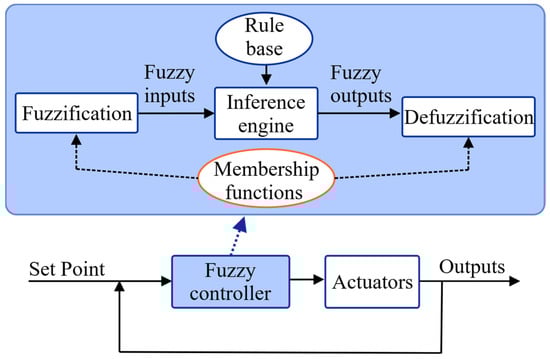
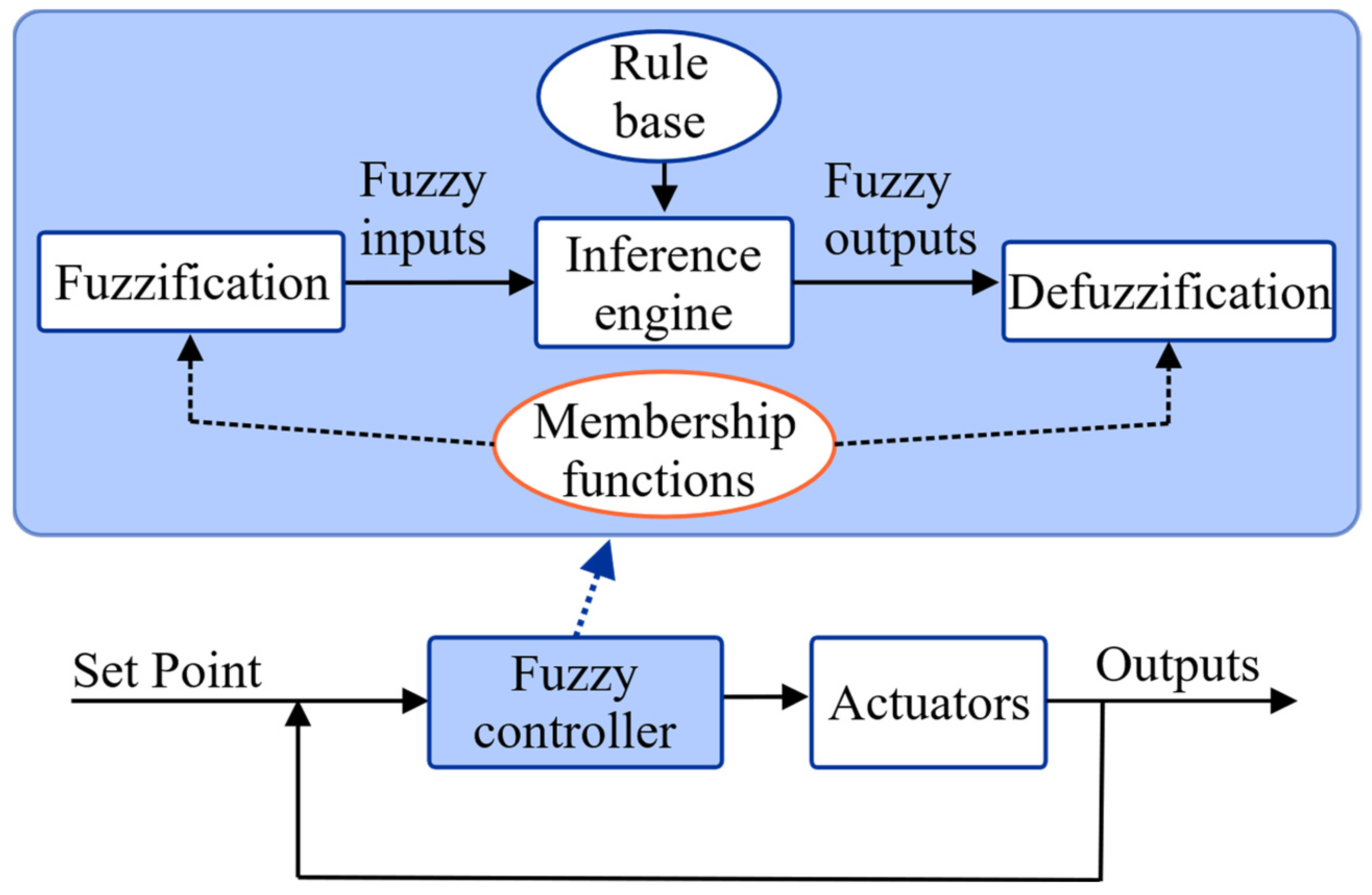
Logic fuzzy systems are based on the human ability to think, which has allowed controllers to adapt better to systems by finding an approximation to their real behavior. This has been observed mainly in those systems where their analytic functions are difficult to obtain. These controllers, through the creation of a database of knowledge with fuzzy linguistic expressions and rules, can make decisions about the control of a process using a method called inference. This method simulates the human thinking process allowing us to understand mathematically the knowledge represented in rules of the type IF-THEN to obtain an output value from the controller. In this sense, the inference method of Mamdani (Max-Min) is most commonly used in the design of fuzzy controls for the RACs. Another method also used in the field of refrigeration is the Sugeno method or Takagi-Sugeno-Kang, TSK. Figure 1 shows the typical structure of a fuzzy control system. It has four stages: fuzzification, rule base, inference engine, and defuzzification. During the fuzzification stage, the crisp inputs (the numeric values), by using membership functions, will determine the fuzzy values (μ(x)) in the range from zero to one. Then, the inference engine takes the fuzzy variables and evaluates the rules established in the rule base, and one or more fuzzy sets representing the output fuzzy variables can be obtained. Finally, defuzzification converts the fuzzy variables into crisp values that can be used by the actuator in a control system [20]. At this stage, it is possible to use different methods to perform this transformation from fuzzy values to real values.
Figure 1.
General scheme of a fuzzy controller.
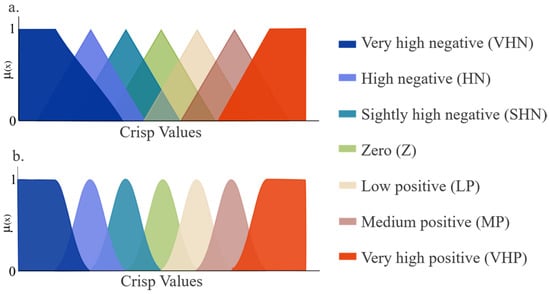
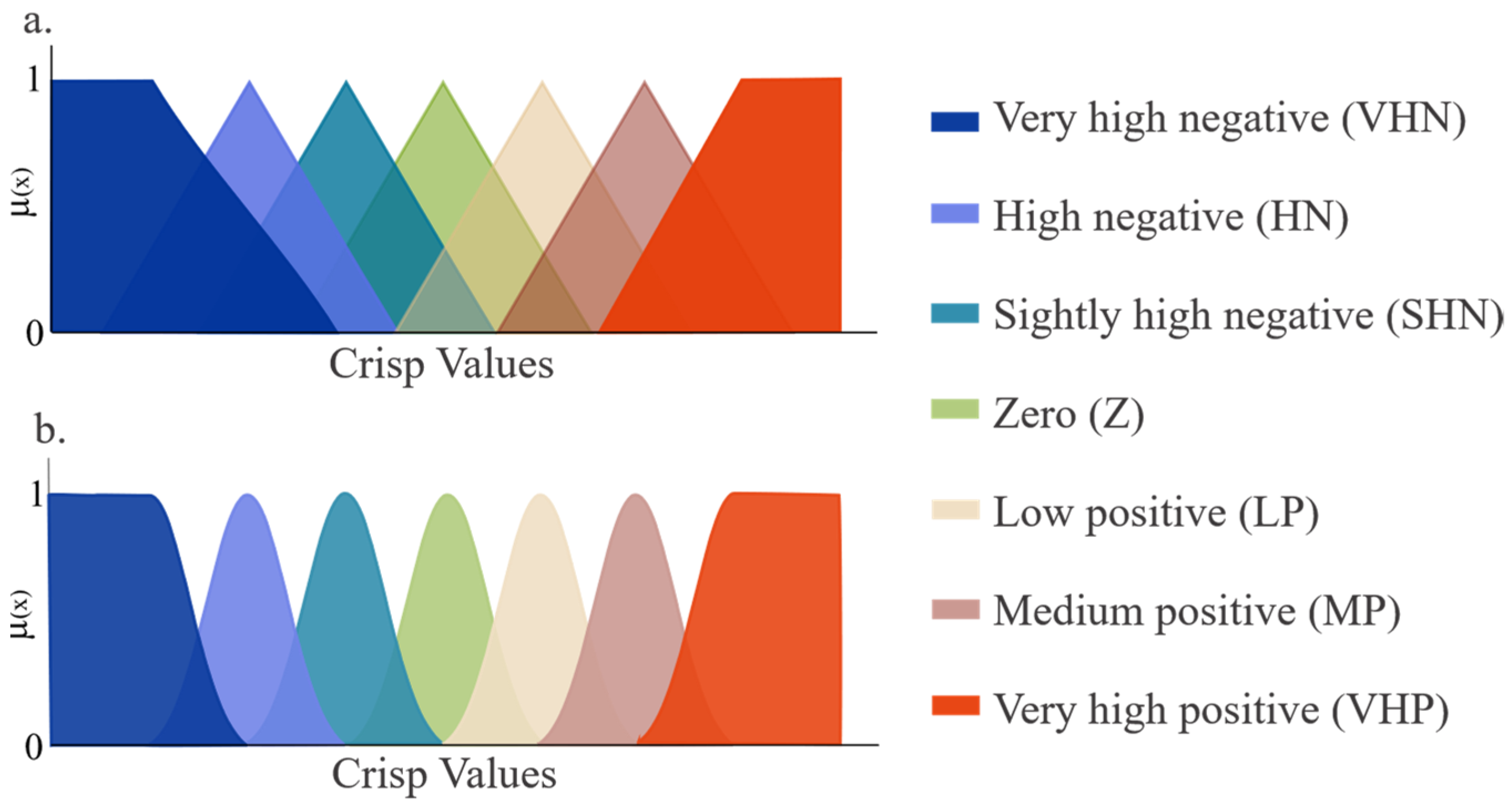
Generally speaking, the fuzzy control applied to the RACs focuses on the control of temperature and humidity. Consequently, variables, such as the duty cycle, the electric frequency of the compressor, the opening of the expansion valve, and the flux of the refrigerant are manipulated. Because of the similarity between the controlled variables (temperature and humidity) and the manipulated variables (operating duration or compressor frequency), the design of controllers for the RACs shares some characteristics independently of the system to which it is applied. The first element corresponds to the design of the membership functions for the input and output variables of the fuzzy system. Figure 2 shows the fuzzy sets most used for the RACs, these present a combination of triangular and Gaussian functions. In these sets, two of the functions are placed at the ends and they correspond to trapezoidal functions (Figure 2a) or Gaussian functions (Figure 2b). In the study of the RACs, the triangular function is most commonly used around 70% of the published research papers present controllers using a combination of triangular functions. This is because a triangle or a trapezius often provides an adequate representation of the expert knowledge, and at the same time, these two shapes simplify significantly the computation process [21] and they can additionally improve the dynamics of the system [22]. However, Islam and Hossain [23] showed that the use of triangular or trapezoidal membership functions affects the performance of the controller and, in particular, for air conditioning systems, trapezoidal functions are the most suitable.
Figure 2.
Membership function sets for the input and output variables. (a) trapezoidal functions; (b) Gaussian functions.
The set of the membership functions may depend directly on the variable or the error. With low frequency, sets of fuzzy functions in which the domain depends directly on the variable are presented. In these cases, the domain of the set of membership functions (or universe) includes all possible values that the variable can take. In most cases, there are sets in which the membership functions depend on the error, the derivative of the error, or the integral of the error. Therefore, the range of the set of functions exhibits negative and positive values. The range of the values that the universe can take is very diverse and depends on the range of the measurement of the variables that are taken into consideration for the design of each controller.
Additionally, it is very common in the design of a controller that the names of the linguistic variables are similar to the names of the membership functions. For instance, if the function is centered around zero, the name would be Z. On the other hand, if the function is positive, the name would be P. When the function is negative, the name could be N. In the same sense, it is customary to use the modifiers “very” (V), “medium” (M), “low” (L), etc. To establish some of the linguistic terms, such as “very positive” (VP) or “slightly low negative” (SLN), it is necessary to assign these names based on the number of functions in the controller. Table 1 shows a summary of the description of the linguistics variables most frequently used in the design of fuzzy logic controllers for the input and output variables.
Table 1.
Linguistic variables frequently used in RACs.
The output variables in the fuzzy logic controllers in the RACs correspond to variables of the actuators. For instance, temperature control is performed by modifying mainly the speed of the compressor, the duty cycle of the compressor, and the opening of the expansion valves. For humidity control, it is regulated by modifying the speed of the fans or opening the gates. The fuzzy sets for the input and output variables generally coincide in quantity and shape. For the RACs, systems with five membership functions for the input and the output are generally designed. However, Almasani et al. [24] presented a set of membership functions with different quantities and shapes for the input and output variables, showing that it is not necessary to use the same type and number of functions to attain satisfactory results in temperature control. Additionally, Islam et al. [25] demonstrated that according to the defuzzification method, the behavior of the output variables is affected and values with considerable differences are obtained that directly affect the behavior of the system.
Fuzzy Logic Integrated with Other Control Systems for RACs
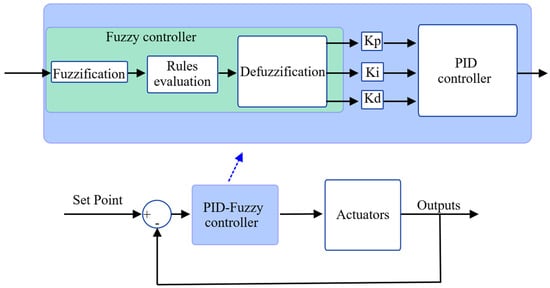
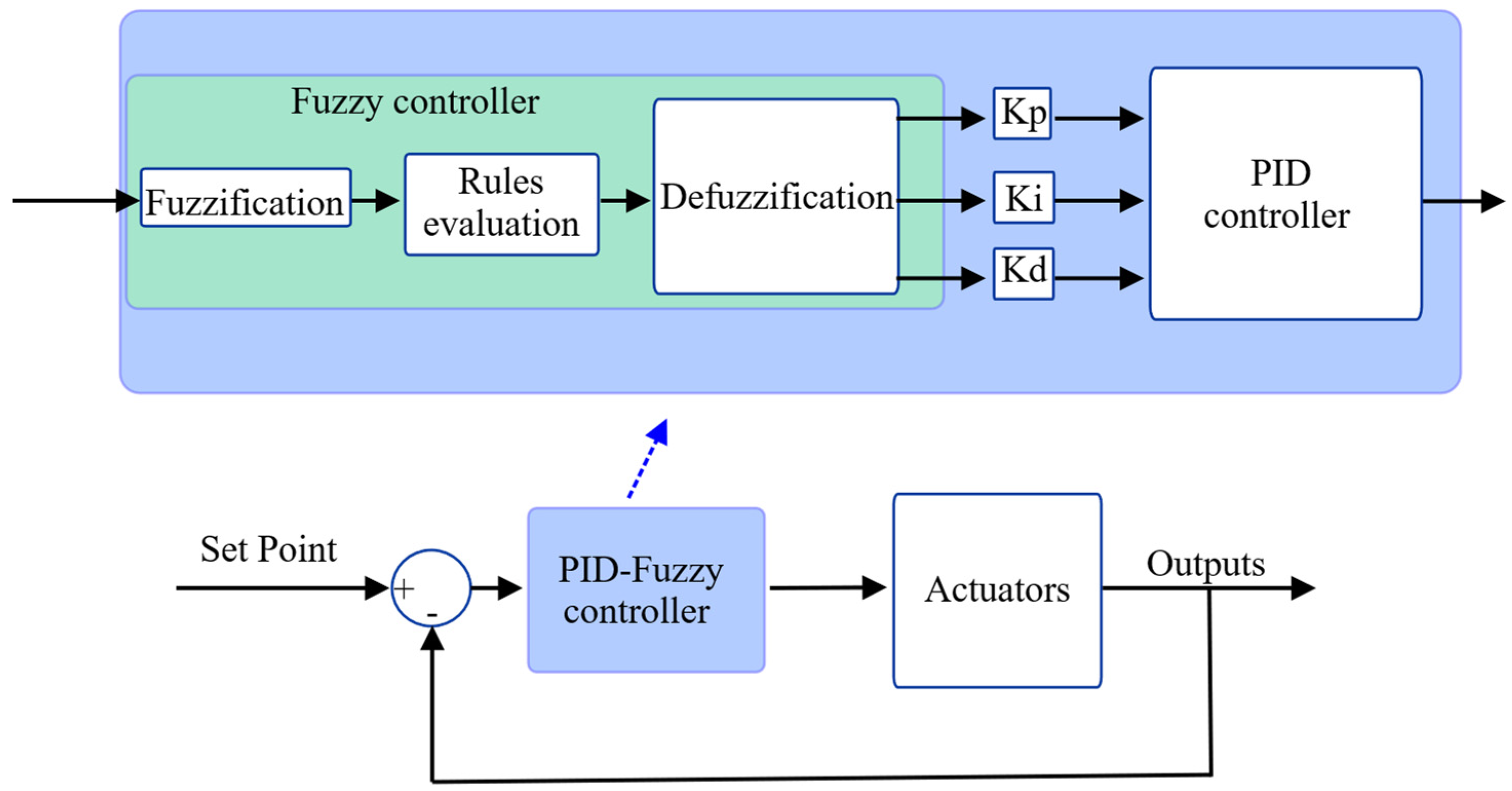
One of the advantages of fuzzy logic is its ease of integration with other controllers; this integration has shown an improvement in the regulation of process variables. One of the most common integrations in RACs is with Proportional Integral Derivate, PID, controllers. Figure 3 shows the general diagram of a fuzzy PID controller. This diagram shows the most frequent application in RACs, where fuzzy control supervises the adjustment of the constants kp, ki, and kd of the PID control, generating self-adjusting controls or adaptive controllers. There are also alternatives in the application of PID fuzzy controllers. For example, determining one or two PID control constants kp and ki or kp or kd [24], application of cascade controls [25]. There is also the possibility that fuzzy control regulates the output of the PID controller [26].
Figure 3.
General scheme of a PID-fuzzy controller.
3. Fuzzy Driver Applications on RACs
The use of fuzzy logic in the design of controllers for RACs is mainly focused on the actual modeling or simulation of the system. As it was previously mentioned, the variables most used in a control system for RACs are the temperature and relative humidity; therefore, in the following subsections, the main studies in this engineering field are discussed. These studies show the scope of fuzzy logic applied to chillers, air conditioning systems, domestic refrigerators, and heat pumps.
3.1. Fuzzy Control in Chillers and Cold Rooms
Chillers are one of the RACs in which the fuzzy logic control systems have been applied with interesting results. For instance, the integration with other control strategies allows to improve the operating conditions and obtain energy savings. In this sense, Barelli et al. [26] found that it was possible to improve energy efficiency by 1% and have more stable thermal conditions through diffuse PD + I control, regulating the frequency and acceleration of the compressor. Silva et al. [27] implemented a fuzzy PID controller and a fuzzy PI controller and found that the fuzzy PID controller was better adapted to the cooling system by presenting better performance, responding to fluctuations in the thermal load, and reducing the error by 43% in the set point.
On the other hand, comparative studies have shown that fuzzy control allows for the obtaining of better results compared to conventional controllers. In this sense, Ekren and Kücüka [28] carried out a comparative study between thermostatic control and diffuse control for a chiller that works with a variable-speed compressor and an expansion solenoid valve, and found that the diffuse controller reduced energy consumption by 17%. In a later study, a fuzzy control, a PID control, and a neural network control were compared; the results indicate that fuzzy control can reduce energy consumption by 1.4% compared to PID control, while fuzzy control consumes 6.6% more than neural network control [29]. Yang et al. [30] proposed a self-adjusting fuzzy controller to improve the performance of cooling systems; in addition, they compared a PID control and fuzzy control. They determined that the self-adjusting fuzzy controller improves thermal performance by reducing thermal inertia compared to the other controllers tested. These studies show the advantages that fuzzy controllers offer compared to PID controllers, mainly more stable temperature control is allowed so that reductions in power consumption can be achieved. Additionally, the integration of fuzzy logic and fuzzy PID controllers allows for better results than implementing each controller.
Aprea et al. [31] presented a fuzzy control algorithm for the temperature of a cold room; they regulated the speed of the compressor to evaluate energy savings. In addition, they evaluated two working fluids, R407C and R507, as substitutes for the R22 refrigerant. The authors found that diffuse control showed 13% energy savings compared to conventional thermostatic control using R407C refrigerant. Becker et al. [32] relied on the coupling of temperature and humidity for the development of the fuzzy controller, concluding that the fuzzy controller had a suitable design for the dynamic behavior of the process. Spiteri et al. [33] found the fuzzy controller as a simple solution for the overheating regulation problem of an industrial refrigeration plant. They regulated the opening of the expansion valve and determined that the controller had the flexibility to implement subjective solutions, as well as being a practical and cost-effective alternative to conventional control methods.
Fuzzy control strategies have been shown to improve the conditions in the control of variables [25,31] and on some occasions, it has even been possible to reduce energy consumption [27,30]. To achieve these energy savings, several factors intervene, such as the number of controlled variables, the type of actuators, and considerations in the design of the controllers. In this sense, Spiteri et al. [33] found that multivariate control is more efficient in controlling temperature, but less efficient in energy consumption, compared to one-variable control. Therefore, control strategies attempt to find a balance between being able to meet control objectives and achieving energy savings.
3.2. Fuzzy Control in Air Conditioning Systems
The application of fuzzy logic to air conditioning systems based on vapor compression has been extensively studied to control temperature and humidity. This has resulted in better comfort conditions. Research in this area involves the design and modeling of the controller. Likewise, research also includes the implementation of these models in experimental benches or in systems that operate under real operating conditions, including rooms, houses, buildings, etc. In this sense, Lea et al. [34] studied the regulation of compressor speed and fan speed according to the areas that required airflow. The data collected and analyzed showed that the temperature values remained at adequate levels in all areas. Tobi and Hanafusa [35] found a more efficient and economical way to maintain adequate conditions in a room compared to other techniques. In general, fuzzy controllers applied to Heating, Ventilation, and Air Conditioning (HVAC) systems are multivariable controllers of temperature and humidity, and it has been shown that this characteristic allows better control over the behavior of the system variables, thus achieving more efficient and stable systems.
Ying-Guo et al. [36] presented a fuzzy adaptive control and compared it with a PID control. The authors concluded that fuzzy logic-based control was the most stable and improved overall system performance. Al-Aifan et al. [37] developed three fuzzy control systems that worked together in an air conditioning system combined with a variable volume of refrigerant. Simultaneous fuzzy logic control was found to reduce power consumption and to be more effective in satisfying cooling conditions compared to a PID control. Li et al. [38] implemented a proportional-derived control system with fuzzy logic. The system worked with two independent control loops, one for temperature control and one for humidity in an air conditioning system. As a result of this specific implementation, it was concluded that the simultaneous temperature and humidity controller provided an accurate response from the control system. In a later study, Li et al. [39] integrated neural networks as a complement to the fuzzy controller and found that the combination of neural networks and fuzzy control offered better performance and simultaneous control with great precision.
Xiaoqing [40] improved the performance of HVAC systems through the use of a self-tuning neuro diffuse temperature and humidity controller. The analysis was performed in those systems that are affected by the variation of the supply airflow rate and relative humidity. The author found that the fuzzy controller responded correctly to disturbances because the self-tuning ability ensured that the controller always worked in optimal conditions. Chu et al. [41] developed a control system for a fan coil unit of an HVAC system. In this sense, they proposed a function for predicting the thermal load based on thermal comfort, and the system was able to control humidity and temperature. Consequently, this strategy controlled thermal comfort achieving energy savings with variations of less than 2% in temperature and a daily energy saving of 36%. Islam et al. [42] presented an algorithm for temperature and humidity control in industrial air conditioning systems. In their study, the control parameters were adjusted by the cooling valve, the heating valve, and the humidification valve. It was concluded that their design showed lower energy consumption and therefore a great efficiency. García Arenas [43] considered the variation in temperature and relative humidity of the environment throughout the year to model the control of comfort in a room.
The use of genetic algorithms and neural networks together with fuzzy controllers has allowed the systems to be brought closer to their optimal operating conditions, with results superior to classic controllers, overcoming their limitations, and performing more intuitive control actions. In this sense, Parameshwaran et al. [44] proposed a fuzzy genetic algorithm that reduced annual energy consumption by 36%, in which compressor speed, fan speed, and damper opening (Do) were regulated. All of these parameters were adjusted to control temperature, air supply, and CO2 concentration. Marvuglia et al. [45] predicted the internal temperature of a building using an autoregressive neural network with external inputs. This internal temperature served as input for the fuzzy control system that controlled the ON/OFF of an air conditioning system. The combination of a neuro-fuzzy control yielded adequate results because of the dynamic regulation of the ON/OFF of the air conditioning system. Hasim et al. [46] improved the efficiency of a system based on the variation of human comfort, as well as relative humidity and dew point. They found that fuzzy control had great feasibility to be implemented in a real system. Kang et al. [47] proposed the integration between a diffuse control and an ON/OFF control for a residential building. The proposal was made to improve the operation of an ON/OFF control taking into consideration the incident solar radiation in the building. Thus, fuzzy controllers can be perfectly coupled to those systems where, due to physical restrictions, they limit the variables that can be manipulated. Air conditioning systems are subject to a variety of variable conditions, such as weather parameters or variations in operating parameters. Therefore, fuzzy controllers perform best when a MIMO control system is considered and the interaction between temperature and humidity is taken into account.
It is not only the use of the internal temperature of the space and the humidity as input variables for the diffuse control allow adequate thermal and energy results. Other variables, such as ambient temperature or refrigerant flow, among others, affect the behavior of the system. The inclusion of these types of variables in the fuzzy controller has also allowed for the obtaining of more efficient systems and achieving better control of the variables, mainly while achieving system stability. In this sense, Lin and Wang [48] succeeded in improving the evaporator superheat (SH) of using an adaptive controller and consequently improved energy efficiency. Fakhruddin et al. [49] developed a MIMO controller for a variable speed compressor taking into account the operating hours of the air conditioning system. The author found that fuzzy logic showed advantages in solving analytically complex problems, starting from intuitive knowledge and resulting in optimal performance.
The study of air quality through CO2 concentration is also considered in some studies. Between these, Almasani et al. [24] showed an expert control system for an HVAC controlling the amount of oxygen in a room and taking into account the outside ambient temperature. It was shown that the performance of this controller was better than the conventional controller, as it reduced the overshoot by 2.25%, provided precise control, and quickly adapted to diverse operating conditions. Abdo-Allah et al. [50] took into account CO2 concentration, in addition to the traditional variables for control, obtaining higher and more stable responses than traditional control algorithms. The above shows that the use of new types of controllers is focused not only on improving performance but also on improving conditions to maintain environments that do not harm health.
On the other hand, the predicted mean vote, PMV, introduced by Fanger [51], is used to predict the thermal sensation on a standard scale based on environment variables, such as air temperature, radiance temperature, airspeed, and relative humidity. Additionally, other personal parameters, such as the activity level or cloth insulations were also considered. Some authors have included this factor in the design of diffuse control systems as an alternative for direct regulation of temperature and humidity. For instance, Dounis et al. [52] and Dounis and Manolakis [53] tested the design of comfort-based controllers as a fuzzy concept. In this sense, new general points of view were proposed for the design of fuzzy controls applied to HVAC systems paying special attention to the selection of suitable rules. Hamdi and Lachiver [54] developed a controller based on the evaluation of the level of thermal comfort, intending to modify the operating parameters to find the optimal value of thermal comfort and obtain a reduction in energy consumption. Calvino et al. [55] developed an adaptive Fuzzy-PID controller trying to avoid shaping the internal and external environments. Ciabattoni et al. [56] developed a controller to overcome the non-linear condition in the PMV index that limits its application to the problem of heating control in HVAC systems. With the introduction of environmental parameters external to the system, the results showed that the proposed control technique made it possible to avoid the use of a temperature set point for the HVAC system. Yan et al. [57] found a simple way to improve comfort by regulating the volume of air delivered when the thermal comfort index was included as a controlled variable. It is evident that the integration of new factors as input variables allows the systems to be greatly improved. In this case, the PMV index includes parameters that are little used in classic controllers and that are more related to the daily use of HVAC systems. Note that the fuzzy controllers are better adapted to the concept of thermal comfort, without the need for mathematical models, which in this case would be very complex or impossible to obtain due to the subjectivity of comfort. Therefore, fuzzy controllers represent a suitable alternative for the replacement of conventional controllers.
Another segment of research in the application of the air conditioning system is present in automobiles, where some research works have been performed. For instance, Davis et al. [58] presented a fuzzy logic control system to overcome the limitations of the linear proportional control. The system was designed using the terms described by the driver to express comfort level. Nasution [59] experimentally evaluated the efficiency of an air conditioning system in a car by performing a comparison of fuzzy control and an ON/OFF control. The author determined that the fuzzy controller was able to save 39.14% and 64.35% of energy according to the setting of the thermal load, and significantly improved the internal comfort. Khayyam et al. [60] implemented a controller for the energy consumption of an air conditioning system for an automobile. One of the input variables for the system was the position of the vehicle using GPS and the speed of the car to determine the exterior conditions; they were able to reduce the energy consumption by 12%. Ibrahim et al. [61] found the balance between internal comfort and energy efficiency by simulating fuzzy control taking into account humidity for an electric car air conditioning system. The implementation of diffuse controllers in air conditioning systems is extensive; it was observed that different strategies, such as modeling and integration with classic controllers, have gradually allowed improvements to thermal behavior and, in some cases, energy savings have been achieved. In this same sense, integration with genetic algorithms and neural networks are becoming increasingly utilized strategies since this integration has been superior to other controllers.
As mentioned, the use of fuzzy controllers in air conditioning systems has been advantageous in maintaining operating conditions and achieving energy savings, showing advantages over traditional controllers. It has also been shown that the integration of fuzzy controllers along with other control strategies allows improving the performance of the systems. In addition, the inclusion of new control variables (PMV, CO2 concentration, number of people) has gradually transformed the controller’s approach to maintaining conditions that do not affect health. These scenarios make the controllers more and more complex, demonstrating that fuzzy logic can achieve satisfactory results, but they also make their application increasingly complex to implement, which would limit the applicability of this type of controller. These limitations can be overcome with the use of other strategies, such as neural networks, which gradually allow fuzzy logic to handle secondary tasks rather than the main control action.
3.3. Fuzzy Control in Domestic Refrigerators
There is very little information in the literature regarding the application of fuzzy logic control in domestic refrigeration systems. Among the works found, Bung-Joon et al. [62] developed a controller model based on fuzzy logic and neural networks to improve the performance of the internal temperature of the refrigerator. Employing the controller, it was also possible to reduce the variation of the internal temperature. Mraz [63] concluded that fuzzy controls can reduce energy consumption by 3% by regulating compressor duty cycles and also represent a good alternative to replace thermostatic control. Rashid and Islam [64] proposed a controller with Mamdani inference for the temperature in a domestic refrigerator with a variable speed compressor; this method was designed to make the transition from the analog control to the digital control of the refrigerators. Azam and Mousavi [65] developed a controller for the temperature and humidity of a refrigerator; through simulation they verified that the fuzzy control saved operating costs and at the same time had fewer fluctuations in the internal temperature. Arfaoui et al. [66] proposed an alternative method for the fuzzy controller, combining it with genetic algorithms and comparing it with the PID control. Using a third-order discrete-state system, they calculated the air temperature in the refrigerator and determined that the combination of genetic algorithms with fuzzy logic exhibited better thermal behavior and, consequently, the temperature of the setpoint was reached quickly, thus reducing energy consumption by 0.3957 kWh. Belman-Flores et al. [67] implemented a fuzzy controller in which, as the main contribution, the opening of the doors of the refrigerator was considered, integrating this habit of use in the rules of the controller. The authors concluded that the diffuse controller along with the incorporation of the habit of using reduced energy consumption by 3% compared to the conventional controller. Although the application and development of fuzzy controllers for home refrigerators are sparse, ample research opportunity presents itself. For example, integration with classic controllers or neural networks allows improvements in thermal and energy behaviors. Additionally, the integration of the usage habits to the controllers would allow the achievement of greater savings in energy consumption and better quality of food products.
3.4. Fuzzy Control in Heat Pumps
Another application of controllers is presented in heat pumps, where, in the same way as in refrigeration systems, control is mainly aimed at temperature by regulating the speed of compressors and fans, and opening expansion valves. Concerning the above, Choi et al. [68] presented the comparison of a PI controller, a non-optimized fuzzy controller, and an optimized controller for the control of overheating in the compressor discharge. The optimization was carried out using genetic algorithms, which allowed modification of the controller rules. Through experiments, it was determined that the fuzzy controller presented the worst performance, but when optimizing it, it was the one that showed the best performance of the three controllers. Tsai et al. [69] designed a cascade fuzzy PID control strategy for the control of an air source heat pump. The controller consisted of two control loops, one of the loops modified the speed of the compressor, and the second of which regulated the opening of the expansion valve. The results showed that the fuzzy cascade control provided superior performance, improved reaction time, and minimized temperature overshoot.
Esen et al. [70] compared the use of artificial neural networks (ANN) against an adaptive neuro-fuzzy inference system (ANFIS) for predicting the performance of a ground-coupled heat pump. The authors obtained the best results for the cooling and heating mode with the combination of neural networks and fuzzy logic. Later, Esen and Inalli [71] applied the control system in a vertical ground source heat pump and found that the best results were obtained with the ANFIS system. Adaptive fuzzy systems with neural networks are presented as the future of expert controllers for RAC, in this case, the advantage of being able to predict the behavior of variables and not needing a mathematical model helps enormously since strategies can be established in advance to have better control and achieve energy reduction. One of the limitations of fuzzy control is found in the initial design stage, at this stage information from an expert in the system is required. In this sense, the combination of genetic algorithms and neural networks can be a viable option that can help improve and optimize the structure of the controller.
Lee et al. [72] presented a fuzzy logic-based compensator for the PI controller, to improve the performance of the temperature control, concluding that the compensated controller had superior performance and presented greater ease of implementation. Sözen et al. [73] used the controller with fuzzy logic to predict the performance of a heat pump that worked with mixtures of R12 and R22 refrigerants. In this study, the authors determined that fuzzy logic is a reliable method to define the performance of the heat pump, giving differences of 1.5% in the prediction of coefficient of performance (COP) and 1% in rational efficiency. Yang et al. [74] obtained a more stable behavior of a heat pump, utilizing two fuzzy controllers in which the evaporator superheating and the temperature were simultaneously regulated in a drying process. Another application of fuzzy control in heat pumps was presented by Şahin et al. [75], which simulated and optimized the operation of a system through a genetic algorithm and fuzzy logic. In this case, the authors used fuzzy logic to obtain the thermodynamic properties necessary for optimization. Within the search for alternative approaches to conventional controllers, the implementation of fuzzy controllers in heat pumps is shown to have various applications along with the use of different strategies. Although this new approach increases the complexity of implementation, it is necessary not only to improve the performance of the systems but also to help reduce maintenance costs and energy consumption caused by conventional controllers.
Finally, to conclude the application of fuzzy controls to the RACs, Table 2 shows a summary of several commonly used controllers. The table includes detailed information about the design and application for each controller. Additionally, the table presents the number of control loops as well as the input and output variables of the controller. Even though the number of variables, the shape of the membership functions, and the number of inference rules are independent variables of the operating conditions of the system and the knowledge of the person designing the system, the error and the derivative of the error are used as input variables despite the flexibility of fuzzy controllers that allow the use of the crisp values of the variables. Additionally, was found the common use of fuzzy sets with 3 and 5 triangular membership functions and 25 inference rules. It was also found that the most commonly used output variables are the speed or frequency of the compressor and the speed of the fans. Although a fuzzy control has a flexible design, it was found that in most cases it is implemented together with a PID controller or artificial neural networks. In these cases, fuzzy logic allows for better adjustment of controller parameters and reduces the use of complex mathematical models, jointly improving system efficiency.
Table 2.
Fuzzy driver application in RACs.
3.5. Energy Saving
According to the previous sections, the implementation of this type of controller has gradually shown that it is possible to attain significant reductions in energy consumption through the implementation of different strategies. In this sense and trying to outline the importance of these strategies in the RACs, Table 3 shows those studies that were able to obtain some energy savings. The table includes the results from the simulations as well as from experimentation. Observe that most of the experimental studies present a higher percentage of energy savings than the simulation studies. It is important to mention that it is not always possible to attain energy savings, for instance, Schmitz et al. [76] showed that when only one variable was controlled, the system can consume more energy than when several variables are used. Additionally, most of the studies were able to get a reduction in the energy consumption when the controller was integrated with other control systems, such as PID and artificial neural networks, or when new variables were integrated into the controller.
Table 3.
Reduction in energy consumption due to the use of fuzzy control.
As discussed in the previous sections, the use of fuzzy controllers in RACs is extensive and is shown to be a viable option for control, demonstrating that adequate thermal conditions can be maintained, and energy consumption reduced. In addition to being simple and intuitive controllers in their implementation, they have been suitable for obtaining satisfactory results in nonlinear systems, such as RACs. Integration with other controllers helps overcome the limitations of the fuzzy controller. Control strategies are important in the foreseeable future when systems are required to be more efficient and consume less energy, helping to take advantage of increasingly scarce energy resources.
3.6. Future Perspectives for the Application of Fuzzy Controllers in RACs
The application evolution of fuzzy controllers to RACs began with the individual implementation of this type of controller. Through the years, fuzzy controllers have been used in combination with classic controllers and advanced control systems for the implementation of real systems. These controllers are designed to maintain desired thermal conditions, and at the same time, reduce energy consumption. Consequently, it is intended that in the future, RACs will be more energy efficient than present systems by making better use of energy resources. In this sense, RCAs present a field of opportunity because they are responsible for a significant percentage of electricity consumption worldwide. Additionally, several technological developments, such as variable speed compressors, expansion solenoid valves, and the integration of elements that improve the interaction between users and RACs, have allowed these systems to become more and more efficient. The main advantage of fuzzy controllers is that they are able to incorporate a large number of variables and rules simultaneously, and thus, decide based on a set of desired thermal conditions and restrictions about the usage of the system. Fuzzy controllers have the ability to adapt with other intelligent controllers, and it is expected that in the future, RACs will anticipate its operating conditions, while maintaining adequate thermal conditions and managing energy consumption more efficiently.
4. Conclusions
In this review, the application of the fuzzy controllers to the RACs is proposed. This review also includes the implementation and design of these systems as well as the results obtained from the different types of implementations. Detailed information about the application of the fuzzy controllers in the RACs is also presented. In the same sense, the input and output variables, the inference methods, and the different shapes for the membership function are explained looking for possible energy savings in these systems:
- It was shown that the use of fuzzy controllers in the RACs has allowed the obtaining of a better thermal efficiency than that of classic controllers, such as the ON/OFF and the PID. Additionally, it is possible to improve the results when the controller is integrated with artificial neural networks or genetic algorithms;
- Computer simulations and experimental validation have shown that the use of fuzzy controllers can reduce energy consumption. Furthermore, the implementation using different control strategies, such as fuzzy-PID or the fuzzy neuro-controllers has allowed better energy savings than using only one type of control.
Author Contributions
Conceptualization, J.M.B.-F. and D.A.R.-V.; methodology and writing of the paper, J.M.B.-F.; analysis of the information, investigation, and writing of the paper, D.M.P.-C., J.J.G.-P., S.L., D.H.; review and editing, J.M.B.-F. and D.A.R.-V.; All authors have read and agreed to the published version of the manuscript.
Funding
This research received no external funding.
Institutional Review Board Statement
Not applicable.
Informed Consent Statement
Not applicable.
Data Availability Statement
Not applicable.
Acknowledgments
We acknowledge the University of Guanajuato for their sponsorship in the realization of this work.
Conflicts of Interest
The authors declare no conflict of interest.
Abbreviations
| Do | Damper opening |
| HR | Relative humidity, % |
| Mass flow rate, kg/s | |
| SH | Superheating, °C, K |
| T | Temperature, °C, K |
| Δ | Change |
| Subscript | |
| amb | Ambient |
| b | Wet bulb |
| d | Dry bulb |
| sc | Secondary fluid |
| w | Water |
References
- Dupont, J.L.; Domanski, P.; Lebrun, P.; Ziegler, P. The Role of Refrigeration in the Global Economy (2019), 38th Note on Refrigeration Technologies; IIF-IIR: Paris, France, 2019. [Google Scholar]
- Heredia-Aricapa, Y.; Belman-Flores, J.M.; Mota-Babiloni, A.; Serrano-Arellano, J.; García-Pabón, J.J. Overview of low GWP mixtures for the replacement of HFC refrigerants: R134a, R404A and R410A Étude des mélanges à faible PRP pour le remplacement des frigorigénes HFC. Int. J. Refrig. 2020, 111, 113–123. [Google Scholar] [CrossRef] [Scilit]
- Azmi, W.H.; Sharif, M.Z.; Yusof, T.M.; Mamat, R.; Redhwan, A.A.M. Potential of nanorefrigerant and nanolubricant on energy saving in refrigeration system—A review. Renew. Sustain. Energy Rev. 2017, 69, 415–428. [Google Scholar] [CrossRef] [Scilit]
- Catrini, P.; Panno, D.; Cardona, F.; Piacentino, A. Characterization of cooling loads in the wine industry and novel seasonal indicator for reliable assessment of energy saving through retrofit of chillers. Appl. Energy 2020, 266, 114856. [Google Scholar] [CrossRef] [Scilit]
- Bista, S.; Hosseini, S.E.; Owens, E.; Phillips, G. Performance improvement and energy consumption reduction in refrigeration systems using phase change material (PCM). Appl. Therm. Eng. 2018, 142, 723–735. [Google Scholar] [CrossRef] [Scilit]
- Murthy, A.A.; Subiantoro, A.; Norris, S.; Fukuta, M. A review on expanders and their performance in vapour compression refrigeration systems. Int. J. Refrig. 2019, 106, 427–446. [Google Scholar] [CrossRef] [Scilit]
- Espíndola, R.S.; Knabben, F.T.; Melo, C.; Hermes, C.J.L. Thermal performance of skin-type, hot-wall condensers, Part II: Design guidelines for household applications. Int. J. Refrig. 2020, 110, 262–267. [Google Scholar] [CrossRef] [Scilit]
- Chua, K.J.; Chou, S.K.; Yang, W.M.; Yan, J. Achieving better energy-efficient air conditioning—A review of technologies and strategies. Appl. Energy 2013, 104, 87–104. [Google Scholar] [CrossRef] [Scilit]
- Goyal, A.; Staedter, M.A.; Garimella, S. A review of control methodologies for vapor compression and absorption heat pumps. Int. J. Refrig. 2019, 97, 1–20. [Google Scholar] [CrossRef] [Scilit]
- Sung, T.; Kim, Y.J.; Kim, H.S.; Kim, J. Empirical modeling and robust control of a novel meso-scale vapor compression refigeration system (mVCRS). Int. J. Refrig. 2017, 77, 99–115. [Google Scholar] [CrossRef] [Scilit]
- Massa Gray, F.; Schmidt, M. A hybrid approach to thermal building modelling using a combination of Gaussian processes and grey-box models. Energy Build. 2018, 165, 56–63. [Google Scholar] [CrossRef] [Scilit]
- Noeding, M.; Tegethoff, W.; Koehler, J. Zero Gradient Control for R-744 refrigeration cycles. Int. J. Refrig. 2019, 106, 283–296. [Google Scholar] [CrossRef] [Scilit]
- Bejarano, G.; Vivas, C.; Ortega, M.G.; Vargas, M. Suboptimal hierarchical control strategy to improve energy efficiency of vapour-compression refrigeration systems. Appl. Therm. Eng. 2017, 125, 165–184. [Google Scholar] [CrossRef] [Scilit]
- Li, X.; Chen, Q.; Hao, J.-H.; Chen, X.; He, K.-L. Heat current method for analysis and optimization of a refrigeration system for aircraft environmental control system. Int. J. Refrig. 2019, 106, 163–180. [Google Scholar] [CrossRef] [Scilit]
- Toub, M.; Reddy, C.R.; Razmara, M.; Shahbakhti, M.; Robinett, R.D.; Aniba, G. Model-based predictive control for optimal MicroCSP operation integrated with building HVAC systems. Energy Convers. Manag. 2019, 199, 111924. [Google Scholar] [CrossRef] [Scilit]
- Esen, H.; Inalli, M.; Sengur, A.; Esen, M. Modelling a ground-coupled heat pump system using adaptive neuro-fuzzy inference systems. Int. J. Refrig. 2008, 31, 65–74. [Google Scholar] [CrossRef] [Scilit]
- Liang, Y.Y.; Wang, D.D.; Chen, J.P.; Shen, Y.G.; Du, J. Temperature control for a vehicle climate chamber using chilled water system. Appl. Therm. Eng. 2016, 106, 117–124. [Google Scholar] [CrossRef] [Scilit]
- Mirinejad, H.; Sadati, S.H.; Ghasemian, M.; Torab, H. Control Techniques in heating, ventilating and air conditioning systems. J. Comput. Sci. 2008, 4, 777–783. [Google Scholar] [CrossRef] [Scilit]
- Mirinejad, H.; Welch, K.C.; Spicer, L. A review of intelligent control techniques in HVAC systems. In Proceedings of the 2012 IEEE Energytech, Cleveland, OH, USA, 29–31 May 2012; pp. 1–5. [Google Scholar] [CrossRef] [Scilit]
- Klir, G.J.; Yuan, B. Fuzzy Sets and Fuzzy Logic: Theory and Applications; Prentice Hall PTR: Hoboken, NJ, USA, 1995; ISBN 0-13-101171-5. [Google Scholar]
- Management Association. Fuzzy Systems: Concepts, Methodologies, Tools, and Applications; IGI Global: Hershey, PA, USA, 2017; Volume 1–3, ISBN 9781522519089. [Google Scholar]
- Koprinkova, P. Membership functions shape and its influence on the dynamical behaviour of fuzzy logic controller. Cybern. Syst. 2000, 31, 161–173. [Google Scholar] [CrossRef] [Scilit]
- Islam, M.A.; Hossain, M.S. The Development of Fuzzy Logic Controller (FLC) in Air Conditioning System Using Several Types of Fuzzy Numbers. Intern. J. Fuzzy Math. Arch. 2021, 1, 2320–3250. [Google Scholar] [CrossRef] [Scilit]
- Almasani, S.A.M.; Qaid, W.A.A.; Khalid, A.; Alqubati, I.A.A. Fuzzy Expert Systems to Control the Heating, Ventilating and Air Conditioning (HVAC) Systems. Int. J. Eng. Res. Technol. 2015, 4, 808–815. [Google Scholar]
- Islam, M.; Hossain, M.; Haque, I. Mathematical Comparison of Defuzzification of Fuzzy Logic Controller for Intelligence Air Conditioning System. Int. J. Sci. Res. Math. Stat. Sci. 2021, 8, 29–37. [Google Scholar]
- Barelli, L.; Bidini, G.; Arce, R. Fuzzy logic regulator for the performance improvement and the energy consumption reduction of an industrial chiller. In Proceedings of the 2003 ASME International Mechanical Engineering Congress, Washington, DC, USA, 15–21 November 2003; pp. 1–10. [Google Scholar]
- Silva, F.V.; Neves Filho, L.C.; Silveira, V. Experimental evaluation of fuzzy controllers for the temperature control of the secondary refrigerant in a liquid chiller. J. Food Eng. 2005, 75, 349–354. [Google Scholar] [CrossRef] [Scilit]
- Ekren, O.; Kücüka, S. Energy saving potential of chiller system with fuzzy logic control. Int. J. Energy Res. 2009, 34, 897–906. [Google Scholar] [CrossRef] [Scilit]
- Ekren, O.; Sahin, S.; Isler, Y. Comparison of different controllers for variable speed compressor and electronic expansion valve. Int. J. Refrig. 2010, 33, 1161–1168. [Google Scholar] [CrossRef] [Scilit]
- Yang, Z.; Duan, P.; Li, Z.; Yang, X. Self-Adjusting Fuzzy Logic Controller for Refrigeration Systems. In Proceedings of the International Conference on Information and Automation, Lijiang, China, 8–10 August 2015; pp. 2823–2827. [Google Scholar]
- Aprea, C.; Mastrullo, R.; Renno, C. Fuzzy control of the compressor speed in a refrigeration plant. Int. J. Refrig. 2004, 27, 639–648. [Google Scholar] [CrossRef]
- Becker, M.; Oestreich, D.; Hasse, H.; Litz, L. Fuzzy control for temperature and humidity in refrigeration system. In Proceedings of the Third IEEE International Conference on Control and Applications, Glasgow, UK, 24–26 August 1994; Volume 3, pp. 1607–1612. [Google Scholar]
- Spiteri, S.; Reznik, L.; Vilas-boas, P. Embedded Fuzzy Control for Reefer Refrigeration Systems. In Proceedings of the 2001 IEEE International Fuzzy Systems Conference, Melbourne, Australia, 2–5 December 2001; pp. 1088–1091. [Google Scholar]
- Lea, R.N.; Dohmann, E.; Prebilsky, W.; Jani, Y. An HVAC fuzzy logic zone control system and performance results. In Proceedings of the IEEE 5th International Fuzzy Systems, New Orleans, LA, USA, 11 September 1996; Volume 3, pp. 2175–2180. [Google Scholar]
- Tobi, T.; Hanafusa, T. A practical application of fuzzy control for an air-conditioning system. Int. J. Approx. Reason. 1991, 5, 331–348. [Google Scholar] [CrossRef] [Scilit]
- Piao, Y.-G.; Zhang, H.-G.; Zeungnam, B. A simple fuzzy adaptive control method and application in HVAC. In Proceedings of the 1998 IEEE International Conference on Fuzzy Systems Proceedings. IEEE World Congress on Computational Intelligence (Cat. No.98CH36228), Anchorage, AK, USA, 4–9 May 1998; Volume 1, pp. 528–532. [Google Scholar]
- Al-Aifan, B.; Parameshwaran, R.; Mehta, K.; Karunakaran, R. Performance evaluation of a combined variable refrigerant volume and cool thermal energy storage system for air conditioning applications. Int. J. Refrig. 2017, 76, 271–295. [Google Scholar] [CrossRef] [Scilit]
- Li, Z.; Xu, X.; Deng, S.; Pan, D. A novel proportional-derivative (PD) law based fuzzy logic principles assisted controller for simultaneously controlling indoor temperature and humidity using a direct expansion (DX) air conditioning (A/C) system gulateur assist e pa. Int. J. Refrig. 2015, 7, 239–256. [Google Scholar] [CrossRef] [Scilit]
- Li, Z.; Xu, X.; Deng, S.; Pan, D. A novel neural network aided fuzzy logic controller for a variable speed (VS) direct expansion (DX) air conditioning (A/C) system. Appl. Therm. Eng. 2015, 78, 9–23. [Google Scholar] [CrossRef] [Scilit]
- Xiaoqing, Z. Self-Tuning Fuzzy Controller for Air-Conditioning Systems. Master’s Thesis, National University of Singapore, Singapore, 2002. [Google Scholar]
- Chu, C.-M.; Jong, T.-L.; Huang, Y.-W. Thermal comfort control on multi-room fan coil unit system using LEE-based fuzzy logic. Energy Convers. Manag. 2005, 46, 1579–1593. [Google Scholar] [CrossRef] [Scilit]
- Islam, M.S.; Sarker, M.S.Z.; Rafi, K.A.A.; Othman, M. Development of a Fuzzy Logic Controller Algorithm for Air-conditioning System. In Proceedings of the 2006 IEEE International Conference on Semiconductor Electronics, Kuala Lumpur, Malaysia, 29 October–1 December 2006; pp. 830–834. [Google Scholar] [CrossRef] [Scilit]
- García Arenas, D. Control Ambiental Psicométrico Mediante Lógica Difusa. Bachelor’s Thesis, Universidad Carlos III de Madrid, Madrid, Spain, 2010. [Google Scholar]
- Parameshwaran, R.; Karunakaran, R.; Kumar, C.V.R.; Iniyan, S. Energy conservative building air conditioning system controlled and optimized using fuzzy-genetic algorithm. Energy Build. 2010, 42, 745–762. [Google Scholar] [CrossRef] [Scilit]
- Marvuglia, A.; Messineo, A.; Nicolosi, G. Coupling a neural network temperature predictor and a fuzzy logic controller to perform thermal comfort regulation in an office building. Build. Environ. 2014, 72, 287–299. [Google Scholar] [CrossRef] [Scilit]
- Hasim, N.; Mohd Shahrieel, M.A. Intelligent Room Temperature Controller System Using MATLAB Fuzzy Logic Toolbox. Int. J. Sci. Res. 2012, 3, 1748–1753. [Google Scholar]
- Kang, C.S.; Hyun, C.H.; Park, M. Fuzzy logic-based advanced on-off control for thermal comfort in residential buildings. Appl. Energy 2015, 155, 270–283. [Google Scholar] [CrossRef] [Scilit]
- Lin, L.; Wang, X. Design for refrigerator evaporator superheat based on direct adaptive fuzzy controller. In Proceedings of the 28th Chinese Control and Decision Conference, CCDC 2016, Yinchuan, China, 28–30 May 2016; pp. 6297–6300. [Google Scholar] [CrossRef] [Scilit]
- Fakhruddin, H.N.; Ali, S.A.; Muzafar, M.; Azam, S. Fuzzy Logic in HVAC for Human Comfort. Int. J. Sci. Eng. Res. 2016, 7, 83–86. [Google Scholar]
- Abdo-Allah, A.; Iqbal, T.; Pope, K. Modeling, Analysis, and Design of a Fuzzy Logic Controller for an AHU in the S.J. Carew Building at Memorial University. J. Energy 2018, 2018, 4540387. [Google Scholar] [CrossRef] [Scilit]
- Fanger, P.O. Thermal Comfort: Analysis and Applications in Environmental Engineering; McGraw-Hill: New York, NY, USA, 1972; ISBN 0070199159. [Google Scholar]
- Dounis, A.I.; Santamouris, M.J.; Lefas, C.C.; Argiriou, A. Design of a fuzzy set environment comfort system. Energy Build. 1995, 22, 81–87. [Google Scholar] [CrossRef] [Scilit]
- Dounis, A.I.; Manolakis, D.E. Design of a fuzzy system for living space thermal-comfort regulation. Appl. Energy 2001, 69, 119–144. [Google Scholar] [CrossRef] [Scilit]
- Hamdi, M.; Lachiver, G. A fuzzy control system based on the human sensation of thermal comfort. In Proceedings of the 1998 IEEE International Conference on Fuzzy Systems Proceedings. IEEE World Congress on Computational Intelligence, Anchorage, AK, USA, 4–9 May 1998; Volume 1, pp. 487–492. [Google Scholar] [CrossRef] [Scilit]
- Calvino, F.; La Gennusa, M.; Rizzo, G.; Scaccianoce, G. The control of indoor thermal comfort conditions: Introducing a fuzzy adaptive controller. Energy Build. 2004, 36, 97–102. [Google Scholar] [CrossRef] [Scilit]
- Ciabattoni, L.; Cimini, G.; Ferracuti, F.; Grisostomi, M.; Ippoliti, G.; Pirro, M. Indoor thermal comfort control through fuzzy logic PMV optimization. In Proceedings of the 2015 International Joint Conference on Neural Networks (IJCNN), Killarney, Ireland, 11–16 July 2015; Volume 2015, pp. 1–6. [Google Scholar]
- Yan, H.; Pan, Y.; Li, Z.; Deng, S. Further development of a thermal comfort based fuzzy logic controller for a direct expansion air conditioning system. Appl. Energy 2018, 219, 312–324. [Google Scholar] [CrossRef] [Scilit]
- Davis, L.I.; Sieja, T.F.; Matteson, R.W.; Dage, G.A.; Ames, R. Fuzzy logic for vehicle climate control. In Proceedings of the 1994 IEEE 3rd International Fuzzy Systems Conference, Orlando, FL, USA, 26–29 June 1994; Volume 1, pp. 530–534. [Google Scholar]
- Nasution, H. Development of fuzzy logic control for vehicle air conditioning system. Telkomnika 2008, 6, 73. [Google Scholar] [CrossRef] [Scilit]
- Khayyam, H.; Nahavandi, S.; Hu, E.; Kouzani, A.; Chonka, A.; Abawajy, J.; Marano, V.; Davis, S. Intelligent energy management control of vehicle air conditioning via look-ahead system. Appl. Therm. Eng. 2011, 31, 3147–3160. [Google Scholar] [CrossRef] [Scilit]
- Ibrahim, B.S.K.K.; Aziah, M.A.N.; Ahmad, S.; Akmeliawati, R.; Nizam, H.M.I.; Muthalif, A.G.A.; Toha, S.F.; Hassan, M.K. Fuzzy-based temperature and humidity control for HVAC of electric vehicle. Procedia Eng. 2012, 41, 904–910. [Google Scholar] [CrossRef] [Scilit]
- Choi, B.J.; Han, S.-W.; Hong, S.-K. Refrigerator temperature control using fuzzy logic and neural network. In Proceedings of the IEEE International Symposium on Industrial Electronics. Proceedings. ISIE’98 (Cat. No.98TH8357), Pretoria, South Africa, 7–10 July 1998; Volume 1, pp. 186–191. [Google Scholar]
- Mraz, M. The design of intelligent control of a kitchen refrigerator. Math. Comput. Simul. 2001, 56, 259–267. [Google Scholar] [CrossRef] [Scilit]
- Rashid, M.M.; Islam, A. Design and implementation of a fuzzy logic based controller for refrigerating systems. In Proceedings of the International Conference on Computer and Communication Engineering (ICCCE’10), Kuala Lumpur, Malaysia, 11–12 May 2010; pp. 1–5. [Google Scholar]
- Azam Baleghy, N.; Mousavi Mashhadi, S.K. Design and implementation fuzzy controller in the frost-free refrigerator by using multivariate regression. In Proceedings of the 20th Iranian Conference on Electrical Engineering (ICEE2012), Tehran, Iran, 15–17 May 2012; pp. 840–844. [Google Scholar]
- Arfaoui, J.; Feki, E.; Mami, A. PID and fuzzy logic optimized controller for temperature control in a cavity of refrigeration. In Proceedings of the IREC2015 The Sixth International Renewable Energy Congress, Sousse, Tunisia, 24–26 March 2015; pp. 1–6. [Google Scholar]
- Belman-Flores, J.M.; Ledesma, S.; Rodríguez-Valderrama, D.A.; Hernández-Fusilier, D. Energy optimization of a domestic refrigerator controlled by a fuzzy logic system using the status of the door. Int. J. Refrig. 2019, 104, 1–8. [Google Scholar] [CrossRef] [Scilit]
- Choi, J.W.; Lee, G.; Kim, M.S. Capacity control of a heat pump system applying a fuzzy control method. Appl. Therm. Eng. 2011, 31, 2332–2339. [Google Scholar] [CrossRef] [Scilit]
- Tsai, C.C.; Tsai, K.I.; Su, C.T. Cascaded fuzzy-PID control using PSO-EP algorithm for air source heat pumps. In Proceedings of the 2012 International Conference on Fuzzy Theory and Its Applications (iFUZZY2012), Taichung, Taiwan, 16–18 November 2012; pp. 163–168. [Google Scholar] [CrossRef] [Scilit]
- Esen, H.; Inalli, M.; Sengur, A.; Esen, M. Artificial neural networks and adaptive neuro-fuzzy assessments for ground-coupled heat pump system. Energy Build. 2008, 40, 1074–1083. [Google Scholar] [CrossRef] [Scilit]
- Esen, H.; Inalli, M. ANN and ANFIS models for performance evaluation of a vertical ground source heat pump system. Expert Syst. Appl. 2010, 37, 8134–8147. [Google Scholar] [CrossRef] [Scilit]
- Lee, S.; Jeong, M.; Jang, B.; Yoo, C.; Kim, S.; Park, Y. Fuzzy Precompensated PI Controller for A Variable Capacity Heat Pump. In Proceedings of the International Conference on Control Applications, Trieste, Italy, 4 September 1998; pp. 953–957. [Google Scholar]
- Sözen, A.; Arcaklioǧlu, E.; Erisen, A.; Akçayol, M.A. Performance prediction of a vapour-compression heat-pump. Appl. Energy 2004, 79, 327–344. [Google Scholar] [CrossRef] [Scilit]
- Yang, Z.; Zhu, Z.; Zhao, F. Simultaneous control of drying temperature and superheat for a closed-loop heat pump dryer. Appl. Therm. Eng. 2016, 93, 571–579. [Google Scholar] [CrossRef] [Scilit]
- Şahin, A.Ş.; Kılıç, B.; Kılıç, U. Optimization of heat pump using fuzzy logic and genetic algorithm. Heat Mass Transf. 2011, 47, 1553–1560. [Google Scholar] [CrossRef] [Scilit]
- Schmitz, J.E.; Silva, F.V.; Neves Filho, L.C.; Fileti, A.M.F.; Silveira, V. Multivariable fuzzy control strategy for an experimental chiller system. J. Food Process. Eng. 2014, 37, 160–168. [Google Scholar] [CrossRef] [Scilit]

Publisher’s Note: MDPI stays neutral with regard to jurisdictional claims in published maps and institutional affiliations. |
© 2022 by the authors. Licensee MDPI, Basel, Switzerland. This article is an open access article distributed under the terms and conditions of the Creative Commons Attribution (CC BY) license (https://creativecommons.org/licenses/by/4.0/).