1. Introduction
Traffic flow is significantly affected by weather conditions, which impact traffic planning, mobility, and efficacy [
1]. Weather can cause traffic delays [
2] and make driving hazardous [
3,
4]. During normal weather, traffic flow is smooth, as the distance between vehicles to align to forward conditions is covered quickly. In adverse weather, the flow is affected by road surface conditions [
1]. Rain, hail, and snow cause slick roadss, which reduce the friction between the road and tires, causing vehicles to take longer to align. This results in congestion and traffic queues that take longer to dissipate. Slick road increase the accident probability, hence driver perception of weather conditions is important [
4]. Thus, a traffic model is required that accurately and realistically characterizes traffic flow based on the weather.
Weather conditions such as fog, rain, snow, and dust reduce friction and visibility, causing a reduction in velocity and increased delay. An 18% increase in delay during adverse weather conditions has been reported [
1]. Slick roads due to light snow decrease vehicle adhesion by 10% [
5]. Heavy snow and rain reduce visibility, which increases the time and distance required to align to forward vehicles. During heavy rain, traffic volume has been reported to increase by 8.5% when the temperature is below freezing, 12% when the temperature is above freezing, and 6.5% when the temperature is high [
1]. In light rain, free flow speed is reduced by
m/s, and in heavy rain, it is reduced by
m/s [
6].
Road safety is a major concern around the world, as accidents cause severe injuries and loss of life. Approximately 1.35 million fatalities occur each year due to traffic accidents [
7] and about
million injuries [
8]. Accident rates increase from
% to
% when it is snowing [
9]. From 1990 to 1998, road accidents increased by
% during the winter in Ottawa, Canada [
10]. When it is snowing, the velocity and traffic flow are reduced by 40% and 11%, respectively, and the time headway increases by
s [
11]. Furthermore, fuel consumption increases during adverse weather due to the greater delay.
The number of vehicles worldwide is estimated to reach
billion by
[
12]. This will increase congestion and accident probability, which will be worse during adverse weather [
13]. According to the National Center for Statistics and Analysis,
people died in 2020 and
million people were injured in 2018 due to accidents on United States roads [
8]. Automated driving technology is being developed to reduce the number of traffic accidents [
14,
15]. However, automated driving is challenging in adverse weather [
15].
Three types of models are used to characterize traffic flow: microscopic, macroscopic, and mesoscopic. Microscopic models consider individual vehicles and are often based on driver physical and psychological response [
16]. These models consider parameters such as vehicle position, velocity, distance, and time headway [
17]. Macroscopic models are used to characterize collective traffic flow behavior, while mesoscopic models consider both individual and collective behavior [
18].
2. Related Work
Newell [
19] developed a microscopic model that characterizes vehicle behavior in dense traffic. In this model, velocity is based on the distance headway, thus a larger headway results in lower density and higher velocity. However, this relationship between velocity and density results in unrealistic acceleration [
20]. Bando et al. [
21] modified the Newell model by ignoring velocity differences, but this results in unstable traffic flow behavior. Furthermore, deviations from equilibrium velocity lead to the same acceleration, which is not realistic. Helbing and Tilch [
22] proposed a model that considers reaction to velocity differences. This model can accurately characterize traffic during congestion, but the acceleration is unrealistic. Gipps [
23] developed a model to better characterize acceleration and driver behavior, but it is accurate for only a small range of parameters [
20].
Treiber, Henneck, and Helbing [
20] proposed the Intelligent Driver (ID) model, which is based on driver response. This model characterizes driver behavior by considering the velocity and distance headway of forward vehicles and incorporating traffic parameters [
24,
25,
26]. However, the acceleration exponent in the ID model is a constant and not based on traffic dynamics, which results in unrealistic traffic behavior. The ID model was revised in [
27] to consider driver intent at junctions. However, at high velocities, the safe distance between vehicles is small, which can lead to accidents in adaptive cruise control systems. An improved safe distance was obtained in [
28] using velocity-based parameters.
Jamal et al. [
29] employed machine learning to predict the severity of injuries due to traffic accidents. The weather, road surface condition, lighting, vehicle type, and damage were considered as features. Ijaz et al. [
30] identified the factors that affect motorbike accident injury severity using the random parameters logit model. The results obtained indicate that weather is a primary cause of these accidents in developing countries. Weather also influences commuting decisions [
31,
32]. Rain, snow, wind, and temperature often result in a switch from open to sheltered modes of transport [
33].
Traffic signal parameters were modified in Lu et al. [
34] to improve traffic efficiency and road safety during adverse weather. Cao et al. [
35] employed a multi-layer logistic regression classification tree model to characterize the relationship between weather, road surface conditions, and traffic speed. The effect of weather on road safety was also examined in [
36,
37]. The influence of weather on traffic flow was examined in [
13] using a combination of driving simulation and traffic simulation. A convolutional neural network was employed in [
38] using data from a traffic monitoring camera to alert road users of adverse weather conditions.
In this paper, a microscopic traffic model is proposed that characterizes traffic flow according to the weather conditions. The road surface condition is determined using the weather severity index. This index is low for normal and high for adverse weather conditions. The behavior of the ID and proposed models is evaluated over a circular road of length m. A circular road is employed so that traffic is conserved and does not move off the road. This can be considered a worst-case condition to assess the performance of traffic models. Results are presented that indicate the proposed model realistically characterizes traffic behavior during adverse weather.
The remainder of this paper is organized as follows.
Section 3 presents the ID and proposed models. In
Section 4, the stability of these models is evaluated. The performance of both models is evaluated and compared in
Section 5, and some concluding remarks are given in
Section 6.
3. Traffic Flow Models
The ID model is a microscopic model that characterizes traffic based on forward vehicles [
39]. Acceleration is based on driver response, distance between vehicles, and time headway. Driver response is defined as the ratio of average velocity to maximum velocity. For a smooth flow, this ratio is 1 and acceleration is low. Thus, acceleration is given by [
20]
where
is the maximum acceleration;
and
are the average and maximum velocities, respectively;
is the acceleration exponent;
is the bumper-to-bumper distance between the vehicles; and
is the distance headway during alignment, which can be expressed as [
11]
where
is the distance between vehicles during congestion, known as the jam spacing;
is the time headway;
is the change in velocity during alignment to forward vehicles; and
is the minimum acceleration. The ID model uses (1) and (2) to characterize traffic flow based on driver response and distance headway for traffic alignment during transitions. The ID model acceleration exponent
is a constant determined considering vehicle alignment during transitions. Thus, it is not based on traffic physics, which leads to unrealistic and inadequate traffic characterization. In particular, traffic behavior does not change according to the environment, including road surface conditions due to weather. Therefore, a variable exponent is proposed in this paper to accurately characterize traffic behavior based on these conditions.
The time required for velocity alignment during a transition is the transition time headway
, and the distance covered during this time is the transition distance headway
. These headways affect driver response during transitions [
40] and vary based on weather conditions. During adverse weather, the headway ratio is smaller than during normal weather. Thus, the acceleration exponent based on weather conditions can be characterized as
where
is the weather severity index and
is the maximum severity index. When
, the weather is considered normal and the road surface is clear, thus there is maximum friction between the road and tires. When
, the friction between the road and tires is minimum due to adverse weather conditions, such as snow, compacted snow, and ice, which make roads slick.
The proposed model is obtained by substituting (3) in (1), so that
This model can characterize traffic during transitions based on the road surface conditions; hence, it is more accurate and realistic than with a constant exponent . The acceleration given by (4) varies according to the weather conditions, unlike the ID model.
The density is given by
[
41], where
is obtained by substituting (2) in (1). At equilibrium,
, thus the distance headway for the ID model at equilibrium is
while for the proposed model it is
According to (5), the equilibrium distance headway between vehicles with the ID model is the same, regardless of the conditions. Conversely, (6) indicates that the distance headway with the proposed model varies according to the weather conditions.
The traffic flow is the product of density and velocity and is given by
Substituting (5) in (7) gives the traffic flow for the ID model
This indicates that the flow with the ID model is the same for all conditions. Substituting (6) in (7) gives the traffic flow for the proposed model
which shows that the flow is based on the weather conditions. In normal weather, the traffic flow is highest, as
is
for
, while in adverse weather, the flow is lowest, as
decreases to
for
4. Model Stability
In this section, the stability of the ID and proposed models is evaluated for different values of the acceleration exponent and weather severity index, respectively, over a circular road of length 800 m for
s. The time headway for both models is
s [
42], and the minimum and maximum acceleration are
m/s
2 and
m/s
2, respectively [
20]. The length of a vehicle is
m [
41], the distance headway is
m [
40], and the jam spacing is
m [
41]. For the ID model, the acceleration exponent ranges between
and
, and is typically 4 [
20]. Hence, this model is evaluated using
and
. The proposed model is evaluated using
and
, where
denotes normal weather and
denotes the most adverse weather. The initial equilibrium velocity is
m/s. A disturbance at the maximum acceleration
m/s
2 is introduced at
s. The parameters for the ID and proposed models are given in
Table 1.
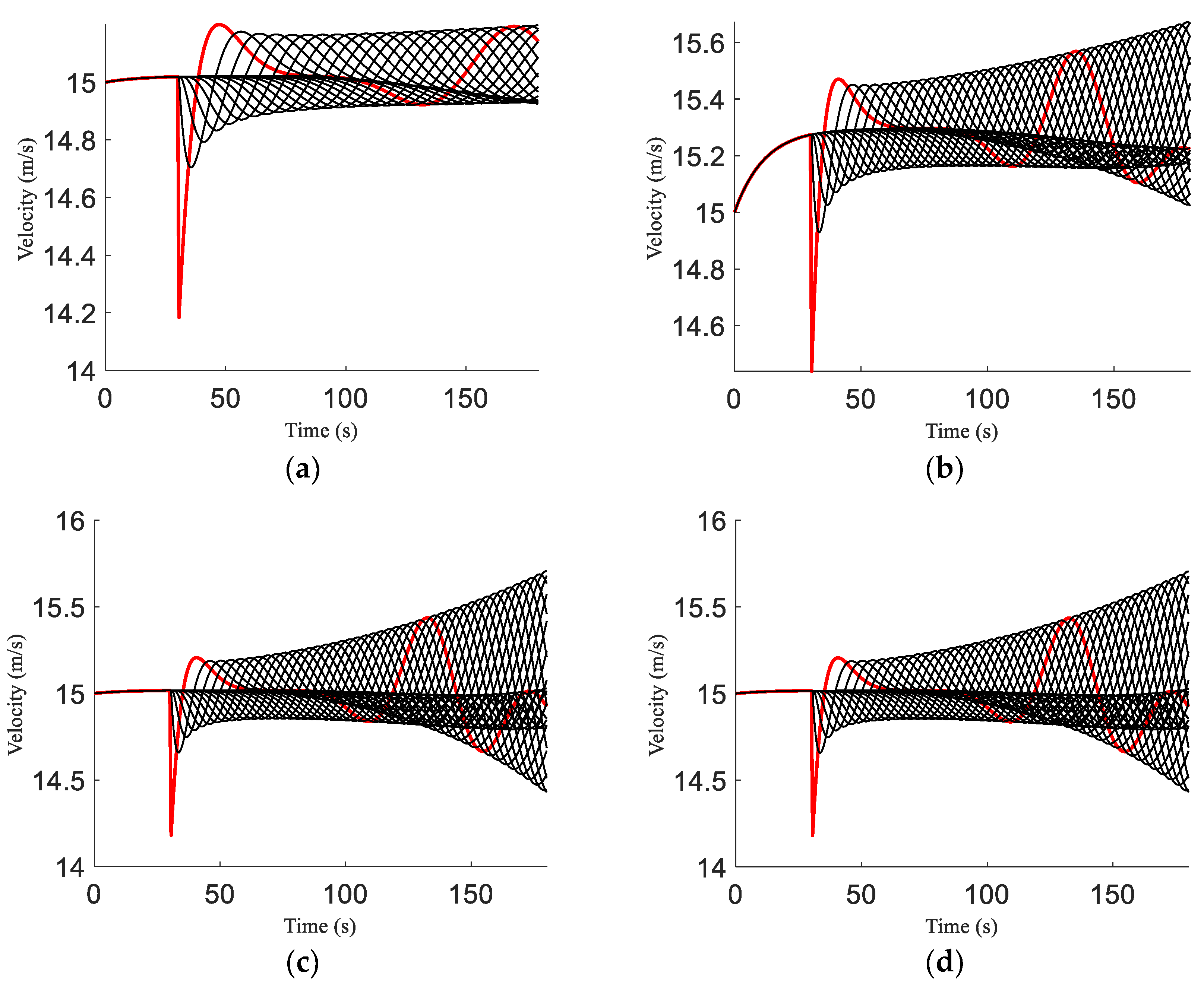
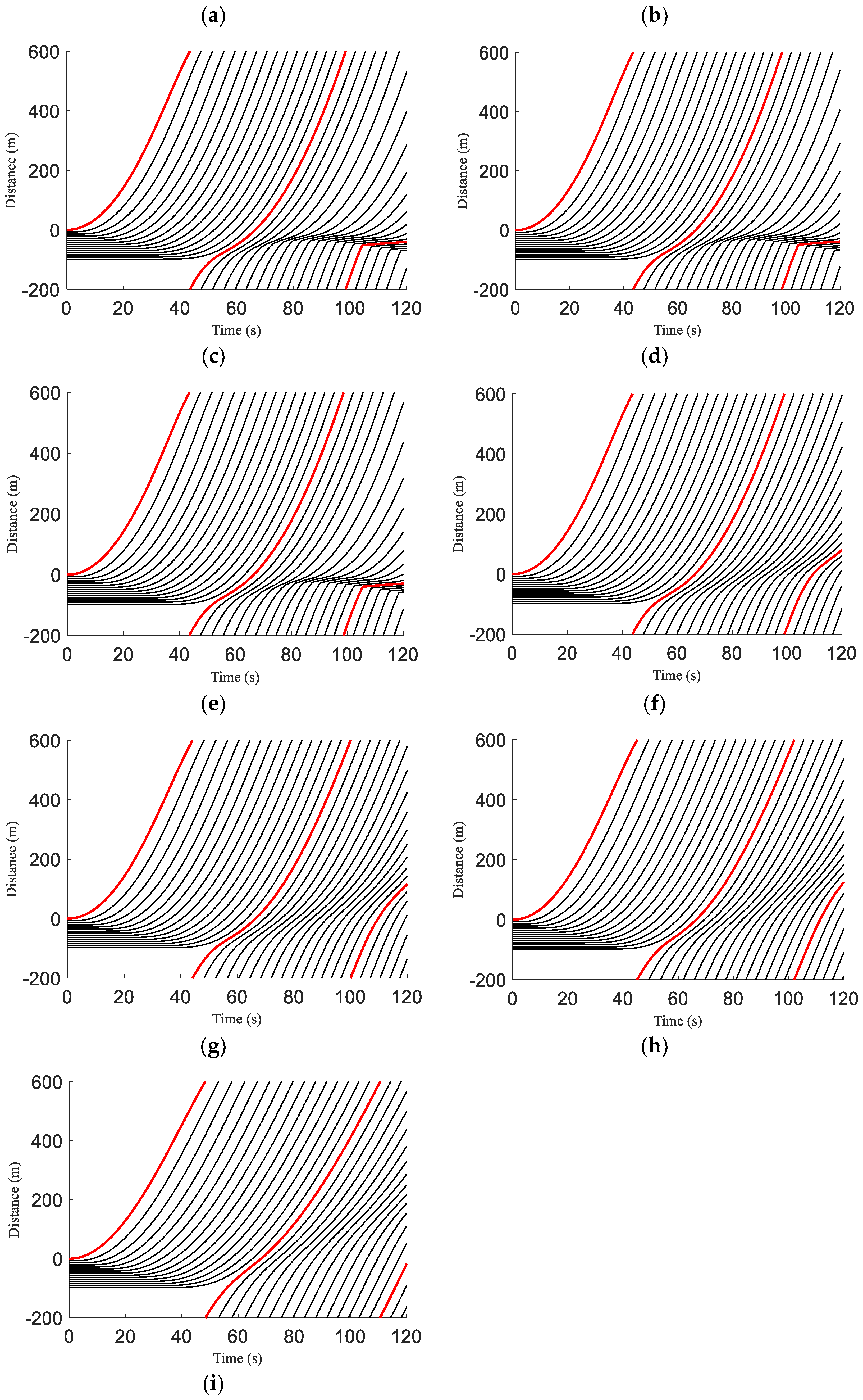
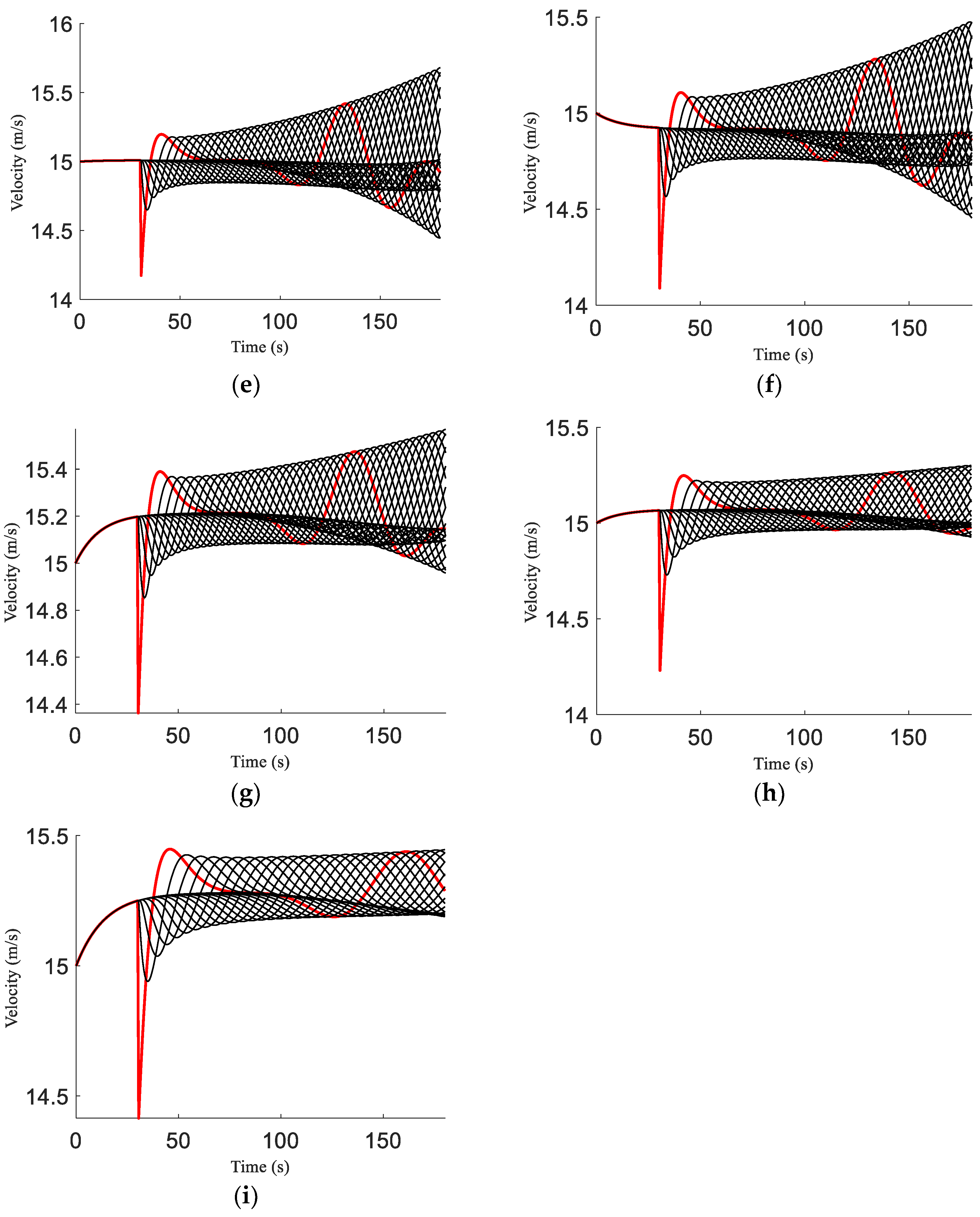
The velocity of the ID and proposed models is shown in
Figure 1. The red line indicates the trajectory of the
st vehicle, and the black lines indicate the trajectories of the following vehicles. For the ID model with
, the disturbance at
s causes the velocity of the 1st vehicle to decrease to
m/s. It then increases to
m/s at
s and fluctuates, as shown in
Figure 1a. These fluctuations increase with time, and the velocity varies between
m/s and
m/s. With
, at
s, the velocity of the 1st vehicle decreases to
m/s. It then increases to
m/s at
s and fluctuates, as shown in
Figure 1b. The fluctuations increase with time, and the velocity varies between
m/s and
m/s. With
, the velocity of the 1st vehicle decreases to
m/s at
s. It then increases to
m/s at
s and fluctuates, as shown in
Figure 1c. The fluctuations increase with time, and the velocity varies between
m/s and
m/s.
For the proposed model with
, the velocity of the 1st vehicle decreases to
m/s at
s. It then increases to
m/s at
s and fluctuates, as shown in
Figure 1d. The fluctuations increase with time, and the velocity varies between
m/s and
m/s. With
, the velocity of the 1st vehicle decreases to
m/s at
s. It then increases to
m/s at
s and fluctuates, as shown in
Figure 1e. The fluctuations increase with time, and the velocity varies between
m/s and
m/s. With
, the velocity of the 1st vehicle decreases to
m/s at
s. It then increases to
m/s at
s and fluctuates, as shown in
Figure 1f. The fluctuations increase with time, and the velocity varies between
m/s and
m/s. With
, the velocity of the 1st vehicle decreases to
m/s at
s. It then increases to
m/s at
s and fluctuates, as shown in
Figure 1g. The fluctuations increase with time, and the velocity varies between
m/s and
m/s. With
, the velocity of the 1st vehicle decreases to
m/s at
s. It then increases to
m/s at
s and fluctuates, as shown in
Figure 1h, varying between
m/s and
m/s. With
, the velocity of the 1st vehicle decreases to
m/s at
s. It then increases to
m/s at
s and fluctuates, as shown in
Figure 1i, varying between
m/s and
m/s.
The results obtained indicate that for the ID model, an increase in
also increases the velocity fluctuations, as shown in
Figure 1a–c. Thus, employing a constant
leads to instability. Conversely, for the proposed model, an increase in
decreases the velocity fluctuations, as shown in
Figure 1d–i. This indicates that the traffic behavior with the proposed model is stable, even during adverse weather.
5. Performance Evaluation
Both the ID and proposed models are evaluated over a circular road of length
m, with a platoon of 15 vehicles for
s, using MATLAB. It is commonly employed for performance evaluation, as it is an interactive environment that integrates numerical and symbolic computations with scientific visualization [
43]. MATLAB has a simple language that is ideal for quick prototyping. It can be more expensive than conventional C or Python compilers [
44], but this is more than offset by the reduced development time [
44].
The explicit Euler scheme [
41] with time step
s is employed to implement both models. The simulation parameters are given in
Table 2. The maximum velocity is
m/s, the time headway is
s [
42], and the minimum and maximum acceleration are
m/s
2 and
m/s
2, respectively [
20]. The vehicle length is
m [
41] and the distance headway is
m [
40]. The proposed model is evaluated with
and 0.9, and the ID model with
, and
. For a platoon of 15 vehicles, the jam spacing is
m [
41] and the maximum normalized density is
. For a platoon of
vehicles, the jam spacing is
m [
20] and the maximum normalized density is
.
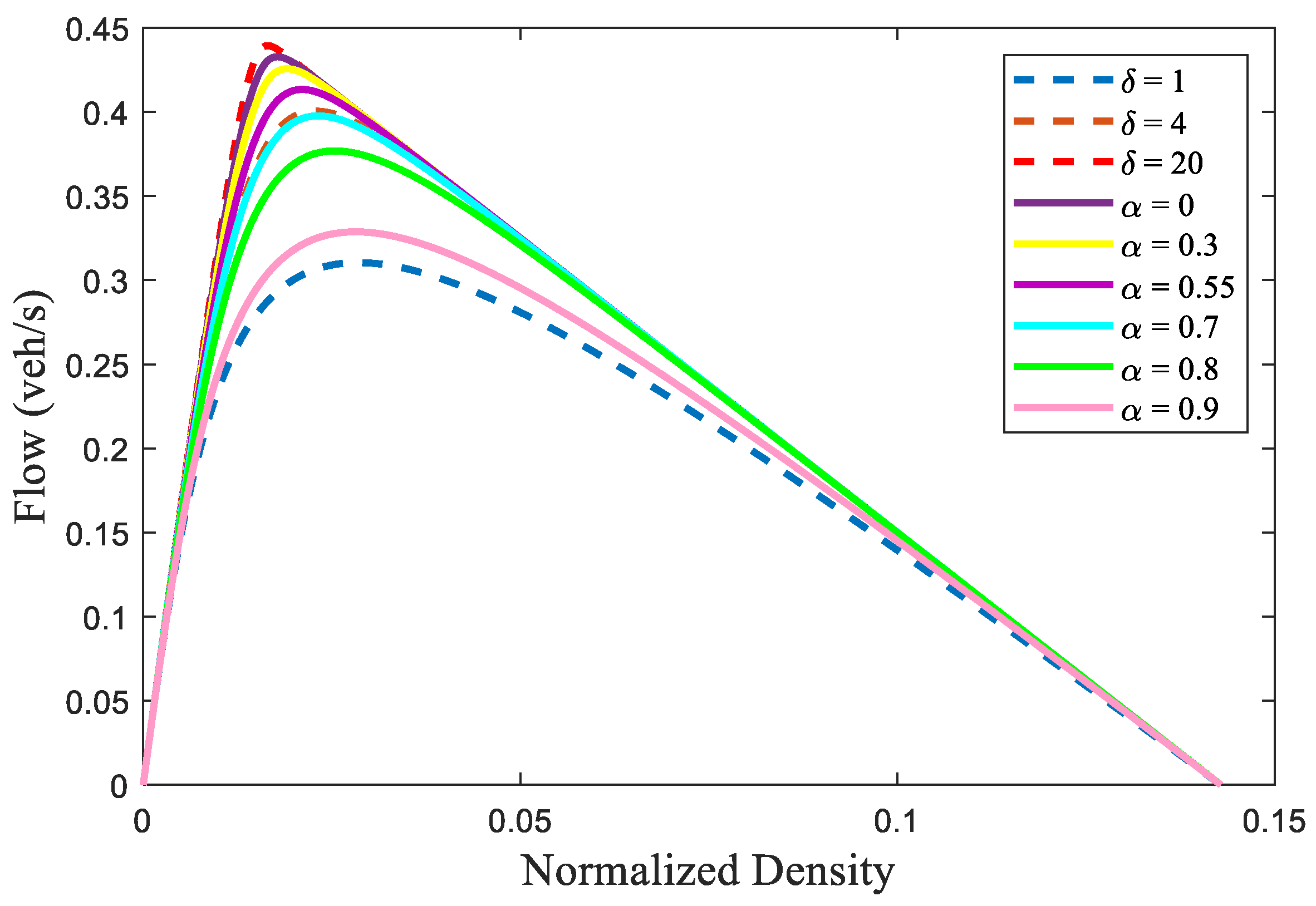
The traffic flow behavior of the ID and proposed models is given in
Figure 2. This shows that for
, the maximum flow with the ID model is
0 veh/s at a density of
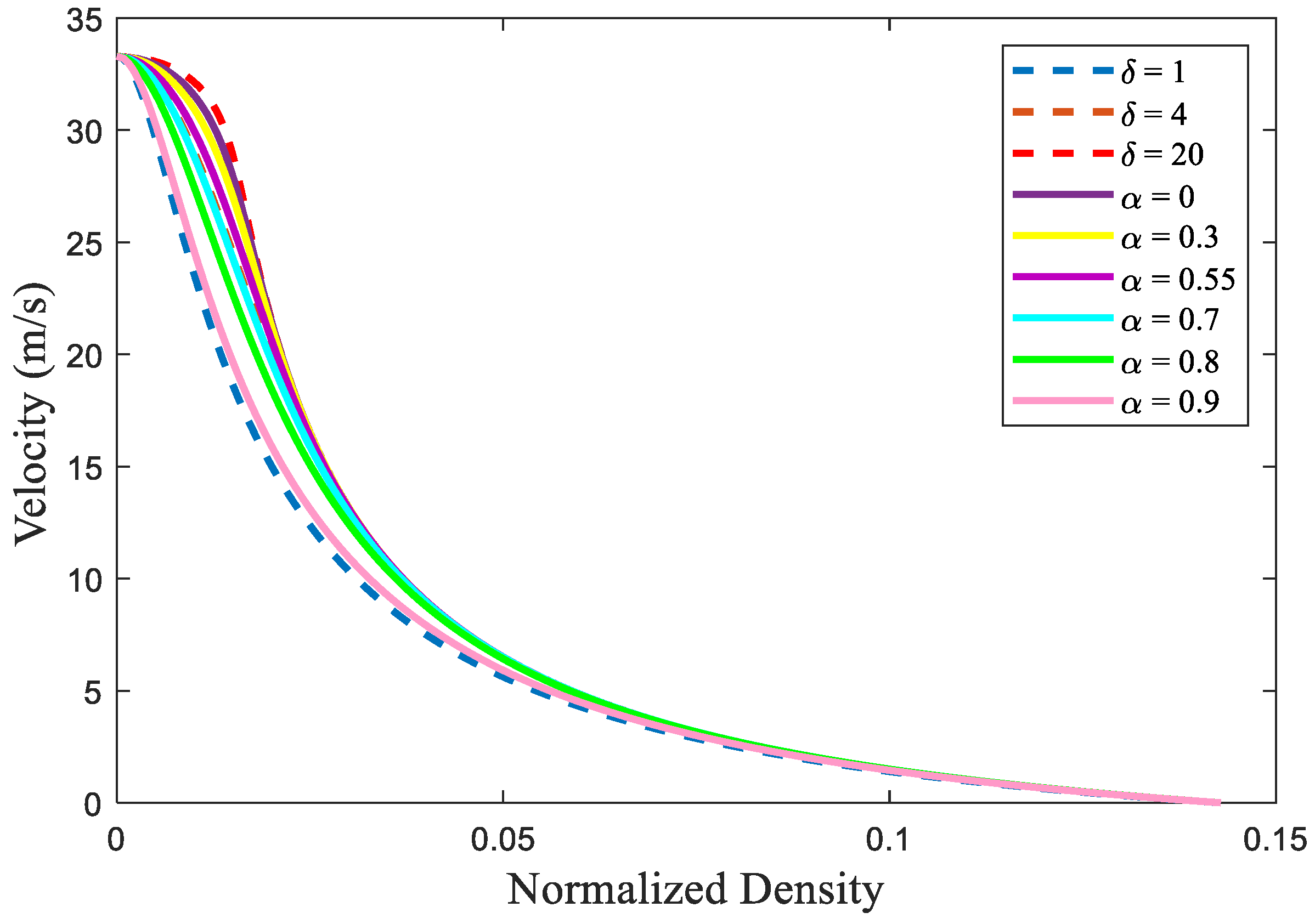
. The corresponding velocity is
m/s, as shown in
Figure 3. With
, the maximum flow is
veh/s at a density of
, and the corresponding velocity is
m/s. With
, the maximum flow is
veh/s at a density of 0.016, and the corresponding velocity is
m/s, as shown in
Figure 3.
Table 3 indicates that the maximum flow and velocity increase with
, whereas the density decreases.
For the proposed model, the maximum flow with
is
veh/s at a density of 0.017, as shown in
Figure 2. The corresponding velocity is
m/s, as shown in
Figure 3. With
and
, the maximum flow is
veh/s and
veh/s at a density of
and 0.021, respectively. The corresponding velocities are
m/s and
m/s, as shown in
Figure 3. With
and
, the maximum flow is
veh/s and
veh/s at a density of
and
respectively. The corresponding velocities are
m/s and
m/s. With
, the maximum flow is
veh/s at a density of
, and the corresponding velocity is
m/s.
Table 4 indicates that the maximum flow decreases as
increases, whereas the maximum density increases and the corresponding velocity decreases.
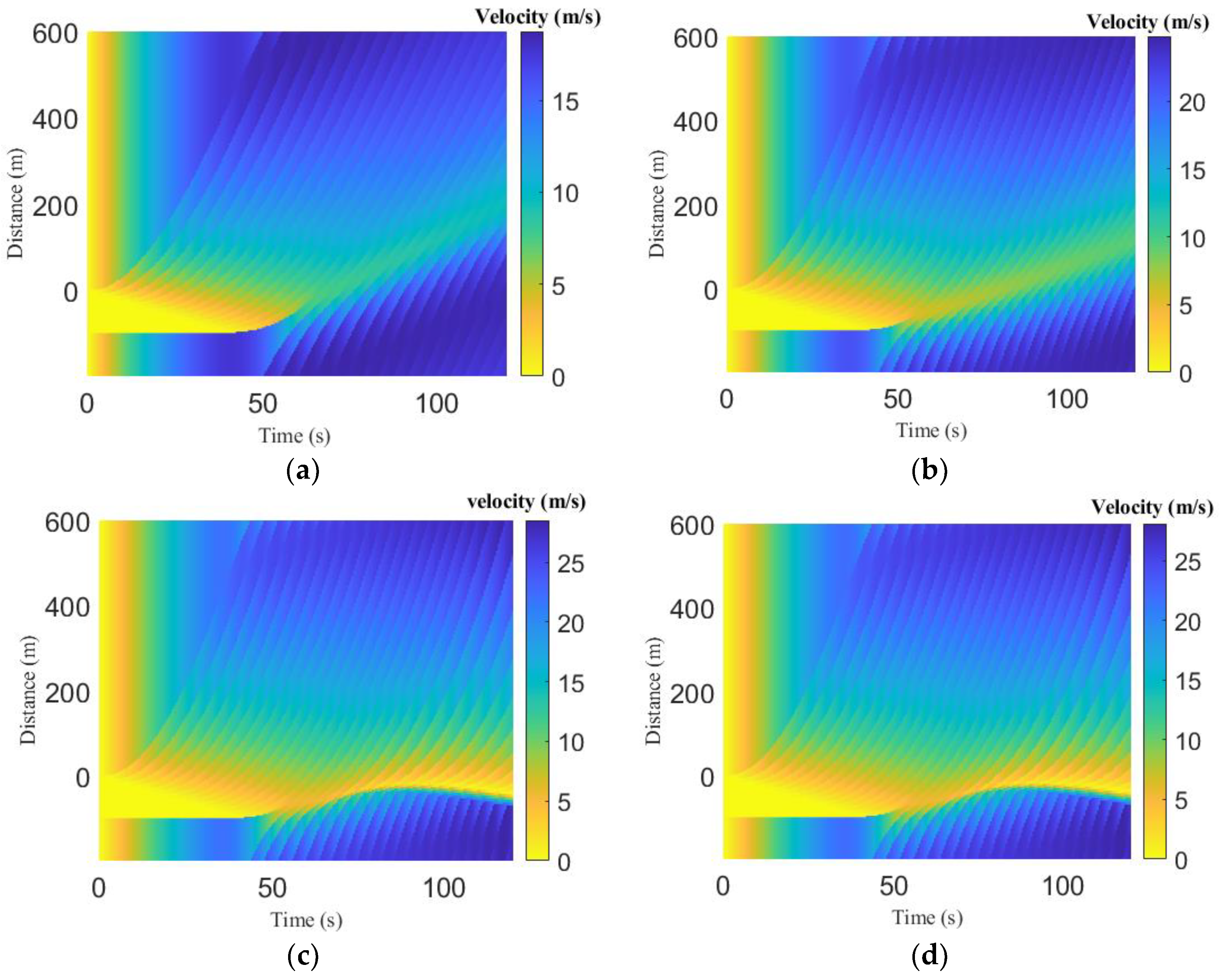
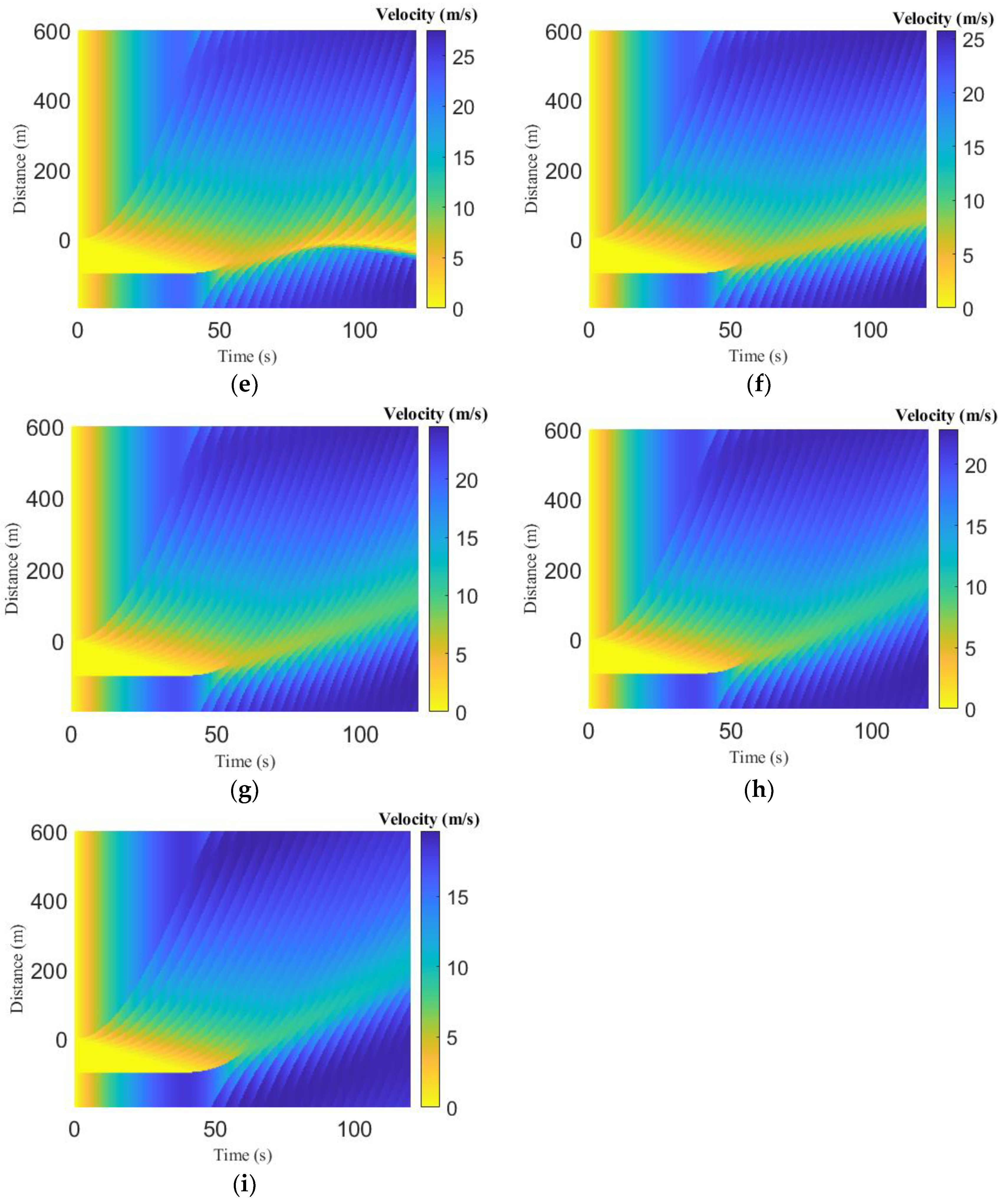
Figure 4 presents the time-space velocity evolution of the queue due to traffic congestion for the ID and proposed models. This shows that, initially, the velocity in the queue is zero. For the ID model with
, the queue dissipates at
s, as shown in
Figure 4a, while with
, the queue dissipates at
s, as shown in
Figure 4b. The corresponding velocity is
m/s and
m/s, respectively. With
, the initial queue dissipates at
s, and the velocity after the queue is
m/s, as shown in
Table 5. The queue again develops at
.0 s and lasts until
s, as shown in
Figure 4c. With
, the maximum velocity is
m/s, while with
and
, the maximum velocity is
m/s and
m/s, respectively. These results show that the maximum velocity increases as
increases.
For the proposed model with
, the queue exists between
s and
s. The velocity after the queue dissipates varies between
m/s and
m/s. The queue appears again at
s and lasts until
s, as shown in
Figure 4d. With
, the queue exists between
s and
s, and the velocity after the queue dissipates varies between
m/s and
m/s. The queue again develops at
s and lasts until
s, as shown in
Figure 4e. With
.55, the queue dissipates at
s, as shown in
Figure 4f, and the corresponding velocity is
m/s. With
and
the queue dissipates at
s and
s, respectively, as shown in
Figure 4g,h. The corresponding velocity is
m/s and
m/s, respectively. With
, the queue dissipates at
s, and the corresponding velocity is
m/s, as shown in
Figure 4g. With
and
, the maximum velocity is
.0 m/s, with
and
it is
m/s, and with
it is
m/s.
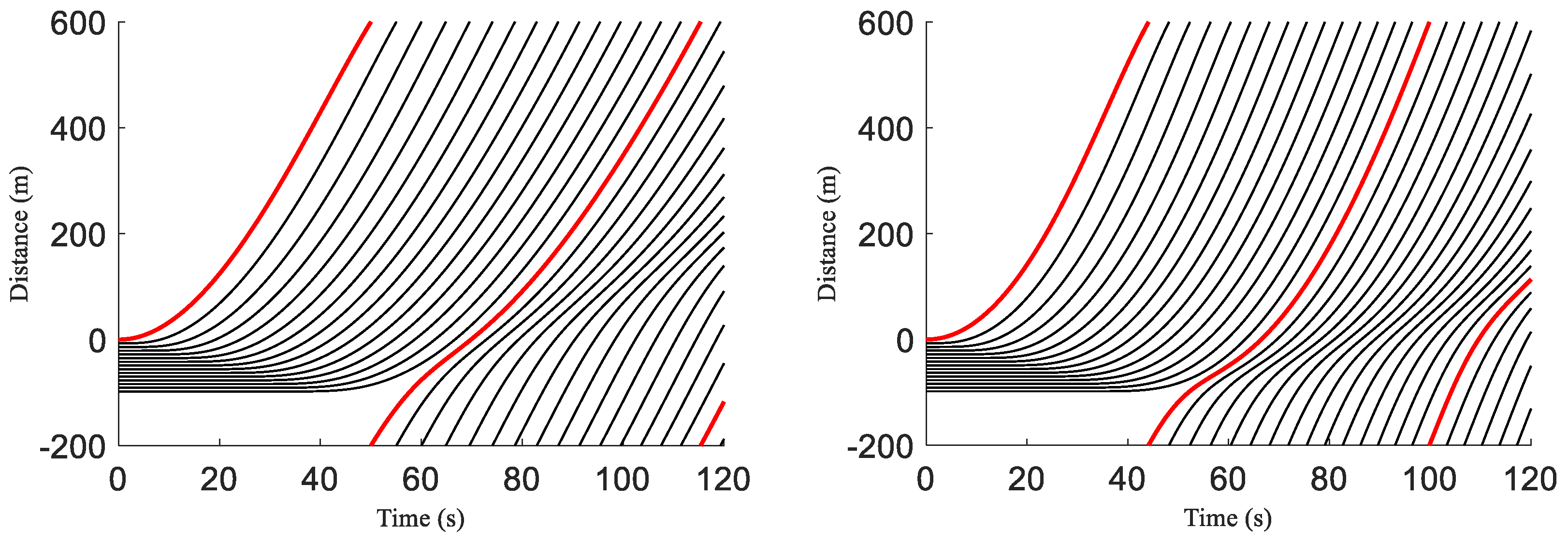
Figure 5 presents the time-space vehicle trajectories for a platoon of 15 vehicles with the ID and proposed models over a circular road of length
m. The red trajectory is for the first vehicle, and the black trajectories are for the remaining 14 vehicles that follow the 1st vehicle. The positions with the ID and proposed models of the
st,
th, and
th vehicles at
s are given in
Table 6. These results show that for the ID model with
, the position of the
st and
th vehicles is
m and
m, respectively, and the position of the
th vehicle is
m, as shown in
Figure 5a. With
, the position of the
st and
th vehicles is
m and
m, respectively, as shown in
Figure 5b, while with
= 20, the position of the
st and
th vehicles is
m and
m, respectively, as shown in
Figure 5c. With
and
, the position of the
th vehicle is
m and
m, respectively. For the proposed model with
, the position of the
st and
th vehicles is
m and
m, respectively, as shown in
Figure 5d. With
, the position of the
st and
th vehicles is
m and
m, respectively, as shown in
Figure 5e, while with
, the position of the
st and
th vehicles is
m and
m, respectively, as shown in
Figure 5f. With
and
, the position of the
th vehicle is
m, as shown in
Figure 5d–f. With
, the position of the
st and
th vehicles is
m and
m, respectively, while the position of the
th vehicle is
m, as shown in
Figure 5g. With
, the position of the
st and
th vehicles is
m and
m, respectively, while the position of the
th vehicle is
m, as shown in
Figure 5h. With
, the position of the
st and
th vehicles is
m and
m, respectively, while the position of the
th vehicle is
m, as shown in
Figure 5i.
Table 6 indicates that as the exponent
increases, the distance covered by the
st and
th vehicles increases, whereas the distance covered by the
th vehicle decreases. Furthermore, with the proposed model, as
increases, the distance covered by the
st and
th vehicles decreases, whereas the distance covered by the
th vehicle increases.
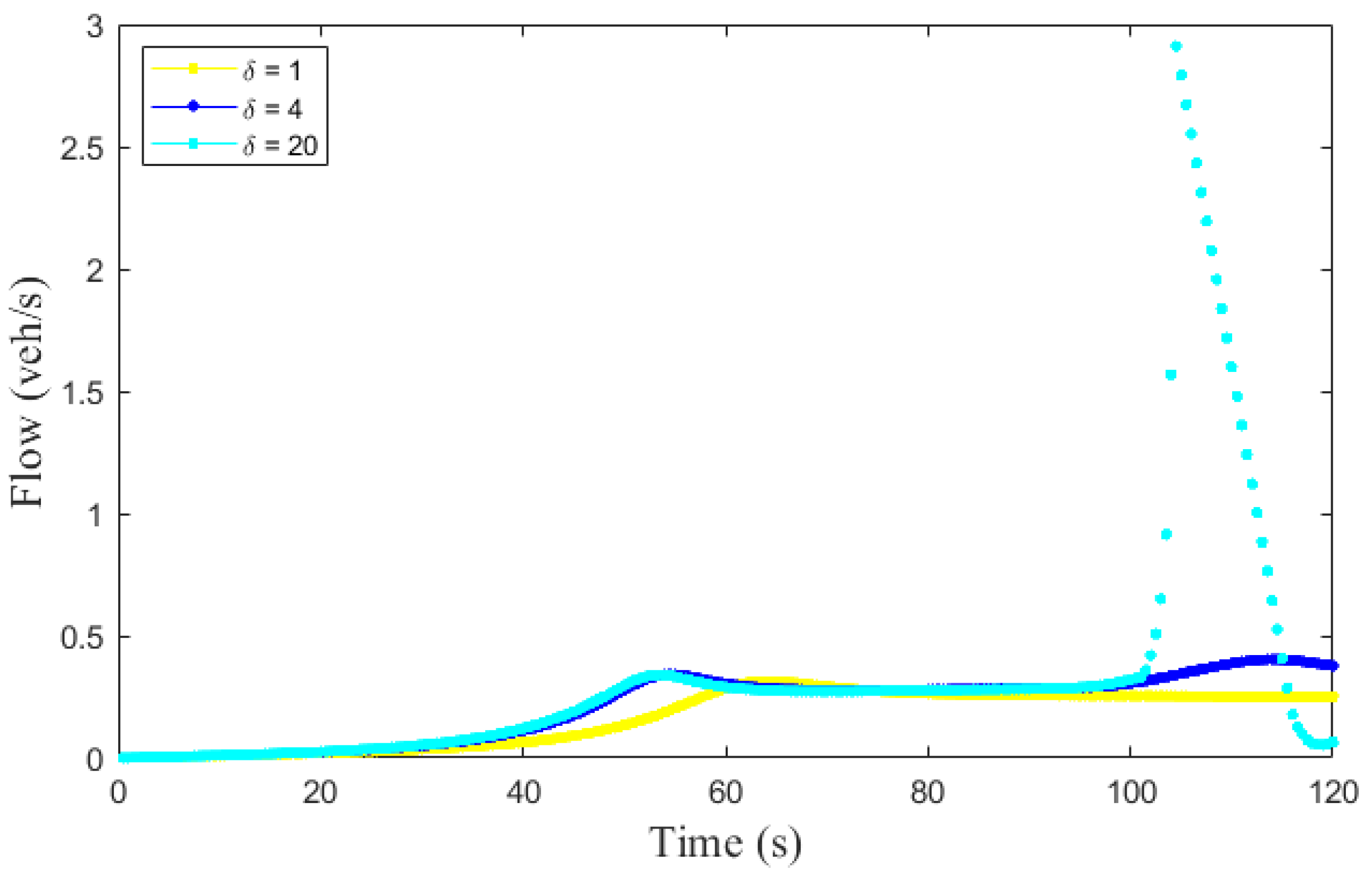
Figure 6 presents the traffic flow evolution for the ID model with
and
over a circular road of length
m. With
, the flow increases to
veh/s at
s and then decreases to
veh/s at
s. It then decreases to
veh/s at
s. With
, the flow increases to
veh/s at
s and then decreases to
veh/s at
s. It then increases to
veh/s at
s. With
the flow increases to
veh/s at
s and then decreases to
veh/s at
s. The flow varies between
veh/s and
veh/s from
s to
s. Further, the flow rapidly increases to
veh/s at
s and then decreases to
veh/s at
s.
Figure 6 indicates that variations in the traffic flow are greater with a larger
.
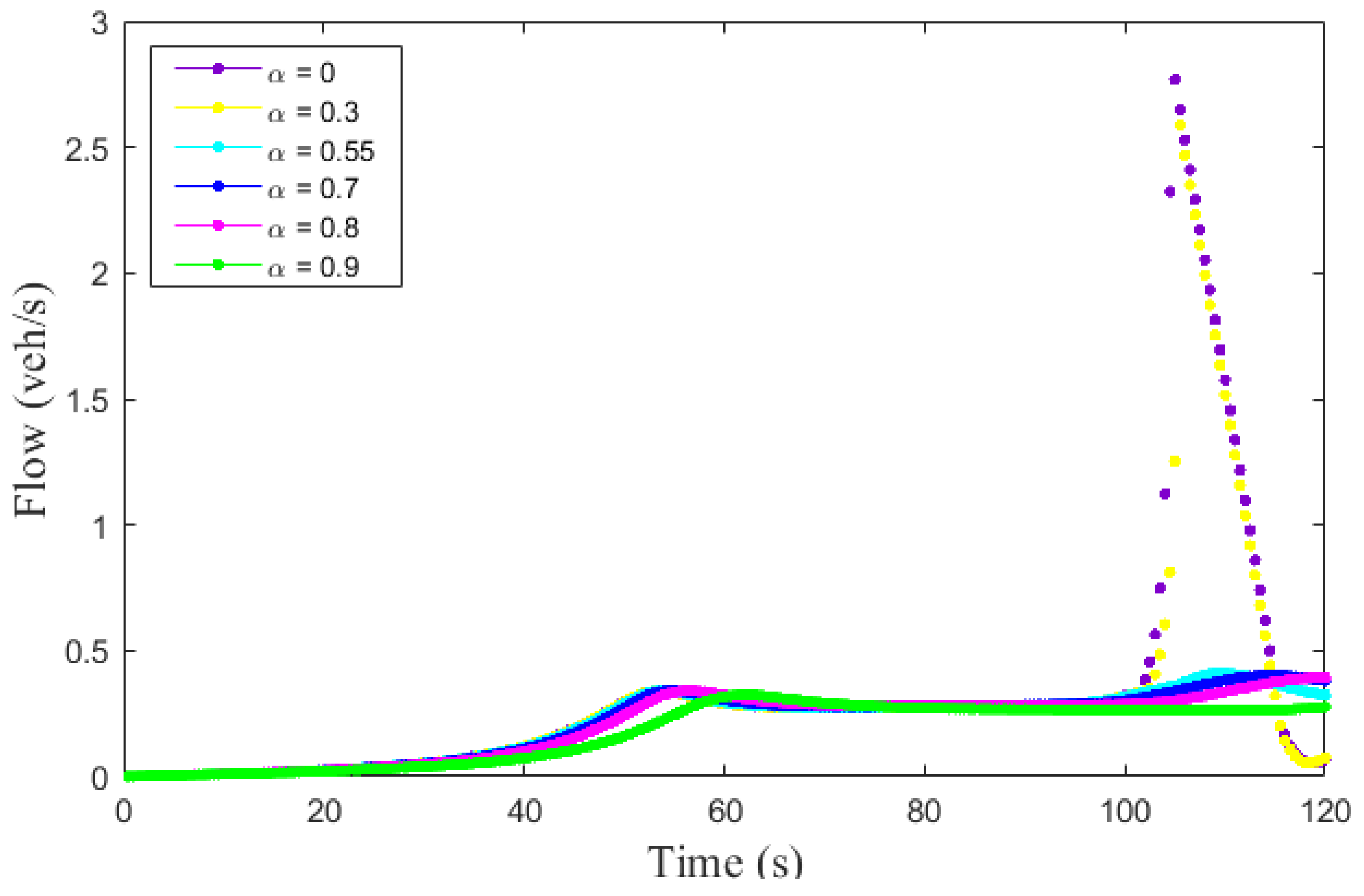
Figure 7 presents the traffic flow evolution for the proposed model with
and
over a circular road of length
m. With
, the flow increases to
veh/s at
s and then decreases to
veh/s at
s. The flow varies between
veh/s and
veh/s from
.0 s to
s. It then rapidly increases to
veh/s at
s and then decreases to
veh/s at
s. With
, the flow increases to
veh/s at
s and then decreases to
veh/s at
s. It varies between
veh/s and
veh/s from
s to
s. Then the flow rapidly increases to
veh/s at
s and then decreases to
veh/s at
s. With
, the flow increases to
veh/s at
s and then decreases to
veh/s at
s. It then increases to
veh/s at
s and decreases to
veh/s at
s. With
, the flow increases to
veh/s at
s and then decreases to
veh/s at
s. It then increases to
veh/s at
s and decreases to
veh/s at
s. With
, the flow increases to
veh/s at
s and then decreases to
veh/s at
.0 s. It then increases to
veh/s at
s. With
, the flow increases to
veh/s at
s and then decreases to
veh/s at
s. It then decreases to
veh/s at
s and increases to
veh/s at
s.
Figure 7 indicates that the variations in traffic flow are smaller during adverse weather than in normal weather.
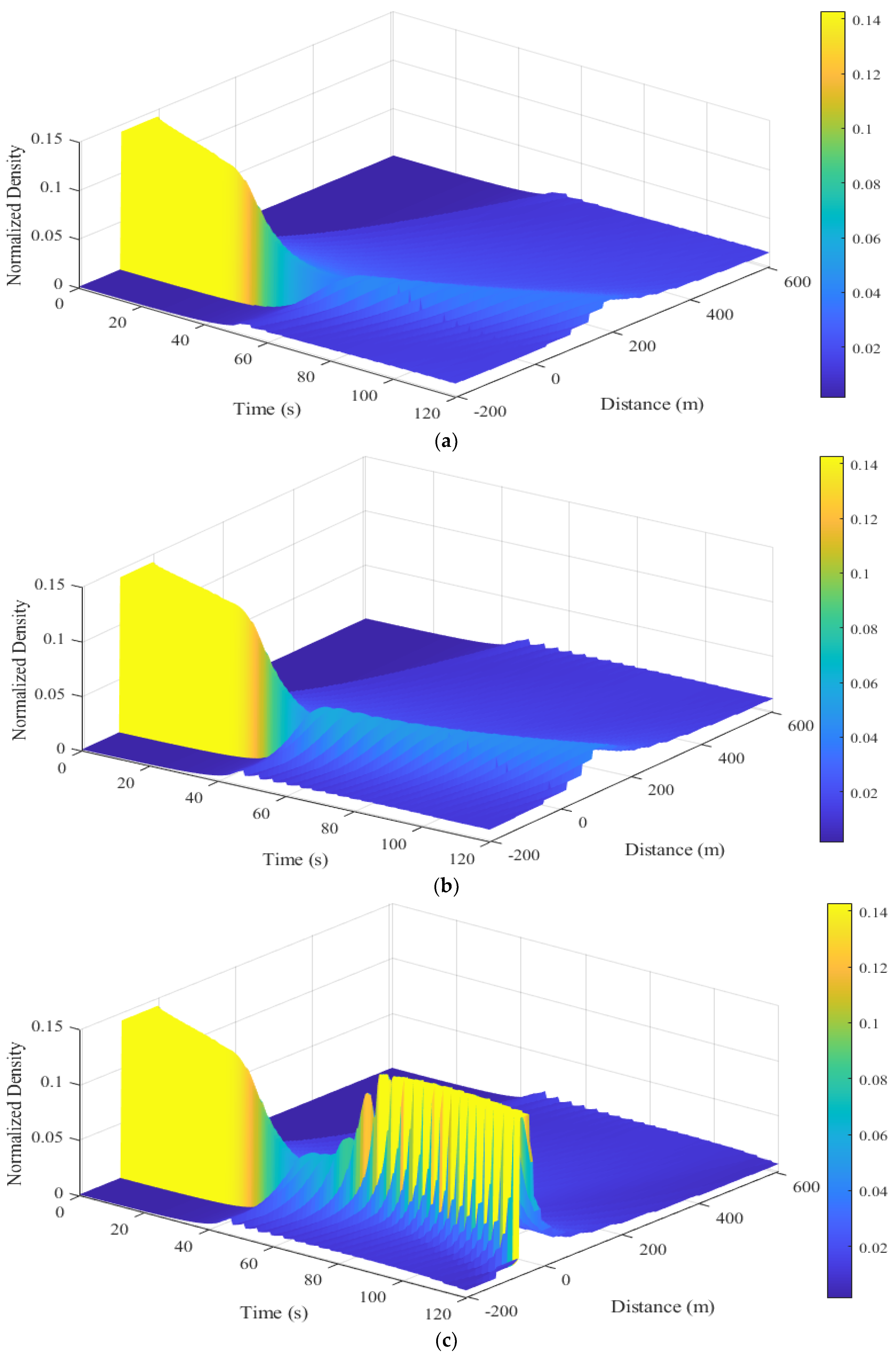
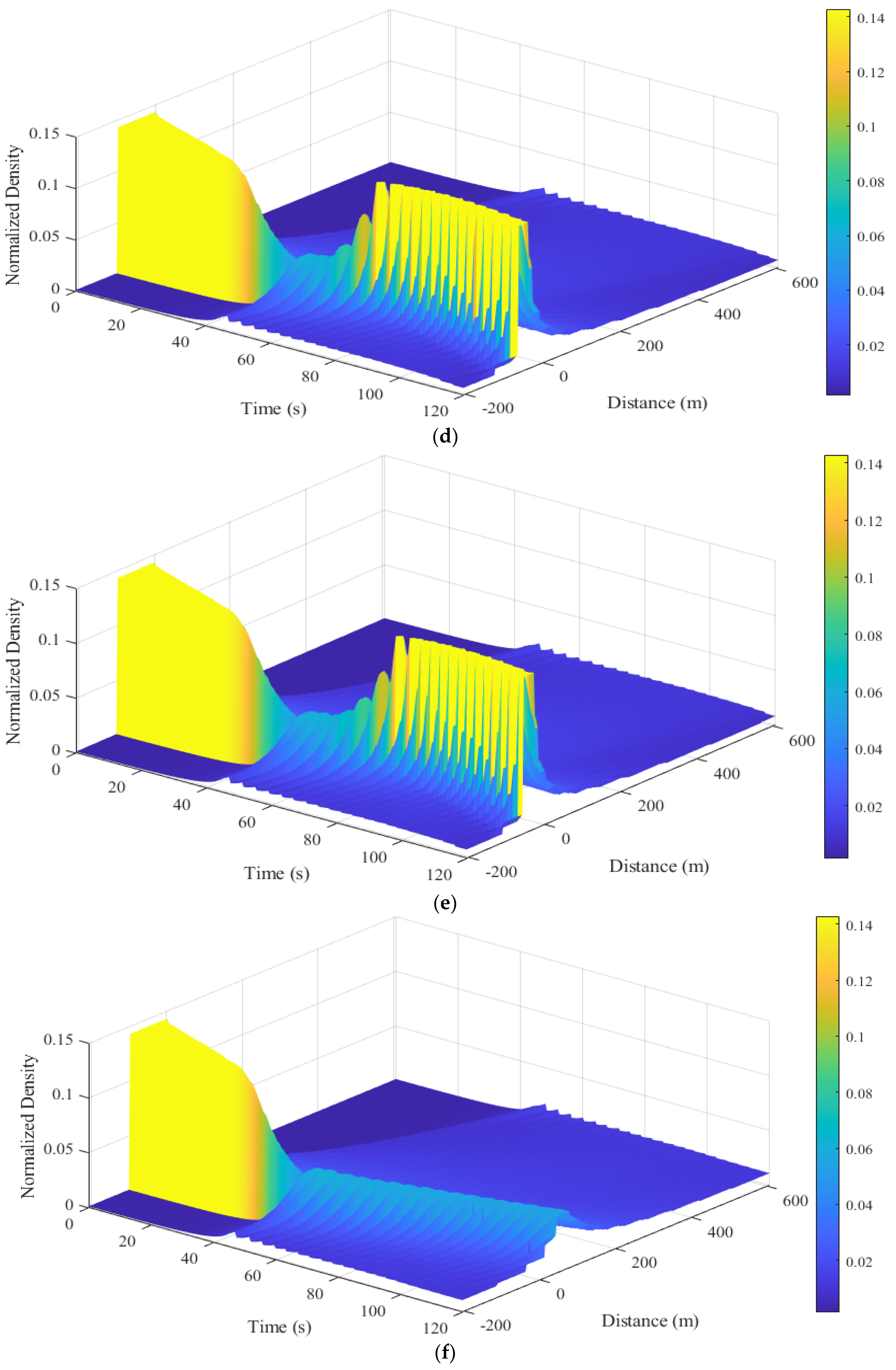
The traffic density behavior of the ID and proposed models is given in
Figure 8. This shows that for the ID model with
, the density between
m and 29.97 m at
s is
. It then increases to
at
m and decreases to
at
m, as shown in
Figure 8a. The density between
s and
s at
m is
, which indicates a traffic queue. After the queue dissipates, the density at
s gradually decreases to
at
m, as shown in
Figure 8a. With
= 4, the density between
m and
m at
s is
. It then increases to
at
m, decreases to
at
m, and decreases further at
m, as shown in
Figure 8b. The density between
s and
s is
, which indicates a traffic queue. The queue then gradually dissipates, and at
s, the density decreases to
at
m, as shown in
Figure 8b. With
= 20, the density between
m and
m at
s is
which indicates a traffic queue. The density then decreases to
at
m, as shown in
Figure 8c. The density between
s and
.0 s is
which indicates a traffic queue. The density at
s gradually decreases to
at
s. The queue develops again at
.0 s and
m, with a density of
, and at
s is between
m and
m, as shown in
Figure 8c.
Figure 8a–c show that as
increases the changes in density over time increase, which indicates that the model is not stable.
For the proposed model with
, the density between
m and
m at
s is
, which indicates a traffic queue. After the queue dissipates, the density decreases to
at
m and then to
at
m, where it remains, as shown in
Figure 8d. The density between
s and
.0 s at
m is
, which indicates a traffic queue. After the queue dissipates, the density at
s gradually decreases to
at
m. The queue again develops at
s and
m, with a density of
and remains until
s, as shown in
Figure 8d. With
, the density between
m and
m at
s is 0.14, which indicates a traffic queue. The density then decreases to
at
m and
at
m, where it remains, as shown in
Figure 8e. The density between
s and
s is 0.14, which indicates a queue. After the queue dissipates, the density gradually decreases to
at
s and
m. The queue again develops at
s and
m, with a density of
and remains until
s, as shown in
Figure 8e. With
, the density between
m and
m at
s is
. It then increases to
at
m and decreases to
at
m, where it remains, as shown in
Figure 8f. The density between
s and
s is
which indicates a traffic queue. After the queue dissipates, the density at
s decreases to
at
m and then to
at
s at
m, as shown in
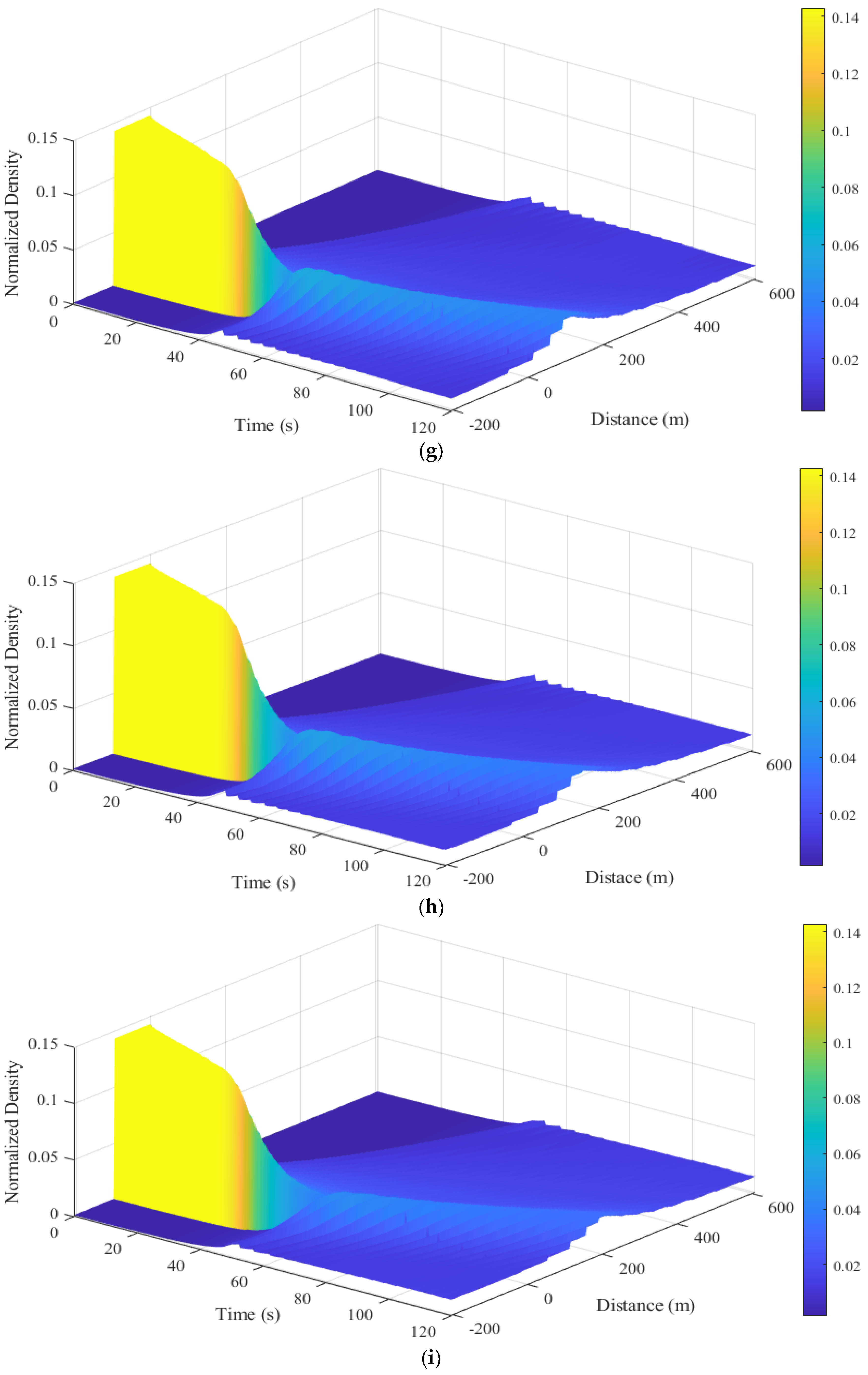
Figure 8f. With
, the density between
m and
m at
s is
. It then increases to
at
and decreases to
at
m, where it remains, as shown in
Figure 8g. The density between
s and
s is
which indicates a queue. After the queue dissipates, the density at
.0 s gradually decreases to
at
m. It then decreases to
at
s and
m, as shown in
Figure 8g. With
, the density between
m and
m at
s is
. It then increases to
at
m and decreases to
at
m, as shown in
Figure 8h. The density between
s and
s is
which indicates a queue. After the queue dissipates, the density decreases to
at
s and
m and then to
at
s and
m, as shown in
Figure 8h. With
, the density between
m and
m at
s is
. It increases to
at
m and decreases to
at
m, as shown in
Figure 8i. The density between
s and
s is
which indicates a queue. After the queue dissipates, the density decreases to
at
s and
m and then to
at
s and
m, as shown in
Figure 8i.
Figure 8d–i show that as the weather severity index
increases, the changes in density with the proposed model decrease over time, which is realistic.
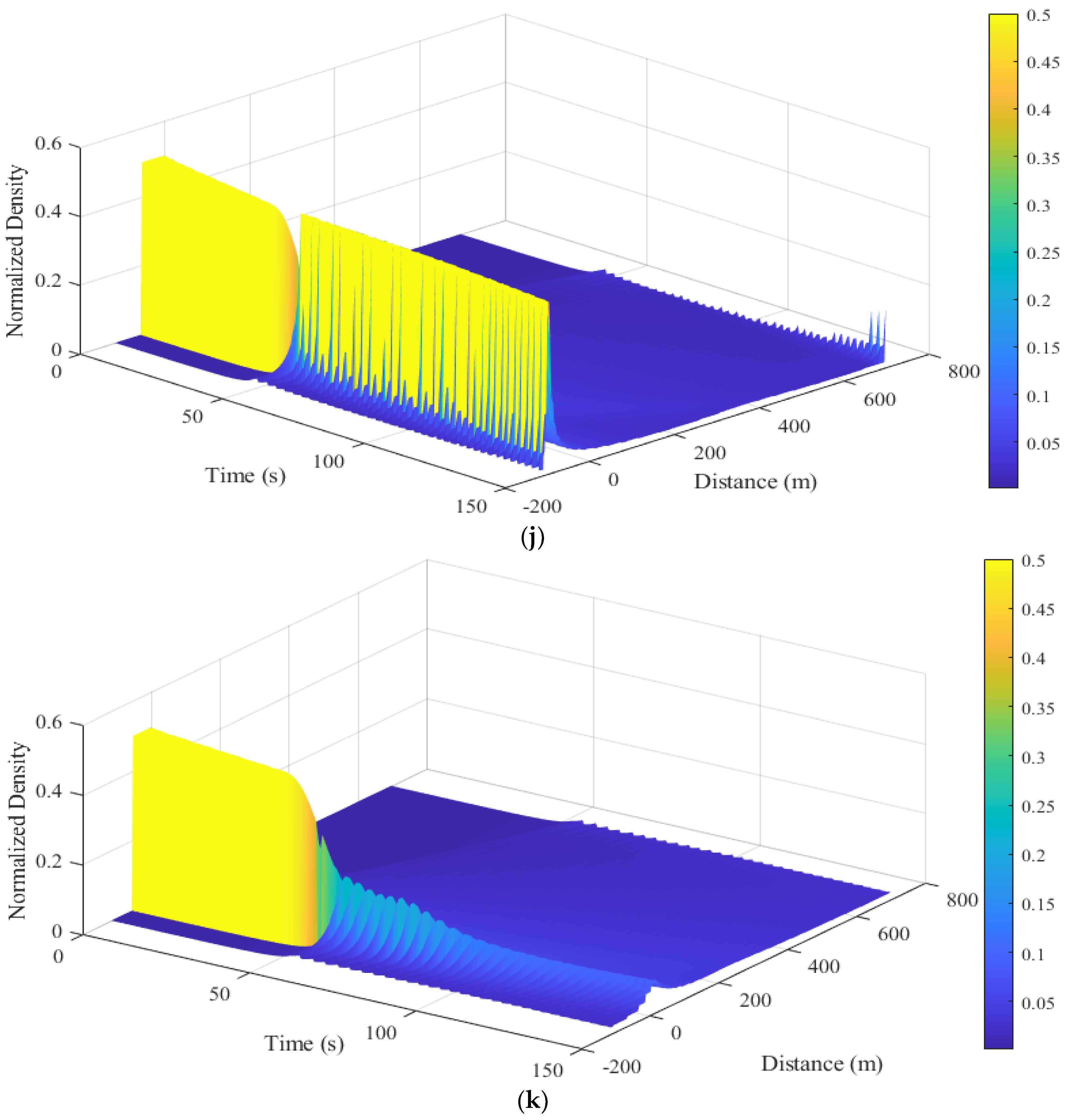
The density of the proposed model for a platoon of
vehicles with
and
is presented in
Figure 8j,k, respectively. With
the density between
m and
m at
s is
, which indicates a traffic queue. After the queue dissipates, the density decreases to
at
m and remains there until
m. It then increases to
at
m, as shown in
Figure 8j. The density between
s and
s at
m is
, which indicates a traffic queue. The density at
s gradually decreases to
at
m. The queue again develops at
s and
m, with a density of
and remains there until
s, as shown in
Figure 8j. With
, the density between
m and
m at
s is
. It increases to
at
m and decreases to
at
m, where it remains, as shown in
Figure 8k. The density between
s and
s is
, which indicates a traffic queue. After the queue dissipates, the density decreases to
at
s and
m and then decreases to
at
s and
m, as shown in
Figure 8k.
The above results show that the changes in velocity and density with the proposed model decrease as the weather becomes more adverse. This holds when the platoon of vehicles is increased from 15 to 30, as indicated in
Figure 8j,k. Conversely, the ID model velocity and density depend on a constant exponent
, which results in unrealistic traffic behavior. For example, large changes in density occur with
, which increase over time, whereas they should decrease. Furthermore, vehicles move slower with a larger exponent
. With the proposed model, vehicles move based on the weather severity index
, and are slower with a larger
, as expected. This is because drivers are more cautious in adverse weather. In addition, the flow is smoother with the proposed model compared to the ID model. Moreover, the variations in flow are smaller during adverse weather with the proposed model, but the variations with the ID model increase with
.