2. Results
Before we delve into the intricacies of the algorithm of the numerical simulation, let us demonstrate the performance of the simulation by reconstructing the complete dynamical evolution of the pulse, from the initial spontaneous noise seed, through the entire cavity buildup, to the final steady state. We will show how the spatial mode of the cavity is formed in steady state by self-focusing and how the soliton pulse is dictated by the interplay between gain-bandwidth, dispersion, and SPM.
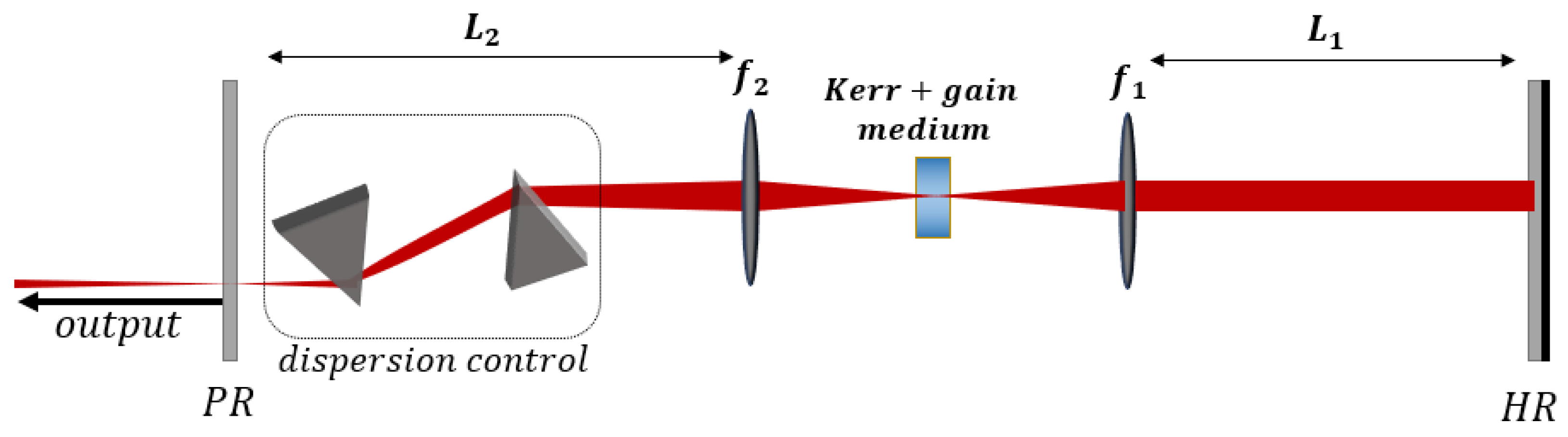
The simulation assumes the standard linear cavity layout of
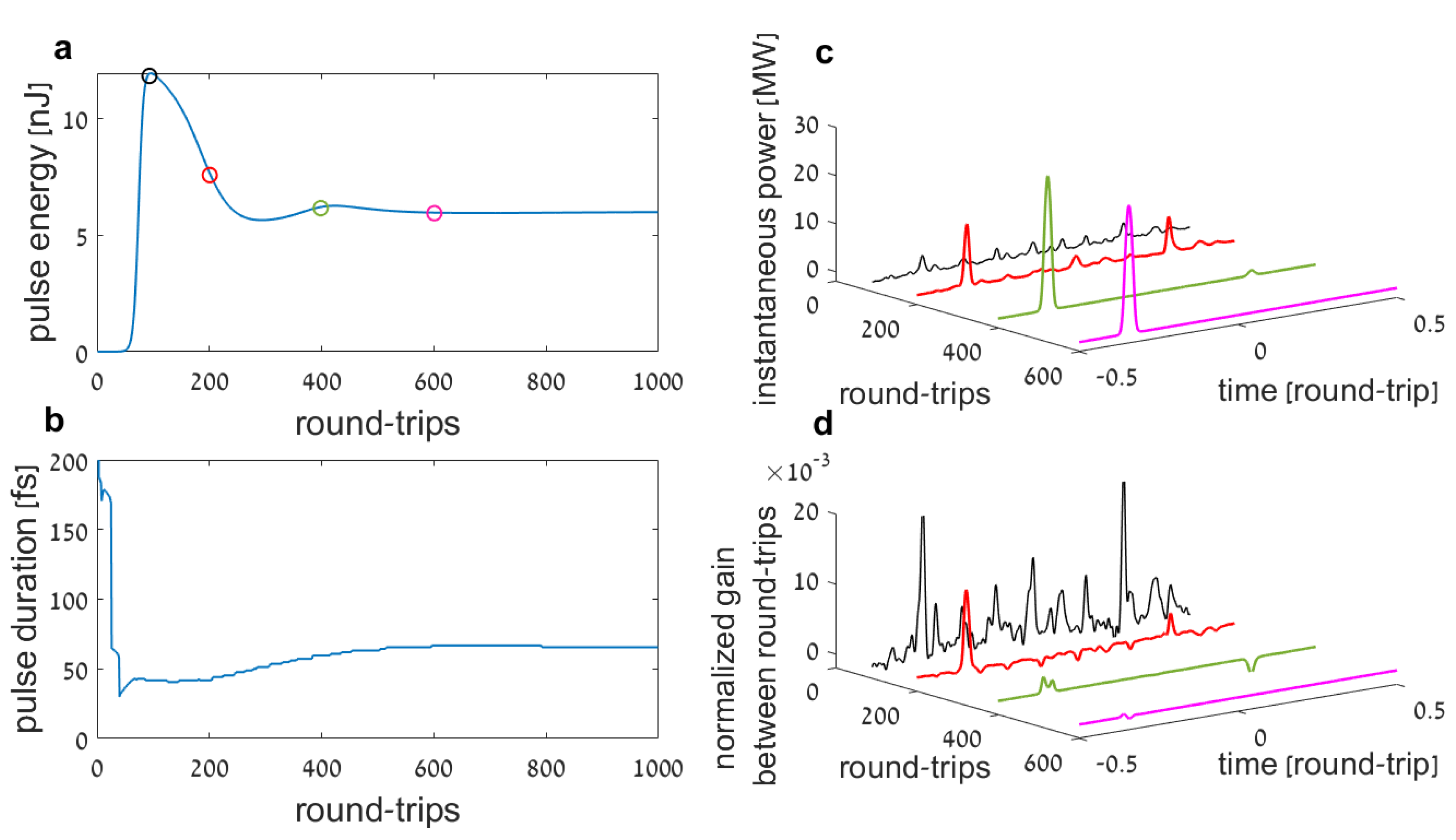
Figure 1, and the evolution of the intra-cavity field during the laser buildup is highlighted in
Figure 2. The cavity (pulse) energy (
Figure 2a) and the pulse-duration (FWHM,
Figure 2b) are shown as a function of round-trip number (the slow time scale), where three stages of evolution are evident
(I) the initial exponential growth,
(II) the nonlinear mode competition, and
(III) the final steady-state. To understand the dynamical operation during each stage, we sampled four specific round-trips from the different stages, which are shown in
Figure 2c (instantaneous power) and
Figure 2d (instantaneous power gain) as a function of time within a single round-trip (fast time scale). The colors of the graphs in
Figure 2c,d correspond to the circles on the energy graph of
Figure 2a. The field at the end of the initial exponential growth (black) is highly noisy and multi-pulsed, with noisy, yet positive gain at all times. This picture changes during the mode competition (red and green). We observe a number of pulses competing for the gain, before all pulses, except one, diminish. During that phase, we also observe variations in the shape of the main pulse. Finally, the purple graph shows the stable pulse near steady state.
It is worth noting that our simulated cavity shows a self-starting mode-lock dynamic under suitable conditions, with no special starting mechanism. This is due to the assumption of ideally slow gain saturation, which is calculated only over the slow time scale of cavity round-trips. Specifically, we assume that the gain within each round trip depends only on the total energy of that round-trip, not to be influenced by the temporal profile of the field within the round trip. Thus, a noise seed at the first round trip will basically grow undisturbed and maintain its temporal profile until the Kerr effect kicks in to favor one specific temporal fluctuation (usually the highest one) to form a single pulse. Although this assumption of slow gain saturation is well validated for the Ti:Sapphire gain medium with ultrashort pulses, it is not correct for a continuous field, where the finite memory of the gain saturation leads to relaxation oscillations and slow damping of temporal fluctuations. Consequently, an external noise mechanism may be needed in reality to induce sufficiently large fluctuations to enjoy the benefit of the Kerr-lens before they are damped out by the gain dynamics.
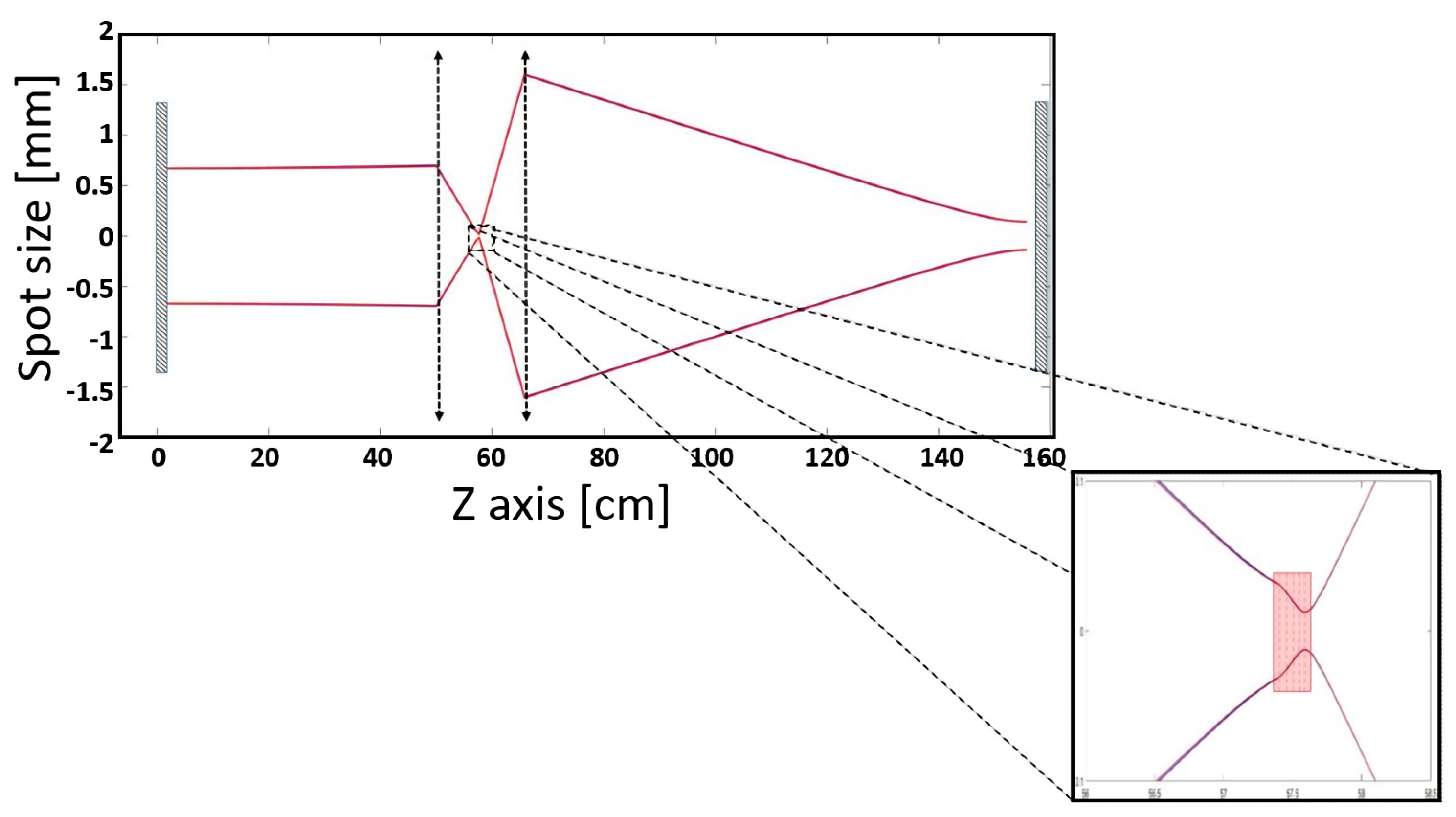
Our simulation is fully spatio-temporal, and calculates the beam propagation through the cavity in space as well as in time.
Figure 3 shows the propagation of the beam through a single run of the cavity. The core function of the Kerr-lens is shown in the inset, where the simulation captures the lensing effect that creates an effective “wave-guide” that stabilizes the cavity and counteracts the diffraction losses.
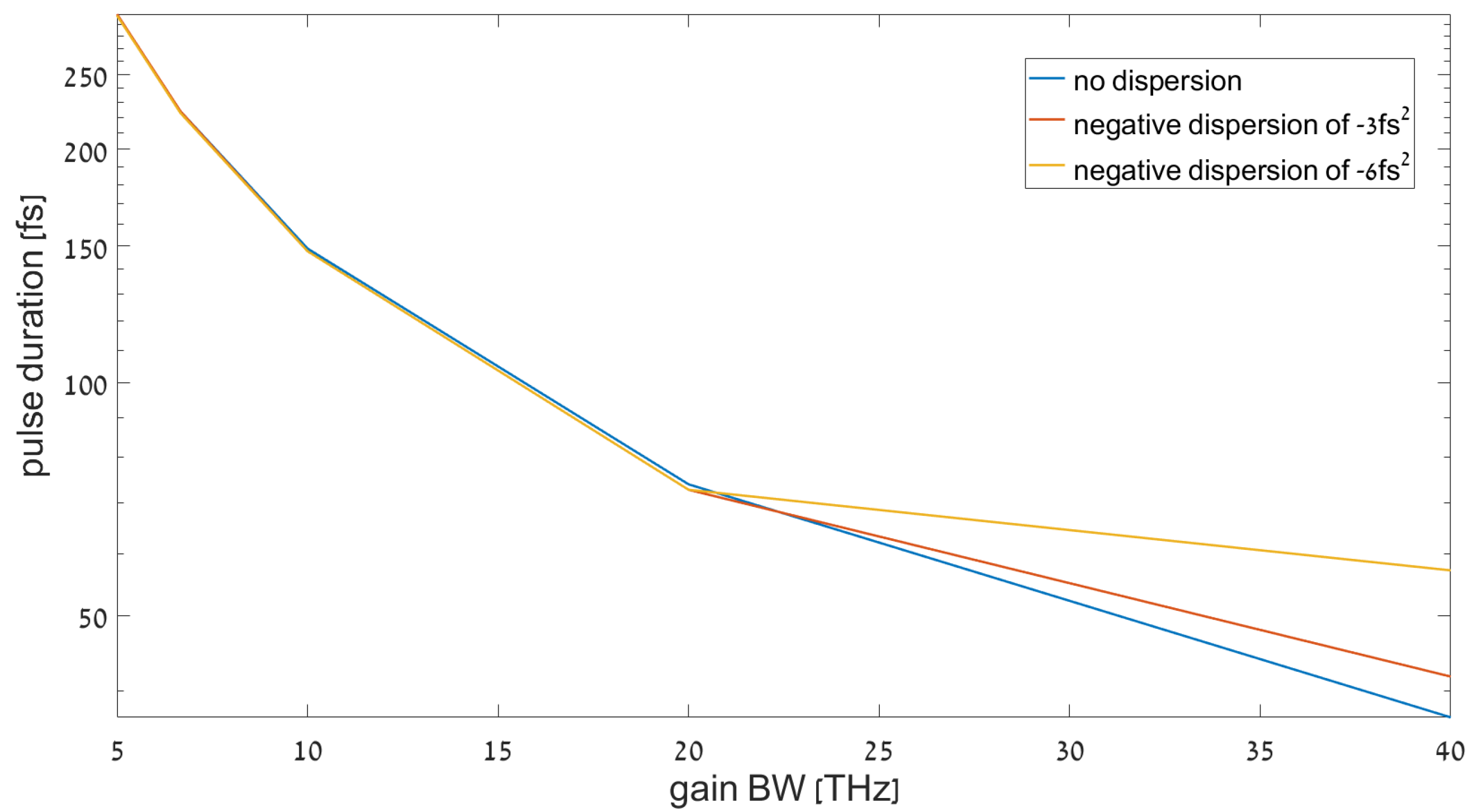
The temporal width of the pulse is dictated by the gain bandwidth and the chromatic dispersion (GVD). The gain-bandwidth sets a lower bound on the pulse duration (by Fourier uncertainty), and the dispersion distorts the temporal shape of the pulse (chirping), which affects shorter pulses more severely than longer pulses [
16]. Thus, the net GVD of the cavity sets another lower bound on the pulse-duration. Our simulation correctly reproduces this behavior, as shown in
Figure 4, where the pulse duration follows the gain bandwidth limit until it reaches the dispersion limit.
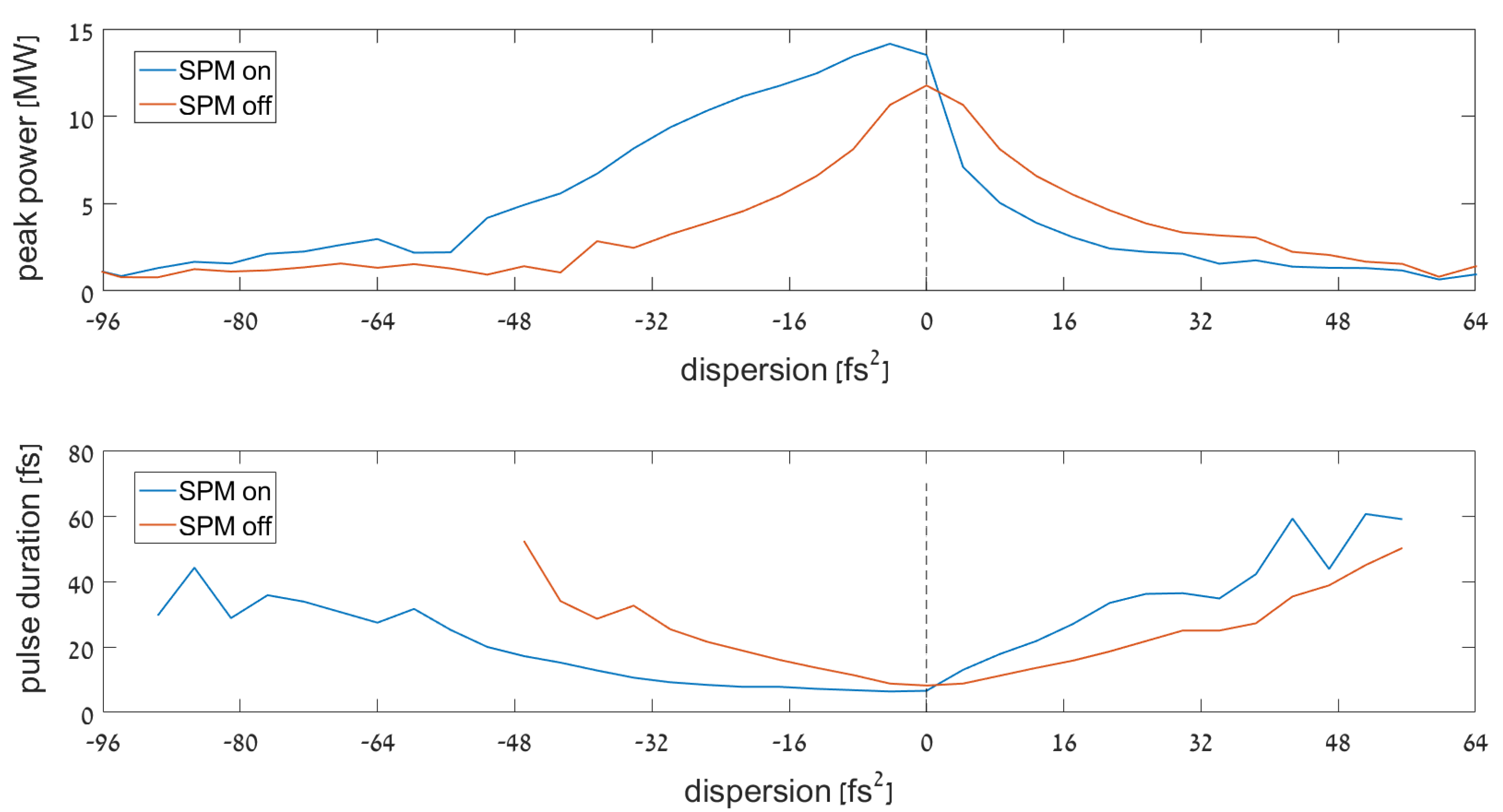
So far, we considered only linear effects on the pulse duration due to GVD and gain bandwidth. The pulse, however, is highly affected by the nonlinear chirping due to SPM, which is critical in the soliton formation mechanism. Specifically, SPM chirping acts as another source of dispersion that shifts the optimal GVD value toward a small negative value. Interestingly, the simulation can explore this interplay between SPM and GVD in greater detail than possible in the experiment. Specifically, in the simulation, we can simply turn off the temporal SPM effects, while keeping the spatial Kerr-lensing effect, and compare the pulse performance in this (unphysical) situation to the one with SPM, a feat that is inherently impossible in the experiment.
Figure 5 highlights exactly this comparison: we plot the pulse duration as a function of the linear GVD in the cavity with SPM (blue) and without (orange). Indeed, the simulation shows that SPM shifts the optimal pulse formation toward the negative GVD range as expected, but also that SPM enhances the peak power at the optimal GVD value. Thus, optimal operation is achieved at some dispersion, rather than the zero dispersion point.
Beyond the validations presented above, this simulation already served two previous publications, where it was used to predict and analyze new details of KLM, with quantitative agreement with experimental results. Specifically, in [
15], we used the simulation to observe and explore the effective saturable-absorption mechanism of KLM, where, although no actual absorption takes place, there are diffraction losses over an effective aperture form the saturation loss mechanism. Using the simulation, we identified how and where exactly these losses occur, which aided us to experimentally measure this time-dependent loss for the first time. In another paper [
17], we used the simulation to show that KLM lasers can break the spatial symmetry between the forward and backward halves of the round-trip in a linear cavity when the pump power is increased above the mode-locking threshold. This symmetry breaking allows the laser to increase the energy of the pulse. Both of these phenomena would have been impossible to predict without a full dynamical simulation, which illustrates the utility of this numerical tool.
3. Materials and Methods
The simulation assumes a set of common parameter values for the cavity configuration, gain medium and Kerr medium, that are typical for KLM experiments [
18,
19]. The values used in the simulation appear in
Table 1.
Our simulation focuses on KLM oscillators in a single transverse spatial-mode, which is time-dependent due to the Kerr-lens.
where
is a transverse Gaussian–Hermite mode and
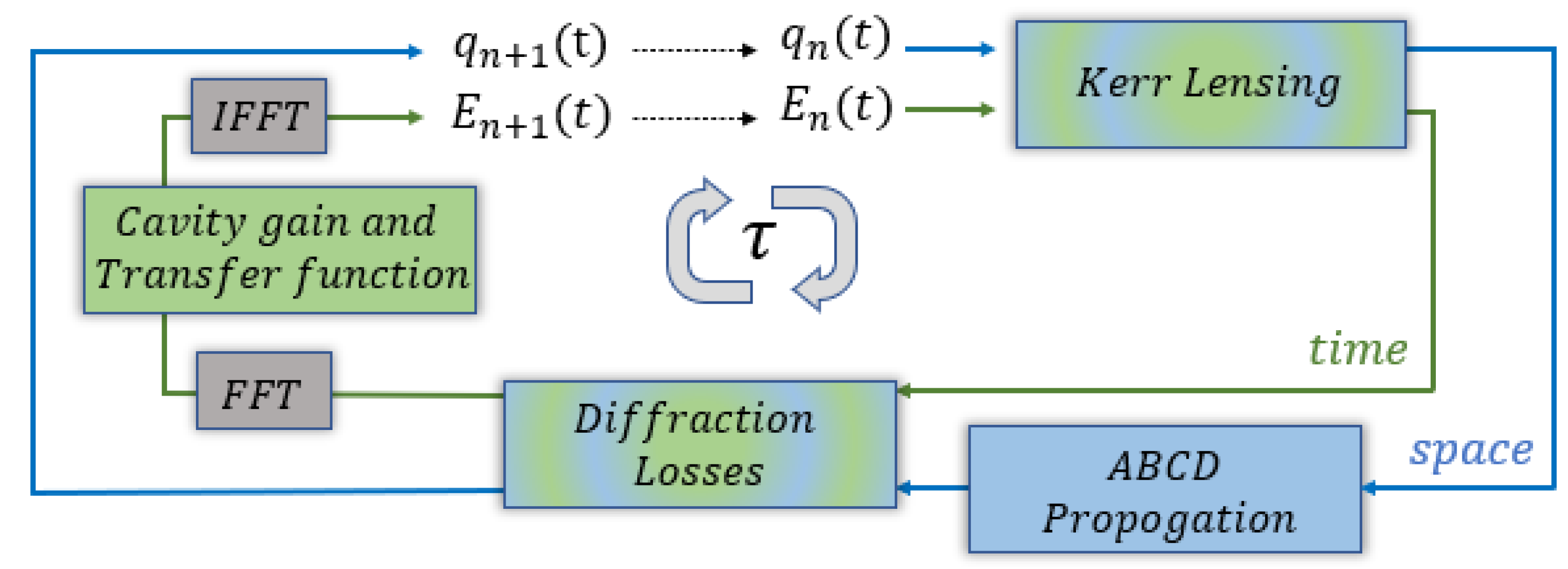
is a slowly-varying time dependent envelope that we divide into two time-scales, as shown in
Figure 6. This product separation of space and time is justified on two accounts—(1) the oscillation spectrum is relatively small compared to the carrier frequency (for pulses down to 10 fs or so), indicating that spectral variations are small; (2) The Kerr-lens, which dominates the dynamics on the fast time scale, acts instantaneously without memory, which corresponds to a very weak (nearly non-existent) frequency dependence. Furthermore, the approximation that the spatial profile is a single transverse Gaussian mode is justified since the nonlinear losses strongly drive the laser toward a single, high-intensity spatial beam. Generally, this approximation is only correct for paraxial propagation, which is well justified for the small divergence angles of the optical beams in our simulation cavity. Aberrations of the Kerr-lens can, in principle, couple energy into higher spatial-modes; however, these aberrations do not build up in the cavity, but rather lead to diffraction outside the cavity, which is encapsulated in the total diffraction loss term.
KLM oscillators can be thought of as passive cavities, with an intensity-dependent lens (or lenses) that couples the temporal and spatial dynamics. When the diffraction losses are also included, the Kerr-lensing effect generates an effective saturable absorber with an instantaneous response, able to generate extremely short pulses [
4,
20,
21,
22]. As such, the KLM oscillator can be divided conceptually into two parts—linear and non-linear. The linear part accounts for the gain spectrum and saturation, dispersion, and linear loss, which can be encapsulated into a total spectral transfer function:
where
is the spectral gain of the active medium and
is the transfer function of the passive elements in the cavity. The spectral phase of
reflects the chromatic dispersion and its amplitude reflects the cavity loss
.
To take into account the gain depletion, which leads to non-linear saturation and mode competition, we reduce the gain
as the intra-cavity pulse energy
U increases according to the standard saturation formula,
where
is the saturation energy of the gain medium, taken to be
for our simulation (
is the round trip time and the saturation power of 2.6 W is based on the saturation intensity of Ti:Sapphire in the literature, calculated for a 3 mm long crystal with
doping and
μm beam waist for the pump) [
23].
We now need to account for the nonlinear response of the Kerr medium, i.e., Kerr-lens and SPM, which we assume to be instantaneous. For simplicity, we start with a thin Kerr medium, whose thickness
is much smaller than the Rayleigh beam range
, and later generalize the result for a thick medium. The ABCD matrix of a thin Kerr medium is a simple lens with an intensity-dependent focus:
where
is the time dependent Kerr-lens focus, which, for a thin nonlinear medium, is given by:
with
the nonlinear index of refraction,
the medium length,
the instantaneous beam waist, and
the on-axis instantaneous intensity [
19]. The SPM of a thin Kerr medium is a simple phase modulation of
.
This introduces a new, fast time scale t into the problem. Unlike the slow laser dynamics, which occur on a time scale of many round-trips (from one round-trip to the next), the instantaneous Kerr-lens evolves on the pulse time-scale within a single cavity round-trip. As a result, we use two different time variables to describe the cavity dynamics—n, which enumerates the round-trip time, and a fast time variable t, which measures the time within each round-trip.
The beam, under the Gaussian approximation, is completely described by two variables—the instantaneous power
and Gaussian beam parameter
that reflects the beam waist
w and phase curvature
R as
. The local intensity is
. With the instantaneous power and beam parameter we can calculate the instantaneous matrix
. The total ABCD matrix of the cavity round trip can now be written. For a ring cavity it is,
However, for a linear cavity, the Kerr interaction occurs twice, which leads to:
where
are the linear ABCD matrices for the two halves of the cavity around the Kerr medium and
are the nonlinear lens matrices in the forward and backward propagation through the cavity, which are time dependent and not necessarily equal. In fact, the dual interaction with the Kerr medium can break the symmetry between the forward and backwards direction, as we showed in [
17]. Note that under a small-gain (or slow-varying envelope) assumption, the order of the cavity elements is not of particular importance, and would not change the results.
For a thick Kerr medium, whose thickness cannot be neglected relative to the Rayleigh range, we must also account for the propagation of the beam within the nonlinear medium. This can be approximated with a split-operator approach, where the thick medium is divided into
thin lenses that are separated by a short distance
of free propagation. The total matrix of the Kerr medium then becomes:
where
is the free space matrix and
are the thin Kerr-lenses of Equation (
5), each calculated according to the beam parameter at its location
. The thick-lens is factorized this way so that multiplying several thick-lens matrices would give, yet again, a thick-lens. In our simulation, the Kerr medium of thickness
mm was divided into
thin lenses.
The nonlinear diffraction loss due to the Kerr-lensing effect is at the heart of KLM. In the single-mode regime, the Kerr-lensing effect couples the beam size and the (on-axis) instantaneous intensity at the crystal. Thus, by inserting a mechanism that penalizes the laser for large beams [
15,
19,
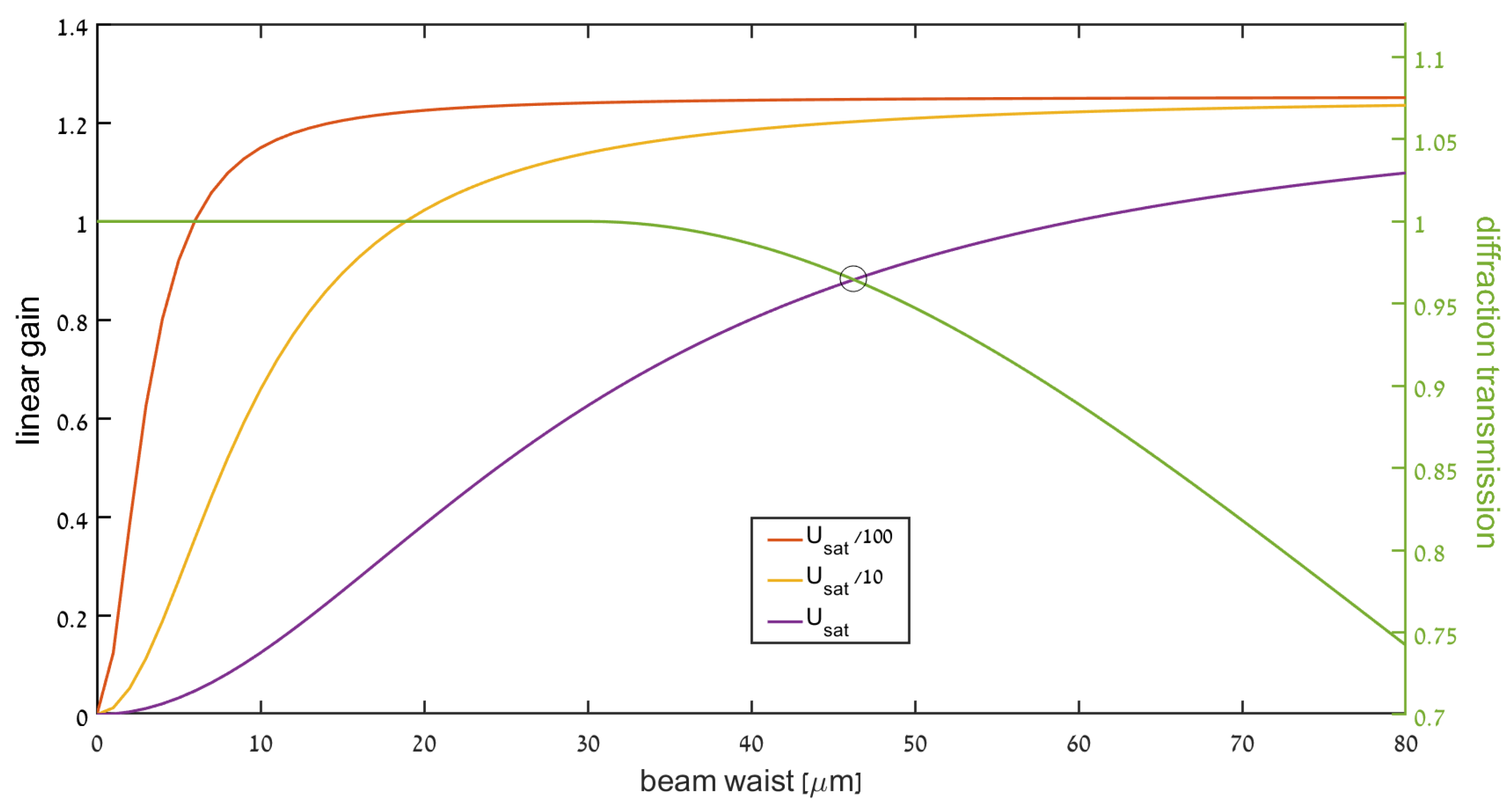
24], we can create an effective saturable absorber. Here, we note two competing loss/saturation mechanisms—small beams suffer from insufficient overlap with the pump mode, which reduces their gain, whereas larger beams suffer increased loss due to the effective Kerr lens aperture. This competition is summarized in
Figure 7. In general, the nonlinear losses can be divided into two categories: hard apertures, where any power beyond a certain beam size is completely cut off; and soft apertures, where beams beyond a certain size incur a certain amount of loss that depends on the beam’s size [
3,
10,
11]. Both can be easily incorporated into our simulation.
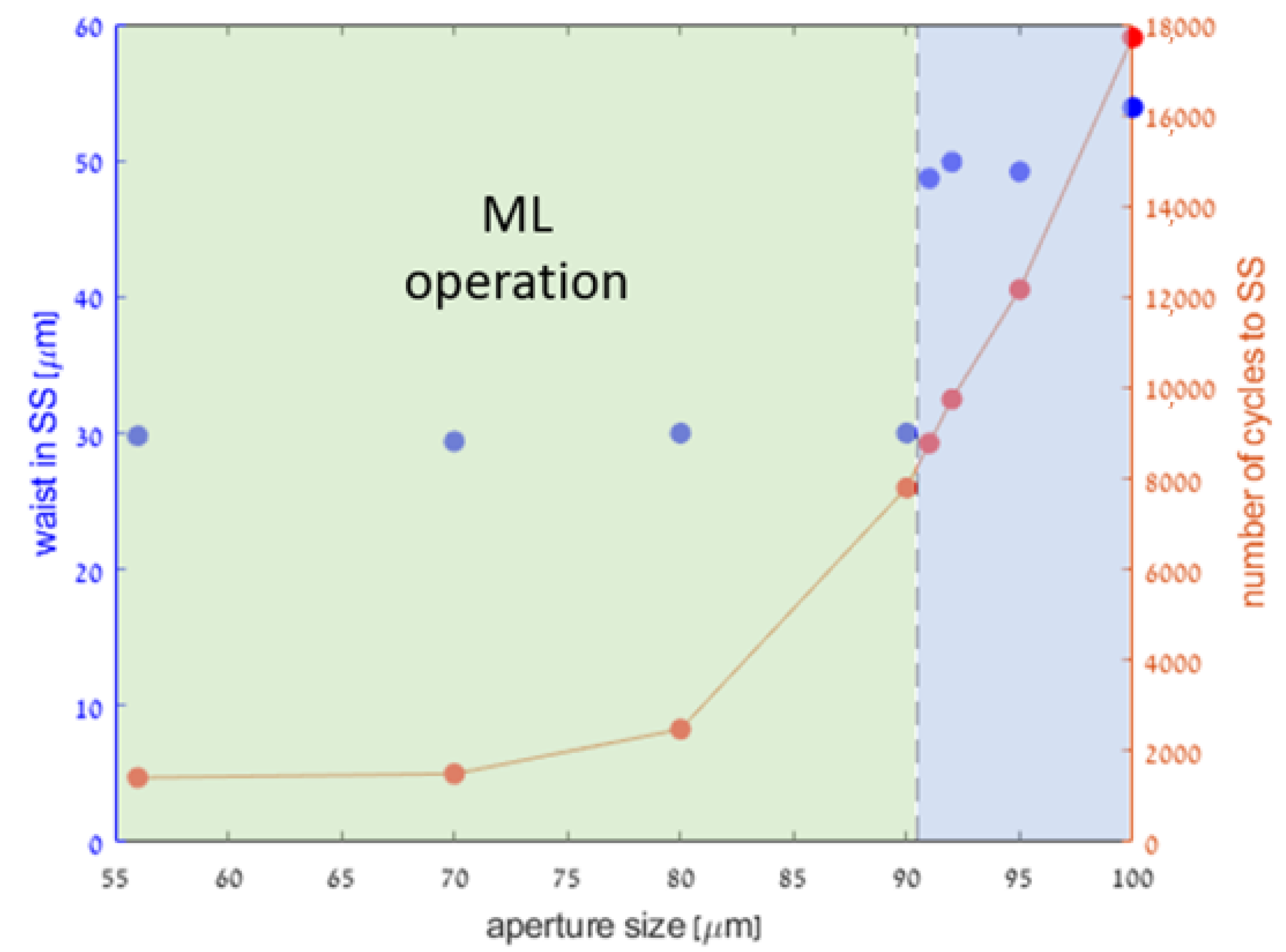
In our simulation, we opt for a soft-aperture mechanism, corresponding to a situation where the most important loss mechanism is the spatial overlap between the laser and the pump mode at the gain medium, where the KLM operates slightly beyond the stability limit. Different mechanisms simply amount to different loss functions, and can be easily accommodated by our software. For numerical reasons, in order to assure convergence of the cavity evolution (power and beam parameter) to the steady state, we need to prevent the beam size from diverging during the initial stage of cavity amplification, when the intra-cavity power is too low to support a significant Kerr lens. For this purpose, we introduce an artificial hard aperture in the round trip that limits the size of large beams effectively without incurring loss on smaller beams. For a narrow beam, only the (exponentially small) wings of the beam would be affected by the aperture and the incurred loss would be minute. This does not affect the dynamics of the cavity or the steady-state value, but only the convergence time of the simulation, as illustrated in
Figure 8.
The simulation is performed partially in the time domain, where the instantaneous nonlinear effects are calculated, and partially in the frequency domain where the linear transfer function of the cavity is calculated, as detailed in the pseudo-code given in Algorithm A1. To propagate the field in both time and space, the simulation is divided into a spatial procedure and a temporal procedure. The spatial procedure, detailed in the pseudo-code in Algorithm A2, handles the spatial ABCD propagation under the Gaussian single-mode assumption (including the spatial Kerr and the diffraction losses). The temporal procedure, detailed in the pseudo-code in Algorithm A3, handles the temporal evolution of SPM, gain, loss, and dispersion. The two components are coupled through the Kerr-lens interaction, where the temporal profile of the beam determines the optical power of the Kerr-lens, which, in turn, affects the temporal evolution via the diffraction losses. The variables and function names are given in
Table 2.