1. Introduction
In recent years, the deployment of LEO (Low Earth Orbit) satellites has increased. A striking example is the launching of the thousands of units already in orbit by the Starlink LEO and more to come with the newer Project Kuiper satellite constellations to encircling elliptically Earth at high velocity [
1]. Consequently, a LEO satellite unit passages a local horizon Earth observer within a few minutes [
2]; thus, strategic locations (
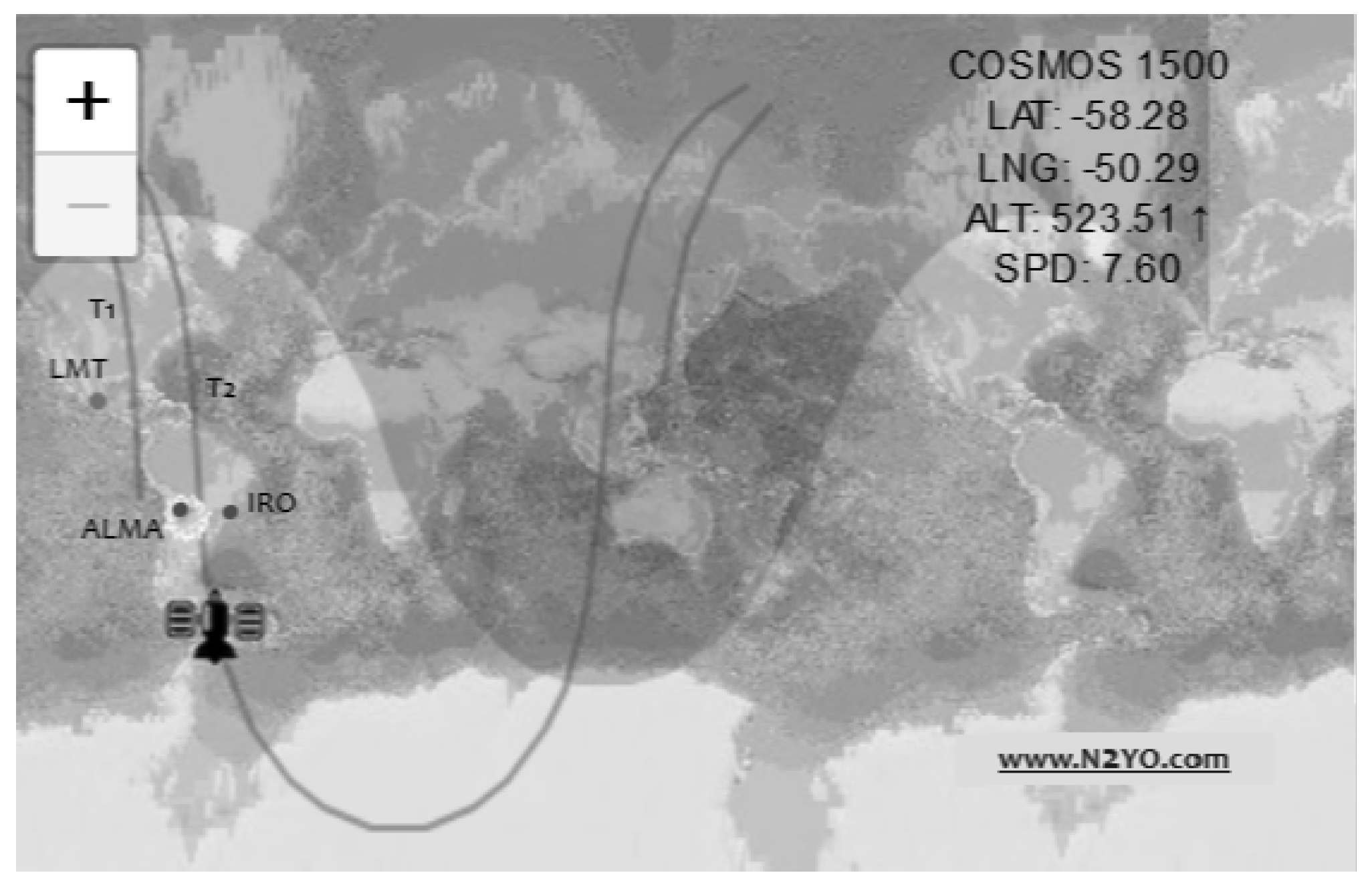
Figure 1) are selected to place fixed ground stations [
3].
To maximize the downlink of the 2D beam signal within specifications, a smaller moving robotic antenna was considered [
4] at the expense of increased complexity of the moving base due to the size and inertial of the antenna load. For full coverage, researchers proposed a parallel robot as the moving base but similar to the antenna, thus, imposing the tantamount task of dealing with nonlinear couplings at a dynamic level.
Despite such apparent technical difficulties arising from a large parallel robot handling such antenna, these have been proven effective for downlink LEO satellites given that these are preferred over geostationary satellites due to the ground proximity, which enables short latency but, in contrast, introduces stringent tracking requirements to the Earth station along the short passage flying time.
Moreover, the Gough–Stewart platform (GS) has been proposed to this end, becoming a robotic base that yields an active antenna tracking the 2D beam slice; however, the large antenna plate induces a state-dependent persistent aerodynamic wind disturbance into the dynamical system. Consequently an integrated design of the GS platform with the antenna structure is required to address properly the problem of downlinking LEO satellite signals at different Earth’s longitude and latitude.
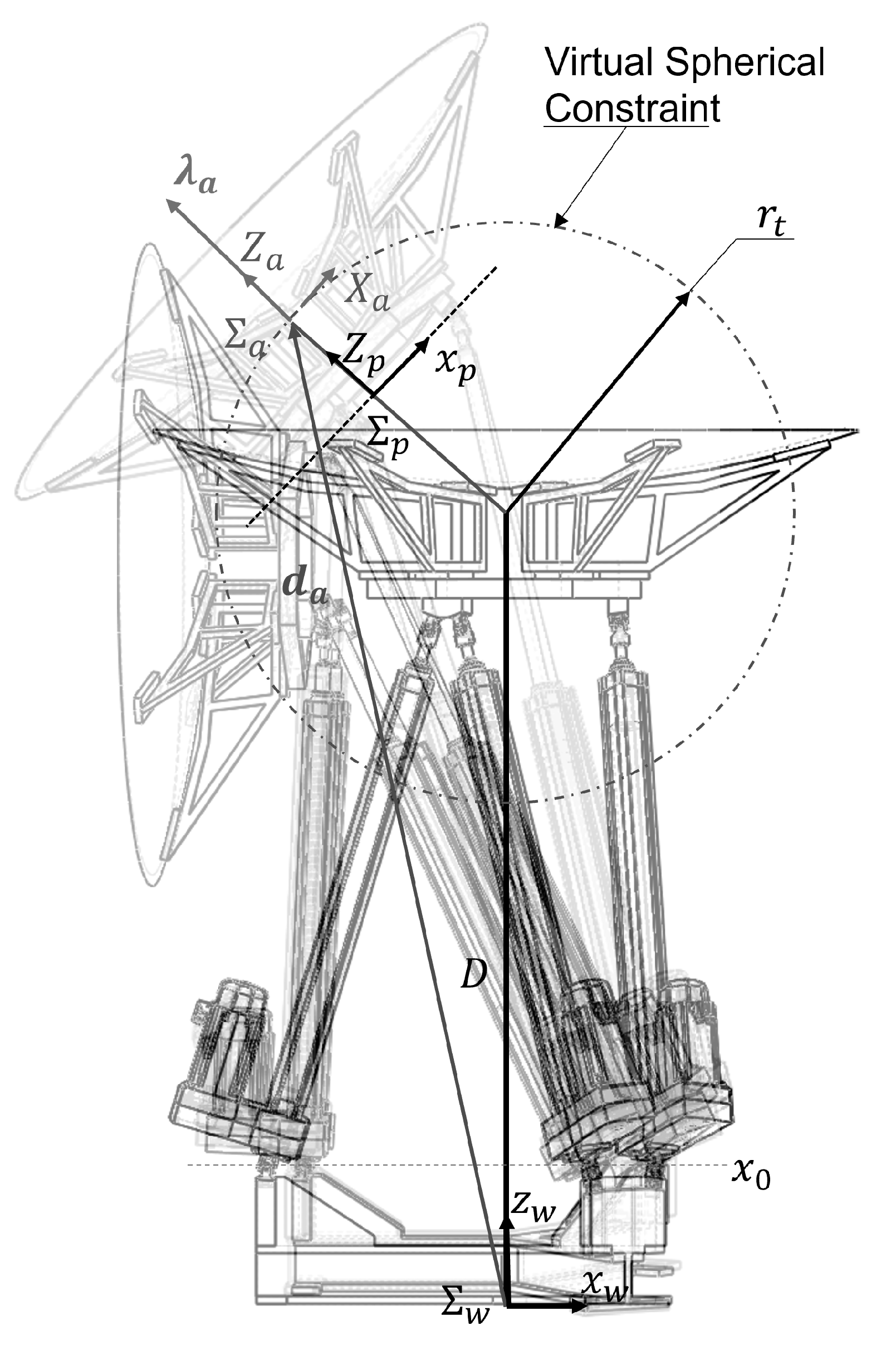
The high stiffness-to-load ratio of GS platforms has become the choice over serial ones, given the large antenna size, of high mass and inertia, the challenge goes beyond integrated design with the antenna but the controller to track a two-DoF trajectory in different Earth locations. Since the beam satellite trajectory lies over a virtual spherical constraint (see
Figure 2) a six-DoF parallel robot is suggested to maneuver in its reachable workspace. Although the modeling and control for the GS is well understood, the challenge to design and control a parallel robot handling the antenna load under induced disturbances, to track a two-DoF trajectory over a virtual spherical constraint, has not been addressed in the literature.
Moreover, the latency and path specifications are critical; thus, the motion planner of georeferenced paths is also an integral part of the problem. In this paper, we aim at solving this problem for a point-to-point tracking scheme with a simple and easy to implement controller that meets the specifications for the downlink signal, yet exhibits some robustness against unavoidable aerodynamic (wind) disturbances. The large body of literature on modeling and control of GS parallel robot deserve further discussion given the plethora of studies for a variety of applications; however, the design at the dynamic level is missing for antenna pointing with high loads and state-dependent disturbances.
Nevertheless, several nonlinear controllers have addressed the tracking of the GS robot under ideal conditions neglecting the antenna load but not for pointing at passive LEO satellite orbits nor subject to state-dependent disturbances, let alone with an online motion planner for this case. Interestingly, Ref. [
5] models the Euler–Lagrange platform under a nominal Computed Torque plus PID and friction estimation, without disturbances neither any antenna load nor pointing.
In [
6], sensitivity analysis of the inertial coupling of a moving base along a space constraint is presented; however, the structural mechanical analysis of limb control is limited to the linear domain, while [
7] proposed a conventional model-based adaptive control assuming simplified dynamics, under ideal tracking conditions.
Although [
8] does not address the GS platform but a class of parallel robots, their review is illustrative guidance to consider the influence of dynamics and operational control and, thus, operational motion planning. A neural network was proposed in [
9] for the GS subject to structured loads under ideal operation. Ref. [
10] presented a model-free high-order sliding mode with an unknown input observer for the operational GS dynamics, however, in ideal conditions without antenna nor pointing. Also in [
10], a cosimulation based on Adams and MATLAB was proposed to analyze the static pointing accuracy, but not the geolocation of orbital paths, of a GS platform without any antenna structural system, friction or wind disturbances. In [
11], a terminal sliding mode controller on
for a GS robot was proposed considering parametric uncertainties. Unfortunately, the control was model based, and antenna structural dynamics were not studied.
Contributions
The Gough–Stewart parallel robot, due to its high stiffness-to-load ratio and despite direct kinematics, remains an open problem [
12]. We circumvent this using inverse kinematics in task-based azimuth and elevation motion planning. In this way, the six quadratic scalar equations with 40 analytical solutions [
13] are avoided at the position level and solved with inverse velocity kinematic schemes [
14]. Then, the coupled dynamics are presented for the parallel GS robot, with viscous and smooth Coulomb friction on the struts carrying the antenna (see
Figure 2) and, thus, subject to state-dependent aerodynamic disturbances.
The path control scheme arises when closing the loop with an adaptive PI controller and an open-loop task-based motion planner using well-posed inverse kinematics. Considering commercial linear actuator specifications, a GS platform with an antenna structure is modeled (see
Figure 2), and the simulations are coded into SimScape and Simulink.
The numerical results show tracking within the limits and bandwidth of components off the shelf (COTS) linear actuators to guarantee the downlink precision of Cosmos 1500 polar trajectories obtained for three geolocations; see
Figure 1. More precisely, the original contribution amounts to the design of a robotic LEO precision antenna by dealing with the overall closed-loop dynamics of the coupled robotic base plus antenna system subject to induced wind disturbances with a simulation study for realistic struts specs, paths and geolocation.
2. Materials and Methods
2.1. Kinematic Model of the Robotic Antenna
The position and orientation of the Gough–Stewart platform is introduced now for completeness, considering the conventional assumption that pose arises through the length of six prismatic actuators placed in a symmetrical triangle-like distribution that shapes an GS mobile upper base with six DoF of freedom, known as a 6–6 parallel robot [
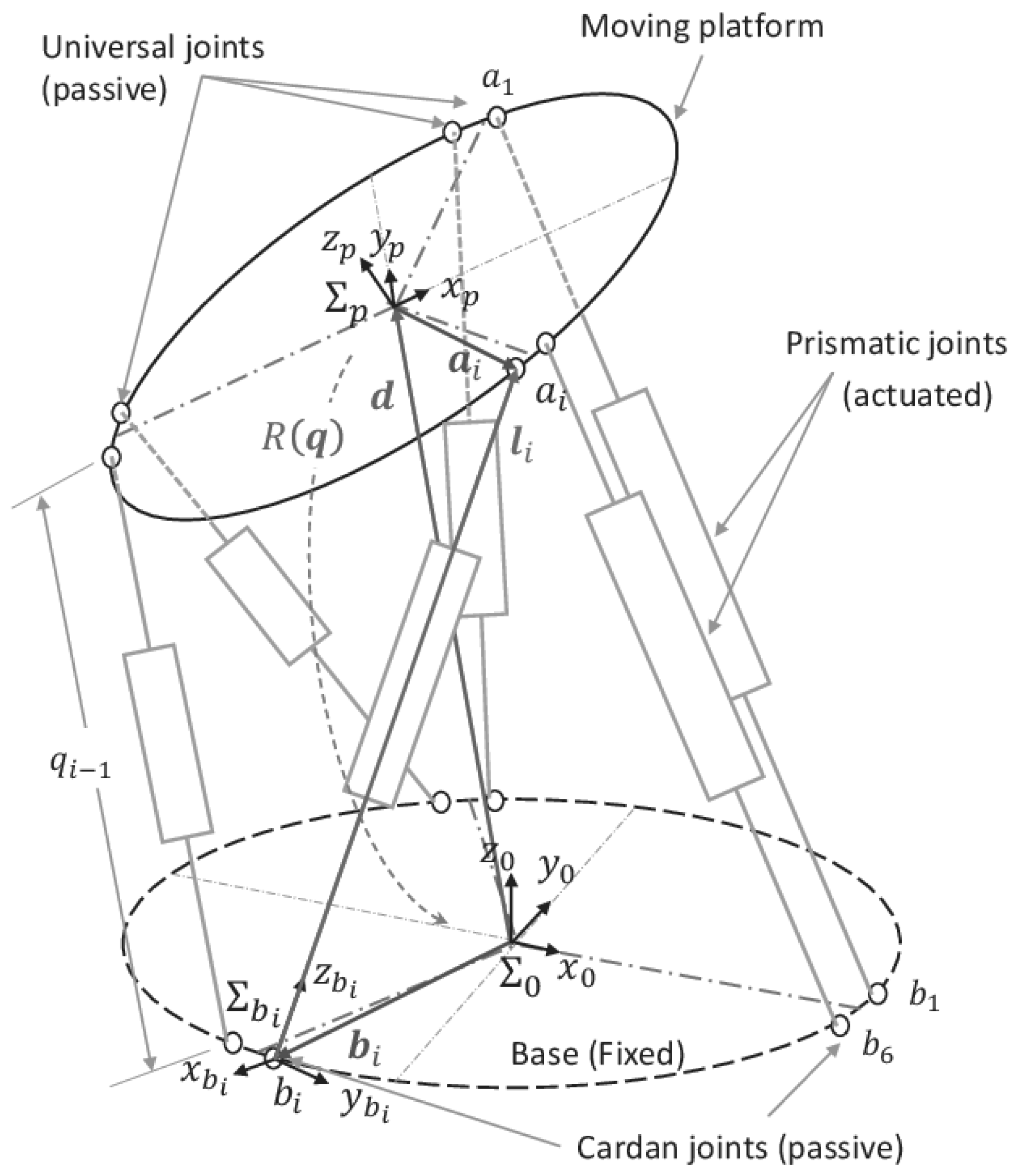
15]. Passive Cardan joints are placed at the static base with and passive universal joints on the moving platform; see
Figure 3. Although kinematic mappings are available in
X,
Y,
Z, it is necessary to derive a consistent description of the inverse and forward kinematics to propose the motion planner scheme in task (antenna) coordinates subject to a virtual sphere constraint, including the velocity kinematics to properly model the friction afterwards.
2.1.1. The Gough–Stewart Platform Kinematics
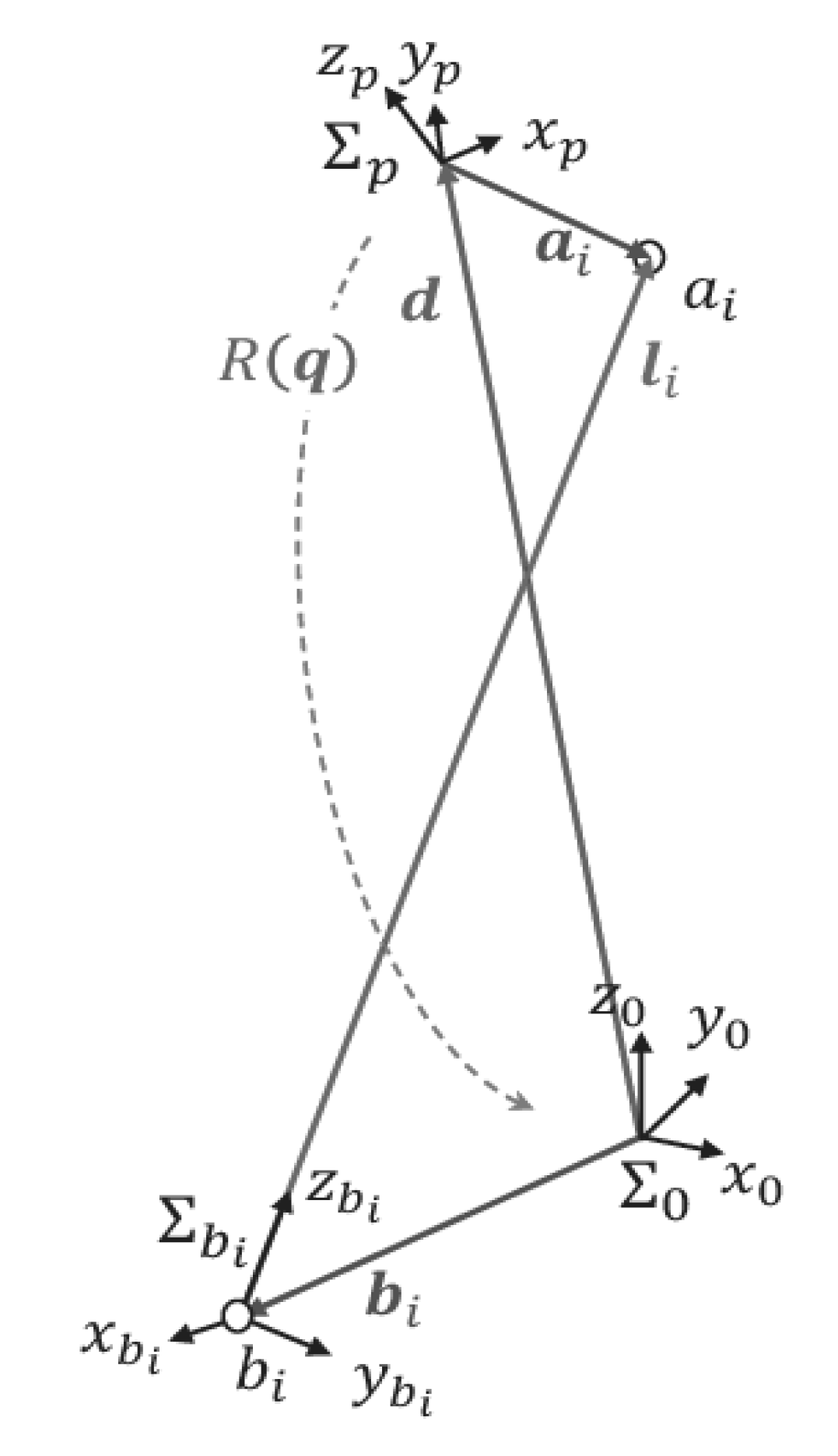
Let the closed kinematic chain for each limb be in accordance to
Figure 4, where the vectors
represent the corresponding spacial directions from base point
to articulated point
,
(
w.r.t. frame
).
Then, the absolute position of
is
[
14], which yields
whose unit vector (in the direction of each limb) becomes
Since the pair
has six DoF [
16], six Equations (
1) are sufficient to solve either for
or for the pair
. Considering a minimal attitude parametrization
[
17], of the set of Euler angles, then
, such that the
pose, where
spans the operational space (
) of the platform:
Let the set of limb extensions span the configuration space (
) of the robot:
, which leads to the following mappings [
18]:
2.1.2. Inverse Kinematics
Using (
1), one obtains
—that is, for
, we have
where
and
are the circle radii where the platform and base passive articulations are, respectively, placed.
2.1.3. Forward Kinematics
The map
can be solved for the roots of
of the homogeneous constraint
, where
. The general problem involves 40 complex solutions [
13,
19] that are still a subject of research [
12,
20,
21]. This non-trivial problem deserves further discussion regarding the methods: (1) numerical, based on analytical decomposition and the properties of the inverse kinematics equation and its numerical solutions [
14,
20,
22,
23,
24,
25]; (2) geometric, involving pose information provided from high-res sensors to support simplified analytical solutions [
15,
26]; and (3) hybrid, taking advantage of both before-mentioned methodologies [
19,
23,
27]. To circumvent the FK problem, our aim is to synthesize the motion planner and control design based on IK.
2.1.4. Velocity Kinematics
The time derivative of the quadratic form of the inverse kinematics becomes
the generalized coordinates velocity expression
, where
is given by (
2). Using the angular velocity identity [
17],
, where
is the cross product operator, then the time derivative of (
1) becomes
with
the platform twist, in base coordinates. Then, generalized velocity coordinates can be written as follows
In vector form, it becomes
where
is the full rank matrix given by
which maps the linear and angular velocities
of the platform to the full space of the generalized velocity vector
for well-posed velocity kinematics. Notice that
can be obtained either using (
2) if the position and attitude of the platform are available or by direct measurement of the two angles in each of the base joints.
2.2. The Task Kinematics
Consider two independent variables to define the task space of the antenna: let azimuth be
(measured from the North) and the elevation be
(measured upwards from the observer horizontal plane), which are complementary to the platform kinematics:
Therefore, the task space kinematics (TSK) relates the task variables to the operational space variables, called the antenna’s kinematics:
To produce the remaining TSK functions, let
be placed at some point in the antenna and let the world frame be
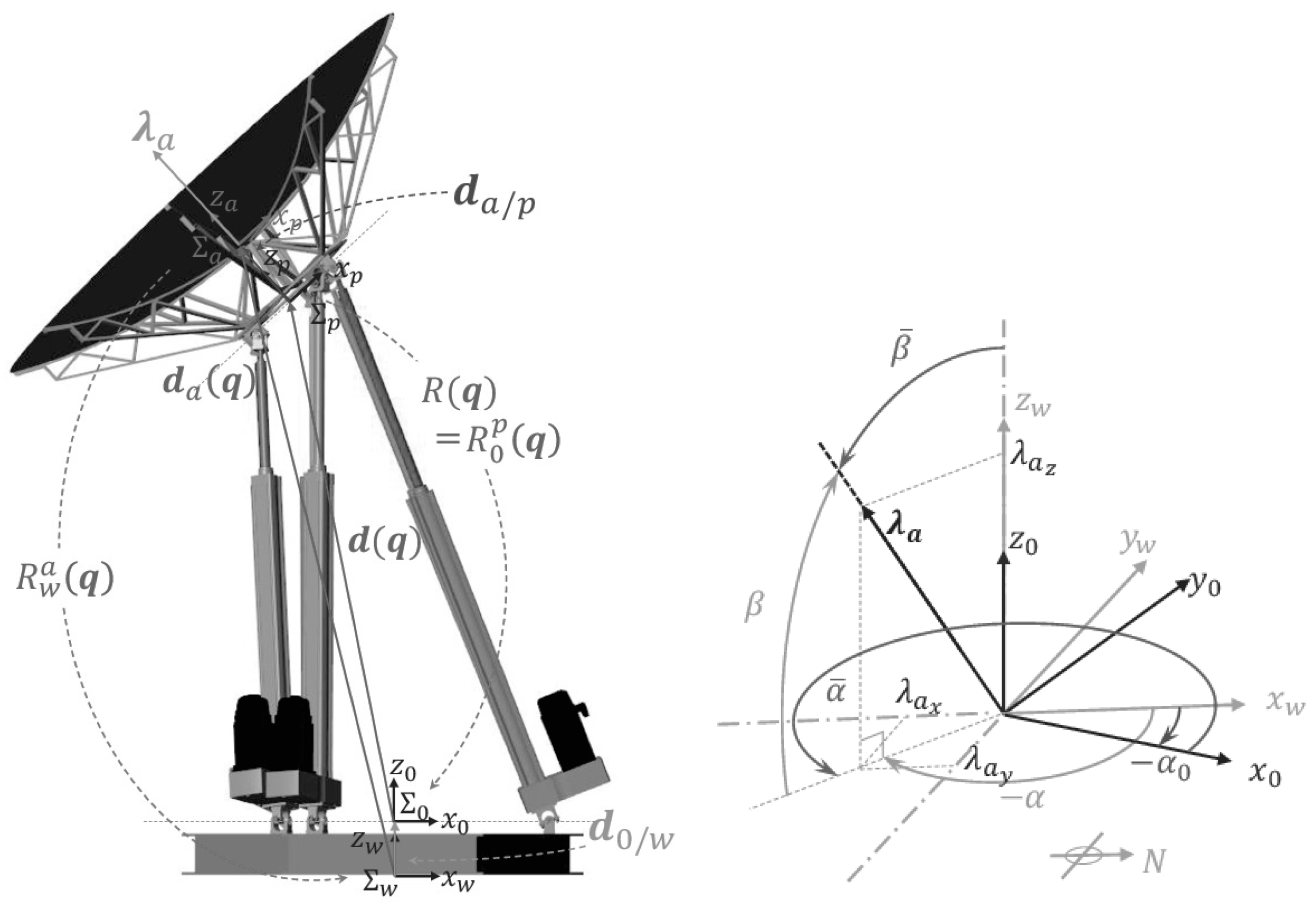
, upon which the attitude of the desired tracking objects is defined; see
Figure 5. The world frame can be placed such that the
axis points northwards, the
points upwards, and the
is defined so that the frame
fulfills the right-hand rule. Then, there exists an angle
to measure the installed orientation of the platform structure
w.r.t. to the North direction at the settling point. In addition, although the antenna’s frame
is placed on an arbitrary point in the antenna (design engineer choice), its orientation is not constrained; therefore, it can be chosen parallel to the platform
to produce an identity as a rotation matrix:
.
In this way, there exists three homogeneous transformations, living in
:
such that the antenna frame kinematics,
w.r.t. the world frame
, are obtained by the following product in
[
18]:
from which, the attitude and position become
2.2.1. Inverse Task Kinematics
After
Figure 5, we remark that angles
,
are measured
w.r.t. in the base frame
at the platform, being positive in the conventional counter-clockwise sense after the right-hand rule, and the vertical rotation angle
is the quadrant complement of the elevation angle
, which is measured from the horizontal plane. Moreover, the azimuth angles
and
are positive in the clockwise sense and measured by a compass
w.r.t. the North; therefore,
In (
9a), the rotation from the world frame
to the final frame
is constructed by only two consecutive rotations, with one of them constant and defined by the particular orientation toward the North. This constant rotation
, from frame
to
, is expressed by the rotation of a negative angle
about the
z axis:
To uniquely define the variable rotation , dependent on generalized coordinate of the robot platform and aiming at parametrizing with and , of the antenna w.r.t. in the base frame . Thus, consider performed after three basic rotations as follows:
A rotation of an angle about the vertical -axis (positive in the counter clockwise sense).
A rotation of an angle about the current horizontal y-axis; such that the new z-axis points in the antenna’s direction .
A “negative” rotation of the same angle about the new -axis; such that the antenna plate is constraint to turn like a rolling coin in order to avoid unfeasible physical configurations in the platform.
The overall rotation (
9a), after (
11) and
, becomes:
Remark 1. The aim is to precisely point the antenna to the downlink LEO signal; thus, it is convenient to make a clear and intuitive design of the antenna-pointing direction to the LEO satellite position. Such a point vector should only depend on the task coordinates . This implies that the FTK shall uniquely depend on elements of the rotation matrix R and not the distance d: . In this way, the inverse mapping for the platform position d can be any arbitrary function. Now, notice that antenna’s z-axis unit vector is nothing but , independent of d, which, in world-frame coordinates, becomes given by the third column above. Finally, at this point, its velocity becomes 2.2.2. Forward Task Position Kinematics
The following FTK function arises straightforwardly as function of (
12),
2.2.3. Forward Task Velocity Kinematics
The first-order (velocity) forward task kinematics can be computed using (
13) and (
Section 2.2.2), whose time derivative leads to, in matrix form,
where
stands for, using
,
2.3. Desired Task Trajectory
Since the FTK is advantageously dependent only on the attitude of the platform and the inverse mapping for the distance
d can be any arbitrary function, it is also convenient to address that the platform’s position does not interfere with the antenna’s pointing direction. To this end, let the position
d be
constrained onto the surface of a virtual sphere of radius
, and then we have
where
stands for its center; see
Figure 5. Then, the attitude
and position
of the platform, i.e., the ITK, can be computed after (
Section 2.2) and (
16) as:
Now, the problem of designing desired generalized coordinates
after a given task trajectory
is easily found after the use of constraint (
16):
.
2.4. Desired Generalized Position
Let the desire attitude and position of the platform be computed using the ITK (
Section 2.3) with desired arguments:
,
. Henceforth, the desired generalized coordinates vector arises after the inverse kinematics (
3), evaluated using desired position and attitude as follows
Desired Generalized Velocity
Differentiating (
18) leads to the desired generalized velocity vector
in terms of the desired operational position and desired velocity. However, alternatively, let the desired platform twist be
expressed in the base frame coordinates, and then using (
6), it leads to
with
given in (
7).
2.5. Inverse Task-Velocity Kinematics
Using (
10) and (
12) and properties
,
,
and
, the angular velocity vector becomes, in terms of the task variables,
where the operator
arises as
Notice that, with this formulation, the product
; thus, the operator
qualifies as the right pseudo-inverse of
, with the additional advantage of being well-conditioned for the zenith-pointing attitude (
), in contrast to
. This problem was also reported in the proposed solution on [
28].
Now, the time derivative of motion constraint (
16) becomes
, using
, where
Then, the complete velocity kinematics operator that maps antenna’s twist
(i.e., linear and angular velocity of frame
) to world-frame coordinates is given by
where, using (
21) and (
22),
Then, we have achieved to formulate the velocity kinematics operators as function only of platform attitude but independent of platform position d.
2.6. The Task Velocity Operator
The antenna twist
in (
23) differs from platform twist
in (
19), though its equivalence arises by translating the
to the origin of the platform frame to obtain platform twist
and rotating the resultant to express it in the base frame (
) coordinates. Then, to compute
, define a constant extended rotation matrix
To switch the point at which the antenna twist is attached, consider the following vector equations
which are valid for any reference coordinates. Although position
is constant in either the antenna frame
or platform frame
coordinates, it is required to be expressed in the coordinates of the base frame
following transformation
. Then, a twist translation matrix can be defined as:
such that
. Finally, considering (
7) and (
24)–(
26), let the
Task Velocity Operator (TVO) be
such that the desired generalized velocity vector becomes the following
Remark 2. Notice that the evaluation of needs platform pose feedback, either from a forward kinematics estimation or direct measurements. However, if the control guarantees a small tracking error, i.e., , then , such that there could be implemented an open-loop evaluation of the TVO using desired trajectories instead of real ones—that is, in such circumstances,could be used reasonably instead of (27), as we have to test the simulation study. 2.7. The Gough–Stewart Platform Dynamics
2.7.1. Lagrangian Modelling
Consider that if the Gough–Stewart platform is composed of
N rigid multibodies, then the Lagrangian formulation with
n DoF in generalized coordinates
can be written as follows [
29,
30],
where
is the generalized force vector,
models the generalized dissipative (friction) affine force vector, and
stands for the persistent state-dependent bounded disturbances, which are assumed to be coming from the wind aerodynamic loads.
2.7.2. Wind Load Aerodynamics
Climatic conditions at the outdoor antenna introduce exogenous (disturbance) forces to the system throughout the large area of the antenna plate, i.e., mainly wind-induced aerodynamic generalized forces
. Assuming that the wind velocity is modeled in world-frame coordinates as
then the wind-induced torques depend on the geometry and orientation of the antenna. Consider, without loss of generality, that
arises at a pressure point where all forces are concentrated as follows
where
is the air density,
is the projection of the antenna area in the directions
:
with
representing the antenna’s minimal lateral exposed area, and
and
are the drag and lift coefficients, respectively, which are typically dependent on the angle of attack of the aerodynamic surface
. For simplicity, consider a circular flat plate to represent the wind current opposing force at the antenna, implying a constant drag coefficient of
and a variable lift coefficient
with an aerodynamic angle of attack
dependent on the antenna’s attitude as follows
Therefore, a simplified expression for the aerodynamic wind disturbance wrench
at the antenna, produced by (
30), computed in terms of the platform’s base coordinates yields to
where
is the distance of the pressure point in the antenna
w.r.t. the platform. The mapping between this aerodynamic wrench at the platform frame and the damping generalized forces in (
29) is obtained after the virtual work principle as
. Therefore,
models a simplified approximation for the generalized aerodynamic forces produced by bounded persistent wind.
2.8. Control Design
At this point, the control problem statement is the following, provided the complexity of the coupled dynamical model composed of robotic base and the antenna subject to wind disturbances: Design a simple model-free control input
for dynamics (
29) subject to unknown smooth friction
and bounded wind disturbance
, such that the closed-loop system enforces asymptotically practical tracking to point at a passive LEO satellite.
Among several control schemes proposed for the Gough–Stewart platform, it remains to analyze objectively which one is convenient for the control regimes of the satellite pointing task. First, consider that civil access to satellite data is limited at discrete time instants, not continuously available, and that the passage time window of passive LEO satellite path lasts a few minutes. Then, only few data points are available to compute desired georeferenced trajectories; thus, the stability regime resembles to point-to-point regulation more than tracking, where polynomial approximations can be used to produce a smooth path along points.
However, since the highly nonlinear plant is subject to time-varying and state-dependent disturbances, an apparent choice is a nonlinear tracking controller. Contrary to this, and recalling that robust linear actuators are available equipped with well-proven PID controllers, in addition to the fact that these actuators are closed architecture, we analyze model-free PID control structures.
2.8.1. Conventional PID Controller
Assuming that the regulation regime, i.e., is piecewise constant and considering the (a) high stiffness-to-load ratio, (b) small-time varying point-to-point regime and (c) no disturbance, i.e., negligible wind velocity (), this suggests that the conventional PID may become an option before the highly nonlinear plant; thus, this apparently naive choice deserves further discussion. However, a formal and objective assessment leads us to consider primarily these facts and that the desired trajectory is indeed obtained after high-latency LEO satellite data points, in the magnitude of several minutes each.
As full system qualifies for the well-known Lagrangian robot dynamics, for which it was proven four decades ago that the model-free PID regulates [
31] and that point-to-point yields GUUB practical point-to-point tracking [
32]. Then, consider the conventional PID control
, where
stand for the position and velocity tracking errors, respectively, and
positive definite feedback matrix gains. There exists a plethora of implementation and tuning procedures in the literature for this mature and proven regulator control, thus, representing a feasible preferred choice since there is enough settle time before the next via point; see Table 2 and citation of Figure 7.
2.8.2. Adaptive Robust PI Controller
To withstand disturbances of realistic, persistent but slow wind velocity, let the extended error be
where
is a velocity nominal reference, for
. Then, adding the state bounded function
to (
29); for
, with
the piecewise hyperbolic tangent function and
a constant diagonal matrix, one obtains the following open loop error equation in a
S-coordinate system
We have the following result.
Proposition 1. Consider the decentralized Model-free Adaptive Proportional-Integral (A-PI) robust controllerin closed loop with (34). Then, the closed-loop system yields asymptotically robust regulation provided that disturbance can be parameterized as constant in the time window before the next desired via point. Proof Substituting (
35) into (
34), one obtains the closed loop system
for
and
. Now, consider the Lyapunov function
, whose time derivative becomes
. Assuming that disturbance is slowly time varying in
and that the settle time of the controller is less than
, then
; thus,
given that
is a constant, and
approximates to a constant.
This chain of arguments leads to
, and then one obtains
. Evaluating
along solution (
36) yields
, where we have used the skew-symmetric property of Coriolis and inertia matrices
[
31] and Equation (35b).
Since
is bounded by a functional in terms of boundedness of system dynamics [
33], there exists a
such that
; thus,
. Henceforth,
. Since the system is autonomous in
, using the maximum invariance principle leads to the boundedness of
S into a small vicinity
of its origin
. Given (
33), then errors
converge asymptotically to a small vicinity of
for high enough damping
. □
Remark 3. (How to Implement the Adaptive Robust PI Controller in Generalized Coordinates).
Notice that (33) qualifies for a manifold composed of independent generalized coordinates, then controller (35) shows a decentralized model-free PID structure for , and . This PID structure can be implemented in industrial COTS actuators throughout tuning accordingly these feedback gains, representing arguably also a major advantage over nonlinear controllers that require unfeasible open architecture systems to implement them. Finally, a rightful comparison of our proposal versus conventional PID controller should show advantages to claim its usefulness in practice, rather than to become simply another proposed controller in the literature. 3. Results
The main objective of the parallel robotic antenna is to track within specs the georeferenced satellite trajectories, We considered COTS linear actuators for a custom-made platform and antenna designs to downlink the LEO satellite signal. Three ground stations of geographic coordinates were simulated for a Russian LEO satellite COSMOS 1500, where real time data was downloaded using Orbitron, a software used by professionals for satellite tracking for weather, communication and astronomy users based on space-track.org database. The remaining parameters were selected keeping in mind COTS accessories and materials, not to exceed linear thruster specs and subject to their encoder resolution, for a feasible and viable design.
3.1. Block Diagram of the Simulator
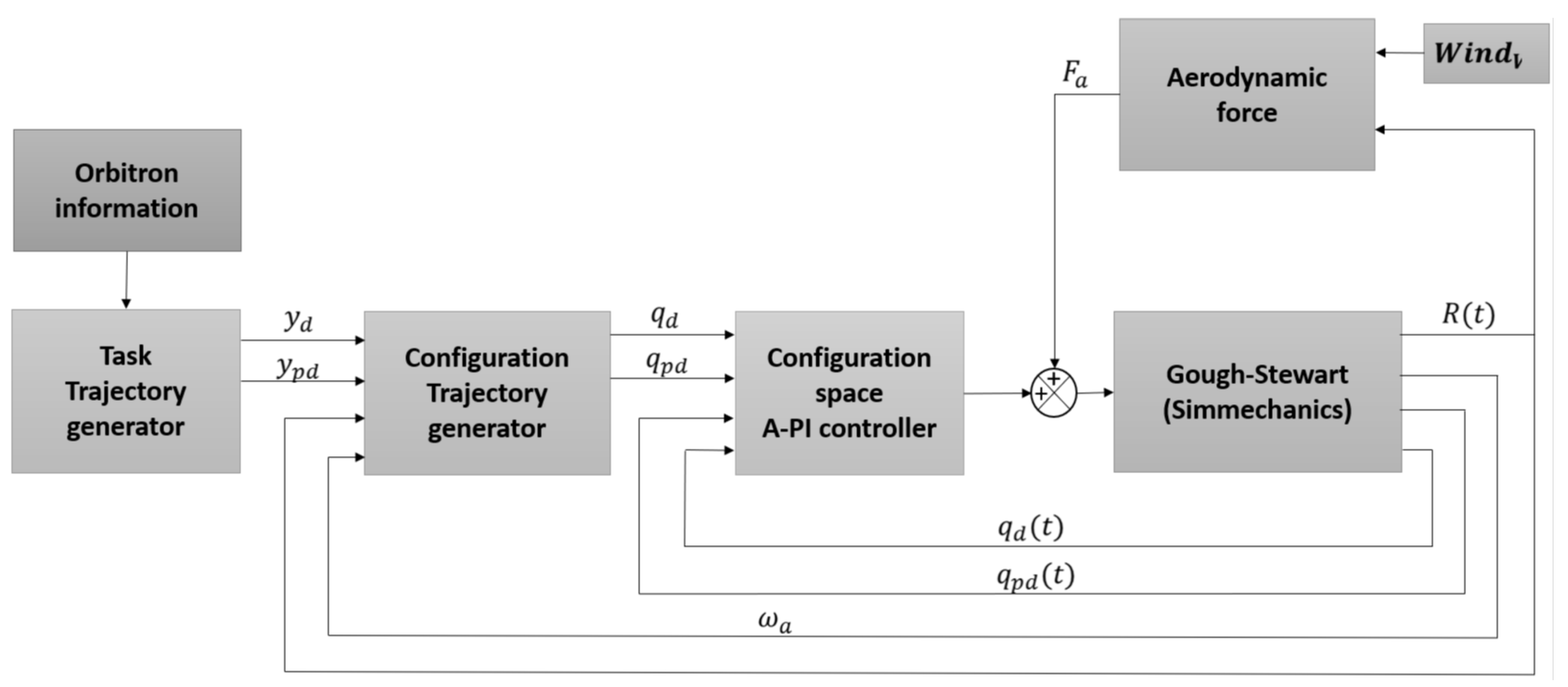
The detailed diagram of interconnection that gives rise to the simulator in closed-loop is presented in a configuration space:
Figure 6.
3.1.1. The Gough–Stewart Platform and Antenna Structure
Kinematics and dynamics, under the given constraints, were programmed in SimScape Multibody, the controller, motion planner, wind aerodynamic disturbance as well as frictions were programmed in Simulink. In all cases, the initial conditions of the azimuth installation angle were aligned to the North, i.e., .
The FESTO actuator ESBF-BS-80-1000-40P-S1-R3 was selected due to its robust life cycle performance, with a stroke length of 1000 mm that provides a maximum speed of 1.34 m/s and 5.4 kN maximum force. The mass of the antenna is 50 kg. The polar moments of inertia of each element are computed by SimScape, given material density and geometry. The base and platform radio, where passive Cardan and universal joints are placed, are mm and mm, where the platform shape is an hexagon of 0.3586 mt each side. Friction is modeled in accordance to selected component’s data sheet, where the combined friction effects of linear actuation mechanism are viscous and Coulomb friction with the same coefficient of 5 for both frictions, with the corresponding units in IS.
3.1.2. Task Trajectory Generator
This block computes the desired azimuth and elevation trajectories of the antenna subject to the constrained virtual sphere, corresponding to the two angles of the slice of the projected path satellite, mapped to three ground stations; see
Table 1. The data correspond to 13 January (T1) and 15 (T2 and T3), 2021; see
Figure 1 and
Table 2:
Large Millimeter Telescope (LMT) at (18°599 N, 97°1853 W) in Atzitzintla (Mexico).
Atacama Large Millimeter Array (ALMA) at (23°19.41 S, 67°4511.45 W) in Atacama Desert (Chile).
Itapeting Radio Observatory (IRO) at (23°116.72 S, 46° 3329.88 W) in Sau Paulo (Brazil).
The point-to-point task trajectories are approximated with cubic splines, where the central curve segment is computed with the azimuth and elevation data of
Figure 7 at different time intervals for each geolocation as obtained from ©Orbitron.
3.1.3. Configuration Trajectory Generator
This block computes the desired positions and velocities of the leg extensions. The position is shown in the third row of
Figure 7 and
Figure 8. Since the robot home position corresponds to contracted legs or zero effective extension, which does not belong to the virtual spherical constraint defined to perform satellite tracking path, then configuration space coordinates trajectories are computed in three different phases:
Initialization Phase: This phase consists of reaching initial pose based on inverse task kinematics of (
18) for open-loop (
27) or closed-loop (
28). This pose corresponds to a point at the virtual spherical constraint from the secure home position of the system. Point to point approximate path is smoothed with a second order filter tuned for a settling time of 30 s.
Point-to-point Phase: System is pointing in the vicinity of initial horizon appearance of the satellite, This phase is set to start at simulation time of s.
Go-to-home Phase: With that second order filter, and for 30 s, it tracks via points to the home position.
3.1.4. Configuration Space A-PI and PID Controller
Initial conditions of the generalized coordinates are near to the desired trajectories. Feedback gains do not consider for a tuning using a heuristic reasoning to achieve a acceptable performance within limits, in this way the A-PI gains are , , and the PID controler gains , and .
3.1.5. Aerodynamic Disturbance Force
Wind exerted forces are coded in a Simulink block using (
30)–(
32). The antenna area
mt
, corresponds to 1.8 m of the diameter disc; thus, the system is exposed from a minimal to a maximum disturbance, corresponding to the minimal when the antenna exposed lateral area is
m
. We considered a temperature of 15 degrees Celsius, an atmospheric pressure of
hPa, a relative humidity of
and a nominal air density
kg/m
corresponding to dry and low moisture conditions at each site altitude; see
Table 1.
Therefore, for the whole travel, the system is subject approximately to magnitudes of N of wind disturbance force corresponding to laminar wind velocity of m/s for LMT, ALMA and IRO stations, respectively. Notice that the first two corresponds already to rough wind conditions, also called near gale in nautical terms.
3.2. Simulation Results
3.2.1. Performance Metrics
Simulations were performed for two scenarios, (1) using an offline motion planer or open-loop trajectory generator (
28) using desired azimuth/elevation trajectories, and (2) closed-loop trajectory generation where the motion planer employs real trajectories (
27), for both controllers PID and A-PI.
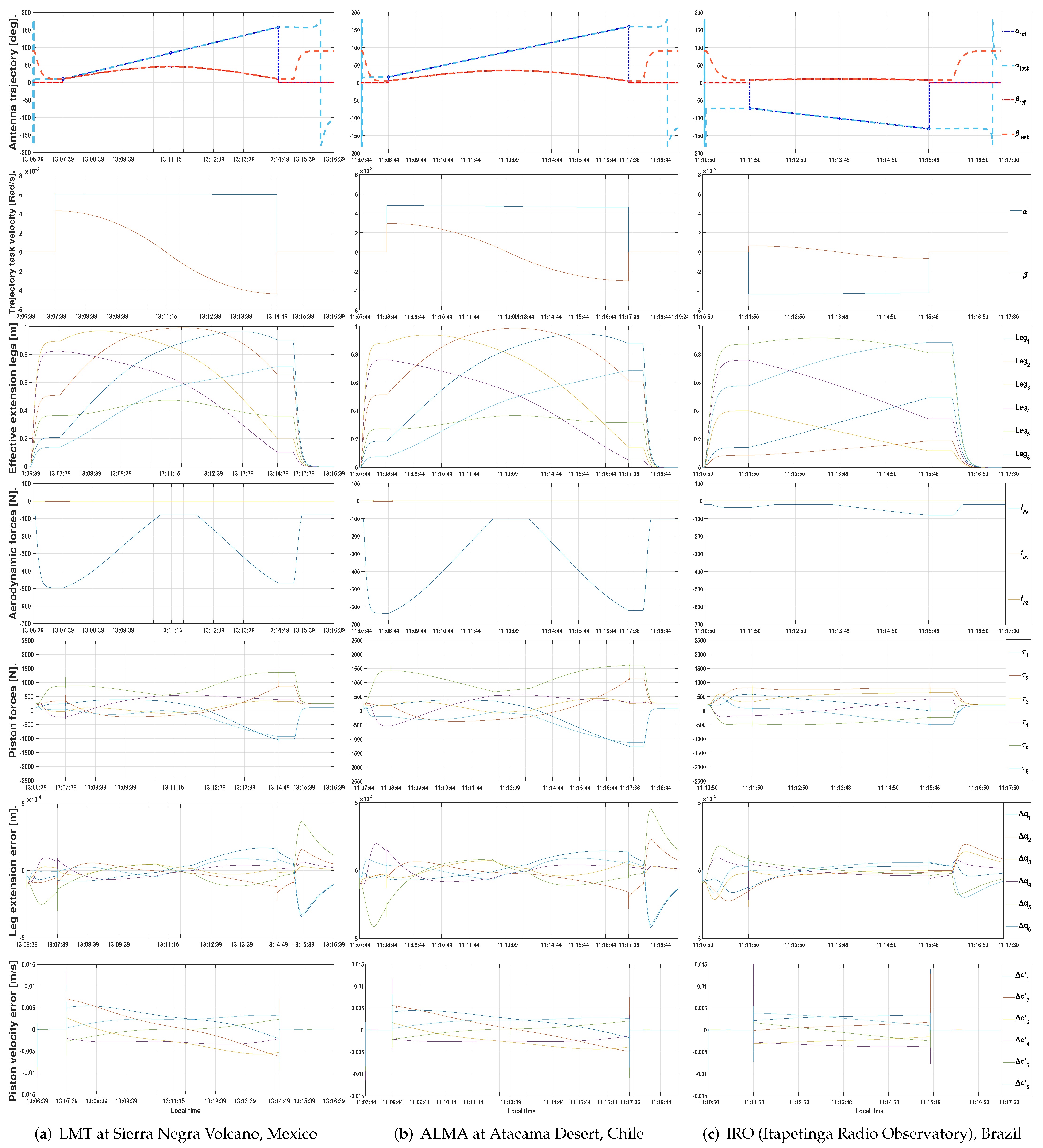
Table 3 and
Table 4 show four performance metrics over the point-to-point tracking phase, for closed-loop and open-loop motion planning, respectively. Notice that, in all cases, the A-PI outperforms the PID, and remarkably in some cases, the open-loop trajectory generation shows better metrics in comparison to its close-loop counterpart.
3.2.2. Graphic Results
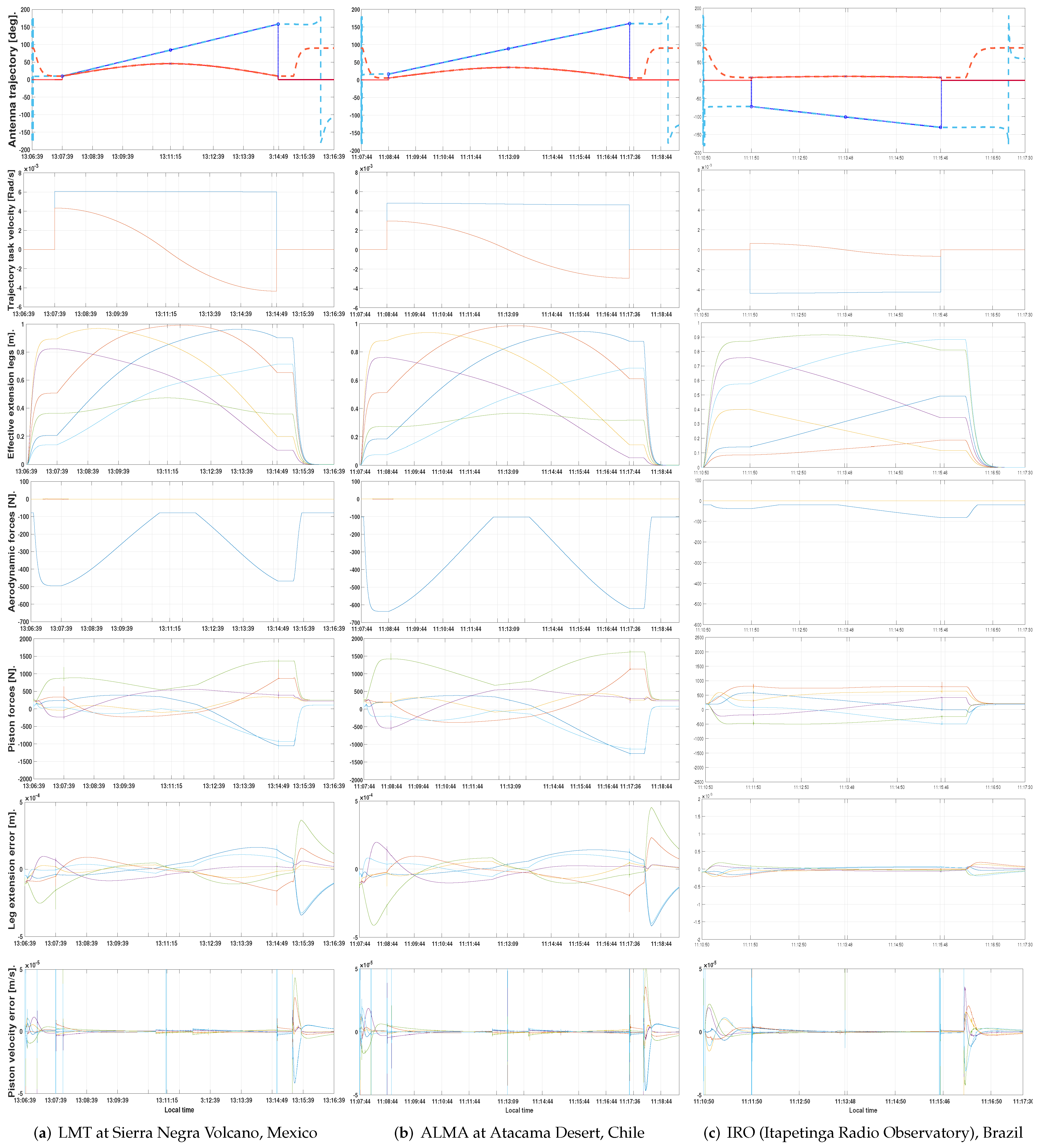
Figure 7 and
Figure 8 depict the close-loop and open-loop trajectory generation, respectively. There exists minor differences between both sets of simulations, due to the small error between real and desired trajectories, and thus similar results are obtained, and similar comments can be issued; henceforth, we provide common comments on them; however, notice that different resources are required to instrument either open- or closed-loop motion planner.
Row 1 and 2: Task space position and velocity coordinates show initial and final changes in velocity profiles when maneuvering to home position, so it does not affect the downlinking capacity of the system (phase two). The negative azimuth for IRO station is due to the satellite trajectory passed through the west from such location, in contrast to the LMT station location; see
Figure 1. Altitude among stations also affect final trajectories, including distance to satellite trajectories.
Row 3: Leg extensions trajectories in configuration space are shown in the third row, where curves exhibit consistency with the trajectory generation block policy. Notice that both the extension and the force of the pistons remain within the operating ranges provided by the manufacturer.
Row 4: The aerodynamic force shows the importance to compensate for drag force along x-direction, particularly at the beginning and at the end of the point-to-point tracking phase, where antenna plate tends to an almost vertical pose, producing the highest wind disturbance, moreover with low lift and slip force components. The difference in the maximal magnitude of the drag force is mainly due to the wind velocity at each ground station, where the shape varies due to the maximal elevation angle needed for a particular satellite georeferenced station and initial conditions.
Row 5: The control exerted forces, positive for pushing and negative for pulling, are smooth.
Row 6 and 7: Small configuration errors are yielded, despite the controller is model-free and subject to induced wind disturbances. The small changes that appear at the beginning and at the end of the tracking phase are produced by the switching among configuration, or task space desired trajectories.
Finally, notice the exponential behavior during initial and go-to-home phases (rows 6) and configuration velocity error plots (row 7), as well its bounds during these regulation phases, are consistent to the stability properties of the A-PI controller.
3.2.3. Tracking Errors
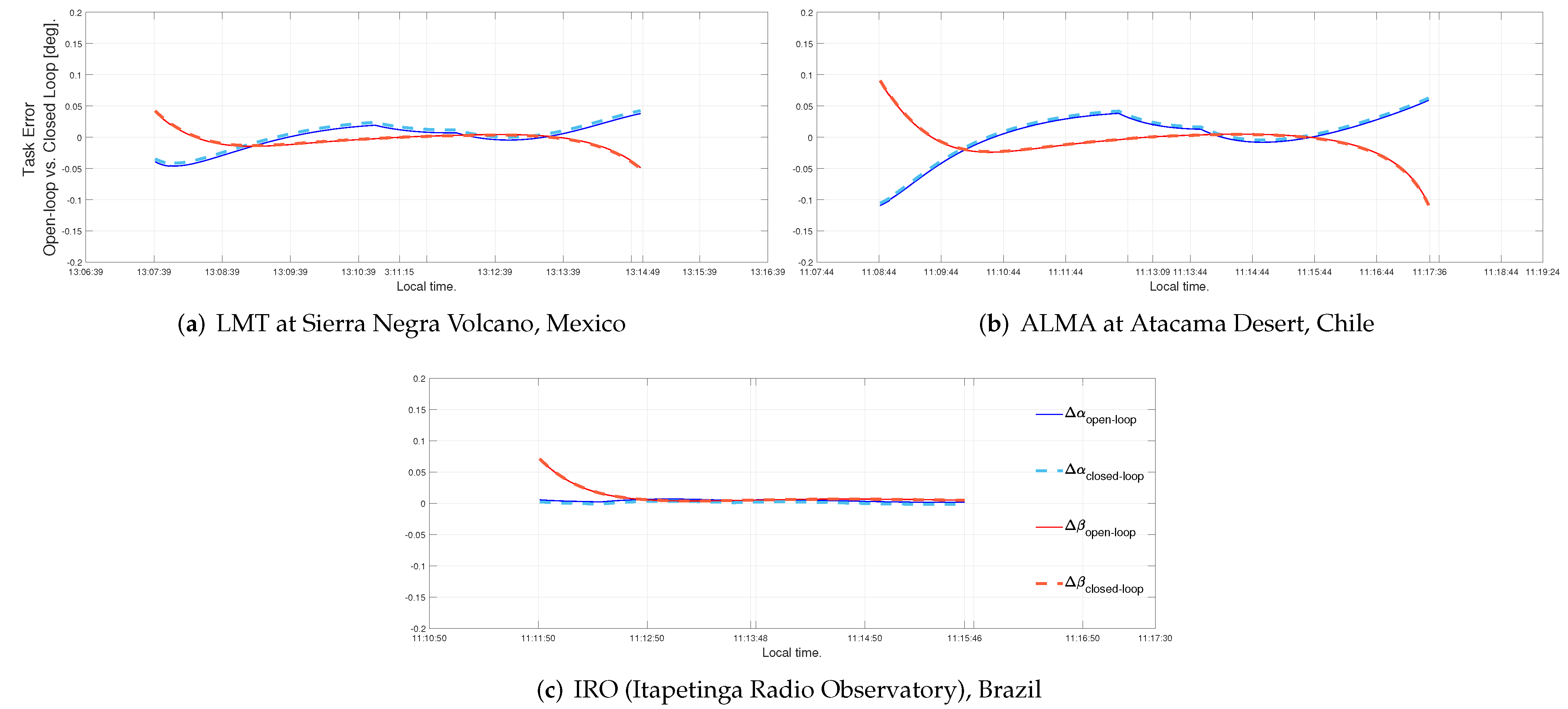
Figure 9 shows the tracking errors only during the satellite tracking phase, where negligible difference are observed between using offline (open-loop) or online (closed-loop) motion planner. Notably the proposed A-PI compensates for slowly time varying disturbances, producing such small errors, with smooth control effort.
4. Discussion
Our proposal addresses an implementable control architecture that does not require knowledge of the complex plant but only conservative bounds, yet it guarantees point-to-point regulation for a critical task. The numerical results show that, considering parameters and specifications of commercial actuators, LEO downlink is feasible; moreover, there arises few discussions that the advantages of our proposal.
First, no previous scheme have included LEO downlinking with a GS platform to cover the worskspace envelope from east horizon to west horizon. The two DoF pedestal robot, usually considered for satellite downlink, or tracking, clearly fails to conver such workspace [
28]. Secondly, in addition, proposing model-based schemes yields a closed-loop system prone to any uncertainty on regressor or parameter, including from approximation theory schemes that neglects approximation errors, such as neural networks and fuzzy logic, or adaptive optimal control or predictive control.
Furthermore, the computational load of any scheme that realies on the model or approximation of inverse dynamics certainly leads to unfeasible implementation with COTS. Finally, our proposal is indeed a path tracking controller, it computes the desired trajectory online in accordance to the real state of the GS, thus, taking action at each instant with respect to its state. Since it may be cumbersome to compute, we compared also the performance when the motion planner is precomputed (offline), which suggests a marginal difference with respect to online implementation of the motion planner.
This suggests that the slow LEO time varying georeferenced trajectories leads to few differences, i.e., there is enough time in between updating data points for the adaptive PID controller to converge in the vicinity of the desired pose; thus, a negligible difference arises between the offline vs. online motion planner, which has not been reported previously, neither with a pedestal two DoF or GS six DoF robot.
Notice that the physical parameters of a realistic design have been used in the simulations, including for friction, structure dimensions, materials, actuators and sensors and for a realizable sampling. It results in control torques within acceptable point-to-point precision and within limits of actuators; thus, a feasible implementation can be assessed. Ongoing work is now near final integration at the Mechatronic Laboratory of CIATEQ for this same design, using a industrial PC real time computer and the aforementioned actuators from that provider.
5. Conclusions
A Gough–Stewart parallel robot handling a large antenna was proposed for pointing space tasks to meet the specifications of downlinking passive LEO satellites, including an online 3D georeferenced motion planning to update the desired pose without structural occlusion.
In contrast to the previous schemes in the literature, (1) our proposal exploits redundancy to introduce a virtual attitude constraint without requiring a home position (forward kinematics) to guarantee the existence of a unique solution for any configuration space trajectory without exceeding the physical limits of leg extensions.
(2) We considered realistic operational outdoor conditions in which the large parallel antenna induces external aerodynamic disturbances when traveling around the envelope.
(3) Consequently, dynamics were obtained under reliable industrial COTS, considered for feasible design for the well–known equivalent PID scheme.
Dynamic simulations with closed- and open-loop desired trajectories definitions fed to the close-loop controlled showed that the system would point at the LEO satellite. Notably, the open-loop case showed negligible errors without requiring the burdensome forward kinematics. This study paves the way for an integral solution of a robotic antenna of the coming powerful passive LEO internet constellations; however, newer challenges are in the horizon from this new technology, for instance: bandwidth and gain antenna related to the precision, resolution and repeatability of the proposed mechanical system, as a matter of future research. For more challenging specifications, research can explore nonlinear control schemes; however, comparison to the PID/PI regulators is advised, in view of the reliable COTS available in the market that facilitates their instrumentation.
Our robust tracking controller, which maintains a PID-like model-free structure [
34], is under way to analyze such tracking versus point-to-point regimes.



 ,
,