Facial Artery Myomucosal Flap vs. Islanded Facial Artery Myomucosal Flap Viability: A Systematic Review

 ,
, 
 ,
,  ,
, 

Abstract
1. Introduction
1.1. Rationale
1.2. Objectives
2. Materials and Methods
2.1. Protocol and Registration
2.2. Eligibility Criteria
2.3. Information Sources
2.4. Search
2.5. Study Selection
2.6. Data Collection Process
2.7. Data Items
2.8. Risk of Bias in Individual Studies
2.9. Summary Measures
2.10. Additional Analyses
3. Results
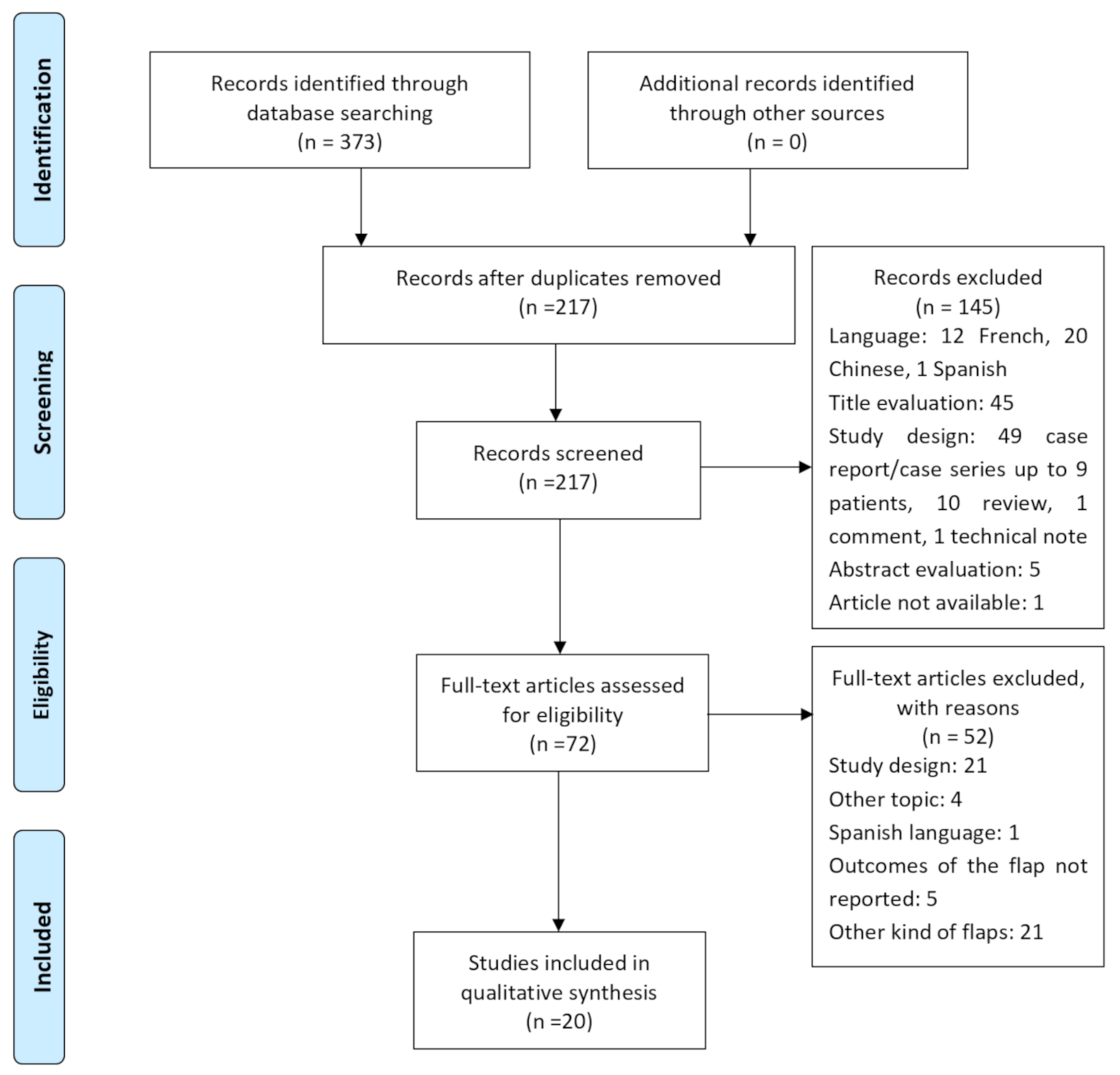
3.1. Study Selection
3.2. Study Characteristics
Participants
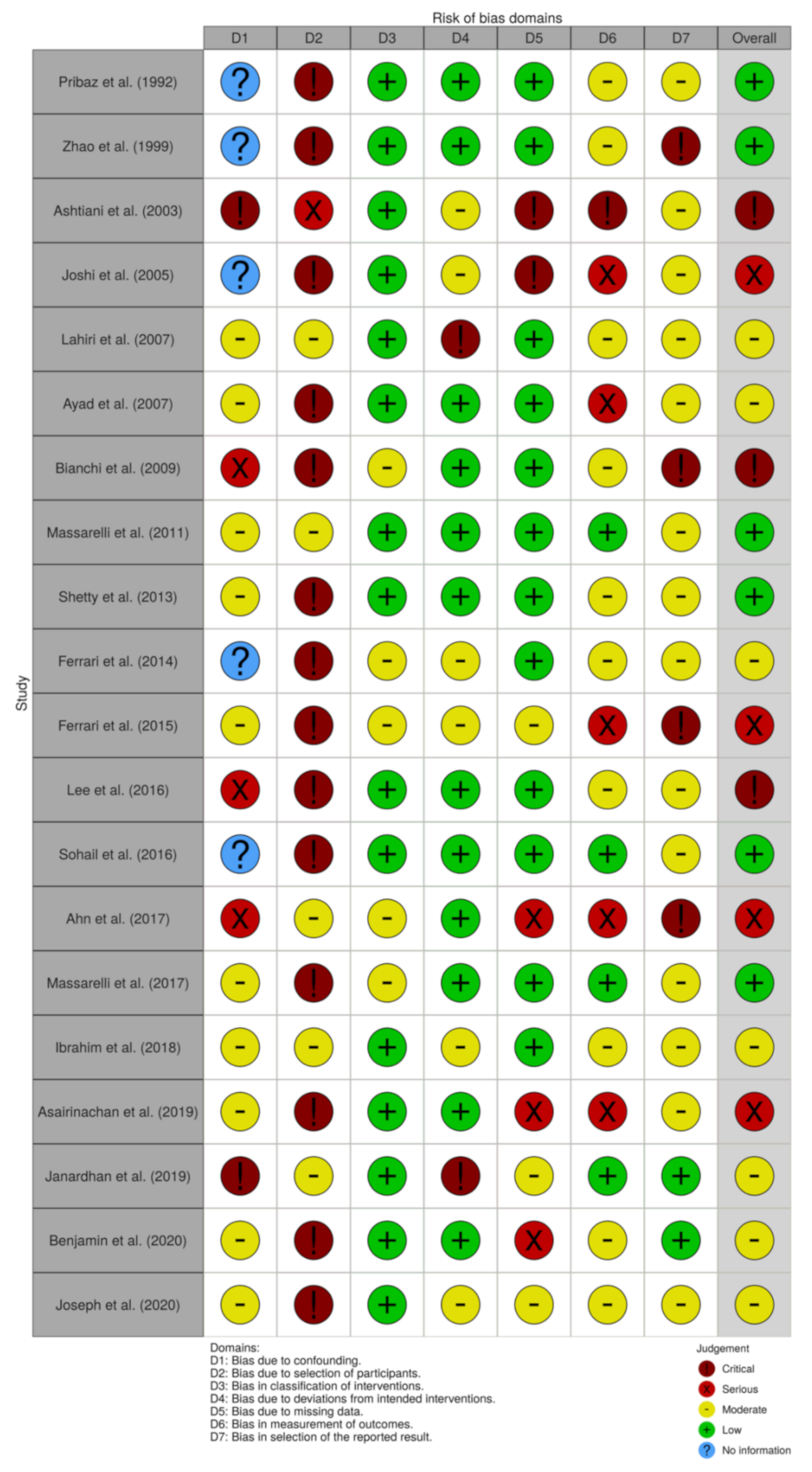
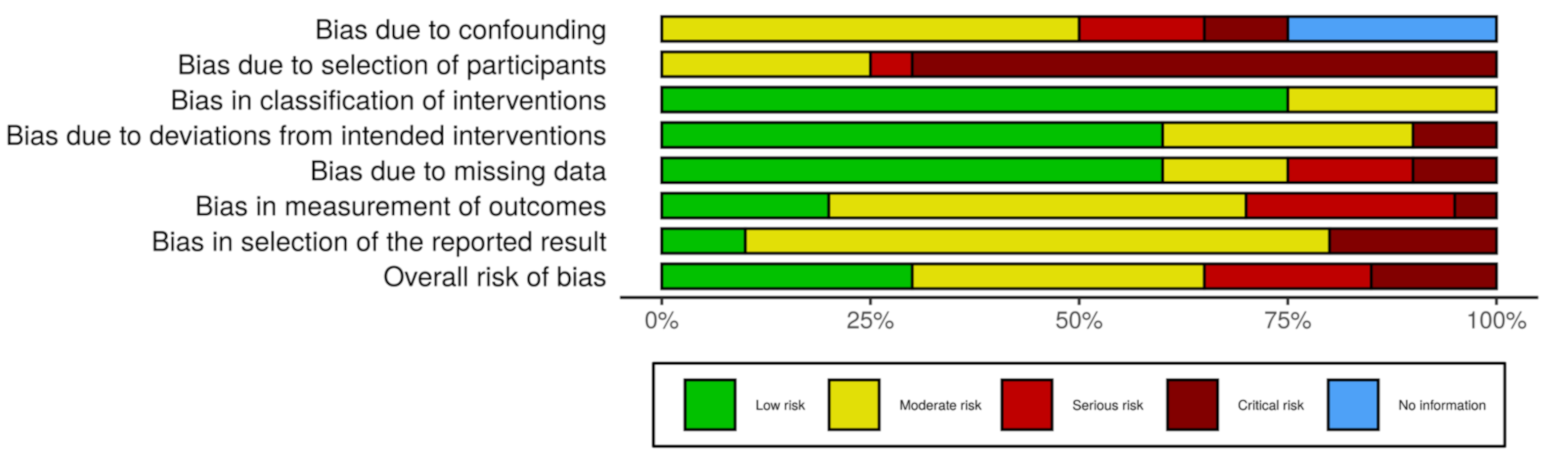
3.3. Risk of Bias within Studies
3.4. Synthesis of Results
4. Discussion
4.1. Summary of Evidence
4.2. Limitations
5. Conclusions
Author Contributions
Funding
Informed Consent Statement
Acknowledgments
Conflicts of Interest
References
- Dort, J.C.; Farwell, D.G.; Findlay, M.; Huber, G.F.; Kerr, P.; Shea-Budgell, M.A.; Simon, C.; Uppington, J.; Zygun, D.; Ljungqvist, O.; et al. Optimal Perioperative Care in Major Head and Neck Cancer Surgery with Free Flap Reconstruction: A Consensus Review and Recommendations from the Enhanced Recovery after Surgery Society. JAMA Otolaryngol. Head Neck Surg. 2017, 143, 292–303. [Google Scholar] [CrossRef] [PubMed]
- Rauso, R.; Nicoletti, G.F.; Sesenna, E.; Lo Faro, C.; Chirico, F.; Fragola, R.; Lo Giudice, G.; Tartaro, G. Superficial Temporal Artery Perforator Flap: Indications, Surgical Outcomes, and Donor Site Morbidity. Dent. J. 2020, 8, 117. [Google Scholar] [CrossRef] [PubMed]
- Boukovalas, S.; Boson, A.L.; Hays, J.P.; Malone, C.H.; Cole, E.L.; Wagner, R.F. A Systematic Review of Lower Lip Anatomy, Mechanics of Local Flaps, and Special Considerations for Lower Lip Reconstruction. J. Drugs Dermatol. 2017, 16, 1254–1261. [Google Scholar] [PubMed]
- Bozola, A.R.; Gasques, J.A.; Carriquiry, C.E.; Cardoso de Oliveira, M. The buccinator musculomucosal flap: Anatomic study and clinical application. Plast. Reconstr. Surg. 1989, 84, 250–257. [Google Scholar] [CrossRef]
- Pribaz, J.; Stephens, W.; Crespo, L.; Gifford, G. A new intraoral flap: Facial artery musculomucosal (FAMM) flap. Plast. Reconstr. Surg. 1992, 90, 421–429. [Google Scholar] [CrossRef]
- Zhao, Z.; Li, S.; Yan, Y.; Li, Y.; Yang, M.; Mu, L.; Huang, W.; Liu, Y.; Zhai, H.; Jin, J.; et al. New buccinator myomucosal island flap: Anatomic study and clinical application. Plast. Reconstr. Surg. 1999, 104, 55–64. [Google Scholar] [CrossRef]
- Moher, D.; Liberati, A.; Tetzlaff, J.; Altman, D.G.; Group, P. Preferred reporting items for systematic reviews and meta-analyses: The PRISMA statement. BMJ 2009, 339, b2535. [Google Scholar] [CrossRef]
- Sterne, J.A.; Hernan, M.A.; Reeves, B.C.; Savovic, J.; Berkman, N.D.; Viswanathan, M.; Henry, D.; Altman, D.G.; Ansari, M.T.; Boutron, I.; et al. ROBINS-I: A tool for assessing risk of bias in non-randomised studies of interventions. BMJ 2016, 355, i4919. [Google Scholar] [CrossRef]
- McGuinness, L.A.; Higgins, J.P.T. Risk-of-bias VISualization (robvis): An R package and Shiny web app for visualizing risk-of-bias assessments. Res. Synth. Methods 2020. [Google Scholar] [CrossRef]
- Ashtiani, A.K.; Emami, S.A.; Rasti, M. Closure of complicated palatal fistula with facial artery musculomucosal flap. Plast. Reconstr. Surg. 2005, 116, 381–386. [Google Scholar] [CrossRef]
- Joshi, A.; Rajendraprasad, J.S.; Shetty, K. Reconstruction of intraoral defects using facial artery musculomucosal flap. Br. J. Plast. Surg. 2005, 58, 1061–1066. [Google Scholar] [CrossRef]
- Lahiri, A.; Richard, B. Superiorly based facial artery musculomucosal flap for large anterior palatal fistulae in clefts. Cleft Palate Craniofac. J. 2007, 44, 523–527. [Google Scholar] [CrossRef]
- Ayad, T.; Kolb, F.; De Mones, E.; Mamelle, G.; Temam, S. Reconstruction of floor of mouth defects by the facial artery musculo-mucosal flap following cancer ablation. Head Neck 2008, 30, 437–445. [Google Scholar] [CrossRef]
- Bianchi, B.; Ferri, A.; Ferrari, S.; Copelli, C.; Sesenna, E. Myomucosal cheek flaps: Applications in intraoral reconstruction using three different techniques. Oral Surg. Oral Med. Oral Pathol. Oral Radiol. Endodontol. 2009, 108, 353–359. [Google Scholar] [CrossRef]
- Massarelli, O.; Baj, A.; Gobbi, R.; Soma, D.; Marelli, S.; De Riu, G.; Tullio, A.; Gianni, A.B. Cheek mucosa: A versatile donor site of myomucosal flaps. Technical and functional considerations. Head Neck 2013, 35, 109–117. [Google Scholar] [CrossRef]
- Shetty, R.; Lamba, S.; Gupta, A.K. Role of facial artery musculomucosal flap in large and recurrent palatal fistulae. Cleft Palate Craniofac. J. 2013, 50, 730–733. [Google Scholar] [CrossRef]
- Ferrari, S.; Ferri, A.; Bianchi, B.; Contadini, E.; Leporati, M.; Sesenna, E. Head and neck reconstruction using the superiorly based reversed-flow facial artery myomucosal flap. J. Oral Maxillofac. Surg. 2015, 73, 1008–1015. [Google Scholar] [CrossRef]
- Ferrari, S.; Ferri, A.; Bianchi, B.; Varazzani, A.; Giovacchini, F.; Sesenna, E. Oncologic safety of facial artery myomucosal flaps in oral cavity reconstruction. Head Neck 2016, 38 (Suppl. 1), E1200–E1202. [Google Scholar] [CrossRef]
- Lee, J.Y.; Alizadeh, K. Spacer Facial Artery Musculomucosal Flap: Simultaneous Closure of Oronasal Fistulas and Palatal Lengthening. Plast. Reconstr. Surg. 2016, 137, 240–243. [Google Scholar] [CrossRef]
- Sohail, M.; Bashir, M.M.; Khan, F.A.; Ashraf, N. Comparison of Clinical Outcome of Facial Artery Myomucosal Flap and Tongue Flap for Closure of Large Anterior Palatal Fistulas. J. Craniofac. Surg. 2016, 27, 1465–1468. [Google Scholar] [CrossRef]
- Ahn, D.; Lee, G.J.; Sohn, J.H. Reconstruction of oral cavity defect using versatile buccinator myomucosal flaps in the treatment of cT2-3, N0 oral cavity squamous cell carcinoma: Feasibility, morbidity, and functional/oncological outcomes. Oral Oncol. 2017, 75, 95–99. [Google Scholar] [CrossRef]
- Massarelli, O.; Vaira, L.A.; Gobbi, R.; Biglio, A.; Dell’aversana Orabona, G.; De Riu, G. Soft palate functional reconstruction with buccinator myomucosal island flaps. Int. J. Oral Maxillofac. Surg. 2017, 47, 316–323. [Google Scholar] [CrossRef]
- Ibrahim, B.; Rahal, A.; Bissada, E.; Christopoulos, A.; Moubayed, S.P.; Guertin, L.; Tabet, J.C.; Olivier, M.J.; Ayad, T. Decreasing Revision Surgery in FAMM Flap Reconstruction of the Oral Cavity: Traditional versus Modified Harvesting Technique. Laryngoscope 2018, 128, 1802–1805. [Google Scholar] [CrossRef]
- Asairinachan, A.; O’Duffy, F.; Li, M.P.; Fua, T.; Chauhan, A.; Magarey, M.J.R.; Dixon, B.J. Facial artery musculomucosal flaps in oropharyngeal reconstruction following salvage transoral robotic surgery: A review of outcomes. J. Laryngol. Otol. 2019, 133, 884–888. [Google Scholar] [CrossRef]
- Janardhan, D.; George, C.K.; Thomas, S.; Iype, E.M.; Varghese, B.T.; George, N.A.; Patil, S.; Sureh, S. Island NLF or Island FAMM Flap in Reconstruction of Oral Malignancy Defects? Indian J. Surg. Oncol. 2020, 11, 188–191. [Google Scholar] [CrossRef]
- Benjamin, M.; Aliano, K.; Davenport, T.; Frank, D. Functional Outcomes Regarding Facial Artery Musculomucosal Flap for Reconstruction of Partial Glossectomy Defects. Ann. Plast. Surg. 2020, 85, S76–S79. [Google Scholar] [CrossRef]
- Joseph, S.T.; Naveen, B.S.; Mohan, M.T.; Tharayil, J. Comparison of islanded facial artery myomucosal flap with fasciocutaneous free flaps in the reconstruction of lateral oral tongue defects. Int. J. Oral Maxillofac. Surg. 2020, 49, 1000–1006. [Google Scholar] [CrossRef]
- Carstens, M.H.; Stofman, G.M.; Hurwitz, D.J.; Futrell, J.W.; Patterson, G.T.; Sotereanos, G.C. The buccinator myomucosal island pedicle flap: Anatomic study and case report. Plast. Reconstr. Surg. 1991, 88, 39–50. [Google Scholar] [CrossRef]
- Carstens, M.H.; Stofman, G.M.; Sotereanos, G.C.; Hurwitz, D.J. A new approach for repair of oro-antral-nasal fistulae. The anteriorly based buccinator myomucosal island flap. J. Craniomaxillofac. Surg. 1991, 19, 64–70. [Google Scholar] [CrossRef]
- Massarelli, O.; Vaira, L.A.; Biglio, A.; Gobbi, R.; Piombino, P.; De Riu, G. Rational and simplified nomenclature for buccinator myomucosal flaps. Oral Maxillofac. Surg. 2017, 21, 453–459. [Google Scholar] [CrossRef] [PubMed]


| Author | FAMM | i-FAMM | FAMM Viability | i-FAMM Viability |
|---|---|---|---|---|
| Pribaz et al. (1992) | 18 | 1 flap loss 1 marginal necrosis | ||
| Zhao Z et al. (1999) | 12 | None | ||
| Ashtiani et al. (2005) | 22 | 2 partial necrosis 1 total necrosis | ||
| Joshi A. et al. (2005) | 2 | 15 | 1 marginal necrosis | |
| Lahiri A. et al. (2007) | 16 | 2 flap loss 2 marginal necrosis | ||
| Ayad et al. (2008) | 61 | 15 partial necrosis | ||
| Bianchi B et al. (2009) | 27 | 9 | 1 total necrosis 1 partial necrosis | |
| Massarelli et al. (2012) | 20 | 30 | 1 total necrosis | |
| Shetty et al. (2013) | 11 | 2 marginal necrosis | ||
| Ferrari et al. (2015) | 12 | 1 partial necrosis | ||
| Ferrari et al. (2015) | 36 | 14 | None | None |
| Lee et al. (2016) | 17 with personal modification (S) | 1 distal necrosis | ||
| Sohail et al. (2016) | 16 | 1 marginal necrosis | ||
| Ahn et al. (2017) | 3 | 3 | 2 partial necrosis | 1 flap loss |
| Massarelli et al. (2017) | 17 | None | ||
| Ibrahim B. et al. (2018) | 55 (29 traditional vs. 26 modified) | 1 distal necrosis in traditional group | ||
| Asairinachan et al. (2019) | 13 | None | ||
| Janardhan et al. (2020) | 16 | None | ||
| Benjamin et al. (2020) | 21 | None | ||
| Joseph et al. (2020) | 20 | None | ||
| Total | 350 | 136 | 5 total necrosis 29 partial necrosis | 2 total necrosis 1 partial necrosis |
| Author | Anatomical Region to Reconstruct | Defect Average Size (mm) | Reported Complications |
|---|---|---|---|
| Pribaz et al. (1992) | Soft/hard palate, floor of mouth, upper lip, lower lip, nasal mucosa | Not reported | None |
| Zhao Z et al. (1999) | Palate, alveolus, nasal septum, orbit | Not reported | None |
| Ashtiani et al. (2005) | Palate | 12 × 12 − 40 × 30 | None |
| Joshi A. et al. (2005) | Alveolus, lip, floor of mouth, palate | 80 × 30 (MAX) | Cheek edema and tightness |
| Lahiri A. et al. (2007) | Hard palate | 32 × 16 (MAX) | Palate fistula |
| Ayad et al. (2008) | Floor of mouth | Not reported | Soft tissue infection, submental abscess, cheek abscess, cheek hematoma, tongue tethering by scar formation, trismus caused by inner cheek scar |
| Bianchi B et al. (2009) | Tongue, floor of mouth, palate, cheek mucosa, lip | Not reported | Partial mouth opening limitation, partial compromise of swallowing and speech |
| Massarelli et al. (2012) | Lower lip, upper lip, hard palate, soft palate, tongue, maxillary alveolar ridge, mandibular alveolar ridge, retromolar trigone, pharynx, floor of mouth, uvula, tuber maxillae, tonsillar fossa | 30 × 20 − 100 × 70 | Salivary fistula, temporary marginalis mandibulae nerve palsy, cheek scar contracture |
| Shetty et al. (2013) | Soft palate, hard palate | 10 × 10 − 20 × 20 | Suture dehiscence |
| Ferrari et al. (2015) | Hard palate, superior alveolar crest, upper lip, lip commissure, nasal septum, lateral nasal wall, inferior conjunctiva | Not reported | Nasal obstruction, palatal wound dehiscence, donor site dehiscence, lagophthalmos |
| Ferrari et al. (2015) | Tongue, floor of mouth | Not reported | Would dehiscence, neck infection due to floor of mouth dehiscence |
| Lee et al. (2016) | Palate | 10 × 10 − 33 × 33 | None |
| Sohail et al. (2016) | Palate | Not reported | Infection, dehiscence, eating problems, speaking difficulty, donor site scar |
| Ahn et al. (2017) | Tongue, floor of mouth, upper alveolar ridge, lower lip | 53 × 38 | Minimal limitation of mouth opening, transient marginal mandibular nerve palsy |
| Massarelli et al. (2017) | Soft palate, hard palate, retromolar trigone, hemipharynx, uvula | 40 × 30 − 70 × 60 | Minor suture dehiscence |
| Ibrahim B. et al. (2018) | Not reported | Not reported | Cheek hematoma |
| Asairinachan et al. (2019) | Base of tongue, tonsil, posterior pharyngeal wall | Not reported | Donor site bleeding, donor site infection, severe dysphagia, mild to severe dysarthria |
| Janardhan et al. (2020) | Tongue, palate, floor of mouth | Not reported | Minor suture dehiscence |
| Benjamin et al. (2020) | Tongue | Not reported | Hemorrhage, wound infection, fistula, oral abscess, mild speech and swallowing impairment |
| Joseph et al. (2020) | Lateral tongue | 60 × 40 | Neck hematoma, neck infection, mandibular nerve paresis, mouth opening limitation, dysarthria, dysphagia |
Publisher’s Note: MDPI stays neutral with regard to jurisdictional claims in published maps and institutional affiliations. |
© 2021 by the authors. Licensee MDPI, Basel, Switzerland. This article is an open access article distributed under the terms and conditions of the Creative Commons Attribution (CC BY) license (https://creativecommons.org/licenses/by/4.0/).
Share and Cite
Giudice, G.L.; Fragola, R.; Nicoletti, G.F.; Cervino, G.; Pedullà, E.; Zerbinati, N.; Rauso, R. Facial Artery Myomucosal Flap vs. Islanded Facial Artery Myomucosal Flap Viability: A Systematic Review. Appl. Sci. 2021, 11, 4202. https://doi.org/10.3390/app11094202
Giudice GL, Fragola R, Nicoletti GF, Cervino G, Pedullà E, Zerbinati N, Rauso R. Facial Artery Myomucosal Flap vs. Islanded Facial Artery Myomucosal Flap Viability: A Systematic Review. Applied Sciences. 2021; 11(9):4202. https://doi.org/10.3390/app11094202
Chicago/Turabian StyleGiudice, Giorgio Lo, Romolo Fragola, Giovanni Francesco Nicoletti, Gabriele Cervino, Eugenio Pedullà, Nicola Zerbinati, and Raffaele Rauso. 2021. "Facial Artery Myomucosal Flap vs. Islanded Facial Artery Myomucosal Flap Viability: A Systematic Review" Applied Sciences 11, no. 9: 4202. https://doi.org/10.3390/app11094202
APA StyleGiudice, G. L., Fragola, R., Nicoletti, G. F., Cervino, G., Pedullà, E., Zerbinati, N., & Rauso, R. (2021). Facial Artery Myomucosal Flap vs. Islanded Facial Artery Myomucosal Flap Viability: A Systematic Review. Applied Sciences, 11(9), 4202. https://doi.org/10.3390/app11094202