You are currently viewing a new version of our website. To view the old version click .
Applied Sciences
  • Review
  • Open Access

3 October 2021

Survey on Data Hiding Based on Block Truncation Coding

,
,
and
1
Department of Computer Engineering, Sejong University, Seoul 05006, Korea
2
Department of Computer Science and Information Engineering, National Dong Hwa University, Hualien 97401, Taiwan
3
Department of Computer Science, Winston-Salem State University, Winston-Salem, NC 27110, USA
4
Key Laboratory of Jiangxi Province for Image Processing and Pattern Recognition, Nanchang Hangkong University, Nanchang 330063, China
This article belongs to the Special Issue Research on Multimedia Systems

Abstract

Data hiding technology has achieved many technological developments through continuous research over the past 20 years along with the development of Internet technology and is one of the research fields that are still receiving attention. In the beginning, there were an intensive amount of studies on digital copyright issues, and since then, interest in the field of secret communications has been increasing. In addition, research on various security issues using this technology is being actively conducted. Research on data hiding is mainly based on images and videos, and there are many studies using JPEG and BMP in particular. This may be due to the use of redundant bits that are characteristic of data hiding techniques. On the other hand, block truncation coding-based images are relatively lacking in redundant bits useful for data hiding. For this reason, researchers began to pay more attention to data hiding based on block-cutting coding. As a result, many related papers have been published in recent years. Therefore, in this paper, the existing research on data hiding technology of images compressed by block-cut coding among compressed images is summarized to introduce the contents of research so far in this field. We simulate a representative methodology among existing studies to find out which methods are effective through experiments and present opinions on future research directions. In the future, it is expected that various data hiding techniques and practical applications based on modified forms of absolute moment block truncation coding will continue to develop.

1. Introduction

With the development of Internet technology, a large number of multimedia data are exchanged on the Internet. Moreover, the development of social media platforms such as YouTube, Facebook, and Twitter have made it possible for many people to conveniently share and communicate their digital content. In other words, data such as text, image, video, and audio are exchanged through the platforms. These contents are often copied, edited, and distributed by other users and are used for purposes other than the original creators’ intention, causing legal problems. Data Hiding (DH) [1,2,3,4,5,6,7] technology can also be used to protect data and verify that received content has been tampered with. Encryption [8] technology can also be one solution to this security problem. However, there is also the problem of making the attacker more interested in encrypted digital content in this case.
The DH can conceal its existence by secretly embedding secret data into cover media such as text, images, and video.
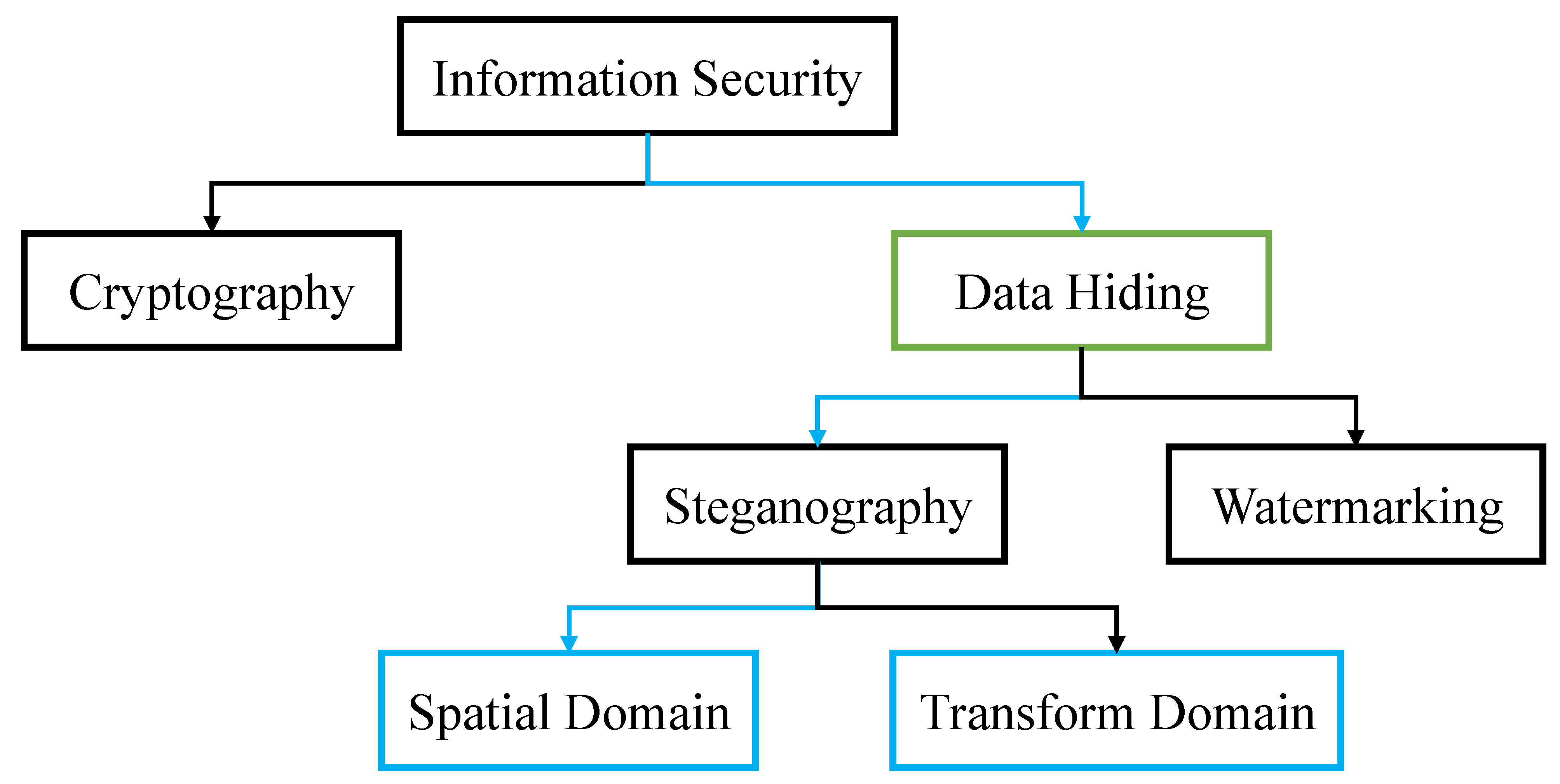
Meanwhile, information security can be described in a simplified manner as the prevention of unauthorized access or alteration during the time of storing data or transferring it from one machine to another. The information can be biometrics, social media profiles, data on mobile phones, etc., due to which the research for information security covers various sectors such as cryptocurrency and online forensics. Information security is one of the useful technologies to achieve its purpose by encryption and data hiding technology. Data hiding techniques can be broadly classified into steganography [3,9,10,11,12] and watermarking [7,8,13,14] (see Figure 1).
Figure 1. Classification of information security.
It can use three methods according to the characteristics of digital media, which correspond to the spatial domain, the frequency domain, and the compression domain. The spatial domain-based method [15,16,17] may embed secret data in the Least Significant Bit (LSB) of pixels directly. The merit of this kind of method is that it is intuitive to embed secret data while maintaining image quality. On the other hand, there is a problem that hidden data may be lost by an attack, such as compression. The frequency-domain method [18,19] is a method of inserting data into the transformed coefficients after each block of the cover image is converted to a frequency domain. The advantage is that it has strong characteristics in image transformation, such as compression, while the disadvantage is that it cannot hide enough data, and the image quality is sensitive by the transformed coefficients.
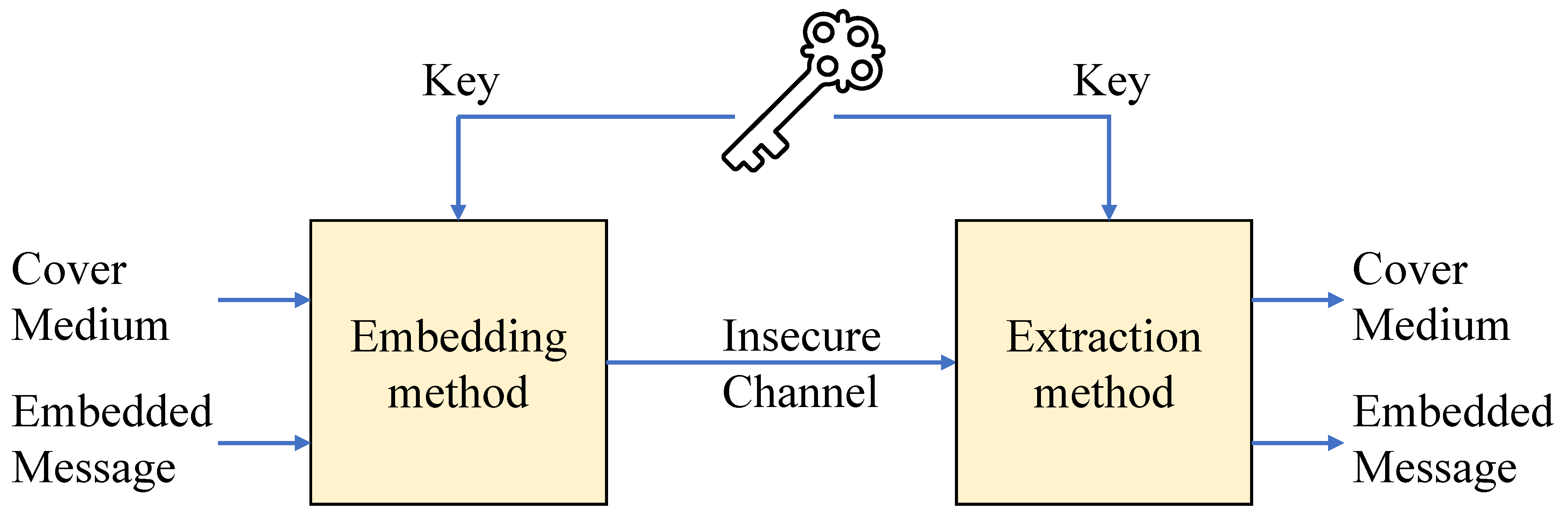
Generally, the DH follows the procedure in Figure 2.
Figure 2. Basic structure of data hiding.
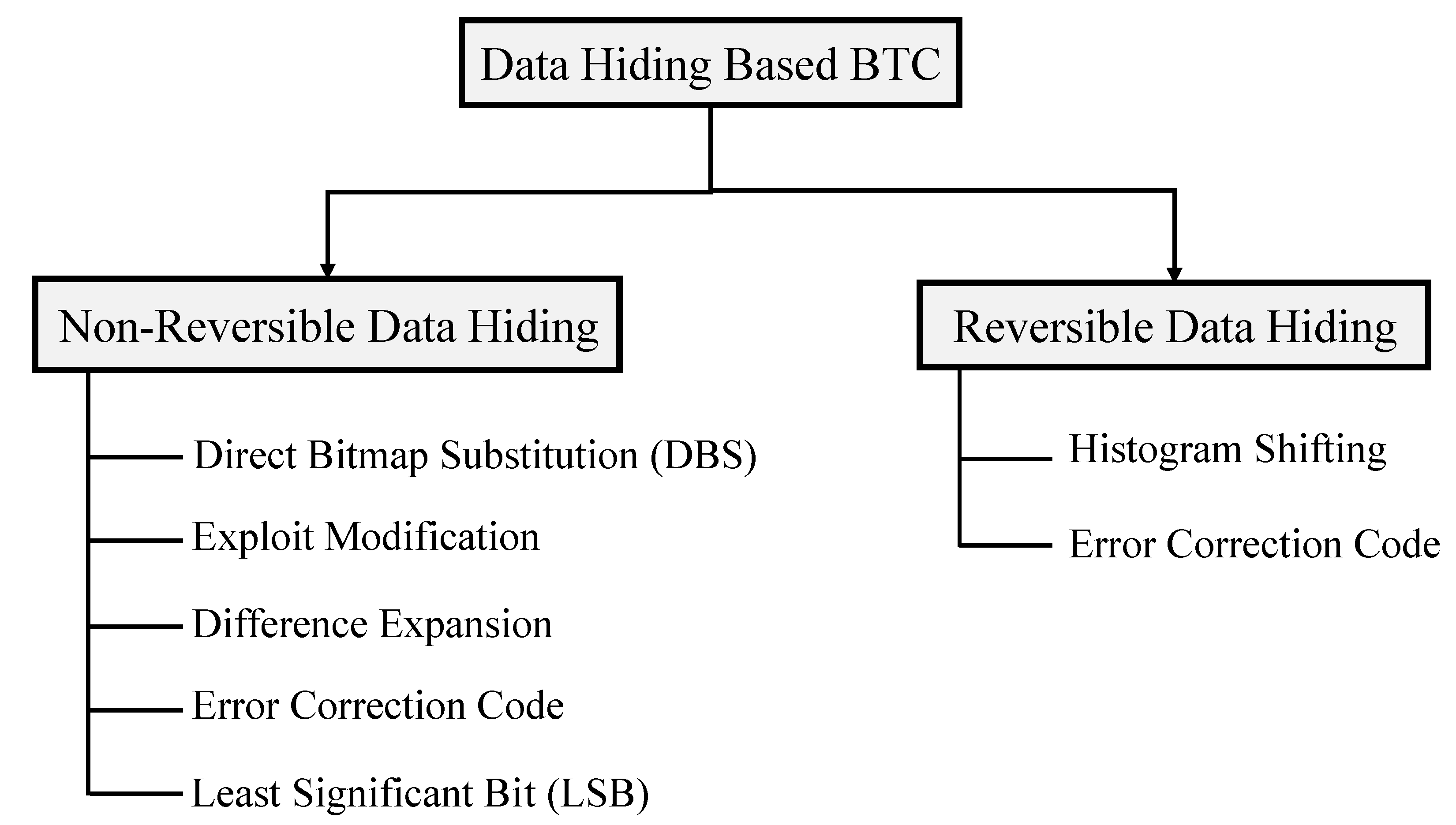
One method that extracts data from a stego image, in which data are hidden and then can exactly restore the original cover image, is called Reversible DH (RDH) [4,5,6,20], and another method that does not is classified as non-RDH, i.e., DH. The RDH can be considered as a superior method compared to the DH.
Compressed domain-based methods embed data in coefficients covertly, such as Block Truncation Coding (BTC) [21], Joint Photographic Experts Group (JPEG) [22], and compressed archieve [12] On the other hand, JPEG and BTC [21] compression methods are lossy compression methods to increase compression performance and are evaluated as methods that balance image quality and compression performance. In particular, the JPEG is a method using the characteristic that the human eye has a lower ability to distinguish when the brightness changes at high frequencies. Because of this, much of the high-frequency component can be discarded. This operation divides each component in the frequency domain by a certain constant and obtains the quotient of the integer. The high-frequency components obtained here can be positive or nearly zero and are often negative. By applying weights during quantization, a lot of low frequencies with high energy are saved, but high frequencies are cut off because there is little difference in the total energy.
Bruno et al. [12] proposed steganography for cloud-based data exchange utilizing compressed archives as a buying matrix. Data hiding is achieved by properly encoding the characteristics of the compressed archive, namely the hierarchical structure and the compression algorithm used to create it. For BTC, compression is performed by obtaining a bitmap and two quantized levels for each block using a simple formula, and the image quality is inferior to that of JPEG, but it shows a level of performance that is not significantly different according to the human visual system.
The lossy compression technique is effective in reducing the bandwidth by reducing the media size when the loss of some content does not significantly affect the meaning of the media. In other words, the lossy compression method can reduce the bandwidth in terms of content sharing of the Social Networking Service (SNS) platform, so it affects the overall performance of the system. For this reason, DH technology based on lossy compression is also being actively studied, and among them, many papers on DH technology based on BTC are being researched and published. At this point, we think that it is meaningful to classify research papers on BTC-based DH, evaluate the performance, and consider the direction of future research.
The rest of this paper is organized as follows. Section 2 gives the introduction of the background of Absolute Moment BTC (AMBTC). The existing data hiding research based on AMBTC and BTC are described in detail in Section 3. The simulation results are analyzed in Section 4. Section 5 draws the conclusions.

2. Absolute Moment Block Truncation Coding

BTC is a lossy compression method for grayscale images that divides the original image into blocks and then uses quantization to reduce the number of grayscale levels using the mean and standard deviation. This method can also be applied to video compression. BTC was first proposed by Delp and Mitchell [21]. Another variation of BTC is Absolute Moment Block Truncation Coding, or AMBTC, in which, instead of using standard deviations, absolute moments are preserved with the mean. AMBTC is simpler to calculate than BTC and usually has a lower mean squared error.
AMBTC was proposed by Lema and Mitchell [23]. For k 2 pixels per block, it is compressed at a ratio of ( k 2 × 8 ) : ( k 2 + 2 × 8 ) when a pixel is 8 bits, where 2 denotes two quantization levels. Increasing the block size improves the compression rate, while the quality of the image allowed is bad. A block of AMBTC is composed of two quantization levels and a bitmap for each block after compression. The distortion of AMBTC is the difference between the compressed pixels and the original pixels, but the difference is not high. If the block size is 4 × 4 , the compression ratio (CR) (=original image size/compressed image size) is 4, so the bitrate of the block is 2 bits per pixel. The merit of it is simple computation and fast image compression. In AMBTC, a grayscale image is divided into non-overlapping ( k × k )-sized blocks, where k will be ( 4 × 4 ) , ( 8 × 8 ) , and so on. For each block, the mean pixel value x ¯ is computed by
x ¯ = 1 k × k i = 1 k 2 x i
where x i is the value of the ith pixel of the block of size k × k . Every pixel in the block is quantized into the bitmap b i (0 or 1). That is, if the corresponding pixel x i is greater than or equal to the mean ( x ¯ ), it will be replaced with ‘1’, otherwise ‘0’. The pixels in each block are divided into two groups: ‘1’ and ‘0’. The symbols t and k 2 t represent the number of pixels of ‘1’ and the number of pixels of ‘0’, respectively. The two quantization levels are calculated by Equation (2).
μ 1 = 1 t x i x ¯ x i and μ 0 = 1 ( k × k ) t x i < x ¯ x i ,
where μ 0 and μ 1 are also used to reconstruct AMBTC, and μ 0 and μ 1 denote the quantization levels. · is the floor function that takes real number x and gives as output the greatest integer less than or equal to x. For example, it is used like x . μ 1 and μ 0 are, respectively, the higher and lower means. Each pixel in a bitmap is created by using the original pixels and the mean of a block. That is, if each pixel is larger than the mean, it is assigned to ‘1’ and otherwise, ‘0’ (see Equation (3)).
b i = 1 , if x i x ¯ , 0 , if x i < x ¯ .
The basic unit of compression is trio ( μ 0 , μ 1 , B M ), and is composed of two quantization levels μ 0 , μ 1 and a bitmap (BM). To reconstruct the image, decoding is performed using Equation (4).
g i = μ 0 , if b i = 0 , μ 1 , if b i = 1 .
Finally, a block of the image is compressed into two quantization levels ( μ 0 , μ 1 ) and a bitmap B M , i.e., trio ( μ 0 , μ 1 , B M ) . A bitmap B M contains the bit-planes that represent the pixels, and the values μ 0 and μ 1 are used to decode the AMBTC compressed image. For the case k = 4 , e.g., we deal with an image by ( 4 × 4 ) block-wise operation. Sixteen pixels in a block are represented as a trio ( μ 0 , μ 1 , B M ) of 8 + 8 + 16 = 32 bits, and thus the CR is ( 16 × 8 )/32 = 4. Consider the example of a 512 × 512 -pixel image. The file size of 2 M bits can be reduced to 0.5 M bits. In decoding phase, when two quantization levels and the bitmap obtained, the corresponding image block can be easily reconstructed by replacing every ‘1’ in a bitmap B M with μ 1 , while every ‘0’ is replaced with μ 0 .
Example 1.
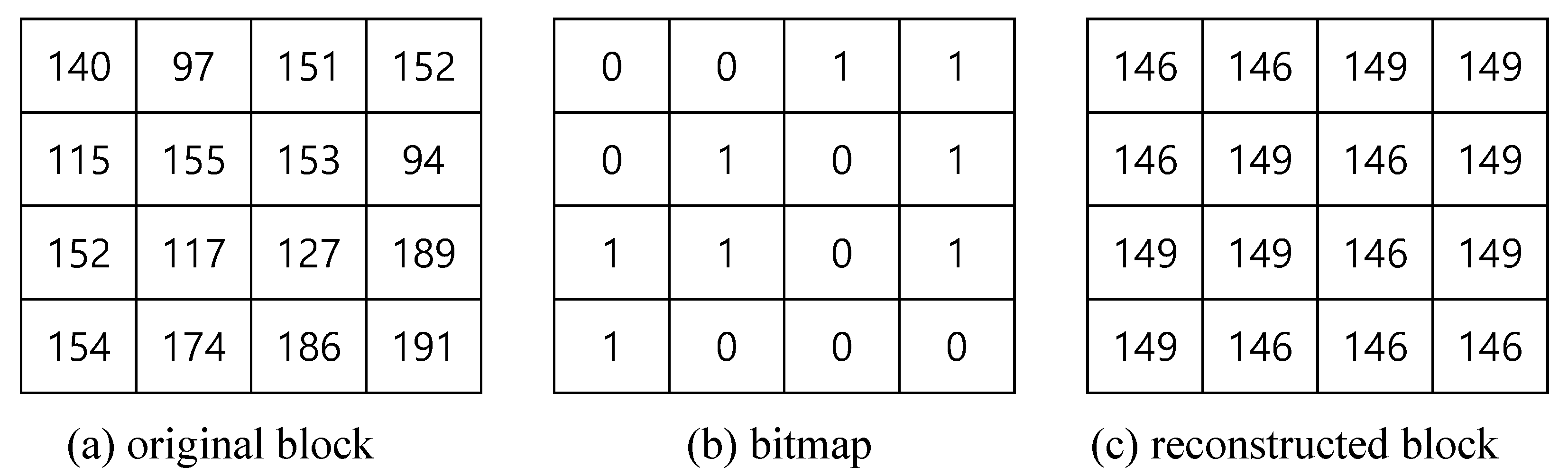
Here, we explain the encoding of one block of a grayscale image using AMBTC. Figure 3a is a grayscale block, and the mean value of the pixels is 122. By applying Equations (2)–(4) on Figure 3a, we can obtain the bitmap as shown in Figure 3b and two quantization levels ( μ 0 = 146 ; μ 1 = 149 ). The basic unit of each block is trio ( μ 0 , μ 1 , B M ) = (146, 149, 0011010111011000). Using the trio, we may recover the grayscale block as shown in Figure 3c.
Figure 3. An example of AMBTC; (a) original block; (b) a bitmap; (c) reconstructed block.

4. Performance Analysis

We have classified the AMBTC-based DH method so far and summarized each classification method. In this section, the performance of the proposed DH method is evaluated with six original grayscale images. The evaluation of existing methods is based on the EC and the quality of the displayed images. EC is the total number of bits embedded in AMBTC and the quality of the marked image is measured in PSNR as
PSNR = 10 l o g 10 255 2 MSE .
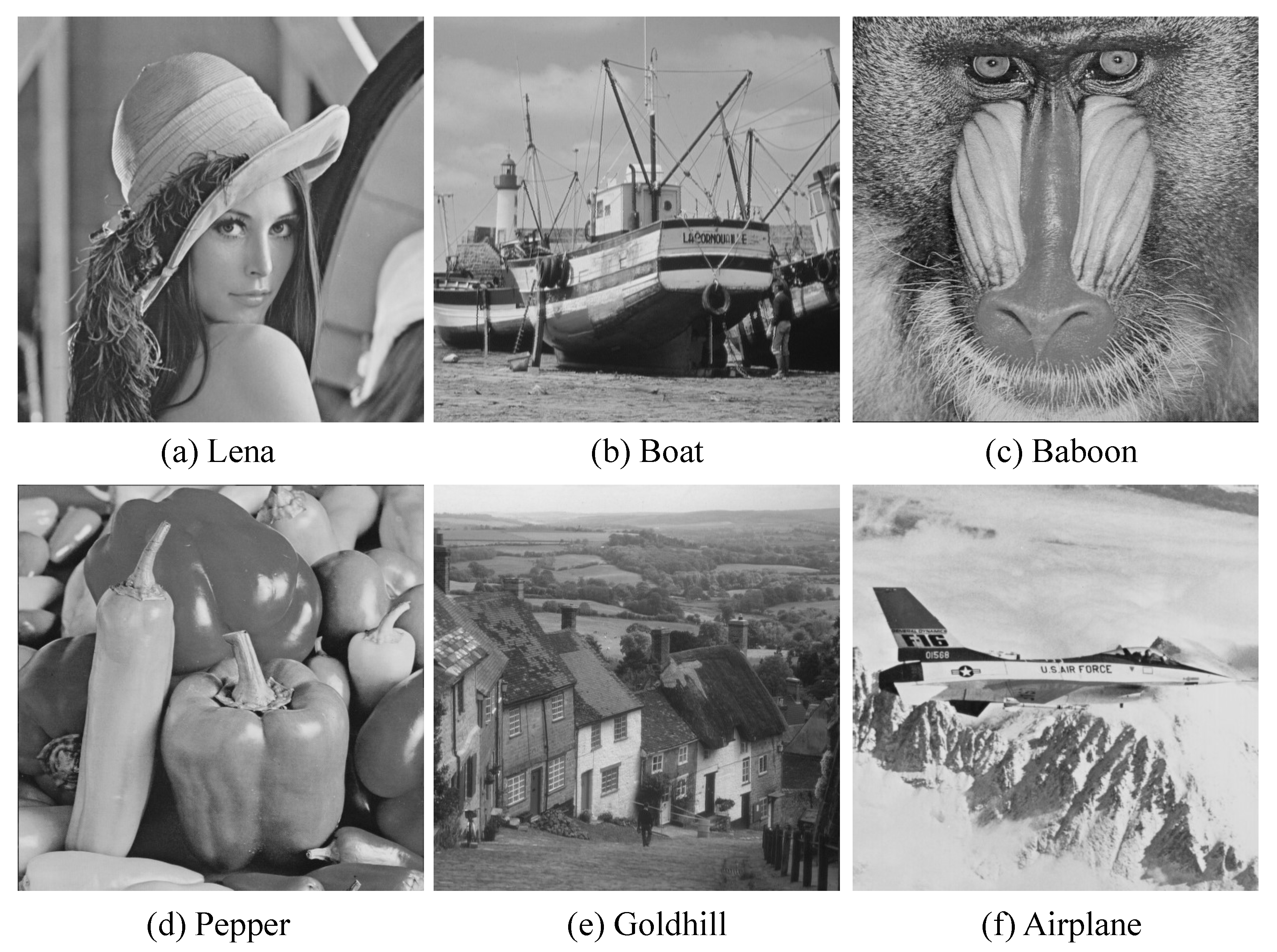
The six original images [54] used in the experiment are Lena, Boat, Baboon, Peppers, Goldhill, and Airplane as shown in Figure 7. These original images must be converted into AMBTC before experimental evaluation. The hidden bits to be used in the experiment are generated by the random number generation library function provided by Matlab. The existing methods are applied to the units of trios converted to AMBTC, that is, the bitmap and two quantization levels.
Figure 7. Original grayscale images for experiments.
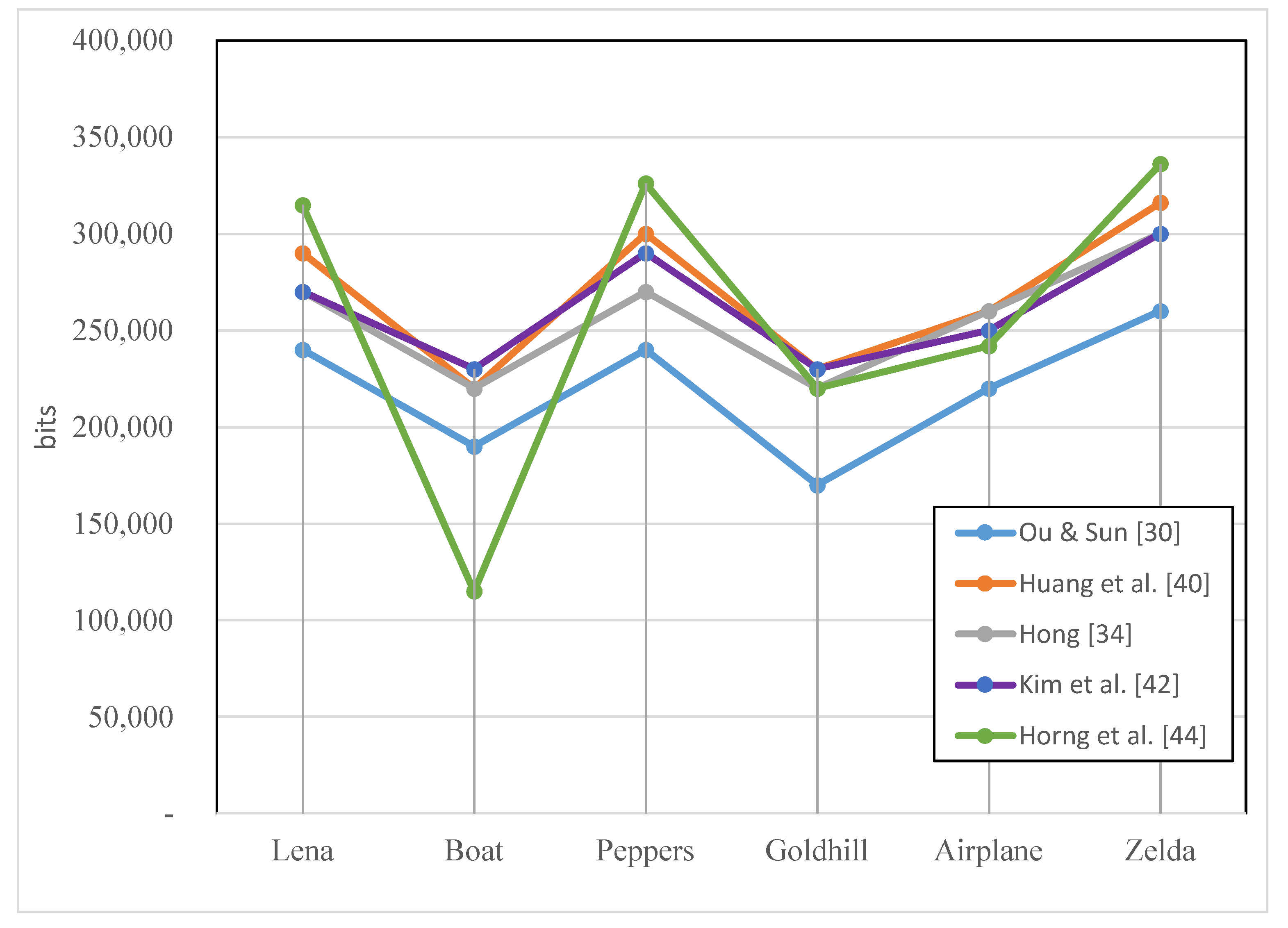
Figure 8 shows the comparison of the EC of the representative DH methods (i.e., Ou and Sun [29], Huang et al. [38], Hong [32], Kim et al. [41] and Horng et al. [43] using six images [54]. Here, EC was measured in case that the image quality was above 30 dB. The reason is that the measured EC when less than 30 dB may not be suitable for use in real systems. Although the other researches ignore this, in Figure 8, EC was measured with this criteria. Of course, even if the experimental result maintains 30 dB, it cannot be guaranteed that the image is not absolutely broken, but for the objective of the experiment, the lower limit of the image is set to 30 dB.
Figure 8. Comparisons of EC performance among existing DH methods.
The methods in Figure 8 use the DBS method [29] commonly, which is to substitute bits of the same size in a 4 × 4 bitmap. The merit of DBS is essential for hiding a large number of bits (1 bpp), and the image quality does not deteriorate significantly even after performing DBS, because on average 50% of the original pixel values of the block are maintained after DBS is performed.
The methods of Huang et al. [38] and Horng et al. [43], respectively, proposed a DH technique that exploits the difference between two pixels to sufficiently hide the data at the quantization level. Huang et al.’s method [38] and Horng et al.’s method [43] have average bpp of 1.3 and 1.28, respectively, and Huang et al.’s method is slightly superior. Since Ou and Sun’s method [29] hides data only with the DBS method, the data hiding rate corresponds to 1 bpp. The methods of Hong [32] and Kim et al. [41] is 1.18 bpp and 1.16 bpp, respectively, which is superior to DBS, but it is measured to be slightly inferior in performance compared to the Huang et al.’s method. AMBTC-based DH does not have enough redundant bits compared to standard grayscale images, so achieving an average of 1.2 bpp while maintaining about 30 dB is a very valuable achievement.
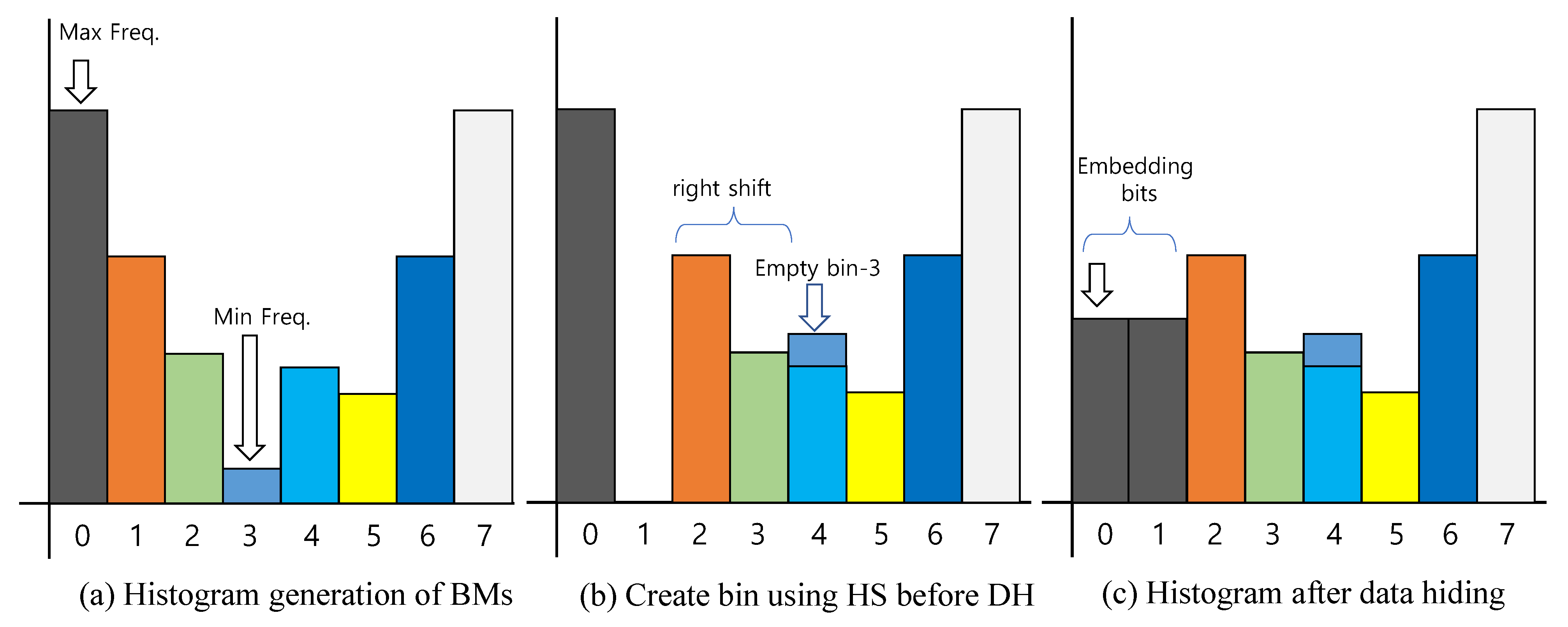
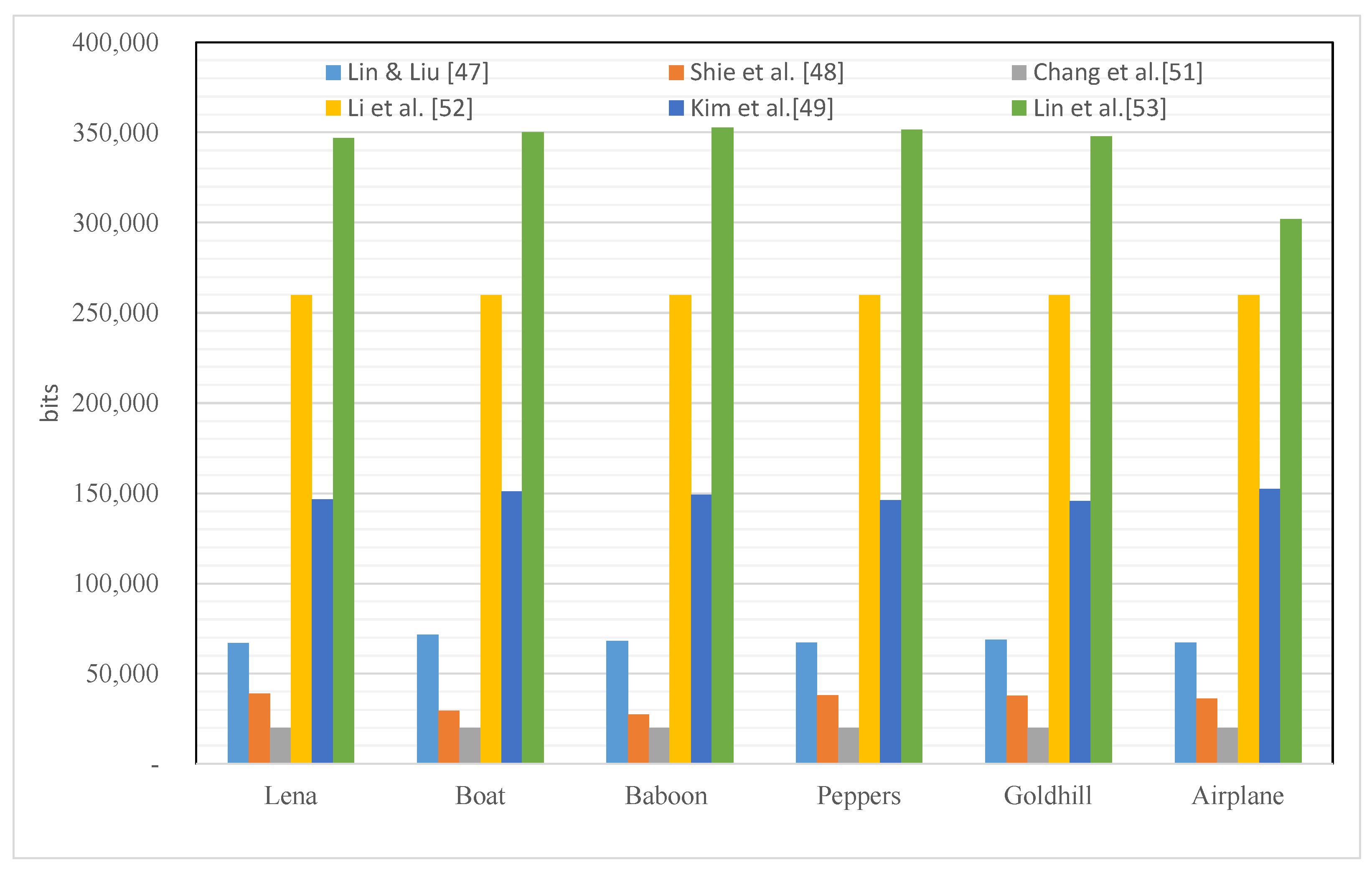
Figure 9 compares and evaluates the performance of a typical RDH method. The methods of Lin and Liu [46], Shie et al. [47], and Chang et al. [50] are AMBTC-based RDH methods that were proposed relatively early. Lin and Liu [46] and Shie et al. [47] are RDH methods using histograms, and Chang et al.’s method [50] is a method using HC (7,4). The data hiding performance is 0.08 bpp, 0.13 bpp, and 0.24 bpp, respectively. These methods show the potential of early BTC-based RDH and can be considered valuable. On the other hand, the relatively recent RDHs (Kim et al. [48], Li et al. [51], and Lin et al. [52]) range from about 0.57 bpp to about 1.3 bpp. In particular, Lin et al.’s method [52] utilizes multiple histograms, so it shows the best performance. Like the existing gray image-based RDH, it can be seen that the HS method is usefully used in the BTC-based RDH system. It is evaluated that methods capable of higher EC will be proposed through the development of a modified method of HS in the future. Meanwhile, sufficient bitmap resources are required to hide a large amount of data. For this purpose, it is a recent trend to use a method of increasing the number of pixels in the bitmap, but this is only expedient. Since the performance is improved by distorting the original method of AMBTC, the compression performance is of course badly affected.
Figure 9. Comparisons of EC performance among existing RDH methods.
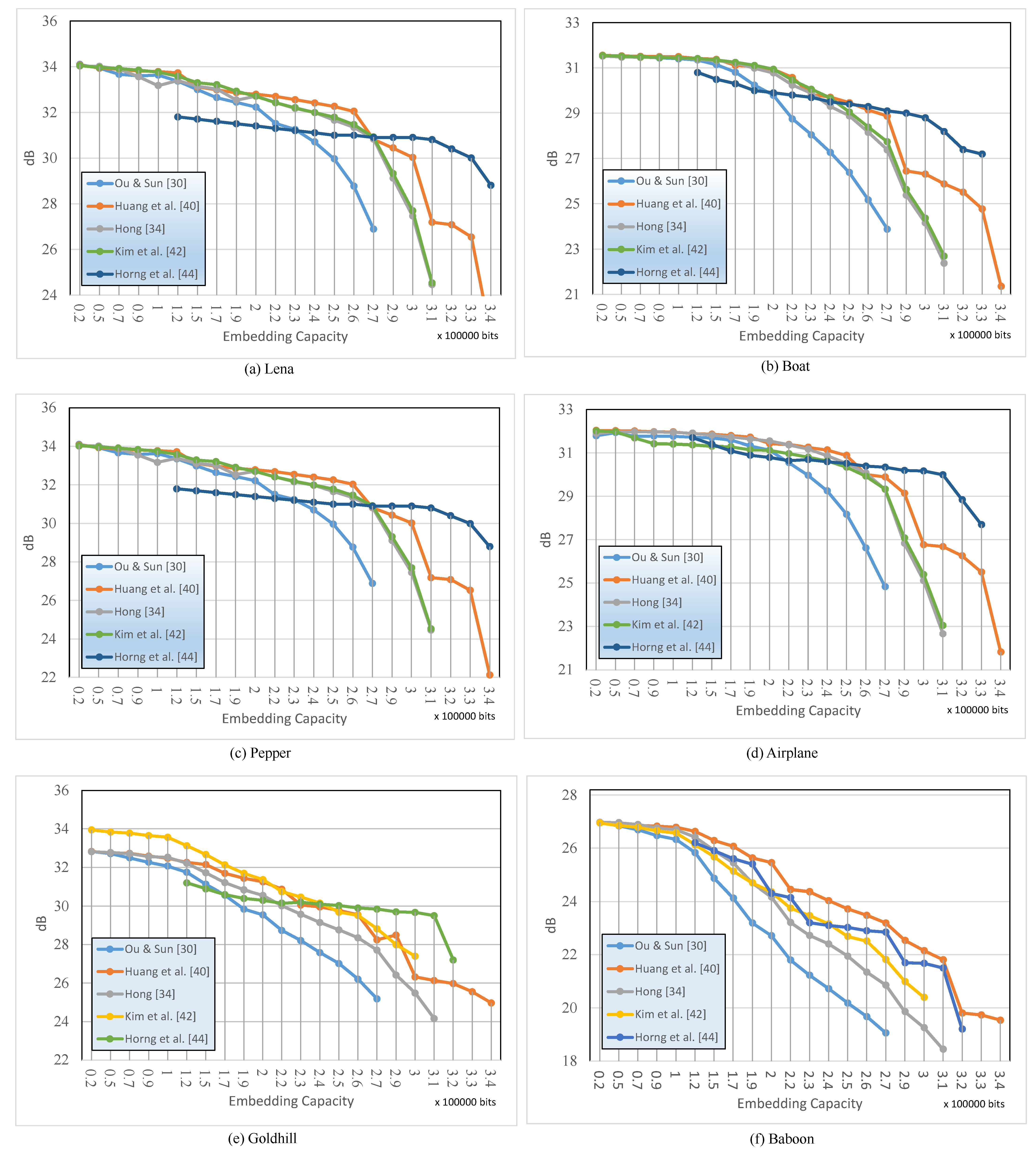
Figure 10 shows a chart where the correlation between EC and PSNR can be observed when six conventional methods are applied to six standard images. The existing five methods can see the data hiding ability through Figure 8. In Figure 10a–f, it is common that the increase in data deteriorates the image quality. Because it is accompanied by distortion of the image. Nevertheless, depending on the performance of the proposed method, the PSNR may be lowered gently or rapidly. We can observe such a basic point. In Figure 10, it can be visually judged that the method proposed by Horng is the method that best meets the two evaluation criteria with the most data. It can be observed that Huang et al.’s [38] method is the best when only the data hiding capacity is used as a standard. In the figure, if the data hiding capacity is limited to 0.2 ∼ 1.5, Horng et al.’s [43] method may not be recommended. In this case, it can be said that all existing methods are excellent. Figure 10f is an image belonging to a high-frequency image, and since the quality of the cover image itself belongs to about 27 dB, when data is hidden in this cover image, it is lowered to a maximum of about 18 dB, so it is not suitable for data hiding by BTC compression.
Figure 10. Comparison of the performance of PSNR vs. EC.

5. Conclusions

We briefly looked at the studies and analyzed their performance using simulations after classifying the various studies on AMBTC-based DH. The cover images used in the experiment are Lena, Boat, Baboon, Peppers, Goldhill, and Airplane. The PSNRs of these cover images are 33.65, 31.57, 26.97, 34.09, 32.83, and 32.03, respectively. Therefore, hiding an amount of data while maintaining more than 30 dB can be a very difficult challenge. However, in the case of a high-frequency image such as the Baboon image, it is difficult to use it as a cover image because the image quality does not reach 30 dB after compression with BTC. With DH and RDH, the maximum data hiding performance is 1.3 bpp. However, if data is hidden by 1.3 bpp, it may not be suitable for the purpose of confidential communication or copyright protection. Existing methods can be a good alternative if existing methods are selected according to the purpose. Most of the methods proposed so far are actually modified methods used in gray images to apply the compression method. In other words, most of the methods verified in the grayscale image were applied to BTC and showed good performance. In the future, we intend to review the papers of various methods to consider future research directions.

Author Contributions

Conceptualization, C.K.; methodology, C.K.; software, L.L.; validation, C.-N.Y.; formal analysis, C.-N.Y.; investigation, L.L.; resources, J.B.; data curation, J.B.; writing—original draft preparation, C.K.; writing—review and editing, C.K.; visualization, L.L.; supervision, C.-N.Y.; project administration, C.K.; funding acquisition, C.K. All authors have read and agreed to the published version of the manuscript.

Funding

This work was partially supported by the Ministry of Science and Technology (MOST) under Grant 108-2221-E-259-009-MY2 and 109-2221-E-259-010 and by the faculty research fund of Sejong University in 2020. This work was supported by the National Natural Science Foundation of China under Grant 61866028.

Institutional Review Board Statement

Not applicable.

Data Availability Statement

Not applicable.

Acknowledgments

Thank you to the reviewers who reviewed this paper and the MDPI editor who edited it professionally.

Conflicts of Interest

The authors declare no conflict of interest.

Abbreviations

The following abbreviations are used in this manuscript:
DHData Hiding
RDHReversible Data Hiding
BTCBlock Truncation Coding
AMBTCAbsolute Moment BTC
DCTDiscrete Cosine Transform
LSBLeast Significant Bit
OPAPOptimal Pixel Adjustment Process
HSHistogram Shifting
ECCError Correction Code
DBSDirect Bitmap Substitution
x i ith pixel of the block
x ¯ Mean pixel value x ¯ of a k × k block
B M A block of common bitmap
μ 0 , μ 1 Two quantization levels of a block
T ( μ 1 μ 0 ) < T
m o d Modular operator
fExtraction function as weighted sum modulo 5
Exclusive or operator
HParity-check matrix for HC(7,4)
H ( x ) Histogram of an image, where x is a pixel
Mn-bit secret message

References

  1. Bender, W.; Gruhl, D.; Morimoto, N.; Lu, A. Techniques for data hiding. IBM Syst. J. 1996, 35, 313–336. [Google Scholar] [CrossRef]
  2. Petitcolas, F.A.P.; Anderson, R.J.; Kuhn, M.G. Information hiding-a survey. Proc. IEEE 1999, 87, 1062–1078. [Google Scholar] [CrossRef]
  3. Provos, N.; Honeyman, P. Hide and seek: An introduction to steganography. IEEE Secur. Priv. 2003, 1, 33–44. [Google Scholar] [CrossRef]
  4. Alattar, A.M. Reversible watermark using the difference expansion of a generalized integer transform. IEEE Trans. Image Process. 2004, 13, 1147–1156. [Google Scholar] [CrossRef] [PubMed]
  5. Celik, M.U.; Sharma, G.; Tekalp, A.M.; Saber, E. Lossless generalized-LSB data embedding. IEEE Trans. Image Process. 2005, 14, 253–266. [Google Scholar] [CrossRef] [PubMed]
  6. Ni, Z.; Shi, Y.Q.; Ansari, N.; Su, W. Reversible data hiding. IEEE Trans. Circuits Syst. Video Technol. 2006, 16, 354–362. [Google Scholar]
  7. Hsu, C.T.; Wu, J.L. Hidden digital watermarks in images. IEEE Trans. Image Process. 1999, 8, 58–68. [Google Scholar] [PubMed]
  8. Dang, P.P.; Chau, P.M. Image encryption for secure Internet multimedia applications. IEEE Trans. Consum. Electron. 2000, 46, 395–403. [Google Scholar] [CrossRef]
  9. Johnson, N.F.; Jajodia, S. Exploring steganography: Seeing the unseen. Computer 1998, 31, 26–34. [Google Scholar] [CrossRef]
  10. Anderson, R.J.; Petitcolas, F.A.P. On the limits of steganography. IEEE J. Sel. Areas Commun. 1998, 16, 474–481. [Google Scholar] [CrossRef]
  11. Fridrich, J.; Goljan, M.; Du, R. Detecting LSB steganography in color, and gray-scale images. IEEE Multimed. 2001, 8, 22–28. [Google Scholar] [CrossRef]
  12. Bruno, C.; Arcangelo, C.; Alfredo, D.S.; Francesco, P.; Pizzolante, R. Compression-based steganography. Concurr. Comput. Pract. Exp. 2020, 32, e5322. [Google Scholar]
  13. Cox, I.J.; Kilian, J.; Leighton, F.T.; Shamoon, T. Secure spread spectrum watermarking for multimedia. IEEE Trans. Image Process. 1997, 6, 1673–1687. [Google Scholar] [CrossRef]
  14. Hartung, F.; Kutter, M. Multimedia watermarking techniques. Proc. IEEE 1999, 87, 1079–1107. [Google Scholar] [CrossRef]
  15. Ker, A.D. Steganalysis of LSB matching in grayscale images. IEEE Signal Process. Lett. 2005, 12, 441–444. [Google Scholar] [CrossRef]
  16. Mielikainen, J. LSB matching revisited. IEEE Signal Process. Lett. 2006, 13, 285–287. [Google Scholar] [CrossRef]
  17. Hassan, F.S.; Gutub, A. Improving data hiding within colour images using hue component of HSV colour space. CAAI Trans. Intell. Technol. 2021. [Google Scholar] [CrossRef]
  18. Lin, S.D.; Chen, C.F. A robust DCT-based watermarking for copyright protection. IEEE Trans. Consum. Electron. 2000, 46, 415–421. [Google Scholar] [CrossRef]
  19. Solachidis, V.; Pitas, L. Circularly symmetric watermark embedding in 2-D DFT domain. IEEE Trans. Image Process. 2001, 10, 1741–1753. [Google Scholar] [CrossRef]
  20. Hassan, F.S.; Gutub, A. Novel embedding secrecy within images utilizing an improved interpolation-based reversible data hiding scheme. J. King Saud Univ. Comput. Inf. Sci. 2020. [Google Scholar] [CrossRef]
  21. Delp, E.; Mitchell, O. Image compression using block truncation coding. IEEE Trans. Commun. 1979, 27, 1335–1342. [Google Scholar] [CrossRef]
  22. Langelaar, G.C.; Lagendijk, R.L. Optimal differential energy watermarking of DCT encoded images and video. IEEE Trans. Image Process. 2001, 10, 148–158. [Google Scholar] [CrossRef] [PubMed]
  23. Lema, M.; Mitchell, O. Absolute moment block truncation coding and its application to color images. IEEE Trans. Commun. 1984, 32, 1148–1157. [Google Scholar] [CrossRef]
  24. Wang, Y.L.; Hwang, M.S. An improved reversible data hiding for block truncation coding compressed images. IETE Tech. Rev. 2020, 37, 615–621. [Google Scholar] [CrossRef]
  25. Chuang, J.C.; Chang, C.C. Using a simple and fast image compression algorithm to hide secret information. Int. J. Comput. Appl. 2006, 28, 329–333. [Google Scholar]
  26. Zhang, X.; Wang, S. Efficient steganographic embedding by exploiting modification direction. IEEE Commun. Lett. 2006, 10, 781–783. [Google Scholar] [CrossRef]
  27. Tian, J. Reversible data embedding using a difference expansion. IEEE Trans. Circuits Syst. Video Technol. 2003, 13, 890–896. [Google Scholar] [CrossRef]
  28. Hamming, R.W. Error detecting and error correcting codes. Bell Syst. Tech. J. 1950, 29, 147–160. [Google Scholar] [CrossRef]
  29. Ou, D.; Sun, W. High payload image steganography with minimum distortion based on absolute moment block truncation coding. Multimed. Tools Appl. 2015, 74, 9117–9139. [Google Scholar] [CrossRef]
  30. Chen, Y.Y.; Chi, K.Y. Cloud image watermarking: High quality data hiding, and blind decoding scheme based on block truncation coding. Multimed. Syst. 2019, 25, 551–563. [Google Scholar] [CrossRef]
  31. Malik, A.; Sikka, G.; Verma, H.K. An AMBTC compression-based data hiding scheme using pixel value adjusting strategy. Multidimens. Syst. Signal Process. 2018, 29, 1801–1818. [Google Scholar] [CrossRef]
  32. Hong, W. Efficient data hiding based on block truncation coding using pixel pair matching technique. Symmetry 2018, 10, 36. [Google Scholar] [CrossRef]
  33. Hong, W.; Chen, T.S. A novel data embedding method using adaptive pixel pair matching. IEEE Trans. Inf. Forensics Secur. 2012, 7, 176–184. [Google Scholar] [CrossRef]
  34. Hong, W.; Li, Y.; Weng, S. A difference matching technique for data embedment based on absolute moment block truncation coding. Multimed. Tools Appl. 2019, 78, 13987–14006. [Google Scholar] [CrossRef]
  35. Su, G.D.; Chang, C.C.; Lin, C.C. High-precision authentication scheme based on matrix encoding for AMBTC—Compressed images. Symmetry 2019, 11, 996. [Google Scholar] [CrossRef]
  36. Kim, C. Data hiding based on BTC using EMD. J. Inst. Internet, Broadcast. Commun. (IIBC) 2014, 14, 11–16. [Google Scholar] [CrossRef]
  37. Lee, C.F.; Chang, C.C.; Li, G.L. A data hiding scheme based on turtle-shell for AMBTC compressed images. KSII Trans. Internet Inf. Syst. 2020, 14, 2554–2575. [Google Scholar]
  38. Huang, Y.H.; Chang, C.C.; Chen, Y.H. Hybrid secret hiding schemes based on absolute moment block truncation coding. Multimed. Tools Appl. 2017, 76, 6159–6174. [Google Scholar] [CrossRef]
  39. Kim, C.; Shin, D.; Yang, C.N. High capacity data hiding with absolute moment block truncation codingimage based on interpolation. Math. Biosci. Eng. 2020, 17, 160–178. [Google Scholar] [CrossRef]
  40. Bai, J.; Chang, C.C. A high payload steganographic scheme for compressed images with Hamming code. Int. J. Netw. Secur. 2016, 18, 1122–1129. [Google Scholar]
  41. Kim, C.; Shin, D.K.; Yang, C.N.; Leng, L. Hybrid data hiding based on AMBTC using enhanced Hamming code. Appl. Sci. 2020, 10, 5336. [Google Scholar] [CrossRef]
  42. Kumar, R.; Kim, D.S.; Jung, K.H. Enhanced AMBTC based data hiding method using hamming distance and pixel value differencing. J. Inf. Secur. Appl. 2019, 47, 94–103. [Google Scholar] [CrossRef]
  43. Horng, J.; Chang, C.; Li, G. Steganography using quotient value differencing and LSB substitution for AMBTC compressed Images. IEEE Access 2020, 8, 129347–129358. [Google Scholar] [CrossRef]
  44. Kim, C.; Yang, C.N.; Leng, L. High-capacity data hiding for ABTC-EQ based compressed image. Electronics 2020, 9, 644. [Google Scholar] [CrossRef]
  45. Wang, R.Z.; Lin, C.F.; Lin, J.C. Hiding data in images by optimal moderately significant-bit replacement. IEE Electron. Lett. 2000, 36, 2069–2070. [Google Scholar] [CrossRef]
  46. Lin, C.; Liu, X. A reversible data hiding scheme for block truncation compressions based on Histogram modification. In Proceedings of the 2012 Sixth International Conference on Genetic and Evolutionary Computing, Kitakyushu, Japan, 25–28 August 2012; pp. 157–160. [Google Scholar] [CrossRef]
  47. Shie, S.; Jiang, J.; Su, Y.; Chang, W. An improved steganographic scheme implemented on the compression domain of image using BTC and Histogram modification. In Proceedings of the 32nd International Conference on Advanced Information Networking and Applications Workshops (WAINA), Krakow, Poland, 16–18 May 2018; pp. 640–644. [Google Scholar] [CrossRef]
  48. Kim, C.; Shin, D.; Leng, L.; Yang, C.N. Lossless data hiding for absolute moment block truncation coding using histogram modification. J. Real-Time Image Process. 2018, 14, 101–114. [Google Scholar] [CrossRef]
  49. Zhao, Z.F.; Tang, L.L. High-capacity reversible data hiding in AMBTC-compressed images. Int. J. Digit Content Technol. Appl. 2012, 6, 205–211. [Google Scholar]
  50. Chang, C.I.; Hu, C.Y.; Chen, L.W.; Lu, C.C. High capacity reversible data hiding scheme based on residual histogram shifting for block truncation coding. Signal Process. 2015, 108, 376–600. [Google Scholar] [CrossRef]
  51. Li, C.H.; Lu, Z.M.; Su, Y.X. Reversible data hiding for BTC-compressed images based on bitplane flipping and histogram shifting of mean tables. Inf. Technol. J. 2011, 10, 1421–1426. [Google Scholar] [CrossRef][Green Version]
  52. Lin, C.-C.; Lin, J.; Chang, C.-C. Reversible data hiding for AMBTC compressed images based on matrix and Hamming coding. Electronics 2021, 10, 281. [Google Scholar] [CrossRef]
  53. Lin, J.; Weng, S.; Zhang, T.; Ou, B.; Chang, C. Two-layer reversible data hiding based on AMBTC image with (7, 4) Hamming code. IEEE Access 2020, 8, 21534–21548. [Google Scholar] [CrossRef]
  54. Standard Images. 2021. Available online: http://sipi.usc.edu/database/ (accessed on 26 September 2021).
Publisher’s Note: MDPI stays neutral with regard to jurisdictional claims in published maps and institutional affiliations.

Article Metrics

Citations

Article Access Statistics

Multiple requests from the same IP address are counted as one view.