You are currently viewing a new version of our website. To view the old version click .
Applied Sciences
  • Article
  • Open Access

3 April 2020

Execution Model to Reduce the Interference of Shared Memory in ARINC 653 Compliant Multicore RTOS


,
,
and
1
Department of Computer Science and Engineering, Chungnam National University, Daejeon 34134, Korea
2
The 2nd R&D Institute, Agency for Defence Development (ADD), Seoul 138110, Korea
3
The Division of Computer Convergence, Chungnam National University, Daejeon 34134, Korea
*
Author to whom correspondence should be addressed.
This article belongs to the Special Issue Operating System Issues in Emerging Systems and Applications

Abstract

Multicore architecture is applied to contemporary avionics systems to deal with complex tasks. However, multicore architectures can cause interference by contention because the cores share hardware resources. This interference reduces the predictable execution time of safety-critical systems, such as avionics systems. To reduce this interference, methods of separating hardware resources or limiting capacity by core have been proposed. Existing studies have modified kernels to control hardware resources. Additionally, an execution model has been proposed that can reduce interference by adjusting the execution order of tasks without software modification. Avionics systems require several rigorous software verification procedures. Therefore, modifying existing software can be costly and time-consuming. In this work, we propose a method to apply execution models proposed in existing studies without modifying commercial real-time operating systems. We implemented the time-division multiple access (TDMA) and acquisition execution restitution (AER) execution models with pseudo-partition and message queuing on VxWorks 653. Moreover, we propose a multi-TDMA model considering the characteristics of the target hardware. For the interference analysis, we measured the L1 and L2 cache misses and the number of main memory requests. We demonstrated that the interference caused by memory sharing was reduced by at least 60% in the execution model. In particular, multi-TDMA doubled utilization compared to TDMA and also reduced the execution time by 20% compared to the AER model.

1. Introduction

Owing to the increased use of sensors in avionics systems, the number of tasks to be executed also increased, and this requires more computing power. As a result, multicore architectures have been introduced in avionics systems [1]. This allows for the execution of complex tasks, but unexpected problems may occur because multiple cores share hardware resources. Safety-critical systems, especially avionics systems, require predictability and tight execution times. Commonly used avionics systems are integrated modular avionics (IMA) structures in which several systems are integrated into a single hardware component. The IMA structure provides time and space partitioning to ensure the execution of each system. The system is divided into objects called partitions, and the memory area is divided and allocated to each partition to ensure space separation. In addition, the defined execution time of each partition is guaranteed by using hierarchical schedulers. Multicore avionics systems apply asymmetric multiprocessing (AMP) in which each core executes independently to reduce inter-core interference [2]. However, this AMP system also shares hardware resources, making it difficult to guarantee absolute execution independence.
To reduce interference from shared resources on multiple cores, methods for dividing shared resources, such as allocation of memory and input-output (I/O) to each core [3,4], or limiting the usage of hardware resources in each core [5,6], have been proposed. Further, resource-aware scheduling [7,8] has been studied to control the execution order of tasks and to prevent interference due to redundant shared resource access. Studies have also been carried out in a bare metal environment [9] or in a simulator [10]. Moreover, kernels have been modified to control hardware resources [5,11,12]. Avionics systems are very costly and take significant time to validate software to meet standards, such as ARINC 653 (AEEC, Annapolis, Maryland, 2019) [13] and DO-178C (RTCA, Washington, D.C 20036, USA, 2012) [1]. Therefore, modifying an existing system incurs additional costs. The execution models have been proposed to reduce interference without software modification. Execution models relate to task scheduling include time-division multiple access (TDMA) [14] and acquisition execution restitution (AER) execution models [9].
In this study, we implemented execution models in a commercial real-time operating system (RTOS) for avionics systems. We analyzed the interference due to memory sharing in a multicore architecture. In particular, we applied an execution model to determine how much the interference is reduced. Furthermore, we proposed a multi-TDMA model that considers the characteristics of the bus interface of the target board. Thus, we measured interference according to shared memory content with the benchmark proposed in our previous study [15]. In the preliminary study [15], we analyzed the memory interference according to the computational characteristics with MiBench automotive suite [16]. To measure interference, we measured the execution time, the L1 and L2 cache miss, and the bus interface unit (BIU) requests during benchmark executions. The objective of this work is to analyze the interference due to resource sharing between cores in AMP-based multicore avionics systems. Mainly, we focus on the interference due to cache and main memory sharing. The reason for focusing on interference due to memory sharing is that in ARINC 653, one hardware device is usually statically mapped to one partition. Therefore, even with AMP-based multicores, multiple partitions cannot access single hardware components simultaneously. However, each partition is allocated its own memory space but still uses the same hardware. Consequently, multiple partitions can access the memory at the same time, causing interference due to contention.
Experimental results show that when multiple cores access memory concurrently, the execution time increased by about 7% due to interference. We analyzed the correlation between the execution time, cache miss, and the BIU request and then confirmed that the L2 cache misses and the BIU requests had a significant effect on the execution time. When applying the TDMA and AER models, the TDMA model’s execution time decreased by more than 60% due to the reduction of the L2 cache misses and BIU requests. The AER model reduced the interference rather than the contention but showed higher interference than TDMA. The AER model has more context switches as inter-partition communication for phase control. This caused more cache misses. Moreover, AER increased the execution time by 30% due to the control of execution flow between partitions on each core. The proposed multi-TDMA has an execution time similar to TDMA. Nevertheless, the L2 cache misses of multi-TDMA were about five times higher than that of TDMA, due to simultaneous memory access on two cores. Conversely, the BIU requests occurred similarly to TDMA, signifying that the execution time did not increase. In summary, we demonstrate that our proposed multi-TDMA can reduce the interference caused by memory sharing and increase multicore utilization.
The contributions of this paper to the literature are as follows:
  • We analyzed the interference caused by memory sharing in a commercial operating system (OS) and commercial off-the-shelf (COTS) hardware adopted in avionics systems. We measured the interference by measuring the execution time, L1 and L2 cache miss, and the BIU request counts. Experiments have shown that L2 cache misses and the BIU requests have a significant impact on the execution time.
  • We applied an execution model to reduce interference. Then, we propose a method to implement the execution model with pseudo-partition and message queuing of commodity OS, which has limited source code modification. Experimental results show that TDMA can reduce the execution time by reducing the interference due to memory sharing. In contrast, the interference of AER was reduced, but its execution time increased by about 20% due to phase control between cores.
  • We propose a multi-TDMA model that takes into account the characteristics of the target hardware. We demonstrate that multi-TDMA can reduce interference due to memory sharing by 60%. Multi-TDMA has twice the utilization of TDMA and can reduce the execution time by 30% compared to AER.
The remainder of this paper is organized as follows. Section 2 describes the digital avionics system and the execution model used in this study. Section 3 discusses the methods used to implement the execution model in commercial RTOS and the proposed execution model. Section 4 shows the results of measuring the interference caused by memory sharing in the multicore architecture and the analyses of the reductions by applying the execution model. Section 5 discusses related studies that reduce the interference caused by hardware resource sharing in multicores. Finally, Section 6 provides the conclusion of the study.

2. Background

In this section, we discuss the avionics system and the execution model used in this work.

2.1. Avionics System

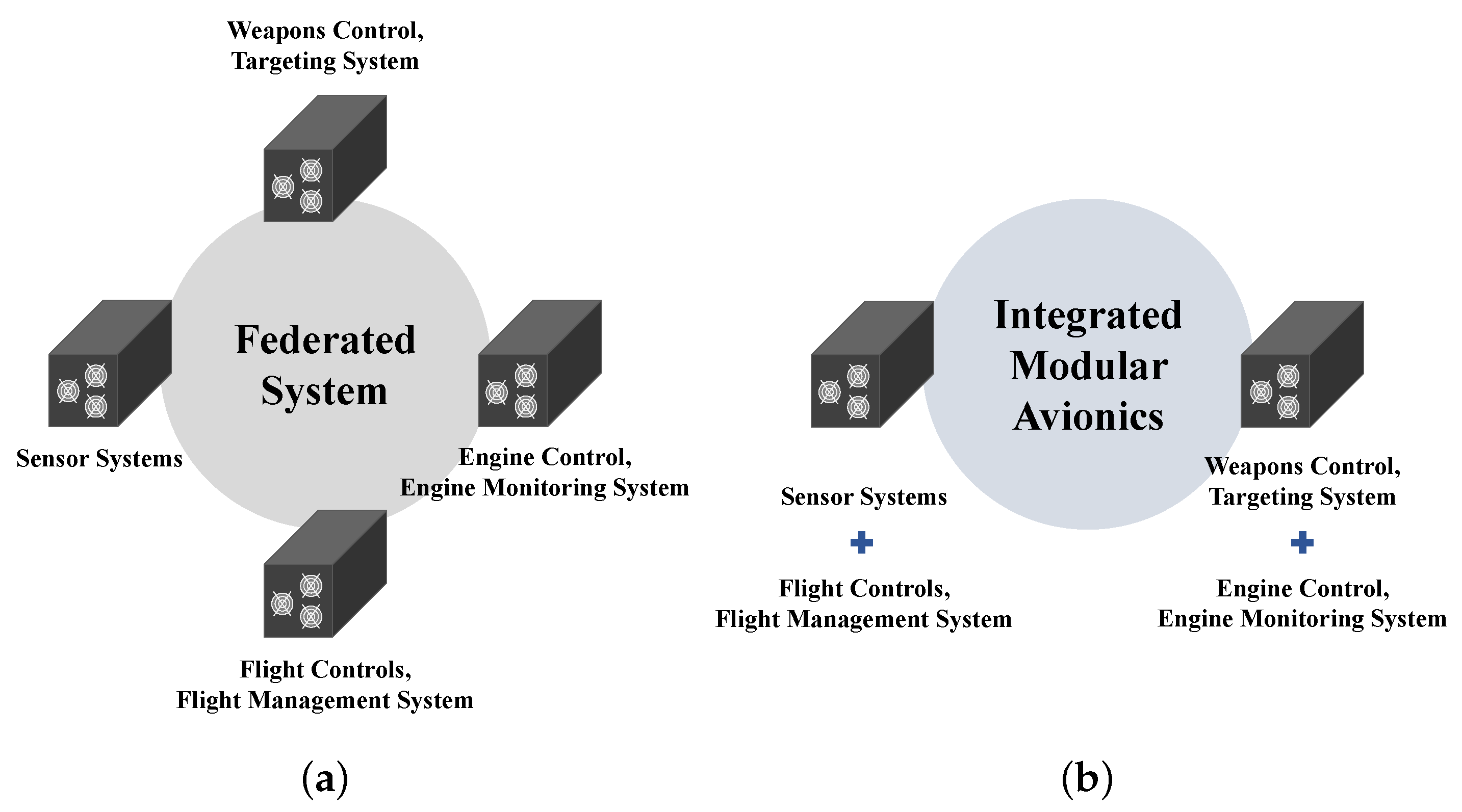
Until the 1990s, aircraft sensors and engine control functions were implemented as individual subsystems called line replaceable units (LRUs) [17] in avionics systems, as shown in Figure 1a. These LRUs consist of a federated architecture, connected via buses, such as, the RS-232, and 1553 analog buses. In a federated architecture, each LRU is connected to an external bus, resulting in slow communication between the LRUs. In particular, additional LRUs are needed to add functionality to avionics systems. For aircraft, only a limited number of LRUs can be added because they have space, weight, and power (SWaP) constraints. Therefore, to deal with more features in aircraft, the IMA architecture [17,18] has been proposed.
Figure 1. Architectures of the avionics system. (a) Federated architecture. (b) Integrated modular architecture.
The IMA architecture integrates multiple LRUs of a federated architecture into a single hardware component with more powerful computing capability, as shown in Figure 1b. Therefore, the IMA architecture can solve the avionics systems’ SWaP problem. Since the LRUs are on the same hardware backbone, the throughput is increased by communication over the external bus being reduced [19]. However, many systems operate on one hardware backbone, and it is necessary to guarantee the execution of each system. For this, the partitioning mechanism [18] following the ARINC 653 standard [13] is applied to avionics systems. Furthermore, virtualization-based methods, such as a hypervisor, provide legacy software compatibility with integrated hardware [20,21]. Hypervisor is also used to separate the running applications to ensure the security and real-time performance in cyber-physical systems [22].
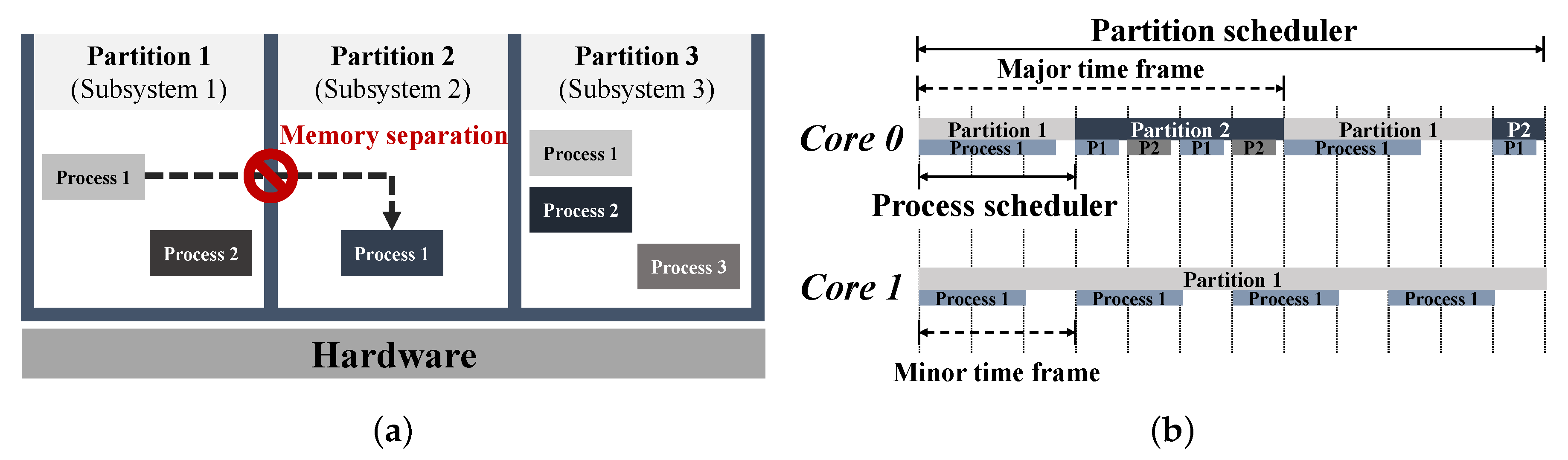
The partitioning system allocates an object called a partition each subsystem. A partition consists of several processes that execute tasks [18]. The partitioning system supports spatial and temporal separation, as shown in Figure 2, to ensure the identical execution of multiple partitions on a hardware unit. As shown in Figure 2a, the memory is divided and allocated to each partition for spatial separation. Each partition has its memory region and cannot access the memory regions of other partitions. Memory access is controlled by a memory management unit (MMU) or a memory protection unit (MPU). Processes within a partition share the memory area allocated to the partition. The partitioning system hierarchically schedules partitions and their processes based on major and minor time frames, as shown in Figure 2b, for time separation. The major time frame is a scheduling sequence in which each partition runs periodically. Meanwhile, the minor time frame is the periodic scheduling sequence of the processes in each partition. The partition scheduler schedules partitions with policies such as round-robin (RR). The process scheduler schedules processes with scheduling policies, such as first-in-first-out and earliest deadline first. The memory space, execution time, and execution period of partitions and processes based on ARINC-653 are defined before runtime. Therefore, neither configuration can be modified at runtime.
Figure 2. Temporal and spatial separation of the partitioning system. (a) Spatial separation. (b) Temporal separation.
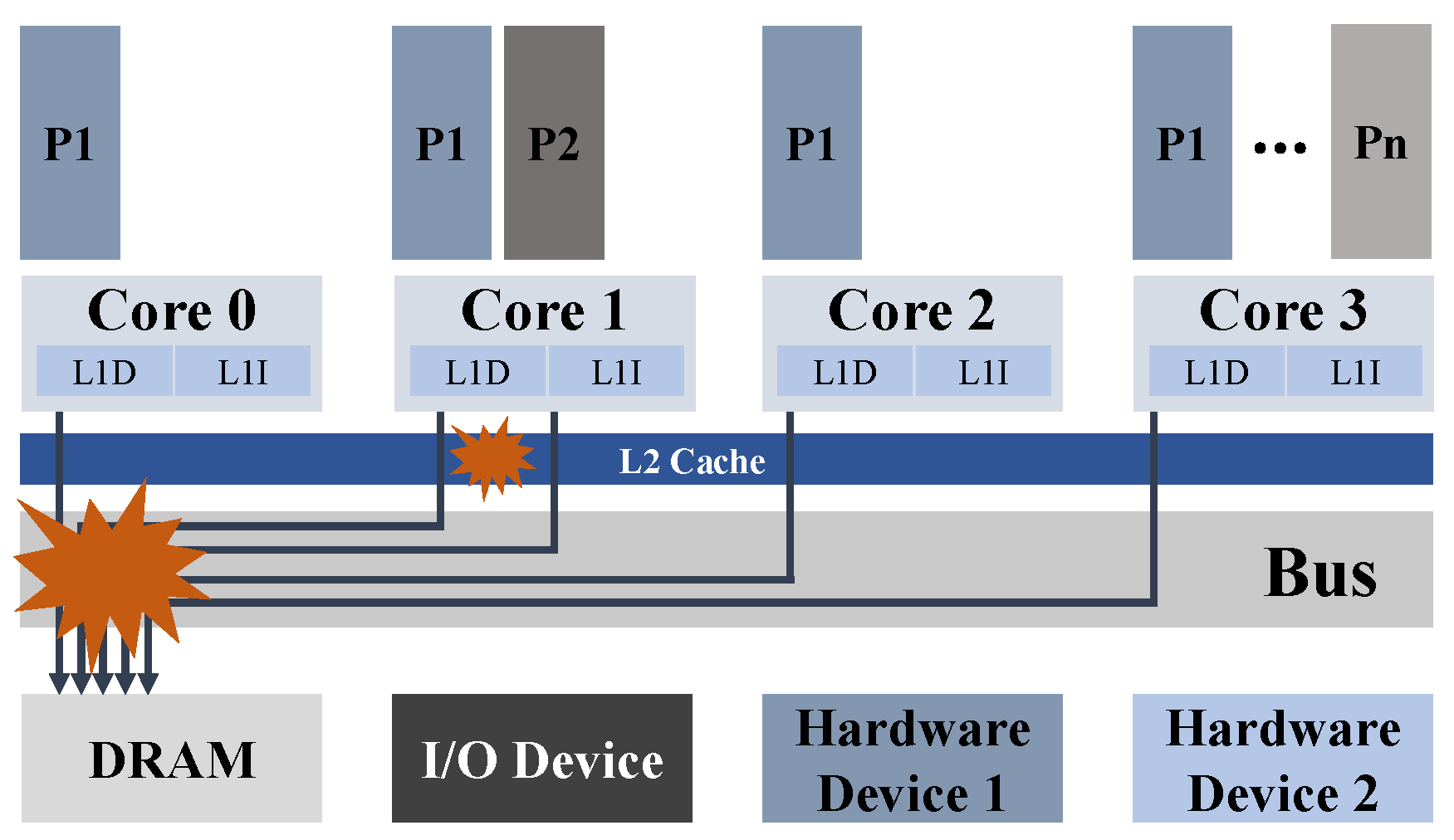
Recently, the amount of data to be processed in avionics systems has increased significantly. Moreover, they conduct complex operations, such as advanced signal processing. Multicore architectures were introduced into avionics systems to meet such requirements. Multicore architectures have the potential to increase throughput using the parallel processing of tasks or hardware resources. However, as shown in Figure 3, multiple cores share hardware resources (e.g., memory, I/O). In particular, hardware resource sharing among the cores can cause interference, such as increased task execution time [23]. Real-time and safety-critical systems, such as avionics systems, must deterministically bound the execution time [23,24,25]. Avionics systems divide the shared memory area and allocate it to each partition to reduce interference. Nevertheless, partitions are still in the same physical memory so interference can still occur. In the multicore IMA system, a model for defining and preventing conflicts between the cores has been studied to aid robust partitioning [26].
Figure 3. Memory sharing on multicore partitioning systems.

2.2. Execution Model

In this work, we apply an execution model to reduce the interference caused by memory sharing in avionics systems. Several methods have been proposed for reducing memory sharing interference. However, the software verification cost for the system and service in avionics systems is very high [27]. Therefore, we employed a model that eliminated interference without modifying the software.
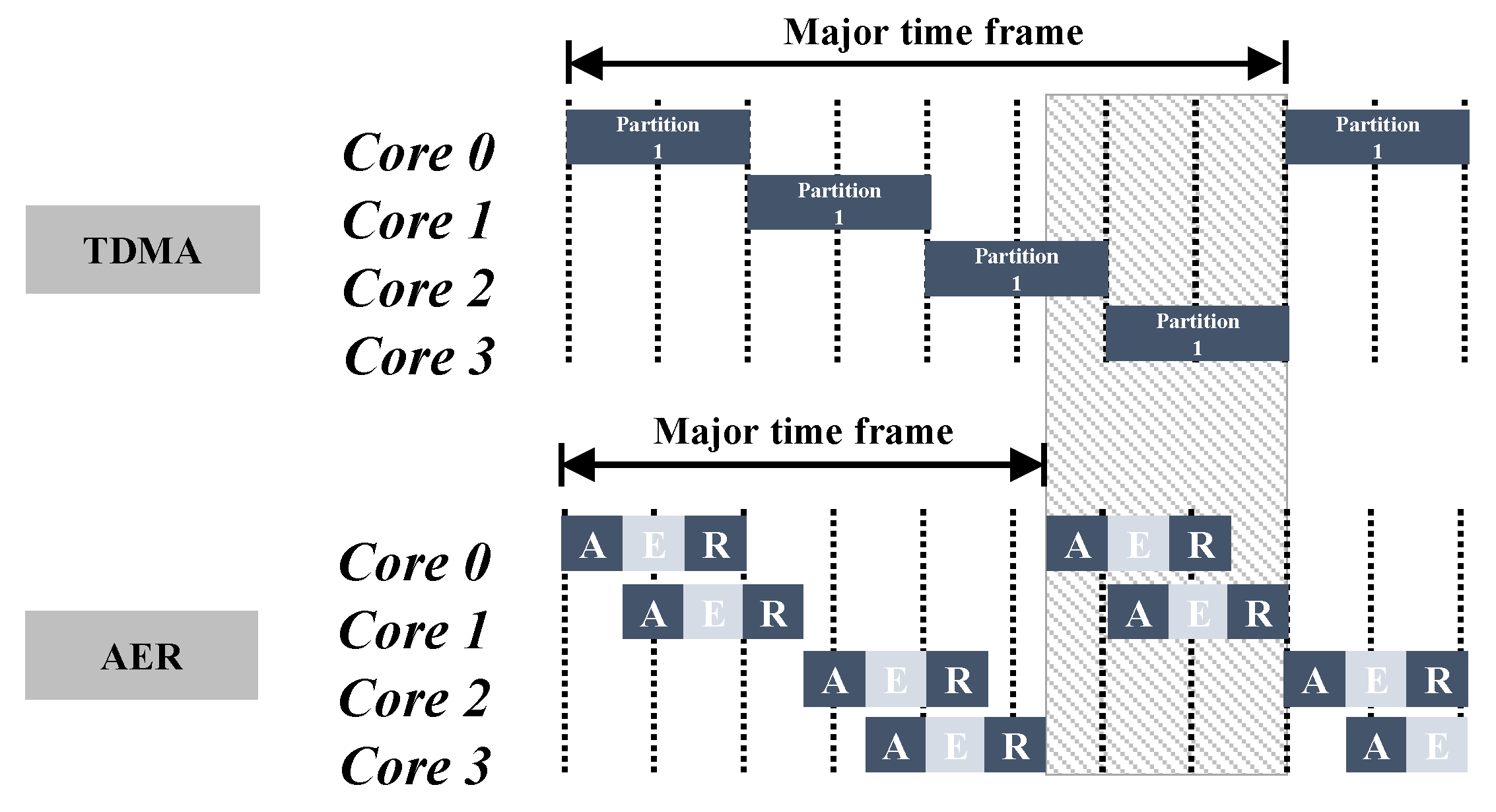
Execution models are methods of defining the execution sequences of tasks. In this section, we describe two execution models that are applied to multicore avionics systems, as shown in Figure 4. Avionics systems set the execution order and time of partitions and processes before runtime, as defined in ARINC-653. Therefore, it is possible statically to design and verify the execution model.
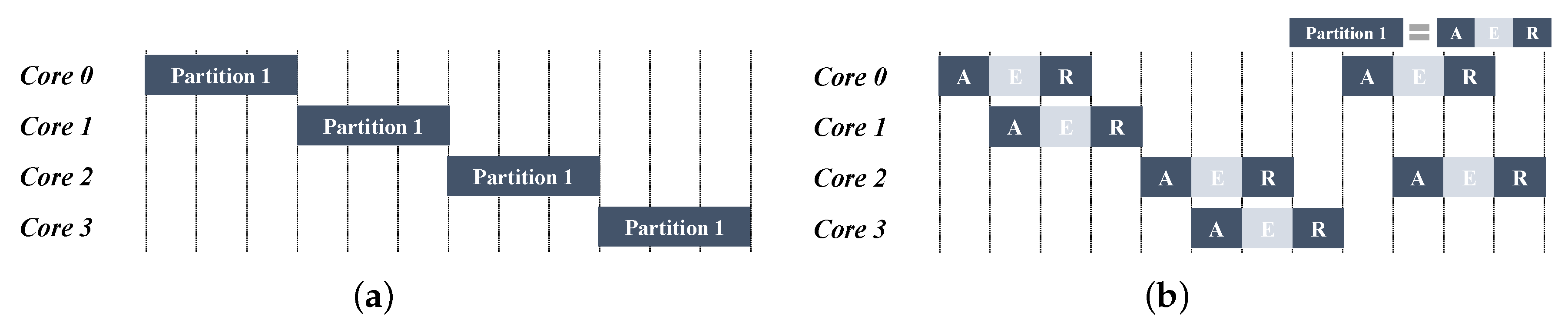
Figure 4. Execution models. (a) Time-division multiple access (TDMA). (b) Acquisition execution restitution (AER).
TDMA [14,28] executes only one core at a time, as shown in Figure 4a. Consequently, even if resources are shared, execution interference does not occur among the cores. However, TDMA uses only one core at a time, thereby reducing the overall throughput.
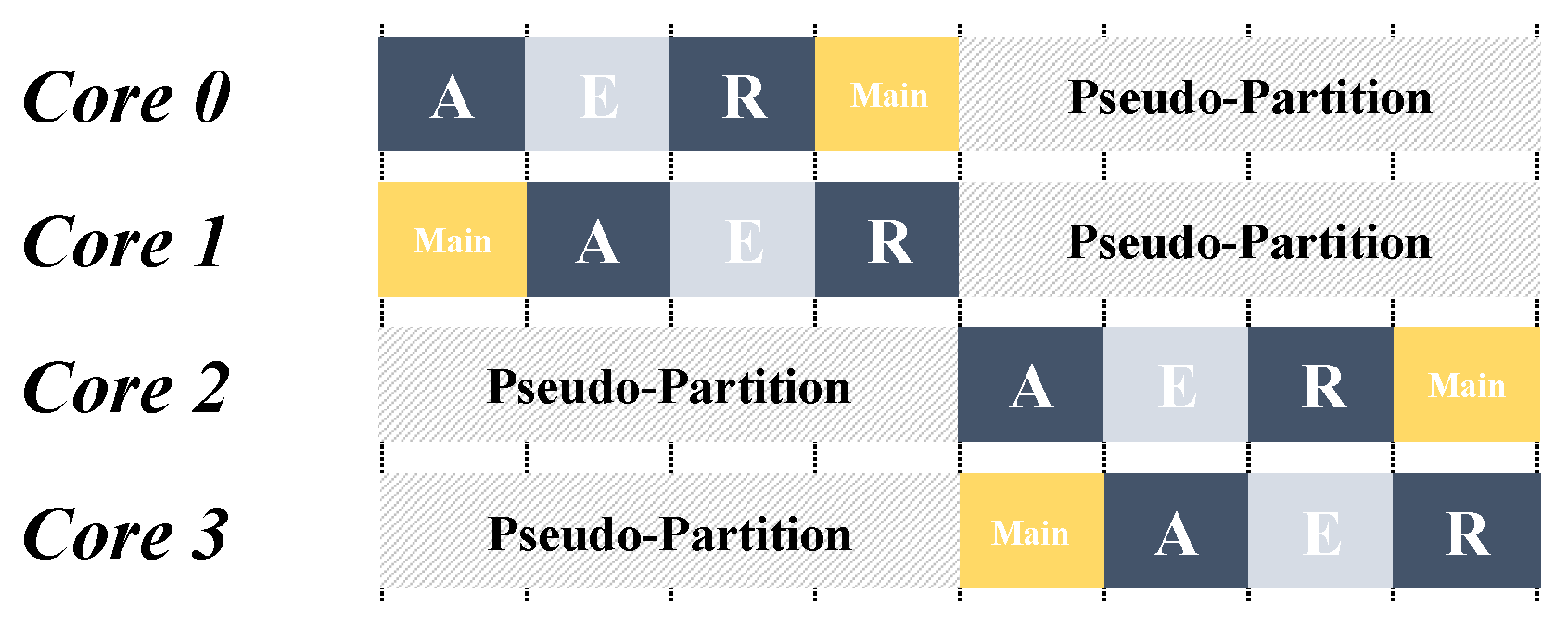
In addition, AER [9,29,30] allows the parallel execution of tasks in each core to improve the limitations of TDMA, as shown in Figure 4b. Tasks are divided into three phases: acquisition, execution, and restitution (denoted by A, E, and R, respectively). The A phase brings data from the shared memory to the local memory, such as a private cache. The E phase performs operations with the data read from the previous phase, and the R phase stores the result in the shared memory. Thus, the E phase can execute concurrently with the A or R phases of other cores by accessing only the local memory. Theoretically, in the AER model, if the execution time of the E phase of one core is longer than the A and R phases of the other core, up to four cores can run simultaneously. However, legacy code may not be split into the A-E-R phases of the AER model.
The major time frames of the TDMA and AER models in a partitioning system are shown in Figure 5. Since AER has higher utilization than TDMA, it has a shorter major time frame. If the major time frame is shortened when performing the same task, the execution safety margin of the partition can be set up. Table 1 summarizes the TDMA and AER execution models.
Figure 5. Major time frame comparison of TDMA and AER execution models.
Table 1. Comparison of execution models.

3. Execution Models for Multicore RTOS

In this section, we describe the RTOS for the experiment. We also cover the implementation of the TDMA and AER models described in Section 2.2 on this RTOS.

3.1. Multicore RTOS for Avionics Systems

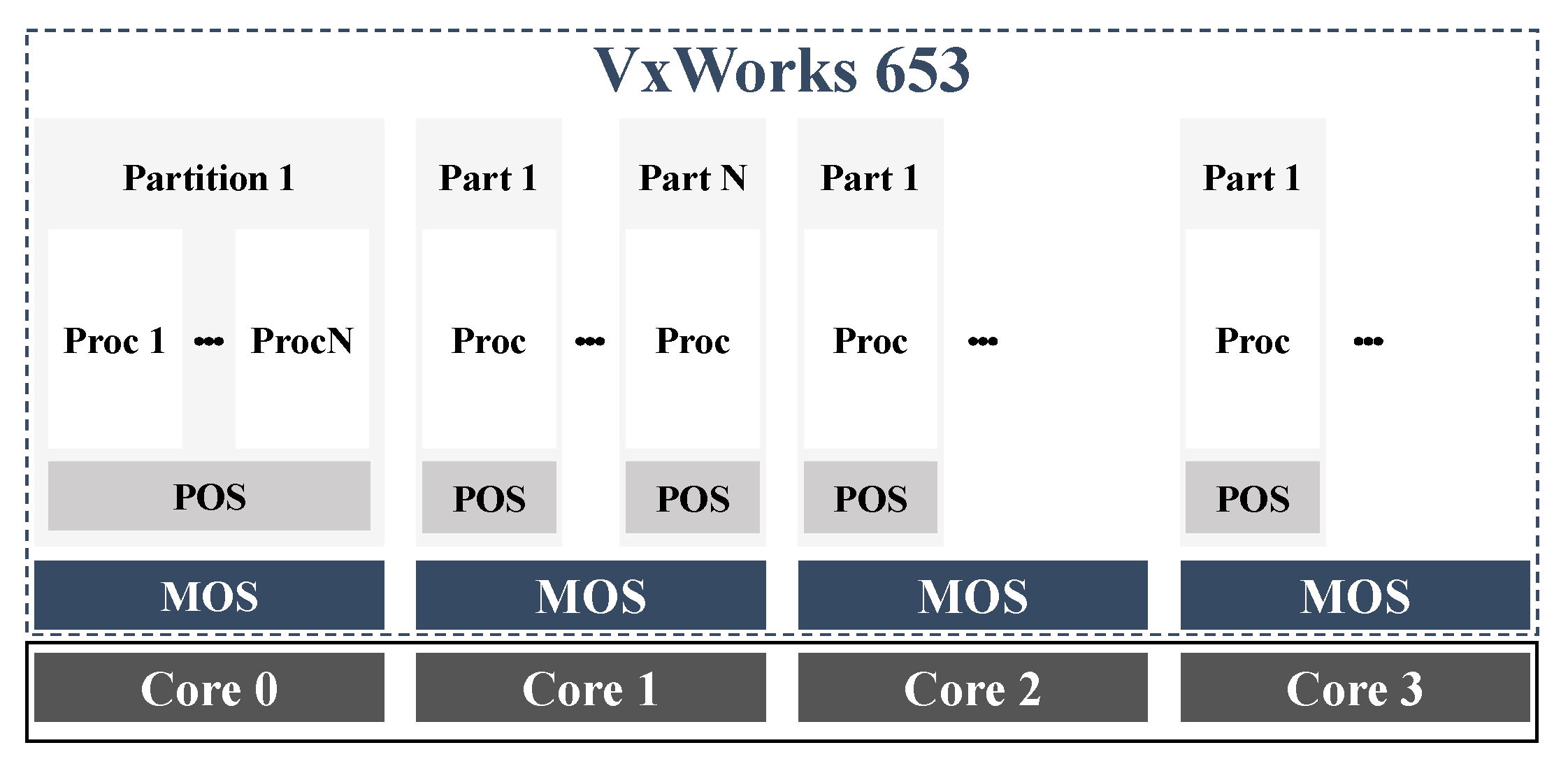
In this study, we used VxWorks 653 (version 3.1, Wind River, Alameda, CA, USA, 2019) [31], a commercial RTOS applied in aircraft, such as the Boeing 787 Dreamliner. The structure of the OS is shown in Figure 6.VxWorks 653 is an AMP system. In AMP systems, each core operates independently and is also applied for robust execution in multicore avionics systems [1,2]. However, since each core shares memory, interference can occur between the cores despite using the AMP system.
Figure 6. The architecture of VxWorks 653.
VxWorks 653 is a hypervisor-based multicore OS called module operating system (MOS) [31], as shown in Figure 6. This OS is an AMP system; therefore it allocates the MOS for each core. The MOS runs in privileged mode, providing spatial and temporal separation of the system. The MOS consists of an MMU manager and a TLB handler to allocate memory space for each partition that is executing on the hypervisor. During system initialization, the MOS determines each partition and associated scheduling information based on predefined configurations. After being initialized, the MOS operates on an event basis. When events occur such as inter-partition communications within a core or interrupts that send messages to a partition on another core, the MOS handles the requests and calls the inter-processor interrupt (IPI). This IPI is also a significant cause of cache misses.
Each core of the VxWorks 653 is composed of one or more partitions, as shown in Figure 6. Each partition consists of a partition operating system (POS) and one or more processes. The POS is a hypervisor guest OS and supports VxWorks 6.3. POS manages processes and provides APIs, such as buffers and blackboards, for intra-partition communication (inter-process communication). The processes are pre-allocated to the appropriate partition memory. Further, inter-process communication continues through the corresponding memory space.
VxWorks 653 uses hierarchical scheduling for the time separation of partitions and processes in the IMA structure. The MOS of each core manages the execution time of each partition. For hierarchical scheduling, this consists of a partition scheduler and a process scheduler. The partition scheduler schedules partitions to the RR policy based on the time slice. The process scheduler applies priority-based preemptive and RR scheduling. For memory separation in VxWorks 653, the MOS allocates a predefined memory area during the initial system configuration.

3.2. Implementation of Execution Models

The goal of this work is to reduce interference without altering the source code of existing systems. Commodity OSs, such as VxWorks 653, allow limited source code modification. Moreover, the recertification of modified avionics software can be costly. Therefore, we execution models without modifying the source code.

3.2.1. TDMA

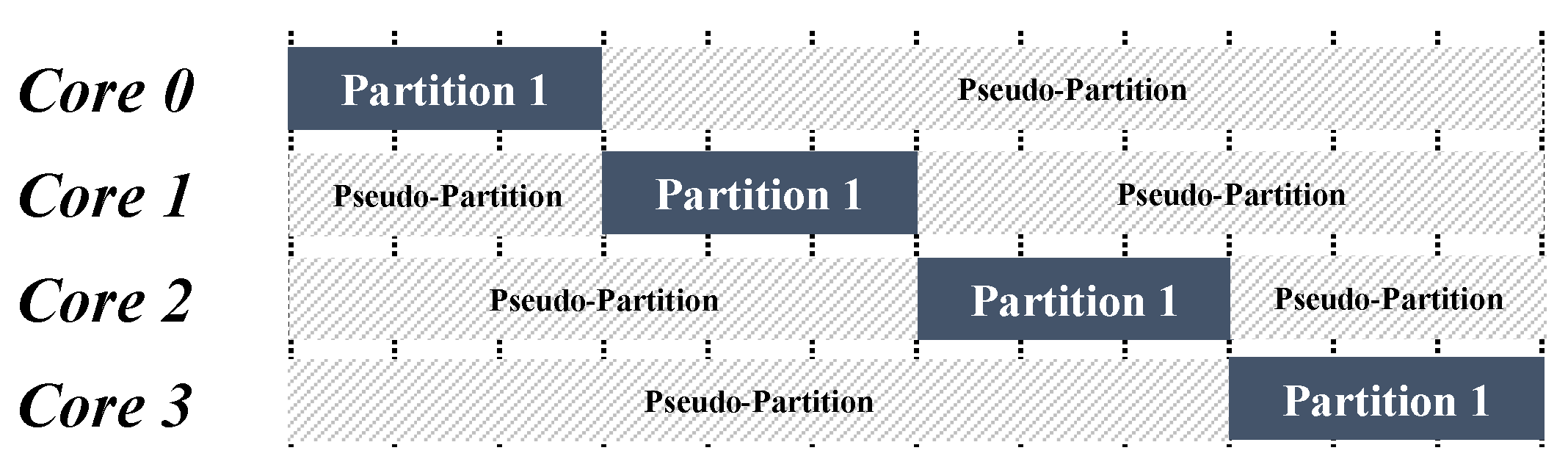
Partition scheduling in VxWorks 653, does not allow the partition start time to be specified. That is, the partitions of each core are executed in parallel simultaneously. For TDMA model, partitions on each core should not be run concurrently. To address this problem, we employed a pseudo-partition as shown in Figure 7 to control the execution order.
Figure 7. Pseudo-partition for execution flow control.
A pseudo-partition is a partition with a single process that executes “while (1) {}”. Based on the predefined partition execution time for each core this pseudo-partition allows only a single core at a time access to the memory. Given that ARINC 653 defines the partitions’ execution period before runtime, the pseudo-partition’s execution period can be set according to the scheduling order. We established a pseudo-partition and heuristically confirmed that the executions on each core did not overlap. This implementation required additional memory space for the six pseudo-partitions to implement TDMA model on a quad-core processor. We used pseudo-partition to control the order of execution between partitions. However, it has the potential to run non-memory jobs instead of pseudo-partitions.

3.2.2. AER

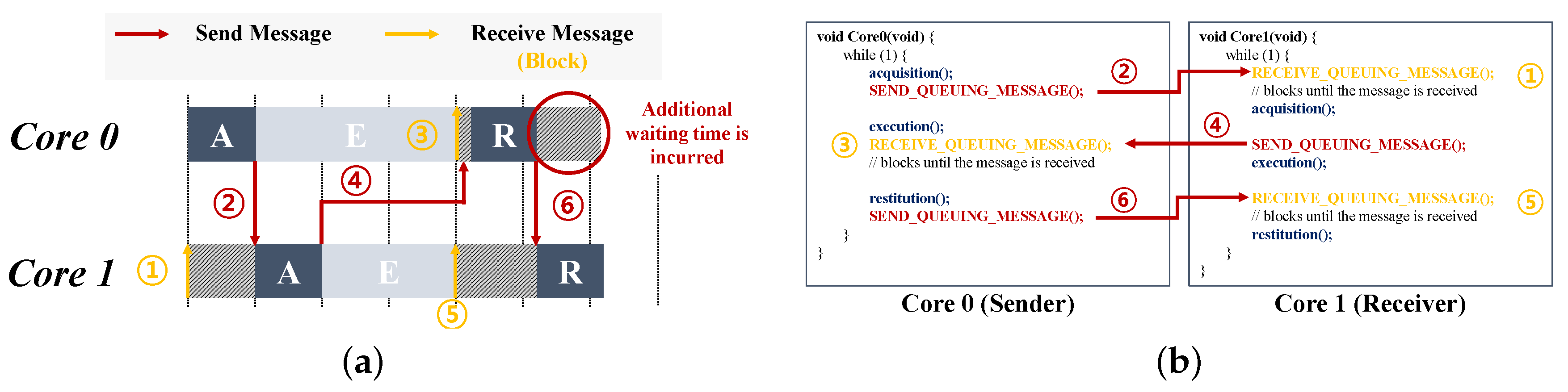
When implemented, the AER model must control the execution order between processes in each core’s partition. VxWorks 653 is an AMP system with all core partitions running independently. For inter-partition communication, the ARINC 653 application execution (APEX) service was used to control the process flow of executions in each partition, as shown in Figure 8a. We used message queuing for inter-partition communication. Message queuing operates by allocating memory space (channels) for a message in the memory of the MOS. The messages on these channels are communicated between partitions. With message queuing, the receiving partition waits for the message to be written to the channel. We used this characteristic to control the execution flow between partitions on each core.
Figure 8. Inter-partition flow control. (a) Inter-partition flow control using message queuing. (b) Code of inter-partition flow control using message queuing.
In this work, the AER model is implemented as shown in Figure 8b. Each partition’s processes have phase functions within the main function. When executing the AER model on two cores, Core 1 (1) calls the message receiving function (RECEIVE_QUEUING_MESSAGE ()) and transitions to the block state when the partition process is executed. Core 0 executes the A phase function, and when the execution ends, (2) sends a message to Core 1 (SEND_QUEUING_MESSAGE ()). When Core 1 receives the message, it switches from the block state to the execution state and executes the A phase function. At this time, Core 0 executes the E phase in parallel with the A phase of Core 1. If the E phase of Core 0 is terminated, (3) calls the message send function. When the A phase task of Core 1 is completed, (4) sends the message to Core 0, and the E phase is executed. The E phase of Core 1 terminates, and (5) calls the message sending function for the R phase of Core 0. Core 0 executes the R phase, (6) sends a message to Core 1, and Core 1 executes the R phase. Until the R phase of Core 1 is completed in Core 0, as shown in Figure 8a the non-executing components pause. Therefore, an additional margin is required to set the process deadline for the partition.
When sending and receiving messages, the cache is polluted or flushed when the partition calls the MOS via the system and the context is switched. In particular, to transfer messages between cores, overhead occurs when MOS checks the number of the core to which the message is sent and then writes a value in the MOS memory area of the core.
To implement the AER model, we used the pseudo-partition applied to the TDMA model. Unlike TDMA, two cores can run concurrently, thus requiring four pseudo-partitions for the major time frame, as shown in Figure 9. In a previous study that implements the existing AER model [29], the last-level cache (LLC) is disabled so that if a miss occurs in the L1 cache, the main memory is accessed directly. However, disabling the LLC was not possible in our setup. Therefore, we used an array smaller than the size of the L1 cache to minimize the L1 cache misses in the benchmark.
Figure 9. AER execution model with pseudo-partition.

3.2.3. Proposed Model

The memory bus of our target board has two coherences in one cycle meaning that two requests for the main memory can be processed at once. We propose a multi-TDMA model that can improve the TDMA and AER models using hardware characteristics. The goal of the proposed multi-TDMA is to increase utilization over TDMA and AER while allowing slight interference due to memory sharing. However, to satisfy the deterministic characteristics of the avionics system, the balance of utilization and interference should be considered.
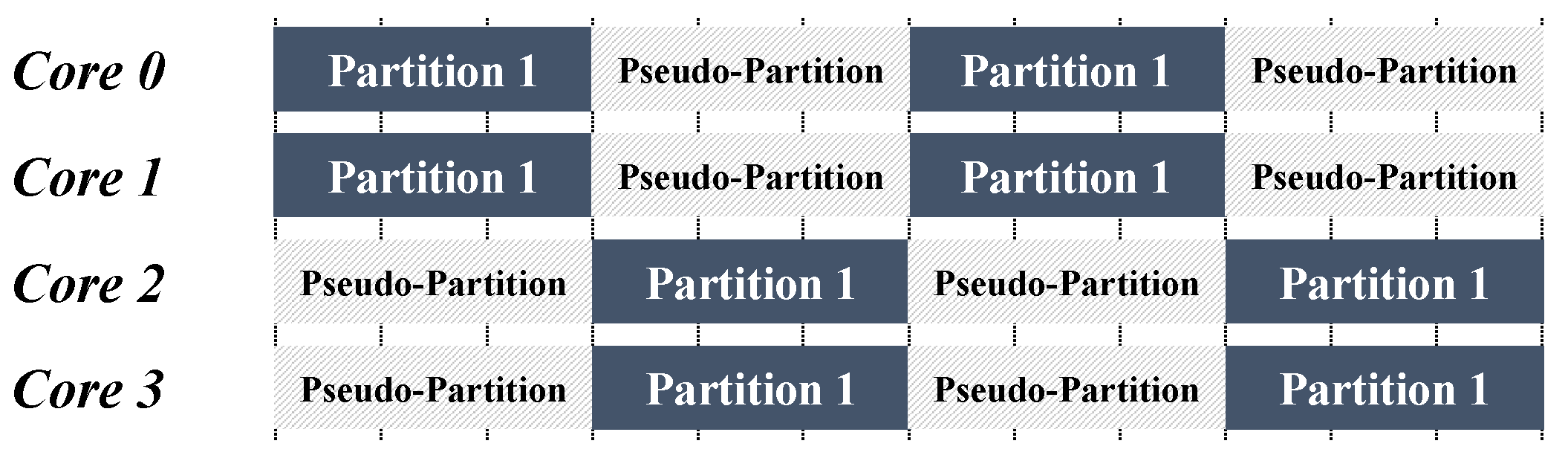
Multi-TDMA runs two cores in parallel, as shown in Figure 10. This implementation of the multi-TDMA model reduces the number of pseudo-partitions by two compared to the TDMA model. With the same major time frame as the AER model, an additional safety margin in partition execution can be set. Furthermore, multi-TDMA can diminish memory usage by reducing the pseudo-partitions. Because with TDMA two cores access the memory simultaneously, more interference is expected to affect the execution time.
Figure 10. Multi-TDMA.

4. Evaluations

This section describes the results of measuring the interference due to memory sharing between cores by executing TDMA, AER, and multi-TDMA on the target hardware described in Section 3. Moreover, we describe the benchmark [15] for this experiment.

4.1. Measurement Environments

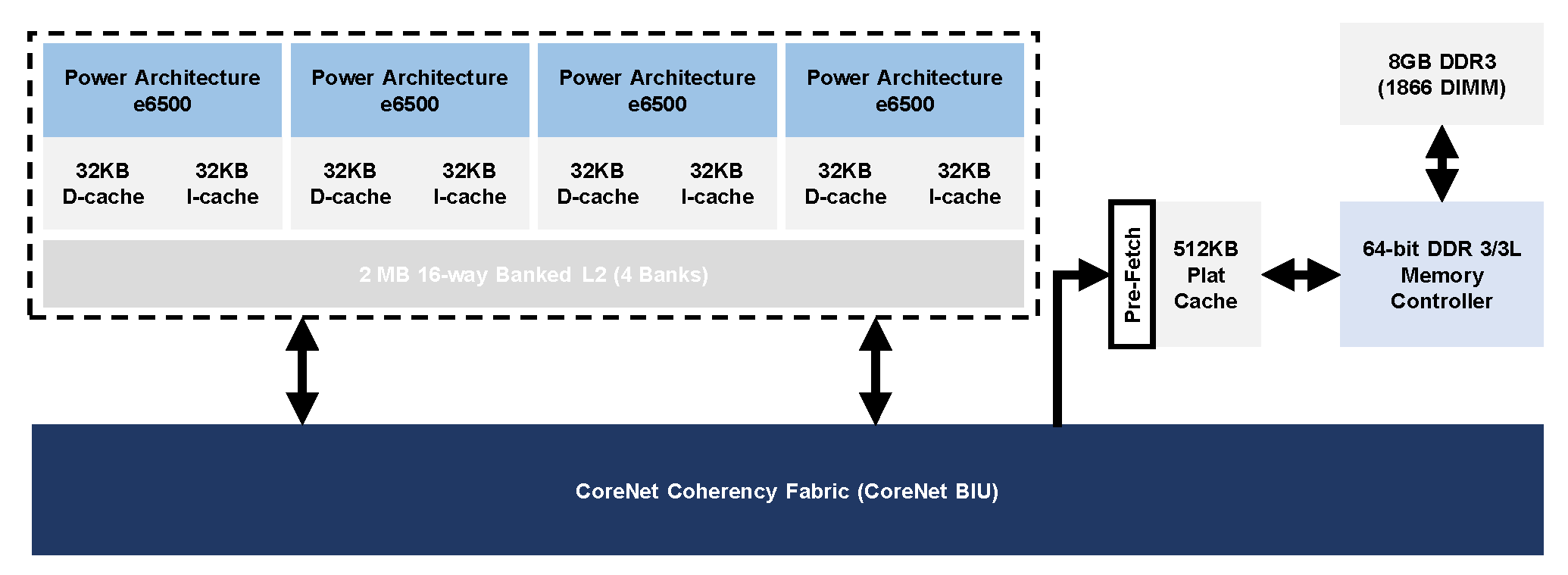
Figure 11 shows the NXP T2080QDS board (NXP, Eindhoven, Netherlands) used to measure the memory sharing interference between cores. The target board is equipped with QorIQ architecture-based quad-core PowerPC E6500 central processing unit (CPU). Each core has a 32 KB private data and instruction cache, and a 2 MB L2 cache is shared among the cores. The L2 cache is 16-way banked with 512 KB for each of the four cores. The main memory and the core transmit data through the CoreNet coherence fabric (eq. CoreNet BIU). The target board employs a 512 KB CoreNet platform cache and a pre-fetched L3 cache to improve access time to the main memory. The main memory is a DDR3 8 GB chip. The CoreNet BIU provides high concurrency by providing multiple and parallel address access. For this purpose, two coherence granules are processed per cycle.
Figure 11. Architecture of T2080QDS.
We measured the number of L1 data cache misses, the L2 cache misses, and the CoreNet BIU requests (L3 and main memory access) to identify the memory sharing interference. As shown in Figure 11, each core shares the L2 cache and LLC. Therefore, cache eviction may occur depending on the cache access of each core. This factor can cause inter-core interference. In particular, we measured the effect of inter-core interference on the partitions’ process execution times. Each cache misses count was read from the core’s performance monitor register (PMR). The PMR consists of a performance monitor global control (PMGC), a performance monitor local control register (PMLC), and a performance monitor counter (PMC). We set event flags for the L1, L2 cache misses rete, and BIU requests in the PMGC and the PMLC and the read values counted in the PMC during benchmark execution. The PMGC and PMLC can only be configured in hypervisor mode, while VxWorks 653’s guest (POS) operates in guest-hypervisor mode and user mode. Therefore, since the PMGC is not set up in the partition process, it is necessary to set up the event flag in the initialization of MOS. The PMC is accessible in user mode. We used the move instruction of PMR (mfpmr) in the assembly code to access the values of the PMC. The latency of the mfpmr instruction was four cycles. The execution time of the benchmark was measured with the POSIX timer library clock_gettime (). We measured the corresponding cache misses only in Core 0 due to the limited the number of registers; the execution time was measured in the partitions of all four cores. All experiments were repeated a hundred times. In addition, only one process was allocated to each partition.

4.2. Benchmark

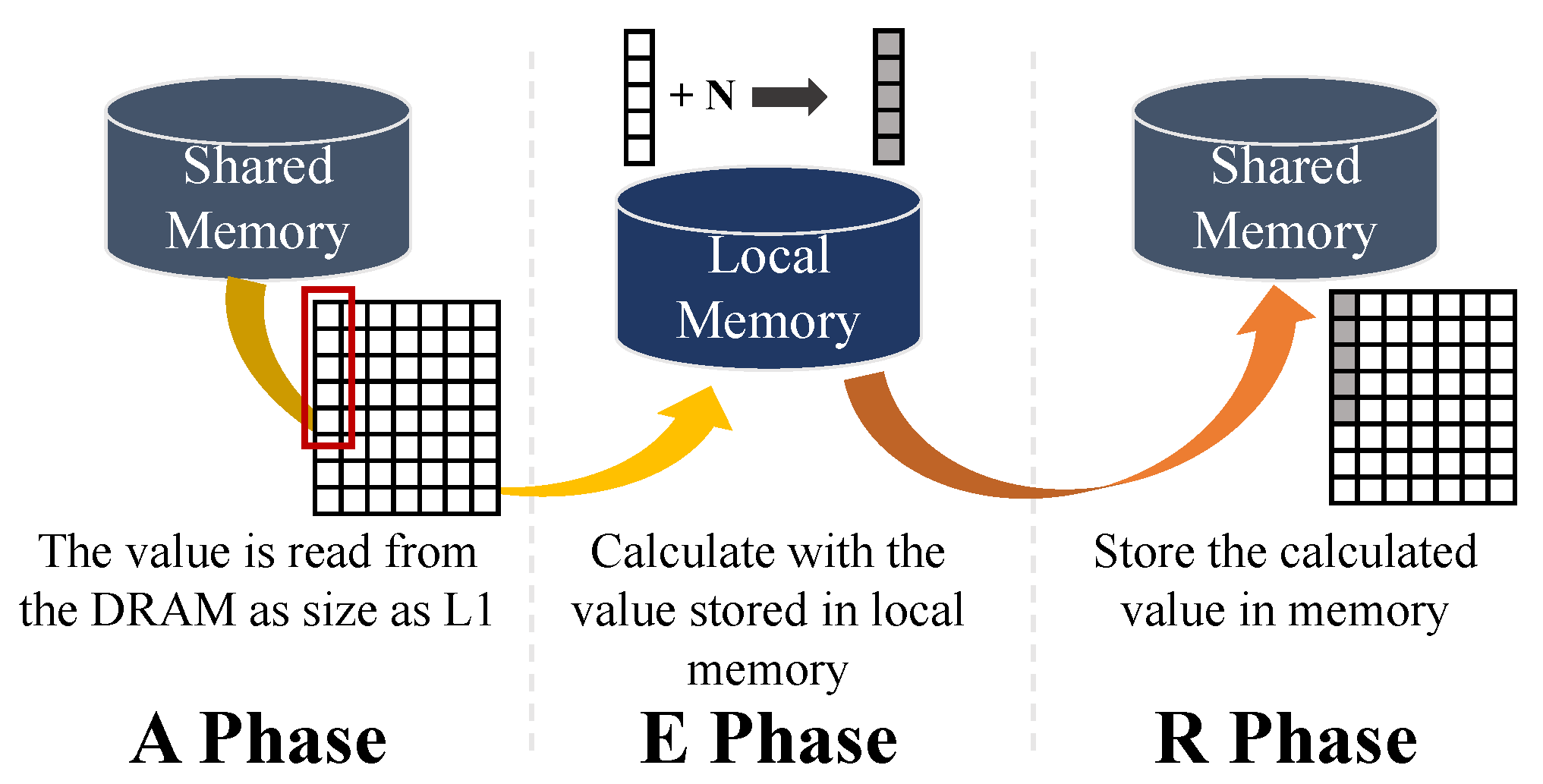
We experimented with the TDMA, AER, and multi-TDMA models applied the micro-benchmarks proposed in the previous study [15]. The benchmark followed the phase structure of the AER model described in Section 3.2.2, implemented with one main function and each phase function. Each phase function was called from the main function. The detailed benchmark operation is shown in Figure 12. The A phase read the array stored in shared memory and stored it in the local variable. Then, to minimize L1 cache misses, the array was accessed by 32 KB, the size of L1 on the target board. The E phase carries out a simple addition operation using local variables stored during the A phase. During the R phase, the value calculated in the E phase was updated in the main memory.
Figure 12. Benchmark for evaluation.
Before experimenting with the execution model, we measured the number of cache misses that occurred at each phase of the benchmark. The measured values for each phase are shown in Table 2. In the E phase, the L1 misses were approximately 15 times fewer than in the A phase, and 31 and 55 times less for the L2 misses and BIU requests, respectively. The cache misses that occurred in the E phase were due to the context switch caused by the calling of each phase function in the main function. The low number of L2 misses and BIU requests in the R phase is because the data is already stored in the cache during the A phase. These results show that the cache misses and BIU request counts in the E phase are acceptable.
Table 2. Benchmark measurement results per phase.

4.3. Experimental Results

To examine the interference reduction in the execution model, we measured the memory sharing interference among the cores. For this purpose, the benchmark was run concurrently on all cores without phase control and the memory was accessed from all partitions simultaneously, for the ensuing bottlenecks to affect the execution time. We measured the memory sharing interference by varying the number of cores accessing the memory concurrently. We also measured the number of cache misses for each benchmark phase function. We also set a 2 ms deadline for executing a process on each core resulting in the same for each partition. The interference measurement results, according to memory sharing are shown in Figure 13.
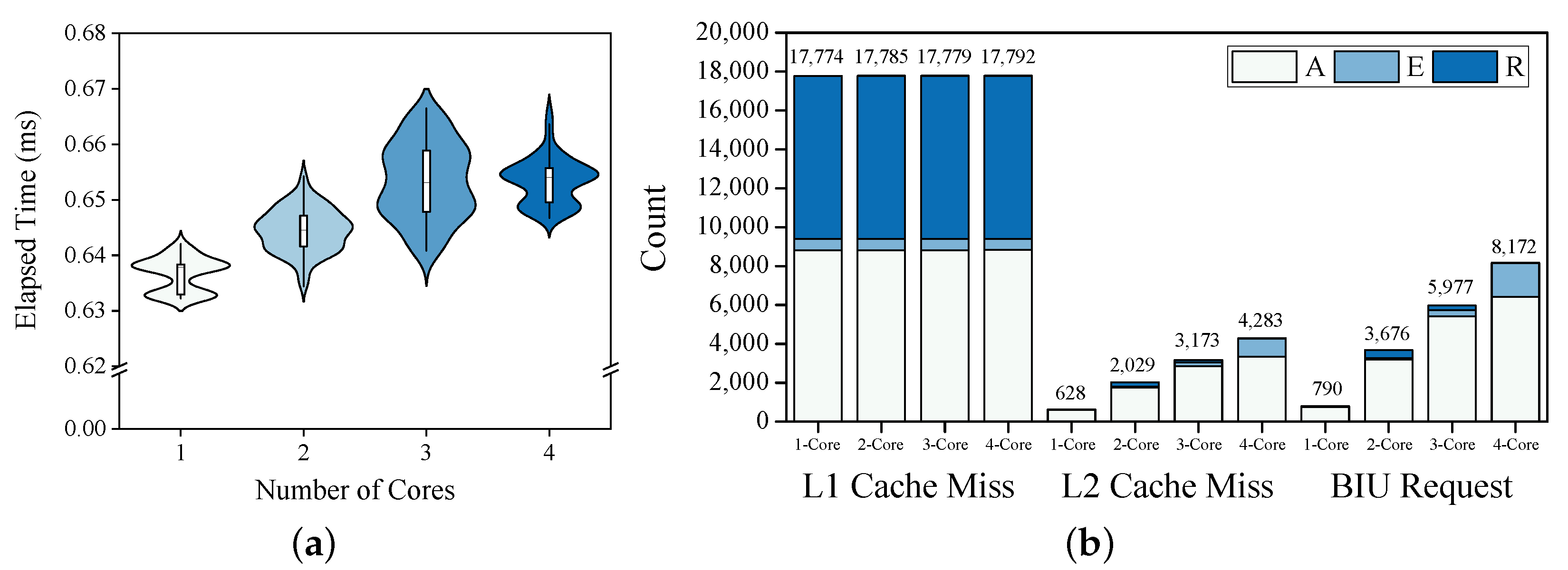
Figure 13. Benchmark measurement results. (a) Execution time. (b) Cache misses and bus interface unit (BIU) requests.
Figure 13a is a violin graph of the benchmark execution times with the width of each graph representing the distribution. The X-axis represents the number of cores, and the Y-axis is the execution time. When executing the benchmark on one core, the execution time was about 0.64 ms, and on four cores, it increased by about 7%. When running the benchmark on only one core, the variation in execution times was 0.01 ms. On 3 cores, the execution time variations were greatest, at 0.04 ms. This demonstrates that as the number of cores accessing the shared memory increases execution times become non-deterministic.
The cache misses measurement results of the benchmark are shown in Figure 13b, where the X-axis represents the variation in the number of cores, and the Y-axis represents the numbers of each item. The L1 cache misses occurred 18,000 times, regardless of the number of cores. At this time, most of the misses occurred in the A and R phases while accessing the shared memory. Approximately 1000 L2 cache misses occurred while executing the benchmark on one core and increased approximately 4.5-fold as the number of cores increased. The BIU requests showed a similar trend and increased more than seven-fold with the increase in the core count being similar to the L2 cache misses. As the number of concurrently running cores increased, the L2 cache misses and the BIU requests in the E phase increased. This means that the execution between processes in each core is not controlled, for it to be executed concurrently with the A and R phases of the other cores. The numbers of L2 misses, and BIU requests during the R phase were small since the data had already been cached in the preceding A and E phases.
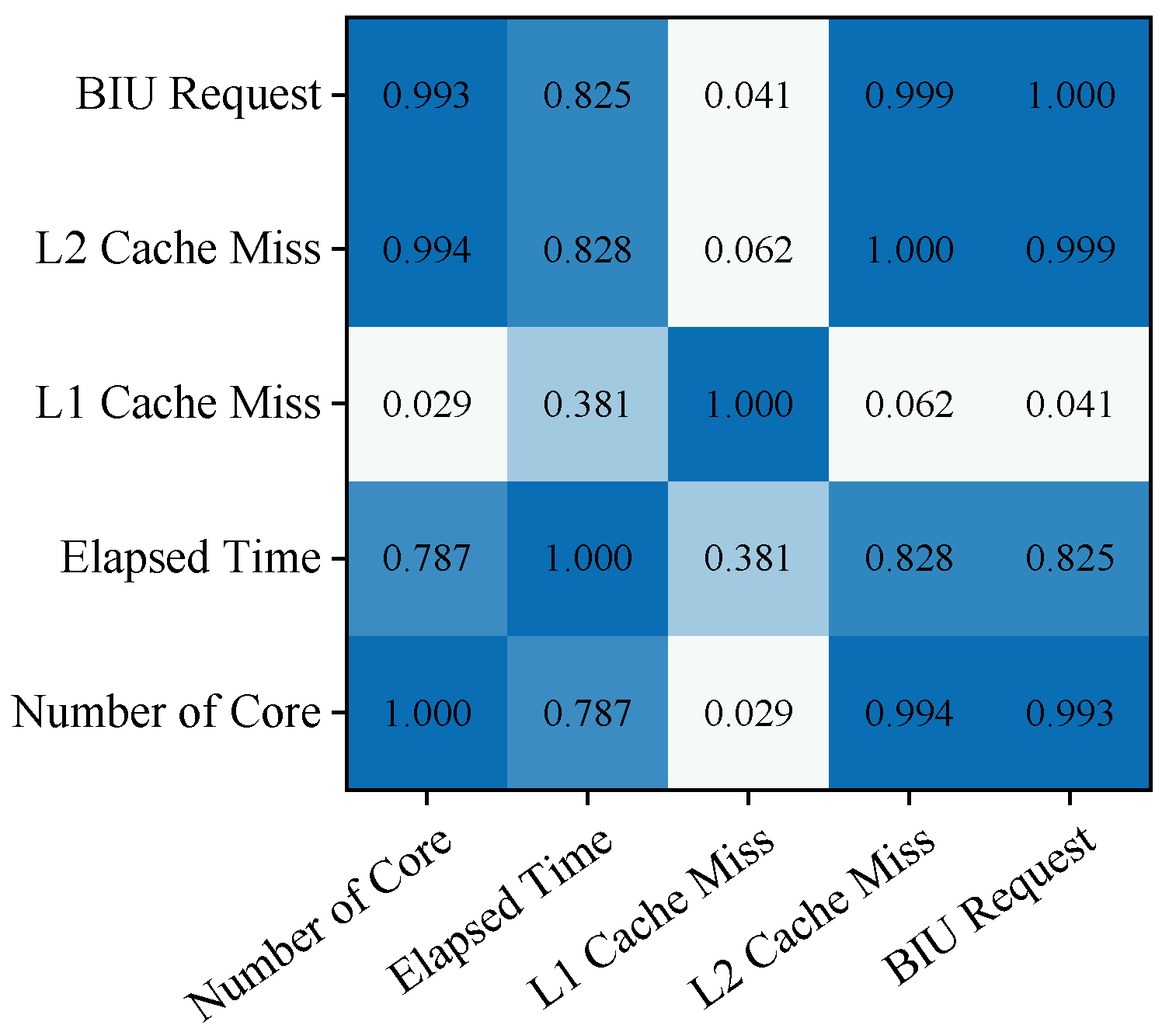
Based on these results, we analyzed the correlation of each measurement item, as shown in Figure 14. Based on the measured values, we calculated the Pearson correlation coefficient using MATLAB. From this figure, it appears that execution times are interrelated with the L2 cache misses and the BIU requests. The L2 cache misses are affected by the number of cores running concurrently. Further, the BIU requests were found to be associated with L2 cache misses. In conclusion, the L2 cache misses should be minimized to reduce the impact of memory-sharing interference between cores during execution.
Figure 14. Correlation by measurement elements.

4.3.1. Application of the Execution Model

Based on the results of the interference due to memory sharing in the multicores measured earlier, we apply each execution model to find interference reductions. To compare the results with the execution models, we set the baseline to run the benchmarks concurrently on four cores. The results of applying the TDMA and AER models are shown in Figure 15.
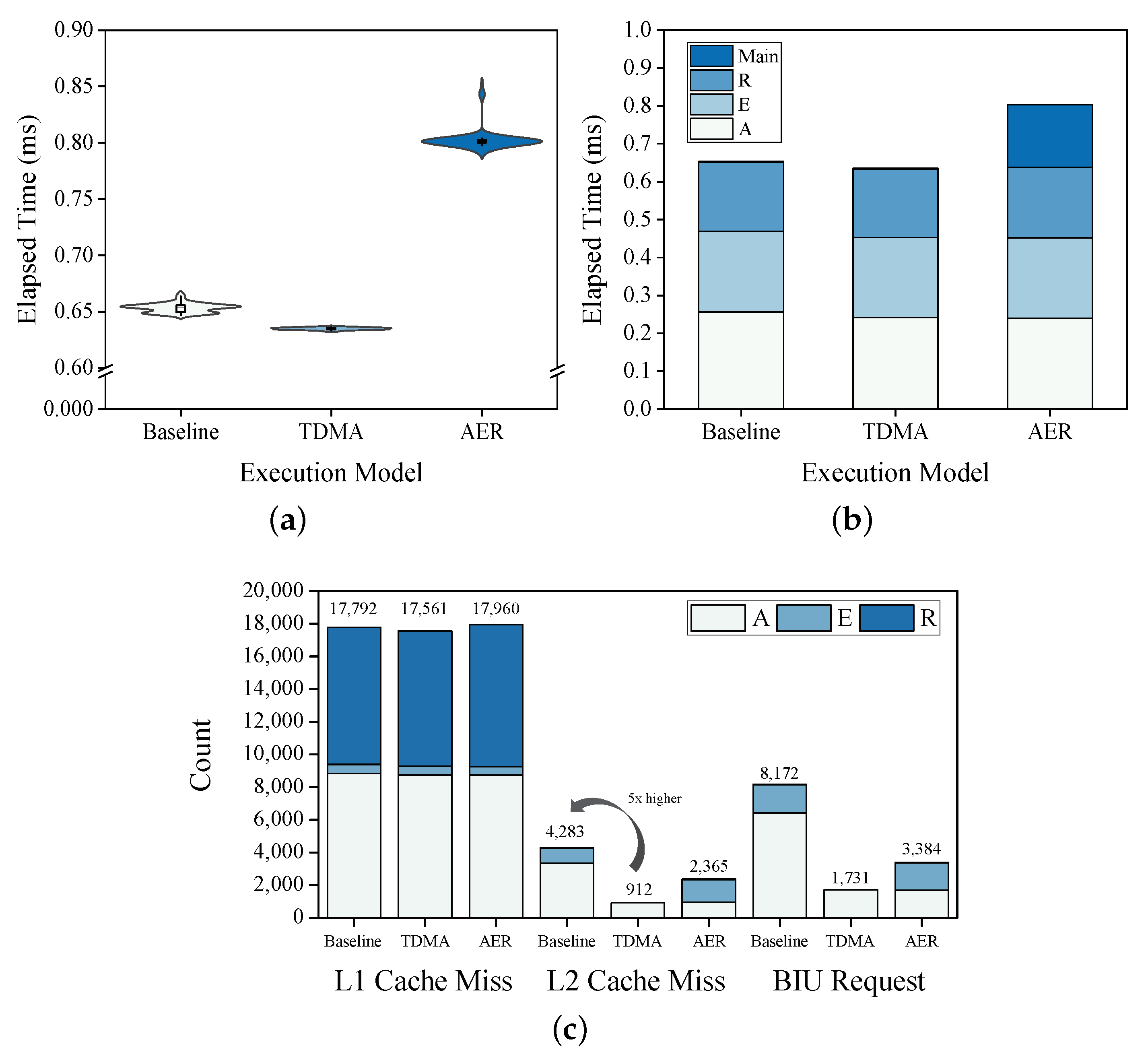
Figure 15. Benchmark measurement results by the execution model. (a) Execution time. (b) Execution time by each phase. (c) Cache misses and BIU requests.
Figure 15a shows the execution time for each model. The TDMA model executes by core partition sequentially and similarly accesses the memory, so there is no interference. Therefore, the variation of the benchmark execution time was the least, and the execution time was reduced by about 0.1 ms, compared to the baseline. Conversely, the AER model had a 0.82 ms, execution time which is approximately 20% longer than the baseline and TDMA results. The increase in the execution time of the AER model is due to the waiting time of the main function while controlling the A, E, and R phases among the cores, as shown in Figure 15b. Moreover, the AER model takes time to send and receive messages to control the order of phases and the IPI overhead for this process. The baseline and TDMA only calls each phase function from the main function, so there is a slight overhead.
The measurement results of L1, L2 cache misses, and the BIU requests according to each execution model are shown in Figure 15c. TDMA execution model incurred the fewest L1 cache misses. As with the previous results, most of the L1 cache misses occurred in the A and R phases in TDMA and AER. The L2 cache misses count was of the same order as the baseline, AER, and TDMA. The baseline had about 4300 L2 cache misses, mostly in the A phase when reading values from the memory. At this time, because there was no execution control for the processes of each core, the E phase was affected, and the L2 cache misses occurred. There were 2000 L2 cache misses when the TDMA model was run. This is caused by the cold cache when a value initially is read from the shared memory to the local memory. The AER model’s L2 cache misses decreased by more than 60%, compared to the baseline. However, approximately 2000 additional L2 cache misses occurred in the E and R phases due to the message calls context switching and each phase control’s send and receive functions. The BIU requests of each model appeared in the order of baseline, AER, and TDMA. In TDMA, the BIU requests were also lower because there were minimal L2 cache misses during the E and R phases. Consequently, the TDMA and AER models reduced interference. However, in the case of AER, 23% of the execution time was required for each phase control action.
We set the partition execution times for all cores to 2 ms for the experiment. To implement each model, the major time frames of the baseline, TDMA, and AER were 2 ms, 8 ms, and 4 ms, respectively. The AER model increased the execution time of the benchmark, but the major time frame was shorter than TDMA by increasing the utilization of the multicore. In particular, the safety margin in the partition of each model was about 67%, 69%, and 60%, respectively. Consequently, higher safety margins can be obtained as memory interference is reduced.

4.3.2. Multi-TDMA

Our experimental results show that the TDMA and AER models can be used to reduce interference due to memory sharing. The TDMA model reduces interference by running only one core at a time on multiple cores. Thus, TDMA has the same utilization as a single core. AER increased the utilization of multicores by splitting the task into three phases and executing both non-memory and memory phases concurrently. However, AER took about 20% more time to control each phase. We propose a multi-TDMA that runs two cores simultaneously, considering the shortcomings of existing models and the characteristics of the target hardware.
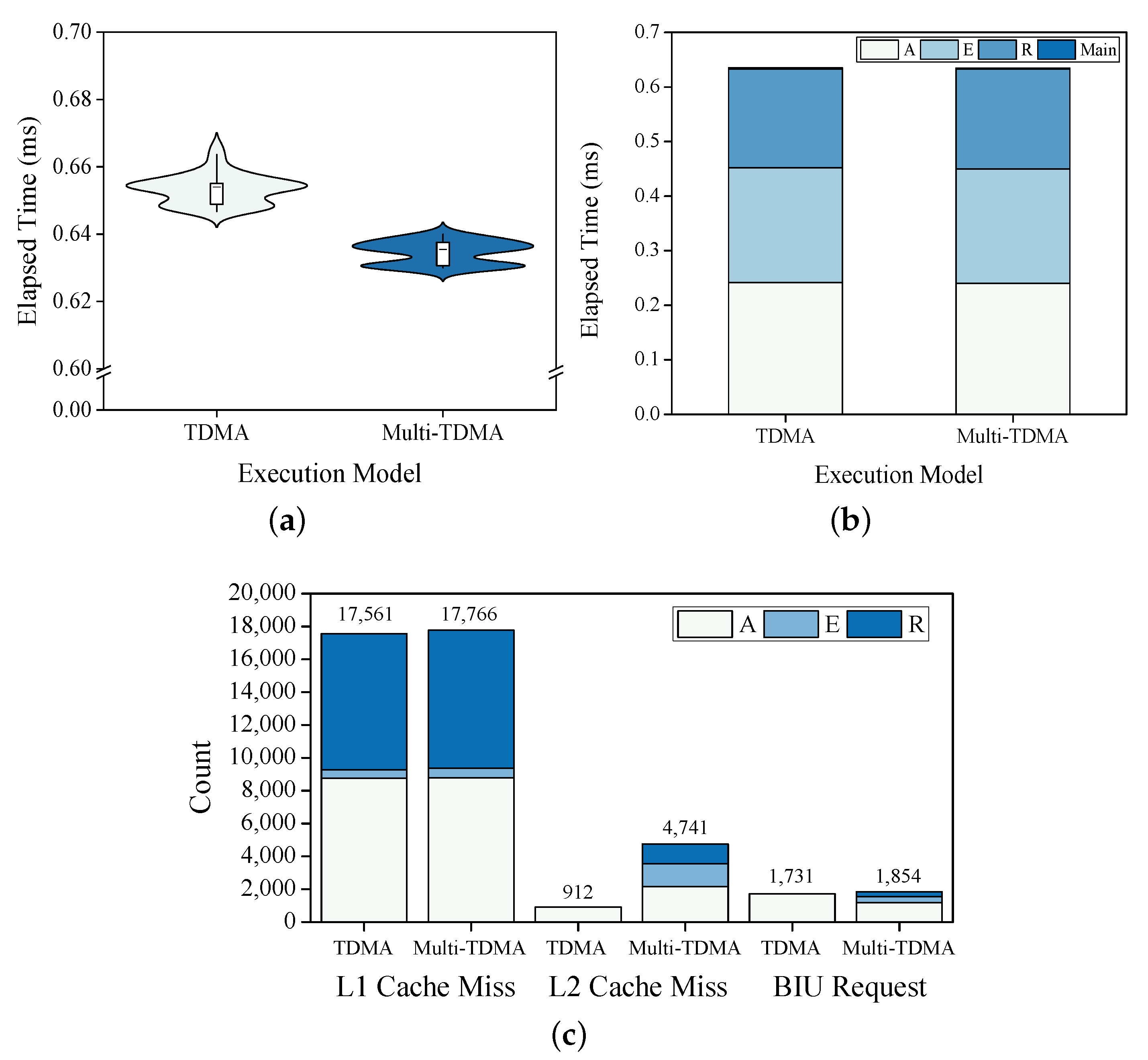
The result of applying the multi-TDMA model is shown in Figure 16. The execution times of the TDMA and multi-TDMA models were 0.65 ms and 0.63 ms, respectively on average, as shown in Figure 16a. The execution time for the A, E and R phases were 0.24 ms, 0.21 ms, and 0.18 ms respectively in both models, as shown in Figure 16b. The variations in the execution times of the models were 0.02 ms and 0.01 ms, respectively. These values are negligible in the cache misses results of Figure 16c, multi-TDMA showed the greatest value in all categories, particularly in the number of L2 cache misses. The L2 cache misses of the TDMA and multi-TDMA were 911 and 4741, respectively. Thus, the L2 cache misses in the multi-TDMA were approximately five times more. This caused more cache misses, as two cores accessed the memory simultaneously. In Figure 13b, when two cores ran the benchmark concurrently, there were about 2000 L2 cache misses, but about twice as many occurred in the multi-TDMA. In the previous experiment each core had one partition but in the multi-TDMA experiment, two partitions were allocated per core. We considered this difference as an overhead for partition scheduling. The number of the BIU requests in the multi-TDMA model was approximately 2000, which is similar to the TDMA model as shown in Figure 16c. Because the BIU requests differences in the multi-TDMA model were insignificant, it appears that this will not affect execution times.
Figure 16. Benchmark measurement results by TDMA and multi-TDMA. (a) Execution time. (b) Execution time by each phase. (c) Cache miss and BIU request.
To implement execution models with the quad-core, six pseudo-partitions and four pseudo-partitions were used for implementing TDMA and multi-TDMA, respectively. This reduced the memory space required to implement the multi-TDMA model. In addition, the major time frame of multi-TDMA was 4 ms, which is 50% shorter than in TDMA.
We show that multi-TDMA reduces the execution time by 1% and 23% respectively compared to TDMA and AER. The multi-TDMA model has more L2 cache misses than TDMA, but does not affect the execution times due to the minor increase in the BIU requests. Consequently, on this study’s the target hardware the multi-TDMA had a higher resource utilization than TDMA and shorter execution time than AER.

6. Conclusions

In this work, the task execution model was applied to reduce the interference due to memory sharing in a multicore avionics system. In safety-critical systems, such as avionics systems, the system must be deterministic by reducing the effects of such interference. We applied the proposed execution model to COTS hardware and commercial RTOS. We proposed a multicore flow control method with pseudo-partition and message queues to implement the TDMA and AER execution models in VxWorks 653. Then, we showed that the execution model reduced interference due to the shared memory access between cores.
We used the micro-benchmark to measure inter-core interference due to memory sharing in a multicore system. We measured the benchmark execution times, L1 and L2 cache misses, and the BIU requests in a quad-core architecture. We showed that the execution time variation increased when all cores accessed the memory and contention occurred. Based on this, when the TDMA model was applied, the non-determinism of the execution time was decreased by reducing the interference caused by shared memory. At this time, the L2 cache and the BIU requests decreased by about 60%. The AER model increased the execution time by about 20% due to the overhead for controlling the execution of processes running on each core. Memory queuing for the process’ phase control of this model caused context switches, resulting in more cache misses than in TDMA. However, in the AER model, the number of cache misses was 50% less than when four cores concurrently accessed the shared memory. We also proposed a multi-TDMA, in which two cores run concurrently while the target hardware bus processes two coherency granules in one cycle. Furthermore, our experiments demonstrated that the TDMA and multi-TDMA models produce insignificant differences in the execution times and cache misses. In particular, multi-TDMA unlike AER does not require phase control. Therefore, the multi-TDMA model has a higher utilization than the TDMA model and a shorter execution time than the AER model.

Author Contributions

Conceptualization, S.P. and H.K.; methodology, S.P. and H.K.; software, S.P.; writing—original draft preparation, S.P.; writing—review and editing, S.P. and H.K.; supervision, H.K.; project administration, M.-Y.K. and H.-K.K. All authors have read and agreed to the published version of the manuscript.

Funding

This work was supported by Agency for Defense Development under the contract UD180002ED.

Conflicts of Interest

The authors declare no conflict of interest.

References

  1. Huyck, P. ARINC 653 and multi-core microprocessors—Considerations and potential impacts. In Proceedings of the 2012 IEEE/AIAA 31st Digital Avionics Systems Conference (DASC), Williamsburg, VA, USA, 4–18 October 2012; pp. 1–16. [Google Scholar]
  2. Agrou, H.; Sainrat, P.; Gatti, M.; Toillon, P. Mastering the behavior of multi-core systems to match avionics requirements. In Proceedings of the 2012 IEEE/AIAA 31st Digital Avionics Systems Conference (DASC), Williamsburg, VA, USA, 4–18 October 2012; pp. 6E5-1–6E5-12. [Google Scholar]
  3. Liedtke, J.; Hartig, H.; Hohmuth, M. OS-controlled cache predictability for real-time systems. In Proceedings of the Third IEEE Real-Time Technology and Applications Symposium, Montreal, QC, Canada, 9–11 June 1997; pp. 213–224. [Google Scholar]
  4. Mittal, S. A survey of techniques for cache locking. ACM Trans. Des. Autom. Electron. Syst. (TODAES) 2016, 21, 1–24. [Google Scholar] [CrossRef]
  5. Yun, H.; Yao, G.; Pellizzoni, R.; Caccamo, M.; Sha, L. Memguard: Memory bandwidth reservation system for efficient performance isolation in multi-core platforms. In Proceedings of the 2013 IEEE 19th Real-Time and Embedded Technology and Applications Symposium (RTAS), Philadelphia, PA, USA, 9–11 April 2013; pp. 55–64. [Google Scholar]
  6. Awan, M.A.; Souto, P.F.; Bletsas, K.; Akesson, B.; Tovar, E. Mixed-criticality scheduling with memory bandwidth regulation. In Proceedings of the 2018 Design, Automation & Test in Europe Conference & Exhibition (DATE), Dresden, Germany, 19–23 March 2018; pp. 1277–1282. [Google Scholar]
  7. Pellizzoni, R.; Betti, E.; Bak, S.; Yao, G.; Criswell, J.; Caccamo, M.; Kegley, R. A predictable execution model for COTS-based embedded systems. In Proceedings of the 2011 17th IEEE Real-Time and Embedded Technology and Applications Symposium, Chicago, IL, USA, 11–14 April 2011; pp. 269–279. [Google Scholar]
  8. Yao, G.; Pellizzoni, R.; Bak, S.; Betti, E.; Caccamo, M. Memory-centric scheduling for multicore hard real-time systems. Real-Time Syst. 2012, 48, 681–715. [Google Scholar] [CrossRef]
  9. Durrieu, G.; Faugère, M.; Girbal, S.; Gracia Pérez, D.; Pagetti, C.; Puffitsch, W. Predictable Flight Management System Implementation on a Multicore Processor. In Proceedings of the Embedded Real Time Software (ERTS’14), Toulouse, France, 5–7 February 2014. [Google Scholar]
  10. Melani, A.; Bertogna, M.; Bonifaci, V.; Marchetti-Spaccamela, A.; Buttazzo, G. Memory-processor co-scheduling in fixed priority systems. In Proceedings of the 23rd International Conference on Real Time and Networks Systems, Lille, France, 4–6 November 2015; pp. 87–96. [Google Scholar]
  11. El-Sayed, N.; Mukkara, A.; Tsai, P.A.; Kasture, H.; Ma, X.; Sanchez, D. KPart: A hybrid cache partitioning-sharing technique for commodity multicores. In Proceedings of the 2018 IEEE International Symposium on High Performance Computer Architecture (HPCA), Vienna, Austria, 24–28 February 2018; pp. 104–117. [Google Scholar]
  12. Yun, H.; Mancuso, R.; Wu, Z.P.; Pellizzoni, R. PALLOC: DRAM bank-aware memory allocator for performance isolation on multicore platforms. In Proceedings of the 2014 IEEE 19th Real-Time and Embedded Technology and Applications Symposium (RTAS), Berlin, Germany, 15–17 April 2014; pp. 155–166. [Google Scholar]
  13. Diniz, N.; Rufino, J. ARINC 653 in space. In Proceedings of the DASIA 2005—Data Systems in Aerospace, Edinburgh, Scotland, 30 May–2 June 2005; Volume 602. [Google Scholar]
  14. Schranzhofer, A.; Chen, J.J.; Thiele, L. Timing analysis for TDMA arbitration in resource sharing systems. In Proceedings of the 2010 16th IEEE Real-Time and Embedded Technology and Applications Symposium, Stockholm, Sweden, 12–15 April 2010; pp. 215–224. [Google Scholar]
  15. Park, S.; Song, D.; Jang, H.; Kwon, M.Y.; Lee, S.H.; Kim, H.K.; Kim, H. Interference Analysis of Multicore Shared Resources with a Commercial Avionics RTOS. In Proceedings of the 2019 IEEE/AIAA 38th Digital Avionics Systems Conference (DASC), San Diego, CA, USA, 8–12 September 2019; pp. 1–10. [Google Scholar]
  16. Guthaus, M.R.; Ringenberg, J.S.; Ernst, D.; Austin, T.M.; Mudge, T.; Brown, R.B. MiBench: A free, commercially representative embedded benchmark suite. In Proceedings of the Fourth Annual IEEE International Workshop on Workload Characterization. WWC-4 (Cat. No.01EX538), Austin, TX, USA, 2 December 2001; pp. 3–14. [Google Scholar]
  17. Watkins, C.B.; Walter, R. Transitioning from federated avionics architectures to integrated modular avionics. In Proceedings of the 2007 IEEE/AIAA 26th Digital Avionics Systems Conference, Dallas, TX, USA, 21–25 October 2007; pp. 2.A.1-1–2.A.1-10. [Google Scholar]
  18. Littlefield-Lawwill, J.; Kinnan, L. System considerations for robust time and space partitioning in integrated modular avionics. In Proceedings of the 2008 IEEE/AIAA 27th Digital Avionics Systems Conference, St. Paul, MN, USA, 26–30 October 2008; pp. 1.B.1-1–1.B.1-11. [Google Scholar]
  19. Bieber, P.; Boniol, F.; Boyer, M.; Noulard, E.; Pagetti, C. New Challenges for Future Avionic Architectures. AerospaceLab 2012, 4, 1–10. [Google Scholar]
  20. VanderLeest, S.H. ARINC 653 hypervisor. In Proceedings of the 29th Digital Avionics Systems Conference, Salt Lake City, UT, USA, 3–7 October 2010; pp. 5.E.2-1–5.E.2-20. [Google Scholar]
  21. Gaska, T.; Werner, B.; Flagg, D. Applying virtualization to avionics systems—The integration challenges. In Proceedings of the 29th Digital Avionics Systems Conference, Salt Lake City, UT, USA, 3–7 October 2010; pp. 5.E.1-1–5.E.1-19. [Google Scholar]
  22. Prehofer, C.; Horst, O.; Dodi, R.; Geven, A.; Kornaros, G.; Montanari, E.; Paolino, M. Towards Trusted Apps platforms for open CPS. In Proceedings of the 2016 3rd International Workshop on Emerging Ideas and Trends in Engineering of Cyber-Physical Systems (EITEC), Vienna, Austria, 11 April 2016; pp. 23–28. [Google Scholar]
  23. Girbal, S.; Jean, X.; Le Rhun, J.; Pérez, D.G.; Gatti, M. Deterministic platform software for hard real-time systems using multi-core COTS. In Proceedings of the 2015 IEEE/AIAA 34th Digital Avionics Systems Conference (DASC), Prague, Czech Republic, 13–17 September 2015; pp. 8D4-1–8D4-15. [Google Scholar]
  24. Jean, X.; Gatti, M.; Faura, D.; Pautet, L.; Robert, T. A software approach for managing shared resources in multicore IMA systems. In Proceedings of the 2013 IEEE/AIAA 32nd Digital Avionics Systems Conference (DASC), East Syracuse, NY, USA, 5–10 October 2013; pp. 7D1-1–7D1-15. [Google Scholar]
  25. Löfwenmark, A.; Nadjm-Tehrani, S. Challenges in future avionic systems on multi-core platforms. In Proceedings of the 2014 IEEE International Symposium on Software Reliability Engineering Workshops, Naples, Italy, 3–6 November 2014; pp. 115–119. [Google Scholar]
  26. Jean, X.; Faura, D.; Gatti, M.; Pautet, L.; Robert, T. Ensuring robust partitioning in multicore platforms for ima systems. In Proceedings of the 2012 IEEE/AIAA 31st Digital Avionics Systems Conference (DASC), Williamsburg, VA, USA, 4–18 October 2012; pp. 7A4-1–7A4-9. [Google Scholar]
  27. Strunk, E.A.; Knight, J.C.; Aiello, M.A. Distributed reconfigurable avionics architectures. In Proceedings of the 23rd Digital Avionics Systems Conference (IEEE Cat. No. 04CH37576), Salt Lake City, UT, USA, 28 October 2004; Volume 2, p. 10.B.4-101. [Google Scholar]
  28. Andrei, A.; Eles, P.; Peng, Z.; Rosen, J. Predictable implementation of real-time applications on multiprocessor systems-on-chip. In Proceedings of the 21st International Conference on VLSI Design (VLSID 2008), Hyderabad, India, 4–8 January 2008; pp. 103–110. [Google Scholar]
  29. Maia, C.; Nogueira, L.; Pinho, L.M.; Pérez, D.G. A closer look into the aer model. In Proceedings of the 2016 IEEE 21st International Conference on Emerging Technologies and Factory Automation (ETFA), Berlin, Germany, 6–9 September 2016; pp. 1–8. [Google Scholar]
  30. Maia, C.; Nelissen, G.; Nogueira, L.; Pinho, L.M.; Pérez, D.G. Schedulability analysis for global fixed-priority scheduling of the 3-phase task model. In Proceedings of the 2017 IEEE 23rd International Conference on Embedded and Real-Time Computing Systems and Applications (RTCSA), Hsinchu, Taiwan, 16–18 August 2017; pp. 1–10. [Google Scholar]
  31. Parkinson, P.; Kinnan, L. Safety-critical software development for integrated modular avionics. Embed. Syst. Eng. 2003, 11, 40–41. [Google Scholar]
  32. Suhendra, V.; Mitra, T. Exploring locking & partitioning for predictable shared caches on multi-cores. In Proceedings of the 45th annual Design Automation Conference, Anaheim, CA, USA, 8–13 June 2008; pp. 300–303. [Google Scholar]
  33. Ding, H.; Liang, Y.; Mitra, T. WCET-centric dynamic instruction cache locking. In Proceedings of the 2014 Design, Automation & Test in Europe Conference & Exhibition (DATE), Dresden, Germany, 24–28 March 2014; pp. 1–6. [Google Scholar]
  34. Puaut, I.; Decotigny, D. Low-complexity algorithms for static cache locking in multitasking hard real-time systems. In Proceedings of the 23rd IEEE Real-Time Systems Symposium, 2002. RTSS 2002, Austin, TX, USA, 3–5 December 2002; pp. 114–123. [Google Scholar]
  35. Dugo, A.T.A.; Lefoul, J.B.; De Magalhaes, F.G.; Assal, D.; Nicolescu, G. Cache locking content selection algorithms for ARINC-653 compliant RTOS. ACM Trans. Embed. Comput. Syst. (TECS) 2019, 18, 1–20. [Google Scholar] [CrossRef]
  36. Vera, X.; Lisper, B.; Xue, J. Data Cache Locking for Tight Timing Calculations. ACM Trans. Embed. Comput. Syst. 2007, 7. [Google Scholar] [CrossRef]
  37. Gracioli, G.; Alhammad, A.; Mancuso, R.; Fröhlich, A.A.; Pellizzoni, R. A Survey on Cache Management Mechanisms for Real-Time Embedded Systems. ACM Comput. Surv. 2015, 48. [Google Scholar] [CrossRef]
  38. Ye, Y.; West, R.; Cheng, Z.; Li, Y. COLORIS: A dynamic cache partitioning system using page coloring. In Proceedings of the 2014 23rd International Conference on Parallel Architecture and Compilation Techniques (PACT), Edmonton, AB, Canada, 24–27 August 2014; pp. 381–392. [Google Scholar] [CrossRef]
  39. Pak, E.; Lim, D.; Ha, Y.M.; Kim, T. Shared Resource Partitioning in an RTOS. In Proceedings of the 13th International Workshop on Operating Systems Platforms for Embedded Real-Time Applications (OSPERT), Dubrovnik, Croatia, 14 April 2017; Volume 14. [Google Scholar]
  40. Alhammad, A.; Wasly, S.; Pellizzoni, R. Memory efficient global scheduling of real-time tasks. In Proceedings of the 21st IEEE Real-Time and Embedded Technology and Applications Symposium, Seattle, WA, USA, 13–16 April 2015; pp. 285–296. [Google Scholar]
  41. Rivas, J.M.; Goossens, J.; Poczekajlo, X.; Paolillo, A. Implementation of Memory Centric Scheduling for COTS Multi-Core Real-Time Systems. In Proceedings of the 31st Euromicro Conference on Real-Time Systems (ECRTS 2019). Schloss Dagstuhl-Leibniz-Zentrum fuer Informatik, Stuttgart, Germany, 9–12 July 2019. [Google Scholar]
  42. Mancuso, R.; Dudko, R.; Caccamo, M. Light-PREM: Automated software refactoring for predictable execution on COTS embedded systems. In Proceedings of the 2014 IEEE 20th International Conference on Embedded and Real-Time Computing Systems and Applications, Chongqing, China, 20–22 August 2014; pp. 1–10. [Google Scholar]
  43. Fort, F.; Forget, J. Code generation for multi-phase tasks on a multi-core distributed memory platform. In Proceedings of the 2019 IEEE 25th International Conference on Embedded and Real-Time Computing Systems and Applications (RTCSA), Hangzhou, China, 18–21 August 2019; pp. 1–6. [Google Scholar]
  44. Girbal, S.; Pérez, D.G.; Le Rhun, J.; Faugère, M.; Pagetti, C.; Durrieu, G. A complete toolchain for an interference-free deployment of avionic applications on multi-core systems. In Proceedings of the 2015 IEEE/AIAA 34th Digital Avionics Systems Conference (DASC), Prague, Czech Republic, 13–17 September 2015; pp. 7A2-1–7A2-14. [Google Scholar]
  45. Perret, Q.; Maurere, P.; Noulard, E.; Pagetti, C.; Sainrat, P.; Triquet, B. Temporal isolation of hard real-time applications on many-core processors. In Proceedings of the 2016 IEEE Real-Time and Embedded Technology and Applications Symposium (RTAS), Vienna, Austria, 11–14 April 2016; pp. 1–11. [Google Scholar]
  46. Yun, H.; Pellizzon, R.; Valsan, P.K. Parallelism-aware memory interference delay analysis for COTS multicore systems. In Proceedings of the 2015 27th Euromicro Conference on Real-Time Systems, Lund, Sweden, 7–10 July 2015; pp. 184–195. [Google Scholar]
  47. Agrawal, A.; Fohler, G.; Freitag, J.; Nowotsch, J.; Uhrig, S.; Paulitsch, M. Contention-aware dynamic memory bandwidth isolation with predictability in cots multicores: An avionics case study. In Proceedings of the 29th Euromicro Conference on Real-Time Systems (ECRTS 2017), Dubrovnik, Croatia, 27–30 June 2017; Schloss Dagstuhl-Leibniz-Zentrum fuer Informatik: Wadern, Germany. [Google Scholar]
Article Metrics

Citations

Article Access Statistics

Multiple requests from the same IP address are counted as one view.