You are currently viewing a new version of our website. To view the old version click .
Applied Sciences
  • Article
  • Open Access

9 November 2020

Investigation of 2D-WH/TS OCDMA Code Stability in Systems with SOA-Based Device


,
,
,
and
1
Electronic and Electrical Engineering Department, University of Strathclyde, Glasgow G1 1XQ, UK
2
Department of Telecommunication Engineering, Mehran University of Engineering & Technology, Jamshoro 76062, Pakistan
3
Modeling and Applied Social Sciences Centre, Federal University of ABC, Santo André 09210-580, Brazil
4
Department of Engineering, Hofstra University, Hempstead, NY 11549, USA
This article belongs to the Special Issue Applications of Semiconductor Optical Amplifiers II

Abstract

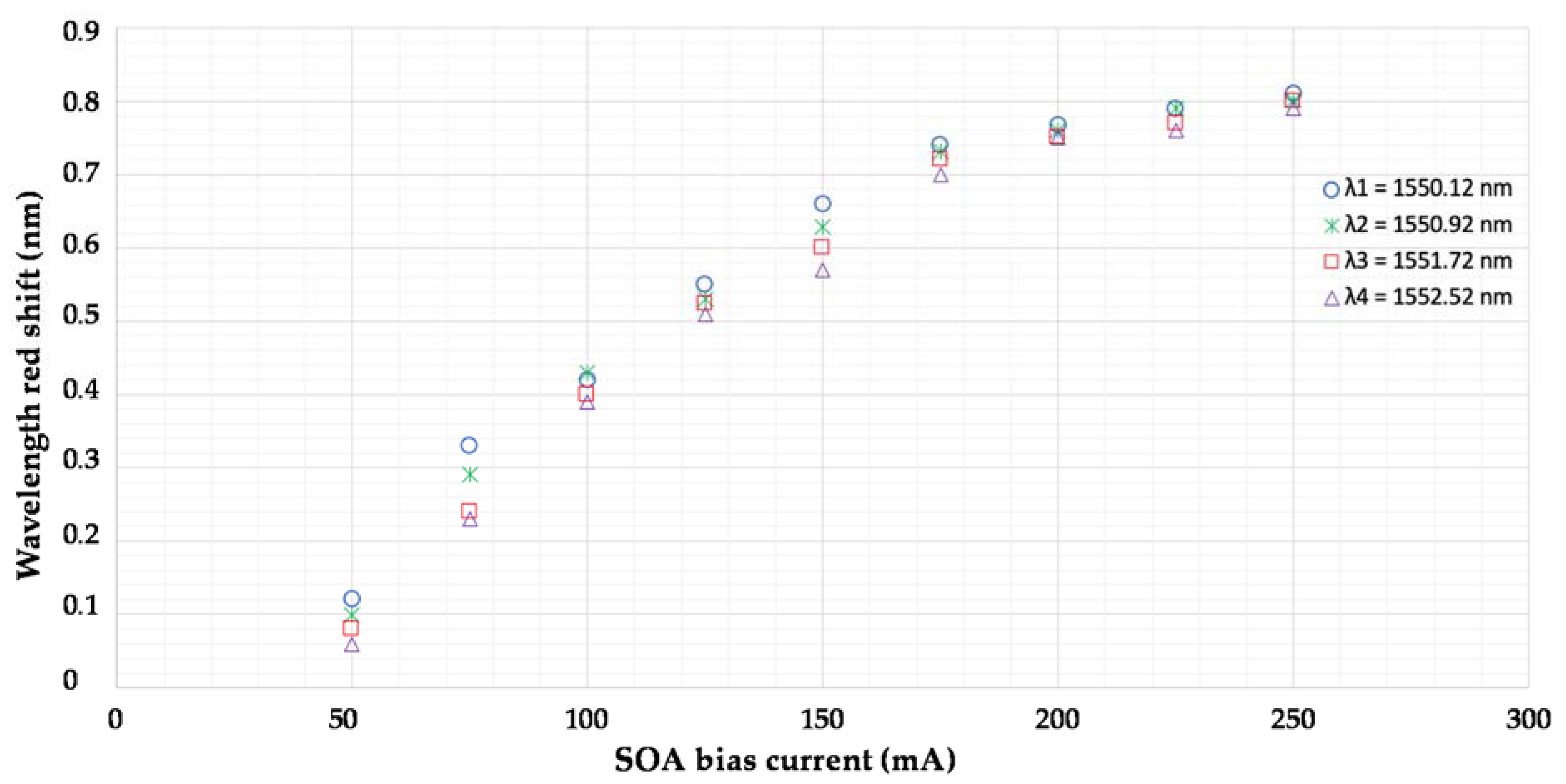
This paper investigates for the first time how the implementation of semiconductor optical amplifier (SOA)-based devices in photonic networks can negatively impact the integrity of two-dimensional wavelength-hopping time-spreading (2D-WH/TS) optical code-division multiple access (OCDMA) codes based on multi-wavelength picosecond code carriers. It is demonstrated and confirmed by simulations that the influence of an SOA under driving currents of 50 mA to 250 mA causes a 0.08 to 0.8 nm multi-wavelength picosecond code carriers’ wavelength redshift. The results obtained are then used to calculate the degradation of OCDMA system performance in terms of the probability of error Pe and the decrease in the number of simultaneous users. It is shown that, when the SOA-induced 0.8 nm code carriers redshift becomes equal to the code carries wavelength channel spacing, the (8,53)-OCDMA system performs only as a (7,53)-OCDMA system, and the number of simultaneous users drops from 14 to 10 or 84 to 74 with the forward error correction (FEC) Pe of 10−9, respectively. The impact of the 0.8 nm redshift is then shown on a (4,53)-OCDMA system, where it causes a drop in the number of simultaneous users from 4 to 3 or 37 to 24 with the FEC Pe of 10−9, respectively.

1. Introduction

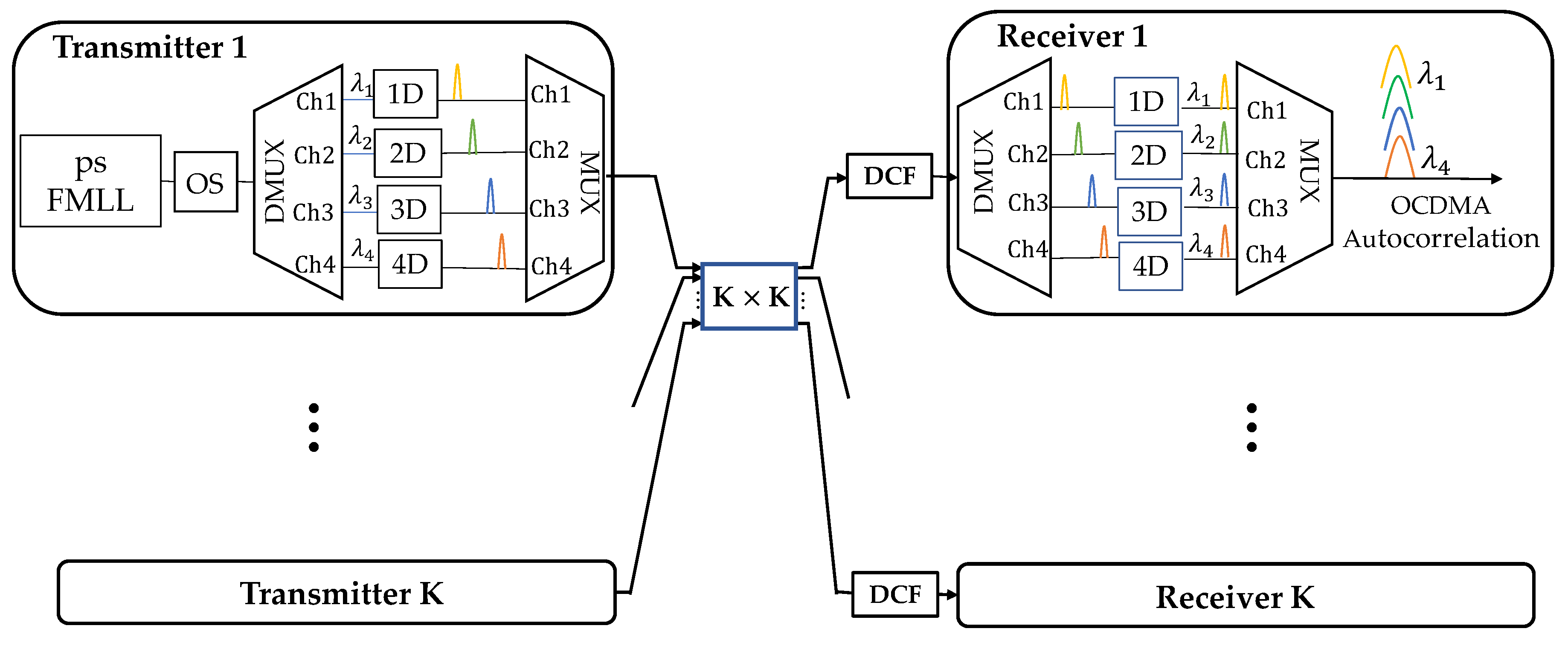
Incoherent optical code-division multiple access (OCDMA) is a promising multiplexing technique known for its soft blocking capabilities that allows a trade-off between the system bit-error-rate (BER) and number of users [1]. To ensure the optimal operation of an OCDMA system, it is necessary to maintain the integrity and fidelity of optical codes during system operation. For instance, the use of two-dimensional (2D) wavelength-hopping time-spreading (WH/TS) incoherent OCDMA with implemented carrier-hopping prime code (CHPC) [2] (a class of 2D asynchronous codes that support wavelength hopping within time spreading over the Galois field of prime numbers with zero autocorrelation side-lobes and periodic cross correlation functions of at most one) will ensure minimal multiple-access interference. The code offers good cardinality and supports a large number of simultaneous users. To further improve the code scalability, 2D-WH/TS coding uses a set of wavelengths as the code carries with a temporal duration of a few picoseconds [3].
In past decades, semiconductor optical amplifiers (SOAs) were developed and demonstrated to support different tasks and functionalities in optical systems, networks, and applications including data centres [4,5,6,7]. A great deal of switching architectures utilizing SOAs in different configurations such as 2 × 2 multi-cascaded switch fabrics, cross-point matrices, for broadcast and select, wavelength selection [8], and DeMux operation [9] have already been successfully demonstrated.
The severity of gain recovery time on 2D-WH/TS OCDMA systems using SOAs is evident even at low data rates [10]. This is because of the nature of the code carriers’ time-spreading. The code carriers are spread with different time delays when forming a unique code signature for each user. The SOA’s response time to incoming code is related to carrier lifetime, which in turn determines the SOA gain recovery [11]. A slow SOA gain recovery time poses a stringent limitation on the choices of the 2D-WH/TS code spreading, thus limiting the overall system scalability, including the number of simultaneous users. For the sake of illustration, even a 2.5 Gbit/s OCDMA system, if using a temporal code carriers’ separation of 25 ps (i.e., 40 OCDMA GHz/s chip rate), will experience the equivalent SOA limitations of a 40 Gbit/s on-off keying (OOK) system.
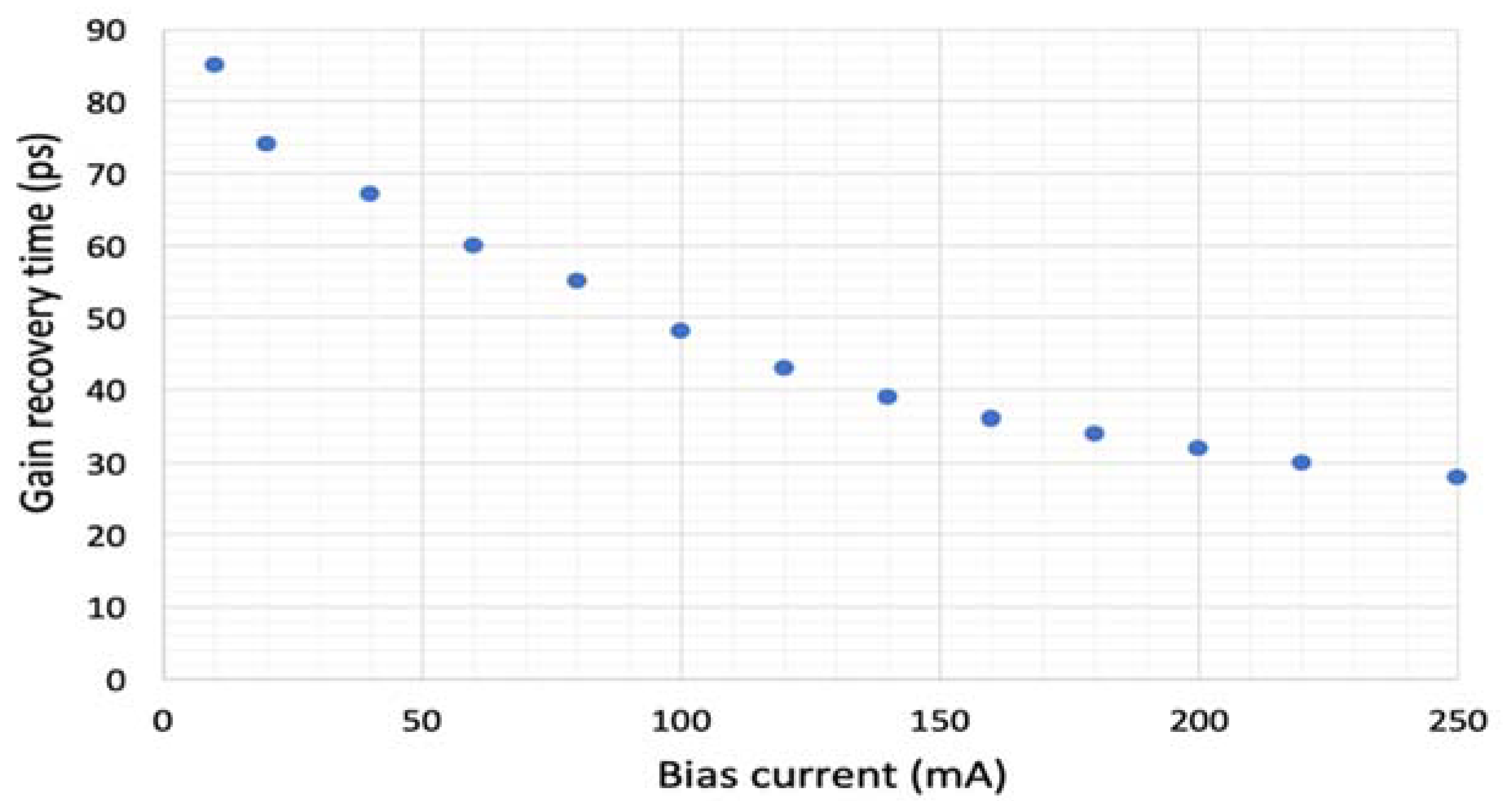
Many techniques have been developed and demonstrated to address and improve the gain recovery time of SOAs [11,12] and these techniques fall into three categories. In the first category, a continuous wave beam is utilized to saturate the SOA at the operating wavelength, which lies in the SOA’s spectral gain region or near the transparency point. The second method comprises the use of quantum wells or quantum dots semiconductors [11]. The third technique utilizes the SOA’s amplified spontaneous emission (ASE) when driving the SOA with a high bias current into saturation. In [12], this method was used to reduce the gain recovery time from 200 ps down to 10 ps with the caveat that signal quality margins were somewhat sacrificed in situations where the SOA was followed by spectral slicing [13]. As the 2D-WH/TS systems can deploy both SOAs and spectral slicing, more investigations are required.
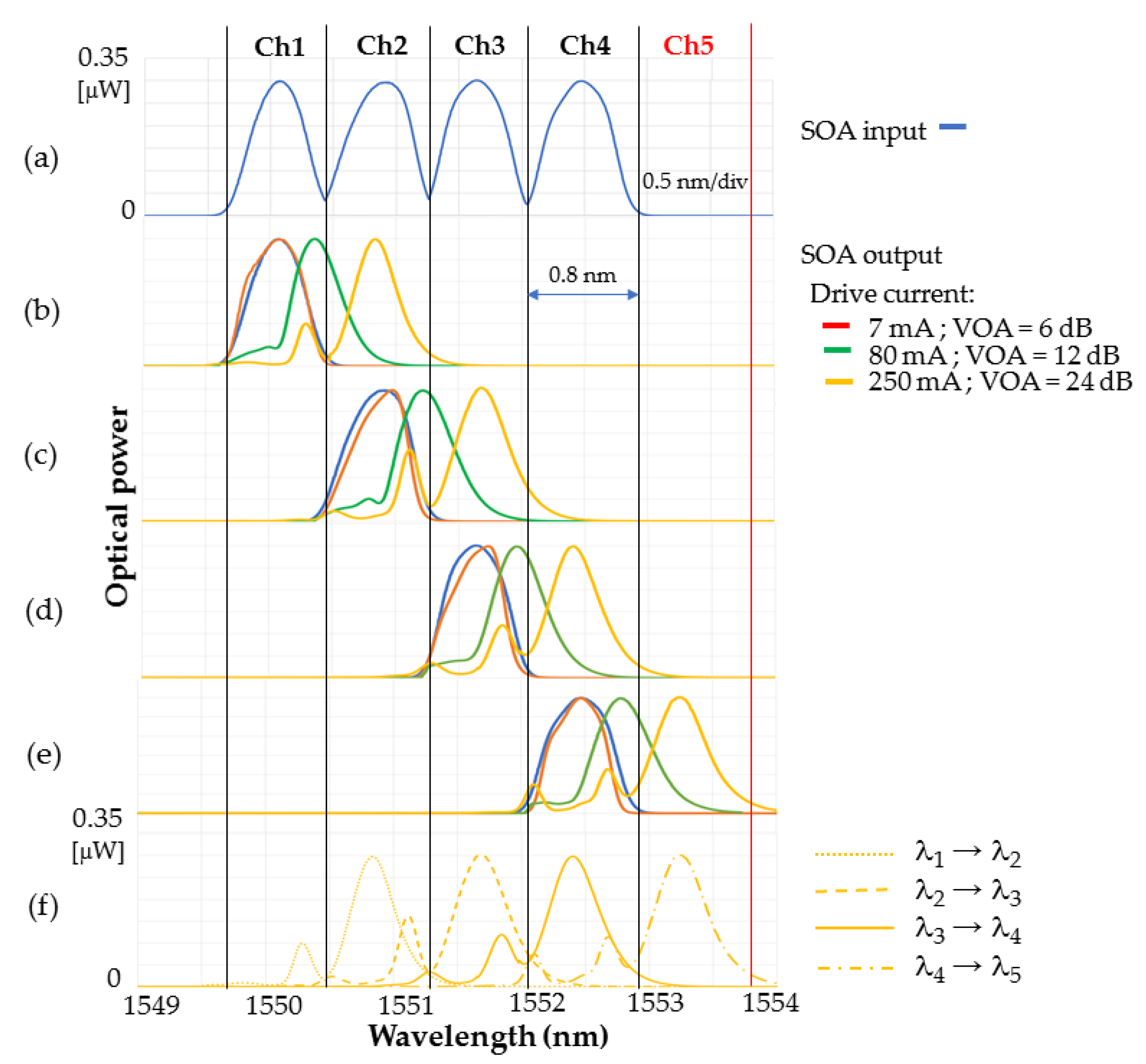
The paper is organized as follows. In Section 2, the impact of SOA-induced redshift on multi wavelength picosecond code carriers under different bias conditions is investigated, experimentally demonstrated, and then confirmed by simulations. In Section 3, the impact of the SOA operating under high bias current/gain conditions is demonstrated on the 2D-WH/TS OCDMA code integrity. The overall performance (the probability of error and the maximum number of simultaneous users) of two different 2D-WH/TS OCDMA systems deploying the SOA is calculated. The results obtained are discussed in Section 4 and then summarized in the Conclusion.

3. Impact of SOA High Bias Current/Gain on 2D-WH/TS OCDMA Prime Code Fidelity

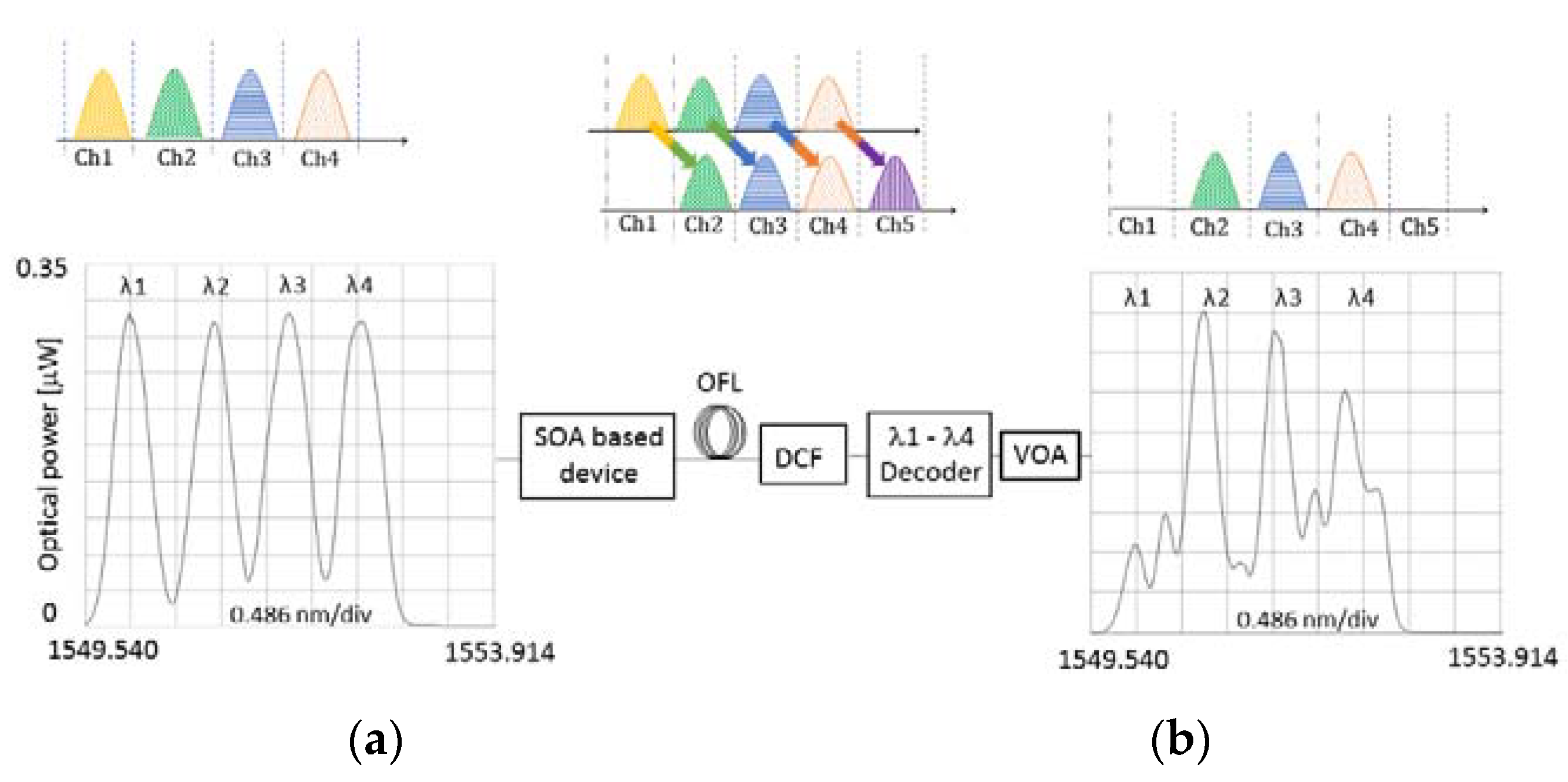
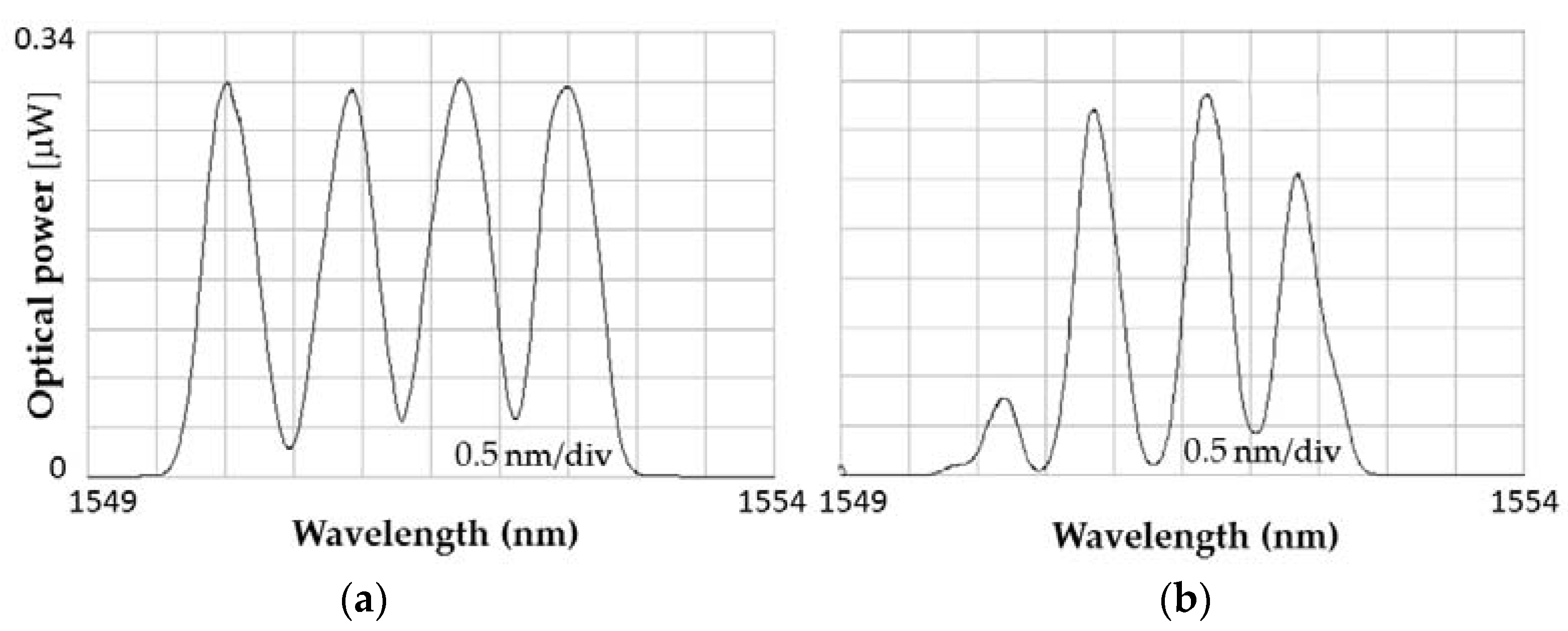
Here, the investigation was repeated by replacing the DWDM-based OCDMA encoder and decoder with a commercial fiber Bragg grating-based encoder and decoder manufactured by OKI, Japan. The implemented 2D-WH/TS OCDMA carrier-hopping prime code (CHPC) [2] is optimised to ensure that the periodic cross correlation function is at most one [2]. This minimises the multiple-access interference. The encoder/decoder pair uses four wavelength code carriers from a code space (w, N) = (4, 53), where w indicates a number of wavelength code carriers with a channel spacing of 100 GHz and N is the number of chips [3] per the bit period. The code signature (1- λ 2 , 21- λ 4 , 27- λ 1 , 39- λ 3 ) guarantees a minimal separation between adjacent code carriers of more than 30 ps. The SOA bias current/gain and code average/code carriers’ peak power at the SOA input were 250 mA/24 dB and 4 mW/57 mW, respectively, resulting in a 100 GHz/0.8 nm code carriers’ redshift. The results obtained are shown in Figure 7. Figure 7a is the OCDMA code optical spectrum recorded by the OSA without, and Figure 7b with an SOA being part of the chromatic dispersion compensated transmission link. By comparing both results, it can be observed that wavelength code carriers were red-shifted by 100 GHz/ 0.8 nm. As explained in Section 2, because of this redshift, λ 1 became λ 2 , λ 2 λ 3 , λ 3 λ 4 , and λ 4 λ 5 . However, the OCDMA fiber Bragg grating (FBG) decoder was designed to handle only ( λ 1 , λ 2 , λ 3 , λ 4 ). Therefore, the wavelength λ 5 that resulted from the λ 4 λ 5 redshift is ‘missing’ in Figure 7b. As a consequence, the resulting OCDMA autocorrelation height will be reduced by one to its new value w − 1. This code weight reduction will decrease the signal-to-noise ratio (SNR) and cause deterioration in the OCDMA system bit-error-rate (BER), which in turn reduces the number of simultaneous users. The performance degradation resulting from the code carriers’ red-shifting can be theoretically evaluated using Equation (1) to calculate the probability of error Pe. Equation (1) is valid for an OCDMA receiver with hard limiting capabilities [3]. Pe can be used to evaluate the number of simultaneous users (K).
P e = 1 2 i = 0 w ( 1 ) w i w ! [ i !   ( w i ) ! ] ( q 0 + i q 1 1 w ) k 1
Figure 7. Impact of SOA on 2D-WH/TS code based on four-wavelength code carriers as recorded by an optical spectrum analyser: (a) without and (b) with the SOA present in the chromatic-dispersion (CD) compensated transmission link.
Here, q 0 = 1 q 1 , q 1 = w 2 2 N L   , w is the code weight, L is a number of wavelength code carriers (in this case w = L), and N is the number of chips.
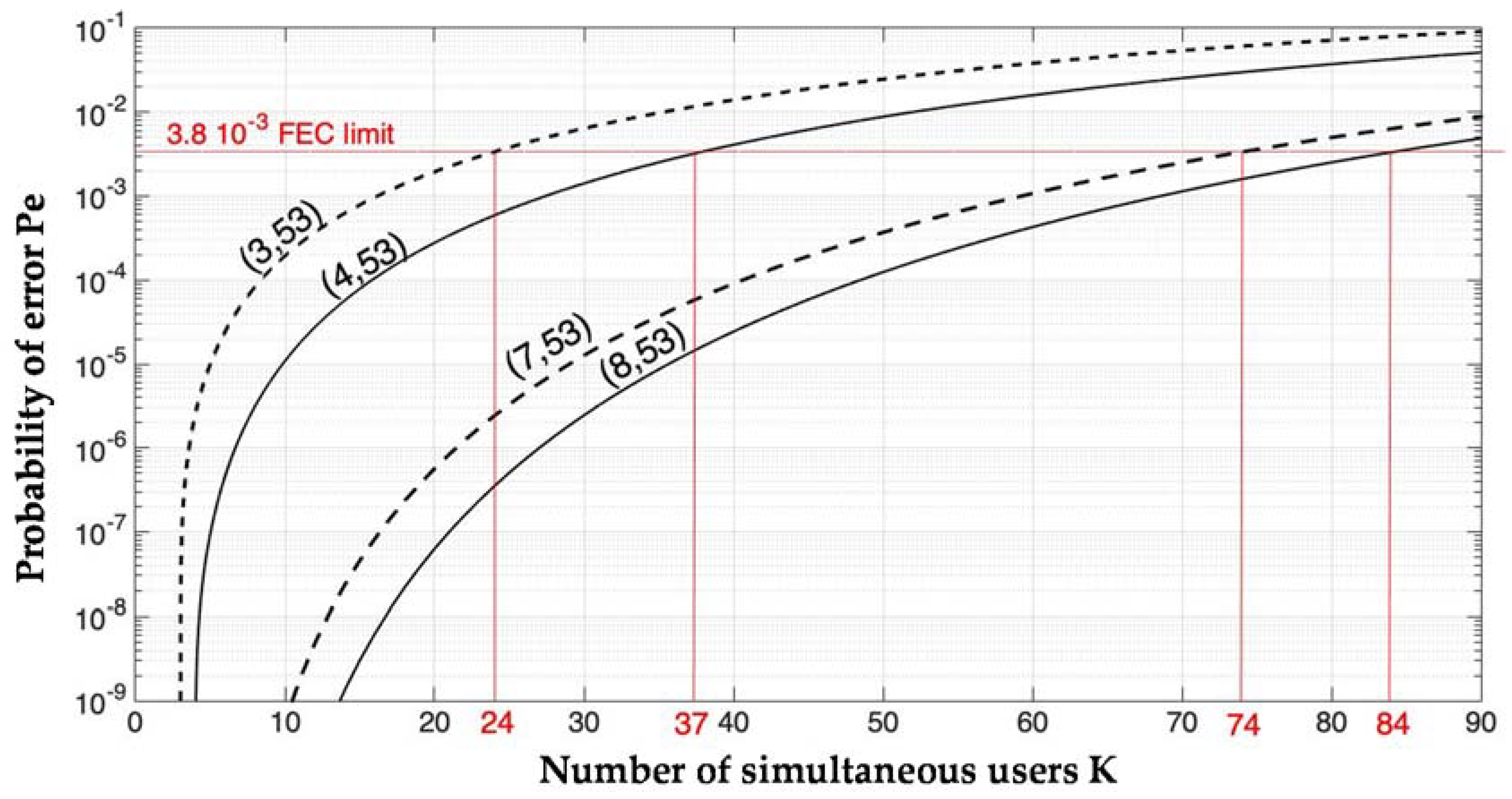
The results obtained are shown in Figure 8. Solid lines show the probability of error of two different 2D-WH/TS OCDMA systems: one that has four wavelength code carriers (w = 4) and N = 53 chips, denoted by (w, N) = (4, 53), and the second, having w = 8 and N = 53, denoted by (8, 53). Dashed lines represent calculations of the respective degraded Pe due to the code carrier redshift, which causes autocorrelation peak reduction from w to w − 1 (i.e., from 4 to 3 and from 8 to 7, respectively).
Figure 8. Probability of error as a function of K simultaneous users for a (4, 53)/(3, 53) and (8, 53)/(7, 53) 2D-WH/TS OCDMA system without/with the deployment of an SOA, respectively, the latter causing a one channel code carriers’ redshift.

4. Discussion

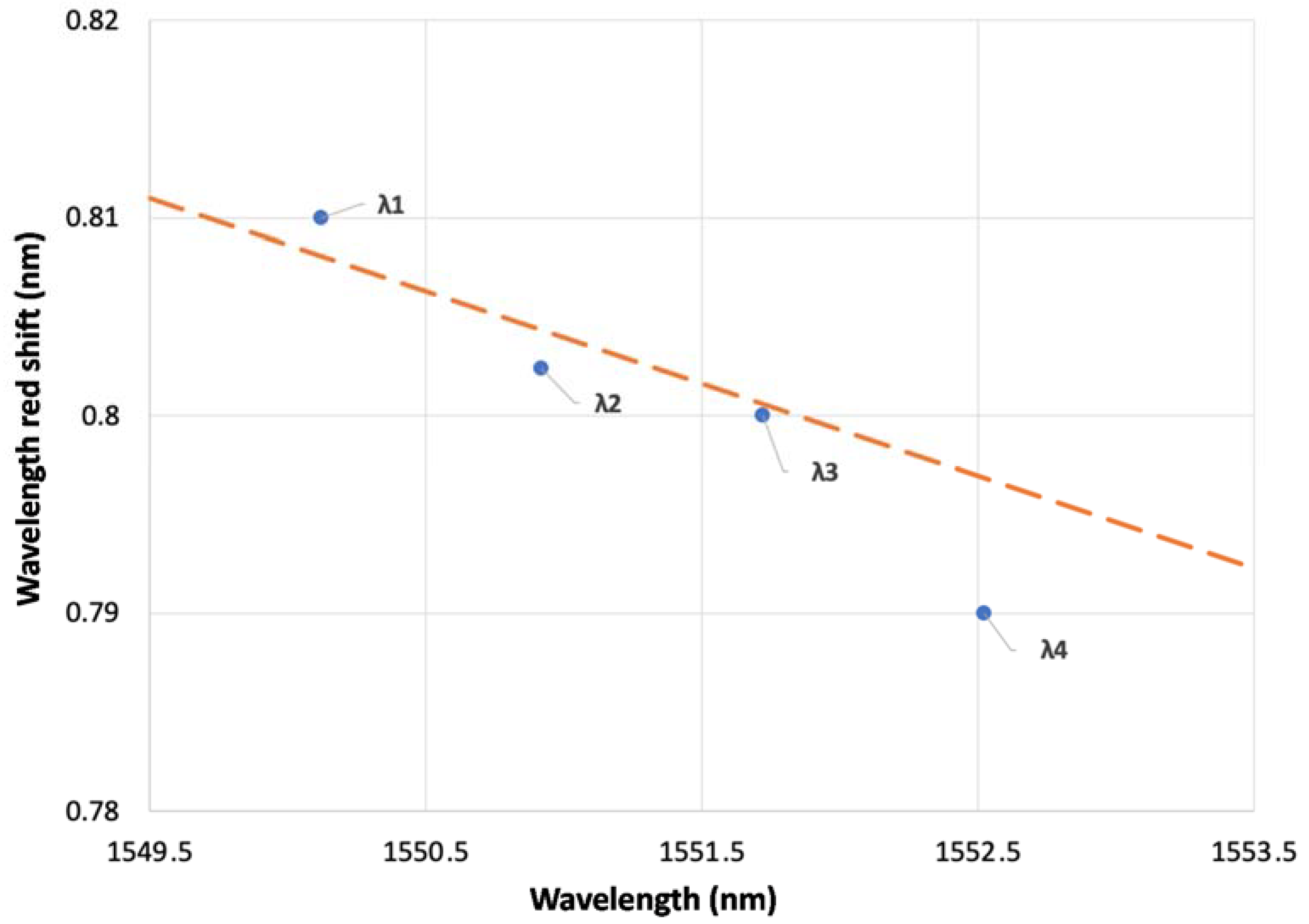
As shown in Figure 5, the SOA driving current variations between 50 mA and 250 mA will result in a 2D-WH/TS code carriers’ redshift from 0.08 to 0.8 nm. By analysing the results in Figure 8, the impact of the SOA-induced redshift on the OCDMA system performance and number of simultaneous OCDMA users was found. First, the OCDMA system performance was determined for the (8, 53) OCDMA without the presence of SOA. The system supports 14 simultaneous users, each operating at Pe of 10−9. Thanks to OCDMA soft-blocking capabilities, one can readily trade the system’s Pe for a number of simultaneous users and then take advantage of the implemented hard-decision forward error correction (HD-FEC) with 7% overhead. By doing so, the number of simultaneous users will be increased (up to 84) by allowing a drop in the Pe to 3.8 × 10⁻³ and then in turn using FEC to return the Pe back to 10−9 (see Figure 8). However, the SOA present in the transmission link driven at 250 mA leads to the code carriers’ redshift of 0.8 nm equal to their channel spacing. As a consequence, the system’s OCDMA autocorrelation is reduced by 1 (from 8 to 7) and the (8, 53)-OCDMA system now performs only as (7, 53)-OCDMA. This will result a drop in the number of simultaneous users from 14 to 10 or 84 to 74 with the FEC Pe of 10−9, respectively. Similar performance degradation is demonstrated for a (4, 53)-OCDMA when the system operates under the same experimental conditions. The SOA’s 250 mA driving current-induced redshift of 0.8 nm equal to code carriers channel spacing causes a drop in the number of simultaneous users from 4 to 3 or 37 to 24 with the FEC Pe of 10−9, respectively. Thus, the (4, 53)-OCDMA system only performs as (3, 53)-OCDMA to maintain the Pe of 10−9.

5. Conclusions

The impact of SOA-induced wavelength redshift on 2D-WH/TS multi wavelength picosecond code carriers was investigated for the first time. For the SOA bias current of 50 to 250 mA, the amount of induced redshift was found to be 0.08 to 0.8 nm. Next, the detrimental effect of 0.8 nm redshift on (8, 53)- and (4, 53)-WH/TS OCDMA systems was investigated. It can be stated that, when the amount of SOA-induced redshift is equal to the code carriers’ wavelength channel spacing, then a (w, N)-WH/TS OCDMA system will only perform as a (w − 1, N)-WH/TS OCDMA system to maintain the Pe of 10−9.

Author Contributions

Conceptualization, U.A.K. and A.L.S.; formal analysis, M.A., A.L.S. and I.G.; investigation, M.A. and U.A.K.; Methodology, M.A.; resources, I.G.; Software, M.A. and W.C.K.; supervision, I.G.; validation, M.A., W.C.K. and I.G.; writing—original draft, M.A.; writing—review & editing, A.L.S., W.C.K. and I.G. All authors have read and agreed to the published version of the manuscript.

Funding

This research was funded by the European Union’s Horizon 2020 Research and Innovation Program under the Marie Skłodowska-Curie under Grant 734331.

Conflicts of Interest

The authors declare no conflict of interest.

References

  1. Yang, G.-C.; Kwong, W.C. Prime Codes with Applications to CDMA Optical and Wireless Networks; Artech House: Norwood, MA, USA, 2002. [Google Scholar]
  2. Yadav, R. Design and performance analysis of 1D, 2D and 3D prime sequence code family for optical CDMA network. J. Opt. 2016, 45, 343–356. [Google Scholar] [CrossRef]
  3. Kwong, W.C.; Yang, G.-C. Optical Coding Theory with Prime; CRC Press: New York, NY, USA, 2013. [Google Scholar]
  4. Wonfor, A.; Wang, H.; Penty, R.V.; White, I.H. Large port count high-speed optical switch fabric for use within datacentres. J. Opt. Commun. Netw. 2011, 3, A32–A39. [Google Scholar] [CrossRef]
  5. Singh, S.; Singh, A.; Kaler, R.S. Performance evaluation of EDFA, RAMAN and SOA optical amplifier for WDM systems. Opt. ELSEVIER 2013, 124, 95–101. [Google Scholar] [CrossRef]
  6. Ahmed, M.S.; Glesk, I. Management of OCDMA Auto-Correlation Width by Chirp Manipulation Using SOA. IEEE Photonics Technol. Lett. 2018, 30, 785–788. [Google Scholar] [CrossRef]
  7. Dong, J.; Zhang, X.; Wang, F.; Hong, W.; Huang, D. Experimental study of SOA-based NRZ-to-PRZ conversion and distortion elimination of amplified NRZ signal using spectral filtering. Opt. Commun. 2008, 281, 5618–5624. [Google Scholar] [CrossRef]
  8. Stabile, R.; Albores-Meija, A.; Rohit, A.; Williams, K.A. Integrated optical switch matrices for packet data networks. Microsyst. Nanoeng. 2016, 2, 15042. [Google Scholar] [CrossRef] [PubMed]
  9. Glesk, I.; Sokoloff, J.P.; Prucnal, P.R. Demonstration of all-optical demultiplexing of TDM data at 250 Gbit/s. Electron. Lett. 1994, 30, 339–341. [Google Scholar] [CrossRef]
  10. Xia, M.; Ghafouri-Shiraz, H.; Hou, L.; Kelly, A.E. High-speed pulse train amplification in semiconductor optical amplifiers with optimized bias current. Appl. Opt. 2017, 56, 1079–1086. [Google Scholar] [CrossRef] [PubMed]
  11. Agrawal, G.P. Fiber-Optic Communication Systems, 2nd ed.; John Wiley & Sons, Inc.: Hoboken, NJ, USA, 1997. [Google Scholar]
  12. Baveja, P.P.; Maywar, D.N.; Kaplan, A.M.; Agrawal, G.P. Self- Phase modulation in semiconductor optical amplifiers: Impact of amplified spontaneous emission. IEEE J. Quantum Electron. 2010, 46, 1396–1403. [Google Scholar] [CrossRef]
  13. McCoy, A.D.; Ibsen, M.; Horak, P.; Thomsen, B.C.; Richardson, D.J. Feasibility study of SOA-base noise suppression for spectral amplitude coded OCDMA. J. Lightwave Technol. 2007, 25, 394–401. [Google Scholar] [CrossRef]
  14. Lee, K.; Lee, J.H.; Lee, S.B. Tunable photonic microwave notch filter using SOA-based single-longitudinal mode dual-wavelength laser. Opt. Express 2009, 17, 13216–13221. [Google Scholar] [CrossRef] [PubMed]
  15. OPA-20-N-C-FA, 1550 nm Nonlinear SOA From Kamelian. Available online: http://www.kamelian.com/data/opa_15_ds.pdf (accessed on 15 April 2009).
  16. Ummy, M.A.; Bikorimana, S.; Madamopoulos, N.; Dorsinville, R. Beam Combining of SOA-Based Bidirectional Tunable Fiber Nested Ring Lasers With Continuous Tunability Over the C-band at Room Temperature. J. Lightwave Technol. 2016, 34, 3703–3710. [Google Scholar] [CrossRef]
  17. Thorlabs. Available online: https://www.thorlabs.com/newgrouppage9.cfm?objectgroup_id=3901 (accessed on 1 May 2020).
  18. Liu, Y.; Tangdiongga, E.; Li, Z.; Zhang, S.; de Waardt, H.; Khoe, G.D.; Dorren, H.J. Error-free all-optical wavelength conversion at 160 gb/s using a semiconductor optical amplifier and an optical bandpass filter. J. Lightwave Technol. 2006, 24, 230–236. [Google Scholar] [CrossRef]
  19. Zoiros, K.E.; O’Riordan, C.; Connelly, M.J. Semiconductor optical amplifier pattern effect suppression using Lyot filter. Electron. Lett. 2009, 45, 1187–1189. [Google Scholar] [CrossRef]
  20. Olsson, N.A.; Agrawal, G.P. Spectral shift and distortion due to self-phase modulation of picosecond pulses in 1.5 pm optical amplifiers. Appl. Phys. Lett. 1989, 55, 13–15. [Google Scholar] [CrossRef]
  21. Agrawal, G.P.; Olsson, N.A. Self-phase modulation and spectral broadening of optical pulses I semiconductor laser amplifiers. IEEE J. Quantum Electron. 1989, QE-25, 2297–2306. [Google Scholar] [CrossRef]
  22. Connelly, M.J. Wideband semiconductor optical amplifier steady-state numerical model. IEEE J. Quantum Electron. 2001, 37, 439–447. [Google Scholar] [CrossRef]
  23. De Melo, A.M.; Petermann, K. On the amplified emission noise modelling of semiconductor optical amplifiers. Opt. Commun. 2008, 281, 4598–4605. [Google Scholar] [CrossRef]
  24. Deguet, C. Homogeneous buried ridge stripe semiconductor optical amplifier with near polarization independence. In Proceedings of the 25th European Conference on Optical Communication, Nice, France, 26–30 September 1999; pp. 46–47. [Google Scholar]
Publisher’s Note: MDPI stays neutral with regard to jurisdictional claims in published maps and institutional affiliations.

Article Metrics

Citations

Article Access Statistics

Multiple requests from the same IP address are counted as one view.