


Abstract
The adequacy of business models to Industry 4.0 (I4.0) is an urgent requirement and a clear concern. Ways to recognize the relative position of a company and ways to evolve towards this new paradigm are an important step both for researchers and professionals. In general, most small and medium enterprises (SME) do not have their own resources or do not have the means to be fully supported by consultancies, to develop a specific model, and they do not recognize themselves as ready to initiate any action to adapt to this new paradigm. Based on the idea of identification of directions and opportunities of research about the conditions for the adoption of approaches involving readiness assessment, implementation framework, roadmap and maturity model, the main objective of this article is the identification of factors for the development of specific maturity models, oriented towards unique conditions, located in specific contexts, and that can cover both the need for self-diagnosis of the level of preparation, as well as the actions that aim to achieve a progressive reconfiguration and guided by continuous improvement towards Industry 4.0. A Systematic Literature Review (SLR) of 67 articles was conducted and resulted in the identification of two approaches to address maturity models, which are the application of existing generic models and the process of building specific ones focused on the peculiarities of certain contexts. Moreover, this work points out five factors for development of a specific maturity model: context characterization, conceptual characterization, interaction with practitioners and experts, development of surveys, and qualitative research. Additionally, this work identified the need for development of methodologies that can be applied in a more autonomous way for the development of specific maturity models.
1. Introduction
The term Industry 4.0 was coined in Germany in 2011 and refers to the process of vertical and horizontal integration of people, objects, equipment and other resources in order to provide agility, flexibility and autonomy, responding to a fast-changing demand from an intensely dynamic environment [1,2,3,4,5,6,7]. Crnjac et al. [8] present the following basic components of a typical Industry 4.0 business model:
- Technology, integrating Big Data Analytics, cloud computing, prototype and simulation, additive manufacturing or 3D printing, augmented reality and robotic systems.
- Process horizontal and vertical integration, i.e., human–machine collaboration, equipment integration on the factory floor.
The authors consider that these dimensions are enabled by resources and designs composed of the Internet of Things (IoT), Internet of Services (IoS) and Internet of Data (IoD). Other authors may refer to other principles when defining the identity of the Industry 4.0. Bakkari and Khatory [9] highlight each of these elementary principles:
- (a)
- Interoperability or the ability to achieve results by different means, to perform the same functions, despite possible exchanges of equipment and manufacturers.
- (b)
- Decentralization, which corresponds to the ability to make decisions without dependence on a data processing center or a decision-making body of human resources.
- (c)
- Virtualization, reproduction resources or simulations of the real world in virtual mode.
- (d)
- Modularity, capacity for change, to make processes more comfortable and adherent depending on environmental configurations and the need for variations in product design.
- (e)
- Real-time reaction through analysis of large volumes of data that allow the identification of profiles and even subtle changes in scenarios.
- (f)
- Orientation to services made possible by the integration of processes, since they present themselves as adequate means to mediate the relationship of the market with the companies, as an opportunity for improvements in the final use of the product.
The strong technological appeal of Industry 4.0 may raise the belief that the simple acquisition of a sophisticated apparatus of technology and connectivity services can raise the organization to a new level of competitiveness. Kagermann et al. [1] state that Industry 4.0 should be dealt with from an interdisciplinary approach and through close cooperation between key areas. This leads to the hypothesis that the successful experiences of one company cannot simply be copied and reproduced in another. Veile et al. [4] suggest addressing the requirements in the following dimensions: Technological, Organizational and Human. The first refers to infrastructure resources and tools, the second to process architecture and, finally, the human dimension concerns to the organizational culture and the specific competences appropriate to the Industry 4.0 paradigm.
Since the 1990s, organizational reconfiguration project models based on the fundamentals of business process reengineering have been adopted. The models have variations, but in general they follow a similar route [10]: (1) definition or review of strategic parameters such as scope and boundaries of organizational objectives, mission, vision, values and SWOT (strengths, weaknesses, opportunities and threats); (2) mapping and optimization of processes; (3) analysis of return on investment (ROI); (4) planning; (5) execution; (6) monitoring, evaluation and continuous improvement. In theory this trajectory is still valid and can be applied for the implementation of Industry 4.0. In the meantime, there are demands of Industry 4.0 that are unprecedented and may require specific paths of development. Considering this line of thought, Sony and Naik [3] show that the maturity models, since they started to be used in software development projects, have evolved into valuable instruments for the management of projects of greater complexity and scope. These authors demonstrated, after a survey and study of the available instruments, that the traditional script for projects of organizational reconfiguration were improved in the maturity models. However, Mittal et al. [11] warn about the different nuances of implementation models that are dealt with in the literature, highlighting different terminology and meaning used in different works:
- Readiness assessments are evaluation and analysis tools that aim to determine the level of preparedness of an organization in terms of conditions, attitudes, and resources.
- Maturity models are models that help organizations achieve expected skills in specific dimensions such as culture, processes, resources, etc., through continuous improvement processes.
- Roadmaps are “plans that match short-term and long-term goals with specific technology solutions to help meet those goals”.
- Frameworks are collections of procedures, methods and tools focused on the design of an organizational architecture or a system.
These perspectives point to the breadth of the theme and open opportunities for future research. The current article aims to study maturity models in the literature, considering the definition by Mittal et al. [11]. Considering that the models proposed so far are generic and differ between them, lacking a unicity in terms of direction, this study aims to identify factors that contribute to the development or selection of general or specific maturity models, which may support the transformation for Industry 4.0.
2. Research Methodology
A systematic literature review [12] aims to systematically analyze the published evidence to answer specific research questions, using an objective and replicable search strategy. According to Popay et al. [13], the systematic literature review process should go through the following steps: (1) identification of the focus of review, research and mapping of available evidence; (2) specification of the question to be answered by the review; (3) identification of the studies that will be included in the review; (4) data extraction and evaluation of the quality of the studies performed; (5) development of the synthesis; (6) communication of the results of the analysis and dissemination. The process referred to by Popay et al. [13] is aligned with the Preferred Reporting Items for Systematic Reviews and Meta-Analyses (PRISMA) recommendations [14] and the current work will follow both.
Considering the first steps referred to by Popay et al. [13], the objective of this research was used as the driver for the identification of the following themes as the main ones for this study:
- Fundamental concepts about Industry 4.0 and Business Process Engineering, acting mainly as a conceptual context for the entire article.
- Existing generic and specific maturity models.
- The process of building specific maturity models and evaluation instruments.
- Researching qualitative and quantitative methods of research, as a way to identify factors to support the process of developing surveys for specific maturity models.
The first screening of these themes allowed the identification of the context, research gap, and objective, as stated in the introduction. Moreover, the questions that this literature review aims at answering are the following:
- What are the main differences among maturity models described in the literature?
- Which factors should be adopted for selection or development of a maturity model?
Having defined the overall context of the study and the research questions allowed the following of the process recommended by the PRISMA Statement [14], including the following four main steps, as adapted to this study (Figure 1): (1) identify records through database searching and other sources; (2) screen and exclude records; (3) assess full-text articles for eligibility; and (4) include studies for qualitative. The bibliography software package Zotero was used as the reference manager system.
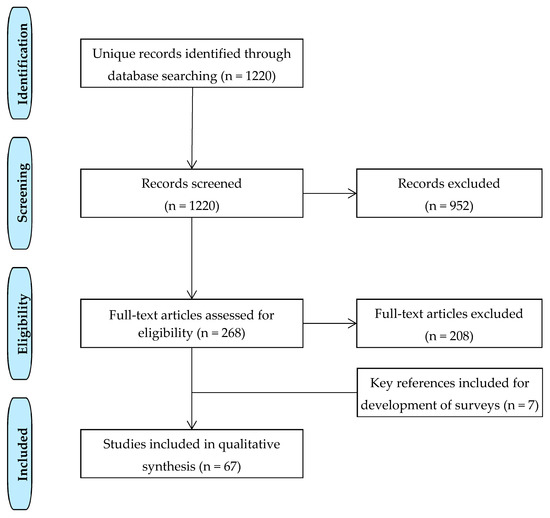
Figure 1.
Systematic review methodology according Preferred Reporting Items for Systematic Reviews and Meta-Analyses (PRISMA) Statement, adapted from [14].
For the identification of papers to be analyzed, three databases were used: Emerald Insight, JSTOR, and SciELO. Papers were searched using the following terms:
- “Fourth Industrial Revolution” OR “Industry 4.0” OR “Smart Manufacturing”.
- (“Business Process Management” OR “Business Process Reengineering” OR “Organizational Architecture”) AND (“Maturity Model” OR “Maturity Assessment” OR “Readiness Assessment”).
The search results were filtered in order to include only articles published in scientific journals, in the English language, from the year 2000 onwards, and belonging to the Business, Engineering, Management and Organizational Behavior, Science and Technology Studies. Removing duplicate records resulted in 1220 papers as a starting point.
After screening the title and abstracts considering the research themes mentioned above, there were more than 900 papers excluded. The remaining 268 articles were analyzed and 208 were excluded because they did not allow to respond to the objectives of this article. A typical example of excluded articles are papers with too narrow and specific areas that would not add relevant information for the objective of the current article. After that, 60 papers were selected for a full text qualitative analysis. As surveys are particularly relevant for the development of maturity models, 7 key references were included to support the identification of factors for the Development of Generic and Specific Maturity Models for Industry 4.0.
The complete list of these articles is referenced in Table 1. It should be noted that Table 1 presents two articles [15,16] classified in two themes of analysis. Thus, even though the total number of articles considered in the analysis is 67, the numbers in Table 1 sum up to 69.

Table 1.
Classification of the articles examined according to the themes under study in this work.
3. Thematic Analysis of the Literature
Most of the studies carried out on Industry 4.0 frameworks focus more attention on technological requirements [26,27,28,29,30,31,32,33,34,35]. Although with different nuances, as for example in Jabbour et al. [26], who present the objective to reconcile Industry 4.0 with the theme of sustainability. In this work, the approach adopted by these authors focuses on the presentation of the potential impact of new technologies. Moreover, despite the fact that Saucedo-Martínez et al. [31] mention studies that point to the importance of a holistic system formed by technology and people, providing an integration of the value chain, the work is then directed to the technological infrastructure that in theory would enable a model of Industry 4.0.
A definition in a few words of the Industry 4.0 model is given by Oztemel and Gursev [30], stating that this movement aims to generate a transformation from a predominantly mechanical manufacturing to a digital manufacturing model. This implies not only structural but also philosophical changes about the productive systems that are based on four pillars: intelligence, smart products, communication, and information networks. These authors highlight in their works which categories of technology can shape this scenario to provide an environment where companies can be fast, agile and flexible, providing high quality goods and services. They consider, however, that these principles cannot be thought of in isolation, but must involve the entire production chain, so that they form cooperation networks, not only between companies, but also between countries capable of sustaining better economies, with a new workforce profile, with increased productivity and industrial growth.
It is worthwhile presenting divergent perspectives over some issues. Crnjac et al. [8] present a strong focus on technological aspects in their research and present the view that the Lean Manufacturing philosophy belongs to the Industry 3.0 manufacturing model, suggesting in contrast that Industry 4.0 converges on a new paradigm called Smart Manufacturing. Following a different line of thought, Tortorella and Fettermann [34] deal with the technological framework of Industry 4.0 and present Lean tools as being a complementary support. In their study, they develop a research among Brazilian companies to identify the level of adherence and purposes that motivate the implementation of Industry 4.0 (I4.0). Moeuf et al. [28] also consider Lean tools and Just in Time (JIT) as being aligned with Industry 4.0 technologies to ensure management and industrial process capabilities such as monitoring, control, automation and autonomy in order to increase performance in indicators such as flexibility, costs, productivity, quality and lead times.
As referred to above, Crnjac et al. [8] highlight articles that specifically address not only Industry 4.0 technologies, but also issues such as horizontal and vertical integration of processes and new business models. They consider that changes should occur at the strategic, tactical, and operational levels. At the strategic level, the reformulation occurs in the company’s vision, which expresses its repositioning in relation to its customers and competitors, making the transition from mass production to mass customization. At the tactical level, the technology is applied according to the defined strategy. Finally, at the operational level, the objectives related to Industry 4.0 are defined and implemented in five dimensions: (1) project management; (2) process management; (3) technology management; (4) organizational management; and (5) people management.
3.1. Maturity Models
The diagnosis and improvement project approach based on maturity models has gained more and more followers since its emergence in the fields of Business Management and Software Engineering. Two definitions of maturity models can be considered. According to Kluth et al. [40], “a maturity model is a (simplified) representation of reality to measure the quality of business processes. Here, depending on the model, different stages of ‘maturity’ of business processes are described”. For Kohlegger et al. [42] “a maturity model conceptually represents phases of increasing quantitative or qualitative capability changes of a maturing element in order to assess its advances with respect to defined focus areas.” Therefore, maturity models are important tools for evaluation in strategic management so that they offer parameters for companies to have clarity about the result of their efforts to achieve their objectives. Table 2 presents a generic procedure for the selection or development of maturity models, which integrates the works by De Bruin et al. [53], Menon et al. [16] and Mettler [59].
Table 2.
Procedure for selection or development of Maturity Models, adapted from De Bruin et al. [53], Menon et al. [16] and Mettler [59].
3.2. Generic Maturity Model
There are several maturity models related to I4.0. In Table 3 several maturity models are listed. Most of them are directed at I4.0, others were considered because they served as a basis for I4.0 maturity models. They have in common the fact that they are generic and their application depends on consulting and external evaluations of the processes to identify the level of maturity. Colli et al. [37] synthesize the fundamental dimensions of maturity models in the following dimensions:
Table 3.
Generic maturity models identified in the researched literature.
- Governance, which corresponds to the existence of strategic planning, resource allocation, digital awareness and engagement of all organizational levels.
- Technology, that is, technological infrastructure that supports I4.0 concepts.
- Connectivity, or availability of technical apparatus for data transmission and communication.
- Value Creation, which is the ability to generate value from the analysis of data.
- Competence, which deals with the management and development of new skills.
In a study conducted by Sony and Naik [3], in addition to these aspects, they also advocate a need for actions to be taken to digitalize not only the activities of the organization, but the entire supply chain, and the change from a strategy that focuses on the product to a new strategy in which the focus is on intelligent products and services.
There are common approaches for the adoption of distinct generic maturity models, applied according to the organizational levels and for specific purposes.
The present article is based on the thesis that the Industry 4.0 necessarily absorbs the organization based on processes. Therefore, it is worth mentioning the works published by Ongena and Ravesteyn [44] and Szelagowski and Berniak-Woźny [45] which propose the application of a maturity model in Business Process Management strategies. Although both articles present particularities, it is important to highlight the elementary maturity levels for business processes:
- Awareness, in which there is recognition of the value of process-oriented management.
- Description, in which processes have already been mapped and documented.
- Measurement, in which the performance of processes can already be monitored.
- Control, in which processes already have an “owner” or someone responsible.
- Improvement, in which there is a continuous practice aimed at improving processes.
- Resources and Knowledge, in which a process-oriented culture manifested in people’s competencies is already established.
- Information Technology, in which information technology is used for the design, simulation and execution of processes.
Traditional maturity models like the Capability Maturity Model (CMM) and Capability Maturity Model Integration (CMMI), and professional models like IMPULS and System Integration Maturity Model Industry 4.0 (SMMI) are cited by several authors in their research work to describe their historical importance and to identify them as success cases. Other professional and generic maturity models appear in exploratory research and are eventually mentioned in the literature as in the works of Sony and Naik [3] and Kohlegger et al. [42], however, the information about them is either not presented in depth or is apparently presented for commercial purposes. Some of these models are:
- PwC Industry 4.0—Enabling Digital Operations and Self-Assessment.
- Boston Consulting Group (BCG)—Digital Acceleration Index.
- The Maturity Model for Assessing Industry 4.0 Readiness and Maturity of Manufacturing, by Fraunhofer Austria.
- Minnosphere and Hochschule Neu-Ulm—University of Applied Sciences, online-assessment, digital readiness of companies.
- Federal Ministry for Economic Affairs and Energy Germany (BMWi), Industrie 4.0—Checkliste: Kommt Industrie 4.0 für unser Unternehmen in Frage.
- Deutscher Industrie-und Handelskammertag (DIHK)—Selbsttest zum digitalen Reifegrad.
- The Connected Enterprise Maturity Model, Rockwell Automation.
- Industry 4.0/Digital Operations Self-Assessment, Pricewaterhouse Coopers.
- Digitalization roadmap, by Siemens.
Generic maturity models share the derivation of process management models based on quality assurance and continuous improvement approaches. They are built for companies, by experts from companies and academia, based on traditional models. Therefore, they correspond to the product of those companies or providers who deliver them in the form of services. They depend on the support of consultancies that, before applying them, perform analysis, diagnosis, and, as a result, develop an adapted implementation strategy based on maturity models. Compliant with what is expected in Crnjac et al. [8], studies using this approach are in general guided by dimensions such as project management, process management, technology management, organizational management, and people management.
Another important factor that should be highlighted was mentioned by Mittal et al. [11], who, in order to support their proposal of the Smart Manufacturing System Readiness Assessment (SMSRA) model, performed both a comparative analysis with another model, namely IMPULS, and also identified other generic approaches of implementation of Industry 4.0. These other approaches use different terminology, as framework, roadmap, maturity model, readiness assessment, with varying meanings assigned to them. Vrchota and Pech [35], for example, investigate the level of preparedness of organizations, both large enterprises and small and medium enterprises, for Industry 4.0 with allusion to a perspective of maturity in addressing the need for reconfiguration. Thus, these terminology and conceptual differences create a research opportunity to better characterize these terms, as well as to present a proposal for a composite solution within the generic implementation models.
3.3. Specific Maturity Model
Another way to address the demand for maturity assessment is by choosing to build a model to meet a specific condition. It is common in such cases to use an existing model as a reference. In any case, the identification of success factors that should be considered is a fundamental element. Table 4 presents the result of the literature review in publications that presented methodologies for the construction of maturity models.
Table 4.
Methodologies for the construction of maturity models identified in the literature researched.
The need to cover very specific requirements was identified in the articles that meet the objective of building maturity models, involving factors such as functional areas (e.g., logistics and supply chain), economic sectors (e.g., software industry, machinery builders, construction and mining), and countries (e.g., Italy, Portugal, Germany, Brazil, Mexico, Turkey and Iran). In some situations, these variables appear isolated, and in others they appear combined. These papers make contributions with different methodological strategies, which are still very specific to the contexts in which they are developed. The analysis of the contextual environment is carried out through exploratory research with interviews and workshops and the gathering of critical knowledge through literature reviews. The research procedure of surveys is widely used but the method of validation is different. In a few cases the surveys are validated by quantitative analysis, and most are validated by comparative analysis in case studies, observation researches, action research or interviews with practitioners and experts. Thus, the development of a more generic strategy that may be applied to broad areas still constitutes an opportunity of research. This would be especially relevant if these strategies could be applied in a more autonomous way by SMEs.
4. Factors for the Systematization of a Survey for Specific Maturity Models
After an extensive and systematic literature review on business model reconfiguration approaches for Industry 4.0 implementation and research methodology exploration in Business Research, as well as for its empirical validation, it was found that researchers can guide themselves considering the following factors:
- Exploratory research to characterize the application context.
- Development of the theoretical background through literature review and validation of experts in order to clarify relevant aspects and concepts. It was observed that the objective in these cases is the identification of constructs and other important elements that serve as a basis for the elaboration of surveys and for the targeting of semi-structured interviews.
- Usually the interventions related to the previous factors are made possible by workshops with possible stakeholders, both experts and practitioners, who collaborate in the refinement of the material elaborated until then.
- Surveys are conducted when there is a substantial number of participants and thus the research take on a quantitative nature. Therefore, in order to avoid false precision in the results, the Bayesian Model of Factorial Analysis for Mixed Data in research projects in the management area can be proposed because it is able to model ordinal data (qualitative measurement) and intervals (quantitative measurement).
- Qualitative research through case studies, action research and observational research with a smaller number of participants and consequently more engaged and interested in the results can prove to be a promising strategy.
A survey is a fundamental instrument of a maturity model. For the development of such an instrument, Araújo et al. [18], influenced by the work of Churchill [19], propose the following ten stages grouped into three categories, for the creation of a survey:
- Theoretical importance and existence of constructs
- (a)
- Literature review and interview, or focus group, with experts
- (b)
- Generation of items
- (c)
- Validation of items by experts
- Representativeness and adequacy of data collection
- (a)
- Development and evaluation of the questionnaire
- (b)
- Translation of the questionnaire
- (c)
- Pilot study
- (d)
- Sampling and data
- Statistical analysis and statistical evidence of the construction
- (a)
- Assessment of dimensionality
- (b)
- Assessment of reliability
- (c)
- Assessment of the validity of the construction (converging and discriminatory validity)
According to Parente and Federo [21], causal complexity is an attribute present in management research. It is guided by three principles, namely, (1) conjunction, which refers to the result that derives from the interdependence of multiple conditions, (2) equifinality, which is the possibility of multiple paths to the same result, and (3) asymmetry, which indicates that the causal relationships that explain one phenomenon may not explain another similar phenomenon. Therefore, research tools based on correlations, characterized by linear and symmetric logic, are not able to deal with these three principles of causal complexity. Qualitative Comparative Analysis (QCA) is the methodological tool suitable for the empirical investigation of conditions of this nature. Its application involves probabilistic approaches that take into account nonlinearity, omitted variables and case-based causal inferences and helps to assess how multiple and distinct conditions are combined and associated with a certain outcome (conjunction), as well as to identify possible conditions associated with an outcome (equifinality), and, finally, how the presence and absence of attributes can be related to an outcome (asymmetry).
An important element of scales are the constructs. For Almeida and Freire [17], the process of building an evaluation instrument begins by defining what will be evaluated, what will it be evaluated for, and with whom the evaluation will be carried out. This measurement is performed by means of constructs that express latent aptitudes, traces or dimensions.
Hair et al. [20], supported by Stevens [23], consider that two terms are often treated as synonyms, but have differences in destination, which are measure and measurement. The first is intended for the evaluation of physical quantities, or measurable phenomena, such as mass, temperature, time, etc., while the second is appropriate for attitudes, perceptions, opinions, behavior and other phenomena not directly measurable.
Hair et al. [20] state that constructs are mental creations and therefore do not actually exist, which implies difficulties in defining and measuring precisely what they are. Therefore, constructs cannot be defined or evaluated (measured) by means of a single item. Single items can measure variables, but never constructs. Similarly, other mental creations, such as attitudes and behaviors, must be measured with various indicators. Constructs are also often identified as latent, subscale, unobserved, unmeasured, factor, component, compound, and other variables. A construct composed of several elements should not be referred to with generic phrases. Researchers should create an operational set of elements that accurately reflect the concept being measured, that can serve as verbal substitutes for open actions, under penalty of obtaining neutral responses that do not reflect the provisions underlying the direct actions. The authors explain that for the creation of constructs the procedures of Literature Review or interviews with specialists are necessary. When information and scientific knowledge about the field under study are abundant and available, the literature review is adequate. Otherwise, the available resource is expert interviews.
In summary, supported by an extensive research, this work points out five factors for the development of a specific maturity model: Characterization of the application context; Literature review for conceptual characterization; Interaction with practitioners and experts; Development of surveys; Qualitative research. Additionally, supported by the conclusion of the previous sections, there is still the need to develop generic methodologies that can be applied in a more autonomous way for the development of specific maturity models.
5. Conclusions
From the investigation carried out some research gaps that this article proposes to for future works were identified. The findings will be presented in answer to the questions formulated as the objective of this article.
(1) What are the main differences among maturity models described in the literature?
The literature review allowed the identification the main characteristics of Maturity models (Table 2), integrating models from I4.0 and other areas of business process management. Additionally, a synthesis of maturity models is presented in Section 3.2, which is a useful resource for researchers and professionals aiming to select and understand these models. However, as the research progressed, it was observed that reconfiguration projects in the transformation for I4.0 are quite diverse, and that the LEs, for the most part, have the resources and critical knowledge to conduct, by themselves or with the support of consultancies, their initiatives to renew their business models. In such cases, generic maturity models are often adopted. However, SMEs and economic sectors suffering from very particular constraints have great difficulties. Numerous research initiatives have been identified to address these cases by building specific maturity models.
(2) Which factors should be adopted for selection or development of a maturity model?
There is a lack of studies on the ways in which companies can orient themselves to discover the approach of reconfiguration of business models best suited to their reality, i.e., whether they should employ their own efforts or seek support for the application of generic maturity Industry 4.0 models, or whether they identify the need for a specific strategy. In the latter case, an approach based on specific maturity models seems to be promising, but there are also no studies aimed at systematizing a methodology that guides researchers in the development and application of maturity models, nor for companies that recognize the need for a special development. Within the demands for generic and wide-ranging models, it was found that there is confusion and difficulties in distinguishing among terms such as framework, roadmap, maturity models and readiness assessments, and this aspect denotes opportunities for research. Although much of the literature treats them as synonyms, there are particularities that need to be taken into consideration. Likewise, there is the lack of a study for the systematization of an integrated approach for an organizational reconfiguration model. This purpose can be pursued in future works. Concerning specific maturity models, although the authors report successful cases of building maturity models for specific contexts, there are also very diverse treatments in the methodological aspect adopted in these processes. However, it was possible to find approaches that allowed the identification of a set of important factors that can be used as the ground base for the development of a specific maturity model for I4.0.
An Industrial Revolution presupposes, to a certain extent, a movement of transformation driven by the emergence of a new scientific paradigm that, in turn, presents a new logical–conceptual matrix. Under these conditions, it is foreseeable that some ambiguities will arise in the discourse of different authors who, on the one hand, may assume biases related to old models and paradigms, and on the other hand, may use old terms to refer to new realities that still lack more appropriate terminology. This level of terminology ambiguity creates one of the limitations of a systematic literature review like the one proposed here. Another limitation is related to the methodology of selection and evaluation of articles that depend on the selected search terms and on the criteria of analysis and the consensus between both researchers. Finally, we consider that the results added valuable knowledge to the area of maturity models for Industry 4.0 both for interested researchers and professionals initiating their journey for I4.0.
Industry 4.0 depends on a chain of cooperation because it is a technological revolution. Thus, the lack of national policies for transforming the productive system into this reality can be a problem. However, many countries have development agendas, but, nevertheless, structural challenges can be seen by companies as obstacles to individual actions. Research projects aimed at reducing the polyphony around models and implementation tools will certainly be useful to achieve a complete model of generic and broad-ranging implementation, especially from the point of view of the small and medium enterprises who do not have their own resources and means to have specialized support to adapt to their specific needs. Moreover, exploratory research to characterize the context of nations in its peculiar conditions and in relation to the surrounding economic area would allow the identification of the relevance of focusing on small and medium enterprises, because they are usually the ones that employ the most and because they face the greatest difficulties in obtaining guidance in structuring competitive strategies, business models and organizational architecture.
Author Contributions
C.d.J. and R.M.L. conceived and designed the systematic literature review process; C.d.J. performed most of the reviewing process and wrote the first draft of the article; both authors reviewed and wrote the article. All authors have read and agreed to the published version of the manuscript.
Funding
This work has been supported by FCT—Fundação para a Ciência e Tecnologia within the R&D Units Project Scope UIDB/00319/2020.
Conflicts of Interest
The authors declare no conflict of interest.
References
- Kagermann, H.; Wahlster, W.; Helbig, J. Recommendations for Implementing the Strategic Initiative INDUSTRIE 4.0: Final Report of the Industrie 4.0 Working Group; Acatech: Frankfurt, Germany, 2013. [Google Scholar]
- Agostini, L.; Filippini, R. Organizational and managerial challenges in the path toward Industry 4.0. Eur. J. Innov. Manag. 2019, 22, 406–421. [Google Scholar] [CrossRef]
- Sony, M.; Naik, S. Key ingredients for evaluating Industry 4.0 readiness for organizations: A literature review. Benchmarking Int. J. 2019, 27, 2213–2232. [Google Scholar] [CrossRef]
- Veile, J.W.; Kiel, D.; Müller, J.M.; Voigt, K.-I. Lessons learned from Industry 4.0 implementation in the German manufacturing industry. J. Manuf. Technol. Manag. 2019. [Google Scholar] [CrossRef]
- Yunis, M.M.; Koong, K.S.; Liu, L.C.; Kwan, R.; Tsang, P. ICT maturity as a driver to global competitiveness: A national level analysis. Int. J. Account. Inf. Manag. 2012, 20, 255–281. [Google Scholar] [CrossRef]
- Gracel, J.; Łebkowski, P. The Concept of Industry 4.0 Related Manufacturing Technology Maturity Model (Manutech Maturity Model, MTMM). Decis. Mak. Manuf. Serv. 2018, 12, 17–31. [Google Scholar] [CrossRef]
- Spruit, M.; Pietzka, K. MD3M: The master data management maturity model. Comput. Hum. Behav. 2015, 51, 1068–1076. [Google Scholar] [CrossRef]
- Crnjac, M.; Veža, I.; Banduka, N. From Concept to the Introduction of Industry 4.0. Int. J. Industrial Eng. Manag. 2017, 8, 21–30. [Google Scholar]
- Bakkari, M.; Khatory, A. Industry 4.0: Strategy for More Sustainable Industrial Development in SMEs. In Proceedings of the IEOM 7th International Conference on Industrial Engineering and Operations Management, Rabat, Morocco, 11–13 April 2017. [Google Scholar]
- Mohapatra, S. Business Process Reengineering: Framework and Approach. In Business Process Reengineering: Automation Decision Points in Process Reengineering; Mohapatra, S., Ed.; Springer: Boston, MA, USA, 2013; pp. 51–67. [Google Scholar]
- Mittal, S.; Khan, M.A.; Romero, D.; Wuest, T. A critical review of smart manufacturing & Industry 4.0 maturity models: Implications for small and medium-sized enterprises (SMEs). J. Manuf. Syst. 2018, 49, 194–214. [Google Scholar] [CrossRef]
- Zumsteg, J.M.; Cooper, J.S.; Noon, M.S. Systematic Review Checklist. J. Ind. Ecol. 2012, 16, S12–S21. [Google Scholar] [CrossRef]
- Popay, J.; Roberts, H.; Sowden, A.; Petticrew, M.; Arai, L.; Rodgers, M.; Britten, N.; Roen, K.; Duffy, S. Guidance on the Conduct of Narrative Synthesis in Systematic Reviews: A Product from the ESRC Methods Programme; Lancaster University: Lancaster, UK, 2006. [Google Scholar]
- Moher, D.; Liberati, A.; Tetzlaff, J.; Altman, D.G.; Group, T.P. Preferred Reporting Items for Systematic Reviews and Meta-Analyses: The PRISMA Statement. PLoS Med. 2009, 6, e1000097. [Google Scholar] [CrossRef]
- Bonilla, S.H.; Silva, H.R.O.; Silva, M.T.; da Gonçalves, R.F.; Sacomano, J.B. Industry 4.0 and Sustainability Implications: A Scenario-Based Analysis of the Impacts and Challenges. In Sustainability; 2018; Volume 10. [Google Scholar] [CrossRef]
- Menon, K.; Kärkkäinen, H.; Lasrado, L.A. Towards a maturity modeling approach for the implementation of industrial internet. In Proceedings of the 20th Pacific Asia Conference on Information Systems (PACIS 2016), Chiayi City, Taiwan, 27 June–1 July 2016; p. 11. [Google Scholar]
- Almeida, L.; Freire, T. Metodologia da Investigação em Psicologia e Educação; Psiquilíbrios: Braga, Portugal, 2008. [Google Scholar]
- de Araújo, C.C.S.; Pedron, C.D.; Bitencourt, C. Identifying and assessing the scales of dynamic capabilities: A systematic literature review. Rev. De Gestão 2018, 25, 390–412. [Google Scholar] [CrossRef]
- Churchill, G.A. A Paradigm for Developing Better Measures of Marketing Constructs. J. Mark. Res. 1979, 16, 64–73. [Google Scholar] [CrossRef]
- Hair, J.F., Jr.; Gabriel, M.L.D.S.; da Silva, D.; Braga Junior, S. Development and validation of attitudes measurement scales: Fundamental and practical aspects. RAUSP Manag. J. 2019, 54, 490–507. [Google Scholar] [CrossRef]
- Parente, T.C.; Federo, R. Qualitative comparative analysis: Justifying a neo-configurational approach in management research. RAUSP Manag. J. 2019, 54, 399–412. [Google Scholar] [CrossRef]
- Proença, D. Methods and techniques for maturity assessment. In Proceedings of the 11th Iberian Conference on Information Systems and Technologies (CISTI), Las Palmas, Spain, 15–18 June 2016. [Google Scholar]
- Stevens, S.S. On the Theory of Scales of Measurement. Sci. New Ser. 1946, 103, 677–680. [Google Scholar] [CrossRef] [PubMed]
- Ghobakhloo, M.; Fathi, M. Corporate survival in Industry 4.0 era: The enabling role of lean-digitized manufacturing. J. Manuf. Technol. Manag. 2018, 31, 1–30. [Google Scholar] [CrossRef]
- de Gooijer, J. Designing a knowledge management performance framework. J. Knowl. Manag. 2000, 4, 303–310. [Google Scholar] [CrossRef]
- de Sousa Jabbour, A.B.L.; Jabbour, C.J.C.; Godinho Filho, M.; Roubaud, D. Industry 4.0 and the circular economy: A proposed research agenda and original roadmap for sustainable operations. Ann. Oper. Res. 2018, 270, 273–286. [Google Scholar] [CrossRef]
- Kohlbacher, M. The effects of process orientation: A literature review. Bus. Process Manag. J. 2010, 16, 135–152. [Google Scholar] [CrossRef]
- Moeuf, A.; Pellerin, R.; Lamouri, S.; Tamayo-Giraldo, S.; Barbaray, R. The industrial management of SMEs in the era of Industry 4.0. Int. J. Prod. Res. 2018, 56, 1118–1136. [Google Scholar] [CrossRef]
- Müller, J.M. Business model innovation in small- and medium-sized enterprises. J. Manuf. Technol. Manag. 2019, 30, 1127–1142. [Google Scholar] [CrossRef]
- Oztemel, E.; Gursev, S. Literature review of Industry 4.0 and related technologies. J. Intell. Manuf. 2018, 31, 127–182. [Google Scholar] [CrossRef]
- Saucedo-Martínez, J.A.; Pérez-Lara, M.; Marmolejo-Saucedo, J.A.; Salais-Fierro, T.E.; Vasant, P. Industry 4.0 framework for management and operations: A review. J. Ambient Intell. Hum. Comput. 2018, 9, 789–801. [Google Scholar] [CrossRef]
- Segatto, M.; Pádua, S.; Martinelli, D. Business process management: A systemic approach? Bus. Process Manag. J. 2013, 4, 4–698. [Google Scholar] [CrossRef]
- Stefan, L.; Thom, W.; Dominik, L.; Dieter, K.; Bernd, K. Concept for an evolutionary maturity based Industrie 4.0 migration model. Procedia CIRP 2018, 72, 404–409. [Google Scholar] [CrossRef]
- Tortorella, G.L.; Fettermann, D. Implementation of Industry 4.0 and lean production in Brazilian manufacturing companies. Int. J. Prod. Res. 2018, 56, 2975–2987. [Google Scholar] [CrossRef]
- Vrchota, J.; Pech, M. Readiness of Enterprises in Czech Republic to Implement Industry 4.0: Index of Industry 4.0. Appl. Sci. 2019, 9, 5405. [Google Scholar] [CrossRef]
- Walczak, S. Organizational knowledge management structure. Learn. Organ. 2005, 12, 330–339. [Google Scholar] [CrossRef]
- Colli, M.; Madsen, O.; Berger, U.; Møller, C.; Wæhrens, B.V.; Bockholt, M. Contextualizing the outcome of a maturity assessment for Industry 4.0. IFAC-Pap. 2018, 51, 1347–1352. [Google Scholar] [CrossRef]
- Goksen, Y.; Cevik, E.; Avunduk, H. A Case Analysis on the Focus on the Maturity Models and Information Technologies. Procedia Econ. Financ. 2015, 19, 208–216. [Google Scholar] [CrossRef][Green Version]
- Huffman, J.; Whitman, L.E. Aligning Enterprise Analytics to Business Process Capability Maturity. IFAC-Pap. 2015, 48, 2220–2225. [Google Scholar] [CrossRef]
- Kluth, A.; Jäger, J.; Schatz, A.; Bauernhansl, T. Method for a Systematic Evaluation of Advanced Complexity Management Maturity. Procedia CIRP 2014, 19, 69–74. [Google Scholar] [CrossRef]
- Koehler, J.; Woodtly, R.; Hofstetter, J. An impact-oriented maturity model for IT-based case management. Inf. Syst. 2015, 47, 278–291. [Google Scholar] [CrossRef]
- Kohlegger, M.; Maier, R.; Thalmann, S. Understanding Maturity Models Models - Results of a Structured Content Analysis. In Proceedings of the 9th International Conference on Knowledge Management (I-KNOW ’09), Graz, Austria, 2–4 September 2009; pp. 51–61. [Google Scholar]
- Leyh, C.; Bley, K.; Schäffer, T.; Forstenhäusler, S. SIMMI 4.0—A maturity model for classifying the enterprise-wide it and software landscape focusing on Industry 4.0. In Proceedings of the 2016 Federated Conference on Computer Science and Information Systems (FedCSIS), Gdansk, Poland, 11–14 September 2016; pp. 1297–1302. [Google Scholar]
- Ongena, G.; Ravesteyn, P. Business process management maturity and performance. Bus. Process Manag. J. 2019, 26, 132–149. [Google Scholar] [CrossRef]
- Szelagowski, M.; Berniak-Woźny, J. The adaptation of business process management maturity models to the context of the knowledge economy. Bus. Process Manag. J. 2019, 26, 212–238. [Google Scholar] [CrossRef]
- Tonelli, F.; Demartini, M.; Loleo, A.; Testa, C. A Novel Methodology for Manufacturing Firms Value Modeling and Mapping to Improve Operational Performance in the Industry 4.0 Era. Procedia CIRP 2016, 57, 122–127. [Google Scholar] [CrossRef]
- Weber, C.; Königsberger, J.; Kassner, L.; Mitschang, B. M2DDM—A Maturity Model for Data-Driven Manufacturing. Procedia CIRP 2017, 63, 173–178. [Google Scholar] [CrossRef]
- Asdecker, B.; Felch, V. Development of an Industry 4.0 maturity model for the delivery process in supply chains. J. Model. Manag. 2018, 13, 840–883. [Google Scholar] [CrossRef]
- Barata, J.; Cunha, P. Climbing the Maturity Ladder in Industry 4.0: A Framework for Diagnosis and Action that Combines National and Sectorial Strategies. In Proceedings of the Twenty-Third Americas Conference on Information Systems (AMCIS), Boston, MA, USA, 10–12 August 2017. [Google Scholar]
- Bibby, L.; Dehe, B. Defining and assessing industry 4.0 maturity levels—Case of the defence sector. Prod. Plan. Control 2018, 29, 1030–1043. [Google Scholar] [CrossRef]
- Brookes, N.; Butler, M.; Dey, P.; Clark, R. The use of maturity models in improving project management performance. Int. J. Manag. Proj. Bus. 2014, 7, 231–246. [Google Scholar] [CrossRef]
- Comuzzi, M.; Patel, A. How organisations leverage Big Data: A maturity model. Ind. Manag. Data Syst. 2016, 116, 1468–1492. [Google Scholar] [CrossRef]
- De Bruin, T.; Freeze, R.; Kaulkarni, U.; Rosemann, M. Understanding the Main Phases of Developing a Maturity Assessment Model. In Proceedings of the Australasian Chapter of the Association for Information Systems, Sydney, Australia, 29 November–2 December 2005; pp. 8–19. [Google Scholar]
- Frank, A.G.; Dalenogare, L.S.; Ayala, N.F. Industry 4.0 technologies: Implementation patterns in manufacturing companies. Int. J. Prod. Econ. 2019, 210, 15–26. [Google Scholar] [CrossRef]
- Häberer, S.; Lau, L.K.; Behrendt, F. Development of an Industrie 4.0 Maturity Index for Small and Medium-Sized Enterprises. In Proceedings of the 7th International Conference on Industrial Engineering and Systems Management, Saarbrücken, Germany, 11–13 October 2017. [Google Scholar]
- Kaltenbach, F.; Marber, P.; Gosemann, C.; Bölts, T.; Kühn, A. Smart Services Maturity Level in Germany. In Proceedings of the 2018 IEEE International Conference on Engineering, Technology and Innovation (ICE/ITMC), Baden-Wuerttemberg, Germany, 17–20 June 2018; pp. 1–7. [Google Scholar]
- Koska, A.; Göksu, N.; Erdem, M.B.; Fettahlioğlu, H.S. Measuring the Maturity of a Factory for Industry 4.0. Int. J. Acad. Res. Bus. Soc. Sci. 2017, 7, 52–60. [Google Scholar] [CrossRef]
- McCormack, K.; Willems, J.; van den Bergh, J.; Deschoolmeester, D.; Willaert, P.; Štemberger, M.I.; Škrinjar, R.; Trkman, P.; Ladeira, M.B.; de Oliveira, M.P.V.; et al. A global investigation of key turning points in business process maturity. Bus. Process Manag. J. 2009, 15, 792–815. [Google Scholar] [CrossRef]
- Mettler, T. Maturity Assessment Models: A Design Science Research Approach. Int. J. Soc. Syst. Sci. 2011, 3, 81–98. [Google Scholar] [CrossRef]
- Netland, T.H.; Alfnes, E. Proposing a quick best practice maturity test for supply chain operations. Meas. Bus. Excell. 2011, 15, 66–76. [Google Scholar] [CrossRef]
- Rainer, A.; Hall, T. Key success factors for implementing software process improvement: A maturity-based analysis. J. Syst. Softw. 2002, 62, 71–84. [Google Scholar] [CrossRef]
- Reyes, H.G.; Giachetti, R. Using experts to develop a supply chain maturity model in Mexico. Supply Chain Manag. Int. J. 2010, 15, 415–424. [Google Scholar] [CrossRef]
- Schumacher, A.; Nemeth, T.; Sihn, W. Roadmapping towards industrial digitalization based on an Industry 4.0 maturity model for manufacturing enterprises. Procedia CIRP 2019, 79, 409–414. [Google Scholar] [CrossRef]
- Sehnem, S.; Campos, L.M.S.; Julkovski, D.J.; Cazella, C.F. Circular business models: Level of maturity. Manag. Decis. 2019, 57, 1043–1066. [Google Scholar] [CrossRef]
- Sheikhshoaei, F.; Naghshineh, N.; Alidousti, S.; Nakhoda, M. Design of a digital library maturity model (DLMM). Electron. Libr. 2018, 36, 607–619. [Google Scholar] [CrossRef]
- Trotta, D.; Garengo, P. Assessing Industry 4.0 Maturity: An Essential Scale for SMEs. In Proceedings of the 2019 8th International Conference on Industrial Technology and Management (ICITM), Cambridge, UK, 2–4 March 2019; pp. 69–74. [Google Scholar]
- Vivares, J.A.; Sarache, W.; Hurtado, J.E. A maturity assessment model for manufacturing systems. J. Manuf. Technol. Manag. 2018, 29, 746–767. [Google Scholar] [CrossRef]
- Willis, C.J.; Rankin, J.H. The construction industry macro maturity model (CIM3): Theoretical underpinnings. Int. J. Product. Perform. Manag. 2012, 61, 382–402. [Google Scholar] [CrossRef]
- Schumacher, A.; Erol, S.; Sihn, W. A maturity model for assessing Industry 4.0 readiness and maturity of manufacturing enterprises. Chang. Agil. Reconfigurable Virtual Prod. 2016, 52, 161–166. [Google Scholar] [CrossRef]
- Ghobakhloo, M. The future of manufacturing industry: A strategic roadmap toward Industry 4.0. J. Manuf. Technol. Manag. 2018, 29, 910–936. [Google Scholar] [CrossRef]
© 2020 by the authors. Licensee MDPI, Basel, Switzerland. This article is an open access article distributed under the terms and conditions of the Creative Commons Attribution (CC BY) license (http://creativecommons.org/licenses/by/4.0/).