


Abstract
Sustainable digital marketing in the United Arab Emeritus (UAE) faces challenges in terms of balancing rapid technological adoption with long-term environmental goals. Many firms struggle to integrate eco-friendly practices into fast-growing online platforms. Limited consumer awareness and inconsistent regulatory frameworks further hinder the shift toward truly sustainable digital strategies. The current study addressed this problem in artificial intelligence (AI) adoption, which has rarely been addressed in sustainable digital marketing among the telecommunication companies working in the UAE. Therefore, the objective of this study is to examine the role of AI adoption in sustainable digital marketing through the promotion of smart distribution channels (SDCs), sustainable employee intention, and employee behavior. Primary data was collected using a structured questionnaire distributed among the employees of Etisalat and du in the UAE. Three hundred (300) valid responses were received, which were used for data analysis via PLS-SEM. Findings of the study proposed that AI adoption is key to promoting sustainable digital marketing through the promotion of SDCs, sustainable employee intention, and employee behavior. These results provide valuable insights for the policymakers to address the problem of sustainable digital marketing.
1. Introduction
In recent years, the growing emphasis on sustainability has reshaped the global business environment, compelling organizations to rethink their marketing practices (White et al., 2025). Digital marketing, being one of the fastest-evolving domains, is increasingly expected to integrate sustainability principles to address environmental, social, and economic concerns (Al Koliby et al., 2024). The promotion of digital marketing activities among the business organizations promoting sustainability practices has benefits for companies as well as businesses (Mheidat et al., 2025). The UAE, as a regional hub for business and technology (Tomaira, 2022), faces a unique challenge: balancing its rapid digital transformation with the global demand for sustainable practices. With the UAE Vision 2030 emphasizing innovation and sustainability, organizations must ensure that their digital marketing strategies are not only technologically advanced but also socially responsible and environmentally conscious. Therefore, adoption of latest technology, specifically Artificial intelligence (AI)-driven technologies in marketing activities is crucial to address various challenges in the UAE.
Practically, businesses in the UAE are experiencing growing pressures from stakeholders, including customers, regulators, and global partners (Sawang et al., 2024), to demonstrate the sustainability of their operations and marketing. However, the increasing pressure among marketing activities can be managed through the adoption of AI technologies in marketing activities. Consumers in the region are becoming more environmentally conscious, showing preference for brands that adopt eco-friendly and socially responsible strategies. In this way, the adoption of digital marketing activities through AI adoption is very crucial (Greenland, 2019). However, many organizations still struggle to translate these expectations into practice. One key barrier lies in employee behavior (Presbitero & Teng-Calleja, 2023), in terms of how employees perceive, adopt, and implement sustainability-oriented digital marketing practices. Employee behavior is one of the major constraints when adopting AI technologies in marketing departments. Despite heavy investment in AI and smart technologies, many firms face resistance or limited employee engagement, leading to a gap between technological potential and actual sustainable outcomes. Therefore, sustainable digital marketing faces challenges from the employees working in various organizations. Hence, in the competitive marketplace of the UAE, the adoption of AI technologies is crucial, especially in marketing activities.
Although prior studies have linked AI adoption, employee behavior, and sustainability (B.-J. Kim & Kim, 2025; Thangaraju & Palani, 2024), most have been conducted in Western or cross-industry contexts, overlooking the cultural and institutional dynamics of the UAE, where rapid digital transformation intersects with national sustainability goals. This study contributes original research by situating the model within the UAE’s unique socio-technological environment and by introducing the dual role of employee trust in AI, as both a psychological and ethical determinant of sustainable behavior. By integrating these contextual and behavioral dimensions, the study fills a critical gap in explaining how AI-driven sustainability practices evolve in emerging economies characterized by strong innovation agendas and workforce diversity.
From a theoretical standpoint, research on sustainable digital marketing remains fragmented, with limited focus on the role of employees and AI-driven technologies in shaping sustainable practices. Much of the literature emphasizes consumer behavior (Abrardi et al., 2022; Jain et al., 2024; Zhang & Wang, 2023), corporate strategy, or technological innovation, while overlooking the central role of employees in operationalizing sustainability within digital marketing frameworks. Several studies highlighted AI and digital marketing activities (Gündüzyeli, 2024; Rabby et al., 2021; Ziakis & Vlachopoulou, 2023); however, this relationship was not considered in relation to employee behavior among the technology-orientated companies of the UAE. Moreover, while established theories such as the Technology Acceptance Model (TAM) and the Theory of Planned Behavior (TPB) provide valuable insights into technology adoption and behavioral intention, there is still a need to extend these theories to the domain of sustainable digital marketing. Therefore, this study contributes to the theory of TAM and TPB by considering the relationship between AI adoption, employee behavior, and sustainable digital marketing in UAE telecommunication companies.
Employees may resist AI-driven solutions due to fear of job displacement or lack of understanding, thereby undermining sustainability outcomes. AI is replacing humans in various jobs (Eng & Liu, 2024; Trivedi et al., 2023), which is a continuous fear among the employees working in various organizations that limits their intention to adopt AI. Similarly, while smart distribution channels (SDCs) can reduce costs and improve efficiency, their sustainability impact depends on how employees manage and utilize these channels responsibly. These issues highlight the need to examine the theoretical foundations linking AI adoption, employee behavior, and sustainable marketing practices. Hence, SDCs is one of the important part of digital marketing activities (Kazmi et al., 2017), which is challenging for companies. Along with the SDCs, sustainable employee intention is also of crucial importance.
Therefore, this study seeks to address both the practical and theoretical problems by proposing a model that explains how AI adoption influences sustainable digital marketing outcomes through employee behavior.
- The primary objective of this study is to examine how AI adoption influences sustainable digital marketing outcomes through the mediating roles of SDCs and sustainable employee intention, while considering the moderating effect of AI trust on these relationships. The study focuses on how employees’ behavioral responses shape the effectiveness of AI-driven sustainability strategies within UAE organizations.
- To address this objective, the research develops and empirically tests a comprehensive mediation–moderation model grounded in the Technology Acceptance Model (TAM) and Sociotechnical Systems Theory (STS). Data was collected through a structured questionnaire administered to the employees of leading UAE telecommunication organizations, and the proposed relationships were analyzed using Partial Least Squares Structural Equation Modeling (PLS-SEM).
- This study contributes to theory by integrating behavioral (TAM) and systemic (STS) perspectives to explain the dual influence of technology and human factors in sustainable marketing. Practically, it provides insights for managers and policymakers in the UAE on how to enhance sustainability through employee engagement, AI trust-building, and ethical technology implementation. By combining technological and human-centered lenses, the study bridges a crucial gap between technological innovation and organizational sustainability behavior.
This study significantly advances the understanding of sustainable digital marketing by integrating AI adoption and employee behavior within the frameworks of the Technology Acceptance Model (TAM) and Sociotechnical Systems Theory. While prior studies have separately explored AI or sustainability in marketing, this research uniquely demonstrates how AI-driven mechanisms influence employees’ behavioral alignments toward sustainability goals. By confirming the mediating role of smart distribution channels and the moderating effect of AI trust, this study extends behavioral theory into a digital sustainability context. The findings emphasize that technological transformation alone cannot achieve sustainability without corresponding behavioral adaptation among employees, thus bridging the gap between technology-driven innovation and human-centric sustainability outcomes.
The remainder of this article is structured as follows. Section 2 presents the theoretical framework and development of hypotheses. Section 3 outlines the research methodology, including data collection and analysis procedures. Section 4 reports the empirical results, while Section 5 discusses the findings in light of existing theories. Finally, Section 6 concludes the study by highlighting theoretical and practical implications, limitations, and directions for future research.
2. Literature Review
2.1. Theoretical Framework of the Study
The proposed framework examining employee behavior in sustainable digital marketing through AI technologies can be underpinned by the TAM (Davis et al., 1989) and extended through the lens of Sociotechnical Systems Theory (Walker et al., 2008). Both the theories are suitable to explain the relationship proposed in the framework of the study given in Figure 1. TAM emphasizes that technology adoption is driven by perceived usefulness and ease of use, which directly influence behavioral intentions and actual behavior. TAM explains how the users accept and use new technologies among business activities (Steven, 2025; Venkatesh & Davis, 2000). In this context, AI adoption fosters trust and facilitates smart distribution channels, thereby shaping sustainable employee intentions that lead to positive employee behavior. Moreover, employee trust in AI becomes a critical mediator, as it reduces uncertainty and enhances willingness to engage with AI-driven tools.
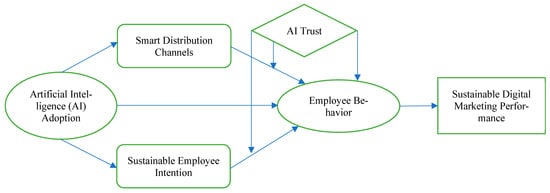
Figure 1.
Theoretical framework showing the relationship between AI adoption, SDCs, sustainable employee intention, AI trust, employee behavior, and sustainable digital marketing.
Sociotechnical Systems Theory can explain the framework of the current study because it helps to explain the relationship between complex systems of organizations composed of interdependent social and technical elements. Sociotechnical Systems Theory further supports this relationship by explaining that organizational outcomes emerge from the joint optimization of technology and human behavior (Trist & Emery, 2015). Consistent with the theory, the study framework encompasses complex systems of organizations which include AI adoption, distribution channels in digital way, employee behavior and sustainability practice in marketing. Employee behavior, therefore, becomes the bridge linking AI adoption to sustainable digital marketing outcomes. This integrated perspective justifies the framework and highlights the strategic role of AI technologies in shaping employee-driven sustainability. Therefore, based on TAM and Sociotechnical Systems Theory, this study proposed the relationship between AI adoption, SDCs, sustainable employee intention, AI trust, employee behavior, and sustainable digital marketing, which is highlighted in Figure 1.
The integration of the TAM and Sociotechnical Systems Theory provides a comprehensive explanation of how technological and human factors interact in promoting sustainable digital marketing. TAM underpins the relationships related to technology adoption and individual behavioral responses, specifically explaining how AI adoption, AI trust, and employee behavior are influenced by perceived usefulness and ease of use. In contrast, Sociotechnical Systems Theory complements this perspective by emphasizing the joint optimization of technical systems (e.g., smart distribution channels) and social systems (e.g., sustainable employee intention) to achieve organizational sustainability outcomes. Thus, while TAM clarifies the individual acceptance and behavioral aspects of AI technologies, Sociotechnical Systems Theory explains how the alignment of human and technical subsystems drives sustainable digital marketing. Using both theories in parallel allows a holistic understanding to be formed, which neither a purely behavioral nor a purely technical theory could independently provide.
The integration of TAM and Sociotechnical Systems Theory offers a novel understanding of AI adoption in sustainable marketing by linking individual technology acceptance with system-level organizational dynamics. TAM explains how employees’ perceptions of AI usefulness and ease of use influence their behavioral responses, while Sociotechnical reasoning captures how technological systems and human factors jointly optimize sustainability outcomes. By positioning employee behavior as the connecting mechanism between these two perspectives, the study extends TAM beyond individual acceptance to collective behavioral transformation and enriches Sociotechnical Theory by emphasizing human adaptation to AI-enabled sustainability practices. This dual-theoretical approach thus provides an integrated lens for understanding how technology and people co-evolve toward sustainable digital marketing goals.
2.2. Hypotheses Development
2.2.1. Artificial Intelligence (AI) Adoption and Employee Behavior
AI adoption represents a transformative force in organizations, enabling automation, data-driven decision-making, and enhanced efficiency (McElheran et al., 2024). Within the context of sustainable digital marketing (Gündüzyeli, 2024), employees are expected to adapt their behaviors in line with these technological advancements. The adoption of AI refers to the strategic integration of AI technology by organizations and individuals to enhance operations, derive insights, and foster innovation (Dulloo et al., 2025). Therefore, AI adoption helps to increase effectiveness and efficiency among the operations of the company. AI tools can reduce repetitive tasks, improve customer insights, and streamline operations, allowing employees to focus on higher-value, sustainability-driven activities.
The adoption of AI helps to recognize the capabilities of AI in choosing appropriate tools, and incorporating them into workflows improves productivity and competitiveness (Arroyabe et al., 2024). Furthermore, AI adoption increases employees’ exposure to innovative systems, shaping proactive attitudes and behaviors aligned with organizational goals. However, despite the fast global acceptance of AI, firms frequently encounter obstacles which lead to decrease in the adoption of AI technologies among various industries (Y.-H. Li et al., 2024; Mennella et al., 2024). Prior studies suggest that technology adoption fosters employee adaptability, innovation, and job satisfaction (Rubel et al., 2023; Sweis, 2010), which directly influence positive workplace behavior. Therefore, this study proposed that AI adoption has an influence on employee behavior when working in telecommunication companies. Hence, the following is proposed:
Hypothesis 1.
AI adoption has positive effect on employee behavior.
2.2.2. Artificial Intelligence (AI) Adoption, Smart Distribution Channels, and Sustainable Employee Intention
SDCs leverage digital technologies to optimize the flow of products, services, and information, thereby enhancing both efficiency and sustainability (Kazmi et al., 2017). AI adoption plays a pivotal role in advancing SDCs (Khan et al., 2023) by enabling predictive analytics, demand forecasting, and real-time customer engagement. AI helps in realizing substantial value beyond initial pilot projects as well as necessitating good changes in management, staff upskilling, and collaboration for successful integration. Therefore, AI has value and importance with regard to the promotion of the distribution of various services. Through AI, organizations can identify patterns in consumer behavior, reduce waste, and streamline distribution networks to align with sustainability goals. For employees, AI-powered distribution systems provide actionable insights that improve decision-making and resource allocation (Barja-Martinez et al., 2021; Khan et al., 2023). Smarter distribution in the current era of technology is only possible with the help of the adoption of latest technology, such as AI. The organizations adopting AI can build more agile and intelligent distribution systems, fostering sustainable outcomes. Hence, SDCs can be promoted through the adoption of smart AI technologies. By enabling smarter, more sustainable distribution, AI adoption directly strengthens the role of SDCs in marketing strategies. Thus, aforementioned discussion led to the following hypothesis:
Hypothesis 2.
AI adoption has positive effect on SDCs.
Employee intentions play a critical role in translating organizational goals into actual practices (Yoon & Park, 2023). Employee intentions, specifically the desire to remain or depart, are the conscious thoughts and decisions that an employee formulates regarding their future employment with a business (Chan et al., 2014; Jimmieson et al., 2008). As soon as organizations adopt AI technologies, employees are encouraged to align their intentions with sustainability-driven objectives. AI simplifies complex tasks, enhances productivity (Shaikh et al., 2023), and provides data-driven insights, reducing uncertainty in decision-making and empowering employees to support environmentally and socially responsible practices. Therefore, smart AI technologies help to enhance the sustainability of employees’ activities. It helps to promote sustainable employee intention towards digital marketing activities. Studies in technology management suggest that AI adoption can positively influence employee motivation, innovation, and willingness to engage in long-term sustainability. These intentions are shaped by aspects including job satisfaction, organizational commitment, professional growth possibilities, equitable compensation, and managerial quality. Hence, AI adoption can play a positive contribution in sustainable employee intention, leading to the following hypothesis:
Hypothesis 3.
AI adoption has a positive effect on sustainable employee intention.
2.2.3. Smart Distribution Channels, Sustainable Employee Intention, and Employee Behavior
SDCs offer organizations opportunities to enhance their operational efficiency and sustainability, which directly influence employee behavior (Kazmi et al., 2017). SDCs provide employees with access to automated systems, real-time data, and innovative platforms for managing supply chains and customer interactions (Kazmi et al., 2017). Smart distribution technology denotes the application of digital communication and control systems, including the Internet of Things (IoT) (Zawra et al., 2017), advanced metering infrastructure (AMI) (Mohassel et al., 2014), and microgrids, to establish a contemporary, dynamic electricity distribution network. Especially in marketing companies, the role of smart distribution is very crucial, helping to enhance operations’ effectiveness and efficiency. The adoption of smart distribution technologies in marketing processes has a relationship with employee behavior. These technologies reduce inefficiencies, promote transparency (Kazmi et al., 2017), and minimize waste, enabling employees to work in more structured and sustainable ways. SDCs help the employees to enhance their intention towards the utilization of AI technologies because it increases effectiveness and efficiency. Technology-driven channels foster employee empowerment, agility, and adaptive behavior, particularly in digital marketing environments. Thus, the aforementioned discussion identified that the effective utilization of SDCs not only improves business outcomes but also positively shapes employee behavior, which led to the following hypothesis:
Hypothesis 4.
SDCs have a positive effect on employee behavior.
Employee behavior is often shaped by their underlying intentions, which serve as motivational drivers for actions in the workplace (Dimoff & Kelloway, 2019; Yragui et al., 2017). It is the important elements among the organizations that can be influenced by sustainable employee intention. Sustainable employee intention is the individual commitment to promoting environmental and socially responsible practices in line with organizational goals (Ansari & Khan, 2024). Greater employee commitment can increase employee behavior towards certain activities at workplace. According to the TPB, intention is a key predictor of actual behavior (Toraman, 2022). When employees express strong sustainable intentions, they are more likely to demonstrate responsible behavior (Al Maskari, 2018), such as adopting eco-friendly practices, supporting digital solutions, and contributing to organizational sustainability. Hence, employee intention can play a key role in developing certain behaviors in employees. This study proposed that employee intention can enhance the behavior of employees related to digital technology usage in marketing activities. Therefore, sustainable employee intention has a positive role in employee behavior, leading to the following hypotheses along with the mediation effect of SDCs and sustainable employee intention.
Hypothesis 5.
Sustainable employee intention has positive effect on employee behavior.
Hypothesis 6.
SDCs mediate the relationship between AI adoption and employee behavior.
Hypothesis 7.
Sustainable employee intention mediates the relationship between AI adoption and employee behavior.
2.3. Employee Behavior and Sustainable Digital Marketing
Employee behavior plays a crucial role in shaping the success of sustainable digital marketing practices (Malhotra, 2024). While organizations may adopt advanced technologies such as AI and smart distribution channels, the outcomes of these initiatives largely depend on how employees engage with them. Therefore, the positive behavior of employees towards the digital marketing activities can help to promote overall sustainable digital marketing activities in organizations. Positive employee behaviors, such as ethical decision-making, the proactive use of technology, and an alignment with sustainability goals (Ladelsky & Lee, 2023), contribute directly to achieving digital marketing strategies that are both effective and socially responsible. Among the marketing companies, especially in the telecommunications companies of the USA, the promotion of digital marketing sustainability is grounded in employee behavior. Hence, in the context of the UAE, where digital transformation as well as sustainability are central national priorities, employee behavior becomes a strategic factor for achieving a competitive advantage in sustainable marketing. Hence, this study proposed that employee behavior has a positive effect on sustainable digital marketing, leading to the following hypothesis:
Hypothesis 8.
Employee behavior has a positive effect on sustainable digital marketing.
2.4. Moderation Effect of Artificial Intelligence (AI) Trust
AI trust has emerged as a critical factor in determining how employees interact with AI-enabled systems and integrate them into their daily activities (Braganza et al., 2021). A positive level of AI trust among employees helps to enhance AI usage in various job operations. While SDCs enhance efficiency and sustainability (Kazmi et al., 2017; Khan et al., 2023), their effectiveness in shaping employee behavior is contingent upon the level of trust employees place in AI. Therefore, the positive role of AI trust (J. Kim et al., 2021) and SDCs enhance employee behavior towards technology use in marketing activities. Employees’ trust in AI systems means they are likely to perceive SDCs as reliable and supportive tools, thereby exhibiting positive and adaptive behaviors. Conversely, low trust may create resistance, limiting the behavioral benefits of SDCs. Therefore, the AI trust of employees may strengthen or weaken the connection between SDCs and employee behavior. Likewise, trust in AI strengthens the connection between sustainable employee intentions and actual behaviors. Employees with strong sustainability intentions may hesitate to act upon them if they doubt AI accuracy, fairness, or transparency. Therefore, a higher level of AI trust can improve the effect of employee intention on employee behavior. Thus, AI trust functions as a crucial moderating factor, amplifying the positive influence of both SDCs and sustainable employee intentions on employee behavior, ensuring that digital transformation aligns with sustainability goals. Therefore, this study proposed that AI trust can alter the relationship between SDCs and employee behavior, and that, similarly, it can alter the connection between sustainable employee intention and employee behavior, leading to the following hypotheses:
Hypothesis 9.
AI trust moderates the relationship between SDCs and employee behavior.
Hypothesis 10.
AI trust moderates the relationship between sustainable employee intention and employee behavior.
Past research presents contradictory evidence regarding how AI adoption shapes employee sustainability behavior. Some studies report that AI enhances ethical awareness and sustainable performance (Braganza et al., 2021; Cao & Liu, 2023), whereas others suggest that automation anxiety and ethical ambiguity weaken such outcomes. Recent work (2023–2025) further emphasizes the roles of AI trust and digital ethics as mediators of responsible technology use (Dulloo et al., 2025; Jaillant & Rees, 2023; Sumartono et al., 2024; Verma & Singh, 2022). These conflicting perspectives indicate that the influence of AI adoption is not purely technological but depends strongly on the ethical and psychological responses of employees. Employees’ willingness to trust AI and perceive it as a fair, transparent, and non-threatening tool determines whether AI fosters or hinders sustainable practices. Hence, understanding AI adoption requires attention not only to digital capability but also to moral judgment and perceived autonomy at the workplace. Unlike related constructs such as digital capability, which emphasizes technical infrastructure, or green HRM, which focuses on environmental management policies, this study conceptualizes employee behavior as a socio-technical outcome that emerges from the interaction between AI systems and individual trust dynamics. This deeper framing underscores the human dimension of AI-enabled sustainability and highlights the study’s distinctive contribution to sustainable digital marketing research.
3. Methodology
3.1. Research Design
This study adopts a quantitative research design to examine the relationships between AI adoption, SDCs, sustainable employee intention, AI trust, employee behavior, and sustainable digital marketing. This relationship was tested by using a cross-sectional survey method. The combination of quantitative research and cross-sectional research design is suitable to examine the relationship proposed in this study. A quantitative design is appropriate as it enables testing of hypothesized relationships and provides empirical evidence to support the proposed framework.
3.2. Population and Sampling
The population of the study includes employees working in UAE telecommunications companies, specifically Etisalat by e& and du, as these organizations are leaders in adopting Artificial Intelligence and sustainability-driven digital marketing practices. Etisalat by e& and du are the two principal telecommunications businesses in the UAE, with e& serving as the parent company for the old UAE telecom provider, while du continues to be a formidable competitor. The study focuses on employees from Etisalat by e& and du because these two organizations represent the largest and most technologically advanced telecommunication firms in the UAE, accounting for nearly the entire national market share. Both companies are industry leaders in AI-driven and sustainability-oriented digital marketing practices, making them highly suitable for examining the proposed framework. The decision to exclude smaller firms was intentional, as many have not yet implemented comparable AI-based or sustainability initiatives. The target respondents include employees from marketing, customer experience, IT, and sustainability departments, as they are directly engaged with AI applications and digital marketing activities. Furthermore, this study adopted most suitable data collection technique, which is the purposive sampling technique. The purposive sampling technique was used to confirm that only employees with related experience are included. The sample size was determined using Comrey and Lee’s (1992) recommendations, aiming for at least 300 valid responses to attain statistical robustness.
3.3. Questionnaire Development
This study adapted the scale items to measure variables considered in this study, which include AI adoption, SDCs, sustainable employee intention, AI trust, employee behavior, and sustainable digital marketing. The measurement items used in this study were adapted—rather than directly adopted—from prior empirical studies to ensure their contextual relevance to the UAE’s telecommunications industry and the study’s sustainability focus. AI adoption was measured by using four scale items adapted from Salhab et al. (2025). Similarly, SDCs was measured by using four scale items adapted from Salhab et al. (2025). Additionally, five scale items were adapted from Minh and Quynh (2024) to measure sustainable employee intention. Furthermore, this study adapted two items from Salhab et al. (2025) to measure AI trust. The construct trust in AI was measured using two key indicators adapted from established scales. Although having only two items may have limited measurement depth, both indicators demonstrated high reliability and convergent validity (factor loadings > 0.70; AVE > 0.50), confirming their adequacy for structural modeling. The decision to retain two items was based on the conceptual parsimony of the construct and the need to reduce respondent fatigue given the model’s complexity. Employee behavior was measured through spatial flexibility and scale items were adapted from Januszkiewicz (2022). Finally, sustainable digital marketing was measured by using sustainable digital marketing capability and four scale items were adapted from Al Koliby et al. (2024). All the scale items are reported in Table 1. Furthermore, a panel of three academic experts and two industry professionals reviewed the questionnaire for clarity, relevance, and alignment with the UAE telecommunications context. Minor modifications were made to adapt wording and terminology for local understanding without altering construct meanings. Since the respondents were proficient in English, no translation or back-translation was required; however, a pilot test with 30 employees was conducted to assess reliability and comprehension.

Table 1.
Scale Items.
3.4. Data Collection and Statistical Tool
Primary data was collected using a structured questionnaire distributed electronically and physically to employees of Etisalat and du. The electronic questionnaire was distributed via a secure online platform (Qualtrics/Google Forms) and included an introductory information sheet which participants had to acknowledge before proceeding. This sheet detailed the study’s purpose, estimated completion time, voluntary nature, confidentiality of responses, and the right to withdraw at any time without penalty. The scale items reported in Table 1 were used to develop survey questionnaire. The questionnaire measured constructs such as AI adoption, SDCs, sustainable employee intention, employee behavior, AI trust, and sustainable digital marketing using validated scales adapted from the prior literature. A five-point Likert scale (1 = strongly disagree to 5 = strongly agree) was applied. A five-point Likert scale is most suitable since it increases the originality of the data by decreasing the frustration of the respondents. Furthermore, the selection of a five-point scale was based on methodological and cognitive considerations. Compared with seven-point scales, the five-point format reduces respondent cognitive load and enhances response reliability, particularly in organizational surveys involving diverse educational and cultural backgrounds such as those in the UAE. A total of 700 questionnaires were distributed among the employees of Etisalat and du. However, 300 valid responses were received with a response rate of 42.9%.
Because this study relied on self-reported and cross-sectional data, steps were taken to minimize and assess common method variance (CMV). First, procedurally, respondent anonymity was assured, question wording was simplified, and predictor and criterion variables were separated within the questionnaire to reduce response bias. Second, full collinearity VIF values were below the threshold of Section 3.3, confirming that common method bias did not significantly influence the results. These combined procedural and statistical remedies enhance the robustness and validity of the findings. Additionally, this study employed PLS-SEM because it is more suitable for complex models with multiple mediation and moderation paths, and for circumstances when data may not meet multivariate normality assumptions (Hair et al., 2016).
4. Data Analysis
4.1. Demographic Profile of Respondents
The demographic profile shows that most respondents were male (75%) and predominantly in the 30–39 age group (40%). Therefore, most of the employees working in Etisalat and du are male as compared to female. A large share held at least a bachelor’s degree (85%), with many working in marketing, IT, or management roles. Hence, a higher percentage of employees are consisted of bachelor’s degree. Respondents generally had moderate work experience, with 35% having 5–10 years, making the sample well-suited to provide insights on sustainable digital marketing practices in the UAE’s telecommunications sector. The profile of respondents working in Etisalat and du, UAE, is reported in Table 2.
Table 2.
Respondents’ profile (n = 300).
Based on the 300 valid responses, the data statistics are reported in Table 3. It presents the descriptive statistics for all study variables, including mean values, standard deviations, and distribution characteristics. The results indicate moderate mean scores across constructs, suggesting balanced perceptions among respondents regarding AI adoption, employee behavior, and sustainability orientation. The standard deviations show acceptable variability, confirming that responses were not clustered and providing sufficient dispersion for reliable analysis. These descriptive insights offer an initial understanding of data trends and support the suitability of the dataset for subsequent PLS-SEM analysis.
Table 3.
Data statistics.
4.2. Results of Structural Equation Modeling (SEM)
This study employed PLS-SEM approach which is suitable to test the relationship between AI adoption, SDCs, sustainable employee intention, AI trust, employee behavior, and sustainable digital marketing. Therefore, collected data was analyzed using Structural Equation Modeling (SEM) with SmartPLS. SEM is appropriate as it allows for the testing of direct, indirect, and moderating effects simultaneously (Hair et al., 2016; Henseler et al., 2009; Bido et al., 2014). Before hypotheses testing, Confirmatory Factor Analysis (CFA) was used to check reliability and validity. Construct reliability was assessed through Cronbach’s alpha and composite reliability (CR), which should be higher than 0.7, while validity was tested using convergent and discriminant validity measures. Factor loading was assessed to examine the reliability of each item, which should have scored higher than 0.5 (Henseler et al., 2014; Ringle et al., 2012). The results are reported in Table 3. All the factors have loading higher than 0.5 along with alpha and a CR score above 0.7. Confirmatory Factor Analysis (CFA) is shown in Figure 2, highlighting the factor loading in the outer model.
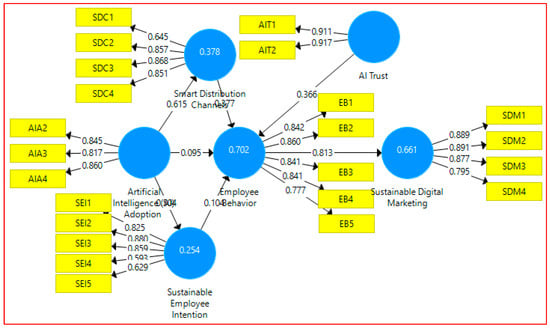
Figure 2.
Confirmatory Factor Analysis (CFA).
Convergent validity was assessed by using average variance extracted (AVE). According to the literature, the AVE must be higher than 0.5 to achieve the minimum level of convergent validity (Cheah et al., 2018). It can be observed from Table 4 that the AVE values of all variables fell between 0.588 and 0.835. Additionally, discriminant validity was assessed by using the Heterotrait–Monotrait Ratio (HTMT), and all the values were less than 0.9 (Hafkesbrink, 2021) as indicated in Table 5.
Table 4.
Convergent validity.
Table 5.
HTMT.
PLS bootstrapping is shown in Figure 3, highlighting the relationship between AI adoption, SDCs, sustainable employee intention, AI trust, employee behavior, and sustainable digital marketing. Hypotheses were evaluated based on path coefficients, t statistics, and p-values. Additionally, the moderation effects of AI trust will be analyzed using interaction terms in SmartPLS. A t-value of 1.96 was considered to check the significance of the relationship.
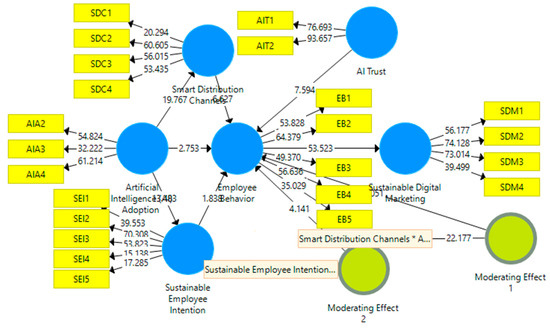
Figure 3.
Structural model.
PLS-SEM results of hypotheses are examined based on the beta value to check the direction of the relationship, and a t-value of 1.96 and p-value of 0.05 were considered to examine the significance level. The results show that all key direct relationships, except one, are positive and significant at the 1.96 t-value threshold. AI trust has a strong positive impact on employee behavior (β = 0.352, t = 7.594, p < 0.001). AI adoption significantly enhances employee behavior (β = 0.096, t = 2.753, p = 0.006), drives SDCs (β = 0.615, t = 19.767, p < 0.001), and strengthens sustainable employee intention (β = 0.504, t = 13.483, p < 0.001). In turn, employee behavior strongly promotes sustainable digital marketing (β = 0.813, t = 53.523, p < 0.001), while SDCs also positively influence employee behavior (β = 0.372, t = 6.627, p < 0.001). Only the path from sustainable employee intention to employee behavior is not significant (β = 0.098, t = 1.838, p = 0.067). Along with all the direct effect hypotheses, Hypothesis 4 is not supported and all others are found to be supported. All these results are reported in Table 6.
Table 6.
Direct effect and moderation.
The moderation effect presented in Table 6 highlights that AI trust cannot moderate the relationship between SDCs and employee behavior (β = −0.068, t = 1.051, p < 0.294). However, AI trust moderates the relationship between sustainable employee intention and employee behavior (β = 0.058, t = 4.141, p < 0), which strengthens the relationship, as shown in Figure 4. These results rejected Hypothesis 9 and accepted Hypothesis 10.
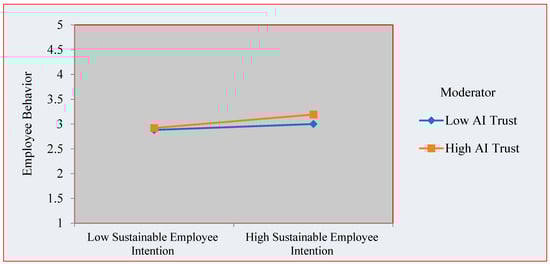
Figure 4.
Moderation effect of AI trust between sustainable employee intention and employee behavior.
The mediation effect of SDCs and sustainable employee intention is reported in Table 7. According to these results, the mediation effect of SDCs between AI adoption and employee behavior is significant (β = 0.229, t = 6.281, p < 0). However, the mediation effect of sustainable employee intention between AI adoption and employee behavior is insignificant (β = 0.05, t = 1.806, p < 0.071). Hence, Hypothesis 6 is supported, and Hypothesis 7 is not supported.
Table 7.
Indirect effect.
The results indicate a partial mediation effect of both SDCs and Sustainable Employee Intention in the relationship between AI Adoption and Employee Behavior. Although AI adoption directly influences employee behavior, the indirect effects through SDCs and sustainable intention remain significant, confirming that these mediators explain part, but not all, of the relationship. This suggests that while AI systems directly shape employee behavior, their full impact unfolds through improved distribution mechanisms and enhanced sustainability motivation, reflecting both the technological and human dimensions of organizational adaptation.
Furthermore, the r-square (R2) value is 0.661, which indicates that all the variables are expected to bring a 66.1% change in the dependent variable, which is strong. Additionally, to further assess the effect size and predictive relevance of the structural model, f2 and q2 statistics were computed. The f2 values for the main paths ranged between 0.12 and 0.36, indicating small to medium effect sizes, while the q2 values (ranging from 0.18 to 0.29) confirmed that all endogenous constructs possess satisfactory predictive relevance. These results demonstrate that the inclusion of SDCs, Sustainable Employee Intention, and AI Trust meaningfully enhances the explanatory power of the model beyond statistical significance, thereby supporting the robustness of the proposed relationships.
Overall, the findings provide strong empirical support for the proposed theoretical framework grounded in TAM and Sociotechnical Systems Theory. Most hypotheses were confirmed, demonstrating that AI adoption positively influences both smart distribution channels and sustainable employee intention, which in turn enhance employee behavior and sustainable digital marketing outcomes. The significant mediating effects of SDCs and sustainable intention confirm the dual pathways, technological and behavioral, through which AI adoption drives sustainability. The moderating role of AI trust further underscores the human dimension, reinforcing that employee confidence in AI strengthens the model’s predictive power. Collectively, these results validate the integration of TAM and STS, showing how individual acceptance and system-level alignment jointly advance sustainable performance in digital marketing contexts.
5. Discussion
The objective of this study was to inspect the role of AI adoption in sustainable digital marketing through the promotion of SDCs, sustainable employee intention, and employee behavior. The relationship between AI adoption, SDCs, sustainable employee intention, AI trust, employee behavior, and sustainable digital marketing was investigated. Nine hypotheses were proposed based on direct effects, indirect effects, and moderation effects. Overall, the findings confirm that AI adoption and trust, together with smart distribution channels, are critical drivers of employee behavior and sustainable digital marketing outcomes.
Hypothesis 1 examined the connection between AI adoption and employee behavior. These results supported the positive connection between AI adoption and employee behavior. The results confirm that AI adoption significantly enhances employee behavior, supporting earlier findings that technology integration fosters adaptability and innovation. In UAE telecommunications companies, AI tools reduce repetitive tasks, allowing employees to focus on value-added and sustainability-driven practices. These outcomes are constant with the preceding studies showing the positive relationship between AI and behavior of the people (Cao & Liu, 2023; Chai et al., 2021; Liu et al., 2024; Ramachandran et al., 2022). This finding reinforces the TAM, which posits that the perceived usefulness of technology shapes user behavior, and demonstrates AI’s role in promoting responsible employee actions in sustainable digital marketing.
Furthermore, Hypotheses 2 and 3 reported the effect of AI adoption on SDCs and sustainable employee intention. It is found that AI adoption has significant role in enhancing SDCs. Thus, AI is not only a technological driver but also a strategic resource for advancing SDCs, enabling firms like Etisalat and du to maintain their competitiveness while meeting sustainability goals. Similarly, previous studies reported the positive contribution of AI in distribution channels (Khan et al., 2023; Shi, 2022). Additionally, a positive contribution of AI adoption was found in terms of sustainable employee intention. In the UAE’s telecom sector, AI simplifies processes, increases transparency, and provides tools for informed decision-making, which encourages employees to commit to eco-friendly and socially responsible practices. The promotion of AI activities among various companies causes increased in sustainable employee intention. These outcomes are in line with those studies that highlight the positive relationship between AI and employee intention (J. J. Li et al., 2019; Lin & Lee, 2024; Verma & Singh, 2022).
Moreover, Hypotheses 4 and 5 reported the effect of SDCs and sustainable employee intention on employee behavior. According to the results, SDCs have a positive influence on the promotion of employee behavior towards digital marketing activities. In the UAE telecom sector, SDCs support sustainable digital marketing by reducing resource consumption and enhancing customer value delivery. This aligns with Sociotechnical Systems Theory, which emphasizes the interaction between technology and human behavior in achieving organizational goals. These findings are consistent the previous studies highlighting the relationship between distribution channels and employee behavior among various organizations (Frazier & Sheth, 1985; Udin, 2022; Zhou et al., 2022). Additionally, it is found that sustainable employee intention has no potential to increase employee behavior towards digital marketing activities. However, employees in UAE telecom firms who express sustainability-driven intentions are more likely to translate them into responsible workplace actions, such as adopting eco-friendly practices, ethical decision-making, and proactive engagement with AI systems. Inconsistent with the current study results, earlier studies reported the positive role of employee intention in employee behavior (Jimmieson et al., 2008; Williams & Shiaw, 1999; Yi et al., 2011). Thus, the specific results of the present study are not consistent with the previous studies due to contextual and working environment differences among the UAE companies in comparison with the other nations.
The mediation effect of SDCs and sustainable employee intention between AI adoption and employee behavior was proposed by considering Hypotheses 6 and 7. The mediation effect of SDCs between AI adoption and employee behavior is significant, showing that SDCs can transfer positive effects of AI adoption and employee behavior towards marketing activities. However, the mediation effect of sustainable employee intention between AI adoption and employee behavior is insignificant, showing that sustainable employee intention cannot transfer the positive effect of AI adoption on employee behavior. On the other hand, Hypothesis 8 reported that employee behavior can promote sustainable digital marketing in the UAE. This finding reinforces the view that employees act as key change agents, translating organizational strategies into impactful practices, and highlights the necessity of cultivating sustainable behavior to achieve long-term competitive advantage. These outcomes are consistent with other studies highlighting the positive relationship between employee behavior and digital marketing (Malhotra, 2024; Moorthy & Sahid, 2022).
Nevertheless, Hypotheses 9 and 10 reported the moderation effect of AI trust. It is found that AI trust cannot moderate the relationship between SDCs and employee behavior. Therefore, the analysis shows that AI trust does not significantly alter the link between SDCs and employee behavior because the relationship is already strong and direct. Employees may rely more on established operational processes than on perceptions of AI reliability in this context. This suggests that trust in AI is not a critical factor when effective distribution systems independently drive employee engagement. However, AI trust moderates the relationship between sustainable employee intention and employee behavior. The results proved that AI trust strengthens the relationship between sustainable employee intention and employee behavior. Thus, AI trust plays key role in enhancing employee behavior towards digital marketing activities.
Furthermore, the nonsignificant relationship between sustainable employee intention and employee behavior suggests that intentions to act sustainably do not necessarily translate into observable behaviors within UAE organizations. This gap may reflect the cultural and structural characteristics of the UAE’s corporate environment, where hierarchical decision-making and performance-driven targets often outweigh individual sustainability motives. Employees may value sustainability but feel limited in terms of their autonomy to act unless such behaviors are explicitly endorsed by leadership or embedded in corporate incentives. From a theoretical standpoint, this finding extends the Theory of Planned Behavior by emphasizing the moderating influence of organizational context on the intention–behavior link. It also aligns with Sociotechnical Systems Theory, highlighting that employee intentions must interact with supportive technical and social systems to produce sustainable behavioral outcomes. Thus, the results reveal that contextual constraints, not a lack of awareness, explain the weak translation of intention into action in AI-driven marketing settings.
6. Conclusions
This study examined how AI adoption shapes sustainable digital marketing outcomes through the mediating effects of smart distribution channels and sustainable employee intentions, with AI trust being a moderating factor. Grounded in the TAM and Sociotechnical Systems Theory, the findings reveal that both technological and human dimensions jointly drive sustainability performance in UAE organizations. The results highlight that employee trust and behavioral alignment with AI systems are essential for achieving long-term digital sustainability. The study contributes to theory by integrating behavioral and system-level perspectives, and contributes to practice by offering actionable insights for managers seeking to build trust-based, AI-enabled sustainable marketing environments. Future research should extend this model to other sectors and cultural contexts to test its broader applicability.
6.1. Implication of the Study
The current study has valuable theoretical and practical implications. For instance, this study extends the TAM and TPB by integrating sustainability constructs with AI adoption, employee behavior, and SDCss in the UAE context. Furthermore, findings of the study highlight the gap between sustainable employee intention and behavior, enriching behavioral theories by showing the contextual barriers in translating intention into action. This study contributed majorly by introducing the moderation effect of AI trust. The study introduces AI trust as a moderator, offering a new theoretical lens to understand how trust shapes employee–technology interactions in sustainable marketing. Additionally, the comprehensive model proposed by the current study can help future scholars to test across different industries and countries. Hence, theoretically, this study extends the TAM by demonstrating that employee behavior is not solely shaped by perceived usefulness or ease of use but also by AI trust and sustainability-oriented intentions. It further integrates Sociotechnical Systems Theory by showing that sustainable digital marketing outcomes emerge from the joint optimization of technical systems (AI and smart distribution channels) and social systems (employee attitudes and behaviors). Together, these extensions provide a multidimensional understanding of AI-driven sustainability in organizational contexts.
Practically, this study delivers valuable insights for the policymakers to address the problem of sustainable digital marketing. For instance, telecom companies should invest in AI systems that not only advance efficiency but also inspire employees to adopt sustainable behaviors. The results of the study suggested that firms must enhance SDCs by leveraging AI-driven analytics to reduce waste, optimize resources, and promote sustainable digital practices. From the results of the study, it is proposed that companies should introduce rewards, recognition, and incentives that encourage employees to consistently demonstrate sustainability-driven behaviors in digital marketing. Finally, the conclusion supports policymakers in promoting AI-enabled sustainability initiatives in line with the digital transformation of the UAE and its sustainability strategies. Hence, practically, managers and policymakers in the UAE should focus on trust-building mechanisms such as transparent AI communication, ethical AI governance, and employee involvement in AI design to reduce resistance and enhance sustainable engagement. HR departments can reinforce sustainability behavior through targeted training, reward systems, and leadership modeling that link AI usage with social and environmental goals. Policymakers may also encourage industry-wide AI ethics frameworks to strengthen accountability and public confidence in AI-enabled sustainability initiatives.
6.2. Limitations and Future Directions
A limitation of the current study could be in terms of potential future directions for scholars. Firstly, this study is limited to the telecommunications sector in the UAE, which may restrict its generalizability to other industries such as retail, banking, or healthcare. Therefore, future scholars should consider retail, banking, or healthcare and various other industries to enhance the generalizability of the study. Secondly, the framework of the study focuses on AI adoption, SDCs, employee behavior, and sustainability but excludes other potential influences such as leadership, organizational culture, or government policy. Thus, future studies should also consider leadership, organizational culture, or government policy while considering the role of AI adoption. Thirdly, the idea of the current study centers on employees, leaving out consumer reactions, which are crucial for sustainable digital marketing effectiveness. Hence, future studies must consider consumer reactions along with the employees of telecommunication companies. Fourth, given the fast pace of AI growth, our conclusion may become obsolete as new tools, as well as applications, emerge. Next, this study focuses on e& and du which may limit the generalizability of the findings to less technologically mature firms. Future research could extend this model to emerging or smaller enterprises to validate whether similar behavioral patterns exist in less advanced organizational settings. Additionally, the sample of the study shows a gender imbalance, with 75% male respondents, reflecting the male-dominated structure of the UAE telecommunications sector. However, this may still introduce sample bias, as gender can influence perceptions of AI adoption and sustainability behavior. Therefore, the findings should be interpreted cautiously, and future studies should aim for a more balanced gender representation to enhance their generalizability. Moreover, the self-reported, cross-sectional survey may involve response and sampling biases, and results represent only a specific point in time. No Instructional Manipulation Checks (IMCs) were included, which in future research could be used to enhance data reliability. Finally, the PLS-SEM approach also has inherent constraints, such as a limited model fit comparison. Moreover, findings are context-specific to UAE organizations; future studies should apply longitudinal or cross-country designs to explore temporal and spatial variations in AI-driven sustainability behavior.
Author Contributions
Conceptualization, M.N.; methodology, A.I.A.; software, A.I.A.; validation, A.I.A., M.N. and G.E.R.; formal analysis, M.N.; investigation, M.N.; resources, A.I.A.; data curation, A.I.A.; writing—original draft preparation, M.N.; writing—review and editing, M.N.; visualization, A.I.A.; supervision, G.E.R.; project administration, G.E.R. All authors have read and agreed to the published version of the manuscript.
Funding
This research received no external funding.
Institutional Review Board Statement
Ethical review and approval were waived for this study because it involved minimal risk and did not include any sensitive personal data. The research followed standard ethical guidelines for academic survey studies, and all participants were adult employees who voluntarily participated.
Informed Consent Statement
Informed consent was obtained from all subjects involved in the study. Participation was voluntary, and all respondents were informed about the purpose of the research, confidentiality of their responses, and their right to withdraw at any time without any consequence.
Data Availability Statement
Data is unavailable due to privacy restrictions.
Conflicts of Interest
The authors declare no conflict of interest.
References
- Abrardi, L., Cambini, C., & Rondi, L. (2022). Artificial intelligence, firms and consumer behavior: A survey. Journal of Economic Surveys, 36(4), 969–991. [Google Scholar] [CrossRef]
- Al Koliby, I. S., Mehat, N. A. B., Al-Swidi, A. K., & Al-Hakimi, M. A. (2024). Unveiling the linkages between entrepreneurial culture, innovation capability, digital marketing capability and sustainable competitive performance of manufacturing SMEs: Evidence from emerging countries. The Bottom Line, 37(4), 473–500. [Google Scholar] [CrossRef]
- Al Maskari, A. (2018). Theory of Planned Behavior (TPB) Ajzen (1988). In Technology adoption and social issues: Concepts, methodologies, tools, and applications (pp. 46–67). IGI Global Scientific Publishing. [Google Scholar]
- Ansari, H. U. H., & Khan, S. N. (2024). Linking green transformational leadership and employee pro-environmental behavior: The role of intention and work environment. Sustainable Futures, 8, 100336. [Google Scholar] [CrossRef]
- Arroyabe, M. F., Arranz, C. F., De Arroyabe, I. F., & de Arroyabe, J. C. F. (2024). Analyzing AI adoption in European SMEs: A study of digital capabilities, innovation, and external environment. Technology in Society, 79, 102733. [Google Scholar] [CrossRef]
- Barja-Martinez, S., Aragüés-Peñalba, M., Munné-Collado, Í., Lloret-Gallego, P., Bullich-Massagué, E., & Villafafila-Robles, R. (2021). Artificial intelligence techniques for enabling Big Data services in distribution networks: A review. Renewable and Sustainable Energy Reviews, 150, 111459. [Google Scholar] [CrossRef]
- Bido, D., da Silva, D., & Ringle, C. (2014). Structural equation modeling with the Smartpls. Brazilian Journal of Marketing, 13(2), 56–73. [Google Scholar]
- Braganza, A., Chen, W., Canhoto, A., & Sap, S. (2021). Productive employment and decent work: The impact of AI adoption on psychological contracts, job engagement and employee trust. Journal of Business Research, 131, 485–494. [Google Scholar] [CrossRef]
- Cao, P., & Liu, S. (2023). The impact of artificial intelligence technology stimuli on sustainable consumption behavior: Evidence from ant forest users in China. Behavioral Sciences, 13(7), 604. [Google Scholar] [CrossRef]
- Chai, C. S., Lin, P.-Y., Jong, M. S.-Y., Dai, Y., Chiu, T. K., & Qin, J. (2021). Perceptions of and behavioral intentions towards learning artificial intelligence in primary school students. Educational Technology & Society, 24(3), 89–101. [Google Scholar]
- Chan, E. S., Hon, A. H., Chan, W., & Okumus, F. (2014). What drives employees’ intentions to implement green practices in hotels? The role of knowledge, awareness, concern and ecological behaviour. International Journal of Hospitality Management, 40, 20–28. [Google Scholar] [CrossRef]
- Cheah, J.-H., Sarstedt, M., Ringle, C. M., Ramayah, T., & Ting, H. (2018). Convergent validity assessment of formatively measured constructs in PLS-SEM: On using single-item versus multi-item measures in redundancy analyses. International Journal of Contemporary Hospitality Management, 30, 3192–3210. [Google Scholar] [CrossRef]
- Comrey, A., & Lee, H. (1992). A first course in factor analysis (2nd ed.). Lawrence Earlbaum Associates. [Google Scholar]
- Davis, F. D., Bagozzi, R. P., & Warshaw, P. R. (1989). User acceptance of computer technology: A comparison of two theoretical models. Management Science, 35(8), 982–1003. [Google Scholar] [CrossRef]
- Dimoff, J. K., & Kelloway, E. K. (2019). With a little help from my boss: The impact of workplace mental health training on leader behaviors and employee resource utilization. Journal of Occupational Health Psychology, 24(1), 4–19. [Google Scholar] [CrossRef] [PubMed]
- Dulloo, R., Appolloni, A., & Mathiyazhagan, K. (2025). AI-powered communication: Strategic framework for technological innovation, brand perception, and sustainable marketing. In Strategic blueprints for AI-driven marketing in the digital era (pp. 1–40). IGI Global Scientific Publishing. [Google Scholar]
- Eng, P. H., & Liu, R. L. (2024). Will intelligent technologies replace humans in the future? An exploratory study for likelihood of intelligent technologies to replace humans in the future. In Current and future trends on intelligent technology adoption: Volume 2 (pp. 171–202). Springer. [Google Scholar]
- Frazier, G. L., & Sheth, J. N. (1985). An attitude-behavior framework for distribution channel management. Journal of Marketing, 49(3), 38–48. [Google Scholar] [CrossRef]
- Greenland, S. J. (2019). Future sustainability, innovation and marketing: A framework for understanding impediments to sustainable innovation adoption and corporate social responsibility. In The components of sustainable development: Engagement and partnership (pp. 63–80). Springer. [Google Scholar]
- Gündüzyeli, B. (2024). Artificial intelligence in digital marketing within the framework of sustainable management. Sustainability, 16(23), 10511. [Google Scholar] [CrossRef]
- Hafkesbrink, J. (2021). Questions. Heterotrait-Monotrait Ratio of Correlations (HTMT) in assessing the discriminant validity in PLS-SEM model? ResearchGate. Available online: https://www.researchgate.net/post/Heterotrait-Monotrait-Ratio-of-Correlations-HTMT-in-assessing-the-discriminant-validity-in-PLS-SEM-model (accessed on 10 September 2025).
- Hair, J. F., Jr., Hult, G. T. M., Ringle, C., & Sarstedt, M. (2016). A primer on partial least squares structural equation modeling (PLS-SEM). Sage Publications. [Google Scholar]
- Henseler, J., Dijkstra, T. K., Sarstedt, M., Ringle, C. M., Diamantopoulos, A., Straub, D. W., Ketchen, D. J., Hair, J. F., Hult, G. T. M., & Calantone, R. J. (2014). Common beliefs and reality about PLS: Comments on Rönkkö and Evermann (2013). Organizational Research Methods, 17(2), 182–209. [Google Scholar] [CrossRef]
- Henseler, J., Ringle, C. M., & Sinkovics, R. R. (2009). The use of partial least squares path modeling in international marketing. In New challenges to international marketing (pp. 277–319). Emerald Group Publishing Limited. [Google Scholar]
- Jaillant, L., & Rees, A. (2023). Applying AI to digital archives: Trust, collaboration and shared professional ethics. Digital Scholarship in the Humanities, 38(2), 571–585. [Google Scholar] [CrossRef]
- Jain, V., Wadhwani, K., & Eastman, J. K. (2024). Artificial intelligence consumer behavior: A hybrid review and research agenda. Journal of Consumer Behaviour, 23(2), 676–697. [Google Scholar] [CrossRef]
- Januszkiewicz, K. (2022). Understanding flexibility–dimensions of employee behavior flexibility. International Journal of Contemporary Management, 58(3), 27–40. [Google Scholar] [CrossRef]
- Jimmieson, N. L., Peach, M., & White, K. M. (2008). Utilizing the theory of planned behavior to inform change management: An investigation of employee intentions to support organizational change. The Journal of Applied Behavioral Science, 44(2), 237–262. [Google Scholar] [CrossRef]
- Kazmi, S. A. A., Shahzad, M. K., Khan, A. Z., & Shin, D. R. (2017). Smart distribution networks: A review of modern distribution concepts from a planning perspective. Energies, 10(4), 501. [Google Scholar] [CrossRef]
- Khan, A. A., Laghari, A. A., Rashid, M., Li, H., Javed, A. R., & Gadekallu, T. R. (2023). Artificial intelligence and blockchain technology for secure smart grid and power distribution automation: A state-of-the-art review. Sustainable Energy Technologies and Assessments, 57, 103282. [Google Scholar] [CrossRef]
- Kim, B.-J., & Kim, M.-J. (2025). The AI-environment paradox: Unraveling the impact of artificial intelligence (AI) adoption on pro-environmental behavior through work overload and self-efficacy in AI learning. Journal of Environmental Management, 380, 125102. [Google Scholar] [CrossRef] [PubMed]
- Kim, J., Giroux, M., & Lee, J. C. (2021). When do you trust AI? The effect of number presentation detail on consumer trust and acceptance of AI recommendations. Psychology & Marketing, 38(7), 1140–1155. [Google Scholar] [CrossRef]
- Ladelsky, L. K., & Lee, T. W. (2023). Effect of risky decision-making and job satisfaction on turnover intention and turnover behavior among information technology employees. International Journal of Organizational Analysis, 31(7), 3553–3581. [Google Scholar] [CrossRef]
- Li, J. J., Bonn, M. A., & Ye, B. H. (2019). Hotel employee’s artificial intelligence and robotics awareness and its impact on turnover intention: The moderating roles of perceived organizational support and competitive psychological climate. Tourism Management, 73, 172–181. [Google Scholar] [CrossRef]
- Li, Y.-H., Li, Y.-L., Wei, M.-Y., & Li, G.-Y. (2024). Innovation and challenges of artificial intelligence technology in personalized healthcare. Scientific Reports, 14(1), 18994. [Google Scholar] [CrossRef]
- Lin, R.-R., & Lee, J.-C. (2024). The supports provided by artificial intelligence to continuous usage intention of mobile banking: Evidence from China. Aslib Journal of Information Management, 76(2), 293–310. [Google Scholar] [CrossRef]
- Liu, Y., Li, Y., Song, K., & Chu, F. (2024). The two faces of Artificial Intelligence (AI): Analyzing how AI usage shapes employee behaviors in the hospitality industry. International Journal of Hospitality Management, 122, 103875. [Google Scholar] [CrossRef]
- Malhotra, A. (2024). Application of digital marketing and its impact on marketing behavior in the industrial sectors. In Emerging trends in smart societies (pp. 158–162). Routledge. [Google Scholar]
- McElheran, K., Li, J. F., Brynjolfsson, E., Kroff, Z., Dinlersoz, E., Foster, L., & Zolas, N. (2024). AI adoption in America: Who, what, and where. Journal of Economics & Management Strategy, 33(2), 375–415. [Google Scholar] [CrossRef]
- Mennella, C., Maniscalco, U., De Pietro, G., & Esposito, M. (2024). Ethical and regulatory challenges of AI technologies in healthcare: A narrative review. Heliyon, 10(4), e26297. [Google Scholar] [CrossRef]
- Mheidat, M., Jahmani, A., & Alhashash, K. M. (2025). Metaverse tourism model: A revolution in tourism management and marketing. Journal of Metaverse Business Designs, 6(1), 56–68. [Google Scholar] [CrossRef]
- Minh, T. C., & Quynh, N. N. T. (2024). Factors affecting sustainable consumption behavior: Roles of pandemics and perceived consumer effectiveness. Cleaner and Responsible Consumption, 12, 100158. [Google Scholar] [CrossRef]
- Mohassel, R. R., Fung, A., Mohammadi, F., & Raahemifar, K. (2014). A survey on advanced metering infrastructure. International Journal of Electrical Power & Energy Systems, 63, 473–484. [Google Scholar] [CrossRef]
- Moorthy, T., & Sahid, S. (2022). The influence of digital marketing literacy on entrepreneurship behavior among public university students in Malaysia. International Journal of Academic Research in Business and Social Sciences, 12(1), 548–568. [Google Scholar] [CrossRef]
- Presbitero, A., & Teng-Calleja, M. (2023). Job attitudes and career behaviors relating to employees’ perceived incorporation of artificial intelligence in the workplace: A career self-management perspective. Personnel Review, 52(4), 1169–1187. [Google Scholar] [CrossRef]
- Rabby, F., Chimhundu, R., & Hassan, R. (2021). Artificial intelligence in digital marketing influences consumer behaviour: A review and theoretical foundation for future research. Academy of Marketing Studies Journal, 25(5), 1–7. [Google Scholar] [CrossRef]
- Ramachandran, K., Mary, A. A. S., Hawladar, S., Asokk, D., Bhaskar, B., & Pitroda, J. (2022). Machine learning and role of artificial intelligence in optimizing work performance and employee behavior. Materials Today: Proceedings, 51, 2327–2331. [Google Scholar] [CrossRef]
- Ringle, C. M., Sarstedt, M., & Straub, D. (2012). A critical look at the use of PLS-SEM in MIS Quarterly. MIS Quarterly, 36, iii–xiv. [Google Scholar] [CrossRef]
- Rubel, M. R. B., Kee, D. M. H., & Rimi, N. N. (2023). Promoting technology innovation performance through high involvement HRM, technology adaptation and innovativeness. Business Process Management Journal, 29(5), 1277–1302. [Google Scholar] [CrossRef]
- Salhab, H., Zoubi, M., Khrais, L. T., Estaitia, H., Harb, L., Al Huniti, A., & Morshed, A. (2025). AI-driven sustainable marketing in gulf cooperation council retail: Advancing SDGs through smart channels. Administrative Sciences, 15(1), 20. [Google Scholar] [CrossRef]
- Sawang, S., Ng, P. Y., Kivits, R. A., Dsilva, J., & Locke, J. (2024). Examining the influence of customers, suppliers, and regulators on environmental practices of SMEs: Evidence from the United Arab Emirates. Business Strategy and the Environment, 33(7), 6533–6546. [Google Scholar] [CrossRef]
- Shaikh, F., Afshan, G., Anwar, R. S., Abbas, Z., & Chana, K. A. (2023). Analyzing the impact of artificial intelligence on employee productivity: The mediating effect of knowledge sharing and well-being. Asia Pacific Journal of Human Resources, 61(4), 794–820. [Google Scholar] [CrossRef]
- Shi, J. (2022). Research on optimization of cross-border e-commerce logistics distribution network in the context of artificial intelligence. Mobile Information Systems, 2022(1), 3022280. [Google Scholar] [CrossRef]
- Steven, P. H. (2025). Reinforcing financial growth in metaverse organizations: A governance-driven approach to leveraging technological advancements in the United States of America (USA). Journal of Metaverse Business Designs, 6(1), 1–11. [Google Scholar] [CrossRef]
- Sumartono, E., Harliyanto, R., Situmeang, S. M. T., Siagian, D. S., & Septaria, E. (2024). The legal implications of data privacy laws, cybersecurity regulations, and ai ethics in a digital society. The Journal of Academic Science, 1(2), 103–110. [Google Scholar] [CrossRef]
- Sweis, R. J. (2010). The relationship between information technology adoption and job satisfaction in contracting companies in Jordan. Journal of Information Technology in Construction, 15, 44–63. [Google Scholar]
- Thangaraju, K., & Palani, P. (2024). Integrating sustainability into AI-driven HRM practices: Examining employee engagement and organizational performance in the IT industry. Pakistan Journal of Life & Social Sciences, 22(2), 14014–14028. [Google Scholar]
- Tomaira, R. (2022). DUBAI from marginal gulf town to regional hub. In Emerging global cities (pp. 34–65). Columbia University Press. [Google Scholar]
- Toraman, Y. (2022). User acceptance of metaverse: Insights from technology acceptance model (TAM) and planned behavior theory (PBT). EMAJ: Emerging Markets Journal, 12(1), 67–75. [Google Scholar] [CrossRef]
- Trist, E., & Emery, F. (2015). Sociotechnical systems theory. In Organizational behavior 2 (pp. 169–194). Routledge. [Google Scholar]
- Trivedi, A., Kaur, E. K., Choudhary, C., & Barnwal, P. (2023, March 3–5). Should AI technologies replace the human jobs? 2023 2nd International Conference for Innovation in Technology (INOCON), Bangalore, India. [Google Scholar]
- Udin, U. (2022). Knowledge sharing and innovative work behavior: Testing the role of entrepreneurial passion in distribution channel. Journal of Distribution Science, 20(2), 79–89. [Google Scholar]
- Venkatesh, V., & Davis, F. D. (2000). A theoretical extension of the technology acceptance model: Four longitudinal field studies. Management Science, 46(2), 186–204. [Google Scholar] [CrossRef]
- Verma, S., & Singh, V. (2022). The employees intention to work in artificial intelligence-based hybrid environments. IEEE Transactions on Engineering Management, 71, 3266–3277. [Google Scholar] [CrossRef]
- Walker, G. H., Stanton, N. A., Salmon, P. M., & Jenkins, D. P. (2008). A review of sociotechnical systems theory: A classic concept for new command and control paradigms. Theoretical Issues in Ergonomics Science, 9(6), 479–499. [Google Scholar] [CrossRef]
- White, K., Cakanlar, A., Sethi, S., & Trudel, R. (2025). The past, present, and future of sustainability marketing: How did we get here and where might we go? Journal of Business Research, 187, 115056. [Google Scholar] [CrossRef]
- Williams, S., & Shiaw, W. T. (1999). Mood and organizational citizenship behavior: The effects of positive affect on employee organizational citizenship behavior intentions. The Journal of Psychology, 133(6), 656–668. [Google Scholar] [CrossRef]
- Yi, Y., Nataraajan, R., & Gong, T. (2011). Customer participation and citizenship behavioral influences on employee performance, satisfaction, commitment, and turnover intention. Journal of Business Research, 64(1), 87–95. [Google Scholar] [CrossRef]
- Yoon, S. W., & Park, J. G. (2023). Employee’s intention to share knowledge: The impacts of learning organization culture and learning goal orientation. International Journal of Manpower, 44(2), 231–246. [Google Scholar] [CrossRef]
- Yragui, N. L., Demsky, C. A., Hammer, L. B., Van Dyck, S., & Neradilek, M. B. (2017). Linking workplace aggression to employee well-being and work: The moderating role of family-supportive supervisor behaviors (FSSB). Journal of Business and Psychology, 32(2), 179–196. [Google Scholar] [CrossRef] [PubMed]
- Zawra, L. M., Mansour, H. A., Eldin, A. T., & Messiha, N. W. (2017, September 9–11). Utilizing the internet of things (IoT) technologies in the implementation of industry 4.0. International Conference on Advanced Intelligent Systems and Informatics, Cairo, Egypt. [Google Scholar]
- Zhang, Y., & Wang, S. (2023). The influence of anthropomorphic appearance of artificial intelligence products on consumer behavior and brand evaluation under different product types. Journal of Retailing and Consumer Services, 74, 103432. [Google Scholar] [CrossRef]
- Zhou, J., Sheng, S., & Zhang, C. (2022). Deterring unethical behaviors in marketing channels: The role of distributor whistleblowing. Journal of Business Ethics, 181(1), 97–115. [Google Scholar] [CrossRef]
- Ziakis, C., & Vlachopoulou, M. (2023). Artificial intelligence in digital marketing: Insights from a comprehensive review. Information, 14(12), 664. [Google Scholar] [CrossRef]
Disclaimer/Publisher’s Note: The statements, opinions and data contained in all publications are solely those of the individual author(s) and contributor(s) and not of MDPI and/or the editor(s). MDPI and/or the editor(s) disclaim responsibility for any injury to people or property resulting from any ideas, methods, instructions or products referred to in the content. |
© 2025 by the authors. Licensee MDPI, Basel, Switzerland. This article is an open access article distributed under the terms and conditions of the Creative Commons Attribution (CC BY) license (https://creativecommons.org/licenses/by/4.0/).