


The human population is exponentially increasing and is projected to reach or exceed 9 billion by 2050. Accordingly, demand for agricultural goods such as cereals and oil crops is expected to grow by more than 200%. To meet crop production targets under a variety of dynamic environmental conditions, new solutions, including further advances in crop genetics and improved crop management practices (e.g., irrigation, fertilizer application, and crop rotation), are required [1]. Controlled experiments that are required to test all potential solutions across the range of environmental conditions are not feasible. Crop models remove experimental limitations and allow us to explore the complex response of crops under different environmental and management scenarios in silico. Incorporating data on genetics, weather, soil, and management practices has greatly improved crop modelling. Accordingly, more complex models, which include water/nutrient uptake, energy utilization, and environmental tolerance, enable the simulation of crop yield at increasingly high levels of detail [2].
The standard approach of simulating crop adaptation to climate change is to first calibrate the crop model to observational data (i.e., to minimize the differences between the actual and predicted crop yield) and then to run future scenarios. However, increasing the number of parameters and variables in these climate- and process-based crop models increases their uncertainty of the estimated yield of a specific crop cultivar for a target environment (Figure 1). The magnitude of this uncertainty varies from model to model and depends on the approach (i.e., empirical or process-based) used to model the effect of climate change on crop physiology (e.g., heat stress) or on grain development and yield estimations [3,4,5,6,7,8]. Moreover, the sensitivity of crop models to one environmental parameter (e.g., temperature) would also influence the magnitude of the effect of other parameters on yield formation. This is due to mechanistic or empirical interactions between parameters (e.g., CO2 × temperature) in crop models which may lead to inaccurate estimates of crops’ adaptive potential under different environmental and management scenarios.
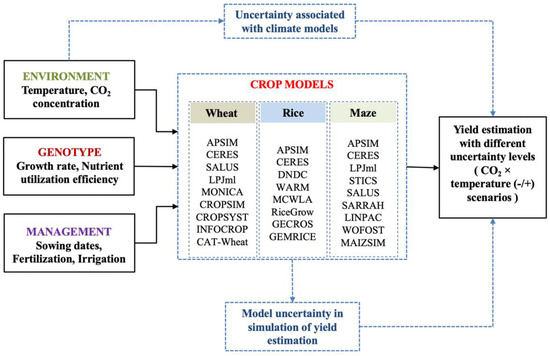
Figure 1.
Crop model simulation framework with different sources of uncertainty affecting model predictions. Note: Further details of crop models are detailed in previous studies [3,4,5,6,7,8].
Currently, crop yield uncertainty is estimated by calibrating multiple crop models to the observational data. However, these data often comprise shorter time spans than the future scenarios for which crop adaptive behavior is predicted. Moreover, there is substantial uncertainty associated with the climate models that are used to generate future scenarios. Thus, it is difficult to accurately estimate the uncertainty of future crop yield predictions without considering both the uncertainty of climate models and propagation of uncertainty. In addition, divergent responses to increasing temperature (i.e., increased growth or heat stress) need to be simulated more precisely. By considering all major sources of uncertainty and divergent crop responses, the accuracy of future crop yield predictions and crop adaptive potential can be improved. This, in turn, enables the assessment of novel solutions to meet future food demand.
Conflicts of Interest
The authors declare no conflict of interest.
References
- Hatfield, J.L.; Walthall, C.L. Meeting global food needs: realizing the potential via genetics × environment × management interactions. Agron. J. 2015, 107, 1215–1226. [Google Scholar] [CrossRef]
- Chenu, K.; Porter, J.R.; Martre, P.; Basso, B.; Chapman, S.C.; Ewert, F.; Bindi, M.; Asseng, S. Contribution of crop models to adaptation in wheat. Trends Plant Sci. 2017, 22, 472–490. [Google Scholar] [CrossRef] [PubMed]
- Li, T.; Hasegawa, T.; Yin, X.; Zhu, Y.; Boote, K.; Adam, M.; Bregaglio, S.; Buis, S.; Confalonieri, R.; Fumoto, T.; et al. Uncertainties in predicting rice yield by current crop models under a wide range of climatic conditions. Glob. Chang. Biol. 2015, 21, 1328–1341. [Google Scholar] [CrossRef] [PubMed]
- Bassu, S.; Brisson, N.; Durand, J.; Boote, K.; Lizaso, J.; Jones, J.W.; Rosenzweig, C.; Ruane, A.C.; Adam, M.; Baron, C.; et al. How do various maize crop models vary in their responses to climate change factors? Glob. Chang. Biol. 2014, 20, 2301–2320. [Google Scholar] [CrossRef] [PubMed]
- O’Leary, G.J.; Christy, B.; Nuttall, J.; Huth, N.; Cammarano, D.; Stöckle, C.; Basso, B.; Shcherbak, I.; Fitzgerald, G.; Luo, Q.; et al. Response of wheat growth, grain yield and water use to elevated CO2 under a free-air CO2 enrichment (FACE) experiment and modelling in a semi-arid environment. Glob. Chang. Biol. 2015, 21, 2670–2686. [Google Scholar]
- Ahmed, M.; Akram, M.N.; Asim, M.; Aslam, M.; Hassan, F.; Higgins, S.; Stöckle, C.O.; Hoogenboom, G. Calibration and validation of APSIM-Wheat and CERES-Wheat for spring wheat under rainfed conditions: Models evaluation and application. Comput. Electron. Agric. 2016, 123, 384–401. [Google Scholar] [CrossRef]
- Asseng, S.; Ewert, F.; Martre, P.; Rötter, R.P.; Lobell, D.B.; Cammarano, D.; Kimball, B.A.; Ottman, M.J.; Wall, G.W.; White, J.W.; et al. Rising temperatures reduce global wheat production. Nat. Clim. Chang. 2015, 5, 143. [Google Scholar] [CrossRef]
- Montesino-San Martín, M.; Olesen, J.E.; Porter, J.R. Can crop-climate models be accurate and precise? A case study for wheat production in Denmark. Agric. For. Meteorol. 2015, 202, 51–60. [Google Scholar] [CrossRef]
© 2019 by the authors. Licensee MDPI, Basel, Switzerland. This article is an open access article distributed under the terms and conditions of the Creative Commons Attribution (CC BY) license (http://creativecommons.org/licenses/by/4.0/).