


Abstract
Most research on air chemistry and human health has focused on negative consequences of air pollution from cities, rural dust, mining, or industrial sites. Research on nature tourism and nature therapy, in contrast, focuses on positive benefits of air quality for physical and mental health, e.g., via “clean air clean water” holidays. Aeroanions and terpenoids in forests have received particular attention, especially in China, Japan, and Korea. We review and analyse several hundred articles published in English and Chinese. With a few recent exceptions, English-language research has tested indoor negative ion generators, and concluded that they have no measurable health benefit. It has tested terpenoids in indoor aroma marketing. Chinese-language research, in contrast, has analysed fine-scale components of outdoor environments that affect concentrations of aeroanions and terpenoids: ecosystem, latitude, altitude, temperature, proximity to water, and individual plant species. Historically, health outcomes have been taken for granted, with little rigorous testing. Air quality research has shown that aeroanions can become attached to fine water droplets, e.g., after rain in forests, or in mists produced locally by waterfalls. We hypothesise that the health benefits of aeroanions in natural environments may arise through the scavenging of airborne particulates by negatively charged mists, creating especially clean, dust-free air. We propose that this particularly clean-tasting air, contrasting strongly with polluted urban air, creates positive effects on human mental health and perhaps, also on pulmonary physical health. Mechanisms and outcomes remain to be tested. We also propose testing psychological health effects of airborne terpenoid scents from forest trees.
Keywords:
therapy; psychology; mental; senses; sight; sound; smell; taste; touch; temperature; terpenoids; aeroanions 1. Introduction
Air affects human health via four main mechanisms. First, breathing oxygen is essential for survival. This is of concern at high altitudes, in sealed spaces such as submarines, and in breathing apparatus, e.g., for firefighting or underwater diving. Second, the physical characteristics of air, such as temperature and humidity extremes, high velocity winds, and very loud sounds, can cause discomfort, danger, or sometimes death. Third, a range of trace components can cause damage to health, even though they may be undetectable by people breathing them. Damage mechanisms may include: physical and physiological, e.g., silica dust, asbestos fibres, or radon gas; chemical and biochemical, e.g., carbon monoxide or other gaseous pollutants and toxins; and biological and microbiological, such as airborne transmissible pathogenic viruses and bacteria. These are studied extensively in epidemiological contexts. Fourth, a very wide range of air components and characteristics affect human physical and mental health via the senses. These include: temperature and humidity; airborne sound; and various gases, vapours, volatiles, and emulsions detectable by smell. These are our focus here (Table 1).

Table 1.
Major characteristics of breathable air affecting human health.
These four mechanisms interact and overlap. For example, detectability and intensity of scents may depend on temperature and humidity. Their effects on human wellbeing also depend on individual physical and mental states, personalities, and life history events. For example, particular smells such as plants or petrichor [1] or sounds such as birdsongs [2] may trigger positive or negative memories of past events. There are also cultural and lifestyle components, e.g., sensory experiences from childhood. The psychological effects of any one sense may be modified by simultaneous experiences through other senses; what a person sees or hears may influence how they respond to smell. Therefore, in analysing the wellbeing effects of any one constituent of air, we must also consider the setting, the person, and their simultaneous experiences through other senses.
Here, we focus on long-standing controversies over the health effects of two constituents of breathable air, especially in forest ecosystems. The first of these is aeroanions, which are oxygen molecules with a negative charge derived from two additional electrons. Every person breathes air containing aeroanions, but relative concentrations differ substantially across different circumstances, in nature and in urban and indoor settings. Machines to generate aeroanions artificially as potential health aids are also widely available. The second is terpenoids, volatile organic chemicals derived from plant resins in many tree species, broadleaf as well as coniferous [3]. These occur naturally, but concentrations vary greatly both at large scales, e.g., mountaintops cf. forests, and at local scales, e.g., near particular tree species. They are also used commercially in indoor air fresheners and aroma generators.
The critical controversies are whether or not aeroanions or terpenoids, separately, improve human physical or mental health. Different opinions hold sway in different bodies of research. Chinese-language literature holds that both yield positive effects, whereas most English-language literature, with a few recent exceptions, dismisses any effects as equivocal. These views are hence in conflict, affecting both research and therapeutic applications. Here, we attempt to reconcile these conflicting views through review and comparison of the two bodies of research. Research literatures on the same topic in different languages are often divergent [4,5,6,7]. Comparative analysis is not straightforward in this case, because individual mental health parameters are also influenced by domestic, demographic, and socioeconomic factors, personality characteristics, and other sensory experiences. In assessing each study, we must consider its context and what factors were controlled for.
Even though the focus is on air chemistry, this is a cross-cultural study. Everything with a human component has a cultural dimension. In the arts, architecture, humanities, human geography, business, law, economics, policy, and politics, that is assumed and addressed routinely. In the social and behavioural sciences, including environmental, health, and leisure sciences, it is sometimes addressed and sometimes ignored. In the hard natural sciences, such as physics and chemistry, it is routinely ignored. Even in those fields, however, there are cultural differences in how analyses and experiments are conceived and conducted, and what research topics are prioritized and published.
Even though English is seen as the de facto lingua franca of international academic research, there are also large volumes of research published in other languages. Researchers at universities or national government institutions may face incentives or requirements to publish either in their own languages or in English, or both, depending on national policies [4]. Each nation may consider its own language of highest importance and rank, and may encourage or demand the construction of corresponding bodies of knowledge.
Our theme here is nature therapy, focusing on sensory experiences in forest ecosystems. This has strong components from health and environmental sciences, each with local geographical and cultural dimensions, and large bodies of research published in a variety of languages. These typically overlap with English-language research, but are not the same. English-language research on nature therapies includes studies conducted in many different countries, most notably Japan and China. Japanese-language research has been reviewed in English, but Chinese-language research has not.
Here, therefore, we review Chinese-language research on one aspect of nature therapies, namely sensory experiences of forest visitors, and we compare directions, emphases, and findings against English-language counterparts. In particular, we search for topics covered only, or more thoroughly, in Chinese-language than English-language research, or those where Chinese-language research yields different or conflicting findings from English-language counterparts. That aim sets constraints on our methods. We are searching for differences rather than overlaps, so broad content-mapping methods are not suitable. We need an iterative process that can first identify similarities, but then focus on distinctions. To achieve this, we use an iterative qualitative thematic analysis. This identifies airborne terpenoids and aeroanions as key differences.
2. English-Language Literature and Theoretical Framework
The positive effects of minor constituents of air on human health arise through two principal mechanisms: via pulmonary, cardiovascular, and biochemical functions, e.g., in reducing asthma [8]; and via the senses and emotions, for mental health. Our focus here is on the latter, and our theoretical framework is thus the role of senses and emotions in self-perceived wellbeing and externally measurable mental health [9,10,11,12,13,14]. As summarised in Figure 1, place and activity create sensory experiences; personality and senses create emotional experiences; sensory and emotional experiences create memories; and memories contribute to mental health and wellbeing. We focus on forest ecosystems [15,16] and compare Chinese-language against English-language research (Table 2). There is also extensive research on the broader wellbeing effects of forest immersion [17,18,19,20,21,22], but with less reference to atmospheric components.
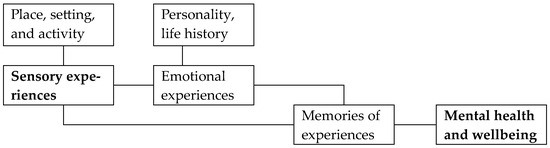
Figure 1.
Mechanism of sensory effects on mental health and wellbeing.
Table 2.
English-language research on airborne senses in nature-based tourism.
3. Materials and Methods
There are no general protocols for multi- or cross-language reviews of research literature [38]. We therefore conducted a literature search in Chinese for relevant Chinese-language publications, analysed them qualitatively both in Chinese and in English translation, and compared Chinese findings against those published in English. We searched broadly for publications on forest sensory experiences, and then analysed them in four stages: all senses; airborne senses; air chemistry and smell; and finally, aeroanions and terpenoids specifically. The rationale for this multi-stage approach is that, whilst there are no relevant differences between the two bodies of literature for most senses, there are substantial differences for terpenoids and aeroanions. Therefore, we returned iteratively to the search and analysis, so as to focus on these components but also to place them in a broader context, as above. This review thus adopts an iterative directed-content qualitative thematic analysis of documentary sources, namely Chinese-language research publications on sensory experiences in forest ecosystems.
We obtained these materials by searching the Chinese National Knowledge Inventory, CNKI (see Figure 2), using the Chinese words for “sense” and each sense individually coupled with “forest” or “woodland”. This includes forest ecotourism, forest tourism, and forest therapy. The full articles were screened and analysed in Chinese by the Chinese-speaking authors, and the analyses translated to English. In parallel, the titles and abstracts were translated to English, and analysed by the English-speaking authors. The two analyses were checked against each other. This is a technique adopted in previous cross-lingual analyses of qualitative data in Chinese and English [39]. Patterns derived from the Chinese-language literature were then compared against those in the English-language literature.
For English-language researchers who do not speak Chinese, the Chinese-language sources are not directly accessible. Readers rely on authors to present patterns in English. We therefore refer to Chinese-language articles as sources in the tables presenting our qualitative analyses. There are also many bilingual Chinese researchers, however, who can access the primary materials as well as reading this article. We therefore list Chinese-language sources in full in Appendix A, translated to English so that titles are available to English-speaking readers. Some, but not all, also have English-language abstracts searchable via Google Scholar®.
4. Results
4.1. Chinese-Language Publications and Themes
We found ~250 relevant items in CNKI. They were published in forestry, ecology, tourism, and medical journals. We excluded 141 items that did not directly report sensory experiences of forest visitors, leaving 119 articles (Figure 2). These are listed in full in Appendix A. That list provides our primary dataset of source materials for this analysis. From both direct Chinese-language and translated English-language analyses, we identified five principal themes within the Chinese-language research literature. These are outlined below, in order from broader to narrower scale and focus. They are: forest therapy; physical and mental health; stress recovery via sensory experiences; airborne terpenoids; and aeroanions. In the sections below, we have tabulated subthemes within each of these five main themes, with examples from the list in Appendix A. Note that Table 3, Table 4, Table 5, Table 6 and Table 7 include only examples to illustrate the subthemes, 85 in total, but the other 34 source articles listed in Appendix A were also used in the thematic analysis.
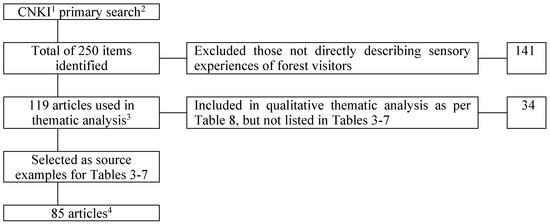
Figure 2.
Numerical summary of CNKI search results. Note that this is a qualitative thematic analysis, not a PRISMA systematic analysis. 1 China National Knowledge Inventory, 2024, https://oversea.cnki.net/index/products/en/index.html (accessed on 9 April 2024) (English), or https://cnki.net (accessed on 9 April 2024) (Chinese, as used here).2 Chinese terms for: [“sense” OR “sight” OR “see” OR “sound” OR “hear” OR “smell” OR “scent” OR “taste” OR “touch” OR “temperature”] AND [“forest” OR “woodland”]. 3 Listed in full in Appendix A. 4 Listed as sample sources in Table 3, Table 4, Table 5, Table 6 and Table 7, inclusive.
4.2. Forest Visitation in China Is Intended to Be Therapeutic
Forest visits and visitor infrastructure in China are designed and evaluated with mental health as a specific goal (Table 3). Chinese approaches to forest therapy are on a far larger scale than English-language approaches [18,20], including over 1000 Forest Healthy Life Centres under construction to provide a billion person-days per year [11].
Table 3.
Examples of Chinese-language research on forest therapy.
Table 3.
Examples of Chinese-language research on forest therapy.
| Subtheme | Research Site or Topic | Chinese Sources * |
|---|---|---|
| Forest therapy as primary goal of forest visits in China | Dongping Forest Park, Chongming | Chen, Kong et al., 2007 |
| Suyukou National Forest Park (NFP) | Du et al., 2019 | |
| Forest therapy functional index | Pan, Liu et al., 2018 | |
| Forest recuperation index | Pan, Zeng et al., 2018 | |
| Forest therapy product design | Xue & Bao, 2010 | |
| Forest therapy convalescence | Yan et al., 2020 | |
| Heilongjiang Jiangdaqi NFP | Wang et al., 2022 | |
| Forest Healthy Life Centres (FHLCs) to national standards | Demand for FHLC | Cong et al., 2023 |
| Planning and design of FHLC | Dan et al., 1999 | |
| Comparison of Japanese designs | Hu & Wang, 2023 | |
| FHLC architecture | Li et al., 2022 | |
| FHLC product construction, Jiangxi | Liu, Z., 2019 | |
| Forest tourist perceptions | Qiu et al., 2021 | |
| Case study, Guangdong | Zhang, J., 2019 | |
| Planning and design, Guangdong | Zhang, Z.Q., 2018 | |
| Product design, scent landscape | Zhu, 2019 | |
| Product development | Zhuang et al., 2022 | |
| Effective construction of FHLC | Ren et al., 2021 | |
| Supply of FHLC products | Xie et al., 2021 | |
| FHLC ecosystems, Beijing Songshan | Yuan et al., 2022 |
* Sources in Appendix A.
4.3. Both Physical and Mental Health Benefits
Chinese-language research identifies a wide range of health benefits, both physical and mental, from forest tourism and recreation (Table 4). English-language research with East and South-East Asian authors is similar [14,17,18,19,21,40,41].
Table 4.
Examples of Chinese-language research on physical and mental health benefits.
Table 4.
Examples of Chinese-language research on physical and mental health benefits.
| Subtheme | Research Site or Topic | Chinese Sources * |
|---|---|---|
| Multiple health parameters | Cardiopulmonary and psychological | Chu et al. 2020 |
| Review of multiple parameters | Chen, H.X. et al., 2020 | |
| Multiple parameters, Beigong NFP | Han et al., 2012 | |
| Multiple parameters, Fuzhou NFP | Li et al., 2017 | |
| Multiple parameters, Yushe NFP | Zhang et al., 2019 | |
| Development of forest medicine | Yang et al., 2019 | |
| Physical and mental health recovery | Zhou et al., 2020 | |
| Healthcare functions, Shimen NFP | Zhu et al., 2021 | |
| Cardiovascular, pulmonary | Chronic obstructive pulmonary disease | Dang et al., 2020 |
| Vascular function, hypertension | Lan et al., 2017 | |
| Blood pressure, lipid, heart function | Zheng, Mo et al., 2017 | |
| Pneumoconiosis | Lu, 1997 | |
| Lung function, middle-aged, elderly | Tan et al., 2019 | |
| Schizophrenia | Schizophrenia alleviation | Li et al., 1998 |
| Forest type, visit frequency | Visitor mental health, Fuzhou NFP | Li et al., 2009 |
| Effects on college students | Liu W.H., 2019 | |
| Huangjialong National Forest Park | Liu Y.Q., 2019 |
* Sources in Appendix A.
4.4. Stress Recovery via Sensory Experiences
Chinese-language research focuses strongly on sensory experiences as an aid in stress recovery (Table 5). It argues that stress is alleviated by: sights of forest colours and shapes; sounds of forest birdsong, running water, windblown leaves, or silence; cool air temperatures and microclimates acting on skin; and scents and air chemistry, as outlined below in the fourth theme. English-language research on smellscapes [25,26,27,28] and soundscapes [42,43,44] is less prolific and less detailed, with limited application so far in forest therapy [45,46].
Table 5.
Examples of Chinese research on forest senses and stress recovery.
Table 5.
Examples of Chinese research on forest senses and stress recovery.
| Subtheme | Research Site or Topic | Chinese Sources * |
|---|---|---|
| Shapes and colours | Forest colour, Jiuzhaigou NFP | Zhang, Z., 2017 |
| Sounds or silence | Soundscape, Meiling NFP | Chen et al., 2016 |
| Soundscape, Shenzhen urban forest | Hao et al., 2019 | |
| Sound source detection, Fuzhou NFP | Liu et al., 2019 | |
| Temperature, microclimate | Microclimate, Sichuan | Chen, Hu et al., 2007 |
| Microclimate variation | Geng & Geng, 2015 | |
| Microclimate, Harbin | Wang et al., 2012 | |
| Microclimate, Hubei Daba Mountain | Dai et al., 2023 |
* Sources in Appendix A.
4.5. Airborne Terpenoids
Chinese-language research pays strong attention to volatile organic chemicals such as terpenoids, which give characteristic scents to trees such as firs, pines, cypresses, cedars, cinnamon, holm oaks, and beeches (Table 6). Emissions differ between species and depend on the weather. There is limited English-language research on terpenoid concentrations in forest air and their role in forest therapy [8,25,30,31,47]. Artificially released terpenoids are used for mood management in retail sales.
Table 6.
Examples of Chinese research on airborne forest terpenoids.
Table 6.
Examples of Chinese research on airborne forest terpenoids.
| Subtheme | Research Site or Topic | Chinese Sources * |
|---|---|---|
| Airborne forest terpenoids | Phytoncides, 5 forest species | Lin et al., 2018 |
| Comparing forest stands, Shimen NFP | Liu S.X. et al. 2021 | |
| Volatile organics, 23 species, Beijing | Wang et al., 2003 | |
| Plant extracts | Wu & Zheng, 2005 | |
| Plant extracts | Wu et al., 2010 | |
| Volatile organics, Baiyun NFP | Wu et al., 2023 | |
| Volatile organics, plant sources | Xu et al., 2023 |
* Sources in Appendix A.
4.6. Aeroanions
Chinese research (Table 7) argues that breathing airborne negative ions is good for human health, and these ions occur at much higher concentrations in forests than cities and are generated differentially at particular forest sites, such as waterfalls. Different forest structures, plant cover, and individual tree species have been compared as sources of anions under different climate and weather conditions and at different altitudes and seasons. That is, this research is very detailed and fine-grained, designed for practical management applications. English-language research on aeroanions has been based largely on indoor anion generators, which apparently have little or no effect on physical or mental health [31,48,49,50,51]. It appears that human noses do not detect aeroanions directly but do recognise the scent of cool, fresh forest air, which may depend on aeroanions, as discussed below.
Table 7.
Examples of Chinese research on forest aeroanions.
Table 7.
Examples of Chinese research on forest aeroanions.
| Subtheme | Research Site or Topic | Chinese Sources * |
|---|---|---|
| Health benefits from breathing aeroanions | Research review monograph | Lin et al., 2006 |
| Effects on hyperlipidemia | Zhou et al., 2015 | |
| Concentrations higher in forests than cities | Aeroanions in pine forest | Wu et al., 1998 |
| Xishan National Forest Park | Yang et al., 2022 | |
| Differential generation patterns | Forest recreational areas | Shi et al., 2004 |
| Variation between forest stands | Shi et al., 2002 | |
| 3 forest types, Beijing | Xu et al., 2023 | |
| Effect of plants | Review, effects of plant species | Li, 2008 |
| Plant diversity, Fushoushan NFP | Li et al., 2022 | |
| Differential generation near waterfalls | Beijing area | Shao et al., 2005 |
| Chebaling National Reserve | Zhang et al., 2004 | |
| Depends on forest structure | Yunyong Forest Park, 6 stands | Zhao, Qian et al., 2018 |
| Zhaichangshan Forest Park | Xie et al., 2014 | |
| Depends on forest age | Multi-site study | Wu et al., 2001 |
| Depends on plant cover | Research review monograph | Lin et al., 2006 |
| Varies between species | Shimen National Forest Park | Liu et al., 2021 |
| Recreational forests, Beijing | Wang, 2008 | |
| Urban forests, Beijing | Xu, 2019 | |
| Varies with climate and weather | Longyan National Forest Park | Chen et al., 2016 |
| Tianjiling National Forest Park | He, 2014 | |
| Beijing area | Shao et al., 2000 | |
| Diaoluoshan Tropical Rainforest | Si et al., 2014 | |
| Aeranions and meteorology | Ye et al., 2000 | |
| Shennong Gu NFP | Zhang, 2011 | |
| Beijing Songshan NR | Zhao, 2018 | |
| Haikou Crater National Geopark | Peng et al., 2020 | |
| Varies with altitude | Research review monograph | Lin et al., 2006 |
| Changes with seasons | Shunanzhuhai Forest | Di, 2018 |
| Beijing area | Shao et al., 2005 | |
| Urban forests | Wang, 2004 | |
| Guangdong Yunyong Forest Park | Zhao et al., 2018 |
* Sources in Appendix A.
4.7. Differences between Chinese- and English-Language Research
There are thus strong overlaps but also substantial differences between Chinese-language and English-language research in this field (Table 8). English-language research examines sensory experiences in destination marketing, with little focus on forest visitor sensory experiences and mental health [52]. Chinese research, in contrast, strongly emphasises senses as part of the forest tourism experience. It has long been argued that forest tourism relieves cardiovascular and pulmonary disease, schizophrenia, and stress, with effects dependent on forest type, frequency, and duration of tourist visits. The closest corresponding English-language review, including both mental and cardiovascular effects, is much more recent [14].
Table 8.
Chinese-language cf. English-language research on senses in forest therapy.
Chinese research also argues that health can be improved even by subtle or subliminal forest sensory experiences, including specific sights, sounds, smells, tastes, touch, and temperature. All these have been analysed in detail, comparing altitudes, seasons, forest types, and tree species. English-language research has only recently begun to measure the effects of forest air chemistry and microclimate on respiratory function [8,21,53,54].
5. Discussion
5.1. Cross-Linguistic Comparison and Consequences
We identified, listed, and conducted thematic analysis of Chinese-language articles on the sensory experiences of forest visitors, not previously available to English-speaking researchers. Most English-language research is already available to Chinese-speaking researchers, who are either bilingual or have access to national research translation programmes, but the reverse does not apply. Including Chinese-language research more than doubles the pool of research on this topic and reduces the existing bias towards English-language research [55].
We found differences in emphasis, with Chinese-language research in this field showing greater attention to air chemistry, notably aeroanions and airborne terpenoids. We identified conflicts in our findings, specifically with regard to aeroanions, and constructed a hypothesis to reconcile them. This hypothesis is derived from Chinese- rather than English-language research. It can be tested in any language, but it would not have been apparent without the Chinese-language research.
There are two principal limitations. The first is that we considered only Chinese- and English-language research. Japanese-language research on forest therapies has been summarised in English [22,45], but we do not know what may have been published in other languages. The second is that this study considers only contemplative visits to forest environments. Comparable research on other natural ecosystems and activities would also be valuable.
There has been increasing recognition in recent years that research and practice in fields such as health and environment should incorporate cross-linguistic and cross-cultural components. IUCN conservation guidelines, such as those for tourism and recreation in protected areas [56], are therefore published in multiple languages. Cross-linguistic quality control for the wording of interpretive signs in geoparks has recently been analysed in detail [57]. Our approach here, examining the role of sensory experiences for the mental health of forest visitors, showed that there have been substantial cultural differences in research directions, which are relevant not only for forest therapy but for research on air chemistry.
5.2. Aeroanion Hypothesis
The most significant difference between Chinese- and English-language research findings is in regard to aeroanions. English-language research essentially dismisses aeroanions as having zero effect, even though anion generators are available commercially [31,48,49,50,51]. Chinese research has assumed therapeutic effects rather than testing them experimentally, but has measured how aeroanion concentrations vary with a wide range of forest parameters (Table 7). Chinese research has shown that aeroanions occur at much higher concentrations in forests than in cities, especially at waterfalls and in forest canopies. Concentrations depend on forest structure, age, cover, tree species, climate, weather, altitudes, and season (Table 7).
We note that the forest sites where Chinese research shows the highest aeroanion concentrations are the same sites that have moist, cool, unpolluted, clean-tasting air; and that irrespective of any physiological or biochemical effects, these clean-air factors improve self-perceived human psychological wellbeing [58]. This suggests a possible therapeutic mechanism for aeroanions via mental rather than physical health. We also note that one major difference between urban and forest air is in concentrations and composition of fine airborne particulates. City air is often dusty, whereas forest air is generally not. Aeroanion concentrations are high near waterfalls and in wet forest canopies, where the air also contains fine water mists. There is some evidence that aeroanions scavenge atmospheric particulates [31]. Fog droplets do likewise [59].
We therefore hypothesise that aeroanions may bind to water droplets, creating negatively charged mists that scavenge dust very effectively, producing moist and particularly unpolluted air. Human senses detect this as especially fresh and pleasant, generating psychological wellbeing. We suggest that experimental tests of indoor artificial anion generators may not have produced any outcomes since they were operating in hot, dry, dusty air, and since the experimenters searched only for physical outcomes.
This hypothesis could reconcile the conflicting bodies of research on aeroanions, but it is still only a hypothesis. It could be tested through two experimental approaches, preferably in combination. The first would be through field measurements of the electric charge on water mist droplets near forest waterfalls. This would need a method to extract water droplets from misty air without any change in electrical charge. One option might be to use fog collectors, used commercially in regions with limited rain but reliable fogs. They are passive structures that cause water to condense and run down into collectors. For example, a vertical screen holding several layers of closely spaced vertical lengths of nylon fishing line, draining to a water collector channel at the bottom, could sample mists effectively.
The second approach would be to repeat tests on indoor anion generators, but operated in conjunction with evaporative air coolers to produce water mists, and using psychological rather than physiological outcome measures. Since water mists and cool air can themselves improve perceived wellbeing, experimental tests would need to measure marginal gains from an evaporative air cooler plus a negative ion generator, as compared to an evaporative air cooler alone. These would be straightforward to run, especially at sites where evaporative air coolers are used more widely than refrigerative air coolers and where urban air has a high dust content. Tropical and subtropical cities in developed, developing, and newly industrialised nations could provide opportunities.
6. Conclusions
For practical implementation of forest therapies, the Chinese-language research reviewed here indicates that the scents of forest trees and moist air near water are likely to make significant contributions to mental health of forest visitors, even though they have not been a focus of English-language research. This matches the reported experiences of park and forest visitors, who seek out those experiences where they are available [22,45]. For research on mechanisms of mental health benefits from nature exposure, Chinese-language publications indicate that research priorities should include quantifying the psychological effects of smelling volatile terpenoids from trees and breathing moist air laden with aeroanions, as well as the possible physical effects of aeroanions in scavenging airborne particulates. Both English-language research, and the Chinese-language research reviewed here, indicate that signs on forest trails, guides for forest tours [60], and instructors at forest therapy centres should draw the attention of visitors, tourists, and clients to subtle scents, including tree resins and moist air near running water.
Author Contributions
Conceptualization, R.B. and L.Z.; methodology, R.B. and L.Z.; data curation, H.Y. and D.Z.; writing—original draft preparation, R.B. and L.Z.; writing—review and editing, R.B., L.Z., H.Y., D.Z. and M.-A.C.; project administration, L.Z.; funding acquisition, L.Z. All authors have read and agreed to the published version of the manuscript.
Funding
This research was funded by the China Ministry of Science and Technology, grant number 2019QZKK0401, and the Chinese Academy of Sciences, grant number 2020VCA0028.
Data Availability Statement
The original contributions presented in the study are included in Appendix A. Further inquiries can be directed to the corresponding author.
Conflicts of Interest
The authors declare no conflicts of interest. The funders had no role in the design of the study, in the collection, analysis, or interpretation of data, in the writing of the manuscript, or in the decision to publish the results.
Appendix A
| Chinese-Language Source Materials, Translated Titles |
| Bo, F.M. The promotion effect of forest health maintenance on human health. Forestry and Ecology, 43(1), 17-19 (In Chinese). |
| Chen, H.Z., Hu, T.X., Gong, W., Wang, J.Y., & Xiao, B. (2007). An advance in research on forest microclimate in China. Journal of Sichuan Forestry Science and Technology, 28(2), 29-32 (In Chinese). |
| Chen, X., Kong, Z.H., Wang, K.Y., Zhao, M., & Li, H.Q. (2007). Study on the recreation quality of Dongping Forest Park in Chongming. Forest Resources Management, 36(3): 67-72 (In Chinese). |
| Chen, F.P., Wang, Y.Q., & Li, H. (2016). The exploration to the function of the forest soundscape in health treatment. Forestry Economics, 38(9): 95-99 (In Chinese, English abstract). |
| Chen, F.P., Wang, Y.Q., & Li, H. (2016). Evaluation of tourist survey of soundscape in Meiling National Forest Park. Scientia Silvae Sinicae, 54, 9-15. (In Chinese, English abstract). |
| Chen, Z.R., Yang, X.K., Fu, W.C., Zhu, Z.P., Dong, J.W., Yu, C.S., & Wang, M.H. (2016). The variation characteristics of anion concentrations in Longyan National Forest Park in winter. Acta Agriculturae Universitatis Jiangxiensis, 38(6), 1119-1126 (In Chinese, English abstract). |
| Chen, H., & Zhang, J.E. (2007). Advances in the study of phytoncides. Ecological Science, 26(3), 281-287 (In Chinese). |
| Chen, H.X., Luo, J., & Zeng, S.B. (2020). Research progress and implementation path of forest health promotion. Health Research, 40(5): 501-508 (In Chinese). |
| Chu, M.T., Nan, H.L., Ma, Y., Zhang, W.L., Liu, S., Wang, Y.Z., Deng, F.R., & Guo, X.B. (2020). Short-term changes of cardiopulmonary functions and psycho-emotional indicators of general population in urban forest environment in Beijing. Journal of Environmental and Occupational Medicine, 37(2), 162-167 (In Chinese). |
| Cong, L., Hou, Y.H., Wall, G., & Lu, A.Q. (2023). The demand for forest-based wellness activities, products and destinations in Beijing. Journal of Resources and Ecology, 14(2):289-298 (In Chinese). |
| Dai, X., Liu, X.Q., Fu, T., Yang, J.W., Wang, X.R., Zeng, Z.B., Hu, M.T., & Wang, S.N. (2023). Characteristics of microclimate in mixed forest in Daba Mountain, Hubei Province. Hubei Forestry Science & Technology, 52(6):8-12 (in Chinese). |
| Dan, X.Q., Jiang, H.X., & Gong, Y. (1999). Discussion on the planning and design of forest bathing place. Central South Forest Inventory and Planning, 18(3), 36-39 (In Chinese). |
| Dang, Y.Y., Hui, X., & Liu, Y. (2020). Rehabilitation effect of forest bathing on elderly patients with chronic obstructive pulmonary disease. Chinese Journal of Convalescent Medicine, 29(1): 22-24 (In Chinese). |
| Deng, S.Y. (2018). Study on the correlation of the environment of ornamental bamboo forest to human psychology. Ya’an: Sichuan Agricultural University (In Chinese). |
| Di, Y.P. (2018). Assessment of forest health care function of Shunan bamboo-sea based on environmental quality. Beijing: Chinese Academy of Forestry Sciences (In Chinese). |
| Du, Q. (2018). Research on the planning of Yandang Mountain Forest health care base. Beijing: Chinese Academy of Forestry Sciences (In Chinese). |
| Du, T.T., Luo, H., Qin, M.L., & Liu, J.J. (2019). Evaluation of overall environmental comfort of Suyukou National Forest Park. Journal of Fujian Forestry Science and Technology, 46(2), 91-96 (In Chinese). |
| Geng, L.H., Geng, M.H. (2015). The formation and variation of forest microclimate. Forest Investigation Design, 35(2), 35-36 (In Chinese). |
| Guo, L.C. (2011). Compositional content of five tree species’ VOCs: A case study in Nanjing Purple Mountain. Nanjing: Nanjing Agricultural University (In Chinese). |
| Han, L.B. (2007). Study on aerial-plants’ VOCs of Jiufeng Country Forest Park. Beijing: Beijing Forestry University (In Chinese). |
| Han, Y., Li, X.G., Yang, L.X., Fan, Y.L., & Zhang, X.W. (2010). Volatiles of Chinese Jujube during different developmental phases. Journal of Northwest Forestry University, 25(5), 170-175 (In Chinese). |
| Han, M.C., Liang, Y.L., Ye, B., & Yu, S.F. (2012). Research on composite evaluation index of urban forest health effects of Beigong National Forest Park. Guangdong Agricultural Sciences, 39(24), 185-188 (In Chinese). |
| Hao, Z.Z., Wang, C., Xu, X.H., Wang, Y.Y., Zhang, C., Duan, W.J., Wang, Z.Y., & Jin, Y.B. (2019). Effect of Shenzhen urban forest soundscape on psychological and physiological changes of human Beings. Journal of Northwest Forestry University, 34(3), 231-239 (In Chinese). |
| He, F.Y. (1999). The science of forest bathing. Sichuan Forestry Exploration and Design, 21(3), 23-25 (In Chinese). |
| He, J.H. (2014). The study of negative air ions and its impact factors in the Tianjiling National Forest Park. ChangSha: Central South University of Forestry and Technology (In Chinese). |
| Hou, X.G. (2019). Research on comprehensive evaluation of environmental quality of forest recreational tourism in Yichun City. Harbin: Northeast Forestry University (In Chinese). |
| Hu, G.C. (2008). The study of air ion’s space-time distribution and influential facts of different forest types. Nanjing: Nanjing Forestry University (In Chinese). |
| Hu, Y.F. (2012). The research on the flower of Lonicera macranthoides volatile organic compounds and the ecological health effects. ChangSha: Central South University of Forestry and Technology (In Chinese). |
| Hu, Y.W., & Yang, J. (2012). Research progress in sanitarian function of urban forest. Journal of Chinese Urban Forestry, 10(5), 18-20 (In Chinese). |
| Hu, N., & Wang, P.Y. (2023). Mode of forest therapy base construction in Japan world forestry research. World Forestry Research, 36(1): 103-109 (In Chinese). |
| Huo, J.J., Chen, X., Zhang, Y.J. (2018). Effects of forest bathing during convalescence on pulmonary function and exercise endurance in military patients with chronic obstructive pulmonary disease. Chinese Journal of Convalescent Medicine, 27(6): 573-575 (In Chinese). |
| Lan, F., Zheng, Z., Cao, T.Y. (2017). Effects of forest bathing on vascular function and related factors in military patients with hypertension. Chinese Journal of Convalescent Medicine, 26(4): 340-342 (In Chinese). |
| Li, P. (2004). Investigation on health factors of forest eco-environment. Journal of Chinese Urban Forestry, 2(6), 45-49 (In Chinese). |
| Li, J.Y. (2008). Study on the effect of plants on the concentration of negative air ions. Yangling: Northwest A&F University (In Chinese). |
| Li, Q. (2013). Forest Medicine. Beijing: Science Press (In Chinese). |
| Li, Z.H., Huang, Y.B., & Chu, Y.H. (1998). Forest bathing for schizophrenia. Chinese Journal of Physical Therapy, 21(5), 305-305 (In Chinese). |
| Li, H., Li, C.Y, & Nan, H.L. (2017). Forest healing landscapes. Landscape Architecture, 25(5), 44-51(In Chinese). |
| Li, B., & Nie, X. (2014). Investigation and analysis of influence of forest bathing on sleep quality of military pilots during recuperation. Chinese Journal of Convalescent Medicine, 23(1), 75-76 (In Chinese). |
| Li, C.Y., Wang, C., Xu, C.Y., Li, J., Sha, G.F., Sun, Z.W., & Wang, Y.Y. (2009). Relationship between visitors’ tour and state of mental health in Fuzhou National Forest Park. Urban Environment & Urban Ecology, 22(3): 1-4 (In Chinese). |
| Li, M., Deng, D.M., Wei, D.F., & Zhao, D. (2022). Research on plant resource diversity and its application in forest wellness of the Fushoushan forest park. Journal of Hunan Ecological Science, 9(3): 45-51 (In Chinese). |
| Li, X.Y., Xiang, L., Huang, J.C., et al. (2022). Resource utilization and product development of forest therapy in China. World Forestry Research, 35(6): 75-81 (In Chinese). |
| Liang, Z.H. (2012). Study on components and emission laws of BVOCS in typical forest communities and by their main trees in Purple Mountain in Nanjing. Nanjing: Nanjing Forestry University (In Chinese). |
| Lin, J., Jian, Y., Luo, Z.S., He, J.M., & Li, J.X. (2018). A study of chemical components and contents in the phytoncides from 5 species of forest health plants. Journal of Sichuan Forestry Science and Technology, 39(6), 13-19 (In Chinese). |
| Liu, J., Zhu, T.Y., & Hong, X.C. (2019). Spatiotemporal dynamics and spatial dependence of sound source perception in urban forest parks. Journal of Chinese Landscape Architecture, 38(12): 64-69 (In Chinese). |
| Lin, J.M., Song, G.Q., Zhao, & L.X. (2006). Environment, health and aero anion. Beijing: Chemical Industry Press (In Chinese). |
| Liu, W.H. (2019a). Influence of different forest landscape structure space on college students’ rehabilitation. Yangling: Northwest A&F University (In Chinese). |
| Liu, Y.Q. (2019b). Study on the planning and design of health base of HuangJiaLong Forest Park in Hunan Province. ChangSha: Central South University of Forestry and Technology (In Chinese). |
| Liu, Z. (2019c). Research on the construction of Jiangxi forest recreational tourism product system based on tourists’ preference. Nanchang: Jiangxi Agricultural University (In Chinese). |
| Liu, S.X., He, S.Y., Hu, F.F., et al. (2021). Comprehensive evaluation of healthcare functions among different stands in Shimen National Forest Park of southern China in summer. Journal of Beijing Forestry University, 43(6):60-74 (In Chinese). |
| Lu, L.X. (1997). Methods and experience of forest bathing rehabilitation therapy for pneumoconiosis patients. China Occupational Medicine, 24(6), 37-38 (In Chinese). |
| Mo, T. (2019). The impact of forest healthcare tourism on stress recovery. Changsha: Hunan Normal University (In Chinese). |
| Pan, Y.L., Liu, Y.Q., & Zeng, J. (2018). Study on evaluation index system of forest resources based on health function. Forestry Economics, 40(8): 53-57 (In Chinese). |
| Pan, L.Y., Zeng, J., Liu, Y.Q., Wen, Y., Yan, Q., & Gu, X.R. (2018). Research on the evaluation of different forest recuperation types. Issues of Forestry Economics, 38(6), 83-89 (In Chinese). |
| Peng, C.M., Xie, D.H., Wang, X., & Zhou, X.P. (2020). Study on air negative oxygen ion and its influencing factors in Haikou Crater National Geopark. Natural Science Journal of Hainan University, 38(1): 95-104 (In Chinese). |
| Qiu, S.Y., Zeng, Z., Cheng, H.S., et al. (2021). Identification and analysis of the characteristics of forest health and nutrition from the perspective of tourists. Chinese Forestry Economy, 2021(6): 107-111 (In Chinese). |
| Ren, Z. (2018). Recreation experience and restorative perception: A case study of Zhangjiajie National Forest Park. Chang Sha: Central South University of Forestry and Technology (In Chinese). |
| Ren, Z.X, Li, X.W, Chen, Y.S., Zhang, T.X., Zhang, Y.J., & Cheng, B.D. (2021). Effect analysis of national forest health base construction based on network public opinion. Forest Resources Management, 6(3): 28-32 (In Chinese). |
| Shao, H.R., & He, Q.T. (2000). Forest and air anion. World Forestry Research, 13(5), 19-23 (In Chinese). |
| Shao, H.R., He, Q.T., Yan, H.P., Hou, Z., & Ti, T. (2005). Spatio-temporal changes of aero anion concentrations in Beijing. Journal of Beijing Forestry University, 27(3), 35-39 (In Chinese). |
| Shi, Q., Shu, H.F., Zhong, L.S., & Wu, C.C. (2004). Research on evaluation of the aero anion in forestry recreational areas. Scientia Silvae Sinicae, 40(1), 36-40 (In Chinese, English abstract). |
| Shi, Q., Zhong, L.S., & Wu, C.C. (2002). Graded standard of aero anion concentration in forest surroundings. China Environmental Science, 22(4), 320-323 (In Chinese). |
| Si, T.T., Luo, Y.J., Zhao, Z.Z., & Ou, Y.Y. (2014). Relationship between negative air ion concentration and meteorological elements in Diaoluoshan Tropical Rainforest. Resources Science, 36(4), 788-792 (In Chinese). |
| Tan, F.K., Liu, L.G., Deng, T., Chen, H., & Li, J. (2019). Investigation on effects of short-term forest health rehabilitation on lung function of the middle-aged and elderly. Journal of Preventive Medicine Information, 35(10), 1172-1177 (In Chinese). |
| Wang, H.J. (2004). Effects of structure of urban forestry on aero-anion concentration. Journal of Nanjing Forestry University (Natural Sciences), 28(5), 96-98 (In Chinese). |
| Wang, X.J. (2008). Primary study on the two healthcare resources and their function of main scenic & recreational forests in Beijing. Beijing: Beijing Forestry University (In Chinese). |
| Wang, Q. (2015). Study on ecological health functions of Phyllostachys pubescens forest in Qishan Mountain of Fuzhou. Beijing: Chinese Academy of Forestry Sciences (In Chinese). |
| Wang, Z.X. (2019). Study on environmental healthcare factors and the empirical effects of forest-based health and wellness. Beijing: Beijing Forestry University (In Chinese). |
| Wang, X.J., & Jia, L.M. (2010). Review of forest healthcare resources. Chinese Agricultural Science Bulletin, 26(12), 73-80 (In Chinese). |
| Wang, Y.Y., Kong, L.W., Li, W., Mao, T.Y., Cao, X.F., & Rong, X.D. (2012). Status of microclimate in urban forests in Harbin and its effects on human comfort degree. Journal of Northeast Forestry University, 40(7), 90-93 (In Chinese). |
| Wang, Q., Wang, C., & Zhang, Z.X. (2019). Study on the ecological health function of Fokienia hodginsii in Qishan Forest Park in Summer. Journal of Ecology and Rural Environment, 35(12), 1573-1581 (In Chinese). |
| Wang, S., Song, S., & Shi M.S. (2022). Construction OF landscape quality evaluation system for suburban forest parks -- A case study of Jiagdaqi National Forest Park, Heilongjiang Province, Journal of Northeast Forestry University, 50(12): 60-65 (In Chinese). |
| Wang, Z.H., Zhang, S.Y., & Lu, S.H, & Bai, Y.H. (2003). Screenings of 23 plant species in Beijing for Volatile Organic Compound emissions. Environmental Science, 24(2), 7-12 (In Chinese). |
| Wu, Q.J., Song, Y.D., & Tao, S.J. (2023). VOCs release characteristics of 5 typical stands in Baiyun National Forest Park and their relationship with environmental factors, Journal of Zhejiang A&F University, 40(5): 930–939 (In Chinese). |
| Wu, Z.W. (2003). Characteristics and classification of forest tourism resources. Journal of Central South Forestry University, 23(2), 39-42 (In Chinese). |
| Wu, Z.W. (2010). Effectiveness for health care of plants of the Family Cupressaceae. Journal of Chinese Urban Forestry, 8(4): 45-47 (In Chinese). |
| Wu, Z.W., Wu, C.C., Chen, Y.H., Tan, Y.M., & Zheng, Q.M. (2010). Components of phytoncidere in 8 Cupressaceae plants and their physiological efficacy analysis. Journal of Central South University of Forestry &Technology, 30 (10), 1-9 (In Chinese). |
| Wu, C.C., Wu, Z.W., & Luo, J.B. (2006). Study on plant essence. Beijing: China Forestry Press (In Chinese). |
| Wu, C.C. & Zheng, Q.M. (2005). Study on plant essence. Journal of Chinese Urban Forestry, 3(4), 61-63 (In Chinese). |
| Wu, C.C., Zheng, Q.M., & Zhong, L.S. (2001). A study of the aero-anion concentration on forest recreational area. Scientia Silvae Sinicae, 37(5), 75-81 (In Chinese, English abstract). |
| Wu, C.C., Zhong, L.S., & Liu, X.M. (1998). The influence of stand factors on aero-anion concentration in pure forest of Masson’s Pine. Journal of Central South Forestry University, 18(1), 70-73 (In Chinese). |
| Xiao, G.M., & Wu, C.C. (2008). A study on tourism utilization of forest bathing. Journal of Beijing International Studies University (Tourism Edition), 30(3): 70-74 (In Chinese). |
| Xie, X.Y., Hu, X.J., & Zhu, X.N. (2014). Spatio-temporal variation characteristics of aero anion concentrations in Zhaichangshan Forest Park. Journal of Northwest Forestry University, 30(5): 37-41 (In Chinese). |
| Xie, Y.F., Xiong, W., & Qin, G.Y. (2021). Analysis on the Characteristics of the Products Supplied by Forest Health Bases in China—Investigation Based on 77 Forest Health Bases. China Forest Products Industry, 58(09): 84-90 (In Chinese). |
| Xu, C., Zhang, T.X., Wu, D., Wu, S., Xin, X.B., & Pei, S.X. (2019). Changes of plant source volatile organic compounds in three typical forest types in Beijing. Journal of Central South University of Forestry & Technology, 43(05): 130-139 (In Chinese). |
| Xu, Z.H. (2004). The anion resources research in tourism area of Anhui province. Hefei: Agricultural University of Anhui (In Chinese). |
| Xu, J.H. (2010). Response of Phytoncidere of Lavandula angustifolia Mill. to temperature, and its application in ecotourism. ChangSha: Central South University of Forestry and Technology (In Chinese). |
| Xu, L. (2019). Spatial and temporal variation characteristics and influencing factors of aero anion concentration in urban forest of Beijing. Shenyang: Shenyang Agricultural University (In Chinese). |
| Xue, Q.H., & Bao, Y.F. (2010). An innovative design of mental intervention-based forest and leisure tourism products. Journal of Zhejiang Forestry College, 27(1), 121-125 (In Chinese). |
| Xue, J., Wang, Q., Fu, X.T, & G.M. (2004). Forest and health. Foreign Medical Sciences (Section of Medgeography), 25(3), 109-122 (In Chinese). |
| Yan, Q., Liu, Y.Q., Wen, Y., Pan, L.Y., & Gu, X.R. (2020). Study of evaluation index system in forest convalescent space based on factor analysis. Chinese Landscape Architecture, 36(1), 81-86 (In Chinese). |
| Yang, H., Chen, Z.Q., & Fan, J.H. (2019). Development and prospect of forest medicine and its preventive effect on disease. World Forestry Research, 32(4), 29-33 (In Chinese). |
| Yang, C., Wang, Y.R., Tang, Z.Y., et al. (2022). Ecological health care effects of scenic recreational forests with different community structures: A case study of Beijing Xishan National Forest Park. Acta Ecologica Sinica, 42(16):6499-6513 (In Chinese). |
| Ye, C.H., Wang, X.Y., & Guo, W.L. (2000). A preliminary study on the relationship between anion concentration in air and meteorological conditions. Meteorological Science and Technology, 28(4): 51-52 (In Chinese). |
| Yin, Z.Y. (2016). Study on forest health tourism products in Fujian Province. Xiamen: Huaqiao University (In Chinese). |
| Yuan, Q.Y., An, J., Wang, W.X., Zhang, Y.J. (2022). Analysis of natural environmental conditions of Beijing Songshan Forest Recuperation Base based on certification standards. Academic Research, 1: 28-31 (In Chinese). |
| Zhang, J.Z. (1995). “Forest Bathing”: which is popular all over the world. Shaanxi Forest Science and Technology, 23(3), 61-63 (In Chinese). |
| Zhang, S.Q. (2011). Research on tourism resource of negative air ion in Shennong Gu National Forest Park. ChangSha: Central South University of Forestry and Technology (In Chinese). |
| Zhang, Y.L. (2013). Ecological health effects of typical urban forests in Hangzhou. Beijing: Chinese Academy of Forestry Sciences (In Chinese). |
| Zhang, Z. (2017). Public response to characteristics of forest color and its influence: A case study of forest in autumn of Jiuzhai Valley, Sichuan Province. Beijing: Chinese Academy of Forestry Sciences (In Chinese). |
| Zhang, Z.Q. (2018). Study on the forest therapy base planning and design based on therapy factors. Zhuzhou: Hunan University of Technology. |
| Zhang, J. (2019). The study of the development of forest health tourism in Guangdong Province. Guangzhou: Guangzhou University of Chinese Medicine (In Chinese). |
| Zhang, S.Q., Hu, X.E., Zhao, X.T., Wang, G.M., & Tang, Y. (2018). A research on forest mental health function based on SAS. Journal of Central South University of Forestry & Technology (Social Sciences), 12(2), 77-82 (In Chinese). |
| Zhang, Y.L., & Wang, D. (2016). Research advance in effects of forest recreation on human health. The Journal of Hebei Forestry Science and Technology, 44(3): 86-90 (In Chinese). |
| Zhang, C.H., Xue, W., Xin, Y., & Gao, Y.J. (2019). Suitability evaluation of rest and recuperation sites in Guizhou Yushe National Forest Park by analytic hierarchy process (AHP). Journal of Nanjing Forestry University (Natural Sciences Edition), 44(2), 215-219 (In Chinese). |
| Zhang, L., Yang, J.Z., Zeng, S.C., Su, Z.Y., & Rao, J.T. (2004). Air anion concentrations in Chebaling National Reserve. Journal of South China Agricultural University, 25(3), 26-28 (In Chinese). |
| Zhang, Z.Y., Ye, B., Liu, L.J., Gao, Y., & Song, C. (2020). Development history, evolution law and research prospect of forest therapy. World Forestry Research, 33(6): 69-75 (In Chinese). |
| Zhao, Y.N. (2018). Characteristics of air ions in typical stands of Beijing Songshan National Reserve. Beijing: Beijing Forestry University (In Chinese). |
| Zhao, X.Y., Ma, Y., & Sun, K.N. (2014). A brief talk on forest bath and forest bath design. Journal of Hebei Forestry Science and Technology, 42(3): 47-49 (In Chinese). |
| Zhao, Q., Qian, W.H., Tang, H.H., Yang, Q., & Yan, J. (2018). Differences of health care functions of six forest stands in Yunyong Forest Park, Guangdong. Journal of Zhejiang A&F University, 35(4), 750-756 (In Chinese). |
| Zheng, Q.M., Liu, J., & Zhong, L.S. (2017). Perception on the sub-health improvement of tourists by forest healthcare tourism. Resources Science, 39(6), 1171-1181 (In Chinese). |
| Zheng, Z., Mo, D.P., Lan, F., Chen, C.Y., & Long, C. (2017). Effects of forest bathing on blood pressure, blood lipid and heart function in patients with hypertension. Chinese Journal of Convalescent Medicine, 26(5), 449-451 (In Chinese). |
| Zhou, Z., Gu, X.D., Qiu, Y., Wang, Z.H., & Wang, J.X. (1992). The effect of forest-air-bath on some physiologic parameters. Chinese Journal of Rehabilitation, 7(1): 22-25 (In Chinese). |
| Zhou, T.F., Jiao, G.L., & Li, S. (2015). Analysis of the effect of natural negative oxygen ion on hyperlipidemia in junior officers. Chinese Journal of Convalescent Medicine, 24(2), 138-139 (In Chinese). |
| Zhou, W., Nie X.J., & Chi M.W. (2020). Influence of the emotional state of forest therapy consumers on the recovery of physical and mental health. Forestry Economics, 9: 53-62 (In Chinese). |
| Zhu, Y. (2015). The relationship between experience of forest healthcare tourism and perception of forest healthcare efficacy. Changsha: Hunan Normal University (In Chinese). |
| Zhu, M.Q. (2019). Research of the evaluation and product development on forest park scent landscape. Harbin: Northeast Forestry University (In Chinese). |
| Zhu, L.N., Wen, G.S., Wang, H.X., & Xu, C.A. (2019). Review on negative air ions. Chinese Agricultural Science Bulletin, 35(18), 44-49 (In Chinese). |
| Zhu, S.X, He, S.Y., & Hu F.F. (2021). Comprehensive evaluation of healthcare functions among different stands in Shimen National Forest Park of southern China in summer. Journal of Beijing Forestry University, 43(6): 60−74 (In Chinese). |
| Zhuang, W., Li, H., Shen, Q.Q. (2022). Resource utilization and product development of forest therapy in Japan. World Forestry Research, 35(1):106-112 (In Chinese). |
References
- Bear, I.J.; Thomas, R.G. Nature of argillaceous odour. Nature 1964, 201, 993–995. [Google Scholar] [CrossRef]
- Buckley, R.C. Mental health effects of birdsong. J. Environ. Psychol. 2023, 87, 102002. [Google Scholar] [CrossRef]
- Šimpraga, M.; Ghimire, R.P.; Van Der Straeten, D.; Blande, J.D.; Kasurinen, A.; Sorvari, J.; Holopainen, T.; Adriaenssens, S.; Holopainen, J.K.; Kivimäenpää, M. Unravelling the functions of biogenic volatiles in boreal and temperate forest ecosystems. Eur. J. For. Res. 2019, 138, 763–787. [Google Scholar] [CrossRef]
- Buckley, R.C.; de Vasconcellos Pegas, F.; Zhong, L.S. Citations: Overcome the language barrier. Nature 2013, 501, 492. [Google Scholar] [CrossRef] [PubMed][Green Version]
- Duff, H.; Vignoles, V.L.; Becker, M.; Milfont, T.L. Self-construals and environmental values in 55 cultures. J. Environ. Psychol. 2021, 79, 101722. [Google Scholar] [CrossRef]
- Epstein, J.; Santo, R.M.; Guillemin, F. A review of guidelines for cross-cultural adaptation of questionnaires could not bring out a consensus. J. Clin. Epidemiol. 2015, 68, 435–441. [Google Scholar] [CrossRef] [PubMed]
- Majid, A.; Roberts, S.G.; Cilissen, L.; Emmorey, K.; Nicodemus, B.; O’Grady, L.; Woll, B.; LeLan, B.; De Sousa, H.; Cansler, B.L.; et al. Differential coding of perception in the world’s languages. Proc. Natl. Acad. Sci. USA 2018, 115, 11369–11376. [Google Scholar] [CrossRef] [PubMed]
- Donelli, D.; Antonelli, M.; Baraldi, R.; Corli, A.; Finelli, F.; Gardini, F.; Margheritini, G.; Meneguzzo, F.; Neri, L.; Lazzeroni, D.; et al. Exposure to Forest Air Monoterpenes with Pulmonary Function Tests in Adolescents with Asthma: A Cohort Study. Forests 2023, 14, 2012. [Google Scholar] [CrossRef]
- Buckley, R.C.; Cooper, M.A. Tourism as a tool in nature-based mental health: Progress and prospects post-pandemic. Int. J. Environ. Res. Public Health 2022, 19, 13112. [Google Scholar] [CrossRef] [PubMed]
- Buckley, R.C.; Cooper, M.A.; Chauvenet, A.L.M.; Zhong, L.S. Theories of experience value & mental health at tourism destinations: Senses, personalities, emotions and memories. J. Destin. Mark. Manag. 2022, 26, 100744. [Google Scholar]
- Buckley, R.C.; Zhong, L.S.; Cooper, M.A. Mental health and nature: More implementation research needed. Nature 2022, 612, 33. [Google Scholar] [CrossRef]
- Hu, F.; Wen, J.; Lim, W.M.; Hou, H.; Wang, W. Mental health on the go: Navigating travel and travel eligibility. J. Travel Res. 2023, 63, 1029–1040. [Google Scholar] [CrossRef]
- Hu, F.; Wen, J.; Phau, I.; Ying, T.; Aston, J.; Wang, W. The role of tourism in healthy aging: An interdisciplinary literature review and conceptual model. J. Hosp. Tour. Manag. 2023, 56, 356–366. [Google Scholar] [CrossRef]
- Nguyen, P.Y.; Astell-Burt, T.; Rahimi-Ardabili, H.; Feng, X. Effect of nature prescriptions on cardiometabolic and mental health, and physical activity: A systematic review. Lancet Planet. Health 2023, 7, e313–e328. [Google Scholar] [CrossRef]
- Brandt, J.S.; Buckley, R.C. A global systematic review of empirical evidence of ecotourism impacts on forests in biodiversity hotspots. Curr. Opin. Environ. Sustain. 2018, 32, 112–118. [Google Scholar] [CrossRef]
- Konijnendijk, C.; Devkota, D.; Mansourian, S.; Wildburger, C. (Eds.) Forests and Trees for Human Health: Pathways, Impacts, Challenges and Response Options: A Global Assessment Report; IUFRO World Series; IUFRO: Vienna, Austria, 2023; Volume 41, pp. 1–232. [Google Scholar]
- Bielinis, E.; Jaroszewska, A.; Lukowski, A.; Takayama, N. The effects of a forest therapy programme on mental hospital patients with affective and psychotic disorders. Int. J. Environ. Res. Public Health 2020, 17, 118. [Google Scholar] [CrossRef]
- Han, J.W.; Choi, H.; Jeon, Y.H.; Yoon, C.H.; Woo, J.M.; Kim, W. The effects of forest therapy on coping with chronic widespread pain: Physiological and psychological differences between participants in a forest therapy program and a control group. Int. J. Environ. Res. Public Health 2016, 13, 255. [Google Scholar] [CrossRef] [PubMed]
- Kabaya, K. Empirical analysis of associations between health expenditure and forest environments: A case of Japan. Ecol. Econ. 2020, 181, 106927. [Google Scholar] [CrossRef]
- Mathias, S.; Daigle, P.; Dancause, K.N.; Gadais, T. Forest bathing: A narrative review of the effects on health for outdoor and environmental education use in Canada. J. Outdoor Environ. Educ. 2020, 23, 309–321. [Google Scholar] [CrossRef]
- Meneguzzo, F.; Albanese, L.; Antonelli, M.; Baraldi, R.; Becheri, F.R.; Centritto, F.; Donelli, D.; Finelli, F.; Firenzuoli, F.; Margheritini, G.; et al. Short-term effects of forest therapy on mood states: A pilot study. Int. J. Environ. Res. Public Health 2021, 18, 9509. [Google Scholar] [CrossRef] [PubMed]
- Takayama, N.; Korpela, K.; Lee, J.; Morikawa, T.; Tsunetsugu, Y.; Park, B.J.; Li, Q.; Tyrväinen, L.; Miyazaki, Y.; Kagawa, T. Emotional, restorative and vitalizing effects of forest and urban environments at four sites in Japan. Int. J. Environ. Res. Public Health 2014, 11, 7207–7230. [Google Scholar] [CrossRef] [PubMed]
- Wang, X.; Gong, X.F.; Xiong, K.X.; Guo, D.S.; Liu, L.J.; Lin, C.M.; Chang, W.Y. Mapping of research in the field of forest therapy-related issues: A bibliometric analysis for 2007–2021. Front. Psychol. 2022, 13, 930713. [Google Scholar] [CrossRef] [PubMed]
- Denstadli, J.M.; Jacobsen, J.K.S.; Lohmann, M. Tourist perceptions of summer weather in Scandinavia. Ann. Tour. Res. 2011, 38, 920–940. [Google Scholar] [CrossRef]
- Antonelli, M.; Donelli, D.; Barbieri, G.; Valussi, M.; Maggini, V.; Firenzuoli, F. Forest volatile organic compounds and their effects on human health: A state-of-the-art review. Int. J. Environ. Res. Public Health 2020, 17, 6506. [Google Scholar] [CrossRef]
- Bentley, P.R.; Fisher, J.C.; Dallimer, M.; Fish, R.D.; Austen, G.E.; Irvine, K.N.; Davies, Z.G. Nature, smells, and human wellbeing. Ambio 2023, 52, 1–14. [Google Scholar] [CrossRef] [PubMed]
- Xiao, J.; Tait, M.; Kang, J. Understanding smellscapes: Sense-making of smell-triggered emotions in place. Emot. Space Soc. 2020, 37, 100710. [Google Scholar] [CrossRef]
- Khamsi, R. A fragrance to remember. Nature 2022, 606, S2–S4. [Google Scholar] [CrossRef] [PubMed]
- Lwin, M.O.; Wijaya, M. Do scents evoke the same feelings across cultures? In Sensory Marketing; Krishna, A., Ed.; Routledge: London, UK, 2010; pp. 109–121. [Google Scholar]
- Kim, T.; Song, B.; Cho, K.S.; Lee, I.S. Therapeutic potential of volatile terpenes and terpenoids from forests for inflammatory diseases. Int. J. Mol. Sci. 2020, 21, 2187. [Google Scholar] [CrossRef] [PubMed]
- Donelli, D.; Meneguzzo, F.; Antonelli, M.; Ardissino, D.; Niccoli, G.; Gronchi, G.; Baraldi, R.; Neri, L.; Zabini, F. Effects of plant-emitted monoterpenes on anxiety symptoms: A propensity-matched observational cohort study. Int. J. Environ. Res. Public Health 2023, 20, 2773. [Google Scholar] [CrossRef]
- Jiang, S.; Ma, A.; Ramachandran, S. Negative air ions and their effects on human health and air quality improvement. Int. J. Mol. Sci. 2018, 19, 2966. [Google Scholar] [CrossRef] [PubMed]
- Ednie, A.; Gale, T.; Beeftink, K.; Adiego, A. Connecting protected area visitor experiences, wellness motivations, and soundscape perceptions in Chilean Patagonia. J. Leis. Res. 2020, 53, 377–403. [Google Scholar] [CrossRef]
- Echeverri, A.; Karp, D.S.; Frishkoff, L.O.; Krishnan, J.; Naidoo, R.; Zhao, J.; Zook, J.; Chan, K.M. Avian cultural services peak in tropical wet forests. Conserv. Lett. 2021, 14, e12763. [Google Scholar] [CrossRef]
- Ferraro, D.M.; Miller, Z.D.; Ferguson, L.A.; Taff, B.D.; Barber, J.R.; Newman, P.; Francis, C.D. The phantom chorus: Birdsong boosts human well-being in protected areas. Proc. R. Soc. B 2020, 287, 20201811. [Google Scholar] [CrossRef] [PubMed]
- Stobbe, E.; Sunderman, J.; Ascone, L.; Kühn, S. Birdsongs alleviate anxiety and paranoia in healthy participants. Sci. Rep. 2022, 12, 16414. [Google Scholar] [CrossRef]
- Zhu, X.; Gao, M.; Zhao, W.; Ge, T. Does the presence of birdsongs improve perceived levels of mental restoration from park use? experiments on parkways of Harbin Sun Island in China. Int. J. Environ. Res. Public Health 2020, 17, 2271. [Google Scholar] [CrossRef] [PubMed]
- Kraus, S.; Breier, M.; Lim, W.M.; Dabić, M.; Kumar, S.; Kanbach, D.; Mukherjee, D.; Corvello, V.; Piñeiro-Chousa, J.; Liguori, E.; et al. Literature reviews as independent studies: Guidelines for academic practice. Rev. Manag. Sci. 2022, 16, 2577–2595. [Google Scholar] [CrossRef]
- Buckley, R.C.; Zhong, L.S.; Martin, S. Mental health key to tourism infrastructure in China’s new megapark. Tour. Manag. 2021, 82, 104169. [Google Scholar] [CrossRef] [PubMed]
- Ohe, Y.; Ikei, H.; Song, C.; Miyazaki, Y. Evaluating the relaxation effects of emerging forest-therapy tourism: A multidisciplinary approach. Tour. Manag. 2017, 62, 322–334. [Google Scholar] [CrossRef]
- Yeon, P.S.; Jeon, J.Y.; Jung, M.S.; Min, G.M.; Kim, G.Y.; Han, K.M.; Shin, M.J.; Jo, S.H.; Kim, J.G.; Shin, W.S. Effect of forest therapy on depression and anxiety: A systematic review and meta-analysis. Int. J. Environ. Res. Public Health 2021, 18, 12685. [Google Scholar] [CrossRef] [PubMed]
- Fisher, J.C.; Irvine, K.N.; Bicknell, J.E.; Hayes, W.M.; Fernandes, D.; Mistry, J.; Davies, Z.G. Perceived biodiversity, sound, naturalness and safety enhance the restorative quality and wellbeing benefits of green and blue space in a neotropical city. Sci. Total Environ. 2020, 755, 143095. [Google Scholar] [CrossRef] [PubMed]
- Francomano, D.; Rodríguez González, M.I.; Valenzuela, A.E.J.; Ma, Z.; Raya Rey, A.N.; Anderson, C.B.; Pijanowski, B.C. Human-nature connection and soundscape perception: Insights from Tierra del Fuego, Argentina. J. Nat. Conserv. 2022, 65, 126110. [Google Scholar] [CrossRef]
- Sethi, S.S.; Jones, N.S.; Fulcher, B.D.; Picinali, L.; Clink, D.J.; Klinck, H.; Orme, C.D.L.; Wrege, P.H.; Ewers, R.M. Characterizing soundscapes across diverse ecosystems using a universal acoustic feature set. Proc. Natl. Acad. Sci. USA 2020, 117, 17049–17055. [Google Scholar] [CrossRef] [PubMed]
- Zhang, Z.; Ye, B. Forest therapy in Germany, Japan, and China: Proposal, development status, and future prospects. Forests 2022, 13, 1289. [Google Scholar] [CrossRef]
- Droli, M.; Sigura, M.; Vassallo, F.G.; Droli, G.; Iseppi, L. Evaluating potential respiratory benefits of forest-based experiences: A regional scale approach. Forests 2022, 13, 387. [Google Scholar] [CrossRef]
- Zorić, M.; Farkić, J.; Kebert, M.; Mladenović, E.; Karaklić, D.; Isailović, G.; Orlović, S. Developing forest therapy programmes based on the health benefits of terpenes in dominant tree species in Tara National Park (Serbia). Int. J. Environ. Res. Public Health 2022, 19, 5504. [Google Scholar] [CrossRef] [PubMed]
- Perez, V.; Alexander, D.D.; Bailey, W.H. Air ions and mood outcomes: A review and meta-analysis. BMC Psychiatry 2013, 13, 29. [Google Scholar] [CrossRef] [PubMed]
- Bowers, B.; Flory, R.; Ametepe, J.; Staley, L.; Patrick, A.; Carrington, H. Controlled trial evaluation of exposure duration to negative air ions for the treatment of seasonal affective disorder. Psychiatry Res. 2018, 259, 7–14. [Google Scholar] [CrossRef]
- Chu, C.H.; Chen, S.R.; Wu, C.H.; Cheng, Y.C.; Cho, Y.M.; Chang, Y.K. The effects of negative air ions on cognitive function: An event-related potential (ERP) study. Int. J. Biometeorol. 2019, 63, 1309–1317. [Google Scholar] [CrossRef] [PubMed]
- Della Vecchia, A.; Mucci, F.; Pozza, A.; Marazziti, D. Negative air ions in neuropsychiatric disorders. Curr. Med. Chem. 2020, 28, 2521–2539. [Google Scholar] [CrossRef] [PubMed]
- Cooper, M.A.; Buckley, R.C. Tourist mental health drives destination choice, marketing, and matching. J. Travel Res. 2022, 61, 786–799. [Google Scholar] [CrossRef]
- Sacchelli, S.; Grilli, G.; Capecchi, I.; Bambi, L.; Barbierato, E.; Borghini, T. Neuroscience application for the analysis of cultural ecosystem services related to stress relief in forest. Forests 2020, 11, 190. [Google Scholar] [CrossRef]
- Grafetstaätter, C.; Gaisberger, M.; Prossegger, J.; Ritter, M.; Kolarz, P.; Pichler, C.; Thalhamer, J.; Hartl, A. Does waterfall aerosol influence mucosal immunity and chronic stress? A randomized controlled clinical trial. J. Physiol. Anthropol. 2017, 36, 10. [Google Scholar] [CrossRef] [PubMed]
- Arenas-Castro, H.; Berdejo-Espinola, V.; Chowdhury, S.; Rodríguez-Contreras, A.; James, A.R.; Raja, N.B.; Dunne, E.M.; Bertolino, S.; Emidio, N.B.; Derez, C.M.; et al. Academic publishing requires linguistically inclusive policies. Proc. R. Soc. B 2024, 291, 20232840. [Google Scholar] [CrossRef] [PubMed]
- Leung, Y.F.; Spenceley, A.; Hvenegaard, G.; Buckley, R.C. Tourism and Visitor Management in Protected Areas: Guidelines for Sustainability; IUCN: Gland, Switzerland, 2018. [Google Scholar] [CrossRef]
- Li, Q.J.; Ng, Y. Effective Chinese-to-English biotic interpretation in ecotourism destinations: A corpus-based interdisciplinary study. J. Sustain. Tour. 2024, 1–31. [Google Scholar] [CrossRef]
- Franco, L.S.; Shanahan, D.F.; Fuller, R.A. A review of the benefits of nature experiences: More than meets the eye. Int. J. Environ. Res. Public Health 2017, 14, 864. [Google Scholar] [CrossRef] [PubMed]
- Khoury, D.; Millet, M.; Jabali, Y.; Delhomme, O. Fog Water: A General Review of Its Physical and Chemical Aspects. Environments 2023, 10, 224. [Google Scholar] [CrossRef]
- Kim, J.G.; Shin, W.S. Forest therapy alone or with a guide: Is there a difference between self-guided forest therapy and guided forest therapy programs? Int. J. Environ. Res. Public Health 2021, 18, 6957. [Google Scholar] [CrossRef] [PubMed]
Disclaimer/Publisher’s Note: The statements, opinions and data contained in all publications are solely those of the individual author(s) and contributor(s) and not of MDPI and/or the editor(s). MDPI and/or the editor(s) disclaim responsibility for any injury to people or property resulting from any ideas, methods, instructions or products referred to in the content. |
© 2024 by the authors. Licensee MDPI, Basel, Switzerland. This article is an open access article distributed under the terms and conditions of the Creative Commons Attribution (CC BY) license (https://creativecommons.org/licenses/by/4.0/).