Shielding Against Information Overload in the Post-Pandemic Era: The Protective Chain of Family Cohesion, Mindfulness, and Lower Anxiety
Abstract
1. Shielding Against Information Overload in the Post-Pandemic Era: The Protective Chain of Family Cohesion, Mindfulness, and Lower Anxiety
1.1. The Relationship Between Family Cohesion and Information Addiction
1.2. The Mediation Role of Mindfulness
1.3. The Mediation Role of Anxiety
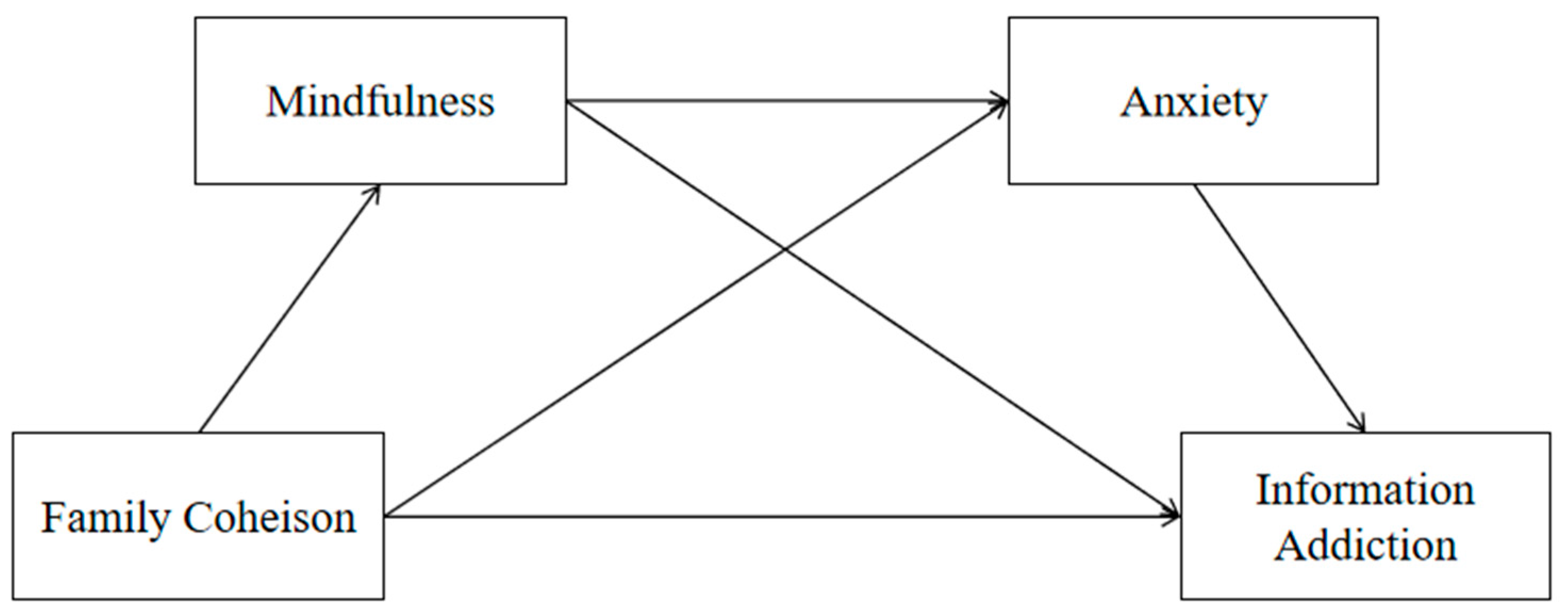
1.4. The Chain Mediating Effect of Mindfulness and Anxiety
2. Method
2.1. Participants
2.2. Measures
2.2.1. Anxiety
2.2.2. Mindfulness
2.2.3. Information Addiction
2.2.4. Family Cohesion
2.3. Procedure and Data Analytic Strategy
3. Results
3.1. Common Method Biases
3.2. Descriptive Statistics and Related Analysis of All Variables
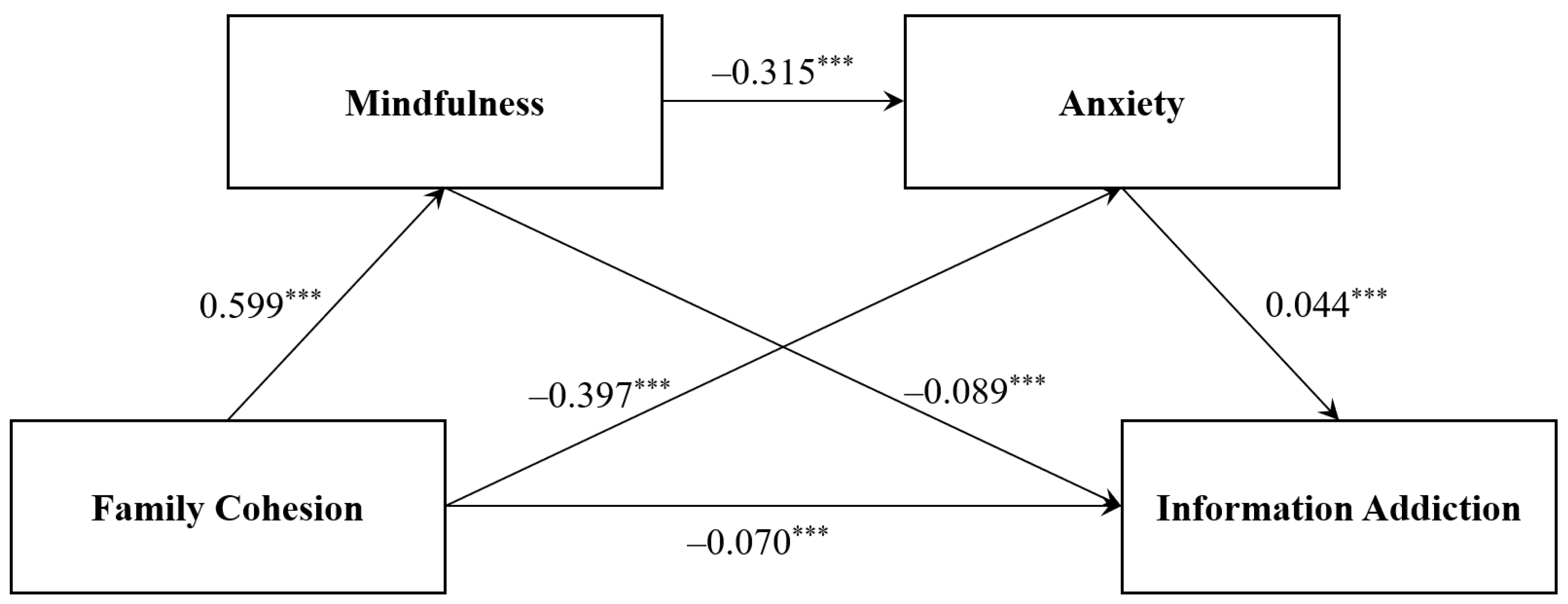
3.3. Testing the Sequence Mediating Model
4. Discussion
5. Conclusions
Author Contributions
Funding
Institutional Review Board Statement
Informed Consent Statement
Data Availability Statement
Conflicts of Interest
References
- Adams, B. L., Stavropoulos, V., Burleigh, T. L., Liew, L. W., Beard, C. L., & Griffiths, M. D. (2019). Internet gaming disorder behaviors in emergent adulthood: A pilot study examining the interplay between anxiety and family cohesion. International Journal of Mental Health and Addiction, 17, 828–844. [Google Scholar] [CrossRef]
- Alimoradi, Z., Broström, A., Potenza, M. N., Lin, C. Y., & Pakpour, A. H. (2024). Associations between behavioral addictions and mental health concerns during the COVID-19 pandemic: A systematic review and meta-analysis. Current Addiction Reports, 11, 565–587. [Google Scholar] [CrossRef]
- Anyan, F., & Hjemdal, O. (2018). Stress of home life and gender role socializations, family cohesion, and symptoms of anxiety and depression. Women & Health, 58(5), 548–564. [Google Scholar]
- Arslan, G. (2017). Psychological maltreatment, forgiveness, mindfulness, and internet addiction among young adults: A study of mediation effect. Computers in Human Behavior, 72, 57–66. [Google Scholar] [CrossRef]
- Barke, A., Bleichhardt, G., Rief, W., & Doering, B. K. (2016). The Cyberchondria Severity Scale (CSS): German validation and development of a short form. International Journal of Behavioral Medicine, 23(5), 595–605. [Google Scholar] [CrossRef]
- Baumgartner, S. E., & Hartmann, T. (2011). The role of health anxiety in online health information search. Cyberpsychology, Behavior, and Social Networking, 14(10), 613–618. [Google Scholar] [CrossRef]
- Bekada, F. I. (2024). The role of the family in protecting children from the dangers of the internet. Social Science Journal, 14(1), 138–141. [Google Scholar]
- Bento, A. I., Nguyen, T., Wing, C., Lozano-Rojas, F., Ahn, Y. Y., & Simon, K. (2020). Evidence from internet search data shows information-seeking responses to news of local COVID-19 cases. Proceedings of the National Academy of Sciences of the United States of America, 117(21), 11220–11222. [Google Scholar] [CrossRef] [PubMed]
- Błachnio, A., Przepiorka, A., Benvenuti, M., Mazzoni, E., & Seidman, G. (2019). Relations between facebook intrusion, internet addiction, life satisfaction, and self-esteem: A study in Italy and the USA. International Journal of Mental Health and Addiction, 17(4), 793–805. [Google Scholar] [CrossRef]
- Brand, M., Young, K. S., Laier, C., Wölfling, K., & Potenza, M. N. (2016). Integrating psychological and neurobiological considerations regarding the development and maintenance of specific Internet-use disorders: An Interaction of Person-Affect-Cognition-Execution (I-PACE) model. Neuroscience & Biobehavioral Reviews, 71, 252–266. [Google Scholar]
- Brik, A. B., Williams, N. A., & Ladd, S. B. (2024). Stressor pileup, family and couple relational well-being, and parent stress during the COVID-19 pandemic. Family Relations, 73(1), 95–115. [Google Scholar] [CrossRef]
- Brooks, S. K., Webster, R. K., Smith, L. E., Woodland, L., Wessely, S., Greenberg, N., & Rubin, G. J. (2020). The psychological impact of quarantine and how to reduce it: Rapid review of the evidence. The Lancet, 395(10227), 912–920. [Google Scholar] [CrossRef]
- Brown, K. W., Creswell, J. D., & Ryan, R. M. (Eds.). (2015). The science of presence a central mediator of the interpersonal benefits of mindfulness. In Handbook of mindfulness: Theory, research, and practice (pp. 225–244). Guilford Press. [Google Scholar]
- Brown, K. W., & Ryan, R. M. (2003). The benefits of being present: Mindfulness and its role in psychological well-being. Journal of Personality and Social Psychology, 84(4), 822–848. [Google Scholar] [CrossRef]
- Chai, W., & Shek, D. T. (2024). Mental health of Hong Kong university students under COVID-19: Protective ecological factors and underlying mechanism. Applied Research in Quality of Life, 19, 921–943. [Google Scholar] [CrossRef]
- Chen, C. Y., Lee, K. Y., Fung, X. C., Chen, J. K., Lai, Y. C., Potenza, M. N., Chang, K.-C., Fang, C.-Y., Pakpour, A. H., & Lin, C. Y. (2024). Problematic use of internet associates with poor quality of life via psychological distress in individuals with ADHD. Psychology Research and Behavior Management, 17, 443–455. [Google Scholar] [CrossRef]
- Chuan, H. M., Jaafar, J. L. S., & Sze, N. Z. (2022). Mediating role of psychological well-being in the relationship between family functioning and internet addiction among youth in Klang Valley, Malaysia. Development, 7(47), 301–312. [Google Scholar]
- Chung, A., Lee, J., & Lee, S. (2019). Personal factors, internet characteristics, and environmental factors contributing to adolescent internet addiction: A public health perspective. International Journal of Environmental Research and Public Health, 16(23), 4635. [Google Scholar] [CrossRef]
- Davis, R. A. (2001). A cognitive-behavioral model of pathological Internet use. Computers in Human Behavior, 17(2), 187–195. [Google Scholar] [CrossRef]
- de Oliveira Santana, K., Pereira, C. F., Ramos, M. S., da Silva, R. R., de Vargas, D., de Fátima Fernandes, M. N., & da Silva Gherard-Donato, E. C. (2024). The effectiveness of mindfulness for the management of anxiety in the nursing staff: Systematic review and meta-analysis. Archives of Psychiatric Nursing, 50, 129–146. [Google Scholar] [CrossRef]
- Desrosiers, A., Vine, V., Klemanski, D. H., & Nolen-Hoeksema, S. (2013). Mindfulness and emotion regulation in depression and anxiety: Common and distinct mechanisms of action. Depression and Anxiety, 30(7), 654–661. [Google Scholar] [CrossRef]
- Farrell, M. P., & Barnes, G. M. (1993). Family systems and social support: A test of the effects of cohesion and adaptability on the functioning of parents and adolescents. Journal of Marriage and Family, 55(1), 119–132. [Google Scholar] [CrossRef]
- Finkelstein-Fox, L., Park, C. L., & Riley, K. E. (2018). Mindfulness and emotion regulation: Promoting well-being during the transition to college. Anxiety, Stress, & Coping, 31(6), 639–653. [Google Scholar] [CrossRef]
- Geurtzen, N., Scholte, R. H. J., Engels, R. C. M. E., Tak, Y. R., & van Zundert, R. M. P. (2015). Association between mindful parenting and adolescents’ internalizing problems: Non-judgmental acceptance of parenting as core element. Journal of Child and Family Studies, 24(4), 1117–1128. [Google Scholar] [CrossRef]
- Gostin, L. O., & Wiley, L. F. (2020). Governmental public health powers during the COVID-19 pandemic: Stay-at-home orders, business closures, and travel restrictions. JAMA, 323(21), 2137–2138. [Google Scholar] [CrossRef]
- Gouveia, F., Gouveia-Pereira, M., & Portugal, A. (2024). COVID-19, family and love relationships: Perception of stress, relational quality, family functioning and online infidelity behaviors. Journal of Couple & Relationship Therapy, 23, 213–228. [Google Scholar] [CrossRef]
- Hayes, A. F. (2017). Introduction to mediation, moderation, and conditional process analysis: A regression-based approach (2nd ed.). Guilford Press. [Google Scholar]
- Hobfoll, S. E., Freedy, J., Lane, C., & Geller, P. (1990). Conservation of social resources: Social support resource theory. Journal of Social and Personal Relationships, 7(4), 465–478. [Google Scholar] [CrossRef]
- Hofmann, S. G., & Gómez, A. F. (2017). Mindfulness-based interventions for anxiety and depression. Psychiatric Clinics, 40(4), 739–749. [Google Scholar] [CrossRef]
- Hofmann, S. G., Sawyer, A. T., Witt, A. A., & Oh, D. (2010). The effect of mindfulness-based therapy on anxiety and depression: A meta-analytic review. Journal of Consulting and Clinical Psychology, 78(2), 169–183. [Google Scholar] [CrossRef]
- Hwang, W., & Silverstein, M. (2025). Intergenerational solidarity and family functioning within Korean families in the post-pandemic transition. Family Process, 64, e70072. [Google Scholar] [CrossRef]
- Kardefelt-Winther, D. (2014). A conceptual and methodological critique of internet addiction research: Towards a model of compensatory internet use. Computers in Human Behavior, 31, 351–354. [Google Scholar] [CrossRef]
- Kil, N., Kim, J., Lee, C., Park, J., Kim, J., & Kim, J. (2024). Influence of leisure experiences on smartphone addiction and emotional distress. World Leisure Journal, 66, 429–442. [Google Scholar] [CrossRef]
- Lachlan, K. A., Spence, P. R., Lin, X., & Del Greco, M. (2014). Screaming into the wind: Examining the volume and content of tweets associated with Hurricane Sandy. Communication Studies, 65(5), 500–518. [Google Scholar] [CrossRef]
- Li, D., Xu, Y., & Cao, S. (2023). How does trait mindfulness weaken the effects of risk factors for adolescent smartphone addiction? A moderated mediation model. Behavioral Sciences, 13(7), 540. [Google Scholar] [CrossRef]
- Li, W., Garland, E. L., & Howard, M. O. (2014). Family factors in Internet addiction among Chinese youth: A review of English-and Chinese-language studies. Computers in Human Behavior, 31, 393–411. [Google Scholar] [CrossRef]
- Lian, S. L., Cao, X. X., Xiao, Q. L., Zhu, X. W., Yang, C., & Liu, Q. Q. (2023). Family cohesion and adaptability reduces mobile phone addiction: The mediating and moderating roles of automatic thoughts and peer attachment. Frontiers in Psychology, 14, 1122943. [Google Scholar] [CrossRef]
- Liu, Q. Q., Yang, X. J., Hu, Y. T., Zhang, C. Y., & Nie, Y. G. (2020). How and when is family dysfunction associated with adolescent mobile phone addiction? Testing a moderated mediation model. Children and Youth Services Review, 111, 104827. [Google Scholar] [CrossRef]
- Liu, Q. Q., Zhang, D. J., Yang, X. J., Zhang, C. Y., Fan, C. Y., & Zhou, Z. K. (2018). Perceived stress and mobile phone addiction in Chinese adolescents: A moderated mediation model. Computers in Human Behavior, 87, 247–253. [Google Scholar] [CrossRef]
- Lochner, C., van den Berg, G., Chamberlain, S. R., Marincowitz, C., & Coetzee, B. (2024). Family functioning and problematic usage of the internet in youth: A cross-sectional investigation. Journal of Psychiatric Research, 173, 239–244. [Google Scholar] [CrossRef]
- Lucia, V. C., & Breslau, N. (2006). Family cohesion and children’s behavior problems: A longitudinal investigation. Psychiatry Research, 141(2), 141–149. [Google Scholar] [CrossRef]
- Lunkenheimer, E. S., Shields, A. M., & Cortina, K. S. (2007). Parental emotion coaching and dismissing in family interaction. Social Development, 16(2), 232–248. [Google Scholar] [CrossRef]
- Mangono, T., Smittenaar, P., Caplan, Y., Huang, V. S., Sutermaster, S., Kemp, H., & Sgaier, S. K. (2021). Information-seeking patterns during the COVID-19 pandemic across the United States: Longitudinal analysis of Google trends data. Journal of Medical Internet Research, 23(5), e22933. [Google Scholar] [CrossRef] [PubMed]
- Morelen, D., & Suveg, C. (2012). A real-time analysis of parent–child emotion discussions: The interaction is reciprocal. Journal of Family Psychology, 26(6), 998. [Google Scholar] [CrossRef]
- Musetti, A., Cattivelli, R., Giacobbi, M., Zuglian, P., Ceccarini, M., Capelli, F., Pietrabissa, G., & Castelnuovo, G. (2016). Challenges in internet addiction disorder: Is a diagnosis feasible or not? Frontiers in Psychology, 7, 177995. [Google Scholar] [CrossRef]
- Olson, D. H., Portner, J., & Larce, Y. (1985). FACES III: Family adaptability & cohesion evaluation scales. Life Innovations. [Google Scholar]
- Olson, D. H., Waldvogel, L., & Schlieff, M. (2019). Circumplex model of marital and family systems: An update. Journal of Family Theory & Review, 11(2), 199–211. [Google Scholar] [CrossRef]
- Öztekin, G. G. (2024). Associations between internet addiction and school engagement among Turkish college students: Mediating role of psychological distress. Frontiers in Psychology, 15, 1367462. [Google Scholar] [CrossRef] [PubMed]
- Pellegrini, M., Ponzo, V., Rosato, R., Scumaci, E., Goitre, I., Benso, A., Belcastro, S., Crespi, C., De Michieli, F., Ghigo, E., Broglio, F., & Bo, S. (2020). Changes in weight and nutritional habits in adults with obesity during the “lockdown” period caused by the COVID-19 virus emergency. Nutrients, 12(7), 2016. [Google Scholar] [CrossRef]
- Peng, Y., Ke, Y., Cai, R., Lv, B., Liu, S., Liu, Y., Li, X., Song, H., & Chen, Q. (2025). Post-pandemic one health: Unpacking the role of greenspaces and human-dog interactions in long-term health and well-being. One Health, 21, 101116. [Google Scholar] [CrossRef]
- Podsakoff, P. M., MacKenzie, S. B., Lee, J. Y., & Podsakoff, N. P. (2003). Common method biases in behavioral research: A critical review of the literature and recommended remedies. Journal of Applied Psychology, 88(5), 879. [Google Scholar] [CrossRef]
- Qin, H., Sanders, C., Prasetyo, Y., Syukron, M., & Prentice, E. (2021). Exploring the dynamic relationships between risk perception and behavior in response to the Coronavirus Disease 2019 (COVID-19) outbreak. Social Science & Medicine, 285, 114267. [Google Scholar] [CrossRef]
- Riley, B. (2014). Experiential avoidance mediates the association between thought suppression and mindfulness with problem gambling. Journal of Gambling Studies, 30(1), 163–171. [Google Scholar] [CrossRef]
- Salimi, A., Jahangiri, M., Ghaderzadeh, M., Mohammadkhani, A., & Hosseini, M. (2016). Correlation between the family function based on Circumplex Model and students’ internet addiction in Shahid Beheshti University of medical sciences in 2015. Global Journal of Health Science, 8(11), 223–232. [Google Scholar] [CrossRef]
- Sarour, E. O., & El Keshky, M. E. S. (2023). Deviant peer affiliation as a mediating variable in the relationship between family cohesion and adaptability and internet addiction among adolescents. Current Psychology, 42(25), 21833–21841. [Google Scholar] [CrossRef]
- Siegel, D. J. (2012). The developing mind: How relationships and the brain interact to shape who we are (2nd ed.). Guilford Press. [Google Scholar]
- Skoranski, A., Coatsworth, J. D., & Lunkenheimer, E. (2019). A dynamic systems approach to understanding mindfulness in interpersonal relationships. Journal of Child and Family Studies, 28, 2659–2672. [Google Scholar] [CrossRef]
- Song, W. J., & Park, J. W. (2019). The influence of stress on internet addiction: Mediating effects of self-control and mindfulness. International Journal of Mental Health and Addiction, 17(4), 1063–1075. [Google Scholar] [CrossRef]
- Spence, P. R., Lachlan, K., Burke, J. M., & Seeger, M. W. (2007). Media use and information needs of the disabled during a natural disaster. Journal of Health Care for the Poor and Underserved, 18(2), 394–404. [Google Scholar] [CrossRef] [PubMed]
- Spielberger, C. D., & Rickman, R. L. (1988). Assessment of state and trait anxiety. In M. Hersen, & A. S. Bellack (Eds.), Dictionary of behavioral assessment techniques (pp. 31–32). Pergamon Press. [Google Scholar]
- Starcevic, V., & Berle, D. (2013). Cyberchondria: Towards a better understanding of excessive health-related Internet use. Expert Review of Neurotherapeutics, 13(2), 205–213. [Google Scholar] [CrossRef]
- Tafa, M., & Baiocco, R. (2009). Addictive behavior and family functioning during adolescence. The American Journal of Family Therapy, 37(5), 388–395. [Google Scholar] [CrossRef]
- Takhdat, K., Rebahi, H., Rooney, D. M., Babram, M. A., Benali, A., Touzani, S., Lamtali, S., & El Adib, A. R. (2024). The impact of brief mindfulness meditation on anxiety, cognitive load, and teamwork in emergency simulation training: A randomized controlled trial. Nurse Education Today, 132, 106005. [Google Scholar] [CrossRef]
- te Poel, F., Baumgartner, S. E., Hartmann, T., & Tanis, M. (2016). The curious case of cyberchondria: A longitudinal study on the reciprocal relationship between health anxiety and online health information seeking. Journal of Anxiety Disorders, 43, 32–40. [Google Scholar] [CrossRef]
- Trull-Oliva, C., Noell, J. F., Pallisera, M., & Planas-Lladó, A. (2024). Support perceived by children and youth during the COVID-19 lockdown in Spain. Education and Urban Society, 56, 809–829. [Google Scholar] [CrossRef]
- Vandeleur, C. L., Jeanpretre, N., Perrez, M., & Schoebi, D. (2009). Cohesion, satisfaction with family bonds, and emotional well-being in families with adolescents. Journal of Marriage and Family, 71(5), 1205–1219. [Google Scholar] [CrossRef]
- Wang, Q., Chen, H., Hu, W., & Qi, Y. (2021). The relationship between risk perception and rumor spreading behavior during COVID-19 pneumonia: Sequence mediating roles of anxiety and information gathering addiction. Chinese Journal of Clinical Psychology, 29(4), 794–798. [Google Scholar]
- Watkins, N. K., Salafia, C., & Ohannessian, C. M. (2022). Family functioning and anxiety symptoms in adolescents: The moderating role of mindfulness. Journal of Child and Family Studies, 31(5), 1474–1488. [Google Scholar] [CrossRef]
- Williams, K. L. (2012). The effects of narrative coherence & mindfulness on parenting style & child behavior [Doctoral dissertation, University of Tennessee]. [Google Scholar]
- Yan, W., Li, Y., & Sui, N. (2014). The relationship between recent stressful life events, personality traits, perceived family functioning and internet addiction among college students. Stress and Health, 30(1), 3–11. [Google Scholar] [CrossRef]
- Yang, X. J., Zhang, L. B., Wang, L. L., Deng, H., Li, Y.-L., Zhao, R.-J., Xu, J.-Y., Yang, Y.-C., & Zhou, S.-J. (2025). Status and risk factors for depression, anxiety, and insomnia symptoms among adolescents in the post-pandemic era. BMC Public Health, 25(1), 471. [Google Scholar] [CrossRef]
- Young, K., Pistner, M., O’Mara, J., & Buchanan, J. (1999). Cyber disorders: The mental health concern for the new millennium. CyberPsychology & Behavior, 2(5), 475–479. [Google Scholar] [CrossRef]
- Young, K. S., & Rogers, R. C. (1998). The relationship between depression and internet addiction. CyberPsychology & Behavior, 1(1), 25–28. [Google Scholar] [CrossRef]
- Yue, P., Zhang, M., & Wei, H. (2020). Effect of Childhood Maltreatment on Internet Addiction: The Role of Mindfulness and Resilience. Chinese Journal of Clinical Psychology, 28(6), 1144–1147+1151. [Google Scholar]
- Zeng, Y., Ye, B., Zhang, Y., & Yang, Q. (2021). Family cohesion and stress consequences among Chinese college students during COVID-19 pandemic: A moderated mediation model. Frontiers in Public Health, 9, 703899. [Google Scholar] [CrossRef] [PubMed]
- Zheng, H., Sin, S. C. J., Kim, H. K., & Theng, Y. L. (2020). Cyberchondria: A systematic review. Internet Research, 31(2), 677–698. [Google Scholar] [CrossRef]
- Zhou, S., Kwan, C. K., Ai, Y., & Ma, Y. (2025). Parent-adolescent intergenerational transmission of distress: The roles of family climate, adolescents’ self-compassion and mindfulness. Frontiers in Psychology, 16, 1595515. [Google Scholar] [CrossRef] [PubMed]
- Zhou, Z., & Yang, W. (2006). The development of different types of internet addiction scale for undergraduates. Chinese Mental Health Journal, 20(11), 754–757. [Google Scholar]



| M (SD) | Skewness | Kurtosis | 1 | 2 | 3 | 4 | |
|---|---|---|---|---|---|---|---|
| 1 Family Cohesion | 37.36 (7.855) | −0.528 | 0.219 | - | |||
| 2 Mindfulness | 62.71 (13.193) | −0.402 | 0.311 | 0.363 ** | - | ||
| 3 Anxiety | 38.84 (10.36) | 0.265 | −0.126 | −0.441 ** | −0.492 ** | - | |
| 4 Information Addiction | 15.89 (4.427) | 0.371 | −0.196 | −0.263 ** | −0.344 ** | 0.294 ** | - |
| Variable | Mindfulness | Anxiety | Information Addiction | ||||||
|---|---|---|---|---|---|---|---|---|---|
| B | SE | t | B | SE | t | B | SE | t | |
| Age | 0.5 | 0.213 | 2.283 * | 0.306 | 0.153 | 1.984 * | 0.318 | 0.073 | 4.348 *** |
| Sex | 3.132 | 0.824 | 3.802 *** | 2.062 | 0.578 | 3.568 *** | 0.46 | 0.278 | 1.656 |
| Cohesion | 0.599 | 0.052 | 11.499 *** | −0.397 | 0.039 | −10.214 *** | −0.07 | 0.02 | −3.550 *** |
| Mindfulness | −0.315 | 0.023 | −13.467 *** | −0.089 | 0.012 | −7.285 *** | |||
| Anxiety | 0.044 | 0.016 | 2.745 ** | ||||||
| R2 | 0.153 | 0.334 | 0.172 | ||||||
| F | 53.119 *** | 110.764 *** | 36.706 *** | ||||||
| Effect | BootSE | BootLLCI | BootULCI | Relative Mediating Effect | |
|---|---|---|---|---|---|
| TOTAL | −0.080 | 0.012 | −0.105 | −0.056 | 53.691% |
| Ind 1 | −0.054 | 0.009 | −0.073 | −0.037 | 36.241% |
| Ind 2 | −0.018 | 0.007 | −0.031 | −0.005 | 12.081% |
| Ind 3 | −0.008 | 0.003 | −0.015 | −0.003 | 5.370% |
Disclaimer/Publisher’s Note: The statements, opinions and data contained in all publications are solely those of the individual author(s) and contributor(s) and not of MDPI and/or the editor(s). MDPI and/or the editor(s) disclaim responsibility for any injury to people or property resulting from any ideas, methods, instructions or products referred to in the content. |
© 2026 by the authors. Licensee MDPI, Basel, Switzerland. This article is an open access article distributed under the terms and conditions of the Creative Commons Attribution (CC BY) license.
Share and Cite
Wang, B.; Li, S.; Wu, M.; Wu, J. Shielding Against Information Overload in the Post-Pandemic Era: The Protective Chain of Family Cohesion, Mindfulness, and Lower Anxiety. Behav. Sci. 2026, 16, 212. https://doi.org/10.3390/bs16020212
Wang B, Li S, Wu M, Wu J. Shielding Against Information Overload in the Post-Pandemic Era: The Protective Chain of Family Cohesion, Mindfulness, and Lower Anxiety. Behavioral Sciences. 2026; 16(2):212. https://doi.org/10.3390/bs16020212
Chicago/Turabian StyleWang, Bingyang, Shangzhe Li, Mengxuan Wu, and Jie Wu. 2026. "Shielding Against Information Overload in the Post-Pandemic Era: The Protective Chain of Family Cohesion, Mindfulness, and Lower Anxiety" Behavioral Sciences 16, no. 2: 212. https://doi.org/10.3390/bs16020212
APA StyleWang, B., Li, S., Wu, M., & Wu, J. (2026). Shielding Against Information Overload in the Post-Pandemic Era: The Protective Chain of Family Cohesion, Mindfulness, and Lower Anxiety. Behavioral Sciences, 16(2), 212. https://doi.org/10.3390/bs16020212