Understanding the Role of Reading and Oral Language Skills Growth in Overcoming Reading Comprehension Difficulties


Abstract
1. Introduction
1.1. Oral Language Skills and Reading Comprehension Development
1.2. The Role of Word-Level and Text-Level Reading Skills on Reading Comprehension Development
1.3. The Present Study
- (1)
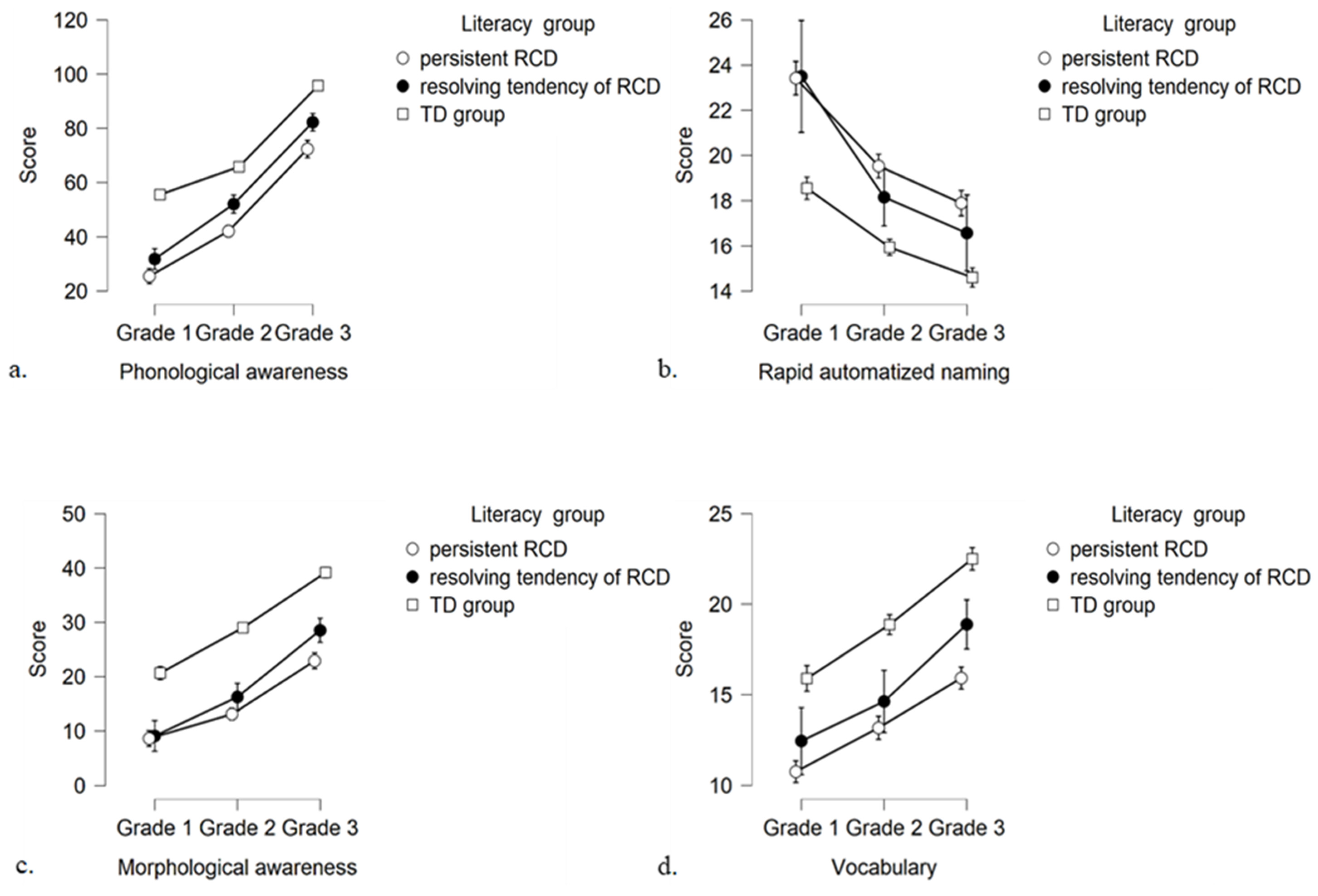
- Does the raw score growth of oral language skills from Grade 1 to Grade 3 differ among children with a profile of pRCD, those with rRCD, and TD children in Grade 3?
- (2)
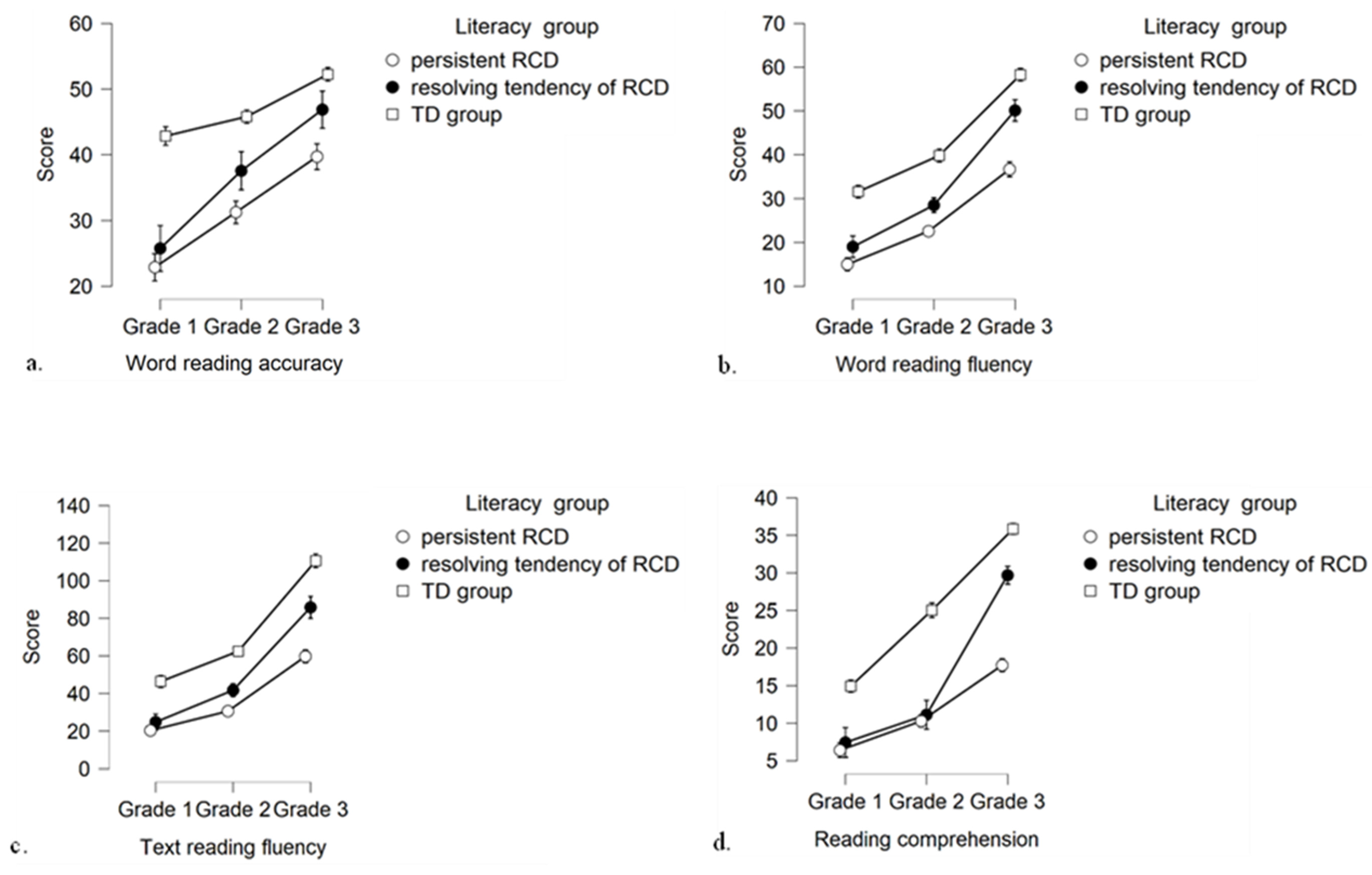
- Does the raw score growth of word reading skills and text-reading fluency from Grade 1 to Grade 3 differ among children with a profile of pRCD, those with rRCD, and TD children in Grade 3?
2. Materials and Methods
2.1. Participants
2.2. Measures
2.2.1. Non-Verbal Intelligence
2.2.2. Morphological Awareness
2.2.3. Vocabulary
2.2.4. Phonological Awareness
2.2.5. Rapid Automatized Naming
2.2.6. Word Reading Accuracy
2.2.7. Word Reading Fluency
2.2.8. Text Reading Fluency
2.2.9. Reading Comprehension
2.3. Procedure
2.4. Statistical Analysis
3. Results
3.1. Preliminary Analyses
3.2. Differences in the Raw Score Growth of Oral Language and Reading Skills
4. Discussion
4.1. Differences in the Raw Score Growth of Oral Language Skills
4.2. Differences in the Raw Score Growth of Reading Skills
5. Limitations and Future Research
6. Implications for Practice
Author Contributions
Funding
Institutional Review Board Statement
Informed Consent Statement
Data Availability Statement
Conflicts of Interest
Abbreviations
| TD | Typically developing children |
| pRCD | Persistent reading comprehension difficulties |
| rRCD | Resolving tendency of reading comprehension difficulties |
| RCD | Reading comprehension difficulties |
| RAN | Rapid automatized naming |
| PA | Phonological awareness |
| MA | Morphological awareness |
| 1 | Mauchly’s test of sphericity was significant (p < 0.05) for phonological awareness, morphological awareness, and RAN. The value of Greenhouse-Geiser ε was above 0.75 for all of them. Thus, we applied the Huynh-Feldt correction (Field, 2018). |
| 2 | Mauchly’s test of sphericity was significant (p < 0.05) for word reading accuracy, word reading fluency, text-reading fluency, and reading comprehension. The value of Greenhouse-Geiser ε was above 0.75 for all of them. Thus, we applied the Huynh-Feldt correction (Field, 2018). |
References
- Adlof, S. M., & Catts, H. W. (2015). Morphosyntax in poor comprehenders. Reading and Writing, 28(7), 1051–1070. [Google Scholar] [CrossRef]
- Aro, M., & Wimmer, H. (2003). Learning to read: English in comparison to six more regular orthographies. Applied Psycholinguistics, 24(4), 621–635. [Google Scholar] [CrossRef]
- Bailey, S., Hoeft, F., Aboud, K., & Cutting, L. (2016). Anomalous gray matter patterns in specific reading comprehension deficit are independent of dyslexia. Annals of Dyslexia, 66(3), 256–274. [Google Scholar] [CrossRef]
- Cain, K. (2016). Reading comprehension development and difficulties: An overview. Perspectives on Language and Literacy, 42(2), 9–16. [Google Scholar]
- Cain, K., & Oakhill, J. (2011). Matthew effects in young readers: Reading comprehension and reading experience aid vocabulary development. Journal of Learning Disabilities, 44(5), 431–443. [Google Scholar] [CrossRef]
- Capin, P., Gillam, S. L., Fall, A., Roberts, G., Dille, J. T., & Gillam, R. B. (2022). Understanding the nature and severity of reading difficulties among students with language and reading comprehension difficulties. Annals of Dyslexia, 72(2), 249–275. [Google Scholar] [CrossRef]
- Catts, H. W., Adlof, S. M., & Weismer, S. E. (2006). Language deficits in poor comprehenders: A case for the simple view of reading. Journal of Speech Language and Hearing Research, 49(2), 278–293. [Google Scholar] [CrossRef]
- Catts, H. W., Herrera, S., Nielsen, D. C., & Bridges, M. S. (2015). Early prediction of reading comprehension within the simple view framework. Reading and Writing, 28(9), 1407–1425. [Google Scholar] [CrossRef]
- Catts, H. W., Nielsen, D. C., Bridges, M. S., & Liu, Y. (2016). Early identification of reading comprehension difficulties. Journal of Learning Disabilities, 49(5), 451–465. [Google Scholar] [CrossRef]
- Clarke, P. J., Snowling, M. J., Truelove, E., & Hulme, C. (2010). Ameliorating children’s reading-comprehension difficulties. Psychological Science, 21(8), 1106–1116. [Google Scholar] [CrossRef]
- Clemens, N. H., Simmons, D., Simmons, L. E., Wang, H., & Kwok, O. (2017). The prevalence of reading fluency and vocabulary difficulties among adolescents struggling with reading comprehension. Journal of Psychoeducational Assessment, 35(8), 785–798. [Google Scholar] [CrossRef]
- Constantinidou, M., & Stainthorp, R. (2009). Phonological awareness and reading speed deficits in reading disabled Greek-speaking children. Educational Psychology, 29(2), 171–186. [Google Scholar] [CrossRef]
- Cutting, L. E., Materek, A., Cole, C. A. S., Levine, T. M., & Mahone, E. M. (2009). Effects of fluency, oral language, and executive function on reading comprehension performance. Annals of Dyslexia, 59(1), 34–54. [Google Scholar] [CrossRef]
- Desrochers, A., Manolitsis, G., Gaudreau, P., & Georgiou, G. (2018). Early contribution of morphological awareness to literacy skills across languages varying in orthographic consistency. Reading and Writing, 31(8), 1695–1719. [Google Scholar] [CrossRef]
- Eason, S. H., Sabatini, J., Goldberg, L., Bruce, K., & Cutting, L. E. (2013). Examining the relationship between word reading efficiency and oral reading rate in predicting comprehension among different types of readers. Scientific Studies of Reading, 17(3), 199–223. [Google Scholar] [CrossRef]
- Fernandes, S., Querido, L., Verhaeghe, A., Marques, C., & Araújo, L. (2017). Reading development in European Portuguese: Relationships between oral reading fluency, vocabulary and reading comprehension. Reading and Writing, 30(9), 1987–2007. [Google Scholar] [CrossRef]
- Field, A. (2018). Discovering statistics using IBM SPSS statistics (5th ed.). SAGE Publications Ltd. [Google Scholar]
- Florit, E., & Cain, K. (2011). The simple view of reading: Is it valid for different types of alphabetic orthographies? Educational Psychology Review, 23(4), 553–576. [Google Scholar] [CrossRef]
- Foorman, B. R., Koon, S., Petscher, Y., Mitchell, A., & Truckenmiller, A. (2015). Examining general and specific factors in the dimensionality of oral language and reading in 4th–10th grades. Journal of Educational Psychology, 107(3), 884–899. [Google Scholar] [CrossRef]
- Francis, D. J., Shaywitz, S. E., Stuebing, K. K., Shaywitz, B. A., & Fletcher, J. M. (1996). Developmental lag versus deficit models of reading disability: A longitudinal, individual growth curves analysis. Journal of Educational Psychology, 88(1), 3–17. [Google Scholar] [CrossRef]
- Georgiou, G. K., Das, J., & Hayward, D. (2009). Revisiting the “simple view of reading” in a group of children with poor reading comprehension. Journal of Learning Disabilities, 42(1), 76–84. [Google Scholar] [CrossRef]
- Georgiou, G. K., Parrila, R., & Papadopoulos, T. C. (2008). Predictors of word decoding and reading fluency across languages varying in orthographic consistency. Journal of Educational Psychology, 100(3), 566–580. [Google Scholar] [CrossRef]
- Giazitzidou, S., Levesque, K., & Deacon, H. (2025). Getting at how: Testing mediating factors in the relation between morphological awareness and reading comprehension in grade 1. Reading Research Quarterly, 60(2). [Google Scholar] [CrossRef]
- Goodwin, A. P., & Ahn, S. (2010). A meta-analysis of morphological interventions: Effects on literacy achievement of children with literacy difficulties. Annals of Dyslexia, 60(2), 183–208. [Google Scholar] [CrossRef]
- Gough, P. B., & Tunmer, W. E. (1986). Decoding, reading, and reading disability. Remedial and Special Education, 7(1), 6–10. [Google Scholar] [CrossRef]
- Grigorakis, I., Kargiotidis, A., Mouzaki, A., & Manolitsis, G. (2022). Early oral language precursors of different types of reading difficulties in a consistent orthography. Frontiers in Education, 7, 959374. [Google Scholar] [CrossRef]
- Hjetland, H. N., Brinchmann, E. I., Scherer, R., Hulme, C., & Melby-Lervåg, M. (2020). Preschool pathways to reading comprehension: A systematic meta-analytic review. Educational Research Review, 30, 100323. [Google Scholar] [CrossRef]
- Hjetland, H. N., Brinchmann, E. I., Scherer, R., & Melby-Lervåg, M. (2017). Preschool predictors of later reading comprehension ability: A systematic review. Campbell Systematic Reviews, 13(1), 1–155. [Google Scholar] [CrossRef]
- Hjetland, H. N., Lervåg, A., Lyster, S. H., Hagtvet, B. E., Hulme, C., & Melby-Lervåg, M. (2019). Pathways to reading comprehension: A longitudinal study from 4 to 9 years of age. Journal of Educational Psychology, 111(5), 751–763. [Google Scholar] [CrossRef]
- Hoover, W. A., & Gough, P. B. (1990). The simple view of reading. Reading and Writing, 2(2), 127–160. [Google Scholar] [CrossRef]
- Høien-Tengesdal, I. (2010). Is the simple view of reading too simple? Scandinavian Journal of Educational Research, 54(5), 451–469. [Google Scholar] [CrossRef]
- Hulme, C., Nash, H. M., Gooch, D., Lervåg, A., & Snowling, M. J. (2015). The foundations of literacy development in children at familial risk of dyslexia. Psychological Science, 26(12), 1877–1886. [Google Scholar] [CrossRef]
- Jenkins, J. R., Fuchs, L. S., Van Den Broek, P., Espin, C., & Deno, S. L. (2003). Sources of individual differences in reading comprehension and reading fluency. Journal of Educational Psychology, 95(4), 719–729. [Google Scholar] [CrossRef]
- Kang, E. Y., & Shin, M. (2019). The contributions of reading fluency and decoding to reading comprehension for struggling readers in fourth grade. Reading & Writing Quarterly, 35(3), 179–192. [Google Scholar] [CrossRef]
- Kargiotidis, A., Grigorakis, I., Mouzaki, A., & Manolitsis, G. (2021). Differences in oral language growth between children with and without literacy difficulties: Evidence from early phases of learning to read and spell in Greek. Australian Journal of Learning Difficulties, 26(2), 89–112. [Google Scholar] [CrossRef]
- Kargiotidis, A., Mouzaki, A., Kagiampaki, E., Marinakis, G., Vervelaki, A. M., Boufachrentin, N., & Manolitsis, G. (2022). Modeling the effects of oral language skills on early reading development in an orthographically consistent language. Scientific Studies of Reading, 27(3), 272–288. [Google Scholar] [CrossRef]
- Kargiotidis, A., Tafa, E., Mouzaki, A., & Manolitsis, G. (2025). Predicting reading comprehension difficulties in the context of an extended simple view of reading model. Reading and Writing. [Google Scholar] [CrossRef]
- Kelso, K., Whitworth, A., Parsons, R., & Leitão, S. (2020). Hidden reading difficulties: Identifying children who are poor comprehenders. Learning Disability Quarterly, 45(3), 225–236. [Google Scholar] [CrossRef]
- Kendeou, P., Van Den Broek, P., White, M. J., & Lynch, J. S. (2009). Predicting reading comprehension in early elementary school: The independent contributions of oral language and decoding skills. Journal of Educational Psychology, 101(4), 765–778. [Google Scholar] [CrossRef]
- Kieffer, M. J. (2014). Morphological awareness and reading difficulties in adolescent Spanish-speaking language minority learners and their classmates. Journal of Learning Disabilities, 47(1), 44–53. [Google Scholar] [CrossRef]
- Kieffer, M. J., & Lesaux, N. K. (2012). Development of morphological awareness and vocabulary knowledge in Spanish-speaking language minority learners: A parallel process latent growth curve model. Applied Psycholinguistics, 33(1), 23–54. [Google Scholar] [CrossRef]
- Kim, Y. G. (2015). Developmental, component-based model of reading fluency: An investigation of predictors of word-reading fluency, text-reading fluency, and reading comprehension. Reading Research Quarterly, 50(4), 459–481. [Google Scholar] [CrossRef]
- Kim, Y. G., Guo, Q., Liu, Y., Peng, Y., & Yang, L. (2019). Multiple pathways by which compounding morphological awareness is related to reading comprehension: Evidence from Chinese second graders. Reading Research Quarterly, 55(2), 193–212. [Google Scholar] [CrossRef]
- Kim, Y. G., & Wagner, R. K. (2015). Text (ORaL) reading fluency as a construct in reading development: An investigation of its mediating role for children from grades 1 to 4. Scientific Studies of Reading, 19(3), 224–242. [Google Scholar] [CrossRef]
- Kim, Y.-S., Wagner, R. K., & Lopez, D. (2012). Developmental relations between reading fluency and reading comprehension: A longitudinal study from grade 1 to grade 2. Journal of Experimental Child Psychology, 113(1), 93–111. [Google Scholar] [CrossRef]
- Landerl, K., Freudenthaler, H. H., Heene, M., De Jong, P. J., Desrochers, A., Manolitsis, G., Parrila, R., & Georgiou, G. (2019). Phonological awareness and rapid automatized naming as longitudinal predictors of reading in five alphabetic orthographies with varying degrees of consistency. Scientific Studies of Reading, 23(3), 220–234. [Google Scholar] [CrossRef]
- Landerl, K., & Wimmer, H. (2000). Deficits in phoneme segmentation are not the core problem of dyslexia: Evidence from German and English children. Applied Psycholinguistics, 21(2), 243–262. [Google Scholar] [CrossRef]
- Landerl, K., & Wimmer, H. (2008). Development of word reading fluency and spelling in a consistent orthography: An 8-year follow-up. Journal of Educational Psychology, 100(1), 150–161. [Google Scholar] [CrossRef]
- Levesque, K. C., Kieffer, M. J., & Deacon, S. H. (2017). Morphological awareness and reading comprehension: Examining mediating factors. Journal of Experimental Child Psychology, 160, 1–20. [Google Scholar] [CrossRef]
- MacKay, E., Levesque, K., & Deacon, S. H. (2017). Unexpected poor comprehenders: An investigation of multiple aspects of morphological awareness. Journal of Research in Reading, 40(2), 125–138. [Google Scholar] [CrossRef]
- Mahony, D., Singson, M., & Mann, V. (2000). Reading ability and sensitivity to morphological relations. Reading and Writing, 12, 191–218. [Google Scholar] [CrossRef]
- Manolitsis, G., & Georgiou, G. (2015). The cognitive profiles of poor readers/good spellers and good readers/poor spellers in a consistent orthography: A retrospective analysis. Preschool and Primary Education, 3(2), 103–116. [Google Scholar] [CrossRef][Green Version]
- Manolitsis, G., Georgiou, G. K., Inoue, T., & Parrila, R. (2019). Are morphological awareness and literacy skills reciprocally related? Evidence from a cross-linguistic study. Journal of Educational Psychology, 111(8), 1362–1381. [Google Scholar] [CrossRef]
- Manolitsis, G., Grigorakis, I., & Georgiou, G. K. (2017). The longitudinal contribution of early morphological awareness skills to reading fluency and comprehension in Greek. Frontiers in Psychology, 8, 1793. [Google Scholar] [CrossRef]
- Margheri, V., Frascari, A., Baiocchini, G., Scalambra, D., Tambaro, C., & Pecini, C. (2025). Empowering reading decoding through training rapid automatised naming (RAN) in primary school: Insights on methods and underpinning processes. Reading and Writing. [Google Scholar] [CrossRef]
- McArthur, G., Sheehan, Y., Badcock, N. A., Francis, D. A., Wang, H. C., Kohnen, S., Banales, E., Anandakumar, T., Marinus, E., & Castles, A. (2018). Phonics training for English-speaking poor readers. Cochrane Database of Systematic Reviews, 2018(11), CD009115. [Google Scholar] [CrossRef] [PubMed]
- Muter, V., Hulme, C., Snowling, M. J., & Stevenson, J. (2004). Phonemes, rimes, vocabulary, and grammatical skills as foundations of early reading development: Evidence from a longitudinal study. Developmental Psychology, 40(5), 665–681. [Google Scholar] [CrossRef]
- Müller, K., & Brady, S. (2001). Correlates of early reading performance in a transparent orthography. Reading and Writing, 14, 757–799. [Google Scholar] [CrossRef]
- Nation, K. (2019). Children’s reading difficulties, language, and reflections on the simple view of reading. Australian Journal of Learning Difficulties, 24(1), 47–73. [Google Scholar] [CrossRef]
- Nation, K., Clarke, P., & Snowling, M. J. (2002). General cognitive ability in children with reading comprehension difficulties. British Journal of Educational Psychology, 72(4), 549–560. [Google Scholar] [CrossRef]
- Nation, K., Cocksey, J., Taylor, J., & Bishop, D. V. M. (2010). A longitudinal investigation of early reading and language skills in children with poor reading comprehension. Journal of Child Psychology and Psychiatry, 51(9), 1031–1039. [Google Scholar] [CrossRef]
- OECD. (2023). PISA 2022 results (Volume I): The state of learning and equity in education. OECD Publishing. [Google Scholar] [CrossRef]
- Ouellette, G., & Beers, A. (2010). A not-so-simple view of reading: How oral vocabulary and visual-word recognition complicate the story. Reading and Writing, 23(2), 189–208. [Google Scholar] [CrossRef]
- Padeliadu, S., Antoniou, F., & Sideridis, G. (2019). ΔΑΔΑ-Δοκιμασία Αξιολόγησης Δεξιοτήτων Ανάγνωσης [DADA—Test for the assessment of reading skills]. Rocketlexia. [Google Scholar]
- Pecini, C., Spoglianti, S., Bonetti, S., Di Lieto, M. C., Guaran, F., Martinelli, A., Gasperini, F., Cristofani, P., Casalini, C., Mazzotti, S., Salvadorini, R., Bargagna, S., Palladino, P., Cismondo, D., Verga, A., Zorzi, C., Brizzolara, D., Vio, C., & Chilosi, A. M. (2019). Training RAN or reading? A telerehabilitation study on developmental dyslexia. Dyslexia, 25(3), 318–331. [Google Scholar] [CrossRef]
- Perfetti, C. (2007). Reading ability: Lexical quality to comprehension. Scientific Studies of Reading, 11(4), 357–383. [Google Scholar] [CrossRef]
- Perfetti, C. A. (1985). Reading ability. Oxford University Press. [Google Scholar]
- Perfetti, C. A., Marron, M. A., & Foltz, P. W. (1996). Sources of comprehension failure: Theoretical perspectives and case studies. In C. Cornoldi, & J. V. Oakhill (Eds.), Reading comprehension difficulties: Processes and remediation (pp. 137–165). Erlbaum. [Google Scholar]
- Porpodas, K. (2008). Εργαλείο ανίχνευσης και διερεύνησης των αναγνωστικών δυσκολιών στο Νηπιαγωγείο και Α΄-Β΄ Δημοτικό [Tool for detecting and investigating reading difficulties in kindergarten and in grades 1 and 2 of primary school]. Hellenic Ministry of Education. [Google Scholar]
- Protopapas, A., Mouzaki, A., Sideridis, G. D., Kotsolakou, A., & Simos, P. G. (2013). The role of vocabulary in the context of the simple view of reading. Reading & Writing Quarterly, 29(2), 168–202. [Google Scholar] [CrossRef]
- Raven, J. C. (1956). Coloured progressive matrices, sets A, AB, B. Lewis & Co., Ltd. [Google Scholar]
- Rothou, K. M. (2021). Exploring inflectional morphological awareness skills in Greek-speaking children with poor reading comprehension. International Journal of Disability Development and Education, 68(2), 191–205. [Google Scholar] [CrossRef]
- Schmidt, C., Brandenburg, J., Busch, J., Büttner, G., Grube, D., Mähler, C., & Hasselhorn, M. (2021). Developmental trajectories of phonological information processing in upper elementary students with reading or spelling disabilities. Reading Research Quarterly, 56(1), 143–171. [Google Scholar] [CrossRef]
- Seymour, P. H. K., Aro, M., Erskine, J. M., Wimmer, H., Leybaert, J., Elbro, C., Lyytinen, H., Gombert, J. E., Le Normand, M. T., Schneider, W., Porpodas, C., Ragnarsdottir, H., Tressoldi, P., Vio, C., De Groot, A., Licht, R., Iønnessen, F. E., Castro, S. L., Cary, L., … Olofsson, Å. (2003). Foundation literacy acquisition in European orthographies. British Journal of Psychology, 94(2), 143–174. [Google Scholar] [CrossRef]
- Sideridis, G., Antoniou, F., Mouzaki, A., & Simos, P. G. (2015). Raven’s coloured progressive matrices and vocabulary. Motivo. (In Greek) [Google Scholar]
- Sparks, E., & Metsala, J. L. (2023). Morphological awareness predicts reading comprehension in first grade students. Frontiers in Education, 8, 1304688. [Google Scholar] [CrossRef]
- Spencer, M., Quinn, J. M., & Wagner, R. K. (2014). Specific reading comprehension disability: Major problem, myth, or misnomer? Learning Disabilities Research and Practice, 29(1), 3–9. [Google Scholar] [CrossRef]
- Stanovich, K. E., Nathan, R., & Vala-Rossi, M. (1986). Developmental changes in the cognitive correlates of reading ability and the developmental lag hypothesis. Reading Research Quarterly, 21(3), 267. [Google Scholar] [CrossRef]
- Stevens, E. A., Walker, M. A., & Vaughn, S. (2016). The effects of reading fluency interventions on the reading fluency and reading comprehension performance of elementary students with learning disabilities: A synthesis of the research from 2001 to 2014. Journal of Learning Disabilities, 50(5), 576–590. [Google Scholar] [CrossRef]
- Stogiannidou, A. (2017). WISC-V GR: Wechsler intelligence scale for children. Motivo. [Google Scholar]
- Storch, S. A., & Whitehurst, G. J. (2002). Oral language and code-related precursors to reading: Evidence from a longitudinal structural model. Developmental Psychology, 38(6), 934–947. [Google Scholar] [CrossRef]
- Suggate, S. P. (2014). A meta-analysis of the long-term effects of phonemic awareness, phonics, fluency, and reading comprehension interventions. Journal of Learning Disabilities, 49(1), 77–96. [Google Scholar] [CrossRef]
- Tafa, E. (1995). Tεστ ανίχνευσης της αναγνωστικής ικανότητας [Test for diagnosing reading ability]. Ellinika Grammata. [Google Scholar]
- Tong, X., Deacon, S. H., & Cain, K. (2013). Morphological and syntactic awareness in poor comprehenders: Another piece of the puzzle. Journal of Learning Disabilities, 47(1), 22–33. [Google Scholar] [CrossRef]
- Torgesen, J. K., Wagner, R. K., & Rashotte, C. A. (1999). Test of word reading efficiency. PRO-ED. [Google Scholar]
- Vellutino, F. R., Fletcher, J. M., Snowling, M. J., & Scanlon, D. M. (2004). Specific reading disability (dyslexia): What have we learned in the past four decades? Journal of Child Psychology and Psychiatry, 45(1), 2–40. [Google Scholar] [CrossRef] [PubMed]
- Verhoeven, L., & van Leeuwe, J. (2008). Prediction of the development of reading comprehension: A longitudinal study. Applied Cognitive Psychology, 22(3), 407–423. [Google Scholar] [CrossRef]
- Wanzek, J., Otaiba, S. A., Schatschneider, C., Donegan, R. E., Rivas, B., Jones, F., & Petscher, Y. (2020). Intensive intervention for upper elementary students with severe reading comprehension difficulties. Journal of Research on Educational Effectiveness, 13(3), 408–429. [Google Scholar] [CrossRef]
- Wolff, U. (2011). Effects of a randomised reading intervention study: An application of Structural equation modelling. Dyslexia, 17(4), 295–311. [Google Scholar] [CrossRef]
- Wolfsperger, J., & Mayer, A. (2024). A brief research report on the efficacy of a RAN training in elementary school age children. Frontiers in Education, 9, 1376434. [Google Scholar] [CrossRef]
- Zimmermann, L. M., Reed, D. K., & Aloe, A. M. (2019). A meta-analysis of non-repetitive reading fluency interventions for students with reading difficulties. Remedial and Special Education, 42(2), 78–93. [Google Scholar] [CrossRef]


| Measures | pRCD Group | rRCD Group | TD Group | ANOVA F-Test df = 2, 120 | |||
|---|---|---|---|---|---|---|---|
| M | SD | M | SD | M | SD | ||
| Word reading accuracy | |||||||
| Grade 1 | 22.88 1 | 12.56 | 25.75 1 | 9.04 | 42.86 2 | 7.48 | 57.52 ***, η2ρ = 0.49 |
| Grade 2 | 31.24 1 | 11.92 | 37.56 2 | 8.28 | 45.81 3 | 5.30 | 35.98 ***, η2ρ = 0.38 |
| Grade 3 | 39.71 1 | 8.99 | 46.88 2 | 4.46 | 52.24 3 | 3.55 | 51.14 ***, η2ρ = 0.46 |
| Word reading fluency | |||||||
| Grade 1 | 14.98 1 | 7.16 | 19.00 1 | 7.37 | 31.57 2 | 10.28 | 49.39 ***, η2ρ = 0.45 |
| Grade 2 | 22.55 1 | 8.46 | 28.50 1 | 8.53 | 39.84 2 | 12.70 | 35.45 ***, η2ρ = 0.37 |
| Grade 3 | 36.69 1 | 10.79 | 50.13 2 | 9.72 | 58.28 3 | 11.33 | 52.00 ***, η2ρ = 0.46 |
| Text-reading fluency | |||||||
| Grade 1 | 20.33 1 | 9.77 | 24.81 1 | 8.71 | 46.41 2 | 18.01 | 48.01 ***, η2ρ = 0.44 |
| Grade 2 | 30.61 1 | 12.44 | 41.75 1 | 12.34 | 62.47 2 | 20.98 | 47.36 ***, η2ρ = 0.44 |
| Grade 3 | 59.73 1 | 19.39 | 85.81 2 | 18.60 | 110.59 3 | 24.99 | 70.07 ***, η2ρ = 0.54 |
| Reading comprehension 4 | |||||||
| Grade 1 | 6.41 1 | 4.80 | 7.44 1 | 5.07 | 14.93 2 | 0.77 | 82.94 ***, η2ρ = 0.58 |
| Grade 2 | 10.29 1 | 2.80 | 11.13 1 | 1.71 | 25.03 2 | 5.25 | 195.72 ***, η2ρ = 0.77 |
| Grade 3 | 17.71 1 | 3.85 | 29.69 2 | 3.61 | 35.84 3 | 3.69 | 313.17 ***, η2ρ = 0.84 |
| Measures | pRCD Group | rRCD Group | TD Group | ANOVA F-Test df = 2, 120 | |||
|---|---|---|---|---|---|---|---|
| M | SD | M | SD | M | SD | ||
| Non-verbal intelligence | |||||||
| Grade 1 | 17.41 1 | 3.30 | 17.50 1 | 2.68 | 22.17 2 | 4.08 | 26.17 ***, η2ρ = 0.30 |
| Phonological awareness 4 | |||||||
| Grade 1 | 25.47 1 | 11.56 | 31.81 1 | 11.30 | 55.55 2 | 11.88 | 93.16 ***, η2ρ = 0.61 |
| Grade 2 | 42.06 1 | 11.90 | 52.06 2 | 10.50 | 65.81 3 | 6.87 | 81.32 ***, η2ρ = 0.58 |
| Grade 3 | 72.37 1 | 15.94 | 82.25 2 | 11.25 | 95.74 3 | 6.50 | 53.15 ***, η2ρ = 0.47 |
| Morphological awareness 4 | |||||||
| Grade 1 | 8.59 1 | 5.42 | 9.06 1 | 6.30 | 20.66 2 | 7.54 | 50.03 ***, η2ρ = 0.46 |
| Grade 2 | 13.08 1 | 5.79 | 16.25 1 | 6.11 | 28.98 2 | 4.54 | 127.86 ***, η2ρ = 0.68 |
| Grade 3 | 22.90 1 | 7.28 | 28.50 2 | 7.18 | 39.16 3 | 3.98 | 101.85 ***, η2ρ = 0.63 |
| Vocabulary | |||||||
| Grade 1 | 10.76 1 | 3.27 | 12.44 1 | 4.56 | 15.90 2 | 3.21 | 30.55 ***, η2ρ = 0.34 |
| Grade 2 | 13.16 1 | 3.39 | 14.63 1 | 3.67 | 18.86 2 | 3.57 | 36.53 ***, η2ρ = 0.38 |
| Grade 3 | 15.92 1 | 3.43 | 18.88 2 | 2.06 | 22.50 3 | 3.20 | 57.22 ***, η2ρ = 0.49 |
| Rapid automatized naming | |||||||
| Grade 1 | 23.421 1 | 4.681 | 23.502 1 | 6.692 | 18.553 2 | 3.494 | 18.16 ***, η2ρ = 0.23 |
| Grade 2 | 19.533 1 | 3.503 | 18.153 1 | 2.886 | 15.938 2 | 2.655 | 18.71 ***, η2ρ = 0.24 |
| Grade 3 | 17.890 1 | 3.247 | 16.568 1 | 2.350 | 14.604 2 | 2.466 | 18.59 ***, η2ρ = 0.24 |
| Measures | pRCD Group | rRCD Group | TD Group | ANOVA F-Test df = 2, 120 | Post Hoc Comparisons t-Test | |||
|---|---|---|---|---|---|---|---|---|
| M | SD | M | SD | M | SD | |||
| Phonological awareness 3 | ||||||||
| Grade 2–Grade 1 | 16.59 1 | 10.70 | 20.25 1 | 9.68 | 10.26 2 | 8.01 | 10.04 ***, η2ρ = 0.14 | pRCD vs. TD, 3.48 **, d = 0.68 rRCD vs. TD, 3.77 ***, d = 1.19 |
| Grade 3–Grade 2 | 30.31 1 | 13.31 | 30.19 1 | 8.17 | 29.93 1 | 6.23 | 0.02, η2ρ = 0 | |
| Grade 3–Grade 1 | 46.90 1 | 15.69 | 50.44 1 | 9.49 | 40.19 2 | 9.47 | 6.28 **, η2ρ = 0.10 | pRCD vs. TD, 2.80 *, d = 0.53 rRCD vs. TD, 2.94 *, d = 1.08 |
| Morphological awareness 3 | ||||||||
| Grade 2–Grade 1 | 4.49 1 | 5.94 | 7.19 1,2 | 7.40 | 8.33 2 | 5.30 | 5.77 **, η2ρ = 0.09 | pRCD vs. TD, 3.38 **, d = 0.69 |
| Grade 3–Grade 2 | 9.82 1 | 5.94 | 12.25 1 | 5.86 | 10.17 1 | 3.63 | 1.48, η2ρ = 0.02 | |
| Grade 3–Grade 1 | 14.31 1 | 7.49 | 19.44 2 | 6.75 | 18.50 2 | 6.25 | 6.22 **, η2ρ = 0.09 | pRCD vs. rRCD, 2.61 *, d = 0.70 pRCD vs. TD, 3.16 **, d = 0.61 |
| Rapid automatized naming | ||||||||
| Grade 2–Grade 1 | −3.89 1,2 | 3.26 | −5.35 1 | 5.45 | −2.62 2 | 2.33 | 5.09 **, η2ρ = 0.08 | rRCD vs. TD, 2.98 *, d = 0.84 |
| Grade 3–Grade 2 | −1.64 1 | 2.26 | −1.58 1 | 2.54 | −1.33 1 | 1.87 | 0.30, η2ρ = 0.01 | |
| Grade 3–Grade 1 | −5.53 1,2 | 3.43 | −6.93 1 | 6.19 | −3.95 2 | 2.66 | 5.35 **, η2ρ = 0.08 | rRCD vs. TD, 2.95 *, d = 0.81 |
| Measures | pRCD Group | rRCD Group | TD Group | ANOVA F-Test df = 2, 120 | Post-Hoc Comparisons t-Test | |||
|---|---|---|---|---|---|---|---|---|
| M | SD | M | SD | M | SD | |||
| Word reading accuracy | ||||||||
| Grade 2–Grade 1 | 8.37 1 | 9.21 | 11.81 1 | 8.79 | 2.95 2 | 6.83 | 10.25 ***, η2ρ = 0.15 | pRCD vs. TD, 3.45 **, d = 0.68 rRCD vs. TD, 3.87 ***, d = 1.22 |
| Grade 3–Grade 2 | 8.47 1 | 8.56 | 9.31 1 | 6.92 | 6.43 1 | 4.56 | 1.81, η2ρ = 0.03 | |
| Grade 3–Grade 1 | 16.84 1 | 10.35 | 21.13 1 | 8.62 | 9.38 2 | 6.85 | 16.42 ***, η2ρ = 0.22 | pRCD vs. TD, 4.46 ***, d = 0.86 rRCD vs. TD, 4.82 ***, d = 1.62 |
| Word reading fluency | ||||||||
| Grade 2–Grade 1 | 7.57 1 | 5.02 | 9.50 1 | 5.23 | 8.28 1 | 7.93 | 0.54, η2ρ = 0.01 | |
| Grade 3–Grade 2 | 14.14 1 | 6.51 | 21.63 2 | 5.23 | 18.43 2 | 7.89 | 8.60 ***, η2ρ = 0.13 | pRCD vs. rRCD, 3.68 **, d = 1.20 pRCD vs. TD, 3.13 **, d = 0.59 |
| Grade 3–Grade 1 | 21.71 1 | 8.63 | 31.13 2 | 7.06 | 26.71 2 | 7.61 | 10.13 ***, η2ρ = 0.14 | pRCD vs. rRCD, 4.10 ***, d = 1.14 pRCD vs. TD, 3.23 **, d = 0.62 |
| Text-reading fluency | ||||||||
| Grade 2–Grade 1 | 10.29 1 | 7.80 | 16.94 1,2 | 7.79 | 16.05 2 | 14.03 | 4.21 *, η2ρ = 0.07 | pRCD vs. TD, 2.65 *, d = 0.50 |
| Grade 3–Grade 2 | 29.12 1 | 12.99 | 44.06 2 | 13.08 | 48.12 2 | 16.68 | 22.36 ***, η2ρ = 0.27 | pRCD vs. TD, 6.59 ***, d = 1.26 pRCD vs. rRCD, 3.49 **, d = 1.15 |
| Grade 3–Grade 1 | 39.41 1 | 16.61 | 61.00 2 | 14.78 | 64.17 2 | 19.70 | 26.73 ***, η2ρ = 0.31 | pRCD vs. TD, 7.11 ***, d = 1.35 pRCD vs. rRCD, 4.18 ***, d = 1.33 |
| Reading comprehension 4 | ||||||||
| Grade 2–Grade 1 | 3.88 1 | 4.40 | 3.69 1 | 5.70 | 10.10 2 | 5.08 | 25.03 ***, η2ρ = 0.29 | pRCD vs. TD, 6.54 ***, d = 1.30 rRCD vs. TD, 4.63 ***, d = 1.23 |
| Grade 3–Grade 2 | 7.43 1 | 3.75 | 18.56 2 | 3.85 | 10.81 3 | 4.67 | 42.34 ***, η2ρ = 0.41 | pRCD vs. TD, 4.13 ***, d = 0.79 rRCD vs. pRCD, 9.16 ***, d = 2.95 rRCD vs. TD, 6.51 ***, d = 1.72 |
| Grade 3–Grade 1 | 11.31 1 | 4.71 | 22.25 2 | 4.01 | 20.91 2 | 3.67 | 84.18 ***, η2ρ = 0.58 | pRCD vs. TD, 11.91 ***, d = 2.30 pRCD vs. rRCD, 9.14 ***, d = 2.40 |
Disclaimer/Publisher’s Note: The statements, opinions and data contained in all publications are solely those of the individual author(s) and contributor(s) and not of MDPI and/or the editor(s). MDPI and/or the editor(s) disclaim responsibility for any injury to people or property resulting from any ideas, methods, instructions or products referred to in the content. |
© 2026 by the authors. Licensee MDPI, Basel, Switzerland. This article is an open access article distributed under the terms and conditions of the Creative Commons Attribution (CC BY) license.
Share and Cite
Kargiotidis, A.; Manolitsis, G. Understanding the Role of Reading and Oral Language Skills Growth in Overcoming Reading Comprehension Difficulties. Behav. Sci. 2026, 16, 90. https://doi.org/10.3390/bs16010090
Kargiotidis A, Manolitsis G. Understanding the Role of Reading and Oral Language Skills Growth in Overcoming Reading Comprehension Difficulties. Behavioral Sciences. 2026; 16(1):90. https://doi.org/10.3390/bs16010090
Chicago/Turabian StyleKargiotidis, Apostolos, and George Manolitsis. 2026. "Understanding the Role of Reading and Oral Language Skills Growth in Overcoming Reading Comprehension Difficulties" Behavioral Sciences 16, no. 1: 90. https://doi.org/10.3390/bs16010090
APA StyleKargiotidis, A., & Manolitsis, G. (2026). Understanding the Role of Reading and Oral Language Skills Growth in Overcoming Reading Comprehension Difficulties. Behavioral Sciences, 16(1), 90. https://doi.org/10.3390/bs16010090