The Effect of Moral Judgment on Bystander Cooperation Behavior: The Role of Personal Force

Abstract
1. Introduction
2. Theoretical Framework and Hypotheses Development
2.1. Moral Reciprocity Theory and Bystander Cooperation
2.2. The Modular Myopia Hypothesis and the Role of Personal Force
2.3. The Present Research
3. Experiment 1
3.1. Purpose and Hypothesis
3.2. Method
3.2.1. Participants
3.2.2. Experimental Design
3.2.3. Experimental Materials and Tools
3.2.4. Experimental Procedure
3.2.5. Data Analysis
3.3. Results
3.3.1. Main Effect
3.3.2. Brief Discussion of Findings
4. Experiment 2
4.1. Purpose and Hypothesis
4.2. Method
4.2.1. Participants
4.2.2. Experimental Design
4.2.3. Experimental Materials and Tools
4.2.4. Experimental Procedure
4.2.5. Data Analysis
4.3. Results
4.3.1. Main and Interaction Effects
4.3.2. The Moderating Role of Personal Force
4.3.3. Brief Discussion of Findings
5. General Discussion
5.1. The Role of Bystanders in Utilitarian Judgments
5.2. The Moderating Effect of Personal Force
5.3. Theoretical and Practical Implications
5.3.1. Theoretical Implications
5.3.2. Practical Implications
5.4. Limitations and Future Directions
6. Conclusions
Author Contributions
Funding
Institutional Review Board Statement
Informed Consent Statement
Data Availability Statement
Conflicts of Interest
References
- Adler, N. E., Epel, E. S., Castellazzo, G., & Ickovics, J. R. (2000). Relationship of subjective and objective social status with psychological and physiological functioning: Preliminary data in healthy, White women. Health Psychology, 19(6), 586–592. [Google Scholar] [CrossRef] [PubMed]
- Bago, B., Kovacs, M., Protzko, J., Nagy, T., Kekecs, Z., Palfi, B., Adamkovic, M., Adamus, S., Albalooshi, S., Albayrak-Aydemir, N., Alfian, I. N., Alper, S., Alvarez-Solas, S., Alves, S. G., Amaya, S., Andresen, P. K., Anjum, G., Ansari, D., Arriaga, P., … Aczel, B. (2022). Situational factors shape moral judgements in the trolley dilemma in Eastern, Southern and Western countries in a culturally diverse sample. Nature Human Behaviour, 6, 880–895. [Google Scholar] [CrossRef] [PubMed]
- Barclay, P. (2016). Biological markets and the effects of partner choice on cooperation and friendship. Current Opinion in Psychology, 7, 33–38. [Google Scholar] [CrossRef]
- Baumard, N., André, J., & Sperber, D. (2013). A mutualistic approach to morality: The evolution of fairness by partner choice. Behavioral and Brain Sciences, 36(1), 59–78. [Google Scholar] [CrossRef]
- Bentham, J. (1983). The collected works of Jeremy Bentham: Deontology, together with a table of the springs of action; And the article on utilitarianism. Oxford University Press. [Google Scholar]
- Bostyn, D. H., & Roets, A. (2017). Trust, trolleys and social dilemmas: A replication study. Journal of Experimental Psychology: General, 146(5), e1–e7. [Google Scholar] [CrossRef]
- Crockett, M. J., Everett, J. A. C., Gill, M., & Siegel, J. Z. (2021). The relational logic of moral inference. In B. Gawronski (Ed.), Advances in experimental social psychology (Vol. 64, p. 1). Elsevier Academic Press. [Google Scholar]
- Cushman, F., Young, L., & Hauser, M. (2006). The role of conscious reasoning and intuition in moral judgment: Testing three principles of harm. Psychological Science, 17(12), 1082–1089. [Google Scholar] [CrossRef]
- Dahò, M. (2025). Emotional responses in clinical ethics consultation decision-making: An exploratory study. Behavioral Sciences, 15(6), 748. [Google Scholar] [CrossRef]
- Decety, J., Jackson, P. L., Sommerville, J. A., Chaminade, T., & Meltzoff, A. N. (2004). The neural bases of cooperation and competition: An fMRI investigation. NeuroImage, 23(2), 744–751. [Google Scholar] [CrossRef]
- Everett, J. A. C., Colombatto, C., Awad, E., Boggio, P., Bos, B., Brady, W. J., Chawla, M., Chituc, V., Chung, D., Drupp, M. A., Goel, S., Grosskopf, B., Hjorth, F., Ji, A., Kealoha, C., Kim, J. S., Lin, Y., Ma, Y., Maréchal, M. A., … Crockett, M. J. (2021). Moral dilemmas and trust in leaders during a global health crisis. Nature Human Behaviour, 5, 1074–1088. [Google Scholar] [CrossRef]
- Everett, J. A. C., Faber, N. S., Savulescu, J., & Crockett, M. J. (2018). The costs of being consequentialist: Social inference from instrumental harm and impartial beneficence. Journal of Experimental Social Psychology, 79, 200–216. [Google Scholar] [CrossRef] [PubMed]
- Everett, J. A. C., & Kahane, G. (2020). Switching tracks? Towards a multidimensional model of utilitarian psychology. Trends in Cognitive Sciences, 24(2), 124–134. [Google Scholar] [CrossRef]
- Everett, J. A. C., Pizarro, D. A., & Crockett, M. J. (2016). Inference of trustworthiness from intuitive moral judgments. Journal of Experimental Psychology: General, 145(6), 772–787. [Google Scholar] [CrossRef] [PubMed]
- Eyal, T., Liberman, N., & Trope, Y. (2008). Judging near and distant virtue and vice. Journal of Experimental Social Psychology, 44(4), 1204–1209. [Google Scholar] [CrossRef] [PubMed]
- Fahrenwaldt, A., Olsen, J., Rahal, R.-M., & Fiedler, S. (2025). Intuitive deontology? A systematic review and multivariate, multilevel meta-analysis of experimental studies on the psychological drivers of moral judgments. Psychological Bulletin, 151(4), 428–454. [Google Scholar] [CrossRef]
- Faul, F., Erdfelder, E., Lang, A.-G., & Buchner, A. (2007). G*Power 3: A flexible statistical power analysis program for the social, behavioral, and biomedical sciences. Behavior Research Methods, 39(2), 175–191. [Google Scholar] [CrossRef]
- Gangemi, A., Rizzotto, C., Riggio, F., Dahò, M., & Mancini, F. (2025). Guilt emotion and decision-making under uncertainty. Frontiers in Psychology, 16, 1518752. [Google Scholar] [CrossRef] [PubMed]
- Greene, J. (2013). Moral tribes: Emotion, reason, and the gap between us and them. Penguin Press. [Google Scholar]
- Greene, J. D., Cushman, F. A., Stewart, L. E., Lowenberg, K., Nystrom, L. E., & Cohen, J. D. (2009). Pushing moral buttons: The interaction between personal force and intention in moral judgment. Cognition, 111(3), 364–371. [Google Scholar] [CrossRef]
- Haidt, J. (2001). The emotional dog and its rational tail: A social intuitionist approach to moral judgment. Psychological Review, 108(4), 814–834. [Google Scholar] [CrossRef]
- Kahane, G., Everett, J. A. C., Earp, B. D., Caviola, L., Faber, N. S., Crockett, M. J., & Savulescu, J. (2018). Beyond sacrificial harm: A two-dimensional model of utilitarian psychology. Psychological Review, 125(2), 131–164. [Google Scholar] [CrossRef]
- Lazari Radek, K. d., & Singer, P. (2017). Utilitarianism: A very short introduction. Oxford University Press. [Google Scholar]
- Moore, A. B., Clark, B. A., & Kane, M. J. (2008). Who shalt not kill? Individual differences in working memory capacity, executive control, and moral judgment. Psychological Science, 19(6), 549–557. [Google Scholar] [CrossRef]
- Myers, S., & Everett, J. A. C. (2025). People expect artificial moral advisors to be more utilitarian and distrust utilitarian moral advisors. Cognition, 256, 106028. [Google Scholar] [CrossRef] [PubMed]
- Rom, S. C., Weiss, A., & Conway, P. (2017). Judging those who judge: Perceivers infer the roles of affect and cognition underpinning others’ moral dilemma responses. Journal of Experimental Social Psychology, 69, 44–58. [Google Scholar] [CrossRef]
- Sawaoka, T., Newheiser, A. K., & Dovidio, J. F. (2014). Group-based biases in moral judgment: The role of shifting moral standards. Social Cognition, 32(4), 360–380. [Google Scholar] [CrossRef]
- Smillie, L. D., Katic, M., & Laham, S. M. (2021). Personality and moral judgment: Curious consequentialists and polite deontologists. Journal of Personality, 89(3), 549–564. [Google Scholar] [CrossRef]
- Wu, Z., Chen, X., Ding, D., Zou, S., Li, S., & Zhang, X. (2022). Effects of primary and secondary psychopathy on deontological and utilitarian response tendencies: The mediator role of alexithymia. Healthcare, 10(9), 1650. [Google Scholar] [CrossRef]
- Xu, K., Xu, Y., Jiao, L., Zhang, S., Xu, X., Xue, H., & Gao, S. (2020). The influence of social class characterisitics of actors on moral judgment. Chinese Science Bulletin, 65(19), 1946–1955. [Google Scholar] [CrossRef]
- Young, L., Cushman, F., Adolphs, R., Tranel, D., & Hauser, M. (2006). Does emotion mediate the relationship between an action’s moral status and its intentional status? Neuropsychological evidence. Journal of Cognition and Culture, 6(1–2), 291–304. [Google Scholar] [CrossRef]
- Young, L., & Saxe, R. (2011). When ignorance is no excuse: Different roles for intent across moral domains. Cognition, 120(2), 202–214. [Google Scholar] [CrossRef] [PubMed]
- Yuan, X. J., & Liu, C. (2021). Moral intuition is moral but not objective. Advances in Psychological Science, 29(11), 2083–2090. [Google Scholar] [CrossRef]



| Non-Utilitarian Agent | Utilitarian Agent | |
|---|---|---|
| A runway trolley is heading down the tracks toward five workers who will all be killed if the trolley proceeds on its present course. Zhang Li is on a footbridge over the tracks, in between the approaching trolley and the five workers. Next to him on this footbridge is a stranger who happens to be large. The only way to save the lives of the five workers is to push this stranger off the bridge and onto the tracks below, where his large body will stop the trolley. The stranger will die if Zhang Li does this, but the five workers will be saved. Should Zhang Li push the stranger to his death in order to save the five workers? | Person A (your matching partner) thinks that Zhang Li should not push the stranger who happens to be large off the bridge. The reason: I think that Zhang Li should not push the stranger who happens to be large off the bridge to save the five workers. I know that by doing this he could stop the trolley and save more lives, but I think that killing people is just wrong even if it has good consequences. | Person A (your matching partner) thinks that Zhang Li should push the stranger who happens to be large off the bridge. The reason: I think that Zhang Li should push the stranger who happens to be large off the bridge to save the five workers. By doing this, he could stop the trolley and save more lives, and I think that it is better to save many lives than just one life. |
| Non-Utilitarian Agent | Utilitarian Agent | ||
|---|---|---|---|
| Personal force | A runway trolley is heading down the tracks toward five workers who will all be killed if the trolley proceeds on its present course. Zhang Li is on a footbridge over the tracks, in between the approaching trolley and the five workers. Next to him on this footbridge is a stranger who happens to be large. The only way to save the lives of the five workers is to push this stranger off the bridge and onto the tracks below, where his large body will stop the trolley. The stranger will die if Zhang Li does this, but the five workers will be saved. Should Zhang Li push the stranger to his death in order to save the five workers? | Person A (your matching partner) thinks that Zhang Li should not push the stranger who happens to be large off the bridge. The reason: I think that Zhang Li should not push the stranger who happens to be large off the bridge to save the five workers. I know that by doing this he could stop the trolley and save more lives, but I think that killing people is just wrong even if it has good consequences. | Person A (your matching partner) thinks that Zhang Li should push the stranger who happens to be large off the bridge. The reason: I think that Zhang Li should push the stranger who happens to be large to save the five workers. By doing this, he could stop the trolley and save more lives, and I think that it is better to save many lives than just one life. |
| No personal force | A runway trolley is heading down the tracks toward five workers who will all be killed if the trolley proceeds on its present course. Zhang Li is on a footbridge over the tracks, in between the approaching trolley and the five workers. Next to him on this footbridge is a stranger who happens to be large. Zhang Li is near a switch that opens the footbridge’s trap door, on which the tall stranger is standing. The only way to save the lives of the five workers is to hit the switch, which will drop the tall stranger onto the tracks below where his large body will stop the trolley. The stranger will die if Zhang Li does this, but the five workers will be saved. Should Zhang Li hit the switch in order to save the five workers? | Person A (your matching partner) thinks that Zhang Li should not hit the switch to drop the stranger who happens to be large from the bridge. The reason: I think that Zhang Li should not hit the switch to drop the stranger who happens to be large from the bridge to save the workers. I know that by doing this he could stop the trolley and save more lives, but I think that killing people is just wrong even if it has good consequences. | Person A (your matching partner) thinks that Zhang Li should have hit the switch to drop the stranger who happens to be large from the bridge. The reason: I think that Zhang Li should hit the switch to drop the stranger who happens to be large from the bridge to save the workers. By doing this, he could stop the trolley and save more lives, and I think that it is better to save many lives than just one life. |
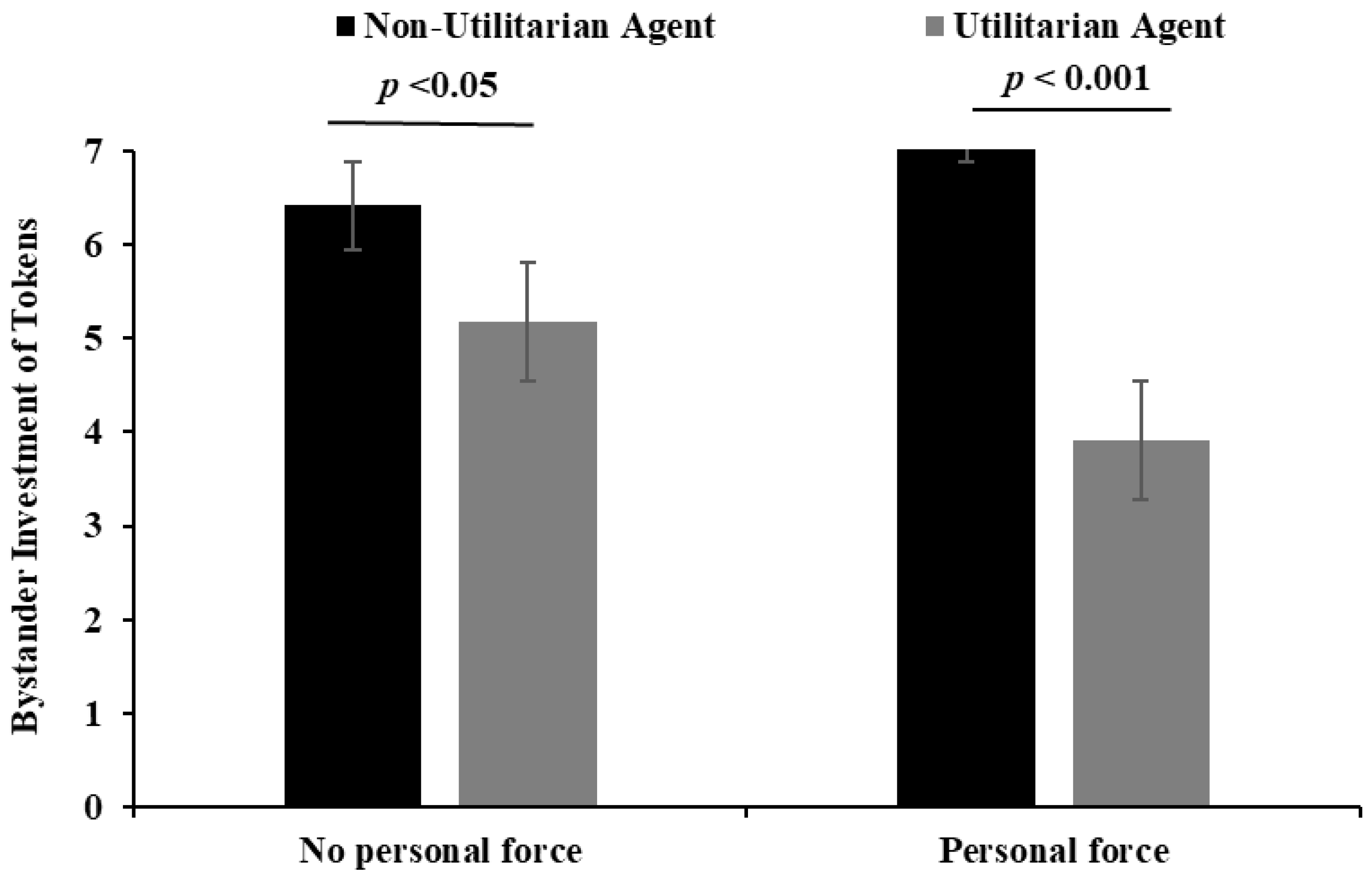
| No Personal Force | Personal Force | |||
|---|---|---|---|---|
| M | SD | M | SD | |
| Non-utilitarian Agent | 6.42 | 3.10 | 7.36 | 2.47 |
| Utilitarian Agent | 5.18 | 3.44 | 3.91 | 2.93 |
Disclaimer/Publisher’s Note: The statements, opinions and data contained in all publications are solely those of the individual author(s) and contributor(s) and not of MDPI and/or the editor(s). MDPI and/or the editor(s) disclaim responsibility for any injury to people or property resulting from any ideas, methods, instructions or products referred to in the content. |
© 2025 by the authors. Licensee MDPI, Basel, Switzerland. This article is an open access article distributed under the terms and conditions of the Creative Commons Attribution (CC BY) license (https://creativecommons.org/licenses/by/4.0/).
Share and Cite
Xu, X.; Lai, Y.; Wang, J.; Liu, Y.; Yu, M.; Zhang, F.; Xu, Y. The Effect of Moral Judgment on Bystander Cooperation Behavior: The Role of Personal Force. Behav. Sci. 2025, 15, 1699. https://doi.org/10.3390/bs15121699
Xu X, Lai Y, Wang J, Liu Y, Yu M, Zhang F, Xu Y. The Effect of Moral Judgment on Bystander Cooperation Behavior: The Role of Personal Force. Behavioral Sciences. 2025; 15(12):1699. https://doi.org/10.3390/bs15121699
Chicago/Turabian StyleXu, Xiaodan, Yidie Lai, Juan Wang, Yang Liu, Ming Yu, Feng Zhang, and Yan Xu. 2025. "The Effect of Moral Judgment on Bystander Cooperation Behavior: The Role of Personal Force" Behavioral Sciences 15, no. 12: 1699. https://doi.org/10.3390/bs15121699
APA StyleXu, X., Lai, Y., Wang, J., Liu, Y., Yu, M., Zhang, F., & Xu, Y. (2025). The Effect of Moral Judgment on Bystander Cooperation Behavior: The Role of Personal Force. Behavioral Sciences, 15(12), 1699. https://doi.org/10.3390/bs15121699