A Transdiagnostic Approach in Psychodiagnosis: The Romanian Adaptation of the Process-Based Assessment Tool (PBAT)

 ,
, 
 , , ,
, , ,
Abstract
1. Introduction
2. Materials and Methods
2.1. Instruments
2.2. Procedure
2.3. Ethical Considerations
2.4. Statistical Analyses
- Descriptive statistics (means, SDs, skewness, kurtosis) were computed for PBAT items and clinical outcomes (PHQ-9 for depression, GAD-7 for anxiety).
- Pearson correlations were performed to assess relationships between PBAT items and clinical outcomes. Answers to PBAT items did not produce any missing data.
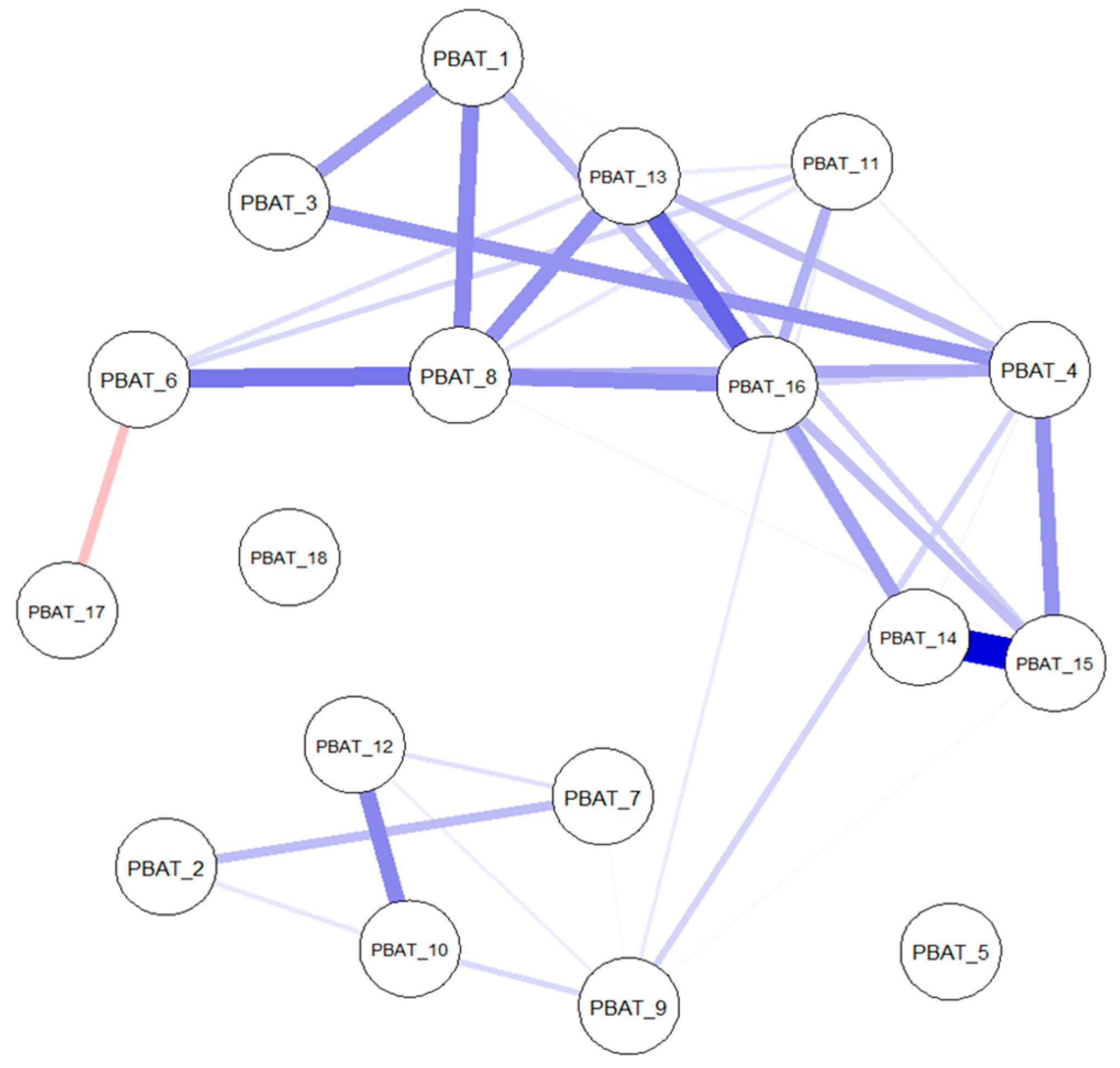
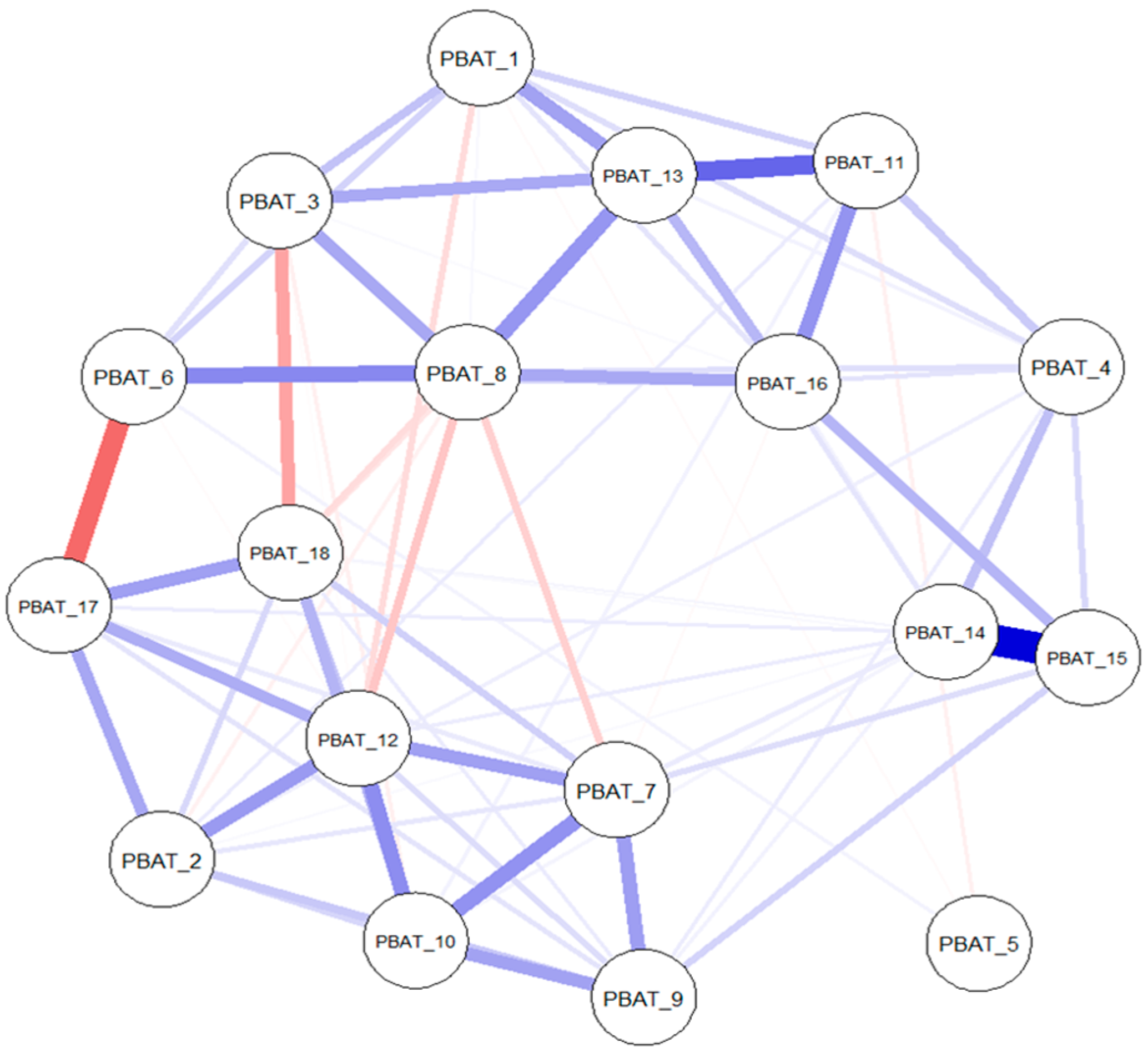
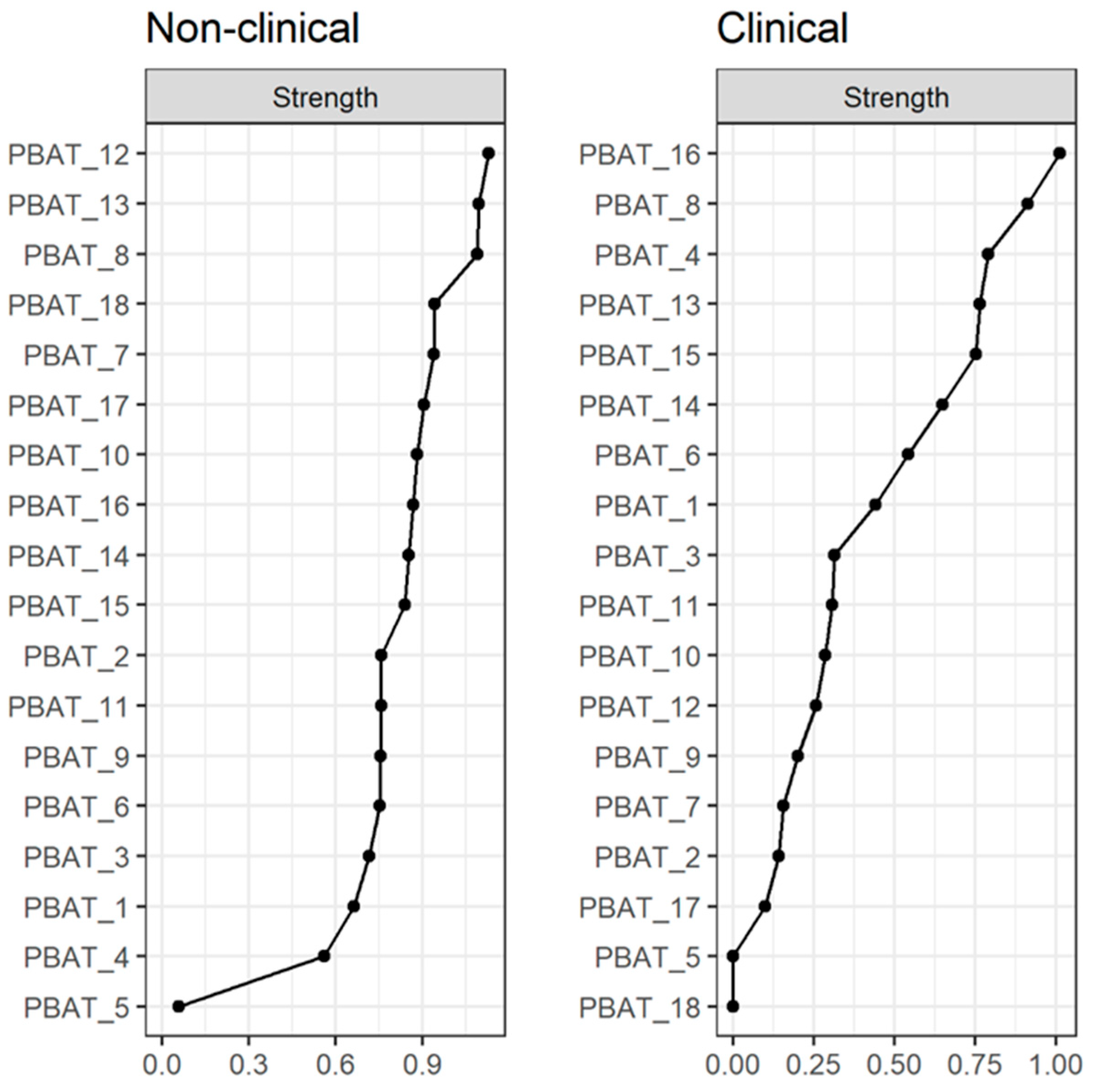
- Network analysis was conducted for both the non-clinical and clinical samples with the bootnet package using EBICglasso estimation with the standardly employed regularization parameter of 0.50 (Epskamp et al., 2018). The regularization parameter can be adjusted to obtain either more dense network connections by lowering the parameter or to obtain a more parsimonious network by increasing the parameter. Our networks did not require any adjustment of regularization, and we maintained the standard gamma threshold of 0.50. Network centrality and stability were examined via case-dropping bootstraps with 2000 bootstrap iterations. Stability of edges was examined with non-parametric bootstrapping with 2000 iterations. We opted to use 2000 iterations as opposed to the typical 1000 iterations to increase the accuracy of the results.
- Boruta feature selection was applied on data obtained within the non-clinical sample to identify PBAT items most strongly associated with depression (PHQ-9) and anxiety (GAD-7). The algorithm compared observed variable importance with randomly permuted shadow features, confirming significant predictors across 1000 importance runs (Kursa & Rudnicki, 2010).
- Network invariance test (NCT) compared clinical and non-clinical subsamples in terms. The test was used to compare the structure of the two networks (network invariance) and the global strength invariance—a measure of network connectivity. A non-significant p-value (above 0.05) for the NCT is typically interpreted as an indication of invariance of the two compared networks (van Borkulo et al., 2023).
3. Results
3.1. Network Stability and Centrality
3.2. Network Invariance
4. Discussion
4.1. Results of Correlational Analyses
4.2. Outcomes of the Network Analyses
4.3. Results of the Boruta Analysis
4.4. Limitations and Future Research
5. Conclusions
Supplementary Materials
Author Contributions
Funding
Institutional Review Board Statement
Informed Consent Statement
Data Availability Statement
Acknowledgments
Conflicts of Interest
Abbreviations
| EEMM | Extended Evolutionary Meta-Model |
| GAD-7 | Generalized Anxiety Disorder-7 |
| PBAT | Process-Based Assessment Tool |
| PBT | Process-Based Therapy |
| PHQ-9 | Patient Health Questionnaire-9 |
Appendix A
Appendix A.1. The English Version of the PBAT (Original)
| 0 | 10 | 20 | 30 | 40 | 50 | 60 | 70 | 80 | 90 | 100 |
| Strongly disagree | Strongly agree | |||||||||
| 1. I was able to change my behavior, when changing helped my life. | ||||||||||
| 0 | 10 | 20 | 30 | 40 | 50 | 60 | 70 | 80 | 90 | 100 |
| 2. I did things that hurt my connection with people who are important to me. | ||||||||||
| 0 | 10 | 20 | 30 | 40 | 50 | 60 | 70 | 80 | 90 | 100 |
| 3. I was able to experience a range of emotions appropriate to the moment. | ||||||||||
| 0 | 10 | 20 | 30 | 40 | 50 | 60 | 70 | 80 | 90 | 100 |
| 4. I struggled to keep doing something good for me. | ||||||||||
| 0 | 10 | 20 | 30 | 40 | 50 | 60 | 70 | 80 | 90 | 100 |
| 5. I did not find a meaningful way to challenge myself. | ||||||||||
| 0 | 10 | 20 | 30 | 40 | 50 | 60 | 70 | 80 | 90 | 100 |
| 6. I acted in ways that helped my physical health. | ||||||||||
| 0 | 10 | 20 | 30 | 40 | 50 | 60 | 70 | 80 | 90 | 100 |
| 7. My thinking got in the way of things that were important to me. | ||||||||||
| 0 | 10 | 20 | 30 | 40 | 50 | 60 | 70 | 80 | 90 | 100 |
| 8. I paid attention to important things in my daily life. | ||||||||||
| 0 | 10 | 20 | 30 | 40 | 50 | 60 | 70 | 80 | 90 | 100 |
| 9. I did things only because I was complying with what others wanted me to do. | ||||||||||
| 0 | 10 | 20 | 30 | 40 | 50 | 60 | 70 | 80 | 90 | 100 |
| 10. I stuck to strategies that seemed to have worked. | ||||||||||
| 0 | 10 | 20 | 30 | 40 | 50 | 60 | 70 | 80 | 90 | 100 |
| 11. I found personally important ways to challenge myself. | ||||||||||
| 0 | 10 | 20 | 30 | 40 | 50 | 60 | 70 | 80 | 90 | 100 |
| 12. I felt stuck and unable to change my ineffective behavior. | ||||||||||
| 0 | 10 | 20 | 30 | 40 | 50 | 60 | 70 | 80 | 90 | 100 |
| 13. I used my thinking in ways that helped me live better. | ||||||||||
| 0 | 10 | 20 | 30 | 40 | 50 | 60 | 70 | 80 | 90 | 100 |
| 14. I struggled to connect with the moments in my day-to-day life. | ||||||||||
| 0 | 10 | 20 | 30 | 40 | 50 | 60 | 70 | 80 | 90 | 100 |
| 15. I did things to connect with people who are important to me. | ||||||||||
| 0 | 10 | 20 | 30 | 40 | 50 | 60 | 70 | 80 | 90 | 100 |
| 16. I chose to do things that were personally important to me. | ||||||||||
| 0 | 10 | 20 | 30 | 40 | 50 | 60 | 70 | 80 | 90 | 100 |
| 17. I acted in ways that hurt my physical health. | ||||||||||
| 0 | 10 | 20 | 30 | 40 | 50 | 60 | 70 | 80 | 90 | 100 |
| 18. I did not find an appropriate outlet for my emotions. | ||||||||||
| 0 | 10 | 20 | 30 | 40 | 50 | 60 | 70 | 80 | 90 | 100 |
Appendix A.2. The Romanian Version of the PBAT
| 0 | 10 | 20 | 30 | 40 | 50 | 60 | 70 | 80 | 90 | 100 |
| Dezacord puternic | Acord puternic | |||||||||
| 1. Am reușit să-mi schimb comportamentul, atunci când schimbarea a adus unele beneficii în viața mea. | ||||||||||
| 0 | 10 | 20 | 30 | 40 | 50 | 60 | 70 | 80 | 90 | 100 |
| 2. Am făcut lucruri care au influențat negativ legătura mea cu oamenii importanți pentru mine. | ||||||||||
| 0 | 10 | 20 | 30 | 40 | 50 | 60 | 70 | 80 | 90 | 100 |
| 3. Am avut capacitatea de a experimenta emoții adecvate în raport cu momentul trăit. | ||||||||||
| 0 | 10 | 20 | 30 | 40 | 50 | 60 | 70 | 80 | 90 | 100 |
| 4. M-am zbătut pentru a continua să fac lucrurile ce mi-au adus beneficii personale. | ||||||||||
| 0 | 10 | 20 | 30 | 40 | 50 | 60 | 70 | 80 | 90 | 100 |
| 5. Nu am avut în viața mea situații importante pe care să le consider o adevarată provocare. | ||||||||||
| 0 | 10 | 20 | 30 | 40 | 50 | 60 | 70 | 80 | 90 | 100 |
| 6. Comportamentul meu a fost adecvat în privința menținerii sănătății mele fizice. | ||||||||||
| 0 | 10 | 20 | 30 | 40 | 50 | 60 | 70 | 80 | 90 | 100 |
| 7. Felul în care am gândit în diferite situații m-a împiedicat să realizez lucruri importante pentru mine. | ||||||||||
| 0 | 10 | 20 | 30 | 40 | 50 | 60 | 70 | 80 | 90 | 100 |
| 8. Am fost atent (ă) la lucrurile pe care le-am considerat importante în viața mea de zi cu zi. | ||||||||||
| 0 | 10 | 20 | 30 | 40 | 50 | 60 | 70 | 80 | 90 | 100 |
| 9. Am făcut unele lucruri doar pentru că alții așteptau asta de la mine. | ||||||||||
| 0 | 10 | 20 | 30 | 40 | 50 | 60 | 70 | 80 | 90 | 100 |
| 10. Am rămas blocat (ă) la strategii care păreau utile în trecut. | ||||||||||
| 0 | 10 | 20 | 30 | 40 | 50 | 60 | 70 | 80 | 90 | 100 |
| 11. M-am ambiționat folosind diferite modalități personale. | ||||||||||
| 0 | 10 | 20 | 30 | 40 | 50 | 60 | 70 | 80 | 90 | 100 |
| 12. M-am simțit blocat (ă) și incapabil (ă) să-mi schimb un comportament pe care l-am considerat ineficient. | ||||||||||
| 0 | 10 | 20 | 30 | 40 | 50 | 60 | 70 | 80 | 90 | 100 |
| 13. Mi-am folosit gândirea pentru a reuși să îmi îmbunătățesc unele aspecte ale vieții. | ||||||||||
| 0 | 10 | 20 | 30 | 40 | 50 | 60 | 70 | 80 | 90 | 100 |
| 14. Am făcut eforturi pentru a mă conecta la momentele zilnice ce apar în viața mea. | ||||||||||
| 0 | 10 | 20 | 30 | 40 | 50 | 60 | 70 | 80 | 90 | 100 |
| 15. M-am străduit pentru a mă conecta cu oamenii pe care îi consider importanți pentru mine. | ||||||||||
| 0 | 10 | 20 | 30 | 40 | 50 | 60 | 70 | 80 | 90 | 100 |
| 16. Am ales să fac lucrurile ce au avut o anumită semnificație personală pentru mine. | ||||||||||
| 0 | 10 | 20 | 30 | 40 | 50 | 60 | 70 | 80 | 90 | 100 |
| 17. Am adoptat comportamente ce au dăunat sănătății mele fizice. | ||||||||||
| 0 | 10 | 20 | 30 | 40 | 50 | 60 | 70 | 80 | 90 | 100 |
| 18. Nu am găsit modalitatea potrivită prin care mi-aș putea exprima emoțiile. | ||||||||||
| 0 | 10 | 20 | 30 | 40 | 50 | 60 | 70 | 80 | 90 | 100 |
Appendix B. Correspondence Between the PBAT Items Labels and Original Descriptions
| Item Number | Item Label | Original Item |
| PBAT_1 | AbleToChangeBehavior | I was able to change my behavior, when changing helped my life. |
| PBAT_2 | HurtConnect | I did things that hurt my connection with people who are important to me. |
| PBAT_3 | ExperienceRangeEmotions | I was able to experience a range of emotions appropriate to the moment. |
| PBAT_4 | StruggledToKeepDoing | I struggled to keep doing something good for me. |
| PBAT_5 | NoMeaningfulChallenge | I did not find a meaningful way to challenge myself. |
| PBAT_6 | HelpHealth | I acted in ways that helped my physical health. |
| PBAT_7 | ThinkingGotInWay | My thinking got in the way of things that were important to me. |
| PBAT_8 | PaidAtToImportant | I paid attention to important things in my daily life. |
| PBAT_9 | Complying | I did things only because I was complying with what others wanted me to do. |
| PBAT_10 | StuckToStrategies | I stuck to strategies that seemed to have worked. |
| PBAT_11 | ImportantChallenge | I found personally important ways to challenge myself. |
| PBAT_12 | StuckUnableChange | I felt stuck and unable to change my ineffective behavior. |
| PBAT_13 | ThinkingHelpedLife | I used my thinking in ways that helped me live better. |
| PBAT_14 | StruggleConnectMoments | I struggled to connect with the moments in my day-to-day life. |
| PBAT_15 | ConnectToPeople | I did things to connect with people who are important to me. |
| PBAT_16 | PersonalImport | I chose to do things that were personally important to me. |
| PBAT_17 | HurtHealth | I acted in ways that hurt my physical health. |
| PBAT_18 | NoOutletForFeelings | I did not find an appropriate outlet for my emotions. |
| Note: Adapted after (Ciarrochi et al., 2022b). | ||
References
- Aizik-Reebs, A., Shoham, A., Hadash, Y., & Bernstein, A. (2021). A network modeling approach to mindfulness mechanisms: A proof-of-concept investigation. Mindfulness, 12(5), 1115–1126. [Google Scholar] [CrossRef]
- Barrera-Caballero, S., Romero-Moreno, R., del Sequeros Pedroso-Chaparro, M., Olmos, R., Vara-García, C., Gallego-Alberto, L., Cabrera, I., Márquez-González, M., Olazarán, J., & Losada-Baltar, A. (2021). Stress, cognitive fusion and comorbid depressive and anxiety symptomatology in dementia caregivers. Psychology and Aging, 36(5), 667–676. [Google Scholar] [CrossRef]
- Bentley, K. H., Bernstein, E. E., Wallace, B., & Mischoulon, D. (2021a). Treatment for anxiety and comorbid depressive disorders: Transdiagnostic cognitive–behavioral strategies. Psychiatric Annals, 51(5), 226–230. [Google Scholar] [CrossRef]
- Bentley, K. H., Cohen, Z. D., Kim, T., Bullis, J. R., Nauphal, M., Cassiello-Robbins, C., Sauer-Zavala, S., Sbi, S., Gallagher, M. W., Farchione, T. J., & Barlow, D. H. (2021b). The nature, timing, and symptom trajectories of dropout from transdiagnostic and single-diagnosis cognitive-behavioral therapy for anxiety disorders. Behavior Therapy, 52(6), 1364–1376. [Google Scholar] [CrossRef]
- Blanchard, D. C., Summers, C. H., & Blanchard, R. J. (2013). The role of behavior in translational models for psychopathology: Functionality and dysfunctional behaviors. Neuroscience & Biobehavioral Reviews, 37(8), 1567–1577. [Google Scholar] [CrossRef]
- Chae, D., Lee, J., & Lee, E. H. (2025). Internal structure of the patient health questionnaire-9: A systematic review and meta-analysis. Asian Nursing Research, 19(1), 1–12. [Google Scholar] [CrossRef]
- Ciarrochi, J., Hayes, S. C., Oades, L. G., & Hofmann, S. G. (2022a). Toward a unified framework for positive psychology interventions: Evidence-based processes of change in coaching, prevention, and training. Frontiers in Psychology, 12, 809362. [Google Scholar] [CrossRef] [PubMed]
- Ciarrochi, J., Hernández, C., Hill, D., Ong, C., Gloster, A. T., Levin, M. E., Yap, K., Fraser, M. I., Sahdra, B. K., Hofmann, S. G., & Hayes, S. C. (2024). Process-based therapy: A common ground for understanding and utilizing therapeutic practices. Journal of Psychotherapy Integration, 34(3), 265–290. [Google Scholar] [CrossRef]
- Ciarrochi, J., Sahdra, B., Hofmann, S. G., & Hayes, S. C. (2022b). Developing an item pool to assess processes of change in psychological interventions: The Process-Based Assessment Tool (PBAT). Journal of Contextual Behavioral Science, 23, 200–213. [Google Scholar] [CrossRef]
- Cotiga, A. C., Zanfirescu, Ş. A., Iliescu, D., Ciumăgeanu, M., Gotca, I., & Popa, C. O. (2023). Psychometric characteristics of the Romanian adaptation of the GAD-7. Journal of Psychopathology and Behavioral Assessment, 45(3), 691–701. [Google Scholar] [CrossRef]
- Cyniak-Cieciura, M., Dudek, J., & Ostaszewski, P. (2024). The Polish version of the Process-Based Assessment Tool (PBAT): The measure of processes of change in psychological interventions. PLoS ONE, 19(6), e0304661. [Google Scholar] [CrossRef] [PubMed]
- Epskamp, S., Borsboom, D., & Fried, E. I. (2018). Estimating psychological networks and their accuracy: A tutorial paper. Behavior Research Methods, 50, 195–212. [Google Scholar] [CrossRef]
- Epskamp, S., Cramer, A. O. J., Waldorp, L. J., Schmittmann, V. D., & Borsboom, D. (2012). qgraph: Network visualizations of relationships in psychometric data. Journal of Statistical Software, 48(4), 1–18. [Google Scholar] [CrossRef]
- Faustino, B., Vasco, A. B., Farinha-Fernandes, A., & Delgado, J. (2023). Psychological inflexibility as a transdiagnostic construct: Relationships between cognitive fusion, psychological well-being and symptomatology. Current Psychology, 42(8), 6056–6061. [Google Scholar] [CrossRef]
- Gibbons, C. J., & DeRubeis, R. J. (2008). Anxiety symptom focus in sessions of cognitive therapy for depression. Behavior Therapy, 39(2), 117–125. [Google Scholar] [CrossRef]
- Goicoechea, C., Wallman-Jones, A., Ciarrochi, J., Hayes, S. C., Hofmann, S. G., & Perakakis, P. (2024). Development and validation of the Spanish Process-Based Assessment Tool (PBAT). Available online: https://osf.io/preprints/psyarxiv/y35sv_v1 (accessed on 14 November 2025).
- Habibović, M., Leissner, P., Nyklíček, I., Widdershoven, J., & Olsson, E. (2025). Association between psychological inflexibility, distress and health-related quality of life in people with cardiovascular disease. General Hospital Psychiatry, 92, 95–99. [Google Scholar] [CrossRef]
- Hayes, S. C., & Hofmann, S. G. (2018). Process-based CBT: The science and core clinical competencies of cognitive behavioral therapy. New Harbinger Publications. [Google Scholar]
- Hayes, S. C., & Hofmann, S. G. (2021). “Third-wave” cognitive and behavioral therapies and the emergence of a process-based approach to intervention in psychiatry. World Psychiatry, 20(3), 363–375. [Google Scholar] [CrossRef]
- Hayes, S. C., Hofmann, S. G., & Ciarrochi, J. (2020a). A process-based approach to psychological diagnosis and treatment: The conceptual and treatment utility of an extended evolutionary meta model. Clinical Psychology Review, 82, 101908. [Google Scholar] [CrossRef]
- Hayes, S. C., Hofmann, S. G., & Ciarrochi, J. (2020b). Building a process-based diagnostic system: An extended evolutionary approach. In S. G. Hofmann, & S. C. Hayes (Eds.), Beyond the DSM: Toward a process-based alternative for diagnosis and mental health treatment. Context Press/New Harbinger Publications. [Google Scholar]
- Hayes, S. C., Hofmann, S. G., Stanton, C. E., Carpenter, J. K., Sanford, B. T., Curtiss, J. E., & Ciarrochi, J. (2019). The role of the individual in the coming era of process-based therapy. Behaviour Research and Therapy, 117, 40–53. [Google Scholar] [CrossRef] [PubMed]
- Hofmann, S. G., & Hayes, S. C. (2019). The future of intervention science: Process-based therapy. Clinical Psychological Science, 7(1), 37–50. [Google Scholar] [CrossRef] [PubMed]
- Hofstede, G. (2001). Culture’s consequences: Comparing values, behaviors, institutions, and organizations across nations (2nd ed.). Sage. [Google Scholar]
- Hofstede, G., Hofstede, G. J., & Minkov, M. (2010). Cultures and organizations: Software of the mind (3rd ed.). McGraw-Hill Professional. [Google Scholar]
- Johnson, S. U., Ulvenes, P. G., Øktedalen, T., & Hoffart, A. (2019). Psychometric properties of the General Anxiety Disorder 7-Item (GAD-7) scale in a heterogeneous psychiatric sample. Frontiers in Psychology, 10, 1713. [Google Scholar] [CrossRef]
- Kroenke, K., Spitzer, R. L., & Williams, J. B. (2001). The PHQ-9: Validity of a brief depression severity measure. Journal of General Internal Medicine, 16(9), 606–613. [Google Scholar] [CrossRef]
- Kursa, M. B., & Rudnicki, W. R. (2010). Feature selection with the Boruta package. Journal of Statistical Software, 36(11), 1–13. [Google Scholar] [CrossRef]
- Landi, G., Pakenham, K. I., Crocetti, E., Tossani, E., & Grandi, S. (2022). The trajectories of anxiety and depression during the COVID-19 pandemic and the protective role of psychological flexibility: A four-wave longitudinal study. Journal of Affective Disorders, 307, 69–78. [Google Scholar] [CrossRef]
- Larsson, A. B., & Sundström, F. T. A. (2024). Optimizing process-based therapy: A Boruta-driven approach to identifying key clinical outcomes in a Swedish validation of the Process-Based Assessment Tool (PBAT). Journal of Contextual Behavioral Science, 33, 100794. [Google Scholar] [CrossRef]
- Levin, M. E., MacLane, C., Daflos, S., Seeley, J. R., Hayes, S. C., Biglan, A., & Pistorello, J. (2014). Examining psychological inflexibility as a transdiagnostic process across psychological disorders. Journal of Contextual Behavioral Science, 3(3), 155–163. [Google Scholar] [CrossRef]
- Moorey, S. (2023). Three ways to change your mind: An epistemic framework for cognitive interventions. Behavioural and Cognitive Psychotherapy, 51(3), 187–199. [Google Scholar] [CrossRef]
- Morris, L., & Mansell, W. (2018). A systematic review of the relationship between rigidity/flexibility and transdiagnostic cognitive and behavioral processes that maintain psychopathology. Journal of Experimental Psychopathology, 9(3), 2043808718779431. [Google Scholar] [CrossRef]
- Norton, P. J., & Barrera, T. L. (2012). Transdiagnostic versus diagnosis-specific cbt for anxiety disorders: A preliminary randomized controlled noninferiority trial. Depression and Anxiety, 29(10), 874–882. [Google Scholar] [CrossRef] [PubMed]
- Ong, C. W., Ciarrochi, J., Hofmann, S. G., Karekla, M., & Hayes, S. C. (2024). Through the extended evolutionary meta-model, and what ACT found there: ACT as a process-based therapy. Journal of Contextual Behavioral Science, 32, 100734. [Google Scholar] [CrossRef]
- Orouji, F., Abdi, R., & Chalabianloo, G. (2022). Mediating role of psychological inflexibility as a transdiagnostic factor in the relationship between emotional dysregulation and sleep problems with symptoms of emotional disorders. Frontiers in Psychology, 13, 800041. [Google Scholar] [CrossRef] [PubMed]
- Paliliunas, D. (2022). Values: A core guiding principle for behavior-analytic intervention and research. Behavior Analysis in Practice, 15(1), 115–125. [Google Scholar] [CrossRef]
- Rahal, G. M., & Gon, M. C. C. (2020). A systematic review of values interventions in acceptance and commitment therapy. International Journal of Psychology and Psychological Therapy, 20(3), 355–372. [Google Scholar]
- R Core Team. (2024). R: A language and environment for statistical computing. R Foundation for Statistical Computing. [Google Scholar]
- Ryan, R. M., & Deci, E. L. (2017). Self-determination theory: Basic psychological needs in motivation, development, and wellness. Guilford Press. [Google Scholar]
- Sanford, B. T., Ciarrochi, J., Hofmann, S. G., Chin, F., Gates, K. M., & Hayes, S. C. (2022). Toward empirical process-based case conceptualization: An idiographic network examination of the Process-Based Assessment Tool. Journal of Contextual Behavioral Science, 25, 10–25. [Google Scholar] [CrossRef]
- Singh, B., Murphy, A., Maher, C., & Smith, A. E. (2024). Time to form a habit: A systematic review and meta-analysis of health behaviour habit formation and its determinants. Healthcare, 12(23), 2488. [Google Scholar] [CrossRef]
- Spitzer, R. L., Kroenke, K., Williams, J. B., & Löwe, B. (2006). A brief measure for assessing generalized anxiety disorder: The GAD-7. Archives of Internal Medicine, 166(10), 1092–1097. [Google Scholar] [CrossRef]
- Talask, G., de Oliveira Paveltchuk, F., & Diogo, C. A. S. C. (2024). Cross-cultural translation and adaptation of the Process-Based Assessment Tool (PBAT) to Brazilian Portuguese: A methodological approach for ensuring linguistic and cultural equivalence/Tradução e adaptação transcultural da ferramenta de avaliação baseada em processos (PBAT) para o português brasileiro: Uma abordagem metodológica para garantir a equivalência linguística e cultural. Revista Interdisciplinar de Psicología y Jurisprudencia, 57(1), e2028. [Google Scholar] [CrossRef]
- Tani, S. (2025). Comprehensive support for a person with disabilities: Application of the Extended Evolutional Meta-Model (EEMM) and the linkage model. Asia-Japan Research Academic Bulletin, 6, 6-0. [Google Scholar] [CrossRef]
- Tavakoli, N., Broyles, A., Reid, E. K., Sandoval, J. R., & Correa-Fernández, V. (2019). Psychological inflexibility as it relates to stress, worry, generalized anxiety, and somatization in an ethnically diverse sample of college students. Journal of Contextual Behavioral Science, 11, 1–5. [Google Scholar] [CrossRef]
- van Borkulo, C. D., Van Bork, R., Boschloo, L., Kossakowski, J. J., Tio, P., Schoevers, R. A., Borsboom, D., & Waldorp, L. J. (2023). Comparing network structures on three aspects: A permutation test. Psychological Methods, 28(6), 1273–1285. [Google Scholar] [CrossRef] [PubMed]
- Wall, A. D., & Lee, E. B. (2025). Comparing cognitive coping components: An investigation of treatment outcomes and processes. Journal of Contextual Behavioral Science, 36(4), 100893. [Google Scholar] [CrossRef]
- Wilson, K. G., Murrell, A. R., Hayes, B. T. I. S., Follette, V. M., & Linehan, M. (2004). Values-centered interventions: Setting a course for behavioral treatment. Cell, 662, 816–5189. [Google Scholar]



| Non-Clinical Sample (N = 485) | Clinical Sample (N = 152) | Overall (N = 637) | ||||
|---|---|---|---|---|---|---|
| Age (mean, SD) | 27.5 | 9.81 | 56.1 | 13.1 | 34.3 | 16.2 |
| Gender (N, %) | ||||||
| Female | 430 | 88.7 | 111 | 73 | 542 | 85.2 |
| Male | 53 | 10.9 | 41 | 26.9 | 94 | 14.7 |
| Other | 2 | 0.4 | 2 | 0.3 | ||
| Education | ||||||
| Professional/High school | 102 | 21 | 75 | 49.3 | 177 | 27.8 |
| Higher education | 383 | 79 | 39 | 25.6 | 422 | 66.2 |
| Middle school | 0 | 0 | 38 | 25 | 38 | 5.9 |
| Main diagnosis | ||||||
| Adjustment disorders | - | - | 11 | 7.2 | - | 1.7 |
| Bipolar disorder | - | - | 1 | 0.65 | - | 0.15 |
| Emotional disorders | - | - | 19 | 12.5 | - | 3 |
| Paranoid schizophrenia | - | - | 8 | 5.3 | - | 1.25 |
| Chronic pain | - | - | 108 | 71 | - | 17 |
| Substance use disorders | - | - | 2 | 1.3 | - | 0.3 |
| Neurocognitive disorders | 2 | 1.3 | - | 0.3 | ||
| Selection Process—Positive | Selection Process—Negative | Variation—Positive and Negative | Retention—Positive and Negative |
|---|---|---|---|
| PersonalImport (PBAT_16) | Complying (PBAT_9) | AbleToChangeBehavior (PBAT_1) | StuckToStrategies (PBAT_10) |
| HelpHealth (PBAT_6) | HurtHealth (PBAT_17) | StuckUnableChange (PBAT_12) | StruggledToKeepDoing (PBAT_4) |
| PaidAtToImportant (PBAT_8) | StruggleConnectMoments (PBAT_14) | ||
| ConnectToPeople (PBAT_15) | HurtConnect (PBAT_2) | ||
| ExperienceRangeEmotions (PBAT_3) | NoOutletForFeelings (PBAT_18) | ||
| ImportantChallenge (PBAT_11) | NoMeaningfulChallenge (PBAT_5) | ||
| ThinkingHelpedLife (PBAT_13) | ThinkingGotInWay (PBAT_7) |
| EEMM Process | Negative Behavior | Positive Behavior |
|---|---|---|
| Selection | ||
| Affect | NoOutletForFeelings (PBAT_18) | ExperienceRangeEmotions (PBAT_3) |
| Cognition | ThinkingGotInWay (PBAT_7) | ThinkingHelpedLife (PBAT_13) |
| Attention | StruggleConnectMoments (PBAT_14) | PaidAtToImportant (PBAT_8) |
| Social connection | HurtConnect (PBAT_2) | ConnectToPeople (PBAT_15) |
| Motivation | Complying (PBAT_9) | PersonalImport (PBAT_16) |
| Overt behavior | NoMeaningfulChallenge (PBAT_5) | ImportantChallenge (PBAT_11) |
| Physical health behaviors | HurtHealth (PBAT_17) | HelpHealth (PBAT_6) |
| Variation | StuckUnableChange (PBAT_12) | AbleToChangeBehavior (PBAT_1) |
| Retention | StruggledToKeepDoing (PBAT_4) | StuckToStrategies (PBAT_10) |
| Non-Clinical | Clinical | |||||||
|---|---|---|---|---|---|---|---|---|
| Variable | M | SD | Skew | Kurt | M | SD | Skew | Kurt |
| PBAT1 | 75.46 | 21.92 | −1.14 | 1.10 | 66.32 | 26.71 | −0.77 | −0.14 |
| PBAT2 | 53.65 | 32.10 | −0.13 | −1.26 | 23.49 | 28.27 | 1.11 | 0.16 |
| PBAT3 | 76.87 | 22.37 | −1.14 | 0.80 | 62.04 | 29.01 | −0.56 | −0.51 |
| PBAT4 | 76.74 | 24.66 | −1.19 | 0.68 | 73.22 | 26.88 | −0.99 | 0.21 |
| PBAT5 | 21.57 | 26.50 | 1.39 | 1.07 | 38.29 | 32.34 | 0.31 | −1.1 |
| PBAT6 | 59.20 | 27.26 | −0.31 | −0.89 | 63.29 | 29.9 | −0.37 | −0.85 |
| PBAT7 | 63.48 | 29.18 | −0.53 | −0.77 | 47.76 | 31.31 | −0.1 | −1.14 |
| PBAT8 | 70.97 | 23.12 | −0.76 | 0.02 | 76.91 | 25.14 | −1.1 | 0.68 |
| PBAT9 | 67.18 | 29.49 | −0.77 | −0.48 | 52.76 | 34.01 | −0.18 | −1.31 |
| PBAT10 | 52.99 | 29.09 | −0.09 | −1.03 | 47.04 | 31.74 | −0.08 | −1.34 |
| PBAT11 | 74.33 | 23.82 | −1.09 | 0.76 | 60.46 | 31.88 | −0.44 | −0.95 |
| PBAT12 | 56.56 | 31.22 | −0.17 | −1.23 | 39.47 | 30.31 | 0.38 | −1.07 |
| PBAT13 | 80.21 | 19.97 | −1.41 | 2.12 | 77.04 | 24.65 | −1.25 | 1.03 |
| PBAT14 | 64.35 | 27.63 | −0.62 | −0.52 | 72.96 | 25.76 | −0.99 | 0.33 |
| PBAT15 | 71.42 | 27.57 | −1.00 | 0.08 | 78.95 | 24.77 | −1.43 | 1.79 |
| PBAT16 | 81.05 | 18.96 | −1.26 | 1.55 | 76.45 | 24.48 | −1.05 | 0.37 |
| PBAT17 | 51.77 | 33.11 | −0.08 | −1.34 | 40.07 | 30.89 | 0.38 | −0.93 |
| PBAT18 | 52.62 | 32.43 | −0.04 | −1.30 | 46.45 | 30.95 | 0.15 | −1.06 |
| PHQ-9 | 1.32 | 0.85 | 0.55 | −0.71 | ||||
| GAD-7 | 1.06 | 0.74 | 0.39 | −0.94 | ||||
| Variable | 1 | 2 | 3 | 4 | 5 | 6 | 7 | 8 | 9 | 10 | 11 | 12 | 13 | 14 | 15 | 16 | 17 | 18 |
|---|---|---|---|---|---|---|---|---|---|---|---|---|---|---|---|---|---|---|
| 1. PBAT_1 | −0.00 | 0.40 ** | 0.34 ** | 0.1 | 0.30 ** | 0.06 | 0.48 ** | 0.13 | 0.06 | 0.26 ** | 0.01 | 0.35 ** | 0.20 * | 0.19 * | 0.43 ** | −0.01 | −0.13 | |
| 2. PBAT_2 | −0.04 | 0.14 | −0.11 | 0.14 | −0.01 | 0.33 ** | −0.09 | 0.17 * | 0.27 ** | −0.11 | 0.13 | −0.22 ** | −0.07 | 0.03 | −0.1 | 0.12 | 0.11 | |
| 3. PBAT_3 | 0.32 ** | −0.16 ** | 0.42 ** | 0.13 | 0.25 ** | −0.02 | 0.27 ** | 0.16 | 0.06 | 0.19 * | −0.03 | 0.26 ** | 0.10 | 0.20 * | 0.28 ** | −0.05 | −0.20 * | |
| 4. PBAT_4 | 0.19 ** | 0.11 * | 0.11 * | −0.01 | 0.38 ** | 0.02 | 0.49 ** | 0.31 ** | 0.22 ** | 0.32 ** | −0.02 | 0.48 ** | 0.41 ** | 0.50 ** | 0.48 ** | 0.03 | −0.03 | |
| 5. PBAT_5 | −0.07 | −0.00 | −0.01 | −0.03 | 0.23 ** | 0.21 ** | 0.09 | 0.07 | 0.03 | 0.05 | 0.02 | 0.10 | 0.06 | 0.04 | 0.10 | −0.09 | 0.03 | |
| 6. PBAT_6 | 0.27 ** | −0.20 ** | 0.30 ** | 0.04 | 0.08 | 0.06 | 0.53 ** | 0.15 | 0.04 | 0.35 ** | −0.01 | 0.41 ** | 0.26 ** | 0.30 ** | 0.43 ** | −0.33 ** | −0.03 | |
| 7. PBAT_7 | −0.11 * | 0.37 ** | −0.22 ** | 0.05 | −0.03 | −0.20 ** | −0.01 | 0.24 ** | 0.22 ** | −0.00 | 0.28 ** | −0.04 | 0.08 | 0.17 * | 0.03 | 0.10 | 0.20 * | |
| 8. PBAT_8 | 0.30 ** | −0.25 ** | 0.42 ** | 0.19 ** | 0.02 | 0.44 ** | −0.32 ** | 0.18 * | 0.08 | 0.36 ** | −0.07 | 0.56 ** | 0.36 ** | 0.40 ** | 0.59 ** | −0.12 | −0.16 | |
| 9. PBAT_9 | −0.02 | 0.36 ** | −0.13 ** | 0.13 ** | −0.02 | −0.13 ** | 0.45 ** | −0.18 ** | 0.30 ** | 0.27 ** | 0.27 ** | 0.11 | 0.12 | 0.26 ** | 0.20 * | 0.12 | 0.16 * | |
| 10. PBAT_10 | −0.11 * | 0.39 ** | −0.24 ** | 0.03 | −0.05 | −0.18 ** | 0.51 ** | −0.20 ** | 0.44 ** | 0.17 * | 0.41 ** | 0.06 | 0.14 | 0.23 ** | 0.11 | 0.07 | 0.07 | |
| 11. PBAT_11 | 0.30 ** | 0.07 | 0.19 ** | 0.25 ** | −0.09 * | 0.18 ** | −0.02 | 0.26 ** | 0.03 | 0.05 | 0.09 | 0.35 ** | 0.16 * | 0.16 | 0.42 ** | −0.05 | 0.09 | |
| 12. PBAT_12 | −0.23 ** | 0.48 ** | −0.27 ** | −0.03 | 0.02 | −0.30 ** | 0.51 ** | −0.37 ** | 0.40 ** | 0.52 ** | −0.08 | −0.03 | 0.11 | 0.12 | 0.03 | 0.10 | 0.21 * | |
| 13. PBAT_13 | 0.41 ** | −0.07 | 0.41 ** | 0.22 ** | −0.06 | 0.28 ** | −0.15 ** | 0.47 ** | −0.09 * | −0.14 ** | 0.48 ** | −0.22 ** | 0.49 ** | 0.49 ** | 0.63 ** | −0.12 | −0.06 | |
| 14. PBAT_14 | 0.04 | 0.18 ** | −0.04 | 0.27 ** | 0.02 | −0.04 | 0.23 ** | −0.04 | 0.23 ** | 0.20 ** | 0.11 * | 0.21 ** | 0.15 ** | 0.70 ** | 0.53 ** | −0.04 | 0.21 ** | |
| 15. PBAT_15 | 0.05 | 0.16 ** | −0.02 | 0.26 ** | 0.00 | 0.05 | 0.23 ** | −0.01 | 0.25 ** | 0.18 ** | 0.15 ** | 0.17 ** | 0.12 ** | 0.59 ** | 0.52 ** | 0.06 | 0.13 | |
| 16. PBAT_16 | 0.28 ** | 0.00 | 0.26 ** | 0.24 ** | −0.03 | 0.28 ** | −0.13 ** | 0.40 ** | −0.02 | −0.08 | 0.41 ** | −0.11 * | 0.42 ** | 0.20 ** | 0.26 ** | −0.02 | 0.07 | |
| 17. PBAT_17 | −0.14 ** | 0.42 ** | −0.20 ** | 0.05 | 0.02 | −0.44 ** | 0.36 ** | −0.31 ** | 0.32 ** | 0.34 ** | −0.02 | 0.47 ** | −0.14 ** | 0.18 ** | 0.13 ** | −0.10 * | 0.20 * | |
| 18. PBAT_18 | −0.19 ** | 0.37 ** | −0.38 ** | 0.04 | 0.06 | −0.28 ** | 0.41 ** | −0.35 ** | 0.33 ** | 0.43 ** | −0.06 | 0.46 ** | −0.28 ** | 0.17 ** | 0.15 ** | −0.17 ** | 0.44 ** | |
| PHQ−9 | −0.21 ** | 0.36 ** | −0.36 ** | 0.02 | −0.12 ** | −0.39 ** | 0.44 ** | −0.35 ** | 0.35 ** | 0.40 ** | −0.08 | 0.51 ** | −0.28 ** | 0.23 ** | 0.17 ** | −0.15 ** | 0.42 ** | 0.49 ** |
| GAD−7 | −0.22 ** | 0.32 ** | −0.41 ** | −0.01 | −0.10 * | −0.40 ** | 0.44 ** | −0.43 ** | 0.28 ** | 0.39 ** | −0.09 * | 0.47 ** | −0.33 ** | 0.21 ** | 0.13 ** | −0.21 ** | 0.45 ** | 0.56 ** |
| GAD-7 | PHQ-9 | ||||||||||
|---|---|---|---|---|---|---|---|---|---|---|---|
| Predictor | meanImp | Decision | Beta | Beta 95% CI [LL, UL] | sr2 | Predictor | meanImp | Decision | Beta | Beta 95% CI [LL, UL] | sr2 |
| R2 = 0.454 ** | R2 = 0.497 ** | ||||||||||
| PBAT_18 | 17.01 | Confirmed | 0.18 | [0.10, 0.27] | 0.02 | PBAT_18 | 23.43 | Confirmed | 0.26 | [0.18, 0.35] | 0.04 |
| PBAT_12 | 16.38 | Confirmed | 0.18 | [0.09, 0.28] | 0.02 | PBAT_3 | 15.11 | Confirmed | −0.12 | [−0.20, −0.04] | 0.01 |
| PBAT_17 | 14.02 | Confirmed | 0.06 | [−0.03, 0.14] | 0.00 | PBAT_7 | 13.17 | Confirmed | 0.13 | [0.05, 0.21] | 0.01 |
| PBAT_7 | 11.94 | Confirmed | 0.11 | [0.02, 0.20] | 0.01 | PBAT_17 | 12.75 | Confirmed | 0.12 | [0.04, 0.20] | 0.01 |
| PBAT_6 | 11.32 | Confirmed | −0.16 | [−0.24, −0.07] | 0.02 | PBAT_6 | 11.17 | Confirmed | −0.11 | [−0.19, −0.03] | 0.01 |
| PBAT_3 | 10.11 | Confirmed | −0.1 | [−0.18, −0.02] | 0.01 | PBAT_12 | 10.58 | Confirmed | 0.10 | [0.01, 0.19] | 0.00 |
| PBAT_9 | 10.09 | Confirmed | 0.06 | [−0.02, 0.14] | 0.00 | PBAT_8 | 10.24 | Confirmed | −0.06 | [−0.14, 0.03] | 0.00 |
| PBAT_13 | 9.17 | Confirmed | −0.11 | [−0.20, −0.02] | 0.01 | PBAT_13 | 7.4 | Confirmed | −0.12 | [−0.21, −0.03] | 0.01 |
| PBAT_10 | 7.7 | Confirmed | 0.01 | [−0.08, 0.10] | 0.00 | PBAT_10 | 6.01 | Confirmed | 0.02 | [−0.06, 0.11] | 0.00 |
| PBAT_2 | 6.43 | Confirmed | 0.05 | [−0.04, 0.13] | 0.00 | PBAT_9 | 5.78 | Confirmed | −0.02 | [−0.10, 0.05] | 0.00 |
| PBAT_14 | 6.37 | Confirmed | 0.11 | [0.02, 0.19] | 0.01 | PBAT_14 | 5.16 | Confirmed | 0.12 | [0.04, 0.21] | 0.01 |
| PBAT_8 | 5.67 | Confirmed | 0.04 | [−0.06, 0.13] | 0.00 | PBAT_2 | 4.71 | Confirmed | −0.01 | [−0.09, 0.07] | 0.00 |
| PBAT_5 | 5.05 | Confirmed | −0.13 | [−0.20, −0.06] | 0.02 | PBAT_16 | 3.01 | Confirmed | −0.03 | [−0.11, 0.05] | 0.00 |
| PBAT_16 | 3.01 | Confirmed | 0.00 | [−0.09, 0.08] | 0.00 | PBAT_5 | 2.31 | Tentative | −0.11 | [−0.18, −0.05] | 0.01 |
| PBAT_1 | 2.81 | Confirmed | −0.02 | [−0.09, 0.06] | 0.00 | PBAT_15 | 2.21 | Rejected | −0.02 | [−0.10, 0.07] | 0.00 |
| PBAT_15 | 2.66 | Tentative | 0.01 | [−0.08, 0.10] | 0.00 | PBAT_1 | 2.18 | Rejected | 0.01 | [−0.07, 0.08] | 0.00 |
| PBAT_11 | 1.94 | Rejected | 0.02 | [−0.06, 0.10] | 0.00 | PBAT_11 | 0.35 | Rejected | 0.04 | [−0.04, 0.12] | 0.00 |
| PBAT_4 | 0.58 | Rejected | 0.00 | [−0.08, 0.07] | 0.00 | PBAT_4 | −0.47 | Rejected | −0.01 | [−0.08, 0.06] | 0.00 |
Disclaimer/Publisher’s Note: The statements, opinions and data contained in all publications are solely those of the individual author(s) and contributor(s) and not of MDPI and/or the editor(s). MDPI and/or the editor(s) disclaim responsibility for any injury to people or property resulting from any ideas, methods, instructions or products referred to in the content. |
© 2025 by the authors. Licensee MDPI, Basel, Switzerland. This article is an open access article distributed under the terms and conditions of the Creative Commons Attribution (CC BY) license (https://creativecommons.org/licenses/by/4.0/).
Share and Cite
Popa, C.O.; Schenk, A.; Cojocaru, C.M.; Gyorgy, M.; Sava, F.A.; Marian, Ș.; Popoviciu, H.; Szasz, S. A Transdiagnostic Approach in Psychodiagnosis: The Romanian Adaptation of the Process-Based Assessment Tool (PBAT). Behav. Sci. 2025, 15, 1697. https://doi.org/10.3390/bs15121697
Popa CO, Schenk A, Cojocaru CM, Gyorgy M, Sava FA, Marian Ș, Popoviciu H, Szasz S. A Transdiagnostic Approach in Psychodiagnosis: The Romanian Adaptation of the Process-Based Assessment Tool (PBAT). Behavioral Sciences. 2025; 15(12):1697. https://doi.org/10.3390/bs15121697
Chicago/Turabian StylePopa, Cosmin Octavian, Alina Schenk, Cristiana Manuela Cojocaru, Manuela Gyorgy, Florin Alin Sava, Ștefan Marian, Horațiu Popoviciu, and Simona Szasz. 2025. "A Transdiagnostic Approach in Psychodiagnosis: The Romanian Adaptation of the Process-Based Assessment Tool (PBAT)" Behavioral Sciences 15, no. 12: 1697. https://doi.org/10.3390/bs15121697
APA StylePopa, C. O., Schenk, A., Cojocaru, C. M., Gyorgy, M., Sava, F. A., Marian, Ș., Popoviciu, H., & Szasz, S. (2025). A Transdiagnostic Approach in Psychodiagnosis: The Romanian Adaptation of the Process-Based Assessment Tool (PBAT). Behavioral Sciences, 15(12), 1697. https://doi.org/10.3390/bs15121697