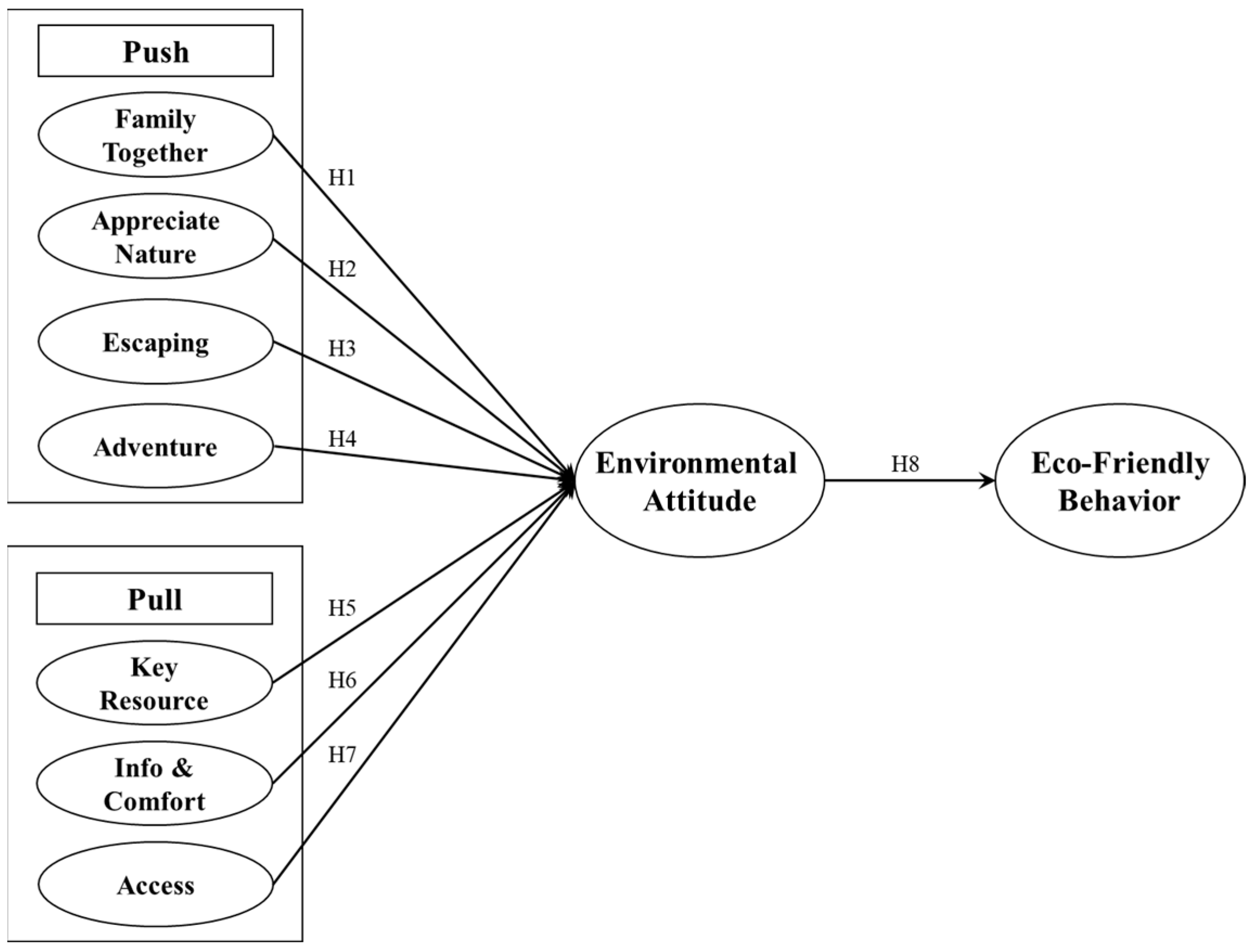
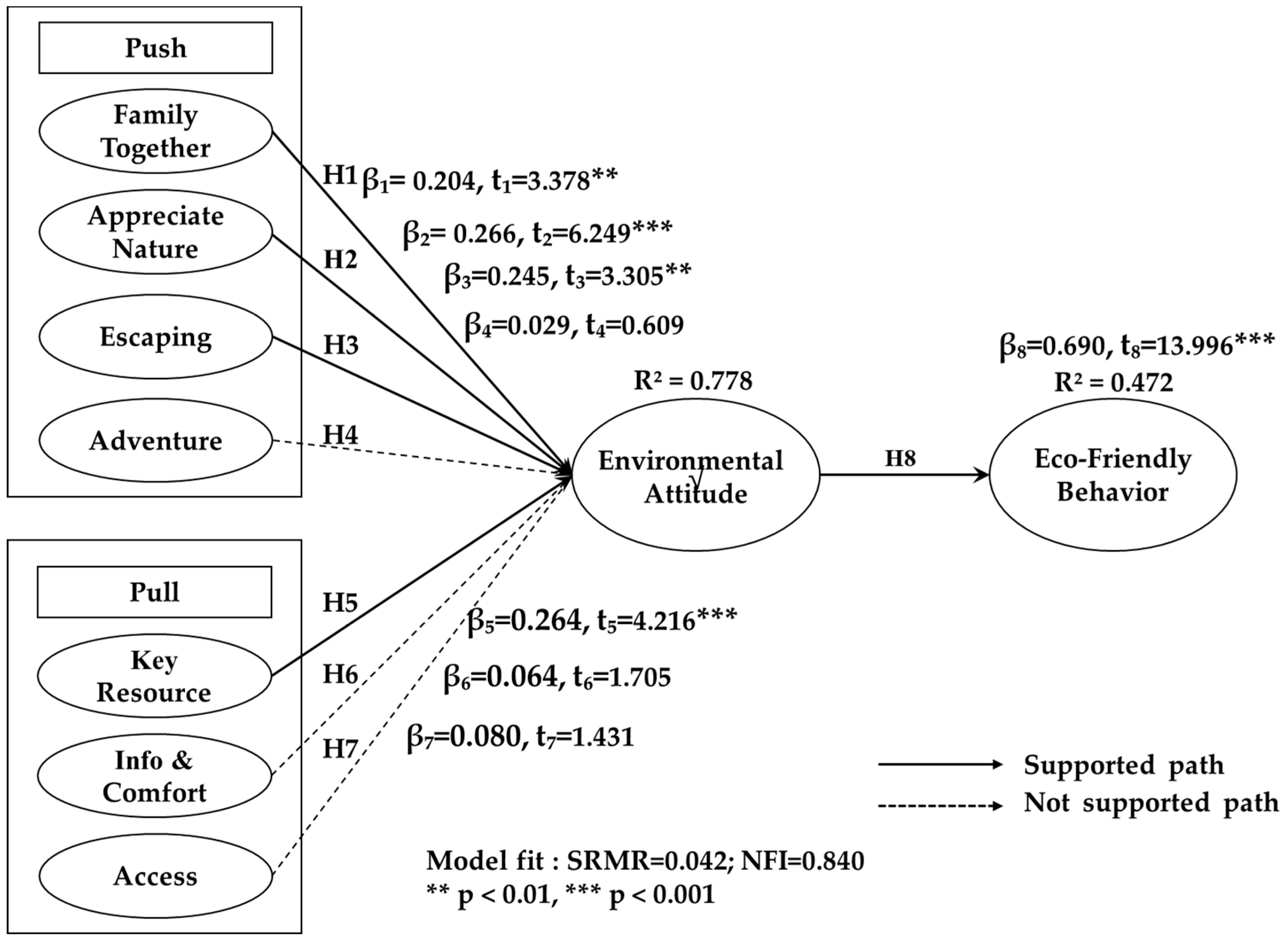
From Desire to Action: Unpacking Push–Pull Motivations to Reveal How Travel Sparks Eco-Intentions and Actions

Abstract
1. Introduction
2. Literature Review
2.1. Transition in Korean Travelers’ Preferences: From Urban-Centric Tourism to Eco-Friendly Destinations
2.2. Ecotourism Motivation on Environmental Attitude
2.3. The Role of Push and Pull Motivations in Shaping Environmental Attitudes
2.4. The Rationale for Environmental Attitude Leading to Eco-Friendly Behavior
3. Methods
3.1. Subjects and Procedures
3.2. Questionnaire Development and Measures
3.3. Data Analytics
4. Results
4.1. Reliability and Construct Validity
4.2. Structural Model
5. Discussion and Conclusions
5.1. Findings and Contributions
5.2. Practical Contributions
5.3. Limitations and Future Research Suggestions
Funding
Institutional Review Board Statement
Informed Consent Statement
Data Availability Statement
Conflicts of Interest
Appendix A

| Paths | Paths Coefficients | SD | t-Values | p-Values |
|---|---|---|---|---|
| Control variables | ||||
| Gender --> Environmental attitude | 0.156 | 0.065 | 2.383 | 0.017 |
| Age --> Environmental attitude | 0.042 | 0.031 | 1.351 | 0.177 |
| Educational level --> Environmental attitude | −0.019 | 0.034 | 0.56 | 0.576 |
| House income --> Environmental attitude | 0.006 | 0.032 | 0.174 | 0.862 |
| Gender --> Eco-friendly behavior | −0.162 | 0.088 | 1.838 | 0.066 |
| Age --> Eco-friendly behavior | 0.02 | 0.037 | 0.552 | 0.581 |
| Educational level --> Eco-friendly behavior | −0.011 | 0.044 | 0.242 | 0.809 |
| House income --> Eco-friendly behavior | 0.009 | 0.037 | 0.254 | 0.800 |
| Push factors | ||||
| Family together --> Environmental attitude | 0.215 | 0.06 | 3.555 | 0.000 |
| Appreciate nature --> Environmental attitude | 0.268 | 0.044 | 6.065 | 0.000 |
| Escaping --> Environmental attitude | 0.229 | 0.076 | 3.017 | 0.003 |
| Adventure --> Environmental attitude | 0.029 | 0.048 | 0.599 | 0.549 |
| Pull factors | ||||
| Key resource --> Environmental attitude | 0.272 | 0.064 | 4.225 | 0.000 |
| Info & comfort --> Environmental attitude | 0.066 | 0.038 | 1.747 | 0.081 |
| Access --> Environmental attitude | 0.084 | 0.056 | 1.504 | 0.133 |
| Relationships among endogenous variables | ||||
| Environmental attitude --> Eco-friendly behavior | 0.687 | 0.05 | 13.758 | 0.000 |
| Mediation Paths | ME | SD | t-Values | p-Values |
|---|---|---|---|---|
| FT --> EA --> EB | 0.141 | 0.042 | 3.371 | 0.001 |
| AN --> EA --> EB | 0.183 | 0.031 | 5.857 | 0.000 |
| ES --> EA --> EB | 0.169 | 0.056 | 3.025 | 0.002 |
| AD --> EA --> EB | 0.020 | 0.034 | 0.604 | 0.546 |
| KR --> EA --> EB | 0.182 | 0.044 | 4.186 | 0.000 |
| IC --> EA --> EB | 0.044 | 0.025 | 1.744 | 0.081 |
| AC --> EA --> EB | 0.056 | 0.039 | 1.420 | 0.156 |
References
- Ajzen, I. (1991). The theory of planned behavior. Organizational Behavior and Human Decision Processes, 50(2), 179–211. [Google Scholar] [CrossRef] [Scilit]
- Akroush, M. N., Jraisat, L. E., Kurdieh, D. J., AL-Faouri, R. N., & Qatu, L. T. (2016). Tourism service quality and destination loyalty—The mediating role of destination image from international tourists’ perspectives. Tourism Review, 71(1), 18–44. [Google Scholar] [CrossRef] [Scilit]
- Baker, M. A., Davis, E. A., & Weaver, P. A. (2014). Eco-friendly attitudes, barriers to participation, and differences in behavior at green hotels. Cornell Hospitality Quarterly, 55(1), 89–99. [Google Scholar] [CrossRef] [Scilit]
- Ballantyne, R., & Packer, J. (2011). Using tourism free-choice learning experiences to promote environmentally sustainable behaviour: The role of post-visit ‘action resources’. Environmental Education Research, 17(2), 201–215. [Google Scholar] [CrossRef] [Scilit]
- Baloglu, S., & Uysal, M. (1996). Market segments of push and pull motivations: A canonical correlation approach. International Journal of Contemporary Hospitality Management, 8(3), 32–38. [Google Scholar] [CrossRef] [Scilit]
- Barr, S., Shaw, G., Coles, T., & Prillwitz, J. (2010). ‘A holiday is a holiday’: Practicing sustainability, home and away. Journal of Transport Geography, 18(3), 474–481. [Google Scholar] [CrossRef] [Scilit]
- Becken, S. (2013). Operators’ perceptions of energy use and actual saving opportunities for tourism accommodation. Asia Pacific Journal of Tourism Research, 18(1–2), 72–91. [Google Scholar] [CrossRef] [Scilit]
- Bhattacharyya, M. (2017). The push-pull strategy: A new approach to the eco-friendly method of pest management in agriculture. Journal of Entomology and Zoology Studies, 5(3), 604–607. [Google Scholar]
- Bramwell, B., & Lane, B. (2011). Critical research on the governance of tourism and sustainability. Journal of Sustainable Tourism, 19(4–5), 411–421. [Google Scholar] [CrossRef] [Scilit]
- Buckley, R. (2011). Adventure tourism management. Routledge. [Google Scholar] [CrossRef] [Scilit]
- Caber, M., & Albayrak, T. (2016). Push or pull? Identifying rock climbing tourists’ motivations. Tourism Management, 55, 74–84. [Google Scholar] [CrossRef] [Scilit]
- Carvache-Franco, M., Segarra-Oña, M., & Carrascosa-López, C. (2019). Segmentation and motivations in eco-tourism: The case of a coastal national park. Ocean & Coastal Management, 178, 104812. [Google Scholar] [CrossRef] [Scilit]
- Chandel, A., & Mishra, S. (2016). Ecotourism revisited: Last twenty-five years. Czech Journal of Tourism, 5(2), 135–154. [Google Scholar] [CrossRef] [Scilit]
- Cheah, J.-H., Memon, M. A., Chuah, F., Ting, H., & Ramayah, T. (2018). Assessing reflective models in marketing research: A comparison between PLS and PLSc estimates. International Journal of Business and Society, 19(1), 139–160. [Google Scholar]
- Chen, F., & Liu, S. (2025). How Confucian values activate tourist environmentally responsible behavior?—An activated perspective of planned behavior. Asia Pacific Journal of Tourism Research, 30(5), 517–536. [Google Scholar] [CrossRef] [Scilit]
- Chen, N., & Funk, D. C. (2010). Exploring destination image, experience and revisit intention: A comparison of sport and non-sport tourist perceptions. Journal of Sport & Tourism, 15(3), 239–259. [Google Scholar] [CrossRef] [Scilit]
- Chiu, Y.-T. H., Lee, W.-I., & Chen, T.-H. (2014). Environmentally responsible behavior in ecotourism: Antecedents and implications. Tourism Management, 40, 321–329. [Google Scholar] [CrossRef] [Scilit]
- Choe, Y., Wang, J., & Song, H. (2021). The impact of the Middle East Respiratory Syndrome coronavirus on inbound tourism in South Korea toward sustainable tourism. In Sustainable consumer behaviour and the environment. Routledge. [Google Scholar]
- Crompton, J. L. (1979). Motivations for pleasure vacation. Annals of Tourism Research, 6(4), 408–424. [Google Scholar] [CrossRef] [Scilit]
- Dann, G. M. S. (1977). Anomie, ego-enhancement and tourism. Annals of Tourism Research, 4(4), 184–194. [Google Scholar] [CrossRef] [Scilit]
- Dann, G. M. S. (1981). Tourist motivation an appraisal. Annals of Tourism Research, 8(2), 187–219. [Google Scholar] [CrossRef] [Scilit]
- Deci, E. L., & Ryan, R. M. (2013). Intrinsic motivation and self-determination in human behavior. Springer Science & Business Media. [Google Scholar]
- Dolnicar, S., Crouch, G. I., & Long, P. (2008). Environment-friendly tourists: What do we really know about them? Journal of Sustainable Tourism, 16, 197–210. [Google Scholar] [CrossRef] [Scilit]
- Dolnicar, S., & Leisch, F. (2008). Selective marketing for environmentally sustainable tourism. Tourism Management, 29(4), 672–680. [Google Scholar] [CrossRef] [Scilit]
- Dunlap, R. E., Van Liere, K., Mertig, A., & Jones, R. E. (2005). Measuring endorsement of the new ecological paradigm: A revised NEP scale. In The Earthscan reader in environmental values. Earthscan. [Google Scholar]
- Filimonau, V., Matute, J., Mika, M., & Faracik, R. (2018). National culture as a driver of pro-environmental attitudes and behavioural intentions in tourism. Journal of Sustainable Tourism, 26(10), 1804–1825. [Google Scholar] [CrossRef] [Scilit]
- Fornell, C., & Larcker, D. F. (1981). Evaluating structural equation models with unobservable variables and measurement error. Journal of Marketing Research, 18(1), 39. [Google Scholar] [CrossRef] [Scilit]
- Gibreel, M. H., Indah, F., Nuryakin, & Musa, S. H. G. (2024). Investigating the impact of push and pull motivations and environmental concerns on sustainable destination loyalty. E3S Web of Conferences, 571, 02009. [Google Scholar] [CrossRef] [Scilit]
- Gnoth, J. (1997). Tourism motivation and expectation formation. Annals of Tourism Research, 24(2), 283–304. [Google Scholar] [CrossRef] [Scilit]
- GSTC. (2023). GSTC sustainable tourism training program (STTP). Available online: https://www.gstc.org/sustainable-tourism-training/?gad_source=1&gad_campaignid=22006177835&gbraid=0AAAAAobdns7iCMCQWME20fibBnqa8pD1y&gclid=Cj0KCQjwj8jDBhD1ARIsACRV2Tsto5PrpsaCTvZm68o8fv46JZN7Zu-U-BiPz4TaHSBP3hvCgpEoyjoaAgZREALw_wcB (accessed on 12 July 2025).
- Hair, J. F., Jr., Hult, G. T. M., Ringle, C. M., Sarstedt, M., Danks, N. P., & Ray, S. (2021). Partial least squares structural equation modeling (PLS-SEM) using R: A workbook. Springer Nature. [Google Scholar] [CrossRef] [Scilit]
- Han, H., Hsu, L.-T., & Lee, J.-S. (2009). Empirical investigation of the roles of attitudes toward green behaviors, overall image, gender, and age in hotel customers’ eco-friendly decision-making process. International Journal of Hospitality Management, 28(4), 519–528. [Google Scholar] [CrossRef] [Scilit]
- Han, H., & Yoon, H. J. (2015). Hotel customers’ environmentally responsible behavioral intention: Impact of key constructs on decision in green consumerism. International Journal of Hospitality Management, 45, 22–33. [Google Scholar] [CrossRef] [Scilit]
- Henseler, J., Dijkstra, T., Sarstedt, M., Ringle, C., Diamantopoulos, A., Straub, D., Jr, D., Hair, J., Hult, G. T. M., & Calantone, R. (2014). Common beliefs and reality about PLS: Comments on Rönkkö and Evermann (2013). Organizational Research Methods, 17, 182–209. [Google Scholar] [CrossRef] [Scilit]
- Higham, J. E. S., Cohen, S. A., & Cavaliere, C. T. (2014). Climate change, discretionary air travel, and the “Flyers’ Dilemma”. Journal of Travel Research, 53(4), 462–475. [Google Scholar] [CrossRef] [Scilit]
- Hinds, J., & Sparks, P. (2008). Engaging with the natural environment: The role of affective connection and identity. Journal of Environmental Psychology, 28(2), 109–120. [Google Scholar] [CrossRef] [Scilit]
- Hines, J. M., Hungerford, H. R., & Tomera, A. N. (1987). Analysis and synthesis of research on responsible environmental behavior: A meta-analysis. The Journal of Environmental Education, 18(2), 1–8. [Google Scholar] [CrossRef] [Scilit]
- Jang, S., & Cai, L. A. (2002). Travel motivations and destination choice: A study of British outbound market. Journal of Travel & Tourism Marketing, 13(3), 111–133. [Google Scholar] [CrossRef] [Scilit]
- Jones, T. E., & Nguyen, M.-H. (2021). Nature-based tourism motivations and visit profiles of domestic and international segments to a Japanese national park. Quaestiones Geographicae, 40(2), 77–92. [Google Scholar] [CrossRef] [Scilit]
- Juvan, E., & Dolnicar, S. (2014). The attitude–behaviour gap in sustainable tourism. Annals of Tourism Research, 48, 76–95. [Google Scholar] [CrossRef] [Scilit]
- Khanh, N. X. (2024). Sustainable tourism development in Vietnam: Current challenges, government initiatives and pathways for long-term sustainability. International Journal of Humanities, Social Sciences and Education, 11(11), 99–104. [Google Scholar] [CrossRef] [Scilit]
- Kim, H., Lee, S., Uysal, M., Kim, J., & Ahn, K. (2015). Nature-based tourism: Motivation and subjective well-being. Journal of Travel & Tourism Marketing, 32Suppl. 1, S76–S96. [Google Scholar] [CrossRef] [Scilit]
- Kim, S. S., Lee, C.-K., & Klenosky, D. B. (2003). The influence of push and pull factors at Korean national parks. Tourism Management, 24(2), 169–180. [Google Scholar] [CrossRef] [Scilit]
- Kim, Y., & Han, H. (2010). Intention to pay conventional-hotel prices at a green hotel—A modification of the theory of planned behavior. Journal of Sustainable Tourism, 18(8), 997–1014. [Google Scholar] [CrossRef] [Scilit]
- Kim, Y., & Zailani, S. (2024). Pull and push factors of Koreans’ sustainable consumption behaviours from plant-based meat products. Environmental Challenges, 15, 100886. [Google Scholar] [CrossRef] [Scilit]
- Klenosky, D. B. (2002). The “pull” of tourism destinations: A means-end investigation. Journal of Travel Research, 40(4), 396–403. [Google Scholar] [CrossRef] [Scilit]
- Kollmuss, A., & Agyeman, J. (2002). Mind the gap: Why do people act environmentally and what are the barriers to pro-environmental behavior? Environmental Education Research, 8(3), 239–260. [Google Scholar] [CrossRef] [Scilit]
- Korea Tourism Organization (KTO). (2023). Global inbound travel statistics [Data set]. Korea Tourism Data Lab. Available online: https://datalab.visitkorea.or.kr/datalab/portal/nat/getForTourForm.do (accessed on 12 June 2025).
- Kornilaki, M., & Font, X. (2019). Normative influences: How socio-cultural and industrial norms influence the adoption of sustainability practices. A grounded theory of Cretan, small tourism firms. Journal of Environmental Management, 230, 183–189. [Google Scholar] [CrossRef] [Scilit]
- Kvasova, O. (2015). The Big Five personality traits as antecedents of eco-friendly tourist behavior. Personality and Individual Differences, 83, 111–116. [Google Scholar] [CrossRef] [Scilit]
- Kwon, M.-y. (2023, August 28). Korea, ASEAN join hands to boost sustainable tourism. The Korea Times. Available online: https://www.koreatimes.co.kr/www/nation/2025/03/120_357909.html (accessed on 23 February 2024).
- Lai, I. K. W., & Hitchcock, M. (2017). Local reactions to mass tourism and community tourism development in Macau. Journal of Sustainable Tourism, 25(4), 451–470. [Google Scholar] [CrossRef] [Scilit]
- Larson, L. R., Whiting, J. W., & Green, G. T. (2011). Exploring the influence of outdoor recreation participation on pro-environmental behaviour in a demographically diverse population. Local Environment, 16(1), 67–86. [Google Scholar] [CrossRef] [Scilit]
- Lee, T.-H. (2009). A structural model for examining how destination image and interpretation services affect future visitation behavior: A case study of Taiwan’s Taomi eco-village. Journal of Sustainable Tourism, 17(6), 727–745. [Google Scholar] [CrossRef] [Scilit]
- Lee, T. H., & Jan, F.-H. (2018). Development and validation of the ecotourism behavior scale. International Journal of Tourism Research, 20(2), 191–203. [Google Scholar] [CrossRef] [Scilit]
- Lee, W. H., & Moscardo, G. (2005). Understanding the impact of ecotourism resort experiences on tourists’ environmental attitudes and behavioural intentions. Journal of Sustainable Tourism, 13(6), 546–565. [Google Scholar] [CrossRef] [Scilit]
- Li, T., Liu, F., & Soutar, G. N. (2021). Experiences and value perceptions of an ecotourism trip—An empirical study of outbound Chinese tourists. Tourism Recreation Research, 46(3), 333–344. [Google Scholar] [CrossRef] [Scilit]
- Manganari, E. E., Siomkos, G. J., & Vrechopoulos, A. P. (2014). Perceived consumer navigational control in travel websites. Journal of Hospitality & Tourism Research, 38(1), 3–22. [Google Scholar] [CrossRef] [Scilit]
- Mehmetoglu, M. (2007). Typologising nature-based tourists by activity—Theoretical and practical implications. Tourism Management, 28(3), 651–660. [Google Scholar] [CrossRef] [Scilit]
- Miller, G., Rathouse, K., Scarles, C., Holmes, K., & Tribe, J. (2010). Public understanding of sustainable tourism. Annals of Tourism Research, 37(3), 627–645. [Google Scholar] [CrossRef] [Scilit]
- Nicolau, J. L., & Más, F. J. (2006). The influence of distance and prices on the choice of tourist destinations: The moderating role of motivations. Tourism Management, 27(5), 982–996. [Google Scholar] [CrossRef] [Scilit]
- Pearce, P. L., & Lee, U.-I. (2005). Developing the travel career approach to tourist motivation. Journal of Travel Research, 43(3), 226–237. [Google Scholar] [CrossRef] [Scilit]
- Peeters, P., Gossling, S., & Becken, S. (2007). Innovation towards tourism sustainability: Climate change and aviation. International Journal of Innovation and Sustainable Development, 1, 184–200. [Google Scholar] [CrossRef] [Scilit]
- Podsakoff, P. M., MacKenzie, S. B., & Podsakoff, N. P. (2012). Sources of method bias in social science research and recommendations on how to control it. Annual Review of Psychology, 63(1), 539–569. [Google Scholar] [CrossRef] [Scilit]
- Powell, R. B., Kellert, S. R., & Ham, S. H. (2009). Interactional theory and the sustainable nature-based tourism experience. Society & Natural Resources, 22(8), 761–776. [Google Scholar] [CrossRef] [Scilit]
- Prayag, G., & Ryan, C. (2011). The relationship between the ‘push’ and ‘pull’ factors of a tourist destination: The role of nationality—An analytical qualitative research approach. Current Issues in Tourism, 14(2), 121–143. [Google Scholar] [CrossRef] [Scilit]
- Rafiq, F., Chishty, S. K., & Adil, M. (2022). Explanatory or dispositional optimism: Which trait predicts eco-friendly tourist behavior? Sustainability, 14(5), 2994. [Google Scholar] [CrossRef] [Scilit]
- Ramkissoon, H., Weiler, B., & Smith, L. D. G. (2012). Place attachment and pro-environmental behaviour in national parks: The development of a conceptual framework. Journal of Sustainable Tourism, 20(2), 257–276. [Google Scholar] [CrossRef] [Scilit]
- Ringle, C. M. (2015). Smart PLS 3. SmartPLS GmbH. [Google Scholar]
- Sarstedt, M., Ringle, C. M., & Hair, J. F. (2017). Treating Unobserved Heterogeneity in PLS-SEM: A Multi-method Approach. In H. Latan, & R. Noonan (Eds.), Partial least squares path modeling: Basic concepts, methodological issues and applications (pp. 197–217). Springer International Publishing. [Google Scholar] [CrossRef] [Scilit]
- Sparks, P., & Shepherd, R. (1992). Self-identity and the theory of planned behavior: Assesing the role of identification with “Green Consumerism”. Social Psychology Quarterly, 55(4), 388–399. [Google Scholar] [CrossRef] [Scilit]
- Statista. (2025). South Korea: Top destinations outbound travel 2024. Available online: https://www.statista.com/statistics/1142544/south-korea-top-destinations-outbound-tourism/ (accessed on 7 March 2025).
- Stern, P. C. (2000). New environmental theories: Toward a coherent theory of environmentally significant behavior. Journal of Social Issues, 56(3), 407–424. [Google Scholar] [CrossRef] [Scilit]
- Sushchenko, O., Prokopishyna, O., & Kozubova, N. (2018). Eco-friendly behavior of local population, tourists and companies as a factor of sustainable tourism development. International Journal of Engineering & Technology, 7(4.3), 514–518. [Google Scholar] [CrossRef] [Scilit]
- Tarinc, A., Ergun, G. S., Aytekin, A., Keles, A., Ozbek, O., Keles, H., & Yayla, O. (2023). Effect of climate change belief and the New Environmental Paradigm (NEP) on eco-tourism attitudes of tourists: Moderator role of green self-identity. International Journal of Environmental Research and Public Health, 20(6), 4967. [Google Scholar] [CrossRef] [Scilit] [PubMed]
- Tieskens, K. F., Schulp, C. J. E., Levers, C., Lieskovský, J., Kuemmerle, T., Plieninger, T., & Verburg, P. H. (2017). Characterizing European cultural landscapes: Accounting for structure, management intensity and value of agricultural and forest landscapes. Land Use Policy, 62, 29–39. [Google Scholar] [CrossRef] [Scilit]
- Uysal, M., & Jurowski, C. (1994). Testing the push and pull factors. Annals of Tourism Research, 21(4), 844–846. [Google Scholar] [CrossRef] [Scilit]
- Vermeir, I., & Verbeke, W. (2006). Sustainable food consumption: Exploring the consumer “Attitude—Behavioral Intention” gap. Journal of Agricultural and Environmental Ethics, 19(2), 169–194. [Google Scholar] [CrossRef] [Scilit]
- VnExpress International. (n.d.). Vietnam’s increasing appeal to Korean tourists—VnExpress international. Available online: https://e.vnexpress.net/news/travel/vietnam-s-increasing-appeal-to-korean-tourists-4621905.html (accessed on 7 March 2025).
- Wang, L., & Li, X. (2023). The five influencing factors of tourist loyalty: A meta-analysis. PLoS ONE, 18(4), e0283963. [Google Scholar] [CrossRef] [Scilit]
- Whyte, L. J. (2017). Understanding the relationship between push and pull motivational factors in cruise tourism: A canonical correlation analysis. International Journal of Tourism Research, 19(5), 557–568. [Google Scholar] [CrossRef] [Scilit]
- World Tourism Organization (UNWTO) & United Nations Development Programme (UNDP). (2017). Tourism and the sustainable development goals—Journey to 2030. World Tourism Organization (UNWTO). [Google Scholar] [CrossRef] [Scilit]
- Yang, W., & Bi, C. (2024). Marketing the community-based eco-tourism for Thai and Chinese under the new media era for local authorities. Journal of Ecohumanism, 3(7), 4481–4496. [Google Scholar] [CrossRef] [Scilit]
- Yang, Y., Yuan, Y., Liu, P., Wu, W., & Huo, C. (2024). Crucial to Me and my society: How collectivist culture influences individual pro-environmental behavior through environmental values. Journal of Cleaner Production, 454, 142211. [Google Scholar] [CrossRef] [Scilit]
- Yoon, K. (2021). Discourse of the post-COVID 19 new deal in South Korea. East Asia, 38(4), 373–388. [Google Scholar] [CrossRef] [Scilit] [PubMed]
- Yoon, Y., & Uysal, M. (2005). An examination of the effects of motivation and satisfaction on destination loyalty: A structural model. Tourism Management, 26(1), 45–56. [Google Scholar] [CrossRef] [Scilit]
- Zhang, H., Wu, Y., & Buhalis, D. (2018). A model of perceived image, memorable tourism experiences and revisit intention. Journal of Destination Marketing & Management, 8, 326–336. [Google Scholar] [CrossRef] [Scilit]
- Zhao, Y., Yang, J., Song, J., & Lu, Y. (2025). The effects of tourism motivation and perceived value on tourists’ behavioral intention toward forest health tourism: The moderating role of attitude. Sustainability, 17(2), 713. [Google Scholar] [CrossRef] [Scilit]


| Constructs | Indicators | Loadings | t-Values | Alpha | Rho_A | CR | AVE |
|---|---|---|---|---|---|---|---|
| Family Together | 0.918 | 0.920 | 0.918 | 0.691 | |||
| To have time for natural study | 0.865 | 27.749 *** | |||||
| To have enjoyable time with family | 0.791 | 22.489 *** | |||||
| To observe rare wildlife | 0.850 | 28.861 *** | |||||
| To appreciate historic resources | 0.885 | 27.602 *** | |||||
| To experience cultural resources | 0.759 | 20.847 *** | |||||
| Appreciating Nature | 0.847 | 0.853 | 0.847 | 0.649 | |||
| To enjoy natural resources | 0.720 | 16.239 *** | |||||
| To enhance health | 0.824 | 23.492 *** | |||||
| To appreciate beautiful natural resources | 0.866 | 21.601 *** | |||||
| Escaping | 0.866 | 0.872 | 0.867 | 0.687 | |||
| To take a rest | 0.894 | 38.478 *** | |||||
| To get away from everyday life | 0.757 | 21.100 *** | |||||
| To avoid hot weather | 0.830 | 29.020 *** | |||||
| Adventure | 0.849 | 0.886 | 0.862 | 0.760 | |||
| To enjoy adventure | 0.971 | 23.518 *** | |||||
| To build friendship | 0.759 | 18.680 *** | |||||
| Key Resources | 0.885 | 0.886 | 0.885 | 0.606 | |||
| Rare fauna and flora (or aquatic plants/animals) | 0.806 | 25.114 *** | |||||
| Beautiful natural resources | 0.732 | 19.574 *** | |||||
| Tranquil rest areas | 0.746 | 18.159 *** | |||||
| Cultural and historic resources | 0.814 | 22.054 *** | |||||
| Well-conserved environment | 0.791 | 22.912 *** | |||||
| Info & Comfort | 0.908 | 0.915 | 0.908 | 0.713 | |||
| Well-organized tourist information system | 0.825 | 11.739 *** | |||||
| Convenient facilities (e.g., restroom, drinking stand) | 0.727 | 8.216 *** | |||||
| Convenient parking lots | 0.936 | 13.920 *** | |||||
| Clean and comfortable accommodations | 0.875 | 10.748 *** | |||||
| Access | 0.777 | 0.779 | 0.777 | 0.636 | |||
| Easy accessibility | 0.820 | 24.489 *** | |||||
| Convenient transportation | 0.774 | 21.107 *** | |||||
| Environmental Attitude | 0.913 | 0.915 | 0.914 | 0.602 | |||
| We are approaching the limit of the number of people the earth can support. | 0.781 | 31.004 *** | |||||
| The earth is like a spaceship with very limited room and resources. | 0.802 | 32.256 *** | |||||
| When humans interfere with nature it often produces disastrous consequences. | 0.762 | 23.874 *** | |||||
| The balance of nature is very delicate and easily upset. | 0.762 | 22.610 *** | |||||
| Humans are severely abusing the environment. | 0.760 | 29.118 *** | |||||
| The so-called “ecological crisis” facing humankind has been greatly exaggerated. | 0.723 | 21.390 *** | |||||
| If things continue on their present course, we will soon experience a major ecological catastrophe. | 0.836 | 40.170 *** | |||||
| Eco-Friendly Behavior | 0.931 | 0.933 | 0.931 | 0.692 | |||
| When I visit foreign countries as a tourist, I avoid buying goods with unnecessary packaging material. | 0.814 | 25.848 *** | |||||
| During my visit to foreign countries as a tourist, I buy environmentally friendly products whenever possible. | 0.836 | 29.030 *** | |||||
| I reduce and recycle waste, whenever possible, during my visits to foreign countries as a tourist. | 0.888 | 31.874 *** | |||||
| As a tourist, I always like to visit environmentally friendly countries. | 0.874 | 30.923 *** | |||||
| When I visit foreign countries as a tourist, I try to minimize my consumption of water and energy. | 0.825 | 33.042 *** | |||||
| When I visit foreign countries as a tourist, I choose means of transportation with the least ecological footprint. | 0.836 | 19.778 *** |
| A | B | C | D | E | F | G | H | I | |
|---|---|---|---|---|---|---|---|---|---|
| A.FT | 0.832 | 0.500 | 0.556 | 0.625 | 0.726 | 0.304 | 0.499 | 0.741 | 0.554 |
| B.AN | 0.502 | 0.806 | 0.389 | 0.400 | 0.519 | 0.102 | 0.396 | 0.648 | 0.606 |
| C.ES | 0.554 | 0.388 | 0.829 | 0.461 | 0.582 | 0.325 | 0.431 | 0.683 | 0.504 |
| D.AD | 0.620 | 0.399 | 0.453 | 0.872 | 0.535 | 0.300 | 0.477 | 0.575 | 0.411 |
| E.KR | 0.727 | 0.519 | 0.579 | 0.532 | 0.779 | 0.337 | 0.475 | 0.767 | 0.549 |
| F.IC | 0.306 | 0.105 | 0.326 | 0.295 | 0.339 | 0.844 | 0.245 | 0.351 | 0.085 |
| G.AC | 0.501 | 0.397 | 0.432 | 0.473 | 0.475 | 0.245 | 0.798 | 0.548 | 0.463 |
| H.EA | 0.743 | 0.648 | 0.684 | 0.570 | 0.768 | 0.354 | 0.549 | 0.776 | 0.685 |
| I.EB | 0.556 | 0.605 | 0.507 | 0.408 | 0.552 | 0.088 | 0.466 | 0.687 | 0.832 |
Disclaimer/Publisher’s Note: The statements, opinions and data contained in all publications are solely those of the individual author(s) and contributor(s) and not of MDPI and/or the editor(s). MDPI and/or the editor(s) disclaim responsibility for any injury to people or property resulting from any ideas, methods, instructions or products referred to in the content. |
© 2025 by the author. Licensee MDPI, Basel, Switzerland. This article is an open access article distributed under the terms and conditions of the Creative Commons Attribution (CC BY) license (https://creativecommons.org/licenses/by/4.0/).
Share and Cite
Choi, J. From Desire to Action: Unpacking Push–Pull Motivations to Reveal How Travel Sparks Eco-Intentions and Actions. Behav. Sci. 2025, 15, 1651. https://doi.org/10.3390/bs15121651
Choi J. From Desire to Action: Unpacking Push–Pull Motivations to Reveal How Travel Sparks Eco-Intentions and Actions. Behavioral Sciences. 2025; 15(12):1651. https://doi.org/10.3390/bs15121651
Chicago/Turabian StyleChoi, Juchoel. 2025. "From Desire to Action: Unpacking Push–Pull Motivations to Reveal How Travel Sparks Eco-Intentions and Actions" Behavioral Sciences 15, no. 12: 1651. https://doi.org/10.3390/bs15121651
APA StyleChoi, J. (2025). From Desire to Action: Unpacking Push–Pull Motivations to Reveal How Travel Sparks Eco-Intentions and Actions. Behavioral Sciences, 15(12), 1651. https://doi.org/10.3390/bs15121651