
Is a Single Lipoprotein(a) Measurement Once in a Lifetime Sufficient? The Results from the STAR-Lp(a) Study †



Abstract
1. Introduction
2. Materials and Methods
Statistical Analysis
3. Results
4. Discussion
5. Conclusions
6. Limitations
Author Contributions
Funding
Institutional Review Board Statement
Informed Consent Statement
Data Availability Statement
Conflicts of Interest
References
- Kostner, K.M.; Kostner, G.M. Lipoprotein (a): A historical appraisal. J. Lipid Res. 2017, 58, 1–14. [Google Scholar] [CrossRef] [PubMed]
- Tsioulos, G.; Kounatidis, D.; Vallianou, N.G.; Poulaki, A.; Kotsi, E.; Christodoulatos, G.S.; Tsilingiris, D.; Karampela, I.; Skourtis, A.; Dalamaga, M. Lipoprotein(a) and Atherosclerotic Cardiovascular Disease: Where Do We Stand? Int. J. Mol. Sci. 2024, 25, 3537. [Google Scholar] [CrossRef]
- Kim, J.A.; Kim, N.H. Lipoprotein(a) and Cardiovascular Risk in Asian Populations: A Comprehensive Review. J. Lipid Atheroscler. 2025, 14, 174–187. [Google Scholar] [CrossRef]
- Doherty, S.; Hernandez, S.; Rikhi, R.; Mirzai, S.; De Los Reyes, C.; McIntosh, S.; Block, R.C.; Shapiro, M.D. Lipoprotein(a) as a Causal Risk Factor for Cardiovascular Disease. Curr. Cardiovasc. Risk Rep. 2025, 19, 8. [Google Scholar] [CrossRef] [PubMed]
- Kronenberg, F.; Mora, S.; Stroes, E.S.G.; Ference, B.A.; Arsenault, B.J.; Berglund, L.; Dweck, M.R.; Koschinsky, M.; Lambert, G.; Mach, F.; et al. Lipoprotein(a) in Atherosclerotic Cardiovascular Disease and Aortic Stenosis: A European Atherosclerosis Society Consensus Statement. Eur. Heart J. 2022, 43, 3925–3946. [Google Scholar] [CrossRef]
- Mach, F.; Baigent, C.; Catapano, A.L.; Koskinas, K.C.; Casula, M.; Badimon, L.; Chapman, M.J.; De Backer, G.G.; Delgado, V.; Ference, B.A.; et al. 2019 ESC/EAS Guidelines for the management of dyslipidaemias: Lipid modification to reduce cardiovascular risk. Eur. Heart J. 2020, 41, 111–188, Erratum in Eur. Heart J. 2020, 41, 4255. https://doi.org/10.1093/eurheartj/ehz826. [Google Scholar] [CrossRef] [PubMed]
- Mach, F.; Koskinas, K.C.; van Lennep, J.E.R.; Tokgözoğlu, L.; Badimon, L.; Baigent, C.; Benn, M.; Binder, C.J.; Catapano, A.L.; De Backer, G.G.; et al. 2025 Focused Update of the 2019 ESC/EAS Guidelines for the management of dyslipidaemias. ESC/EAS Scientific Document Group. Atherosclerosis 2025, 409, 120479. [Google Scholar] [CrossRef]
- Cegla, J.; France, M.; Marcovina, S.M.; Neely, R.D.G. Lp(a): When and How to Measure It. Ann. Clin. Biochem. 2021, 58, 16–21. [Google Scholar] [CrossRef]
- Banach, M.; Burchardt, P.; Chlebus, K.; Dobrowolski, P.; Dudek, D.; Dyrbuś, K.; Gąsior, M.; Jankowski, P.; Jóźwiak, J.; Kłosiewicz-Latoszek, L.; et al. PoLA/CFPiP/PCS/PSLD/PSD/PSH guidelines on diagnosis and therapy of lipid disorders in Poland 2021. Arch. Med. Sci. 2021, 17, 1447–1547. [Google Scholar] [CrossRef]
- Berg, K. A New Serum Type System in Man-the Lp System. Acta Pathol. Microbiol. Scand. 1963, 59, 369–382. [Google Scholar] [CrossRef]
- Surma, S.; Sahebkar, A.; Banach, M. endorsed by the International Lipid Expert Panel (ILEP). Low carbohydrate/ketogenic diet in the optimization of lipoprotein(a) levels: Do we have sufficient evidence for any recommendation? Eur. Heart J. 2023, 44, 4904–4906. [Google Scholar] [CrossRef] [PubMed]
- Rubio-Serrano, J.; Gullón Ojesto, A.; Suárez Fernández, C. Clinical characteristics associated with elevated levels of lipoprotein(a) in patients with vascular risk. Adv. Lab. Med. 2023, 4, 396–401. [Google Scholar] [CrossRef]
- Cicero, A.F.G.; Fogacci, F.; Giovannini, M.; Grandi, E.; D’addato, S.; Borghi, C. Estimating the Prevalence and Characteristics of Patients Potentially Eligible for Lipoprotein(a)-Lowering Therapies in a Real-World Setting. Biomedicines 2023, 11, 3289. [Google Scholar] [CrossRef]
- Meireles-Brandão, J.A.; Meireles-Brandão, L.R.; Coelho, R.; Rocha-Gonçalves, F.R. Lipoprotein(a) in the Evaluation of Cardiovascular Risk in the Portuguese Population. Acta Med. Port. 2019, 32, 202–207. [Google Scholar] [CrossRef]
- Burzyńska, M.; Jankowski, P.; Babicki, M.; Banach, M.; Chudzik, M. Prevalence of hyperlipoproteinemia(a) in individuals of European ancestry treated at outpatient cardiology clinics: Results from a cross-sectional STAR-Lp(a) study. Pol. Arch. Intern. Med. 2024, 134, 16860. [Google Scholar] [CrossRef]
- Joo, H.J.; Yun, S.G.; Park, J.H.; Hong, S.J.; Yu, C.W.; Shin, S.Y.; Kim, E.J. Predictors of lipoprotein(a) variability in clinical practice and their impact on cardiovascular risk. Lipids Health Dis. 2025, 24, 250. [Google Scholar] [CrossRef] [PubMed]
- Matera, M.G.; Rinaldi, B.; Annibale, R.; De Novellis, V.; Cazzola, M. The pharmacological management of asthma in adults: 2023 update. Expert. Opin. Pharmacother. 2024, 25, 383–393. [Google Scholar] [CrossRef]
- Sosnowska, B.; Stepinska, J.; Mitkowski, P.; Bielecka-Dabrowa, A.; Bobrowska, B.; Budzianowski, J.; Burchardt, P.; Chlebus, K.; Dobrowolski, P.; Gasior, M.; et al. Recommendations of the Experts of the Polish Cardiac Society (PCS) and the Polish Lipid Association (PoLA) on the diagnosis and management of elevated lipoprotein(a) levels. Arch. Med. Sci. 2024, 20, 8–27. [Google Scholar] [CrossRef] [PubMed]
- Vrints, C.; Andreotti, F.; Koskinas, K.C.; Rossello, X.; Adamo, M.; Ainslie, J.; Banning, A.P.; Budaj, A.; Buechel, R.R.; Chiariello, G.A.; et al. 2024 ESC Guidelines for the management of chronic coronary syndromes. Eur. Heart J. 2024, 45, 3415–3537. [Google Scholar] [CrossRef]
- McEvoy, J.W.; McCarthy, C.P.; Bruno, R.M.; Brouwers, S.; Canavan, M.D.; Ceconi, C.; Christodorescu, R.M.; Daskalopoulou, S.S.; Ferro, C.J.; Gerdts, E.; et al. 2024 ESC Guidelines for the management of elevated blood pressure and hypertension. Eur. Heart J. 2024, 45, 3912–4018. [Google Scholar] [CrossRef]
- Harb, T.; Ziogos, E.; Blumenthal, R.S.; Gerstenblith, G.; Leucker, T.M. Intra-individual variability in lipoprotein(a): The value of a repeat measure for reclassifying individuals at intermediate risk. Eur. Heart J. Open 2024, 4, oeae064. [Google Scholar] [CrossRef] [PubMed]
- Deshotels, M.R.; Sun, C.; Nambi, V.; Virani, S.S.; Matsushita, K.; Yu, B.; Ballantyne, C.M.; Hoogeveen, R.C. Temporal Trends in Lipoprotein(a) Concentrations: The Atherosclerosis Risk in Communities Study. J. Am. Heart Assoc. 2022, 11, e026762. [Google Scholar] [CrossRef]
- Marcovina, S.M.; Viney, N.J.; Hughes, S.G.; Xia, S.; Witztum, J.L.; Tsimikas, S. Temporal variability in lipoprotein(a) levels in patients enrolled in the placebo arms of IONIS-APO(a)Rx and IONIS-APO(a)-LRx antisense oligonucleotide clinical trials. J. Clin. Lipidol. 2018, 12, 122–129.e2. [Google Scholar] [CrossRef]
- Awad, K.; Mahmoud, A.K.; Abbas, M.T.; Alsidawi, S.; Ayoub, C.; Arsanjani, R.; Farina, J.M. Intra-individual variability in lipoprotein(a) levels: Findings from a large academic health system population. Eur. J. Prev. Cardiol. 2025, 32, 716–721. [Google Scholar] [CrossRef] [PubMed]
- Nazir, D.J.; McQueen, M.J. Monthly intra-individual variation in lipoprotein(a) in 22 normal subjects over 12 months. Clin. Biochem. 1997, 30, 163–170. [Google Scholar] [CrossRef]
- Satała, J.; Witkowska, A.; Pawlos, A.; Woźniak, A.; Broncel, M.; Woźniak, E.; Gorzelak-Pabiś, P. Changes in lipoprotein(a) concentrations in patients with acute coronary syndrome. Pol. Arch. Intern. Med. 2025, 135, 16959. [Google Scholar] [CrossRef]
- Garnotel, R.; Monier, F.; Lefèvre, F.; Gillery, P. Long-term variability of serum lipoprotein(a) concentrations in healthy fertile women. Clin. Chem. Lab. Med. 1998, 36, 317–321. [Google Scholar] [CrossRef] [PubMed]
- Matta, M.G.; Schreier, L.; Lavalle-Cobo, A.; Garcia-Zamora, S.; Ferraresi, A.; Madsen, A.; Bellini, S.; Ramos, G.; Roubicek, P.; Corral, P. Temporal variability of Lp(a) in clinically stable patients: Implications for cardiovascular risk assessment. Med. Clin. 2024, 163, 436–441. [Google Scholar] [CrossRef]
- Kronenberg, F. Human Genetics and the Causal Role of Lipoprotein(a) for Various Diseases. Cardiovasc. Drugs Ther. 2016, 30, 87–100. [Google Scholar] [CrossRef]
- Aljawini, N.; Aldakhil, L.O.; Habib, S.S. High-Risk Lipoprotein(a) Levels in Saudi Women and Its Relationship to Menopause and Adiposity. Nutrients 2023, 15, 693. [Google Scholar] [CrossRef] [PubMed]
- Tsimikas, S. A Test in Context: Lipoprotein(a): Diagnosis, Prognosis, Controversies, and Emerging Therapies. J. Am. Coll. Cardiol. 2017, 69, 692–711. [Google Scholar] [CrossRef] [PubMed]
- Schwedt, T. Endothelial Dysfunction in Migraine. Cephalalgia 2009, 29, 997–1002. [Google Scholar] [CrossRef] [PubMed]
- Neri, M.; Frustaci, A.; Milic, M.; Valdiglesias, V.; Fini, M.; Bonassi, S.; Barbanti, P. A meta-analysis of biomarkers related to oxidative stress and nitric oxide pathway in migraine. Cephalalgia 2015, 35, 931–937. [Google Scholar] [CrossRef] [PubMed]
- Viney, N.J.; van Capelleveen, J.C.; Geary, R.S.; Xia, S.; Tami, J.A.; Yu, R.Z.; Marcovina, S.M.; Hughes, S.G.; Graham, M.J.; Crooke, R.M.; et al. Antisense oligonucleotides targeting apolipoprotein(a) in people with raised lipoprotein(a): Two randomised, double-blind, placebo-controlled, dose-ranging trials. Lancet 2016, 388, 2239–2253. [Google Scholar] [CrossRef]
- Tsimikas, S.; Karwatowska-Prokopczuk, E.; Gouni-Berthold, I.; Tardif, J.C.; Baum, S.J.; Steinhagen-Thiessen, E.; Shapiro, M.D.; Stroes, E.S.; Moriarty, P.M.; Nordestgaard, B.G.; et al. Lipoprotein(a) Reduction in Persons with Cardiovascular Disease. N. Engl. J. Med. 2020, 382, 244–255. [Google Scholar] [CrossRef]





| Variable | Lp(a) Change < 20% n = 703 | Lp(a) Change ≥ 20% n = 560 | p | Total N = 1263 | |
|---|---|---|---|---|---|
| N (%) | N (%) | ||||
| Sex | Men | 218 (31.0) | 176 (31.5) | 0.857 | 394 (31.2) |
| Women | 486 (69.0) | 384 (68.5) | 869 (68.8) | ||
| Age | <40 | 17 (2.4) | 18 (3.2) | 0.376 | 35 (2.8) |
| 40–64 | 210 (29.9) | 182 (32.5) | 392 (31.0) | ||
| 65 and over | 476 (67.7) | 360 (64.3) | 836 (66.2) | ||
| Hypertension | 461 (65.6) | 360 (64.3) | 0.633 | 821 (65.0) | |
| Hyperlipidemia | 147 (20.9) | 114 (20.4) | 0.809 | 261 (20.7) | |
| Diabetes | 134 (19.1) | 116 (20.7) | 0.464 | 250 (19.8) | |
| Coronary artery disease | 65 (9.3) | 65 (11.6) | 0.170 | 130 (10.3) | |
| Cerebrovascular disease | 40 (5.7) | 54 (9.6) | 0.008 | 94 (7.4) | |
| Asthma | 54 (7.7) | 49 (8.8) | 0.718 | 103 (8.2) | |
| Rheumatoid arthritis | 42 (6.0) | 30 (5.4) | 0.826 | 72 (5.7) | |
| Migraine | 44 (6.3) | 53 (9.5) | 0.092 | 97 (7.7) | |
| Thrombophlebitis | 15 (2.1) | 13 (2.3) | 0.822 | 28 (2.2) | |
| Myocardial infarction | 24 (3.4) | 16 (2.8) | 0.575 | 40 (3.2) | |
| Smoking | 65 (9.2) | 63 (11.3) | 0.157 | 128 (10.1) | |
| Variable | Me (Q1–Q3) | p | Me (Q1–Q3) | ||
| Body mass index, kg/m2 | 27.5 (24.5–30.9) | 27.5 (24.8–31.1) | 0.707 | 27.5 (24.8–30.9) | |
| Total cholesterol, mg/dL | 178.5 (151.0–210.0) | 180.0 (148.0–210.0) | 0.452 | 179.0 (149.0–210.0) | |
| LDL cholesterol, mg/dL | 100.0 (75.00–131.00) | 99.5 (70.0–128.0) | 0.253 | 100.0 (73.0–130.0) | |
| HDL cholesterol, mg/dL | 54.0 (45.0–64.0) | 53.0 (45.0–63.0) | 0.168 | 54.0 (45.0–64.0) | |
| Triglycerides, mg/dL | 106.0 (81.0–140.0) | 107.0 (82.0–151.0) | 0.094 | 107.0 (81.0–144.0) | |
| Hemoglobin A1c, % | 5.6 (5.3–5.9) | 5.6 (5.3–5.9) | 0.625 | 5.6 (5.3–5.9) | |
| C-reactive protein | 2.0 (1.0–3.0) | 1.6 (1.0–3.0) | 0.870 | 2.0 (1.0–3.0) | |
| Homocysteine, µmol/L | 12.0 (10.1–14.6) | 12.1 (9.6–14.4) | 0.355 | 12.0 (9.9–14.6) | |
| Parameter | Mean | Standard Deviation | Median | Quartile 1 | Quartile 3 |
|---|---|---|---|---|---|
| Lp(a) 1st measurement (mg/dL) | 21.7 | 30.7 | 9.0 | 4.0 | 23.0 |
| Lp(a) 2nd measurement (mg/dL) | 21.9 | 30.6 | 8.8 | 4.9 | 24.0 |
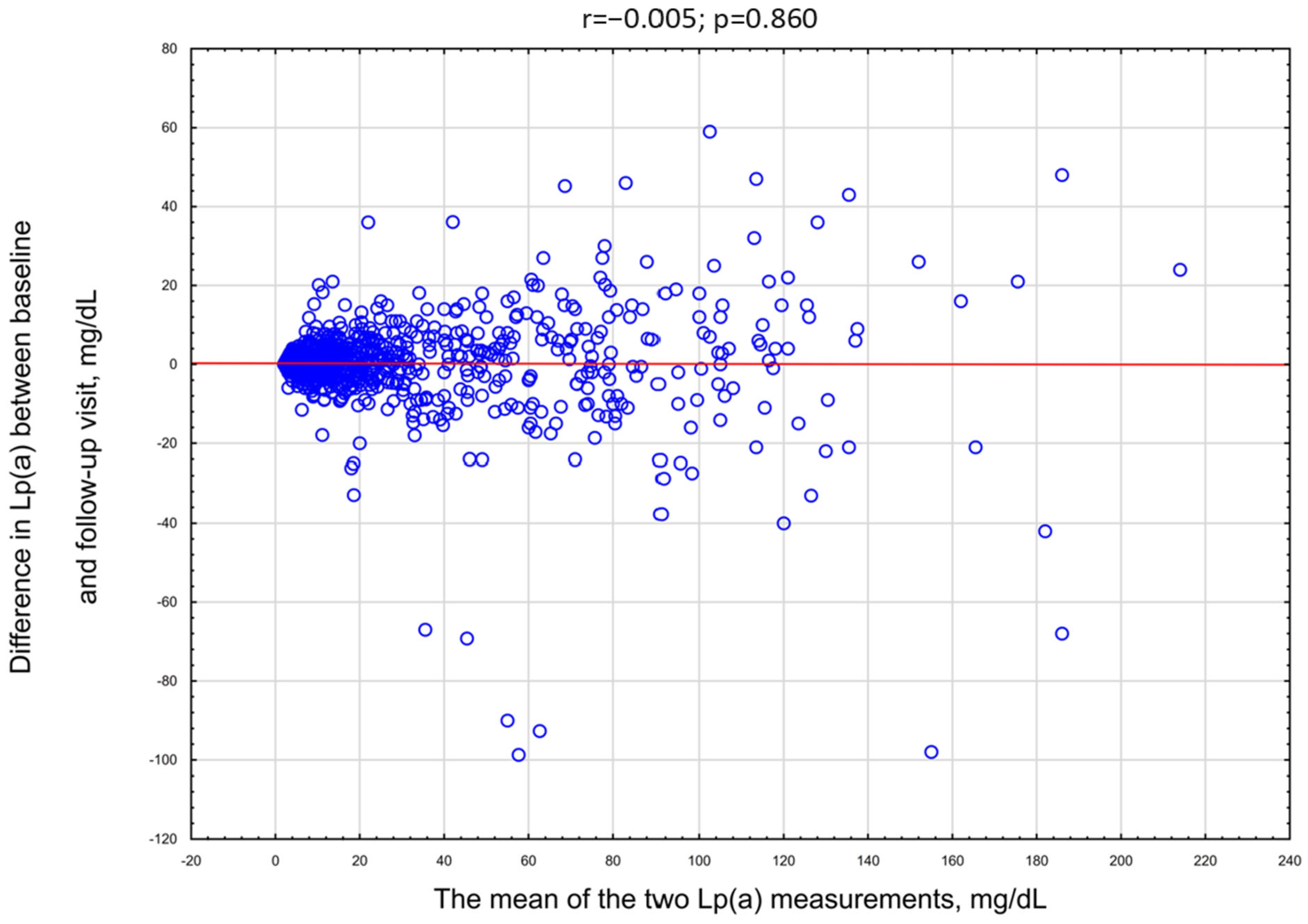
| The change between 1st and 2nd measurements (mg/dL) | 4.5 | 8.8 | 1.8 | 0.6 | 4.7 |
| The change between 1st and 2nd measurements (%) | 36.2 | 288.0 | 16.7 | 6.5 | 33.3 |
Disclaimer/Publisher’s Note: The statements, opinions and data contained in all publications are solely those of the individual author(s) and contributor(s) and not of MDPI and/or the editor(s). MDPI and/or the editor(s) disclaim responsibility for any injury to people or property resulting from any ideas, methods, instructions or products referred to in the content. |
© 2025 by the authors. Licensee MDPI, Basel, Switzerland. This article is an open access article distributed under the terms and conditions of the Creative Commons Attribution (CC BY) license (https://creativecommons.org/licenses/by/4.0/).
Share and Cite
Burzyńska, M.; Jankowski, P.; Banach, M.; Chudzik, M. Is a Single Lipoprotein(a) Measurement Once in a Lifetime Sufficient? The Results from the STAR-Lp(a) Study. Med. Sci. 2025, 13, 320. https://doi.org/10.3390/medsci13040320
Burzyńska M, Jankowski P, Banach M, Chudzik M. Is a Single Lipoprotein(a) Measurement Once in a Lifetime Sufficient? The Results from the STAR-Lp(a) Study. Medical Sciences. 2025; 13(4):320. https://doi.org/10.3390/medsci13040320
Chicago/Turabian StyleBurzyńska, Monika, Piotr Jankowski, Maciej Banach, and Michał Chudzik. 2025. "Is a Single Lipoprotein(a) Measurement Once in a Lifetime Sufficient? The Results from the STAR-Lp(a) Study" Medical Sciences 13, no. 4: 320. https://doi.org/10.3390/medsci13040320
APA StyleBurzyńska, M., Jankowski, P., Banach, M., & Chudzik, M. (2025). Is a Single Lipoprotein(a) Measurement Once in a Lifetime Sufficient? The Results from the STAR-Lp(a) Study. Medical Sciences, 13(4), 320. https://doi.org/10.3390/medsci13040320