


Predictors of Early Death in Acute Promyelocytic Leukemia

Abstract
1. Introduction
2. Initial Treatment of APL
- (1)
- Start ATRA therapy immediately, even before genetic confirmation of the diagnosis;
- (2)
- Administer supportive care with specific blood products;
- (3)
- Confirm genetic diagnosis of APL [1].
3. Early Death in APL
3.1. Evolution of ED Rates over Time
3.2. Incidence of ED in APL
3.3. Causes of ED in APL
3.3.1. Hemorrhage
3.3.2. Infection
3.3.3. Differentiation Syndrome
3.3.4. Thrombosis
4. Predictors of ED in APL
4.1. Age
4.2. WBC
4.3. Platelets and Coagulation Parameters
4.4. Disseminated Intravascular Coagulation Score
4.5. Mortality Cause-Specific Predictors
4.6. Resource-Limited Settings
4.7. Predictors of Death Before APL Treatment
5. Measures to Prevent ED
- -
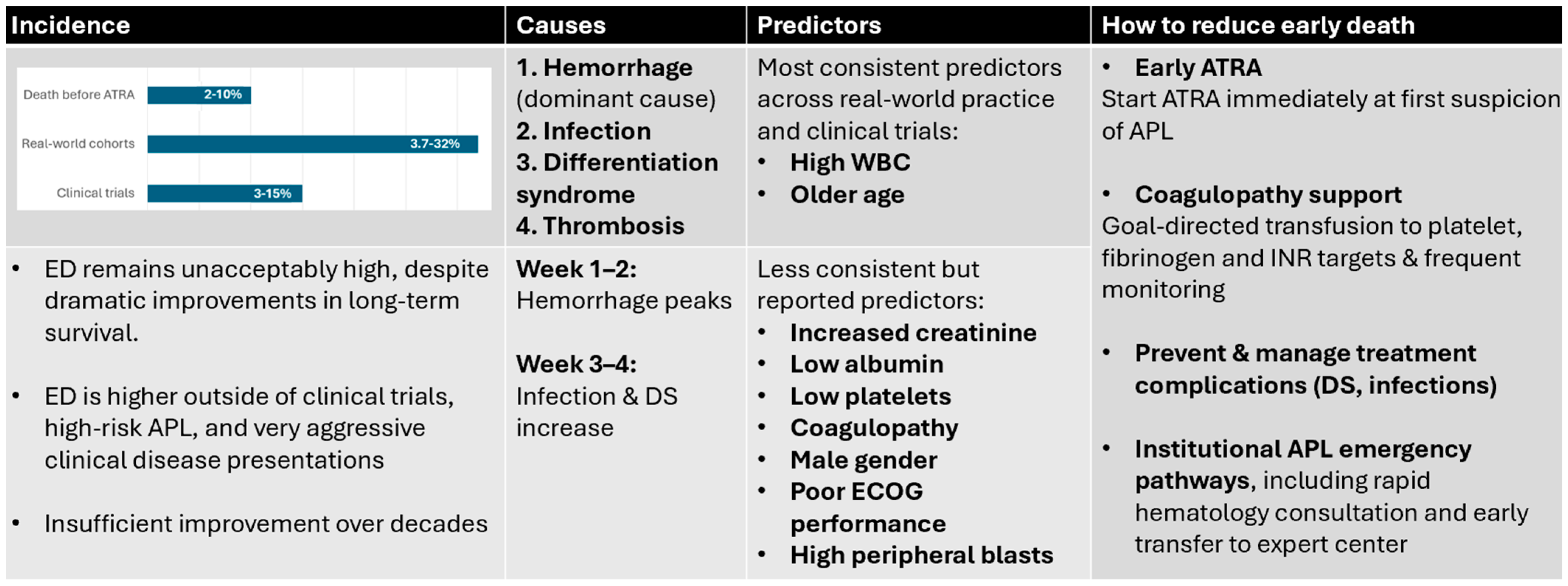
- Immediate administration of ATRA upon APL suspicion and not waiting until the marrow is examined or the PML-RARα is genetically confirmed to begin ATRA.
- -
- Coagulopathy support:
- ○
- Administration of fibrinogen or cryoprecipitate if serum fibrinogen < 100–150 mg/dL, fresh frozen plasma or prothrombin complex if PT-INR > 1.3, and platelet transfusion if platelets < 30,000–50,000/µL.
- ○
- Monitoring coagulation parameters from one to four times daily until all laboratory and clinical signs of the coagulopathy resolve.
- ○
- No routine use of fibrinolytics, heparin, or other anticoagulant therapy since their benefit as routine care in APL is questionable.
- ○
- Avoidance of invasive procedures before and during induction therapy because of a high risk of hemorrhage.
- -
- Differentiation syndrome (DS) prophylaxis with corticosteroids.
- -
- Daily evaluation for signs and symptoms of DS to allow for early recognition and immediate treatment with dexamethasone.
- -
- Treatment of leukocytosis to reduce the atypical promyelocyte burden in the peripheral blood, either with idarubicin in high-risk patients, or hydroxyurea, idarubicin, and/or gemtuzumab ozogamicin for low-risk patients who develop leukocytosis under ATRA plus ATO treatment.
- -
- Prophylactic antibiotics and/or antifungals according to local infection control guidelines.
6. Conclusions
Funding
Institutional Review Board Statement
Informed Consent Statement
Data Availability Statement
Conflicts of Interest
References
- Sanz, M.A.; Fenaux, P.; Tallman, M.S.; Estey, E.H.; Löwenberg, B.; Naoe, T.; Lengfelder, E.; Döhner, H.; Burnett, A.K.; Chen, S.-J.; et al. Management of acute promyelocytic leukemia: Updated recommendations from an expert panel of the European LeukemiaNet. Blood 2019, 133, 1630–1643. [Google Scholar] [CrossRef] [Scilit]
- Iland, H.J.; Bradstock, K.; Supple, S.G.; Catalano, A.; Collins, M.; Hertzberg, M.; Browett, P.; Grigg, A.; Firkin, F.; Hugman, A.; et al. All-trans-retinoic acid, idarubicin, and IV arsenic trioxide as initial therapy in acute promyelocytic leukemia (APML4). Blood 2012, 120, 1570–1580. [Google Scholar] [CrossRef] [Scilit]
- Lo-Coco, F.; Avvisati, G.; Vignetti, M.; Thiede, C.; Orlando, S.M.; Iacobelli, S.; Ferrara, F.; Fazi, P.; Cicconi, L.; Di Bona, E.; et al. Retinoic Acid and Arsenic Trioxide for Acute Promyelocytic Leukemia. N. Engl. J. Med. 2013, 369, 111–121. [Google Scholar] [CrossRef] [Scilit]
- Tallman, M.S.; Lo-Coco, F.; Kwaan, H.C.; Sanz, M.A.; Gore, S.D. Early death in patients with acute promyelocytic leukemia. Proceedings from a live roundtable at the 2010 American Society of Hematology Annual Meeting, December 4–7, 2010, Orlando, Florida. Clin. Adv. Hematol. Oncol. 2011, 9, 1–16. [Google Scholar] [PubMed]
- Jácomo, R.H.; Melo, R.A.M.; Souto, F.R.; de Mattos, E.R.; de Oliveira, C.T.; Fagundes, E.M.; Bittencourt HNda, S.; Bittencourt, R.I.; Bortolheiro, T.C.; Paton, E.J.A.; et al. Clinical features and outcomes of 134 Brazilians with acute promyelocytic leukemia who received ATRA and anthracyclines. Haematologica 2007, 92, 1431–1432. [Google Scholar] [CrossRef] [Scilit] [PubMed]
- de la Serna, J.; Montesinos, P.; Vellenga, E.; Rayón, C.; Parody, R.; León, A.; Esteve, J.; Bergua, J.M.; Milone, G.; Debén, G.; et al. Causes and prognostic factors of remission induction failure in patients with acute promyelocytic leukemia treated with all-trans retinoic acid and idarubicin. Blood 2008, 111, 3395–3402. [Google Scholar] [CrossRef] [Scilit]
- Stahl, M.; Tallman, M.S. Acute promyelocytic leukemia (APL): Remaining challenges towards a cure for all. Leuk. Lymphoma 2019, 60, 3107–3115. [Google Scholar] [CrossRef] [Scilit]
- Odetola, O.; Tallman, M.S. How to avoid early mortality in acute promyelocytic leukemia. Hematology 2023, 2023, 248–253. [Google Scholar] [CrossRef] [Scilit]
- Ablain, J.; Leiva, M.; Peres, L.; Fonsart, J.; Anthony, E.; de Thé, H. Uncoupling RARA transcriptional activation and degradation clarifies the bases for APL response to therapies. J. Exp. Med. 2013, 210, 647–653. [Google Scholar] [CrossRef] [Scilit] [PubMed]
- Fenaux, P.; Le Deley, M.C.; Castaigne, S.; Archimbaud, E.; Chomienne, C.; Link, H.; Guerci, A.; Duarte, M.; Daniel, M.T.; Bowen, D. Effect of all transretinoic acid in newly diagnosed acute promyelocytic leukemia. Results of a multicenter randomized trial. European APL 91 Group. Blood 1993, 82, 3241–3249. [Google Scholar] [CrossRef] [Scilit]
- Falanga, A.; Russo, L.; Montesinos, P. APL coagulopathy, In Acute Promyelocytic Leukemia; Springer International Publishing: Cham, Switzerland, 2018; pp. 55–70. [Google Scholar]
- Altman, J.K.; Rademaker, A.; Cull, E.; Weitner, B.B.; Ofran, Y.; Rosenblat, T.L.; Haidau, A.; Park, J.H.; Ram, S.L.; Orsini, J.M.J.; et al. Administration of ATRA to newly diagnosed patients with acute promyelocytic leukemia is delayed contributing to early hemorrhagic death. Leuk. Res. 2013, 37, 1004–1009. [Google Scholar] [CrossRef] [Scilit]
- Platzbecker, U.; Adès, L.; Montesinos, P.; Ammatuna, E.; Fenaux, P.; Baldus, C.; Berthon, C.; Bocchia, M.; Bonmati, C.; Borlenghi, E. First results of the APOLLO trial: A randomized phase III study to compare ATO combined with ATRA versus standard AIDA regimen for patients with newly diagnosed, high-risk acute promyelocytic leukemia. In Proceedings of the 2024 European Hematology Association Congress, Madrid, Spain, 13–16 June 2024. Abstract S102. [Google Scholar]
- Lehmann, S.; Ravn, A.; Carlsson, L.; Antunovic, P.; Deneberg, S.; Möllgård, L.; Derolf, A.R.; Stockelberg, D.; Tidefelt, U.; Wahlin, A.; et al. Continuing high early death rate in acute promyelocytic leukemia: A population-based report from the Swedish Adult Acute Leukemia Registry. Leukemia 2011, 25, 1128–1134. [Google Scholar] [CrossRef] [Scilit] [PubMed]
- Schuh, A.C. Timely diagnosis and treatment of acute promyelocytic leukemia should be available to all. Haematologica 2022, 107, 570–571. [Google Scholar] [CrossRef] [Scilit]
- Lehmann, S.; Deneberg, S.; Antunovic, P.; Rangert-Derolf, Å.; Garelius, H.; Lazarevic, V.; Myhr-Eriksson, K.; Möllgård, L.; Uggla, B.; Wahlin, A.; et al. Early death rates remain high in high-risk APL: Update from the Swedish Acute Leukemia Registry 1997–2013. Leukemia 2017, 31, 1457–1459. [Google Scholar] [CrossRef] [Scilit] [PubMed]
- Paulson, K.; Serebrin, A.; Lambert, P.; Bergeron, J.; Everett, J.; Kew, A.; Jones, D.; Mahmud, S.; Meloche, C.; Sabloff, M.; et al. Acute promyelocytic leukaemia is characterized by stable incidence and improved survival that is restricted to patients managed in leukaemia referral centres: A pan-Canadian epidemiological study. Br. J. Haematol. 2014, 166, 660–666. [Google Scholar] [CrossRef] [Scilit]
- Park, J.H.; Qiao, B.; Panageas, K.S.; Schymura, M.J.; Jurcic, J.G.; Rosenblat, T.L.; Altman, J.K.; Douer, D.; Rowe, J.M.; Tallman, M.S. Early death rate in acute promyelocytic leukemia remains high despite all-trans retinoic acid. Blood 2011, 118, 1248–1254. [Google Scholar] [CrossRef] [Scilit]
- Mcclellan, J.S.; Kohrt, H.E.; Coutre, S.; Gotlib, J.R.; Majeti, R.; Alizadeh, A.A.; Medeiros, B.C. Treatment advances have not improved the early death rate in acute promyelocytic leukemia. Haematologica 2012, 97, 133–136. [Google Scholar] [CrossRef] [Scilit]
- Li, G.; Wu, J.; Li, R.; Pan, Y.; Ma, W.; Xu, J.; Nan, M.; Hou, L. Improvement of Early Death in Acute Promyelocytic Leukemia: A Population-Based Analysis. Clin. Lymphoma Myeloma Leuk. 2022, 23, e78–e84. [Google Scholar] [CrossRef] [Scilit]
- Teng-Fei, S.; Diyaer, A.; Hong-Ming, Z.; Xin-Jie, C.; Wen-Fang, W.; Yu-Bing, Z.; Xiao-Jing, L.; Wen-Yan, C.; Yang, S. Evolving of treatment paradigms and challenges in acute promyelocytic leukaemia: A real-world analysis of 1105 patients over the last three decades. Transl. Oncol. 2022, 25, 101522. [Google Scholar] [CrossRef] [Scilit] [PubMed]
- Fenaux, P.; Chastang, C.; Chevret, S.; Sanz, M.; Dombret, H.; Archimbaud, E.; Fey, M.; Rayon, C.; Huguet, F.; Sotto, J.J.; et al. A randomized comparison of all transretinoic acid (ATRA) followed by chemotherapy and ATRA plus chemotherapy and the role of maintenance therapy in newly diagnosed acute promyelocytic leukemia. The European APL Group. Blood 1999, 94, 1192–1200. [Google Scholar] [CrossRef] [Scilit]
- Lo-Coco, F.; Avvisati, G.; Vignetti, M.; Breccia, M.; Gallo, E.; Rambaldi, A.; Paoloni, F.; Fioritoni, G.; Ferrara, F.; Specchia, G.; et al. Front-line treatment of acute promyelocytic leukemia with AIDA induction followed by risk-adapted consolidation for adults younger than 61 years: Results of the AIDA-2000 trial of the GIMEMA Group. Blood 2010, 116, 3171–3179. [Google Scholar] [CrossRef] [Scilit]
- Burnett, A.K.; Grimwade, D.; Solomon, E.; Wheatley, K.; Goldstone, A.H. Presenting white blood cell count and kinetics of molecular remission predict prognosis in acute promyelocytic leukemia treated with all-trans retinoic acid: Result of the Randomized MRC Trial. Blood 1999, 93, 4131–4143. [Google Scholar] [CrossRef] [Scilit]
- Lengfelder, E.; Haferlach, C.; Saussele, S.; Haferlach, T.; Schultheis, B.; Schnittger, S.; Ludwig, W.-D.; Staib, P.; Aul, C.; Grüneisen, A.; et al. High dose ara-C in the treatment of newly diagnosed acute promyelocytic leukemia: Long-term results of the German AMLCG. Leukemia 2009, 23, 2248–2258. [Google Scholar] [CrossRef] [Scilit]
- Sanz, M.A.; Martiín, G.; Gonzaález, M.; Leoón, A.; Rayoón, C.; Rivas, C.; Colomer, D.; Amutio, E.; Capote, F.J.; Milone, G.A.; et al. Risk-adapted treatment of acute promyelocytic leukemia with all-trans-retinoic acid and anthracycline monochemotherapy: A multicenter study by the PETHEMA group. Blood 2004, 103, 1237–1243. [Google Scholar] [CrossRef] [Scilit]
- Rego, E.M.; Kim, H.T.; Ruiz-Argüelles, G.J.; Undurraga, M.S.; Uriarte Mdel, R.; Jacomo, R.H.; Gutiérrez-Aguirre, H.; Melo, R.A.M.; Bittencourt, R.; Pasquini, R.; et al. Improving acute promyelocytic leukemia (APL) outcome in developing countries through networking, results of the International Consortium on APL. Blood 2013, 121, 1935–1943. [Google Scholar] [CrossRef] [Scilit]
- Gill, H.; Raghupathy, R.; Lee, C.Y.Y.; Yung, Y.; Chu, H.-T.; Ni, M.Y.; Xiao, X.; Flores, F.P.; Yim, R.; Lee, P.; et al. Acute promyelocytic leukaemia: Population-based study of epidemiology and outcome with ATRA and oral-ATO from 1991 to 2021. BMC Cancer 2023, 23, 141. [Google Scholar] [CrossRef] [Scilit] [PubMed]
- Rashidi, A.; Riley, M.; Goldin, T.A.; Sayedian, F.; Bayerl, M.G.; Aguilera, N.S.; Vos, J.A.; Goudar, R.K.; Fisher, S.I. Delay in the administration of all-trans retinoic acid and its effects on early mortality in acute promyelocytic leukemia: Final results of a multicentric study in the United States. Leuk. Res. 2014, 38, 1036–1040. [Google Scholar] [CrossRef] [Scilit] [PubMed]
- Österroos, A.; Maia, T.; Eriksson, A.; Jädersten, M.; Lazarevic, V.; Wennström, L.; Antunovic, P.; Cammenga, J.; Deneberg, S.; Lorenz, F.; et al. A risk score based on real-world data to predict early death in acute promyelocytic leukemia. Haematologica 2022, 107, 1528–1537. [Google Scholar] [CrossRef] [Scilit] [PubMed]
- Voso, M.T.; Guarnera, L.; Lehmann, S.; Döhner, K.; Döhner, H.; Platzbecker, U.; Russell, N.; Dillon, R.; Thomas, I.; Ossenkoppele, G.; et al. Acute promyelocytic leukemia: Long-term outcomes from the HARMONY project. Blood 2025, 145, 234–243. [Google Scholar] [CrossRef] [Scilit] [PubMed]
- Guru Murthy, G.S.; Szabo, A.; Michaelis, L.; Carlson, K.-S.; Runaas, L.; Abedin, S.; Atallah, E. Improving Outcomes of Acute Promyelocytic Leukemia in the Current Era: Analysis of the SEER Database. J. Nat. Compr. Cancer Netw. 2020, 18, 169–175. [Google Scholar] [CrossRef] [Scilit]
- Zhu, H.; Hu, J.; Chen, L.; Zhou, W.; Li, X.; Wang, L.; Zhao, X.; Zhang, Y.; Zhao, H.; Wang, A.; et al. The 12-year follow-up of survival, chronic adverse effects, and retention of arsenic in patients with acute promyelocytic leukemia. Blood 2016, 128, 1525–1528. [Google Scholar] [CrossRef] [Scilit]
- Dhakal, P.; Lyden, E.; Rajasurya, V.; Zeidan, A.M.; Chaulagain, C.; Gundabolu, K.; Bhatt, V.R. Early mortality and overall survival in acute promyelocytic leukemia: Do real-world data match results of the clinical trials? Leuk Lymphoma 2021, 62, 1949–1957. [Google Scholar] [CrossRef] [Scilit]
- Silva, W.F.; Kim, H.T.; Undurraga, M.S.; Navarro-Cabrera, J.R.; Salinas, V.; Muxi, P.; Melo, R.A.M.; Gloria, A.B.F.; Pagnano, K.B.B.; Nunes, E.C.; et al. Early death and intracranial hemorrhage prediction in acute promyelocytic leukemia: Validation of a risk score in a cohort from an international consortium treated with chemotherapy plus all-trans retinoic acid. Haematologica 2025, 110, 795–798. [Google Scholar] [CrossRef] [Scilit] [PubMed]
- Jin, B.; Zhang, Y.; Hou, W.; Cao, F.; Lu, M.; Yang, H.; Tian, X.; Wang, Y.; Hou, J.; Fu, J.; et al. Comparative analysis of causes and predictors of early death in elderly and young patients with acute promyelocytic leukemia treated with arsenic trioxide. J. Cancer Res. Clin. Oncol. 2020, 146, 485–492. [Google Scholar] [CrossRef] [Scilit]
- Zhu, H.-H.; Ma, Y.-F.; Yu, K.; Ouyang, G.-F.; Luo, W.-D.; Pei, R.-Z.; Xu, W.-Q.; Hu, H.-X.; Mo, S.-P.; Xu, X.-H.; et al. Early Death and Survival of Patients With Acute Promyelocytic Leukemia in ATRA Plus Arsenic Era: A Population-Based Study. Front Oncol. 2021, 11, 762653. [Google Scholar] [CrossRef] [Scilit]
- Lebon, D.; Da Rocha, A.; Cassinat, B.; Heiblig, M.; Bertoli, S.; Bonmati, C.; Zilliox, A.; Laloi, M.; Berthon, C.; Duployez, N.; et al. Comparison of induction with arsenic trioxide or chemotherapy in a real-world cohort of patients with high-risk acute promyelocytic leukemia. Leukemia 2025, 39, 1865–1870. [Google Scholar] [CrossRef] [Scilit] [PubMed]
- Brioso Infante, J.; Aguiar, E.; Sá, I.; Marques, I.; Neto, M.; Almeida, C.; Nascimento, T.; Pereira, M.I.; Cortesao, E.; Mendes Sapinho, G.; et al. Improved Real-World Outcomes of Patients with Acute Promyelocytic Leukemia Treated with First-Line Arsenic Trioxide in Specialized Centers in Portugal through a 24/7 Phone-Based Referral: A Study from the Portuguese Acute Leukemia Group. Blood 2024, 144, 2894. [Google Scholar] [CrossRef] [Scilit]
- Micol, J.B.; Raffoux, E.; Boissel, N.; Lengliné, E.; Canet, E.; Daniel, M.T.; Labarthe Ade Maarek, O.; Cassinat, B.; Adès, L.; Baruchel, A.; et al. Management and treatment results in patients with acute promyelocytic leukaemia (APL) not enrolled in clinical trials. Eur. J. Cancer 2014, 50, 1159–1168. [Google Scholar] [CrossRef] [Scilit] [PubMed]
- Infante, J.; Esteves, G.; Raposo, J.; de Lacerda, J.F. Predictors of very early death in acute promyelocytic leukemia: A retrospective real-world cohort study. Ann. Hematol. 2023, 102, 3031–3037. [Google Scholar] [CrossRef] [Scilit]
- Breccia, M.; Latagliata, R.; Cannella, L.; Minotti, C.; Meloni, G.; Lo-Coco, F. Early hemorrhagic death before starting therapy in acute promyelocytic leukemia: Association with high WBC count, late diagnosis and delayed treatment initiation. Haematologica 2010, 95, 853–854. [Google Scholar] [CrossRef] [Scilit]
- Sanz, M.A.; Montesinos, P. How we prevent and treat differentiation syndrome in patients with acute promyelocytic leukemia. Blood 2014, 123, 2777–2782. [Google Scholar] [CrossRef] [Scilit]
- Hambley, B.C.; Tomuleasa, C.; Ghiaur, G. Coagulopathy in Acute Promyelocytic Leukemia: Can We Go Beyond Supportive Care? Front. Med. 2021, 8, 722614. [Google Scholar] [CrossRef] [Scilit]
- Abla, O.; Coco, F.L.; Sanz, M.A. Acute Promyelocytic Leukemia: A Clinical Guide; Springer International Publishing: Cham, Switzerland, 2018. [Google Scholar]
- Frankel, S.R.; Eardley, A.; Lauwers, G.; Weiss, M.; Warrell, R.P. The “Retinoic Acid Syndrome” in Acute Promyelocytic Leukemia. Ann. Intern. Med. 1992, 117, 292–296. [Google Scholar] [CrossRef] [Scilit]
- Montesinos, P.; Sanz, M.A. The differentiation syndrome in patients with acute promyelocytic leukemia: Experience of the pethema group and review of the literature. Mediterr. J. Hematol. Infect. Dis. 2011, 3, e2011059. [Google Scholar] [CrossRef] [Scilit]
- Stahl, M.; Tallman, M.S. Differentiation syndrome in acute promyelocytic leukaemia. Br. J. Haematol. 2019, 187, 157–162. [Google Scholar] [CrossRef] [Scilit] [PubMed]
- Montesinos, P.; Bergua, J.M.; Vellenga, E.; Rayón, C.; Parody, R.; de la Serna, J.; León, A.; Esteve, J.; Milone, G.; Debén, G.; et al. Differentiation syndrome in patients with acute promyelocytic leukemia treated with all-trans retinoic acid and anthracycline chemotherapy: Characteristics, outcome, and prognostic factors. Blood 2009, 113, 775–783. [Google Scholar] [CrossRef] [Scilit] [PubMed]
- Cicconi, L.; Lo-Coco, F. Current management of newly diagnosed acute promyelocytic leukemia. Ann. Oncol. 2016, 27, 1474–1481. [Google Scholar] [CrossRef] [Scilit]
- Sanz, M.A.; Montesinos, P.; Rayón, C.; Holowiecka, A.; de la Serna, J.; Milone, G.; de Lisa, E.; Brunet, S.; Rubio, V.; Ribera, J.M.; et al. Risk-adapted treatment of acute promyelocytic leukemia based on all-trans retinoic acid and anthracycline with addition of cytarabine in consolidation therapy for high-risk patients: Further improvements in treatment outcome. Blood 2010, 115, 5137–5146. [Google Scholar] [CrossRef] [Scilit]
- Xu, F.; Wang, C.; Yin, C.; Jiang, X.; Jiang, L.; Wang, Z.; Meng, F. Analysis of early death in newly diagnosed acute promyelocytic leukemia patients. Medicine 2017, 96, e9324. [Google Scholar] [CrossRef] [Scilit] [PubMed]
- Mantha, S.; Goldman, D.A.; Devlin, S.M.; Lee, J.W.; Zannino, D.; Collins, M.; Douer, D.; Iland, H.J.; Litzow, M.R.; Stein, E.M.; et al. Determinants of fatal bleeding during induction therapy for acute promyelocytic leukemia in the ATRA era. Blood 2017, 129, 1763–1767. [Google Scholar] [CrossRef] [Scilit]
- Avvisati, G.; Lo-Coco, F.; Paoloni, F.P.; Petti, M.C.; Diverio, D.; Vignetti, M.; Latagliata, R.; Specchia, G.; Baccarani, M.; Di Bona, E.; et al. AIDA 0493 protocol for newly diagnosed acute promyelocytic leukemia: Very long-term results and role of maintenance. Blood 2011, 117, 4716–4725. [Google Scholar] [CrossRef] [Scilit] [PubMed]
- Kim, D.-Y.; Lee, J.-H.; Lee, J.-H.; Kim, S.-D.; Lim, S.-N.; Choi, Y.; Lee, Y.-S.; Kang, Y.-A.; Seol, M.; Jeon, M.; et al. Significance of fibrinogen, D-dimer, and LDH levels in predicting the risk of bleeding in patients with acute promyelocytic leukemia. Leuk. Res. 2011, 35, 152–158. [Google Scholar] [CrossRef] [Scilit]
- Ferro, J.M.; Infante, J. Cerebrovascular manifestations in hematological diseases: An update. J. Neurol. 2021, 268, 3480–3492. [Google Scholar] [CrossRef] [Scilit] [PubMed]
- Song, Y.; Peng, P.; Qiao, C.; Zhang, R.; Li, J.; Lu, H. Low platelet count is potentially the most important contributor to severe bleeding in patients newly diagnosed with acute promyelocytic leukemia. OncoTargets Ther. 2017, 10, 4917–4924. [Google Scholar] [CrossRef] [Scilit]
- Xiao, M.; Zhou, P.; Liu, Y.; Wei, S.; Li, D.; Li, W.; Niu, X.; Niu, J.; Zhang, Y.; Cao, W.; et al. Predictive factors for differentiating thrombohemorrhagic disorders in high-risk acute promyelocytic leukemia. Thromb. Res. 2022, 210, 33–41. [Google Scholar] [CrossRef] [Scilit]
- Chang, H.; Kuo, M.C.; Shih, L.Y.; Dunn, P.; Wang, P.N.; Wu, J.H.; Lin, T.L.; Hung, Y.S.; Tang, T.C. Clinical bleeding events and laboratory coagulation profiles in acute promyelocytic leukemia. Eur. J. Haematol. 2012, 88, 321–328. [Google Scholar] [CrossRef] [Scilit]
- Falanga, A. Predicting APL lethal bleeding in the ATRA era. Blood 2017, 129, 1739–1740. [Google Scholar] [CrossRef] [Scilit] [PubMed]
- Madan, V.; Shyamsunder, P.; Han, L.; Mayakonda, A.; Nagata, Y.; Sundaresan, J.; Kanojia, D.; Yoshida, K.; Ganesan, S.; Hattori, N.; et al. Comprehensive mutational analysis of primary and relapse acute promyelocytic leukemia. Leukemia 2016, 30, 1672–1681. [Google Scholar] [CrossRef] [Scilit]
- Picharski, G.L.; Andrade, D.P.; Fabro, A.L.M.R.; Lenzi, L.; Tonin, F.S.; Ribeiro, R.C.; Figueiredo, B.C. The Impact of Flt3 Gene Mutations in Acute Promyelocytic Leukemia: A Meta-Analysis. Cancers 2019, 11, 1311. [Google Scholar] [CrossRef] [Scilit]
- Song, Y.; Peng, P.; Qiao, C.; Li, J.; Long, Q.; Lu, H. Potential Effects of the FLT3-ITD Mutation on Chemotherapy Response and Prognosis of Acute Promyelocytic Leukemia. Cancer Manag. Res. 2021, 13, 2371–2378. [Google Scholar] [CrossRef] [Scilit]
- Singh, C.; Karunakaran, P.; Yanamandra, U.; Jindal, N.; Kumar, S.R.; Saini, N.; Jandial, A.; Jain, A.; Lad, D.; Prakash, G.; et al. Factors associated with thrombo-hemorrhagic deaths in patients with Acute Promyelocytic leukemia treated with Arsenic Trioxide and all-trans retinoic acid. Leuk. Res. 2023, 134, 107392. [Google Scholar] [CrossRef] [Scilit]
- Toh, C.H.; Hoots, W.K.; ISTH, T. The scoring system of the Scientific and Standardisation Committee on Disseminated Intravascular Coagulation of the International Society on Thrombosis and Haemostasis: A 5-year overview. J. Thromb. Haemost. 2007, 5, 604–606. [Google Scholar] [CrossRef] [Scilit]
- Mitrovic, M.; Suvajdzic, N.; Bogdanovic, A.; Kurtovic, N.K.; Sretenovic, A.; Elezovic, I.; Tomin, D. International Society of Thrombosis and Hemostasis Scoring System for disseminated intravascular coagulation ≥6: A new predictor of hemorrhagic early death in acute promyelocytic leukemia. Med. Oncol. 2013, 30, 478. [Google Scholar] [CrossRef] [Scilit] [PubMed]
- Baysal, M.; Gürsoy, V.; Hunutlu, F.C.; Erkan, B.; Demirci, U.; Bas, V.; Gulsaran, S.K.; Pinar, I.E.; Ersal, T.; Kirkizlar, T.A.; et al. The evaluation of risk factors leading to early deaths in patients with acute promyelocytic leukemia: A retrospective study. Ann. Hematol. 2022, 101, 1049–1057. [Google Scholar] [CrossRef] [Scilit] [PubMed]
- Infante, J.B.; Esteves, G.V.; Raposo, J.; de Lacerda, J.F. Disseminated intravascular coagulation score evolution in 48 h predicts early death in acute promyelocytic leukemia patients. Eur. J. Haematol. 2024, 112, 840–844. [Google Scholar] [CrossRef] [Scilit]
- Infante, J.B.; Esteves, G.; Martins, H.; Medeiros, J.; Alves, D.; Lopes, C.; Costa, M.J.; Guerrero, M.B.; Moreno, R.; Lourenço, F.; et al. Disseminated intravascular coagulation score evolution in 48 hours predicts early death in newly-diagnosed chemotherapy-treated acute promyelocytic leukemia patients. Blood 2020, 136, 9. [Google Scholar] [CrossRef] [Scilit]
- Di Bona, E.; Avvisati, G.; Castaman, G.; Luce Vegna, M.; De Sanctis, V.; Rodeghiero, F.; Mandelli, F. Early haemorrhagic morbidity and mortality during remission induction with or without all-trans retinoic acid in acute promyelocytic leukaemia. Br. J. Haematol. 2000, 108, 689–695. [Google Scholar] [CrossRef] [Scilit] [PubMed]
- Dally, N.; Hoffman, R.; Haddad, N.; Sarig, G.; Rowe, J.M.; Brenner, B. Predictive factors of bleeding and thrombosis during induction therapy in acute promyelocytic leukemia—A single center experience in 34 patients. Thromb. Res. 2005, 116, 109–114. [Google Scholar] [CrossRef] [Scilit]
- Yanada, M.; Matsushita, T.; Asou, N.; Kishimoto, Y.; Tsuzuki, M.; Maeda, Y.; Horikawa, K.; Okada, M.; Ohtake, S.; Yagasaki, F.; et al. Severe hemorrhagic complications during remission induction therapy for acute promyelocytic leukemia: Incidence, risk factors, and influence on outcome. Eur. J. Haematol. 2007, 78, 213–219. [Google Scholar] [CrossRef] [Scilit]
- Jillella, A.P.; Lee, S.J.; Altman, J.K.; Luger, S.M.; Tallman, M.S.; Foran, J.M.; Bradshaw, D.; Law, L.Y.; Bryan, L.J.; Abou Zahr, A.; et al. Academic Community Partnership in Acute Promyelocytic Leukemia and Early Mortality. JAMA Oncol. 2025, 11, 400. [Google Scholar] [CrossRef] [Scilit]

| Study | Patients | Years | Induction Treatment | ED Rate | Major Cause of ED | Prognostic Factors for ED |
|---|---|---|---|---|---|---|
| Fenaux et al. [22] | 413 | 1993–1996 | ATRA + Daunorubicin + ARA-C | 7% | Sepsis (42%) CNS hemorrhage (33%) | Older age Higher WBC count |
| Lo-Coco et al. [23] | 1081 | 1993–2006 | AIDA | 6% | Hemorrhage (35%) Sepsis (17%) | Higher WBC count Lower platelet count Older age |
| Burnett et al. [24] | 120 | 1993–1997 | ATRA + Dauno/ARA-C | 12% | Hemorrhage (36%) Infection (18%) | Higher age Higher WBC count |
| Lengfelder et al. [25] | 142 | 1994–2005 | ATRA + TAD/HAM | 8% | Hemorrhage (36%) Infection (18%) | Higher age 99 Higher WBC count |
| Sanz et al. [26] | 426 | 1996–2002 | AIDA | 9% | Hemorrhage (64%) Sepsis (28%) | Age > 70 years WBC > 10,000/uL |
| De la Serna et al. [6] | 732 | 1999–2005 | ATRA + Idarubicin | 9% | Hemorrhage (56%) Infection (26%) | ED by hemorrhage: abnormal creatinine, increased peripheral blast counts, coagulopathy ED by infection: age > 60 years, male gender, fever ED by DS: ECOG PS > 1, low albumin |
| Lo-Coco et al. [3] | 156 | 2007–2012 | AIDA ATRA + ATO | 3% | Differentiation syndrome (50%) Acute ischemic stroke (25%) Infection (25%) | NA |
| Platzbecker et al. [13] | 131 | 2016–2022 | AIDA ATRA + ATO | 10% 7% | Intracranial hemorrhage (58%) | NA |
| Rego et al. [27] | 180 | NA | ATRA + Dauno | 15% | Hemorrhage (48%) Infection (26%) | Higher WBC count Coagulopathy Increased creatinine Low albumin |
| Study | Patients | Years | Induction Treatment | ED Rate | Major Cause of ED | Prognostic Factors for ED |
|---|---|---|---|---|---|---|
| Li et al. [20] | 3212 | 1986–2015 | Not reported | 21.3% | Not reported | Older age Earlier diagnosis year Socioeconomic status |
| Gill et al. [28] | 751 | 1991–2021 | ATRA + Dauno Oral ATO + ATRA + Dauno | 19% | Differentiation syndrome (45%) | Male gender Age > 50 years WBC > 10 × 109/L Diagnosis in 1991–2009 |
| Park et al. [18] | 1400 | 1992–2007 | Not reported | 17.3% | Not reported | Age ≥ 55 years Diagnosis in 1992–1995 (vs. 1996–2007) |
| Altman et al. [12] | 204 | 1992–2009 | ATRA + chemotherapy | 11% | Hemorrhage (61%) | Higher WBC count Low fibrinogen Prolonged PT Prolonged aPTT |
| Paulson et al. [17] | 399 | 1993–2007 | Not reported | 22% | Not reported | Age ≥ 50 years |
| Rashidi et al. [29] | 120 | 1996–2013 | ATRA + chemotherapy | 17% | Hemorrhage (55%) | WBC > 10 × 109/L DIC on admission Transfer to ICU |
| Lehmann et al. [14] | 105 | 1997–2006 | ATRA-based | 29% | Hemorrhage (41%) | Higher WBC count High LDH High CRP Lower platelet count Increased creatinine |
| Lehmann et al. [16] | 195 | 1997–2013 | ATRA-based | 25.1% | Hemorrhage (46%) | Older age Higher WBC count Lower platelet count Increased creatinine |
| Österroos et al. [30] | 301 | 1997–2020 | ATRA + idarubicin + cytarabine | 19.6% | Hemorrhage or thrombosis (59.4%) | White blood cell count Lower platelet count Older age |
| Voso et al. [31] | 1438 | 1999–2022 | ATO + ATRA or ATRA + idarubicin | Overall: 5.9% Clinical trial: 2.2% Real-world: 8.1% | Hemorhage Infections | Increasing age High Sanz risk score |
| Murthy et al. [32] | 2962 | 2000–2014 | Not reported | 2000–2004: 25.3%; 2005–2009: 20.6%; 2010–2014: 17.1% | Not reported | Older age Earlier treatment period (2000–2009) Male gender Hispanic ethnicity |
| Zhu et al. [33] | 265 | 2001–2012 | ATRA + ATO ± chemotherapy | 6.8% | Hemorrhage (66.7%) | Not reported |
| Jacomo et al. [5] | 157 | 2003–2006 | ATRA + chemotherapy | 32% | Hemorrhage (66.6%) | Not reported |
| Dhakal et al. [34] | 7190 | 2004–2015 | Not reported | 12% (19–40 y: 6%; 41–60 y: 10%; >60 y: 21%) | Not reported | Higher Charlson Comorbidity Index No private insurance Treatment at community center |
| Silva et al. [35] | 813 | 2005–2020 | ATRA + daunorubicin | 14% | Hemorrhage (60.5%) | Age ≥ 40 years High white blood cell count |
| Jin et al. [36] | 409 | 2007–2019 | ATO + ATRA | Elderly pts: 23.74%; younger pts: 11.85% | Hemorrhage | Elderly patients: male gender, WBC count > 10 × 109/L, fibrinogen < 1.0 g/L, low albumin levels Younger patients: higher WBC count, lower fibrinogen, and increased creatinine |
| Zhu et al. [37] | 1233 | 2015–2019 | ATRA + ATO in 78% | 8.2% | Intracranial hemorrhage (59.4%) | Age ≥ 60 years WBC > 10 × 109/L |
| Lebon et al. [38] | 135 | 2010–2021 | ATRA + CHT (62%) ATRA + ATO (38%) | ATRA + ATO: 10% ATRA + CHT: 22% | Hemorrhage (45.8%), sepsis (41.7%) | Not reported |
| Infante et al. [39] | 135 | 2017–2024 | ATO + ATRA | 3.7% | Intracranial hemorrhage (60%) Septic shock (40%) | Older age (age > 75 years) |
Disclaimer/Publisher’s Note: The statements, opinions and data contained in all publications are solely those of the individual author(s) and contributor(s) and not of MDPI and/or the editor(s). MDPI and/or the editor(s) disclaim responsibility for any injury to people or property resulting from any ideas, methods, instructions or products referred to in the content. |
© 2025 by the author. Licensee MDPI, Basel, Switzerland. This article is an open access article distributed under the terms and conditions of the Creative Commons Attribution (CC BY) license (https://creativecommons.org/licenses/by/4.0/).
Share and Cite
Infante, J.B. Predictors of Early Death in Acute Promyelocytic Leukemia. Med. Sci. 2025, 13, 300. https://doi.org/10.3390/medsci13040300
Infante JB. Predictors of Early Death in Acute Promyelocytic Leukemia. Medical Sciences. 2025; 13(4):300. https://doi.org/10.3390/medsci13040300
Chicago/Turabian StyleInfante, Joana Brioso. 2025. "Predictors of Early Death in Acute Promyelocytic Leukemia" Medical Sciences 13, no. 4: 300. https://doi.org/10.3390/medsci13040300
APA StyleInfante, J. B. (2025). Predictors of Early Death in Acute Promyelocytic Leukemia. Medical Sciences, 13(4), 300. https://doi.org/10.3390/medsci13040300