


Abstract
Coasts are highly dynamic and geomorphologic complex systems that evolve under the increasing pressure of climate change and anthropogenic activities, having direct or indirect impacts on the coastal environment. Among the major adverse effects, coastal erosion represents one of the most pressing global issues, especially in flat and low-lying coastal areas that appear to be particularly susceptible to beach erosion and related shoreline retreat. This Special Issue collects a set of twelve papers on “Shoreline Dynamics and Beach Erosion”. Of course, this collection of papers does not cover all the broad number of topics concerning the dynamics and spatial-temporal evolution of shorelines and beach systems, but, in our opinion, they contribute to the growing body of knowledge. Coastal systems of variable complexity located in different geographic and climatic contexts are investigated from various points of view by using multi- and interdisciplinary approaches, as well as new experimental ones. The major topics covered concern the morphodynamics and hydrodynamics of coastal systems, the driving factors of coastal erosion, and the use of models/indexes to study coastal vulnerability and the mitigation of human/natural pressures affecting coastal ecosystems.
1. Editorial for the Special Issue Shoreline Dynamics and Beach Erosion
The coastal zone is a unique physical space including the transition between the land and sea, whose surface area totals approximately 5% of the earth’s surface [1]. However, this percentage and the related features change based on the definitions used and the related spatial boundaries attributed to them, which can vary depending on the way they are studied, exploited, and/or managed (e.g., [2]).
Although the coastal zone represents only a narrow strip of the Earth’s surface, there is no doubt about its great socio-economic and ecological importance, as it provides a wide range of services of fundamental importance to human well-being, health, and subsistence [3,4,5]. The high socio-economic and strategic value of coastal areas explain why around two-thirds of the world’s population live within 100 km from the coastline [6] and about 17% in low-elevation coastal zones, i.e., in low-lying areas that are less than 10 m above sea level [7,8]. In particular, sandy coasts are largely preferred as places for living and leisure activities, thus playing a fundamental role in the lucrative and growing tourism market, providing easy access to the sea [9,10].
From a dynamic perspective, the coastal zone represents one of the most energetic environments on Earth. Although the physical processes governing coastal dynamics show moderate and reasonably predictable behaviors most of the time, forcing processes can undergo unexpected abrupt and rapid changes leading to extreme and dangerous events. In particular, coastal storms, during which the wave energy reaches values significantly higher than those observed under average conditions, are among the most damaging natural events, primarily due to the high number of victims, but also to huge monetary losses (e.g., [11]).
The occurrence of storm events is particularly important along open, low-lying coastlines where beach erosion is one of the most common impacts, often causing the loss of land of high socio-economic and natural value (e.g., [10,12,13,14] and references therein). To succeed in planning and developing resilient and sustainable coastal built environments [15], it is crucial that coastal planners, engineers, and decision makers are aware of the fact that coastal areas are highly dynamic and hazard-prone zones.
In the light of the above, the progressive expansion of our knowledge on coastal morphodynamics and shoreline evolution and the modelling of shoreline changes and beach erosion in response to natural and anthropogenic stressors are of enormous relevance. Progress in this direction requires advances in various branches of science and technology, including techniques used for data acquisition, processing, and analysis, as well as the development of efficient numerical procedures for the computational implementation of theoretical models based on detailed studies and monitoring the activities of investigated coastal systems.
2. Special Issue
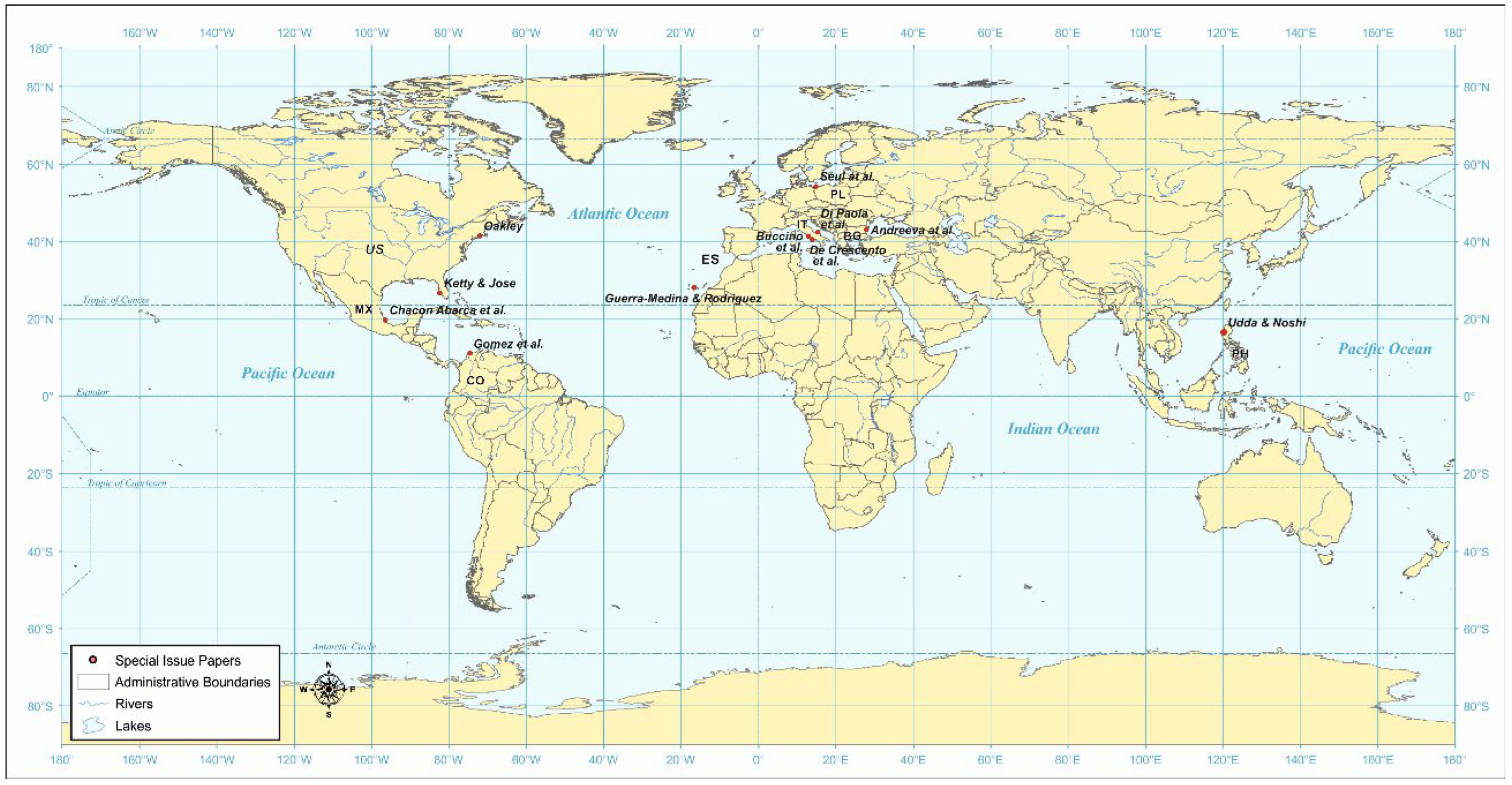
This Special Issue collects a set of twelve contributions authored by forty researchers on the topic of “Shoreline Dynamics and Beach Erosion”. Of course, this collection of papers does not cover the entire range of subjects concerning the dynamics and spatial-temporal evolution of shorelines and beach systems, but, in our opinion, it contributes to the growing body of knowledge. In particular, these papers address the study of coastal systems of variable complexity located in different geographic areas (Figure 1) and climatic contexts from various points of view by using multi- and interdisciplinary approaches and providing new experimental data and methodologies.
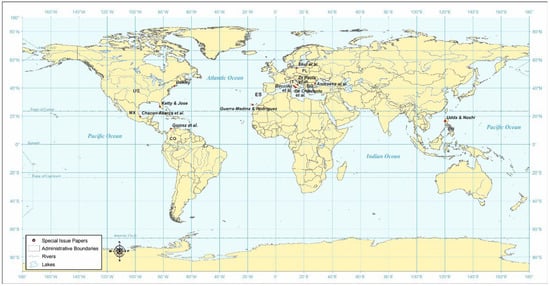
Figure 1.
Geographical distribution of the contributions included in the Special Issue.
We hope that the papers of this issue serve to foster additional research, stimulate scientific discussion, and promote reflections on how to achieve a better understanding of the coastal systems morphodynamics, or even present research opportunities in this field, contributing, in the end, to the safeguarding of coastal zones and beaches. From an operational point of view, we expect that their results may contribute to the development of pragmatic approaches through which the competent institutions and administrations can implement intervention strategies to eliminate, reduce, and/or compensate coastal erosion, as well as support the resilience and sustainable development of coastal areas.
The contributions included in this issue refer to different continents, from the Americas to Africa, Europe, and South East Asia (Figure 1). The review paper written by Pranzini and William [16], which deals with theoretical concepts and, therefore, does not refer to a specific geographic area, represents the only exception.
The papers have been categorized into three groups according to the major research topics addressed, as presented in Table 1.

Table 1.
Grouping of contributions according to major research topics covered.
A first group of papers (Group 1, Table 1) focuses on the morphodynamics and hydrodynamics of coastal systems. In detail, the papers written by Andreeva et al. [17] and Uda and Noshi [18] highlight that coastal morphodynamics assessed by analyzing the formation, location, and movement of coastal bars and sand spits strongly depends on the wave climate that controls the erosion and movement of sediments along the coast. Seul et al. [19], based on the petrographic analysis and characterization of beach sediments, have created an index that aids in understanding both the nature and origin of sediments, as well as the characteristics of wave climate responsible for their transport. The paper by Buccino et al. [20] illustrates how numerical modelling can be used for investigating the relationships between incident wave characteristics and beach shape. Finally, the review paper by Pranzini and William [16], which uses examples from the literature to analyze some of the major processes responsible for the evolution of a beach, highlights that the use of the term “beach equilibrium” is not entirely appropriate, since the sedimentary budget depends on numerous non-feedback-regulated factors.
A second consistent group of papers (Group 2, Table 1) analyzes some of the major driving factors of coastal erosion in different geographical and geomorphological contexts. In detail, these papers deal with the effects of subsidence [21], storm surges [22], and hurricanes [23] on the studied coastal systems, which adapt to new morphological conditions in different times. Furthermore, the paper by Guerra-Medina and Rodríguez [24] highlights how such control factors can decisively influence the economic and social decisions of a community and, especially, tourism activities.
Finally, the third group of papers (Group 3, Table 1) focuses on the development and application of models/indexes suitable for coastal erosion vulnerability assessments for developing mitigation strategies for coastal ecosystem in relation to human and natural pressures. In detail, the papers by Di Crescenzo et al. [25] and Di Paola et al. [26] illustrate the identification and application of indexes that allowed them to assess the susceptibility of the coastline to undergo erosion, respectively, in high rocky coast and sandy beach contexts. The paper by Chacón Abarca et al. [27] deals with the evaluation of a model to help the community reducing the negative effects on ecosystems caused by physical and human changes in lagoon coastal environments. It illustrates a developed tool that considers the inter-relationships between natural systems and the factors inducing alterations in the coastal lagoon environment, providing insights into human actions that can reduce these negative consequences on ecosystems.
Funding
This research received no external funding.
Data Availability Statement
No new data were created or analyzed in this study. Data sharing is not applicable to this article.
Acknowledgments
We thank our informants and supporting staff for their contribution to the Special Issue.
Conflicts of Interest
The authors declare no conflict of interest.
References
- Hossain, M.S.; Gain, A.K.; Rogers, K.G. Sustainable coastal social-ecological systems: How do we define “coastal”? Int. J. Sustain. Dev. World Ecol. 2020, 27, 577–582. [Google Scholar] [CrossRef]
- Masselink, G.; Hughes, M.G. Introduction to Coastal Processes and Geomorphology; Arnold: London, UK, 2004; 354p. [Google Scholar]
- Costanza, R.; d’Arge, R.; de Groot, R.; Farber, S.; Grasso, M.; Hannon, B.; Limburg, K.; Naeem, S.; O’Neill, R.V.; Paruelo, J.; et al. The value of the world’s ecosystem services and natural capital. Nature 1997, 387, 253–260. [Google Scholar] [CrossRef]
- Martínez, M.L.; Intralawan, A.; Vázquez, G.; Pérez-Maqueo, O.; Sutton, P.; Landgrave, R. The coasts of our world: Ecological, economic and social importance. Ecol. Econ. 2007, 63, 254–272. [Google Scholar] [CrossRef]
- Costanza, R.; Groot, R.; Sutton, P.; van der Ploeg, S.; Anderson, S.J.; Kubiszewski, I.; Farber, S.; Turner, R.K. Changes in the global value of ecosystem services. Glob. Environ. Change 2014, 26, 152–158. [Google Scholar] [CrossRef]
- Maul, G.A.; Duedall, I.W. Demography of Coastal Populations. In Encyclopedia of Coastal Science; Encyclopedia of Earth Sciences Series; Finkl, C.W., Makowski, C., Eds.; Springer: Cham, Switzerland, 2019. [Google Scholar] [CrossRef]
- Agardy, T.; Alder, J.; Dayton, P.; Curran, S.; Kitchingman, A.; Wilson, M.; Catenazzi, A.; Restrepo, J.; Birkeland, C.; Blaber, S.; et al. Coastal systems. In Millennium Ecosystem Assessment: Ecosystems & Human Well-Being, Volume 1: Current State and Trends; Reid, W., Ed.; Island Press: Washington, DC, USA, 2005; pp. 513–549. [Google Scholar]
- McGranahan, G.; Balk, D.; Anderson, B. The rising tide: Assessing the risks of climate change and human settlements in low elevation coastal zones. Environ. Urban. 2007, 19, 17–37. [Google Scholar] [CrossRef]
- Williams, A.; Micallef, A. Beach Management: Principles and Practice, 1st ed.; Earthscan: London, UK, 2009. [Google Scholar]
- Houston, J.R. The economic value of beaches—A 2013 update. Shore Beach 2013, 81, 3–10. [Google Scholar]
- Harley, M.D. Coastal Storm Definition. In Coastal Storms: Processes and Impacts; Ciavola, P., Coco, G., Eds.; Wiley-Blackwell: Hoboken, NJ, USA, 2017; pp. 1–21. [Google Scholar] [CrossRef]
- Alexandrakis, G.; Manasakis, C.; Kampanis, N.A. Valuating the effects of beach erosion to tourism revenue. A management perspective. Ocean. Coast. Manag. 2015, 11, 1–11. [Google Scholar] [CrossRef]
- Rosskopf, C.M.; Di Paola, G.; Atkinson, D.E.; Rodríguez, G.; Walker, I.J. Recent shoreline evolution and beach erosion along the central Adriatic coast of Italy: The case of Molise region. J. Coast. Conserv. 2018, 22, 879–895. [Google Scholar] [CrossRef]
- Flayou, L.; Snoussi, M.; Raji, O. Evaluation of the economic costs of beach erosion due to the loss of the recreational services of sandy beaches—The case of Tetouan coast (Morocco). J. Afr. Sci. 2021, 182, 104257. [Google Scholar] [CrossRef]
- Burningham, H.; Fernandez-Nunez, M. Shoreline change analysis. In Sandy Beach Morphodynamics; Jackson, D.W.T., Short, A.D., Eds.; Elsevier: Amsterdam, The Netherlands, 2020; pp. 439–460. [Google Scholar]
- Pranzini, E.; Williams, A.T. The Equilibrium Concept, or…(Mis)concept in Beaches. Geosciences 2021, 11, 59. [Google Scholar] [CrossRef]
- Andreeva, N.; Saprykina, Y.; Valchev, N.; Eftimova, P.; Kuznetsov, S. Influence of Wave Climate on Intra and Inter-Annual Nearshore Bar Dynamics for a Sandy Beach. Geosciences 2021, 11, 206. [Google Scholar] [CrossRef]
- Uda, T.; Noshi, Y. Recent Shoreline Changes Due to High-Angle Wave Instability along the East Coast of Lingayen Gulf in the Philippines. Geosciences 2021, 11, 144. [Google Scholar] [CrossRef]
- Seul, C.; Bednarek, R.; Kozłowski, T.; Maciąg, Ł. Beach Gravels as a Potential Lithostatistical Indicator of Marine Coastal Dynamics: The Pogorzelica–Dziwnów (Western Pomerania, Baltic Sea, Poland) Case Study. Geosciences 2020, 10, 367. [Google Scholar] [CrossRef]
- Buccino, M.; Tuozzo, S.; Ciccaglione, M.C.; Calabrese, M. Predicting Crenulate Bay Profiles from Wave Fronts: Numerical Experiments and Empirical Formulae. Geosciences 2021, 11, 208. [Google Scholar] [CrossRef]
- Gómez, J.F.; Kwoll, E.; Walker, I.J.; Shirzaei, M. Vertical Land Motion as a Driver of Coastline Changes on a Deltaic System in the Colombian Caribbean. Geosciences 2021, 11, 300. [Google Scholar] [CrossRef]
- Oakley, B.A. Storm Driven Migration of the Napatree Barrier, Rhode Island, USA. Geosciences 2021, 11, 330. [Google Scholar] [CrossRef]
- Kelly, E.W.; Jose, F. Geomorphologic Recovery of North Captiva Island from the Landfall of Hurricane Charley in 2004. Geosciences 2021, 11, 358. [Google Scholar] [CrossRef]
- Guerra-Medina, D.; Rodríguez, G. Spatiotemporal Variability of Extreme Wave Storms in a Beach Tourism Destination Area. Geosciences 2021, 11, 237. [Google Scholar] [CrossRef]
- Di Crescenzo, G.; Santangelo, N.; Santo, A.; Valente, E. Geomorphological Approach to Cliff Instability in Volcanic Slopes: A Case Study from the Gulf of Naples (Southern Italy). Geosciences 2021, 11, 289. [Google Scholar] [CrossRef]
- Di Paola, G.; Minervino Amodio, A.; Dilauro, G.; Rodriguez, G.; Rosskopf, C.M. Shoreline Evolution and Erosion Vulnerability Assessment along the Central Adriatic Coast with the Contribution of UAV Beach Monitoring. Geosciences 2022, 12, 353. [Google Scholar] [CrossRef]
- Chacón Abarca, S.; Chávez, V.; Silva, R.; Martínez, M.L.; Anfuso, G. Understanding the Dynamics of a Coastal Lagoon: Drivers, Exchanges, State of the Environment, Consequences and Responses. Geosciences 2021, 11, 301. [Google Scholar] [CrossRef]
Disclaimer/Publisher’s Note: The statements, opinions and data contained in all publications are solely those of the individual author(s) and contributor(s) and not of MDPI and/or the editor(s). MDPI and/or the editor(s) disclaim responsibility for any injury to people or property resulting from any ideas, methods, instructions or products referred to in the content. |
© 2023 by the authors. Licensee MDPI, Basel, Switzerland. This article is an open access article distributed under the terms and conditions of the Creative Commons Attribution (CC BY) license (https://creativecommons.org/licenses/by/4.0/).