Histomorphometric Analysis of the Endometrium of Jennies (Equus asinus) and Mares (Equus caballus) in Estrus: Anatomical Differences and Possible Reproductive Implications

 ,
,  , ,
, ,  , , ,
, , ,  and
and
Simple Summary
Abstract
1. Introduction
2. Materials and Methods
2.1. Animals and Breeding Soundness Evaluation
2.2. Sample Collection
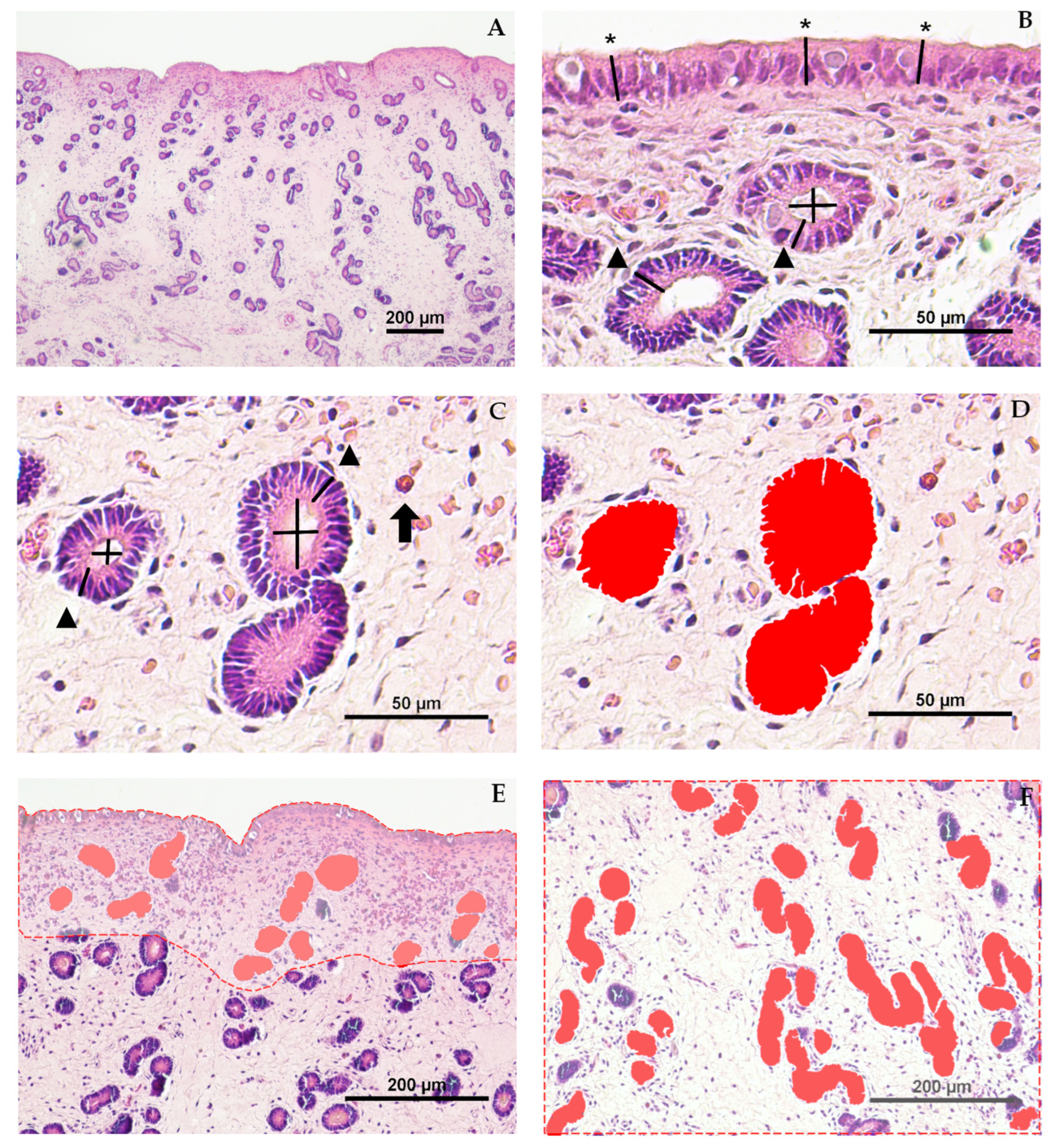
2.3. Endometrial Histomorphometric Evaluation
2.3.1. Measurement of Luminal Epithelium Height and Glandular Size Parameters
2.3.2. Measurement of Glandular Density Parameters

2.4. Statistical Analysis
3. Results
3.1. Breeding Soundness Evaluation
3.2. Histological Characteristics of the Endometrial Tissue
3.3. Endometrial Histomorphometric Evaluation Results
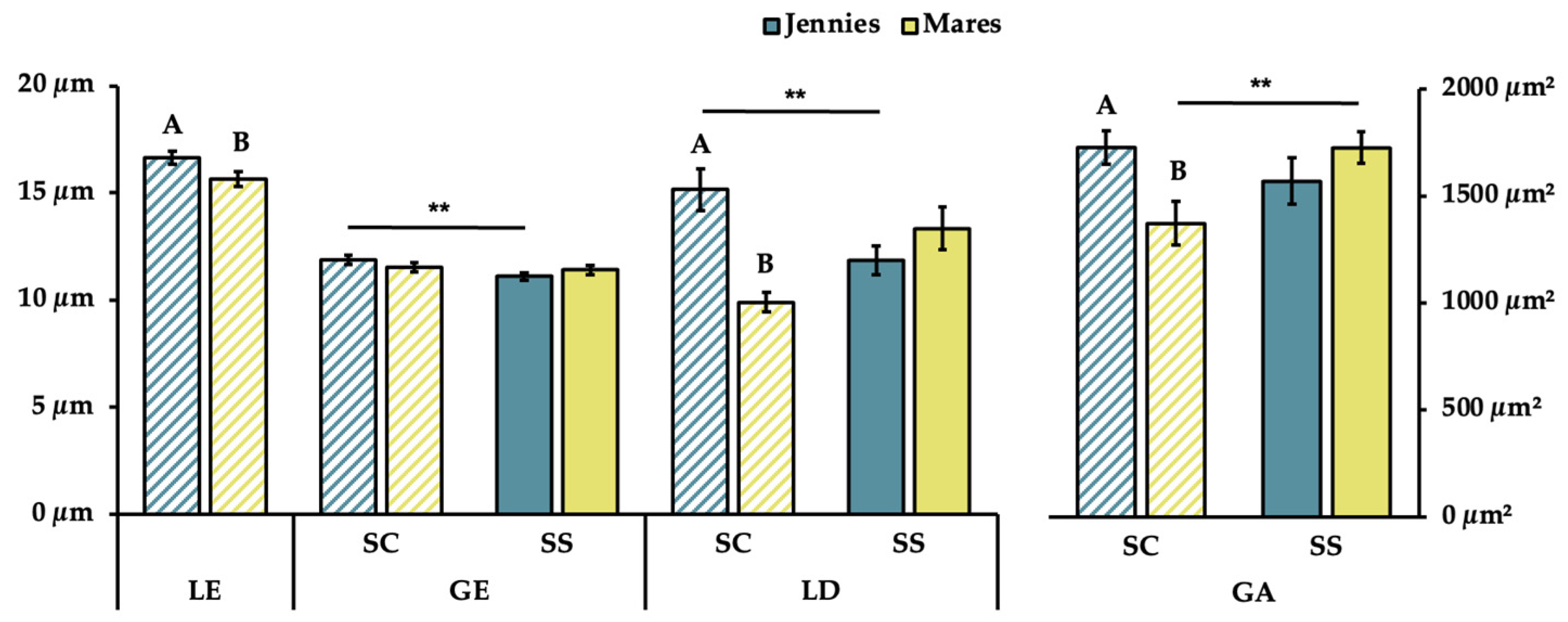
3.3.1. Results of Luminal Epithelium and Endometrial Glandular Size Parameters
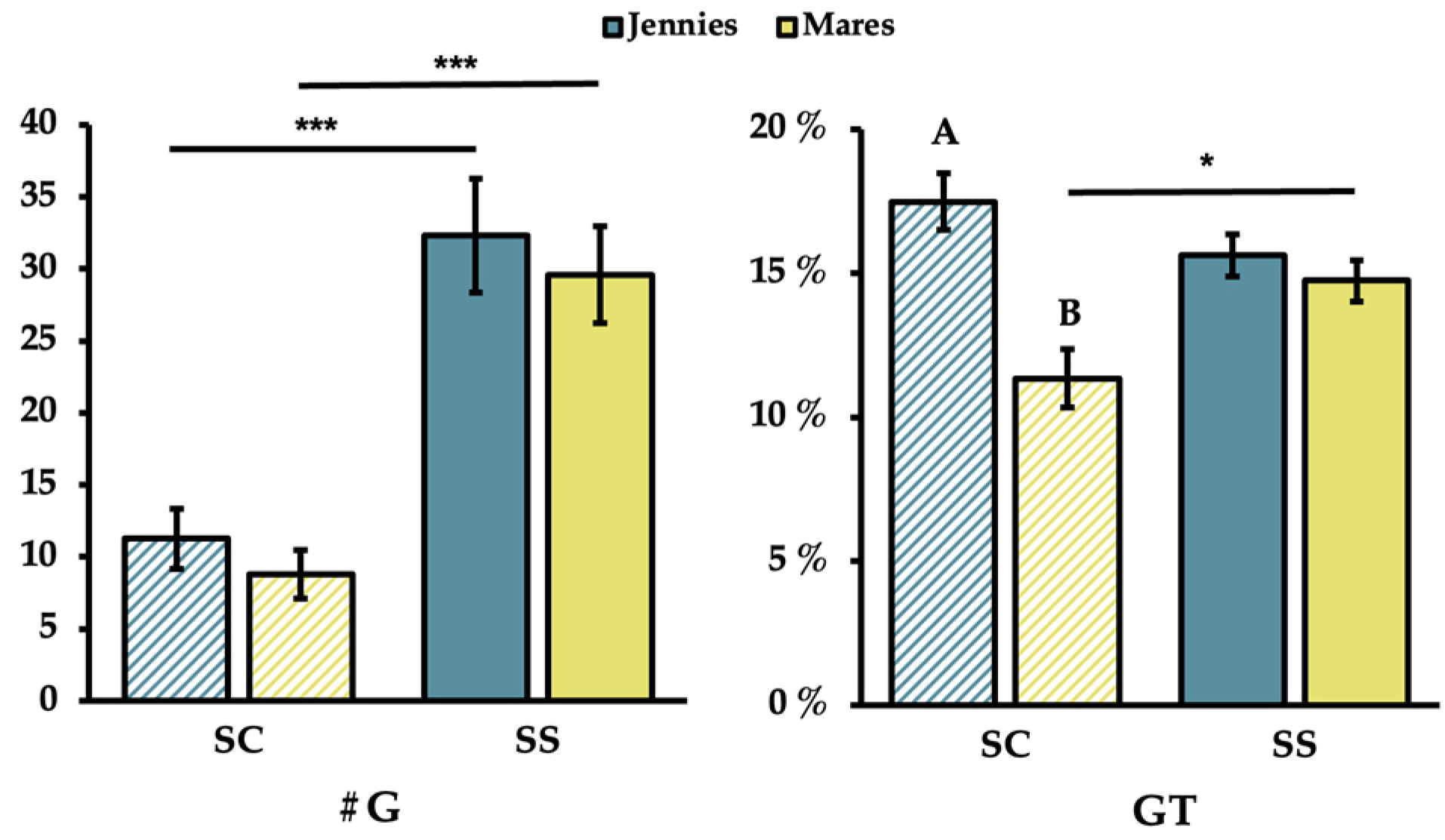
3.3.2. Results of Glandular Density Parameters
4. Discussion
5. Conclusions
Supplementary Materials
Author Contributions
Funding
Institutional Review Board Statement
Informed Consent Statement
Data Availability Statement
Acknowledgments
Conflicts of Interest
Abbreviations
| #G | Number of glands |
| AI | Artificial Insemination |
| ARTs | Assisted reproductive technologies |
| GA | Glandular area |
| GE | Glandular epithelium |
| GT | Glandular tissue percentage |
| KDGS | Kenney and Doig biopsy grading system |
| LD | Lumen diameter |
| LE | Luminal epithelium |
| SC | Stratum compactum |
| SS | Stratum spongiosum |
References
- Food and Agriculture Organization (FAO). Domestic Animal Diversity Information System (DAD-IS). Available online: https://www.fao.org/dad-is/en/ (accessed on 13 March 2025).
- Camillo, F.; Rota, A.; Biagini, L.; Tesi, M.; Fanelli, D.; Panzani, D. The Current Situation and Trend of Donkey Industry in Europe. J. Equine Vet. Sci. 2018, 65, 44–49. [Google Scholar] [CrossRef]
- Hedrick, P.W.; Garcia-Dorado, A. Understanding Inbreeding Depression, Purging, and Genetic Rescue. Trends Ecol. Evol. 2016, 31, 940–952. [Google Scholar] [CrossRef] [PubMed]
- Kenney, R.M. Cyclic and pathologic changes of the mare endometrium as detected by biopsy, with a note on early embryonic death. J. Am. Vet. Med. Assoc. 1978, 172, 242–262. [Google Scholar] [CrossRef]
- Kenney, R.M.; Doig, P.A. Equine endometrial biopsy. Curr. Ther. Theriogenol. 1986, 2, 723–729. [Google Scholar]
- Hildebrandt, T.B.; Hermes, R.; Goeritz, F.; Appeltant, R.; Colleoni, S.; de Mori, B.; Diecke, S.; Drukker, M.; Galli, C.; Hayashi, K.; et al. The ART of bringing extinction to a freeze—History and future of species conservation, exemplified by rhinos. Theriogenology 2021, 169, 76–88. [Google Scholar] [CrossRef]
- De Oliveira, J.V.; Oliveira, P.V.L.F.; e Oña, C.M.M.; Guasti, P.N.; Monteiro, G.A.; da Silva, Y.F.R.S.; de Mello Papa, P.; Alvarenga, M.A.; Dell’Aqua Junior, J.A.; Ozanam Papa, F. Strategies to improve the fertility of fresh and frozen donkey semen. Theriogenology 2016, 85, 1267–1273. [Google Scholar] [CrossRef]
- Panzani, D.; Fanelli, D.; Camillo, F.; Rota, A. Embryo technologies in donkeys (Equus asinus). Theriogenology 2020, 156, 130–137. [Google Scholar] [CrossRef]
- Fanelli, D.; Moroni, R.; Bocci, C.; Camillo, F.; Rota, A.; Panzani, D. Interspecific and Intraspecific Artificial Insemination in Domestic Equids. Animals 2023, 13, 582. [Google Scholar] [CrossRef]
- Hidalgo, M. Sperm vitrification in horses and donkeys. J. Equine Vet. Sci. 2025, 145, 105340. [Google Scholar] [CrossRef]
- Vidament, M.; Vincent, P.; Martin, F.X.; Magistrini, M.; Blesbois, E. Differences in ability of jennies and mares to conceive with cooled and frozen semen containing glycerol or not. Anim. Reprod. Sci. 2009, 112, 22–35. [Google Scholar] [CrossRef]
- Rota, A.; Panzani, D.; Sabatini, C.; Camillo, F. Donkey jack (Equus asinus) semen cryopreservation: Studies of seminal parameters, post breeding inflammatory response, and fertility in donkey jennies. Theriogenology 2012, 78, 1846–1854. [Google Scholar] [CrossRef] [PubMed]
- Vilés, K.; Rabanal, R.; Rodríguez-Prado, M.; Miró, J. Effect of ketoprofen treatment on the uterine inflammatory response after AI of jennies with frozen semen. Theriogenology 2013, 79, 1019–1026. [Google Scholar] [CrossRef] [PubMed]
- Miró, J.; Papas, M. Post–Artificial Insemination Endometrial Inflammation and Its Control in Donkeys. J. Equine Vet. Sci. 2018, 65, 38–43. [Google Scholar] [CrossRef]
- Canisso, I.F.; Panzani, D.; Miró, J.; Ellerbrock, R.E. Key Aspects of Donkey and Mule Reproduction. Vet. Clin. N. Am.—Equine Pract. 2019, 35, 607–642. [Google Scholar] [CrossRef]
- Taberner, E.; Medraño, A.; Peña, A.; Rigau, T.; Miró, J. Oestrus cycle characteristics and prediction of ovulation in Catalonian jennies. Theriogenology 2008, 70, 1489–1497. [Google Scholar] [CrossRef]
- Galisteo, J.; Perez-Marin, C.C. Factors affecting gestation length and estrus cycle characteristics in Spanish donkey breeds reared in southern Spain. Theriogenology 2010, 74, 443–450. [Google Scholar] [CrossRef]
- McLean, A.K.; Navas González, F.J.; Canisso, I.F. Donkey and Mule Behavior. Vet. Clin. N. Am.—Equine Pract. 2019, 35, 575–588. [Google Scholar] [CrossRef]
- Renner-Martin, T.F.P.; Forstenpointer, G.; Weissengruber, G.E.; Eberhardt, L. Gross anatomy of the female genital organs of the domestic donkey (Equus asinus Lineé, 1758). J. Vet. Med. Ser. C Anat. Histol. Embryol. 2009, 38, 133–138. [Google Scholar] [CrossRef]
- Quartuccio, M.; Cristarella, S.; Medica, P.; Fazio, E.; Mazzullo, G.; Rifici, C.; Liotta, L.; Satué, K. Endometrial cytology during the different phases of the estrous cycle in Jennies: New evidences. Animals 2020, 10, 1062. [Google Scholar] [CrossRef]
- Abdelnaeim, M. Morphological Characteristics of the Donkey (Equus asinus) Uterus during Estrus: Light, Scanning and Transmission Electron Microscopic Study. J. Agric. Vet. Sci. 2008, 2, 45–57. [Google Scholar]
- Miró, J.; Gutiérrez-Reinoso, M.; da Silva, J.A.; Fernandes, C.; Rebordao, M.R.; Alexandre-Pires, G.; Catalán, J.; Ferreira-Dias, G. Collagen and Eosinophils in Jenny’s Endometrium: Do They Differ with Endometrial Classification? Front. Vet. Sci. 2020, 10, 7. [Google Scholar] [CrossRef] [PubMed]
- Allen, W.R.; Wilsher, S. A Review of Implantation and Early Placentation in the Mare. Placenta 2009, 30, 1005–1015, Corrigendum in Placenta 2010, 31, 560. https://doi.org/10.1016/j.placenta.2010.03.011. [Google Scholar] [CrossRef] [PubMed]
- Bracher, V.; Mathias, S.; Allen, W.R. Influence of chronic degenerative endometritis (endometriosis) on placental development in the mare. Equine Vet. J. 1996, 28, 180–188. [Google Scholar] [CrossRef] [PubMed]
- Alfradique, V.A.P.; Netto, D.L.S.; Alves, S.V.P.; Machado, A.F.; Novaes, C.M.; Penitente-Filho, J.M.; Machado-Neves, M.; Lopes, M.S.; Guimaraes, S.E.F. The impact of FSH stimulation and age on the ovarian and uterine traits and histomorphometry of prepubertal gilts. Domest. Anim. Endocrinol. 2023, 83, 106786. [Google Scholar] [CrossRef]
- Wang, C.K.; Robinson, R.S.; Flint, A.P.F.; Mann, G.E. Quantitative analysis of changes in endometrial gland morphology during the bovine oestrous cycle and their association with progesterone levels. Reproduction 2007, 134, 365–371. [Google Scholar] [CrossRef][Green Version]
- Lefranc, A.C.; Allen, W.R. Influence of breed and oestrous cycle on endometrial gland surface density in the mare. Equine Vet. J. 2007, 39, 506–510. [Google Scholar] [CrossRef]
- Abdoon, A.S.S.; Soliman, S.S.; Nagy, A.M. Uterotubal junction of the bovine (Bos taurus) versus the dromedary camel (Camelus dromedarius): Histology and histomorphometry. Reprod. Domest. Anim. 2024, 59, e14665. [Google Scholar] [CrossRef]
- Dubrovskaya, A.B.; Lebedeva, L.F.; Schukis, K.A. Comparative histomorphological characteristics of the endometrium of young and aged mares in estrus and diestrus. IOP Conf. Ser. Earth Environ. Sci. 2019, 341, 012067. [Google Scholar] [CrossRef]
- Mansour, G.D.; Ferreira, A.M.R.; Fernandes, F.T.; Henry, M. Histomorphometry of epithelial structures of the mare’s endometrium. Rev. Bras. Ciência Veterinária 2004, 11, 44–48. [Google Scholar] [CrossRef]
- Herrera, M.; Herrera, J.M.; Cantatore, S.; Aguilar, J.; Felipe, A.; Fumuso, E. Comparative histomorphological study of endometrium in mares. J. Vet. Med. Ser. C Anat. Histol. Embryol. 2018, 47, 153–158. [Google Scholar] [CrossRef]
- Rasch, K.; Schoon, H.A.; Sieme, H.; Klug, E. Histomorphological endometrial status and influence of oxytocin on the uterine drainage and pregnancy rate in mares. Equine Vet. J. 1996, 28, 455–460. [Google Scholar] [CrossRef] [PubMed]
- Herrera, M.F.; Otermin, M.; Herrera, J.M.; Simoy, M.V.; Bianchi, C.P.; Aguilar, J.J.; Fumuso, E.A. Effect of Mycobacterium cell wall fraction on endometrial histomorphometry of mares resistant and susceptible to persistent breeding-induced endometritis. Theriogenology 2020, 156, 2–10. [Google Scholar] [CrossRef] [PubMed]
- Love, C.C. Evaluation of reproductive efficiency. In Equine Breeding Management and Artificial Insemination, 2nd ed.; Samper, J.C., Ed.; Saunders: Philadelphia, PA, USA, 2009; pp. 289–294. [Google Scholar] [CrossRef]
- Card, C. Post-breeding inflammation and endometrial cytology in mares. Theriogenology 2005, 64, 580–588. [Google Scholar] [CrossRef]
- Samper, J.C. A review of a practitioner’s perspective on endometrial edema. Pferdeheilkunde 2010, 26, 14–18. [Google Scholar] [CrossRef]
- Hinrichs, K.; Cummings, M.R.; Sertich, P.L.; Kenney, R.M. Clinical significance of aerobic bacterial flora of the uterus, vagina, vestibule, and clitoral fossa of clinically normal mares. J. Am. Vet. Med. Assoc. 1988, 193, 72–75. [Google Scholar] [CrossRef]
- Dascanio, J.J. Uterine Lavage. In Equine Reproductive Procedures, 2nd ed.; Dascanio, J.J., McCue, P., Eds.; John Wiley & Sons: Hoboken, NJ, USA, 2021; pp. 127–130. [Google Scholar] [CrossRef]
- Aguilar, J.; Hanks, M.; Shaw, D.J.; Else, R.; Watson, E. Importance of using guarded techniques for the preparation of endometrial cytology smears in mares. Theriogenology 2006, 66, 423–430. [Google Scholar] [CrossRef]
- Rasmussen, C.D.; Petersen, M.R.; Bojesen, A.M.; Pedersen, H.G.; Lehn-Jensen, H.; Christoffersen, M. Equine Infectious Endometritis—Clinical and Subclinical Cases. J. Equine Vet. Sci. 2015, 35, 95–104. [Google Scholar] [CrossRef]
- Álvarez-Delgado, C.; Ruedas-Torres, I.; Sánchez-Carvajal, J.M.; Priego-Capote, F.; Castillo-Peinado, L.; Galán-Relaño, Á.; Moreno, P.J.; Díaz-Bueno, E.; Lozano-Buenestado, B.; Rodríguez-Gómez, I.M.; et al. Impact of supplementation with dihydroxylated vitamin D3 on performance parameters and gut health in weaned Iberian piglets under indoor/outdoor conditions. Porc. Health Manag. 2023, 9, 15. [Google Scholar] [CrossRef]
- Leishman, D.; Miller, R.B.; Doig, P.A. A Quantitative Study of the Histological Morphology of the Endometrium of Normal and Barren Mares. Can. J. Comp. Med. 1982, 46, 17–20. [Google Scholar]
- Van Camp, S.D. Endometrial biopsy of the mare. A review and update. Vet. Clin. N. Am. Equine Pr. 1988, 4, 229–245. [Google Scholar] [CrossRef]
- Causey, R.C. Mucus and the mare: How little we know. Theriogenology 2007, 68, 386–394. [Google Scholar] [CrossRef]
- Troedsson, M.H.T.; Liu, I.K.M.; Thurmond, M. Function of uterine and blood-derived polymorphonuclear neutrophils in mares susceptible and resistant to chronic uterine infection: Phagocytosis and chemotaxis. Biol. Reprod. 1993, 49, 507–514. [Google Scholar] [CrossRef] [PubMed][Green Version]
- Petersen, M.R.; Skive, B.; Christoffersen, M.; Lu, K.; Nielsen, J.M.; Troedsson, M.H.T.; Bojesen, A.M. Activation of persistent Streptococcus equi subspecies zooepidemicus in mares with subclinical endometritis. Vet. Microbiol. 2015, 179, 119–125. [Google Scholar] [CrossRef] [PubMed]
- Ferris, R.A.; Mccue, P.M.; Borlee, G.I.; Glapa, K.E.; Martin, K.H.; Mangalea, M.R.; Hennet, M.L.; Wolfe, M.L.; Broeckling, C.D.; Borlee, B.R. Model of Chronic Equine Endometritis Involving a Pseudomonas aeruginosa Biofilm. Infect. Inmunity 2017, 85, e00332-17. [Google Scholar] [CrossRef] [PubMed]
- Skive, B.; Rohde, M.; Molinari, G.; Braunstein, T.H.; Bojesen, A.M. Streptococcus equi subsp. zooepidemicus invades and survives in epithelial cells. Front. Cell Infect. Microbiol. 2017, 7, 465. [Google Scholar] [CrossRef]
- Köhne, M.; Hüsch, R.; Tönissen, A.; Schmidt, M.; Müsken, M.; Böttcher, D.; Hirnet, J.; Plötz, M.; Kittler, S.; Sieme, H. Isolation and characterization of bacteriophages specific to Streptococcus equi subspecies zooepidemicus and evaluation of efficacy ex vivo. Front. Microbiol. 2024, 15, 1448958. [Google Scholar] [CrossRef]
- Veiga, G.A.L.; Miziara, R.H.; Angrimani, D.S.R.; Papa, P.C.; Cogliati, B.; Vannucchi, C.I. Cystic endometrial hyperplasia-pyometra syndrome in bitches: Identification of hemodynamic, inflammatory, and cell proliferation changes. Biol. Reprod. 2017, 96, 58–69. [Google Scholar] [CrossRef]
- Radar-Chafirovitch, A.; Catarino, J.; Lourenço, L.; Payan-Carreira, R.; Ferreira-Dias, G.; Miró, J.; Quaresma, M.; Pires, M.A. Evaluation of Inflammatory Infiltrated in the Endometrium of the Jenny (Equus asinus). J. Comp. Pathol. 2022, 191, 46. [Google Scholar] [CrossRef]
- Wu, R.; Yu, F.; Holyoak, G.R.; Gao, Y.; Zhu, Y.; Li, J. Use of the endometrial histopathology to improve diagnosis of donkeys with endometritis. Equine Vet. Educ. 2023, 36, 43–50. [Google Scholar] [CrossRef]
- Lopes Costa, L.M.; Sancler-Silva, Y.F.R.; Albino, M.V.; Fontes, C.S.; Texeira, C.S.; Freitas, M.S.; Kladt, L.V.; Schultz, E.B. Does the uterine inflammatory response differ between mares and donkey jennies inseminated with frozen donkey semen? J. Equine Vet. Sci. 2023, 125, 104703. [Google Scholar] [CrossRef]
- Diaz-Jimenez, M.; Rota, A.; Dorado, J.; Consuegra, C.; Pereira, B.; Camillo, F.; Panzani, D.; Fanelli, D.; Tesi, M.; Monaco, D.; et al. First pregnancies in jennies with vitrified donkey semen using a new warming method. Animal 2021, 15, 100097. [Google Scholar] [CrossRef]
- Gerstenberg, C.; Allen, W.R.; Stewart, F. Cell proliferation patterns in the equine endometrium throughout the non-pregnant reproductive cycle. J. Reprod. Fertil. 1999, 116, 167–175. [Google Scholar] [CrossRef]
- Nielsen, J.M. Endometritis in the mare: A diagnostic study comparing cultures from swab and biopsy. Theriogenology 2005, 64, 510–518. [Google Scholar] [CrossRef]
- Rudolph, N.; Schoon, H.A.; Schöniger, S. Immunohistochemical characterisation of immune cells in fixed equine endometrial tissue: A diagnostic relevant method. Pferdeheilkunde 2017, 33, 524–537. [Google Scholar] [CrossRef]



| Parameters | Jennies | Mares | ||||||||||
|---|---|---|---|---|---|---|---|---|---|---|---|---|
| J1 | J2 | J3 | J4 | J5 | J6 | M1 | M2 | M3 | M4 | M5 | M6 | |
| Parity status 1 | Maiden | Maiden | Foaling | Foaling | Foaling | Foaling | Maiden | Maiden | Foaling | Foaling | Foaling | Foaling |
| Age (years) 2 | 3 | 5 | 10 | 10 | 11 | 12 | 3 | 3 | 12 | 13 | 14 | 16 |
| Breed 3 | AD | AD | AD | AD | AD | AD | PRE | PRE | Ar | Ar | Ar | PRE |
| DFD (mm) 4 | 30.5 | 39 | 31 | 30 | 33 | 38 | 36 | 32 | 33.5 | 38.5 | 31.5 | 35 |
| Edema 5 | 3 | 2 | 4 | 3 | 3 | 2 | 2 | 2 | 3 | 3 | 3 | 4 |
| Cervix 6 | O | O | O | O | O | O | O | O | O | O | O | O |
| PMNs (%) 7 | 1.62 | 0.50 | 0.17 | 2.61 | 3.71 | 0.66 | 0.66 | 0.33 | 0.50 | 0.00 | 0.33 | 0.00 |
| Neu (%) 8 | 1.35 | 0.5 | 0 | 1.74 | 2.94 | 0.33 | 0.33 | 0.33 | 0.50 | 0 | 0.33 | 0.00 |
| Eos (%) 9 | 0.27 | 0 | 0.17 | 0.87 | 0.77 | 0.33 | 0 | 0 | 0 | 0 | 0 | 0 |
| KDGS 10 | I | IIa | I | IIa | I | IIa | I | IIa | IIa | IIa | IIa | I |
| Parameters | Jennies | Mares | ||
|---|---|---|---|---|
| Maiden (n = 2) | Foaling (n = 4) | Maiden (n = 2) | Foaling (n = 4) | |
| LE (µm) | 14.19 ± 0.47 b | 17.88 ± 0.33 a | 10.93 ± 0.24 c | 18.01 ± 0.37 a |
| GE-SC | 11.23 ± 0.30 b** | 12.21 ± 0.26 ab | 9.75 ± 0.21 c | 12.43 ± 0.25 a |
| GE-SS | 10.10 ± 0.25 b | 11.59 ± 0.22 a | 9.39 ± 0.23 b | 12.43 ± 0.25 a |
| LD-SC | 15.25 ± 1.39 a | 15.62 ± 1.27 a** | 10.78 ± 0.75 b | 9.37 ± 0.55 b |
| LD-SS | 12.80 ± 1.45 | 11.47 ± 0.71 | 12.78 ± 1.47 | 13.71 ± 1.38 ** |
| GA-SC | 1322.03 ± 105.85 bc | 1908.62 ± 148.64 a | 1018.72 ± 74.21 c | 1588.38 ± 103.27 ab |
| GA-SS | 1501.21 ± 110.18 | 1599.21 ± 104.16 | 1485.8 ± 127.31 ** | 1835.28 ± 137.12 |
| Parameters | Jennies | Mares | ||
|---|---|---|---|---|
| Maiden (n = 2) | Foaling (n = 4) | Maiden (n = 2) | Foaling (n = 4) | |
| #G-SC | 11.68 ± 1.51 | 10.86 ± 1.20 | 8.70 ± 1.66 | 8.83 ± 1.22 |
| #G-SS | 26.25 ± 3.05 *** | 35.53 ± 2.31 *** | 31.90 ± 4.24 *** | 25.91 ± 2.31 *** |
| GT-SC | 15.67 ± 1.20 ab | 18.31 ± 1.33 a | 8.70 ± 1.52 c | 12.67 ± 1.27 bc |
| GT-SS | 14.37 ± 1.22 | 16.12 ± 0.91 | 12.87 ± 0.81 * | 15.41 ± 0.99 |
Disclaimer/Publisher’s Note: The statements, opinions and data contained in all publications are solely those of the individual author(s) and contributor(s) and not of MDPI and/or the editor(s). MDPI and/or the editor(s) disclaim responsibility for any injury to people or property resulting from any ideas, methods, instructions or products referred to in the content. |
© 2026 by the authors. Licensee MDPI, Basel, Switzerland. This article is an open access article distributed under the terms and conditions of the Creative Commons Attribution (CC BY) license.
Share and Cite
Vallejo-Soto, P.; Dorado, J.; Herrera-García, R.; Álvarez-Delgado, C.; Gómez-Laguna, J.; Santiago, Á.d.; Manrique, M.; González Ariza, A.; León Jurado, J.M.; Hidalgo, M.; et al. Histomorphometric Analysis of the Endometrium of Jennies (Equus asinus) and Mares (Equus caballus) in Estrus: Anatomical Differences and Possible Reproductive Implications. Animals 2026, 16, 143. https://doi.org/10.3390/ani16010143
Vallejo-Soto P, Dorado J, Herrera-García R, Álvarez-Delgado C, Gómez-Laguna J, Santiago Ád, Manrique M, González Ariza A, León Jurado JM, Hidalgo M, et al. Histomorphometric Analysis of the Endometrium of Jennies (Equus asinus) and Mares (Equus caballus) in Estrus: Anatomical Differences and Possible Reproductive Implications. Animals. 2026; 16(1):143. https://doi.org/10.3390/ani16010143
Chicago/Turabian StyleVallejo-Soto, Pilar, Jesús Dorado, Rafaela Herrera-García, Carmen Álvarez-Delgado, Jaime Gómez-Laguna, Álvaro de Santiago, María Manrique, Antonio González Ariza, José Manuel León Jurado, Manuel Hidalgo, and et al. 2026. "Histomorphometric Analysis of the Endometrium of Jennies (Equus asinus) and Mares (Equus caballus) in Estrus: Anatomical Differences and Possible Reproductive Implications" Animals 16, no. 1: 143. https://doi.org/10.3390/ani16010143
APA StyleVallejo-Soto, P., Dorado, J., Herrera-García, R., Álvarez-Delgado, C., Gómez-Laguna, J., Santiago, Á. d., Manrique, M., González Ariza, A., León Jurado, J. M., Hidalgo, M., & Ortiz, I. (2026). Histomorphometric Analysis of the Endometrium of Jennies (Equus asinus) and Mares (Equus caballus) in Estrus: Anatomical Differences and Possible Reproductive Implications. Animals, 16(1), 143. https://doi.org/10.3390/ani16010143