Molecular Prevalence of Avian Haemosporidian Parasites in Southeast Asia: Systematic Review and Meta-Analysis
 , , ,
, , ,  , , , and
Simple Summary
Abstract
1. Introduction
2. Materials and Methods
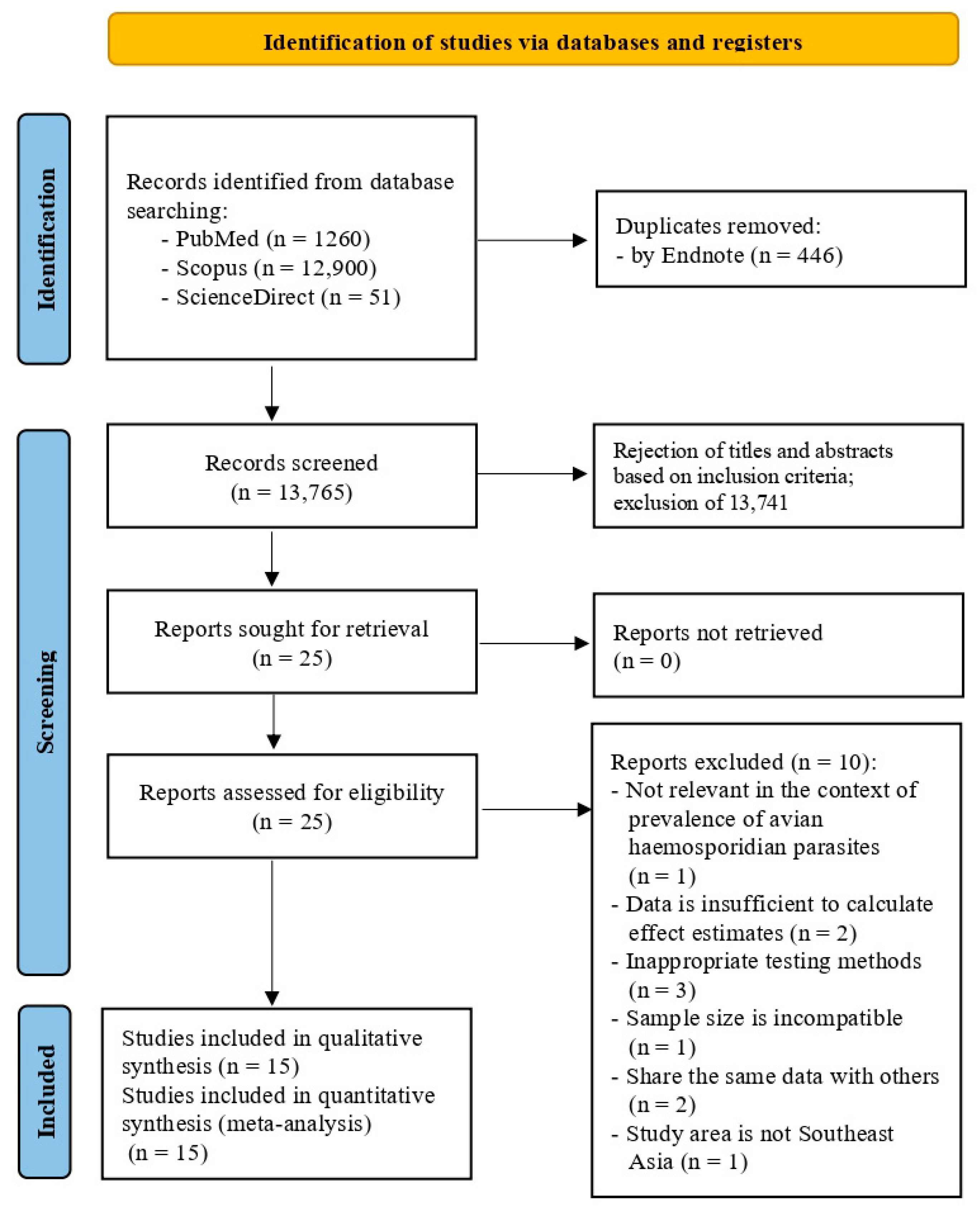
2.1. Study Protocol, Literature Search and Screening
2.2. Article Selection and Quality Assessment
2.3. Data Extraction
2.4. Statistical Analysis
3. Results
3.1. Characteristics of Included Studies (Table 1)

| Author | Year | Country | Region | Period of Study | PCR-Based Detection Method | Information of Birds | Information of Parasites | Positive Cases | Sample Size |
|---|---|---|---|---|---|---|---|---|---|
| Boonchuay et al. [39] | 2023 | Thailand | Mainland | 2021–2022 | HaemF-HaemR2 | Galliformes | P. gallinaceum | 7 | 57 |
| HaemF-HaemR2 | Galliformes | P. juxtanucleare | 5 | 57 | |||||
| HaemF-HaemR2 | Galliformes | Plasmodium sp. | 25 | 57 | |||||
| HaemFL-HaemR2L | Galliformes | L. schoutedeni | 6 | 57 | |||||
| HaemFL-HaemR2L | Galliformes | Leucocytozoon sp. | 45 | 57 | |||||
| Chatan et al. [40] | 2024 | Thailand | Mainland | 2022 | HaemF-HaemR2 | Galliformes | P. gallinaceum | 4 | 36 |
| HaemF-HaemR2 | Galliformes | P. juxtanucleare | 1 | 36 | |||||
| HaemF-HaemR2 | Galliformes | Plasmodium sp. | 20 | 36 | |||||
| HaemF-HaemR2 | Anseriformes | Plasmodium sp. | 12 | 80 | |||||
| Dhamayanti et al. [41] | 2023 | Indonesia | Maritime | 2022 | HaemOF-HaemOR | Galliformes | P. juxtanucleare | 21 | 60 |
| Ivanova et al. [42] | 2010 | Malaysia | Maritime | 2010 | HaemF-HaemR2 | Coraciiformes | Plasmodium sp. | 0 | 9 |
| HaemF-HaemR2 | Coraciiformes | Haemoproteus sp. | 1 | 9 | |||||
| HaemF-HaemR2 | Apodiformes | Plasmodium sp. | 0 | 1 | |||||
| HaemF-HaemR2 | Apodiformes | Haemoproteus sp. | 0 | 1 | |||||
| HaemF-HaemR2 | Columbiformes | Plasmodium sp. | 0 | 3 | |||||
| HaemF-HaemR2 | Columbiformes | Haemoproteus sp. | 1 | 3 | |||||
| HaemF-HaemR2 | Passeriformes | Plasmodium sp. | 4 | 62 | |||||
| HaemF-HaemR2 | Passeriformes | Haemoproteus sp. | 16 | 62 | |||||
| HaemF-HaemR2 | Piciformes | Plasmodium sp. | 0 | 4 | |||||
| HaemF-HaemR2 | Piciformes | Haemoproteus sp. | 1 | 4 | |||||
| Khumpim et al. [35] | 2021 | Thailand | Mainland | 2019–2020 | LsF2-LsR2 | Galliformes | L. sabrazesi | 252 | 313 |
| Lertwatcharasarakul et al. [43] | 2021 | Thailand | Mainland | 2012–2019 | HaemFL-HaemR2L | Accipitriformes | Lecucocytozoon sp. | 3 | 198 |
| HaemFL-HaemR2L | Strigiformes | Lecucocytozoon sp. | 5 | 202 | |||||
| Muriel et al. [44] | 2021 | Myanmar | Mainland | 2019 | HaemF-HaemR2 | Passeriformes | Plasmodium sp. | 3 | 120 |
| HaemF-HaemR2 | Passeriformes | Haemoproteus sp. | 8 | 120 | |||||
| HaemF-HaemR2 | Passeriformes | Haems/Plas * | 1 | 120 | |||||
| HaemF-HaemR2 | Pelecaniformes | Plasmodium sp. | 1 | 1 | |||||
| HaemF-HaemR2 | Pelecaniformes | Haemoproteus sp. | 0 | 1 | |||||
| HaemF-HaemR2 | Coraciiformes | Plasmodium sp. | 0 | 4 | |||||
| HaemF-HaemR2 | Coraciiformes | Haemoproteus sp. | 2 | 4 | |||||
| HaemF-HaemR2 | Cuculiformes | Plasmodium sp. | 0 | 1 | |||||
| HaemF-HaemR2 | Cuculiformes | Haemoproteus sp. | 0 | 1 | |||||
| HaemF-HaemR2 | Columbiformes | Plasmodium sp. | 0 | 1 | |||||
| HaemF-HaemR2 | Columbiformes | Haemoproteus sp. | 1 | 1 | |||||
| Noni and Tan [45] | 2023 | Malaysia | Maritime | 2021 | AE983-AE985 | Passeriformes | Plasmodium sp. | 14 | 29 |
| Piratae et al. [46] | 2021 | Thailand | Mainland | 2020 | HaemFL-HaemR2L | Galliformes | L. schoutedeni | 5 | 250 |
| HaemFL-HaemR2L | Galliformes | Lecucocytozoon sp. | 45 | 250 | |||||
| Pornpanom et al. [22] | 2019 | Thailand | Mainland | 2012–2018 | HaemF-HaemR2 | Strigiformes | Plasmodium sp. | 15 | 167 |
| HaemF-HaemR2 | Strigiformes | Haemoproteus sp. | 41 | 167 | |||||
| HaemF-HaemR2 | Strigiformes | Haem/Plas | 1 | 167 | |||||
| Pornpanom et al. [47] | 2021 | Thailand | Mainland | 2013–2019 | HaemF-HaemR2 | Accipitriformes | Plasmodium sp. | 5 | 198 |
| HaemF-HaemR2 | Accipitriformes | Haemoproteus sp. | 8 | 198 | |||||
| Prompiram et al. [48] | 2023 | Thailand | Mainland | 2018–2019 | HaemF-HaemR2 | Columbiformes | H. columbae | 24 | 87 |
| Subaneg et al. [49] | 2024 | Thailand | Mainland | 2020–2022 | HaemF-HaemR2 | Accipitriformes | Plasmodium sp. | 3 | 78 |
| HaemF-HaemR2 | Strigiformes | Plasmodium sp. | 1 | 31 | |||||
| Win et al. [50] | 2020 | Myanmar | Mainland | 2017–2020 | HaemFL-HaemR2L | Galliformes | Lecucocytozoon sp. | 81 | 461 |
| HaemF-HaemR2 | Galliformes | Haem/Plas | 158 | 461 | |||||
| Yuda [23] | 2019 | Indonesia | Maritime | 2009 | HaemF-HaemR2 | Pelecaniformes | Plasmodium sp. | 3 | 3 |
| HaemF-HaemR2 | Pelecaniformes | Haemoproteus sp. | 0 | 3 | |||||
| HaemFL-HaemR2L | Pelecaniformes | Lecucocytozoon sp. | 0 | 3 | |||||
| HaemF-HaemR2 | Charadriiformes | Plasmodium sp. | 3 | 40 | |||||
| HaemF-HaemR2 | Charadriiformes | Haemoproteus sp. | 0 | 40 | |||||
| HaemFL-HaemR2L | Charadriiformes | Lecucocytozoon sp. | 1 | 40 | |||||
| HaemF-HaemR2 | Columbiformes | Plasmodium sp. | 0 | 3 | |||||
| HaemF-HaemR2 | Columbiformes | Haemoproteus sp. | 0 | 3 | |||||
| HaemFL-HaemR2L | Columbiformes | Lecucocytozoon sp. | 0 | 3 | |||||
| HaemF-HaemR2 | Cuculiformes | Plasmodium sp. | 0 | 5 | |||||
| HaemF-HaemR2 | Cuculiformes | Haemoproteus sp. | 1 | 5 | |||||
| HaemFL-HaemR2L | Cuculiformes | Lecucocytozoon sp. | 0 | 5 | |||||
| HaemF-HaemR2 | Caprimulgiformes | Plasmodium sp. | 0 | 11 | |||||
| HaemF-HaemR2 | Caprimulgiformes | Haemoproteus sp. | 0 | 11 | |||||
| HaemFL-HaemR2L | Caprimulgiformes | Lecucocytozoon sp. | 0 | 11 | |||||
| HaemF-HaemR2 | Apodiformes | Plasmodium sp. | 0 | 14 | |||||
| HaemF-HaemR2 | Apodiformes | Haemoproteus sp. | 0 | 14 | |||||
| HaemFL-HaemR2L | Apodiformes | Lecucocytozoon sp. | 0 | 14 | |||||
| HaemF-HaemR2 | Coraciiformes | Plasmodium sp. | 0 | 2 | |||||
| HaemF-HaemR2 | Coraciiformes | Haemoproteus sp. | 0 | 2 | |||||
| HaemFL-HaemR2L | Coraciiformes | Lecucocytozoon sp. | 0 | ||||||
| HaemF-HaemR2 | Passerinformes | Plasmodium sp. | 1 | 34 | |||||
| HaemF-HaemR2 | Passerinformes | Haemoproteus sp. | 1 | 34 | |||||
| HaemFL-HaemR2L | Passerinformes | Lecucocytozoon sp. | 1 | 34 | |||||
| HaemF-HaemR2 | Galliformes | Plasmodium sp. | 0 | 10 | |||||
| HaemF-HaemR2 | Galliformes | Haemoproteus sp. | 0 | 10 | |||||
| HaemFL-HaemR2L | Galliformes | Lecucocytozoon sp. | 0 | 10 | |||||
| HaemF-HaemR2 | Aneriformes | Plasmodium sp. | 1 | 10 | |||||
| HaemF-HaemR2 | Aneriformes | Haemoproteus sp. | 0 | 10 | |||||
| HaemFL-HaemR2L | Aneriformes | Lecucocytozoon sp. | 0 | 10 |
3.2. The Crude Prevalence of Haemosporidian Parasites in Southeast Asia
3.3. Genetic Diversity of Haemosporidian Parasites in Southeast Asia
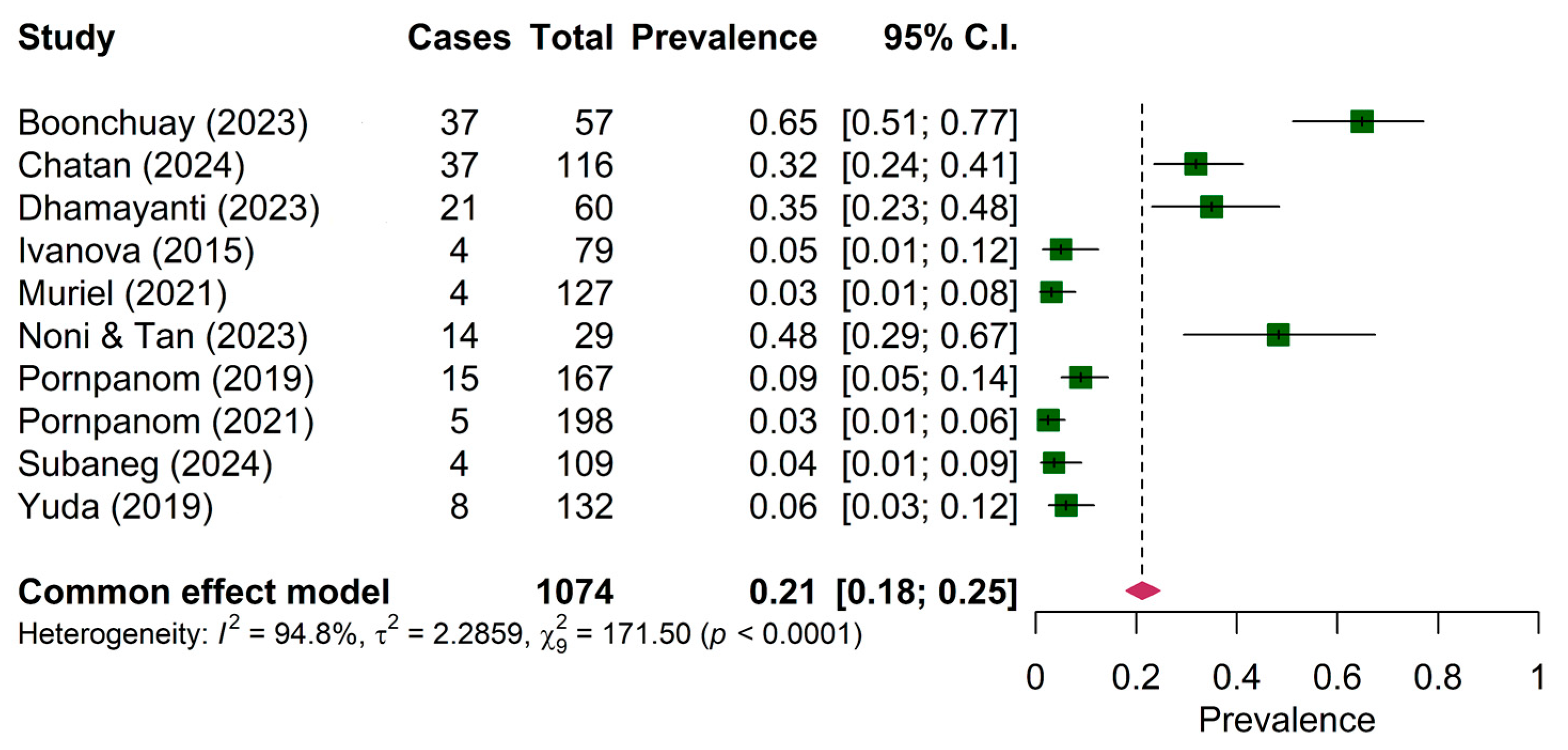
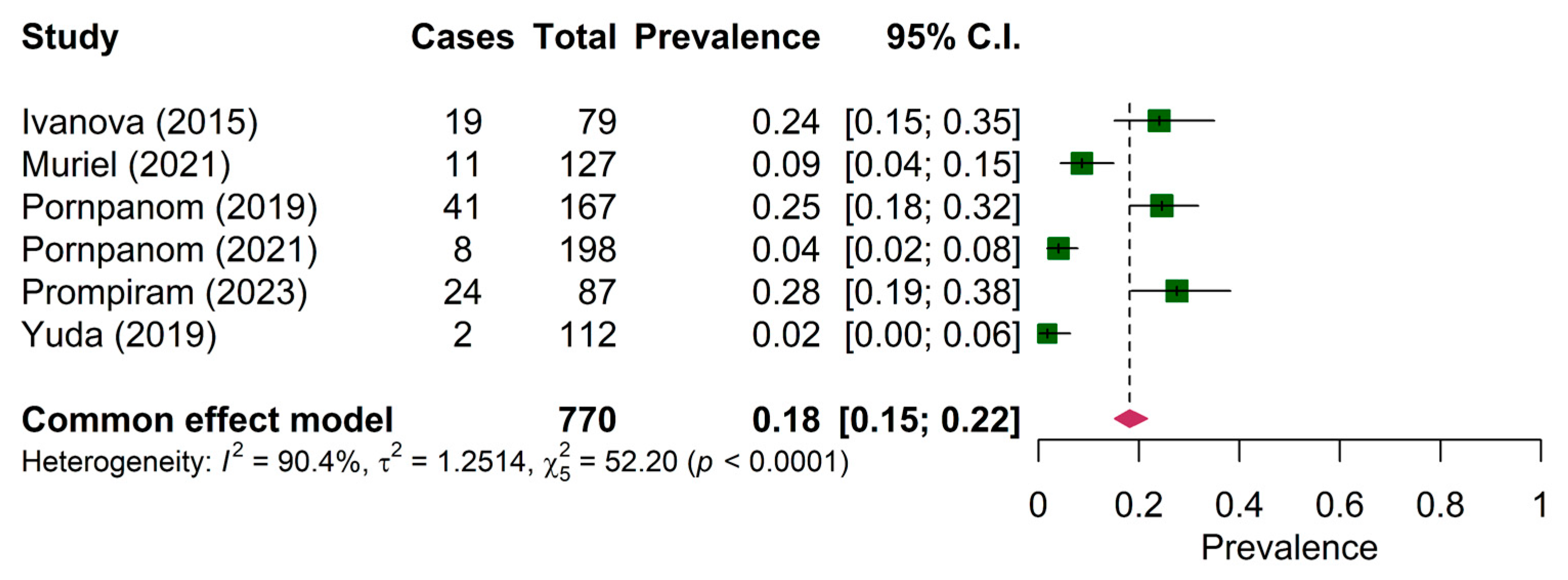
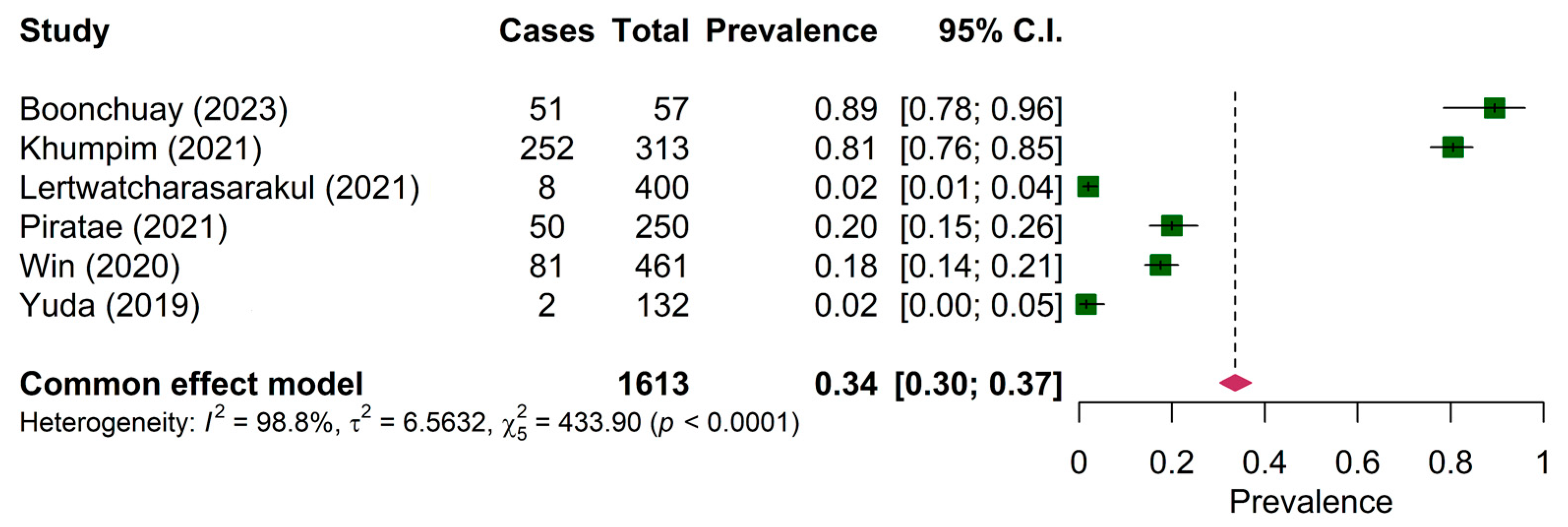
3.4. The Pooled Prevalence Estimate of Haemosporidian Parasites in Southeast Asia
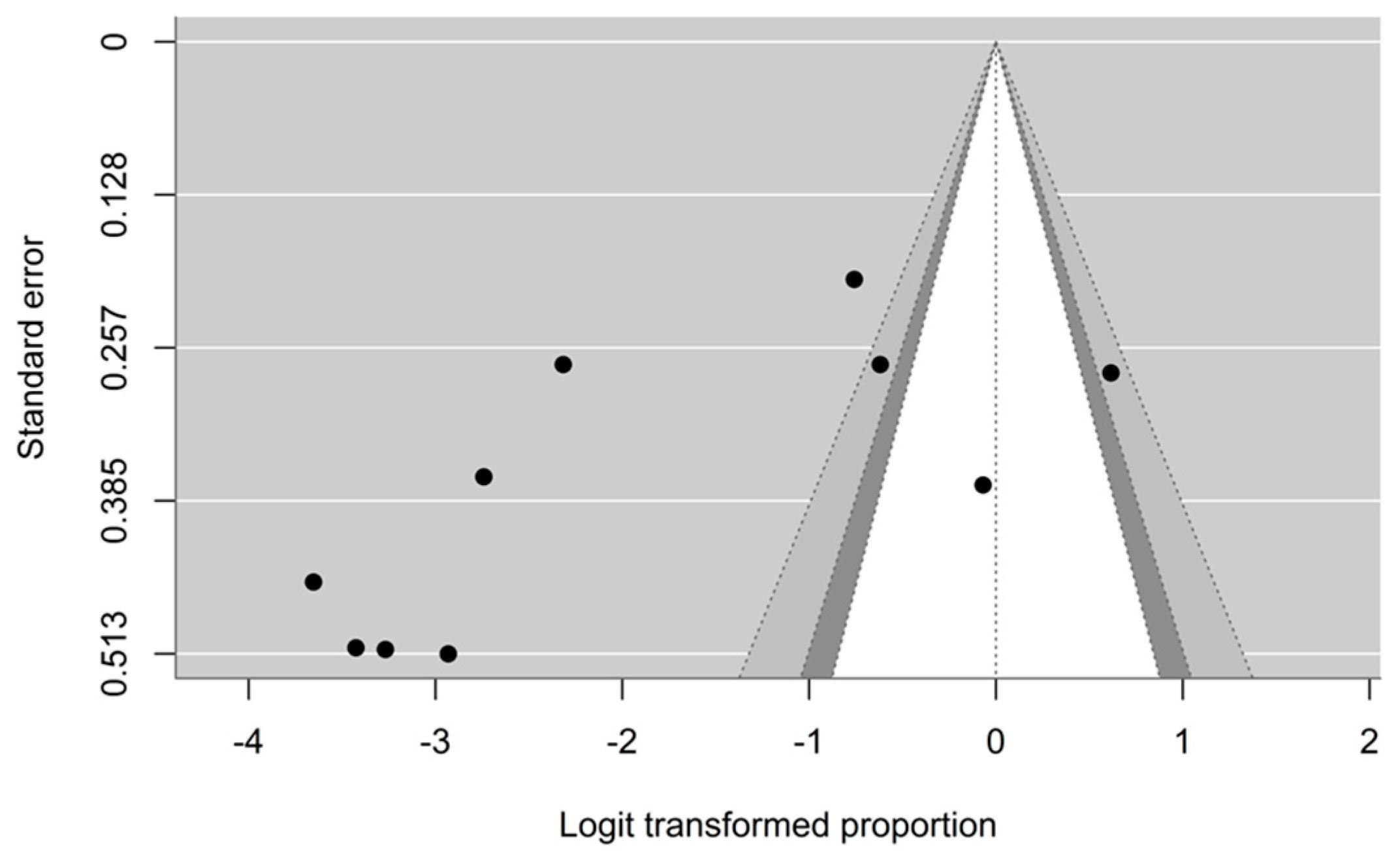
3.5. Publication Bias
4. Discussion
5. Conclusions
Supplementary Materials
Author Contributions
Funding
Institutional Review Board Statement
Informed Consent Statement
Data Availability Statement
Acknowledgments
Conflicts of Interest
References
- Valkiūnas, G. Avian Malaria Parasites and Other Haemosporidia; CRC Press: Boca Roton, FL, USA, 2005. [Google Scholar]
- Minichová, L.; Slobodník, V.; Slobodník, R.; Olekšák, M.; Hamšíková, Z.; Škultéty, L.; Špitalská, E. Detection of avian haemosporidian parasites in wild birds in Slovakia. Diversity 2024, 16, 121. [Google Scholar] [CrossRef]
- Valkiūnas, G.; Anwar, A.M.; Atkinson, C.T.; Greiner, E.C.; Paperna, I.; Peirce, M.A. What distinguishes malaria parasites from other pigmented haemosporidians? Trends Parasitol. 2005, 21, 357–358. [Google Scholar] [CrossRef] [PubMed]
- Valkiūnas, G.; Iezhova, T.A. Keys to the avian malaria parasites. Malar. J. 2018, 17, 212. [Google Scholar] [CrossRef] [PubMed]
- Valkiūnas, G.; Iezhova, T.A. Keys to the avian Haemoproteus parasites (Haemosporida, Haemoproteidae). Malar. J. 2022, 21, 269. [Google Scholar] [CrossRef]
- Valkiūnas, G.; Iezhova, T.A. Insights into the biology of Leucocytozoon Species (Haemosporida, Leucocytozoidae): Why is there slow research progress on agents of leucocytozoonosis? Microorganisms 2023, 11, 1251. [Google Scholar] [CrossRef]
- Bensch, S.; Stjerman, M.; Hasselquist, D.; Östman, Ö.; Hansson, B.; Westerdahl, H.; Pinheiro, R.T. Host specificity in avian blood parasites: A study of Plasmodium and Haemoproteus mitochondrial DNA amplified from birds. Proc. Roy. Soc. Lond. B 2000, 267, 1583–1589. [Google Scholar] [CrossRef]
- Hellgren, O.; WaldenstrÖm, J.; Bensch, S. A new PCR assay for simultaneous studies of Leucocytozoon, Plasmodium, and Haemoproteus from avain blood. J. Pasasitol. 2004, 90, 797–802. [Google Scholar] [CrossRef]
- Bensch, S.; Hellgren, O.; Pérez-Tris, J. MalAvi: A public database of malaria parasites and related haemosporidians in avian hosts based on mitochondrial cytochrome b lineages. Mol. Ecol. Resour. 2009, 9, 1353–1358. [Google Scholar] [CrossRef]
- Ilgūnas, M.; Palinauskas, V.; Platonova, E.; Lezhova, T.; Valkiūnas, G. The experimental study on susceptibility of common European songbirds to Plasmodium elongatum (lineage pGRW6), a widespread avian malaria parasite. Malar. J. 2019, 18, 290. [Google Scholar] [CrossRef]
- Williams, R.B. Avian malaria: Clinical and chemical pathology of Plasmodium gallinaceum in the domesticated fowl Gallus gallus. Avian. Pathol. 2005, 34, 29–47. [Google Scholar] [CrossRef]
- Ilgūnas, M.; Bukauskaitė, D.; Palinauskas, V.; Iezhova, T.; Fragner, K.; Platonova, E.; Weissenböck, H.; Valkiūnas, G. Patterns of Plasmodium homocircumflexum virulence in experimentally infected passerine birds. Malar. J. 2019, 18, 174. [Google Scholar] [CrossRef] [PubMed]
- Atkinson, C.T.; Woods, K.L.; Dusek, R.J.; Sileo, L.S.; Iko, W.M. Wildlife disease and conservation in Hawaii: Pathogenicity of avian malaria (Plasmodium relictum) in experimentally infected Iiwi (Vestiaria coccinea). Parasitology 1995, 111, S59–S69. [Google Scholar] [CrossRef] [PubMed]
- Ortiz-Catedral, L.; Brunton, D.; Stidworthy, M.; Elsheikha, H.M.; Pennycott, T.; Schulze, C.; Braun, M.; Wink, M.; Gerlach, H.; Pendl, H.; et al. Haemoproteus minutus is highly virulent for Australasian and South American parrots. Parasit. Vectors. 2019, 12, 40. [Google Scholar] [CrossRef] [PubMed]
- Lee, H.R.; Koo, B.-S.; Jeon, E.-O.; Han, M.-S.; Min, K.-C.; Lee, S.B.; Bae, Y.; Mo, I.-P. Pathology and molecular characterization of recent Leucocytozoon caulleryi cases in layer flocks. J. Biomed. Res. 2016, 30, 517–524. [Google Scholar]
- Yan, W.-L.; Sun, H.-T.; Zhao, Y.-C.; Hou, X.-W.; Zhang, M.; Zhao, Q.; Elsheikha, H.M.; Ni, H.-B. Global prevalence of Plasmodium infection in wild birds: A systematic review and meta-analysis. Res. J. Vet. Sci. 2024, 168, 105136. [Google Scholar] [CrossRef]
- Pattaradilokrat, S.; Tiyamaneea, W.; Simpalipana, P.; Kaewthamasornb, M.; Saiwichai, T.; Li, J.; Harnyuttanakorna, P. Molecular detection of the avian malaria parasite Plasmodium gallinaceum in Thailand. Vet. Parasitol. 2015, 210, 1–9. [Google Scholar] [CrossRef]
- Valkiūnas, G.; Iezhova, T.A. Exo-erythrocytic development of avian malaria and related haemosporidian parasites. Malar. J. 2017, 16, 101. [Google Scholar] [CrossRef]
- Gulliver, E.; Hunter, S.; Howe, L.; Castillo-Alcala, F. The pathology of fatal avian malaria due to Plasmodium elongatum (GRW6) and Plasmodium matutinum (LINN1) infection in New Zealand Kiwi (Apteryx spp.). Animals 2022, 12, 3376. [Google Scholar] [CrossRef]
- Yoshimoto, M.; Ozawa, K.; Kondo, H.; Echigoya, Y.; Shibuya, H.; Sato, Y.; Sehgal, R.N.M. A fatal case of a captive snowy owl (Bubo scandiacus) with Haemoproteus infection in Japan. Parasitol. Res. 2021, 120, 277–288. [Google Scholar] [CrossRef]
- Pohuang, T.; Jittimanee, S.; Junnu, S. Pathology and molecular characterization of Leucocytozoon caulleryi from backyard chickens in Khon Kaen Province, Thailand. Vet. World. 2021, 14, 2634–2639. [Google Scholar] [CrossRef]
- Pornpanom, P.; Fernandes Chagas, C.R.; Lertwatcharasarakul, P.; Kasorndorkbua, C.; Valkiūnas, G.; Salakij, C. Molecular prevalence and phylogenetic relationship of Haemoproteus and Plasmodium parasites of owls in Thailand: Data from a rehabilitation centre. Int. J. Parasitol. Parasites Wildl. 2019, 9, 248–257. [Google Scholar] [CrossRef] [PubMed]
- Yuda, P. Detection of avian malaria in wild birds at Trisik beach of Yogyakarta, Java (Indonesia). Ann. Parasitol. 2019, 65, 171–175. [Google Scholar] [PubMed]
- Moher, D.; Liberati, A.; Tetzlaff, J.; Altman, D.G.; Group, P. Preferred reporting items for systematic reviews and meta-Analyses: The PRISMA statement. PLoS Med. 2009, 6, e1000097. [Google Scholar] [CrossRef]
- Zhou, S.; Sang, Z.; Wang, L.; Zhang, T. Seroprevalence of Toxoplasma gondii in cats in mainland China 2016–2020: A meta-analysis. J. Vet. Sci. 2021, 23, e13. [Google Scholar] [CrossRef]
- R Core Team. R: A Language and Environment for Statistical Computing; R Foundation for Statistical Computing: Vienna, Austria, 2024. [Google Scholar]
- Wang, N. Conducting meta-analyses of proportions in R. J. Behav. Data Sci. 2023, 3, 64–126. [Google Scholar] [CrossRef]
- Huedo-Medina, T.B.; Sánchez-Meca, J.; Marín-Martínez, F.; Botella, J. Assessing heterogeneity in meta-analysis: Q statistic or I2 index? Psychol. Methods 2006, 11, 193–206. [Google Scholar] [CrossRef]
- Karadjian, G.; Martinsen, E.; Duval, L.; Chavatte, J.M.; Landau, I. Haemoproteus ilanpapernai n. sp. (Apicomplexa, Haemoproteidae) in Strix seloputo from Singapore: Morphological description and reassignment of molecular data. Parasite 2014, 21, 17. [Google Scholar] [CrossRef][Green Version]
- Prasopsom, P.; Salakij, C.; Lertwatcharasarakul, P.; Pornpranom, P. Hematological and phylogenetic studies of Leucocytozoon spp. in backyard chickens and fighting cocks around Kamphaeng Saen, Thailand. Agric. Nat. Resour. 2020, 54, 595–602. [Google Scholar]
- Vaisusuk, K.; Chatan, W.; Seerintra, T.; Piratae, S. High prevalence of Plasmodium Infection in fighting cocks in Thailand determined with a molecular method. J. Vet. Res. 2022, 66, 373–379. [Google Scholar] [CrossRef]
- Archawaranon, M. First report of Haemoproteus sp. in Hill Mynah blood in Thailand. Int. J. Poult. Sci. 2005, 4, 523–525. [Google Scholar]
- Ong, B.K.C.; Paller, V.G.V.; de Guia, A.P.O.; Balatibat, J.B.; Gonzalez, J.C.T. Prevalence of avian haemosporidians among understorey birds of Mt. Banahaw de Lucban, Philippines. Raffles Bull. Zool. 2015, 63, 279–286. [Google Scholar]
- Prompiram, P.; Kaewviyudth, S.; Sukthana, Y.; Rattanakorn, P. Study of morphological characteristic and prevalence of Haemoproteus blood parasite in passerines in bung boraphet. Thai J. Vet. Med. 2015, 45, 399–409. [Google Scholar] [CrossRef]
- Khumpim, P.; Chawengkirttikul, R.; Junsiri, W.; Watthanadirek, A.; Poolsawat, N.; Minsakorn, S.; Srionrod, N.; Anuracpreeda, P. Molecular detection and genetic diversity of Leucocytozoon sabrazesi in chickens in Thailand. Sci. Rep. 2021, 11, 16686, Erratum in Sci. Rep. 2024, 14, 3373. [Google Scholar] [CrossRef] [PubMed]
- Salakij, C.; Pornpanom, P.; Lertwatcharasarakul, P.; Kasorndorkbua, C.; Salakij, J. Haemoproteus in barn and collared scops owls from Thailand. J. Vet. Sci. 2018, 19, 280–289. [Google Scholar] [CrossRef] [PubMed]
- Chavatte, J.M.; Okumura, C.; Landau, I. Haematozoa of the great blue turacos, Corythaeola cristata (Vieillot, 1816) (Aves: Musophagiformes: Musophagidae) imported to Singapore jurong bird park with description and molecular characterisation of Haemoproteus (Parahaemoproteus) minchini new species (Apicomplexa: Haemosporidia: Haemoproteidae). Raffles Bull. Zool. 2017, 65, 325–340. [Google Scholar]
- Masello, J.F.; Martínez, J.; Calderón, L.; Wink, M.; Quillfeldt, P.; Sanz, V.; Theuerkauf, J.; Ortiz-Catedral, L.; Berkunsky, I.; Brunton, D.; et al. Can the intake of antiparasitic secondary metabolites explain the low prevalence of hemoparasites among wild Psittaciformes? Parasites Vectors 2018, 11, 357. [Google Scholar] [CrossRef]
- Boonchuay, K.; Thomrongsuwannakij, T.; Chagas, C.R.F.; Pornpanom, P. Prevalence and diversity of blood parasites (Plasmodium, Leucocytozoon and Trypanosoma) in backyard chickens (Gallus gallus domesticus) raised in Southern Thailand. Animals 2023, 13, 2798. [Google Scholar] [CrossRef]
- Chatan, W.; Khemthong, K.; Akkharaphichet, K.; Suwarach, P.; Seerintra, T.; Piratae, S. Molecular survey and genetic diversity of Plasmodium sp. infesting domestic poultry in Northeastern Thailand. J. Vet. Res. 2024, 68, 101–108. [Google Scholar] [CrossRef]
- Dhamayanti, E.; Priyowidodo, D.; Nurcahyo, W.; Firdausy, L.W. Morphological and molecular characteristics of Plasmodium juxtanucleare in layer chicken from three districts of Yogyakarta, Indonesia. Vet. World 2023, 16, 1576–1583. [Google Scholar] [CrossRef]
- Ivanova, K.; Zehtindjiev, P.; Mariaux, J.; Georgiev, B.B. Genetic diversity of avian haemosporidians in Malaysia: Cytochrome b lineages of the genera Plasmodium and Haemoproteus (Haemosporida) from Selangor. Infect. Genet. Evol. 2015, 31, 33–39. [Google Scholar] [CrossRef]
- Lertwatcharasarakul, P.; Salakij, C.; Prasopsom, P.; Kasorndorkbua, C.; Jakthong, P.; Santavakul, M.; Suwanasaeng, P.; Ploypan, R. Molecular and morphological analyses of Leucocytozoon parasites (Haemosporida: Leucocytozoidae) in raptors from Thailand. Acta Parasitol. 2021, 66, 1406–1416. [Google Scholar] [CrossRef] [PubMed]
- Muriel, J.; Marzal, A.; Magallanes, S.; García-Longoria, L.; Suarez-Rubio, M.; Bates, P.J.J.; Lin, H.H.; Soe, A.N.; Oo, K.S.; Aye, A.A.; et al. Prevalence and diversity of avian haemosporidians may vary with anthropogenic disturbance in tropical habitats in Myanmar. Diversity 2021, 13, 111. [Google Scholar] [CrossRef]
- Noni, V.; Tan, C.S. Prevalence of haemosporidia in Asian glossy starling with discovery of misbinding of Haemoproteus-specific primer to Plasmodium genera in Sarawak, Malaysian Borneo. BMC Vet. Res. 2023, 19, 66. [Google Scholar] [CrossRef] [PubMed]
- Piratae, S.; Vaisusuk, K.; Chatan, W. Prevalence and molecular identification of Leucocytozoon spp. in fighting cocks (Gallus gallus) in Thailand. Parasitol. Res. 2021, 120, 2149–2155. [Google Scholar] [CrossRef]
- Pornpanom, P.; Kasorndorkbua, C.; Lertwatcharasarakul, P.; Salakij, C. Prevalence and genetic diversity of Haemoproteus and Plasmodium in raptors from Thailand: Data from rehabilitation center. Int. J. Parasitol. Parasites Wildl. 2021, 16, 75–82. [Google Scholar] [CrossRef]
- Prompiram, P.; Mongkolphan, C.; Poltep, K.; Chunchob, S.; Sontigun, N.; Chareonviriyaphap, T. Baseline study of the morphological and genetic characteristics of Haemoproteus parasites in wild pigeons (Columba livia) from paddy fields in Thailand. Int. J. Parasitol. Parasites Wildl. 2023, 21, 153–159. [Google Scholar] [CrossRef]
- Subaneg, S.; Sitdhibutr, R.; Pornpanom, P.; Lertwatcharasarakul, P.; Ploypan, R.; Kiewpong, A.; Chatkaewchai, B.; To-adithep, N.; Kasorndorkbua, C. Molecular prevalence and haematological assessments of avian malaria in wild raptors of Thailand. Birds 2024, 5, 428–439. [Google Scholar] [CrossRef]
- Win, S.Y.; Chel, H.M.; Hmoon, M.M.; Htun, L.L.; Bawm, S.; Win, M.M.; Murata, S.; Nonaka, N.; Nakao, R.; Katakura, K. Detection and molecular identification of Leucocytozoon and Plasmodium species from village chickens in different areas of Myanmar. Acta Trop. 2020, 212, 105719. [Google Scholar] [CrossRef]
- Bukauskaite, D.; Ziegyte, R.; Palinauskas, V.; Iezhova, T.A.; Dimitrov, D.; Ilgunas, M.; Bernotiene, R.; Markovets, M.Y.; Valkiunas, G. Biting midges (Culicoides, Diptera) transmit Haemoproteus parasites of owls: Evidence from sporogony and molecular phylogeny. Parasites Vectors 2015, 8, 303. [Google Scholar] [CrossRef]
- LaPointe, D.A.; Goff, M.L.; Atkinson, C.T. Thermal constraints to the sporogonicdevelopment and altitudinal aistribution of avian malaria Plasmodium relictum in Hawai’i. J. Parasitol. Res. 2010, 96, 318–324. [Google Scholar] [CrossRef]
- Fallis, A.M.; Bennett, G.F. Sporogony of Leucocytozoon and Haemoproteus in simulids and ceratopogonids and a revised classification of the haemosporiida. Can. J. Zool. 1961, 39, 215–228. [Google Scholar] [CrossRef]
- Ammartsena, A.; Dittapan, S. The swiftlet house business in Thailand sustainable development goals: Study in the legal and policy. Environ. Sustain. Indic. 2023, 20, 100306. [Google Scholar] [CrossRef]
- Darbro, J.M.; Harrington, L.C. Avian defensive behavior and blood-feeding success of the West Nile vector mosquito, Culex pipiens. Behav. Ecol. 2007, 18, 750–757. [Google Scholar] [CrossRef]
- Praveen, J.; Nameer, P.O.; Karuthedathu, D.; Ramaiah, C.; Balakrishnan, B.; Rao, K.M.; Shurpali, S.; Puttaswamaiah, R.; Tavcar, I. On the vagrancy of the Himalayan Vulture Gyps himalayensis to southern India. Indian Birds 2024, 9, 19–22. [Google Scholar]
- Yong, D.L.; Kasorndorkbua, C. The status of the Himalayan Griffon Gyps himalayensis in South-East Asia. Forktail 2008, 24, 57–62. [Google Scholar]
- Yong, D.L.; Heim, W.; Chowdhury, S.U.; Choi, C.-Y.; Ktitorov, P.; Kulikova, O.; Kondratyev, A.; Round, P.D.; Allen, D.; Trainor, C.R.; et al. The state of migratory landbirds in the East Asian Flyway: Distributions, threats, and conservation needs. Front. Ecol. Evol. 2021, 9, 613172. [Google Scholar] [CrossRef]
- Sehgal, R.N.M.; Valkiunas, G.; Iezhova, T.A.; Smith, T.B. Blood parasites of chickens in Uganda and Cameroon with molecular descriptions of Leucocytozoon schoutedeni and Trypanosoma gallinarum. J. Pasasitol. 2006, 92, 1336–1343. [Google Scholar] [CrossRef]
- Valkiūnas, G.; Iezhova, T.-A.; Križanauskienė, A.; Palinauskas, V.; Sehgal, R.N.M.; Bensch, S. A comparative analysis of microscopy and PCR-based detection methods for blood parasites. J. Parasitol. 2008, 94, 1395–1401. [Google Scholar] [CrossRef]
- Page, M.J.; McKenzie, J.E.; Bossuyt, P.M.; Boutron, I.; Hoffmann, T.C.; Mulrow, C.D.; Shamseer, L.; Tetzlaff, J.M.; Akl, E.A.; Brennan, S.E.; et al. The PRISMA 2020 statement: An updated guideline for reporting systematic reviews. BMJ 2021, 372, n71. [Google Scholar] [CrossRef]


| No. | Studies | Selection Bias a | Performance Bias | Detection Bias | Reporting Bias | Total Scores b | |||
|---|---|---|---|---|---|---|---|---|---|
| Domain 1 | Domain 2 | Domain 3 | Domain 4 | Domain 5 | Domain 6 | Domain 7 | |||
| 1 | Boonchuay et al. (2023) [39] | Low risk | Low risk | Low risk | Low risk | Low risk | Uncertain | Low risk | 13 |
| 2 | Chatan et al. (2024) [40] | Low risk | Low risk | Low risk | Low risk | Low risk | Uncertain | Low risk | 13 |
| 3 | Dhamayanti et al. (2023) [41] | Low risk | Low risk | Low risk | Low risk | Low risk | Uncertain | High risk | 11 |
| 4 | Ivanova et al. (2015) [42] | Low risk | Low risk | Low risk | Low risk | Low risk | Uncertain | Low risk | 13 |
| 5 | Khumpim et al. (2021) [35] | Low risk | Low risk | Low risk | Low risk | Low risk | Uncertain | Low risk | 13 |
| 6 | Lertwatcharasarakul et al. (2021) [43] | Low risk | Low risk | Low risk | Low risk | Low risk | Uncertain | Low risk | 13 |
| 7 | Muriel et al. (2021) [44] | Low risk | Low risk | Low risk | Low risk | Low risk | Uncertain | Low risk | 13 |
| 8 | Noni and Tan (2023) [45] | Low risk | Low risk | Low risk | Low risk | High risk | Uncertain | Low risk | 11 |
| 9 | Piratae et al. (2021) [46] | Low risk | Low risk | Low risk | Low risk | Low risk | Uncertain | Low risk | 13 |
| 10 | Pornpanom et al. (2019) [22] | Low risk | Low risk | Low risk | Low risk | Low risk | Uncertain | Low risk | 13 |
| 11 | Pornpanom et al. (2021) [47] | Low risk | Low risk | Low risk | Low risk | Low risk | Uncertain | Low risk | 13 |
| 12 | Prompiram et al. (2023) [48] | Low risk | Low risk | Low risk | Low risk | Low risk | Uncertain | Low risk | 13 |
| 13 | Subaneg et al. (2024) [49] | Low risk | Low risk | Low risk | Low risk | Low risk | Uncertain | Low risk | 13 |
| 14 | Win et al. (2020) [50] | Low risk | Low risk | Low risk | Low risk | Low risk | Uncertain | Low risk | 13 |
| 15 | Yuda et al. (2019) [23] | Low risk | Low risk | Low risk | Low risk | Low risk | Uncertain | Low risk | 13 |
| Studies | Country | Birds (Order) | Parasites | Lineages a |
|---|---|---|---|---|
| Boonchuay et al. (2023) [39] | Thailand | Galliformes | Plasmodium gallinaceum | GALLUS01 |
| Galliformes | Plasmodium Juxtanucleare | GALLUS02 | ||
| Galliformes | Plasmodium sp. | TSUB01, GALLUS47, GALLUS48 and GALLUS49 | ||
| Galliformes | Lecucocytozoon schoutedeni | GALLUS06 and GALLUS07 | ||
| Galliformes | Lecucocytozoon sp. | GALLUS17, GALLUS50. GALLUS51, GALLUS52, GALLUS53, GALLUS54, GALLUS55, GALLUS56, GALLUS57, GALLUS58, GALLUS59, GALLUS60, GALLUS61 and GALLUS62 | ||
| Chatan et al. (2024) [40] | Thailand | Galliformes | Plasmodium gallinaceum | GALLUS01 |
| Galliformes | Plasmodium Juxtanucleare | GALLUS02 | ||
| Galliformes | Plasmodium sp. | ACCBAD01 and ORW1 | ||
| Anseriformes | Plasmodium sp. | ACCBAD01, ORW1 and FANTAIL01 | ||
| Ivanova et al. (2015) [42] | Malaysia | Passeriformes | Plasmodium sp. | ENRUF01, TRICRI01, ENRUF02 and NILSUN01 |
| Coraciiformes | Haemoproteus sp. | LACPUL01 | ||
| Columbiformes | Haemoproteus sp. | CHAIND02 | ||
| Passeriformes | Haemoproteus sp. | COLI2, LACPUL01, PELCAP01, IOOLI01, PYCCYA01, PYCBRU01, COPMAL03. DICTRI01, PYCMEL02 and YWT2 | ||
| Piciformes | Haemoproteus sp. | MEGHEN01 | ||
| Lertwatcharasarakul et al. (2021) [43] | Thailand | Accipitriformes | Lecucocytozoon sp. | ACCTRI01 and CIAE02 |
| Strigiformes | Lecucocytozoon sp. | BUBSUM01, NINOX08 and ASIFLA01 | ||
| Muriel et al. (2021) [44] | Myanmar | Passeriformes | Plasmodium sp. | FANTAIL01 and ORW1 |
| Pelecaniformes | Plasmodium sp. | IXOMIN02 | ||
| Passeriformes | Haemoproteus sp. | AFR084, TURSTR02 and FIPAR02 | ||
| Columbiformes | Haemoproteus sp. | HAECOL1 | ||
| Noni and Tan (2023) [45] | Malaysia | Passeriformes | Plasmodium sp. | FANTAIL01, COLL4 and ACCBAD01 |
| Pornpanom et al. (2019) [22] | Thailand | Strigiformes | Plasmodium sp. | ACCBAD01, FANTAIL01, GLACUC05, GLACUC06, GLACUC07, GLACUC08, MILANS06, NISCU2, ORW1, OTULET03 and TEPON02 |
| Strigiformes | Haemoproteus sp. | ATHBRA01, GLACUC03, GLACUC04, NINOX07, OTULET01, OTULET02, PHOBAD01, TYTAL3, TYTAL4, TYTAL5, TYTAL6 and TYTAL7 | ||
| Pornpanom et al. (2021) [47] | Thailand | Accipitriformes | Plasmodium sp. | ACCBAD01, AEGMO03, GLACUC08, MILANS06 and ORW1 |
| Accipitriformes | Haemoproteus sp. | ACCBAD02, NISALB01, NISALB02, OTUSCO02, TYTAL4 and TYTAL6 | ||
| Prompiram et al. (2023) [48] | Thailand | Columbiformes | Haemoproteus columbae | HAECOL1, COLIV03 and COQUI05 |
| Variable | Category | No. Studies | No. Examined | No. Positive | Pooled Prevalence (95% CI) | Heterogeneity | Meta-Regression | ||
|---|---|---|---|---|---|---|---|---|---|
| Q (χ2) | p-Value | I2 (%) | p-Value | ||||||
| Plasmodium sp. | |||||||||
| Regions | Mainland | 7 | 607 | 87 | 14.33 (11.55–17.12) | 152.28 | <0.0001 | 95.40 | 0.2430 |
| Maritime | 4 | 271 | 33 | 12.18 (8.28–16.07) | 31.45 | <0.0001 | 87.28 | ||
| Host species | Domestic poultry | 4 | 253 | 96 | 37.94 (37.97–43.92) | 23.52 | <0.0001 | 83.00 | <0.0001 |
| Wild birds | 7 | 821 | 53 | 6.46 (4.77–8.14) | 57.67 | <0.0001 | 87.86 | ||
| Haemoproteus sp. | |||||||||
| Regions | Mainland | 4 | 549 | 84 | 19.89 (16.23–24.14) | 51.79 | <0.0001 | 94.21 | <0.0001 |
| Maritime | 2 | 191 | 21 | 10.99 (6.56–15.43) | NA | NA | NA | ||
| Leucocytozoon sp. | |||||||||
| Regions | Mainland | 5 | 1481 | 442 | 29.84 (27.51–32.18) | 414.66 | <0.001 | 98.79 | NA |
| Maritime | 1 | 132 | 2 | 1.52 (0.00–3.60) | NA | NA | NA | ||
| Host species | Domestic poultry | 4 | 1081 | 434 | 40.15 (37.23–43.07) | 323.22 | <0.001 | 98.76 | NA |
| Wild birds | 2 | 512 | 10 | 1.95 (0.75–3.15) | NA | NA | NA | ||
Disclaimer/Publisher’s Note: The statements, opinions and data contained in all publications are solely those of the individual author(s) and contributor(s) and not of MDPI and/or the editor(s). MDPI and/or the editor(s) disclaim responsibility for any injury to people or property resulting from any ideas, methods, instructions or products referred to in the content. |
© 2025 by the authors. Licensee MDPI, Basel, Switzerland. This article is an open access article distributed under the terms and conditions of the Creative Commons Attribution (CC BY) license (https://creativecommons.org/licenses/by/4.0/).
Share and Cite
Swangneat, K.; Srikacha, N.; Soulinthone, N.; Paudel, S.; Srisanyong, W.; Stott, C.J.; Mahawan, T.; Pornpanom, P. Molecular Prevalence of Avian Haemosporidian Parasites in Southeast Asia: Systematic Review and Meta-Analysis. Animals 2025, 15, 636. https://doi.org/10.3390/ani15050636
Swangneat K, Srikacha N, Soulinthone N, Paudel S, Srisanyong W, Stott CJ, Mahawan T, Pornpanom P. Molecular Prevalence of Avian Haemosporidian Parasites in Southeast Asia: Systematic Review and Meta-Analysis. Animals. 2025; 15(5):636. https://doi.org/10.3390/ani15050636
Chicago/Turabian StyleSwangneat, Kannawee, Nikom Srikacha, Nittakone Soulinthone, Surya Paudel, Wilasinee Srisanyong, Christopher James Stott, Tanakamol Mahawan, and Pornchai Pornpanom. 2025. "Molecular Prevalence of Avian Haemosporidian Parasites in Southeast Asia: Systematic Review and Meta-Analysis" Animals 15, no. 5: 636. https://doi.org/10.3390/ani15050636
APA StyleSwangneat, K., Srikacha, N., Soulinthone, N., Paudel, S., Srisanyong, W., Stott, C. J., Mahawan, T., & Pornpanom, P. (2025). Molecular Prevalence of Avian Haemosporidian Parasites in Southeast Asia: Systematic Review and Meta-Analysis. Animals, 15(5), 636. https://doi.org/10.3390/ani15050636