Embryonic Development and Growth Performance of the Tomato Hind Grouper (Cephalopholis sonnerati): A New Cultivated Aquaculture Species
 ,
,  ,
, 
Simple Summary
Abstract
1. Introduction
2. Materials and Methods
2.1. Experimental Materials
2.1.1. Fertilized Egg Acquisition and Incubation
2.1.2. Larval Rearing and Grow-Out
2.2. Sampling and Observation
2.3. Calculations Using Formulas
2.4. Statistics
3. Results
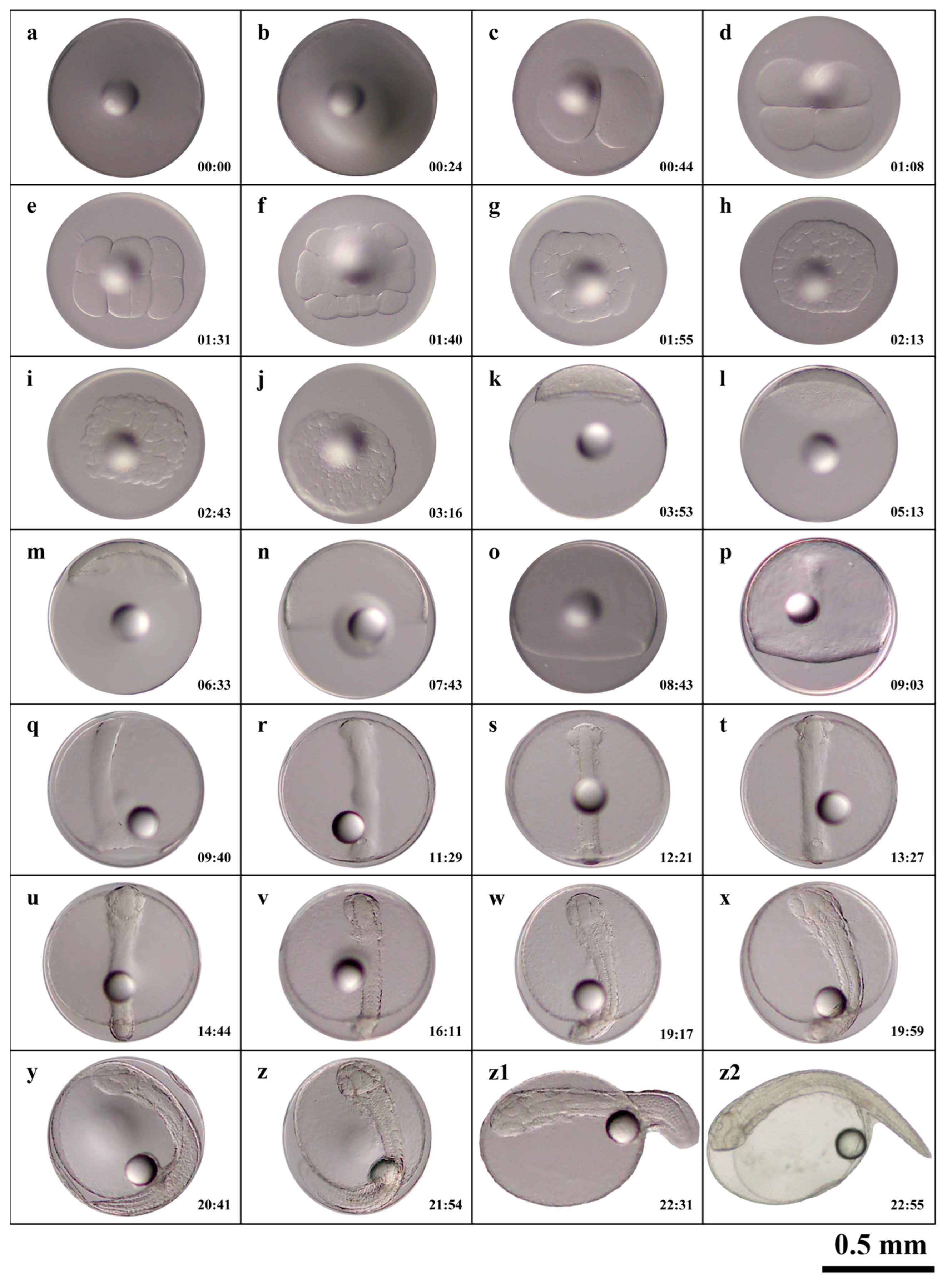
3.1. Embryonic Development Observation
3.1.1. Cleavage Stage
3.1.2. Blastula Stage
3.1.3. Gastrula Stage
3.1.4. Neurula Stage
3.1.5. Organogenesis Stage
3.1.6. Hatching Stage
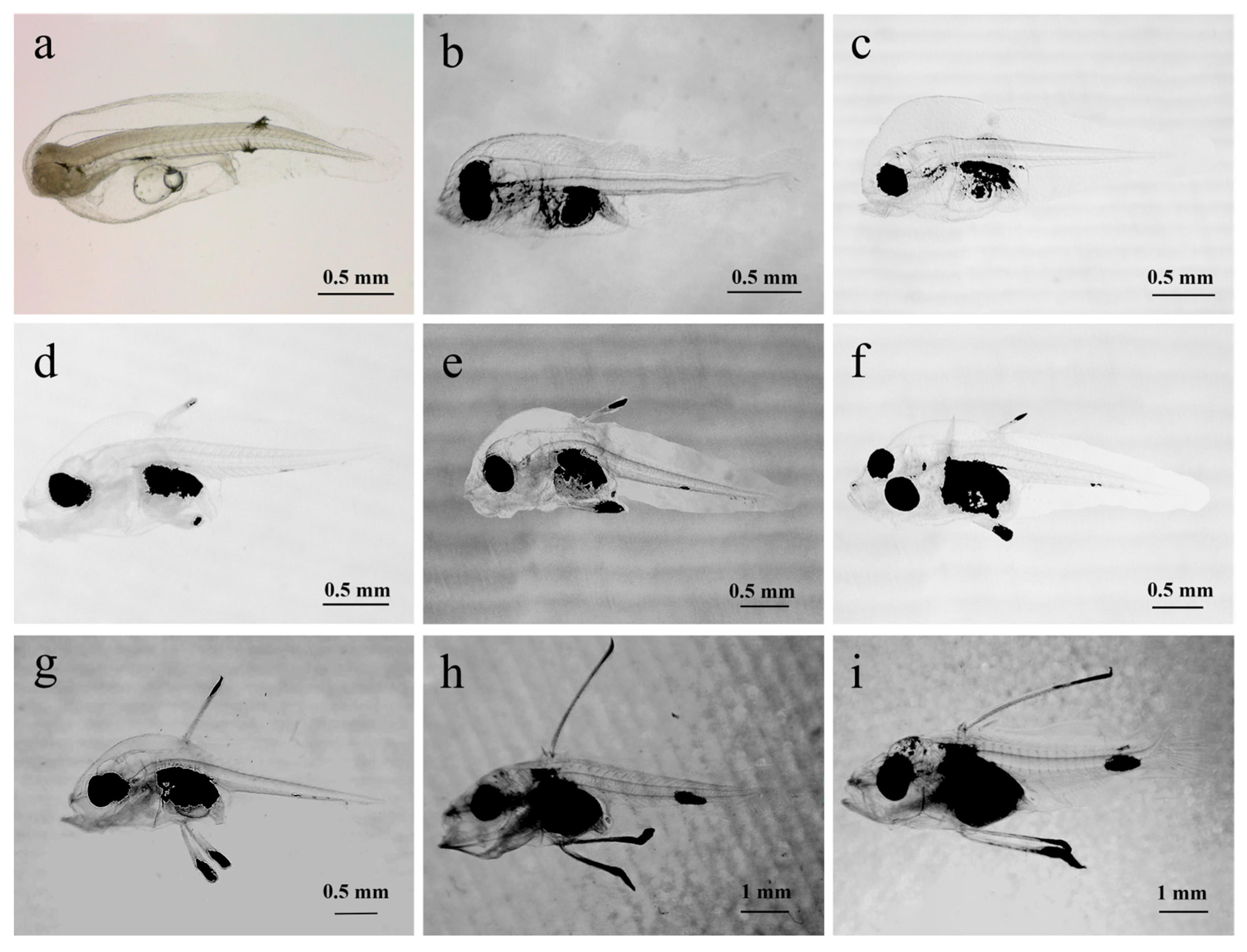
3.2. Larvae Characteristics
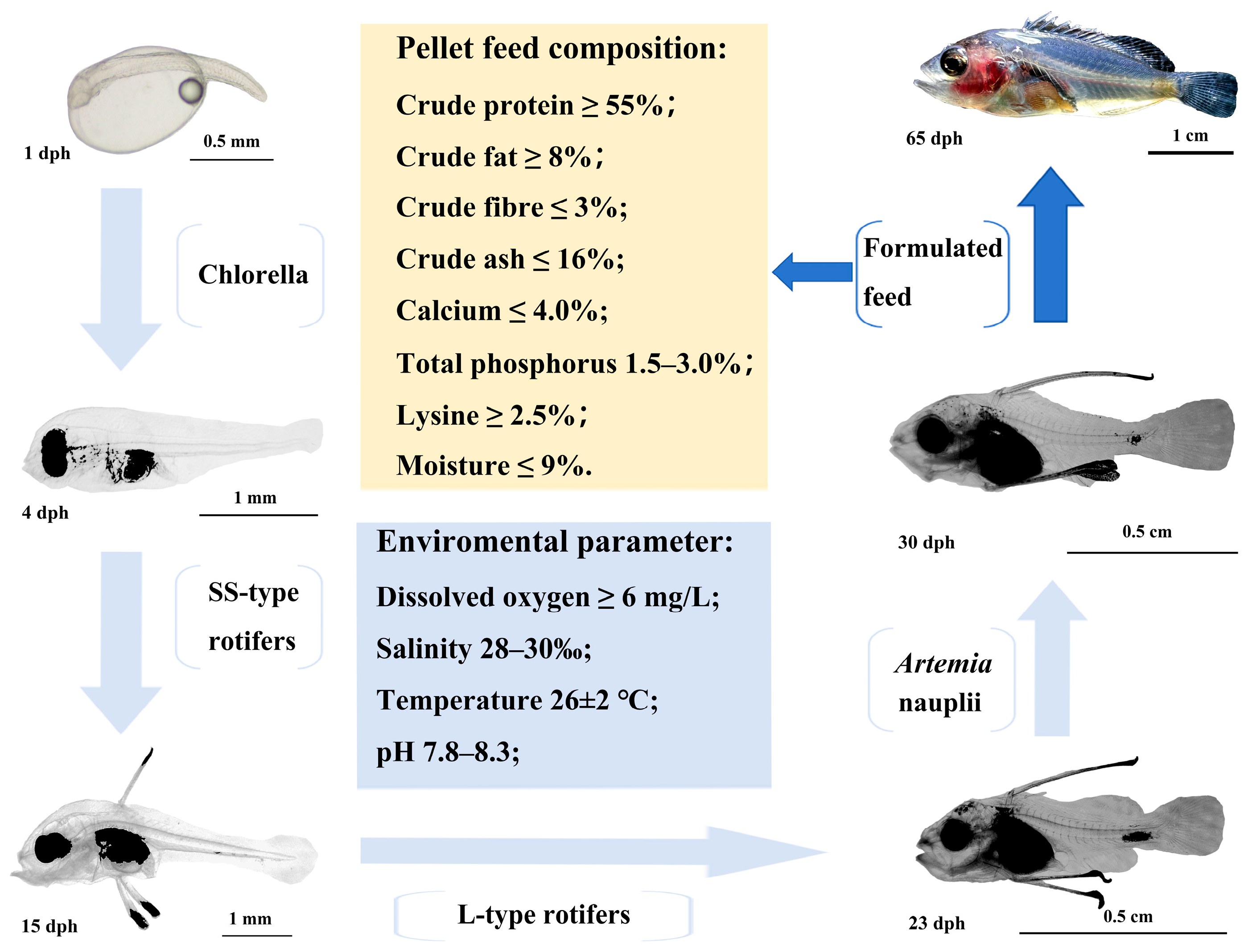
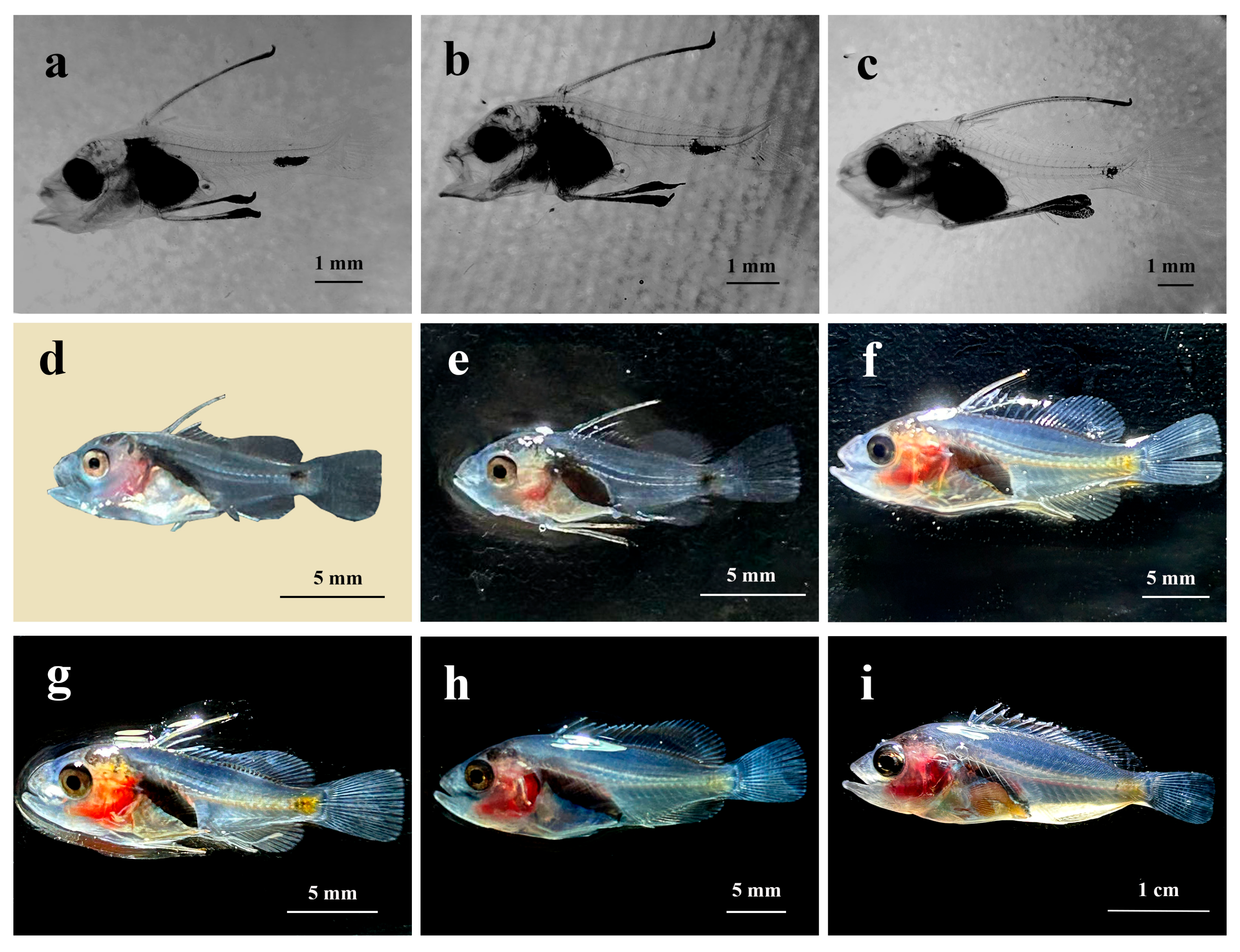
3.3. Observations on Larval Feed Transition and Growth and Development
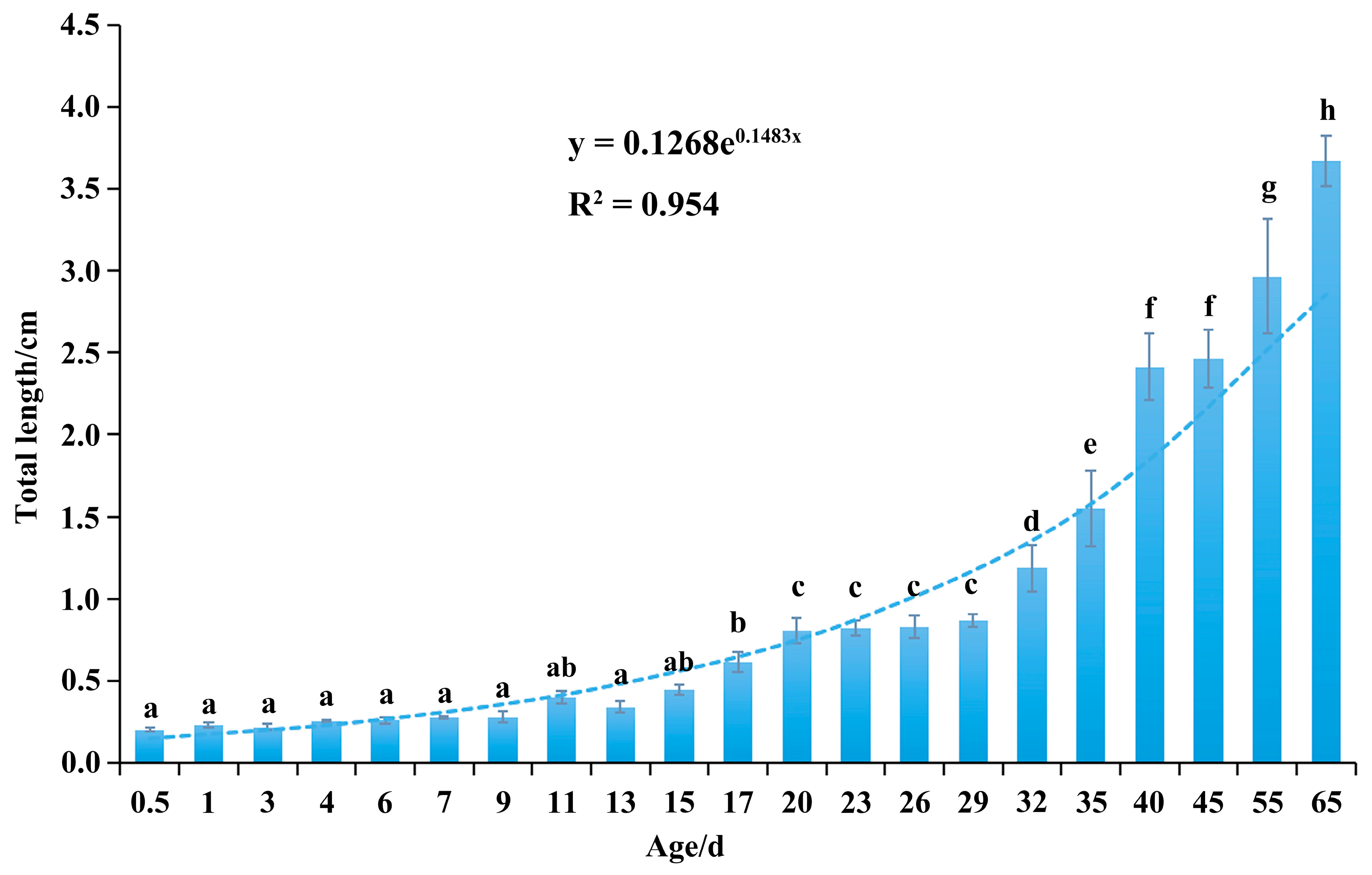
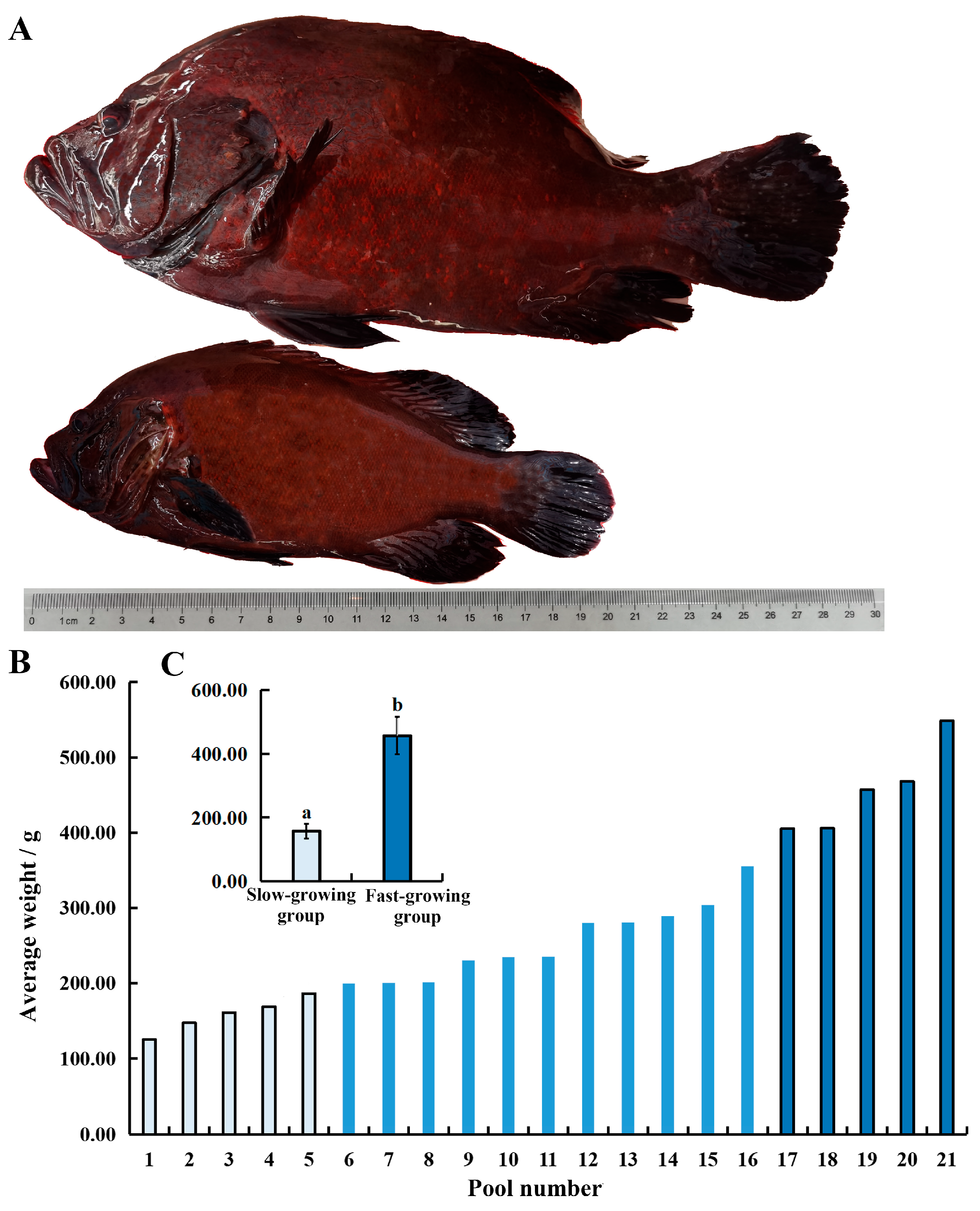
3.4. Evaluating Growth Performance
4. Discussion
4.1. Embryonic Development Evaluation
4.2. Growth Performance Evaluation
5. Conclusions
Author Contributions
Funding
Institutional Review Board Statement
Informed Consent Statement
Data Availability Statement
Conflicts of Interest
References
- Suo, X.; Yan, X.; Tan, B.; Pan, S.; Li, T.; Liu, H.; Huang, W.; Zhang, S.; Yang, Y.; Dong, X. Lipid Metabolism Disorders of Hybrid Grouper (♀Epinephelus fuscointestinestatus × ♂E. lanceolatu) Induced by High-Lipid Diet. Front. Mar. Sci. 2022, 9, 990193. [Google Scholar] [CrossRef]
- Chen, C.; Kong, X.; Li, Y.; Song, Z.; Jia, R.; Yu, H.; Zhai, J.; Ma, W.; Pang, Z.; Liu, J. Embryonic and Morphological Development in the Larva, Juvenile, and Young Stages of Epinephelus fuscoguttatus (♀) × E. lanceolatus (♂). Mar. Fish. Res. 2014, 35, 135–144. [Google Scholar]
- Wang, L.; Tian, Y.; Tang, J.; Li, Z.; Cheng, M.; Ma, W.; Mao, D.; Lin, H.; Zhai, J. Analysis and quality evaluation of nutritional components in the muscle of Epinehelus moara, E. lanceolatus and hybrid”Yunlong grouper”. J. Fish. China 2018, 42, 1085–1093. [Google Scholar]
- Moravec, F.; Justine, J.-L. New Records of Species of Philometra (nematoda: Philometridae) from Marine Fishes off New Caledonia, Including P. cephalopholidis sp. N. from Cephalopholis sonnerati (Serranidae). Parasitol. Res. 2015, 114, 3223–3228. [Google Scholar] [CrossRef]
- Lu, S.; Liu, Y.; Li, M.; Ge, Q.; Wang, C.; Song, Y.; Zhou, B.; Chen, S. Gap-free Telomere-to-telomere Haplotype Assembly of the Tomato Hind (Cephalopholis sonnerati). Sci. Data 2024, 11, 1268. [Google Scholar] [CrossRef]
- Xie, Z.; Wang, D.; Jiang, S.; Peng, C.; Wang, Q.; Huang, C.; Li, S.; Lin, H.; Zhang, Y. Chromosome-Level Genome Assembly and Transcriptome Comparison Analysis of Cephalopholis sonnerati and Its Related Grouper Species. Biology 2022, 11, 1053. [Google Scholar] [CrossRef]
- Fang, F.; Gong, Z.; Guo, C.; Wang, C.; Ding, L.; Zhou, B.; Chen, S. Establishment of an Ovarian Cell Line from Tomato Grouper (Cephalopholis sonnerati) and Its Transcriptome Response to ISKNV Infection. Fish Shellfish Immunol. 2025, 162, 110304. [Google Scholar] [CrossRef]
- Li, C.; Wang, C.; Liu, S.; Fang, F.; Zhou, B.; Hu, Q.; Sun, C.; Zhang, Y.; Chen, S. Establishment of a New Intestinal Cell Line of the Grouper (Cephalopholis sonnerati) and Immune Response to Vibrio Harveyi Infection. Fish Shellfish Immunol. 2025, 168, 110953. [Google Scholar] [CrossRef]
- Mohan, P.J.; Anil, M.K.; Gopalakrishnan, A.; Joseph, S.; Pillai, D.; Fazula, A.M.; Prasannan, P.P. Unraveling the Spawning and Reproductive Patterns of Tomato Hind Grouper, Cephalopholis sonnerati (valenciennes, 1828) from South Kerala Waters. J. Fish Biol. 2024, 105, 186–200. [Google Scholar] [CrossRef]
- Lin, Y.R.; Liao, T.Y.; Nan, F.H.; Chu, Y.T. Astaxanthin Supplementation in Cephalopholis sonnerati: Effects on Coloration, and Immunity. Taiwan Fish. Soc. J. 2025, 52, 75–88. [Google Scholar]
- Dalpathadu, K.R.; Haputhantri, S.S.K. Sustainability Status of the Fishery for Cephalopholis sonnerati (tomato Hind) in Sri Lankan Waters: A Length-Based Assessment of Survival and Management Needs. Thalassas 2024, 41, 29. [Google Scholar] [CrossRef]
- Aoki, R.; Matsumasa, T.; Kumada, T.; Jin, N.; Masuma, S. Hatchability and growth performance of F1, F2, and backcross progenies of Epinephelus bruneus and Epinephelus lanceolatus. Aquac. Int. 2025, 33, 291. [Google Scholar] [CrossRef]
- Gong, S.; Wang, T.; Cai, C.; Cai, J.; Yang, Y.; Zhong, C.; Wu, X.; Tao, Y.; Zeng, L.; Wei, Q.; et al. Development and characterization of a novel intergeneric hybrid grouper (Cromileptes altivelis♀ × Epinephelus lanceolatus♂). Aquaculture 2025, 595, 741493. [Google Scholar] [CrossRef]
- Jiao, X.; Ding, T.; Tian, Y.; Guo, Y.; Wang, Y.; Wang, S.; Zhang, C.; Yang, F.; Wang, L.; Li, Z.; et al. Comparative Analysis of Embryonic Development and Mitochondrial Genome of a New Intergeneric Hybrid Grouper (Epinephelus fasciatus ♀ × Plectropomus leopardus ♂). Animals 2025, 15, 3445. [Google Scholar] [CrossRef]
- Yan, F.; Wang, C.; Zhu, Y.; Wu, J.; Yang, J.; Gan, S.; Lin, H.R.; Zhang, Y.; Li, S. Transcriptome analysis reveals the dynamics of gene expression during early embryonic development of hybrid groupers. Aquaculture 2025, 596, 741746. [Google Scholar] [CrossRef]
- Liu, Y.; Tian, Y.; Wang, L.; Li, Z.; Zhang, J.; Wu, Y.; Chen, S.; Li, L.; Li, W.; Ma, W.; et al. Construction of High-Density Linkage Maps and QTL Mapping for Growth-Related Traits in F1 Hybrid Yunlong Grouper (Epinephelus moara♀ × E. lanceolatus♂). Aquaculture 2022, 548, 737698. [Google Scholar] [CrossRef]
- Ojanguren, A.; Brana, F. Thermal Dependence of Embryonic Growth and Development in Brown Trout. J. Fish Biol. 2003, 62, 580–590. [Google Scholar] [CrossRef]
- Ching, F.F.; Othman, N.; Anuar, A.; Shapawi, R.; Senoo, S. Natural Spawning, Embryonic and Larval Development of F2 Hybrid Grouper, Tiger Grouper Epinephelus fuscoguttatus × Giant Grouper E. lanceolatus. Int. Aquat. Res. 2018, 10, 391–402. [Google Scholar] [CrossRef]
- Zhou, L.; Weng, W.M.; Li, J.L.; Lai, Q.M. Studies on Embryonic Development, Morphological Development and Feed Changeover of Epinephelus lanceolatus Larva. Chin. Agric. Sci. Bull. 2010, 26, 293–302. [Google Scholar]
- Wang, Y.B.; Chen, G.H.; Lin, B. Artificially induced spawning and embryonic development observation of the Plectropomus leopardus Lacépède. Mar. Sci. 2009, 33, 21–26. [Google Scholar]
- Zhang, T.T.; Chen, C.; Shi, Z.H.; Li, Y.; Yu, H.; Ren, B.; Xu, W. Effects of Temperature on the Embryonic Development and Larval Activity of Epinephelus moara. Mar. Fish. Res. 2016, 37, 28–33. [Google Scholar]
- Yu, H.; Li, Y.; Chen, C.; Jia, R.; Kong, X.; Zhai, J. The Effects of Temperature on the Embryonic Development and the Larval Activity of F1 Epinephelus moara (♀) × E. septemfasciatus (♂). Mar. Fish. Res. 2014, 35, 109–114. [Google Scholar]
- Alam, M.R.; Sharmin, S.; Islam, S.M.; Alam, M.A.; Ehiguese, F.O.; Pattadar, S.N.; Shahjahan, M. Salinity Intrusion Affects Early Development of Freshwater Aquaculture Species Pabda, Ompok Pabda. Aquac. Rep. 2020, 18, 100476. [Google Scholar] [CrossRef]
- Chen, S.; Tian, Y.; Li, Z.; Li, Z.; Zhang, J.; Wang, L.; Wu, Y.; Cheng, M.; Yuan, S.; Pang, Z.; et al. Metamorphosis and skeletal development of hybrid Epinephelus awoara (♀) and Epinephelus tukula (♂) progenies. Aquaculture 2021, 530, 735727. [Google Scholar] [CrossRef]
- Zhou, Q.; Yu, D.; Gao, T.; Guan, S. Studies on the Early Morphological Development and Breeding of Larval, Juvenile and Young Fish of Epinephelus septemfasciatus. Mar. Sci. 2014, 38, 58–68. [Google Scholar]
- Tang, X.; Liu, X.; Lin, H. The development of thyroid of orange-spotted grouper (Epinephelus coioides) larvae during metamorphosis. Acta Hydrobiol. Sin. 2010, 34, 210–214. [Google Scholar] [CrossRef]
- Cheng, M.; Tian, Y.; Wang, Y.; Liu, S.; Guo, B.; Lin, H.; Li, G. Analysis of Metamorphosis Development and Growth Characteristics of Hybrid Offspring of Epinephelus lanceolatus♀ × Epinephelus tukula♂. Acta Oceanol. Sin. 2019, 41, 52–62. [Google Scholar]
- Xu, Y.; Tian, Y.; Wang, S.; Ding, T.; Wang, L.; Li, Z.; Li, L.; Liu, Y. Embryonic and Larval Development of an Interspecific Grouper Backcross Between the Kelp Grouper (Epinephelus moara) ♀ and KGGG (E. moara ♀ × E. lanceolatus ♂) ♂. Fishes 2025, 10, 488. [Google Scholar] [CrossRef]
- Wang, X.; Tian, Y.; Chen, S.; Li, L.; Duan, P.; Li, Z.; Wang, L.; Liu, Y.; Wang, Q.; Li, W.; et al. A Comparative Study of the Skeletal Development of Epinephelus fuscoguttatus (♀) and E. tukula (♂) Hybrid Progeny and E. fuscoguttatus. Aquac. Res. 2023, 2023, 5740050. [Google Scholar] [CrossRef]
- Kolmann, M.A.; Peixoto, T.; Pfeiffenberger, J.A.; Summers, A.P.; Donatelli, C.M. Swimming and Defence: Competing Needs Across Ontogeny in Armoured Fishes (Agonidae). J. R. Soc. Interface 2020, 17, 20200301. [Google Scholar] [CrossRef]
- Liu, Y.; Wang, L.; Li, Z.; Li, L.; Chen, S.; Duan, P.; Wang, X.; Qiu, Y.; Ding, X.; Su, J.; et al. DNA Methylation and Subgenome Dominance Reveal the Role of Lipid Metabolism in Jinhu Grouper Heterosis. Int. J. Mol. Sci. 2024, 25, 9740. [Google Scholar] [CrossRef]
- Tian, Y.; Chen, Z.; Duan, H.; Ma, W.; Tang, J.; Li, W.; Liu, J.; Hou, Y.; Sun, Z.; Pang, Z.; et al. The Family Line Establishment of the Hybrid Epinephelus moara (♀) × E. lanceolatus (♂) by Using Cryopreserved Sperm and the Related Genetic Effect Analysis. J. Fish. China 2017, 41, 1817–1828. [Google Scholar]
- Chen, S.; Tian, Y.; Li, Z.; Liu, Y.; Li, Z.; Duan, P.; Li, L.; Wang, X.; Wang, L.; He, X.; et al. Heterosis in Growth and Low Temperature Tolerance in Jinhu Grouper (Epinephelus fuscoguttatus ♀ × Epinephelus tukula ♂). Aquaculture 2023, 562, 738751. [Google Scholar] [CrossRef]
- Zhou, Q.; Guo, X.; Huang, Y.; Gao, H.; Xu, H.; Liu, S.; Zheng, W.; Zhang, T.; Tian, C.; Zhu, C.; et al. De Novo Sequencing and Chromosomal-Scale Genome Assembly of Leopard Coral Grouper, Plectropomus leopardus. Mol. Ecol. Resour. 2020, 20, 1403–1413. [Google Scholar] [CrossRef]
- Huang, M.; Ding, L.; Wang, J.; Ding, C.; Tao, J. The Impacts of Climate Change on Fish Growth: A Summary of Conducted Studies and Current Knowledge. Ecol. Indic. 2021, 121, 106976. [Google Scholar] [CrossRef]
- Tupper, M.; Juanes, F. Testing Foraging Arena Theory: The Effects of Conspecific Density and Habitat Type on Time and Energy Budgets of Juvenile Cunner. J. Exp. Mar. Biol. Ecol. 2016, 487, 86–93. [Google Scholar] [CrossRef]
- Wang, H.; Jiang, X.; Wu, X.; Deng, D.; Xiang, C.; Cheng, Y. Evaluation of culture and immunity performance of the second-year-old early-maturing and late-maturing strains of the fourth selective generation during the juvenile culture of Chinese mitten crab (Eriocheir sinensis). J. Fish. China 2020, 44, 816–826. [Google Scholar]
- Zhang, H.; Li, R.; Zeng, Y.; Wang, J.; Liu, Z.; Zhou, Y.; Wang, C.; Liu, D. Novel Screening of Molecular Markers Reveals Genetic Basis for Heterosis in Hybrids from Red Crucian Carp and White Crucian Carp. Aquaculture 2025, 599, 742098. [Google Scholar] [CrossRef]





| Embryonic Developmental Stage | Detailed Developmental Stage | Primary Characteristics | hAF |
|---|---|---|---|
| Fertilized egg | Fertilized egg | Spherical, with 1 oil globule | 00:00 |
| Cleavage stage | Blastodisc formation period | Blastodisc appears as a cap-like protuberance | 00:24 |
| 2-cell stage | 1st cleavage, forming 2 equivalent cells | 00:44 | |
| 4-cell stage | 2nd cleavage, forming 4 equivalent cells | 01:08 | |
| 8-cell stage | 3rd cleavage, forming 8 equivalent cells | 01:31 | |
| 16-cell stage | 4th cleavage, forming 16 cells | 01:40 | |
| 32-cell stage | 5th cleavage, forming 32 cells | 01:55 | |
| 64 cell stage | 6th cleavage, forming 64 cells of unequal size and irregular arrangement | 02:13 | |
| Multicellular stage | Continued division, increasing cell count | 02:43 | |
| Morula stage | Cells accumulate in multiple layers, appearing round, resembling a mulberry | 03:16 | |
| Blastula stage | High blastula stage | The blastoderm is high and concentrated, appearing like a high hat in lateral view | 03:53 |
| Low blastula stage | The blastoderm becomes lower, cells are preparing to envelop the vegetal pole | 05:13 | |
| Gastrula stage | Early gastrula stage | The blastoderm covers 1/3 of the yolk, and the embryonic shield is visible laterally | 06:33 |
| Middle gastrula stage | The blastoderm covers 1/2 of the yolk | 07:43 | |
| Late gastrula stage | The germ layers enclose 3/4 of the yolk, embryonic shield becomes elongated, and the embryo is forming | 08:43 | |
| Neurula stage | Embryo formation stage | Embryo formation, distinct outline | 09:03 |
| Blastopore closure stage | Epiboly, blastopore completely closed | 09:40 | |
| Organogenesis stage | Optic vesicle formation stage | A pair of optic vesicles appears in the embryonic head | 11:29 |
| Somite formation stage | Somites appear in the middle of the embryo | 12:21 | |
| Otic vesicle formation stage | A pair of optic vesicles appear posterior to the optic vesicles in the head | 13:27 | |
| Brain vesicle formation stage | Brain vesicles appear between the two optic vesicles | 14:44 | |
| Heart formation stage | The heart forms ventrally, with a clear outline | 16:11 | |
| Tail bud stage | The caudal part of the embryo begins to separate from the yolk sac | 19:17 | |
| Lens formation stage | Lens appears in the embryo’s eyes | 19:59 | |
| Heartbeat stage | Heart begins to beat faintly, then gradually stabilizes | 20:41 | |
| Hatching stage | Pre-hatching stage | Embryo twitches violently | 21:54 |
| Hatching stage | Head first out of membrane | 22:31 | |
| Newly hatched larvae | Larvae hatch out of membrane | 22:55 |
| Group | Body Weight (g) | Total Length (cm) | Body Length (cm) | Condition Factor | Coefficient of Variation for Body Weight |
|---|---|---|---|---|---|
| Fast-growing | 457.12 ± 58.68 b | 29.06 ± 1.23 b | 23.66 ± 1.39 b | 3.45 ± 0.23 | 12.84 |
| Slow-growing | 157.86 ± 22.94 a | 19.92 ± 0.94 a | 16.82 ± 1.33 a | 3.32 ± 0.30 | 14.53 |
| Species | Incubation Water Temperature (°C) | Hatching Time (Hours) | Degree-Hours |
|---|---|---|---|
| C. sonnerati | 24.8 | 22.92 | 568.42 |
| E. lanceolatus | 29.0 | 18.50 | 536.50 |
| E. fuscoguttatus | 27.3 | 22.00 | 600.60 |
| P. leopardus | 30.6 | 16.53 | 505.82 |
Disclaimer/Publisher’s Note: The statements, opinions and data contained in all publications are solely those of the individual author(s) and contributor(s) and not of MDPI and/or the editor(s). MDPI and/or the editor(s) disclaim responsibility for any injury to people or property resulting from any ideas, methods, instructions or products referred to in the content. |
© 2025 by the authors. Licensee MDPI, Basel, Switzerland. This article is an open access article distributed under the terms and conditions of the Creative Commons Attribution (CC BY) license (https://creativecommons.org/licenses/by/4.0/).
Share and Cite
Wang, Y.; Ding, T.; Tian, Y.; Bai, D.; Jiao, X.; Wang, S.; Zhang, C.; Yang, F.; Wang, L.; Li, Z.; et al. Embryonic Development and Growth Performance of the Tomato Hind Grouper (Cephalopholis sonnerati): A New Cultivated Aquaculture Species. Animals 2025, 15, 3655. https://doi.org/10.3390/ani15243655
Wang Y, Ding T, Tian Y, Bai D, Jiao X, Wang S, Zhang C, Yang F, Wang L, Li Z, et al. Embryonic Development and Growth Performance of the Tomato Hind Grouper (Cephalopholis sonnerati): A New Cultivated Aquaculture Species. Animals. 2025; 15(24):3655. https://doi.org/10.3390/ani15243655
Chicago/Turabian StyleWang, Yimeng, Tangtang Ding, Yongsheng Tian, Dongqing Bai, Xinlu Jiao, Shihao Wang, Chunbai Zhang, Fengfan Yang, Linna Wang, Zhentong Li, and et al. 2025. "Embryonic Development and Growth Performance of the Tomato Hind Grouper (Cephalopholis sonnerati): A New Cultivated Aquaculture Species" Animals 15, no. 24: 3655. https://doi.org/10.3390/ani15243655
APA StyleWang, Y., Ding, T., Tian, Y., Bai, D., Jiao, X., Wang, S., Zhang, C., Yang, F., Wang, L., Li, Z., Li, L., Xu, Y., & Liu, Y. (2025). Embryonic Development and Growth Performance of the Tomato Hind Grouper (Cephalopholis sonnerati): A New Cultivated Aquaculture Species. Animals, 15(24), 3655. https://doi.org/10.3390/ani15243655