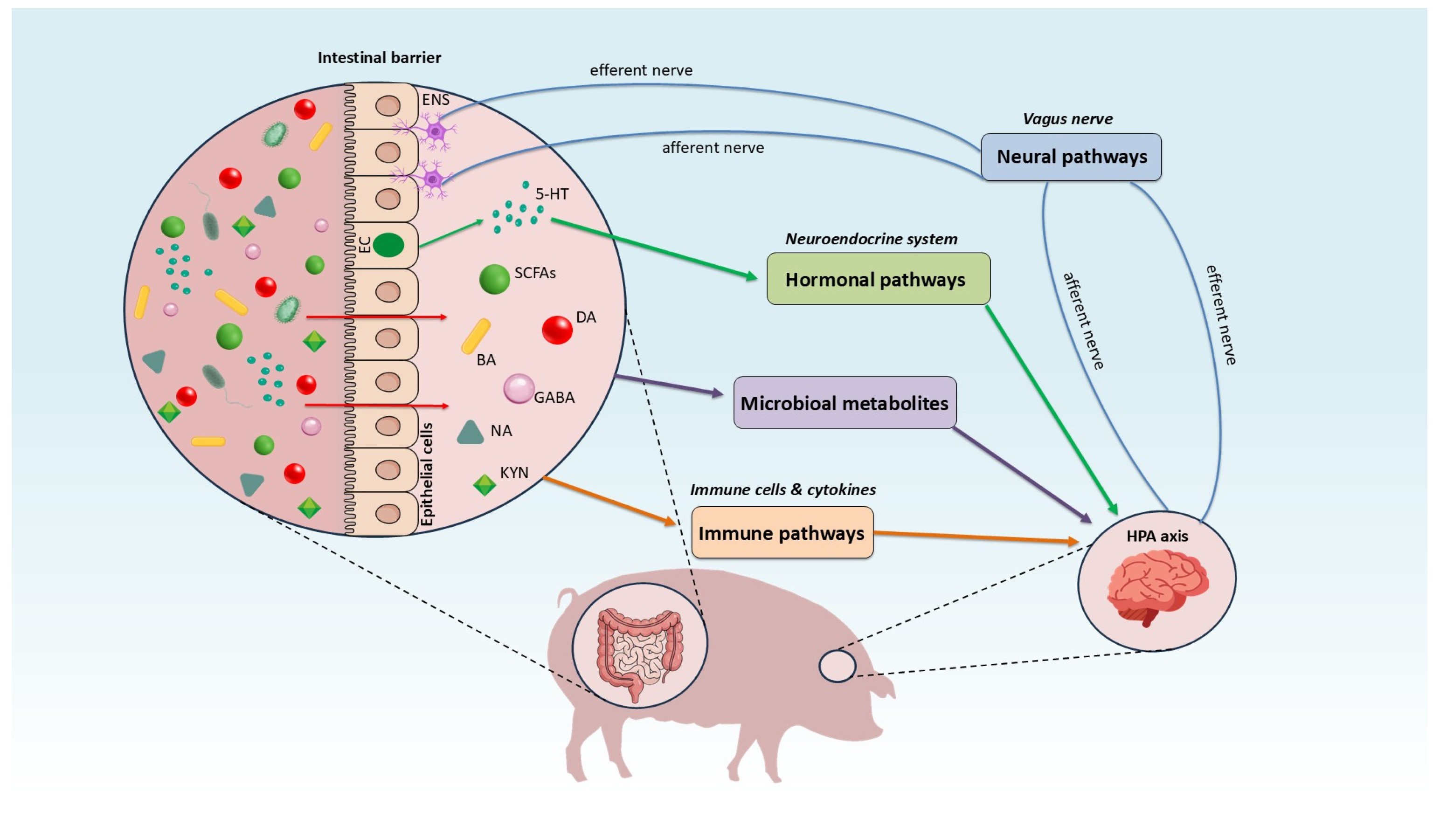
The Role of Swine Gut Microbiota and Its Metabolites in Maintaining Intestinal Barrier Integrity and Mitigating Stress via the Gut–Brain Axis

 , and
, and
Simple Summary
Abstract
1. Introduction
2. Materials and Methods
3. Physiological and Molecular Aspects of Gut-Brain Axis Function
4. Microbiota Regulation of the Intestinal Barrier Integrity and Gut-Brain Axis
5. Developmental Changes in the Porcine Gut Microbiota and Animal Behavior
6. The Influence of Nutrition on the Gut Microbiota of Pigs

| Production Group | N | Experimental Group | Duration | Results | Behavioral/Stress Effect | Study |
|---|---|---|---|---|---|---|
| Sows (Pic Camborough, Agroceres-PIC) | 147 | Multi-strain probiotic: L. acidophilus, bulgaricus, plantarum, rhamnosus B. bifidum E. faecium S. thermophilus | From insemination to 21 days of piglet age | ↑ 5-HT (p = 0.034) ↓ Cortisol (p = 0.047) | ↓ apathy, ↓ anxiety ↓ cortisol in saliva ↑ serotonin in blood | [60] |
| Duroc piglets × (Landrace × Yorkshire) | 35 | Synbiotic: 3 Lactobacillus strains (L. salivarius, L. reuteri) + FOS + beta-glucan + vitamin C | Days 1–28 of age | ↑Bacteroidetes (p = 0.017), ↓Firmicutes (p = 0.012) | ↑ interaction speed ↑ problem-solving ability ↑ learning flexibility | [66] |
| Suckling piglets (Specific pathogen-free sows) | 64 | Probiotic: L. reuteri ATCC-PTA-6475 L. plantarum L1-6 | Days 3–35 of age | ↓ anxiety ↓ increased vigilance ↑ attention to threat | [61] | |
| Suckling piglets (Landrace × Duroc × Yorkshire) | 18 | Prebiotic: GOS | Days 1–14 of age | ↓ ROS (p < 0.05) ↓ MDA (p < 0.05) ↑ AMPK (p < 0.05) | ↓ oxidative stress ↑ digestive and absorptive functions | [64] |
| Male piglets (PIC Line 3 dams, pooled semen source) | 24 | Postbiotic: TBCD | Days 1–26/27 of age | ↓ MWF (p = 0.003) ↓ TBV (p = 0.006) ↓ GMV (p = 0.013) ↓ FA (p < 0.05) | ↑ feed aversion x lack of health-promoting effects | [69] |
| Weaning piglets (Duroc × Landrace × Large White) | 96 | Probiotic: Bifidobacterium animalis subsp. lactis JYBR-190 | Days 1–28 of age | ↑ BW (p = 0.022) ↑ ADG (p < 0.05) ↑ T-AOC (0.003) ↓ MDA (p = 0.037) ↑ Amylase activity (p = 0.049) ↓Helicobacter i Escherichia-Shigella (p < 0.05) | ↓diarrhoea ↑ body weight | [62] |
| Male piglets (Duroc Landrace Yorkshire) | 32 | Probiotic: Bacillus amyloliquefaciens SC06 (SC06) | Days 1–29 of age | ↑ ADG (p = 0.03) ↓ DAO (p < 0.01) ↓ D-lactate (p < 0.01) ↓Clostridium (p < 0.01) ↑Actinobacillus (p < 0.05) | ↑ growth performance ↑ Intestinal barrier health and function ↓ stress | [63] |
7. The Importance of the Gut-Brain Axis in Modern Pig Production
8. Challenges and Directions for Future Research
9. Multi-Omics Approaches to Elucidating Microbiota-Brain Interactions in Swine
10. Summary
Author Contributions
Funding
Institutional Review Board Statement
Informed Consent Statement
Data Availability Statement
Conflicts of Interest
References
- Kraimi, N.; Dawkins, M.; Gebhardt-Henrich, S.G.; Velge, P.; Rychlik, I.; Volf, J.; Creach, P.; Smith, A.; Colles, F.; Leterrier, C. Influence of the Microbiota-Gut-Brain Axis on Behavior and Welfare in Farm Animals: A Review. Physiol. Behav. 2019, 210, 112658. [Google Scholar] [CrossRef]
- Niu, X.; Ding, Y.; Chen, S.; Gooneratne, R.; Ju, X. Effect of Immune Stress on Growth Performance and Immune Functions of Livestock: Mechanisms and Prevention. Animals 2022, 12, 909. [Google Scholar] [CrossRef] [PubMed]
- Carabotti, M.; Scirocco, A.; Maselli, M.A.; Severi, C. The Gut-Brain Axis: Interactions between Enteric Microbiota, Central and Enteric Nervous Systems. Ann. Gastroenterol. 2015, 28, 203–209. [Google Scholar]
- Arneth, B. Gut-Brain Axis and Brain Microbiome Interactions from a Medical Perspective. Brain Sci. 2025, 15, 167. [Google Scholar] [CrossRef]
- Lo, B.C.; Chen, G.Y.; Núñez, G.; Caruso, R. Gut microbiota and systemic immunity in health and disease. Int. Immunol. 2021, 33, 197–209. [Google Scholar] [CrossRef]
- Diao, H.; Jiao, A.R.; Yu, B.; Mao, X.B.; Chen, D.W. Gastric infusion of short-chain fatty acids can improve intestinal barrier function in weaned piglets. Genes Nutr. 2019, 14, 4. [Google Scholar] [CrossRef]
- Rabhi, N.; Dicksved, J.; Keeling, L.; Landberg, R. Association between tail-biting and intestinal microbiota composition in pigs. Front. Vet. Sci. 2020, 7, 563762. [Google Scholar] [CrossRef] [PubMed]
- Parker, A.; Fonseca, S.; Carding, S.R. Gut microbes and metabolites as modulators of blood-brain barrier integrity and brain health. Gut Microbes 2020, 11, 135–157. [Google Scholar] [CrossRef] [PubMed]
- Hestad, K.; Alexander, J.; Rootwelt, H.; Aaseth, J.O. The role of tryptophan dysmetabolism and quinolinic acid in depressive and neurodegenerative diseases. Biomolecules 2022, 12, 998. [Google Scholar] [CrossRef]
- Kearns, R. Gut-Brain Axis and Neuroinflammation: The Role of Gut Permeability and the Kynurenine Pathway in Neuro-logical Disorders. Cell. Mol. Neurobiol. 2024, 44, 64. [Google Scholar] [CrossRef]
- Jiang, C.; Chen, Y.; Sun, T. From the gut to the brain, mechanisms and clinical applications of γ-aminobutyric acid (GABA) on the treatment of anxiety and insomnia. Front. Neurosci. 2025, 19, 1570173. [Google Scholar] [CrossRef]
- Kiriyama, Y.; Nochi, H. The Biosynthesis, Signaling, and Neurological Functions of Bile Acids. Biomolecules 2019, 9, 232. [Google Scholar] [CrossRef]
- Choudhury, R.; Middelkoop, A.; Bolhuis, J.E.; Kleerebezem, M. Exploring the Association between Microbiota and Behaviour in Suckling Piglets. Sci. Rep. 2022, 12, 12322. [Google Scholar] [CrossRef]
- Chen, S.; Luo, S.; Yan, C. Gut Microbiota Implications for Health and Welfare in Farm Animals: A Review. Animals 2021, 12, 93. [Google Scholar] [CrossRef] [PubMed]
- Hwang, Y.K.; Oh, J.S. Interaction of the Vagus Nerve and Serotonin in the Gut-Brain Axis. Int. J. Mol. Sci. 2025, 26, 1160. [Google Scholar] [CrossRef]
- Lu, S.; Zhao, Q.; Guan, Y.; Sun, Z.; Li, W.; Guo, S.; Zhang, A. The communication mechanism of the gut-brain axis and its effect on central nervous system diseases: A systematic review. Biomed. Pharmacother. 2024, 178, 117207. [Google Scholar] [CrossRef] [PubMed]
- Wachsmuth, H.R.; Weninger, S.N.; Duca, F.A. Role of the gut–brain axis in energy and glucose metabolism. Exp. Mol. Med. 2022, 54, 377–392. [Google Scholar] [CrossRef] [PubMed]
- Spencer, N.J.; Hu, H. Enteric nervous system: Sensory transduction, neural circuits and gastrointestinal motility. Nat. Rev. Gastroenterol. Hepatol. 2020, 17, 338–351. [Google Scholar] [CrossRef]
- Kim, Y.; Lim, J.; Oh, J. Taming neuroinflammation in Alzheimer’s disease: The protective role of phytochemicals through the gut-brain axis. Biomed. Pharmacother. 2024, 178, 117277. [Google Scholar] [CrossRef]
- Jameson, K.G.; Kazmi, S.A.; Ohara, T.E.; Son, C.; Yu, K.B.; Mazdeyasnan, D.; Leshan, E.; Vuong, H.E.; Paramo, J.; Lopez-Romero, A.; et al. Select microbial metabolites in the small intestinal lumen regulate vagal activity via receptor-mediated signaling. iScience 2025, 28, 111699. [Google Scholar] [CrossRef]
- Wang, L.; Wang, C.; Peng, Y.; Zhang, Y.; Liu, Y.; Liu, Y.; Yin, Y. Research progress on anti-stress nutrition strategies in swine. Anim. Nutr. 2023, 13, 342–360. [Google Scholar] [CrossRef]
- Fukasawa, N.; Tsunoda, J.; Sunaga, S.; Kiyohara, H.; Nakamoto, N.; Teratani, T.; Mikami, Y.; Kanai, T. The gut-organ axis: Clinical aspects and immune mechanisms. Allergol. Int. 2025, 74, 197–209. [Google Scholar] [CrossRef]
- Delgado-Ocaña, S.; Cuesta, S. From microbes to mind: Germ-free models in neuropsychiatric research. mBio 2024, 15, e0207524. [Google Scholar] [CrossRef]
- Cryan, J.F.; O’Riordan, K.J.; Cowan, C.S.M.; Sandhu, K.V.; Bastiaanssen, T.F.S.; Boehme, M.; Codagnone, M.G.; Cussotto, S.; Fulling, C.; Golubeva, A.V.; et al. The Microbiota-Gut-Brain Axis. Physiol. Rev. 2019, 99, 1877–2013. [Google Scholar] [CrossRef] [PubMed]
- Gribble, F.M.; Reimann, F. Enteroendocrine Cells: Chemosensors in the Intestinal Epithelium. Annu. Rev. Physiol. 2016, 78, 277–299. [Google Scholar] [CrossRef]
- Faraji, N.; Payami, B.; Ebadpour, N.; Gorji, A. Vagus nerve stimulation and gut microbiota interactions: A novel therapeutic avenue for neuropsychiatric disorders. Neurosci. Biobehav. Rev. 2025, 169, 105990. [Google Scholar] [CrossRef]
- Strandwitz, P. Neurotransmitter modulation by the gut microbiota. Brain Res. 2018, 1693, 128–133. [Google Scholar] [CrossRef] [PubMed]
- He, Y.; Ouyang, J.; Hu, Z.; Yang, J.; Chu, Y.; Huang, S.; Yang, Y.; Liu, C. Intervention mechanism of repeated oral GABA administration on anxiety-like behaviors induced by emotional stress in rats. Psychiatry Res. 2019, 271, 649–657. [Google Scholar] [CrossRef] [PubMed]
- Braga, J.D.; Thongngam, M.; Kumrungsee, T. Gamma-aminobutyric acid as a potential postbiotic mediator in the gut-brain axis. npj Sci. Food 2024, 8, 16. [Google Scholar] [CrossRef]
- Choi, W.; Moon, J.H.; Kim, H. Serotonergic regulation of energy metabolism in peripheral tissues. J. Endocrinol. 2020, 245, R1–R10. [Google Scholar] [CrossRef]
- Buey, B.; Forcén, A.; Grasa, L.; Layunta, E.; Mesonero, J.E.; Latorre, E. Gut Microbiota-Derived Short-Chain Fatty Acids: Novel Regulators of Intestinal Serotonin Transporter. Life 2023, 13, 1085. [Google Scholar] [CrossRef]
- Yaghoubfar, R.; Behrouzi, A.; Fateh, A.; Nojoumi, S.A.; Vaziri, F.; Khatami, S.; Siadat, S.D. Effects of Akkermansiamuciniphila and Faecalibacteriumprausnitzii on serotonin transporter expression in intestinal epithelial cells. J. Diabetes Metab. Disord. 2021, 20, 1–5. [Google Scholar] [CrossRef]
- Liu, B.; Yu, D.; Sun, J.; Wu, X.; Xin, Z.; Deng, B.; Fan, L.; Fu, J.; Ge, L.; Ren, W. Characterizing the influence of gut microbiota on host tryptophan metabolism with germ-free pigs. Anim. Nutr. 2022, 11, 190–200. [Google Scholar] [CrossRef]
- Reyes-Martínez, S.; Segura-Real, L.; Gómez-García, A.P.; Tesoro-Cruz, E.; Constantino-Jonapa, L.A.; Amedei, A.; Aguirre-García, M.M. Neuroinflammation, Microbiota-Gut-Brain Axis, and Depression: The Vicious Circle. J. Integr. Neurosci. 2023, 22, 65. [Google Scholar] [CrossRef] [PubMed]
- Silva, D.F.; Empadinhas, N.; Cardoso, S.M.; Esteves, A.R. Neurodegenerative Microbially-Shaped Diseases: Oxidative Stress Meets Neuroinflammation. Antioxidants 2022, 11, 2141. [Google Scholar] [CrossRef] [PubMed]
- Feng, Y.; Huang, Y.; Wang, Y.; Wang, P.; Song, H.; Wang, F. Antibiotics induced intestinal tight junction barrier dysfunction is associated with microbiota dysbiosis, activated NLRP3 inflammasome and autophagy. PLoS ONE 2019, 14, e0218384. [Google Scholar] [CrossRef] [PubMed]
- Rosser, E.C.; Piper, C.J.M.; Matei, D.E.; Blair, P.A.; Rendeiro, A.F.; Orford, M.; Alber, D.G.; Krausgruber, T.; Catalan, D.; Klein, N.; et al. Microbiota-derived metabolites suppress arthritis by amplifying aryl-hydrocarbon receptor activation in regulatory B cells. Cell Metab. 2020, 31, 837–851.e10. [Google Scholar] [CrossRef]
- Metzler-Zebeli, B.U.; Koger, S.; Sharma, S.; Sener-Aydemir, A.; Ruczizka, U.; Kreutzmann, H.; Ladinig, A. Short-Chain Fatty Acids Modulate Permeability, Motility and Gene Expression in the Porcine Fetal Jejunum Ex Vivo. Nutrients 2022, 14, 2524. [Google Scholar] [CrossRef]
- Andrani, M.; Borghetti, P.; Ravanetti, F.; Cavalli, V.; Ferrari, L.; De Angelis, E.; Martelli, P.; Saleri, R. Acetate and propionate effects in response to LPS in a porcine intestinal co-culture model. Porc. Health Manag. 2023, 9, 23. [Google Scholar] [CrossRef]
- Zhou, H.; Yu, B.; Sun, J.; Chen, D.; Chen, H.; Mao, X.; Huang, Z.; Zheng, P.; Yu, J.; Luo, Y. Short-Chain Fatty Acids Can Improve Lipid and Glucose Metabolism Independently of the Pig Gut Microbiota. J. Anim. Sci. Biotechnol. 2021, 12, 61. [Google Scholar] [CrossRef]
- Qi, R.; Qiu, X.; Du, L.; Wang, J.; Wang, Q.; Huang, J.; Liu, Z. Changes of Gut Microbiota and Its Correlation with Short-Chain Fatty Acids and Bioamines in Piglets at the Early Growth Stage. Front. Vet. Sci. 2021, 7, 617259. [Google Scholar] [CrossRef]
- Song, M.; Zhang, F.; Fu, Y.; Yi, X.; Feng, S.; Liu, Z.; Deng, D.; Yang, Q.; Yu, M.; Zhu, C.; et al. Tauroursodeoxycholic Acid (TUDCA) Improves Intestinal Barrier Function Associated with the TGR5-MLCK Pathway and the Alteration of Serum Metabolites and Gut Bacteria in Weaned Piglets. J. Anim. Sci. Biotechnol. 2022, 13, 73. [Google Scholar] [CrossRef]
- Hou, Y.; Li, J.; Ying, S. Tryptophan Metabolism and Gut Microbiota: A Novel Regulatory Axis Integrating the Microbiome, Immunity, and Cancer. Metabolites 2023, 13, 1166. [Google Scholar] [CrossRef]
- Xia, Y.; Peng, X.; Mao, J.; Li, Z.; Zhang, H.; Wang, Q. Dietary 5-Hydroxytryptophan Supplementation Improves Growth Performance and Intestinal Health of Weaned Piglets. Porc. Health Manag. 2024, 10, 60. [Google Scholar] [CrossRef]
- Tossou, M.C.; Liu, H.; Bai, M.; Chen, S.; Cai, Y.; Duraipandiyan, V.; Liu, H.; Adebowale, T.O.; Al-Dhabi, N.A.; Long, L.; et al. Effect of High Dietary Tryptophan on Intestinal Morphology and Tight Junction Protein of Weaned Pig. BioMed Res. Int. 2016, 2016, 2912418. [Google Scholar] [CrossRef]
- Sharan, P.; Vellapandian, C. Hypothalamic-Pituitary-Adrenal (HPA) Axis: Unveiling the Potential Mechanisms Involved in Stress-Induced Alzheimer’s Disease and Depression. Cureus 2024, 16, e67595. [Google Scholar] [CrossRef]
- Missiego-Beltrán, J.; Beltrán-Velasco, A.I. The role of microbial metabolites in the progression of neurodegenerative diseases-Therapeutic approaches: A comprehensive review. Int. J. Mol. Sci. 2024, 25, 10041. [Google Scholar] [CrossRef] [PubMed]
- Luo, Y.; Ren, W.; Smidt, H.; Wright, A.G.; Yu, B.; Schyns, G.; McCormack, U.M.; Cowieson, A.J.; Yu, J.; He, J.; et al. Dynamic Distribution of Gut Microbiota in Pigs at Different Growth Stages: Composition and Contribution. Microbiol. Spectr. 2022, 10, e0068821. [Google Scholar] [CrossRef]
- Shin, D.; Chang, S.Y.; Bogere, P.; Won, K.; Choi, J.Y.; Choi, Y.J.; Lee, H.K.; Hur, J.; Park, B.Y.; Kim, Y.; et al. Beneficial Roles of Probiotics on the Modulation of Gut Microbiota and Immune Response in Pigs. PLoS ONE 2019, 14, e0220843. [Google Scholar] [CrossRef]
- Verbeek, E.; Keeling, L.; Landberg, R.; Lindberg, J.E.; Dicksved, J. The Gut Microbiota and Microbial Metabolites Are Associated with Tail Biting in Pigs. Sci. Rep. 2021, 11, 20547. [Google Scholar] [CrossRef] [PubMed]
- König, E.; Heponiemi, P.; Kivinen, S.; Räkköläinen, J.; Beasley, S.; Borman, T.; Collado, M.C.; Hukkinen, V.; Junnila, J.; Lahti, L.; et al. Fewer Culturable Lactobacillaceae Species Identified in Faecal Samples of Pigs Performing Manipulative Behaviour. Sci. Rep. 2024, 14, 132. [Google Scholar] [CrossRef] [PubMed]
- Everaert, N.; Van Cruchten, S.; Weström, B.; Bailey, M.; Van Ginneken, C.; Thymann, T.; Pieper, R. A Review on Early Gut Maturation and Colonization in Pigs, Including Biological and Dietary Factors Affecting Gut Homeostasis. Anim. Feed Sci. Technol. 2017, 233, 89–103. [Google Scholar] [CrossRef]
- Wen, C.; van Dixhoorn, I.; Schokker, D.; Smidt, H.; de Groot, J.; Kaal-Lansbergen, L.M.T.E.; Reimert, I.; van der Meer, I.M.; van Nes, A.; van der Waaij, L.A.; et al. Environmentally Enriched Housing Conditions Affect Pig Welfare, Immune System and Gut Microbiota in Early Life. Anim. Microbiome 2021, 3, 52. [Google Scholar] [CrossRef]
- Yang, H.; Yang, M.; Fang, S.; Huang, X.; He, M.; Ke, S.; Huang, L. Evaluating the Profound Effect of Gut Microbiome on Host Appetite in Pigs. BMC Microbiol. 2018, 18, 215. [Google Scholar] [CrossRef]
- Amat, S.; Lantz, H.; Munyaka, P.M.; Willing, B.P. Prevotella in Pigs: The Positive and Negative Associations with Production and Health. Microorganisms 2020, 8, 1584. [Google Scholar] [CrossRef]
- Liao, S.F.; Nyachoti, M. Using Probiotics to Improve Swine Gut Health and Nutrient Utilization. Anim. Nutr. 2017, 3, 331–343. [Google Scholar] [CrossRef]
- Plaza-Diaz, J.; Ruiz-Ojeda, F.J.; Gil-Campos, M.; Gil, A. Mechanisms of Action of Probiotics. Adv. Nutr. 2019, 10, S49–S66. [Google Scholar] [CrossRef] [PubMed]
- Rossi, R.; Mainardi, E. Prebiotics and Probiotics Supplementation in Pigs as a Model for Human Gut Health and Disease. Biomolecules 2025, 15, 665. [Google Scholar] [CrossRef]
- Rathore, K.; Shukla, N.; Naik, S.; Sambhav, K.; Dange, K.; Bhuyan, D.; Imranul Haq, Q.M. The Bidirectional Relationship Between the Gut Microbiome and Mental Health: A Comprehensive Review. Cureus 2025, 17, e80810. [Google Scholar] [CrossRef]
- Pereira, M.M.C.; Andretta, I.; Franceschi, C.H.; Kipper, M.; Mariani, A.; Stefanello, T.; Carvalho, C.; Vieira, J.; Moura Rocha, L.; Ribeiro, A.M.L. Effects of Multistrain Probiotic Supplementation on Sows’ Emotional and Cognitive States and Progeny Welfare. Animals 2024, 14, 847. [Google Scholar] [CrossRef] [PubMed]
- Verbeek, E.; Dicksved, J.; Keeling, L. Supplementation of Lactobacillus Early in Life Alters Attention Bias to Threat in Piglets. Sci. Rep. 2021, 11, 10130. [Google Scholar] [CrossRef] [PubMed]
- Pang, J.; Liu, Y.; Kang, L.; Ye, H.; Zang, J.; Wang, J.; Han, D. Bifidobacterium animalis Promotes the Growth of Weaning Piglets by Improving Intestinal Development, Enhancing Antioxidant Capacity, and Modulating Gut Microbiota. Appl. Environ. Microbiol. 2022, 88, e0129622. [Google Scholar] [CrossRef]
- Yuan, J.; Meng, H.; Liu, Y.; Wang, L.; Zhu, Q.; Wang, Z.; Liu, H.; Zhang, K.; Zhao, J.; Li, W.; et al. Bacillus amyloliquefaciens Attenuates the Intestinal Permeability, Oxidative Stress and Endoplasmic Reticulum Stress: Transcriptome and Microbiome Analyses in Weaned Piglets. Front. Microbiol. 2024, 15, 1362487. [Google Scholar] [CrossRef]
- Tian, S.; Wang, J.; Gao, R.; Wang, J.; Zhu, W. Early-Life Galacto-Oligosaccharides Supplementation Alleviates the Small Intestinal Oxidative Stress and Dysfunction of Lipopolysaccharide-Challenged Suckling Piglets. J. Anim. Sci. Biotechnol. 2022, 13, 70. [Google Scholar] [CrossRef]
- Vijaya, A.K.; Kuras, S.; Šimoliūnas, E.; Mingaila, J.; Makovskytė, K.; Buišas, R.; Daliri, E.B.; Meškys, R.; Baltriukienė, D.; Burokas, A. Prebiotics Mitigate the Detrimental Effects of High-Fat Diet on Memory, Anxiety and Microglia Functionality in Ageing Mice. Brain Behav. Imm. 2024, 122, 167–184. [Google Scholar] [CrossRef]
- Parois, S.P.; Eicher, S.D.; Lindemann, S.R.; Marchant, J.N. Potential Improvements of the Cognition of Piglets through a Synbiotic Supplementation from 1 to 28 Days via the Gut Microbiota. Sci. Rep. 2021, 11, 24113. [Google Scholar] [CrossRef]
- Vinderola, G.; Sanders, M.E.; Salminen, S. The Concept of Postbiotics. Foods 2022, 11, 1077. [Google Scholar] [CrossRef] [PubMed]
- Sanz-Martos, A.B.; Fernández-Felipe, J.; Merino, B.; Cano, V.; Ruiz-Gayo, M.; Del Olmo, N. Butyric Acid Precursor Tributyrin Modulates Hippocampal Synaptic Plasticity and Prevents Spatial Memory Deficits: Role of PPARγ and AMPK. Int. J. Neuropsychopharmacol. 2022, 25, 498–511. [Google Scholar] [CrossRef] [PubMed]
- Sutkus, L.T.; Sommer, K.M.; Li, Z.; Sutton, B.P.; Donovan, S.M.; Dilger, R.N. Correction: Experimentally Induced Colitis Impacts Myelin Development and Home-Cage Behavior in Young Pigs Regardless of Supplementation with Oral Gamma-Cyclodextrin-Encapsulated Tributyrin. Front. Neurosci. 2025, 19, 1637628. [Google Scholar] [CrossRef]
- Lyte, J.M.; Lyte, M. Review: Microbial Endocrinology: Intersection of Microbiology and Neurobiology Matters to Swine Health from Infection to Behavior. Animals 2019, 13, 2689–2698. [Google Scholar] [CrossRef]
- Connolly, K.R.; Sweeney, T.; P’Doherty, J.V. Sustainable nutritional strategies for gut health in weaned pigs: The role of reduced dietary crude protein, organic acids and butyrate production. Animals 2025, 15, 66. [Google Scholar] [CrossRef] [PubMed]
- Su, W.; Li, Z.; Gong, T.; Wang, F.; Jin, M.; Wang, Y.; Lu, Z. An Alternative ZnO with Large Specific Surface Area: Preparation, Physicochemical Characterization and Effects on Growth Performance, Diarrhea, Zinc Metabolism and Gut Barrier Function of Weaning Piglets. Sci. Total Environ. 2023, 863, 163558. [Google Scholar] [CrossRef] [PubMed]
- Tag, X.; Xiong, K.; Zeng, Y.; Fang, R. The Mechanism of Zinc Oxide in Alleviating Diarrhea in Piglets after Weaning: A Review from the Perspective of Intestinal Barrier Function. Int. J. Mol. Sci. 2024, 25, 10040. [Google Scholar] [CrossRef]
- Méndez-Palacios, N.; Méndez-Mendoza, M.; Vázquez-Flores, F.; Castro-Colombres, J.G.; Ramírez-Bribiesca, J.E. Productive and Economic Parameters of Pigs Supplemented from Weaning to Finishing with Prebiotic and Probiotic Feed Additives. Anim. Sci. J. 2018, 89, 994–1001. [Google Scholar] [CrossRef]
- Shen, C.; Tong, X.; Chen, R.; Gao, S.; Liu, X.; Schinckel, A.P.; Li, Y.; Xu, F.; Zhou, B. Identifying Blood-Based Biomarkers Associated with Aggression in Weaned Pigs after Mixing. Appl. Anim. Behav. Sci. 2020, 224, 104927. [Google Scholar] [CrossRef]
- Wang, M.; Yue, J.; Lv, G.; Wang, Y.; Guo, A.; Liu, Z.; Yu, T.; Yang, G. Effects of Interactions between Feeding Patterns and the Gut Microbiota on Pig Reproductive Performance. Animals 2024, 14, 2714. [Google Scholar] [CrossRef]
- Du, H.; Li, K.; Guo, W.; Na, M.; Zhang, J.; Zhang, J.; Na, R. Physiological and Microbial Community Dynamics in Does During Mid-Gestation to Lactation and Their Impact on the Growth, Immune Function, and Microbiome Transmission of Offspring Kids. Animals 2025, 15, 954. [Google Scholar] [CrossRef] [PubMed]
- Potes, Y.; Oliván, M.; Rubio-González, A.; de Luxán-Delgado, B.; Díaz, F.; Sierra, V.; Arroyo, L.; Peña, R.; Bassols, A.; González, J.; et al. Pig Cognitive Bias Affects the Conversion of Muscle into Meat by Antioxidant and Autophagy Mechanisms. Animal 2017, 11, 2027–2035. [Google Scholar] [CrossRef]
- Lee, I.K.; Kye, Y.C.; Kim, G.; Kim, H.W.; Gu, M.J.; Umboh, J.; Maaruf, K.; Kim, S.W.; Yun, C.H. Stress, Nutrition, and Intestinal Immune Responses in Pigs-A Review. Asian-Australas.J. Anim. Sci. 2016, 29, 1075–1082. [Google Scholar] [CrossRef]
- Yu, J.; Zuo, B.; Li, Q.; Zhao, F.; Wang, J.; Huang, W.; Sun, Z.; Chen, Y. Dietary Supplementation with Lactiplantibacillus plantarum P-8 Improves the Growth Performance and Gut Microbiota of Weaned Piglets. Microbiol. Spectr. 2024, 12, e02345-22. [Google Scholar] [CrossRef]
- Wang, J.; Tong, T.; Yu, C.; Wu, Q. The Research Progress on the Impact of Pig Gut Microbiota on Health and Production Performance. Front. Vet. Sci. 2025, 12, 1564519. [Google Scholar] [CrossRef]
- Li, B.; Li, M.; Luo, Y.; Li, R.; Li, W.; Liu, Z. Engineered 5-HT producing gut probiotic improves gastrointestinal motility and behavior disorder. Front. Cell. Infect. Microbiol. 2022, 12, 1013952. [Google Scholar] [CrossRef] [PubMed]
- Su, F.; Su, M.; Wei, W.; Wu, J.; Chen, L.; Sun, X.; Liu, M.; Sun, S.; Mao, R.; Bourgonje, A.R.; et al. Integrating Multi-Omics Data to Reveal the Host–Microbiota Interactome in Inflammatory Bowel Disease. Gut Microbes 2025, 17, 2476570. [Google Scholar] [CrossRef]
- Xu, J.; Xu, R.; Jia, M.; Su, Y.; Zhu, W. MetatranscriptomicAnalysis of Colonic Microbiota’s Functional Response to Different Dietary Fibers in Growing Pigs. Anim. Microbiome 2021, 3, 45. [Google Scholar] [CrossRef]
- Liu, S.; Feng, B.; Zhang, Z.; Miao, J.; Lai, X.; Zhao, W.; Xie, Q.; Ye, X.; Cao, C.; Yu, P.; et al. UPGG: Expanding the Taxonomic and Functional Diversity of the Pig Gut Microbiome with an Enhanced Genome Catalog. NPJ Biofilms Microbiomes 2025, 11, 196. [Google Scholar] [CrossRef] [PubMed]
- Chen, L.H.; Canibe, N.; Curtasu, M.V.; Hedemann, M.S. Untargeted Metabolomics as a Tool to Assess the Impact of Dietary Approaches on Pig Gut Health: A Review. J. Anim. Sci. Biotechnol. 2025, 16, 106. [Google Scholar] [CrossRef] [PubMed]
- Yang, B.; Yang, J.; Chen, R.; Chai, J.; Wei, X.; Zhao, J.; Zhao, Y.; Deng, F.; Li, Y. Metagenome-Assembled Genomes of Pig Fecal Samples in Nine European Countries: Insights into Antibiotic Resistance Genes and Viruses. Microorganisms 2024, 12, 2409. [Google Scholar] [CrossRef]
- Liu, Z.; Klümper, U.; Liu, Y.; Yang, Y.; Wei, Q.; Lin, J.-G.; Gu, J.-D.; Li, M. Metagenomic and Metatranscriptomic Analyses Reveal Activity and Hosts of Antibiotic Resistance Genes in Activated Sludge. Environ. Int. 2019, 129, 208–220. [Google Scholar] [CrossRef]
- Ma, W.; Yin, L.; Hu, Y.; Liu, X.; Guo, Z.; Zhong, B.; Qiu, H.; Li, J. Multi-Omics Analysis Reveals Interactions between Host and Microbes in Bama Miniature Pigs during Weaning. Front. Microbiol. 2024, 15, 1482925. [Google Scholar] [CrossRef]
- Zheng, X.; Xu, L.; Tang, Q.; Shi, K.; Wang, Z.; Shi, L.; Ding, Y.; Yin, Z.; Zhang, X. Integrated Metagenomic and Metabolomics Profiling Reveals Key Gut Microbiota and Metabolites Associated with Weaning Stress in Piglets. Genes 2024, 15, 970. [Google Scholar] [CrossRef]
- Onarman Umu, Ö.C.; Mydland, L.T.; Chen, C.; Pérez de Nanclares, M.; Shurson, G.C.; Urriola, P.E.; Sørum, H.; Øverland, M. Integrated Multi-Omics Approach Reveals Novel Associations in the Rapeseed Diet-Microbiota-Host Axis in Pigs. ISME Commun. 2024, 4, ycae061. [Google Scholar] [CrossRef] [PubMed]

| Production Group | N | Duration | Behavioral Group | Microbiota Changes | Study | ||
|---|---|---|---|---|---|---|---|
| Finishing pigs (Landrace × Large White hybrid sows sired with Duroc × synthetic hybrid boar) | 352 | 4 weeks | Tail-biting pigs (aggressor)/bitten finisher pigs (victim) | Aggressor | ↑Coprococcus ↑Clostridium IV | ↓Lactobacillus | [7] |
| Victim | ↑Sphaerochaeta ↑Blautia, ↑Phascolarctobacterium | ↓Lactobacillus | |||||
| Swine (Swedish Landrace Yorkshire × Hampshire) | 29 | 2 years | Tail-biting piglets (aggressor)/bitten piglets (victim) | Aggressor | ↑Firmicutes (mainly Lachnospiraceae, Ruminococcaceae) | [50] | |
| Victim | ↑Firmicutes (mainly LachnospiraceaeiButyrivibrio), ↑ Bacteroidetes (Alloprevotella) | ↓Bacteroidetes (mainly ↓Prevotella 7), ↓Proteobacteria (Ralstonia) | |||||
| Piglets (Finnish Landrace × Yorkshire × Duroc) | 30 | Single-day study (day 45) | Piglets exhibiting manipulative behavior (manipulators) | Manipulators | ↑ Lactobacillus amylovorus | ↓ diversity of Lactobacillaceae | [51] |
| Suckling piglets (2-4 tyg.) Topigs-20 | 47 | 4 weeks | Piglets exhibiting increased/decreased exploratory activity | ↑ Exploratory activity | ↑Atopobium ↑Coprococcus 3 ↑CAG-873 ↑Eubacterium ↑Coprostanoligenes | [13] | |
| ↓ Exploratory activity | ↑Prevotella 9 | ||||||
Disclaimer/Publisher’s Note: The statements, opinions and data contained in all publications are solely those of the individual author(s) and contributor(s) and not of MDPI and/or the editor(s). MDPI and/or the editor(s) disclaim responsibility for any injury to people or property resulting from any ideas, methods, instructions or products referred to in the content. |
© 2025 by the authors. Licensee MDPI, Basel, Switzerland. This article is an open access article distributed under the terms and conditions of the Creative Commons Attribution (CC BY) license (https://creativecommons.org/licenses/by/4.0/).
Share and Cite
Woś, K.; Pachciński, K.; Wacko, M.; Koszła, O.; Sołek, P.; Czech, A. The Role of Swine Gut Microbiota and Its Metabolites in Maintaining Intestinal Barrier Integrity and Mitigating Stress via the Gut–Brain Axis. Animals 2025, 15, 3653. https://doi.org/10.3390/ani15243653
Woś K, Pachciński K, Wacko M, Koszła O, Sołek P, Czech A. The Role of Swine Gut Microbiota and Its Metabolites in Maintaining Intestinal Barrier Integrity and Mitigating Stress via the Gut–Brain Axis. Animals. 2025; 15(24):3653. https://doi.org/10.3390/ani15243653
Chicago/Turabian StyleWoś, Katarzyna, Karol Pachciński, Marianna Wacko, Oliwia Koszła, Przemysław Sołek, and Anna Czech. 2025. "The Role of Swine Gut Microbiota and Its Metabolites in Maintaining Intestinal Barrier Integrity and Mitigating Stress via the Gut–Brain Axis" Animals 15, no. 24: 3653. https://doi.org/10.3390/ani15243653
APA StyleWoś, K., Pachciński, K., Wacko, M., Koszła, O., Sołek, P., & Czech, A. (2025). The Role of Swine Gut Microbiota and Its Metabolites in Maintaining Intestinal Barrier Integrity and Mitigating Stress via the Gut–Brain Axis. Animals, 15(24), 3653. https://doi.org/10.3390/ani15243653