


A Simple Yet Reliable 12S rRNA-Based Molecular Approach for Identifying Bat Species
 , ,
, ,  , and
, and 
Simple Summary
Abstract
1. Introduction
2. Materials and Methods
2.1. Bats
2.2. DNA Extraction of Muscle Tissue from Bats
2.3. Design of Primers to Amplify Bat Species
2.4. Morphological Identification of Bats
3. Results
4. Discussions
5. Conclusions
Supplementary Materials
Author Contributions
Funding
Institutional Review Board Statement
Informed Consent Statement
Data Availability Statement
Acknowledgments
Conflicts of Interest
References
- Arnaout, Y.; Djelouadji, Z.; Robardet, E.; Cappelle, J.; Cliquet, F.; Touzalin, F.; Jimenez, G.; Hurstel, S.; Borel, C.; Picard-Meyer, E. Genetic identification of bat species for pathogen surveillance across France. PLoS ONE 2022, 17, e0261344. [Google Scholar] [CrossRef] [Scilit] [PubMed]
- Buckles, E.L. Chiroptera (Bats). In Fowler’s Zoo and Wild Animal Medicine; Eric, M., Fowler, M.E., Eds.; Saunders: Philadelphia, PA, USA, 2014; Volume 8, pp. 281–290. [Google Scholar]
- Letko, M.; Seifert, S.N.; Olival, K.J.; Plowright, R.K.; Munster, V.J. Bat-borne virus diversity, spillover and emergence. Nat. Rev. Microbiol. 2020, 18, 461–471. [Google Scholar] [CrossRef] [Scilit] [PubMed]
- Russo, D.; Salinas-Ramos, V.B.; Cistrone, L.; Smeraldo, S.; Bosso, L.; Ancillotto, L. Do We Need to Use Bats as Bioindicators? Biology 2021, 10, 693. [Google Scholar] [CrossRef] [Scilit]
- Zukal, J.; Pikula, J.; Bandouchova, H. Bats as bioindicators of heavy metal pollution: History and prospect. Mamm. Biol. 2015, 80, 220–227. [Google Scholar] [CrossRef] [Scilit]
- Kunz, T.H.; Braun de Torrez, E.; Bauer, D.; Lobova, T.; Fleming, T.H. Ecosystem services provided by bats. Ann. N. Y. Acad. Sci. 2011, 1223, 1–38. [Google Scholar] [CrossRef] [Scilit]
- Wilson, J.J.; Sing, K.W.; Halim, M.R.; Ramli, R.; Hashim, R.; Sofian-Azirun, M. Utility of DNA barcoding for rapid and accurate assessment of bat diversity in Malaysia in the absence of formally described species. Genet. Mol. Res. 2014, 13, 920–925. [Google Scholar] [CrossRef] [Scilit]
- Festa, F.; Ancillotto, L.; Santini, L.; Pacifici, M.; Rocha, R.; Toshkova, N.; Amorim, F.; Benitez-Lopez, A.; Domer, A.; Hamidovic, D.; et al. Bat responses to climate change: A systematic review. Biol. Rev. Camb. Philos. Soc. 2023, 98, 19–33. [Google Scholar] [CrossRef] [Scilit]
- Tollefson, J. Humans are driving one million species to extinction. Nature 2019, 569, 171. [Google Scholar] [CrossRef] [Scilit]
- Adams, A.M.; Trujillo, L.A.; Campbell, C.J.; Akre, K.L.; Arroyo-Cabrales, J.; Burns, L.; Coleman, J.T.H.; Dixon, R.D.; Francis, C.M.; Gamba-Rios, M.; et al. The state of the bats in North America. Ann. N. Y. Acad. Sci. 2024, 1541, 115–128. [Google Scholar] [CrossRef] [Scilit]
- Frick, W.F.; Kingston, T.; Flanders, J. A review of the major threats and challenges to global bat conservation. Ann. N. Y. Acad. Sci. 2020, 1469, 5–25. [Google Scholar] [CrossRef] [Scilit]
- Teeling, E.C.; Vernes, S.C.; Davalos, L.M.; Ray, D.A.; Gilbert, M.T.P.; Myers, E.; Bat, K.C. Bat Biology, Genomes, and the Bat1K Project: To Generate Chromosome-Level Genomes for All Living Bat Species. Annu. Rev. Anim. Biosci. 2018, 6, 23–46. [Google Scholar] [CrossRef] [Scilit] [PubMed]
- Calisher, C.H.; Childs, J.E.; Field, H.E.; Holmes, K.V.; Schountz, T. Bats: Important reservoir hosts of emerging viruses. Clin. Microbiol. Rev. 2006, 19, 531–545. [Google Scholar] [CrossRef] [Scilit] [PubMed]
- Hayman, D.T.S. Bats as Viral Reservoirs. Annu. Rev. Virol. 2016, 3, 77–99. [Google Scholar] [CrossRef] [Scilit] [PubMed]
- Brook, C.E.; Dobson, A.P. Bats as ‘special’ reservoirs for emerging zoonotic pathogens. Trends Microbiol. 2015, 23, 172–180. [Google Scholar] [CrossRef] [Scilit]
- Jones, K.E.; Patel, N.G.; Levy, M.A.; Storeygard, A.; Balk, D.; Gittleman, J.L.; Daszak, P. Global trends in emerging infectious diseases. Nature 2008, 451, 990–993. [Google Scholar] [CrossRef] [Scilit]
- Nuñez, G.B.; Becker, D.J.; Plowright, R.K. The emergence of vampire bat rabies in Uruguay within a historical context. Epidemiol. Infect. 2019, 147, e180. [Google Scholar] [CrossRef] [Scilit]
- Johnson, N.; Vos, A.; Freuling, C.; Tordo, N.; Fooks, A.R.; Müller, T. Human rabies due to lyssavirus infection of bat origin. Vet. Microbiol. 2010, 142, 151–159. [Google Scholar] [CrossRef] [Scilit]
- Li, W.; Shi, Z.; Yu, M.; Ren, W.; Smith, C.; Epstein, J.H.; Wang, H.; Crameri, G.; Hu, Z.; Zhang, H.; et al. Bats are natural reservoirs of SARS-like coronaviruses. Science 2005, 310, 676–679. [Google Scholar] [CrossRef] [Scilit]
- Huang, Y.W.; Dickerman, A.W.; Pineyro, P.; Li, L.; Fang, L.; Kiehne, R.; Opriessnig, T.; Meng, X.J. Origin, evolution, and genotyping of emergent porcine epidemic diarrhea virus strains in the United States. mBio 2013, 4, e00737-00713. [Google Scholar] [CrossRef] [Scilit]
- Memish, Z.A.; Mishra, N.; Olival, K.J.; Fagbo, S.F.; Kapoor, V.; Epstein, J.H.; Alhakeem, R.; Durosinloun, A.; Al Asmari, M.; Islam, A.; et al. Middle East respiratory syndrome coronavirus in bats, Saudi Arabia. Emerg. Infect. Dis. 2013, 19, 1819–1823. [Google Scholar] [CrossRef] [Scilit]
- Zhou, P.; Yang, X.L.; Wang, X.G.; Hu, B.; Zhang, L.; Zhang, W.; Si, H.R.; Zhu, Y.; Li, B.; Huang, C.L.; et al. A pneumonia outbreak associated with a new coronavirus of probable bat origin. Nature 2020, 579, 270–273. [Google Scholar] [CrossRef] [Scilit] [PubMed]
- Chambers, C.L.; Herder, M.J.; Yasuda, K.; Mikesic, D.G.; Dewhurst, S.M.; Masters, W.M.; Vleck, D. Roosts and home ranges of spotted bats (Euderma maculatum) in northern Arizona. Can. J. Zool.-Rev. Can. Zool. 2011, 89, 1256–1267. [Google Scholar] [CrossRef] [Scilit]
- Richter, H.V.; Cumming, G.S. First application of satellite telemetry to track African straw-coloured fruit bat migration. J. Zool. 2008, 275, 172–176. [Google Scholar] [CrossRef] [Scilit]
- O’Shea, T.J.; Bogan, M.A.; Ellison, L.E. Monitoring trends in bat populations of the United States and territories: Status of the science and recommendations for the future. Wildl. Soc. B 2003, 31, 16–29. [Google Scholar]
- Wiese, W.H. Bat biology and conservation. Libr. J. 1999, 124, 115–116. [Google Scholar]
- Francis, C.M. A Guide to the Mammals of South-East Asia. J. Mammal. 2008, 90, 779–780. [Google Scholar]
- Morgan, C.N.; Ammerman, L.K.; Demere, K.D.; Doty, J.B.; Nakazawa, Y.J.; Mauldin, M.R. Field Identification Key and Guide for Bats of the United States of America. Occas. Pap. Tex. Tech. Univ. Mus. 2019, 360, 360. [Google Scholar]
- Russo, D.; Voigt, C.C. The use of automated identification of bat echolocation calls in acoustic monitoring: A cautionary note for a sound analysis. Ecol. Indic. 2016, 66, 598–602. [Google Scholar] [CrossRef] [Scilit]
- Lacki, M.J.; Amelon, S.K.; Baker, M.D. Foraging ecology of bats in forests. In Bats in Forests: Conservation and Management; Johns Hopkins University Press: Baltimore, MD, USA, 2007; pp. 83–128. [Google Scholar]
- Eggerbauer, E.; Troupin, C.; Passior, K.; Pfaff, F.; Hoper, D.; Neubauer-Juric, A.; Haberl, S.; Bouchier, C.; Mettenleiter, T.C.; Bourhy, H.; et al. The Recently Discovered Bokeloh Bat Lyssavirus: Insights Into Its Genetic Heterogeneity and Spatial Distribution in Europe and the Population Genetics of Its Primary Host. Adv. Virus Res. 2017, 99, 199–232. [Google Scholar] [CrossRef] [Scilit]
- Andrianiaina, A.F.; Andry, S.; Kettenburg, G.; Ranaivoson, H.C.; Lacoste, V.; Dussart, P.; Heraud, J.M.; Laverty, T.M.; Guth, S.; Young, K.I.; et al. Diversity and seasonality of ectoparasite burden on two species of Madagascar fruit bat, Eidolon dupreanum and Rousettus madagascariensis. Parasit. Vectors 2025, 18, 302. [Google Scholar] [CrossRef] [Scilit]
- Folmer, O.; Black, M.; Hoeh, W.; Lutz, R.; Vrijenhoek, R. DNA primers for amplification of mitochondrial cytochrome c oxidase subunit I from diverse metazoan invertebrates. Mol. Mar. Biol. Biotechnol. 1994, 3, 294–299. [Google Scholar] [PubMed]
- Najera-Cortazar, L.A.; Keen, A.; Kitching, T.; Stokes, D.; Goodman, S.J. Phylogenetic analyses reveal bat communities in Northwestern Mexico harbor a high diversity of novel cryptic ectoparasite species. Ecol. Evol. 2023, 13, e9645. [Google Scholar] [CrossRef] [Scilit] [PubMed]
- Walker, F.M.; Williamson, C.H.; Sanchez, D.E.; Sobek, C.J.; Chambers, C.L. Species from Feces: Order-Wide Identification of Chiroptera From Guano and Other Non-Invasive Genetic Samples. PLoS ONE 2016, 11, e0162342. [Google Scholar] [CrossRef] [Scilit]
- Moussy, C.; Atterby, H.; Griffiths, A.G.; Allnutt, T.R.; Mathews, F.; Smith, G.C.; Aegerter, J.N.; Bearhop, S.; Hosken, D.J. Population genetic structure of serotine bats (Eptesicus serotinus) across Europe and implications for the potential spread of bat rabies (European bat lyssavirus EBLV-1). Heredity 2015, 115, 83–92. [Google Scholar] [CrossRef] [Scilit]
- Troupin, C.; Picard-Meyer, E.; Dellicour, S.; Casademont, I.; Kergoat, L.; Lepelletier, A.; Dacheux, L.; Baele, G.; Monchatre-Leroy, E.; Cliquet, F.; et al. Host Genetic Variation Does Not Determine Spatio-Temporal Patterns of European Bat 1 Lyssavirus. Genome Biol. Evol. 2017, 9, 3202–3213. [Google Scholar] [CrossRef] [Scilit]
- Hebert, P.D.N.; Cywinska, A.; Ball, S.L.; DeWaard, J.R. Biological identifications through DNA barcodes. Proc. R. Soc. B-Biol. Sci. 2003, 270, 313–321. [Google Scholar] [CrossRef] [Scilit]
- Hoque, M.M.; Valentine, M.J.; Kelly, P.J.; Barua, S.; Murillo, D.F.B.; Wang, C. Modification of the Folmer primers for the cytochrome c oxidase gene facilitates identification of mosquitoes. Parasit. Vectors 2022, 15, 437. [Google Scholar] [CrossRef] [Scilit]
- Clare, E.L.; Lim, B.K.; Engstrom, M.D.; Eger, J.L.; Hebert, P.D.N. DNA barcoding of Neotropical bats: Species identification and discovery within Guyana. Mol. Ecol. Notes 2007, 7, 184–190. [Google Scholar] [CrossRef] [Scilit]
- Hernandez-Davila, A.; Vargas, J.A.; Martinez-Mendez, N.; Lim, B.K.; Engstrom, M.D.; Ortega, J. DNA barcoding and genetic diversity of phyllostomid bats from the Yucatan Peninsula with comparisons to Central America. Mol. Ecol. Resour. 2012, 12, 590–597. [Google Scholar] [CrossRef] [Scilit]
- Kruskop, S.V.; Borisenko, A.V.; Ivanova, N.V.; Lim, B.K.; Eger, J.L. Genetic diversity of northeastern Palaearctic bats as revealed by DNA barcodes. Acta Chiropterol. 2012, 14, 1–14. [Google Scholar] [CrossRef] [Scilit]
- Garrett, N.R.; Watkins, J.; Simmons, N.B.; Fenton, B.; Maeda-Obregon, A.; Sanchez, D.E.; Froehlich, E.M.; Walker, F.M.; Littlefair, J.E.; Clare, E.L. Airborne eDNA documents a diverse and ecologically complex tropical bat and other mammal community. Environ. DNA 2023, 5, 350–362. [Google Scholar] [CrossRef] [Scilit]
- Iduu, N.; Barua, S.; Falkenberg, S.; Armstrong, C.; Stockler, J.W.; Moye, A.; Walz, P.H.; Wang, C. Theileria orientalis Ikeda in Cattle, Alabama, USA. Vet. Sci. 2023, 10, 638. [Google Scholar] [CrossRef] [Scilit] [PubMed]
- Tamura, K.; Nei, M. Estimation of the number of nucleotide substitutions in the control region of mitochondrial DNA in humans and chimpanzees. Mol. Biol. Evol. 1993, 10, 512–526. [Google Scholar] [CrossRef] [Scilit] [PubMed]
- Mota, T.F.M.; Fabrin, T.M.C.; Gasques, L.S.; Ortencio Filho, H.; Prioli, A.J.; Prioli, S. Extraction of DNA from micro-tissue for bat species identification. Mitochondrial DNA B Resour. 2018, 3, 758–762. [Google Scholar] [CrossRef] [Scilit] [PubMed]
- Meusnier, I.; Singer, G.A.; Landry, J.F.; Hickey, D.A.; Hebert, P.D.; Hajibabaei, M. A universal DNA mini-barcode for biodiversity analysis. BMC Genom. 2008, 9, 214. [Google Scholar] [CrossRef] [Scilit]
- Mitchell, A. Collecting in collections: A PCR strategy and primer set for DNA barcoding of decades-old dried museum specimens. Mol. Ecol. Resour. 2015, 15, 1102–1111. [Google Scholar] [CrossRef] [Scilit]
- Mejias-Alpizar, M.J.; Porras-Silesky, C.; Rodriguez, E.J.; Quesada, J.; Alfaro-Segura, M.P.; Robleto-Quesada, J.; Gutierrez, R.; Rojas, A. Mitochondrial and ribosomal markers in the identification of nematodes of clinical and veterinary importance. Parasit. Vectors 2024, 17, 77. [Google Scholar] [CrossRef] [Scilit]
- Maritz, J.M.; Rogers, K.H.; Rock, T.M.; Liu, N.; Joseph, S.; Land, K.M.; Carlton, J.M. An 18S rRNA Workflow for Characterizing Protists in Sewage, with a Focus on Zoonotic Trichomonads. Microb. Ecol. 2017, 74, 923–936. [Google Scholar] [CrossRef] [Scilit]
- Leal, E.S.B.; Gomes-Silva, F.F. Update compilation on the geographic distribution of Lasiurus ega (Gervais, 1856) (Mammalia, Chiroptera, Vespertilionidae), including thefirst record for the Caatinga in the state of Paraíba, northeastern Brazil. Chiropt. Neotrop. 2015, 21, 1320–1331. [Google Scholar]
- Allen Kurta, T.C.; Melotti, J.; Boersen, M.R. An Accidental Record of the Southern Yellow Bat, Lasiurus ega, in Michigan. Bat Res. News 2016, 57, 1–2. [Google Scholar]
- Kumar, S.; Stecher, G.; Suleski, M.; Sanderford, M.; Sharma, S.; Tamura, K. Molecular Evolutionary Genetics Analysis Version 12 for adaptive and green computing. Mol. Biol. Evol. 2024, 41, msae263. [Google Scholar] [CrossRef] [Scilit]
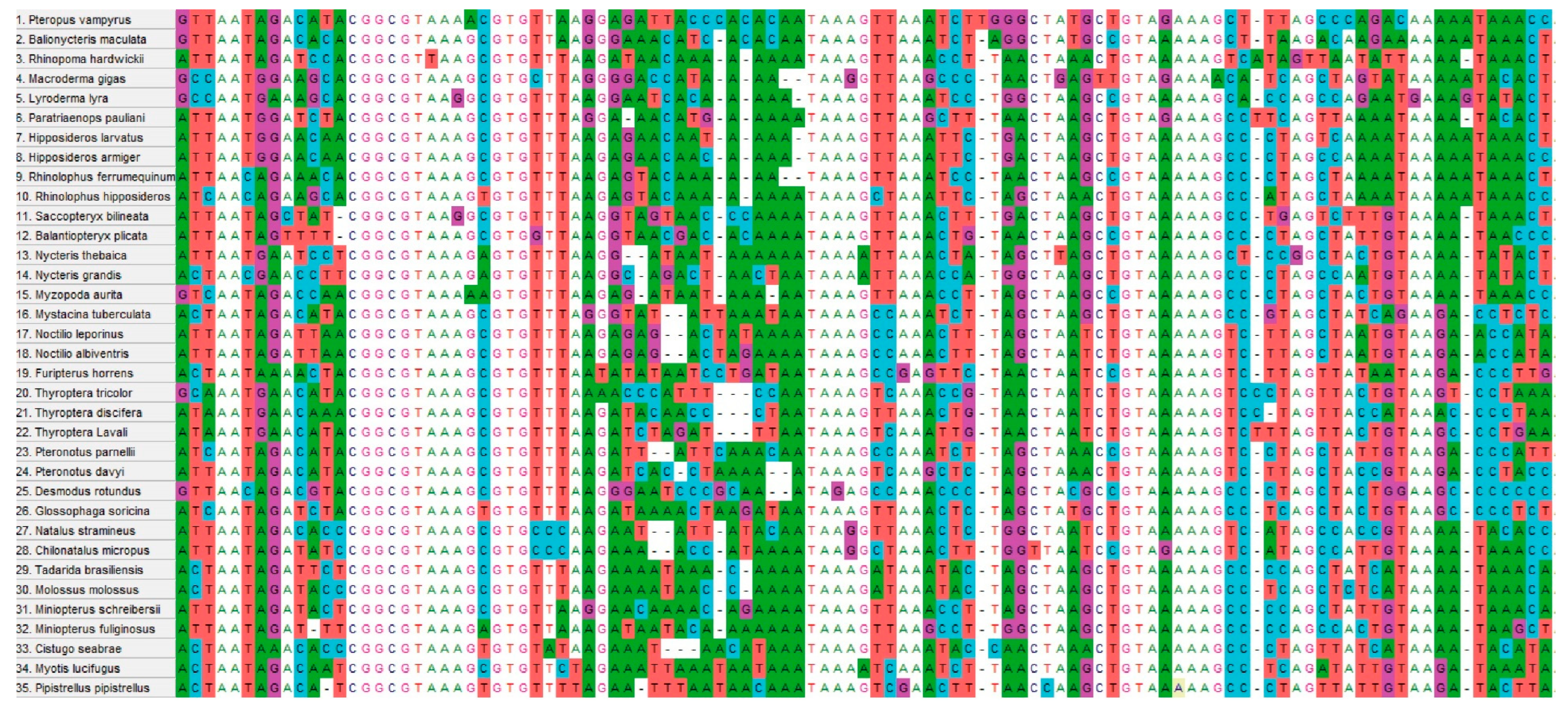
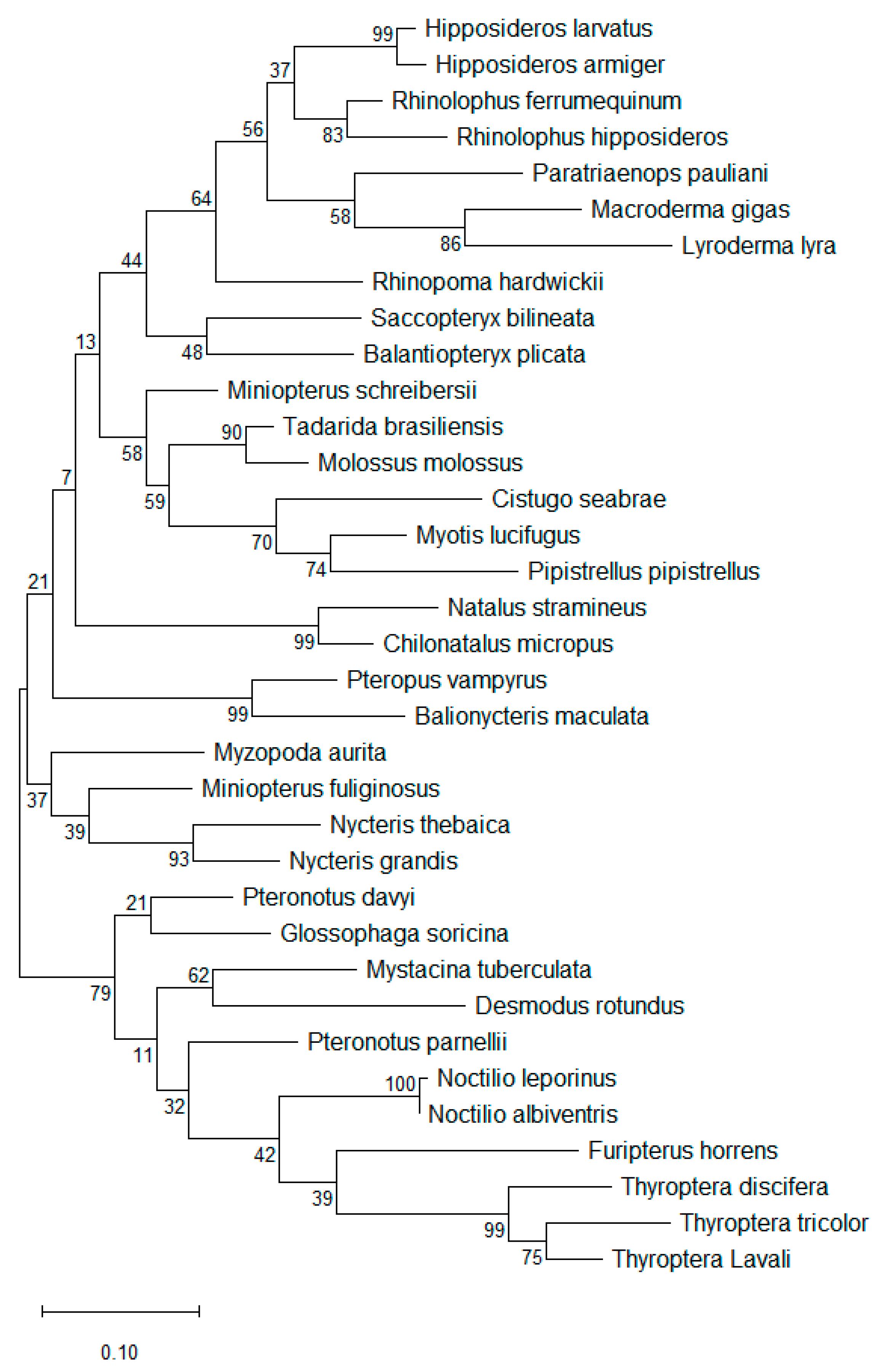
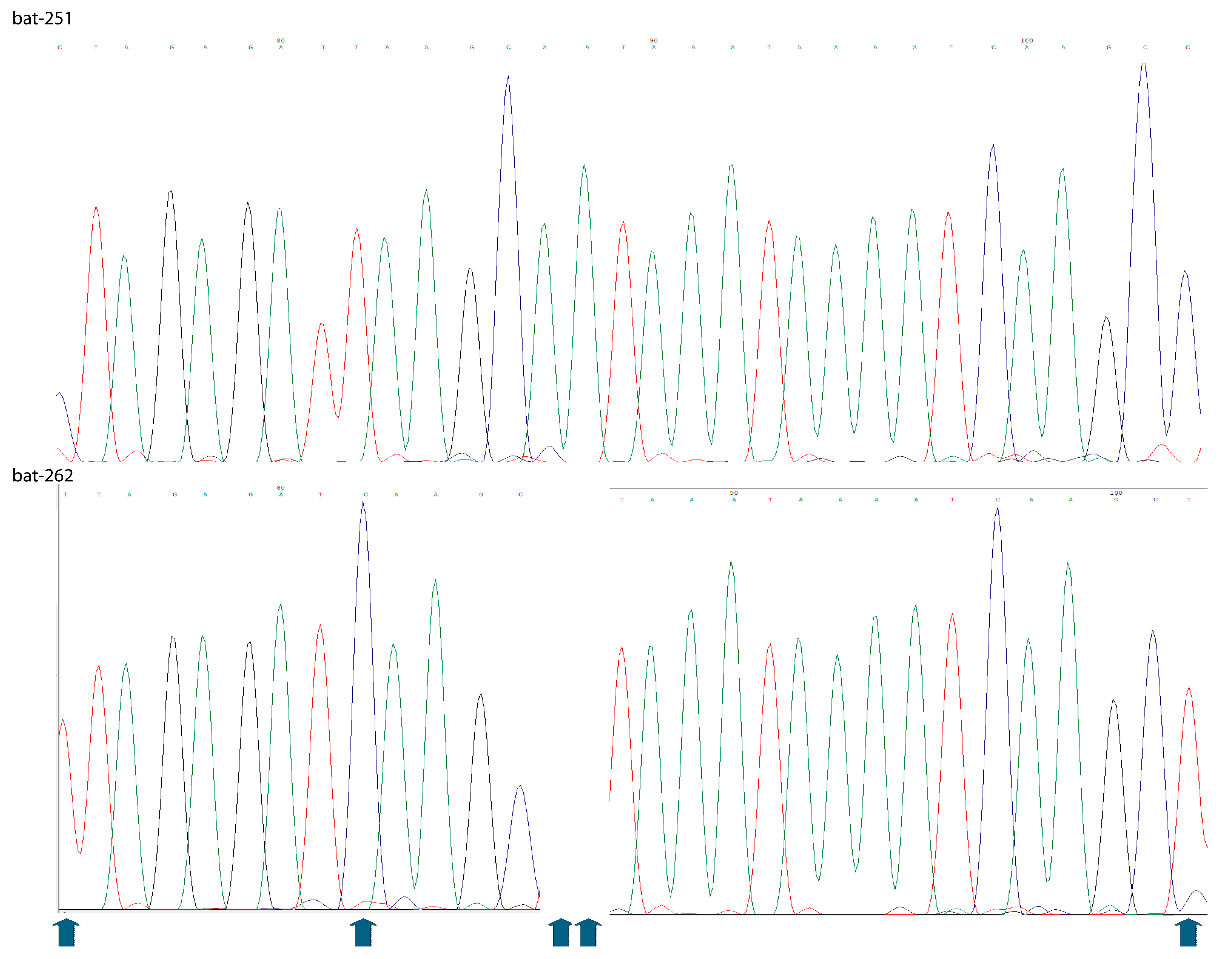

| Family | Genus and Species | Family | Genus and Species |
|---|---|---|---|
| Cistugidae | Cistugo seabrae | Pteropodidae | Desmalopex leucopterus |
| Emballonuridae | Balantiopteryx plicata | Dyacopterus spadiceus | |
| Cormura brevirostris | Desmalopex leucopterus | ||
| Diclidurus scutatus | Dyacopterus spadiceus | ||
| Paremballonura atrata | Eidolon helvum | ||
| Peropteryx kappleri | Eonycteris spelaea | ||
| Rhynchonycteris naso | Epomophorus gambianus | ||
| Saccopteryx bilineata, S. leptura | Epomops franqueti | ||
| Taphozous nudiventris | Haplonycteris fischeri | ||
| Furipteridae | Furipterus horrens | Harpyionycteris celebensis | |
| Hipposideridae | Aselliscus stoliczkanus | Hypsignathus monstrosus | |
| Doryrhina cyclops | Latidens salimalii | ||
| Hipposideros abae, H. armige, H. larvatus | Macroglossus sobrinus | ||
| Macronycteris commersonii | Megaerops niphanae | ||
| Megadermatidae | Lyroderma lyra | Megaloglossus woermanni | |
| Macroderma gigas | Melonycteris melanops | ||
| Miniopteridae | Miniopterus fuliginosus, M. inflatus, M. pusillus, M. schreibersii | Mirimiri acrodonta | |
| Molossidae | Cynomops mexicanus | Myonycteris angolensis | |
| Eumops auripendulus, E. perotis | Nanonycteris veldkampii | ||
| Molossus molossus | Neopteryx frosti | ||
| Mops condylurus | Nesonycteris fardoulisi | ||
| Nyctinomops femorosaccus, N. macrotis | Notopteris macdonaldii | ||
| Otomops martiensseni | Nyctimene albiventer, N. cephalotes | ||
| Ozimops planiceps | Paranyctimene raptor | ||
| Promops centralis | Penthetor lucasii | ||
| Sauromys petrophilus | Plerotes anchietae | ||
| Tadarida brasiliensis, T. teniotis | Ptenochirus wetmorei | ||
| Mormoopidae | Mormoops blainvillii, M. megalophylla | Pteralopex taki | |
| Pteronotus davyi, P. gymnonotus, P. parnellii, P. personatus | Pteropus medius, P. rayneri, P. vampyrus | ||
| Mystacinidae | Mystacina tuberculata | Rousettus amplexicaudatus | |
| Myzopodidae | Myzopoda aurita | Sphaerias blanfordi | |
| Natalidae | Chilonatalus micropus | Stenonycteris lanosus | |
| Natalus macrourus, N. stramineus, N. tumidirostris | Styloctenium wallacei | ||
| Noctilionidae | Noctilio albiventris. N. leporinus | Syconycteris australis | |
| Nycteridae | Nycteris grandis, N. thebaica | Thoopterus nigrescens | |
| Phyllostomidae | Ametrida centurio | Rhinolophidae | Rhinolophus ferrumequinum, R. hipposideros, R. luctus, R. pusillus, R. sinicus |
| Anoura caudifer | Rhinonycteridae | Paratriaenops pauliani | |
| Ardops nichollsi | Rhinopomatidae | Rhinopoma hardwickii | |
| Ariteus flavescens | Thyropteridae | Thyroptera discifera, T. lavali, T. tricolor | |
| Artibeus jamaicensis, A. lituratus | Vespertilionidae | Aeorestes cinereus | |
| Brachyphylla cavernarum | Alionoctula coromandra | ||
| Carollia brevicauda | Antrozous pallidus | ||
| Centurio senex | Arielulus circumdatus | ||
| Phyllostomidae | Chiroderma trinitatum | Barbastella barbastellus | |
| Choeroniscus minor | Bauerus dubiaquercus | ||
| Chrotopterus auritus | Vespertilionidae | Cassistrellus dimissus | |
| Desmodus rotundus | Chalinolobus tuberculatus | ||
| Diaemus youngi | Cnephaeus hottentotus | ||
| Diphylla ecaudata | Corynorhinus mexicanus, C. rafinesquii, C. townsendii | ||
| Ectophylla alba | Dasypterus ega, D. intermedius, D. Xanthinus | ||
| Enchisthenes hartii | Eptesicus fuscus, E. nilssonii | ||
| Erophylla sezekorni | Euderma maculatum | ||
| Gardnerycteris crenulatum | Eudiscopus denticulus | ||
| Glossophaga morenoi, G. soricina | Glauconycteris beatrix | ||
| Glyphonycteris daviesi | Glischropus bucephalus | ||
| Hsunycteris thomasi | Hesperoptenus blanfordi | ||
| Hylonycteris underwoodi | Histiotus macrotus | ||
| Lampronycteris brachyotis | Hypsugo alaschanicus | ||
| Leptonycteris curasoae, L. nivalis, L. yerbabuenae | Ia io | ||
| Lichonycteris obscura | Idionycteris phyllotis | ||
| Lionycteris spurrelli | Kerivoula minuta | ||
| Lonchorhina aurita | Laephotis namibensis | ||
| Lophostoma brasiliense | Lasionycteris noctivagans | ||
| Macrophyllum macrophyllum | Lasiurus blossevillii, L. borealis, L. seminolus | ||
| Macrotus californicus, M. waterhousii | Mimetillus moloneyi | ||
| Mesophylla macconnelli | Murina hilgendorfi | ||
| Mimon bennettii | Murina huttoni rubella | ||
| Monophyllus redmani | Myotis austroriparius, M. californicus, M. ciliolabrum, M. evotis, M. keenii, M. leibii, M. lucifugus, M. septentrionalis, M. thysanodes, M. velifer, M. volans | ||
| Musonycteris harrisoni | Neoromicia somalica | ||
| Phylloderma stenops | Nyctalus aviator | ||
| Phyllostomus hastatus | Nycticeinops eisentrauti | ||
| Platyrrhinus brachycephalus | Nycticeius humeralis | ||
| Pygoderma bilabiatum | Nyctophilus geoffroyi | ||
| Rhinophylla pumilio | Otonycteris hemprichi | ||
| Sphaeronycteris toxophyllum | Parastrellus hesperus | ||
| Stenoderma rufum | Perimyotis subflavus | ||
| Sturnira magna | Philetor brachypterus | ||
| Tonatia saurophila | Pipistrellus pipistrellus | ||
| Trachops cirrhosus | Plecotus auritus | ||
| Trinycteris nicefori | Pseudoromicia brunnea, P. rendalli | ||
| Uroderma bilobatum | Rhogeessa aenea, R. alleni | ||
| Vampyriscus brocki | Scotoecus hirundo | ||
| Vampyrodes caraccioli | Scotomanes ornatus | ||
| Vampyrum spectrum | Scotonycteris bergmansi | ||
| Pteropodidae | Acerodon celebensis, A. jubatus | Scotophilus viridus | |
| Aethalops alecto | Submyotodon latirostris | ||
| Alionycteris paucidentata | Thainycteris aureocollaris | ||
| Aproteles bulmerae | Tylonycteris fulvida | ||
| Balionycteris maculata | Vansonia rueppellii | ||
| Boneia bidens | Vespadelus darlingtoni | ||
| Casinycteris campomaanensis | |||
| Chironax melanocephalus | |||
| Cynopterus brachyotis |
| Pteropus_vampyrus | ||||||||||||||||||||||||||||||||||
| Balionycteris_maculata | 0.13 | |||||||||||||||||||||||||||||||||
| Rhinopoma_hardwickii | 0.25 | 0.21 | ||||||||||||||||||||||||||||||||
| Macroderma_gigas | 0.27 | 0.26 | 0.23 | |||||||||||||||||||||||||||||||
| Lyroderma_lyra | 0.26 | 0.21 | 0.23 | 0.18 | ||||||||||||||||||||||||||||||
| Paratriaenops_pauliani | 0.25 | 0.24 | 0.18 | 0.19 | 0.23 | |||||||||||||||||||||||||||||
| Hipposideros_lanvatus | 0.22 | 0.21 | 0.15 | 0.22 | 0.19 | 0.17 | ||||||||||||||||||||||||||||
| Hipposideros_armiger | 0.20 | 0.20 | 0.17 | 0.22 | 0.19 | 0.19 | 0.03 | |||||||||||||||||||||||||||
| Rhinolophus_ferumequinum | 0.22 | 0.18 | 0.15 | 0.20 | 0.19 | 0.20 | 0.11 | 0.12 | ||||||||||||||||||||||||||
| Rhinolophus_hipposideros | 0.23 | 0.23 | 0.16 | 0.20 | 0.21 | 0.21 | 0.13 | 0.13 | 0.08 | |||||||||||||||||||||||||
| Saccopteryx_bilineata | 0.24 | 0.23 | 0.18 | 0.26 | 0.23 | 0.19 | 0.19 | 0.20 | 0.22 | 0.24 | ||||||||||||||||||||||||
| Balantiopteryx_plicata | 0.25 | 0.24 | 0.19 | 0.24 | 0.23 | 0.19 | 0.19 | 0.18 | 0.17 | 0.20 | 0.16 | |||||||||||||||||||||||
| Nycteris_thebaica | 0.28 | 0.27 | 0.21 | 0.24 | 0.22 | 0.23 | 0.19 | 0.20 | 0.22 | 0.22 | 0.21 | 0.21 | ||||||||||||||||||||||
| Nycteris_grandis | 0.24 | 0.24 | 0.22 | 0.26 | 0.21 | 0.26 | 0.18 | 0.20 | 0.20 | 0.22 | 0.23 | 0.22 | 0.12 | |||||||||||||||||||||
| Myzopoda_aurita | 0.19 | 0.22 | 0.21 | 0.25 | 0.23 | 0.21 | 0.18 | 0.18 | 0.17 | 0.18 | 0.20 | 0.18 | 0.17 | 0.19 | ||||||||||||||||||||
| Mystacina_tuberculata | 0.24 | 0.26 | 0.23 | 0.27 | 0.25 | 0.25 | 0.23 | 0.23 | 0.23 | 0.22 | 0.25 | 0.23 | 0.26 | 0.24 | 0.23 | |||||||||||||||||||
| Noctilio_leoprinus | 0.26 | 0.26 | 0.18 | 0.27 | 0.27 | 0.22 | 0.20 | 0.19 | 0.20 | 0.18 | 0.21 | 0.19 | 0.23 | 0.23 | 0.20 | 0.19 | ||||||||||||||||||
| Noctilio_albiventris | 0.26 | 0.26 | 0.18 | 0.27 | 0.27 | 0.22 | 0.20 | 0.19 | 0.20 | 0.18 | 0.21 | 0.19 | 0.23 | 0.30 | 0.19 | 0.19 | 0.01 | |||||||||||||||||
| Furipterus_horrens | 0.35 | 0.33 | 0.27 | 0.34 | 0.30 | 0.25 | 0.24 | 0.25 | 0.27 | 0.28 | 0.29 | 0.28 | 0.34 | 0.32 | 0.30 | 0.22 | 0.21 | 0.21 | ||||||||||||||||
| Thyroptera_tricolor | 0.33 | 0.34 | 0.30 | 0.33 | 0.28 | 0.30 | 0.28 | 0.29 | 0.30 | 0.32 | 0.30 | 0.31 | 0.27 | 0.24 | 0.25 | 0.26 | 0.24 | 0.24 | 0.26 | |||||||||||||||
| Thyroptera_discifera | 0.29 | 0.30 | 0.24 | 0.30 | 0.30 | 0.26 | 0.21 | 0.22 | 0.25 | 0.26 | 0.26 | 0.26 | 0.26 | 0.25 | 0.25 | 0.24 | 0.21 | 0.21 | 0.23 | 0.14 | ||||||||||||||
| Thyroptera_Lavali | 0.31 | 0.33 | 0.27 | 0.35 | 0.30 | 0.27 | 0.24 | 0.26 | 0.27 | 0.28 | 0.25 | 0.27 | 0.25 | 0.25 | 0.25 | 0.22 | 0.20 | 0.20 | 0.22 | 0.10 | 0.11 | |||||||||||||
| Pteronotus_parnellii | 0.25 | 0.26 | 0.21 | 0.29 | 0.25 | 0.25 | 0.23 | 0.24 | 0.21 | 0.21 | 0.24 | 0.25 | 0.25 | 0.24 | 0.17 | 0.14 | 0.16 | 0.16 | 0.19 | 0.20 | 0.24 | 0.19 | ||||||||||||
| Pteronotus_davyi | 0.24 | 0.26 | 0.19 | 0.27 | 0.25 | 0.21 | 0.20 | 0.20 | 0.20 | 0.18 | 0.23 | 0.21 | 0.22 | 0.21 | 0.18 | 0.16 | 0.17 | 0.17 | 0.22 | 0.20 | 0.20 | 0.17 | 0.12 | |||||||||||
| Desmodus_rotundus | 0.30 | 0.29 | 0.31 | 0.31 | 0.29 | 0.31 | 0.30 | 0.27 | 0.26 | 0.26 | 0.27 | 0.24 | 0.28 | 0.27 | 0.23 | 0.21 | 0.23 | 0.23 | 0.30 | 0.30 | 0.30 | 0.22 | 0.22 | 0.21 | ||||||||||
| Glossophaga_sonicina | 0.25 | 0.27 | 0.20 | 0.25 | 0.25 | 0.20 | 0.20 | 0.21 | 0.22 | 0.19 | 0.22 | 0.21 | 0.20 | 0.21 | 0.18 | 0.20 | 0.19 | 0.18 | 0.24 | 0.25 | 0.19 | 0.20 | 0.17 | 0.12 | 0.21 | |||||||||
| Natalus_stramineus | 0.26 | 0.24 | 0.24 | 0.27 | 0.27 | 0.25 | 0.21 | 0.20 | 0.23 | 0.22 | 0.25 | 0.25 | 0.25 | 0.25 | 0.23 | 0.26 | 0.23 | 0.24 | 0.32 | 0.30 | 0.25 | 0.28 | 0.24 | 0.20 | 0.31 | 0.25 | ||||||||
| Chilonatalus_micropus | 0.25 | 0.26 | 0.24 | 0.30 | 0.29 | 0.26 | 0.25 | 0.22 | 0.27 | 0.25 | 0.22 | 0.22 | 0.28 | 0.27 | 0.27 | 0.27 | 0.21 | 0.21 | 0.30 | 0.34 | 0.29 | 0.31 | 0.24 | 0.24 | 0.29 | 0.27 | 0.10 | |||||||
| Tadanda_brasiliensis | 0.22 | 0.23 | 0.17 | 0.22 | 0.19 | 0.19 | 0.16 | 0.16 | 0.15 | 0.14 | 0.18 | 0.18 | 0.18 | 0.22 | 0.17 | 0.18 | 0.20 | 0.20 | 0.27 | 0.29 | 0.25 | 0.27 | 0.21 | 0.18 | 0.25 | 0.18 | 0.22 | 0.22 | ||||||
| Molossus_molossus | 0.22 | 0.21 | 0.18 | 0.24 | 0.21 | 0.19 | 0.18 | 0.18 | 0.16 | 0.16 | 0.16 | 0.20 | 0.21 | 0.25 | 0.20 | 0.18 | 0.18 | 0.18 | 0.26 | 0.31 | 0.25 | 0.28 | 0.23 | 0.19 | 0.26 | 0.19 | 0.21 | 0.21 | 0.05 | |||||
| Miniopterus_schreibersii | 0.20 | 0.19 | 0.16 | 0.23 | 0.22 | 0.19 | 0.18 | 0.18 | 0.15 | 0.17 | 0.18 | 0.18 | 0.16 | 0.19 | 0.16 | 0.21 | 0.18 | 0.18 | 0.29 | 0.26 | 0.24 | 0.24 | 0.21 | 0.18 | 0.26 | 0.17 | 0.21 | 0.20 | 0.11 | 0.13 | ||||
| Miniopterus_fuliginosus | 0.20 | 0.20 | 0.16 | 0.24 | 0.21 | 0.20 | 0.18 | 0.19 | 0.17 | 0.20 | 0.17 | 0.18 | 0.17 | 0.15 | 0.16 | 0.25 | 0.21 | 0.21 | 0.31 | 0.30 | 0.27 | 0.28 | 0.23 | 0.19 | 0.25 | 0.17 | 0.23 | 0.21 | 0.15 | 0.18 | 0.10 | |||
| Cistugo_seabrae | 0.28 | 0.27 | 0.20 | 0.28 | 0.25 | 0.27 | 0.21 | 0.22 | 0.19 | 0.20 | 0.26 | 0.26 | 0.25 | 0.23 | 0.26 | 0.24 | 0.25 | 0.25 | 0.26 | 0.25 | 0.21 | 0.23 | 0.24 | 0.23 | 0.31 | 0.25 | 0.25 | 0.28 | 0.15 | 0.17 | 0.20 | 0.23 | ||
| Myotis_lucifugus | 0.25 | 0.25 | 0.21 | 0.27 | 0.27 | 0.25 | 0.23 | 0.24 | 0.21 | 0.23 | 0.22 | 0.25 | 0.23 | 0.22 | 0.21 | 0.21 | 0.21 | 0.21 | 0.29 | 0.26 | 0.27 | 0.22 | 0.22 | 0.23 | 0.31 | 0.25 | 0.28 | 0.27 | 0.16 | 0.18 | 0.16 | 0.19 | 0.18 | |
| Pipistrellus_pipistrellus | 0.32 | 0.34 | 0.25 | 0.32 | 0.33 | 0.28 | 0.25 | 0.26 | 0.25 | 0.26 | 0.25 | 0.27 | 0.26 | 0.24 | 0.22 | 0.23 | 0.23 | 0.23 | 0.29 | 0.25 | 0.25 | 0.24 | 0.24 | 0.25 | 0.32 | 0.26 | 0.29 | 0.30 | 0.21 | 0.25 | 0.22 | 0.24 | 0.18 | 0.14 |
| Species Identified | Number of Bats (%) | Identification Method | Nucleotide Similarity (%) |
|---|---|---|---|
| Eptesicus fuscus | 113 (46.9%) | Molecular and morphological | 98.9–100.0% |
| Lasiurus borealis | 31 (12.9%) | Molecular and morphological | 98.1–100.0% |
| Lasiurus ega * | 1 (0.4%) | Molecular only | 90.7% |
| Lasiurus seminolus | 9 (3.7%) | Molecular and morphological | 99.1–100.0% |
| Myotis austroriparius | 6 (2.5%) | Molecular and morphological | 98.6–100.0% |
| Myotis dominicensis | 6 (2.5%) | Molecular only | 97.1–97.6% |
| Myotis grisescens ** | 2 (0.8%) | Morphological only | 97.3–99.1% |
| Nycticeius humeralis | 32 (13.3%) | Molecular and morphological | 98.0–100.0% |
| Pipistrellus subflavus | 3 (1.2%) | Molecular and morphological | 99.0–100.0% |
| Tadarida brasiliensis | 38 (15.8%) | Molecular and morphological | 98.5–100.0% |
Disclaimer/Publisher’s Note: The statements, opinions and data contained in all publications are solely those of the individual author(s) and contributor(s) and not of MDPI and/or the editor(s). MDPI and/or the editor(s) disclaim responsibility for any injury to people or property resulting from any ideas, methods, instructions or products referred to in the content. |
© 2025 by the authors. Licensee MDPI, Basel, Switzerland. This article is an open access article distributed under the terms and conditions of the Creative Commons Attribution (CC BY) license (https://creativecommons.org/licenses/by/4.0/).
Share and Cite
Barua, S.; Tarannum, A.; Rupprecht, C.E.; Simonis, M.C.; Barrantes Murillo, D.F.; Willoughby, J.R.; Wang, C. A Simple Yet Reliable 12S rRNA-Based Molecular Approach for Identifying Bat Species. Animals 2025, 15, 3643. https://doi.org/10.3390/ani15243643
Barua S, Tarannum A, Rupprecht CE, Simonis MC, Barrantes Murillo DF, Willoughby JR, Wang C. A Simple Yet Reliable 12S rRNA-Based Molecular Approach for Identifying Bat Species. Animals. 2025; 15(24):3643. https://doi.org/10.3390/ani15243643
Chicago/Turabian StyleBarua, Subarna, Asfiha Tarannum, Charles E. Rupprecht, Molly C. Simonis, Daniel Felipe Barrantes Murillo, Janna R. Willoughby, and Chengming Wang. 2025. "A Simple Yet Reliable 12S rRNA-Based Molecular Approach for Identifying Bat Species" Animals 15, no. 24: 3643. https://doi.org/10.3390/ani15243643
APA StyleBarua, S., Tarannum, A., Rupprecht, C. E., Simonis, M. C., Barrantes Murillo, D. F., Willoughby, J. R., & Wang, C. (2025). A Simple Yet Reliable 12S rRNA-Based Molecular Approach for Identifying Bat Species. Animals, 15(24), 3643. https://doi.org/10.3390/ani15243643

