Comparative Study on Feeding Physiology, Metabolic Physiology, and Energy Budget of Meretrix meretrix, Mactra veneriformis, and Ruditapes philippinarum in the Tidal Flat Aquaculture Zone
Simple Summary
Abstract
1. Introduction
2. Materials and Methods
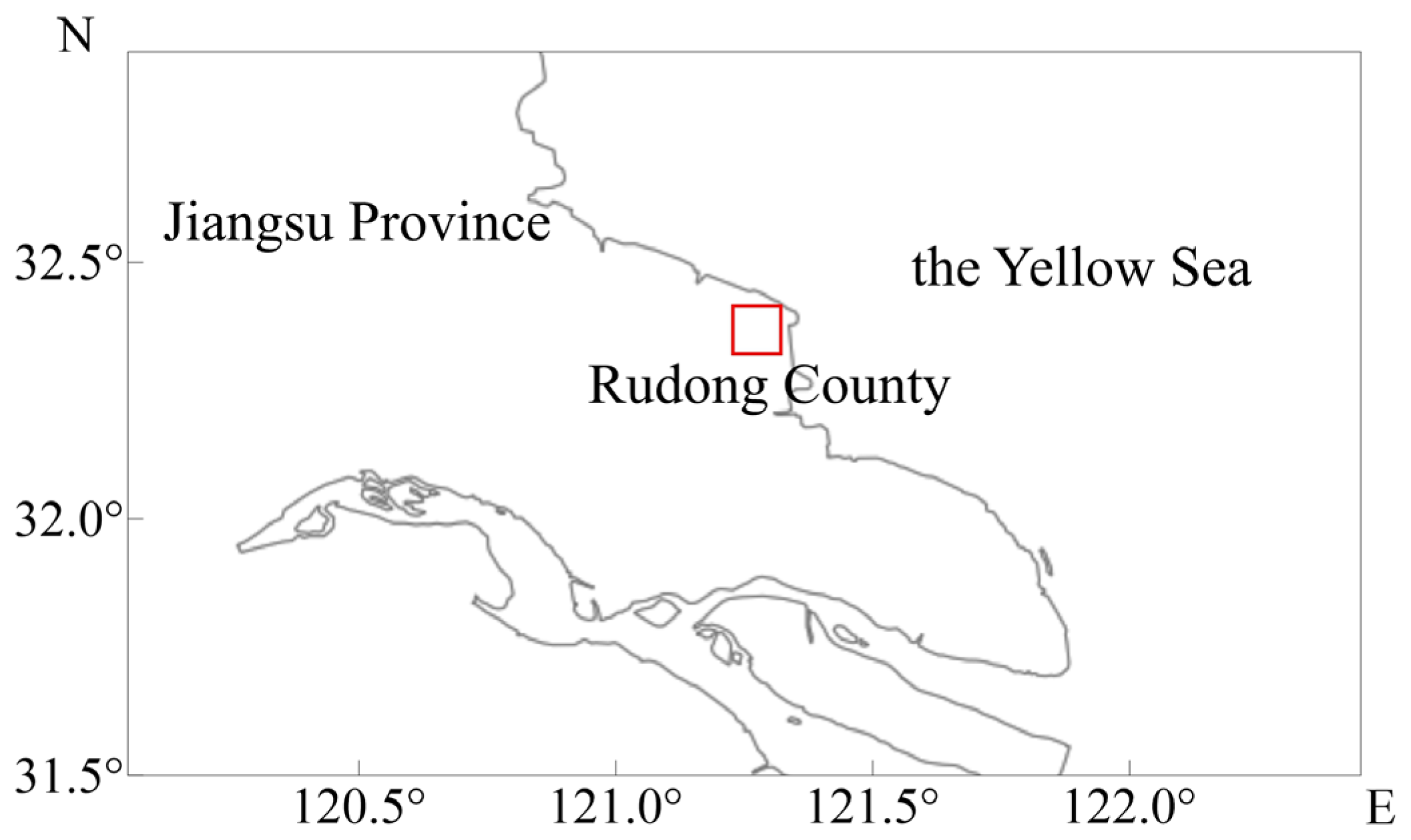
2.1. Experimental Materials
2.2. Experimental Design
2.3. Experimental Methods
2.3.1. Determination of Feeding Physiological Indicators
E = W1/W2; W1 = W65 − W450; W2 = W65 − W0
2.3.2. Measurement of Metabolic Physiological Indicators
2.3.3. Energy Calculation
2.4. Data Analysis
3. Results
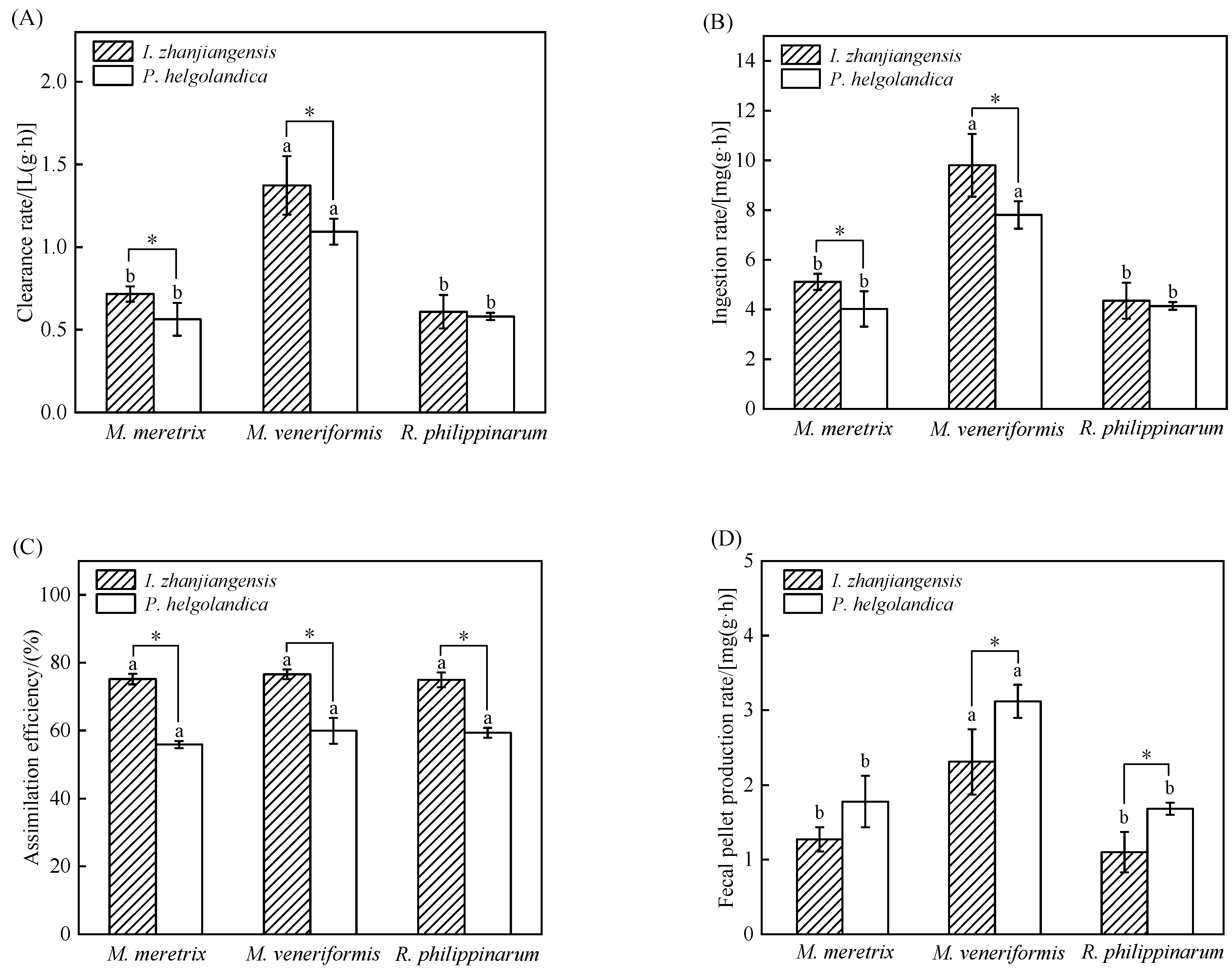
3.1. Comparative Feeding Physiology of M. meretrix, M. veneriformis, and R. philippinarum
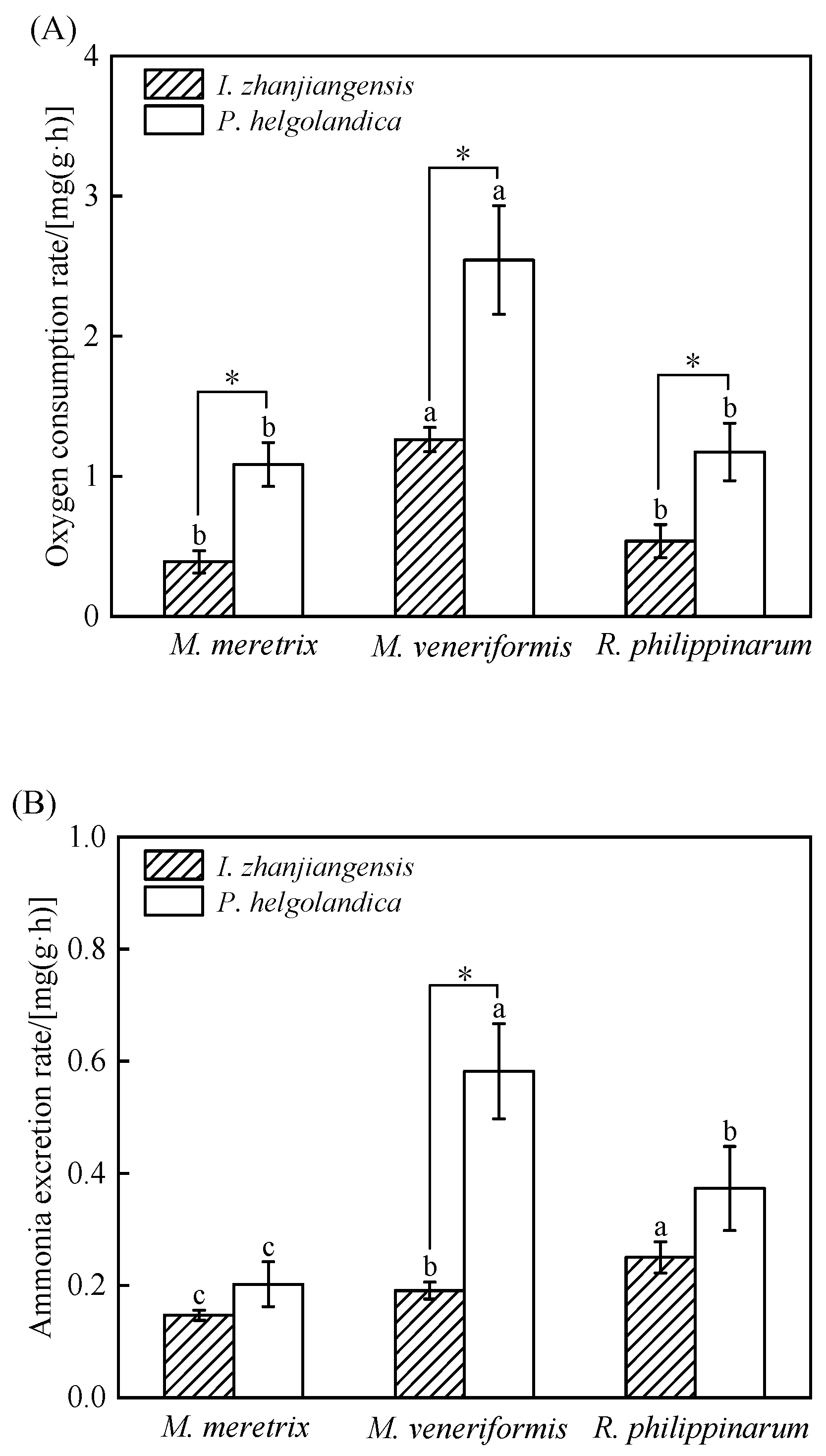
3.2. Comparative Metabolic Physiology of M. meretrix, M. veneriformis, and R. philippinarum
3.3. Comparative Energy Budget of M. meretrix, M. veneriformis, and R. philippinarum
4. Discussion
4.1. Comparative Feeding Physiology of M. meretrix, M. veneriformis, and R. philippinarum
4.2. Comparative Metabolic Physiology of M. meretrix, M. veneriformis, and R. philippinarum
4.3. Effects of I. zhanjiangensis and P. helgolandica on Energy Budget of Bivalves
4.4. Comparative Energy Budget of M. meretrix, M. veneriformis, and R. philippinarum
5. Conclusions
Author Contributions
Funding
Institutional Review Board Statement
Informed Consent Statement
Data Availability Statement
Conflicts of Interest
References
- FAO. The State of World Fisheries and Aquaculture 2022; Food and Agriculture Organization of the United Nations: Rome, Italy, 2022. [Google Scholar]
- The Bureau of Fisheries and Fishery Administration; The Ministry of Agriculture; National Fisheries Technology Extension Center; China Society of Fisheries. China Fisheries Yearbook 2021; China Agriculture Press: Beijing, China, 2021; p. 158. [Google Scholar]
- Turolla, E.; Castaldelli, G.; Fano, E.A.; Tamburini, E. Life cycle assessment (LCA) proves that manila clam farming (Ruditapes Philippinarum) is a fully sustainable aquaculture practice and a carbon sink. Sustainability 2020, 12, 5252. [Google Scholar] [CrossRef]
- Puccinelli, E.; Porri, F.; Altieri, K.; Flynn, R.; Little, H.; Louw, T.; Pattrick, P.; Sparks, C.; Tsanwani, M.; de Waardt, S.; et al. Coastal ecosystem services in South Africa’s largest natural bay: The role of marine benthic filter feeders in mitigating pollution. Ecol. Indic. 2022, 139, 108899. [Google Scholar] [CrossRef]
- Cotou, E.; Miliou, H.; Chatzoglou, E.; Schoina, E.; Politakis, N.; Kogiannou, D.; Fountoulaki, E.; Androni, A.; Konstantinopoulou, A.; Assimakopoulou, G.; et al. Growth performance and environmental quality indices and biomarkers in a co-culture of the European sea bass with filter and deposit feeders: A case study of an IMTA system. Fishes 2024, 9, 69. [Google Scholar] [CrossRef]
- Phong, N.T.; Thuan, N.B.; Loi, L.T.; Quoc, H.V. Morphological evolution of an intertidal mudflat in relation to mangrove growth: Implications for future erosion control. Life 2024, 14, 711. [Google Scholar] [CrossRef]
- Li, X. Sustainable utilization and protection of the tidal-flat resources in Rudong County. J. Suzhou Univ. Sci. Technol. Nat. Sci. Ed. 2004, 21, 8–12. [Google Scholar]
- Rong, Y.; Tang, Y.; Ren, L.; Taylor, W.D.; Razlutskij, V.; Naselli-Flores, L.; Liu, Z.; Zhang, X. Effects of the filter-feeding benthic bivalve corbicula fluminea on plankton community and water quality in aquatic ecosystems: A mesocosm study. Water 2021, 13, 1827. [Google Scholar] [CrossRef]
- Cubillo, A.M.; Lopes, A.S.; Ferreira, J.G.; Moore, H.; Service, M.; Bricker, S.B. Quantification and valuation of the potential of shellfish ecosystem services in mitigating coastal eutrophication. Estuar. Coast. Shelf Sci. 2023, 293, 108469. [Google Scholar] [CrossRef]
- Kang, H.Y.; Lee, Y.-J.; Choi, K.-S.; Park, H.J.; Yun, S.-G.; Kang, C.-K. Combined effects of temperature and seston concentration on the physiological energetics of the manila clam Ruditapes philippinarum. PLoS ONE 2016, 11, e0152427. [Google Scholar] [CrossRef]
- Zhang, J.; Li, Q.; Liu, S.; Yu, H.; Kong, L. The effect of temperature on physiological energetics of a fast-growing selective strain and a hatchery population of the Pacific oyster (Crassostrea gigas). Aquac. Res. 2018, 49, 2844–2851. [Google Scholar] [CrossRef]
- Gu, Z.; Wei, H.; Cheng, F.; Wang, A.; Liu, C. Effects of air exposure time and temperature on physiological energetics and oxidative stress of winged pearl oyster (Pteria penguin). Aquac. Rep. 2020, 17, 100384. [Google Scholar] [CrossRef]
- Zhang, X.; Yang, M.; Zhou, C.; Song, H.; Dong, S.; Guo, Y.; Li, Y.; Wang, F.; Zhang, T. Effect of sulfide on the physiological energetics of Mercenaria mercenaria. Aquaculture 2024, 581, 740396. [Google Scholar] [CrossRef]
- Jiang, X.; Zhang, X.; Guan, J.; He, P.; Wei, P.; Zhang, L.; Peng, J.; Zhao, L. Physiological energetics of selectively bred oysters (Crassostrea hongkongensis) under marine heatwaves. Mar. Environ. Res. 2025, 204, 106871. [Google Scholar] [CrossRef] [PubMed]
- Hong, J. Sustainable development of beach and marine economy along the coast of Rudong. Fish. Inf. Strategy 2004, 40, 28–31. [Google Scholar]
- Huang, J.; Liang, S.; Liu, H.; Li, Y.; Wang, X.; Guo, Y.; Liang, J. Establishment of axenic cultures for two marine microalgae and the effects of antibiotics on their growth. Water 2025, 17, 275. [Google Scholar] [CrossRef]
- Chen, Y.; Ling, Y.; Li, X.; Hu, J.; Cao, C.; He, D. Size-dependent cellular internalization and effects of polystyrene microplastics in microalgae P. helgolandica var. tsingtaoensis and S. quadricauda. J. Hazard. Mater. 2020, 399, 123092. [Google Scholar] [CrossRef]
- Oyarzún, P.A.; Toro, J.E.; Navarro, J.M. Comparison of the physiological energetics between Mytilus chilensis, Mytilus galloprovincialis and their hybrids, under laboratory conditions. Aquac. Res. 2013, 44, 1805–1814. [Google Scholar] [CrossRef]
- Griffiths, R.J. Filtration, respiration and assimilation in the black mussel Choromytilus meridionalis. Mar. Ecol. Prog. Ser. 1980, 3, 63–70. [Google Scholar] [CrossRef]
- Coughlan, J. The estimation of filtering rate from the clearance of suspensions. Mar. Biol. 1969, 2, 356–358. [Google Scholar] [CrossRef]
- Conover, R.J. Assimilation of organic matter by zooplankton. Limnol. Oceanogr. 1966, 11, 338–345. [Google Scholar] [CrossRef]
- Wang, Y.; Li, L.; Hu, M.; Lu, W. Physiological energetics of the thick shell mussel Mytilus coruscus exposed to seawater acidification and thermal stress. Sci. Total Environ. 2015, 514, 261–272. [Google Scholar] [CrossRef]
- Xie, Y.; Wang, B.; Sun, D.; An, K.; Zhang, C.; Ma, Y.; Xiong, L.; Tan, J. Determination of ammonia nitrogen in seawater by sodium hypobromite oxidation method. Chem. Eng. Manag. 2023, 38, 151–155. [Google Scholar] [CrossRef]
- Elliott, J.M. Energy losses in the waste products of brown trout (Salmo trutta L.). J. Anim. Ecol. 1976, 45, 561–580. [Google Scholar] [CrossRef]
- Crisp, D.J. Energy flow measurements. In Methods for the Study of Marine Benthos; John Wiley & Sons, Ltd.: Hoboken, NJ, USA, 1984; pp. 284–372. [Google Scholar]
- Widdows, J.; Johnson, D. Physiological energetics of Mytilus edulis: Scope for growth. Mar. Ecol. Prog. Ser. 1988, 46, 113–121. [Google Scholar] [CrossRef]
- Bayne, B.L.; Newell, R.C. Physiological energetics of marine molluscs. In The Mollusca; Saleuddin, A.S.M., Wilbur, K.M., Eds.; Academic Press: Cambridge, MA, USA, 1983; Volume 4, pp. 407–515. [Google Scholar]
- Winter, J.E. A review on the knowledge of suspension-feeding in lamellibranchiate bivalves, with special reference to artificial aquaculture systems. Aquaculture 1978, 13, 1–33. [Google Scholar] [CrossRef]
- Lin, Y.; Luo, W.; Cao, W.; Guo, D. Studies on filtration rate in four species of suspension feeding bivalves. Acta Oceanolog. Sin. 2002, 21, 147–155. [Google Scholar]
- Jiang, W.; Li, J.; Gao, Y.; Mao, Y.; Jiang, Z.; Du, M.; Zhang, Y.; Fang, J. Effects of temperature change on physiological and biochemical responses of Yesso scallop, Patinopecten yessoensis. Aquaculture 2016, 451, 463–472. [Google Scholar] [CrossRef]
- Rodrigues, N.; Ribeiro, D.; Miyahira, I.C.; Portugal, S.G.M.; Santos, L.N.; Neves, R.A.F. Hypereutrophic conditions limit the removal of suspended particulate matter by the invasive bivalve Mytilopsis leucophaeata (Conrad, 1831) (Dreissenidae). Hydrobiologia 2023, 850, 1461–1476. [Google Scholar] [CrossRef]
- Samperio-Ramos, G.; Vidal-Nieves, C.; García-Esquivel, Z.; Herzka, S.Z.; Sandoval-Gil, J.M.; Camacho-Ibar, V.F. Environmental influence on feeding and biodeposition rates of Pacific oysters (Crassostrea gigas) throughout its culture cycle in a coastal lagoon with upwelling influence. Estuaries Coasts 2024, 47, 1282–1298. [Google Scholar] [CrossRef]
- Teng, W.; Gao, S.; Liu, X.; Yan, H.; Xie, X.; Li, X.; Zhou, Z.; Wang, Q. Effects of salinity on filtration and ingestion rates of surf clam Mactra veneriformis and clam Potamocorbula laevis in Liaodong Bay. Fish. Sci. 2018, 37, 622–627. [Google Scholar] [CrossRef]
- Beninger, P.G.; St-Jean, S.D. The role of mucus in particle processing by suspension-feeding marine bivalves: Unifying principles. Mar. Biol. 1997, 129, 389–397. [Google Scholar] [CrossRef]
- Steeves, L. Feeding physiology of suspension-feeding bivalves: Inter- and intraspecific plasticity. Ph.D. Thesis, Institute of Marine Research in Norway, Bergen, Norway, 2022. [Google Scholar]
- Li, A.; Bai, Y.; Zhu, L.; Xue, S.; Li, J.; Li, X.; Liu, L.; Liu, L.; Mao, Y. Diet composition and feeding habits of Meretrix meretrix and Mactra veneriformis in the northern Bohai Sea based on high-throughput sequencing. Sci. Rep. 2025, 15, 16203. [Google Scholar] [CrossRef] [PubMed]
- Riisgård, H.U. Efficiency of particle retention and filtration rate in 6 species of Northeast American bivalves. Mar. Ecol. Prog. Ser. 1988, 45, 217–223. [Google Scholar] [CrossRef]
- Zhang, X.; Li, S.; He, J.; Wu, Y.; Gu, Z.; Fan, M.; Guo, B.; Buttino, I.; Liao, Z.; Yan, X. Microalgal feeding preference of Mytilus coruscus and its effects on fatty acid composition and microbes of the digestive gland. Aquac. Rep. 2022, 23, 101024. [Google Scholar] [CrossRef]
- Xie, B.; Lin, Z.; He, L. Effects of particle concentration on the retention efficiency of Meretrix meretrix, Mercenaria mercenaria and Ruditapes philippinarum. Prog. Fish. Sci. 2022, 43, 190–198. [Google Scholar] [CrossRef]
- Qi, Q. The life history of the clam (Ruditapes philippinarum). J. Fish. China 1987, 11, 111–119. [Google Scholar]
- Zhao, J. Morphology and habit of Mactra veneriformis deshares. Songliao J. Nat. Sci. Ed. 1992, 14, 41–44. [Google Scholar] [CrossRef]
- Zhang, S.; Wang, H.; Xu, F. Taxonomic study on Meretrix (Bivalvia, Veneridae) from China seas. Zool. Syst. 2012, 37, 473–479. [Google Scholar]
- Thomsen, J.; Himmerkus, N.; Holland, N.; Sartoris, F.J.; Bleich, M.; Tresguerres, M. Ammonia excretion in mytilid mussels is facilitated by ciliary beating. J. Exp. Biol. 2016, 219, 2300–2310. [Google Scholar] [CrossRef]
- Li, Y.; Zhang, X.; Tong, R.; Xu, Q.; Zhang, N.; Liao, Q.; Pan, L. Mechanisms of ammonotelism, epithelium damage, cellular apoptosis, and proliferation in gill of Litopenaeus vannamei under NH4Cl exposure. Environ. Sci. Pollut. Res. 2024, 31, 15153–15171. [Google Scholar] [CrossRef]
- Pineda, M.O.; Gebauer, P.; Briceño, F.A.; López, B.A.; Paschke, K. A bioenergetic approach for a novel aquaculture species, the giant barnacle Austromegabalanus psittacus (Molina, 1788): Effects of microalgal diets on larval development and metabolism. Aquac. Rep. 2021, 21, 100824. [Google Scholar] [CrossRef]
- Duong, D.N.; Stone, D.A.J.; Qin, J.G.; Bansemer, M.S.; Harris, J.O. Energy budgets for greenlip abalone (Haliotis laevigata Donovan) fed live macroalgae compared to commercial formulated diets. Aquac. Res. 2020, 51, 4948–4960. [Google Scholar] [CrossRef]
- Brown, M.R.; Jeffrey, S.W.; Volkman, J.K.; Dunstan, G.A. Nutritional properties of microalgae for mariculture. Aquaculture 1997, 151, 315–331. [Google Scholar] [CrossRef]
- Vadeboncoeur, Y.; Power, M.E. Attached algae: The cryptic base of inverted trophic pyramids in freshwaters. Annu. Rev. Ecol. Evol. Syst. 2017, 48, 255–279. [Google Scholar] [CrossRef]
- Glazier, D.; Gjoni, V. Interactive effects of intrinsic and extrinsic factors on metabolic rate. Philos. Trans. R. Soc. B 2024, 379, 20220489. [Google Scholar] [CrossRef]
- Zhuang, S.; Liu, X. The influence of fresh weight and water temperature on metabolic rates and the energy budget of Meretrix meretrix Linnaeus. Mar. Biol. 2006, 150, 245–252. [Google Scholar] [CrossRef]
- Norkko, J.; Pilditch, C.A.; Thrush, S.F.; Wells, R.M.G. Effects of food availability and hypoxia on bivalves: The value of using multiple parameters to measure bivalve condition in environmental studies. Mar. Ecol. Prog. Ser. 2005, 298, 205–218. [Google Scholar] [CrossRef]
- Jiang, W.; Wang, X.; Rastrick, S.P.S.; Wang, J.; Zhang, Y.; Strand, Ø.; Fang, J.; Jiang, Z. Effects of elevated pCO2 on the physiological energetics of Pacific oyster, Crassostrea gigas. ICES J. Mar. Sci. 2021, 78, 2579–2590. [Google Scholar] [CrossRef]



| Species | Number | Shell Length (mm) | Shell Height (mm) | Shell Width (mm) | Wet Weight (g) | Soft Tissue Dry Weight (g) | Shell Dry Weight (g) | Condition Index (%) |
|---|---|---|---|---|---|---|---|---|
| M. meretrix | 30 | 41.17 ± 1.69 | 34.08 ± 1.64 | 21.18 ± 1.86 | 19.13 ± 2.06 | 0.808 ± 0.117 | 13.644 ± 2.063 | 5.949 ± 0.611 |
| M. veneriformis | 30 | 36.42 ± 1.34 | 31.94 ± 1.53 | 24.76 ± 1.26 | 15.95 ± 2.08 | 0.475 ± 0.038 | 5.828 ± 0.720 | 8.191 ± 0.615 |
| R. philippinarum | 30 | 36.25 ± 1.94 | 24.32 ± 1.20 | 16.14 ± 1.03 | 8.68 ± 1.27 | 0.365 ± 0.038 | 4.186 ± 0.501 | 8.808 ± 1.302 |
| Species | C | R | U | F | SFG |
|---|---|---|---|---|---|
| M. meretrix | 106.232 ± 6.825 b | 5.554 ± 1.143 b | 3.650 ± 0.212 c | 26.478 ± 3.371 b | 70.550 ± 2.133 b |
| M. veneriformis | 203.711 ± 26.261 a | 17.944 ± 1.240 a | 4.743 ± 0.376 b | 47.975 ± 9.032 a | 133.050 ± 15.705 a |
| R. philippinarum | 90.406 ± 15.056 b | 7.637 ± 1.665 b | 6.216 ± 0.702 a | 22.866 ± 5.622 b | 53.688 ± 7.548 b |
| Species | C | R | U | F | SFG |
|---|---|---|---|---|---|
| M. meretrix | 83.581 ± 14.693 b | 15.425 ± 2.220 b | 5.024 ± 0.995 c | 36.975 ± 7.167 b | 26.157 ± 5.478 b |
| M. veneriformis | 162.168 ± 11.528 a | 36.182 ± 5.514 a | 14.443 ± 2.116 a | 64.822 ± 4.616 a | 46.721 ± 6.939 a |
| R. philippinarum | 86.054 ± 3.225 b | 16.697 ± 2.932 b | 9.270 ± 1.863 b | 34.982 ± 1.691 b | 25.106 ± 2.719 b |
Disclaimer/Publisher’s Note: The statements, opinions and data contained in all publications are solely those of the individual author(s) and contributor(s) and not of MDPI and/or the editor(s). MDPI and/or the editor(s) disclaim responsibility for any injury to people or property resulting from any ideas, methods, instructions or products referred to in the content. |
© 2025 by the authors. Licensee MDPI, Basel, Switzerland. This article is an open access article distributed under the terms and conditions of the Creative Commons Attribution (CC BY) license (https://creativecommons.org/licenses/by/4.0/).
Share and Cite
Liu, L.; Zhu, Y.; Xin, C.; Bao, J.; Wang, F.; Han, S.; Hu, H.; Zhang, X.; Li, L.; Jiang, M. Comparative Study on Feeding Physiology, Metabolic Physiology, and Energy Budget of Meretrix meretrix, Mactra veneriformis, and Ruditapes philippinarum in the Tidal Flat Aquaculture Zone. Animals 2025, 15, 3543. https://doi.org/10.3390/ani15243543
Liu L, Zhu Y, Xin C, Bao J, Wang F, Han S, Hu H, Zhang X, Li L, Jiang M. Comparative Study on Feeding Physiology, Metabolic Physiology, and Energy Budget of Meretrix meretrix, Mactra veneriformis, and Ruditapes philippinarum in the Tidal Flat Aquaculture Zone. Animals. 2025; 15(24):3543. https://doi.org/10.3390/ani15243543
Chicago/Turabian StyleLiu, Longyu, Yue Zhu, Chaozhong Xin, Jinmeng Bao, Fengbiao Wang, Shuai Han, Haopeng Hu, Xuan Zhang, Lei Li, and Mei Jiang. 2025. "Comparative Study on Feeding Physiology, Metabolic Physiology, and Energy Budget of Meretrix meretrix, Mactra veneriformis, and Ruditapes philippinarum in the Tidal Flat Aquaculture Zone" Animals 15, no. 24: 3543. https://doi.org/10.3390/ani15243543
APA StyleLiu, L., Zhu, Y., Xin, C., Bao, J., Wang, F., Han, S., Hu, H., Zhang, X., Li, L., & Jiang, M. (2025). Comparative Study on Feeding Physiology, Metabolic Physiology, and Energy Budget of Meretrix meretrix, Mactra veneriformis, and Ruditapes philippinarum in the Tidal Flat Aquaculture Zone. Animals, 15(24), 3543. https://doi.org/10.3390/ani15243543