Prevalence of Bacterial Urinary Tract Infections in Dogs and Cats with Lower Urinary Tract Diseases and Other Illnesses: A Systematic Review and Meta-Analysis


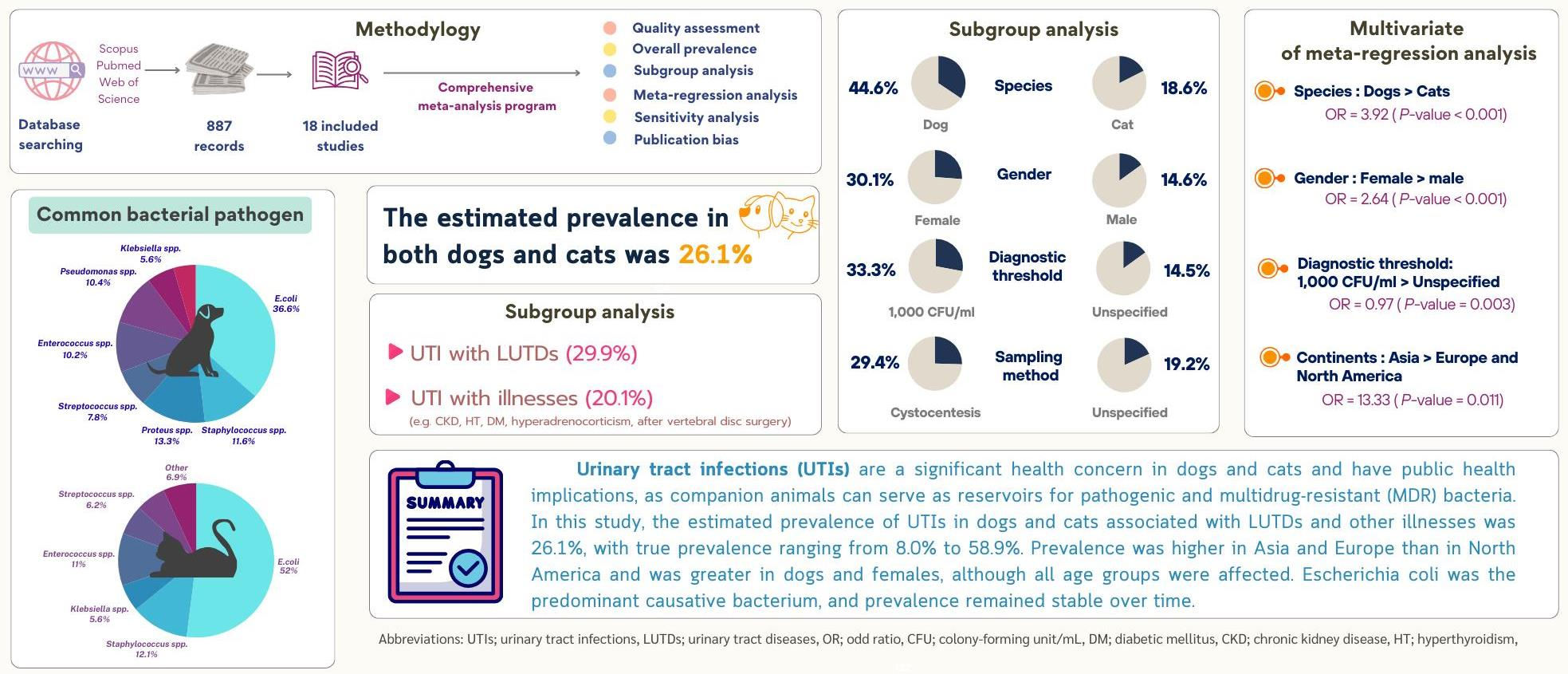
Simple Summary
Abstract
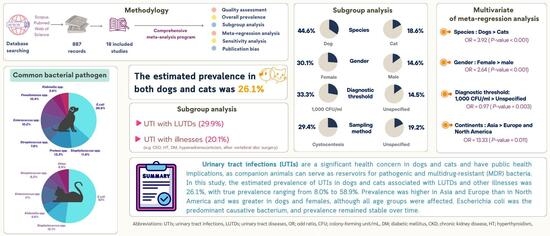
1. Introduction
2. Materials and Methods
2.1. Review Questions
2.2. Search Strategy
2.3. Eligibility Criteria
2.4. Data Extraction
2.5. Quality Assessment
2.6. Statistical Analysis
2.6.1. Overall Meta-Analysis
2.6.2. Subgroup Meta-Analysis
2.6.3. Meta-Regression
2.7. Sensitivity Analysis
2.8. Publication Bias
3. Results
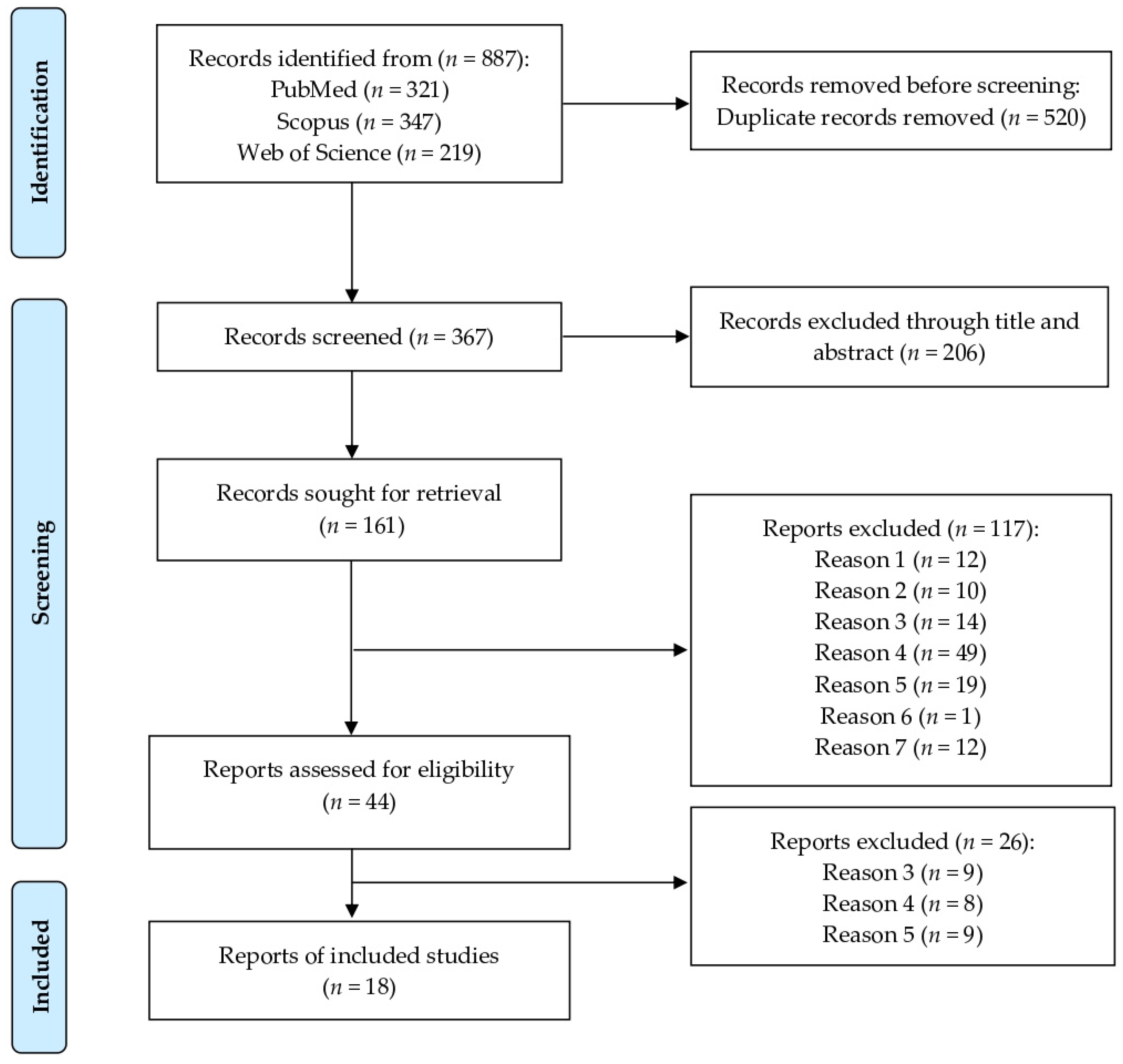
3.1. Literature Search and Study Characteristics
3.2. Assessment of Study Quality
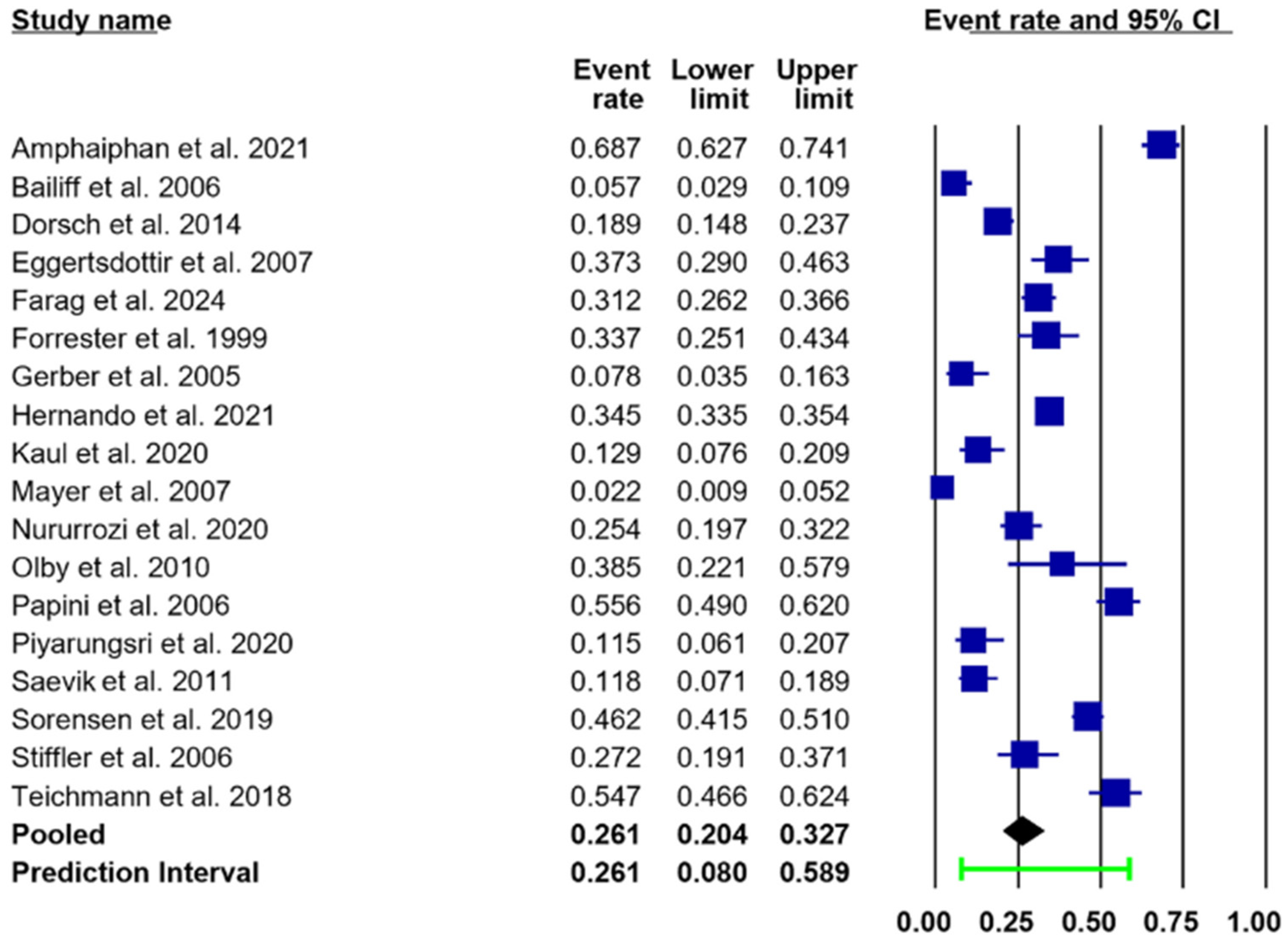
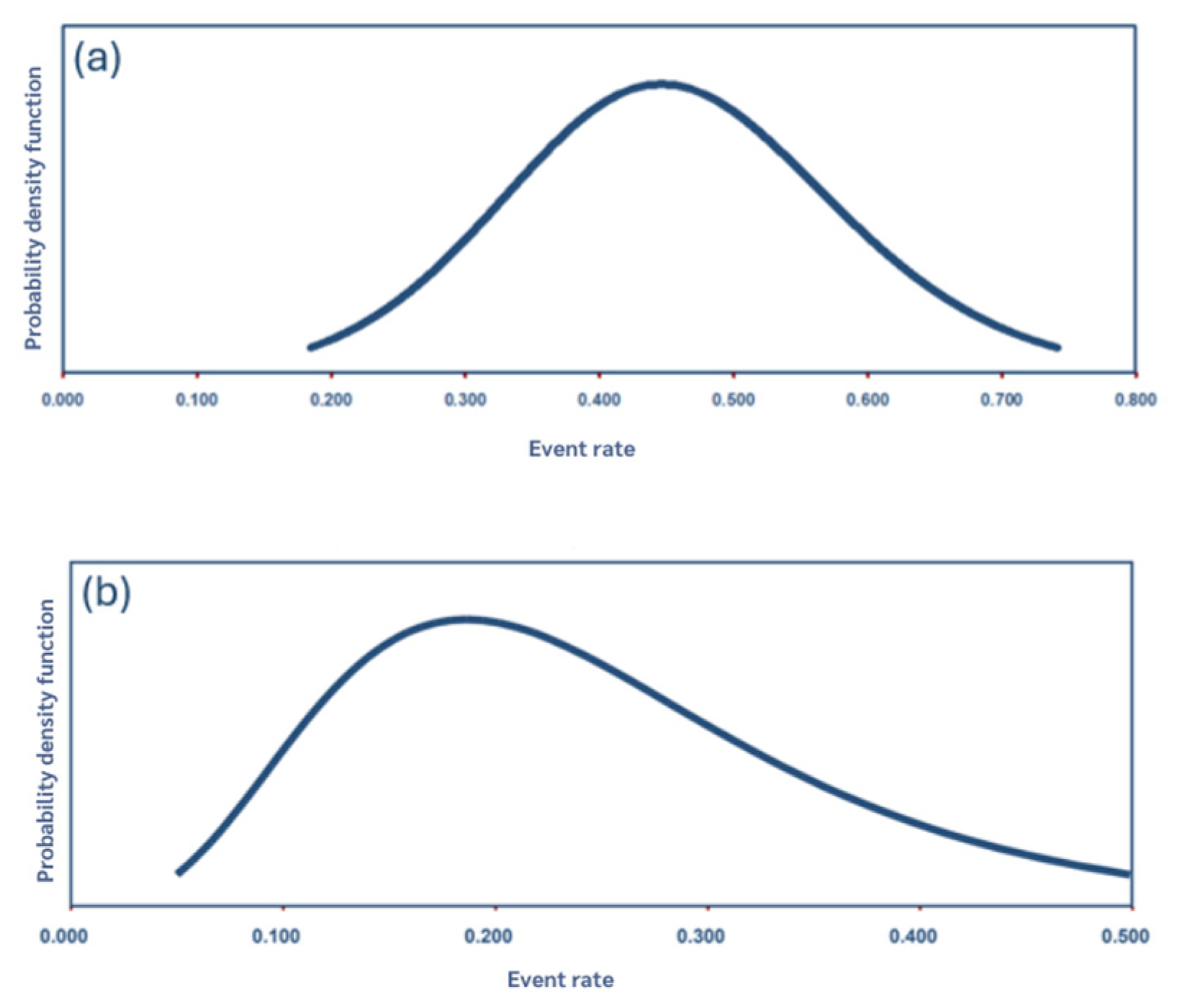
3.3. Overall Prevalence Estimates
3.4. Subgroup Analysis
3.4.1. Cohort-Specific Prevalence
3.4.2. Continent-Specific Prevalence
3.4.3. Species-Specific Prevalence
3.4.4. Sex-Specific Prevalence
3.4.5. Age-Specific Prevalence
3.4.6. Diagnostic Threshold Based on Quantitative Bacterial Cultures of Urine
3.4.7. Prevalence According to Sampling Methods
3.5. Meta-Regression Analysis
3.6. Sensitivity Analysis
3.7. Prevalence of Pathogenic Bacteria Isolated from the Urine of Dogs and Cats with UTIs
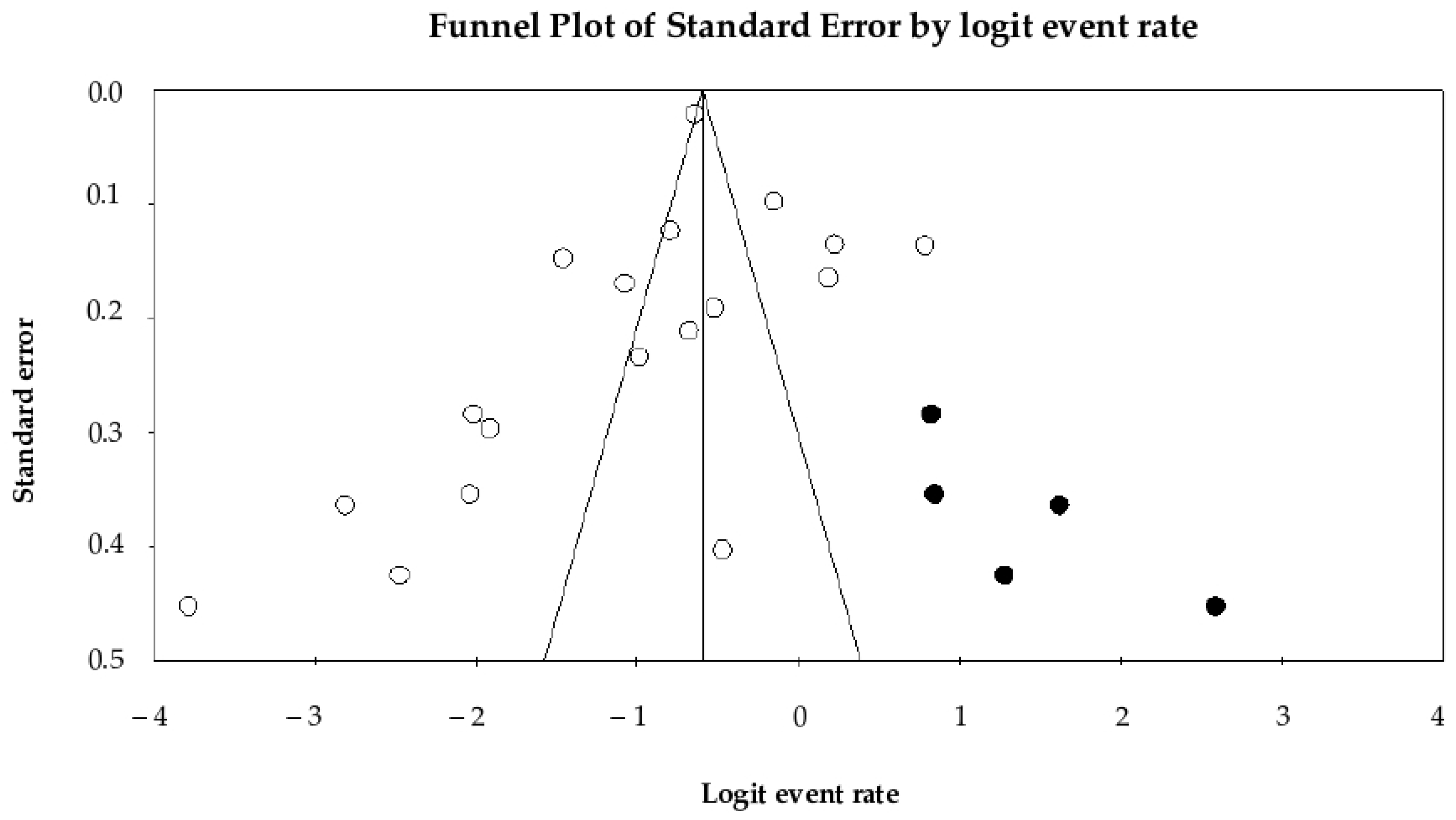
3.8. Evaluation of Publication Bias
4. Discussion
5. Conclusions
Author Contributions
Funding
Institutional Review Board Statement
Informed Consent Statement
Data Availability Statement
Conflicts of Interest
References
- Weese, J.S.; Blondeau, J.; Boothe, D.; Guardabassi, L.G.; Gumley, N.; Papich, M.; Jessen, L.R.; Lappin, M.; Rankin, S.; Westropp, J.L.; et al. International Society for Companion Animal Infectious Diseases (ISCAID) guidelines for the diagnosis and management of bacterial urinary tract infections in dogs and cats. Vet. J. 2019, 247, 8–25. [Google Scholar] [CrossRef]
- Weese, J.S.; Blondeau, J.M.; Boothe, D.; Breitschwerdt, E.B.; Guardabassi, L.; Hillier, A.; Lloyd, D.H.; Papich, M.G.; Rankin, S.C.; Turnidge, J.D.; et al. Antimicrobial use guidelines for treatment of urinary tract disease in dogs and cats: Antimicrobial guidelines working group of the International Society for Companion Animal Infectious Diseases. Vet. Med. Int. 2011, 2011, 263768. [Google Scholar] [CrossRef]
- Bouillon, J.; Snead, E.; Caswell, J.; Feng, C.; Hélie, P.; Lemetayer, J. Pyelonephritis in dogs: Retrospective study of 47 histologically diagnosed cases (2005–2015). J. Vet. Intern. Med. 2018, 32, 249–259. [Google Scholar] [CrossRef]
- Damborg, P.; Pirolo, M.; Schøn Poulsen, L.; Frimodt-Møller, N.; Guardabassi, L. Dogs can be reservoirs of Escherichia coli strains causing urinary tract infection in human household contacts. Antibiotics 2023, 12, 1269. [Google Scholar] [CrossRef] [PubMed]
- Faires, M.C.; Tater, K.C.; Weese, S.J. An investigation of methicillin-resistant Staphylococcus aureus colonization in people and pets in the same household with an infected person or infected pet. J. Am. Vet. Med. Assoc. 2009, 235, 540–543. [Google Scholar] [CrossRef] [PubMed]
- Marques, C.; Belas, A.; Menezes, J.; da Silva, J.M.; Cavaco-Silva, P.; Trigueiro, G.; Gama, L.T.; Pomba, C. Human and companion animal Proteus mirabilis sharing. Microbiol. Res. 2022, 13, 38–48. [Google Scholar] [CrossRef]
- Von Wintersdorff, C.J.H.; Penders, J.; Van Niekerk, J.M.; Mills, N.D.; Majumder, S.; Van Alphen, L.B.; Savelkoul, P.H.M.; Wolffs, P.F.G. Dissemination of antimicrobial resistance in microbial ecosystems through horizontal gene transfer. Front. Microbiol. 2016, 7, 173. [Google Scholar] [CrossRef]
- Varela, M.F.; Stephen, J.; Lekshmi, M.; Ojha, M.; Wenzel, N.; Sanford, L.M.; Hernandez, A.J.; Parvathi, A.; Kumar, S.H. Bacterial resistance to antimicrobial agents. Antibiotics 2021, 10, 593. [Google Scholar] [CrossRef] [PubMed]
- Terreni, M.; Taccani, M.; Pregnolato, M. New antibiotics for multidrug-resistant bacterial strains: Latest research developments and future perspectives. Molecules 2021, 26, 2671. [Google Scholar] [CrossRef]
- Dupont, P.; Burkhardt, W.A.; Boretti, F.S.; Riond, B.; Reusch, C.E.; Willi, B.; Sieber-Ruckstuhl, N.S. Urinary tract infections in dogs with spontaneous hypercortisolism—Frequency, symptoms and involved pathogens. Schweiz. Arch. Tierheilkd 2020, 162, 439–450. [Google Scholar] [CrossRef]
- Amphaiphan, C.; Yano, T.; Som-in, M.; Kungwong, P.; Wongsawan, K.; Pusoonthornthum, R.; Salman, M.D.; Tangtrongsup, S. Antimicrobial drug resistance profile of isolated bacteria in dogs and cats with urologic problems at Chiang Mai University Veterinary Teaching Hospital, Thailand (2012–2016). Zoonoses Public Health 2021, 68, 452–463. [Google Scholar] [CrossRef] [PubMed]
- Hernando, E.; Vila, A.; D’Ippolito, P.; Rico, A.J.; Rodon, J.; Roura, X. Prevalence and characterization of urinary tract infection in owned dogs and cats from Spain. Top. Companion Anim. Med. 2021, 43, 100512. [Google Scholar] [CrossRef]
- Mayer-Roenne, B.; Goldstein, R.E.; Erb, H.N. Urinary tract infections in cats with hyperthyroidism, diabetes mellitus and chronic kidney disease. J. Feline Med. Surg. 2007, 9, 124–132. [Google Scholar] [CrossRef] [PubMed]
- Bailiff, N.L.; Nelson, R.W.; Feldman, E.C.; Westropp, J.L.; Ling, G.V.; Jang, S.S.; Kass, P.H. Frequency and risk factors for urinary tract infection in cats with diabetes mellitus. J. Vet. Intern. Med. 2006, 20, 850–855. [Google Scholar] [CrossRef]
- Stiffler, K.S.; Stevenson, M.A.M.C.; Sanchez, S.; Barsanti, J.A.; Hofmeister, E.; Budsberg, S.C. Prevalence and characterization of urinary tract infections in dogs with surgically treated type 1 thoracolumbar intervertebral disc extrusion. Vet. Surg. 2006, 35, 330–336. [Google Scholar] [CrossRef]
- Gerber, B.; Boretti, F.S.; Kley, S.; Laluha, P.; Muller, C.; Sieber, N.; Unterer, S.; Wenger, M.; Fluckiger, M.; Glaus, T.; et al. Evaluation of clinical signs and causes of lower urinary tract disease in European cats. J. Small Anim. Pract. 2005, 46, 571–577. [Google Scholar] [CrossRef]
- Forrester, S.D.; Troy, G.C.; Dalton, M.N.; Huffman, J.W.; Holtzman, G. Retrospective evaluation of urinary tract infection in 42 dogs with hyperadrenocorticism or diabetes mellitus or both. J. Vet. Int. Med. 1999, 13, 557–560. [Google Scholar] [CrossRef]
- Mintzker, Y.; Blum, D.; Adler, L. Replacing PICO in non-interventional studies. BMJ Evid. Based Med. 2023, 28, 284. [Google Scholar] [CrossRef]
- Sukon, P.; Nam, N.H.; Kittipreeya, P.; Sara-in, A.; Wawilai, P.; Inchuai, R.; Weerakhun, S. Global prevalence of Chlamydial infections in birds: A systematic review and meta-Analysis. Prev. Vet. Med. 2021, 192, 105370. [Google Scholar] [CrossRef] [PubMed]
- Higgins, J.P.T.; Thompson, S.G. Quantifying Heterogeneity in a meta-analysis. Stat. Med. 2002, 21, 1539–1558. [Google Scholar] [CrossRef]
- Begg, C.B.; Mazumdar, M. Operating characteristics of a rank correlation test for publication bias. Biometrics 1994, 50, 1088–1101. [Google Scholar] [CrossRef]
- Egger, M.; Smith, G.D.; Schneider, M.; Minder, C. Bias in meta-analysis detected by a simple, graphical test. Br. Med. J. 1997, 315, 629–634. [Google Scholar] [CrossRef]
- Duval, S.; Tweedie, R. Trim and fill: A simple funnel-plot-based method. Biometrics 2000, 56, 455–463. [Google Scholar] [CrossRef]
- Farag, H.S.; Ali, M.E.; Abdel Masseih, E.S.; Bakry, N.M. Diagnostic ultrasonography and antimicrobial resistance of different pathogens associated with canine and feline lower urinary tract disorders. Comp. Immunol. Microbiol. Infect. Dis. 2024, 112, 102216. [Google Scholar] [CrossRef]
- Piyarungsri, K.; Tangtrongsup, S.; Thitaram, N.; Lekklar, P.; Kittinuntasilp, A. Prevalence and risk factors of feline lower urinary tract disease in Chiang Mai, Thailand. Sci. Rep. 2020, 10, 196. [Google Scholar] [CrossRef]
- Nururrozi, A.; Yanuartono, Y.; Sivananthan, P.; Indarjulianto, S. Evaluation of lower urinary tract disease in the Yogyakarta cat population, Indonesia. Vet. World 2020, 13, 1182–1186. [Google Scholar] [CrossRef]
- Kaul, E.; Hartmann, K.; Reese, S.; Dorsch, R. Recurrence rate and long-term course of cats with feline lower urinary tract disease. J. Feline Med. Surg. 2020, 22, 544–556. [Google Scholar] [CrossRef] [PubMed]
- Sørensen, T.M.; Holmslykke, M.; Nordlund, M.; Siersma, V.; Jessen, L.R. Pre-test probability of urinary tract infection in dogs with clinical signs of lower urinary tract disease. Vet. J. 2019, 247, 65–70. [Google Scholar] [CrossRef] [PubMed]
- Teichmann-Knorrn, S.; Dorsch, R. Significant bacteriuria in cats: Urinary tract infection and subclinical bacteriuria—A current review. Tierarztl. Prax. Ausg. K Kleintiere Heimtiere 2018, 46, 247–259. [Google Scholar] [PubMed]
- Dorsch, R.; Remer, C.; Sauter-Louis, C.; Hartmann, K. Feline lower urinary tract disease in a German cat population: A retrospective analysis of demographic data, causes and clinical signs. Tierarztl. Prax. Ausg. K Kleintiere Heimtiere 2014, 42, 231–239. [Google Scholar]
- Sævik, B.K.; Trangerud, C.; Ottesen, N.; Sørum, H.; Eggertsdóttir, A.V. Causes of lower urinary tract disease in Norwegian cats. J. Feline Med. Surg. 2011, 13, 410–417. [Google Scholar] [CrossRef] [PubMed]
- Olby, N.J.; Mackillop, E.; Moore, S.; Mun, K.R.; Grafinger, M.; Osborne, J.A.; Vaden, S.L. Prevalence of urinary tract infection in dogs after surgery for thoracolumbar intervertebral disc extrusion. J. Vet. Intern. Med. 2010, 24, 1106–1111. [Google Scholar] [CrossRef]
- Eggertsdóttir, A.V.; Lund, H.S.; Krontveit, R.; Sørum, H. Bacteriuria in cats with feline lower urinary tract disease: A clinical study of 134 cases in Norway. J. Feline Med. Surg. 2007, 9, 458–465. [Google Scholar] [CrossRef]
- Papini, R.; Ebani, V.V.; Cerri, D.; Guidi, G. Survey on bacterial isolates from dogs with urinary tract infections and their in vitro sensitivity. Rev. Med. Vet. 2006, 157, 35–41. [Google Scholar]
- Barker, T.H.; Migliavaca, C.B.; Stein, C.; Colpani, V.; Falavigna, M.; Aromataris, E.; Munn, Z. Conducting proportional meta-analysis in different types of systematic reviews: A guide for synthesisers of evidence. BMC Med. Res. Methodol. 2021, 21, 189. [Google Scholar] [CrossRef]
- Munn, Z.; MClinSc, S.M.; Lisy, K.; Riitano, D.; Tufanaru, C. Methodological guidance for systematic reviews of observational epidemiological studies reporting prevalence and cumulative incidence data. Int. J. Evid. Based Healthc. 2015, 13, 147–153. [Google Scholar] [CrossRef]
- Mendóza-lópez, C.I.; Del-angel-caraza, J.; Quijano-Hernández, I.A.; Barbosa-Mireles, M.A. Analysis of lower urinary tract disease of dogs. Pesq. Vet. Bras. 2017, 37, 1275–1280. [Google Scholar] [CrossRef]
- Seguin, M.A.; Vaden, S.L.; Altier, C.; Stone, E.; Levine, J.F. Persistent urinary tract infections and reinfections in 100 dogs (1989–1999). J. Vet. Intern. Med. 2003, 17, 622–631. [Google Scholar] [CrossRef]
- Johnson, J.R.; Kaster, N.; Kuskowski, M.A.; Ling, G.V. Identification of urovirulence traits in Escherichia coli by comparison of urinary and rectal E. coli isolates from dogs with urinary tract infection. J. Clin. Microbiol. 2003, 41, 337–345. [Google Scholar] [CrossRef]
- Burton, E.N.; Cohn, L.A.; Reinero, C.N.; Rindt, H.; Moore, S.G.; Ericsson, A.C. Characterization of the urinary microbiome in healthy dogs. PLoS ONE 2017, 12, e0177783. [Google Scholar] [CrossRef] [PubMed]
- Yamamoto, S.; Tsukamoto, T.; Terai, A.; Kurazono, H.; Takeda, Y.; Yoshida, O. Genetic evidence supporting the fecal-perineal-urethral hypothesis in cystitis caused be Escherichia coli. J. Urol. 1997, 157, 1127–1129. [Google Scholar] [CrossRef]
- Bartges, J. Urine culture. In Nephrology and Urology of Small Animals; John Wiley & Sons: Hoboken, NJ, USA, 2011; pp. 62–69. [Google Scholar]
- Sørensen, T.M.; Jensen, A.B.; Damborg, P.; Bjørnvad, C.R.; Guardabassi, L.; Jessen, L.R. Evaluation of different sampling methods and criteria for diagnosing canine urinary tract infection by quantitative bacterial culture. Vet. J. 2016, 216, 168–173. [Google Scholar] [CrossRef] [PubMed]
- Córdoba, G.; Holm, A.; Hansen, F.; Hammerum, A.M.; Bjerrum, L. Prevalence of antimicrobial resistant Escherichia coli from patients with suspected urinary tract infection in primary care, Denmark. BMC Infect. Dis. 2017, 17, 670. [Google Scholar] [CrossRef] [PubMed]
- Mlugu, E.M.; Mohamedi, J.A.; Sangeda, R.Z.; Mwambete, K.D. Prevalence of urinary tract infection and antimicrobial resistance patterns of uropathogens with biofilm forming capacity among outpatients in Morogoro, Tanzania: A cross-sectional study. BMC Infect. Dis. 2023, 23, 660. [Google Scholar] [CrossRef] [PubMed]
- Terlizzi, M.E.; Gribaudo, G.; Maffei, M.E. Uropathogenic Escherichia coli (UPEC) infections: Virulence factors, bladder responses, antibiotic, and non-antibiotic antimicrobial strategies. Front. Microbiol. 2017, 8, 1566. [Google Scholar] [CrossRef]
- Zhou, Y.; Zhou, Z.; Zheng, L.; Gong, Z.; Li, Y.; Jin, Y.; Huang, Y.; Chi, M. Urinary tract infections caused by uropathogenic Escherichia coli: Mechanisms of infection and treatment options. Int. J. Mol. Sci. 2023, 24, 10537. [Google Scholar] [CrossRef]
- Punia, M.; Kumar, A.; Charaya, G.; Kumar, T. Pathogens isolated from clinical cases of urinary tract infection in dogs and their antibiogram. Vet. World 2018, 11, 1037–1042. [Google Scholar] [CrossRef]
- Zhao, F.; Yang, H.; Bi, D.; Khaledi, A.; Qiao, M. A systematic review and meta-analysis of antibiotic resistance patterns, and the correlation between biofilm formation with virulence factors in uropathogenic E. coli isolated from urinary tract infections. Microb. Pathog. 2020, 144, 104196. [Google Scholar] [CrossRef]
- Aurich, S.; Prenger-Berninghoff, E.; Ewers, C. Prevalence and antimicrobial resistance of bacterial uropathogens isolated from dogs and cats. Antibiotics 2022, 11, 1730. [Google Scholar] [CrossRef]
- Oh, J.Y.; Park, H.M. Molecular Characterization of uropathogenic Escherichia coli (UPEC) strains isolated from companion dogs and cats in Korea. J. Vet. Sci. 2025, 26, e14. [Google Scholar] [CrossRef]
- Schroll, J.B.; Moustgaard, R.; Gøtzsche, P.C. Dealing with substantial heterogeneity in Cochrane reviews. Cross-sectional study. BMC Med. Res. Methodol. 2011, 11, 22. [Google Scholar] [CrossRef] [PubMed]



| Inclusion Criteria | Exclusion Criteria |
|---|---|
| 1. Studies investigating naturally occurring bacterial urinary tract infections (UTIs), defined as the presence of clinical signs consistent with lower urinary tract diseases (LUTDs) in combination with a positive urine culture. | 1. Studies that did not investigate naturally occurring bacterial urinary tract infections (UTIs), for example, those involving experimentally induced UTIs or in vitro models. |
| 2. Studies conducted on canine and feline species. | 2. Studies conducted on species other than dogs and cats. |
| 3. Studies reporting the prevalence of UTIs, including the total population examined and the number of positive urine cultures. | 3. Studies focusing exclusively on cases of subclinical bacteriuria. |
| 4. Studies that were cross-sectional and observational in design, either retrospective or prospective. | 4. Studies that did not report diagnostic testing for UTIs, lacked urine sample collection, or did not perform urine culture. |
| 5. Articles published in English. | 5. Studies employing the following designs: randomized controlled trials, review articles, case reports, case series, case–control studies, editorials, conference abstracts, or short communications. |
| 6. Full-text articles available from online databases. | 6. Articles not published in English. |
| 7. Full-text articles not available for download. |
| Author | Country | Species | Condition | Diagnostic Cutoff (CFU/mL) | Prevalence Rate (%) |
|---|---|---|---|---|---|
| [11] | Thailand | dogs | With urologic problems | 103 | 75.37 |
| [11] | Thailand | cats | With urologic problems | 103 | 40.82 |
| [12] | Spain | dogs | With clinical signs of LUTDs | NA | 39.09 |
| [12] | Spain | cats | With clinical signs of LUTDs | NA | 24.62 |
| [13] | The United States of America | cats | Hyperthyroidism, diabetic mellitus, and chronic kidney disease | NA | 2.23 |
| [14] | The United States of America | cats | Diabetic mellitus and clinical signs of lower urinary tract disease | 103 | 5.67 |
| [15] | The United States of America | dogs | After surgical intervertebral disk extrusion | 105 | 27.17 |
| [16] | Switzerland | cats | With clinical signs of LUTDs | NA | 7.79 |
| [17] | The United States of America | dogs | Diabetic mellitus or hyperadrenocorticism with signs of LUTD | 103 | 33.66 |
| [24] | Egypt | dogs | With clinical signs of LUTDs | 103 | 36.99 |
| [24] | Egypt | cats | With clinical signs of LUTDs | 103 | 25.93 |
| [25] | Thailand | cats | With clinical signs of LUTDs | NA | 11.54 |
| [26] | Indonesia | cats | With clinical signs of LUTDs | 103 | 25.41 |
| [27] | Germany | cats | LUTDs | NA | 12.87 |
| [28] | Denmark | dogs | With clinical signs of LUTDs | 104 | 46.23 |
| [29] | Germany | cats | With clinical signs of LUTDs | 103 | 54.67 |
| [30] | Germany | cats | With clinical signs of LUTDs | 103 | 18.87 |
| [31] | Norway | cats | With clinical signs of LUTDs | 103 | 11.76 |
| [32] | The United States of America | dogs | After surgical disk extrusion | 103 | 38.46 |
| [33] | Norway | cats | With clinical signs of LUTDs | 103 | 37.29 |
| [34] | Italy | dogs | With clinical signs suggestive of UTIs | 103 | 55.61 |
| Items | No. of Included Studies in Each Category | |||
|---|---|---|---|---|
| Yes (Score = 1) | No (Score = 0) | Unclear (Score = 0) | Total Score | |
| 1. Was the sample frame appropriate to address the target population? | 18 | 0 | 0 | 18/18 |
| 2. Were study participants sampled in an appropriate way? | 15 | 3 | 0 | 15/18 |
| 3. Was the sample size adequate? | 18 | 0 | 0 | 18/18 |
| 4. Were the study subjects and the setting described in detail? | 12 | 6 | 0 | 12/18 |
| 5. Was the data analysis conducted with sufficient coverage of the identified sample? | 11 | 7 | 0 | 11/18 |
| 6. Were valid methods used for the identification of the condition? | 11 | 7 | 0 | 11/18 |
| 7. Was the condition measured in a standard, reliable way for all participants? | 11 | 7 | 0 | 11/18 |
| 8. Was there appropriate statistical analysis? | 18 | 0 | 0 | 18/18 |
| 9. Was the response rate adequate, and if not, was the low response rate managed appropriately? | NA | NA | NA | NA |
| Categories | No. of Studies or Subgroups | Prevalence (%) | Heterogeneity | p-Value for Subgroup Difference | ||||
|---|---|---|---|---|---|---|---|---|
| Estimate | 95% CI | PI | Q | p-Value | I2 (%) | |||
| Overall | 18 | 26.1 | 20.4–32.7 | 8.0–58.9 | 402.4 | <0.001 | 95.8 | |
| Cohort | 0.322 | |||||||
| UTIs with LUTDs | 12 | 29.9 | 23.9–36.8 | 10.7–60.5 | 498.0 | <0.001 | 97.2 | |
| UTIs with other illnesses | 6 | 20.1 | 8.5–40.7 | 0.6–90.6 | 111.1 | <0.001 | 95.5 | |
| Continent a | 0.295 | |||||||
| Asia | 3 | 36.0 | 12.5–68.9 | 0.1–99.8 | 119.6 | <0.001 | 97.5 | |
| Europe | 9 | 29.5 | 22.7–37.2 | 10.3–60.2 | 378.3 | <0.001 | 97.6 | |
| North America | 5 | 15.3 | 5.9–34.3 | 0.3–91.4 | 62.0 | <0.001 | 93.5 | |
| Species | <0.001 | |||||||
| Dogs | 8 | 44.6 | 36.0–53.6 | 18.5–74.1 | 126.3 | <0.001 | 94.5 | |
| Cats | 13 | 18.6 | 13.6–25.0 | 5.0–49.9 | 175.5 | <0.001 | 93.2 | |
| Sex | 0.001 | |||||||
| Female | 9 | 30.1 | 18.9–44.3 | 5.3–76.8 | 56.6 | <0.001 | 85.9 | |
| Male | 9 | 14.6 | 9.6–21.1 | 3.3–46.5 | 51.7 | <0.001 | 84.5 | |
| Unspecified | 9 | 36.3 | 26.6–47.2 | 10.0–74.6 | 223.2 | <0.001 | 96.4 | |
| Age | 0.231 | |||||||
| <10 years | 4 | 26.7 | 17.0–39.2 | 2.4–84.3 | 44.5 | <0.001 | 93.3 | |
| ≥10 years | 3 | 19.6 | 14.2–26.4 | 0.3–95.8 | 11.5 | <0.001 | 82.6 | |
| Unspecified | 12 | 28.8 | 19.8–39.9 | 5.0–75.8 | 288.5 | <0.001 | 95.5 | |
| Diagnostic threshold b | 0.004 | |||||||
| 103 CFU/mL | 11 | 33.3 | 22.9–45.0 | 5.9–79.5 | 278.3 | <0.001 | 98.5 | |
| Unspecified | 5 | 14.5 | 9.3–22.1 | 2.9–49.0 | 298.4 | <0.001 | 97.6 | |
| Sampling method | 0.036 | |||||||
| Cystocentesis | 9 | 29.4 | 23.6–35.9 | 10.1–60.5 | 551.2 | <0.001 | 96.9 | |
| Other | 9 | 19.2 | 13.6–26.7 | 0.2–96.7 | 6.9 | <0.001 | 71.0 | |
| Categories | Univariable Meta-Regression | Multivariable Meta-Regression | ||||
|---|---|---|---|---|---|---|
| Coefficient (95% CI) | Crude OR (95% CI) | p-Value | Coefficient (95% CI) | Adjusted OR (95% CI) | p-Value | |
| Study year | 0.02 (−0.02–0.05) | 1.02 (0.98–1.05) | 0.310 | 0.00 (−0.06–0.06) | 1.00 (0.94–1.06) | 0.922 |
| Cohort | ||||||
| UTIs with LUTDs | 0.17 (−0.41–0.75) | 1.19 (0.66–2.12) | 0.570 | −1.13 (−2.22–−0.03) | 0.32 (0.10–0.97) | 0.044 |
| UTIs with other illnesses | Reference | Reference | ||||
| Continent | ||||||
| Africa | 0.53 (−0.54–1.59) | 1.70 (0.18–4.90) | 0.331 | 1.35 (−0.94–3.64) | 3.86 (0.39–38.09) | 0.248 |
| Asia | 0.52 (−0.30–1.34) | 1.68 (0.74–3.82) | 0.210 | 2.59 (0.59–4.59) | 13.33 (1.80–98.49) | 0.011 |
| Europe | 0.41 (−0.24–1.06) | 1.51 (0.79–2.89) | 0.215 | 1.92 (0.56–3.28) | 6.82 (1.75–26.58) | 0.006 |
| North America | Reference | Reference | ||||
| Species | ||||||
| dogs | 1.18 (0.66–1.69) | 1.51 (1.27–2.89) | <0.001 | 1.37 (0.84–1.90) | 3.94 (2.32–6.69) | <0.001 |
| cats | Reference | Reference | ||||
| Sex | ||||||
| Female | 0.98 (0.32–1.64) | 2.66 (1.38–5.16) | 0.004 | 0.97 (0.44–1.50) | 2.64 (1.55–4.48) | <0.001 |
| Unspecified | 1.18 (0.61–1.76) | 3.25 (1.84–5.81) | <0.001 | 0.69 (0.05–1.33) | 1.99 (1.05–3.78) | 0.035 |
| Male | Reference | Reference | ||||
| Age | ||||||
| <10 years | 0.30 (−0.68–1.28) | 1.35 (0.51–3.60) | 0.551 | −0.63 (−1.37–0.12) | 0.53 (0.25–1.13) | 0.100 |
| Unspecified | 0.50 (−0.35–1.34) | 1.65 (0.70–3.82) | 0.248 | −0.53 (−1.31–0.25) | 0.59 (0.27–1.28) | 0.184 |
| ≥10 years | Reference | Reference | ||||
| Diagnostic threshold | ||||||
| 103 CFU/mL | 1.00 (0.36–1.63) | 2.72 (1.43–5.10) | 0.002 | 0.97 (0.33–1.60) | 2.64 (1.39–4.95) | 0.003 |
| 104 CFU/mL | 1.21 (0.25–2.16) | 3.35 (1.28–8.67) | 0.014 | 0.39 (−0.52–1.30) | 1.48 (0.59–3.67) | 0.402 |
| Unspecified | Reference | Reference | ||||
| Sampling method | ||||||
| Cystocentesis | 0.59 (−0.07–1.25) | 1.80 (0.93–3.49) | 0.079 | 0.44 (−0.31–1.19) | 1.55 (0.73–3.29) | 0.249 |
| Other | Reference | Reference | ||||
| Categories | No. of Studies or Subgroups | Prevalence (%) | |
|---|---|---|---|
| Estimate | 95% CI | ||
| Model | |||
| Fixed effects | 18 | 34.9 | 34.1–35.9 |
| Random effects | 18 | 26.1 | 20.4–32.7 |
| Leave-one-out analysis | |||
| Lowest prevalence a | 17 | 24.2 | 19.2–30.1 |
| Highest prevalence b | 17 | 28.7 | 22.8–35.3 |
| Inclusion criteria | |||
| UTIs with LUTDs or UTIs with other illnesses | 18 | 26.1 | 20.4–32.7 |
| All data | 22 | 26.1 | 21.1–31.9 |
| Bacteria | Author | Mean ± SD | Median | Min | Max | |||||||
|---|---|---|---|---|---|---|---|---|---|---|---|---|
| [11] | [12] | [15] | [17] | [24] | [28] | [32] | [34] | |||||
| Single infection | - | 89.2 | 90 | 83.3 | - | - | 66.6 | - | 82.3 ± 10.9 | 86.3 | 66.6 | 90.0 |
| E. coli | 16.7 | 45.3 | 11 | 69 | 46.4 | 24 | 58.3 | 17.5 | 36.0 ± 21.6 | 34.7 | 11.0 | 69.0 |
| Proteus spp. | 13.6 | 13.2 | 4.5 | 2.4 | 16.1 | 12 | 8.3 | 16.6 | 10.8 ± 5.3 | 12.6 | 2.4 | 16.6 |
| Pseudomonas spp. | 13.1 | 4.1 | - | - | 12.5 | - | - | 7.2 | 10.0 ± 4.3 | 9.9 | 4.1 | 13.1 |
| Klebsiella spp. | 7.1 | 5.1 | - | 14.3 | 5.3 | 2 | 25 | 0.9 | 8.5 ± 8.5 | 5.3 | 0.9 | 25.0 |
| Enterobacter spp. | 0.5 | 1.7 | - | 7.1 | 3.6 | - | - | - | 3.2 ± 2.9 | 2.7 | 0.5 | 7.1 |
| Pasteurella spp. | - | 0.1 | - | - | - | - | - | - | - | - | 0.1 | 0.1 |
| Staphylococcus spp. | 30.3 | 11 | 13.6 | 4.8 | - | 2 | 16.6 | 6.7 | 12.1 ± 9.5 | 11.0 | 2.0 | 30.3 |
| Enterococcus spp. | 5.1 | 8.6 | 12 | 7.1 | 10.7 | - | 25 | - | 11.4 ± 7.1 | 9.7 | 5.1 | 25.0 |
| Streptococcus spp. | 9.6 | 6.5 | - | 14.3 | - | 1 | 8.3 | 2.2 | 7.0 ± 4.9 | 7.4 | 1.0 | 14.3 |
| Bacillus spp. | 0.5 | 0.1 | - | - | - | - | - | - | 0.3 ± 0.3 | 0.3 | 0.1 | 0.5 |
| Other genera | 3 | 4.3 | 4.5 | 7.1 | - | 2 | - | - | 4.2 ± 1.9 | 4.3 | 2.0 | 7.1 |
| Mixed infection | - | 10.8 | 10 | 16.6 | 3.7 | - | 33.3 | - | 14.9 ± 11.3 | 10.8 | 3.7 | 33.3 |
| Two organisms | - | - | - | - | 100 | - | 75 | - | 87.5 ± 17.7 | 87.5 | 75.0 | 100.0 |
| Three organisms | - | - | - | - | - | - | 25 | - | - | - | 25.0 | 25.0 |
| Four organisms | - | - | - | - | - | - | - | - | - | - | 0.0 | 0.0 |
| Fungal infection | - | 0.4 | - | - | - | - | - | - | - | - | 0.4 | 0.4 |
| Bacteria | Author | Mean ± SD | Median | Min | Max | ||||||||
|---|---|---|---|---|---|---|---|---|---|---|---|---|---|
| [11] | [12] | [13] | [14] | [16] | [29] | [30] | [31] | [33] | |||||
| Single infection | - | 87 | - | 88.9 | - | - | - | - | 72.3 | 82.7 ± 9.1 | 87.0 | 72.3 | 88.9 |
| E. coli | 20.8 | 42.7 | 46 | 67 | 66.7 | 50.5 | 65.3 | 44.4 | 38.5 | 49.1 ± 15.3 | 46.0 | 20.8 | 67.0 |
| Proteus spp. | 16.7 | 3.4 | 2.7 | - | - | 2.6 | - | 5.5 | 1.5 | 5.4 ± 5.7 | 3.1 | 1.5 | 16.7 |
| Pseudomonas spp. | 25 | 4.2 | 5.4 | - | - | - | - | 5.5 | - | 10.0 ± 10.0 | 5.5 | 4.2 | 25.0 |
| Klebsiella spp. | 12.5 | 2.5 | - | 5 | - | - | - | - | - | 6.7 ± 5.2 | 5.0 | 2.5 | 12.5 |
| Enterobacter spp. | - | 2.6 | 2.7 | 5 | - | - | - | - | 3 | 3.3 ± 1.1 | 2.9 | 2.6 | 5.0 |
| Pasteurella spp. | 4.2 | 0.4 | 2.7 | - | - | - | - | 5.6 | 4.6 | 3.5 ± 2.0 | 4.2 | 0.4 | 5.6 |
| Staphylococcus spp. | 4.2 | 15.2 | 5.4 | - | 33.3 | 22.9 | 10.2 | 11.1 | 9.2 | 13.9 ± 9.8 | 10.7 | 4.2 | 33.3 |
| Enterococcus spp. | 8.3 | 22.2 | 27 | 5 | - | 15.1 | 4.1 | 11.1 | 3 | 12.0 ± 8.8 | 9.7 | 3.0 | 27.0 |
| Streptococcus spp. | 4.2 | 2 | 5.4 | 17 | - | 3.6 | 8.2 | 5.5 | 6.1 | 6.5 ± 4.6 | 5.5 | 2.0 | 17.0 |
| Bacillus spp. | - | 0.1 | - | - | - | - | - | - | - | - | - | 0.1 | 0.1 |
| Other genera | 4.1 | 4.7 | 2.7 | - | 33.3 | - | 12.3 | 11.1 | 6.1 | 10.6 ± 10.6 | 6.1 | 2.7 | 33.3 |
| Mixed infection | - | 13 | - | 11.1 | - | - | - | - | 27.6 | 17.2 ± 9.0 | 13.0 | 11.1 | 27.6 |
| Fungal infection | - | 0.9 | - | - | - | - | - | - | - | - | - | 0.9 | 0.9 |
Disclaimer/Publisher’s Note: The statements, opinions and data contained in all publications are solely those of the individual author(s) and contributor(s) and not of MDPI and/or the editor(s). MDPI and/or the editor(s) disclaim responsibility for any injury to people or property resulting from any ideas, methods, instructions or products referred to in the content. |
© 2025 by the authors. Licensee MDPI, Basel, Switzerland. This article is an open access article distributed under the terms and conditions of the Creative Commons Attribution (CC BY) license (https://creativecommons.org/licenses/by/4.0/).
Share and Cite
Thassakorn, P.; Sukon, P.; Phuektes, P.; Fungbun, N. Prevalence of Bacterial Urinary Tract Infections in Dogs and Cats with Lower Urinary Tract Diseases and Other Illnesses: A Systematic Review and Meta-Analysis. Animals 2025, 15, 3456. https://doi.org/10.3390/ani15233456
Thassakorn P, Sukon P, Phuektes P, Fungbun N. Prevalence of Bacterial Urinary Tract Infections in Dogs and Cats with Lower Urinary Tract Diseases and Other Illnesses: A Systematic Review and Meta-Analysis. Animals. 2025; 15(23):3456. https://doi.org/10.3390/ani15233456
Chicago/Turabian StyleThassakorn, Patchaya, Peerapol Sukon, Patchara Phuektes, and Numfa Fungbun. 2025. "Prevalence of Bacterial Urinary Tract Infections in Dogs and Cats with Lower Urinary Tract Diseases and Other Illnesses: A Systematic Review and Meta-Analysis" Animals 15, no. 23: 3456. https://doi.org/10.3390/ani15233456
APA StyleThassakorn, P., Sukon, P., Phuektes, P., & Fungbun, N. (2025). Prevalence of Bacterial Urinary Tract Infections in Dogs and Cats with Lower Urinary Tract Diseases and Other Illnesses: A Systematic Review and Meta-Analysis. Animals, 15(23), 3456. https://doi.org/10.3390/ani15233456