Evaluation of the Role of Veterinarians for Outcomes Related to the Health and Production of Dairy Small Ruminants in Greece

Simple Summary
Abstract
1. Introduction
2. Materials and Methods
2.1. Study Design—Collection of Samples and Information
2.2. Laboratory Examinations
2.3. Data Management and Analysis
3. Results
3.1. Descriptive Results
3.2. Characteristics of Veterinarians Associated with the Farms Visited
3.3. Differences between Farms with or without a Professional Relationship with a Veterinarian
3.4. Differences among Farms with a Professional Relationship with a Veterinarian, in Accord with Characteristics of the Veterinarian
3.4.1. Gender of the Veterinarian
3.4.2. Age of the Veterinarian
3.4.3. Annual Frequency of Veterinary Visits to the Farms
3.5. Associations of Characteristics of Veterinarians with Production- or Health-Related Outcomes
4. Discussion
4.1. Associations of Professional Relationship with a Veterinarian with Outcomes Related to Milk Production
4.2. Associations of Professional Relationship with a Veterinarian with Practices Related to Administration of Pharmaceutical Products
4.3. Characteristics of the Veterinarians
5. Conclusions
Supplementary Materials
Author Contributions
Funding
Institutional Review Board Statement
Informed Consent Statement
Data Availability Statement
Conflicts of Interest
Appendix A

| General Management Applied in the Farm |
| Management system applied in farms (description according to EFSA classification: intensive/semi-intensive/semi-extensive/extensive) |
| Seasonal transfer of animals to other sites (yes/no) |
| Infrastructure |
| Availability of milking parlour (yes/no) |
| Availability of isolation facilities for animals (yes/no) |
| Availability of milk replacer facilities and equipment for administration of milk replacer (yes/no) |
| Animals |
| No. of female animals in the farm (no.) |
| Average age of culling females (years: up to 6 years of age/over 6 years of age) |
| Health Management |
| Preventive use of laboratory diagnostic examinations in samples of milk (yes/no) |
| Preventive use of laboratory diagnostic examinations in samples of blood (yes/no) |
| Preventive use of laboratory diagnostic examinations in samples of faeces (yes/no) |
| Number of occasions of administration of anthelmintic drugs annually (no.) |
| Families of anthelmintics administered (description) |
| Pharmaceutical form of anthelmintics administered (description) |
| Administration of ectoparasiticides (yes/no) |
| Vaccination against Chlamydia infection (yes/no) |
| Vaccination against clostridial infections (yes/no) |
| Vaccination against contagious agalactia (yes/no) |
| Vaccination against foot rot (yes/no) |
| Vaccination against contagious ecthyma (yes/no) |
| Vaccination against paratuberculosis (yes/no) |
| Vaccination against bacterial pneumonia (yes/no) |
| Vaccination against staphylococcal mastitis (yes/no) |
| Total number of optional vaccines administered annually (no.) |
| Administration of ‘dry-ewe’ treatment at the end of the lactation period (yes/no) |
| Duration of the dry period (months) |
| Record keeping (yes/no) |
| Pharmaceutical Treatment |
| Routine administration of antimicrobials to newborns (yes/no) |
| Maintenance of prescribed withdrawal periods after administration of pharmaceuticals (yes/no) |
| Means of calculating live bodyweight for the administration of pharmaceutical products (weighing/estimation) |
| Routine overdosing (compared to dose prescribed) of pharmaceuticals (yes/no) |
| Number of antibiotics used for treatment of clinical mastitis (number) |
| Route for administration of antibiotics (systemic/intramammary) |
| Administration of flunixin in cases of clinical mastitis (yes/no) |
| Biosecurity Management |
| Quarantine of new animals arriving at the farm (yes/no) |
| Isolation of sick animals at the farm (yes/no) |
| Means for disposal of carcasses of animals that died in the farm (incineration, burial or removal by specialised agent/given to dogs, left unburied, or left in water streams) |
| Presence of a ditch at the entrance of the farm (yes/no) |
| Presence of a fence or a wall around the farm (yes/no) |
| Carrying out disinfections in the farm (yes/no) |
| Practicing sharing of equipment with other farms (yes/no) |
| Administration of rodenticides (yes/no) |
| Presence of spots suitable for reproduction of vectors within 500 m (yes/no) |
| Reproductive Management |
| Beginning of the mating period for ewes/does (month) |
| Application of reproductive control (yes/no) |
| Changes of rams/bucks into ewes/does during the mating period (yes/no) |
| Use of artificial insemination (yes/no) |
| Use of embryo transfer (yes/no) |
| Use of ultrasound for pregnancy diagnosis (yes/no) |
| Nutritional modifications before the lambing/kidding period (yes/no) |
| Grouping of pregnant females during the final stage of pregnancy (yes/no) |
| Administration of oxytetracycline to the pregnant animals (yes/no) |
| Administration of selenium to pregnant animals (yes/no) |
| Induction of lambing/kidding (yes/no) |
| Recording of births—maintenance of a lambing/kidding book (yes/no) |
| Newborn care and specific monitoring (yes/no) |
| Month of the start of the lambing/kidding season (description) |
| Administration of selenium to newborn animals (yes/no) |
| Disinfection of navel stump in newborns (yes/no) |
| Maintenance of a colostrum bank (yes/no) |
| Tail docking in newborns (yes/no) |
| Newborn fostering to female animals other than their dams (yes/no) |
| Age of lamb/kid removal from their dams (days) |
| Management in the Milking Parlour |
| Daily number of milking sessions (no.) |
| System pulsation rate (p. min−1) |
| System pressure (kPa.) |
| Use of teat disinfection after milking (yes/no) |
| Temperature of cleaning water after the milking sessions (°C) |
| Frequency of changing teatcups (description) |
| Nutritional Management |
| Provision of hay as fodder to animals (yes/no) |
| Average quantity of hay provided daily to animals during the preceding season (kg) |
| Provision of straw to animals (yes/no) |
| Provision of silage to adult animals (yes/no) |
| Provision of finished feed (concentrate) to adult animals (yes/no) |
| Provision of finished feed (concentrate) to adult animals throughout the year (yes/no) |
| Type of finished feed (concentrate) provided to adult animals (description) |
| Average quantity of finished feed (concentrate) provided daily to animals during the preceding season (kg) |
| Person responsible for nutritional management (description) |
| Production- or Health-related Outcomes |
| Average milk production per ewe/doe during the preceding milking period (litres) |
| Average number of lambs/kids born per ewe/doe (no.) |
| Incidence of clinical mastitis during the preceding season (%) |
| Incidence of abortion during the preceding season (%) |
| Incidence of lameness during the preceding season (%) |
| Incidence of mange during the preceding season (%) |
| Incidence of obstetrical problems during the preceding season (%) |
| Incidence of deaths, of any cause, in adult animals during the preceding season (%) |
| Incidence of pneumonia in lambs/kids during the preceding season (%) |
| Incidence of diarrhoea in lambs/kids during the preceding season (%) |
| Epg counts in faecal samples (epg) |
| Body condition score (score on scale 0–5, including half-scores) |
| Somatic cell counts in bulk-tank milk (cells mL−1) |
| Total bacterial counts in bulk-tank milk (cfu mL−1) |
| Isolation of staphylococci from bulk-tank milk (yes/no) |
| Isolation of antibiotic-resistant staphylococci from bulk-tank milk (yes/no) |
| Isolation of Listeria spp. from bulk-tank milk (yes/no) |
| Fat content in bulk-tank milk (%) |
| Protein content in bulk-tank milk (%) |
| Added water in bulk-tank milk (%) |
| Characteristics of Human Resources |
| Age of farmer (years) |
| Length of previous animal farming experience (years) |
| Farmer’s general education (description: primary = European Qualifications Framework Levels 1 or 2/secondary or post-secondary = European Qualifications Framework Levels 3, 4 or 5/tertiary = European Qualifications Framework Level 6, 7 or 8) |
| Farmer’s professional involvement in farming (full-time/part-time) |
| Daily period spent by farmer at the farm (hours) |
| Family tradition in farming (yes/no) |
| Presence of working staff in the farm (yes/no) |
| Occurrence of brucellosis in farmer (yes/no) |
Appendix B
| Farms in Which There Was a Professional Relationship with a Veterinarian (n = 384) | Farms in Which There Was No Professional Relationship with a Veterinarian (n = 60) | p-Value |
|---|---|---|
| Management system applied in farms | ||
| Intensive: 12.5%, Semi-intensive: 40.4%, Semi-extensive: 40.9%, Extensive: 6.3% | Intensive: 8.3%, Semi-intensive: 23.3%, Semi-extensive: 33.3%, Extensive: 35.0% | <0.0001 |
| Seasonal transfer of animals to other sites | ||
| Yes: 15.9%, No: 84.1% | Yes: 28.3%, No: 81.7% | 0.018 |
| Availability of milking parlour | ||
| Yes: 76.0%, No: 24.0% | Yes: 48.3%, No: 51.7% | <0.0001 |
| Availability of isolation facilities for animals | ||
| Yes: 77.1%, No: 22.9% | Yes: 55.0%, No: 45.0% | 0.0003 |
| Average age of culling females | ||
| ≤6 years: 62.2%, >6 years: 37.8% | ≤6 years: 50.0%, >6 years: 50.0% | 0.007 |
| Preventive use of laboratory diagnostic examinations in samples of milk | ||
| Yes: 23.7%, No: 76.3% | Yes: 6.7%, No: 93.3% | 0.0003 |
| Preventive use of laboratory diagnostic examinations in samples of faeces | ||
| Yes: 13.3%, No: 86.7% | Yes: 0.0%, No: 100.0% | 0.003 |
| Number of occasions of administration of anthelmintic drugs annually | ||
| 2 (1) | 1.5 (1) | 0.009 |
| Pharmaceutical form of anthelmintics administered | ||
| Injectable solution: 60.7% | Injectable solution: 38.3% | 0.001 |
| Vaccination against contagious agalactia | ||
| Yes: 61.2%, No: 38.8% | Yes: 26.7%, No: 73.3% | <0.0001 |
| Vaccination against staphylococcal mastitis | ||
| Yes: 39.1%, No: 60.9% | Yes: 16.7%, No: 83.3% | 0.0007 |
| Total number of optional vaccines administered annually | ||
| 3 (2) | 2 (2) | <0.0001 |
| Record keeping | ||
| Yes: 66.7%, No; 33.3% | Yes: 51.7%, No: 48.3% | 0.024 |
| Routine administration of antimicrobials to newborns | ||
| Yes: 24.5%, No: 75.5% | Yes: 10.0%, No: 90.0% | 0.013 |
| Means of calculating live bodyweight for the administration of pharmaceutical products | ||
| Weighing: 20.6%, Estimation: 79.4% | Weighing: 33.3%, Estimation: 66.7% | 0.027 |
| Administration of flunixin in cases of clinical mastitis | ||
| Yes: 9.9%, No: 90.1% | Yes: 1.7%, No: 98.3% | 0.036 |
| Quarantine of new animals arriving at the farm | ||
| Yes: 63.8%, No: 36.2% | Yes: 45.0%, No: 55.0% | 0.005 |
| Presence of a fence or a wall around the farm | ||
| Yes: 52.3%, No: 47.7% | Yes: 35.0%, No: 65.0% | 0.012 |
| Changes of rams/bucks into ewes/does during the mating period | ||
| Yes: 28.6%, No: 71.4% | Yes:11.7%, No: 88.3% | 0.005 |
| Use of ultrasound for pregnancy diagnosis | ||
| Yes: 33.9%, No: 66.1% | Yes: 15.0%, No: 85.0% | 0.003 |
| Grouping of pregnant females during the final stage of pregnancy | ||
| Yes: 65.9%, No: 34.1% | Yes: 50.0%, No: 50.0% | 0.017 |
| Month of the start of the lambing/kidding season | ||
| October | November | 0.023 |
| Administration of selenium to newborn animals | ||
| Yes: 69.3%, No: 30.7% | Yes: 48.3%, No: 51.7% | 0.001 |
| Use of teat disinfection after milking | ||
| Yes: 16.4%, No: 83.6% | Yes: 1.7%, No: 98.3% | 0.003 |
| Average quantity of hay provided daily to animals during the preceding season | ||
| 0.97 (1.18) kg | 0.61 (1.00) kg | 0.004 |
| Provision of finished feed (concentrate) to adult animals throughout the year | ||
| Yes: 31.9%, No: 68.1% | Yes: 53.4%, No: 46.6% | 0.001 |
| Type of finished feed (concentrate) provided to adult animals | ||
| Pellets: 28.8%, Small pellets: 31.9% | Pellets: 51.7%, Small pellets: 15.5% | <0.01 |
| Average quantity of finished feed (concentrate) provided daily to animals during the preceding season | ||
| 0.74 (0.62) kg | 0.53 (0.48) kg | <0.0001 |
| Person responsible for nutritional management | ||
| Veterinarian: 30.5% | Veterinarian: 14.0% | 0.003 |
| Average milk production per ewe/doe during the preceding milking period | ||
| 199.5 (127.5) L | 129.0 (114.0) L | <0.0001 |
| Average number of lambs/kids born per ewe/doe | ||
| 1.28 (0.20) newborns | 1.20 (0.16) newborns | 0.003 |
| Incidence of clinical mastitis during the preceding season | ||
| 2.0% (4.5%) | 3.0% (4.1%) | 0.021 |
| Epg counts in faecal samples | ||
| 228 ± 11 epg | 320 ± 42 epg | 0.011 |
| Body condition score | ||
| 2.40 (0.22) | 2.26 (0.61) | 0.16 |
| Somatic cell counts | ||
| 0.543 × 10⁶ (0.504 × 10⁶–0.583 × 10⁶) cells mL−1 | 0.680 × 10⁶ (0.567 × 10⁶–0.814 × 10⁶) cells mL−1 | 0.026 |
| Length of previous animal farming experience | ||
| 25 (25) | 30 (10) | 0.010 |
| Daily period spent by farmer at the farm | ||
| 15 (7) h | 10 (7) h | 0.035 |
References
- Scott, P.R. The management and welfare of some common ovine obstetrical problems in the United Kingdom. Vet. J. 2005, 170, 33–40. [Google Scholar] [CrossRef] [PubMed]
- Dwyer, C.M.; Bunger, L. Factors affecting dystocia and offspring vigour in different sheep genotypes. Prev. Vet. Med. 2012, 103, 257–264. [Google Scholar] [CrossRef] [PubMed]
- Plant, J.W. Sheep ectoparasite control and animal welfare. Small Rumin. Res. 2006, 62, 109–112. [Google Scholar] [CrossRef]
- Geddes, E.; Mohr, S.; Mitchell, E.S.; Robertson, S.; Brzozowska, A.M.; Burgess, S.T.G.; Busin, V. Exploiting scanning surveillance data to inform future strategies for the control of endemic diseases: The example of sheep scab. Front. Vet. Sci. 2021, 8, 647711. [Google Scholar] [CrossRef]
- Crawford, P.E.; Hamer, K.; Lovatt, F.; Robinson, P.A. Sheep scab in Northern Ireland: Its distribution, costs and farmer knowledge about prevention and control. Prev. Vet. Med. 2022, 205, 105682. [Google Scholar] [CrossRef]
- Windsor, P.A.; Lomax, S. Addressing welfare concerns in control of ovine cutaneous myiosis in sheep in Australia. Small Rumin. Res. 2013, 110, 165–169. [Google Scholar] [CrossRef]
- Scott, P.R.; Sargison, N.D.; Wilson, D.J. The potential for improving welfare standards and productivity in United Kingdom sheep flocks using veterinary flock health plans. Vet. J. 2007, 173, 522–531. [Google Scholar] [CrossRef]
- Strobel, H.; Spengler, D.; Voigt, K.; Hilke, J. Flock status—Sheep flock assessment ressource and management related welfare indicators. Tierarztl. Prax. Ausg. Grosstiere Nutztiere 2021, 49, 336–348. [Google Scholar]
- Hosie, B.; Clark, S. Sheep flock health security. In Pract. 2007, 29, 246–254. [Google Scholar] [CrossRef]
- Noremark, M.; Sternberg-Lewerin, S. On-farm biosecurity as perceived by professionals visiting Swedish farms. Acta Vet. Scand. 2014, 56, 28. [Google Scholar] [CrossRef]
- Van der Heijden, M.; Dijkstra, E.; Holstege, M.; van den Brom, R.; Vellema, P. Data analysis supports monitoring and surveillance of sheep health and welfare in the Netherlands. Small Rumin. Res. 2022, 216, 106831. [Google Scholar] [CrossRef]
- Higgins, H.M.; Green, L.E.; Green, M.J.; Kaler, J. How does reviewing the evidence change veterinary surgeons’ beliefs regarding the treatment of ovine footrot? A quantitative and qualitative study. PLoS ONE 2013, 8, e64175. [Google Scholar] [CrossRef]
- Gelasakis, A.I.; Kalogianni, A.I.; Bossis, I. Aetiology, risk factors, diagnosis and control of foot-related lameness in dairy sheep. Animals 2019, 9, 509. [Google Scholar] [CrossRef] [PubMed]
- Windsor, P.A.; Lomax, S.; White, P. Progress in pain management to improve small ruminant farm welfare. Small Rumin. Res. 2016, 142, 55–57. [Google Scholar] [CrossRef]
- Windsor, P.A. Role of topical anaesthesia in pain management of farm animals, a changing paradigm. Animals 2022, 12, 2459. [Google Scholar] [CrossRef] [PubMed]
- Grandin, T. Livestock-handling assessments to improve the welfare of cattle, pigs and sheep. Anim. Prod. Sci. 2018, 58, 403–407. [Google Scholar] [CrossRef]
- Rioja-Lang, F.; Bacon, H.; Connor, M.; Dwyer, C.M. Prioritisation of animal welfare issues in the UK using expert consensus. Vet. Rec. 2020, 187, 490. [Google Scholar] [CrossRef]
- Federation of Veterinarians in Europe. Survey of the Veterinary Profession in Europe; Federation of Veterinarians in Europe: Brussels, Belgium, 2019; 138p. [Google Scholar]
- Lianou, D.T.; Chatziprodromidou, I.P.; Vasileiou, N.G.C.; Michael, C.K.; Mavrogianni, V.S.; Politis, A.P.; Kordalis, N.G.; Billinis, C.; Giannakopoulos, A.; Papadopoulos, E.; et al. A detailed questionnaire for the evaluation of health management in dairy sheep and goats. Animals 2020, 10, 1489. [Google Scholar] [CrossRef]
- Martin, W.B.; Aitken, I.A. Appendix C. In Diseases of Sheep, 3rd ed.; Martin, W.B., Aitken, I.A., Eds.; Blackwell Science: Oxford, UK, 2000; p. 502. [Google Scholar]
- Lianou, D.T. Mapping the Small Ruminant Industry in Greece: Health Management and Diseases of Animals, Preventive Veterinary Medicine and Therapeutics, Reproductive Performance, Production Outcomes, Veterinary Public Health, Socio-demographic Characteristics of the Farmers. Ph.D. Thesis, University of Thessaly, Volos, Greece, 2023. [Google Scholar]
- Federation of Veterinarians of Europe. Veterinary Act-European Veterinary Code of Conduct; Federation of Veterinarians in Europe: Brussels, Belgium, 2009. [Google Scholar]
- Hellenic Veterinary Association. Code of Correct Veterinary Practice; Hellenic Veterinary Association: Athens, Greece, 2011. [Google Scholar]
- Grant, S.W.; Hickey, G.L.; Head, S.J. Statistical primer: Multivariable regression considerations and pitfalls. Eur. J. Cardiothor. Surg. 2018, 55, 179–185. [Google Scholar] [CrossRef]
- Wiggans, G.R.; Shook, G.E. A lactation measure of somatic cell count. J. Dairy Sci. 1987, 70 (Suppl. 13), 2666–2672. [Google Scholar] [CrossRef]
- Franzoi, M.; Manuelian, C.L.; Penasa, M.; De Marchi, M. Effects of somatic cell score on milk yield and mid-infrared predicted composition and technological traits of Brown Swiss, Holstein Friesian, and Simmental cattle breeds. J. Dairy Sci. 2020, 103, 791–804. [Google Scholar] [CrossRef] [PubMed]
- Pulina, G.; Milan, M.J.; Lavin, M.P.; Theodoridis, A.; Morin, E.; Capote, J.; Thomas, D.L.; Francesconi, A.H.D.; Caja, G. Current production trends, farm structures, and economics of the dairy sheep and goat sector. J. Dairy Sci. 2018, 101, 6715–6729. [Google Scholar] [CrossRef] [PubMed]
- Lianou, D.T.; Fthenakis, G.C. Scientometrics approach to research in ovine mastitis from 1970 to 2019 (with a complete list of relevant literature references). Pathogens 2020, 9, 585. [Google Scholar] [CrossRef] [PubMed]
- Lianou, D.T.; Fthenakis, G.C. Scientometrics study of research output on sheep and goats from Greece. Animals 2022, 12, 2666. [Google Scholar] [CrossRef] [PubMed]
- Davies, P.; Remnant, J.G.; Green, M.J.; Gascoigne, E.; Gibbon, N.; Hyde, R.; Porteous, J.R.; Schubert, K.; Lovatt, F.; Corbishley, A. Quantitative analysis of antibiotic usage in British sheep flocks. Vet. Rec. 2017, 181, 511. [Google Scholar] [CrossRef] [PubMed]
- Landfried, L.K.; Barnidge, E.K.; Pithua, P.; Lewis, R.D.; Jacoby, J.A.; King, C.C.; Baskin, C.R. Antibiotic use on goat farms: An Investigation of knowledge, attitudes, and behaviors of Missouri goat farmers. Animals 2018, 8, 198. [Google Scholar] [CrossRef]
- Lovatt, F.; Duncan, J.; Hinde, D.; King, L. Industry Guidance Document for Veterinary Surgeons and Farmers on Responsible Use of Antibiotics in Sheep; Sheep Antibiotic Guardian Group, Ruminant Health & Welfare: UK, 2019; 18p. [Google Scholar]
- Lovatt, F.; Duncan, J.; Hinde, D. Responsible use of antibiotics on sheep farms: Application at farm level. In Pract. 2019, 41, 23–33. [Google Scholar] [CrossRef]
- Henderson, D.C. Neonatal conditions. In Diseases of Sheep, 3rd ed.; Martin, W.B., Aitken, I.A., Eds.; Blackwell Science: Oxford, UK, 2000; pp. 58–64. [Google Scholar]
- Donachie, W. Pasteurellosis. In Diseases of Sheep, 3rd ed.; Martin, W.B., Aitken, I.A., Eds.; Blackwell Science: Oxford, UK, 2000; pp. 191–198. [Google Scholar]
- Sargison, N. Sheep Flock Health: A Planned Approach; Blackwell Science: Oxford, UK, 2008; 465p. [Google Scholar]
- Smith, M.C.; Sherman, D.M. Goat Medicine, 2nd ed.; Wiley-Blackwell: Ames, IW, USA, 2009; 871p. [Google Scholar]
- Lianou, D.T.; Fthenakis, G.C. Use of antibiotics against bacterial infections on dairy sheep and goat farms: Patterns of usage and associations with health management and human resources. Antibiotics 2022, 11, 753. [Google Scholar] [CrossRef]
- Papadopoulos, E.; Gallidis, E.; Ptochos, S. Anthelmintic resistance in sheep in Europe: A selected review. Vet. Parasitol. 2012, 189, 85–88. [Google Scholar] [CrossRef]
- Sargison, N.D. Pharmaceutical treatments of gastrointestinal nematode infections of sheep—Future of anthelmintic drugs. Vet. Parasitol. 2012, 189, 79–84. [Google Scholar] [CrossRef]
- Torres-Acosta, J.F.J.; Mendoza-de-Gives, P.; Aguilar-Caballero, A.J.; Cuéllar-Ordaz, J.A. Anthelmintic resistance in sheep farms: Update of the situation in the American continent. Vet. Parasitol. 2012, 189, 88–96. [Google Scholar] [CrossRef] [PubMed]
- Arsenopoulos, K.; Minoudi, S.; Symeonidou, I.; Triantafyllidis, A.; Katsafadou, A.; Lianou, D.; Fthenakis, G.; Papadopoulos, E. Frequency of resistance to benzimidazoles of Haemonchus contortus helminths from dairy sheep, goats, cattle and buffaloes in Greece. Pathogens 2020, 9, 347. [Google Scholar] [CrossRef] [PubMed]
- Petersson-Wolfe, C.S.; Leslie, K.E.; Swartz, T.H. An update on the effect of clinical mastitis on the welfare of dairy cows and potential therapies. Vet. Clin. N. Am. Food Anim. Pract. 2018, 34, 525–535. [Google Scholar] [CrossRef] [PubMed]
- Mainau, E.; Llonch, P.; Temple, D.; Goby, L.; Manteca, X. Alteration in activity patterns of cows as a result of pain due to health conditions. Animals 2022, 12, 176. [Google Scholar] [CrossRef] [PubMed]
- European Food Safety Authority. Scientific opinion on the welfare risks related to the farming of sheep for wool, meat and milk production. EFSA J. 2014, 12, 3933–4060. [Google Scholar]
- Lofstedt, J.D. Gender and veterinary medicine. Can. Vet. J. 2003, 44, 533–535. [Google Scholar]
- Maines, R. Why Are Women Crowding into Schools of Veterinary Medicine but Are not Lining up to Become Engineers? Cornell Cronicle. 2007. Available online: https://news.cornell.edu/stories/2007/06/why-women-become-veterinarians-not-engineers (accessed on 30 September 2023).
- Payne, E.; Morton, E.; Lally, C.; Remnant, J. Farm animal careers and perception of ‘fit’ in undergraduate veterinary students: A mixed methods study. Vet. Rec. 2023, 192, e2339. [Google Scholar] [CrossRef]
- Huxley, J. Cattle practice: Ready to adapt to a changing world? Vet Rec. 2016, 179, 377–381. [Google Scholar] [CrossRef]
- European Board of Veterinary Specialisation. European College of Small Ruminant Health Management. Available online: https://ebvs.eu/colleges/ECSRHM (accessed on 30 September 2023).
- Guerra-Carrillo, B.; Katovich, K.; Bunge, S.A. Does higher education hone cognitive functioning and learning efficacy? Findings from a large and diverse sample. PLoS ONE 2017, 12, e0182276. [Google Scholar] [CrossRef]
- Greenfield, E.A.; Akincigil, A.; Moorman, S.M. Is college completion associated with better cognition in later life for people who are the least, or most, likely to obtain a bachelor’s degree? J. Gerontol. B Psychol. Sci. Soc. Sci. 2020, 75, 1286–1291. [Google Scholar] [CrossRef]
- Panousis, N.; Giadinis, N.; Karatzias, H. Selenium, vitamin E and vitamin A status in dairy sheep reared under different feeding systems in Greece. J. Vet. Med. A 2007, 54, 123–127. [Google Scholar] [CrossRef] [PubMed]
- Giadinis, N.D.; Panousis, N.; Petridou, E.J.; Siarkou, V.I.; Lafi, S.Q.; Pourliotis, K.; Hatzopoulou, E.; Fthenakis, G.C. Selenium, vitamin E and vitamin A blood concentrations in dairy sheep flocks with increased or low clinical mastitis incidence. Small Rumin Res. 2011, 95, 193–196. [Google Scholar] [CrossRef]
- Corner-Thomas, R.A.; Kenyon, P.R.; Morris, S.T.; Ridler, A.L.; Hickson, R.E.; Greer, A.W.; Logan, C.M.; Blair, H.T. Influence of demographic factors on the use of farm management tools by New Zealand farmers. N. Z. J. Agric. Res. 2015, 58, 412–422. [Google Scholar] [CrossRef]
- Moore, S.J. European perspectives on efforts to reduce antimicrobial usage in food animal production. Ir. Vet. J. 2020, 73, 2. [Google Scholar] [CrossRef]

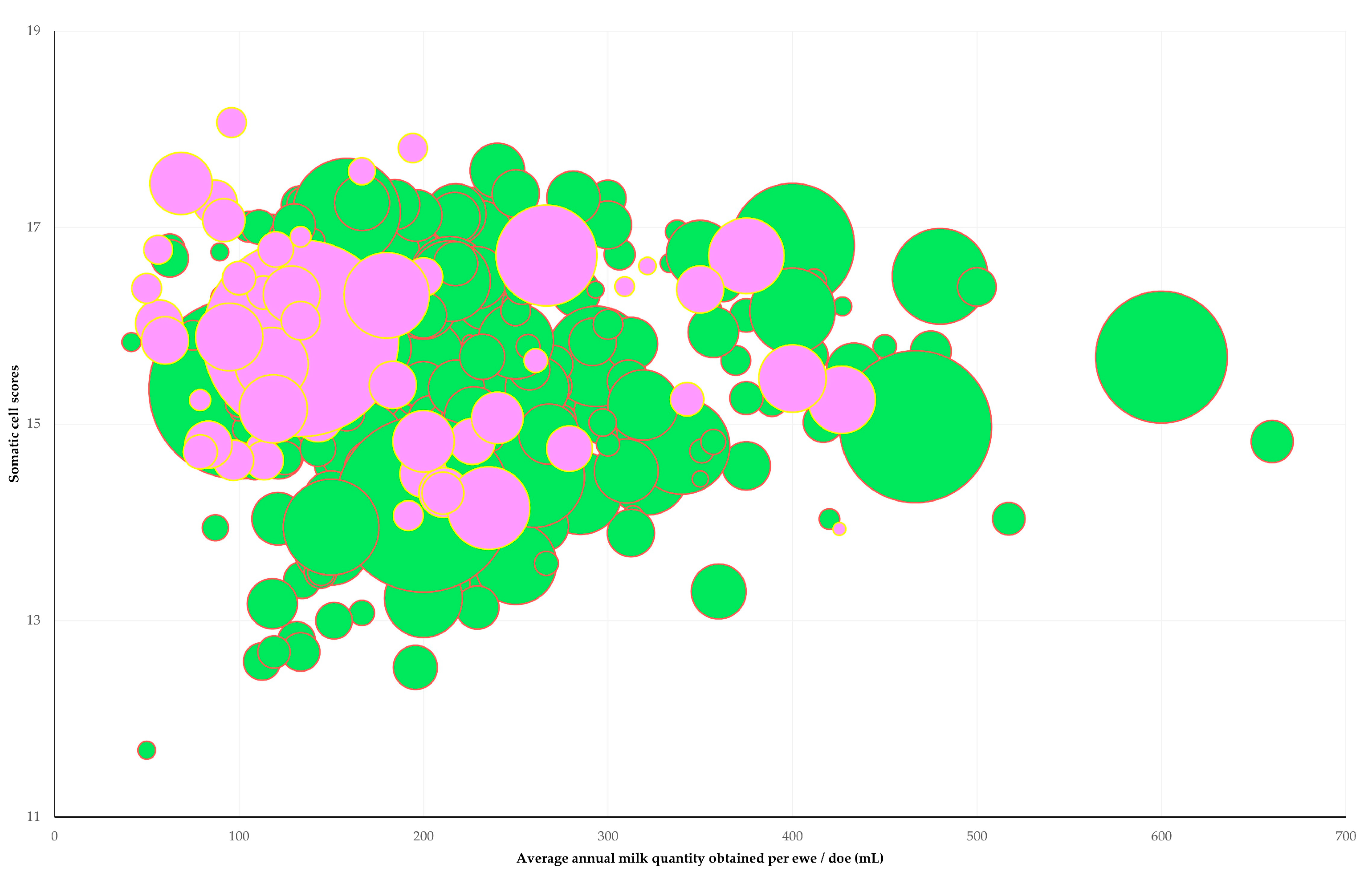
| Type of Variables | Difference between Farms with or without Professional Relationship with a Veterinarian in Number of Variables | ||
|---|---|---|---|
| Significant 1 | Tending for Significance 2 | Not Significant 3 | |
| Health management | 8 | 2 | 9 |
| Pharmaceutical treatment | 3 | 0 | 4 |
| Biosecurity management | 2 | 2 | 4 |
| Reproductive management | 5 | 3 | 10 |
| Management in the milking parlour | 1 | 0 | 5 |
| Nutritional management | 5 | 1 | 3 |
| Production-related outcomes | 2 | 0 | 3 |
| Health-related outcomes | 3 | 1 | 10 |
| Animal condition outcomes | 1 | 0 | 0 |
| Total | 30 variables | 9 variables | 48 variables |
| Farms in Which There Was a Professional Relationship with a Veterinarian (n = 384) | Farms in Which There Was No Professional Relationship with a Veterinarian (n = 60) | p-Value |
|---|---|---|
| Average milk production per ewe/doe during the preceding milking period | ||
| 199.5 (127.5) L | 129.0 (114.0) L | <0.0001 |
| Average number of lambs/kids born per ewe/doe | ||
| 1.28 (0.20) newborns | 1.20 (0.16) newborns | 0.003 |
| Incidence of clinical mastitis during the preceding season | ||
| 2.0% (4.5%) | 3.0% (4.1%) | 0.021 |
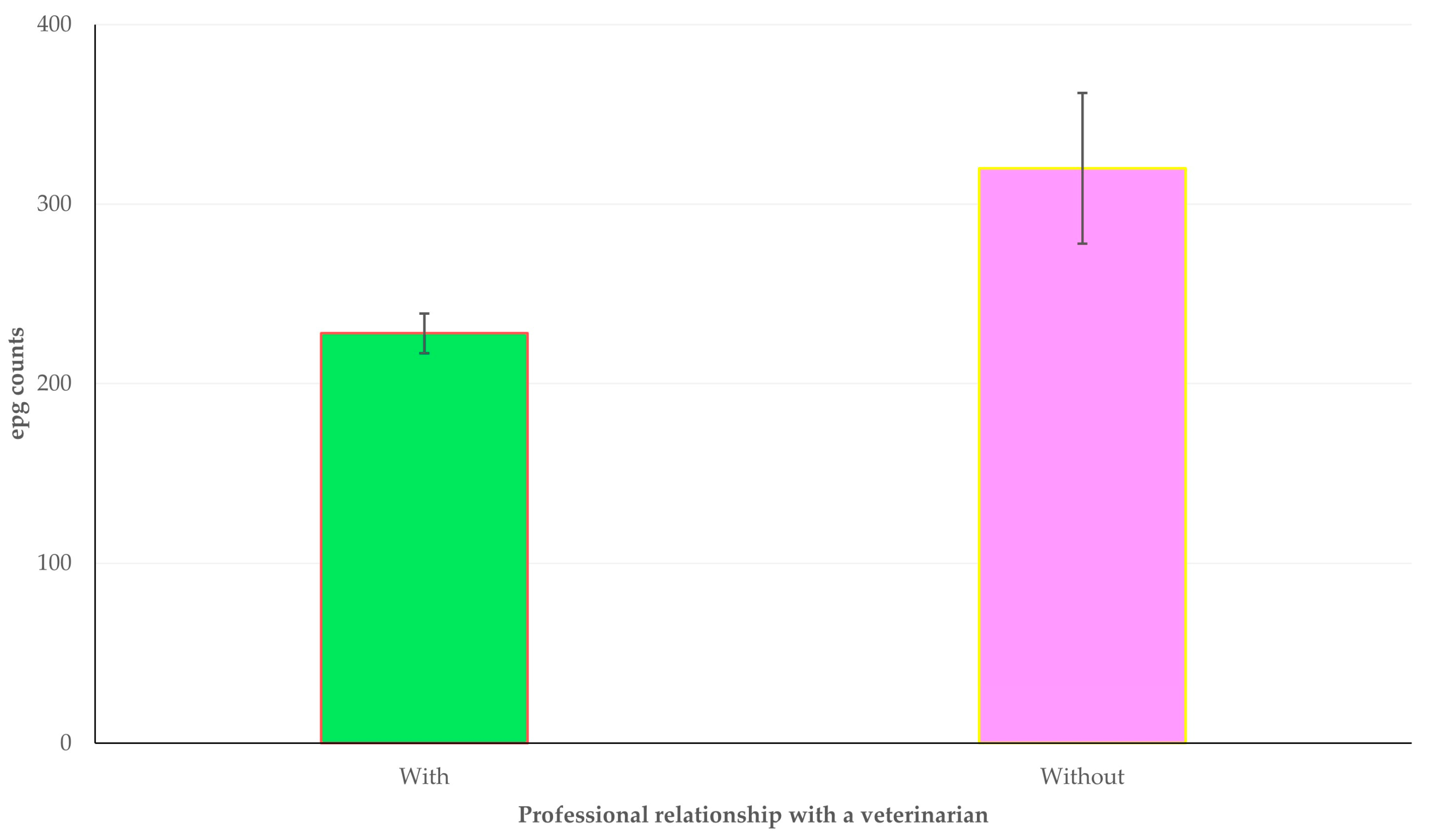
| Epg counts in faecal samples | ||
| 228 ± 11 epg | 320 ± 42 epg | 0.011 |
| Body condition score | ||
| 2.40 (0.22) | 2.26 (0.61) | 0.016 |
| Somatic cell counts in bulk-tank milk | ||
| 0.543 × 10⁶ (0.504 × 10⁶–0.583 × 10⁶) cells mL−1 | 0.680 × 10⁶ (0.567 × 10⁶–0.814 × 10⁶) cells mL−1 | 0.026 |
| Production- or Health-Related Outcomes | Odds Risk (±se 1) | p |
|---|---|---|
| epg counts in faecal samples | 0.012 | |
| With ‘veterinarian’ 2 | reference | - |
| Without ‘veterinarian’ | 1.406 ± 0.147 | 0.011 |
| Average annual milk production per ewe/doe | 0.015 | |
| With ‘veterinarian’ | reference | - |
| Without ‘veterinarian’ | 1.269 ± 0.109 | 0.002 |
| Somatic cell counts in bulk-tank milk | 0.037 | |
| With ‘veterinarian’ | reference | - |
| Without ‘veterinarian’ | 1.021 ± 0.012 | 0.028 |
| Annual incidence of clinical mastitis | 0.044 | |
| With ‘veterinarian’ | reference | - |
| Without ‘veterinarian’ | 1.408 ± 0.429 | 0.24 |
| Farms in Which There Was a Professional Relationship with a Female Veterinarian (n = 121) | Farms in Which There Was a Professional Relationship with a Male Veterinarian (n = 263) | p-Value |
|---|---|---|
| Epg counts in faecal samples | ||
| 183 ± 15 epg | 250 ± 16 epg | 0.024 |
| Somatic cell counts in bulk-tank milk | ||
| 0.461 × 10⁶ (0.401 × 10⁶–0.529 × 10⁶) cells mL−1 | 0.585 × 10⁶ (0.540 × 10⁶–0.638 × 10⁶) cells mL−1 | 0.026 |
| Variables | rsp | Type of Association | p-Value |
|---|---|---|---|
| Incidence of clinical mastitis | 0.116 | positive | 0.024 |
| Epg counts in faecal samples | 0.131 | positive | 0.020 |
| Variables | Odds Risk (±se 1) | p |
|---|---|---|
| Gender of veterinarian | 0.0001 | |
| Female | reference | - |
| Male | 1.558 ± 1.120 | - |
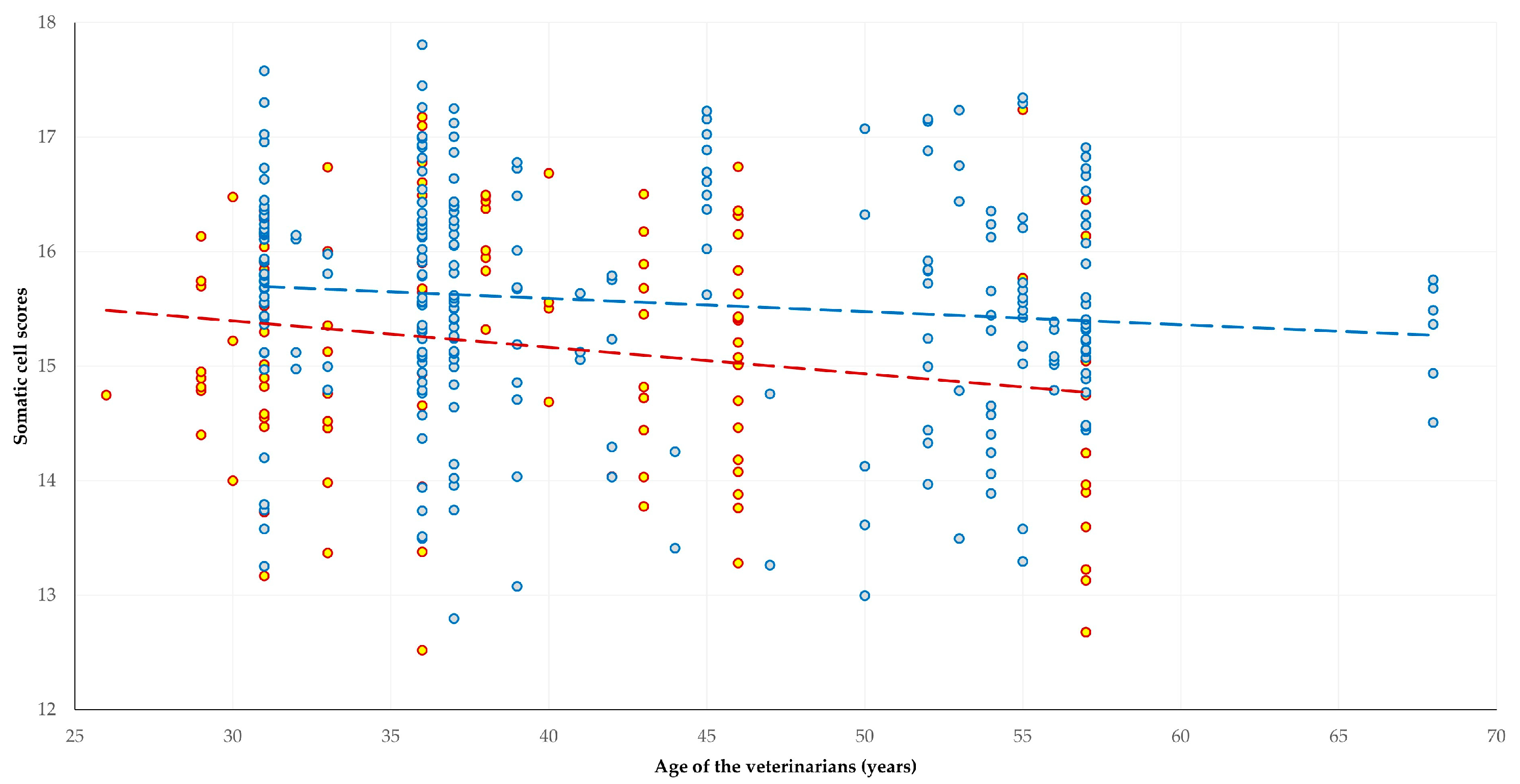
| Age of veterinarian | 0.004 | |
| Per year decrease | 1.015 ± 1.005 | - |
Disclaimer/Publisher’s Note: The statements, opinions and data contained in all publications are solely those of the individual author(s) and contributor(s) and not of MDPI and/or the editor(s). MDPI and/or the editor(s) disclaim responsibility for any injury to people or property resulting from any ideas, methods, instructions or products referred to in the content. |
© 2023 by the authors. Licensee MDPI, Basel, Switzerland. This article is an open access article distributed under the terms and conditions of the Creative Commons Attribution (CC BY) license (https://creativecommons.org/licenses/by/4.0/).
Share and Cite
Lianou, D.T.; Fthenakis, G.C. Evaluation of the Role of Veterinarians for Outcomes Related to the Health and Production of Dairy Small Ruminants in Greece. Animals 2023, 13, 3371. https://doi.org/10.3390/ani13213371
Lianou DT, Fthenakis GC. Evaluation of the Role of Veterinarians for Outcomes Related to the Health and Production of Dairy Small Ruminants in Greece. Animals. 2023; 13(21):3371. https://doi.org/10.3390/ani13213371
Chicago/Turabian StyleLianou, Daphne T., and George C. Fthenakis. 2023. "Evaluation of the Role of Veterinarians for Outcomes Related to the Health and Production of Dairy Small Ruminants in Greece" Animals 13, no. 21: 3371. https://doi.org/10.3390/ani13213371
APA StyleLianou, D. T., & Fthenakis, G. C. (2023). Evaluation of the Role of Veterinarians for Outcomes Related to the Health and Production of Dairy Small Ruminants in Greece. Animals, 13(21), 3371. https://doi.org/10.3390/ani13213371