


Simple Summary
Owners’ understanding of dog behaviour influences dog welfare. This study explored owners’ experiences and perceptions of dog behaviour. Data came from an ongoing UK/ROI study of dogs. Survey questions when dogs were 12/16 weeks (data combined), 6, 12, 18 and 24 months were analysed. Data were explored with two approaches: (1) qualitative thematic analysis and (2) quantitative text analysis. Responses to ‘other information’ questions and those regarding owner-reported problem behaviours were explored to understand owners’ experiences/understanding of dog behaviour (1). Responses to the ‘other information’ questions were evaluated to understand how sentiment in the text and in word use changes over time (2). The proportion of positive: negative sentiments increased with the dog’s age. At the first time point, ‘bite’ was the most common word, later replaced by words related to ‘love’. Owners referred to the ‘dog’s biology’, ‘personality/deliberate action’ and ‘external influences’ when explaining dogs’ behaviour. Problematic behaviours of young dogs were seen as ‘mischievous’, unintentional and context-specific. Similar behaviours shown by older dogs were described as ‘deliberate’. Both positive and negative experiences of dog ownership were identified. Free-text survey responses are a useful resource for exploring data but should be interpreted cautiously, as not all respondents answer these questions.
Abstract
Owners’ understanding of dog behaviour influences dog welfare. This study aimed to investigate owners’ experiences of living with dogs and perceptions of dog behaviour/behaviour change. Data from an ongoing UK/ROI longitudinal study of dogs were used. Open-ended survey data (n = 3577 comments, n = 1808 dogs) when dogs were 12/16 weeks (data combined), 6, 12, 18 and 24 months were analysed to cover the dog’s puppyhood/adolescence. To evaluate the usefulness of open-ended survey questions, both quantitative textual and qualitative thematic analyses were employed. Textual analysis identified an overall positive sentiment at all timepoints; the proportion of positive: negative sentiments increased with the dog’s age. Words related to ‘love’ were the most frequent descriptors at all but the first timepoint, when ‘bite’ was the most frequent descriptor. Qualitative analysis helped to identify that owners attribute dog behaviour to ‘Dog’s biology’, ‘Personality/deliberate action’ and ‘External influences’. Analysis of open-ended survey responses helped to identify changes in perception over time. When dogs were young, owners described problematic behaviours as ‘mischievous’, unintentional and context-specific. Similar behaviours shown by older dogs were seen as ‘deliberate’. Both positive and negative experiences of dog ownership were identified. However, as not all respondents answered open-ended questions, the generalisability of our findings is limited.
1. Introduction
Owner perceptions and understanding of dog behaviour can influence the day-to-day management of dogs, potentially affecting dog welfare. For example, although repetitive behaviours, such as tail chasing, are often considered as indicative of poor welfare [1,2,3,4,5] or health issues [6], these behaviours are frequently described as funny or cute by dog owners and observers, potentially hindering help seeking by owners [7]. It is therefore important to understand how owners perceive dog behaviour.
Owners’ perceptions of dog behaviour are particularly important when dogs are young, as dogs aged under two years old are most likely to be relinquished to shelters [8,9,10], and dogs under three years of age are most likely to be euthanised for behavioural reasons [11]. Although the exact reasons for a peak in relinquishments and euthanasia at this age are unknown, it is plausible that dog behaviour during adolescence contributes to a breakdown of the dog–owner bond. Dog behaviour continues to change across the dog’s life, but the degree of change is most pronounced during adolescence [12]. Adolescence is a relatively long period of development during which a juvenile becomes an adult and is marked by wide-ranging neurological and hormonal changes [12]. There is no precise agreed age at which an individual dog can be considered behaviourally mature, but cognitive and behavioural changes suggest that dogs between 6 months and 2 years of age can be considered as adolescent [13,14,15].
The adolescent period of development in mammals is typically associated with changes in social behaviour that include a weakened ability to regulate emotions and behaviour, resulting in increased impulsivity, reactivity to stressors, risk-taking behaviour and a greater awareness of conspecifics [12]. Owner–dog relationships have many features in common with human relationships and are believed to be based upon similar behavioural and hormonal bonding mechanisms [16,17]. In terms of the owner–dog relationship, dog behaviour during adolescence also bears perceptive similarities to that of human adolescent–parent relationships, with dogs displaying a socially specific reduction in obedience at this time for previously well-established cues such as ‘sit’ and an increase in separation-related behaviour problems [15]. Although anecdotal information exists, little scientific research has been undertaken on canine adolescence behaviour and owners’ experiences of dog adolescence. Therefore, the first objective of this study was to explore experiences of dog ownership as dogs mature between the age of 12 weeks and 2 years.
Previous research based on ‘Generation Pup’ longitudinal study data used here showed that both owner and dog characteristics influence whether a particular dog behaviour is perceived as problematic when dogs are 9 months of age [18]. Perception and interpretation of dog behaviour may also contribute to owner resilience in response to potentially problematic dog behaviour. To explore this further, a better understanding of owner perceptions of dog behaviour is needed. Therefore, the second objective of this study was to examine owners’ perceptions and attributions of dog behaviour as dogs mature between the age of 12 weeks and 2 years. To this end, the study utilises free-text responses from a longitudinal survey-based study, including responses to an ‘any other information’ question posed at the end of surveys at different timepoints. Both qualitative thematic analysis and quantitative textual analysis are used, and the third objective was to compare the two analytical approaches for the analysis of open-ended survey questions.
2. Materials and Methods
2.1. Study Design and Participants
This study used data collected as part of ‘Generation Pup’—a longitudinal study of dog health, behaviour and welfare. ‘Generation Pup’ is open to participants who are residents of the United Kingdom (UK) or the Republic of Ireland (ROI); aged 16 years or over; and who own a puppy of any breed or mix-breed. The study does not specify exclusion criteria related to the way dogs were acquired, as long as at the time of registration, the dog was younger than 16 weeks of age (or younger than 21 weeks if a puppy entered the UK/ROI through quarantine). Study recruitment is ongoing and will pause when 10,000 dogs are enrolled. Participants are recruited through social media, radio interviews, advertisements at veterinary practices, dog training venues and articles in veterinary, dog-related and other publications. This analysis uses data for dogs recruited between May 2016 and February 2020, i.e., before the COVID-19 pandemic. For further details regarding the methodology and protocol of ‘Generation Pup’, please see Murray et al. [19].
2.2. Data Collection
Data were obtained from online and postal self-administered surveys completed by owners when dogs were 12 and/or 16 weeks (depending on the age of the puppy when the owner joined the study), 6, 9, 12, 18 and 24 months (2 years). Owner and dog demographic characteristics were extracted from a survey completed upon registration for the project. Each survey has between 2–19 sections. The introductory surveys completed as a part of registration (1–3 weeks after acquisition or until 16 weeks of age) collect information about the owner, household, puppy and puppy acquisition. Topics covered in the later surveys analysed here include: introducing the puppy to the household, the puppy’s/dog’s experiences, activities undertaken with the puppy/dog, meeting other people, meeting other dogs, the puppy’s/dog’s behaviour, the puppy’s/dog’s day, the puppy’s sleep, diet, training approaches, health, surgery, neutering, insurance, the dog’s boarding/kennelling experience, breeding, exercise, mobility, reflection and other information. Topics are repeated at regular intervals; topics related to dog behaviour, the dog’s day, health and other information were included in all surveys analysed here (please see [19] for details). Each survey includes primarily close-ended questions and free-text boxes that enable owners to expand on and clarify or to provide an alternative response to the close-ended questions. Open-ended questions included in the analysis are specified in Table 1.

Table 1.
Timepoints, questions, number of responses available for analysis and the number of completed surveys at a given timepoint. All data were analysed with qualitative thematic analysis; data analysed with quantitative textual analysis are marked with *.
It has been suggested that open-ended questions within a survey can be used to explore general experiences and reflections related to other topics covered in a survey [20]. For this reason, the ‘any other information’ question was selected from all but the last timepoint of interest. This question was optional. Questions about the best, the funniest and the most annoying thing about one’s dog, asked only in the 2-year survey, were included, as they explicitly enquire about owners’ experiences and enable insight into owners’ perceptions of dog behaviour. A preliminary reading of responses to the ‘any other information’ question highlighted frequent comments related to the things owners enjoyed about their dogs. Therefore, a free-text question about behaviours that owners found to be a problem was included to learn more about behaviours owners find challenging and to explore perceptions of these behaviours. Owners were asked to answer this question if they specified that their dog shows a behaviour they find to be a problem.
2.3. Data Analysis
Quantitative text analysis (word frequency, word importance and sentiment analyses) and qualitative thematic analyses were carried out. A mixed-methods approach was chosen to facilitate analytical triangulation [21]. Additionally, whereas the qualitative analysis lends itself to identifying owners’ perceptions and experiences, the quantitative textual analysis helps to quantify the changes in word use linked with these attributes over time. As open-ended survey questions were previously described as valuable but difficult to analyse [20], a comparison of the two analytical approaches to the analysis of this type of data is therefore valuable. Ahead of analyses, one dog from each multi-dog household was randomly included to avoid household-level clustering. Data from 12- and 16-week surveys were combined, as some owners joined the study in time to complete only the 16-week survey.
2.3.1. Quantitative Text Analysis: Data Preparation
To minimise the bias in sentiment introduced by asking specifically about problematic behaviours, only the text entered in response to ‘Any other information’ was analysed. This question was placed at the end of each survey and was unrelated to other questions about health, behaviour, the dog’s experiences, etc. Analysis of individual questions was further limited to the first five surveys (combined 12- and 16-week, 6-, 9-, 12- and 18-month surveys), as for the 2-year survey, we extracted questions specifically asking about owners’ experiences, which were not asked earlier. In addition, data from owners who answered questions at all timepoints (up to and including age 18 months) were included in a subset and analysed separately. The analysis for this subset of dogs was compared to the analysis based on the whole dataset to assess whether owners who completed all surveys described dog behaviour differently (i.e., with a different overall sentiment).
All textual analysis was carried out in R [22]. Data were prepared by removing punctuation, gaps and numbers and by transforming all words to lower case. Stop words, i.e., common English words that occur in any text frequently [23], were removed using pre-specified list words from the tm package [24]. Custom stop words associated with dogs (e.g., ‘dog’, ‘pup’, ‘bitch’, etc.) were also removed. Words were stemmed (i.e., reduced to their roots by removing suffixes and prefixes) using the SnowballC package [25] to improve word retrieval and recognition. For example, the words ‘connection’, ‘connections’, ‘connective’, ‘connected’ and ‘connecting’ were stemmed to ‘connect’. Stemming an algorithm works by conflating words with the same meaning rather than words that just have common linguistic roots (e.g., awe and awful have different stems). For this reason, stemming reduces some words in a non-obvious way, and some stems do not correspond to linguistic word stems, e.g., ‘happy’ and ‘happiness’ are stemmed as ‘happi’ to differentiate from stems of words related to ‘happening’ or ‘happened’ (which stem to ‘happen’).
2.3.2. Quantitative Text Analysis: Word Frequency and Importance Analyses
To identify the most frequently used words at each timepoint (term frequency, TF), text was tokenised, i.e., converted to a format of one term per line. The term frequencies for tokens were calculated and depicted using word clouds with the Wordcloud package [26]. To evaluate the importance of a word with regard to a particular timepoint, the term frequency inverse document frequency (TF-IDF) metric was used. Inverse document frequency is derived by dividing the total number of documents (in this case, 5 documents corresponding to the first 5 timepoints) by the number of documents that a given word appears in and multiplying these two scores [27]. High scores reflect words that appear frequently in a few documents and are therefore important to those documents, and low scores identify words that appear frequently in every document and, as such, are less important [27].
2.3.3. Quantitative Text Analysis: Sentiment Analysis
Sentiment analysis was carried out using multiple lexicon dictionaries (NRC, Bing, AFFIN, Syuazhet) to reduce uncertainty and error related to relying on one lexicon. The NRC Emotion Lexicon categorises English words into eight basic emotions (anger, fear, anticipation, trust, surprise, joy, sadness and disgust) and two binary sentiments (positive and negative) [23]. The Bing [28] and Syuazhet [29] lexicons categorise words as having a positive or negative sentiment (i.e., as binaries), and the AFFIN lexicon does so by assigning a score from −5 (most negative) to 5 (most positive) [30]. Sentiment scores from individual tokens were added for each survey response, and to compare different lexicon dictionaries, the net sentiment (positive–negative) was plotted. The proportion of positive to negative sentiments was also ascertained using the Syuzhet lexicon. Words that contributed the most to the overall positive and negative sentiments at each timepoint were identified.
2.3.4. Qualitative Analysis: Data Coding and Thematic Analysis
Thematic analysis was applied to longitudinal data [31]. The purpose of thematic analysis is to identify the patterns within a text, i.e., themes [32]. Thematic analysis is a flexible approach that is suitable for characterising a range and diversity of perceptions, beliefs, experiences, representations, etc. but not for the quantification of findings [33]. Thematic analysis is also not designed to establish ‘the truth’. Consequently, as the respondents were free to discuss any behaviours as problematic to them, the findings capture owner perceptions of dog behaviour, which should be distinguished from categories of behaviours based on clinical or ethological research.
After familiarisation with the text, all questions listed in Table 1 were coded inductively line-by-line by one researcher (S.C.O.-G). Additionally, 15% of the text was coded by two co-authors (K.G.) to ensure coding rigour. Inductive coding means that codes were based on the data rather than being developed before the analysis. At the same time, coding was focused on identifying experiences of dog ownership and perceptions and attributions of dog behaviour. Codes were refined and revised as coding progressed and in the course of discussion between the co-authors [34]. Themes were first identified for individual timepoints, and then comparisons were made between timepoints [31]. Themes were constructed by grouping and categorising codes and then defining the code groups. Next, between-timepoint comparisons were made. This was achieved by identifying differences and similarities between timepoints with respect to owners’ attributions of changes in dog behaviour and the prominence of owners’ experiences [31,35,36]. Comments regarding changes in dog behaviour over time are provided alongside themes and illustrative quotes. All coding was conducted in NVivo 11 software [37].
2.4. Research Ethics Statement
The study had ethical approval from the University of Bristol Animal Welfare Ethical Research Board (UIN/18/052), the Clinical Research Ethical Review Board at the Royal Veterinary College–URN 2017 1658-3, the Social Science Ethical Review Board at the Royal Veterinary College–URN SR2017-1116, and Dogs Trust Ethical Review Board–ERB009. Informed consent to take part in the study was obtained from all participants. During the analysis and when selecting illustrative quotes, data were pseudonymised by removing identifiable characteristics (such as the dog’s or owner’s names or the mention of breeds, if they were uncommon).
3. Results
3.1. Sample Description
After removing (at random) all dogs bar one from multi-dog households, 3577 comments about 1808 dogs were included in the analysis. Most (88.9%, n = 1609) owners identified as female, 10.8% (n = 195) identified as male, and this information was unavailable for 0.2% (n = 4) of respondents. The most common age of respondents was 35–44 years and 45–54 years (21.9%, n = 396 and 22.3%, n = 403 respectively). There was an even split between male (n = 907, 50.2%) and female dogs (n = 901, 49.8%). Slightly over half the dogs were crossbreeds or mongrels (n = 978, 54.0%), and 46.0% (n = 830) were purebred (for further details about the cohort, see [19]). No obvious differences in comments were identified between the full dataset and the subset of 117 dogs for whom data at all timepoints were available. No differences with respect to demographic data were identified between all participants registered onto the study at the time of data analysis (n = 3162) and participants who answered questions analysed here.
3.2. Word Frequency
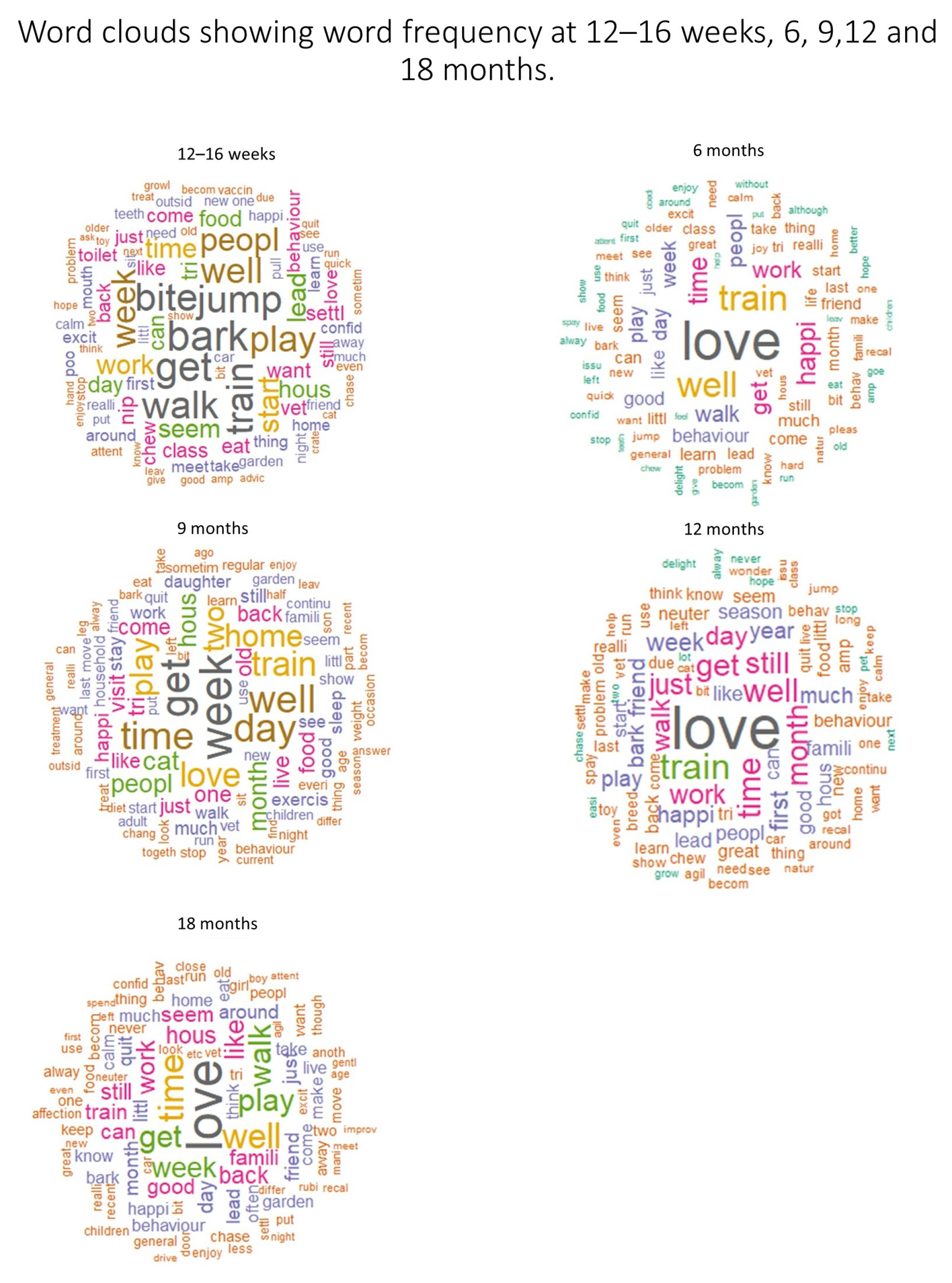
Aside from the 12–16-week and the 9-month mark, at all timepoints, words related to ‘love’ were most frequent (Figure 1). At 12–16 weeks, the most common words were ‘bark’, ‘bite’, ‘jump’ and ‘play’. At 9 months, words related to ’love’ were relatively frequent, but the most frequently used words were common words, such as ‘get’ or ‘week’ (Figure 1).
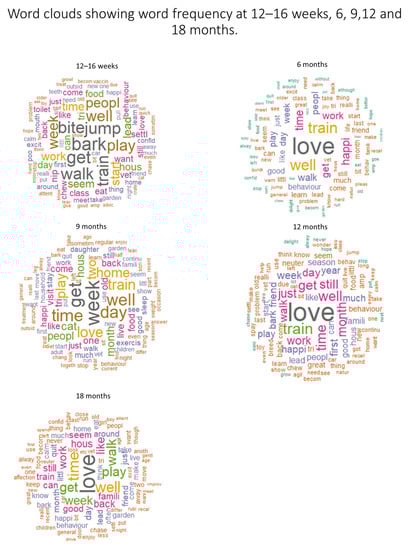
Figure 1.
Word clouds showing the most frequently used words in responses to the ‘Any other information’ questions at 12–16 weeks, 6, 9, 12 and 18 months. Word size reflects frequency of use.
3.3. Word Importance: TF-IDF
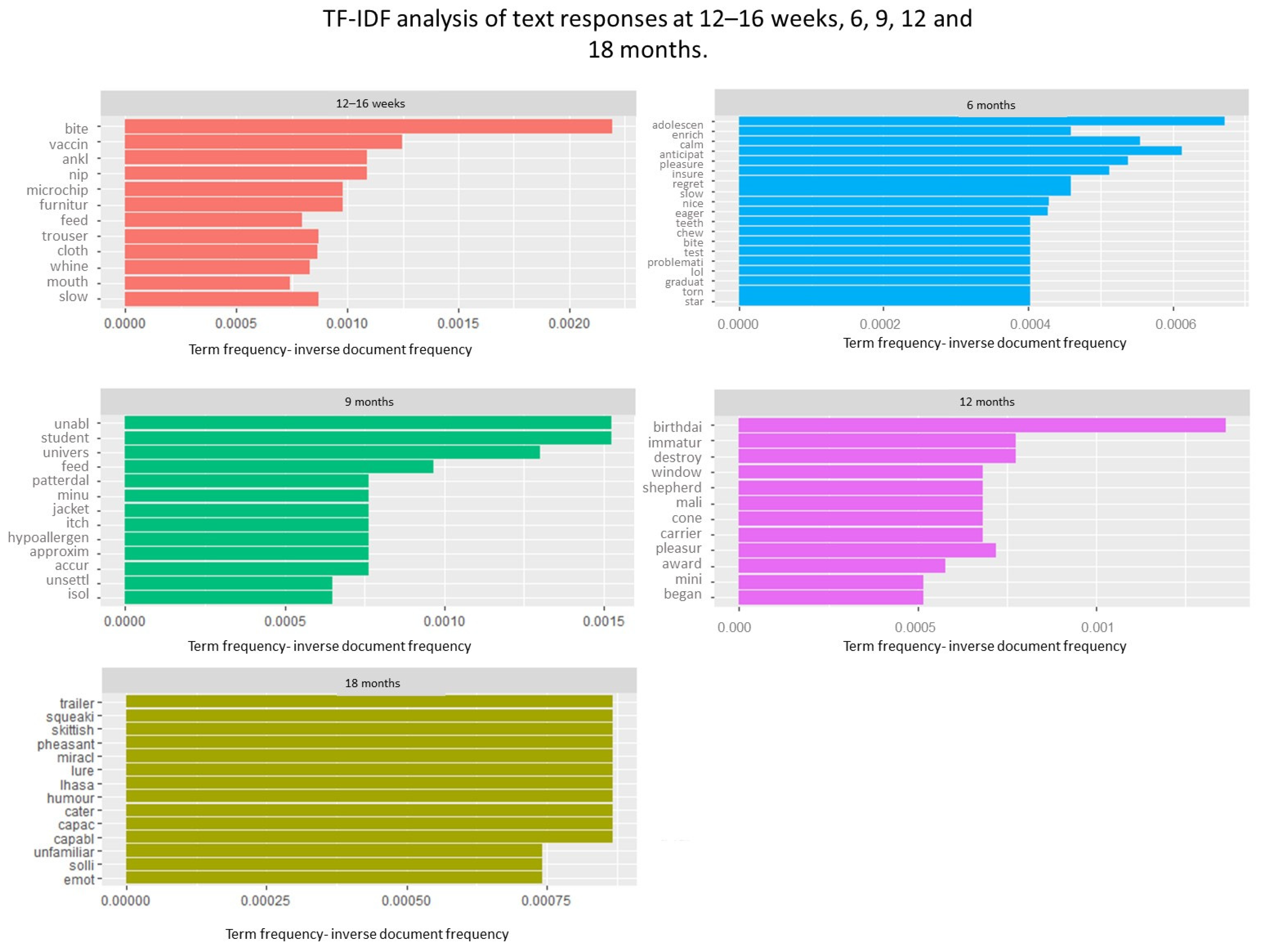
The TF-IDF analysis (Figure 2) shows that the most important words at 12–16 weeks were related to puppy biting/mouthing and chewing (‘bite’, ‘ankle’, ‘nip’, ‘furniture’, ‘trouser’, ‘cloth’- stem of clothing, ‘mouth’- stem of mouthing), vaccinations and microchipping. At 6 months, important words were related to dog behaviour (‘teeth’- stem of teething, ‘bite’, ‘chew’), adolescence (‘adolescence’, ‘test’- stem of testing), dog temperament/disposition (‘calm’, ‘pleasure’, ‘eager’) and owners’ expectations (‘anticipat’- stem of anticipate, ‘regret’, ‘problematic’). Important words at 9 months reflected possible changes within the family (‘university’, ‘students’), the dog’s health (‘itch’- stem of itchiness, ‘hypoallergen’- stem of hypoallergenic, ‘feed’- stem of feeding) and dog behaviour (‘unabl’- stem of unable, ‘unsettl’- stem of unsettled). At 12 months, the most important words were related to the dog’s age (‘birthdai’- stem of birthday), dog behaviour (e.g., ‘destroy’, ‘immatur’- stem of immature, ‘began’) and breed (‘shepherd’, ‘mini’, ‘mali’- stem of Malinois breed). The variation in responses at the age of 18 months was lower than at other timepoints, possibly due to a smaller sample size (n = 138). At 18 months, the most important words were also associated with dog breed (‘lhasa’—related to Lhasa Apso), dogs’ activities, their character and behaviour (‘squeaky’, e.g., playing with a squeaky toy, ‘skittish’, ‘humour’, ‘capac’- stem of capacity, ‘emot’- stem of emotion, ‘capabl’- stem of capable) and, plausibly, things that owners and dogs do together/encounter on walks and holidays (‘trailer’, ‘pheasant’, ‘lure’).
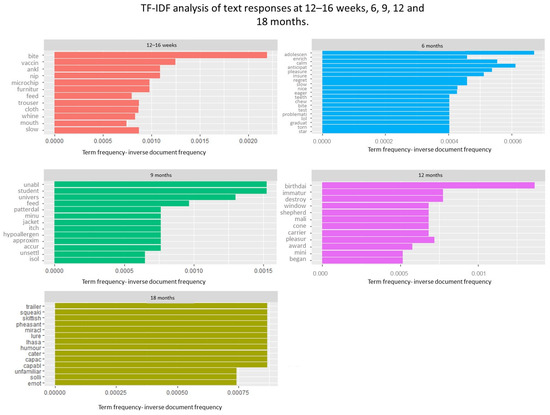
Figure 2.
Word importance left in comments to ‘Any other information’ questions at 12–16 weeks, 6, 9, 12 and 18 months expressed using term frequency inverse document frequency (TF-IDF) metric.
3.4. Sentiment Analysis
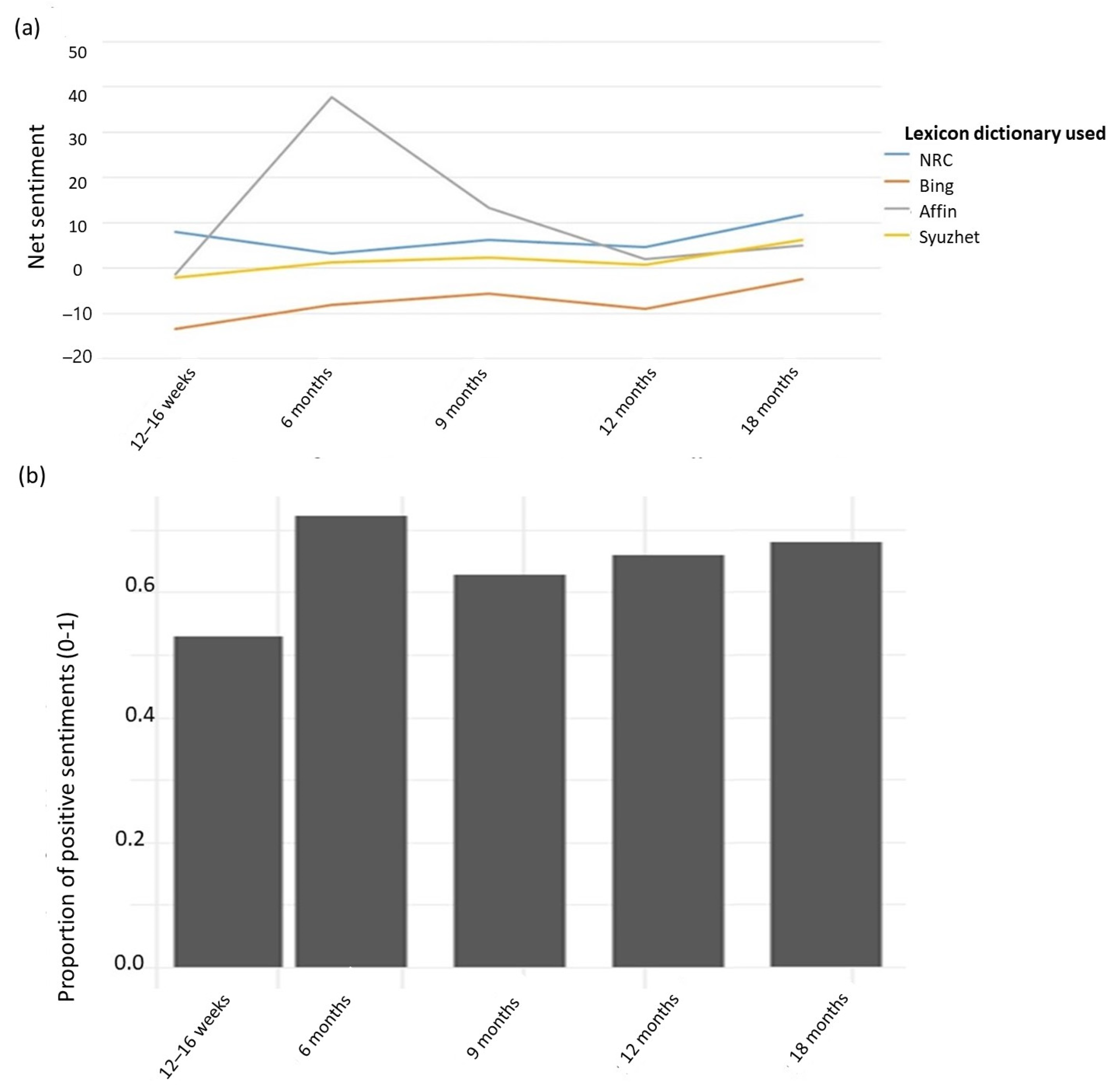
All lexicons apart from Bing (at all timepoints) and Syuzhet (at 12–16 weeks) showed a net positive sentiment (Figure 3a). The trend across all lexicons shows that the proportion of positive to negative sentiment was the lowest in the 12–16-week survey, and that the sentiment was more positive with each consecutive timepoint (Figure 3).
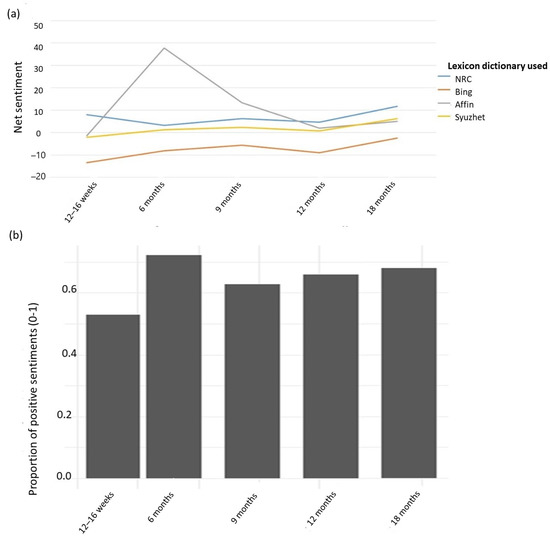
Figure 3.
(a). Net sentiment (positive–negative) in words left in comments to ‘Any other information’ questions at 12–16 weeks, 6, 9, 12 and 18 months and (b). the proportion of positive sentiments in the whole text (0–1) according to Syuzhet lexicon.
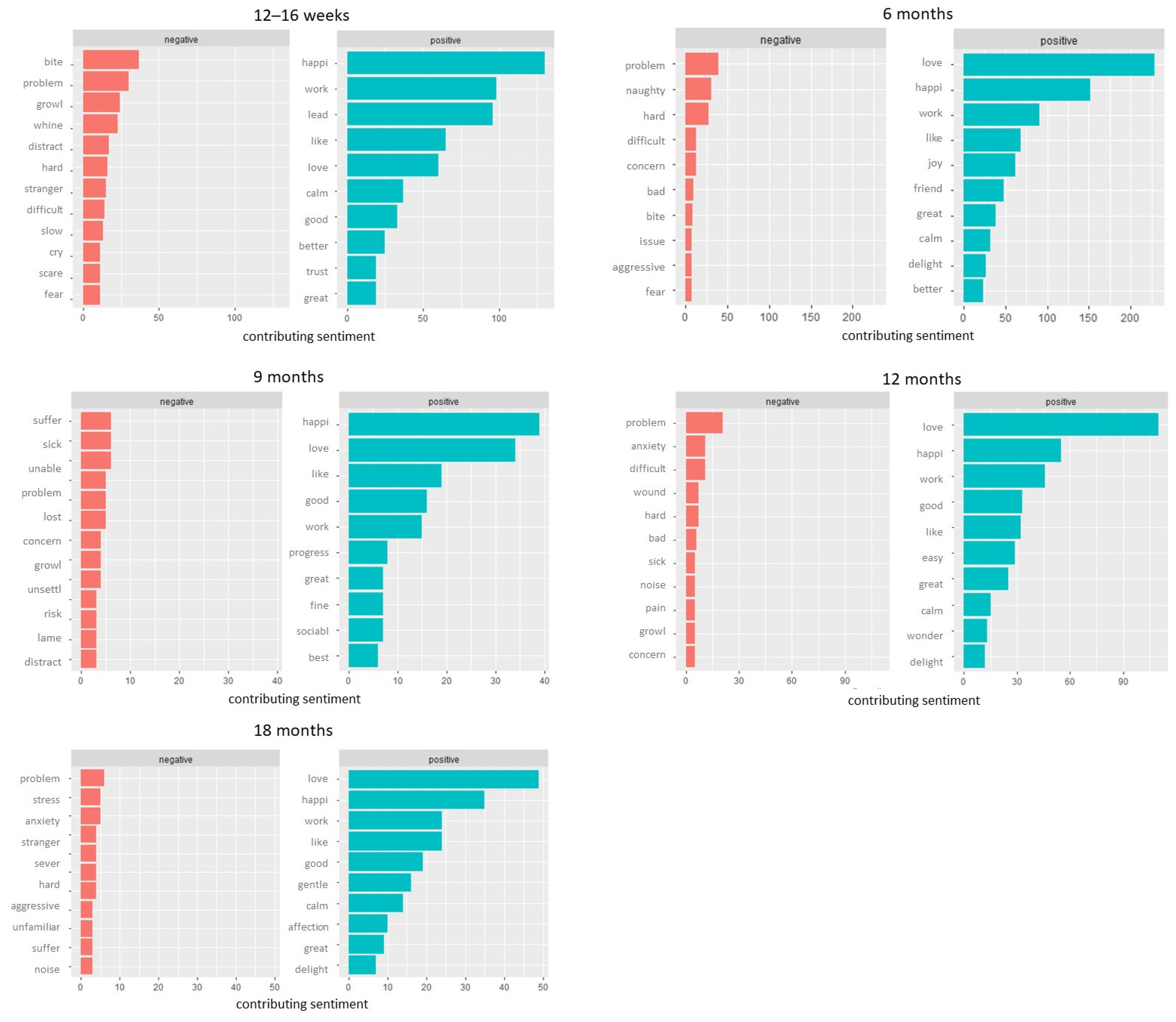
Words that contributed most to the negative sentiments were related to dog behaviour (e.g., ‘bite’, ‘whine’, ‘naughty’, ‘unsettl’- stem of unsettled), changes in dog behaviour/the owner’s expectations (e.g., ‘slow’, ‘hard’, ‘unable’, ‘difficult’, ‘concern’) and health (e.g., ‘sick’, ‘lame’, ‘wound’, ‘pain’). Words that made the most significant contribution to the positive sentiment were related to dogs’ dispositions (e.g., ‘happi’- stem of happiness, ‘love’- stem of lovely, loving, loved and love, ‘calm’, friend’- stem of friendly) and behaviour change/training (e.g., ‘good’, ‘better’, ‘great’, ‘work’, Figure 4).
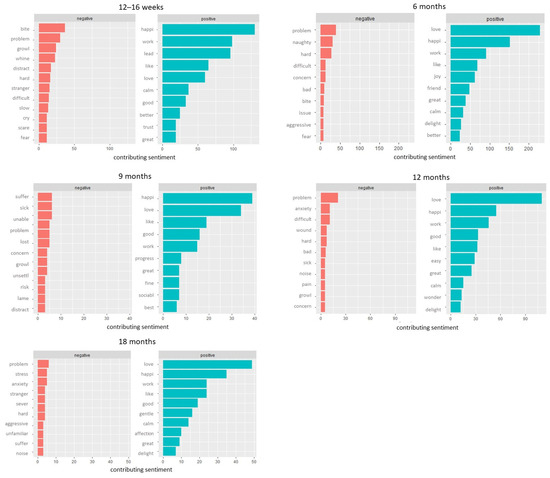
Figure 4.
Word contribution to positive and negative sentiments left in comments to ‘Any other information’ questions at 12–16 weeks, 6, 9,12 and 18 months.
3.5. Qualitative Analysis
Three themes were constructed: ‘Explaining dog behaviour’, ‘Positive experiences of dog ownership’ and ‘Negative experiences of dog ownership’.
3.5.1. Explaining Dog Behaviour
Some explanations of behaviour did not change over time, e.g., references to the dog’s biology. At all timepoints, some owners explained dog behaviour with respect to the dog’s age; however, the references changed over time (from ‘toddler’ in the 12–16-week survey to a ‘teenager’ later on). In the 12–16-week, 6-, 9-, 12- and 18-month surveys, owners often saw behaviours as transient—something a dog will ‘grow out of’. In the 12-month, 18-month and 2-year surveys, owners tended to describe dog behaviour as ‘immature’ or expressed their frustration when a dog was ‘still’ engaging in a particular behaviour. In the 6-, 9- and 12-month surveys, explaining dog behaviour with respect to hormones was more common than at other timepoints. Explanations that attributed behaviour to the dog’s personality or to deliberate action by the dog were more common in the later surveys (those at 12 and 18 months and 2 years, see Table 2 for details).
Table 2.
‘Explaining dog behaviour’ theme, sub-themes and codes. Quotes that illustrate a particular code are provided.
3.5.2. Positive Experiences of Dog Ownership
The shift in the theme of ‘Positive experiences of dog ownership’ over time was subtle, and similar sub-themes and codes were identified at all timepoints (see Table 3).
Table 3.
Sub-themes and codes that contribute to the ‘Positive experience of dog ownership’ theme at different timepoints. Quotes that illustrate a particular sub-theme/code are provided in addition to comments regarding the direction of change.
3.5.3. Challenges of Dog Ownership
Most sub-themes within the ‘Challenges of dog ownership’ theme were identified at all timepoints (Table 4). However, the negative experiences mentioned in earlier surveys (12–16 weeks) differed from those discussed later. Four sub-themes were identified: ‘Settling into a life with a family’, ‘Issues with training’, ‘Challenging personality/disposition’ and ‘Challenging behaviour’ (see Table 4).
Table 4.
Sub-themes and codes that contribute to ‘Negative experiences of dog ownership’ meta-theme at different timepoints. Quotes that illustrate a particular sub-theme/code are provided in addition to comments regarding the direction of change.
4. Discussion
4.1. Owners’ Attributions of Dog Behaviour
Three main patterns in attributions of dog behaviour were identified: (1) referring to the dog’s biology, such as breed, genetics, sex and age; (2) seeing dog behaviour as reflective of the dog’s personality/deliberate action; and (3) perceiving behaviour as externally influenced. Breed-related explanations of dog behaviour were common, and references to rare breeds were identified as important words through TF-IDF analysis, particularly in later surveys (12 and 18 months). This shows that though textual analysis is helpful at identifying important words in a document, context (in this case, the findings of the thematic analysis) may be needed for interpretation. Both traits that owners enjoyed (such as sociability and friendliness) and those that owners found challenging, such as nervousness, were seen as breed-related. Explanations that referred to the dog’s biology (e.g., genetics) were sometimes used to explain a lack of expectation that the dog’s behaviour would improve and a cessation of attempts to change the dog’s behaviour. The literature on parent–child relationships shows that parents who attribute their child’s behaviour to stable, internal causes (genetics, free will) feel helpless and believe that their child’s behaviour is unlikely to improve [38,39]. Further research is needed to explore whether the same pattern holds true for human–dog relationships.
A number of behaviours, in particular those experienced as challenging, were seen as deliberate and a reflection of the dog’s personality. For example, owners described things that dogs did despite previous training or after a period of improvement e.g., pulling on the lead, not coming back when called or toileting within the home. Research into parent–child relationships shows that attributing responsibility for the behaviour to a child’s will is related to greater anger and emotional arousal in parents compared to the same behaviour being explained with situational attributions [38,40]. It is unclear whether the same is true for human–dog relationships, and this theme warrants further studies.
Many dog behaviours were explained with external factors, such as the impact of other dogs, people, past training or socialisation. In particular, potentially serious behaviour problems, such as dog-to-dog reactivity or aggressive behaviour towards people or other dogs, were discussed in this way. Existing research shows that attributing children’s misbehaviour to situations outside of the child’s control helps caregivers to maintain a positive view of the child [39]. This style of attribution is also associated with reduced conflict between parents and children [39]. Again, it is necessary to establish whether the same pattern applies to the dog–human relationship. Nonetheless, as previous studies show that owners often experience stigma and feel blamed for their dog’s behaviour [41,42], contextual explanations may help owners to cope and encourage them to seek help if needed.
At all timepoints, owners’ comments indicated a misunderstanding of the dog’s behaviour. For example, some owners explained that a dog was not aggressive, because they were wagging their tail. Research shows that tail wagging alone is a poor indicator of a dog’s emotional state, as it is more likely to indicate an overall arousal [43]. A few owners discussed spinning behaviour as something funny, despite evidence indicating that repetitive behaviour may be associated with poor welfare [1,2,4,5]. Some possibly dangerous behaviours, such as the puppy chewing and swallowing stones or socks, were described as normal and seen as‘mischievious’. In these cases, further education into dog behaviour is thus needed.
Finally, the use of anthropomorphic language (e.g., calling dogs ‘wimpy’ or ‘needy’ when discussing difficulties with leaving them on their own, ‘grumpy’ when talking about reactivity, describing disobedience as ‘testing boundaries’, referring to dogs as a ‘toddler’ or ‘teenager’ or talking about their ‘mischief’, ‘sass’ and ‘stubbornness’) was common. Anthropomorphic references could reflect a lack of language to describe dog behaviour or owners’ perceptions that dogs share human-like inner lives and motivations. The latter explanation could indicate that owners assume that dogs’ motivations for challenging behaviours are similar to humans. This could lead to unrealistic expectations regarding dog behaviour. However, anthropomorphic language also encourages empathy towards animals [44], which could help owners in seeking help for their dog’s behaviour if needed. Together, these findings suggest that further research is needed to ascertain a relationship between the pattern of attributing dog behaviour and owner–dog interactions.
4.2. Change in Dog Behaviour
Textual and qualitative analyses show that at all timepoints, some owners were concerned about their dog’s training, but they also derived a lot of satisfaction from it. At 12–16 weeks, owners often remarked how quickly their puppies became housetrained and settled into family life, and textual analysis identified the word ‘train’ among the most often used words at this timepoint (Figure 1). At the same timepoint, owners also discussed issues with housetraining and their dog’s ability to adapt to family life. Words related to biting, mouthing and nipping were identified as important in the 12–16-week surveys but not at other timepoints (except for a single word, ‘bite’, a stem of biting, which was identified as important in the 6-month survey). This suggests that the challenges related to living with puppies are different from the challenges related to living with older dogs. Issues related to training, puppy biting and mouthing and settling in at night were the likely reason that the overall sentiment in the 12–16-week surveys was the lowest.
Issues with housetraining were discussed in later surveys as well. However, whereas at the earlier timepoints, owners emphasised that a puppy was learning (i.e., the behaviour was explained as transient and modifiable), later (from 6 months onwards), they stressed that the dog was still engaging in the inappropriate behaviour (i.e., lesser emphasis on the behaviour being temporal and requiring training to change). In earlier surveys, jumping up or pulling on the lead were more often described as a ‘work in progress’. Later, owners emphasised that their dog continued to engage in these behaviours despite previous training, or that the behaviour deteriorated after a period of improvement, and the behaviours were more often seen as a part of the dog’s personality. This suggests that owners may accept undesirable behaviours when they are perceived as specific to a dog’s age but find the same behaviours more challenging when the dog is older. Comments regarding the hope that a dog will ‘grow out’ of these behaviours indicate that some owners expect their dogs to toilet appropriately, walk on a loose lead and/or be less excitable by a certain age and may not be aware that further training in those areas is required to change behaviour. Further communication of known changes in dog behaviour around adolescence [15] is needed to manage owner expectations.
At 6 months, words associated with behavioural changes relating to adolescence (‘adolecen’- stem of adolescence, ‘test’- stem of testing) emerged as important in showing how central these behaviours were to owners’ experiences at this point. In the 6-month, and to a lesser degree, in the 9-month surveys, dog owners still struggled with puppy biting and mouthing but also reported that their dogs were barking more than previously and were more ‘mischievous’ and disobedient, which echoes previous research into adolescence in dogs [15].
From 6 months onwards, the words ‘aggression’ (or related words such as ‘growl’) were identified as contributing to the negative sentiment, and aggressive and/or reactive behaviour emerged as a concern through qualitative analysis. Overall, comments about the dog’s aggression and/or reactivity towards known and unfamiliar people and guarding were, however, uncommon. Research shows that the risk of aggression towards familiar and unfamiliar people increases with a dog’s age [45] and is more common in adult dogs than in adolescent or senior dogs [46]. Aggressive behaviours are likely to emerge later as dogs have more negative experiences with people and escalate their responses over time. Descriptions of intraspecific aggression and/or reactivity also became more common from 12 months onwards. Previous research has identified that the risk of intraspecific aggression increases with age, possibly as a result of dogs accumulating more negative experiences around other dogs [47]. In addition, behavioural changes related to dogs reaching social maturity around the 12-month timepoint [12] may impact upon their interactions with other dogs, contributing to the observed findings.
Over time, a gradual increase in positive sentiment was identified. Comments about dogs being affectionate and relaxed were more common from 12 months onwards. It is possible that calmer behaviour, lesser intensity of behaviours associated with adolescence and the development of a bond with the dog explain the more positive sentiment over time. In the 12–16-week survey, owners commented on how quickly dogs adapted to family life. In the later surveys, doing things together (e.g., walking, playing, going to the pub) was more often discussed as an important part of the owner–dog relationship. In the 12–16-week and 6-month surveys, owners more often commented on their dog’s cuteness. Previous research shows that owner-perceived dog cuteness is a significant factor that is predictive of the quality of the human–dog relationship [48]. Factors that contribute to bonding with a dog have previously been identified [49], but little is known about the initial development of this relationship and how the dog–owner relationship changes over time.
Some behaviours and dog characteristics observed at all timepoints were seen as both positive and negative aspects of dog ownership. For example, some owners enjoyed their dog’s ‘mischief’, ‘sassiness’, ‘enthusiasm’ and ‘affection’ reflected in behaviours such as ‘stealing’ and destroying some household items, being excitable and seeking the owner’s proximity. These behaviours were often framed as signs of a dog’s unique character and personality. However, owners complained about dogs ‘testing boundaries’, excessive excitability and difficulties leaving their dogs alone. It is possible that acceptance of dog behaviours depends, to an extent, on their context, intensity, the way the behaviour is framed and owner characteristics. For instance, jumping up at people as well as ‘stealing’ household items may be seen as ‘mischievous’ and ‘cute’ when a dog is young, but these behaviours become a nuisance as the dog matures or gets hold of valuable items. Alternatively, this finding may suggest that over time, perception of the same behaviour changes, and behaviours that were initially tolerated are perceived as not acceptable later on. Different levels of understanding the reasons for dog behaviour can also explain why similar behaviours were discussed as both positive and negative. For example, when explaining why dog barking is irritating, owners emphasised that their dogs barked ‘for no reason’; not understanding the reasons for this behaviour contributes to seeing it as annoying. Positive framing of undesirable behaviours was previously observed as a helpful coping strategy [41]. Here, labelling challenging behaviours as mischievous may be a way of humouring the dog helping to accept the dog’s behaviour.
4.3. Positive Experiences Related to Dog Ownership
This study identified an overall positive sentiment in comments about dogs at all timepoints. Across all timepoints, words derived from ‘love’ were among the most often used terms (Figure 1 and Figure 4), and the relationship with a dog was an important sub-theme identified through qualitative analysis. The relationship with the dog was often described as life-changing, and owners expressed that their dog helped to reduce their loneliness and gave them a purpose in life. This echoes past studies that identified the impact on interpersonal relations, happiness and the owner’s wellbeing as important facets of the owner–dog relationship [50]. The textual analysis showed that words related to a dog’s friendly, happy, sociable and calm disposition as well as training progress made the greatest contribution to positive sentiment. The happiness, enthusiasm, affection, zest for life and trainability shown by dogs were also important sub-themes identified through qualitative analysis, showing that the findings from the textual and thematic analyses were similar. Compared to the previous research into characteristics of an ideal dog in Australia [51], we did not find owners wanting their dogs to be faithful or protective. Our findings were, however, in line with the description of an ideal dog in Italy [52], where being calm, sociable, healthy, well trained, adaptable, energetic and easy to manage emerged as ideal behavioural traits. The differences between these and previous findings could be explained with differences in study methodology—we did not explicitly ask about the characteristics of an ideal dog; this analysis was based on ‘other information’ comments at the end of the survey.
4.4. Negative Experiences Related to Dog Ownership
At all timepoints, some owners described difficulties related to leaving their dog alone, as well as to their dog’s attention-seeking behaviour and jealousy (which described times when dogs reacted negatively to a lack of attention). No changes over time were identified for these sub-themes. This contrasts with previous research in which separation-related behaviours were found to worsen around adolescence compared to the pre- and post-adolescent periods [15]. This difference in findings could be explained by the fact that the previous study used specific measures of attachment to the carer, whereas in the current study, owners described difficulties related to leaving the dog alone.
At all timepoints, dog owners found a dog’s ‘stubbornness’ difficult. The non-academic literature frequently portrays some breeds as inherently stubborn [53]. Some dog personality traits have a strong genetic component and could therefore be expected to be observed early on and remain relatively stable during the dog’s life [54,55]. However, behavioural responses are likely to result from intersectional effects of multiple personality characteristics as well as learned experience. It is also plausible that a consistency of this aspect as an issue across all timepoints reflects the owners’ struggle to identify how to motivate their dogs to behave in the ways they desire.
4.5. Strengths and Limitations
Open-ended survey data and ‘any other information’-type questions in particular are valuable, but these are a hard-to-analyse and under-utilised resource [20]. Methodological guidelines for analysing general, non-directive open-ended survey questions are scant [20,56]. The application of a mixed-method approach (i.e., using qualitative thematic and quantitative textual analyses) helps to develop analytical triangulation [21], allows for cross-checking the findings and makes the presented results more robust. To the best of our knowledge, this is also the first analysis of dog owner reported experiences and attributions based on longitudinal data. The data presented here are unlikely to be affected by a recall bias, as surveys were administered at regular intervals asking for recent experiences.
However, our findings have a number of limitations. The analysed text did not specifically ask about owners’ experiences and perceptions of dog behaviour (except for the questions from the 2-year survey, which explicitly asked about the best, most annoying and funniest aspects of dog ownership). As such, our data were not always rich enough to understand the details of owners’ experiences. Future research could draw on in-depth qualitative interview data repeated regularly over the course of a dog’s life to develop more detailed understanding. This approach could help to explore the nuances of change in the human–dog relationship experienced as dogs mature. Moreover, as the questions analysed here were placed at the end of the survey, it is possible that the analysed text was influenced by the content of previous questions. For example, the 9-month survey asked a number of questions about a dog’s surgeries, and it is possible that health-related concerns identified through textual analysis for this point were a result of this bias.
Although textual analysis is quick to carry out, it is hard to interpret its findings out of context. For example, the word frequency analysis identified that words related to ‘love’ were common at all time points, which was further corroborated by the qualitative analysis (sub-theme of ‘Dogs love and bond with a dog’). However, other words were also common, e.g., ‘get’ and ‘week’ (Figure 1, 9-month survey). This suggests that though word frequency graphs may be useful for highlighting macro-trends in word use over time, they need to be interpreted cautiously. Moreover, as the algorithm reduces words to stems to enable comparison, without context, it is unclear whether the high frequency of the stem ‘love’ is due to reporting dogs as loved, talking about love for a dog or describing them as lovely. Some of the most important or frequent words identified through the textual analysis could be used in a negation. Combining the findings of qualitative and textual analyses helps to reduce this risk. In addition, TF-IDF analysis of the 18-month timepoint showed less variation in the importance of words than analysis of previous timepoints, due to a lower sample size at 18 months compared to previous timepoints (n = 138), indicating how this approach is limited by sample size. Finally, the sentiment lexicons are also trained on data different from that analysed here (e.g., data from film reviews) and may therefore not capture the sentiment in our text accurately [57]. We used multiple lexicons (trained on different datasets) to overcome this issue; however, our findings need to be interpreted cautiously.
The textual analysis of the sub-set of comments for dogs for whom data at all timepoints were available did not reveal different patterns than the analysis of comments for the whole dataset. However, the sample size of this subset was small. The ‘any other comments’ question was not compulsory, and the question about problematic behaviour was asked if a problem was first reported. It is possible that only the owners who felt particularly strongly about their experiences offered comments, biasing the findings. The ‘Generation Pup’ cohort may also not be entirely representative of the UK dog-owning population. Surveys require a substantial time commitment, so it is possible that our findings reflect the experiences and perceptions of particularly dedicated dog owners.
5. Conclusions
This exploratory analysis showed that experiences related to dog ownership over the first two years of a dog’s life are primarily positive, as reflected in the overall sentiment of owners’ comments. Owners enjoyed forming a relationship with their dog and found their dog’s personality, training and physical appearance rewarding. Over time, positive experiences of dog ownership changed less than negative experiences, which were mostly related to a dog’s age. Many owners found early experiences with puppies and behaviours associated with adolescence challenging. This finding can be used to manage expectations of new or prospective dog owners. Owners sometimes believed that adolescence-related behaviours would resolve themselves without an intervention as dogs matured. Although this perception can help the owner to tolerate challenging behaviour, it can also hinder their seeking help. Therefore, further owner education regarding age-specific changes in dog behaviour and training needs may be beneficial. The most common pattern of dog behaviour attribution referred to a dog’s unmodifiable characteristics, such breed, genetics or the dog’s personality. Other attributions focused on external or situational factors, such as the dog’s training or the social influence of other people and dogs. Most behavioural explanations were similar at all timepoints; however, a shift in the attribution of dog behaviour to their personality was observed as dogs matured. Attributions that explain dog behaviour with regard to internal characteristics can help owners to justify and accept undesirable behaviours, preserving the owner–dog bond. However, this perception can also discourage attempts to change these behaviours, potentially threatening the dog’s welfare. Many behaviours were perceived as both positive and challenging, likely depending on the context in which they were expressed, as well as their intensity, the dog’s age, the owners’ previous experience and their personality. Further exploration of the factors that shape owners’ attributions of dog behaviour and the ways in which these attributions may translate into the ways in which dogs are managed is needed. Finally, the study identified that the use of qualitative thematic and quantitative textual analyses to study free-text survey responses can be a useful way of exploring perceptions and experiences over time and a way to generate research questions. However, due to the limitations of this type of data, findings need to be interpreted cautiously.
Author Contributions
Conceptualisation, R.A.C., R.H.K., J.K.M. and S.T.; methodology, R.A.C., J.K.M., R.H.K., S.C.O.-G. and S.T.; formal analysis S.C.O.-G. and K.G.; investigation S.C.O.-G.; data curation, S.C.O.-G.; writing—original draft preparation, S.C.O.-G. and N.D.H.; writing—review and editing, R.A.C., R.E.P.D.C., J.K.M., R.H.K., K.G., N.D.H., S.C.O.-G. and S.T.; visualisation, S.C.O.-G.; funding acquisition, R.A.C., J.K.M. and S.T. All authors have read and agreed to the published version of the manuscript.
Funding
This research was funded by Dogs Trust and the Dogs Trust Canine Welfare Grants Committee, grant number CWG012.
Institutional Review Board Statement
Ethical approval was obtained from the University of Bristol Animal Welfare Ethical Research Board (UIN/18/052), the Clinical Research Ethical Review Board at the Royal Veterinary College (URN 2017 1658-3), the Social Science Ethical Review Board at the Royal Veterinary College (URN SR2017-1116) and the Dogs Trust Ethical Review Board (ERB009). Informed consent was provided by all participants in ‘Generation Pup’.
Informed Consent Statement
Written informed consent was obtained from all subjects involved in the study.
Data Availability Statement
The data are not publicly available due to the ethical approval of participant informed consent that included ‘Generation Pup’ participants being informed that we will remove all personally identifiable information before sharing data with universities and/or research institutions.
Acknowledgments
The authors would like to thank the study participants for completing surveys and for their ongoing commitment to the ‘Generation Pup’ project. The authors are grateful to Adam Williams, Ben Rosier and Jessie Fitts for their assistance with the ‘Generation Pup’ project. The ‘Generation Pup’ team is also very grateful to the Canine Welfare Grants Committee for funding the first three years of the study.
Conflicts of Interest
The authors are salaried employees of Dogs Trust, a dog welfare charity. The funders had no role in the design of the study; in the collection, analyses or interpretation of data; in the writing of the manuscript; or in the decision to publish the results.
References
- Hetts, S.; Clark, J.D.; Calpin, J.P.; Arnold, C.E.; Mateo, J.M. Influence of housing conditions on beagle behaviour. Appl. Anim. Behav. Sci. 1992, 34, 137–155. [Google Scholar] [CrossRef]
- Hubrecht, R.C. A comparison of social and environmental enrichment methods for laboratory housed dogs. Appl. Anim. Behav. Sci. 1993, 37, 345–361. [Google Scholar] [CrossRef]
- Beerda, B.; Schilder, M.B.H.; Bernadina, W.; Van Hooff, J.A.R.A.M.; De Vries, H.W.; Chronic, J.A.M. stress in dogs subjected to social and spatial restriction. II. Hormonal and immunological responses. Physiol. Behav. 1999, 66, 243–254. [Google Scholar] [CrossRef] [PubMed]
- Beerda, B.; Schilder, M.B.H.; Van Hooff, J.A.R.A.M.; De Vries, H.W.; Mol, J.A. Behavioural and hormonal indicators of enduring environmental stress in dogs. Anim. Welf. 2000, 9, 49–62. [Google Scholar] [CrossRef]
- Hiby, E.F.; Rooney, N.J.; Bradshaw, J.W.S. Behavioural and physiological responses of dogs entering re-homing kennels. Physiol. Behav. 2006, 89, 385–391. [Google Scholar] [CrossRef]
- Halnan, C.R.E. The frequency of occurrence of anal sacculitis in the dog. J. Small Anim. Pract. 1976, 17, 537–541. [Google Scholar] [CrossRef]
- Burn, C.C. A vicious cycle: A cross-sectional study of canine tail-chasing and human responses to it, using a free video-sharing website. PLoS ONE 2011, 6, e26553. [Google Scholar] [CrossRef]
- Salman, M.D.; Hutchison, J.; Ruch-Gallie, R.; Kogan, L.; New, J.C., Jr.; Kass, P.H.; Scarlett, J.M. Behavioral Reasons for Relinquishment of Dogs and Cats to 12 Shelters. J. Appl. Anim. Welf. Sci. 2000, 3, 93–106. [Google Scholar] [CrossRef]
- Weiss, E.; Slater, M.; Garrison, L.; Drain, N.; Dolan, E.; Scarlett, J.M.; Zawistowski, S.L. Large Dog Relinquishment to Two Municipal Facilities in New York City and Washington, D.C.: Identifying Targets for Intervention. Animals 2014, 4, 409–433. [Google Scholar] [CrossRef]
- Talamonti, Z.; Zusman, N.; Cannas, S.; Minero, M.; Mazzola, S.; Palestrini, C. A description of the characteristics of dogs in, and policies of 4 shelters in, different countries. J. Vet. Behav. 2018, 28, 25–29. [Google Scholar] [CrossRef]
- Pegram, C.; Gray, C.; Packer, R.; Richards, Y.; Church, D.B.; Brodbelt, D.C.; O’Neill, D.G. Proportion and risk factors for death by euthanasia in dogs in the UK. Sci. Rep. 2021, 11, 9145. [Google Scholar] [CrossRef]
- Harvey, N.D. Adolescence BT—Encyclopedia of Animal Cognition and Behavior; Vonk, J., Shackelford, T., Eds.; Springer International Publishing: Cham, Switzerland, 2019; pp. 1–7. [Google Scholar] [CrossRef]
- Pongrácz, P.; Benedek, V.; Enz, S.; Miklósi, Á. The owners’ assessment of ‘everyday dog memory’: A questionnaire study. Interact. Stud. 2012, 13, 386–407. [Google Scholar] [CrossRef]
- Riemer, S.; Müller, C.; Virányi, Z.; Huber, L.; Range, F. Individual and group level trajectories of behavioural development in Border collies. Appl. Anim. Behav. Sci. 2016, 180, 78–86. [Google Scholar] [CrossRef] [PubMed]
- Asher, L.; England, G.C.W.; Sommerville, R.; Harvey, N.D. Teenage dogs? Evidence for adolescent-phase conflict behaviour and an association between attachment to humans and pubertal timing in the domestic dog. Biol. Lett. 2020, 16, 20200097. [Google Scholar] [CrossRef] [PubMed]
- Romero, T.; Nagasawa, M.; Mogi, K.; Hasegawa, T.; Kikusui, T. Oxytocin promotes social bonding in dogs. Proc. Natl. Acad. Sci. USA 2014, 111, 9085–9090. [Google Scholar] [CrossRef] [PubMed]
- Nagasawa, M.; Mitsui, S.; En, S.; Ohtani, N.; Ohta, M.; Sakuma, Y.; Kikusui, T. Oxytocin-gaze positive loop and the coevolution of human-dog bonds. Science 2015, 348, 333–336. [Google Scholar] [CrossRef] [PubMed]
- Lord, M.S.; Casey, R.A.; Kinsman, R.H.; Tasker, S.; Knowles, T.G.; Da Costa, R.E.; Murray, J.K. Owner perception of problem behaviours in dogs aged 6 and 9-months. Appl. Anim. Behav. Sci. 2020, 232, 105147. [Google Scholar] [CrossRef]
- Murray, J.K.; Kinsman, R.H.; Lord, M.S.; Da Costa, R.E.P.; Woodward, J.L.; Owczarczak-Garstecka, S.C.; Casey, R.A. ‘Generation Pup’—Protocol for a longitudinal study of dog behaviour and health. BMC Vet. Res. 2021, 17, 1. [Google Scholar] [CrossRef] [PubMed]
- O’Cathain, A.; Thomas, K.J. ‘Any other comments?’ Open questions on questionnaires–a bane or a bonus to research? BMC Med. Res. Methodol. 2004, 4, 1–7. [Google Scholar] [CrossRef]
- Morse, J.M. Approaches to qualitative-quantitative methodological triangulation. Nurs. Res. 1991, 40, 120–123. [Google Scholar] [CrossRef]
- R Core Team. R: A language and Environment for Statistical Computing; R Foundation for Statistical Computing: Vienna, Austria, 2021; Available online: https://www.r-project.org/ (accessed on 26 March 2023).
- Mohammad, S.; Turney, P. Emotions evoked by common words and phrases: Using mechanical turk to create an emotion lexicon. In Proceedings of the NAACL HLT 2010 Workshop on Computational Approaches to Analysis and Generation of Emotion in Text, Los Angelese, CA, USA, 5 June 2010; pp. 26–34. [Google Scholar]
- Feinerer, I. Introduction to the tm Package Text Mining in R. Access. en Ligne. Available online: http//cran.r-project.org/web/packages/tm/vignettes/tm.pdf (accessed on 26 March 2023).
- Bouchet-Valat, M. SnowballC: Snowball Stemmers Based on the C ‘Libstemmer’UTF-8 Library (0.7.0). CRAN. 2020. Available online: https://cran.r-project.org/web/packages/SnowballC/SnowballC.pdf (accessed on 26 March 2023).
- Fellows, I. Wordcloud: Word Clouds. R Package Version 2.6. 2018. Available online: https://CRAN.R-project.org/package=wordcloud (accessed on 26 March 2023).
- O’Keefe, T.; Koprinska, I. Feature selection and weighting methods in sentiment analysis. In Proceedings of the 14th Australasian Document Computing Symposium, Sydney, Australia, 4 December 2009; pp. 67–74. [Google Scholar]
- Hu, M.; Liu, B. Mining and summarizing customer reviews. In Proceedings of the Tenth ACM SIGKDD International Conference on Knowledge Discovery and Data Mining, Seattle, WA, USA, 22–25 August 2004; pp. 168–177. [Google Scholar]
- Jockers, M. Package ‘Syuzhet’. 2007. Available online: https//cran.r-project.org/web/packages/syuzhet (accessed on 26 March 2023).
- Nielsen, F.Å. A new ANEW: Evaluation of a word list for sentiment analysis in microblogs. arXiv 2011, arXiv:1103.2903. [Google Scholar]
- Grossoehme, D.; Lipstein, E. Analyzing longitudinal qualitative data: The application of trajectory and recurrent cross-sectional approaches. BMC Res. Notes 2016, 9, 1–5. [Google Scholar] [CrossRef] [PubMed]
- Braun, V.; Clarke, V. Using thematic analysis in psychology. Qual. Res. Psychol. 2006, 3, 77–101. [Google Scholar] [CrossRef]
- Maxwell, J.A. Using numbers in qualitative research. Qual. Inq. 2010, 16, 475–482. [Google Scholar] [CrossRef]
- Braun, V.; Clarke, V. What can ‘thematic analysis’ offer health and wellbeing researchers? Int. J. Qual. Stud. Health Well-Being 2014, 9, 26152. [Google Scholar] [CrossRef] [PubMed]
- Saldaña, J. Longitudinal Qualitative Research: Analyzing Change through Time; Altamira Press: Walnut Creek, CA, USA, 2003. [Google Scholar]
- Lewis, J. Analysing qualitative longitudinal research in evaluations. Soc. Policy Soc. 2007, 6, 545–556. [Google Scholar] [CrossRef]
- QSR International Pty Ltd (2015). NVivo (version 10) [Software Program]. Available online: https://www.qsrinternational.com/nvivo-qualitative-data-analysis-software/home (accessed on 26 March 2023).
- Slep, A.M.S.; O’Leary, S.G. The effects of maternal attributions on parenting: An experimental analysis. J. Fam. Psychol. 1998, 12, 234. [Google Scholar] [CrossRef]
- Colalillo, S.; Miller, N.V.; Johnston, C. Mother and father attributions for child misbehavior: Relations to child internalizing and externalizing problems. J. Soc. Clin. Psychol. 2015, 34, 788–808. [Google Scholar] [CrossRef]
- Miller, S.A. Parents’ attributions for their children’s behavior. Child Dev. 1995, 66, 1557–1584. [Google Scholar] [CrossRef]
- Sanders, C.R. Excusing tactics: Social responses to the public misbehavior of companion animals. Anthrozoos 1990, 4, 82–90. [Google Scholar] [CrossRef]
- Buller, K.; Ballantyne, K.C. Living with and loving a pet with behavioral problems: Pet owners’ experiences. J. Vet. Behav. 2020, 37, 41–47. [Google Scholar] [CrossRef]
- Bradshaw, J.; Rooney, N.; Serpell, J. Dog social behavior and communication. In The Domestic Dog: Its Evolution, Behavior and Interactions with People; Cambridge University Press Cambridge (UK): Cambridge, UK, 2017; pp. 133–159. [Google Scholar]
- Dawkins, M.S. Why Animals Matter: Animal Consciousness, Animal Welfare, and Human Well-Being; Oxford University Press (UK): Oxford, UK, 2012. [Google Scholar]
- Casey, R.A.; Loftus, B.; Bolster, C.; Richards, G.J.; Blackwell, E.J. Human directed aggression in domestic dogs (Canis familiaris): Occurrence in different contexts and risk factors. Appl. Anim. Behav. Sci. 2014, 152, 52–63. [Google Scholar] [CrossRef]
- Flint, H.E.; Coe, J.B.; Serpell, J.A.; Pearl, D.L.; Niel, L. Risk factors associated with stranger-directed aggression in domestic dogs. Appl. Anim. Behav. Sci. 2017, 197, 45–54. [Google Scholar] [CrossRef]
- Blackwell, E.J.; Bradshaw, J.W.S.; Casey, R.A. Fear responses to noises in domestic dogs: Prevalence, risk factors and co-occurrence with other fear related behaviour. Appl. Anim. Behav. Sci. 2013, 145, 15–25. [Google Scholar] [CrossRef]
- Thorn, P.; Howell, T.J.; Brown, C.; Bennett, P.C. The canine cuteness effect: Owner-Perceived cuteness as a predictor of human–dog relationship quality. Anthrozoos 2015, 28, 569–585. [Google Scholar] [CrossRef]
- Payne, E.; Bennett, P.C.; McGreevy, P.D. Current perspectives on attachment and bonding in the dog–human dyad. Psychol. Res. Behav. Manag. 2015, 8, 71–79. [Google Scholar] [CrossRef] [PubMed]
- Maharaj, N.; Haney, C.J. A qualitative investigation of the significance of companion dogs. West. J. Nurs. Res. 2015, 37, 1175–1193. [Google Scholar] [CrossRef]
- King, T.; Marston, L.C.; Bennett, P.C. Describing the ideal Australian companion dog. Appl. Anim. Behav. Sci. 2009, 120, 84–93. [Google Scholar] [CrossRef]
- Diverio, S.; Boccini, B.; Menchetti, L.; Bennett, P.C. The Italian perception of the ideal companion dog. J. Vet. Behav. 2016, 12, 27–35. [Google Scholar] [CrossRef]
- NA. Top 11 Stubborn Breeds. WAG. Available online: https://wagwalking.com/breed/top-stubborn-dog-breeds (accessed on 26 March 2023).
- Ilska, J.; Haskell, M.J.; Blott, S.C.; Sánchez-Molano, E.; Polgar, Z.; Lofgren, S.E.; Wiener, P. Genetic characterization of dog personality traits. Genetics 2017, 206, 1101–1111. [Google Scholar] [CrossRef]
- Saetre, P.; Strandberg, E.; Sundgren, P.; Pettersson, U.; Jazin, E.; Bergström, T.F. The genetic contribution to canine personality. Genes, Brain Behav. 2006, 5, 240–248. [Google Scholar] [CrossRef] [PubMed]
- Decorte, T.; Malm, A.; Sznitman, S.R.; Hakkarainen, P.; Barratt, M.J.; Potter, G.R.; Asmussen Frank, V. The challenges and benefits of analyzing feedback comments in surveys: Lessons from a cross-national online survey of small-scale cannabis growers. Methodol. Innov. 2019, 12, 2059799119825606. [Google Scholar] [CrossRef]
- Silge, J.; Robinson, D. Text Mining with R: A Tidy Approach; O’Reilly Media, Inc.: Sebastopol, CA, USA, 2017. [Google Scholar]
Disclaimer/Publisher’s Note: The statements, opinions and data contained in all publications are solely those of the individual author(s) and contributor(s) and not of MDPI and/or the editor(s). MDPI and/or the editor(s) disclaim responsibility for any injury to people or property resulting from any ideas, methods, instructions or products referred to in the content. |
© 2023 by the authors. Licensee MDPI, Basel, Switzerland. This article is an open access article distributed under the terms and conditions of the Creative Commons Attribution (CC BY) license (https://creativecommons.org/licenses/by/4.0/).