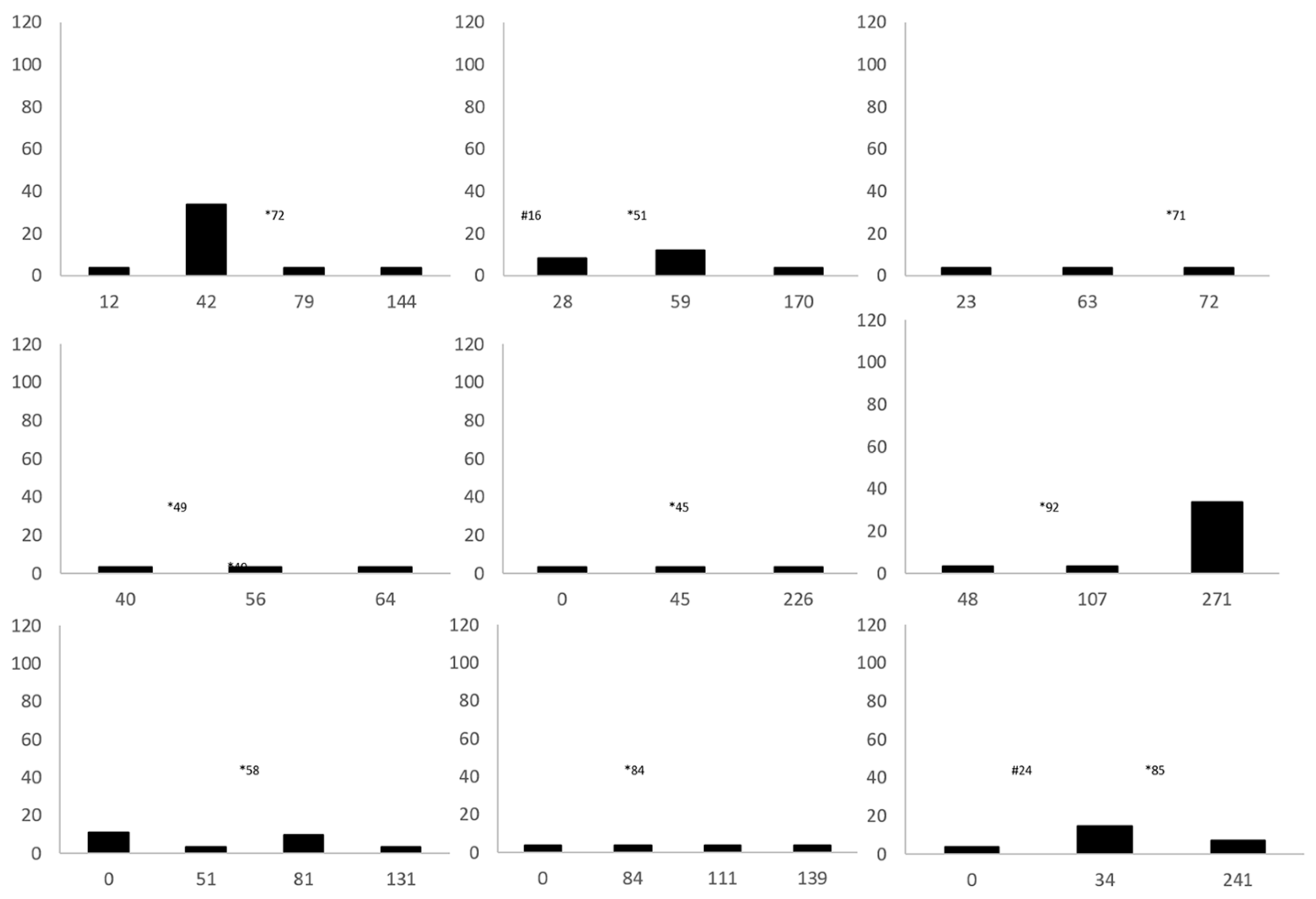
Correction: Turner et al. Steatitis in Cold-Stunned Kemp’s Ridley Sea Turtles (Lepidochelys kempii). Animals 2021, 11, 898

 ,
, Error in Figure/Table


| Variables | Cold-Stunned Turtles with Diagnosis of Steatitis | Free-Ranging Immature Control Turtles | Z | p |
|---|---|---|---|---|
| Mass (kg) | ||||
| N | 10 | 8 | ||
| Mean ± SD | 2.9 ± 0.9 | 17.9 ± 7.8 | ||
| Median (minimum, maximum) | 3.1 (1.6, 4.1) | 18.1 (3.4, 28.0) | 3.20 | <0.01 |
| Straight carapace length (cm) | ||||
| N | 10 | 8 | ||
| Mean ± SD | 27.5 ± 3.1 | 46.1 ± 8.7 | ||
| Median (minimum, maximum) | 28.5 (22.6, 31.4) | 47.7 (27.0, 55.3) | 2.98 | <0.01 |
| Vitamin E * nmol/g | ||||
| N | 10 | 9 | ||
| Mean ± SD | 3.6 ± 0.7 | 61.2 ± 23.3 | ||
| Median (minimum, maximum) | 3.5 (2.3, 5.5) | 62.3 (25.3, 90.9) | 3.67 | <0.01 |
| TBARS nmol/g | ||||
| N | 10 | 9 | ||
| Mean ± SD | 1.8 ± 0.6 | 2.5 ± 0.7 | ||
| Median (minimum, maximum) | 1.6 (1.2, 3.2) | 2.1 (1.8, 3.9) | 2.41 | 0.01 |
| TBARS to vitamin E ratio | ||||
| N | 10 | 9 | ||
| Mean ± SD | 0.52 ± 0.18 | 0.05 ± 0.03 | ||
| Median (minimum, maximum) | 0.50 (0.28, 0.92) | 0.03 (0.02, 0.10) | 3.63 | <0.01 |
Reference
- Turner, R.C.; Innis, C.J.; Stacy, B.A.; Hernandez, J.A.; Hill, R.C.; Scott, K.C.; Frasca, S., Jr.; Garner, M.M.; Burns, R.E.; Arendt, M.D.; et al. Steatitis in Cold-Stunned Kemp’s Ridley Sea Turtles (Lepidochelys kempii). Animals 2021, 11, 898. [Google Scholar] [CrossRef] [Scilit]
Publisher’s Note: MDPI stays neutral with regard to jurisdictional claims in published maps and institutional affiliations. |
© 2022 by the authors. Licensee MDPI, Basel, Switzerland. This article is an open access article distributed under the terms and conditions of the Creative Commons Attribution (CC BY) license (https://creativecommons.org/licenses/by/4.0/).
Share and Cite
Turner, R.C.; Innis, C.J.; Stacy, B.A.; Hernandez, J.A.; Hill, R.C.; Scott, K.C.; Frasca, S., Jr.; Garner, M.M.; Burns, R.E.; Arendt, M.D.; et al. Correction: Turner et al. Steatitis in Cold-Stunned Kemp’s Ridley Sea Turtles (Lepidochelys kempii). Animals 2021, 11, 898. Animals 2022, 12, 1129. https://doi.org/10.3390/ani12091129
Turner RC, Innis CJ, Stacy BA, Hernandez JA, Hill RC, Scott KC, Frasca S Jr., Garner MM, Burns RE, Arendt MD, et al. Correction: Turner et al. Steatitis in Cold-Stunned Kemp’s Ridley Sea Turtles (Lepidochelys kempii). Animals 2021, 11, 898. Animals. 2022; 12(9):1129. https://doi.org/10.3390/ani12091129
Chicago/Turabian StyleTurner, Rachel C., Charles J. Innis, Brian A. Stacy, Jorge A. Hernandez, Richard C. Hill, Karen C. Scott, Salvatore Frasca, Jr., Michael M. Garner, Rachel E. Burns, Michael D. Arendt, and et al. 2022. "Correction: Turner et al. Steatitis in Cold-Stunned Kemp’s Ridley Sea Turtles (Lepidochelys kempii). Animals 2021, 11, 898" Animals 12, no. 9: 1129. https://doi.org/10.3390/ani12091129
APA StyleTurner, R. C., Innis, C. J., Stacy, B. A., Hernandez, J. A., Hill, R. C., Scott, K. C., Frasca, S., Jr., Garner, M. M., Burns, R. E., Arendt, M. D., Brisson, J., Norton, T. M., Williams, S. R., Kennedy, A., Alexander, A. B., & Stacy, N. I. (2022). Correction: Turner et al. Steatitis in Cold-Stunned Kemp’s Ridley Sea Turtles (Lepidochelys kempii). Animals 2021, 11, 898. Animals, 12(9), 1129. https://doi.org/10.3390/ani12091129