


Simple Summary
Vitamin K3 (VK3) is the most unstable vitamin. Menadione sodium bisulfite (MSB) and menadione nicotinamide bisulfite (MNB) are two commonly used VK3 in animal diets. Micro-capsule and micro-sphere forms of vitamins, provided from encapsulation techniques, have been used in vitamin production, while the effects of these encapsulated forms on the storage stability of VK3 need systematic investigation. Our results show that high temperature-high relative humidity had a negative effect on the recovery of VK3. The retention of MNB was higher than that of MSB in vitamin premixes. VK3 retention was higher in micro-capsule or micro-sphere forms in vitamin premix and vitamin trace mineral premixes during storage.
Abstract
Six types of vitamin K3 (VK3); two sources (menadione sodium bisulfite, MSB; menadione nicotinamide bisulfite, MNB), and three different forms (crystal, micro-capsule, and micro-sphere) were used to determine the retention of VK3 in vitamin premixes (Experiment 1) or vitamin trace mineral (VTM) premixes (Experiment 2) after 1, 2, 3, and 6 months of storage. The retention of VK3 in vitamin premixes was evaluated at 25 °C/60% relative humidity or 40 °C/75% relative humidity in an incubator in Experiment 1 and in VTM premixes (choline chloride: 0 vs. 16,000 mg/kg) stored at room temperature in Experiment 2. The VK3 retention in vitamin premix or VTM premix decreased significantly with the extension of storage time (p < 0.05). In Experiment 1, the VK3 retention was higher in the 25 °C/60% incubator (56%) than in the 40 °C/75% incubator (28%). The MNB retention (52%) was higher than MSB retention (32%). The retention of VK3 in micro-capsules (43%) or micro-spheres (48%) was higher than the crystal form (35%) after six months of storage. In Experiment 2, there was no difference between the retention of MSB (49%) or MNB (47%). The retention of VK3 of micro-capsule (51%) or micro-sphere (54%) was higher than that of crystal form (40%). The VK3 retention was higher in the choline-free group (51%) than in the choline group (47%) after six months of storage. Finally, the predicted equations of VK3 retention with storage time in vitamin premixes or VTM premixes were established. The R2 of the prediction equations was ≥0.9005, indicating that time is an important factor in predicting VK3 retention. In conclusion, the higher temperature-relative humidity, choline had negative effects on VK3 retention during premix storage. MNB retention was higher than MSB during storage of vitamin premix. The encapsulated forms of VK3, micro-capsules and micro-spheres, could improve VK3 storage stability in vitamin premix and VTM premix.
1. Introduction
Vitamins are involved in the metabolism of animals and have positive effects on animal health [1]. However, proper integration is difficult to achieve due to the instability of many vitamins with physical and chemical factors [2]. The presence of choline and improper storage environment cause losses of vitamins in premixes. In previous studies on vitamin stability, we found that VK3 was the most unstable vitamin [3], which could directly affect the effects of vitamin premix and can be used as a marker of the validity of the premix. The encapsulated forms of VK3, such as micro-capsule or micro-sphere form was chosen by some premix manufacturers to improve VK3 stability, but more research is needed to validate their storage stability [4]. Considering the difference in climate between North China and South China, we also used temperature-relative humidity as a factor when designing the experiment. Therefore, the aim of this study was to determine the influence of two sources and three forms of VK3, temperature- relative humidity and choline chloride, on the storage stability of VK3 in vitamin and vitamin trace mineral (VTM) premix, and develop predicted equations to estimate VK3 retention during storage, for accurate usage of VK3 in the feed industry and animal production.
2. Materials and Methods
This study was conducted at the Ministry of Agriculture and Rural Affairs Feed Efficacy and Safety Evaluation Center located at China Agricultural University (Beijing, China).
2.1. Premix Treatments
Six types of VK3 (Provided by Wellroad Animal Health Co. Ltd., Taiyuan, China) were used, and the analyzed VK3 content in these forms is shown in Table S1. Experiment 1 was designed by a 2 × 3 × 2 factorial arrangement with two sources, menadione sodium bisulfite (MSB) vs. menadione nicotinamide bisulfite (MNB), and three forms (crystal vs. micro-capsule vs. micro-sphere), and two storage environments (temperature/relative humidity: 25 °C/60% vs. 40 °C/75%). Six vitamin premixes were formulated using different VK3 (Table 1). Experiment 2 was designed with a 2 × 3 × 2 factorial arrangement with two sources (MSB vs. MNB), three forms (crystal vs. micro-capsule vs. micro-sphere), and with and without choline (0 vs. 16,000 mg/kg). Twelve vitamin trace mineral (VTM) premixes were formulated (with and without choline), which contained the same levels of vitamins except for choline (Table 1). Vitamin levels were determined based on typical commercial premixes [5,6] to make the laboratory analysis more reliable.

Table 1.
Composition of the vitamin and vitamin-trace mineral (VTM) premixes.
2.2. Premix Preparation, Storage, and Sampling
Premixes were formulated at Wellroad Animal Health Co. Ltd., Taiyuan, China. Each of the vitamin premixes was prepared in six separate batches following the same procedure (6.0 kg per batch). Each batch represented one repetition and was divided into ten polyethylene bags weighing 0.6 kg. Each of the twelve VTM premixes was prepared in six separate batches following the same procedure (15.0 kg per batch). Each batch represented one repetition and was divided into five polyethylene bags (3.0 kg). The vitamin premixes were stored in two incubators (Cerberus instrument Co., Ltd., Beijing, China), with the temperature/relative humidity set at 25 °C/60% or 40 °C/75%. Thirty bags of vitamin premixes were randomly placed in each incubator. The VTM premixes were stored in a storeroom, the temperature and relative humidity of the storeroom were recorded daily (Figure S1). The samples were analyzed after 0, 1, 2, 3, and 6 months of storage.
2.3. Determination of Vitamin K3 Content
The content of VK3 in premix was determined with high-performance liquid chromatography (HPLC) [7]. In brief, a 0.5 g sample was extracted with 50 mL of trichloromethane. Then, 5 mL sodium carbonate solution and 5 g adsorbent were added, and after 30 min of blending, the extract passed 0.45 μM filter samples were assayed in triplicates. The VK3 retention was used as the stability measurement index, based on a method in a previous study [3] as follows: the retention of VK3 (%) = (nutrient content per gram of premix after storage × premix weight (gram) after storage)/(nutrient content per gram of premix × premix weight (gram) before storage) × 100.
2.4. Statistical Analysis
Statistical analysis was performed using a Proc MIXED model of SAS (SAS Institute, Cary, NC, USA). The statistical model included the fixed main effects of source, form, temperature/relative humidity, and their interaction effects in Experiment 1. The statistical model included the fixed main effects of source, form, choline, and their interaction effects in Experiment 2. A single degree of freedom contrast was performed for fixed effects in Experiment 1 and 2. Meanwhile, statistical differences among mean values were separated by Tukey’s multiple comparison test (Tables S2 and S3). Statistical significance was considered at p < 0.05. Excel 2019 (Microsoft Corporation, Redmond, Washington, DC, USA) was used to establish the prediction equation. The R2 and root mean square error (RMSE) were used to examine the quality of the prediction equation.
3. Results
The analyzed VK3 values of the samples are shown in Table 2, which was consistent with that of the research design.
Table 2.
Analyzed vitamin K3 values in vitamin and vitamin vitamin-trace mineral (VTM) premixes.
3.1. Effect of Source and Form of Vitamin K3 and Temperature/Relative Humidity on Its Stability in Vitamin Premix during Storage
The retention of VK3 was significantly decreased with the extension of the storage time in vitamin premix (p < 0.05, Table 3). The retention of MNB (86%, 80%, 73%, or 52% after 1, 2, 3, or 6-months of storage, respectively) was significantly higher than that of MSB (82%, 66%, 54%, or 32% after 1, 2, 3, or 6-months of storage, respectively) during storage (p < 0.05). The VK3 retention of micro-capsule or micro-sphere was significantly higher than crystals (p < 0.05) at each time point. The VK3 retention was significantly higher at 25 °C/60% relative humidity than 40 °C/75% relative humidity (p < 0.05). In addition, there were interaction effects between source, form, and temperature-relative humidity after part of the storage time (p < 0.05). Although there was no significant difference between the retention of MSB of micro-capsules (71%) and micro-spheres (73%), the retention of MNB of micro-capsules (74%) was lower than the MNB of micro-spheres (80%) at 40 °C/75% relative humidity after one month of storage (p < 0.05, Table S2), this suggested that there was an interaction between the source and form. In addition, there was no difference between the retention of MSB micro-capsules (88%) and that of MNB (89%) at 25 °C/60% relative humidity, while the retention of MNB micro-capsules (65%) was higher than that of MSB (50%) at 40 °C/75% after two months of storage (p < 0.05, Table S2), this demonstrated that there was an interaction between the source and temperature.
Table 3.
Effects of sources and forms of vitamin K3, and temperature/relative humidity on the retention of vitamin K3 in vitamin premixes.
3.2. Effect of Source and Form of Vitamin K3 and Choline on Its Stability in Vitamin Trace Mineral Premix during Storage
The retention of VK3 was significantly decreased with the extension of storage time in VTM premix (p < 0.05, Table 4). There was no statistical difference between the retention of MSB (95%, 88%, 83%, or 49%) and MNB (94%, 87%, 81%, or 47%) after one, two, three, or six months of storage. The retention of VK3 of micro-capsule or micro-sphere was significantly higher than crystals (p < 0.05) at each time of the investigation. Furthermore, the retention of VK3 in a choline-free group (51%) was higher (p < 0.05) than that of the choline group (46%) after six months of storage. In addition, there were interaction effects between source, form, and choline after part of the storage time (p < 0.05). For example, there was no difference between the retention of MNB crystals in the choline-free group (71%) and the choline group (73%), while the retention of MSB crystals in the choline-free group (84%) was higher than that of MSB in choline group (75%) after three months of storage (p < 0.05, Table S3), this indicated that there was an interaction between the source and choline. Meanwhile, the retention of MSB of micro-sphere in the choline-free group (84%) was lower than that of MSB in the choline group (90%), while the retention of MSB of crystal in the choline-free group (84%) was higher than that of MSB in choline group (75%) after three months of storage (p < 0.05, Table S3), this suggested that there was an interaction between the form and choline.
Table 4.
Effects of sources and forms of vitamin K3 and choline on the retention of vitamin K3 in vitamin trace mineral (VTM) premixes.
3.3. Prediction Equations for Retention of Vitamin K3 in Vitamin or Vitamin Trace Mineral (VTM) Premixes during Storage
Prediction equations have been used in many aspects of animal nutrition, such as the prediction of digestibility of feed ingredients and enzyme activity [8,9]. The use of prediction equations can decrease experimental costs and improve the accuracy when estimating values. The prediction equation with the greatest R2 and the smallest RMSE was regarded as the most accurate prediction equation [8]. The prediction equations in this research were fitted with data, and all of the equations had a good fit (Figure 1 and Figure 2). Time is an important predictor of vitamin recovery during storage, which is consistent with one former research [3].
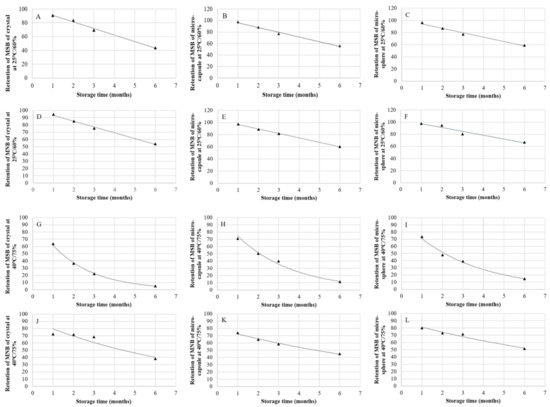
Figure 1.
Prediction equations for vitamin K3 retention (%) in vitamin premixes during storage. (A) Retention of MSB of crystal at 25 °C/60% (y = −9.5807x + 100.58, R2 = 0.992); (B) Retention of MSB of micro-capsule at 25 °C/60% (y = −8.255x + 104.43, R2 = 0.990); (C) Retention of MSB of micro-sphere at 25 °C/60% (y = −7.2871x + 101.66, R2 = 0.985); (D) Retention of MNB of crystal at 25 °C/60% (y = −8.0286x + 101.26, R2 = 0.994); (E) Retention of MNB of micro-capsule at 25 °C/60% (y = −7.3439x + 103.92, R2 = 0.999); (F) Retention of MNB of micro-sphere at 25 °C/60% (y = −6.3364x + 103.8, R2 = 0.943); (G) Retention of MSB of crystal at 40 °C/75% (y = 101.26e − 0.498x, R2 = 0.999); (H) Retention of MSB of micro-capsule at 40 °C/75% (y = 107.69e − 0.367x, R2 = 0.991); (I) Retention of MSB of micro-sphere at 40 °C/75% (y = 96.72e − 0.313x, R2 = 0.994); (J) Retention of MNB of crystal at 40 °C/75% (y = 91.176e − 0.136x, R2 = 0.901); (K) Retention of MNB of micro-capsule at 40 °C/75% (y = 79.747e − 0.097x, R2 = 0.991); (L) Retention of MNB of micro-sphere at 40 °C/75% (y = 88.783e − 0.088x, R2 = 0.974). MSB, menadione sodium bisulfite; MNB, menadione nicotinamide bisulfite.
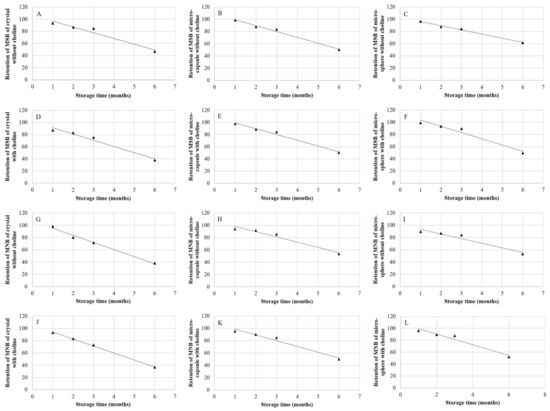
Figure 2.
Prediction equations for vitamin K3 retention (%) in vitamin trace mineral (VTM) premixes during storage. (A) Retention of MSB of crystal without choline (y = −9.5393x + 106.29, R2 = 0.951); (B) Retention of MSB of micro-capsule without choline (y = −9.5707x + 108.66, R2 = 0.988); (C) Retention of MSB of micro-sphere without choline (y = −6.8729x + 103.11, R2 = 0.991); (D) Retention of MSB of crystal with choline (y = −10.227x + 101.33, R2 = 0.970); (E) Retention of MSB of micro-capsule with choline (y = −9.4579x + 108.52, R2 = 0.983); (F) Retention of MSB of micro-sphere with choline (y = −10.225x + 113.7, R2 = 0.954); (G) Retention of MNB of crystal at without choline (y = −11.606x + 106.85, R2 = 0.989); (H) Retention of MNB of micro-capsule without choline (y = −8.5214x + 106.62, R2 = 0.958); (I) Retention of MNB of micro-sphere without choline (y = −7.5507x + 100.93, R2 = 0.938); (J) Retention of MNB of crystal with choline (y = −11.378x + 105.59, R2 = 0.998); (K) Retention of MNB of micro-capsule with choline (y = −9.3086x + 107.79, R2 = 0.968); (L) Retention of MNB of micro-sphere with choline (y = −8.9407x + 108.06, R2 = 0.952). MSB, menadione sodium bisulfite; MNB, menadione nicotinamide bisulfite.
4. Discussion
4.1. Effect of Storage Time on the Stability of Vitamin K3
Storage time is an important factor affecting the retention of VK3 in vitamin premixes and VTM premixes. European Food Safety Authority [10] reported that after one month of storage, VK3 retained 88.65% or 83.38% of its original activity in vitamin premix or VTM premix, respectively. After three months, VK3 retained 77.00% or 67.80% of its original activity in vitamin premix or VTM premix, respectively. Shurson et al. [11] observed that the retention of VK3 was 75.96% in vitamin premix after 120 d storage. Whitehead [12] reported that the retention of VK3 was 64% or 0% after one or six months in VTM premix. All these reports had a similar outcome to our research. The outcome was mainly due to the degradation of VK3 and a reduction in its effective active ingredient with the extension of the storage time. Therefore, we recommend reducing the time interval between the production and use of vitamin premix or VTM premix.
4.2. Effect of Source on the Stability of Vitamin K3
MSB is a free-flowing white to yellow crystalline, almost odorless powder that is extremely unstable when exposed to air and sensitive to light and heat. Due to its instability, a new K3 preparation, MNB, was developed. The MNB was developed by combining nicotinamide molecular groups to replace the sodium ion and three crystalline water molecules in MSB. European Food Safety Authority [10] reported that MSB or MNB had a shelf life of 18 or 30 months at 25 °C. In addition, they indicated that the MNB retention was 93.1% or 82.3%, and the MSB retention was 84.2% or 71.1% after one month or three months of storage, respectively. Our results also showed that MNB retention was higher than MSB after storage in vitamin premix, which was consistent with previous research. The difference between MSB retention and MNB retention may be explained by their chemical structure. MSB has three more crystalline water molecules than MNB, and the presence of water molecules more easily triggers the degradation of VK3 [13]. However, there was no difference between the retention of MSB and MNB during storage in VTM premix. This may be related to the ambient temperature and relative humidity, composition of premixes, and the microencapsulation process in the present study.
4.3. Effect of Form on the Stability of Vitamin K3
Encapsulation preparation techniques have been used in vitamin production in recent years, and the benefit of these technologies can extend the shelf-time of vitamins, control release in the intestine, and increase bio-availability [14,15]. As the capsule core of the capsule, vitamins reduce the contact with unfavorable factors such as air and moisture, so its stability is improved. Coelho [2] reported that the retention of crystalline MSB was 84%, 75%, 66%, 40%, and the retention of coated MSB was 92%, 86%, 80%, 68%, in vitamin premixes after one, two, three or six months of storage, respectively. In a study by Coelho [2], the stability of coated MSB was higher than crystalline MSB. These results were consistent with our observation, which showed that micro-capsule and micro-sphere forms of VK3 provided by encapsulation and micro-particle preparation techniques might improve its stability during storage.
4.4. Effect of Temperature and Relative Humidity on the Stability of Vitamin K3
The temperature and relative humidity are important factors affecting the stability of VK3 in premix. Our results showed that the retention of VK3 was higher at 25 °C/60% than at 40 °C/75%. This was mainly due to high temperature provides energy for many redox reactions and accelerates the destruction of VK3 [16]. In addition, the increase in relative environmental humidity increased the absorption of water by VK3, creating conditions for the destruction of oxygen and trace elements, causing VK3 degradation [13]. Therefore, vitamin premix should be stored under lower temperature and relative humidity conditions.
4.5. Effect of Choline on the Stability of Vitamin K3
Choline has strong hygroscopicity and can absorb moisture from the environment, which can affect the stability of the other vitamin [17]. Our results showed that the VK3 retention was higher in the choline-free group than in the choline group after six months of storage in VTM premix. Tavčar-Kalcher et al. [18] reported that the retention of VK3 was 80% in a choline-free group and 9% in a choline group after twelve months of storage of the vitamin premix. In an experiment by Coelho [2], the retention of VK3 was 94% in a choline-free group and 40% in a choline group in vitamin premix after six months of storage. These results were consistent with the present study, indicating that choline significantly affected the stability of VK3 during long-term storage. This is mainly due to the fact that choline absorbs a large amount of water from the environment, putting VK3 in an imbalanced state which accelerates its degradation. Therefore, vitamin stability could be improved by removing choline chloride from premixes.
5. Conclusions
Our results showed that MNB was a better source of VK3 in vitamin premix, while VK3 performed better when coated in vitamin premix and VTM premix. Meanwhile, the VTM premix should not contain choline during storage, and the vitamin premix and VTM premix should be stored at low temperature and relative humidity conditions to ensure the stability of VK3. Additionally, the prediction equations obtained in this study may be adopted by vitamin and/or VTM premix companies and their users for predicting the retention of VK3 for a more accurate nutrient allowance in animal production.
Supplementary Materials
The following are available online at https://www.mdpi.com/article/10.3390/ani11041140/s1, Table S1: The analysis of VK3 in six forms, Table S2: Effects of sources and forms of vitamin K3, and temperature/relative humidity on the retention of vitamin K3 in vitamin premixes, Table S3: Effects of sources and forms of vitamin K3 and choline on the retention of vitamin K3 in vitamin trace mineral (VTM) premixes, Figure S1: The record of temperature and relative humidity during the storage of the vitamin trace mineral premixes.
Author Contributions
Designed research, H.W. and Y.M.; Conducted research, H.W., P.Y., L.L. and N.Z.; Conducted laboratory analyses, H.W.; Data curation, H.W. and X.X.; Wrote the first draft of the manuscript, H.W.; Project administration, Y.M.; Funding acquisition, Y.M. All authors have read and agreed to the published version of the manuscript.
Funding
This study was financially supported by the National Natural Science Foundation of China (32072740) and the Evaluation of stability and bioavailability of new feed additives (201705510410056).
Institutional Review Board Statement
Not applicable.
Data Availability Statement
Not applicable.
Acknowledgments
The authors express their appreciation to the Wellroad Animal Health Co. Ltd. (Taiyuan, China) for the samples and funding support.
Conflicts of Interest
The authors declare no conflict of interest.
References
- Zempleni, J.; Suttie, J.W.; Gregory, J.F.; Stover, P.J. Handbook of Vitamins, 3rd ed.; CRC Press: Boca Raton, FL, USA, 2001; pp. 122–139. [Google Scholar]
- Coelho, M. Vitamin stability in premixes and feeds: A practical approach in ruminant diets. In Proceedings of the 13th Annual Florida Ruminant Nutrition Symposium, University of Florida, Gainesville, FL, USA, 11–12 January 2002; Volume 127, p. 145. [Google Scholar]
- Yang, P.; Wang, H.K.; Zhu, M.; Ma, Y.X. Effects of Choline Chloride, Copper Sulfate and Zinc Oxide on Long-Term Stabilization of Microencapsulated Vitamins in Premixes for Weanling Piglets. Animals 2019, 9, 1154. [Google Scholar] [CrossRef] [PubMed]
- Lee, J.S.; Nam, Y.S.; Kang, B.; Han, S.; Chang, I. Vitamin A microencapsulation within poly (methyl methacrylate)-g-polyethylenimine microspheres: Localized proton buffering effect on vitamin A stability. J. Appl. Polym. Sci. 2010, 92, 517–522. [Google Scholar] [CrossRef]
- DSM Vitamin Supplementation Guidelines 2016 for Animal Nutrition. Available online: https://www.dsm.com/markets/anh/en_US/generic/download-registration-vitamin-supplementation-guidelines-in-animal-nutrition-2016.html?assetPath=/content/dam/dsm/anh/en_US/documents/Vitamin_Supp_Guidelines.pdf (accessed on 28 November 2019).
- Trouw Nutrition China Vitamins and Minerals Recommendation. Available online: https://www.trouwnutrition.com.cn/Products_overview/Service-Overview/Technical-article/Recommendatiom/ (accessed on 28 November 2019).
- National Standard Determination of Vitamin K3 in Feeds—High Performance Liquid Chromatography; General Administration of Quality Supervision, Inspection and Quarantine of the People’s Republic of China: Beijing, China, 2017.
- Pan, L.; Ma, H.; Piao, X.S.; Liu, L.; Li, D.F. A computer-controlled simulated digestion system is a promising in vitro digestibility technique to predict digestible energy of corn grain for growing pigs. Anim. Feed Sci. Technol. 2018, 235, 43–49. [Google Scholar] [CrossRef]
- Pope, J.T.; Brake, J.; Fahrenholz, A.C. Parameters monitored during the pelleting process and their relationship to xylanase activity loss. Anim. Feed Sci. Technol. 2020, 259, 114344. [Google Scholar] [CrossRef]
- EFSA Panel on Additives and Products or Substances used in Animal Feed (FEEDAP). Scientific Opinion on the safety and efficacy of vitamin K3 (menadione sodium bisulphite and menadione nicotinamide bisulphite) as a feed additive for all animal species. EFSA J. 2014, 12, 3532. [Google Scholar]
- Shurson, G.C.; Salzer, T.M.; Koehler, D.D.; Whitney, M.H. Effect of metal specific amino acid complexes and inorganic trace minerals on vitamin stability in premixes. Anim. Feed Sci. Technol. 2011, 163, 200–206. [Google Scholar] [CrossRef]
- Whitehead, C.C. Vitamins in feedstuffs. In Poultry Feedstuffs. Supply, Composition and Nutritive Values, 1st ed.; Poultry Science Symposium Series; CABI: Wallingford, UK, 2002; pp. 181–190. [Google Scholar]
- Ball, G.F.M. Bioavailability and Analysis of Vitamins in Foods; Springer: Berlin/Heidelberg, Germany, 1998; pp. 241–266. [Google Scholar]
- Gonnet, M.; Lethuaut, L.; Boury, F. New trends in encapsulation of liposoluble vitamins. J. Control. Release 2010, 146, 276–290. [Google Scholar] [CrossRef] [PubMed]
- Mougin, K.; Bruntz, A.; Severin, D.; Teleki, A. Morphological stability of microencapsulated vitamin formulations by AFM imaging. Food Struct. 2016, 9, 1–12. [Google Scholar] [CrossRef]
- Ford, J.E.; Hurrell, R.F.; Finot, P.A. Storage of milk powders under adverse conditions. 2. Influence on the content of water-soluble vitamins. Br. J. Nutr. 1983, 49, 355–364. [Google Scholar] [CrossRef] [PubMed]
- Baker, D.H. Swine Nutrition; CRC Press: Boca Raton, FL, USA, 2010; pp. 377–400. [Google Scholar]
- Tavčar-Kalcher, G.; Vengušt, A. Stability of vitamins in premixes. Anim. Feed Sci. Technol. 2007, 132, 148–154. [Google Scholar] [CrossRef]
Publisher’s Note: MDPI stays neutral with regard to jurisdictional claims in published maps and institutional affiliations. |
© 2021 by the authors. Licensee MDPI, Basel, Switzerland. This article is an open access article distributed under the terms and conditions of the Creative Commons Attribution (CC BY) license (https://creativecommons.org/licenses/by/4.0/).