Targeting Microorganisms in Lignocellulosic Biomass to Produce Biogas and Ensure Sanitation and Hygiene

Abstract
1. Introduction
2. Anaerobic Digestion
2.1. Factors Affecting Anaerobic Digestion
2.2. Microorganisms Involved in the Anaerobic Digestion Process
3. Global Perspective on Energy, Sanitation, and Hygiene and Mitigation Through Anaerobic Digestion of Lignocellulosic Wastes
3.1. Energy
A Comparative Analysis of Anaerobic Digestion Adoption, Technological Maturity, and Socio-Economic Benefits Between Developed and Developing Regions
3.2. Sanitation and Hygiene (Waste Management)

| Microorganisms | Description of the Organism | Infections Caused in Humans/Animals and Symptoms | Route of Infection | References |
|---|---|---|---|---|
| Escherichia coli | It is a Gram-negative bacterium that occurs as a commensal among the first, colonising the gut following birth. E. coli can be differentiated into phylogenetic lineages that are distinct, such as A, B1, B2, D1, D2, E, and Clade I. Accordingly, E. coli, through genetic changes based on the high plasticity of its genome, evolves producing different pathotypes different from their commensal counterparts, which are associated with different disease conditions. These pathotypes include EPEC(Enteropathogenic), EHEC (Enterohemorrhagic), ETEC (Enterotoxigenic), EIEC (Enteroinvasive), UPEC (Uropathogenic), APEC (Avian pathogenic), E. coli, etc. | The diseases are presented according to the different pathotypes described in the previous column, including acute and prolonged diarrhoea in children, haemorrhagic colitis and haemolytic uraemic syndrome, traveller’s diarrhoae, dysentery and watery diarrhoea, urinary tract infections, septicaemia, and severe respiratory and systemic infections in poultry. | Contaminated food and water | Mudau et al. [271]; Pokharel et al. [272]. |
| Salmonella spp. | Gram-negative, non-spore-forming, aerobic, and facultative bacteria belonging to the family Enterobacteriacea. Pathogens with the greatest probability of being spread in the environment through animal slurry and sewage sludge. All serotypes are harmful to both humans and animals. Of increasing global public health concern to both animals and humans relating to antimicrobial resistance. | Food poisoning/gastroenteritis, which is characterised by fever, diarrhoae and abdominal cramps. Also, more severe systemic diseases, including typhoid fever. | Contaminated food and water | Billah and Rahman [273] and Lamichhane et al. [274]. |
| Campylobacter jejuni Campylobacter coli | The genus Campylobacter belongs to the family Campylobacteriaceae. These two species are closely related by phylogenetic and genetic measures. The species can be differentiated using high-resolution melting curve analysis targeting variations in the sequence of the cadF gene. This gene mediates cell binding to the cell–matrix protein, Fibronectin. They are both incriminated in human gastroenteritis. Accordingly, antibiotic treatment is based on the species causing the infection (C. jejuni with Erythromycin, while C. coli is resistant to this drug). | Bacterial diarrhoael illness (traveller’s diarrhoae, which can be self-limiting), bacteraemia, abscess, and meningitis. | Consumption of contaminated food or water, direct contact with faeces of infected humans or animals | Zenebe et al. [275]; |
| Listeria monocytogenes | It is a well-known Gram-positive, facultatively anaerobic, non-encapsulated, rod-shaped intracellular bacterium that is ubiquitous in nature, i.e., found everywhere. It belongs to the genus Listeria, family Listeriaceae, classified into four (4) major lineages 1 to IV, consisting of 14 serotypes. L. monocytogenes demonstrates great strain divergence coupled with increased antibiotic resistance as well as biofilm potential. | The bacterium causes listeriosis, which can occur as non-invasive, self-limiting gastroenteritis and invasive listeriosis. Clinically- associated manifestations such as encephalitis, pneumonia, meningitis, septicaemia, sepsis, brain infection, abortions or stillbirths, headache, backache, etc. | Contaminated ready-to-eat foods. | Getaneh et al. [276]; Manyi-Loh and Lues [277]. |
| Yersinia enterocolitica | Y. entrocolitica is a species belonging to the genus Yersinia and family Yersiniaceae. It is a very important zoonotic pathogen, whose reservoir is pigs. Y. enterocolitica is considered the third bacterial cause of gastrointestinal infection in humans, residing in Europe, whilst its infection in West Africa is rare. Its pathogenicity relies on the expression of chromosome and plasmid determinants. | It causes yersiniosis in both humans and animals. Clinical manifestations include enteritis, colitis, secretory and bloody diarrhoae, fever, stomach pain, and vomiting. Yersiniosis is associated with significant economic effects relating to health and veterinary costs, trade restrictions, productivity and livestock losses, food recalls, and the need for compliance and public health measures. | It is foodborne and transmitted through contaminated meat, milk, and related products. Infection occurs through sick or asymptomatic carriers and contact with the faeces of infected animals. | Lemos et al. [278]; Sohoty et al. [279]; Grygiel-Górniak [280]. |
| Staphylococcus aureus | It is a Gram-positive coccoid-shaped opportunistic bacterium, registered among the significant foodborne pathogens. The staphylococcal enterotoxins, a class of heat-stable enterotoxins with the ability to induce superantigen activity, lead to immunosuppression and T-cell proliferation. The enterotoxins demonstrate resistance to protein hydrolytic enzymes and low pHs, allowing them to maintain their activity in the gastrointestinal tract following ingestion. The biofilm ability of this bacterium threatens and exacerbates infections by permitting its attachment to pathological areas and livestock product surfaces. | In humans, the bacterium causes primary bacteraemia, otitis media, soft tissue infection, pneumonia, and septic arthritis. In animals, it causes mastitis, joint infections, skin infections, and bacterial chondronecrosis with osteomyelitis. | Foodborne, direct contact with skin. | Zhou et al. [281]; Song et al. [282]. |
| Shigella dysenteriae | It is a Gram-negative, facultatively anaerobic, non-motile, non-spore-forming, non-lactose-fermenting, rod-shaped bacterium, which exists in humans as the only host. It produces Shiga toxin, and it is genetically highly correlated with Escherichia coli. | Shigellosis (bacterial dysentery) or bacillary dysentery in humans. It is an acute inflammation of the intestines, presenting as mild watery diarrhoea to severe inflammatory bacillary dysentery. In severe cases, haemolytic uraemic syndrome, kidney failure, and even death. Symptoms include fever, abdominal cramps, mucus and blood in the stool, and vomiting. | The faecal–oral route, contaminated food or water, or direct contact with infected persons (food handlers), and poor hygiene. | Ayele et al. [283]; Hmar et al. [284]. |
| Cryptosporidium parvum | It is a protozoan parasite belonging to the genus Cryptosporidium, class Coccidia, and phylum Apicomplexa that occurs as a parasite in both humans and animals, exhibiting a monoxen cycle (i.e., completing its life cycle within a single host), with alternating asexual and sexual reproduction. Together with C. hominis, they occur as the only species of the genus Cryptosporidium that infect humans. | It causes cryptosporidiosis, a water-and food-borne zoonotic disease, with no available therapeutic drugs or vaccines that are effective for treatment and control. Associated symptoms include vomiting, diarrhoea, nausea, abdominal pain, and fever. | Faecal–oral route transmission by ingestion of viable oocysts deposited in the faeces of infected humans and animals, contaminating food or water, and is added to the respiratory route. | Helmy and Hafez, [285]; Enbom et al. [286]. |
| Vibrio cholerae | It is described as a curved, rod-shaped, motile Gram-negative, zoonotic bacterium that inhabits aquatic environments. It is a major public health concern, especially in countries with poor sanitary conditions and areas affected by natural disasters. V. cholerae is a species of bacteria with a remarkable capacity to adapt and evolve, making it a great global concern as it raises the risk of cholera outbreaks and its distribution to new regions, thereby rendering control of the disease challenging. | It is the causative agent of cholera, via secreting an AB5 multimeric toxin, cholera toxin (CT), that binds directly to intestinal epithelial cells. Cholera is a severe and highly contagious diarrhoeal disease that can cause extreme dehydration, leading to cholera-associated deaths. | The faecal–oral route of transmission or indirectly through contaminated food and water or person-to-person contact. | Dominguez et al. [287], Montero et al. [288]. |
| Rotavirus | It is a highly infectious virus associated with the most common cause of diarrheal-related deaths and the fifth (5th) highest cause of death in children under five (5) years. The virus demonstrates genetic heterogeneity across different strains, and it can infect a wide range of species, suggesting that it possesses the potential to produce highly virulent variants via gene reassortment. | Infections caused by Rotavirus are the leading cause of severe dehydrating gastroenteritis in children under the age of five (5). | Transmitted via the faecal–oral route in humans. In animals, the possibility of transmission is via ingestion of contaminated feed or water, exposure to contaminated environments, and contact with infected animals. | Crawford et al. [289]; Njifon et al. [290]. |
| Avian influenza virus | It is described as a negative-sense single-stranded RNA virus with eight gene segments comprising haemagglutinin, neuraminidase glycoproteins, and six (6) internal genes. Avian influenza viruses are also known as bird flu or avian flu. These viruses are classified as a type of influenza virus. The evolution of Avian influenza A (through H1N1, H2N2, H3N2, H5N1) is a crucial driver for the emergence of pandemic strains. On a global scale, these viruses are challenging owing to widespread circulation and high mortality rates. Outbreaks of this virus affect all age groups, displaying distinct geographical epidemiological patterns of its infections in humans across regions, provinces, and countries. | Infections ranging from mild to severe, presenting with symptoms including fever, cough, sore throat, pneumonia, and acute respiratory distress syndrome. | Human transmission occurs via direct contact with infected birds, human-to- human transmission. Inter-premise airborne transmission and through virus-contaminated surfaces and materials. | Charostad et al. [291]; Kang et al. [292]. |
| Clostridium spp. | Gram-positive, anaerobic spore-forming bacteria, with known pathogen species, including C. perfringens and C. botulinum, that produce toxins. Also, C. difficile is of high prevalence in animals. Presently, diseases caused by these bacterial species are persistent because of challenging diagnosis, vaccines and treatments are not readily available, and these bacterial species occupy habitats everywhere in the environment (ubiquitous). | Clostridial diseases are grouped into enteric, neurotoxic, and histotoxic. Human and animal botulism, gangrene, necrosis, pseudo-membranous enteritis, food poisoning, enterocolitis, and enterotoxemia. Symptoms include muscle weakness, vomiting, nausea, headache, respiratory failure, dizziness, severe abdominal pain, and diarrhoea. | Foodborne, i.e., ingestion of contaminated food, spores. Direct contact with animals (contaminated wounds) and indirect transmission via the environment. | Uzal et al. [293]; Wang et al. [196]. |
| Bacillus cereus | Gram-positive, facultatively anaerobic, aerobic, endospore-forming, ubiquitously distributed, and opportunistic bacterium. During vegetative growth, the bacterium pre-forms an emetic toxin known as cereulide (a small peptide of molecular weight 1.2 kDa, which is responsible for the emetic syndrome). Cereulide is one of the important determinants of the pathogenicity of B. cereus. In addition, the emetic toxin is a cyclic dodecadepsipeptide, highly stable towards heat, acid, and digestive enzymes; therefore, it can be difficult to remove or become inactivated. This is because it comprises a repeated sequence of [D-O-Leu D-Ala L-O-Val D-Val]3. Bacillus spp. are regarded as safe bacteria endowed with remarkable abilities for encouraging plant growth. | It causes both local and systemic infections in humans. In other words, it causes gastrointestinal and food poisoning in addition to gastrointestinal infections (rare). It causes two types of gastrointestinal symptoms, the emetic type, which appears half an hour following ingestion of food intoxicated with cereulide, the emetic toxin. This is associated with nausea and vomiting. Secondly, the diarrhoeal form of food poisoning manifests as diarrhoea and abdominal cramps. The emetic syndrome is clinically indistinguishable from intoxication with enterotoxins of Staphylococcus aureus. In animals, it causes anthrax-like disease, manifesting as septicaemia and sudden death. | In humans, transmission of infections is via the ingestion of contaminated foods. Spore production and environmental transmission. Precisely, through cutaneous, inhalation, or gastrointestinal routes. | Dietrich et al. [294]; Calvigioni et al. [295]; Jiranantasak et al. [296]. |
| Enterococcus faecalis | It is described as a Gram-positive, facultatively anaerobic, and opportunistic/nosocomial bacterium with the ability to resist or withstand harsh environmental conditions. Therefore, it demonstrates great adaptability. The bacterial species belonging to the genus Enterococcus, family Enterococcaceae, phylum Firmicutes, is also known as faecal streptococci. It is suggested as the most suitable bacterium to validate the hygienic treatment of biowaste in biogas plants. The bacterium produces proteins as virulence factors that enhance its pathogenicity. More attention is given to E. faecalis because of its extensive resistance to multiple antibiotics through plasmid and transposon transfer, chromosomal exchange, or mutations. Based on its ubiquitous nature, outstanding adaptative capability added to the propensity to acquire virulence and resistance genes, making them excellent sentinels for evaluating the spread or presence of the presence/spread of pathogenic and virulent clones and hazardous determinants across settings of the human–animal–environment triad. | It has graduated from being a commensal bacterium to becoming a leading pathogen in humans and animals. In humans, it causes urinary tract infections. In animals, it leads to endocarditis, diarrhoeae, septicaemia, and mastitis. | Transmission via handling and consuming contaminated foods or direct contact with animals or their environment. | Marques et al. [297]; Mubarak et al. [298]; Cebeci [299]. |
3.2.1. Antibiotics and Antibiotic Resistance
3.2.2. Inactivation/Reduction in Bacterial Pathogens
3.2.3. Reduction in Antibiotic-Resistant Bacteria and Resistance Genes
3.3. Biofertiliser Production
4. Mitigation of Biomass Recalcitrance in Anaerobic Digestion
4.1. Pretreatment Methods
4.2. Co-Digestion
4.3. Supplementation of Additives
5. Conclusions
Author Contributions
Funding
Institutional Review Board Statement
Informed Consent Statement
Data Availability Statement
Acknowledgments
Conflicts of Interest
References
- Adewuyi, A. Underutilized Lignocellulosic Waste as Sources of Feedstock for Biofuel Production in Developing Countries. Front. Energy Res. 2022, 10, 741570. [Google Scholar] [CrossRef] [Scilit]
- Blasi, A.; Verardi, A.; Lopresto, C.G.; Sialiano, S.; Sangiorgio, P. Lignocellulosic agricultural waste valorisation to obtain valuable products: An overview. Recycling 2023, 8, 61. [Google Scholar] [CrossRef] [Scilit]
- Siddiqua, A.; John, N.; Hahladakis, J.N.; Al-Attiya, W.A.K.A. An overview of the environmental pollution and health effects associated with waste landfilling and open dumping. Environ. Sci. Pollut. Res. 2022, 29, 58514–58536. [Google Scholar] [CrossRef] [Scilit]
- Pratap, V.; Kumar, S.; Yadava, B.R. Sewage sludge management and enhanced energy recovery using anaerobic digestion: An insight. Water Sci. Technol. 2024, 90, 696–720. [Google Scholar] [CrossRef] [Scilit]
- Congilosi, J.L.; Aga, D.S. Review on the fate of antimicrobials, antimicrobial resistance genes, and other micropollutants in manure during enhanced anaerobic digestion and composting. J. Hazard. Mater. 2021, 405, 123634. [Google Scholar] [CrossRef] [Scilit] [PubMed]
- Gerba, C.P.; Smith, J.E., Jr. Sources of pathogenic microorganisms and their fate during land application of wastes. J. Environ. Qual. 2005, 34, 42–48. [Google Scholar] [CrossRef] [Scilit]
- Choi, G.; Kan, E.; Lee, J.H.; Choi, Y. Insight into the performance and microbial community of anaerobic digestion treating cow manure with a novel iron-functionalized activated biochar. Chemosphere 2024, 364, 143058. [Google Scholar] [CrossRef] [Scilit] [PubMed]
- Kamilaris, A.; Engelbrecht, A.; Pitsillides, A.; Prenafeta-Boldú, F.X. Transfer of manure as fertilizer from livestock farms to crop fields: The case of Catalonia. Comput. Electron. Agric. 2020, 175, 105550. [Google Scholar] [CrossRef] [Scilit]
- Adegbeye, M.J.; Reddy, P.R.K.; Obaisi, A.I.; Elghandour, M.M.M.Y.; Oyebamiji, K.J.; Salem, A.Z.M.; Morakinyo-Fasipe, O.T.; Cipriano-Salazar, M.; Camacho-Díaz, L.M. Sustainable agriculture options for production, greenhouse gasses, and pollution alleviation, and nutrient recycling in emerging and transitional nations—An overview. J. Clean. Prod. 2020, 242, 118319. [Google Scholar] [CrossRef] [Scilit]
- Loyon, L. Overview of Animal Manure Management for Beef, Pig, and Poultry Farms in France. Front. Sustain. Food Syst. 2018, 2, 36. [Google Scholar] [CrossRef] [Scilit]
- Kovačić, Đ.; Lončarić, Z.; Jović, J.; Samac, D.; Popović, B.; Tišma, M. Digestate Management and Processing Practices: A Review. Appl. Sci. 2022, 12, 9216. [Google Scholar] [CrossRef] [Scilit]
- Romio, C.; Kofoed, M.V.W.; Møller, H.B. Digestate Post-Treatment Strategies for Additional Biogas Recovery: A Review. Sustainability 2021, 13, 9295. [Google Scholar] [CrossRef] [Scilit]
- Atasoy, M.; Ordóñez, A.A.; Cenian, A.; Djukic-Vukovic, A.; Lund, P.A.; Ozogul, F.; Trcek, J.; Ziv, C.; De Biase, D. Exploitation of microbial activities at low pH to enhance planetary health. FEMS Microbiol. Rev. 2024, 48, fuad062. [Google Scholar] [CrossRef] [Scilit] [PubMed]
- Niya, B.; Yaakoubi, K.; Beraich, F.Z.; Arouch, M.; Kadmi, I.M. Current status and future developments of assessing microbiome composition and dynamics in anaerobic digestion systems using metagenomic approaches. Heliyon 2024, 10, e28221. [Google Scholar] [CrossRef] [Scilit]
- Harirchi, S.; Wainaina, S.; Sar, T.; Nojoumi, S.A.; Parchami, M.; Parchami, M.; Varjani, S.; Khanal, S.K.; Wong, J.; Awasthi, M.K.; et al. Microbiological insights into anaerobic digestion for biogas, hydrogen or volatile fatty acids (VFAs): A review. Bioengineered 2022, 13, 6521–6557. [Google Scholar] [CrossRef] [Scilit]
- Neshat, S.A.; Arumugam, K.; Segaran, U.S.C.; Sekae, P.; Purbojati, R.; Nguyen, T.Q.N.; Cokro, A.A.; Santillan, E.N.; Ng, T.C.A.; Willikams, R.B.H.; et al. A genome-centre metagenomic approach to explain microbial community structure in anaerobic digesters. In Proceedings of the Singapore International Water Week, Singapore, 17 April–31 May 2022. [Google Scholar]
- Yadav, M.; Joshi, C.; Paritosh, K.; Thakur, J.; Pareek, N.; Masakapalli, S.K.; Vivekanand, V. Reprint of Organic Waste Conversion through Anaerobic Digestion: A Critical Insight into the Metabolic Pathways and Microbial Interactions. Metab. Eng. 2022, 71, 62–76. [Google Scholar] [CrossRef] [Scilit]
- Kabaivanova, L.; Nacheva, L.; Petrova, P. Microbial Community Structure in Anaerobic Digestion for Green Energy Production: A Mini Review. J. Microbiol. Biotechnol. 2024, 9, 000298. [Google Scholar]
- Yu, Q.; Cui, S.; Sun, C.; Liu, R.; Sarker, M.; Guo, Z.; Lai, R. Synergistic Effects of Anaerobic Co-Digestion of Pretreated Corn Stover with Chicken Manure and Its Kinetics. Biotechnol. Appl. Biochem. 2021, 193, 515–532. [Google Scholar] [CrossRef] [Scilit]
- Cao, J.; Zhang, C.; Li, X.; Wang, X.; Dai, X.; Xu, Y. Microbial Community and Metabolic Pathways in Anaerobic Digestion of Organic Solid Wastes: Progress, Challenges and Prospects. Fermentation 2025, 11, 457. [Google Scholar] [CrossRef] [Scilit]
- Castro-Ramos, J.J.; Solís-Oba, A.; Solís-Oba, M.; Calderón-Vázquez, C.L.; Higuera-Rubio, J.M.; Castro-Rivera, R. Effect of the initial pH on the anaerobic digestion process of dairy cattle manure. AMB Express 2022, 12, 162. [Google Scholar] [CrossRef] [Scilit] [PubMed]
- Nguyen, L.N.; Nguyen, A.Q.; Johir, M.A.H.; Guo, W.; Ngo, H.H.; Chaves, A.V.; Nghiem, L.D. Application of rumen and anaerobic sludge microbes for bio harvesting from lignocellulosic biomass. Chemosphere 2019, 228, 702–708. [Google Scholar] [CrossRef] [Scilit]
- Kabaivanova, L.; Petrova, P.; Hubenov, V.; Simeonov, I. Biogas Production Potential of Thermophilic Anaerobic Biodegradation of Organic Waste by a Microbial Consortium Identified with Metagenomics. Life 2022, 12, 702. [Google Scholar] [CrossRef] [Scilit]
- Olatunji, K.O.; Ahmed, N.A.; Ogunkunle, O. Optimization of biogas yield from lignocellulosic materials with different pretreatment methods: A review. Biotechnol. Biofuels 2021, 14, 159. [Google Scholar] [CrossRef] [Scilit] [PubMed]
- Agregán, R.; Lorenzo, J.M.; Kumar, M.; Shariati, M.A.; Khan, M.U.; Sarwar, A.; Sultan, M.; Rebezov, M.; Usman, M. Anaerobic Digestion of Lignocellulose Components: Challenges and Novel Approaches. Energies 2022, 15, 8413. [Google Scholar] [CrossRef] [Scilit]
- Shah, A.M.; Zhang, H.; Shahid, M.; Ghazal, H.; Shah, A.R.; Niaz, M.; Naz, T.; Ghimire, K.; Goswami, N.; Shi, W.; et al. The Vital Roles of Agricultural Crop Residues and Agro-Industrial By-Products to Support Sustainable Livestock Productivity in Subtropical Regions. Animals 2025, 15, 1184. [Google Scholar] [CrossRef] [Scilit]
- El Asri, O.; Afila, M.E.; Laiche, H.; Larbi Elfarh, L. Evaluation of physicochemical, microbiological, and energetic characteristics of four agricultural wastes for use in the production of green energy in Moroccan farms. Chem. Biol. Technol. Agric. 2020, 7, 21, Erratum in Chem. Biol. Technol. Agric. 2020, 7, 32. https://doi.org/10.1186/s40538-020-00202-7. [Google Scholar] [CrossRef] [Scilit]
- Praspaliauskas, M.; Pedišius, N.; Čepauskienė, D.; Valantinavičius, M. Study of chemical composition of agricultural residues from various agro-mass types. Biomass Convers. Biorefin. 2020, 10, 937–948. [Google Scholar] [CrossRef] [Scilit]
- Beily, M.E.; Young, B.J.; Bres, P.A.; Riera, N.I.; Wang, W.; Crespo, D.E.; Komilis, D. Relationships among Physicochemical, Microbiological, and Parasitological Parameters, Ecotoxicity, and Biochemical Methane Potential of Pig Slurry. Sustainability 2023, 15, 3172. [Google Scholar] [CrossRef] [Scilit]
- Louh, S.; Ori, T.R.; Koua, K.B.; Gbaha, P. Study of the Optimal Conditions for Anaerobic Digestion of Cow Dung in Households in Cote d’Ivoire. Open J. Appl. Sci. 2024, 14, 2679–2696. [Google Scholar] [CrossRef]
- Ejigboye, O.P.; Elemile, O.O.; Gana, A.J.; Oladejo, O.S.; Mezue, E.A.; Olajide, O.S.; Badejoko, B.E.; Ibitoye, O.O.; Gesiye, M.A. Anaerobic digestion of Gliricidia sepium co-digested with pig manure using automated and portable digester. Sci. Rep. 2025, 15, 38667. [Google Scholar] [CrossRef] [Scilit]
- Odekanle, E.L.; Teniola, O.S.; Olaoye, I.O.; Falowo, O.A. Undiandeye, Physicochemical characterization and kinetic study of anaerobic digestion of cattle dung in a semi-batch reactor. S. Afr. J. Chem. Eng. 2025, 54, 390–396. [Google Scholar]
- Li, F.; Feng, B.; Zha, X.; Chu, Y.; Zhang, X.; He, R. Insights into Physiochemical and Biological Characteristics of Pig Manure During Anaerobic Digestion and Sheep Manure During Composting. Fermentation 2025, 11, 307. [Google Scholar] [CrossRef] [Scilit]
- Tian, P.; Gong, B.; Bi, K.; Liu, Y.; Ma, J.; Wang, X.; Ouyang, Z.; Cui, X. Anaerobic Co-Digestion of Pig Manure and Rice Straw: Optimization of Process Parameters for Enhancing Biogas Production and System Stability. Int. J. Environ. Res. Public Health 2023, 20, 804. [Google Scholar] [CrossRef] [Scilit]
- Mutungwazi, A.; Ijoma, G.N.; Ogola, H.J.O.; Matambo, T.S. Physico-Chemical and Metagenomic Profile Analyses of Animal Manures Routinely Used as Inocula in Anaerobic Digestion for Biogas Production. Microorganisms 2022, 10, 671. [Google Scholar] [CrossRef] [Scilit]
- Feng, L.; Lin, X.; Li, X. Combined anaerobic digestion of chicken manure and corn straw: Study on methanogenic potential and microbial diversity. Ann. Microbiol. 2022, 72, 44. [Google Scholar] [CrossRef] [Scilit]
- Chen, X.; Niu, Q.; Li, J.; Zhou, Z.; Wu, Y.; Song, G.; Liu, R. Anaerobic Digestion of High-Solid Chicken Manure (CM) at Different Temperature: Intestinal Microbiome Efficiency, Inhibition, and Microbial Community Evolution. Microorganisms 2025, 13, 724. [Google Scholar] [CrossRef] [Scilit]
- Karanja, A.W.; Njeru, E.M.; Maingi, J.M. Assessment of physicochemical changes during composting rice straw with chicken and donkey manure. Int. J. Recycl. Org. Waste Agric. 2019, 8, 4. [Google Scholar] [CrossRef] [Scilit]
- Zealand, A.M.; Mei, R.; Papachristodoulou, P.; Roskilly, A.P.; Liu, W.T.; David, W.; Graham, D.W. Microbial community composition and diversity in rice straw digestion bioreactors with and without dairy manure. Appl. Microbiol. Biotechnol. 2018, 102, 8599–8612. [Google Scholar] [CrossRef] [Scilit]
- Wojcieszak, M.; Pyzik, A.; Poszytek, K.; Krawczyk, P.S.; Sobczak, A.; Lipinski, L.; Roubinek, O.; Palige, J.; Sklodowska, A.; Drewniak, L. Adaptation of Methanogenic Inocula to Anaerobic Digestion of Maize Silage. Front. Microbiol. 2017, 8, 1881. [Google Scholar] [CrossRef] [Scilit]
- Zhang, H.; Yan, P.; Qin, Z.; Zhao, X.; Yuan, X.; Cui, Z.; Wu, J. Ensilage and Secondary Fermentation of Maize Stalk and Their Effect on Methane Production and Microbial Community Dynamics in Anaerobic Digestion. Fermentation 2025, 11, 309. [Google Scholar] [CrossRef] [Scilit]
- Manyi-Loh, C.E.; Mamphweli, S.N.; Meyer, E.L.; Okoh, A.I.; Makaka, G.; Simon, M. Inactivation of Selected Bacterial Pathogens in Dairy Cattle Manure by Mesophilic Anaerobic Digestion (Balloon Type Digester). Int. J. Environ. Res. Public Health 2014, 11, 7184–7194. [Google Scholar] [CrossRef] [Scilit] [PubMed]
- DAFF. Strategic Plan for the Department of Agriculture, Forestry and Fisheries, 2010/11. 2010. Available online: https://www.gov.za/sites/default/files/gcis_document/201409/daffstratplan2010.pdf (accessed on 23 September 2023).
- Scollan, N.; Moran, D.; Kim, E.J.; Thomas, C. The Environmental Impact of Meat Production Systems. Report to the International Meat Secretariat, 2 July 2010, Paris, France. Available online: http://www.meat-ims.org (accessed on 23 September 2023).
- Giwa, H.O.; Giwa, H.N.; Alepu, S.O.; Zelong, W.; Giwa, A.S. Anaerobic Digestion for Pathogen Reduction in Waste Treatment and Safe Agricultural Use of Digestates. Int. J. Agric. Sci. Food Technol. 2024, 10, 124–130. [Google Scholar] [CrossRef] [Scilit]
- Roopnarain, A.; Rama, H.; Ndaba, B.; Bello-Akinosho, M.; Bamuza-Pemu, E.; Adeleke, R. Unravelling the anaerobic digestion ‘black box’: Biotechnological approaches for process optimization. Renew. Sustain. Energy Rev. 2021, 152, 111717. [Google Scholar] [CrossRef] [Scilit]
- Otite, S.V.; Gandhi, B.P.; Agyabeng Fofie, E.; Lag-Brotons, A.J.; Ezemonye, L.I.; Martin, A.D.; Pickup, R.W.; Semple, K.T. Effect of the Inoculum-to-Substrate Ratio on Putative Pathogens and Microbial Kinetics during the Batch Anaerobic Digestion of Simulated Food Waste. Microorganisms 2024, 12, 603. [Google Scholar] [CrossRef] [Scilit]
- Arora, S.; Kazmi, A.A. The effect of seasonal temperature on pathogen removal efficacy of vermifilter for wastewater treatment. Water Res. 2015, 74, 88–99. [Google Scholar] [CrossRef] [Scilit]
- Budatala, J.M.; Purkrtova, S.; Marin, M.A.L.; Appel, L.; Bartáček, J. Fate of antibiotic resistance genes and resistant bacteria under various operating temperatures of sludge anaerobic digestion. Water Sci. Technol. 2025, 92, 53–65. [Google Scholar] [CrossRef] [Scilit] [PubMed]
- Song, Q.; Hua, Y.; Yu, Y.; Chen, C.; Wu, B.; Dai, X. Impediments to bioaccessibility in the anaerobic digestion of waste activated Sludge: An in-depth review of challenges and influencing factors. Energy Environ. Sustain. 2025, 1, 100026. [Google Scholar] [CrossRef] [Scilit]
- Akkermans, S.; Van Impe, J.F. Mechanistic modelling of the inhibitory effect of pH on microbial growth. Food Microbiol. 2018, 72, 214–219. [Google Scholar] [CrossRef] [Scilit]
- Zamri, M.F.M.A.; Hasmady, S.; Akhiar, A.; Ideris, F.; Shamsuddin, A.H.; Mofijur, M.; Fattah, I.M.R.; Mahlia, T.M.I. A Comprehensive Review on Anaerobic Digestion of Organic Fraction of Municipal Solid Waste. Renew. Sustain. Energy Rev. 2021, 137, 110637. [Google Scholar] [CrossRef] [Scilit]
- Άlvarez-Fraga, L.; Cpson-Tojo, G.; Sanglier, M.; Hamelin, J.; Escudié, R.; Wéry, N.; García-Bernet, D.; Battimeli, A.; Guilayn, F. A meta-analysis of pathogen reduction data in anaerobic digestion. Renew. Sustain. Energy Rev. 2025, 207, 114982. [Google Scholar] [CrossRef] [Scilit]
- Tang, R.; Zhang, P.; Chen, Y.-D.; Bai, W.-J.; Xu, J.-J.; Pang, Y.; An, Y.; Zhou, Z.; Hu, Z.-H. Deciphering pathogens inactivation mechanism during anaerobic co-digestion of food waste and activated sludge: The role of pH. Chem. Eng. J. 2024, 498, 155197. [Google Scholar] [CrossRef] [Scilit]
- Jiang, Y.; Dennehy, C.; Lawlor, P.G.; Hu, Z.; Zhan, X.; Gardiner, G.E. Inactivation of enteric indicator bacteria and system stability during dry co-digestion of food waste and pig manure. Sci. Total Environ. 2018, 612, 293–302. [Google Scholar] [CrossRef] [Scilit]
- Fang, W.; Zhang, P.; Gou, X.; Zhang, H.; Wu, Y.; Ye, J.; Zeng, G. Volatile fatty acid production from spent mushroom compost: Effect of total solid content. Int. Biodeterior. Biodegrad. 2016, 113, 217–221. [Google Scholar] [CrossRef] [Scilit]
- Sun, M.; Liu, B.; Yanagawa, K.; Ha, N.T.; Goel, R.; Terashima, M.; Yasui, H. Effects of low pH conditions on decay of methanogenic biomass. Water Res. 2020, 179, 115883. [Google Scholar] [CrossRef] [Scilit] [PubMed]
- Ekstrand, E.-M.; Björn, A.; Karlsson, A.; Schnürer, A.; Kanders, L.; Yekta, S.S.; Karlsson, M.; Moestedt, J. Identifying targets for increased biogas production through chemical and organic matter characterization of digestate from full-scale biogas plants: What remains and why? Biotechnol. Biofuels Bioprod. 2022, 15, 16. [Google Scholar] [CrossRef] [Scilit]
- Pandey, P.K.; Soupir, M.L. Escherichia coli inactivation kinetics in anaerobic digestion of dairy manure under moderate, mesophilic and thermophilic temperatures. AMB Express 2011, 1, 18. [Google Scholar] [CrossRef] [Scilit]
- Ali, N.; Gong, H.; Giwa, A.S.; Yuan, Q.; Wang, K. Metagenomic analysis and characterization of acidogenic microbiome and effect of pH on organic acid production. Arch. Microbiol. 2019, 201, 1163–1171. [Google Scholar] [CrossRef] [Scilit] [PubMed]
- Manyi-Loh, C.; Mamphweli, S.; Meyer, E.; Okoh, A. Antibiotic Use in Agriculture and Its Consequential Resistance in Environmental Sources: Potential Public Health Implications. Molecules 2018, 23, 795. [Google Scholar] [CrossRef] [Scilit]
- Manyi-Loh, C.E.; Lues, R. Anaerobic Digestion of Lignocellulosic Biomass: Substrate Characteristics (Challenge) and Innovation. Fermentation 2023, 9, 755. [Google Scholar] [CrossRef] [Scilit]
- Maroyi, A. Treatment of diarrhoea using traditional medicines: Contemporary research in South Africa and Zimbabwe. Afr. J. Tradit. Complement. Altern. Med. 2016, 13, 5–10. [Google Scholar] [CrossRef] [Scilit]
- Bwire, G.; Malimbo, M.; Maskery, B.; Kim, Y.E.; Mogasale, V.; Levin, A. The burden of cholera in Uganda. PLoS Neglected Trop. Dis. 2013, 7, e2545. [Google Scholar] [CrossRef] [Scilit] [PubMed]
- Kariuki, S.; Dougan, G. Antibacterial resistance in sub-Saharan Africa: An underestimated emergency. Ann. N. Y. Acad. Sci. 2014, 1323, 43–55. [Google Scholar] [CrossRef] [Scilit] [PubMed]
- Johnson, L.F.; Dorrington, R.E.; Moolla, H. HIV epidemic drivers in South Africa: A model-based evaluation of factors accounting for inter-provincial differences in HIV prevalence and incidence trends. S. Afr. J. HIV Med. 2017, 18, 695. [Google Scholar] [CrossRef] [Scilit] [PubMed]
- Kalra, L.; Camacho, F.; Whitener, C.J.; Du, P.; Miller, M.; Zalonis, C.; Julian, K.G. Risk of methicillin-resistant Staphylococcus aureus surgical site infection in patients with nasal MRSA colonization. Am. J. Infect. Control 2013, 41, 1253–1257. [Google Scholar] [CrossRef] [Scilit]
- McCord, A.I.; Stefanos, S.A.; Tumwesige, V.; Lsoto, D.; Kawala, M.; Mutebi, J.; Nansubuga, I.; Larson, R.A. Anaerobic digestion in Uganda: Risks and opportunities for integration of waste management and agricultural systems. Renew. Agric. Food Syst. 2020, 35, 678–687. [Google Scholar] [CrossRef] [Scilit]
- Mukumba, P.; Makaka, G.; Mamphweli, S.; Simon, M.; Meyer, E. An insight into the status of biogas digesters technologies in South Africa with reference to the Eastern Cape Province. Fort Hare Pap. 2012, 19, 5–29. [Google Scholar]
- Manyi-Loh, C.E.; Mamphweli, S.N.; Meyer, E.L.; Okoh, A.I.; Makaka, G.; Michael Simon, M. Microbial Anaerobic Digestion (Bio-Digesters) as an Approach to the Decontamination of Animal Wastes in Pollution Control and the Generation of Renewable Energy. Int. J. Environ. Res. Public Health 2013, 10, 4390–4417. [Google Scholar] [CrossRef] [Scilit]
- Rayne, N.; Aula, L. Livestock Manure and the Impacts on Soil Health: A Review. Soil Syst. 2020, 4, 64. [Google Scholar] [CrossRef] [Scilit]
- Risse, L.M.; Cabrera, M.L.; Franzluebbers, A.J.; Gaskin, J.W.; Gilley, J.E.; Killorn, R.; Radcliffe, D.E.; Tollner, W.E.; Zhang, H. Land Application of Manure for Beneficial Reuse. In Animal Agriculture and the Environment: National Center for Manure and Animal Waste Management White Papers; Rice, J.M., Caldwell, D.F., Humenik, F.J., Eds.; American Society of Agricultural and Biological Engineers: St. Joseph, MI, USA, 2006; pp. 283–316. [Google Scholar]
- Cucina, M.; Castro, L.; Escalante, H.; Ferrer, I.; Munoz, A.M.; Bravo Ordonez, A.F.M.; Vidiella, E.T.; Garfí, M. Evaluating slow sand filtration for digestate post-treatment: A step toward safe agricultural reuse in rural communities in Colombia. J. Water Process Eng. 2025, 71, 107282. [Google Scholar] [CrossRef] [Scilit]
- Tang, M.; Wu, Z.; Li, W.; Shoaib, M.; Aqib, A.I.; Shang, R.; Yang, Z.; Pu, W. Effects of different composting methods on antibiotic-resistant bacteria, antibiotic resistance genes, and microbial diversity in dairy cattle manures. J. Dairy Sci. 2023, 106, 257–273. [Google Scholar] [CrossRef] [Scilit]
- Chukwu, V.A.; Smith, J.U.; Strachan, N.J.C.; Avery, L.M.; Obiekezie, S.O. Impacts of different treatment methods for cattle manure on the spread of faecal indicator organisms from soil to lettuce in Nigeria. J. Appl. Microbiol. 2022, 132, 618–632. [Google Scholar] [CrossRef] [Scilit] [PubMed]
- Chukwu, E.E.; Oladele, D.A.; Awoderu, O.B.; Afocha, E.E.; Lawal, R.G.; Abdus-Salam, I.; Ogunsola, F.T.; Audu, R.A. A national survey of public awareness of antimicrobial resistance in Nigeria. Antimicrob. Resist. Infect. Control 2020, 9, 72. [Google Scholar] [CrossRef] [Scilit] [PubMed] [PubMed Central]
- Ragályi, P.; Szécsy, O.; Uzinger, N.; Magyar, M.; Szabó, A.; Rékási, M. Factors Influencing the Impact of Anaerobic Digestates on Soil Properties. Soil Syst. 2025, 9, 78. [Google Scholar] [CrossRef] [Scilit]
- van Midden, C.; Harris, J.; Shaw, L.; Sizmur, T.; Pawlett, M. The impact of anaerobic digestate on soil life: A review. Appl. Soil Ecol. 2023, 191, 105066. [Google Scholar] [CrossRef] [Scilit]
- Bjerg, M.A.; Ekstrand, E.-M.; Sundgren, I.; Yekta, S.S.; Moestedt, J.; Björn, A. Moderate thermal post-treatment of digestate to improve biomethane production from agricultural- and food waste. Bioresour. Technol. Rep. 2024, 27, 101887. [Google Scholar] [CrossRef] [Scilit]
- Martín-Sanz-Garrido, C.; Revuelta-Aramburu, M.; Santos-Montes, A.M.; Morales-Polo, C. A Review on Anaerobic Digestate as a Biofertilizer: Characteristics, Production, and Environmental Impacts from a Life Cycle Assessment Perspective. Appl. Sci. 2025, 15, 8635. [Google Scholar] [CrossRef] [Scilit]
- Friedman, N.D.; Temkin, E.; Carmeli, Y. The negative impact of antibiotic resistance. Clin. Microbiol. Infect. 2016, 22, 416–422. [Google Scholar] [CrossRef] [Scilit]
- Rossi, E.; Becarelli, S.; Pecorini, I.; Di Gregorio, S.; Iannelli, R. Anaerobic Digestion of the Organic Fraction of Municipal Solid Waste in Plug-Flow Reactors: Focus on Bacterial Community Metabolic Pathways. Water 2022, 14, 195. [Google Scholar] [CrossRef] [Scilit]
- Kowalczyk-Juśko, A.; Pochwatka, P.; Mazurkiewicz, J.; Pulka, J.; Kępowicz, K.; Janczak, D.; Dach, J. Reduction of Greenhouse Gas Emissions by Replacing Fertilizers with Digestate. J. Ecol. Eng. 2023, 24, 312–319. [Google Scholar] [CrossRef] [Scilit]
- Malet, N.; Pellerin, S.; Girault, R.; Nesme, T. Does anaerobic digestion really help to reduce greenhouse gas emissions? A nuanced case study based on 30 cogeneration plants in France. J. Clean. Prod. 2023, 384, 135578. [Google Scholar] [CrossRef] [Scilit]
- Parra-Orobio, B.A.; Rotavisky-Sinisterra, M.P.; Andrea Pérez-Vidal, A.; Marmolejo-Rebellón, L.F.; Torres-Lozada, P. Physicochemical, microbiological characterization and phytotoxicity of digestates produced on single-stage and two-stage anaerobic digestion of food waste. Sustain. Environ. Res. 2021, 31, 11. [Google Scholar] [CrossRef] [Scilit]
- Fernández-Rodríguez, M.J.; Palenzuela, M.V.; Ballesteros, M.; Mancilla-Leytón, J.M.; Borja, R. Effect of different digestates derived from anaerobic co-digestion of olive mill solid waste (omsw) and various microalgae as fertilizers for the cultivation of ryegrass. Plant Soil. 2022, 475, 331–342. [Google Scholar] [CrossRef] [Scilit]
- Ning, C.C.; Gao, P.D.; Wang, B.Q.; Lin, W.P.; Jiang, N.H.; Cai, K.Z. Impacts of chemical fertilizer reduction and organic amendments supplementation on soil nutrient, enzyme activity and heavy metal content. J. Integr. Agr. 2017, 16, 1819–1831. [Google Scholar] [CrossRef] [Scilit]
- Tilvikiene, V.; Venslauskas, K.; Povilaitis, V.; Navickas, K.; Zuperka, V.; Kadziuliene, Z. The effect of digestate and mineral fertilisation of cocksfoot grass on greenhouse gas emissions in a cocksfoot-based biogas production system. Energy Sustain. Soc. 2020, 10, 13. [Google Scholar] [CrossRef] [Scilit]
- Rybickia, J.; Kisdic, E.; Anttilab, J.V. Model of bacterial toxin-dependent pathogenesis explains infective dose. Proc. Natl. Acad. Sci. USA 2018, 115, 10690–10695. [Google Scholar] [CrossRef] [Scilit]
- Jiang, Y.; Xie, S.H.; Dennehy, C.; Lawlor, P.G.; Hu, Z.H.; Wu, G.X.; Zhan, X.M.; Gardiner, G.E. Inactivation of Pathogens in Anaerobic Digestion Systems for Converting Biowastes to Bioenergy: A Review. Renew. Sustain. Energy Rev. 2020, 120, 109654. [Google Scholar] [CrossRef] [Scilit]
- Meegoda, J.N.; Li, B.; Patel, K.; Wang, L.B. A Review of the Processes, Parameters, and Optimization of Anaerobic Digestion. Int. J. Environ. Res. Public Health 2018, 15, 2224. [Google Scholar] [CrossRef] [Scilit]
- Sayara, T.; Sanchez, A. A review on anaerobic digestion of lignocellulosic wastes, pretreatments and operational conditions. Appl. Sci. 2019, 9, 4655. [Google Scholar] [CrossRef] [Scilit]
- Manyi-Loh, C.E.; Mamphweli, S.N.; Meyer, E.L.; Okoh, A.I. Microbial anaerobic digestion: Process dynamics and implications from renewable energy, environmental and agronomy perspectives. Int. J. Environ. Sci. Technol. 2019, 16, 3913–3934. [Google Scholar] [CrossRef] [Scilit]
- Sfetsas, T.; Patsatzis, S.; Chioti, A.; Kopteropoulos, A.; Dimitropoulou, G.; Tsioni, V.; Kotsopoulos, T. A review of advances in valorization and post-treatment of anaerobic digestion liquid fraction effluent. Waste Manag. Res. 2022, 40, 1093–1109. [Google Scholar] [CrossRef] [Scilit]
- Chang, V.S.; Holtzapple, M.T. Fundamental factors affecting biomass enzymatic reactivity. Appl. Biochem. Biotechnol. 2000, 84, 5–37. [Google Scholar] [CrossRef] [Scilit]
- Schorn, S.; Ahmerkamp, S.; Bullock, E.; Weber, M.; Lott, C.; Liebeke, M.; Lavik, G.; Kuypers, M.M.M.; Graf, J.S.; Milucka, J. Diverse methylotrophic methanogenic archaea cause high methane emissions from seagrass meadows. Proc. Natl. Acad. Sci. USA 2022, 119, e2106628119. [Google Scholar] [CrossRef] [Scilit] [PubMed]
- Yuan, T.; Zhang, Z.; Lei, Z.; Shimizu, K.; Lee, D.J. A review on biogas upgrading in anaerobic digestion systems treating organic solids and wastewaters via biogas recirculation. Bioresour. Technol. 2021, 344, 126412. [Google Scholar] [CrossRef] [Scilit]
- Cai, M.; Wilkins, D.; Chen, J.; Ng, S.-K.; Lu, H.; Jia, Y.; Lee, P.K.H. Metagenomic Reconstruction of Key Anaerobic Digestion Pathways in Municipal Sludge and Industrial Wastewater Biogas-Producing Systems. Front. Microbiol. 2016, 7, 778. [Google Scholar] [CrossRef] [Scilit] [PubMed]
- Silva, I.; Jorge, C.; Brito, L.; Duarte, E. A pig slurry feast/famine feeding regime strategy to improve mesophilic anaerobic digestion efficiency and digestate hygienisation. Waste Manag. Res. 2020, 39, 947–955. [Google Scholar] [CrossRef] [Scilit]
- Tambone, F.; Orzi, V.; D’Imporzano, G.; Adani, F. Solid and liquid fractionation of digestate: Mass balance, chemical characterization, and agronomic and environmental value. Bioresour. Technol. 2017, 243, 1251–1256. [Google Scholar] [CrossRef] [Scilit] [PubMed]
- Nkoa, R. Agricultural benefits and environmental risks of soil fertilization with anaerobic digestates: A review. Agron. Sustain. Dev. 2014, 34, 473–492. [Google Scholar] [CrossRef] [Scilit]
- Parra, R.; Chicaiza-Ortiz, C.; Herrera-Feijoo, R.J.; Arellano-Yasaca, D.V.; Lee, L.-C.; Supe-Tulcan, R.X.; Marti-Herrero, J. Advancements of Biohydrogen Production Based on Anaerobic Digestion: Technologies, Substrates, and Future Prospects. Science 2025, 7, 52. [Google Scholar] [CrossRef] [Scilit]
- Cai, G.; Zhao, L.; Wang, T.; Lv, N.; Li, J.; Ning, J.; Pan, X.; Zhu, G. Variation of volatile fatty acid oxidation and methane production during the bioaugmentation of anaerobic digestion system: Microbial community analysis revealing the influence of microbial interactions on metabolic pathways. Sci. Total Environ. 2021, 754, 142425. [Google Scholar] [CrossRef] [Scilit]
- Menzel, T.; Neubauer, P.; Junne, S. Role of Microbial Hydrolysis in Anaerobic Digestion. Energies 2020, 13, 5555. [Google Scholar] [CrossRef] [Scilit]
- Jourdain, L.; Gu, W. Designing Synthetic Microbial Communities for Enhanced Anaerobic Waste Treatment. Appl. Environ. Microb. 2025, 91, e00404-25. [Google Scholar] [CrossRef] [Scilit]
- Zhou, M.; Yan, B.; Wong, J.W.C.; Zhang, Y. Enhanced Volatile Fatty Acids Production from Anaerobic Fermentation of Food Waste: A Mini-Review Focusing on Acidogenic Metabolic Pathways. Bioresour. Technol. 2018, 248, 68–78. [Google Scholar] [CrossRef] [Scilit]
- Lim, J.W.; Park, T.; Tong, Y.W.; Yu, Z. The microbiome driving anaerobic digestion and microbial analysis. Adv. Bioenergy 2020, 5, 1–61. [Google Scholar]
- Sfetsas, T.; Panou, M.; Tsioni, V.; Ghoghoberidze, S.; Mitsopoulos, A. Microbial Dynamics in Anaerobic Digestion: A Review of Operational and Environmental Factors Affecting Microbiome Composition and Function. Int. J. Res. Eng. Sci. 2025, 13, 89–115. [Google Scholar]
- Westerholm, M.; Schnürer, A. Microbial Responses to Different Operating Practices for Biogas Production Systems; IntechOpen: London, UK, 2019. [Google Scholar] [CrossRef] [Scilit]
- Venkiteshwaran, K.; Bocher, B.; Maki, J.; Zitomer, D. Relating Anaerobic Digestion Microbial Community and Process Function: Supplementary Issue: Water Microbiology. Microbiol. Insights 2015, 8, 37–44. [Google Scholar] [CrossRef] [Scilit]
- Jiménez, J.; Guardia-Puebla, Y.; Cisneros-Ortiz, M.; Morgan-Sagastume, J.; Guerra, G.; Noyola, A. Optimization of the specific methanogenic activity during the anaerobic co-digestion of pig manure and rice straw, using industrial clay residues as inorganic additive. Chem. Eng. J. 2015, 259, 703–714. [Google Scholar] [CrossRef] [Scilit]
- Seruga, P.; Krzywonos, M.; Paluszak, Z.; Urbanowska, A.; Pawlak-Kruczek, H.; Niedzwiecki, L.; Pinkowska, H. Pathogen Reduction Potential in Anaerobic Digestion of Organic Fraction of Municipal Solid Waste and Food Waste. Molecules 2020, 25, 275. [Google Scholar] [CrossRef] [Scilit]
- Sudiartha, G.A.W.; Imai, T.; Hung, Y.-T. Effects of Stepwise Temperature Shifts in Anaerobic Digestion for Treating Municipal Wastewater Sludge: A Genomic Study. Int. J. Environ. Res. Public. Health 2022, 19, 5728. [Google Scholar] [CrossRef] [Scilit] [PubMed]
- Saucedo, L.L.L. Anaerobic Digestion of Organic Waste Mixtures with the Addition of Biochar. Master’s Thesis, The University of British Columbia, Vancouver, BC, Canada, 2024. [Google Scholar]
- Xia, W.Y.; Xu, T.; Qin, T.T.; Li, P.P.; Liu, Y.; Kang, H.Q.; Gu, B.; Ma, P. Characterization of integrons and novel cassette arrays in bacteria from clinical isloates in China, 2000–2014. J. Biomed. Res. 2016, 30, 292–303. [Google Scholar]
- Zheng, X.; Li, R. Critical Review on Two-Stage Anaerobic Digestion with H2 and CH4 Production from Various Wastes. Water 2024, 16, 1608. [Google Scholar] [CrossRef] [Scilit]
- Bolzonella, D.; Fatone, F.; Gottardo, M.; Frison, N. Nutrients recovery from anaerobic digestate of agro-waste: Techno-economic assessment of full scale applications. J. Environ. Manag. 2018, 216, 111–119. [Google Scholar] [CrossRef] [Scilit]
- Si, B.C.; Liu, Z.D.; Zhang, Y.H.; Li, J.M.; Shen, R.X.; Zhu, Z.B.; Xing, X.H. Towards biohythane production from biomass: Influence of operational stage on anaerobic fermentation and microbial community. Int. J. Hydrogen Energy 2016, 41, 4429–4438. [Google Scholar] [CrossRef] [Scilit]
- Nedwell, D.B. Effect of Low Temperature on Microbial Growth: Lowered Affinity for Substrates Limits Growth at Low Temperature. FEMS Microbiol. Ecol. 1999, 30, 101–111. [Google Scholar] [CrossRef] [PubMed]
- Akindolire, M.A.; Rama, H.; Roopnarain, A. Psychrophilic anaerobic digestion: A critical evaluation of microorganisms and enzymes to drive the process. Renew. Sustain. Energy Rev. 2022, 161, 112394. [Google Scholar] [CrossRef] [Scilit]
- Alavi-Borazjani, S.A.; Capela, I.; Tarelho, L.A.C. Over-Acidification Control Strategies for Enhanced Biogas Production from Anaerobic Digestion: A Review. Biomass Bioenergy 2020, 143, 105833. [Google Scholar] [CrossRef] [Scilit]
- Xu, X.; Wang, Q.; Li, C. The Impact of Dependency Burden on Urban Household Health Expenditure and its Regional Heterogeneity in China: Based on Quantile Regression Method. Front. Public. Health 2022, 10, 876088. [Google Scholar] [CrossRef] [Scilit]
- Rama, H.; Ndaba, B.; Dhlamini, M.S.; Cochrane, N.; Maaza, M.; Roopnarain, A. Elucidating Key Microbial Drivers for Methane Production during Cold Adaptation and Psychrophilic Anaerobic Digestion of Cattle Manure and Food Waste. Fermentation 2024, 10, 370. [Google Scholar] [CrossRef] [Scilit]
- Steiniger, B.; Hupfauf, S.; Insam, H.; Schaum, C. Exploring Anaerobic Digestion from Mesophilic to Thermophilic Temperatures—Operational and Microbial Aspects. Fermentation 2023, 9, 798. [Google Scholar] [CrossRef] [Scilit]
- Blair, E.M.; Dickson, K.L.; O’malley, M.A. Microbial communities and their enzymes facilitate degradation of recalcitrant polymers in anaerobic digestion. Curr. Opin. Microbiol. 2021, 64, 100–108. [Google Scholar] [CrossRef] [Scilit]
- WEF. Design of Water Resource Recovery Facilities, 6th ed.; McGraw-Hill Education: New York, NY, USA, 2018. [Google Scholar]
- Westerholm, M.; Isaksson, S.; Karlsson Lindsjö, O.K.; Schnürer, A. Microbial community adaptability to altered temperature conditions determines the potential for process optimisation in biogas production. Appl. Energy 2018, 226, 838–848. [Google Scholar] [CrossRef] [Scilit]
- Moset, V.; Poulsen, M.; Wahid, R.; Højberg, O.; Møller, H.B. Mesophilic versus thermophilic anaerobic digestion of cattle manure: Methane productivity and microbial ecology. Microb. Biotechnol. 2015, 8, 787–800. [Google Scholar] [CrossRef] [Scilit]
- Kirkegaard, R.H.; McIlroy, S.J.; Kristensen, J.M.; Nierychlo, M.; Karst, S.M.; Dueholm, M.S.; Albertsen, M.; Nielsen, P.H. The impact of immigration on microbial community composition in full-scale anaerobic digesters. Sci. Rep. 2017, 7, 9343. [Google Scholar] [CrossRef] [Scilit]
- Chen, M. Adaptation of mesophilic anaerobic sewage fermentor populations to thermophilic temperatures. Appl. Environ. Microbiol. 1983, 45, 1271–1276. [Google Scholar] [CrossRef] [Scilit]
- Pap, B.; Györkei, Á.; Boboescu, I.Z.; Nagy, I.K.; Bíró, T.; Kondorosi, É.; Maróti, G. Temperature-dependent transformation of biogas-producing microbial communities points to the increased importance of hydrogenotrophic methanogenesis under thermophilic operation. Bioresour. Technol. 2015, 177, 375–380. [Google Scholar] [CrossRef] [Scilit]
- Yin, D.-M.; Westerholm, M.; Qiao, W.; Bi, S.-J.; Wandera, S.M.; Fan, R.; Jiang, M.-M.; Dong, R.-J. An explanation of the methanogenic pathway for methane production in anaerobic digestion of nitrogen-rich materials under mesophilic and thermophilic conditions. Bioresour. Technol. 2018, 264, 42–50. [Google Scholar] [CrossRef] [Scilit]
- Lanko, I.; Hejnic, J.; Ríhová-Ambrožová, J.; Ferrer, I.; Jenicek, P. Digested Sludge Quality in Mesophilic, Thermophilic and Temperature-Phased Anaerobic Digestion Systems. Water 2021, 13, 2839. [Google Scholar] [CrossRef] [Scilit]
- Lv, X.M.; Shao, M.F.; Li, C.L.; Li, J.; Gao, X.L.; Sun, F.Y. Comparative study of the bacterial community in denitrifying and traditional Enhanced biological phosphorus removal processes. Microbes Environ. 2014, 29, 261–268. [Google Scholar] [CrossRef] [Scilit]
- Nape, K.M.; Magama, P.; Moeletsi, M.E.; Tongwane, M.I.; Nakana, P.M.; Mliswa, V.K.; Motsepe, M.; Madikiza, S. Introduction of Household Biogas Digesters in Rural Farming Households of the Maluti-a-Phofung Municipality, South Africa. J. Energy S. Afr. 2019, 30, 28–37. [Google Scholar] [CrossRef] [Scilit]
- Massé, D.I.; Rajagopal, R.; Singh, G. Technical and operational feasibility of psychrophilic anaerobic digestion biotechnology for processing ammonia-rich waste. Appl. Energy 2014, 120, 49–55. [Google Scholar] [CrossRef] [Scilit]
- Moerland, M.J.; Borneman, A.; Chatzopoulos, P.; Fraile, A.G.; van Eekert, M.H.A.; Zeeman, G.; Cees, J.N.; Buisman, C.J.N. Increased (Antibiotic-Resistant) Pathogen Indicator Organism Removal during (Hyper-)Thermophilic Anaerobic Digestion of Concentrated Black Water for Safe Nutrient Recovery. Sustainability 2020, 12, 9336. [Google Scholar] [CrossRef] [Scilit]
- Gomez-Quiroga, X.; Aboudi, K.; Alvarez-Gallego, C.J.; Romero-García, L.I. Successful and stable operation of anaerobic thermophilic co-digestion of sun-dried sugar beet pulp and cow manure under short hydraulic retention time. Chemosphere 2022, 293, 133484. [Google Scholar] [CrossRef] [Scilit] [PubMed]
- Rubio, J.A.; Fdez-Güelfo, L.A.; Romero-García, L.I.; Wilkie, A.C.; García-Morales, J.L. Start-up of the mesophilic anaerobic co-digestion of two-phase olive-mill waste and cattle manure using volatile fatty acids as process control parameter. Fuel 2022, 325, 124901. [Google Scholar] [CrossRef] [Scilit]
- Zhang, Q.; Zhao, M.; Wang, T.; Zeng, L.; Bai, C.; Wu, R.; Xing, Z.; Xiao, G.; Shi, X. Enhanced sludge thermophilic anaerobic digestion performance by single-chambered microbial electrolysis cells under ammonia inhibition. J. Environ. Chem. Eng. 2022, 10, 107802. [Google Scholar] [CrossRef] [Scilit]
- Singh, R.; Hans, M.; Kumar, S.; Yadav, Y.K. Thermophilic Anaerobic Digestion: An Advancement towards Enhanced Biogas Production from Lignocellulosic Biomass. Sustainability 2023, 15, 1859. [Google Scholar] [CrossRef] [Scilit]
- Rosas-Mendoza, E.S.; Alvarado-Vallejo, A.; Vallejo-Cantú, N.A.; Snell-Castro, R.; Martínez-Hernández, S.; Alvarado-Lassman, A. Batch and Semi-Continuous Anaerobic Digestion of Industrial Solid Citrus Waste for the Production of Bioenergy. Processes 2021, 9, 648. [Google Scholar] [CrossRef] [Scilit]
- Huang, X. The Promotion of Anaerobic Digestion Technology Upgrades in Waste Stream Treatment Plants for Circular Economy in the Context of “Dual Carbon”: Global Status, Development Trend, and Future Challenges. Water 2024, 16, 3718. [Google Scholar] [CrossRef] [Scilit]
- Zhu, G.; Jha, A.K. Psychrophilic dry anaerobic digestion of cow dung for methane production: Effect of inoculum. ScienceAsia 2013, 39, 500–510. [Google Scholar] [CrossRef] [Scilit]
- Uddin, M.; Wright, M.M. Anaerobic digestion fundamentals, challenges, and technological advances. Phys. Sci. Rev. 2022, 8, 2819–2837. [Google Scholar] [CrossRef] [Scilit]
- Lin, M.; Wang, A.; Ren, L.; Qiao, W.; Wandera, S.M.; Dong, R. Challenges of pathogen inactivation in animal manure through anaerobic digestion: A short review. Bioengineered 2022, 13, 1149–1161. [Google Scholar] [CrossRef] [Scilit] [PubMed]
- Aboudi, K.; Gómez-Quiroga, X.; Álvarez-Gallego, C.J.; Luis Isidoro Romero-García, L.I. Insights into Anaerobic Co-Digestion of Lignocellulosic Biomass (Sugar Beet By-Products) and Animal Manure in Long-Term Semi-Continuous Assays. Appl. Sci. 2020, 10, 5126. [Google Scholar] [CrossRef] [Scilit]
- Yu, X.; Liu, Y.; Wang, Y.; Feng, X.; Tu, M.; Chen, J. Role of bioengineering and laborers in integration of farmland resources toward to improve dimension of sustainable agriculture in China. Bioengineered 2020, 11, 559–571. [Google Scholar] [CrossRef] [Scilit]
- Burch, T.R.; Spencer, S.K.; Borchardt, S.S.; Larson, R.A.; Borchardt, M.A. Fate of Manure-Borne Pathogens during Anaerobic Digestion and Solids Separation. J. Environ. Qual. 2018, 47, 336–344. [Google Scholar] [CrossRef] [Scilit]
- Tilley, E.; Strande, L.; Lüthi, C.; Mosler, H.-J.; Udert, K.M.; Gebauer, H.; Hering, J.G. Looking beyond Technology: An Integrated Approach to Water, Sanitation and Hygiene in Low Income Countries. Environ. Sci. Technol. 2014, 48, 9965–9970. [Google Scholar] [CrossRef] [Scilit]
- Njewa, J.B.; Mweta, G.; Sumani, J.; Biswick, T.T. The impact of dumping sites on air, soil and water pollution in selected Southern African countries: Challenges and recommendations. Water Emerg. Contam. Nanoplastics 2025, 4, 3. [Google Scholar] [CrossRef] [Scilit]
- Bhat, R.A.; Singh, D.V.; Qadri, H.; Dar, G.H.; Dervash, M.A.; Bhat, S.A.; Unal, T.B.; Ozturk, M.; Hakeem, K.R.; Yousaf, B. Vulnerability of municipal solid waste: An emerging threat to aquatic ecosystems. Chemosphere 2022, 287, 132223. [Google Scholar] [CrossRef] [Scilit] [PubMed]
- Mohee, R.; Simelane, T. Future Directions of Municipal Solid Waste Management in Africa; Africa Institute of South Africa: Pretoria, South Africa, 2015. [Google Scholar]
- Leelavathy, K.; Suresh, V.M.; Krishnan, V.; Tudor, T.; Varshini, V. The Management of Hazardous Solid Waste in India: An Overview. Environments 2018, 5, 103. [Google Scholar] [CrossRef] [Scilit]
- Pandey, N.; Kamboj, N.; Bharti, M.; Kamboj, V.; Sharma, S.; Bisht, A. An overview on enormous effect of hazardous wastes on water components and their management. In Advances in Environmental Pollution Management: Wastewater Impacts and Treatment Technologies; Kumar, V., Kamboj, N., Payum, T., Singh, J., Kumar, P., Eds.; Agriculture and Environmental Science Academy: Haridwar, India, 2020; Volume 1, pp. 158–173. [Google Scholar] [CrossRef] [Scilit]
- Zhao, Q.; Liu, Y. Is anaerobic digestion a reliable barrier for deactivation of pathogens in biosludge? Sci. Total Environ. 2019, 668, 893–902, Erratum in Sci. Total Environ. 2020, 723, 138016. [Google Scholar] [CrossRef] [Scilit]
- Fröschle, B.; Heiermann, M.; Lebuhn, M.; Messelhäusser, U.; Plöchl, M. Hygiene and sanitation in biogas plants. In Biogas Science and Technology; Guebitz, G.M., Bauer, A., Bochmann, G., Gronauer, A., Weiss, S., Eds.; Springer International Publishing: Cham, Switzerland, 2015; pp. 63–99. [Google Scholar]
- Lin, L.; Yang, H.; Xu, X. Effects of Water Pollution on Human Health and Disease Heterogeneity: A Review. Front. Environ. Sci. 2022, 10, 880246. [Google Scholar] [CrossRef] [Scilit]
- Chahal, C.; van den Akker, B.; Young, F.; Franco, C.; Blackbeard, J.; Monis, P. Pathogen and Particle Associations in Wastewater: Significance and Implications for Treatment and Disinfection Processes. Adv. Appl. Microbiol. 2016, 97, 63–119. [Google Scholar] [CrossRef] [Scilit]
- Kummu, M.; de Moel, H.; Porkka, M.; Siebert, S.; Varis, O.; Ward, P.J. Hidden impacts of freshwater use behind the global food system. Front. Environ. Sci. 2016, 4, 53. [Google Scholar]
- Phungela, T.; Gqomfa, B.; Maphanga, T.; Shale, K. The impact of wastewater treatment effluent on water resources: A South African perspective. J. Water Law 2021, 27, 140–148. [Google Scholar]
- Urooj, A.; Ilyas, R.; Humayun, N. Effects of Dumping Solid Waste on Water Quality of Surface Water Bodies. J. Plant Environ. 2019, 1, 21–24. [Google Scholar] [CrossRef] [Scilit]
- Huepa Briñez, J.A.; Florez-Yepes, G.Y. Impact associated with water sources: An environmental analysis. Nat. Conserv. 2025, 58, 311–337. [Google Scholar] [CrossRef] [Scilit]
- Nadal, M.; Rovira, J.; Díaz-Ferrero, J.; Schuhmacher, M.; Domingo, J. Human exposure to environmental pollutants after a tire landfill fire in Spain: Health risks. Environ. Int. 2016, 97, 37–44. [Google Scholar] [CrossRef] [Scilit] [PubMed]
- Mogane, B.; Momba, M.N.B. Enteropathogenic Bacteria in Water Sources Associated with Faecal Waste from Open Defecation and Animals in Rural Communities of Vhembe District, South Africa. Water 2025, 17, 2410. [Google Scholar] [CrossRef] [Scilit]
- Ahmad, Z.; Abd-Elbasit, M.A.M.; Butt, S.J.; Khan, S.; Liaquat, M.; Gurmani, A.R.; Basir, A.; Kakar, K.M.; Qadir, M. Spreading of Bio-wastes onto Soil Surfaces to Control Pathogens: Human Health and Environmental Consequences. Int. J. Agric. Biol. 2015, 17, 671–680. [Google Scholar] [CrossRef] [Scilit]
- Samaddar, S.; Karp, D.S.; Schmidt, R.; Devarajan, N.; McGarvey, J.A.; Pires, A.F.A.; Scow, K. Role of soil in the regulation of human and plant pathogens: Soils’ contributions to people. Phil. Trans. R. Soc. B 2021, 376, 20200179. [Google Scholar] [CrossRef] [Scilit] [PubMed]
- Chen, J.; Zhang, L.; Song, L.; Ye, M.; Wang, L.; Fan, B.; Li, B.; Yang, Z.; Jin, R.; Jia, P. Effects of Illegal Solid Waste Dumping on the Structure of Soil Bacterial Communities: A Case Study in China. Toxics 2025, 13, 20. [Google Scholar] [CrossRef] [Scilit]
- Li, J.; Gan, C.; Zhou, J.; Novakovic, V. Performance analysis of biomass direct combustion heating and centralized biogas supply system for rural districts in China. Energy Convers. Manag. 2023, 278, 116730. [Google Scholar] [CrossRef] [Scilit]
- Somadas, P.; Sarvade, P.S. An overview of the impacts of various industrial and urban wastes on soil properties: Contamination and remediation strategies. Environ. Res. Commun. 2025, 7, 032002. [Google Scholar] [CrossRef] [Scilit]
- Almansa, X.F.; Starostka, R.; Rasken, L.; Zeeman, G.; De Los Reys, R.; Waechters Yeh, D.; Radu, T. Anaerobic Digestion as a Core Technology in Addressing the Global Sanitation Crisis: Challenges and Opportunities. Environ. Sci. Technol. 2023, 57, 19078–19087. [Google Scholar] [CrossRef] [Scilit]
- Yilmazel, Y.D.; Demirer, G.N. Nitrogen and phosphorus recovery from anaerobic co-digestion residues of poultry manure and maize silage via struvite precipitation. Waste Manag. Res. 2013, 31, 792–804. [Google Scholar] [CrossRef] [Scilit]
- DelaVega-Quintero, J.C.; Nuñez-Pérez, J.; Lara-Fiallos, M.; Barba, P.; Burbano-García, J.L.; Espín-Valladares, R. Advances and Challenges in Anaerobic Digestion for Biogas Production: Policy, Technological, and Microbial Perspectives. Processes 2025, 13, 3648. [Google Scholar] [CrossRef] [Scilit]
- Mukhubau, M.; Roopnarain, A.; Adeleke, R.; Moeletsi, M.; Makofane, R. Comparative assessment of bio-fertiliser quality of cow dung and anaerobic digestion effluent. Cogent Food Agr. 2018, 4, 1435019. [Google Scholar] [CrossRef] [Scilit]
- Li, L.; He, Q.; Ma, Y.; Wang, X.; Peng, X. A mesophilic anaerobic digester for treating food waste: Process stability and microbial community analysis using pyrosequencing. Microb. Cell Fact. 2016, 15, 65. [Google Scholar] [CrossRef] [Scilit] [PubMed]
- Babaee, A.; Jalal Shayegan, J. Effect of organic loading rates (OLR) on production of methane from anaerobic digestion of vegetables waste. In Proceedings of the World Renewable Energy Congress—Sweden, Linköping, Sweden, 8–13 May 2011. [Google Scholar]
- Shaw, G.T.-W.; Liu, A.-C.; Weng, C.-Y.; Chou, C.-Y.; Wang, D. Inferring microbial interactions in thermophilic and mesophilic anaerobic digestion of hog waste. PLoS ONE 2017, 12, e0181395. [Google Scholar] [CrossRef] [Scilit]
- Salem, R.M.R.; Farhoud, N.H.; Saleh, H.A. Enhancing biogas production through optimized organic loading rate and temperature in anaerobic digestion of municipal solid waste: A study from Aleppo. Environ. Health Eng. Manag. J. 2025, 12, 1439. [Google Scholar] [CrossRef] [Scilit]
- Ndubuisi-Nnaji, U.U.; Ofon, U.A.; Ekponne, N.I.; Offiong, N.-A. Improved biofertilizer properties of digestate from codigestion of brewer’s spent grain and palm oil mill effluent by manure supplementation. Sustain. Environ. Res. 2020, 30, 14. [Google Scholar] [CrossRef] [Scilit]
- Srisowmeya, G.; Chakravarthy, M.; Nandhini Devi, G. Critical considerations in two-stage anaerobic digestion of food waste—A review. Renew. Sustain. Energy Rev. 2020, 119, 1364032119307956. [Google Scholar] [CrossRef] [Scilit]
- Haryanto, A.; Triyono, S.; Wicaksono, N.H. Effect of Loading Rate on Biogas Production from Cow Dung in a Semi Continuous Anaerobic Digester. Int. J. Renew. Energy Dev. 2018, 7, 93–100. [Google Scholar] [CrossRef] [Scilit]
- Nelabhotla, A.B.T.; Khoshbaktian, M.; Chopra, N.; Dinamarca, C. Effect of Hydraulic Retention Time on MES Operation for Biomethane Production. Front. Energy Res. 2020, 8, 87. [Google Scholar] [CrossRef] [Scilit]
- Liu, X.; Khalid, H.; Amin, F.R.; Ma, X.; Li, X.; Chen, C.; Liu, G. Effects of hydraulic retention time on anaerobic digestion performance of food waste to produce methane as a biofuel. Environ. Technol. Innov. 2018, 11, 348–357. [Google Scholar] [CrossRef] [Scilit]
- Mu, L.; Wang, Y.; Xu, F.; Li, J.; Tao, J.; Sun, Y.; Song, Y.; Duan, Z.; Li, S.; Chen, G. Emerging Strategies for Enhancing Propionate Conversion in Anaerobic Digestion: A Review. Molecules 2023, 28, 3883. [Google Scholar] [CrossRef] [Scilit]
- Rehman, M.L.U.; Iqbal, A.; Chang, C.-C.; Li, W.; Ju, M. Anaerobic digestion. Water Environ. Res. 2019, 91, 1253–1271. [Google Scholar] [CrossRef] [Scilit]
- Pilarska, A.A.; Pilarski, K. Bioenergy Generation from Different Types of Waste by Anaerobic Digestion. Energies 2023, 16, 6919. [Google Scholar] [CrossRef] [Scilit]
- Beniche, I.; Hungria, J.; El Bari, H.; Siles, J.A.; Chica, A.F.; Martin, M.A. Effects of C/N ratio on anaerobic co-digestion of cabbage, cauliflower and restaurant food waste. Biomass Convers. Biorefinery 2021, 11, 2133–2145. [Google Scholar] [CrossRef] [Scilit]
- Kumar, D.J.P.; Mishra, R.K.; Chinnam, S.; Binnal, P.; Dwivedi, N. A comprehensive study on anaerobic digestion of organic solid waste: A review on configurations, operating parameters, techno-economic analysis and current trends. Biotechnol. Notes 2024, 5, 33–49. [Google Scholar] [CrossRef] [Scilit]
- Gonde, L.; Wickham, T.; Brink, H.G.; Nicol, W. pH-Based Control of Anaerobic Digestion to Maximise Ammonium Production in Liquid Digestate. Water 2023, 15, 417. [Google Scholar] [CrossRef] [Scilit]
- Dinz, B.C.; Wilfert, P.; Sorokin, D.Y.; van Loosdrecht, M.C.M. Anaerobic digestion at high-pH and alkalinity for biomethane production: Insights into methane yield, biomethane purity, and process performance. Bioresour. Technol. 2025, 429, 132505. [Google Scholar] [CrossRef] [Scilit]
- Gyadi, T.; Ajay Bharti, A.; Basack, S.; Kumar, P.; Lucchi, E. Influential factors in anaerobic digestion of rice-derived food waste and animal manure: A comprehensive review. Bioresour. Technol. 2024, 413, 131398. [Google Scholar] [CrossRef] [Scilit]
- Thuppahige, W.T.R.; Babel, S. Environmental impact assessment of organic fraction of municipal solid waste treatment by anaerobic digestion in Sri Lanka. Waste Manag. Res. 2021, 40, 734242X211013405. [Google Scholar] [CrossRef] [Scilit]
- Christy, P.M.; Gopinath, L.; Divya, D. A review on anaerobic decomposition and enhancement of biogas production through enzymes and microorganisms. Renew. Sust. Energ. Rev. 2014, 34, 167–173. [Google Scholar] [CrossRef] [Scilit]
- Rodrigues, B.C.; De Mello, B.S.; Grangeiro, L.C.; Sarti, A. Microbial degradation in the biogas production of value-added compounds. In Recent Advances in Microbial Degradation; Springer: Singapore, 2021. [Google Scholar]
- Ma, H.; Chen, L.; Guo, W.; Wang, L.; Zhang, J.; Zhang, D. Synergistic Promotion of Direct Interspecies Electron Transfer by Biochar and Fe3O4 Nanoparticles to Enhance Methanogenesis in Anaerobic Digestion of Vegetable Waste. Fermentation 2024, 10, 656. [Google Scholar] [CrossRef] [Scilit]
- Wang, Y.; Pandey, P.K.; Kuppu, S.; Pereira, R.; Aly, S.; Zhang, R. Degradation of antibiotic resistance genes and mobile gene elements in dairy manure anerobic digestion. PLoS ONE 2021, 16, e0254836. [Google Scholar] [CrossRef] [Scilit] [PubMed]
- Talavera-Cortés, D.; Carpio, L.E.; Serrano-Candelas, P.; Lafita, C.; Marti, M.J.T.; Baeza-Serrano, Á.; Granell, P.; Gozalbes, R.; Serrano-Candelas, E. Computational Characterisation of Sulphate Reducing Bacteria Inhibitors to Overcome Methanogenic Competence and Optimise Green Biogas Production. Appl. Microbiol. 2025, 5, 128. [Google Scholar] [CrossRef] [Scilit]
- Amin, F.R.; Khalid, H.; El-mashad, H.M.; Chen, C.; Liu, G.; Zhang, R. Functions of bacteria and archaea participating in the bioconversion of organic waste for methane production. Sci. Total Environ. 2021, 763, 143007. [Google Scholar] [CrossRef] [Scilit] [PubMed]
- Czatzkowska, M.; Harnisz, M.; Korzeniewska, E.; Wolak, I.; Rusanowska, P.; Paukszto, Ł.; Jastrzębski, J.P.; Bajkacz, S. Long-Term, Simultaneous Impact of Antimicrobials on the Efficiency of Anaerobic Digestion of Sewage Sludge and Changes in the Microbial Community. Energies 2022, 15, 1826. [Google Scholar] [CrossRef] [Scilit]
- Vanwonterghem, I.; Evans, P.N.; Parks, D.H.; Jensen, P.D.; Woodcroft, B.J.; Hugenholtz, P.; Tyson, G.W. Methylotrophic methanogenesis discovered in the archaeal phylum verstraetearchaeota. Nat. Microbiol. 2016, 1, 16170. [Google Scholar] [CrossRef] [Scilit]
- Sun, Y.; Zuo, J.; Chen, L.; Wang, Y. Eubacteria and Archaea community of simultaneous methanogenesis and denitrification granular sludge. J. Environ. Sci. 2008, 20, 626–631. [Google Scholar] [CrossRef] [Scilit] [PubMed]
- Amani, T.A.; Nosrati, M.N.; Sreekrishnan, T.R.S.R. Anaerobic digestion from the viewpoint of microbiological, chemical, and operational aspects—A review. Environ. Rev. 2010, 18, 255–278. [Google Scholar] [CrossRef] [Scilit]
- Le Maréchal, C.; Druilhe, C.; Repérant, E.; Boscher, E.; Rouxel, S.; Sophie Le Roux, S.; Poëzévara, T.; Ziebal, C.; Houdayer, C.; Nagard, B.; et al. Evaluation of the occurrence of sporulating and nonsporulating pathogenic bacteria in manure and in digestate of five agricultural biogas plants. MicrobiologyOpen 2019, 8, e872. [Google Scholar] [CrossRef] [Scilit]
- Manyi-Loh, C.; Lues, R. Reduction in Bacterial Pathogens in a Single-Stage Steel Biodigester Co-Digesting Saw Dust and Pig Manure at Psychrophilic Temperature. Appl. Sci. 2022, 12, 10071. [Google Scholar] [CrossRef] [Scilit]
- Blaiotta, G.; Di Cerbo, A.; Murru, N.; Coppola, R.; Maria Aponte, M. Persistence of bacterial indicators and zoonotic pathogens in contaminated cattle wastes. BMC Microbiol. 2016, 16, 87. [Google Scholar] [CrossRef] [Scilit] [PubMed]
- Thakur, R.; Chandrahas Kumar, N.; Gaur, G.K.; Singh, M.; Tarafdar, A.; Verma, M.R.; Tiwari, V. Changes in microbiota and parasitic load of poultry manure undergoing value addition through different techniques for their safe disposal or utilization. Indian J. Exp. Biol. 2024, 62, 199–205. [Google Scholar] [CrossRef] [Scilit]
- Salsali, H.R.; Parker, W.J.; Sattar, S.A. Impact of concentration, temperature, and pH on inactivation of Salmonella spp. by volatile fatty acids in anaerobic digestion. Can. J. Microbiol. 2006, 52, 279–286. [Google Scholar] [CrossRef] [Scilit]
- Steinberg, L.M.; Martino, A.J.; House, C.H. Convergent Microbial Community Formation in Replicate Anaerobic Reactors Inoculated from Different Sources and Treating Ersatz Crew Waste. Life 2021, 11, 1374. [Google Scholar] [CrossRef] [Scilit]
- Jiang, C.; Gomez, M.P.; Andersen, M.H.; Kucheryavskiy, S.; Nierychlo, M.A.; Yashiro, E.; Andersen, K.S.; Kirkegaard, R.H.; Hao, L.; Høgh, J.; et al. Characterizing the growing microorganisms at species level in 46 anaerobic digesters at Danish wastewater treatment plants: A six year survey on microbial community structure and key drivers. Water Res. 2021, 193, 116871. [Google Scholar] [CrossRef] [Scilit] [PubMed]
- Ostos, I.; Flórez-Pardo, L.M.; Camargo, C. A metagenomic approach to demystify the anaerobic digestion black box and achieve higher biogas yield: A review. Front. Microbiol. 2024, 15, 1437098. [Google Scholar] [CrossRef] [Scilit] [PubMed]
- Silwadi, M.; Mousa, H.; AL-Hajji, B.Y.; Shamsa, S.; AL-Wahaibi, S.S.; AL-Harrasi, Z.Z. Enhancing biogas production by anaerobic digestion of animal manure. Int. J. Green Energy 2022, 20, 257–264. [Google Scholar] [CrossRef] [Scilit]
- Alengebawy, A.; Ran, Y.; Osman, A.I.; Jin, K.; Samer, M.; Ai, P. Anaerobic digestion of agricultural waste for biogas production and sustainable bioenergy recovery: A review. Environ. Chem. Lett. 2024, 22, 2641–2668. [Google Scholar] [CrossRef] [Scilit]
- Eurostat. European Statistics. Eurostat Regional Yearbook; Kotzeva, M., Teodóra Brandmüller, T., Önnerfors, A., Eds.; Publications Office of the European Union: Luxembourg, 2017; Available online: https://ec.europa.eu/eurostat/documents/3217494/8222062/KS-HA-17-001-EN-N.pdf (accessed on 29 December 2025).
- Searchinger, T.; Herrero, M.; Yan, X.; Wang, J.; Dumas, P.; Beauchemin, K.; Kebreab, E. Opportunities to Reduce Methane Emissions from Global Agriculture; Princeton University: Princeton, NJ, USA; Cornell University: Ithaca, NY, USA, 2021; pp. 1–40. [Google Scholar]
- Tolessa, A.; Zantsi, S.; Louw, T.M.; Greyling, J.C.; Goosen, N.J. Estimation of Biomass Feedstock Availability for Anaerobic Digestion in Smallholder Farming Systems in South Africa. Biomass Bioenergy 2020, 142, 105798. [Google Scholar] [CrossRef] [Scilit]
- Gustafsson, M.; Meneghetti, R.; Souza Marques, F.; Trim, H.; Dong, R.; Al Saedi, T.; Rasi, S.; Thual, J.; Kornatz, P.; Wall, D.; et al. A Perspective on the State of the Biogas Industry from Selected Member Countries; Gustafsson, M., Liebetrau, J., Eds.; IEA Bioenergy Task 37; IEA Bioenergy: Paris, France, 2024; Volume 2, Available online: https://www.ieabioenergy.com/wp-content/uploads/2024/10/IEA_Bioenergy_T37_CountryReportSummary_2024.pdf (accessed on 29 December 2025).
- Ricciardi, V.; Ramankutty, N.; Mehrabi, Z.; Jarvis, L.; Chookolingo, B. How Much of the World’s Food Do Smallholders Produce? Glob. Food Secur. 2018, 17, 64–72. [Google Scholar] [CrossRef] [Scilit]
- SANEDI; UJ-TRCTI; UJ-PEETS; SABIA. Sector Development Plan for the Micro-Digester Sector in South Africa: Pathways to Growth and Sustainability by 2030; SANEDI: Johannesburg, South Africa, 2022; pp. 1–19. [Google Scholar]
- Nakamya, J.; Tumuhairwe, J.B.; Sabiiti, E.N.; Strachan, N.J.C.; Avery, L.M.; Smith, J. Influence of Biogas Digesters on Faecal Indicator Organisms in Digestate and around Homesteads in Ethiopia. Biomass Bioenergy 2020, 142, 105746. [Google Scholar] [CrossRef] [Scilit]
- Akpan, J.F.; Isong, I.A.; Asikong, E.B.E. Anaerobic digestion of organic waste for the production of biogas in Calabar, Cross River State, Nigeria. World News Nat. Sci. 2019, 24, 9–21. [Google Scholar]
- USEPA. AgStar Program Biogas Recovery in the Agriculture Sector; United States Environmental Protection Agency: Washington, DC, USA, 2017.
- Lendormi, T.; Jaziri, K.; Béline, F.; Leroux, S.; Bureau, C.; Midoux, C.; Barrington, S.; Dabert, P. Methane production and microbial community acclimation of five manure inocula during psychrophilic anaerobic digestion of swine manure. J. Clean. Prod. 2022, 340, 130772. [Google Scholar] [CrossRef] [Scilit]
- Swedish Energy Agency. Energy in Sweden—An Overview. 2021. Available online: https://www.google.com/url?sa=t&source=web&rct=j&opi=89978449&url=https://energimyndigheten.a-w2m.se/arkitektkopia/GetTemplateResource/121%3Fid%3Dae2ed66205b34028b721e2a536eb70eb%26res%3Df4cf464562ec43619ecba74a97ad34a8%26lr%3DFalse%26fn%3DENMY_Energilaget_2021_EN_WEBB.pdf%26elp%3Dportal%26elt%3Dt%26eloid%3Dae2ed66205b34028b721e2a536eb70eb&ved=2ahUKEwjP4szBjaiSAxXmX2wGHXbDDx8QFnoECBAQAQ&usg=AOvVaw13Wp2TTf2JhQLzy0NvPdLA (accessed on 15 October 2025).
- Ferrer-Martí, L.; Ferrer, I.; Sanchez, E.; Garfí, M. A multi-criteria decision support tool for the assessment of household biogas digester programmes in rural areas. A case study in Peru. Renew. Sustain. Energy Rev. 2018, 95, 74–83. [Google Scholar] [CrossRef] [Scilit]
- Jaman, K.; Amir, N.; Musa, M.A.; Zainal, A.; Yahya, L.; Abdul Wahab, A.M.; Suhartini, S.; Tuan Mohd Marzuki, T.N.; Harun, R.; Idrus, S. Anaerobic Digestion, Codigestion of Food Waste, and chicken Dung: Correlation of Kinetic Parameters with Digester Performance and On-Farm Electrical Energy Generation Potential. Fermentation 2022, 8, 28. [Google Scholar] [CrossRef] [Scilit]
- Ibarra-Esparza, F.E.; Gonzalez-Lopez, M.E.; Ibarra-Esparza, J.; Lara-Topete, G.O.; Senes-Guerrero, C.; Cansdale, A.; Forrester, S.; Chong, J.P.J.; Gradilla-Hernandez, M.S. Implementation of anaerobic digestion for valorizing the organic fraction of municipal solid waste in developing countries: Technical insights from a systematic review. J. Environ. Manag. 2023, 347, 118993. [Google Scholar] [CrossRef] [Scilit]
- Funk, K.; Milford, J.; Simpkins, T. Waste not, want not: Analyzing the economic and environmental viability of waste-to-energy technology for site-specific optimization of renewable energy options. In Bioenergy: Biomass to Biofuels and Waste to Energy; Academic Press: Cambridge, MA, USA, 2020; pp. 385–423. [Google Scholar] [CrossRef] [Scilit]
- Piadeh, F.; Offie, I.; Behzadian, K.; Rizzuto, J.P.; Bywater, A.; Cordoba-Pachon, J.-R.; Mark Walker, M. A critical review for the impact of anaerobic digestion on the sustainable development goals. J. Environ. Manag. 2024, 349, 119458. [Google Scholar] [CrossRef] [Scilit]
- Soni, A.; Das, P.K.; Hashmi, A.W.; Yusuf, M.; Kamyab, H.; Chelliapan, S. Challenges and opportunities of utilizing municipal solid waste as alternative building materials for sustainable development goals: A review. Sustain. Chem. Pharm. 2022, 27, 100706. [Google Scholar] [CrossRef] [Scilit]
- Gonçalves, A.; Galliano, D.; Triboulet, P. Eco-innovations towards circular economy: Evidence from cases studies of collective methanization in France. Eur. Plann. Stud. 2021, 30, 1230–1250. [Google Scholar] [CrossRef] [Scilit]
- Darmey, J.; Ahiekpor, J.C.; Narra, S.; Achaw, O.-W.; Ansah, H.F. Municipal Solid Waste Generation Trend and Bioenergy Recovery Potential: A Review. Energies 2023, 16, 7753. [Google Scholar] [CrossRef] [Scilit]
- Okaiyeto, S.A.; Sutar, P.P.; Chen, C.; Ni, J.-B.; Wang, J.; Mujumdar, A.S.; Zhang, J.-S.; Xu, M.-Q.; Fang, X.-M.; Zhang, C.; et al. Antibiotic resistant bacteria in food systems: Current status, resistance mechanisms, and mitigation strategies. Agric. Commun. 2024, 2, 100027. [Google Scholar] [CrossRef] [Scilit]
- Yang, X.; Liu, Y.; Thrän, D.; Bezama, A.; Wang, M. Effects of the German renewable energy sources act and environmental, social and economic factors on biogas plant adoption and agricultural land use change. Energy Sustain. Soc. 2021, 11, 6, Erratum in Energy Sustain. Soc. 2021, 11, 11. [Google Scholar] [CrossRef] [Scilit]
- Shrestha, B.; Hernandez, R.; Fortela, D.; Sharp, W.; Chistoserdov, A.; Gang, D.; Revellame, E.; Holmes, W.; Zappi, M. A review of pretreatment methods to enhance solids reduction during anaerobic digestion of municipal wastewater sludges and the resulting digester performance: Implications to future urban biorefineries. Appl. Sci. 2020, 10, 9141. [Google Scholar] [CrossRef] [Scilit]
- Traub, A.; Welsh, R.; Rogers, S.; Grimberg, S. Small Farms Using Anaerobic Digestion: A Viable Technology Education and Outreach Effort. Agroecol. Sustain. Food Syst. 2021, 45, 718–731. [Google Scholar] [CrossRef] [Scilit]
- Pilloni, M.; Abu Hamed, T. Small-Size Biogas Technology Applications for Rural Areas in the Context of Developing Countries. In Anaerobic Digestion in Built Environments; Sikora, A., Ed.; IntechOpen: London, UK, 2021. [Google Scholar]
- Roopnarain, A.; Adeleke, R. Current status, hurdles and future prospects of biogas digestion technology in Africa. Renew. Sustain. Energy Rev. 2017, 67, 1162–1179. [Google Scholar] [CrossRef] [Scilit]
- Atelge, M.R.; Krisa, D.; Kumar, G.; Eskicioglu, C.; Nguyen, D.D.; Chang, S.W.; Atabani, A.E.; Al-Muhtaseb, A.H.; Unalan, S. Biogas Production from Organic Waste: Recent Progress and Perspectives. Waste Biomass Valorization 2020, 11, 1019–1040. [Google Scholar] [CrossRef] [Scilit]
- Akhiar, A.; Ahmad Zamri, M.F.M.; Torrijos, M.; Shamsuddin, A.H.; Battimelli, A.; Roslan, E.; Mohd Marzuki, M.H.; Carrere, H. Anaerobic digestion industries progress throughout the world. IOP Conf. Ser. Earth Environ. Sci. 2020, 476, 12074. [Google Scholar] [CrossRef] [Scilit]
- Vasco-Correa, J.; Khanal, S.; Manandhar, A.; Shah, A. Anaerobic digestion for bioenergy production: Global status, environmental and techno-economic implications, and government policies. Bioresour. Technol. 2018, 247, 1015–1026. [Google Scholar] [CrossRef] [Scilit] [PubMed]
- Silva-Martínez, R.D.; Sanches-Pereira, A.; Ortiz, W.; Gomez’ Galindo, M.F.; Coelho, S.T. The state-of-the-art of organic waste to energy in Latin America and the Caribbean: Challenges and opportunities. Renew. Energy 2020, 156, 509–525. [Google Scholar] [CrossRef] [Scilit]
- USEPA. Best Practise for Solid Waste Management: A Guide for Decision Makers in Developing Countries; U.S. Environmental Protection Agency: Washington, DC, USA, 2020.
- IRENA. 2021 Biomass for Power Generation, Renewable Energy Technologies: Cost Analysis Series. Available online: https://www.academia.edu/32248016/RENEWABLE_ENERGY_TECHNOLOGIES_COST_ANALYSIS_SERIES (accessed on 29 December 2025).
- Edwards, J.; Othman, M.; Burn, S. A review of policy drivers and barriers for the use of anaerobic digestion in Europe, the United States and Australia. Renew. Sustain. Energy Rev. 2015, 52, 815–828. [Google Scholar] [CrossRef] [Scilit]
- Bourdin, S.; Colas, M.; Raulin, F. Understanding the problems of biogas production deployment in different regions: Territorial governance matters too. J. Environ. Plann. Manag. 2020, 63, 1655–1673. [Google Scholar] [CrossRef] [Scilit]
- Bourdin, S.; Chassy, A. Are citizens ready to make an environmental effort? A study of the social acceptability of biogas in France. Environ. Manag. 2023, 71, 1228–1239. [Google Scholar] [CrossRef] [Scilit] [PubMed]
- Norouzi, O.; Dutta, A. The current status and future potential of biogas production from Canada’s organic fraction municipal solid waste. Energies 2022, 15, 475. [Google Scholar] [CrossRef] [Scilit]
- Vögeli, Y.; Lohri, C.R.; Gallardo, A.; Diener, S.; Zurbrügg, C. Anaerobic Digestion of Biowaste in Developing Countries: Practical Information and Case Studies; Swiss Federal Institute of Aquatic Science and Technology (Eawag): Dübendorf, Switzerland, 2014; pp. 1–135. [Google Scholar]
- Ampese, L.; Sganzerla, W.; Ziero, D.D.H.; Mudhoo, A.; Martins, G.; Carneiro, F.T. Research progress, trends, and updates on anaerobic digestion technology: A bibliometric analysis. J. Clean. Prod. 2022, 331, 130004. [Google Scholar] [CrossRef] [Scilit]
- Ornelas-Ferreira, B.; Lobato, L.C.S.; Colturato, L.F.D.; Torres, E.O.; Pombo, L.M.; Pujatti, F.J.P.; Araújo, J.C.; Chernicharo, C.A.L. Strategies for energy recovery and gains associated with the implementation of a solid state batch methanization system for treating organic waste from the city of Rio de Janeiro-Brazil. Renew. Energy 2020, 146, 1976–1983. [Google Scholar] [CrossRef] [Scilit]
- Le Pera, A.; Sellaro, M.; Bencivenni, E.; D’Amico, F. Environmental sustainability of an integrate anaerobic digestion-composting treatment of food waste: Analysis of an Italian plant in the circular bioeconomy strategy. Waste Manag. 2022, 139, 341–351. [Google Scholar] [CrossRef] [Scilit]
- Valentino, F.; Munarin, G.; Biasiolo, M.; Cavinato, C.; Bolzonella, D.; Pavan, P. Enhancing volatile fatty acids (VFA) production from food waste in a two-phases pilot-scale anaerobic digestion process. J. Environ. Chem. Eng. 2021, 9, 106062. [Google Scholar] [CrossRef] [Scilit]
- Grudziński, M.; Pietruszka, A.; Wojciech Sawicki, W. Anaerobic digestion in sanitisation of pig slurry and biomass in agricultural biogas plant. J. Microbiol. Biotechnol. Food Sci. 2015, 4, 524–526. [Google Scholar] [CrossRef] [Scilit]
- Milford, A.B.; Le Mouël, C.; Bodirsky, B.L.; Rolinski, S. Drivers of meat consumption. Appetite 2019, 141, 104313. [Google Scholar] [CrossRef] [Scilit]
- Qi, J.; Yang, H.; Wang, X.; Zhu, H.; Wang, Z.; Zhao, C.; Li, B.; Liu, Z. State-of-the-art on animal manure pollution control and resource utilization. J. Environ. Chem. Eng. 2023, 11, 110462. [Google Scholar] [CrossRef] [Scilit]
- Sentamu, D.N.; Kungu, J.; Dione, M.; Thomas, L.F. Prevention of human exposure to livestock faecal waste in the household: A scoping study of interventions conducted in sub-Saharan Africa. BMC Public Health 2023, 23, 1613. [Google Scholar] [CrossRef] [Scilit] [PubMed]
- Van Hao, T.T.; Yidana, Z.; Smooker, P.M.; Coloe, P.J. Antibiotic use in food animals worldwide, with a focus on Africa: Pluses and minuses. J. Glob. Antimicrob. Resist. 2020, 20, 170–177. [Google Scholar] [CrossRef] [Scilit] [PubMed]
- Abat, C.; Huart, M.; Garcia, V.; Dubourg, D.; Raoult, D. Enterococcus faecalis urinary-tract infections: Do they have a zoonotic origin? J. Infect. 2016, 73, 305–313. [Google Scholar] [CrossRef] [Scilit]
- Yue, C.; Dong, H.; Chen, Y.; Shang, B.; Wang, Y.; Wang, S.; Zhu, Z. Direct Purification of Digestate Using Ultrafiltration Membranes: Influence of Pore Size on Filtration Behavior and Fouling Characteristics. Membranes 2021, 11, 179. [Google Scholar] [CrossRef] [Scilit]
- World Bank. For Up to 800 Million Rural Poor, a Strong World Bank Commitment to Agriculture. 2014. Available online: https://www.worldbank.org/en/news/feature/2014/11/12/for-up-to-800-million-rural-poor-a-strong-world-bank-commitment-to-agriculture (accessed on 20 August 2020).
- Gaffan, N.; Kpozehouen, A.; Degbey, C.; Ahanhanzo, Y.G.; Paraïso, M.N. Effects of household access to water, sanitation, and hygiene services on under-five mortality in Sub-Saharan Africa. Front. Public. Health 2023, 11, 1136299, Erratum in Front. Public Health 2023, 11, 1280610. https://doi.org/10.3389/fpubh.2023.1280610. [Google Scholar] [CrossRef] [Scilit]
- Boutayeb, A. The Burden of Communicable and Non-Communicable Diseases in Developing Countries. In Handbook of Disease Burdens and Quality of Life Measures; Springer: Berlin/Heidelberg, Germany, 2010; pp. 531–546. [Google Scholar] [CrossRef] [Scilit]
- WHO; UNICEF. Joint Monitoring Programme (JMP) for Water Supply, Sanitation and Hygiene (WASH). Progress on Drinking Water, Sanitation and Hygiene in Schools 2015–2023: Special Focus on Menstrual Health. Available online: https://data.unicef.org/resources/jmp-wash-in-schools-2024/ (accessed on 30 December 2025).
- Szogi, A.A.; Vanotti, M.B.; Ro, K.S. Methods for Treatment of Animal Manures to Reduce Nutrient Pollution Prior to Soil Application. Curr. Pollut. Rep. 2015, 1, 47–56. [Google Scholar] [CrossRef] [Scilit]
- Almaary, K.S. Food-Borne Diseases and their Impact on Health. Biosci. Biotechnol. Res. Asia 2023, 20, 745–755. [Google Scholar] [CrossRef] [Scilit]
- World Health Organization. Sanitation Safety Planning Manual for Safe Use and Disposal of Wastewater, Greywater and Excreta; World Health Organization: Geneva, Switzerland, 2015; pp. 1–13. [Google Scholar]
- Wang, Y.; Cheng, B.; Jia, Y.; Qi, Y.; Li, H.; Zhang, Q.; Wang, H.J. Fate of antibiotic resistance genes during sludge anaerobic fermentation: Roles of different sludge pretreatment. Environ. Res. 2024, 263, 120139. [Google Scholar] [CrossRef] [Scilit]
- Stufano, A.; Schino, V.; Plantone, D.; Lucchese, G. Occupational zoonoses, neurological diseases, and public health: A one health approach. Infect. Med. 2025, 4, 100184. [Google Scholar] [CrossRef] [Scilit] [PubMed]
- Akinnawo, S.O. Eutrophication: Causes, consequences, physical, chemical and biological techniques for mitigation strategies. Environ. Chall. 2023, 12, 100733. [Google Scholar] [CrossRef] [Scilit]
- Chaher, N.E.H.; Nassour, A.; Hamdi, M.; Nelles, M. Digestate Post-treatment and Upcycling: Unconventional Moisturizing Agent for Food Waste In-Vessel Composting. Waste Biomass Valorization 2022, 13, 1459–1473. [Google Scholar] [CrossRef] [Scilit]
- Mudau, K.L.; Ntobeng, L.R.; Kalu, C.M.; Tekere, M. Pathogenicity and virulence factors of Escherichia coli discovered using next generation sequencing technologies and proteomics. Front. Bacteriol. 2025, 4, 1677775. [Google Scholar] [CrossRef] [Scilit]
- Pokharel, P.; Dhakal, S.; Dozois, C.M. The Diversity of Escherichia coli Pathotypes and Vaccination Strategies against This Versatile Bacterial Pathogen. Microorganisms 2023, 11, 344. [Google Scholar] [CrossRef] [Scilit] [PubMed]
- Billah, M.M.; Rahman, S. Salmonella in the environment: A review on ecology, antimicrobial resistance, seafood contaminations, and human health implications. J. Hazard. Mater. Adv. 2024, 13, 100407. [Google Scholar] [CrossRef] [Scilit]
- Lamichhane, B.; Mawad, A.M.M.; Saleh, M.; Kelley, W.G.; Harrington, P.J., II; Lovestad, C.W.; Amezcua, J.; Sarhan, M.M.; El Zowalaty, M.E.; Ramadan, H.; et al. Salmonellosis: An Overview of Epidemiology, Pathogenesis, and Innovative Approaches to Mitigate the Antimicrobial Resistant Infections. Antibiotics 2024, 13, 76. [Google Scholar] [CrossRef] [Scilit]
- Zenebe, T.; Zegeye, N.; Eguale, T. Prevalence of Campylobacter species in human, animal and food of animal origin and their antimicrobial susceptibility in Ethiopia: A systematic review and meta-analysis. Ann. Clin. Microbiol. Antimicrob. 2020, 19, 61. [Google Scholar] [CrossRef] [Scilit]
- Getaneh, A.; Berhanu, L.; Gume, B.; Deneke, Y.; Kassa, T.; Dadi, L.S.; Suleman, S.; Tegegne, D.; Bediru, H.; Seid Tiku Mereta, S.T. Occurrences and antibiotic susceptibility patterns of Listeria monocytogenes in raw meat samples from abattoir and butcher shops in Jimma Town, Southwest Ethiopia. Heliyon 2025, 11, e42589. [Google Scholar] [CrossRef] [Scilit]
- Manyi-Loh, C.E.; Lues, R. Listeria monocytogenes and Listeriosis: The Global Enigma. Foods 2025, 14, 1266. [Google Scholar] [CrossRef] [Scilit]
- de Lemos, G.A.A.; Pires, B.G.; Mainardi, R.M.; Chideroli, R.T.; Pereira, U.D.P.; Bracarense, A.P.F.R.L. Spontaneous Outbreak of Yersinia enterocolitica Infection and Co-Infection with Escherichia coli in Black-Tufted Marmosets (Callithrix penicillata). Braz. J. Vet. Pathol. 2021, 14, 173–179. [Google Scholar] [CrossRef] [Scilit]
- Sotohy, A.S.; Diab, M.S.; Ewida, R.M.; Aballah, A.; Eldin, N.K.A. An investigative study on Yersinia enterocolitica in animals, humans and dried milk in New Valley Governorate, Egypt. BMC Microbiol. 2024, 24, 395. [Google Scholar] [CrossRef] [Scilit]
- Grygiel-Górniak, B. Current Challenges in Yersinia Diagnosis and Treatment. Microorganisms 2025, 13, 1133. [Google Scholar] [CrossRef] [Scilit] [PubMed]
- Zhou, Y.; Yu, S.; Su, C.; Gao, S.; Jiang, G.; Zhou, Z.; Li, H. Molecular Characteristics of Methicillin-Resistant and Susceptible Staphylococcus aureus from Pediatric Patients in Eastern China. Pathogens 2023, 12, 549. [Google Scholar] [CrossRef] [Scilit]
- Song, M.; Tang, Q.; Ding, Y.; Peng Tan, P.; Zhang, Y.; Tao Wang, T.; Zhou, C.; Xu, S.; Lyu, M.; Bai, Y.; et al. Staphylococcus aureus and biofilms: Transmission, threats, and promising strategies in animal husbandry. J. Anim. Sci. Biotechnol. 2024, 15, 44. [Google Scholar] [CrossRef] [Scilit] [PubMed]
- Ayele, B.; Beyene, G.; Alemayehu, M.; Dekebo, A.; Mekonnen, Z.; Nigussie, G. Prevalence and Antimicrobial-Resistant Features of Shigella Species in East Africa from 2015–2022: A Systematic Review and Meta-Analysis. Interdiscip. Perspect. Infect. Dis. 2023, 2023, 8277976. [Google Scholar] [CrossRef] [Scilit] [PubMed]
- Hmar, E.B.; Paul, S.; Sharma, H.K. The role of Shigella spp. in propagating bacillary dysentery in humans and the prominence of nanotechnology in disease prevention. Future J. Pharm. Sci. 2024, 10, 97. [Google Scholar] [CrossRef] [Scilit]
- Helmy, Y.A.; Hafez, H.M. Cryptosporidiosis: From Prevention to Treatment, a Narrative Review. Microorganisms 2022, 10, 2456. [Google Scholar] [CrossRef] [Scilit]
- Enbom, T.; Suominen, K.; Laitinen, S.; Ollgren, J.; Autio, T.; Rimhanen-Finne, R. Cryptosporidium parvum: An emerging occupational zoonosis in Finland. Acta Vet. Scand. 2023, 65, 25. [Google Scholar] [CrossRef] [Scilit]
- Dominguez, S.R.; Doan, P.N.; Fabian Rivera-Chávez, F. The intersection between host–pathogen interactions and metabolism during Vibrio cholerae infection. Curr. Opin. Microbiol. 2024, 77, 102421. [Google Scholar] [CrossRef] [Scilit]
- Montero, D.A.; Vidal, R.M.; Velasco, J.; George, S.; Lucero, Y.; Gómez, L.A.; Carreño, L.J.; García-Betancourt, R.; O’Ryan, M. Vibrio cholerae, classification, pathogenesis, immune response, and trends in vaccine development. Front. Med. 2023, 10, 1155751. [Google Scholar] [CrossRef] [Scilit]
- Crawford, S.E.; Ramani, S.; Tate, J.E.; Parashar, U.D.; Svensson, L.; Hagbom, M.; Franco, M.A.; Greenberg, H.B.; O’Ryan, M.; Kang, G.; et al. Rotavirus infection. Nat. Rev. Dis. Primers 2017, 3, 17083. [Google Scholar] [CrossRef] [Scilit]
- Njifon, H.L.M.; Kenmoe, S.; Ahmed, S.M.; Takuissu, G.R.; Ebogo-Belobo, J.T.; Daniel Kamga Njile, D.K.; Bowo-Ngandji, A.B.; Mbaga, D.S.; Cyprien Kengne-Nde, C.; Mouiche, M.M.M.; et al. Epidemiology of Rotavirus in Humans, Animals, and the Environment in Africa: A Systematic Review and Meta-analysis. J. Infect. Dis. 2024, 229, 1470–1480. [Google Scholar] [CrossRef] [Scilit]
- Charostad, J.; Rukerd, M.R.Z.; Mahmoudvand, S.; Bashash, D.; Hashemi, S.M.A.; Nakhaie, M.; Zandi, K. A comprehensive review of highly pathogenic avian influenza (HPAI) H5N1: An imminent threat at doorstep. Travel Med. Infect. Dis. 2023, 55, 102638. [Google Scholar] [CrossRef] [Scilit]
- Kang, M.; Wang, L.F.; Sun, B.W.; Wan, W.B.; Ji, X.; Baele, G.; Bi, Y.H.; Suchard, M.A.; Lai, A.; Zhang, M.; et al. Zoonotic infections by avian influenza virus: Changing global epidemiology, investigation, and control. Lancet Infect. Dis. 2024, 24, e522–e531. [Google Scholar] [CrossRef] [Scilit] [PubMed]
- Uzal, F.A.; Navarro, M.A.; Hostetter, J.M. Focus issue on clostridial disease. J. Vet. Diagn. Investig. 2020, 32, 173–174. [Google Scholar] [CrossRef] [Scilit] [PubMed]
- Dietrich, R.; Jessberger, N.; Ehling-Schulz, M.; Märtlbauer, E.; Granum, P.E. The Food Poisoning Toxins of Bacillus cereus. Toxins 2021, 13, 98. [Google Scholar] [CrossRef] [Scilit]
- Calvigioini, M.; Cara, A.; Celandroni, F.; Mazzantini, D.; Panattoni, A.; Tirloni, E.; Bernardi, C.; Pinotti, L.; Stella, S.; Ghelardi, E. Characterization of a Bacillus cereus strain associated with a large feed-related outbreak of severe infection in pigs. Appl. Microbiol. 2022, 133, 1078–1088. [Google Scholar] [CrossRef] [Scilit]
- Jiranantasak, T.; Bluhm, A.P.; Chabot, D.J.; Friedlander, A.; Bowen, R.; McMillan, I.A.; Hatfield, T.L.; Hartwig, A.; Blackburn, J.K.; Norris, M.H. Toxin and capsule production by Bacillus cereus biovar anthracis influence pathogenicity in macrophages and animal models. PLoS Neglected Trop. Dis. 2024, 18, e0012779. [Google Scholar] [CrossRef] [Scilit]
- Marques, J.; Coelho, M.; Santana, A.R.; Pinto, D.; Semedo-Lemsaddek, T. Dissemination of Enterococcal Genetic Lineages: A One Health Perspective. Antibiotics 2023, 12, 1140. [Google Scholar] [CrossRef] [Scilit] [PubMed]
- Mubarak, A.G.; El-Zamkan, M.A.; Younis, W.; Saleh, S.O.; Abd-Elhafeez, H.H.; Yoseef, A.G. Phenotypic and genotypic characterization of Enterococcus faecalis and Enterococcus faecium isolated from fish, vegetables, and humans. Sci. Rep. 2024, 14, 21741. [Google Scholar] [CrossRef] [Scilit]
- Cebeci, T. Species prevalence, virulence genes, and antibiotic resistance of enterococci from food-producing animals at a slaughterhouse in Turkey. Sci. Rep. 2024, 14, 13191. [Google Scholar] [CrossRef] [Scilit]
- Sun, W.; Qian, X.; Gu, J.; Wang, X.J.; Zhang, L.; Guo, A.Y. Mechanisms and effects of arsanilic acid on antibiotic resistance genes and microbial communities during pig manure digestion. Bioresour. Technol. 2017, 234, 217–223. [Google Scholar] [CrossRef] [Scilit] [PubMed]
- Pham, M.N.; Nishimura, F.; Lan, J.C.W.; Khoo, K.S. Recent advancement of eliminating antibiotic resistance bacteria and antibiotic resistance genes in livestock waste: A review. Environ. Technol. Innov. 2024, 36, 103751. [Google Scholar] [CrossRef] [Scilit]
- Grenni, P.; Ancona, V.; Barra Caracciolo, A. Ecological effects of antibiotics on natural ecosystems: A review. Microchem. J. 2018, 136, 25–39. [Google Scholar] [CrossRef] [Scilit]
- Wright, G.D. Antibiotic resistance in the environment: A link to the clinic? Curr. Opin. Microbiol. 2010, 13, 589–594. [Google Scholar] [CrossRef] [Scilit]
- Bengtsson-Palme, J.; Kristiansson, E.; Larsson, D.J. Environmental factors influencing the development and spread of antibiotic resistance. FEMS Microbiol. Rev. 2018, 42, fux053. [Google Scholar] [CrossRef] [Scilit]
- Fouz, N.; Pangesti, K.N.A.; Yasir, M.; Al-Malki, A.L.; Azhar, E.I.; Hill-Cawthorne, G.A.; El Ghany, M.A. The contribution of wastewater to the transmission of antimicrobial resistance in the environment: Implications of mass gathering settings. Trop. Med. Infect. Dis. 2020, 5, 33. [Google Scholar] [CrossRef] [Scilit]
- Massini, G.; Barra Caracciolo, A.; Rauseo, J.; Spataro, F.; Scordo, G.; Patrolecco, L.; Garbini, G.L.; Visca, A.; Grenni, P.; Rolando, L.; et al. Anaerobic Digestion of Cattle Manure Contaminated with an Antibiotic Mixture: A Nature-Based Solution for Environmental Management. Land 2025, 14, 353. [Google Scholar] [CrossRef] [Scilit]
- McDaniel, C.J.; Cardwell, D.M.; Moeller, R.B., Jr.; Gray, G.C. Humans and cattle: A review of bovine zoonoses. Vector Borne Zoonotic Dis. 2014, 14, 1–19. [Google Scholar] [CrossRef] [Scilit]
- Chadwick, D.; Sommer, S.; Thorman, R.; Fangueiro, D.; Cardenas, L.; Amon, B.; Misselbrook, T. Manure management: Implications for greenhouse gas emissions. Anim. Feed Sci. Technol. 2011, 166–167, 514–531. [Google Scholar] [CrossRef] [Scilit]
- Nordahl, S.L.; Preble, C.V.; Kirchstetter, T.W.; Scown, C.D. Greenhouse Gas and Air Pollutant Emissions from Composting. Environ. Sci. Technol. 2023, 57, 2235–2247, Erratum in Environ. Sci. Technol. 2025, 59, 15573–15574. [Google Scholar] [CrossRef] [Scilit] [PubMed]
- Petersen, S.O.; Andersen, A.J.; Eriksen, J. Effects of cattle slurry acidification on ammonia and methane evolution during storage. J. Environ. Qual. 2012, 41, 88. [Google Scholar] [CrossRef] [Scilit]
- Orzi, V.; Scaglia, B.; Lonati, S.; Riva, C.; Boccasile, G.; Alborali, G.L.; Adani, F. The role of biological processes in reducing both odor impact and pathogen content during mesophilic anaerobic digestion. Sci. Total Environ. 2015, 526, 116–126. [Google Scholar] [CrossRef] [Scilit]
- Nag, R.; Auer, A.; Markey, B.K.; Whyte, P.; Nolan, S.; O’Flaherty, V.; Russell, L.; Bolton, D.; Fenton, O.; Richards, K.; et al. Anaerobic digestion of agricultural manure and biomass—Critical indicators of risk and knowledge gaps. Sci. Total Environ. 2019, 690, 460–479. [Google Scholar] [CrossRef] [Scilit]
- Nag, R.; Auer, A.; Nolan, S.; Russell, L.; Markey, B.K.; Paul Whyte PO’Flaherty, V.; Bolton, D.; Fenton, O.; Richards, K.G.; Cummins, E. Evaluation of pathogen concentration in anaerobic digestate using a predictive modelling approach (ADRISK). Sci. Total Environ. 2021, 800, 149574. [Google Scholar] [CrossRef] [Scilit]
- Russell, L.; Whyte, P.; Zint, A.; Gordon, S.; Bryan Markey, B.; de Waal, T.; Cummins, E.; Nolan, S.; O’Flaherty, V.; Abram, F.; et al. A Small Study of Bacterial Contamination of Anaerobic Digestion Materials and Survival in Different Feed Stocks. Bioengineering 2020, 7, 116. [Google Scholar] [CrossRef] [Scilit]
- Ma, G.; Chen, Y.; Ndegwa, P. Anaerobic digestion process deactivates major pathogens in biowaste: A meta-analysis. Renew. Sustain. Energy Rev. 2022, 153, 111752. [Google Scholar] [CrossRef] [Scilit]
- Arthurson, V. Proper sanitization of sewage sludge: A critical issue for a sustainable society. Appl. Environ. Microbiol. 2008, 74, 5267–5275. [Google Scholar] [CrossRef] [Scilit]
- Qi, G.; Pan, Z.; Yamamoto, Y.; Andriamanohiarisoamanana, F.J.; Yamashiro, T.; Iwasaki, M.; Ihara, I.; Tangtaweewipat, S.; Umetsu, K. The survival of pathogenic bacteria and plant growth promoting bacteria during mesophilic anaerobic digestion in full-scale biogas plants. Anim. Sci. J. 2019, 90, 297–303. [Google Scholar] [CrossRef] [Scilit]
- Hofmann, J.; Müller, L.; Weinrich, S.; Debeer, L.; Schumacher, B.; Velghe, F.; Liebetrau, J. Assessing the effects of substrate disintegration on methane yield. Chem. Eng. Technol. 2020, 43, 47–58. [Google Scholar] [CrossRef] [Scilit]
- Costa, A.; Gusmara, C.; Gardoni, D.; Zaninelli, M.; Tambone, F.; Sala, V.; Guarino, M. The effect of anaerobic digestion and storage on indicator microorganisms in swine and dairy manure. Environ. Sci. Pollut. Res. 2017, 24, 24135–24146. [Google Scholar] [CrossRef] [Scilit]
- Manyi-Loh, C.E.; Mamphweli, S.N.; Meyer, E.L.; Makaka, G.; Simon, M.; Okoh, A.I. An Overview of the Control of Bacterial Pathogens in Cattle Manure. Int. J. Environ. Res. Public Health 2016, 13, 843. [Google Scholar] [CrossRef] [Scilit]
- Motlagh, A.M.; Yang, Z. Detection and occurrence of indicator organisms and pathogens. Water Environ. Res. 2019, 91, 1402–1408. [Google Scholar] [CrossRef] [Scilit]
- Black, Z.; Balta, I.; Black, L.; Naughton, P.J.; Dooley, J.S.G.; Corcionivoschi, N. The Fate of Foodborne Pathogens in Manure Treated Soil. Front. Microbiol. 2021, 12, 781357. [Google Scholar] [CrossRef] [Scilit] [PubMed]
- Roszak, D.B.; Colwell, R.R. Survival strategies of bacteria in the natural environment. Microbiol. Rev. 1987, 51, 365–379. [Google Scholar] [CrossRef]
- Oliver, J.D. The viable but nonculturable state in bacteria. J. Microbiol. 2005, 43, 93–100. [Google Scholar]
- Wainaina, S.; Kumar Awasthi, M.; Taherzadeh, M.J. Bioengineering of anaerobic digestion for volatile fatty acids, hydrogen or methane production: A critical review. Bioengineered 2019, 10, 437–458. [Google Scholar] [CrossRef] [Scilit]
- Nolan, S.; Waters, N.R.; Brennan, F.; Auer, A.; Fenton, O.; Richards, K.; Bolton, D.J.; Pritchard, L.; O’Flaherty, V.; Abram, F. Toward Assessing Farm-Based Anaerobic Digestate Public Health Risks: Comparative Investigation with Slurry, Effect of Pasteurization Treatments, and Use of Miniature Bioreactors as Proxies for Pathogen Spiking Trials. Front. Sustain. Food Syst. 2018, 2, 41. [Google Scholar] [CrossRef] [Scilit]
- Toth, J.D.; Aceto, H.W.; Rankin, S.C.; Dou, Z. Survey of animal-borne pathogens in the farm environment of 13 dairy operations. J. Dairy. Sci. 2013, 96, 5756. [Google Scholar] [CrossRef] [Scilit] [PubMed]
- Avery, L.M.; Booth, P.; Campbell, C.; Tompkins, D.; Hough, R.L. Prevalence and survival of potential pathogens in source-segregated green waste compost. Sci. Total Environ. 2012, 431, 128–138. [Google Scholar] [CrossRef] [Scilit]
- Miller, J.H.; Novak, J.T.; Knocke, W.R.; Pruden, A. Survival of antibiotic resistant bacteria and horizontal gene transfer control antibiotic resistance gene content in anaerobic digesters. Front. Microbiol. 2016, 7, 263. [Google Scholar] [CrossRef] [Scilit]
- Woolhouse, M.; Waugh, C.; Perry, M.R.; Nair, H. Global disease burden due to antibiotic resistance—State of the evidence. J. Glob. Health 2016, 6, 010306. [Google Scholar] [CrossRef] [Scilit]
- Sazykin, I.S.; Khmelevtsova, L.E.; Seliverstova, E.Y.; Sazykina, M.A. Effect of antibiotics used in animal husbandry on the distribution of bacterial drug resistance (Review). Appl. Biochem. Microbiol. 2021, 57, 20–30. [Google Scholar] [CrossRef] [Scilit]
- Health Emergency Preparedness and Response Authority. HEALTH UNION: Identifying Top 3 Priority Health Threats. 2022. Available online: https://commission.europa.eu/about/departments-and-executive-agencies/health-emergency-preparedness-and-response-authority_en (accessed on 29 December 2025).
- World Health Organisation. Antimicrobial Resistance. 2021. Available online: https://www.who.int/news-room/fact-sheets/detail/antimicrobial-resistance (accessed on 29 December 2025).
- Franchitti, E.; Pedulla, M.; Madsen, A.M.; Traversi, D. Effect of anaerobic digestion on pathogens and antimicrobial resistance in the sewage sludge. Environ. Int. 2024, 191, 108998. [Google Scholar] [CrossRef] [Scilit]
- Hernando-Amado, S.; Coque, T.M.; Baquero, F.; Martínez, J.L. Defining and combating antibiotic resistance from One Health and Global Health perspectives. Nat. Microbiol. 2019, 4, 1432–1442. [Google Scholar] [CrossRef] [Scilit] [PubMed]
- The World Bank Group. Drug-Resistant Infections: A Threat to Our Economic Future; The World Bank Group: Washington, DC, USA, 2017. [Google Scholar]
- Niavol, K.P.; Bordoloi, A.; Suri, R. An overview of the occurrence, impact of process parameters, and the fate of antibiotic resistance genes during anaerobic digestion processes. Environ. Sci. Pollut. Res. 2024, 31, 41745–41774. [Google Scholar] [CrossRef] [Scilit] [PubMed]
- Tong, Y.; Fang, K.; Xue, Y.; Zhu, N.; Zhou, Y.; Zhao, J.; Yao, G.; Liu, D. Treatment Methods for Antibiotic Mycelial Residues: A Review. Appl. Sci. 2025, 15, 7170. [Google Scholar] [CrossRef] [Scilit]
- Kwietniewska, E.; Tys, J. Process characteristics, inhibition factors and methane yields of anaerobic digestion process, with particular focus on microalgal biomass fermentation. Renew. Sustain. Energy Rev. 2014, 34, 491–500. [Google Scholar] [CrossRef] [Scilit]
- Wang, C.; Yin, X.; Xu, X.; Wang, D.; Wang, Y.; Zhang, T. Antibiotic resistance genes in anaerobic digestion: Unresolved challenges and potential solutions. Bioresour. Technol. 2025, 419, 132075. [Google Scholar] [CrossRef] [Scilit]
- Sui, Q.; Zhang, J.; Chen, M.; Tong, J.; Wang, R.; Wei, Y. Distribution of antibiotic resistance genes (ARGs) in anaerobic digestion and land application of swine wastewater. Environ. Pollut. 2016, 213, 751–759. [Google Scholar] [CrossRef] [Scilit]
- Wang, S.; Hu, Y.; Hu, Z.; Wu, W.; Wang, Z.; Jiang, Y.; Zhan, X. Improved reduction of antibiotic resistance genes and mobile genetic elements from biowastes in dry anaerobic co-digestion. Waste Manag. 2021, 126, 152–162. [Google Scholar] [CrossRef] [Scilit]
- Katada, S.; Fukuda, A.; Nakajima, C.; Suzuki, Y.; Azuma, T.; Takei, A.; Takada, H.; Okamoto, E.; Kato, T.; Tamura, Y.; et al. Aerobic Composting and Anaerobic Digestion Decrease the Copy Numbers of Antibiotic-Resistant Genes and the Levels of Lactose-Degrading Enterobacteriaceae in Dairy Farms in Hokkaido, Japan. Front. Microbiol. 2021, 12, 737420. [Google Scholar] [CrossRef] [Scilit] [PubMed]
- Visca, A.; Barra Caracciolo, A.; Grenni, P.; Patrolecco, L.; Rauseo, J.; Massini, G.; Mazzurco Miritana, V.; Spataro, F. Anaerobic Digestion and Removal of Sulfamethoxazole, Enrofloxacin, Ciprofloxacin and Their Antibiotic Resistance Genes in a Full-Scale Biogas Plant. Antibiotics 2021, 10, 502. [Google Scholar] [CrossRef] [Scilit] [PubMed]
- Burch, T.R.; Firnstahl, A.D.; Susan, K.; Spencer, S.K.; Larson, R.A.; Borchardt, M.A. Fate and seasonality of antimicrobial resistance genes during full-scale anaerobic digestion of cattle manure across seven livestock production facilities. J. Environ. Qual. 2022, 51, 352–363. [Google Scholar] [CrossRef] [Scilit]
- Zou, Y.; Tu, W.; Wang, H.; Fang, T. Anaerobic digestion reduces extracellular antibiotic resistance genes in waste activated sludge: The effects of temperature and degradation mechanisms. Environ. Int. 2020, 143, 105980. [Google Scholar] [CrossRef] [Scilit]
- Liu, H.; Zhang, Z.; Li, X.; Zhou, T.; Wang, Z.; Li, J.; Yi Li, Y.; Wang, Q. Temperature-phased anaerobic sludge digestion effectively removes antibiotic resistance genes in a full-scale wastewater treatment plant. Sci. Total Environ. 2024, 924, 171555. [Google Scholar] [CrossRef] [Scilit]
- Redhead, S.; Nieuwland, J.; Esteves, S.; Lee, D.-H.; Kim, D.-W.; Mathias, J.; Cha, C.-J.; Toleman, M.; Dinsdale, R.; Guwy, A.; et al. Fate of antibiotic-resistant E. coli and antibiotic resistance genes during full scale conventional and advanced anaerobic digestion of sewage sludge. PLoS ONE 2020, 15, e0237283. [Google Scholar] [CrossRef] [Scilit] [PubMed]
- Resende, J.A.; Diniz, C.G.; Silva, V.L.; Otenio, M.H.A.; Bonnafous, A.; Arcuri, P.B.; Godon, J.-J. Dynamics of antibiotic resistance genes and presence of putative pathogens during ambient temperature anaerobic digestion. J. Appl. Microbiol. 2014, 117, 1689–1699. [Google Scholar] [CrossRef] [Scilit]
- Zhang, T.; Yang, Y.; Pruden, A. Effect of temperature on removal of antibiotic resistance genes by anaerobic digestion of activated sludge revealed by metagenomic approach. Appl. Microbiol. Biotechnol. 2015, 99, 7771–7779. [Google Scholar] [CrossRef] [Scilit]
- Gurmessa, B.; Pedretti, E.F.; Cocco, S.; Cardelli, V.; Corti, G. Manure anaerobic digestion effects and the role of pre-and posttreatments on veterinary antibiotics and antibiotic resistance genes removal efficiency. Sci. Total Environ. 2020, 721, 137532. [Google Scholar] [CrossRef] [Scilit]
- Syafiuddin, A.; Boopathy, R. Role of anaerobic sludge digestion in handling antibiotic resistant bacteria and antibiotic resistance genes: A review. Bioresour. Technol. 2021, 12, 124970. [Google Scholar] [CrossRef] [Scilit]
- Wang, M.; Li, R.; Zhao, Q. Distribution and removal of antibiotic resistance genes during anaerobic sludge digestion with alkaline, thermal hydrolysis and ultrasonic pretreatments. Front. Environ. Sci. Eng. 2019, 13, 43. [Google Scholar] [CrossRef] [Scilit]
- Han, Z.; Shao, B.; Lei, L.; Pang, R.; Wu, D.; Tai, J.; Xie, B.; Su, Y. The role of pretreatments in handling antibiotic resistance genes in anaerobic sludge digestion—A review. Sci. Total Environ. 2023, 869, 161799. [Google Scholar] [CrossRef] [Scilit]
- Oliver, J.P.; Gooch, C.A.; Lansing, S.; Schueler, J.; Hurst, J.J.; Sassoubre, L.; Crossette, E.M.; Aga, D.S. Invited review: Fate of antibiotic residues, antibiotic resistant bacteria, and antibiotic resistance genes in US dairy manure management systems. J. Dairy. Sci. 2020, 103, 1051–1071. [Google Scholar] [CrossRef] [Scilit] [PubMed]
- Zhang, Y.; Dong, S.; Chen, H.; Chen, J.; Zhang, J.; Zhang, Z.; Yang, Y.; Xu, Z.; Zhan, L.; Mei, L. Prevalence, Genotypic Characteristics and Antibiotic Resistance of Listeria monocytogenes from Retail Foods in Bulk in Zhejiang Province, China. Front. Microbiol. 2019, 10, 1710. [Google Scholar] [CrossRef] [Scilit]
- Fan, S. On the Generation, Impact and Removal of Antibiotic Resistance in the Water Environment. BIO Web Conf. 2023, 59, 02008. [Google Scholar] [CrossRef] [Scilit]
- Yamin, D.; Uskoković, V.; Wakil, A.M.; Goni, M.D.; Shamsuddin, S.H.; Mustafa, F.H.; Alfouzan, W.A.; Alissa, M.; Alshengeti, A.; Almaghrabi, R.H.; et al. Current and Future Technologies for the Detection of Antibiotic-Resistant Bacteria. Diagnostics 2023, 13, 3246. [Google Scholar] [CrossRef] [Scilit] [PubMed]
- Van Nevel, S.; Koetzsch, S.; Proctor, C.R.; Besmer, M.D.; Prest, E.I.; Vrouwenvelder, J.S.; Knezev, A.; Boon, N.; Hammes, F. Flow cytometric bacterial cell counts challenge conventional heterotrophic plate counts for routine microbiological drinking water monitoring. Water Res. 2017, 113, 191–206. [Google Scholar] [CrossRef] [Scilit]
- Sun, H.; Schnürer, A.; Müller, B.; Mößnang, B.; Lebuhn, M.; Oliwia Makarewicz, O. Uncovering antimicrobial resistance in three agricultural biogas plants using plant-based substrates. Sci. Total Environ. 2022, 829, 154556. [Google Scholar] [CrossRef] [Scilit]
- Borchardt, M.A.; Stokdyk, J.P.; Kieke, B.A., Jr.; Muldoon, M.A.; Spencer, S.K.; Firnstahl, A.D.; Bonness, D.E.; Hunt, R.J.; Burch, T.R. Sources and risk factors for nitrate and microbial contamination of private household wells in the fractured dolomite aquifer of northeastern Wisconsin. Environ. Health Perspect. 2021, 129, 067004. [Google Scholar] [CrossRef] [Scilit] [PubMed]
- Ludvigsen, J.; Amdam, G.V.; Rudi, K.; L’Abée-Lund, T.M. Detection and characterization of streptomycin resistance (strA-strB) in a honeybee gut symbiont (Snodgrassella alvi) and the associated risk of antibiotic resistance transfer. Microb. Ecol. 2018, 76, 588–591. [Google Scholar] [CrossRef] [Scilit]
- Zhou, J.; Qian, Y.; Lang, Y.; Zhang, Y.; Tao, X.; Moya, B.; Sayed, A.R.M.; Landersdorfer, C.B.; Shin, E.; Werkman, C.; et al. Comprehensive stability analysis of 13 β-lactams and β-lactamase inhibitors in in-vitro media, and novel supplement dosing strategy to mitigate thermal drug degradation. Antimicrob. Agents Chemother. 2024, 68, e01399-23. [Google Scholar] [CrossRef] [Scilit]
- Venkatesan, M.; Fruci, M.; Verellen, L.A.; Skarina, T.; Mesa, N.; Flick, R.; Pham, C.; Mahadevan, R.; Stogios, P.J.; Savchenko, A. Molecular mechanism of plasmid-borne resistance to sulfonamide antibiotics. Nat. Commun. 2023, 14, 4031. [Google Scholar] [CrossRef] [Scilit]
- Guo, J.; Li, J.; Chen, H.; Bond, P.L.; Yuan, Z. Metagenomic analysis reveals wastewater treatment plants as hotspots of antibiotic resistance genes and mobile genetic elements. Water Res. 2017, 123, 468–478. [Google Scholar] [CrossRef] [Scilit]
- He, D.; Zhang, Y.-J.; He, C.; Yu, H.-Q. Changing profiles of bound water content and distribution in the activated sludge treatment by NaCl addition and pH modification. Chemosphere 2017, 186, 702–708. [Google Scholar] [CrossRef] [Scilit]
- Zeng, Y.; Feng, R.; Huang, C.; Liu, J.; Yang, F. Antibiotic Resistance Genes in Agricultural Soils: A Comprehensive Review of the Hidden Crisis and Exploring Control Strategies. Toxics 2025, 13, 239. [Google Scholar] [CrossRef] [Scilit] [PubMed]
- Emamalipour, M.; Seidi, K.; Zununi Vahed, S.; Jahanban-Esfahlan, A.; Jaymand, M.; Majdi, H.; Amoozgar, Z.; Chitkushev, L.T.; Javaheri, T.; Jahanban-Esfahlan, R.; et al. Horizontal gene transfer: From evolutionary flexibility to disease progression. Front. Cell Dev. Biol. 2020, 8, 229. [Google Scholar] [CrossRef] [Scilit] [PubMed]
- Goldlust, K.; Ducret, A.; Halte, M.; Dedieu-Berne, A.; Erhardt, M.; Lesterlin, C. The F pilus serves as a conduit for the DNA during conjugation between physically distant bacteria. Proc. Natl. Acad. Sci. USA 2023, 120, e2310842120. [Google Scholar] [CrossRef] [Scilit] [PubMed]
- Agga, G.E.; Kasumba, J.; Loughrin, J.H.; Conte, E.D. Anaerobic Digestion of Tetracycline Spiked Livestock Manure and Poultry Litte Increased the Abundances of Antibiotic and Heavy Metal Resistance Genes. Front. Microbiol. 2020, 11, 614424. [Google Scholar] [CrossRef] [Scilit]
- Li, Z.; Yuan, D. Metagenomic Analysis Reveals the Effects of Microplastics on Antibiotic Resistance Genes in Sludge Anaerobic Digestion. Toxics 2024, 12, 920. [Google Scholar] [CrossRef] [Scilit]
- Qi, G.D.; Pan, Z.F.; Sugawa, Y.; Andriamanohiarisoamanana, F.J.; Yamashiro, T.; Iwasaki, M.; Kawamoto, K.; Ihara, I.; Umetsu, K. Comparative fertilizer properties of digestates from mesophilic and thermophilic anaerobic digestion of dairy manure: Focusing on plant growth promoting bacteria (PGPB) and environmental risk. J. Mater. Cycles Waste Manag. 2018, 20, 1448–1457. [Google Scholar] [CrossRef] [Scilit]
- Sheets, J.P.; Yang, L.; Ge, X.; Wang, Z.; Li, Y. Beyond land application: Emerging technologies for the treatment and reuse of anaerobically digested agricultural and food waste. Waste Manag. 2015, 44, 94–115. [Google Scholar] [CrossRef] [Scilit]
- Quintanar-Orozco, E.T.; Vazquez-Rodriguez, G.A.; Beltran-Hernandez, R.I.; LuchoConstantino, C.A.; Coronel-Olivares, C.; Montiel, S.G.; Islas-Valdez, S. Enhancement of the biogas and biofertilizer production from Opuntia heliabravoana Scheinvar. Environ. Sci. Pollut. Res. 2018, 25, 28403–28412. [Google Scholar] [CrossRef] [Scilit] [PubMed]
- Tampio, E.; Salo, T.; Rintala, J. Agronomic characteristics of five different urban waste digestates. J. Environ. Manag. 2016, 169, 293–302. [Google Scholar] [CrossRef] [Scilit]
- Fuldauer, L.I.; Parker, B.M.; Yaman, R.; Borrion, A. Managing anaerobic digestate from food waste in the urban environment: Evaluating the feasibility from an interdisciplinary perspective. J. Clean. Prod. 2018, 185, 929–940. [Google Scholar] [CrossRef] [Scilit]
- Krasilnikov, P.; Taboada, M.A.; Amanullah. Fertilizer Use, Soil Health and Agricultural Sustainability. Agriculture 2022, 12, 462. [Google Scholar] [CrossRef] [Scilit]
- Cermak, L.; Pechouckova, E.; Marounek, M.; Paulova, T. Pathogenic bacteria in biogas plants using cattle, swine, and poultry manure. Vet. Med. 2025, 70, 151–155. [Google Scholar] [CrossRef] [Scilit]
- Stocker, M.; Yakirevich, A.; Guber, A.; Martinez, G.; Blaustein, R.; Whelan, G.; Goodrich, D.; Shelton, D.; Pachepsky, Y. Functional evaluation of three manure-borne indicator bacteria release models with multiyear field experiment data. Water Air Soil Pollut. 2018, 228, 181. [Google Scholar] [CrossRef] [Scilit]
- Alegbeleye, O.O.; Sant’Ana, A.S. Manure-borne pathogens as an important source of water contamination: An update on the dynamics of pathogen survival/transport as well as practical risk mitigation strategies. Int. J. Hyg. Environ. Health 2020, 227, 113524. [Google Scholar] [CrossRef] [Scilit]
- Alegbeleye, O.O.; Singleton, I.; Sant’Ana, A.S. Sources and contamination routes of microbial pathogens to fresh produce during field cultivation: A review. Food Microbiol. 2018, 73, 177–208. [Google Scholar] [CrossRef] [Scilit] [PubMed]
- Bicudo, J.R.; Goyal, S.M. Pathogens and manure management systems: A review. Environ. Technol. 2003, 24, 115–130. [Google Scholar] [CrossRef] [Scilit]
- United States Environmental Protection Agency (USEPA). Literature Review of Contaminants in Livestock and Poultry Manure and Implications for Water Quality, 2013, EPA 820-R-13-002. Available online: https://nepis.epa.gov (accessed on 10 July 2020).
- Hyder, U.S.; AlSayed, A.; Elbeshbishy, E.; McPhee, J.; Misir, R. Iron and Hydrogen Peroxidation-Induced Post-Treatment Improvement of Municipal Mesophilic Digestate in an Alkaline Environment and Its Impact on Biosolids Quality. Processes 2023, 11, 2752. [Google Scholar] [CrossRef] [Scilit]
- Cerda, A.; Mejiasa, L.; Rodríguez, P.; Rodríguez, A.; Artola, A.; Font, X.; Gea, T.; Sánchez, A. Valorisation of digestate from biowaste through solid-state fermentation to obtain value added bioproducts: A first approach. Bioresour. Technol. 2019, 271, 409–416. [Google Scholar] [CrossRef] [Scilit]
- Isemin, R.; Klimov, D.; Larina, O.; Sytchev, G.; Zaichenko, V.; Milovanov, O. Application of torrefaction for recycling bio-waste formed during anaerobic digestion. Fuel 2019, 243, 230–239. [Google Scholar] [CrossRef] [Scilit]
- Plana, P.V.; Noche, B. A review of the current digestate distribution models: Storage and transport. In WIT Transactions on Ecology and the Environment; Brebbia, C.A., Itoh, H., Eds.; WIT Press: Southampton, UK, 2016; p. 346. [Google Scholar]
- Schilling, T.; Hoelzle, K.; Philipp, W.; Hoelzle, L.E. Survival of Salmonella Typhimurium, Listeria monocytogenes, and ESBL Carrying Escherichia coli in Stored Anaerobic Biogas Digestates in Relation to Different Biogas Input Materials and Storage Temperatures. Agriculture 2022, 12, 67. [Google Scholar] [CrossRef] [Scilit]
- Kumar, R.; Gupta, M.K.; Kanwar, S.S. Fate of bacterial pathogens in cattle dung slurry subjected to anaerobic digestion. World J. Microbiol. Biotechnol. 1999, 15, 335–338. [Google Scholar] [CrossRef] [Scilit]
- Monfet, E.; Aubry, G.; Ramirez, A.A. Nutrient removal and recovery from digestate: A review of the technology. Biofuels 2018, 9, 247–262. [Google Scholar] [CrossRef] [Scilit]
- Herbes, C.; Roth, U.; Wulf, S.; Dahlin, J. Economic assessment of different biogas digestate processing technologies: A scenario-based analysis. J. Clean. Prod. 2020, 255, 120282. [Google Scholar] [CrossRef] [Scilit]
- Drosg, B.; Fuchs, W.; Al Seadi, T.; Madsen, M.; Linke, B. Nutrient Recovery by Biogas Digestate Processing; Baxter, D., Ed.; IEA Bioenergy: Paris, France, 2015; pp. 4–38. Available online: https://www.iea-biogas.net (accessed on 29 December 2025).
- Husfeldt, A.W.; Endres, M.I.; Salfer, J.A.; Janni, K.A. Management and characteristics of recycled manure solids used for bedding in Midwest freestall dairy herds. J. Dairy. Sci. 2012, 95, 2195–2203. [Google Scholar] [CrossRef] [Scilit]
- Camilleri-Rumbau, M.S.; Briceño, K.; Fjerbæk Søtoft, L.; Christensen, K.V.; Roda-Serrat, M.C.; Errico, M.; Norddahl, B. Treatment of Manure and Digestate Liquid Fractions Using Membranes: Opportunities and Challenges. Int. J. Environ. Res. Public Health 2021, 18, 3107. [Google Scholar] [CrossRef] [Scilit]
- Kolar, L.; Kuzel, S.; Peterka, J.; Borova-Batt, J. Agrochemical value of the liquid phase of wastes from fermenters during biogas production. Plant Soil Environ. 2010, 56, 23–27. [Google Scholar] [CrossRef] [Scilit]
- Nordell, E.; Moestedt, J.; Österman, J.; Yekta, S.S.; Björn, A.; Sun, L.; Schnürer, A. Post-treatment of dewatered digested sewage sludge by thermophilic high-solid digestion for pasteurization with positive energy output. Waste Manag. 2021, 119, 11–21. [Google Scholar] [CrossRef] [Scilit] [PubMed]
- Svensson, K.; Kjørlaug, O.; Higgins, M.J.; Linjordet, R.; Horn, S.J. Post-anaerobic digestion thermal hydrolysis of sewage sludge and food waste: Effect on methane yields, dewaterability and solids reduction. Water Res. 2018, 132, 158–166. [Google Scholar] [CrossRef] [Scilit] [PubMed]
- Abdelfatah-Aldayyat, E.; Gómez, X. Hydrothermal Treatment of Digestates: Challenges and Perspectives. Environments 2025, 12, 347. [Google Scholar] [CrossRef] [Scilit]
- He, K.; He Liu, Y.; Tian, L.; He, W.; Cheng, Q. Review in anaerobic digestion of food waste. Heliyon 2024, 10, e28200. [Google Scholar] [CrossRef] [Scilit]
- Asensi, E.; Alemany, E.; Duque-Sarango, P.; Aguado, D. Assessment and modelling of the effect of precipitated ferric chloride addition on the activated sludge settling properties. Chem. Eng. Res. Des. 2019, 150, 14–25. [Google Scholar] [CrossRef] [Scilit]
- Yu, W.; Yang, J.; Shi, Y.; Song, J.; Shi, Y.; Xiao, J.; Li, C.; Xu, X.; He, S.; Liang, S.; et al. Roles of iron species and pH optimization on sewage sludge conditioning with Fenton’s reagent and lime. Water Res. 2016, 95, 124–133. [Google Scholar] [CrossRef] [Scilit]
- Papale, M.; Romano, I.; Finore, I.; Lo Giudice, A.; Piccolo, A.; Cangemi, S.; Di Meo, V.; Nicolaus, B.; Poli, A. Prokaryotic Diversity of the Composting Thermophilic Phase: The Case of Ground Coffee Compost. Microorganisms 2021, 9, 218. [Google Scholar] [CrossRef] [Scilit]
- Meena, A.; Karwal, M.; Dutta, D.; Mishra, R.P. Composting: Phases and Factors Responsible for Efficient and Improved Composting. Agric. Food e-Newsl. 2021, 3, 85–90. [Google Scholar] [CrossRef]
- Moreno, J.; López, M.J.; Vargas-García, M.C.; Suárez-Estrella, F. Recent advances in microbial aspects of compost production and use. Acta Horticult. 2013, 1013, 443–457. [Google Scholar] [CrossRef] [Scilit]
- López-González, J.A.; Suárez-Estrella, F.; Vargas-García, M.C.; López, M.J.; Jurado, M.M.; Moreno, J. Dynamics of bacterial microbiota during lignocellusic waste composting: Studies upon its structure, functionality and biodiversity. Bioresour. Technol. 2015, 175, 406–416. [Google Scholar] [CrossRef] [Scilit]
- Jurado, M.M.; Camelo-Castillo, A.J.; Suárez-Estrella, F.; López, M.J.; López-González, J.A.; Estrella-González, M.J.; Siles-Castellano, A.B.; Moreno, J. Integral approach using bacterial microbiome to stabilize municipal solid waste. J. Environ. Manag. 2020, 265, 110528. [Google Scholar] [CrossRef] [Scilit]
- Chen, L.; de Haro Marti, M.; Moore, A.; Falen, C. The Composting Process: Dairy Compost Production and Use in Idaho; University of Idaho: Moscow, ID, USA, 2011. [Google Scholar]
- Pahalvi, H.N.; Rafiya, L.; Rashid, S.; Nisar, B.; Kamili, A.N. Chemical Fertilizers and Their Impact on Soil Health. In Microbiota and Biofertilizers; Dar, G.H., Bhat, R.A., Mehmood, M.A., Hakeem, K.R., Eds.; Springer: Cham, Switzerland, 2021; Volume 2, pp. 1–20. [Google Scholar]
- Gao, Q.; Li, L.; Zhao, Q.; Wang, K.; Zhou, H.; Wang, W.; Ding, J. Insights into high-solids anaerobic digestion of food waste concomitant with sorbate: Performance and mechanisms. Bioresour. Technol. 2023, 381, 129159. [Google Scholar] [CrossRef] [Scilit]
- Suhartini, S.; Hidayat, N.; Rohma, N.A.; Paul, R.; Pangestuti, M.B.; Utami, R.N.; Nurika, I.; Lynsey Melville, L. Sustainable strategies for anaerobic digestion of oil palm empty fruit bunches in Indonesia: A review. Int. J. Sustain. Energy 2022, 41, 2044–2096. [Google Scholar] [CrossRef] [Scilit]
- Weiland, P. Biogas production: Current state and perspectives. Appl. Microbiol. Biotechnol. 2010, 85, 849–860. [Google Scholar] [CrossRef] [Scilit] [PubMed]
- Isikgor, F.H.; Becer, C.R. Lignocellulosic biomass: A sustainable platform for the production of bio-based chemicals and polymers. Polym. Chem. 2015, 6, 4497–4559. [Google Scholar] [CrossRef] [Scilit]
- Zhao, X.; Zhang, L.; Liu, D. Biomass recalcitrance. Part I: The chemical compositions and physical structures affecting the enzymatic hydrolysis of lignocellulose. Biofuels Bioprod. Biorefining 2012, 6, 246–256. [Google Scholar] [CrossRef] [Scilit]
- Zhang, L.; Lee, Y.W.; Jahng, D. Anaerobic co-digestion of food waste and piggery wastewater: Focusing on the role of trace elements. Bioresour. Technol. 2011, 102, 5048–5059. [Google Scholar] [CrossRef] [Scilit]
- Neshat, S.A.; Mohammadi, M.; Najafpour, G.D.; Lahijani, P. Anaerobic co-digestion of animal manures and lignocellulosic residues as a potent approach for sustainable biogas production. Renew. Sust. Energy Rev. 2017, 79, 308–322. [Google Scholar] [CrossRef] [Scilit]
- Escribano, A.J. Organic Feed: A Bottleneck for the Development of the Livestock Sector and Its Transition to Sustainability? Sustainability 2018, 10, 2393. [Google Scholar] [CrossRef] [Scilit]
- Xie, T.; Xie, S.; Sivakumar, M.; Nghiem, L.D. Relationship between the synergistic/antagonistic effect of anaerobic co-digestion and organic loading. Int. Biodeterior. Biodegrad. 2017, 124, 155–161. [Google Scholar] [CrossRef] [Scilit]
- Van Fan, Y.V.; Klemeš, J.J.; Lee, C.T. Pre- and post-treatment assessment for the anaerobic digestion of lignocellulosic waste: P-graph. Chem. Eng. Trans. 2018, 63, 1–6. [Google Scholar] [CrossRef] [Scilit]
- Bharadwaj, A.; Holwerda, E.K.; Regan, J.M.; Lynd, L.R.; Richard, T.L. Enhancing anaerobic digestion of lignocellulosic biomass by mechanical cotreatment. Biotechnol. Biofuels Bioprod. 2024, 17, 76. [Google Scholar] [CrossRef] [Scilit]
- Mutegoa, E.; Hilonga, A.; Njau, K.N. Approaches to the mitigation of ammonia inhibition during anaerobic digestion—A review. Water Pract. Technol. 2020, 15, 551–570. [Google Scholar] [CrossRef] [Scilit]
- Achi, C.G.; Kupolati, W.K.; Snyman, J.; Ndambuki, J.M.; Fameso, F.O. Investigating the effects of biochars and zeolites in anaerobic digestion and co-digestion of cassava wastewater with livestock manure. Front. Energy Res. 2024, 12, 1386550. [Google Scholar] [CrossRef] [Scilit]
- Li, J.; Zhou, Q.; Campos, L.C. The application of GAC sandwich slow sand filtration to remove pharmaceutical and personal care products. Sci. Total Environ. 2018, 635, 1182–1190. [Google Scholar] [CrossRef] [Scilit]
- Abbas, Y.; Yun, S.; Wang, Z.; Zhang, Y.; Zhang, X.; Wang, K. Recent advances in bio-based carbon materials for anaerobic digestion: A review. Renew. Sustain. Energy Rev. 2021, 135, 110378. [Google Scholar] [CrossRef] [Scilit]
- Mahmoodi-Eshkaftaki, M.; Houshyar, E. Biogas recirculation technology: Effect on biogas purification, slurry characteristics, microbial activity and energy consumption. Environ. Technol. Innov. 2020, 19, 100867. [Google Scholar] [CrossRef] [Scilit]
- Borowski, S.; Domanski, J.; Weatherley, L. Anaerobic co-digestion of swine and poultry manure with municipal sewage sludge. Waste Manag. 2014, 34, 513–521. [Google Scholar] [CrossRef] [Scilit]
- Mary, C.T.; Swarnalatha, K.; Harishma, S.J. Experimental analysis on the effects of trace metals as micronutrients in enhancing biomethane production. Sustain. Energy Res. 2024, 11, 3. [Google Scholar] [CrossRef] [Scilit]
- Altamirano-Corona, M.F.; Anaya-Reza, O.; Durán-Moreno, A. Biostimulation of food waste anaerobic digestion supplemented with granular activated carbon, biochar and magnetite: A comparative analysis. Biomass Bioenergy 2021, 149, 106105. [Google Scholar] [CrossRef] [Scilit]
- Hassanein, A.; Lansing, S.; Tikekar, R. Impact of metal nanoparticles on biogas production from poultry litter. Bioresour. Technol. 2019, 275, 200–206. [Google Scholar] [CrossRef] [Scilit]
- Almegbl, A.M.; Rahmani, A.M.; Kamal, K.; Munshi, F.M.A.; Khursheed, A.; Ali, M.; Khursheed, A. Retrospective of DIET process for enhanced biogas production during anaerobic digestion of thermal/chemically pretreated waste activated sludge. Front. Environ. Eng. 2025, 4, 1597684. [Google Scholar] [CrossRef] [Scilit]
- Zamel, D.; Pan, X.; Ye, Z.L. Ethanol-mediated anaerobic digestion: Functional bacteria and metabolic pathways. Chemosphere 2024, 367, 143560. [Google Scholar] [CrossRef] [Scilit]
- Nguyen, V.K.; Chaudhary, D.K.; Dahal, R.H.; Trinh, N.H.; Kim, J.; Chang, S.W.; Hong, Y.; La, D.D.; Nguyen, X.C.; Ngo, H.H.; et al. Review on pretreatment techniques to improve anaerobic digestion of sewage sludge. Fuel 2021, 285, 119105. [Google Scholar] [CrossRef] [Scilit]
- Kim, B.-R.; Shin, J.; Guevarra, R.B.; Lee, J.H.; Kim, D.W.; Seol, K.-H.; Lee, J.-H.; Kim, H.B.; Isaacson, R.E. Deciphering Diversity Indices for a Better Understanding of Microbial Communities. J. Microbiol. Biotechnol. 2017, 27, 2089–2093. [Google Scholar] [CrossRef] [Scilit] [PubMed]
- Casper D’Silva, T.; Isha, A.; Chandra, R.; Vijay, V.K.; Subbarao, P.M.V.; Kumar, R.; Chaudhary, V.P.; Khan, A.A.; Tyagi, V.K.; Kovács, K.L. Enhancing methane production in anaerobic digestion through hydrogen assisted pathways—A state of the art review. Renew. Sustain. Energy Rev. 2021, 151, 111536. [Google Scholar] [CrossRef] [Scilit]
- De Filippis, F.; Scarano, F.G. The Kyoto protocol and European energy policy. Eur. View 2010, 9, 39–46. [Google Scholar] [CrossRef] [Scilit]
- Lindfors, A.; Hagman, L.; Eklund, M. The Nordic biogas model: Conceptualization, societal effects, and policy recommendations. City Environ. Interact. 2022, 15, 100083. [Google Scholar] [CrossRef] [Scilit]

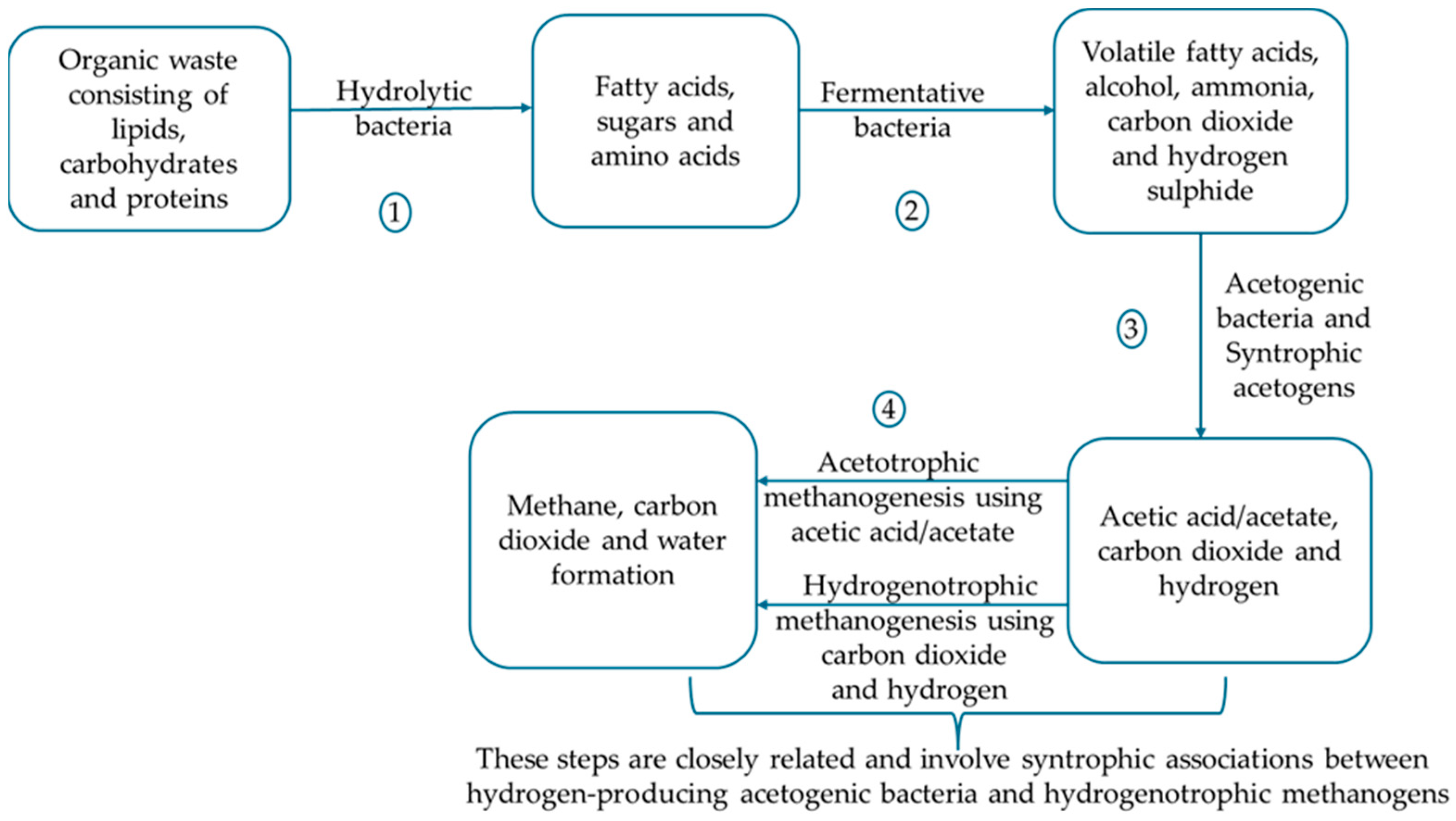

| Agricultural Wastes | Composition of the Waste | References | |
|---|---|---|---|
| Physicochemical | Microbiological (Before or During or After AD in Terms of Quantity or Diversity) | ||
| Barley straw | Crude protein (3.8%), dry matter (90.0%) | Not applicable | Shah et al. [26] |
| Rice straw | Crude protein (3–7%), dry matter (92–96%) | ||
| Cow dung | TS (77.33%), VS (67.65%), MC (9.68%) | TAMB (25 × 108), yeasts and fungi (11 × 109) cfu/g | El Asri et al. [27] |
| Horse manure | TS (83.29%), VS (74.5%), MC (8.7%) | TAMB (92 × 108), yeasts and fungi (57 × 105) cfu/g | |
| Chicken manure | TS (82.9%), VS (72.82%), MC (10.08%) | TAMB (11 × 104), yeasts and fungi (12 × 108) cfu/g | |
| Wheat straw | Crude protein (3.36%) | Not applicable | Praspaliareskau et al. [28] |
| Sorghum stover | Crude protein (6.6%), MC (8%), dry matter (91.25%) | ||
| Sugarcane bagasse | Crude protein (3%), dry matter (89.8%) | Lactobacillus | |
| Corn stover | Crude protein (4.05%), MC (5.33%), dry matter (93.38%) | Not applicable | |
| Sugarcane tops | Crude protein (7.85%), MC (50–55%), dry matter (41.86%) | ||
| Rice straw | Crude protein (3.15%), MC (4.62%) | ||
| Pig manure | Copper, Zinc, quaternary ammonium | E. coli, Salmonella, Trichuris and Trichostrongylus | Beily et al. [29] |
| Finishers | pH (6.3), TS (18 g/L), VS (12.9 g/L); | Faecal coliforms (9.96 × 10³ MPN/mL), E. coli (9.50 × 10³ MPN/mL). | |
| Weaners | pH (6.5), TS (13 g/L), VS (7.6 g/L) | Faecal coliforms (8.4 × 10³ MPN/mL), E. coli (8.4 × 10³ MPN/mL). | |
| Cow dung | Dry matter (15.5%), organic matter (95.82%), C/N ratio (27.78) | Not applicable | Louh et al. [30] |
| Pig dung | pH (7.9), TS (29.9%), VS (84.2%), C/N (12:01); total Nitrogen (305), potassium (4.2), magnesium (32), manganese (0.028), iron (3.8), Zinc (12), aluminium (0.36), copper (2.3) [mg/L] | Not applicable | Ejigboye et al. [31] |
| Cow manure | TS (14%), VS (11.76), pH (6.55) | Romboutsia, Turicibacter, Clostridium, Ruminococcus, Peptostreptococcus | Castro-Ramos et al. [21] |
| Cattle slurry | pH (6.4), C/N (21:1); MC (84.42) VS (82), Ash content (4.06) [%]; calcium (261.42), nickel (5.38), iron (9.46), potassium (14.35), manganese (1.35), zinc (12.36), aluminium (3.23) [g/kg/TS] | Total viable counts (1.6 × 10⁶ cfu/100 mL) | Odekanle et al. [32] |
| Pig manure | pH (6.90–7.79); MC (87), TS (6.90–12.34), VS (70.07–81.18) [%], total nitrogen content (6.50), total sulphur (6.50–9.71), total ammonia nitrogen (6.09–7.62), phosphorus (54.60–76.42), potassium (23.60–62.25) [g/kg]; zinc 568.6–206.9, mg/kg and others (copper, chromium, nickel, lead, cadmium, mercury). | Pseudomonas, Enterococcus, Lactobacillus, Streptococcus, Staphylococcus, Clostridium, Halomonas, Bacteriodes, Tissierella, Acholeplasma | Li et al. [33] |
| Sheep manure | pH (7.86–8.44); MC (64.86–77.46) TS (22.54–35.14), VS (75.85–77.05) [%]; total nitrogen (16.46–20.22), total ammonium nitrogen (3.60–4.099), total phosphorus (4.67–8.14), sulphur (2.89–3.65) [g/kg] and others (potassium, chromium, nickel, lead, aluminium) | ||
| Pig manure | pH (7.86), C/N (8.18); TS (31.93), VS (25.03), ash content (9.56) [%] | Not applicable | Tian et al. [34] |
| Rice straw | C/N (40.04); TS (94.79), VS (81.80), ash content (10.12) [%] | ||
| Inoculum | pH (7.58), C/N (5.12); TS (13.57), VS (5.33) | ||
| Cow dung | Carbon (20.0), hydrogen (3.56), nitrogen (7.17), sulphur (0.313), oxygen (69.0) [%] | Clostridium, Lactobacillus, Enterococcus, Escherichia, Prevotella, Joetgalicoccus, Streptococcus, Romboutsia, Ruminococcus | Mutungwazi et al. [35] |
| Chicken manure | Carbon (33.0), hydrogen (3.56), nitrogen (1.69), sulphur (0.205), oxygen (57.3) [%] | ||
| Pig manure | Carbon (29.9), hydrogen (4.96), nitrogen (3.63), oxygen (0.234), oxygen (61.3) [%] | ||
| Horse manure | Carbon (27.7), hydrogen (3.63), nitrogen (1.85), sulphur (0.219), oxygen (66.6) [%] | ||
| Chicken manure | C/N ratio (9.77); TS (27.29), VS (23.33), total carbon (46.08), total nitrogen (4.728) [%] | Lactobacillus, Bacteroides, Acidaminococcus, Clostridium, Msthanosarcina, Methanosaeta, Methanobacterium, Methanospirillum, Methanosphaera, Methanoculleus | Feng et al. [36] |
| Corn stalk | C/N ratio (57.038); TS (91.44), VS (86.50), total nitrogen (0.877), total carbon (50.22) [%] | ||
| Inoculum | pH (6.41); TS (18.12), VS (8.36) [%] | ||
| Chicken manure | TS (16), VS (76) [%] | Lactobacillus, Wiessella, Bacteroides, Proteiniphilium, Tepidimicrobium, Caldicoprobacter, Flexilinea floccule, Methanobacterium, Methanosaeta, Methanolinea, Methanoculleus | Chen et al. [37] |
| Rice straw | Magnesium (3.68), calcium (24.07), potassium (6.85) (Cmol/kg), phosphorus (697.4 mg/kg); C/N (60.33) | Not applicable | Karanja et al. [38] |
| Donkey manure | Magnesium (13.85), calcium (30.38), potassium (8.81) (Cmol/kg), C/N (52.0) | ||
| Chicken manure | Magnesium (17.99), calcium (39.41), potassium (10.0) (Cmol/kg); C/N 58.67 | ||
| Rice straw | Total carbon (40.1), total nitrogen (0.66), TS (93.5), VS (87.5), MC (6.5), ash content (12.5) [%], C/N (60.4) | Bacteriodetes, Firmicutes, Proteobacteria, Spirochaeta, Euryarchaeota, Chloroflexi, Clostridiales, Anaerolineaceae, Christensenellaceae, Rhodobacteriaceae, Peptostreptococcacea, Spirochaetaceae, Ruminococcus, Proteiniphilium, Methanobacterium, Methanosarcina, methanobrevibacter, Clostridium | Zealand et al. [39] |
| Dairy manure | Total carbon (40.9), total nitrogen (4.09), TS (11.1), VS (84.5), MC (89.7), ash content (25.7) [%], C/N (10.0) | ||
| Maize silage | pH (3.77), TS (37), VS (96) [%]; chemical oxygen demand (38.9), volatile fatty acids (1.05) [g/L] | Draconibacteriaceae, Rikenellaceae, Anaerolinaceae, Ruminococcaceae, Pseudomonadaceae, Carnobacteriaceae, Porphyromonadaceae, Campylobacteriaceae, moraxellaceae, Lacnospiraceae, Aeromonadaceae, Bacteriodaceae, Acidaminicoccaceae, Prevotellaceae, Desulfovibrionaceae, Spirochaetaceae, Synergistaceae, Xanthomonadaceae, Christensenellaceae, Methanoplasmatales, methanosaetaceae, Methanobacteriaceaea, thermoplasmatales, Methanomicrobiaceae | Wojcieszak et al. [40] |
| Cattle slurry | pH (7.45), TS (2.21), VS (45.60) [%]; chemical oxygen demand (18.40), volatile fatty acids (11.30) (g/L) | ||
| Ensiled maize stalk | Dry matter (301), organic dry matter (276.6), ash content (24.7) [g/kg], neutral detergent fibre (65.45), acid detergent fibre (3.69), Crude protein (5.35) [%DM] | Firmicutes, Chloroflexi, Bacteriodetes, Proteobacteria, Synergistes, Actinobacteria, artribacteria, Clostridia, Anaerolinea, Bacteriodia, Carnobacteriaceae, Moraxellaceae, Lachnospiraceae, Porphyromonadaceae, Corynebacteriaceae, Anaerolinaceae, Ruminococcaceae, Streptococcaceae, Rikenellaceae, Trichococcus | Zhang et al. [41] |
| Process Parameters | Categories of Anaerobic Digestion Based on Temperature | ||
|---|---|---|---|
| Psychrophilic AD | Mesophilic AD | Thermophilic AD | |
| Temperature range | 15–25 °C | 35–39 °C | 50–56 °C |
| Pathogen inactivation | Between 1 and 2-log removal of E. coli, Salmonella spp., Yersinia enterocolitica, Campylobacter spp., and Listeria monocytogenes cells by a co-digesting mixture of pinewood sawdust and pig manure treated over a temperature of 13.16–24.56. | >2 log removal of the indicator bacterium, E. coli, during the anaerobic mesophilic treatment of black water in upflow anaerobic sludge blanket (UASB) reactors at 35 °C. | Temperature is the most important parameter, based on bacterial inactivation, and thermophilic conditions led to the highest reductions in pathogens. For example, 4–5 log removal of the E. coli indicator bacterium during the anaerobic thermophilic treatment (55–60 °C) of black water, resulting in complete elimination of the indicator bacterium in the effluent discharged from upflow anaerobic sludge blanket (UASB) reactors at 35 °C. |
| Process stability | A critical parameter in the performance and stability of AD animal manure is ammonia nitrogen. Extended solids/hydraulic retention times in psychrophilic AD in sequencing batch reactors (PADSBR) enhanced biomass acclimation even at high ammonia. So VFA, an indicator of process stability, did not accumulate in PADSBR. | During the anaerobic co-digestion of two-phase olive-mill waste and cattle manure, the accumulation of propionic acid was the process control parameter, causing imbalance. To achieve a stable performance, a total of 140 days was required, but the start phase was operated in a batch mode for 97 days, reaching a final propionic acid of 12.77 mg/L. Subsequently, a semi-continuous mode was applied with an HRT of 40 days, yielding methane productivity of 0.34 LCH4/LRd. | The key stability factor is the ratio of acidity (VFAs) versus alkalinity. The accumulation of acetic acid in the system co-digesting sun-dried sugar beet pulp and cow manure at thermophilic temperature was the main cause of instability in the system at HRT. Nevertheless, the best global system performance was achieved at an HRT as short as 5 days (OLR of 12.47 gVS/Lreactor∙d) with a biogas yield of 315 mL/gVSadded. |
| Methane yield | The solids retention time of psychrophilic AD is twice to thrice compared to mesophilic AD because of a lower rate of hydrolysis and a decrease in the population, growth, and activity of microbial consortia. Nonetheless, producing methane under such low temperatures is possible via the application of a high inoculation rate. The psychropilic anaerobic digestion of cow manure and food waste together with cold-adapted inoculum resulted in cumulative specific methane yields of 0.874 ± 0.231 and 0.552 ± 0.089 L CH4 g−1 volatile solids, respectively, after 14 weeks. In addition, the absence of a cold-adapted inoculum led to acidification and no methane production during the process. | The methane production of four animal wastes, including carnivore, herbivore and omnivore, was investigated at both thermophilic and mesophilic anaerobic digestion. Accordingly, the methane yield recovered at thermophilic treatment was higher than the mesophilic ones. For example, 0.326 L/g VS and 0.391 L/g VS methane yields realised from lion manure under the mesophilic and thermophilic AD, respectively, were higher than those of herbivore and omnivore waste. | This process could accelerate biochemical reactions, leading to higher efficiency of degradation together with higher methane production rates. It also involves improved kinetics, economic and environmental sustainability. Cumulative volumes of biogas yields were registered: 4.78 L for 1 L of the bioreactor working volume with substrate loading 30 g/L of wheat straw, 7.39 L for 40 g/L, and 8.22 L for 45 g/L. The degree of biodegradation was calculated to be 68.9%, 74% and 72%. The biomethane content of biogas was 60%. |
| Parameters | Description, Optimal Ranges, and Impact on Biogas Yield | References |
|---|---|---|
| Organic loading rate (OLR) | OLR determines the quantity of volatile solids that are to be fed into the digester per unit time (day). Therefore, OLR relies on the nature of the substrate employed as input into the digester. For a specific lignocellulosic biomass (LCB), the typical range is from 1 to 6 kg of volatile solids (VS) per cubic metre per day (kg VS/m3/day). It is equally affected by other factors such as temperature, digestion type, and the stirring or mixing rate. The OLR is indirectly related to HR. Process stability is the driving factor behind the successful operation of a digester treating food waste. Gradually, increasing the OLR leads to increasing biogas yields, but excessive organic loading rates subject an operating digester to instabilities, improving process efficiency, but affecting the balance of metabolic activities within the distinct microbial groups. The lack of balance at a single degradation step will disrupt the entire process, causing a decrease in both biogas and methane yields. This is because a balanced interaction between microbes in the bio-digestion chain is central to stable and efficient gas production. For example, a temperature of 45 °C and OLR of 6.99 kg VS/m3·day were observed as the optimum conditions for the anaerobic digestion of municipal solid wastes at Alepo, enhancing biogas production. | [175,176,177,178] |
| Hydraulic retention time (HRT) | It denotes the duration needed for the complete degradation of the organic wastes within the biodigester. In other words, it is the mean residence time of the substrate in the system or the average process time of the influent in the reactor, and, theoretically, it is equivalent to the ratio of the digester volume to the daily intake flow rate. HRT is regarded as one of the most significant parameters affecting the performance of AD. However, changes in HRT may also affect the microbiome community structure and thus the microbial balance within the digester. Reducing the HRT leads to an increase in methane production and thus economic efficiency. However, changes in HRT may also affect the microbiome community structure and thus the microbial balance within the digester. HRT represents the available duration for microbial growth and for bioconversion of the wastes to biogas. Primarily, it relies on the type of substrate, in terms of its concentration and microbial concentration, and the operational conditions, including temperature, process stability (pH), and organic loading rate. Depending on the substrate, longer HRT is needed for lignocellulosic biomass, allowing ample time for optimal breakdown of the complex compounds because of their persistence with anaerobic microbes, in addition to preventing the washout of slowly growing microbes. The longer the HRT, the higher the biogas yields. However, the shorter HRT is desirable as it is associated with reduced capital cost and an increase in the efficiency of the process. For a single-stage anaerobic co-digestion of agricultural residues, 20 days was required, but depending on the substrate and temperature of operation, HRT can occur in the range 10–60 days. | [179,180,181,182,183,184] |
| Carbon to nitrogen ratio (C/N) | It is part of the substrate characteristics, which can be described in relation to macromolecule or polymer compositions, including carbohydrates, lipids, and proteins. Unbalanced nutrients are a limiting factor for the AD of organic waste, but can be addressed via the co-digestion of organic mixtures to augment nutrition and C/N ratios. Proper composition of feedstock in terms of carbon and nitrogen is vital for a balanced C/N ratio that is needed for an efficient AD process. Both elements, C and N, are necessary for the growth of anaerobic microorganisms in that C is utilised as a source of energy while N is employed in the synthesis of proteins, amino acids, and building cell structures. The optimal range of C/N needed by microbes during AD is dependent on the substrate, but the ratio of 20–30:1 is endorsed. A low C/N ratio leads to ammonia accumulation, inhibiting methanogenesis, while a high C/N ratio leads to slower decomposition rates due to nitrogen limitation. The right balance of C and N in the substrate guarantees stable and efficient biogas production owing to balanced microbial activity. The ratio of C to N is therefore used to optimise the process of co-digestion. The co-digestion of cabbage and cauliflower leaves and stalks (CCF) together with food waste at a C/N ratio of 45 added value to the agricultural wastes, yielding a high biodegradability (98%), a methane yield of 475 mLSTP CH4/g VS, and an organic loading rate (OLR) of 0.06 kg of VS/m3 h for the CCF and FW mixture (CCF + FW). | [58,185,186,187,188] |
| Ph (pH) | To ensure the stability of the digester, pH is the key parameter to be considered and monitored. The performance of the AD process is greatly impacted by the pH; therefore, it is a fundamental parameter for the growth of different microbes at various stages. The optimal range is 6.8–7.4. The degradation of substrates at each stage of the process leads to different metabolites affecting the pH (volatile fatty acids) and alkalinity of the medium under decomposition. Overall, the pH exerts an effect on the chemical equilibria of ammonia, hydrogen sulphide, and VFAs, which could inhibit microbial activity, thus negatively impacting biogas production. The pH can drop meaningfully to less than 3 if the VFAs generated during acidogenesis are not metabolised, thus leading to process failure. A low pH demonstrates an inherent inhibitory effect on the entire process, while a higher pH causes partial chemical breakdown of the complex organic matter with a potential for faster microbial conversion. It offers advantages with respect to CO2 capture and the direct production of methane gas. Small variations in pH of approximately 0.5 can greatly impact microbial metabolism and reaction kinetics, affecting gas production. Thus, methanogens are particularly sensitive to alterations in pH and function best within a pH close to 7. | [90,186,188,189,190] |
| Bacterial Pathogens | Substrate Types/Biodigester Type | Rate and Duration of Reduction (Log) | Anaerobic Digestion Types and Retention Periods | Methods of Assessing Pathogen Survival | Countries | References |
|---|---|---|---|---|---|---|
| Escherichia coli 0157 | Food waste, bovine slurry grease trap waste/Ramboldi tubes (100 mL) that were batch operated | 1 log reduction from 1.6 to 2.8 days | Co-digestion at 37 °C (mesophilic temperature) for 10 days | Enumeration by cultivation and confirmation of isolates via polymerase chain reaction | Ireland | Russell et al. [314]. |
| Listeria monocytogenes | 1 log reduction from 3.1 to 23.5 days | |||||
| Enterococcus faecalis | 1 log reduction from 2.2 to 6.6 days | |||||
| Clostridium sporogenes | 1 log reduction from 2.4 to 9.1 days | |||||
| Salmonella Newport | 1 log reduction from 1.5 to 2.8 days | |||||
| Escherichia coli | Dairy manure fermented using balloon type biodigester under batch operation | 1 log reduction for 62 days | Mono-digestion at ambient temperature for 6 months | Culture-based method (total viable plate method) | South Africa (Eastern Cape province) | Manyi-Loh et al. [42]. |
| Salmonella species | 1 to 2 log reduction for 133 days | |||||
| Campylobacter species | 1 log reduction for 18 days | |||||
| Vibrio | Brewers spent grains, palm oil mill effluent, and livestock manure (cow dung, swine slurry, and poultry droppings). 100 mL amber borosilicate serum bottles, which were batch operated | 2.3 log reduction | Co-digestion at 40 °C for 30 days | Standard plate count method | Nigeria | Ndubuisi-Nnaji et al. [179]. |
| Salmonella sp. | 0.20 log reduction | |||||
| Staphylococcus | 0.27 log reduction | |||||
| Escherichia coli | Pig manure and pine wood sawdust were digested using a 75 mL capacity single-stage steel biodigester, which was batch operated | 1 log reduction for 77 days | Co-digestion at a psychrophilic temperature range for seven (7) months | Standard plate count method | South Africa (Eastern Cape Province) | Manyi-Loh et al. [204]. |
| Salmonella species | 1–2 log reduction for 84 days | |||||
| Yersinia enterocolitica | 1 log reduction for 98 days | |||||
| Campylobacter species | 1 log reduction for 112 days | |||||
| Listeria monocytogenes | 1 log reduction for 175 days | |||||
| Total coliforms | Pig manure fermented with maize silage in agricultural biogas plants, which were operated under a continuous mode | 2.3 log reductions | Co-digestion at mesophilic temperature regime (30–42 °C) | Most probable number method | Poland | Grudziński et al. [253]. |
| Enterococci | Below detection limits |
| Investigations | Antibiotic Resistance Genes Involved | Methods for Detecting ARGs | Inactivation/ Reductions | Countries | References |
|---|---|---|---|---|---|
| 50 samples of sewage sludge extracted from two wastewater plants. | (blaOXA, blaTEM, ermB, qnrB, tet (A)-(W), sulI-II). | Antibiotic susceptibility testing and quantitative polymerase chain reaction. | 1 log | Northern Italy | Franchitti et al. [334]. |
| 31 sludge samples from the organic fraction of municipal solid waste treatment plants. | blaTEM, blaOXA, ermB, qnrB, sulI, sulII, tetA, and tetW. | Quantitative polymerase chain reaction. | <1 log | Northern Italy | Franchitti et al. [334]. |
| Swine wastewater, including urine, residual faeces, and flushing water. | ermB, tetX, mefA, ermf, sul2, tetM. | 0.21–1.34 logs | North and South China | Sui et al. [341]. | |
| Anaerobic co-digestion of food waste and pig manure together with dewatered sludge (inoculum). | A total of 199 ARGs and 12 mobile genetic elements clustered based on antibiotics such as tetracycline, vancomycins, sulfonamides, beta-lactams, aminoglycosides, macrolides, lincosamide, streptogramin, etc. | High-throughput quantitative polymerase chain reaction. | 1.24 logs | Ireland | Wang et al. [342] |
| Dairy manure mixed with granules-inocula subjected to thermophilic anaerobic digestion. | 16S rRNA, tnpA (mobile genetic element), intl1(class 1 integrase), sulII. | Real-time quantitative polymerase chain reaction. | 0.6–1.3 log | California, USA | Wang et al. [196]. |
| Dairy cow manure subjected to anaerobic mono-digestion at mesophilic temperatures. | blaTEM, tetA, and tetB. | Quantitative polymerase chain reaction. | 3-log | Hokkaido, Japan | Katada et al. [343]. |
| Zootechnical wastes subjected to anaerobic mono-digestion at mesophilic temperatures. | sul1, sul2, qnrS, qepA, aac-(6′)-Ib-cr, intl1 | Real-time quantitative polymerase chain reaction. | 0–1.08-log | Italy | Visca et al. [344]. |
| Cattle manure treated under anaerobic digestion operated at mesophilic temperature. | intI1, sul1, and tet(A) | Real-time quantitative polymerase chain reaction. | ≥0.3-log | Southern-eastern Wisconsin, USA | Burch et al. [345]. |
| Mixed raw sludge digester anaerobically using a bench-scale continuously stirred anaerobic at thermophilic temperatures. | aadA, blaOXA1-blaOXA30, strB, sulI, intI, cmlA, ermB, tetM. | Quantitative polymerase chain reaction. | ≥1.5-log | Prague, Czech Republic | Budatala et al. [49]. |
| Waste-activated sludge from a wastewater treatment plant (WWTP) subjected to anaerobic digestion performed under two temperature conditions: (i) Mesophilic temperature, 35 °C, (ii) Thermophilic temperature, 55 °C | Extracellular ARGs (eARGs): sulI, sulII, tetA, tetO, tetX, blaTEM, blaSHV. | Quantitative polymerase chain reaction. | 0.1–1.2 Log 0.33–1.5-log | Beijing, China | Zou et al. [346]. |
| Sludge procured from a full-scale WWTP employed in temperature-phased anaerobic digestion [i.e., sequential thermophilic (55 °C) and mesophilic (37 °C) anaerobic digestion]. | aac(6′)-Ib-cr, blaTEM, drfA, sulI, sul2, ermB, mefA, tetA, tetB and tetX. | Real-time quantitative polymerase chain reaction. | 0–0.9-log | Australia | Liu et al. [347]. |
| Mixed sludge from two WWTP subjected to thermal hydrolysis prior to mesophilic anaerobic digestion. | tetM, bla-IMP, bla-CTX-M, qnrS, aac(3)-1, dfrA1, dfrA5, dfrA7, dfrA12, ermF, sulI, intl1, 16S rRNA. | Single-gen quantitative polymerase chain reaction and high-throughput quantitative polymerase chain reaction. | 4–4.8 log | United Kingdom | Redhead et al. [348]. |
| Fresh cattle manure subjected to anaerobic digestion conducted at ambient temperature during winter and summer periods. | aphA2, ermB, blaTEM-1. | Quantitative polymerase chain reaction. | 0.72–1-log (winter) 1.2–2.2-log (summer) | Minas Gerais State, Brazil | Resende et al. [349]. |
| Waste-activated sludge for Urban WWTP exposed to anaerobic digestion at mesophilic and thermophilic temperatures following pH and oxidising agent pretreatments. | tetA, tetC, tetQ, tetX, ermB, sulI, sul2, sul3, aadA-1, intl1. | Qualitative polymerase chain reaction and high-throughput real-time fluorescence quantification polymerase chain reaction. | 0.6-log | Baoding, China | Wang et al. [340]. |
Disclaimer/Publisher’s Note: The statements, opinions and data contained in all publications are solely those of the individual author(s) and contributor(s) and not of MDPI and/or the editor(s). MDPI and/or the editor(s) disclaim responsibility for any injury to people or property resulting from any ideas, methods, instructions or products referred to in the content. |
© 2026 by the authors. Licensee MDPI, Basel, Switzerland. This article is an open access article distributed under the terms and conditions of the Creative Commons Attribution (CC BY) license.
Share and Cite
Manyi-Loh, C.E.; Tangwe, S.L.; Lues, R. Targeting Microorganisms in Lignocellulosic Biomass to Produce Biogas and Ensure Sanitation and Hygiene. Microorganisms 2026, 14, 299. https://doi.org/10.3390/microorganisms14020299
Manyi-Loh CE, Tangwe SL, Lues R. Targeting Microorganisms in Lignocellulosic Biomass to Produce Biogas and Ensure Sanitation and Hygiene. Microorganisms. 2026; 14(2):299. https://doi.org/10.3390/microorganisms14020299
Chicago/Turabian StyleManyi-Loh, Christy Echakachi, Stephen Loh Tangwe, and Ryk Lues. 2026. "Targeting Microorganisms in Lignocellulosic Biomass to Produce Biogas and Ensure Sanitation and Hygiene" Microorganisms 14, no. 2: 299. https://doi.org/10.3390/microorganisms14020299
APA StyleManyi-Loh, C. E., Tangwe, S. L., & Lues, R. (2026). Targeting Microorganisms in Lignocellulosic Biomass to Produce Biogas and Ensure Sanitation and Hygiene. Microorganisms, 14(2), 299. https://doi.org/10.3390/microorganisms14020299