Microbiome and Skin Health: A Systematic Review of Nutraceutical Interventions, Disease Severity, Inflammation, and Gut Microbiota

 , , and
Abstract
1. Introduction
2. Methods
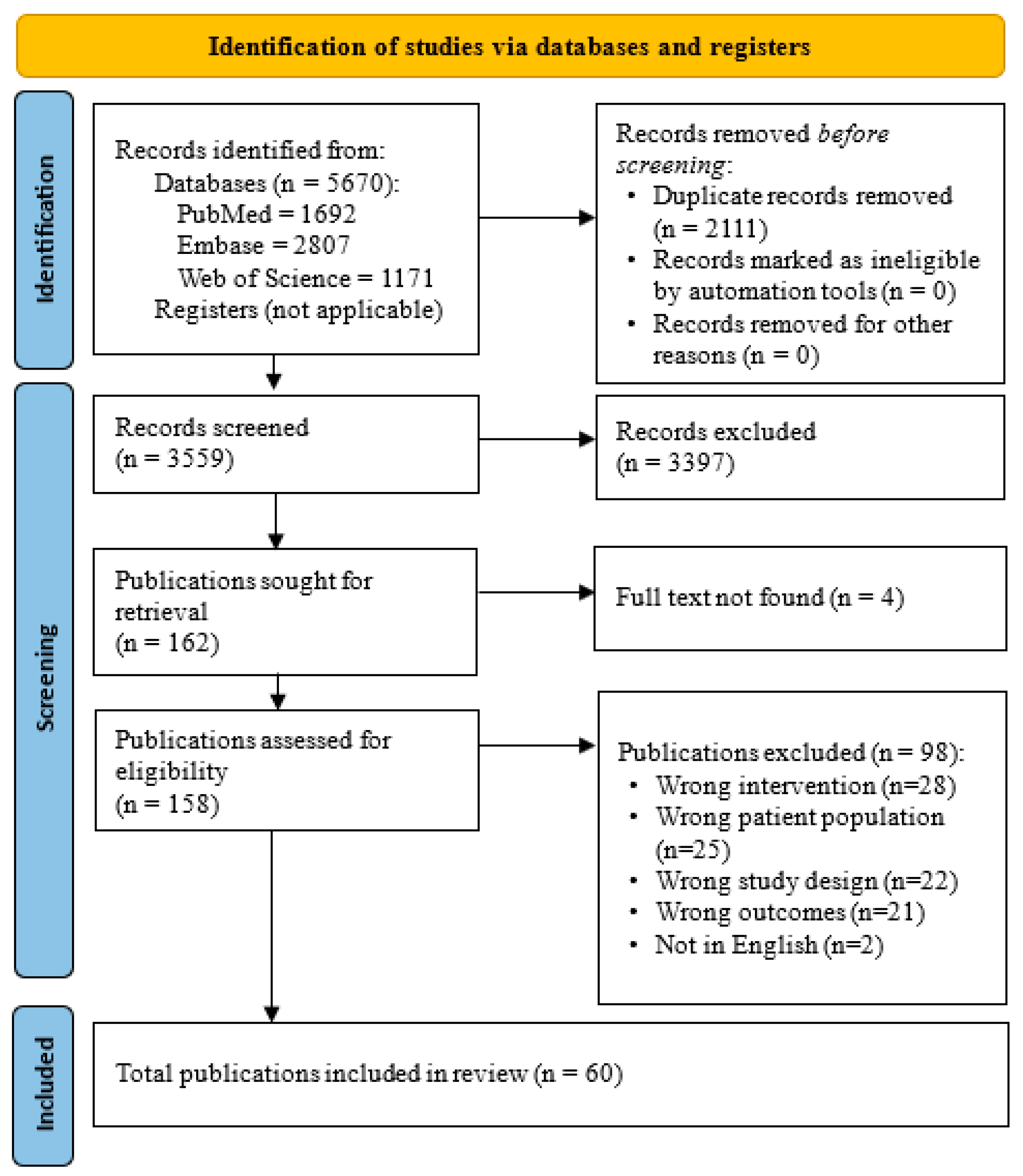
2.1. Study Protocol and Literature Search
2.2. Inclusion and Exclusion Criteria
2.3. Screening and Data Extraction
2.4. Risk of Bias Assessment
3. Results
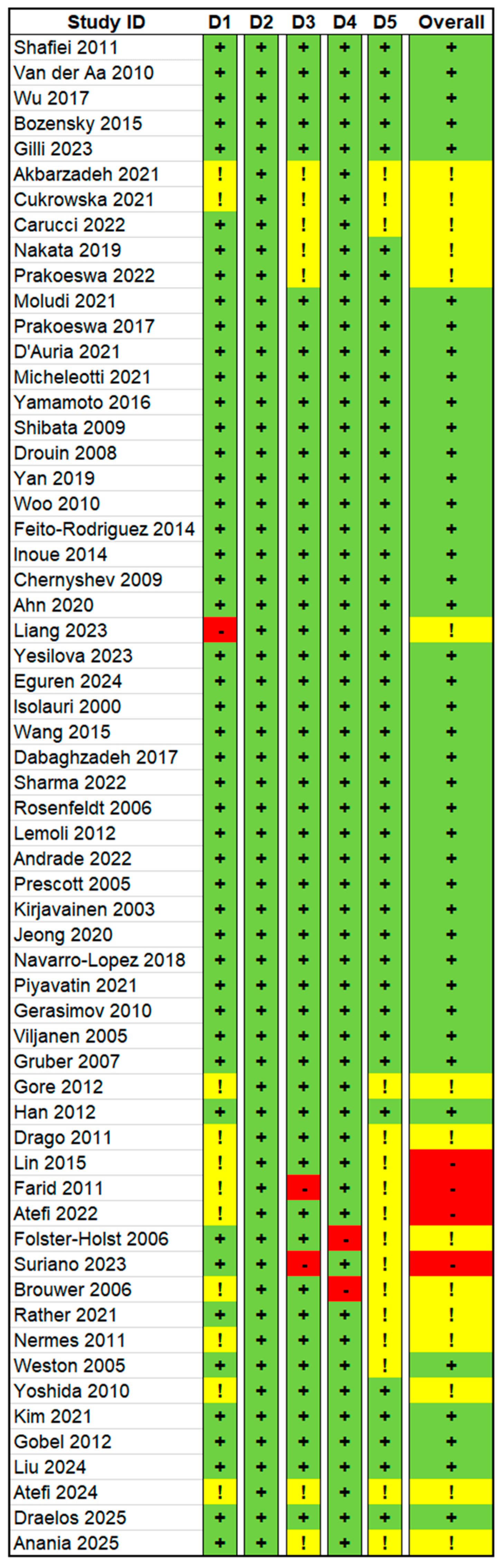
3.1. Study Characteristics and Risk of Bias
3.2. Atopic Dermatitis
3.2.1. Effect of Microbiome-Targeted Therapies on Disease Severity Index
3.2.2. Effect of Nutraceuticals on Inflammatory and/Immunological Markers
3.2.3. Effect of Nutraceuticals on Quality of Life
3.2.4. Effect of Nutraceuticals on Microbiome Composition
3.3. Psoriasis
3.3.1. Effect of Nutraceuticals on Disease Severity Index
3.3.2. Effect of Nutraceuticals on Inflammatory/Immunological Markers
3.3.3. Effect of Nutraceuticals on Quality of Life
3.4. Acne Vulgaris
3.4.1. Effect of Nutraceuticals on Disease Severity Index
3.4.2. Effect of Nutraceuticals on Microbiome Composition
3.5. Chronic Urticaria
3.5.1. Effect of Nutraceuticals on Disease Severity Index
3.5.2. Effect of Nutraceuticals on Quality of Life
3.6. Melasma
Effect of Nutraceuticals on Disease Severity Index
4. Discussion
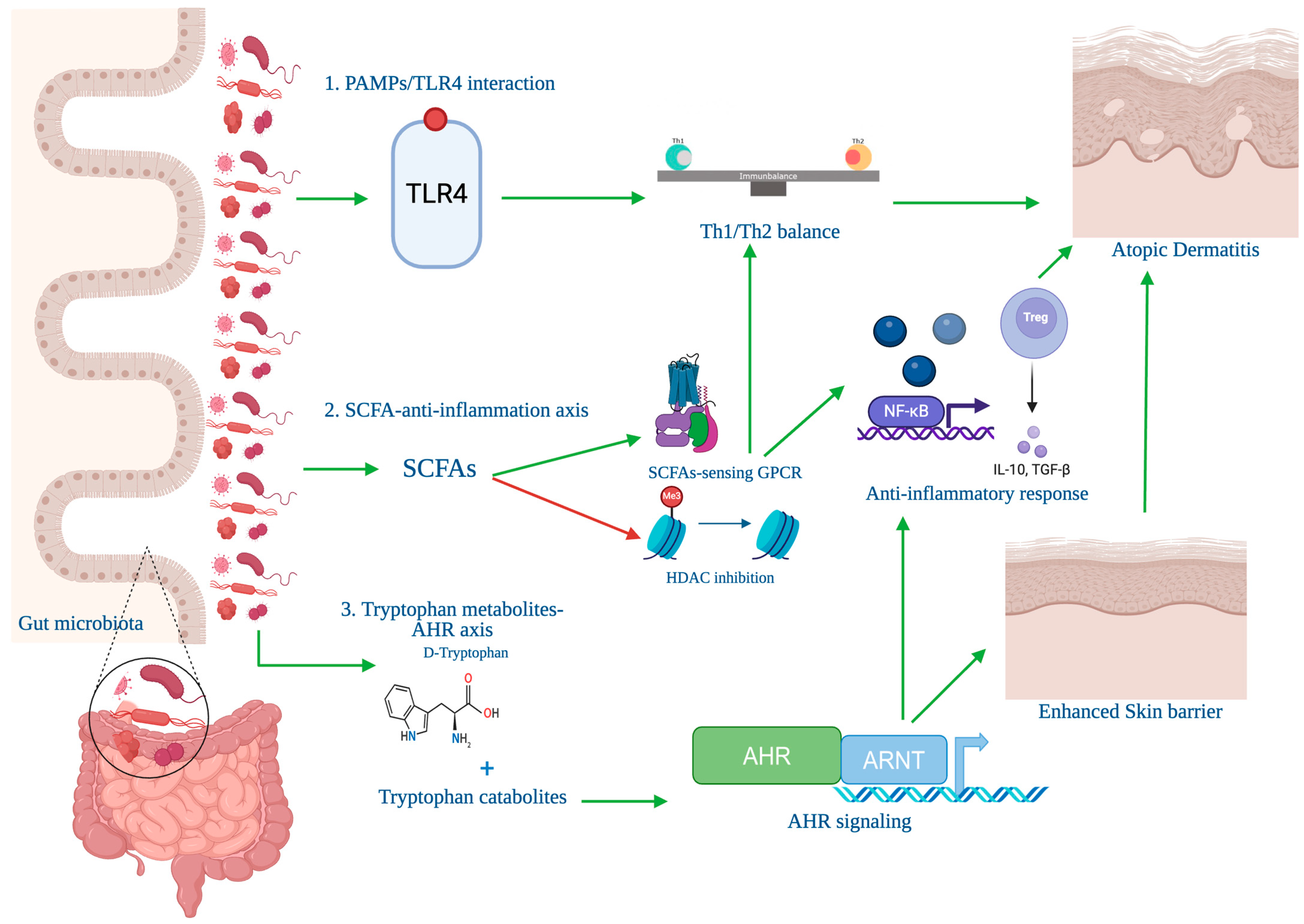
4.1. Gut Microbiome Dysbiosis and Therapeutic Modulation in Atopic Dermatitis
4.2. Gut Microbiome Dysbiosis and Therapeutic Modulation in Psoriasis
4.3. Gut Microbiome Dysbiosis and Therapeutic Modulation in Acne Vulgaris
4.4. Gut Microbiome Dysbiosis and Therapeutic Modulation in Urticaria
4.5. Gut Microbiome Dysbiosis and Therapeutic Modulation in Melasma
4.6. Overlap and Divergence
4.7. Limitations
4.8. Future Perspectives
5. Conclusions
Supplementary Materials
Author Contributions
Funding
Institutional Review Board Statement
Informed Consent Statement
Data Availability Statement
Acknowledgments
Conflicts of Interest
Abbreviations
| AD | Atopic Dermatitis |
| AGSS | Acne Global Severity Scale |
| AhR | Aryl Hydrocarbon Receptor |
| CDLQI | Children’s Dermatology Life Quality Index |
| DLQI | Dermatology Life Quality Index |
| FMT | Fecal Microbiota Transplantation |
| FOS | Fructooligosaccharide |
| FXR | Farnesoid X Receptor |
| GALT | Gut-Associated Lymphoid Tissue |
| GOS | Galactooligosaccharide |
| GPCR | G-Protein-Coupled Receptor |
| HDAC | Histone Deacetylase |
| IDQoL | Infant Dermatology Quality of Life Index |
| IQR | Interquartile Range |
| LPS | Lipopolysaccharide |
| mMASI | Modified Melasma Area and Severity Index |
| MHC | Major Histocompatibility Complex |
| PASI | Psoriasis Area and Severity Index |
| PAMP | Pathogen-Associated Molecular Pattern |
| PRISMA | Preferred Reporting Items for Systematic Reviews and Meta-Analyses |
| QoL | Quality of Life |
| RCT | Randomized Controlled Trial |
| RoB 2 | Risk of Bias Version 2 Tool |
| SCFAs | Short-Chain Fatty Acids |
| SCORAD | Scoring Atopic Dermatitis Index |
| TARC | Thymus and Activation-Regulated Chemokine |
| TLR | Toll-Like Receptor |
| TLC | Total Lesion Count |
| TNF-α | Tumor Necrosis Factor Alpha |
| Treg | Regulatory T Cell |
| TSLP | Thymic Stromal Lymphopoietin |
| UAS7 | Urticaria Activity Score Over 7 Days |
| WAO | World Allergy Organization |
References
- Seth, D.; Cheldize, K.; Brown, D.; Freeman, E.E. Global Burden of Skin Disease: Inequities and Innovations. Curr. Derm. Rep. 2017, 6, 204–210. [Google Scholar] [CrossRef] [PubMed]
- Parisi, R.; Iskandar, I.Y.K.; Kontopantelis, E.; Augustin, M.; Griffiths, C.E.M.; Ashcroft, D.M. National, Regional, and Worldwide Epidemiology of Psoriasis: Systematic Analysis and Modelling Study. BMJ 2020, 369, m1590. [Google Scholar] [CrossRef] [PubMed]
- Pu, Y.; He, L.; Wang, X.; Zhang, Y.; Zhao, S.; Fan, J. Global, Regional, and National Levels and Trends in Burden of Urticaria: A Systematic Analysis for the Global Burden of Disease Study 2019. J. Glob. Health 2024, 14, 04095. [Google Scholar] [CrossRef]
- Wang, L.-J.; Pang, Y.-B.; Li, W.-Q.; He, Q.-Y.; Zhang, X.-E.; Liu, E.; Guo, J. Global Research Trends on Melasma: A Bibliometric and Visualized Study from 2014 to 2023. Front. Pharmacol. 2024, 15, 1421499. [Google Scholar] [CrossRef]
- Lolou, V.; Panayiotidis, M.I. Functional Role of Probiotics and Prebiotics on Skin Health and Disease. Fermentation 2019, 5, 41. [Google Scholar] [CrossRef]
- Wakelin, S. Dermatological Pharmacology: Systemic Drugs. Medicine 2013, 41, 330–333. [Google Scholar] [CrossRef]
- Ellis, S.R.; Nguyen, M.; Vaughn, A.R.; Notay, M.; Burney, W.A.; Sandhu, S.; Sivamani, R.K. The Skin and Gut Microbiome and Its Role in Common Dermatologic Conditions. Microorganisms 2019, 7, 550. [Google Scholar] [CrossRef]
- Zhao, M.; Chu, J.; Feng, S.; Guo, C.; Xue, B.; He, K.; Li, L. Immunological Mechanisms of Inflammatory Diseases Caused by Gut Microbiota Dysbiosis: A Review. Biomed. Pharmacother. 2023, 164, 114985. [Google Scholar] [CrossRef]
- Valdes, A.M.; Walter, J.; Segal, E.; Spector, T.D. Role of the Gut Microbiota in Nutrition and Health. BMJ 2018, 361, k2179. [Google Scholar] [CrossRef]
- Mahmud, M.R.; Akter, S.; Tamanna, S.K.; Mazumder, L.; Esti, I.Z.; Banerjee, S.; Akter, S.; Hasan, R.; Acharjee, M.; Hossain, S.; et al. Impact of Gut Microbiome on Skin Health: Gut-Skin Axis Observed through the Lenses of Therapeutics and Skin Diseases. Gut Microbes 2022, 14, 2096995. [Google Scholar] [CrossRef]
- De Pessemier, B.; Grine, L.; Debaere, M.; Maes, A.; Paetzold, B.; Callewaert, C. Gut–Skin Axis: Current Knowledge of the Interrelationship between Microbial Dysbiosis and Skin Conditions. Microorganisms 2021, 9, 353. [Google Scholar] [CrossRef] [PubMed]
- Lee, A. Recent Progress in Melasma Pathogenesis. Pigment Cell Melanoma Res. 2015, 28, 648–660. [Google Scholar] [CrossRef] [PubMed]
- Passos, M.D.C.F.; Moraes-Filho, J.P. Intestinal microbiota in digestive diseases. Arq. Gastroenterol. 2017, 54, 255–262. [Google Scholar] [CrossRef]
- O’Neill, C.A.; Monteleone, G.; McLaughlin, J.T.; Paus, R. The Gut-skin Axis in Health and Disease: A Paradigm with Therapeutic Implications. BioEssays 2016, 38, 1167–1176. [Google Scholar] [CrossRef]
- Zhang, L.; Cao, H.; Li, L.; Zhao, W.; Zhang, F. Oral and External Intervention on the Crosstalk between Microbial Barrier and Skin via Foodborne Functional Component. J. Funct. Foods 2022, 92, 105075. [Google Scholar] [CrossRef]
- Huang, L.; Gao, R.; Yu, N.; Zhu, Y.; Ding, Y.; Qin, H. Dysbiosis of Gut Microbiota Was Closely Associated with Psoriasis. Sci. China Life Sci. 2019, 62, 807–815. [Google Scholar] [CrossRef] [PubMed]
- Alam, M.J.; Xie, L.; Yap, Y.-A.; Marques, F.Z.; Robert, R. Manipulating Microbiota to Treat Atopic Dermatitis: Functions and Therapies. Pathogens 2022, 11, 642. [Google Scholar] [CrossRef]
- Kim, M.-J.; Kim, K.-P.; Choi, E.; Yim, J.-H.; Choi, C.; Yun, H.-S.; Ahn, H.-Y.; Oh, J.-Y.; Cho, Y. Effects of Lactobacillus plantarum CJLP55 on Clinical Improvement, Skin Condition and Urine Bacterial Extracellular Vesicles in Patients with Acne Vulgaris: A Randomized, Double-Blind, Placebo-Controlled Study. Nutrients 2021, 13, 1368. [Google Scholar] [CrossRef]
- Liu, R.; Peng, C.; Jing, D.; Xiao, Y.; Zhu, W.; Zhao, S.; Zhang, J.; Chen, X.; Li, J. Biomarkers of Gut Microbiota in Chronic Spontaneous Urticaria and Symptomatic Dermographism. Front. Cell. Infect. Microbiol. 2021, 11, 703126. [Google Scholar] [CrossRef]
- Rezazadeh, A.; Shahabi, S.; Bagheri, M.; Nabizadeh, E.; Jazani, N.H. The Protective Effect of Lactobacillus and Bifidobacterium as the Gut Microbiota Members against Chronic Urticaria. Int. Immunopharmacol. 2018, 59, 168–173. [Google Scholar] [CrossRef]
- Liu, Y.; Du, X.; Zhai, S.; Tang, X.; Liu, C.; Li, W. Gut Microbiota and Atopic Dermatitis in Children: A Scoping Review. BMC Pediatr. 2022, 22, 323. [Google Scholar] [CrossRef]
- Wu, K.; Lee, T.-H.; Chen, Y.-L.; Wang, Y.-S.; Wang, P.-H.; Yu, C.-P.; Chu, K.-H.; Chiang, Y.-R. Metabolites Involved in Aerobic Degradation of the A and B Rings of Estrogen. Appl. Environ. Microbiol. 2019, 85, e02223-18. [Google Scholar] [CrossRef]
- Yu, C.-P.; Deeb, R.A.; Chu, K.-H. Microbial Degradation of Steroidal Estrogens. Chemosphere 2013, 91, 1225–1235. [Google Scholar] [CrossRef]
- Maguire, M.; Maguire, G. The Role of Microbiota, and Probiotics and Prebiotics in Skin Health. Arch. Dermatol. Res. 2017, 309, 411–421. [Google Scholar] [CrossRef] [PubMed]
- Eslami, M.; Bahar, A.; Keikha, M.; Karbalaei, M.; Kobyliak, N.M.; Yousefi, B. Probiotics Function and Modulation of the Immune System in Allergic Diseases. Allergol. Immunopathol. 2020, 48, 771–788. [Google Scholar] [CrossRef] [PubMed]
- Gore, C.; Custovic, A.; Tannock, G.W.; Munro, K.; Kerry, G.; Johnson, K.; Peterson, C.; Morris, J.; Chaloner, C.; Murray, C.S.; et al. Treatment and Secondary Prevention Effects of the Probiotics Lactobacillus paracasei or Bifidobacterium lactis on Early Infant Eczema: Randomized Controlled Trial with Follow-up until Age 3 Years. Clin. Exp. Allergy 2012, 42, 112–122. [Google Scholar] [CrossRef]
- Ma, T.; Shen, X.; Shi, X.; Sakandar, H.A.; Quan, K.; Li, Y.; Jin, H.; Kwok, L.-Y.; Zhang, H.; Sun, Z. Targeting Gut Microbiota and Metabolism as the Major Probiotic Mechanism—An Evidence-Based Review. Trends Food Sci. Technol. 2023, 138, 178–198. [Google Scholar] [CrossRef]
- Gowda, V.; Sarkar, R.; Verma, D.; Das, A. Probiotics in Dermatology: An Evidence-Based Approach. Indian Dermatol. Online J. 2024, 15, 571–583. [Google Scholar] [CrossRef]
- Notay, M.; Foolad, N.; Vaughn, A.R.; Sivamani, R.K. Probiotics, Prebiotics, and Synbiotics for the Treatment and Prevention of Adult Dermatological Diseases. Am. J. Clin. Dermatol. 2017, 18, 721–732. [Google Scholar] [CrossRef]
- Polak, K.; Jobbágy, A.; Muszyński, T.; Wojciechowska, K.; Frątczak, A.; Bánvölgyi, A.; Bergler-Czop, B.; Kiss, N. Microbiome Modulation as a Therapeutic Approach in Chronic Skin Diseases. Biomedicines 2021, 9, 1436. [Google Scholar] [CrossRef] [PubMed]
- Zou, X.; Zou, X.; Gao, L.; Zhao, H. Gut Microbiota and Psoriasis: Pathogenesis, Targeted Therapy, and Future Directions. Front. Cell. Infect. Microbiol. 2024, 14, 1430586. [Google Scholar] [CrossRef]
- Fanfaret, I.; Boda, D.; Ion, L.; Hosseyni, D.; Leru, P.; Ali, S.; Corcea, S.; Bumbacea, R. Probiotics and Prebiotics in Atopic Dermatitis: Pros and Cons (Review). Exp. Ther. Med. 2021, 22, 1376. [Google Scholar] [CrossRef] [PubMed]
- Prado Franco De Godoy, L.; Garcia Michalichen, F.; Cartagena Rossi, R.; Bortoletto Gomes De Aquino, S.; Ferreira, F.R. Use of Oral Probiotics in Inflammatory Skin Diseases. Literature Review. Port. J. Dermatol. Venereol. 2023, 80, 42–46. [Google Scholar] [CrossRef]
- Umborowati, M.A.; Damayanti, D.; Anggraeni, S.; Endaryanto, A.; Surono, I.S.; Effendy, I.; Prakoeswa, C.R.S. The Role of Probiotics in the Treatment of Adult Atopic Dermatitis: A Meta-Analysis of Randomized Controlled Trials. J. Health Popul. Nutr. 2022, 41, 37. [Google Scholar] [CrossRef]
- Zeng, L.; Yu, G.; Wu, Y.; Hao, W.; Chen, H. The Effectiveness and Safety of Probiotic Supplements for Psoriasis: A Systematic Review and Meta-Analysis of Randomized Controlled Trials and Preclinical Trials. J. Immunol. Res. 2021, 2021, 7552546. [Google Scholar] [CrossRef]
- Page, M.J.; Moher, D.; Bossuyt, P.M.; Boutron, I.; Hoffmann, T.C.; Mulrow, C.D.; Shamseer, L.; Tetzlaff, J.M.; Akl, E.A.; Brennan, S.E.; et al. PRISMA 2020 Explanation and Elaboration: Updated Guidance and Exemplars for Reporting Systematic Reviews. BMJ 2021, 372, n160. [Google Scholar] [CrossRef]
- Kim, J.E.; Kim, H.S. Microbiome of the Skin and Gut in Atopic Dermatitis (AD): Understanding the Pathophysiology and Finding Novel Management Strategies. JCM 2019, 8, 444. [Google Scholar] [CrossRef]
- Carucci, L.; Nocerino, R.; Paparo, L.; De Filippis, F.; Coppola, S.; Giglio, V.; Cozzolino, T.; Valentino, V.; Sequino, G.; Bedogni, G.; et al. Therapeutic Effects Elicited by the Probiotic Lacticaseibacillus rhamnosus GG in Children with Atopic Dermatitis. The Results of the ProPAD Trial. Pediatr. Allergy Immunol. 2022, 33, e13836. [Google Scholar] [CrossRef] [PubMed]
- Prakoeswa, C.R.S.; Bonita, L.; Karim, A.; Herwanto, N.; Umborowati, M.A.; Setyaningrum, T.; Hidayati, A.N.; Surono, I.S. Beneficial Effect of Lactobacillus plantarum IS-10506 Supplementation in Adults with Atopic Dermatitis: A Randomized Controlled Trial. J. Dermatol. Treat. 2022, 33, 1491–1498. [Google Scholar] [CrossRef]
- Akbarzadeh, A.; Alirezaei, P.; Doosti-Irani, A.; Mehrpooya, M.; Nouri, F. The Efficacy of Lactocare® Synbiotic on the Clinical Symptoms in Patients with Psoriasis: A Randomized, Double-Blind, Placebo-Controlled Clinical Trial. Dermatol. Res. Pract. 2022, 2022, 4549134. [Google Scholar] [CrossRef] [PubMed]
- Liang, L.; Qi, X.; Jiang, X.; Chen, T.; Dong, L. Lactobacillus plantarum MH-301 as an Effective Adjuvant to Isotretinoin in the Treatment of Acne Vulgaris: A Randomized and Open-Label Trail. Front. Med. 2024, 10, 1340068. [Google Scholar] [CrossRef]
- Atefi, N.; Mohammadi, M.; Bodaghabadi, M.; Mehrali, M.; Behrangi, E.; Ghassemi, M.; Jafarzadeh, A.; Goodarzi, A. Evaluating the Effectiveness of Probiotic Supplementation in Combination with Doxycycline for the Treatment of Moderate Acne: A Randomized Double-Blind Controlled Clinical Trial. J. Cosmet. Dermatol. 2025, 24, e16614. [Google Scholar] [CrossRef]
- Cukrowska, B.; Ceregra, A.; Maciorkowska, E.; Surowska, B.; Zegadło-Mylik, M.A.; Konopka, E.; Trojanowska, I.; Zakrzewska, M.; Bierła, J.B.; Zakrzewski, M.; et al. The Effectiveness of Probiotic Lactobacillus rhamnosus and Lactobacillus casei Strains in Children with Atopic Dermatitis and Cow’s Milk Protein Allergy: A Multicenter, Randomized, Double Blind, Placebo Controlled Study. Nutrients 2021, 13, 1169. [Google Scholar] [CrossRef] [PubMed]
- Nakata, J.; Hirota, T.; Umemura, H.; Nakagawa, T.; Kando, N.; Futamura, M.; Nakamura, Y.; Ito, K. Additive Effect of Lactobacillus Acidophilus L-92 on Children with Atopic Dermatitis Concomitant with Food Allergy. Asia Pac. Allergy 2019, 9, e18. [Google Scholar] [CrossRef] [PubMed]
- Drago, L.; Iemoli, E.; Rodighiero, V.; Nicola, L.; De Vecchi, E.; Piconi, S. Effects of Lactobacillus salivarius LS01 (DSM 22775) Treatment on Adult Atopic Dermatitis: A Randomized Placebo-Controlled Study. Int. J. Immunopathol. Pharmacol. 2011, 24, 1037–1048. [Google Scholar] [CrossRef]
- Fölster-Holst, R.; Müller, F.; Schnopp, N.; Abeck, D.; Kreiselmaier, I.; Lenz, T.; Von Rüden, U.; Schrezenmeir, J.; Christophers, E.; Weichenthal, M. Prospective, Randomized Controlled Trial on Lactobacillus rhamnosus in Infants with Moderate to Severe Atopic Dermatitis. Br. J. Dermatol. 2006, 155, 1256–1261. [Google Scholar] [CrossRef]
- Brouwer, M.L.; Wolt-Plompen, S.A.A.; Dubois, A.E.J.; Van Der Heide, S.; Jansen, D.F.; Hoijer, M.A.; Kauffman, H.F.; Duiverman, E.J. No Effects of Probiotics on Atopic Dermatitis in Infancy: A Randomized Placebo-controlled Trial. Clin. Exp. Allergy 2006, 36, 899–906. [Google Scholar] [CrossRef]
- Rather, I.A.; Kim, B.-C.; Lew, L.-C.; Cha, S.-K.; Lee, J.H.; Nam, G.-J.; Majumder, R.; Lim, J.; Lim, S.-K.; Seo, Y.-J.; et al. Oral Administration of Live and Dead Cells of Lactobacillus sakei proBio65 Alleviated Atopic Dermatitis in Children and Adolescents: A Randomized, Double-Blind, and Placebo-Controlled Study. Probiotics Antimicro. Prot. 2021, 13, 315–326. [Google Scholar] [CrossRef]
- Nermes, M.; Kantele, J.M.; Atosuo, T.J.; Salminen, S.; Isolauri, E. Interaction of Orally Administered Lactobacillus rhamnosus GG with Skin and Gut Microbiota and Humoral Immunity in Infants with Atopic Dermatitis. Clin. Exp. Allergy 2011, 41, 370–377. [Google Scholar] [CrossRef]
- Yoshida, Y.; Seki, T.; Matsunaka, H.; Watanabe, T.; Shindo, M.; Yamada, N.; Yamamoto, O. Clinical Effects of Probiotic Bifidobacterium breve Supplementation in Adult Patients with Atopic Dermatitis. Yonago Acta Medica 2010, 53, 37–45. [Google Scholar]
- Anania, C.; Matys, V.; Marra, S.; De Canditiis, D.; Olivero, F.; Carraro, C.; Giugliano, A.; Zicari, A.M.; Piccioni, M.G. Effect of Supplementation with a Specific Probiotic (Bifidobacterium bifidum PRL2010) in Pregnancy for the Prevention of Atopic Dermatitis in Children: Preliminary Results of a Randomized Trial. Nutrients 2025, 17, 673. [Google Scholar] [CrossRef]
- Atefi, N.; Fallahpour, M.; Sharifi, S.; Ghassemi, M.; Roohaninasab, M.; Goodarzi, A. Probiotic as an Adjuvant Therapy in Chronic Urticaria: A Blinded Randomized Controlled Clinical Trial. Eur. Ann. Allergy Clin. Immunol. 2022, 54, 123. [Google Scholar] [CrossRef]
- Lin, R.-J.; Qiu, L.-H.; Guan, R.-Z.; Hu, S.-J.; Liu, Y.-Y.; Wang, G.-J. Protective Effect of Probiotics in the Treatment of Infantile Eczema. Exp. Ther. Med. 2015, 9, 1593–1596. [Google Scholar] [CrossRef]
- Farid, R.; Ahanchian, H.; Jabbari, F.; Moghiman, T. Effect of a New Synbiotic Mixture on Atopic Dermatitis in Children: A Randomized-Controlled Trial. Iran. J. Pediatr. 2011, 21, 225–230. [Google Scholar] [PubMed]
- Suriano, E.S.; Souza, M.D.M.; Kobata, C.M.; Santos, F.H.Y.; Mimica, M.J. Efficacy of an Adjuvant Lactobacillus rhamnosus Formula in Improving Skin Lesions as Assessed by PASI in Patients with Plaque Psoriasis from a University-Affiliated, Tertiary-Referral Hospital in São Paulo (Brazil): A Parallel, Double-Blind, Randomized Clinical Trial. Arch. Dermatol. Res. 2023, 315, 1621–1629. [Google Scholar] [CrossRef]
- Liu, X.; Luo, Y.; Chen, X.; Wu, M.; Xu, X.; Tian, J.; Gao, Y.; Zhu, J.; Wang, Z.; Zhou, Y.; et al. Fecal Microbiota Transplantation against Moderate-to-severe Atopic Dermatitis: A Randomized, Double-blind Controlled Explorer Trial. Allergy 2025, 80, 1377–1388. [Google Scholar] [CrossRef]
- Shafiei, A.; Moin, M.; Pourpak, Z.; Gharagozlou, M.; Aghamohammadi, A.; Sajedi, V.; Soheili, H.; Sotoodeh, S.; Movahedi, M. Synbiotics Could Not Reduce the Scoring of Childhood Atopic Dermatitis (SCORAD): A Randomized Double Blind Placebo-Controlled Trial. Iran. J. Allergy Asthma Immunol. 2011, 10, 21–28. [Google Scholar] [PubMed]
- Van Der Aa, L.B.; Heymans, H.S.; Van Aalderen, W.M.; Sillevis Smitt, J.H.; Knol, J.; Ben Amor, K.; Goossens, D.A.; Sprikkelman, A.B.; the Synbad Study Group. Effect of a New Synbiotic Mixture on Atopic Dermatitis in Infants: A Randomized-controlled Trial. Clin. Exp. Allergy 2010, 40, 795–804. [Google Scholar] [CrossRef]
- Wu, Y.-J.; Wu, W.-F.; Hung, C.-W.; Ku, M.-S.; Liao, P.-F.; Sun, H.-L.; Lu, K.-H.; Sheu, J.-N.; Lue, K.-H. Evaluation of Efficacy and Safety of Lactobacillus rhamnosus in Children Aged 4–48 Months with Atopic Dermatitis: An 8-Week, Double-Blind, Randomized, Placebo-Controlled Study. J. Microbiol. Immunol. Infect. 2017, 50, 684–692. [Google Scholar] [CrossRef] [PubMed]
- Boženský, J.; Hill, M.; Zelenka, R.; Skýba, T. Prebiotics Do Not Influence the Severity of Atopic Dermatitis in Infants: A Randomised Controlled Trial. PLoS ONE 2015, 10, e0142897. [Google Scholar] [CrossRef]
- Prakoeswa, C.R.S.; Herwanto, N.; Prameswari, R.; Astari, L.; Sawitri, S.; Hidayati, A.N.; Indramaya, D.M.; Kusumowidagdo, E.R.; Surono, I.S. Lactobacillus plantarum IS-10506 Supplementation Reduced SCORAD in Children with Atopic Dermatitis. Benef. Microbes 2017, 8, 833–840. [Google Scholar] [CrossRef]
- D’Auria, E.; Panelli, S.; Lunardon, L.; Pajoro, M.; Paradiso, L.; Beretta, S.; Loretelli, C.; Tosi, D.; Perini, M.; Bedogni, G.; et al. Rice Flour Fermented with Lactobacillus paracasei CBA L74 in the Treatment of Atopic Dermatitis in Infants: A Randomized, Double-Blind, Placebo-Controlled Trial. Pharmacol. Res. 2021, 163, 105284. [Google Scholar] [CrossRef] [PubMed]
- Michelotti, A.; Cestone, E.; De Ponti, I.; Giardina, S.; Pisati, M.; Spartà, E.; Tursi, F. Efficacy of a Probiotic Supplement in Patients with Atopic Dermatitis: A Randomized, Double-Blind, Placebo-Controlled Clinical Trial. Eur. J. Dermatol. 2021, 31, 225–232. [Google Scholar] [CrossRef]
- Yamamoto, K.; Yokoyama, K.; Matsukawa, T.; Kato, S.; Kato, S.; Yamada, K.; Hirota, T. Efficacy of Prolonged Ingestion of Lactobacillus acidophilus L-92 in Adult Patients with Atopic Dermatitis. J. Dairy. Sci. 2016, 99, 5039–5046. [Google Scholar] [CrossRef]
- Shibata, R.; Kimura, M.; Takahashi, H.; Mikami, K.; Aiba, Y.; Takeda, H.; Koga, Y. Clinical Effects of Kestose, a Prebiotic Oligosaccharide, on the Treatment of Atopic Dermatitis in Infants. Clin. Exp. Allergy 2009, 39, 1397–1403. [Google Scholar] [CrossRef]
- Yan, D.-C.; Hung, C.-H.; Sy, L.B.; Lue, K.-H.; Shih, I.-H.; Yang, C.-Y.; Chen, L.-C.; Sun, H.-L.; Lee, M.-S.; Chambard, J.; et al. A Randomized, Double-Blind, Placebo-Controlled Trial Assessing the Oral Administration of a Heat-Treated Lactobacillus paracasei Supplement in Infants with Atopic Dermatitis Receiving Topical Corticosteroid Therapy. Ski. Pharmacol. Physiol. 2019, 32, 201–211. [Google Scholar] [CrossRef]
- Woo, S.-I.; Kim, J.-Y.; Lee, Y.-J.; Kim, N.-S.; Hahn, Y.-S. Effect of Lactobacillus Sakei Supplementation in Children with Atopic Eczema–Dermatitis Syndrome. Ann. Allergy Asthma Immunol. 2010, 104, 343–348. [Google Scholar] [CrossRef]
- Feíto-Rodríguez, M.; Ramírez-Boscà, A.; Vidal-Asensi, S.; Fernández-Nieto, D.; Ros-Cervera, G.; Alonso-Usero, V.; Prieto-Merino, D.; Núñez-Delegido, E.; Ruzafa-Costas, B.; Sánchez-Pellicer, P.; et al. Randomized Double-Blind Placebo-Controlled Clinical Trial to Evaluate the Effect of a Mixture of Probiotic Strains on Symptom Severity and Use of Corticosteroids in Children and Adolescents with Atopic Dermatitis. Clin. Exp. Dermatol. 2023, 48, 495–503. [Google Scholar] [CrossRef] [PubMed]
- Inoue, Y.; Kambara, T.; Murata, N.; Komori-Yamaguchi, J.; Matsukura, S.; Takahashi, Y.; Ikezawa, Z.; Aihara, M. Effects of Oral Administration of Lactobacillus acidophilus L-92 on the Symptoms and Serum Cytokines of Atopic Dermatitis in Japanese Adults: A Double-Blind, Randomized, Clinical Trial. Int. Arch. Allergy Immunol. 2014, 165, 247–254. [Google Scholar] [CrossRef] [PubMed]
- Chernyshov, P.V. Randomized, Placebo-Controlled Trial on Clinical and Immunologic Effects of Probiotic Containing Lactobacillus rhamnosus R0011 and L. Helveticus R0052 in Infants with Atopic Dermatitis. Microb. Ecol. Health Dis. 2009, 21, 228–232. [Google Scholar] [CrossRef]
- Ahn, S.H.; Yoon, W.; Lee, S.Y.; Shin, H.S.; Lim, M.Y.; Nam, Y.-D.; Yoo, Y. Effects of Lactobacillus pentosus in Children with Allergen-Sensitized Atopic Dermatitis. J. Korean Med. Sci. 2020, 35, e128. [Google Scholar] [CrossRef]
- Yeşilova, Y.; Çalka, Ö.; Akdeniz, N.; Berktaş, M. Effect of Probiotics on the Treatment of Children with Atopic Dermatitis. Ann. Dermatol. 2012, 24, 189. [Google Scholar] [CrossRef] [PubMed]
- Isolauri, E.; Arvola, T.; SÜtas, Y.; Moilanen, E.; Salminen, S. Probiotics in the Management of Atopic Eczema. Clin. Exp. Allergy 2000, 30, 1605–1610. [Google Scholar] [CrossRef]
- Wang, L.; Wang, F.; Gershwin, M.E. Human Autoimmune Diseases: A Comprehensive Update. J. Intern. Med. 2015, 278, 369–395. [Google Scholar] [CrossRef]
- Sharma, R.; Handa, S.; Mahajan, R.; De, D.; Sachdeva, N. Evaluating the Effect of Supplementation with Bacillus clausii on Therapeutic Outcomes in Atopic Eczema—Results of an Observer-Blinded Parallel-Group Randomized Controlled Study. Indian. J. Dermatol. 2022, 67, 121–126. [Google Scholar] [CrossRef] [PubMed]
- Rosenfeldt, V.; Benfeldt, E.; Nielsen, S.D.; Michaelsen, K.F.; Jeppesen, D.L.; Valerius, N.H.; Paerregaard, A. Effect of Probiotic Lactobacillus Strains in Children with Atopic Dermatitis. J. Allergy Clin. Immunol. 2003, 111, 389–395. [Google Scholar] [CrossRef]
- Iemoli, E.; Trabattoni, D.; Parisotto, S.; Borgonovo, L.; Toscano, M.; Rizzardini, G.; Clerici, M.; Ricci, E.; Fusi, A.; De Vecchi, E.; et al. Probiotics Reduce Gut Microbial Translocation and Improve Adult Atopic Dermatitis. J. Clin. Gastroenterol. 2012, 46, S33–S40. [Google Scholar] [CrossRef]
- Andrade, P.D.S.M.A.d.; Maria e Silva, J.; Carregaro, V.; Sacramento, L.A.; Roberti, L.R.; Aragon, D.C.; Carmona, F.; Roxo-Junior, P. Efficacy of Probiotics in Children and Adolescents with Atopic Dermatitis: A Randomized, Double-Blind, Placebo-Controlled Study. Front. Nutr. 2022, 8, 833666. [Google Scholar] [CrossRef]
- Prescott, S.L.; Dunstan, J.A.; Hale, J.; Breckler, L.; Lehmann, H.; Weston, S.; Richmond, P. Clinical Effects of Probiotics Are Associated with Increased Interferon-γ Responses in Very Young Children with Atopic Dermatitis. Clin. Exp. Allergy 2005, 35, 1557–1564. [Google Scholar] [CrossRef]
- Kirjavainen, P.V.; Salminen, S.J.; Isolauri, E. Probiotic Bacteria in the Management of Atopic Disease: Underscoring the Importance of Viability. J. Pediatr. Gastroenterol. Nutr. 2003, 36, 223–227. [Google Scholar] [CrossRef] [PubMed]
- Jeong, S.; Huang, L.-K.; Tsai, M.-J.; Liao, Y.-T.; Lin, Y.-S.; Hu, C.-J.; Hsu, Y.-H. Cognitive Function Associated with Gut Microbial Abundance in Sucrose and S-Adenosyl-L-Methionine (SAMe) Metabolic Pathways. J. Alzheimer’s Dis. 2022, 87, 1115–1130. [Google Scholar] [CrossRef]
- Navarro-López, V.; Ramírez-Boscá, A.; Ramón-Vidal, D.; Ruzafa-Costas, B.; Genovés-Martínez, S.; Chenoll-Cuadros, E.; Carrión-Gutiérrez, M.; Horga De La Parte, J.; Prieto-Merino, D.; Codoñer-Cortés, F.M. Effect of Oral Administration of a Mixture of Probiotic Strains on SCORAD Index and Use of Topical Steroids in Young Patients with Moderate Atopic Dermatitis: A Randomized Clinical Trial. JAMA Dermatol. 2018, 154, 37. [Google Scholar] [CrossRef]
- Gerasimov, S.V.; Vasjuta, V.V.; Myhovych, O.O.; Bondarchuk, L.I. Probiotic Supplement Reduces Atopic Dermatitis in Preschool Children: A Randomized, Double-Blind, Placebo-Controlled, Clinical Trial. Am. J. Clin. Dermatol. 2010, 11, 351–361. [Google Scholar] [CrossRef]
- Viljanen, M.; Savilahti, E.; Haahtela, T.; Juntunen-Backman, K.; Korpela, R.; Poussa, T.; Tuure, T.; Kuitunen, M. Probiotics in the Treatment of Atopic Eczema/Dermatitis Syndrome in Infants: A Double-blind Placebo-controlled Trial. Allergy 2005, 60, 494–500. [Google Scholar] [CrossRef]
- Grüber, C.; Wendt, M.; Sulser, C.; Lau, S.; Kulig, M.; Wahn, U.; Werfel, T.; Niggemann, B. Randomized, Placebo-controlled Trial of Lactobacillus rhamnosus GG as Treatment of Atopic Dermatitis in Infancy. Allergy 2007, 62, 1270–1276. [Google Scholar] [CrossRef]
- Han, Y.; Kim, B.; Ban, J.; Lee, J.; Kim, B.J.; Choi, B.S.; Hwang, S.; Ahn, K.; Kim, J. A Randomized Trial of Lactobacillus plantarum CJLP133 for the Treatment of Atopic Dermatitis. Pediatr. Allergy Immunol. 2012, 23, 667–673. [Google Scholar] [CrossRef] [PubMed]
- Weston, S. Effects of Probiotics on Atopic Dermatitis: A Randomised Controlled Trial. Arch. Dis. Child. 2005, 90, 892–897. [Google Scholar] [CrossRef] [PubMed]
- Gobel, R.J.; Larsen, N.N.; Mølgaard, C.; Jakobsen, M.; Michaelsen, K.F. Probiotics to Young Children with Atopic Dermatitis: A Randomized Placebo-Controlled Trial. Int. J. Probiotics Prebiotics 2010, 5, 53–60. [Google Scholar]
- Moludi, J.; Khedmatgozar, H.; Saiedi, S.; Razmi, H.; Alizadeh, M.; Ebrahimi, B. Probiotic Supplementation Improves Clinical Outcomes and Quality of Life Indicators in Patients with Plaque Psoriasis: A Randomized Double-Blind Clinical Trial. Clin. Nutr. ESPEN 2021, 46, 33–39. [Google Scholar] [CrossRef]
- Drouin, R.; Moroni, O.; Cantin, K.; Juneau, C. A Double-Blind, Placebo-Controlled, Randomized Trial of XP-828L (800 Mg) on the Quality of Life and Clinical Symptoms of Patients with Mild-to-Moderate Psoriasis. Altern. Med. Rev. 2008, 13, 145–152. [Google Scholar]
- Gilli, I.O.; Da Silva, G.C.; Mendes, V.; Duarte, M.G.; Tanaka, A.A. The Role of Probiotics as an Adjunctive Therapy in Psoriasis. J. Psoriasis Psoriatic Arthritis 2023, 8, 49–55. [Google Scholar] [CrossRef]
- Draelos, Z.; Harper, J.; Farris, P.K.; Hazan, A.; Raymond, I. A 12-Week Randomized, Double-Blind, Placebo-Controlled Trial for the Efficacy and Safety of a Novel Nutraceutical for Mild-to-Moderate Acne. J. Cosmet. Dermatol. 2025, 24, e70220. [Google Scholar] [CrossRef]
- Eguren, C.; Navarro-Blasco, A.; Corral-Forteza, M.; Reolid-Pérez, A.; Setó-Torrent, N.; García-Navarro, A.; Prieto-Merino, D.; Núñez-Delegido, E.; Sánchez-Pellicer, P.; Navarro-López, V. A Randomized Clinical Trial to Evaluate the Efficacy of an Oral Probiotic in Acne Vulgaris. Acta Derm. Venereol. 2024, 104, adv33206. [Google Scholar] [CrossRef]
- Dabbaghzadeh, A.; Ghaffari, J.; Moradi, S.; Sayadian separghan, D. Probiotics on Chronic Urticaria: A Randomized Clinical Trial Study. Casp. J. Intern. Med. 2023, 14, 192–198. [Google Scholar] [CrossRef]
- Piyavatin, P.; Chaichalotornkul, S.; Nararatwanchai, T.; Bumrungpert, A.; Saiwichai, T. Synbiotics Supplement Is Effective for Melasma Improvement. J. Cosmet. Dermatol. 2021, 20, 2841–2850. [Google Scholar] [CrossRef] [PubMed]
- Chouraqui, J.-P. Does the Contribution of Human Milk Oligosaccharides to the Beneficial Effects of Breast Milk Allow Us to Hope for an Improvement in Infant Formulas? Crit. Rev. Food Sci. Nutr. 2021, 61, 1503–1514. [Google Scholar] [CrossRef]
- Du, B.; Shama, A.; Zhang, Y.; Chen, B.; Bu, Y.; Chen, P.; Lin, C.; Liu, J.; Zheng, J.; Li, Z.; et al. Gut Microbiota and Plasma Metabolites in Pregnant Mothers and Infant Atopic Dermatitis: A Multi-Omics Study. World Allergy Organ. J. 2025, 18, 101017. [Google Scholar] [CrossRef]
- Reddel, S.; Del Chierico, F.; Quagliariello, A.; Giancristoforo, S.; Vernocchi, P.; Russo, A.; Fiocchi, A.; Rossi, P.; Putignani, L.; El Hachem, M. Gut Microbiota Profile in Children Affected by Atopic Dermatitis and Evaluation of Intestinal Persistence of a Probiotic Mixture. Sci. Rep. 2019, 9, 4996. [Google Scholar] [CrossRef] [PubMed]
- Xiao, X.; Hu, X.; Yao, J.; Cao, W.; Zou, Z.; Wang, L.; Qin, H.; Zhong, D.; Li, Y.; Xue, P.; et al. The Role of Short-Chain Fatty Acids in Inflammatory Skin Diseases. Front. Microbiol. 2023, 13, 1083432. [Google Scholar] [CrossRef] [PubMed]
- Trompette, A.; Pernot, J.; Perdijk, O.; Alqahtani, R.A.A.; Domingo, J.S.; Camacho-Muñoz, D.; Wong, N.C.; Kendall, A.C.; Wiederkehr, A.; Nicod, L.P.; et al. Gut-Derived Short-Chain Fatty Acids Modulate Skin Barrier Integrity by Promoting Keratinocyte Metabolism and Differentiation. Mucosal Immunol. 2022, 15, 908–926. [Google Scholar] [CrossRef]
- Akbarzadeh, A.; Taheri, M.; Ebrahimi, B.; Alirezaei, P.; Doosti-Irani, A.; Soleimani, M.; Nouri, F. Evaluation of Lactocare® Synbiotic Administration on the Serum Electrolytes and Trace Elements Levels in Psoriasis Patients: A Randomized, Double-Blind, Placebo-Controlled Clinical Trial Study. Biol. Trace Elem. Res. 2022, 200, 4230–4237. [Google Scholar] [CrossRef]
- Kober, M.-M.; Bowe, W.P. The Effect of Probiotics on Immune Regulation, Acne, and Photoaging. Int. J. Women’s Dermatol. 2015, 1, 85–89. [Google Scholar] [CrossRef]
- Deng, Y.; Wang, H.; Zhou, J.; Mou, Y.; Wang, G.; Xiong, X. Patients with Acne Vulgaris Have a Distinct Gut Microbiota in Comparison with Healthy Controls. Acta Derm. Venerol. 2018, 98, 783–790. [Google Scholar] [CrossRef]
- Wang, A.; Rojas, O.; Lee, D.; Gommerman, J.L. Regulation of Neuroinflammation by B Cells and Plasma Cells. Immunol. Rev. 2021, 299, 45–60. [Google Scholar] [CrossRef]
- Zhao, M.; Shen, C.; Ma, L. Treatment Efficacy of Probiotics on Atopic Dermatitis, Zooming in on Infants: A Systematic Review and Meta-analysis. Int. J. Dermatol. 2018, 57, 635–641. [Google Scholar] [CrossRef] [PubMed]
- Wu, Y.; Wang, X.; Wu, W.; Yang, J. Mendelian Randomization Analysis Reveals an Independent Causal Relationship between Four Gut Microbes and Acne Vulgaris. Front. Microbiol. 2024, 15, 1326339. [Google Scholar] [CrossRef] [PubMed]
- The Integrative HMP (iHMP) Research Network Consortium; Proctor, L.M.; Creasy, H.H.; Fettweis, J.M.; Lloyd-Price, J.; Mahurkar, A.; Zhou, W.; Buck, G.A.; Snyder, M.P.; Strauss, J.F.; et al. The Integrative Human Microbiome Project. Nature 2019, 569, 641–648. [Google Scholar] [CrossRef] [PubMed]



| Author | Country | Intervention + Dose | Type of Intervention | Intervention Duration | Route of Intervention | Control/Placebo | Intervention Patient Demographics (n, M/F, Mean Age (SD), BMI) | Controls Patient Demographics (n, M/F, Mean Age (SD), BMI) | Primary Outcome | Secondary Outcome |
|---|---|---|---|---|---|---|---|---|---|---|
| Shafiei 2011 [57] | Iran | 10 mg mixture of 1 × 10⁹ CFU/ of 7 strain probiotics plus prebiotic (990 mg fructooligosaccharides) | Synbiotic | 2 months | Oral | Daily one sachet containing 1000 mg sucrose | 18, 12/6, 14.7 (6) months | 18, 12/6, 15.4 (8.4) months | SCORAD | Total IgE level and Eosinophil Count |
| Va Der Aa 2010 [58] | The Netherlands | B. breve M-16V, 1.3 × 10⁹ CFU/100 mL and a mixture of 90% scGOS and 10% lcFOS, 0.8 g/100 mL | Synbiotic | 12 weeks | Oral | Infants received the same formula without synbiotics | 46, 31/15, 5 (1.4) months | 44, 28/16, 4.8 (1.5) months | SCORAD | Topical Corticosteroid Usage, Total IgE, Eosinophilic granulocytes, Microbiota Composition, and Stool Characteristic, gastrointestinal symptoms, and adverse events |
| Wu 2017 [59] | Taiwan | Lactobacillus rhamnosus (MP108), 350 mg/day | Probiotic (Lactobacillus rhamnosus) | 8 weeks | Oral | Placebo (Maltodextrin capsule) | 33 children, 31/15, mean age 1.5 years (SD = 1.1) | 33 children, 28/16, mean age 1.8 years (SD = 1.1) | SCORAD | Infant Dermatitis Quality of Life Questionnaire, Dermatitis Family Impact Questionnaire |
| Boženský 2015 [60] | Czech Republic | Hypoallergenic formula supplemented with galacto-oligosaccharides (0.5 g/100 mL) | Prebiotic (galacto-oligosaccharides) | 6 months | Oral | Hypoallergenic formula without prebiotics | 52, 31/21, 6–8 weeks (no SD provided), BMI: Not applicable (infants) | 51, 36/15, 6–8 weeks (no SD provided), BMI: Not applicable (infants) | SCORAD | Anthropometry, infections, Stool frequency, Vomiting, adverse effects |
| Cukrowska 2021 [43] | Poland | Lactobacillus rhamnosus ŁOCK 0900, Lactobacillus rhamnosus ŁOCK 0908, and Lactobacillus casei ŁOCK 0918 1 billion CFU/day | Probiotic | 3 months | Oral | Maltodextrin (placebo) | 66, 37/29, 8.2 ± 6.1 months, BMI: Not applicable | 68, 48/29, 8.8 ± 6.6 months, BMI: Not applicable | SCORAD | Levels of total serum IgE and allergen-specific IgE |
| Carucci 2022 [38] | Italy | Lacticaseibacillus rhamnosus GG (LGG) at 1 × 10¹⁰ CFU/daily | Probiotic | 12 weeks | Oral | Placebo capsule (identical in appearance and dosage) | 46, 31/15, 18.9 ± 8.6 months, BMI: Not reported | 45, 33/12, 16.4 ± 7.4 months, BMI: Not reported | SCORAD | Number of Days Without Rescue Medications, IDQOL and Gut and Skin Microbiome |
| Nakata 2019 [44] | Japan | Lactobacillus acidophilus L-92 (20 mg/day, 2 × 10¹⁰ cells) | Paraprobiotic | 24 weeks | Oral | Placebo with a low dose of 0.2 mg L-92 | 25, 16/9, 1.7 years (0.9–3.0), BMI: Not reported | 20, 12/8, 1.8 years (0.9–2.7), BMI: Not reported | SCORAD | Total IgE level, TARC level |
| Prakoeswa 2022 [39] | Indonesia | Lactobacillus plantarum IS-10506 (2 × 10¹⁰ CFU/day) | Probiotic | 8 weeks | Oral | Placebo (skim milk-Avicel) | 15, 4/11, 37.67 ± 15.92 years, BMI: Not reported | 15, 5/10, 38.07 ± 12.83 years, BMI: Not reported | SCORAD | Serum IgE Levels and Levels of IL-4, IFN-γ, IL-17, Foxp3 |
| Prakoeswa 2017 [61] | Indonesia | Microencapsulated Lactobacillus plantarum IS-10506 (1010 CFU/day) | Probiotic | 12 weeks | Oral | Placebo (skim milk-Avicel) | 12, 5/7, 5.7 ± 4.06 years, BMI: Not reported | 10, 7/3, 6.02 ± 4.42 years, BMI: Not reported | SCORAD | Serum IgE Levels and Cytokine Levels |
| D’Auria 2021 [62] | Italy | 8 g of rice flour fermented with heat-killed Lactobacillus paracasei CBA L74, daily | Probiotic | 12 weeks | Oral | Placebo (rice powder without probiotics) | 26, 20/6, 12 months (IQR 6–16 months), BMI: Not reported | 27, 14/13, 12 months (IQR 8–23 months), BMI: Not reported | SCORAD | Steroid Usage |
| Michelotti 2021 [63] | Italy | Mixture of probiotics (Lactobacillus plantarum PBS067, Lactobacillus reuteri PBS072, and Lactobacillus rhamnosus LRH020), 1 × 10⁹ CFU per strain | Probiotic | 56 days | Oral | Placebo (corn starch and vegetable magnesium stearate) | 40, 7/33, 39 ± 1.8 years, BMI: Not reported, SCORAD (Baseline): 20.9 ± 0.5 | 40, 5/35, 38 ± 1.4 years, BMI: Not reported, SCORAD (Baseline): 19.7 ± 0.4 | SCORAD | Skin Smoothness, TEWL, Skin Moisturization, TNF-α, TARC, TSLP levels |
| Yamamoto 2016 [64] | Japan | Heat-killed Lactobacillus acidophilus L-92 (20.7 mg/day) | Probiotic (heat-killed) | 24 weeks | Oral | Placebo (tablet containing maltose, starch, and vegetable oil) | 24, not specified, 25.5 years, BMI: Not reported | 26, not specified, 27 years, BMI: Not reported | SCORAD | EASI, IGA, Serum LDH |
| Shibata 2009 [65] | Japan | Kestose (1 g for infants <1 year; 2 g for infants >1 year) | Prebiotic (fructo-oligosaccharide) | 12 weeks | Oral | Placebo (maltose) | 15, 9/6, 17.0 ± 9.4 months, BMI: Not reported | 14, 10/5, 17.4 ± 9.1 months, BMI: Not reported | SCORAD | Fecal Bifidobacteria Count and Serum IgE Levels |
| Yan 2019 [66] | Taiwan | Heat-treated Lactobacillus paracasei GM-080, 1 × 10¹⁰ CFU/day | Probiotic (heat-treated) | 16 weeks | Oral | Placebo (maltodextrin) | 62, 44/18, 13.48 ± 7.72 months, BMI: Not reported | 61, 37/24, 14.62 ± 7.88 months, BMI: Not reported | SCORAD | TEWL, CCL17/TARC Levels, and IgE Levels |
| Woo 2010 [67] | Korea | Lactobacillus sakei KCTC 10755BP (5 × 10⁹ CFU), twice daily | Probiotic | 12 weeks | Oral | Placebo (microcrystalline cellulose) | 41, 20/21, 6.3 years, BMI: Not reported | 34, 13/21, 5.8 years, BMI: Not reported | SCORAD | CCL17/TARC and CCL27 and Use of Topical Corticosteroids |
| Feito-Rodriguez 2023 [68] | Spain | Mixture of Bifidobacterium lactis, Bifidobacterium longum, and Lactobacillus casei, 1 × 10⁹ CFU per capsule | Probiotic | 12 weeks | Oral | Placebo (maltodextrin powder) | 35, 22/13, 8.43 ± 3.28 years, BMI: Not reported | 35, 24/11, 8.40 ± 3.77 years, BMI: Not reported | SCORAD | IGA and Use of Topical Corticosteroids |
| Inoue 2014 [69] | Japan | Heat-killed Lactobacillus acidophilus L-92, 20.7 mg/day | Probiotic (heat-killed) | 8 weeks | Oral | Placebo (maltose, starch, vegetable oil) | 24, 14/10, 29.6 ± 13.8 years, BMI: Not reported | 25, 14/11, 29.7 ± 14.5 years, BMI: Not reported | SCORAD | Eosinophil count and TGF-β levels |
| Chernyshov 2009 [70] | Ukraine | Lactobacillus rhamnosus R0011 (95%) and Lactobacillus helveticus R0052 (5%), 2 billion CFU per capsule, once daily | Probiotic | 30 days | Oral | Placebo (maltodextrin) | 30, 18/12, 18.43 ± 11.94 months, BMI: Not reported | 28, 17/11, 18.21 ± 10.51 months, BMI: Not reported | SCORAD | Topical Steroid Usage and Specific IgG4 to Cow’s Milk |
| Ahn 2020 [71] | Korea | Lactobacillus pentosus (1.0 × 10¹⁰ CFU), twice daily | Probiotic | 12 weeks | Oral | Placebo (similar in taste, smell, and appearance to the probiotic) | 41, 25/16, 4.8 ± 2.3 years | 41, 12/29, 5.4 ± 3.0 years, BMI: Not reported | SCORAD | Blood Eosinophil Counts and Total Serum IgE |
| Yeşilova 2012 [72] | Turkey | Combination of Bifidobacterium bifidum, Lactobacillus acidophilus, Lactobacillus casei, and Lactobacillus salivarius (2 × 10⁹ CFU/day) | Probiotic | 8 weeks | Oral | Placebo (skim milk powder and dextrose) | 20, 12/8, age ranged from 1–13 years, BMI: not reported | 20, 11/9, age ranged from 1–13 years, BMI: not reported | SCORAD | Levels of IL-5, IL-6, IFN-γ and Total serum IgE |
| Isolauri 2000 [73] | Finland | Bifidobacterium lactis Bb-12 or Lactobacillus GG (3 × 10⁸ CFU/g or 1 × 10⁹ CFU/g), included in extensively hydrolyzed whey formula | Probiotic | 2 months | Oral (formula feeding) | Placebo (extensively hydrolyzed formula) | 18, 4.6 months, BMI: Not reported | 9, age not specified, 4.6 months, BMI: Not reported | SCORAD | EPX in Urine and Serum CD4 levels |
| Wang 2015 [74] | Taiwan | Lactobacillus paracasei (LP) and Lactobacillus fermentum (LF), either alone or in combination (2 × 10⁹ CFU/day) | Probiotic | 3 months | Oral | Placebo | 165, M/F: not provided, 7.8 years (SD: 3.79–8.34), BMI: Not reported | 55, M/F: not provided, 8.04 years (SD: 3.97), BMI: Not reported | SCORAD | Quality of Life (FDLQI & CDLQI), Cytokine Levels, IgE Levels, Fecal Microbiota |
| Sharma 2022 [75] | India | Bacillus clausii (Strains O/C, N/R, SIN, and T), 2 billion spores/5 mL, twice daily | Probiotic | 8 weeks | Oral (suspension) | Conventional treatment (topical corticosteroids, calcineurin inhibitors, etc.) | 57 (49 completed the study), M/F: Not specifically provided, 5.75 ± 3.34 years, BMI: Not reported | 57 (54 completed the study), M/F: Not specifically provided, 5.33 ± 4.10 years, BMI: Not reported | SCORAD | IL-17A Levels and Quality of Life (CDLQI and IDQOL) |
| Rosenfeldt 2003 [76] | Denmark | Lactobacillus rhamnosus 19070-2 and Lactobacillus reuteri DSM 122460 (1010 CFU of each strain twice daily) | Probiotic | 6 weeks | Oral (dissolved in water) | Placebo (skimmed milk powder and dextrose) | 43, 18/255.2 years (range: 1–13 years), BMI: Not reported | 43, 18/25 5.2 years (range: 1–13 years), BMI: Not reported | SCORAD | Serum Eosinophil Cationic Protein (sECP) and levels of IL-2, IL-4, IL-10, IFN-γ |
| Iemoli 2012 [77] | Italy | Lactobacillus salivarius LS01 and Bifidobacterium breve BR03 (1 × 10⁹ CFU/day for each strain) | Probiotic | 12 weeks | Oral | Placebo (maltodextrin) | 32, 14/18, 32.44 ± 1.47 years, BMI: Not reported | 16, 6/10, 30.91 ± 2.79 years, BMI: Not reported | SCORAD | Dermatology Life Quality Index (DLQI), Plasma LPS levels, CD8/CD38/CD45RO T Lymphocytes |
| Andrade 2022 [78] | Brazil | Mixture of probiotics (Lactobacillus rhamnosus, Lactobacillus acidophilus, Lactobacillus paracasei, and Bifidobacterium lactis), 1 g per day (once a day) | Probiotic | 6 months | Oral | Placebo (maltodextrin sachet) | 24, 8/16, Mean age (SD): Not provided, Age: 2–6 years: 7 children, 6–12 years: 10 children, Adolescents: 7 children, BMI: Not reported | 16, 8/8, Mean age (SD): Not provided, Age: 2–6 years: 4 children, 6–12 years: 9 children, Adolescents: 3 children, BMI: Not reported | SCORAD | Serum IgE Levels, Skin Prick Test (SPT), Cytokine Levels and Topical Immunosuppressant Use |
| Prescott 2005 [79] | Australia | Lactobacillus fermentum VRI 003 PCC (1 × 10⁹ CFU) twice daily | Probiotic | 8 weeks | Oral | Placebo (maltodextrin) | 26, 13/13, 11.6 (4.3) months, BMI: Not reported | 27, 16/11, 10.4 (3.32) months, BMI: Not reported | SCORAD | IFN-γ levels, TNF-α levels, IL-13 levels |
| Kirjavainen 2003 [80] | Finland | Viable LGG Group: Lactobacillus rhamnosus GG (1 × 10⁹ CFU/g, resulting in a daily intake of 3 × 10¹⁰ CFU/kg body weight) and Heat-inactivated LGG Group: Heat-inactivated Lactobacillus rhamnosus GG | Probiotic | 7.5 weeks | Oral (mixed with extensively hydrolyzed whey formula) | Extensively hydrolyzed whey formula (placebo group) | Viable LGG Group: 14, M/F: Not specified, Mean age (IQR): 5.5 months (3.5–6.8 months) and Heat-inactivated LGG Group: 13, M/F: Not specified, Mean age (IQR): 5.5 months | 8, M/F: Not specified, Mean age (IQR): 5.5 months | SCORAD | Adverse Gastrointestinal Symptoms and Fecal Microbiota |
| Jeong 2022 [81] | South Korea | Lactobacillus rhamnosus IDCC 3201 Tyndallizate (RHT3201), 1 × 10¹⁰ CFU/day | Probiotic (heat-killed) | 12 weeks | Oral (administered in sachet form) | Placebo (matching sachet without probiotic) | 33, 18/15, mean age: 5.67 ± 3.30 years | 33, 12/21, mean age: 5.33 ± 2.53 years | SCORAD | Eosinophil Cationic Protein (ECP), Interleukin-31 (IL-31) and Eosinophil Count |
| Navarro-Lopez 2018 [82] | Spain | Mixture of Bifidobacterium lactis CECT 8145, Bifidobacterium longum CECT 7347, and Lactobacillus casei CECT 9104, 1 × 10⁹ CFU/day | Probiotic | 12 weeks | Oral (capsules) | Placebo (maltodextrin capsules) | 26, 13/13, 9.35 ± 3.58 years, BMI: Not reported | 24, 11/13, 8.96 ± 3.94 years, BMI: Not reported | SCORAD | Topical Steroid Use and Eosinophil Count |
| Gerasimov 2010 [83] | Ukraine | A mixture of Lactobacillus acidophilus DDS-1, Bifidobacterium lactis UABLA-12, and fructo-oligosaccharide, administered at 5 billion CFU twice daily | Probiotic | 8 weeks | Oral (powder form reconstituted in water, juice, or baby food) | Identical rice maltodextrin powder without active probiotics | 43, 28/1525.6 ± 7.7 months, BMI: Not reported | 46, 28/19 24.1 ± 6.3 months, BMI: Not reported | SCORAD | Infant Dermatitis Quality of Life (IDQOL) and Dermatitis Family Impact (DFI) |
| Viljanen 2005 [84] | Finland | Lactobacillus GG (LGG) 5 × 10⁹ CFU | Probiotic | 4 weeks | Oral (capsules mixed with food twice daily) | Placebo containing inert matrix material, microcrystalline cellulose | 80, M/F: Not provided, Age: Mean 6.4 months, BMI: Not reported | 76, M/F: Not provided, Age: Mean 6.8 months, BMI: Not reported | SCORAD | |
| Grüber 2007 [85] | Germany | Lactobacillus rhamnosus GG (LGG) 5 × 10⁹ CFU, administered twice daily | Probiotic | 12 weeks | Oral (capsules mixed with milk or water) | Placebo capsules without LGG | 54, 7.7 months, 39/15 | 48, 7.0 months, 30/18 | Symptom Load Score (SLS) | SCORAD subscores, Use of Rescue Medication, IgE Levels, Quality of Life |
| Gore 2012 [26] | United Kingdom | Daily administration of a freeze-dried sachet containing either Lactobacillus paracasei CNCM I-2116 or Bifidobacterium lactis CNCM I-3446 at 1010 CFU per dose | Probiotic | 12 weeks | Oral (sachet mixed with liquid) | Placebo sachet containing maltodextrin with no active probiotic | Lactobacillus paracasei Group: 45 infants, average age 19 weeks, 28 males/17 females and Bifidobacterium lactis Group: 45 infants, average age 20.5 weeks, 24 males/21 females | 47 infants, average age 20 weeks, 28 males/19 females | SCORAD | IDQoL, allergic sensitization rates, stool presence of probiotics, urinary eosinophilic protein X (U-EPX), gastrointestinal permeability, or respiratory/allergy symptoms |
| Han 2012 [86] | South Korea | Lactobacillus plantarum CJLP133 at a dosage of 5 × 10⁹ CFU per dose, taken twice daily | Probiotic | 12 weeks | Oral (sachet form) | Placebo with identical appearance and taste | 58 participants, average age 4.6 years (SD = 3.3), 34 males/24 females | 60 participants, average age 5.1 years (SD = 3.3), 35 males/25 females | SCORAD | Total Eosinophil Count, Total IgE Levels, IFN-γ and IL-4 levels, Topical Corticosteroid use, Presence of Probiotic Strain in Fecal Samples |
| Drago 2011 [45] | Italy | Twice daily dose of Lactobacillus salivarius LS01 (DSM 22775) at 1 × 10⁹ CFU per gram, administered in sachet form | Probiotic | 16 weeks | Oral (sachet dissolved in water or cold liquid) | Placebo sachets containing only maltodextrin | 19 participants, average age 32.07 years (SD = 1.79), 10 males/9 females | 19 participants, average age 28.86 years (SD = 2.15), 8 males/11 females | SCORAD | DLQI, Total Serum IgE Levels, Cytokine Production in PBMCs (IL-4 and IFN-γ), Th1/Th2 Cytokine Ratio (IFN-γ + IL-12/IL-4 + IL-5), Fecal Microflora Changes |
| Lin 2015 [53] | China | Bifidobacterium bifidum triple viable capsules, taken at a dosage of one capsule three times daily | Probiotic | 4 weeks | Oral (capsules) | No placebo capsules were administered to the control group | 20 infants, average age 11.45 months (SD = 7.87), 9 males/11 females | 20 infants, average age 12.26 months (SD = 8.31), 12 males/8 females | SCORAD | Bifidobacterium bifidum Levels in Stool |
| Farid 2011 [54] | Iran | Synbiotic mixture containing (Lactobacillus casei, Lactobacillus rhamnosus, Streptococcus thermophilus, Bifidobacterium breve, Lactobacillus acidophilus, Bifidobacterium infantis, and Lactobacillus bulgaricus) with Fructooligosaccharide (FOS) as a prebiotic. Administered as 1 billion CFU in freeze-dried powder form, taken twice daily | Synbiotic | 8 weeks | Oral (powder reconstituted with water or breast milk) | Placebo powder | 19 children, mean age 28.68 months (SD = 40.86), 11 males/8 females | 21 children, mean age 22.76 months (SD = 34.03), 14 males/7 females | SCORAD | IL-4 and IFN-γ, Skin Prick Test Sensitization, Adverse Events |
| Fölster-Holst 2006 [46] | Germany | Lactobacillus rhamnosus strain GG, administered at 5 × 10⁹ CFU twice daily, mixed with milk or water depending on the age of the infant | Probiotic | 8 weeks | Oral (capsules) | Placebo capsules containing microcrystalline cellulose | 26 infants, median age 16.5 months (range 1–53), gender ratio F/M = 9/17 | 27 infants, median age 21 months (range 5–55), gender ratio F/M = 10/17 | SCORAD | VAS Scores, Corticosteroid and Antihistamine Use, Quality of Life and Immunological Markers (ECP, IgE, sCD30) |
| Brouwer 2006 [47] | Netherlands | Nutrilon Pepti formula with Lactobacillus rhamnosus at 5 × 10⁹ CFU/100 mL and Lactobacillus GG at 5 × 10⁹ CFU/100 mL | Probiotic | 3 months | Oral (hydrolyzed infant formula) | Nutrilon Pepti without probiotics | (Lactobacillus rhamnosus): 17 infants, M/F ratio not specified, mean age under 5 months (SD not specified), BMI not reported. Lactobacillus GG): 16 infants, M/F not specified, mean age under 5 months, BMI not reported | 17 infants, M/F ratio not specified, mean age under 5 months, BMI not reported | SCORAD | Total IgE levels, specific food IgEs, skin prick tests, blood eosinophils, urinary eosinophil protein X (EPX), and cytokine production (IL-4, IL-5, IFN-gamma) |
| Rather 2021 [48] | South Korea | Live Cells Group: Freeze-dried Lactobacillus sakei proBio65 live cells at a dose of 1 × 10¹⁰ and Dead Cells Group: Freeze-dried, heat-killed Lactobacillus sakei proBio65 dead cells at the same dose as the live cells group | Probiotic (Live and Dead Cells) | 12 weeks | Oral (sachets) | Microcrystalline cellulose with no active probiotic ingredient | Live Cells Group: 16 (9 males, 7 females), mean age 9.19 ± 4.97 years and Dead Cells Group: 22 (9 males, 13 females), mean age 9.18 ± 4.53 years | 20 (9 males, 11 females), mean age 10.10 ± 4.49 years | SCORAD | Intensity score, SCORAD subjective scores, Investigator’s Global Assessment (IGA), moisture and sebum levels, and eosinophils, IgE, ECP, CCL17, CCL27 levels |
| Nermes 2011 [49] | Finland | Probiotic formula containing Lactobacillus rhamnosus GG (LGG) at a dose of 3.4 × 10⁹ CFU daily, mixed with an extensively hydrolyzed casein formula | Probiotic | 3 months | Oral (administered with formula) | Identical casein hydrolysate formula without LGG | 19 infants, 10/9, mean age 6.4 months (range 2.5–13) | 20 infants, 12/8, mean age 7.1 months (range 2.2–12.5) | SCORAD | IgA, IgG, IgM secreting cells, memory B cells (CD19+CD27+ counts), gut and skin microbiota composition, skin prick test (SPT) for allergen sensitivity, and infection rates |
| Weston 2005 [87] | Australia | Lactobacillus fermentum VRI-033 PCC at a dose of 1 × 10⁹ CFU, administered twice daily | Probiotic | 8 weeks | Oral (sachets) | Identical maltodextrin powder without active probiotics, given twice daily | 28 children, 14/14, mean age 11.5 months (SD = 4.2), | 28 children, 16/12 mean age 10.3 months (SD = 3.23) | SCORAD | DFIQ scores, topical corticosteroid usage, parental perception of AD improvement, and lower respiratory tract infection rates |
| Yoshida 2010 [50] | Japan | B. breve (1.0 × 10¹⁰ CFU) | Probiotic | 8 weeks | Oral | Placebo is Test sample B, capsules in which the Test sample A (capsules filled with a lyophilized powder of live B. breve strain YY) constituent was replaced with a placebo powder | 16, 5/11, 30.7 years (No SD and no BMI) | 8, 3/5, 29.3 years (No SD and BMI) | SCORAD and Skindex-29-J | IgE, TARC, QoL |
| Gobel 2010 [88] | Denmark | Lactobacillus acidophilus NCFM (1 × 10¹⁰ CFU/day) and Bifidobacterium animalis subsp. (1 × 10¹⁰ CFU/day) | Probiotic | 8 weeks | oral (capsules) | placebo consisted of filler consisting of cellulose, silicon dioxide and rice maltodextrin | for BI-07: 17, 9/8, 18 months and for NCFM: 17, 15/2, 18 months | 16, 8/8, 18 months | SCORAD | Total IgE, specific IgE, ECP, fecal calprotectin and the cytokines IL-10, IFN- and IL-31 |
| Liu 2025 [56] | China | 15 FMT capsules per week for 3 weeks | FMT | 3 weeks | Oral (capsules) | placebo present | 20, 10/10, 36.7, BMI N/A | 10, 4/6, 36.9, BMI N/A | Proportion achieving EASI 50 | SCORAD, IGA, ADCT, DLQI, VAS, POEM, HADS, Aes, reduced Th2/Th17 cell proportions, TNF-α, total IgE, IL-12p70, NK-cell perforin levels |
| Anania 2025 [51] | Italy | Bifidobacterium bifidum PRL2010 (1 × 10⁹ CFU) | Probiotic (single-strain) | From 36 weeks gestation through 6 months postpartum | Oral | Placebo sachets containing maltodextrins, administered on the same schedule as the probiotic | 37 mothers, all female, mean age 32.53 ± 5.10 years, BMI not reported | 34 mothers, all female, mean age 33.56 ± 4.92 years, BMI not reported | Incidence of atopic dermatitis in infants | SCORAD |
| Author | Country | Intervention + Dose | Type of Intervention | Intervention Duration | Route of Intervention | Control/Placebo | Intervention Patient Demographics (n, M/F, Mean Age (SD), BMI) | Controls Patient Demographics (n, M/F, Mean Age (SD), BMI) | Primary Outcome | Secondary Outcome |
|---|---|---|---|---|---|---|---|---|---|---|
| Gilli 2023 [91] | Brazil | 1 capsule of Lactobacillus rhamnosus Lr-G14, 5 billion CFU/g, 1 ×/day | Probiotic (Lactobacillus rhamnosus) | 60 days | Oral | Placebo capsule | 18, 4/14, 51.67 years (14.88), 30.42 (6.656) | 17, 10/7, 53.29 (14.59), 29.71 (5.525) | PASI, BSA, and DLQI | IL-17 and IL-23 levels, adverse events |
| Akbarzadeh 2022 [40] | Iran | Lactocare® probiotic (two times daily) associated with topical hydrocortisone | Synbiotic | 12 weeks | Oral | Placebo with topical hydrocortisone | 25, 16/9, 44.16 ± 2.18 years, BMI: Not reported | 27, 17/10, 38.25 ± 1.79 years, BMI: Not reported | PASI and VAS scores | DLQI scores |
| Moludi 2021 [89] | Iran | Multi-strain probiotic capsule (Lactobacillus acidophilus, Bifidobacterium bifidum, Bifidobacterium lactis, Bifidobacterium langum); 1.8 × 10⁹ CFU, twice daily | Probiotic | 8 weeks | Oral | Maltodextrin capsules | 25, 15/10, 42.7 ± 9.1 years, BMI: Not reported | 25, 17/8, 43.1 ± 7.8 years, BMI: Not reported | PASI | DLQI, Cytokine Levels (IL-6, hs-CRP, MDA) |
| Drouin 2008 [90] | Canada | XP-828L (Dermylex) 800 mg daily | Probiotic (whey protein extract) | 56 days | Oral | Placebo (400 mg tablet of microcrystalline cellulose) | 16, 11/5, 45.3 ± 13.9 years, PASI (Baseline): 7.5 ± 1.9, BMI: Not reported | 10, 5/5, 55.2 ± 13.9 years, PASI (Baseline): 9.7 ± 3.7, BMI: Not reported | PASI | Itching Sensation and DLQI |
| Suriano 2023 [55] | Brazil | Lactobacillus rhamnosus formula (6 × 10⁵ bacteria/mL), administered as 5 mL daily in a 5% whey solution | Probiotic | 6 months | Oral (liquid formula) | Identical whey formula without active probiotics | 50 participants, 27/23, mean age 50 years (range 20–76), mean BMI 29.8 (SD = 4.9) | 53 participants, 26/27, mean age 52 years (range 18–77), mean BMI 28.3 (SD = 5.7) | PASI | DLQI |
| Author | Country | Intervention + Dose | Type of Intervention | Intervention Duration | Route of Intervention | Control/Placebo | Intervention Patient Demographics (n, M/F, Mean Age (SD), BMI) | Controls Patient Demographics (n, M/F, Mean Age (SD), BMI) | Primary Outcome | Secondary Outcome |
|---|---|---|---|---|---|---|---|---|---|---|
| Liang 2024 [41] | China | Lactobacillus plantarum MH-301 (2 × 10⁹ CFU/day) | Probiotic and isotretnoin | 12 weeks | Oral | Isotretinoin only | 35, 21/14, 22.44 ± 3.59 years, and Probiotic group: 35, 17/18, 21.72 ± 3.54 years | 35, 17/18, 22.68 ± 2.78 years, BMI: Not reported | Total lesion count (TLC) | Skin Microbiota Diversity and Gut Microbiota |
| Eguren 2024 [93] | Spain | Lacticaseibacillus rhamnosus CECT 30031 and Arthrospira platensis (1 × 10⁹ CFU/day) | Probiotic | 12 weeks | Oral | Placebo (maltodextrin capsule) | 42, 32/10, 20.13 years, BMI: Not reported | 39, 24/15, 18.03 years, BMI: Not reported | Acne Global Severity Scale (AGSS) | Inflammatory Lesions Count, Total Lesion Count, Global Acne Grading System (GAGS) |
| Kim 2021 [18] | South Korea | CJLP55 1.0 × 10¹⁰ CFU | Probiotic | 12 weeks | Oral | Mixture of maltodextrin and glucose anhydrocrystalline | 14, 7/7, 24.29 years ± 0.73, 20.74 ± 0.64 | 14, 5/9, 23.86 years ± 0.80, 21.39 ± 0.55 | Total lesion count (TLC) | Skin sebum, hydration and pH values |
| Atefi 2025 [42] | Iran | Two daily probiotic capsules from LactoCare (Zist Takhmir, Iran). Each capsule contains seven probiotic strains: Lactobacillus casei, Lactobacillus acidophilus, Lactobacillus rhamnosus, Lactobacillus bulgaricus, Bifidobacterium breve, Bifidobacterium longum, and Streptococcus thermophilus, with a colony count exceeding 109 colony-forming units. | Probiotic | 8 weeks | Oral | Daily antibacterial face wash and Adapalene gel every other night and one pill of doxycycline per day | 40, 20/20, age N/A, 23.67 kg/m2 | 40, 23/17, age N/A, 24.11 | Global Acne Grading System (GAGS) | Global Acne Assessment Scale (GAAS), Acne Grading Method |
| Draelos 2025 [92] | USA | Probiotic (B. subtilis DE111) Postbiotic (L. plantarum L-137) | Probiotic + postbiotic + other compounds | 12 weeks | Oral | inactive ingredients, which included organic rice hulls, cellulose, artificial color, and brown rice flour | 47, sex N/A, 30.8, BMI N/A | 45, sex N/A, 31.6, BMI N/A | Investigator Global Assessment (IGA) | Inflammatory lesion counts, non-inflammatory lesion counts, blinded investigator skin assessments |
| Author | Country | Intervention + Dose | Type of Intervention | Intervention Duration | Route of Intervention | Control/Placebo | Intervention Patient Demographics (n, M/F, Mean Age (SD), BMI) | Controls Patient Demographics (n, M/F, Mean Age (SD), BMI) | Primary Outcome | Secondary Outcome |
|---|---|---|---|---|---|---|---|---|---|---|
| Dabbaghzadeh 2023 [94] | Iran | Probiotic (Femilact capsule containing Lactobacillus casei, Lactobacillus acidophilus, Lactobacillus bulgaricus, Lactobacillus rhamnosus, Bifidobacterium breve, Bifidobacterium longum) twice daily (2 × 10⁹ CFU/day) + cetirizine | Probiotic | 8 weeks | Oral | Placebo | 20, 16/4, 24.5 ± 6.7 years, 24.1 ± 5.7 | 18, 15/3, 27.1 ± 1.7 years, 27.0 ± 5.7 | UAS7 | Quality of Life (DLQI) |
| Atefi 2022 [52] | Iran | Synbiotic called LactoCare containing Lactobacillus rhamnosus, Lactobacillus casei, Lactobacillus acidophilus, Bifidobacterium breve, Lactobacillus bulgaricus, Bifidobacterium longum, and Streptococcus thermophilus, plus fructooligosaccharides. Administered twice daily in capsule form alongside an antihistamine regimen | Synbiotic | 8 weeks | Oral capsules | Antihistamines | 21 patients, aged 18–45 years, mean age 36.50 years (SD = 10.75) | 21 patients, mean age 40.21 years (SD = 13.74) | Urticaria Activity Score (UAS7) | DLQI, Severity Categories and Response Rates and Symptom Reduction |
| Author | Country | Intervention + Dose | Type of Intervention | Intervention Duration | Route of Intervention | Control/Placebo | Intervention Patient Demographics (n, M/F, Mean Age (SD), BMI) | Controls Patient Demographics (n, M/F, Mean Age (SD), BMI) | Primary Outcome | Secondary Outcome |
|---|---|---|---|---|---|---|---|---|---|---|
| Piyavatin 2021 [95] | Thailand | Synbiotic TS6 Supplement (containing six probiotic strains and prebiotics) administered at 1 sachet daily | Synbiotic (Probiotics + Prebiotics) | 12 weeks | Oral (sachets) | Placebo with identical properties but without the active synbiotics/prebiotics | 29, 0/29 39.45 ± 7.02 years, BMI: Not reported | 28, 0/25, 41.38 ± 7.59 years, BMI: Not reported | mMASI | Melanin and Erythema Index |
Disclaimer/Publisher’s Note: The statements, opinions and data contained in all publications are solely those of the individual author(s) and contributor(s) and not of MDPI and/or the editor(s). MDPI and/or the editor(s) disclaim responsibility for any injury to people or property resulting from any ideas, methods, instructions or products referred to in the content. |
© 2025 by the authors. Licensee MDPI, Basel, Switzerland. This article is an open access article distributed under the terms and conditions of the Creative Commons Attribution (CC BY) license.
Share and Cite
Ashkanani, A.; Ashkanani, G.; Yousef, M.; Rob, M.; Al-Marri, M.; Naseem, N.; Laws, S.; Chaari, A. Microbiome and Skin Health: A Systematic Review of Nutraceutical Interventions, Disease Severity, Inflammation, and Gut Microbiota. Microorganisms 2026, 14, 63. https://doi.org/10.3390/microorganisms14010063
Ashkanani A, Ashkanani G, Yousef M, Rob M, Al-Marri M, Naseem N, Laws S, Chaari A. Microbiome and Skin Health: A Systematic Review of Nutraceutical Interventions, Disease Severity, Inflammation, and Gut Microbiota. Microorganisms. 2026; 14(1):63. https://doi.org/10.3390/microorganisms14010063
Chicago/Turabian StyleAshkanani, Alia, Ghalya Ashkanani, Mahmoud Yousef, Mlaak Rob, Maha Al-Marri, Nesha Naseem, Sa’ad Laws, and Ali Chaari. 2026. "Microbiome and Skin Health: A Systematic Review of Nutraceutical Interventions, Disease Severity, Inflammation, and Gut Microbiota" Microorganisms 14, no. 1: 63. https://doi.org/10.3390/microorganisms14010063
APA StyleAshkanani, A., Ashkanani, G., Yousef, M., Rob, M., Al-Marri, M., Naseem, N., Laws, S., & Chaari, A. (2026). Microbiome and Skin Health: A Systematic Review of Nutraceutical Interventions, Disease Severity, Inflammation, and Gut Microbiota. Microorganisms, 14(1), 63. https://doi.org/10.3390/microorganisms14010063