Abstract
Model Reference Adaptive Control (MRAC) guarantees closed loop stability and desired steady state performance of dynamical systems without undue dependence upon their mathematical models. However, the applicability of MRAC may not be suitable for systems that are crucial to safety due to its poor transient response. A modified MRAC design is presented in this paper for the purpose of enhancing the transient closed loop performance of MRAC by utilizing generalized dynamic inversion (GDI) and nullspace control. Two adaptive control actions take place under the proposed control design. The first control action is responsible for enforcing the reference model dynamics, and the second control action works to enhance the transient performance of MRAC. The two control actions do not interfere with each other because they act on two orthogonally complement control subspaces. The GDI-based MRAC law forces the uncertain dynamical system to follow the reference model, and it also restricts the undesirable oscillations intensity of the closed loop transient system response. Simulations are conducted on a flying wing aircraft model to demonstrate the efficacy of the proposed design.
1. Introduction
Model Reference Adaptive Control (MRAC) [1,2,3,4,5] aims to control an uncertain dynamical system by emulating the prescribed dynamics of a reference model. The MRAC methodology is well established in the field of adaptive control. However, a prime difficulty remains when implementing the methodology, namely the poor transient response of the closed loop state variables.
On the way to enhance MRAC performance, several control design improvements shaped the methodology throughout the years. Among the modifications that took place on baseline MRAC is the combined direct/indirect MRAC design [6]. The combination/composite of these adaptive laws can lead to a substantial improvement in transient performance. The authors in [7,8,9] made significant contributions to the combined/composite structure. Two other important advancements in that direction are MRAC with closed-loop reference models [10,11] and the adaptive control augmentation [12].
The closed loop stability and asymptotic convergence of the error dynamics are guaranteed by standard MRAC for all bounded inputs. Nevertheless, unless the regressor signals meet the criterion of persistent excitation, the adaptive system parameters do not converge to the true system parameters [1]. In [13], the authors demonstrated that the persistent excitation constraint on the regressor results in the reference input possesses the same number of spectral lines as the unknown parameters; however, the condition is usually quite limiting. Imposing the persistent excitation criterion via the external reference input may not always be feasible, and it is frequently impossible to monitor a signal’s PE status online, even as criteria are dependent on the signal’s predicted values. As a result, finding a realistic solution to the parameter converging and transient response enhancement problems has been a lengthy research objective within adaptive control [9,11,12,13,14,15,16,17,18,19].
Numerous such efforts have been made in recent years to build adaptive methods for an enhanced transient response. Consolidated direct and indirect adaptation has been demonstrated to be capable, with simulations demonstrating milder transients when compared to either indirect or direct learning on their own [6,20,21]. While these papers established the stability of these mixed techniques, no firm guarantees of optimum transient response have been made, and this remains a theoretical possibility [8].
Another technique for interpreting the transient response is to employ a prescribed performance function that specifies the peak overshoot, error dynamics, and convergence rate that were previously integrated into the adaptive control design [22]. Regrettably, the initial conditions have been well-acknowledged, but the error dynamics do not appear to be diminishing [23].
The Luenberger observer-based adaptive control technique can be utilized to enhance MRAC transient responsiveness by introducing an error feedback component to the reference model [5,24]. This strategy provides clear insight into transitory performance by boosting the rate of convergence of the error signal; however, it does so by replacing the well-designed reference model, altering the intended output of the reference to be followed. Authors in [18,25] attempt to improve the identification method by incorporating a high-order parameter estimator, which leads to dynamic certainty equivalency in a closed-loop adaptive system, hence improving transient response without relying on direct error normalizing.
The literature reviewed in this paper summarizes the problems that the performance of the adaptive system faces and suggests numerous remedies, some of which are costly to adopt. As a result, research is being conducted in this area to improve MRAC’s performance, particularly in terms of the asymptotic convergence of tracking errors and transient response. Therefore, in this paper, we propose an MRAC structure for dynamic system stabilization and command follow-up that guarantees the tracking error diminishes asymptotically and that improves transient performance. Our method improves the performance of MRAC that is based on GDI.
The GDI control method was demonstrated to be efficient for spacecraft control [26,27], particularly in terms of under-actuated spaceflight [28], as well as robots manipulators [29]. Within the architecture of GDI, the Greville formula provides for two basic collaborating controllers: one which imposes the required constraints and another which enables an extra degree of design flexibility. This additional level of flexibility enables the incorporation of several design techniques inside GDI. The use of a null projection matrix ensures that the auxiliary component operates on the constraint matrix’s null space, whereas the particular part operates on the range space of the constraint matrix’s transpose. The non-interference of control actions is ensured by the orthogonality of two control subspaces, and hence both actions strive forward into a single aim. Constraint dynamics incorporate the performance criteria and then are reversed using the Moore–Penrose generalized inverse to produce the reference system trajectories; i.e., the particular part is responsible for enforcing the reference system-constrained behaviors. Another control action is carried out by the control law’s auxiliary component, which is carefully constructed and then implemented into the standard MRAC control law to improve MRAC performance.
2. Generalized Dynamic Inversion-Based Model Reference Control
The Model Reference Control (MRC) design aims to control a dynamical system by emulating transient and steady state response characteristics of a predetermined reference model. This section introduces the GDI-based MRC methodology, which forms a certainty-equivalent version of the GDI-based MRAC methodology that is presented later in the paper. We assume in the present design of the GDI-based MRC system that the plant is linear time-invariant (LTI). Consider the following state space model for a multi-input dynamical control system
where and are the state and control vectors, and are the LTI system and control matrices, respectively. We assume that the pair is controllable and completely known. The first time derivatives of the state variable along the solution trajectories of (1) are
where is the relative degree of with respect to u, and is the row of the identity matrix . Assume that the first control objective is to force to asymptotically track a scalar piecewise continuous bounded function . Hence, let us prescribe the following LTI virtual constraint dynamics (VCD) in
where are positive real scalar constants, chosen such that the VCD is asymptotically stable. By substituting (2) and (3) in (4), the VCD appears in the following algebraic form
where is the controls coefficient row vector given by
and is given by
The fact that has a relative degree with respect to u implies that . Therefore, (5) is consistent. Moreover, the fact that implies that (5) is over-determined in the elements of u. Therefore, (5) has an infinite number of solutions, and these solutions are parameterized by the Greville formula [30,31,32] as
where is the MPGI of , and is given by
and is the projection matrix on the nullspace of , and is given by
and is an arbitrary null control vector. The first part of the control law u given by (8) is contained in the range space , and the second part is contained in the orthogonally complement nullspace . Pre-multiplying (8) by and observing that and recovers the algebraic form (5) of the VCD (4) regardless of the choice of y. Therefore, y forms a degree of freedom in designing the GDI-based MRC system, and it will be used later in this paper to improve transient response of the MRAC system. The control law u given by (8) can be written as
where and are feedback and feedforward control gain matrices, respectively. An intermediate closed loop MRC system is obtained by substituting (11) in (1), resulting in
The closed loop MRC system (12) is written more compactly as
where , , and . An intermediate reference model is taken to have the following LTI state space form
where and are predetermined system and input matrices of the reference model, and is the reference model state vector. The matrix is chosen to be Hurwitz and complying with desired transient and steady state response characteristics of the closed loop MRC system. The state error vector is defined as . Therefore, the state error dynamics is obtained from (13) and (14) as
It is assumed that can be selected such that and . The state error dynamics (15) reduces accordingly to
The deign of y substantially affects the closed loop dynamics of the system, but it does not affect the closed loop dynamics of the state variable as imposed by the VCD (4). For instance, y maybe chosen to be linear in as , where is yet to be designed. The state error dynamics (16) becomes
The choice renders the equilibrium point asymptotically stable because is Hurwitz. Instead, can be designed to accelerate the convergence of to . However, the choice of does not alter the dynamics of as given by (4). Moreover, the choice of does not affect the reference model matrices and .
Alternatively, the null control vector y can be utilized to enforce a VCD on another state variable, say the state variable , provided that the pair is mutually directly controllable (MDC) [33,34], i.e., has a relative degree with respect to y in (13). In that case, the first time derivatives of along the solution trajectories of (13) are
where is the relative degree of with respect to y, and is the row of the identity matrix . Let the second control objective be to force to asymptotically track a scalar piecewise continuous bounded function . Hence, let us prescribe the following LTI VCD in
where are positive real scalar constants, chosen such that the (20) is asymptotically stable. By substituting (18) and (19) in (20), the VCD appears in the following algebraic form
where is the controls coefficient row vector given by
and is given by
Because has a relative degree with respect to y, the fact that follows, and therefore (21) is consistent. Moreover, because , the algebraic VCD (21) is over-determined in the elements of y, and therefore (21) has an infinite number of solutions. These solutions are parameterized by the Greville formula as
where is the MPGI of , and is given by
and is the projection matrix on the nullspace of , and is given by
and is an arbitrary null control vector. The first part of the null control vector y given by (24) is contained in the range space , and the second part is contained in the orthogonally complement nullspace . Pre-multiplying (24) by and observing that and recovers the algebraic form (21) of the VCD (20) regardless of the choice of z. The null control vector y given by (24) can be written as
where and are feedback and feedforward control gain matrices, respectively, and . The intermediate closed loop MRC system is updated by substituting (27) in (13), resulting in
Alternatively, the null control vector z can be designed to enforce another VCD on another state variable, say , , provided that the triplet is MDC, i.e., has a relative degree with respect to z in (30). The maximum number of VCDs that can be imposed on the open loop system (1) is the maximum number of MDC state variables in the system, which is exactly the column rank of B [33,34]. If (4) and (20) are the only VCDs that are imposed on the system then the final reference model is the one given by (31), and it can be written in the following form
where , , and .
3. Generalized Dynamic Inversion-based Model Reference Adaptive Control
This section presents the GDI control-based MRAC design. We begin by providing an overview of classical MRAC.
3.1. Classical MRAC
Consider the dynamical system
where is an unknown system matrix, is the state vector, is a known nominal control matrix, is the control vector, and is an unknown diagonal actuator effectiveness matrix. Within MRAC, a reference model in the form given by (35) is prescribed to reflect the system’s desired closed-loop response of (36). The adaptive control law [4,5] consists of a linear feedback component and a linear feedforward component.
There are two control gains that change over time: and . These are called direct estimates of the control parameters. Substituting (37) in (36) results in:
To aid in the design purpose of making system (38) behave like the selected reference model of (35), the following matching conditions are assumed [4,5].
Assumption 1.
There exist ideal matrices and that have the properties:
The tracking error can be described as follows:
The adaptive laws are obtained as [4,5]
Here, and signify appropriate dimension positive-definite learning rate matrices. The positive-definite matrix can be solved using the Lyapunov equation:
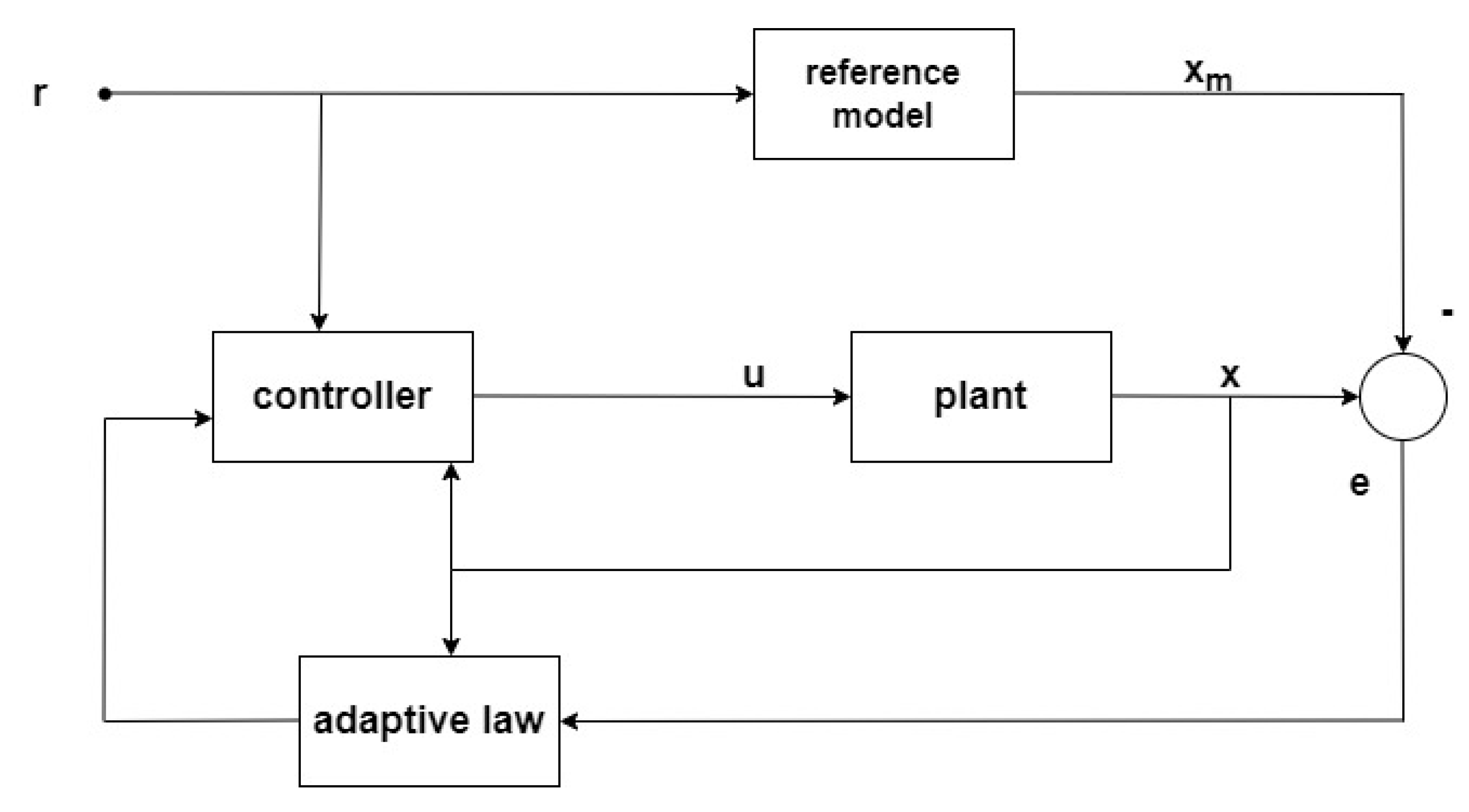
where represents any obtained positive-definite matrix. See Figure 1.
Figure 1.
Model Reference Adaptive Control.
Remark 1.
Despite the fact that equations (37), (44), and (45) ensure that the error between both the dynamic system in (36) and the reference model in (35) reduces asymptotically as , practically, the trajectory of the dynamic system can deviate significantly from the trajectory of the reference model during the learning stage (transient phase). This issue is known as the poor transient response problem.
Remark 2.
Remark 3.
As the dynamic system’s complexity develops, it becomes more susceptible to parametric uncertainty. As a result, the typical MRAC system is incapable of providing a convenient performance. Specifically, MRAC cannot ensure that the error will converge to zero practically.
3.2. Modified MRAC
Motivated by the prior remarks on MRAC performance, our goals are to ensure that the tracking errors vanish asymptotically and to improve MRAC transient response. These will be accomplished by modifying the MRAC control law (37) to include the null space parameterization provided by the Greville formula.
The following is a proposal for a null control vector () that is projected through a projection matrix () to act on the control coefficient’s null space; it is chosen to be a function of tracking error to speed up the error dynamics:
where is the gain of the null control vector that is adaptively generated using the Lyapunov candidate function.
Now, the control law for the modified MRAC can be written in the following form:
This implies the following:
Equation (49) must be enforced for the tracking errors to dissipate asymptotically in such a way that:
This implies that the error dynamics can be expressed as:
By utilizing the matching conditions in Assumption 1 and substituting (35) and (51) in Equation (53), the error dynamics of the modified MRAC are obtained as follows:
Remark 4.
According to the description of the error dynamics (54), the projected null control vector on the null space of control coefficients is composed of a gain that is adaptively adjusted in response to the tracking error, which plainly affects the system error. The update law is prevented from learning from the oscillation content of the system error in this manner.
The following is Lyapunov candidate function that we use to derive the adaptive parameters:
Now, the derivative of the Lyapunov function is obtained as:
By using the properties of trace, Equation (56) can be formulated as:
Now, the adaptive parameters can be constructed as:
Theorem 1.
Proof.
Equation (66) will result in and being really bounded, and hence:
Now, by checking the derivative of , we can prove that it is uniformly continuous:
Because are bounded by the fact that , the trajectory is bounded due to and being bounded, and reference signal is also bounded; therefore, is obviously uniformly continuous. This explains that and as ; therefore, the error dynamics achieve asymptotic stability. See Figure 2. □
Figure 2.
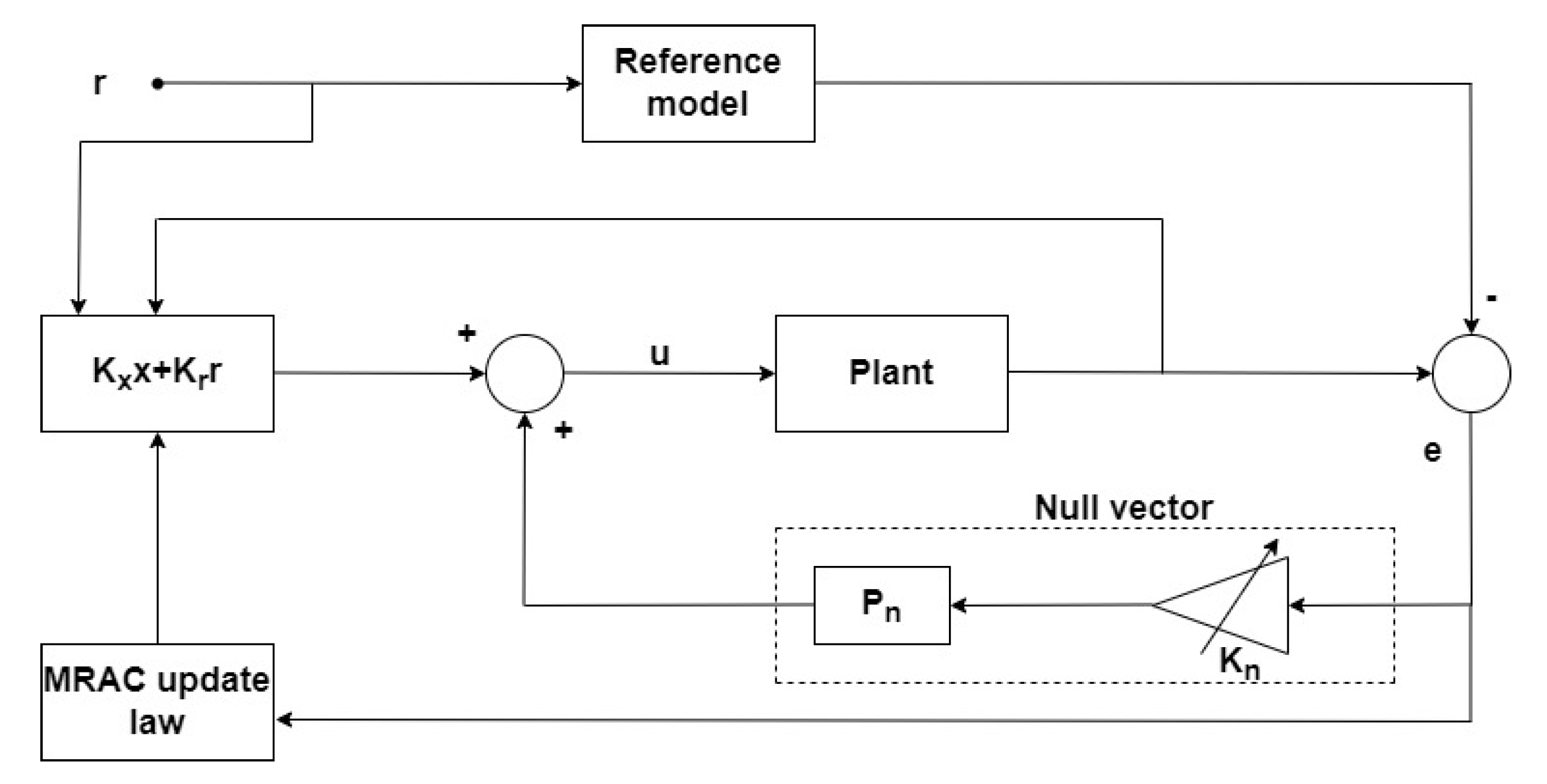
Modified Model Reference Adaptive Control.
Remark 5.
Theorem 1 emphasizes stability and good performance during both the transient and steady-state periods. Clearly, , implying that the state trajectory asymptotically approaches the reference model of Equation (35). Additionally, the control law (49) is generated based on the null control vector (48) projected by a projection matrix to act on the null space of control coefficients. In other words, it forces the dynamic system (36) to behave similarly to the reference model throughout the system’s response.
4. Application to Aircraft Longitudinal and Lateral Directional Control
By considering a flying wing aircraft as an example, this section describes how the proposed method can be implemented.
4.1. Aircraft Dynamic Model
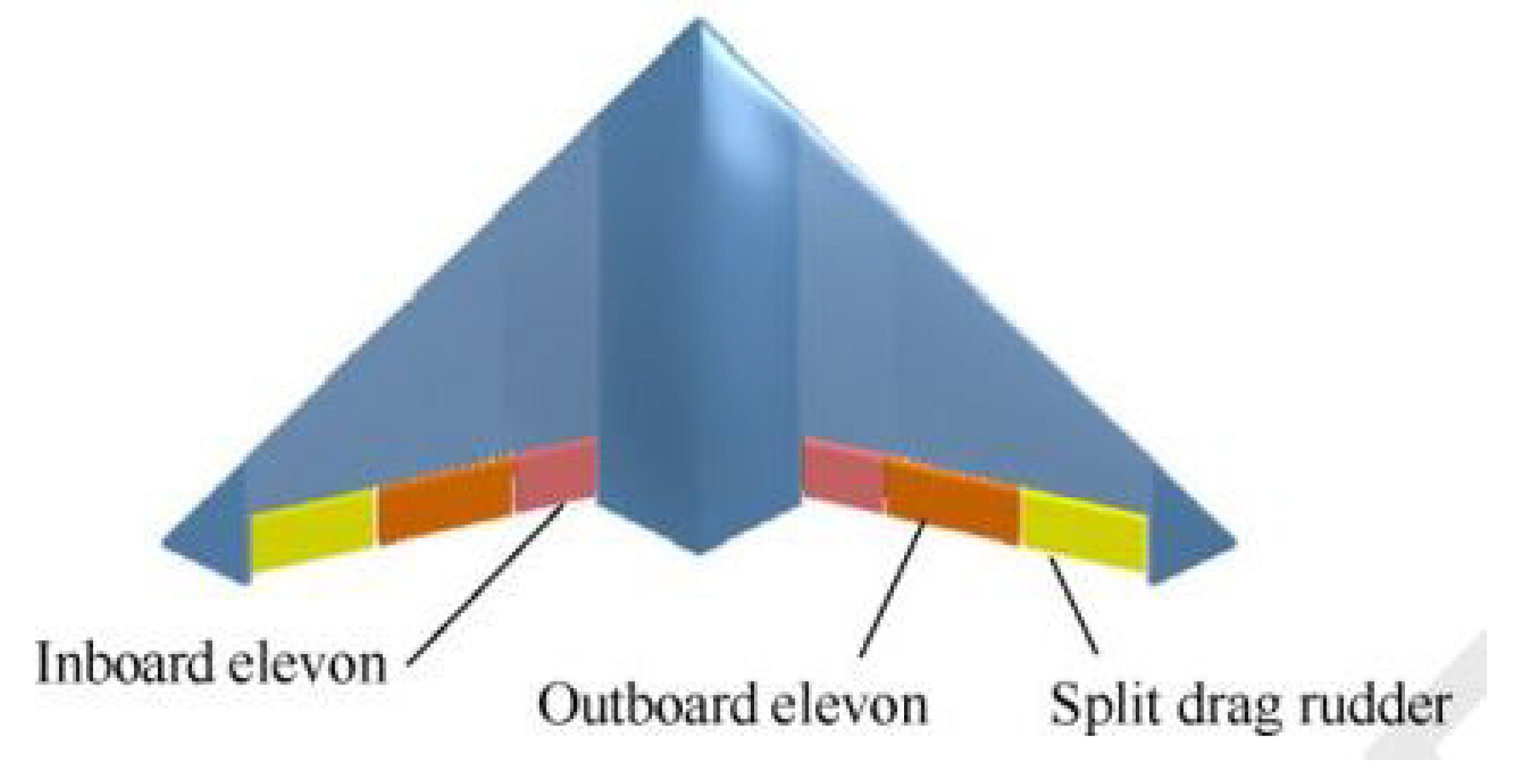
Figure 3 depicts an illustration of a flying wing aircraft. It features two sets of elevons and split drag rudders. The inboard elevons are mostly used to regulate pitch, and positive deflection is considered as symmetric downward deflection. The outboard elevons are employed to control the roll of the vehicle through differential deflection. Yaw control is handled by split drag rudders.
Figure 3.
Flying wing aircraft.
Equations (70) and (71) as in [35] depict the dynamic model in which the sideslip angle affects both the longitudinal and lateral dynamics, resulting in longitudinal and lateral directional coupling. The example aircraft’s dynamic modes are listed in Table 1.
Table 1.
Aircraft dynamic modes.
Corresponding to the structure in Figure 3, the angle of attack, sideslip angle, roll rate, pitch rate, and yaw rate have been chosen as accessible state variables for a flying wing aircraft. The control variables are chosen to be , , and , signifying inboard elevons (for roll), outboard elevons (for pitch), and drag rudders (for yaw).
4.2. Reference Model
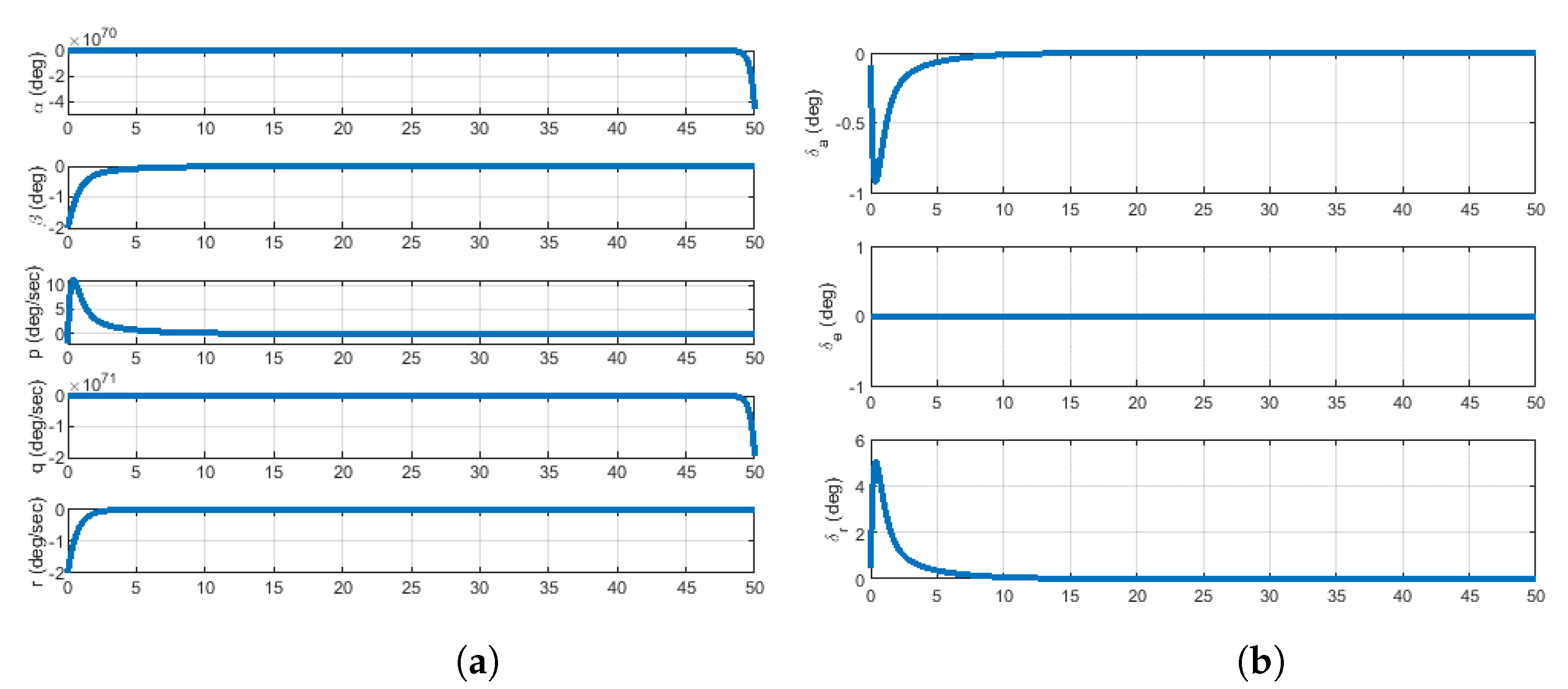
As shown in Table 1, both short period and dutch roll are dynamically unstable, but the properties of the roll mode are rather excellent. This means that the design of a reference model must concentrate on enhancing the aircraft’s short period and dutch roll modes in order to attain stability and high performance. Therefore, the yaw–pitch axis will be subjected to the dynamic constraints. See Figure 4.
Figure 4.
Yaw rate constraint configuration. (a) First constraint reference model. (b) First constraint control variables.
4.2.1. First Constraint {r} Configuration
Here, implies that and . Hence, the values of , , and are obtained as follows:
The controller that enforces the constraint is obtained as:
This implies that:
Table 2 demonstrates the dynamic modes of the first constraint configuration. the table shows that the first constraint configuration stabilizes the dutch roll mode, but the short period mode is still dynamically unstable.
Table 2.
First constraint dynamic modes.
4.2.2. Second Constraint {q} Configuration
The state and control matrices produced from the first constraint configuration are as follows:
Now, setting implies that and . Hence, the values of , , and are obtained as:
The controller that enforces the second constraint is obtained as:
Table 3 highlights that the second constraint stabilized the modes of the aircraft, i.e., is Lyapunov stable.
Table 3.
Second constraint dynamic modes.
4.3. Adaptive System Simulation
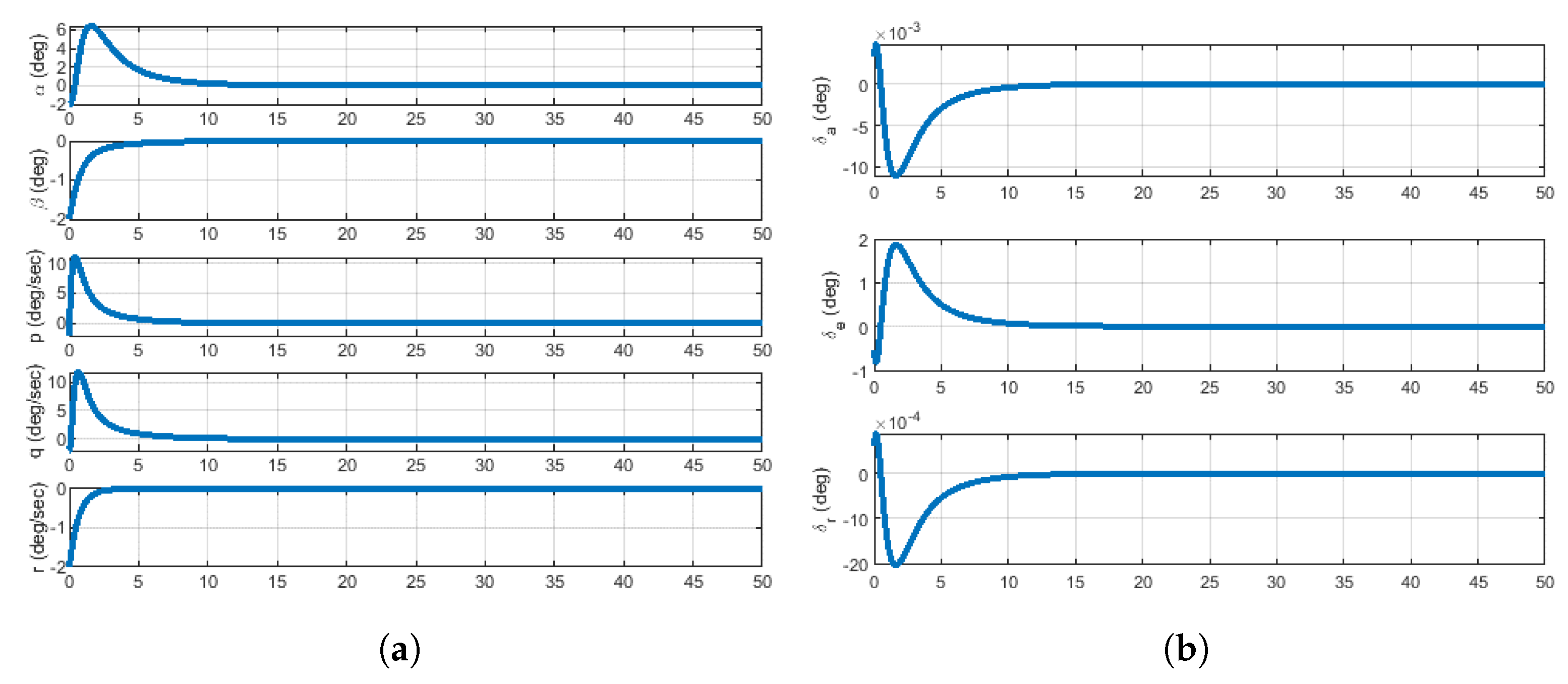
Simulated results are now provided to show the suggested method’s superior performance over the traditional MRAC. The resulting findings were achieved using MATLAB software, and the computer simulation used Ode45 as a numerical solver. The reference model adopted is shown in Figure 5, which constrains the yaw and pitch rates.
Figure 5.
Yaw and pitch rate constraint configuration vs. time. (a) Second constraint reference model. (b) Second constraint control variables.
4.3.1. First Case Study
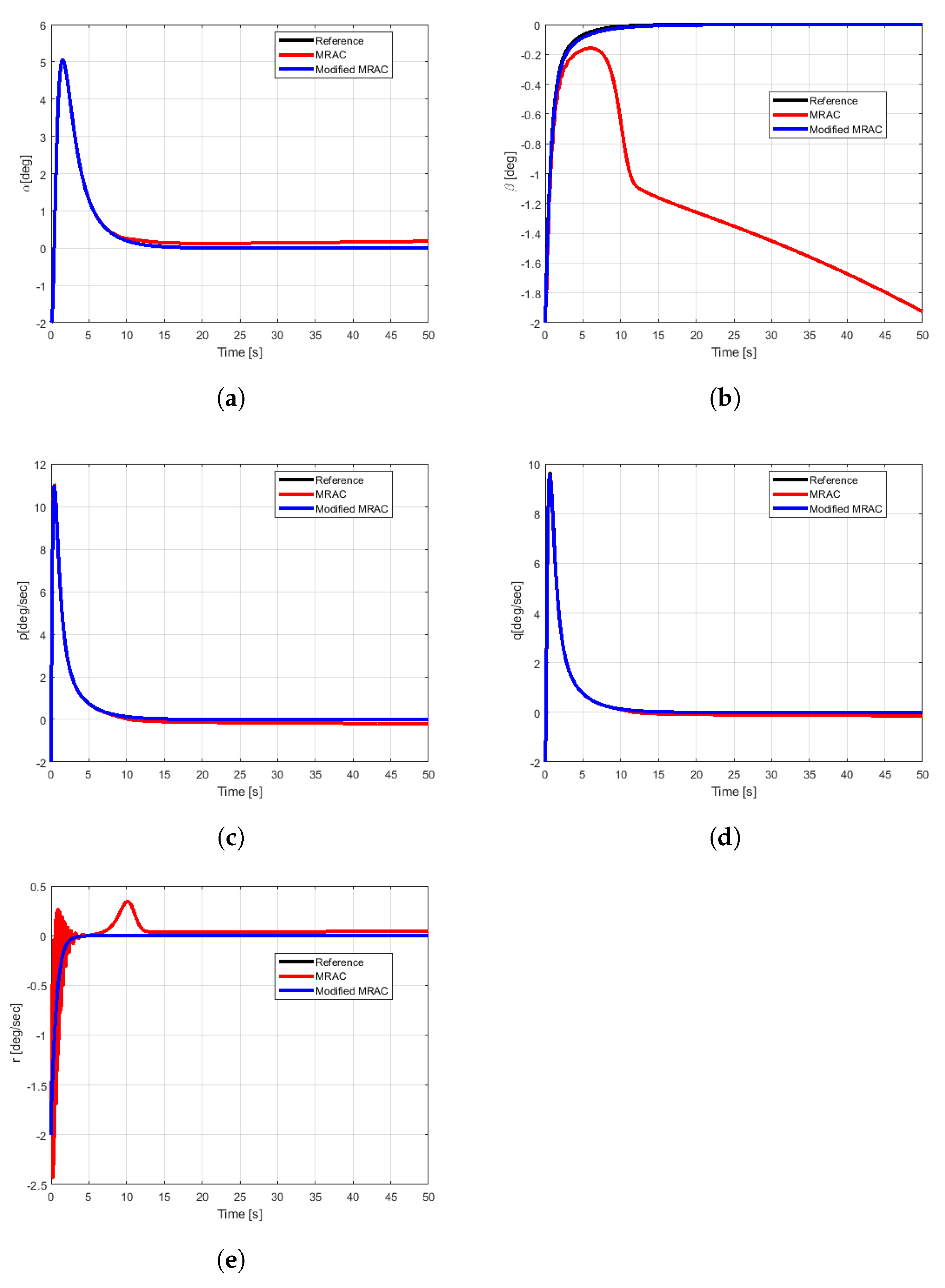
Figure 6, Figure 7, Figure 8, Figure 9 and Figure 10 were created with learning rates of , , and . By examining Figure 6, it is obvious that the modified MRAC method achieves precise tracking of the reference model and produces smooth trajectories. As illustrated in Figure 6b, MRAC is unable to achieve acceptable tracking performance for the sideslip angle due to a minor drift in the corresponding adaptive parameter. Additionally, as a result of the learning rate, Figure 6e demonstrates oscillatory behavior. The suggested scheme overcomes these disadvantages by incorporating Equation (47) into the control law of the classic MRAC in order to address the tracking error problem. Furthermore, the projection matrix used in Equation (48) permits the null control vector to act on the null space of control coefficients, thereby suppressing the oscillations.
Figure 6.
System states for reference, MRAC, and modified MRAC. (a) Behavior of angle of attack. (b) Behavior of sideslip angle. (c) Behavior of roll angle rate. (d) Behavior of pitch angle rate. (e) Behavior of yaw angle rate.
Figure 7.
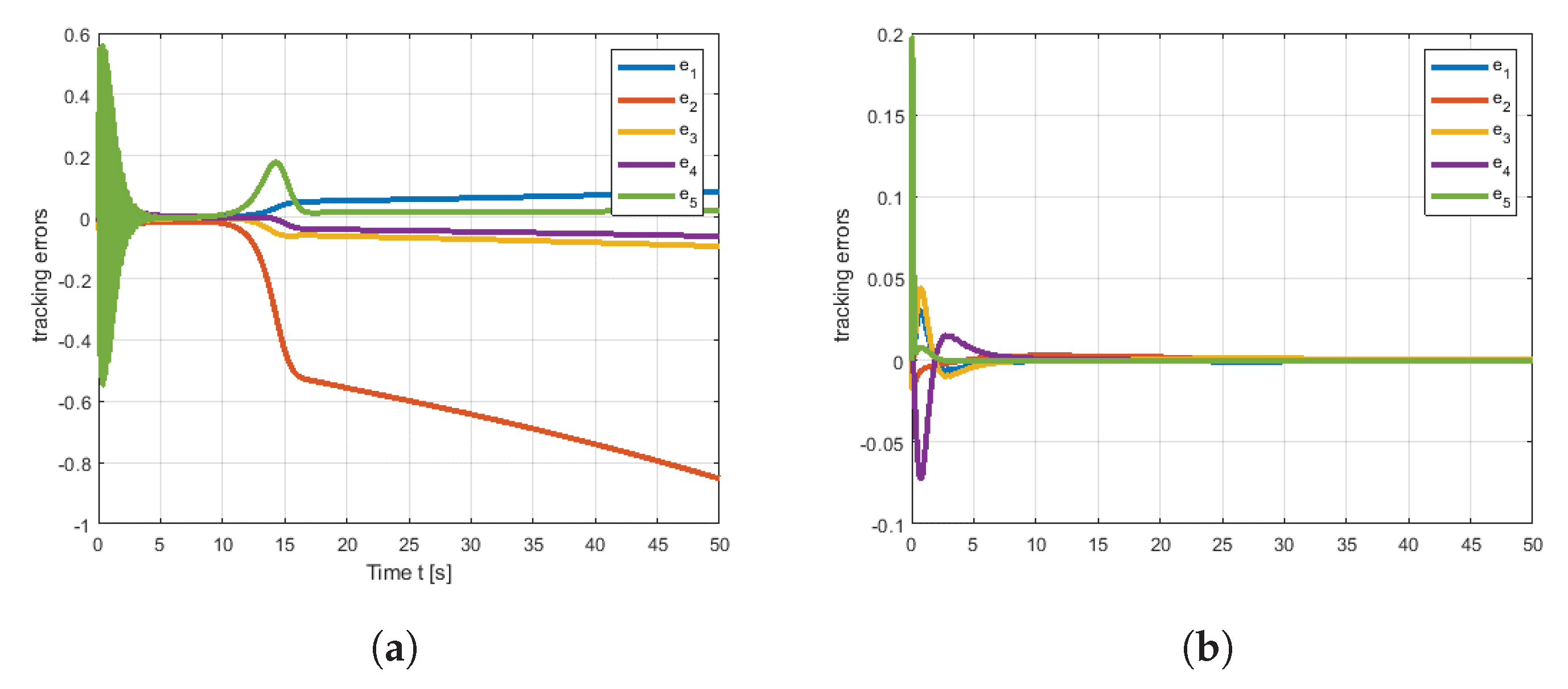
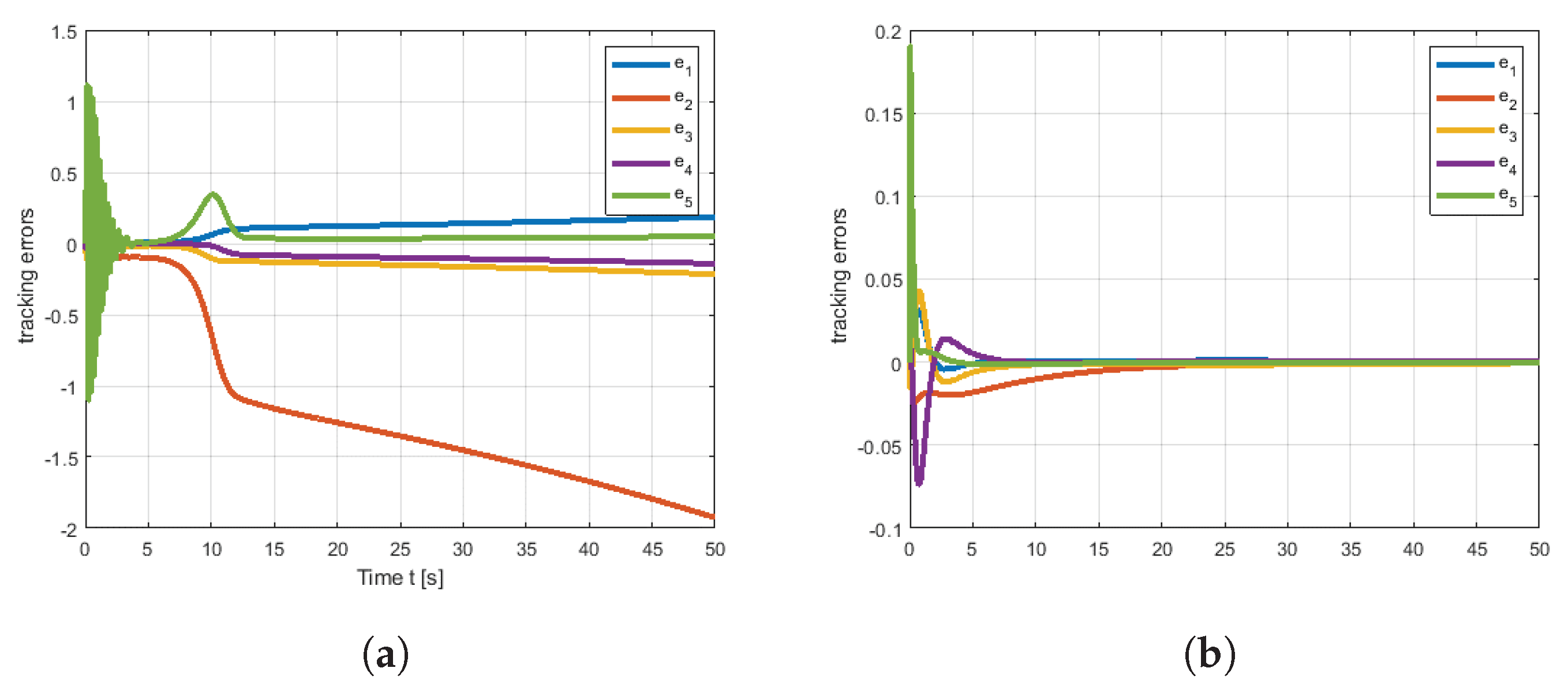
Error dynamics with MRAC and modified MRAC. (a) MRAC tracking errors. (b) Modified MRAC tracking errors vs. time.
Figure 8.
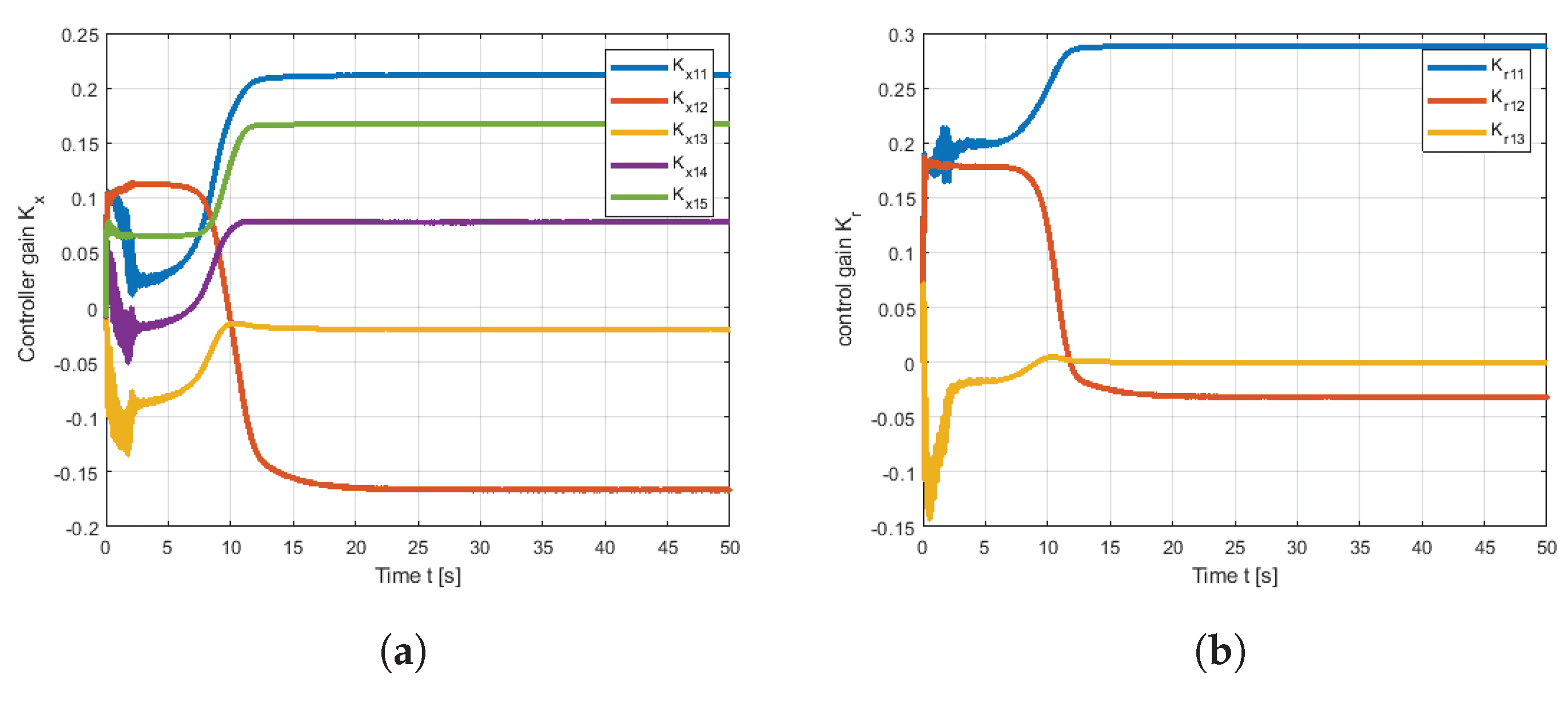
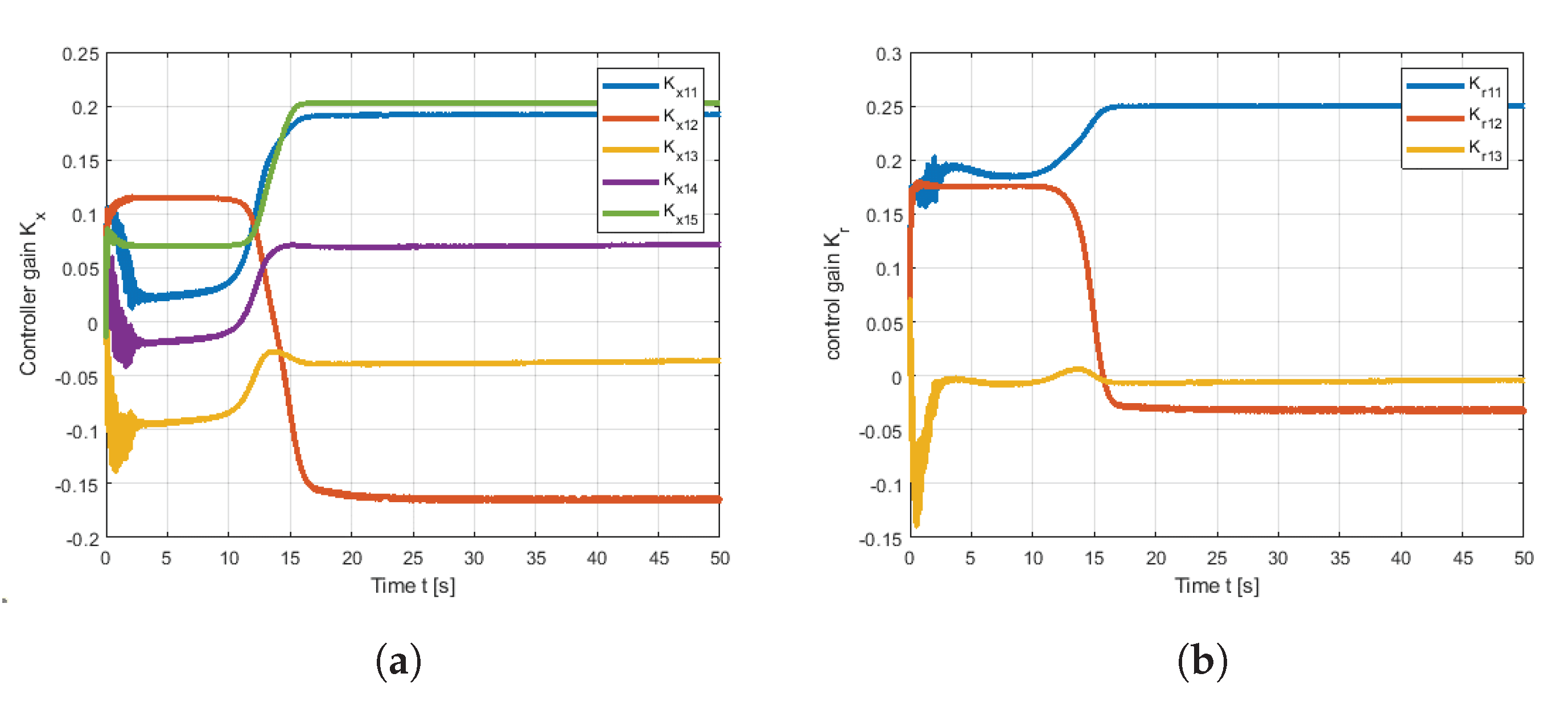
MRAC adaptive parameters. (a) Feedback gain. (b) Feedforward gain.
Figure 9.
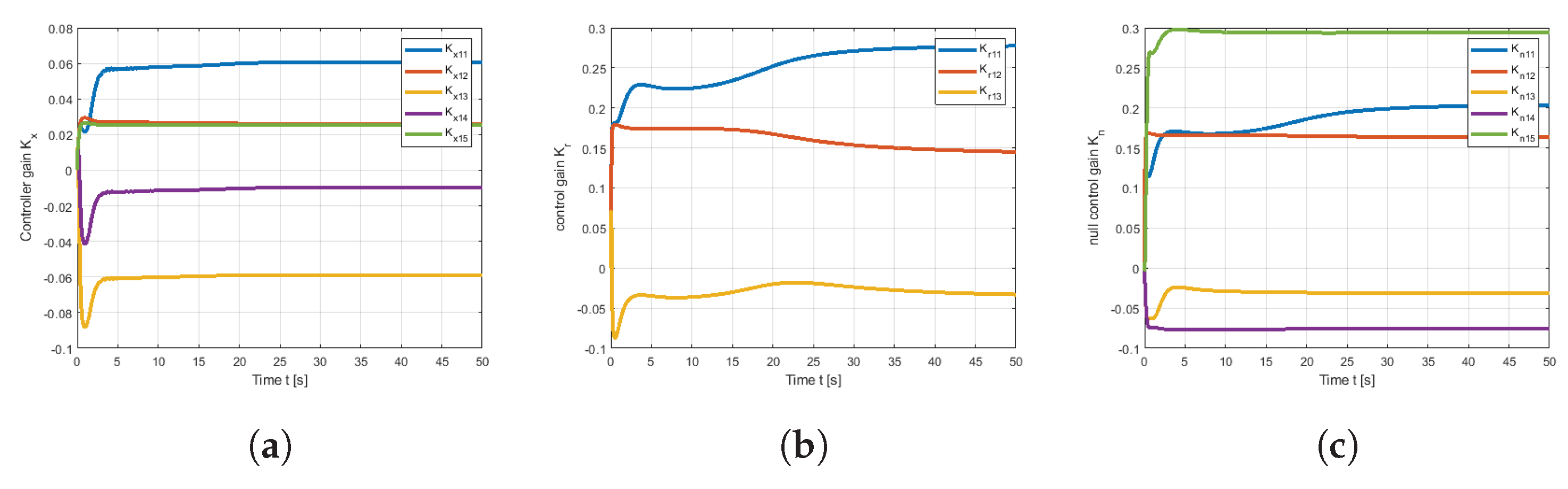
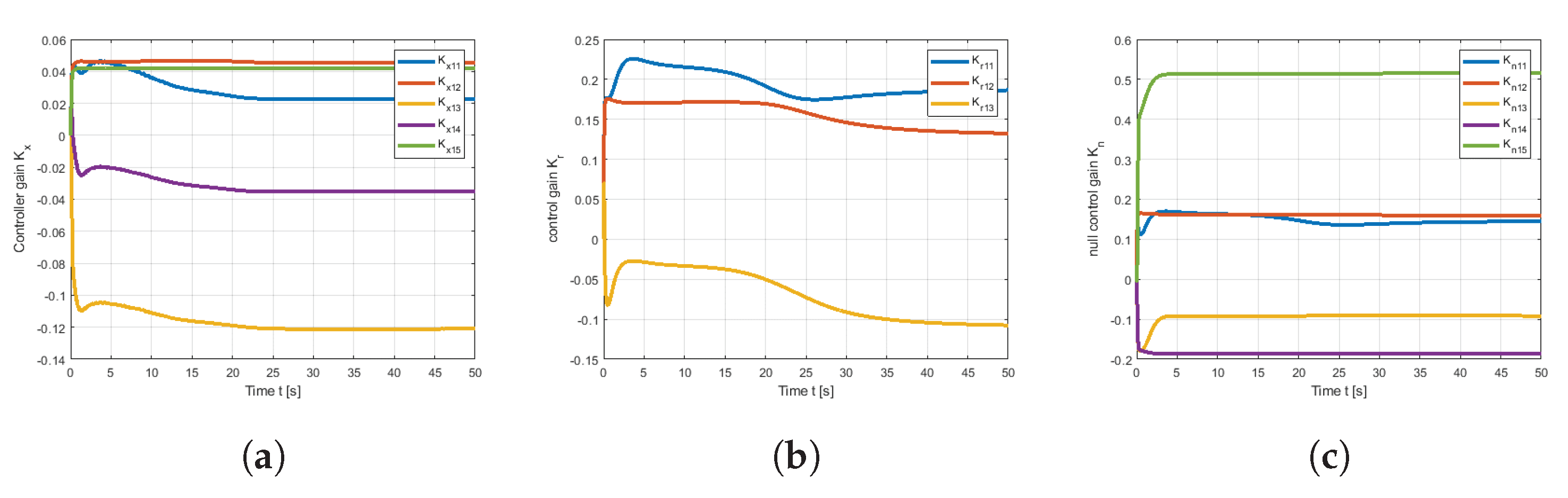
Modified MRAC adaptive parameters. (a) Feedback gain. (b) Feedforward gain. (c) Null gain.
Figure 10.
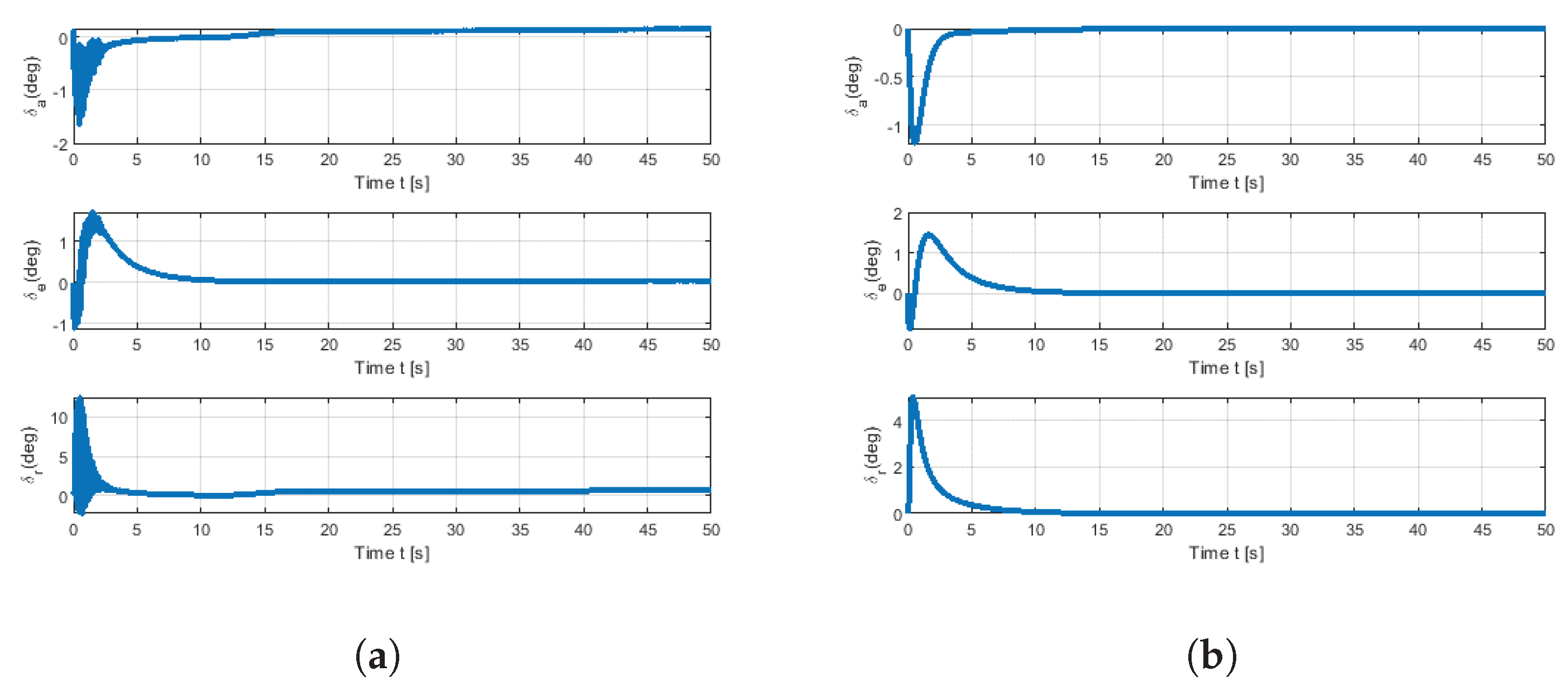
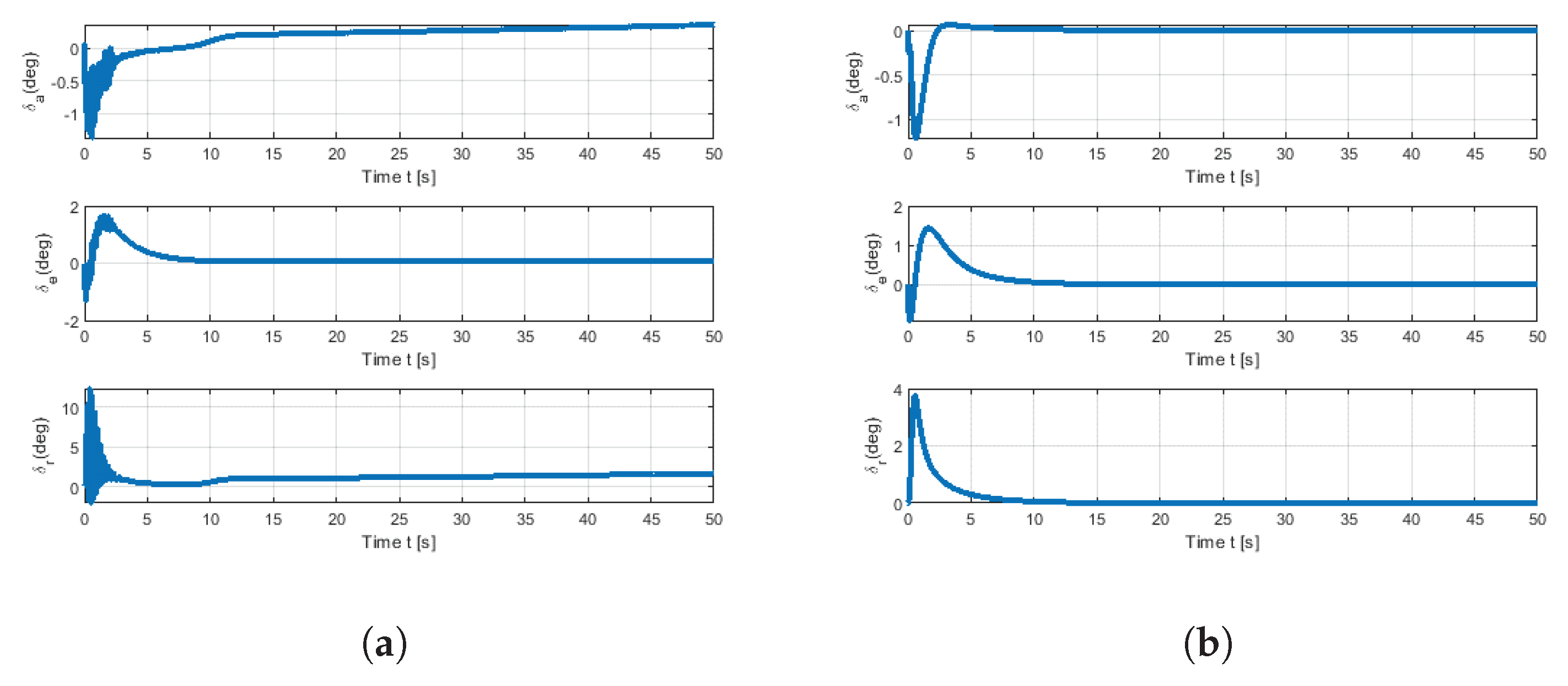
MRAC and modified MRAC control commands. (a) MRAC control variables. (b) Modified MRAC control variables.
The error dynamics of both MRAC and the modified MRAC are depicted in Figure 7. As illustrated in Figure 7a, the error dynamic does not totally converge to zero; additionally, it contains oscillations that drive the adaptive parameters, as seen in Figure 8. On the other hand, as illustrated in Figure 7b, the proposed method ensures that the error is convergent and free of fluctuations, corroborating Theorem 1. The temporal history of adaptive parameters governed by the modified MRAC error dynamics is depicted in Figure 9.
The control history of both methods is depicted in Figure 10. Our approach’s control response is obviously superior to that of traditional MRAC. Additionally, as illustrated in Figure 10b, the suggested scheme’s control is very similar to the control that forces the reference model to respect constraints (see Figure 5b); therefore, Equation (49) influences the adaptive system to behave similarly to the reference model.
4.3.2. Second Case Study
Figure 11, Figure 12, Figure 13, Figure 14 and Figure 15 have been generated with tuning gains of , , and .
Figure 11.
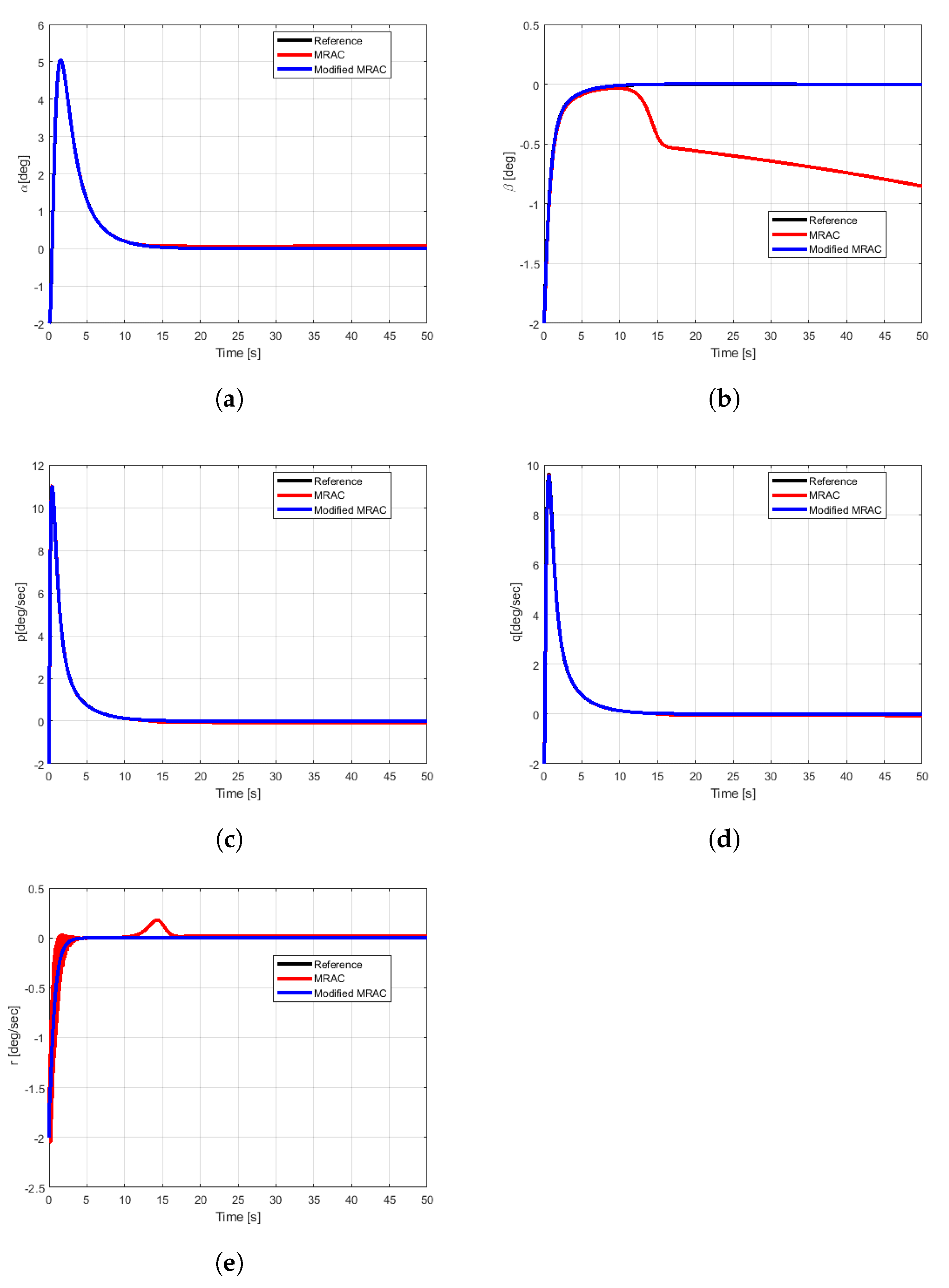
System states for reference, MRAC, and modified MRAC. (a) Behavior of angle of attack. (b) Behavior of sideslip angle. (c) Behavior of roll angle rate. (d) Behavior of pitch angle rate. (e) Behavior of yaw angle rate.
Figure 12.
Error dynamics for MRAC and modified MRAC. (a) MRAC tracking errors. (b) Modified MRAC tracking errors vs. time.
Figure 13.
MRAC adaptive parameters. (a) Feedback gain. (b) Feedforward gain.
Figure 14.
Modified MRAC adaptive parameters. (a) Feedback gain. (b) Feedforward gain. (c) Null gain.
Figure 15.
MRAC and modified MRAC control commands. (a) MRAC control variables. (b) Modified MRAC control variables.
Here, we would like to emphasize that the structure of the proposed scheme clearly limits adaptive parameter oscillations (as illustrated in Figure 14) and results in a reduction of control input oscillations (as illustrated in Figure 15b); therefore, the error dynamics of the modified MRAC (as illustrated in Figure 12b) do not encapsulate any of these oscillations.
Since adaptive parameters and control inputs have minimized oscillations, the trajectory of the states for the modified MRAC scheme will have to be smooth, as illustrated in Figure 11.
5. Conclusions
This article contributes to existing research in model reference adaptive control theory by presenting a generalized dynamic inversion and null space parameterization. The adaptive system’s closed-loop simulations reveal a highly satisfying performance concerning guaranteed error convergence asymptotically to zero and better transient response. The developed GDI control law is separated into two sections: the first section is referred to as the particular section, and it was used to formulate the reference model trajectories by applying the stipulated dynamic constraints on the system. The other component is the null control vector, which was projected onto the null space of control coefficients and then substituted into the MRAC control law to enhance performance. The effective implementation of GDI demonstrates that this approach has the potential to simplify adaptive control problems by eliminating the need for complex and tedious procedures. Moreover, The structure of the proposed scheme clearly limits adaptive parameter oscillations and eliminates control input oscillations, so the modified MRAC’s error dynamics are missing any of these oscillations. Future work will include robustizing the approach versus nonlinear uncertainty and measurement noise, as well as developing a null control vector to account for these non-parametric uncertainties.
Author Contributions
Conceptualization and methodology, A.M.; software and result discussions, A.M.; resources, A.M.; writing and original draft preparation, A.M.; review and editing, A.H.B.; supervision and administration, A.H.B. All authors have read and agreed to the published version of the manuscript.
Funding
This research was supported by Institutional Fund Projects. This project was funded by KAU Endowment (WAQF) at King Abdulaziz University, Jeddah, under grant no. (WAQF: 282-135-2024). The authors, therefore, acknowledge with thanks WAQF and the Deanship of Scientific Research (DSR) for technical and financial support.
Data Availability Statement
The original contributions presented in the study are included in the article, further inquiries can be directed to the corresponding author.
Conflicts of Interest
The authors declare no conflicts of interest.
References
- Narendra, K.S.; Annaswamy, A.M. Stable Adaptive Systems; Courier Corporation: Chelmsford, MA, USA, 2012. [Google Scholar]
- Åström, K.J.; Wittenmark, B. Adaptive Control; Courier Corporation: Chelmsford, MA, USA, 2013. [Google Scholar]
- Sastry, S.; Bodson, M. Adaptive Control: Stability, Convergence and Robustness; Courier Corporation: Chelmsford, MA, USA, 2011. [Google Scholar]
- Nguyen, N.T. Model-Reference Adaptive Control: A Primer; Springer International Publishing: Cham, Switzerland, 2018. [Google Scholar]
- Lavretsky, E.; Wise, K.A. Robust and Adaptive Control with Aerospace Applications; Springer International Publishing: Cham, Switzerland, 2024. [Google Scholar]
- Duarte, M.A.; Narendra, K.S. Combined direct and indirect approach to adaptive control. IEEE Trans. Autom. Control 1989, 34, 1071–1075. [Google Scholar] [CrossRef]
- Nakanishi, J.; Farrell, J.A.; Schaal, S. Composite adaptive control with locally weighted statistical learning. Neural Netw. 2005, 18, 71–90. [Google Scholar] [CrossRef] [PubMed][Green Version]
- Lavretsky, E. Combined/composite model reference adaptive control. IEEE Trans. Autom. Control 2009, 54, 2692–2697. [Google Scholar] [CrossRef]
- Patre, P.M.; MacKunis, W.; Johnson, M.; Dixon, W.E. Composite adaptive control for Euler–Lagrange systems with additive disturbances. Automatica 2010, 46, 140–147. [Google Scholar] [CrossRef]
- Gibson, T.E.; Annaswamy, A.M.; Lavretsky, E. On adaptive control with closed-loop reference models: Transients, oscillations, and peaking. IEEE Access 2013, 1, 703–717. [Google Scholar] [CrossRef]
- Gibson, T.E.; Qu, Z.; Annaswamy, A.M.; Lavretsky, E. Adaptive output feedback based on closed-loop reference models. IEEE Trans. Autom. Control 2015, 60, 2728–2733. [Google Scholar] [CrossRef]
- Cao, C.; Hovakimyan, N. Design and analysis of a Novel L1 adaptive control architecture with guaranteed transient performance. IEEE Trans. Autom. Control 2008, 53, 586–591. [Google Scholar] [CrossRef]
- Boyd, S.; Sastry, S.S. Necessary and sufficient conditions for parameter convergence in adaptive control. Automatica 1986, 22, 629–639. [Google Scholar] [CrossRef]
- Loria, A. Explicit convergence rates for MRAC-type systems. Automatica 2004, 40, 1465–1468. [Google Scholar] [CrossRef]
- Krstić, M.; Kokotović, P.V.; Kanellakopoulos, I. Transient-performance improvement with a new class of adaptive controllers. Syst. Control Lett. 1993, 21, 451–461. [Google Scholar] [CrossRef]
- Datta, A.; Ioannou, P.A. Performance analysis and improvement in model reference adaptive control. IEEE Trans. Autom. Control 1994, 39, 2370–2387. [Google Scholar] [CrossRef]
- Sun, J. A modified model reference adaptive control scheme for improved transient performance. IEEE Trans. Autom. Control 1993, 38, 1255–1259. [Google Scholar] [CrossRef]
- Miller, D.E.; Davison, E.J. An adaptive controller which provides an arbitrarily good transient and steady-state response. IEEE Trans. Autom. Control 1991, 36, 68–81. [Google Scholar] [CrossRef]
- Huang, J.T. Sufficient conditions for parameter convergence in linearizable systems. IEEE Trans. Autom. Control 2003, 48, 878–880. [Google Scholar] [CrossRef]
- Landau, I. A survey of model reference adaptive techniques—Theory and applications. Automatica 1974, 10, 353–379. [Google Scholar] [CrossRef]
- Slotine, J.J.E.; Li, W. Composite adaptive control of robot manipulators. Automatica 1989, 25, 509–519. [Google Scholar] [CrossRef]
- Bechlioulis, C.P.; Rovithakis, G.A. Adaptive control with guaranteed transient and steady state tracking error bounds for strict feedback systems. Automatica 2009, 45, 532–538. [Google Scholar] [CrossRef]
- Na, J.; Chen, Q.; Ren, X.; Guo, Y. Adaptive prescribed performance motion control of servo mechanisms with friction compensation. IEEE Trans. Ind. Electron. 2013, 61, 486–494. [Google Scholar] [CrossRef]
- Annaswamy, A.; Lavretsky, E.; Dydek, Z.; Gibson, T.; Matsutani, M. Recent results in robust adaptive flight control systems. Int. J. Adapt. Control Signal Process. 2013, 27, 4–21. [Google Scholar] [CrossRef]
- Morse, A.S. High-order parameter tuners for the adaptive control of linear and nonlinear systems. In Systems, Models and Feedback: Theory and Applications; Springer: Berlin/Heidelberg, Germany, 1992; pp. 339–364. [Google Scholar]
- Bajodah, A.H. Generalised dynamic inversion spacecraft control design methodologies. IET Control Theory Appl. 2009, 3, 239–251. [Google Scholar] [CrossRef]
- Bajodah, A.H. Asymptotic generalised dynamic inversion attitude control. IET Control Theory Appl. 2010, 4, 827–840. [Google Scholar] [CrossRef]
- Bajodah, A.H. Asymptotic perturbed feedback linearisation of underactuated Euler’s dynamics. Int. J. Control 2009, 82, 1856–1869. [Google Scholar] [CrossRef]
- Bajodah, A.H. Servo-constraint generalized inverse dynamics for robot manipulator control design. In Proceedings of the 2009 IEEE International Conference on Control and Automation, Christchurch, New Zealand, 9–11 December 2009; IEEE: Piscataway, NJ, USA, 2009; pp. 1019–1026. [Google Scholar]
- Greville, T. The pseudoinverse of a rectangular or singular matrix and its application to the solution of systems of linear equations. SIAM Rev. 1959, 1, 38–43. [Google Scholar] [CrossRef]
- Ben-Israel, A.; Greville, T.N. Generalized Inverses: Theory and Applications; Springer Science & Business Media: Berlin/Heidelberg, Germany, 2003; Volume 15. [Google Scholar]
- Bajodah, A.H.; Hodges, D.H.; Chen, Y.H. Inverse dynamics of servo-constraints based on the generalized inverse. Nonlinear Dyn. 2005, 39, 179–196. [Google Scholar] [CrossRef]
- Mibar, H.; Bajodah, A.H. Mutual direct controllability of MIMO systems and application to longitudinal aircraft control. In Proceedings of the 2020 IEEE International Conference on System Theory, Control and Computing (ICSTCC), Sinaia, Romania, 8–10 October 2020; IEEE: Piscataway, NJ, USA, 2020; pp. 1618–2372. [Google Scholar]
- Mibar, H.; Bajodah, A.H. Mutual direct state controllability analysis of multivariable underactuated LTI systems. In Proceedings of the 2020 IEEE Australian and New Zealand Control Conference (ANZCC), Gold Coast, QLD, Australia, 26–27 November 2020; IEEE: Piscataway, NJ, USA, 2020; pp. 18–23. [Google Scholar]
- Wang, L.; Zhang, N.; Yue, T.; Liu, H.; Zhu, J.; Jia, X. Three-axis coupled flight control law design for flying wing aircraft using eigenstructure assignment method. Chin. J. Aeronaut. 2020, 33, 2510–2526. [Google Scholar] [CrossRef]
Disclaimer/Publisher’s Note: The statements, opinions and data contained in all publications are solely those of the individual author(s) and contributor(s) and not of MDPI and/or the editor(s). MDPI and/or the editor(s) disclaim responsibility for any injury to people or property resulting from any ideas, methods, instructions or products referred to in the content. |
© 2025 by the authors. Licensee MDPI, Basel, Switzerland. This article is an open access article distributed under the terms and conditions of the Creative Commons Attribution (CC BY) license (https://creativecommons.org/licenses/by/4.0/).