1. Introduction
In the past years, many studies of wheeled mobile robots have been presented. Among them, the differential wheel type mobile robot is still the most important development project in the indoor flat environment because of its flexibility and cost advantages. Common applications include unmanned factories [
1], automated warehouses, and home sweeping robots [
2]. Robot navigation is the basic ability to realize application functions, and path planning is the most important ability. A* algorithm is one of most representative algorithms for path planning because of its best priority search and heuristic exploration strategy to obtain good application value in most cases [
3,
4]. However, the exponential growth of time and space complexity makes it difficult to be applied to large or high-dimensional maps. Relatively, those algorithms with only probabilistic completeness, such as RRT algorithms, are usually able to complete path planning tasks in less time, but it is also difficult to ensure optimality and requires subsequent improvement measures [
5,
6,
7,
8]. Therefore, this paper improves the traditional RRT algorithm and designs a series of optimization mechanisms to improve the path quality and solve the problems faced by the traditional RRT algorithm.
Although path planning provides a feasible solution to the goal point, there may be some unexpected situations, such as moving obstacles overlapping the path, so that the robot cannot proceed along the predetermined path. In addition, the robot itself will deviate from the predetermined path due to some disturbances or uncertainties, so a good controller is needed to correct the state error of the robot, such as PID, feedback linearization, backstepping, sliding mode control, neural networks, and the hybrids of the above controllers [
9,
10,
11,
12]. According to the level of the controllers, they can be classified into two types, depending on the controller designed with only kinematic [
13,
14,
15,
16] or both kinematic and dynamic methods [
17,
18]. Generally, the former is much more simple but still enough for general cases and suitable for those motors with the ability to control velocity already. The latter is applied to high-speed cases where accuracy is required, but it requires more computing.
At the only-kinematic level, there are some research studies that have improved existing controllers. For instance, Simon X. Yang et al. [
13] proposed a controller based on bioinspired neurodynamics, which can produce smooth continuous robot control signals with zero initial velocities. Thanks to the continuity of velocities, the robot reduces the overshoot at startup. Sašo Blažič [
14] proposed a periodic controller, which let the convergence of the orientation error be 2kπ or kπ with k being an integer constant for different condition instead of zero. Thus, there is no need for excessive rotation of the mobile robots in the case that the initial orientation error is large. Sašo Blažič also proposed a controller design role to determine a suitable control law. Many controllers can be obtained by following this design role. Zhong-Ping Jiang et al. [
15] proposed one local and one global backstepping controller for path tracking. Limiting of the denominator may be zero, and the local controller is only for small initial errors. This problem is solved in global controllers by choosing a different way for the convergence path. In this study, the global controller also expands to a very simple dynamic model.
At both kinematic and dynamic levels, Bong Seok Park [
17] proposed an adaptive controller with dynamic surface control and parameter estimators. The dynamic also includes motors, and all system parameters are obtained by the four update laws estimator. Chih-Lyang Hwang [
18] proposed hierarchical variable structure tracking control for car-like mobile robots. The control output is composed of equivalent and switching parts. Instead of using the PID controller of kinematic errors as the only surface to be the input of the switch function, it also considers the dynamic errors and virtual reference as the second surface so that the system has better performance against disturbances. However, saturation problems of the controller output, which are not considered in most controller designs, may become more serious, especially in the high-speed or large-initial-error cases. When the controller output is saturated, the system stability and the convergence of errors guaranteed by Lyapunov theory is invalid, which means the system may diverge. One way to avoid this is reducing the controller gain, although doing so reduces the transient response. Thus, Xiaohan Chen [
16] proposed a controller with diamond-shaped input constraints to guarantee the control value is limited by the input constraints. However, this controller only works in kinematic models. To solve this, we introduce a dynamic gain adjustment [
19] considering the system errors and current output based on fuzzy logic control. Once the output is saturated, the controller gain reduces automatically, and then a limited increase of the gain occurs if it finds that there is still room to increase the amount of control. By adjusting the gain, the system can still have a good transient response when solving the saturation problem.
This paper is derived from the short conference paper published in [
20]. In the initial conference paper, we focused on the controller design only. This paper extends the previous research and integrates the path planning as a reference signal to the controller, which finally enables the robot to follow the predetermined path to the destination. This paper is organized as follows. The problem statement is proposed in
Section 2. Path planning is proposed in
Section 3. The controller design and its stability analysis are presented in
Section 4. Experimental results and conclusion are proposed in
Section 5 and
Section 6, respectively.
3. Path Planning
Traditional RRT algorithm is a random sampling method and with non-heuristic iteratives. The general operation process of the RRT algorithm is given in Algorithm 1.
| Algorithm1. RRT |
- 1:
T.Initialize(S) - 2:
for i = 0 to Parameters.MaxSearchingNumber - 3:
nr = RandomSampling(Map) - 4:
nc = FindNearest(T, nr) - 5:
nn = Extend(nc, nr) - 6:
if CollisionCheck (Map, nc, nn) continue - 7:
nn.parent = nc - 8:
T.Add(nn) - 9:
if !GoalTest(Map, nn, E) continue - 10:
return SelectPath (T, E) - 11:
end - 12:
return Error.PathPlanningFailed.OutOfSearchingNumber
|
If the robot can move freely in the environment, a two-way searching strategy may reduce the search range. Bidirectional RRT (BRRT), an improved algorithm from RRT, searches from starting point and ending point. The pseudocode is given in Algorithm 2. Therefore, there are two search trees Ts and Te. The pseudo-code of bidirectional RRT is given as follows. In the initialize state, only S in Ts and only E in Te. T is the cell array, including Ts and Te. nr is a point of random sampling on the map. Lines 7 to 15 are a twice-loop for two-side searching. nc is the closest point in the current searching tree to nr. nn is a point extending from nc with a random distance. CollisionCheck(Map, nc, nn) is to check if there are some obstacles between nc and nn to cause a collision. GoalTest(Map, nn, N(j)) is to check if there are no obstacle between nn and the target N(j). SelectPath (T(j), T(1 − j), nn, S, E) is to construct the path form S to E. This function constructs the first path Path1 based on T(j) starting at nn, constructs the second path Path2 based on T(1 − j) starting at nn, reverses Path1 as Path3, combines Path3 and Path2 as Path, and finally returns Path or its reversed vision Reverse(Path) based on whether the first point of Path is S or E. If i reaches the max searching number, BRRT returns an error to indicate the searching number is reached.
| Algorithm2. BRRT |
- 1:
Ts.Initialize(S) - 2:
Te.Initialize(E) - 3:
T = {Ts, Te} - 4:
N = {S, E} - 5:
for i = 0 to Parameters.MaxSearchingNumber - 6:
nr = RandomSampling(Map) - 7:
for j = 0 to 1 - 8:
nc = FindNearest(T(j), nr) - 9:
nn = Extend(nc, nr) - 10:
if CollisionCheck(Map, nc, nn) continue - 11:
nn.parent = nc - 12:
T(j).Add(nn) - 13:
if !GoalTest(Map, nn, N(j)) continue - 14:
return SelectPath (T(j), T(1 − j), nn, S, E) - 15:
end - 16:
end - 17:
return Error.PathPlanningFailed.OutOfSearchingNumber
|
Both RRT and BRRT algorithms create many unnecessary and time-consuming turns. Therefore, a path-improving mechanism is needed. Three mechanisms, which are path pruning, path smoothing, and trapezoidal velocity profile, are used to improve the path.
3.1. Path Pruning
The concept of path pruning is established by the greedy method. Although it is not guaranteed that the best path is selected, it is suitable for matching with RRT or BRRT algorithms because of its fast convergence. The pseudocode of path pruning is given in Algorithm 3. PrunedPath is initialized with only Path(0). Once the condition in Line 5 is satisfied, the point Path(j) is added in PrunedPath, because it is the furthest point from Path(i). If the condition on Line 3 is no longer satisfied, PathPrunning() returns PrunedPath.
| Algorithm3. Path Pruning |
- 1:
PrunedPath.Initialize(Path(0)) - 2:
i = 0 - 3:
while i < length(Path) − 1 - 4:
for j = length(Path) −1 to i + 1 by −1 - 5:
if CollisionCheck(Map, Path(i), Path(j)) continue - 6:
PrunedPath.Add(Path(j)) - 7:
i = j - 8:
break - 9:
end - 10:
end - 11:
return Pruned
|
3.2. Path Smoothing
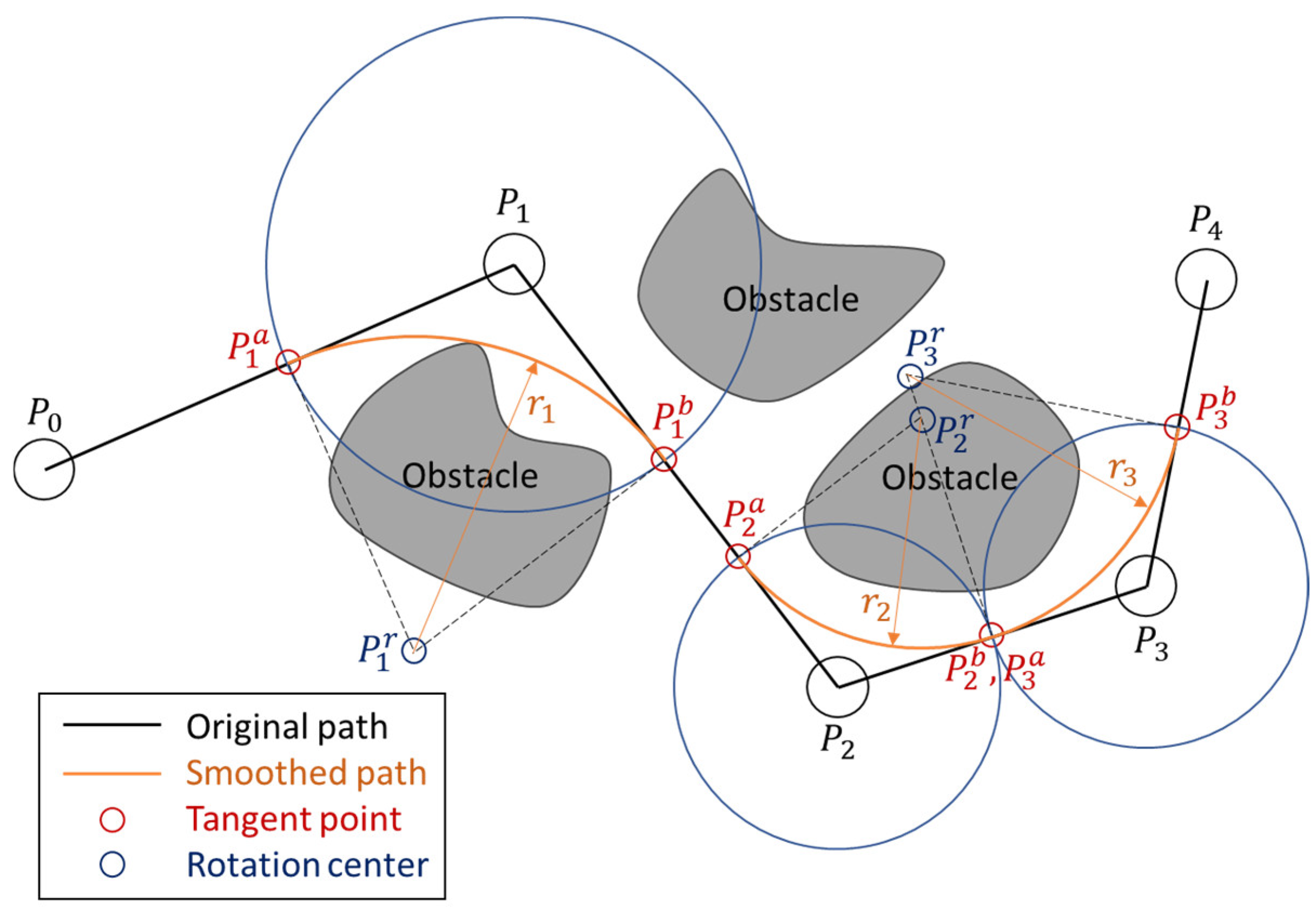
The purpose of path smoothing is to find an arc to replace the path around the path points so that the continuity of the orientation is obtained.
Figure 2 shows an example of path smoothing on a five-point path. In this example, we have three arcs to replace part of the original path. For each point of path except the first and the last, its rotation radius, rotation center, and two tangent points are represented as
ri,
,
, and
, respectively. The relations between these points are given in (18).
With a larger rotation radius, robots may move with less angular velocity to obtain higher linear velocity. Therefore, path smoothing becomes an optimization problem, and the fitness function is designed in (19) to maximum the rotation radius.
c is a positive constant satisfying
c > 1 to maintain log(
ri +
c) > 0.
The conditions of the optimization problem are given in (20).
3.3. Trapezoidal Velocity Profile
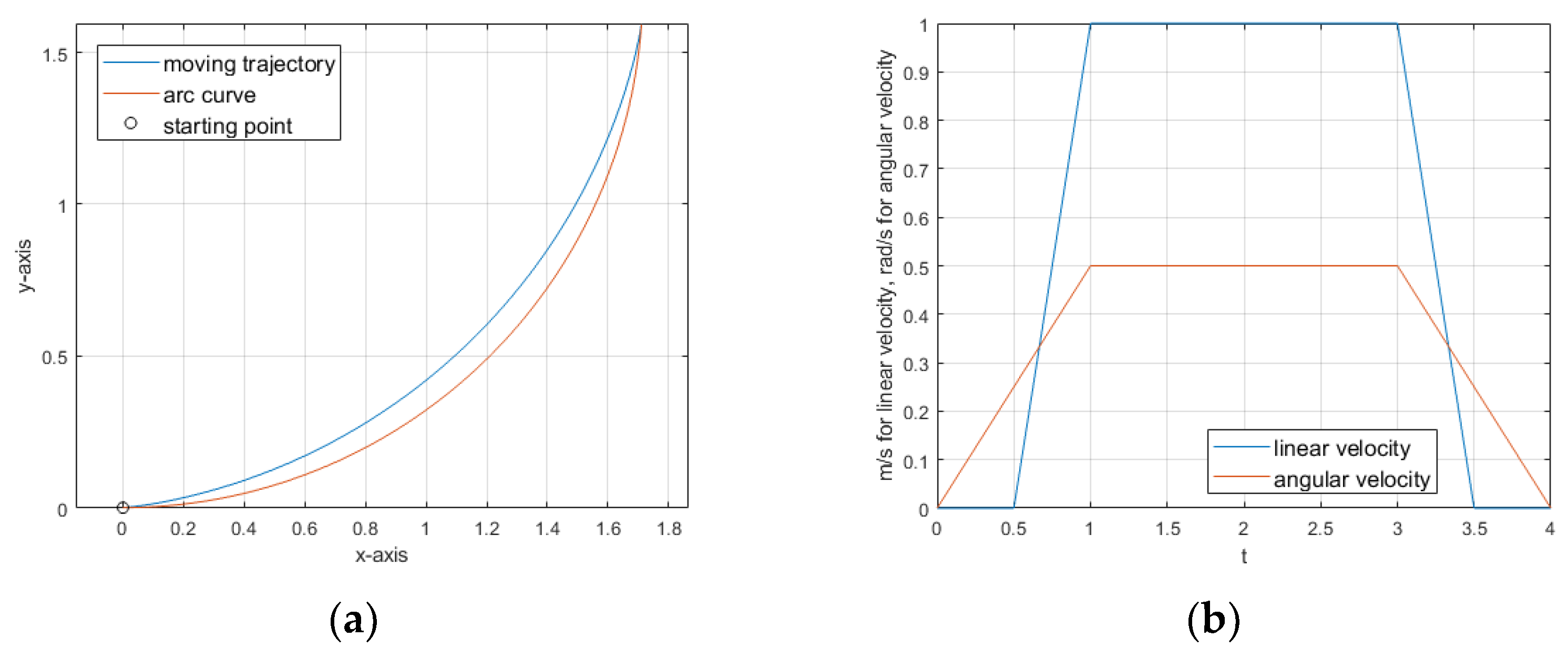
The trapezoidal velocity profile (TVP) is a simple and common method for motion planning by giving a fixed distance. In our case, the robot moves in a 2-D plane with two control inputs. Therefore, we consider implementing the trapezoidal velocity profile on both linear and angular velocities with the kinematic model of wheeled mobile robots in (21).
Figure 3 shows an example of the trapezoidal velocity profile with (21) to replace an arc curve. Both linear and angular velocities are designed by TVP as (22) and shown in
Figure 3b. The initial location of the robot is [
x,
y,
θ] = [0, 0, 0]. In
Figure 3a, an arc curve with same starting and ending point is added in to compare with the moving trajectory. The state of ending point in this example is [1.7100, 1.5934, 1.4997].
Taking the example in
Figure 2, three arc curves are replaced with the TVP method. Then, the linear velocities of three straight segments, which are
P0 to
1,
1 to
2, and
3 to
P4, are simply applied with traditional TVP, and their angular velocities are kept at zero. After combining three curves and three straight segments, the velocity profile from
P0 to
P4 is obtained, and the time function of this path can also be further obtained. Therefore, the time plan of this path is obtained.
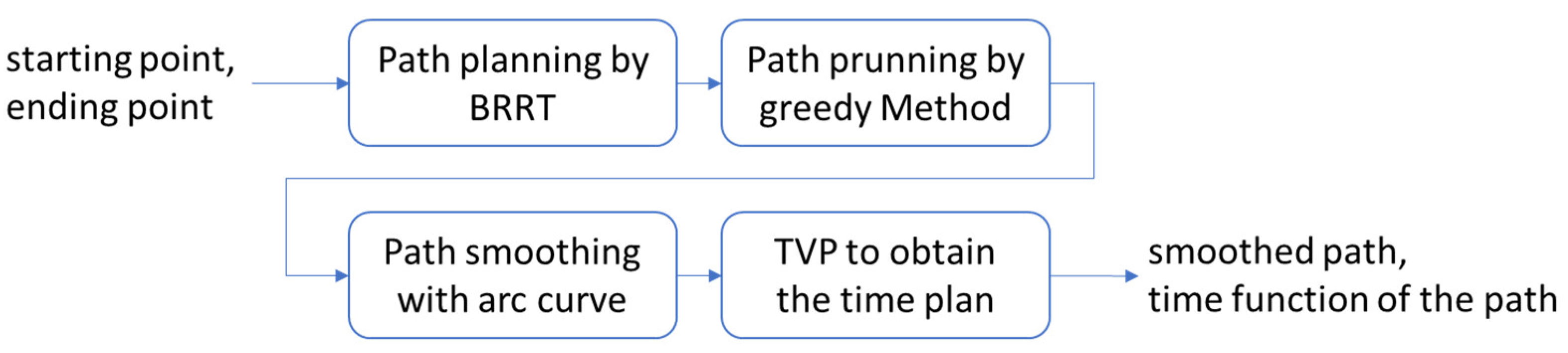
The step-by-step process of the proposed path planning in this paper is given in
Figure 4, including BRRT and three improving methods.
4. Controller Design and Stability Analysis
In this section, we develop a controller in four parts. The first part is at the kinematic level to determine the virtual reference velocities. The dynamic for controller design is included in the second part. In the second part, the controller law is also obtained to determine the control value with the virtual reference velocities. The mechanism of dynamic gain adjustment is shown in the third part to solve the saturation problem. Obstacle avoidance is shown in the last part.
4.1. Kinematic Controller
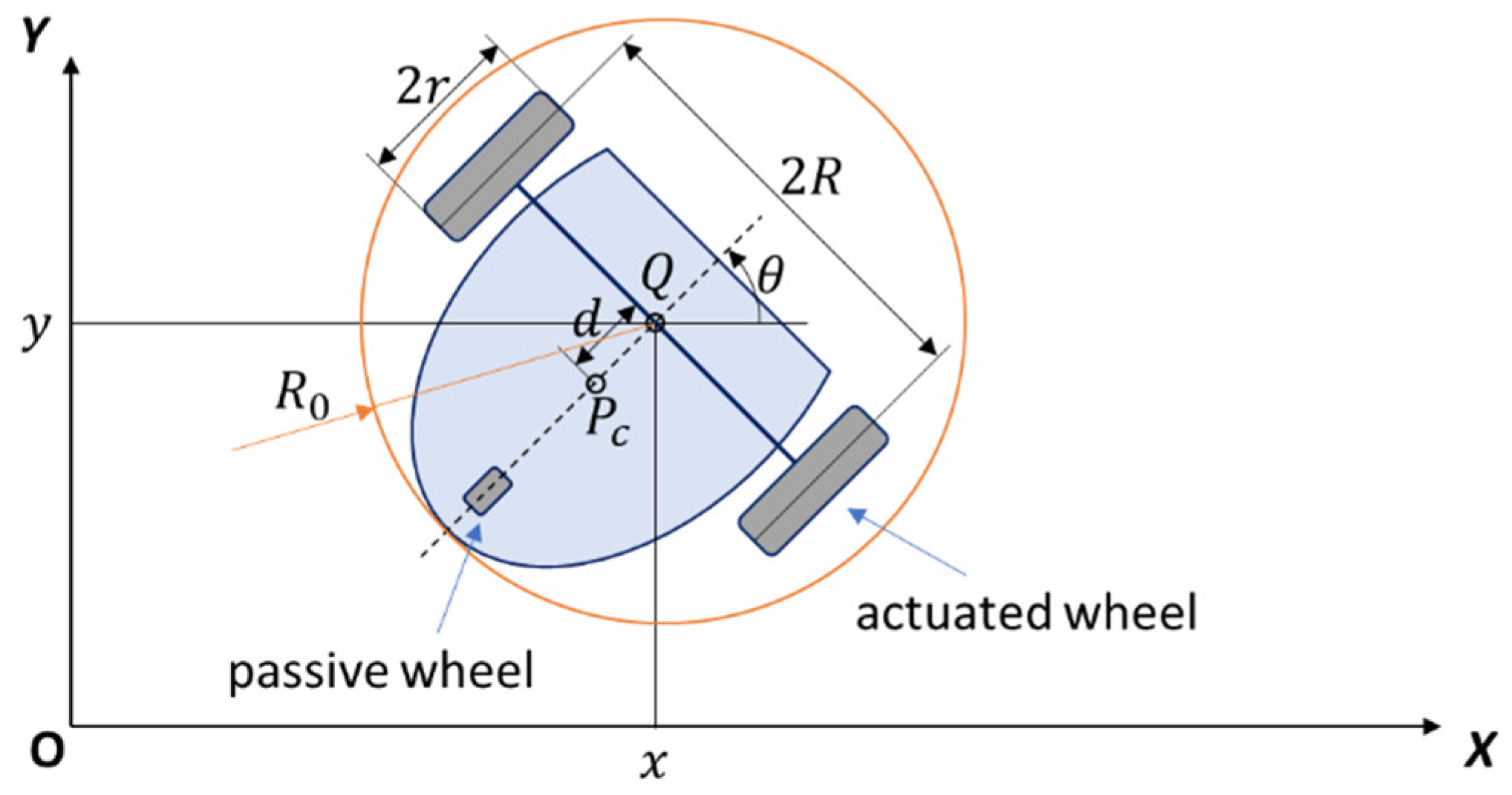
From the kinematic controller in (2), there are two parameters,
r and
R, in the system. For the convenience of parameter estimation, we define
a1 = 1/
r,
a2 =
R/
r, and
âi is the estimation of
ai as
i = 1, 2. The Lyapunov function
V1 is chosen as:
where
Vθ(
θe) is a Lyapunov function of
θe to
Vθ > 0 as
θe ≠ 2
kπ and
Vθ = 0 as
θe = 2
kπ with
k ∈ ℤ. The estimation errors are defined as
ãi =
ai −
âi,
i = 1, 2.
γ1 and
γ2 are positive constants, the gain of estimators. Using the error dynamic Equation (15), the time derivative of
V1 becomes:
The virtual control law
is chosen as
and
, where
h1 and
h2 are given in (25).
Then, the time derivative of
V1 becomes:
with
Ω
y and Ω
θ are chosen as:
with
â1 and
â2 are updated by:
q0 comes from the error between virtual control law and the angular velocity of wheels, which should deal with the dynamic controller. For this reason, it can be ignored only considering the kinematic level, which gives that time derivative of V1 ≤ 0.
4.2. Dynamic Controller
To simplify the complexity of the controller, the dynamic surface control is introduced though a first-order equation as:
The velocity error is defined as:
Its time derivative is given as:
In (33), the vector of system parameter
W can be estimated by
â3 with the update law in (24), such that
a3 =
WTW. Φ is a based matrix of system variable. Both
W and Φ are shown in (34).
Notice that
żf1 and
żf2 can be obtained easily with (31), and that is the reason why dynamic surface control can reduce the complexity of the controller. Then, the control law is chosen by:
The update law of
â3 is designed as:
Instead of estimating all the parameters in the dynamic equation, â3 is the estimator of WTW. Therefore, although this dynamic controller is simple, it can work without precise parameters.
4.3. Dynamic Gain Adjustment
To overcome the saturation problem, we adjust the gain of the controller by fuzzy logic control. As the conditions in (28) must be maintained, only kx and kθ are tuned. In this fuzzy logic control, the position error e and the duty of control value are the input, and the output tunes the ratio of gain rk to achieve dynamic gain adjustment.
The major target is to reduce controller saturation. Therefore, we choose the larger one of
u to define the duty of control value
u0 as (37).
umax is max driving voltage of the motors, so that 0 ≤
u0 ≤ 1. The position error
e is defined in (38).
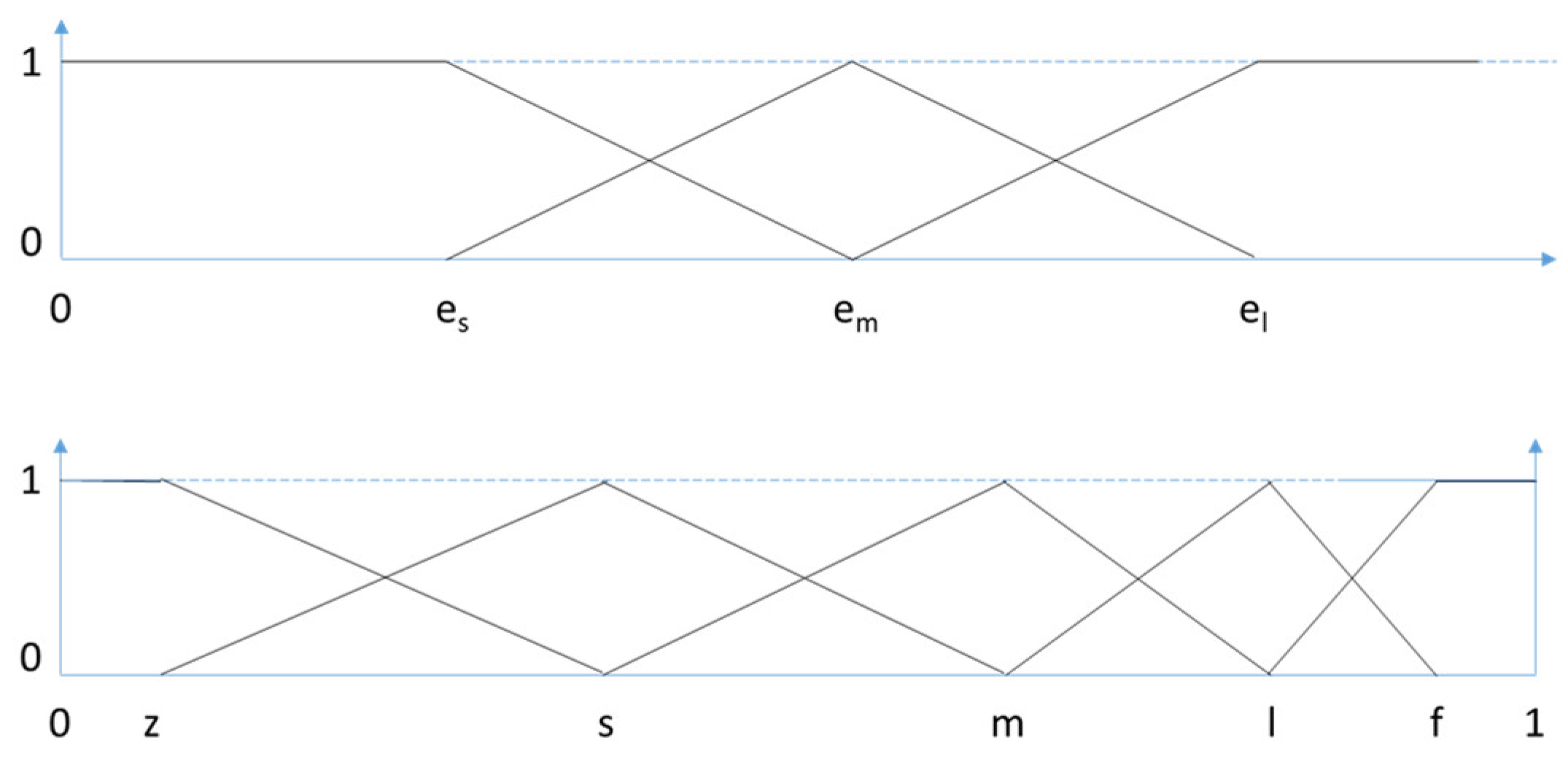
The membership function of the two inputs in shown in
Figure 5. It is clear shown that the scale design of
u0 is asymmetric. This is because of the best duty of the motors should be put in the m scale to keep a good operating space.
Table 1 is the rules to determine to increase or decrease the gain of the controller in each case. The output given in five levels in each case are: heavy increasing (HI), smooth increasing (SI), non-change (NC), smooth reducing (SR) and heavy reducing (HR).
Finally, the controller gain can be tuned as follows:
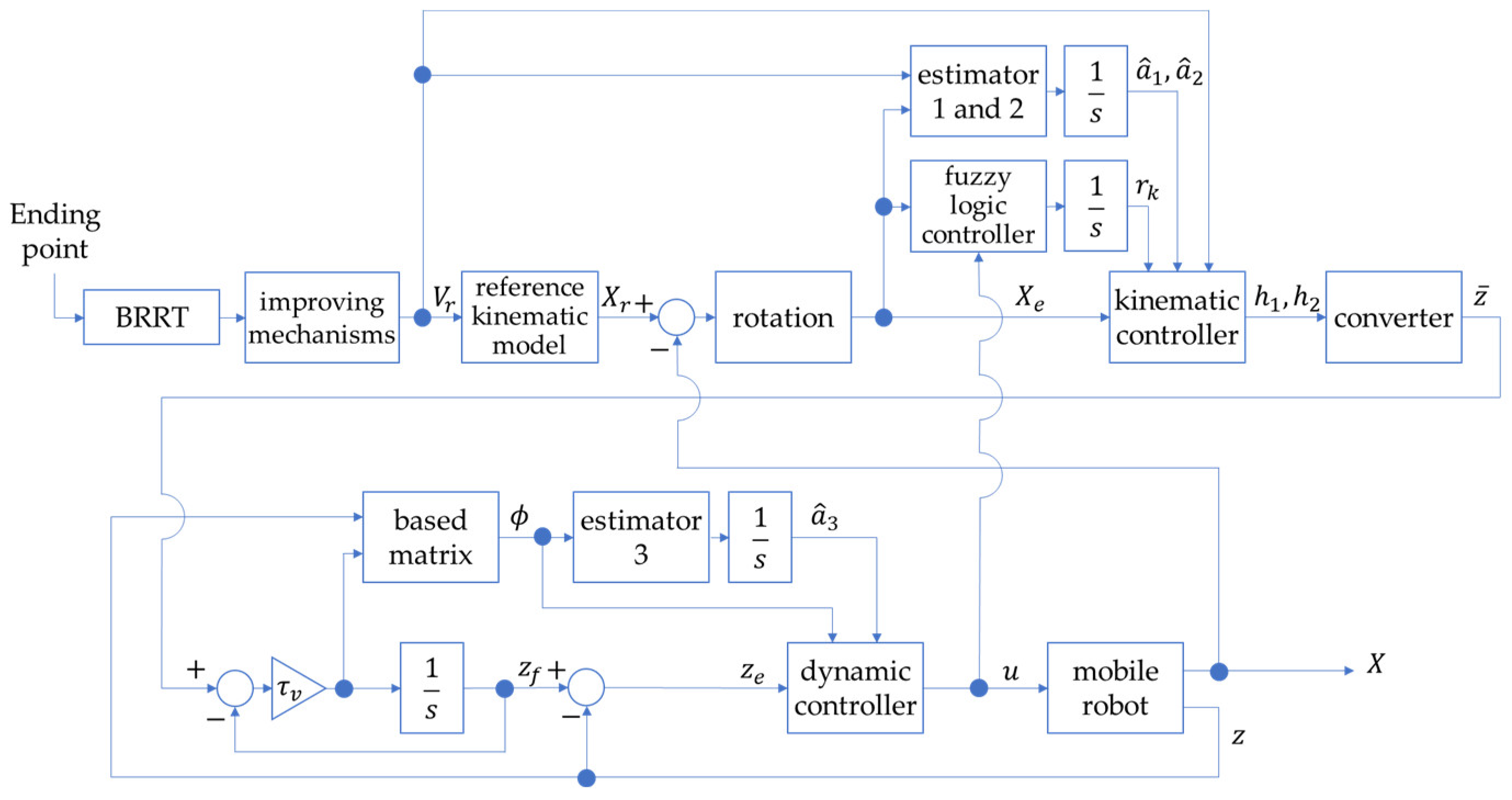
The structure diagram of proposed controller is shown on
Figure 6. The reference velocity
Vr of the virtual wheeled mobile robot and the path
Xr based on the kinematic model are obtained from path planning algorithm. The tracking error
Xe, obtained from (15) with a rotation is further provided to estimator 1 and 2 in (29) to obtain
â1 and
â2, provided to the fuzzy logic controller in (39) to obtain the gain ratio
rk, and provided to the kinematic controller in (25) with
â1,
â2,
rk, and a converter to obtain the virtual control law
. The dynamic surface control proposes
zf from
with the first-order differential equation in (31). The based matrix Φ in (34) is provided to estimator 3 to obtain
â3 in (36). Finally, the dynamic controller for the mobile robot is designed in (35) with
â3, Φ, and
ze. The gain of the kinematic controller is also adjusted by
u according to (37) and (39).
For traditional path planning algorithms, such as the A* algorithm and RRT algorithm in the grid, only the path
Xr is provided, and its differentiability is not guaranteed. Hence, some controllers, such as PD, PID, and the proposed controller, are not suitable for direct application to traditional path planning algorithms. Take the PD controller as an example: the design of orientation control is given as the following:
According to the definition of θe in (15), its time differential is obtained as ωr − ω. Because the differentiability of Xr is not guaranteed, the angular velocity of the virtual wheeled mobile robot ωr does not always exist. In this case, the time differential needs to be obtained by the numerical difference method from θe, which may cause approximation errors and the huge peak problem because of the discontinuity of orientation. However, ωr is the second state of Vr in proposed path planning algorithm, so that ωr always exists. Therefore, ub has been fully defined, so that PD controller can be easily implemented in robot control with the proposed path planning algorithm.
4.4. Obstacle Avoidance
In this section, we focus on the ability of obstacle avoidance. The pseudo-code of obstacle avoidance is shown in Algorithm 4, where
n is the number of levels.
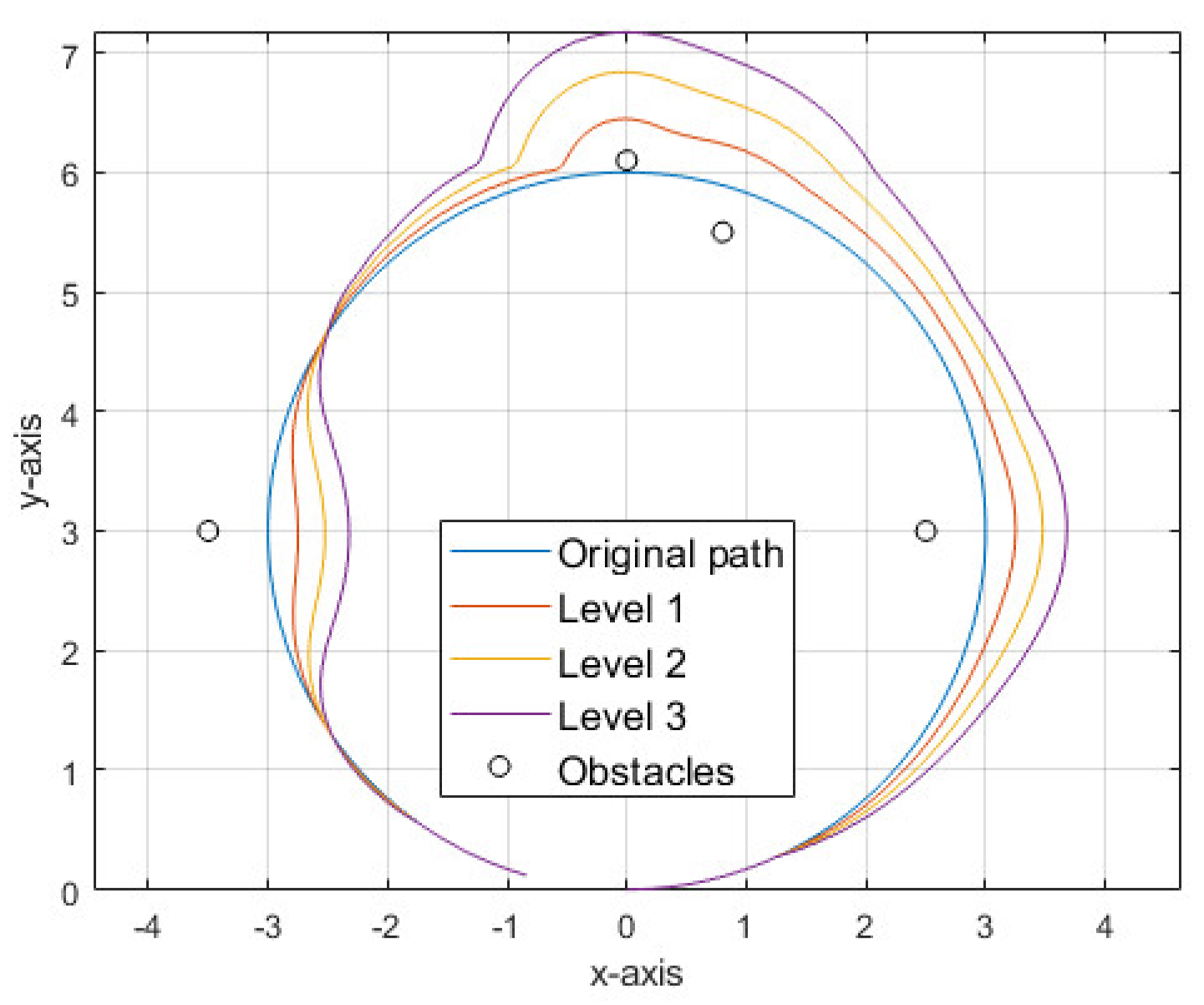
Figure 7 shows an example with four obstacles close to the original path with three obstacle avoidance levels. In this case, the obstacles are too close to the path and may cause collisions. Here, we define two parameters
d0 and
d1.
d0 is the hard-safe range so that the distance
d between the obstacles and the robot should be larger than
d0.
d1 is the soft-safe range, which is also the threshold for obstacle avoidance design to take effect.
| Algorithm4. Obstacle Avoidance |
- 1:
for i = 1 to length(Path) - 2:
for j = 1 to n - 3:
NewPath(i) = Path(i) - 4:
for k = 1 to length(Obstacles) - 5:
d = Distance(Path(i), Obstacles(k)) - 6:
theta = Orientation(Obstacles(k), Path(i)) - 7:
m = min(max(−(d − d1)/(d1 − d0), 0), 1) - 8:
NewPath(i) = NewPath(i) + m * d1 * [cos(theta), sin(theta)] - 9:
end - 10:
Path = NewPath - 11:
end - 12:
end - 13:
return NewPath
|
5. Experimental Results
The size of the map is 512 × 512 pixels and the origin is defined in the upper left corner of the map.
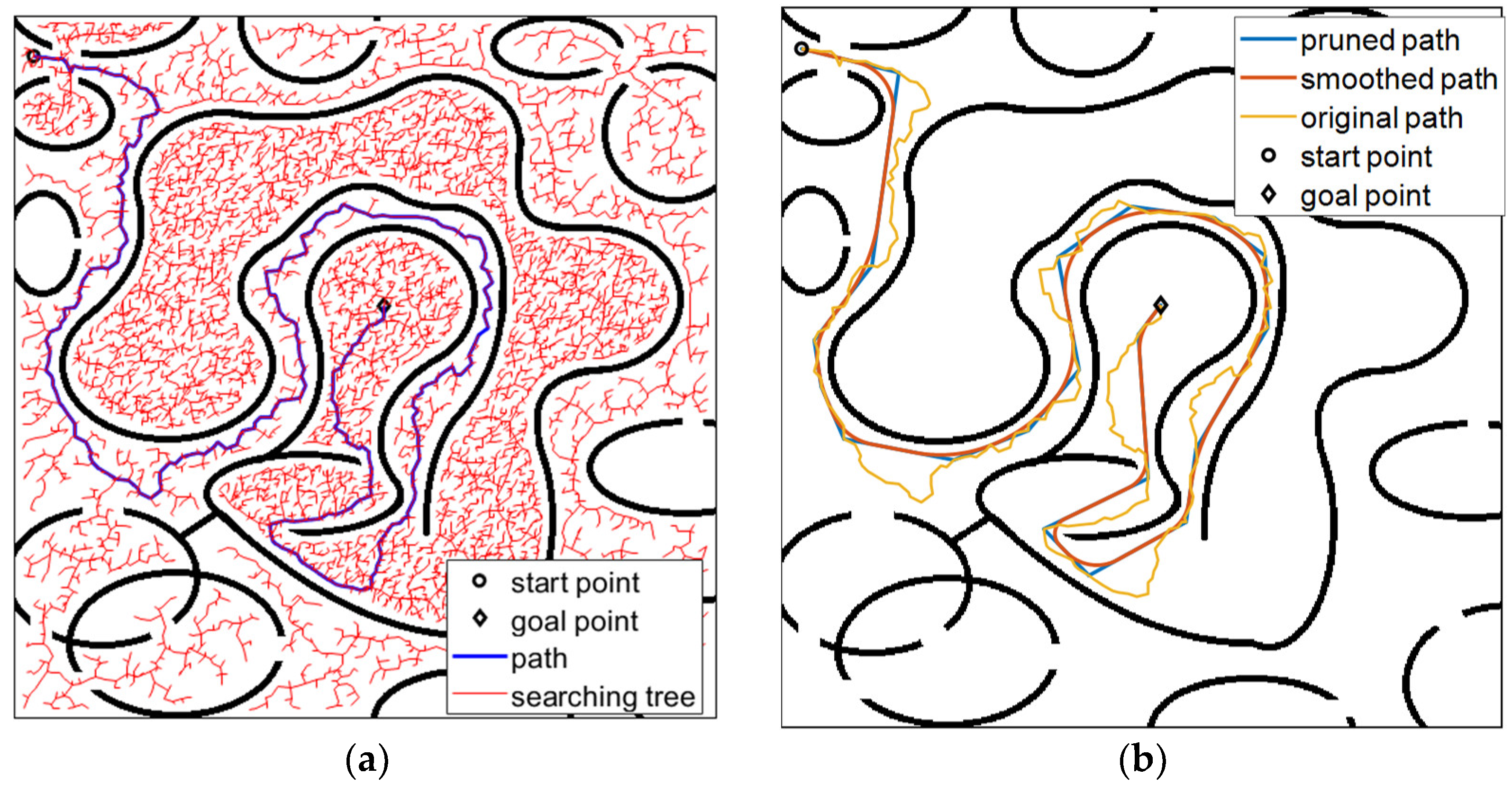
Figure 8 shows the results of path planning. In
Figure 8a, the start point is marked as a circle and located at (15, −30). The goal point is marked as a diamond and located at (270, −212). The blue polyline is the planned path by BRRT, and the red line is the tree of BRRT. Clearly, lots of unnecessary turns are included in the path. Therefore, a smoothed path is given in
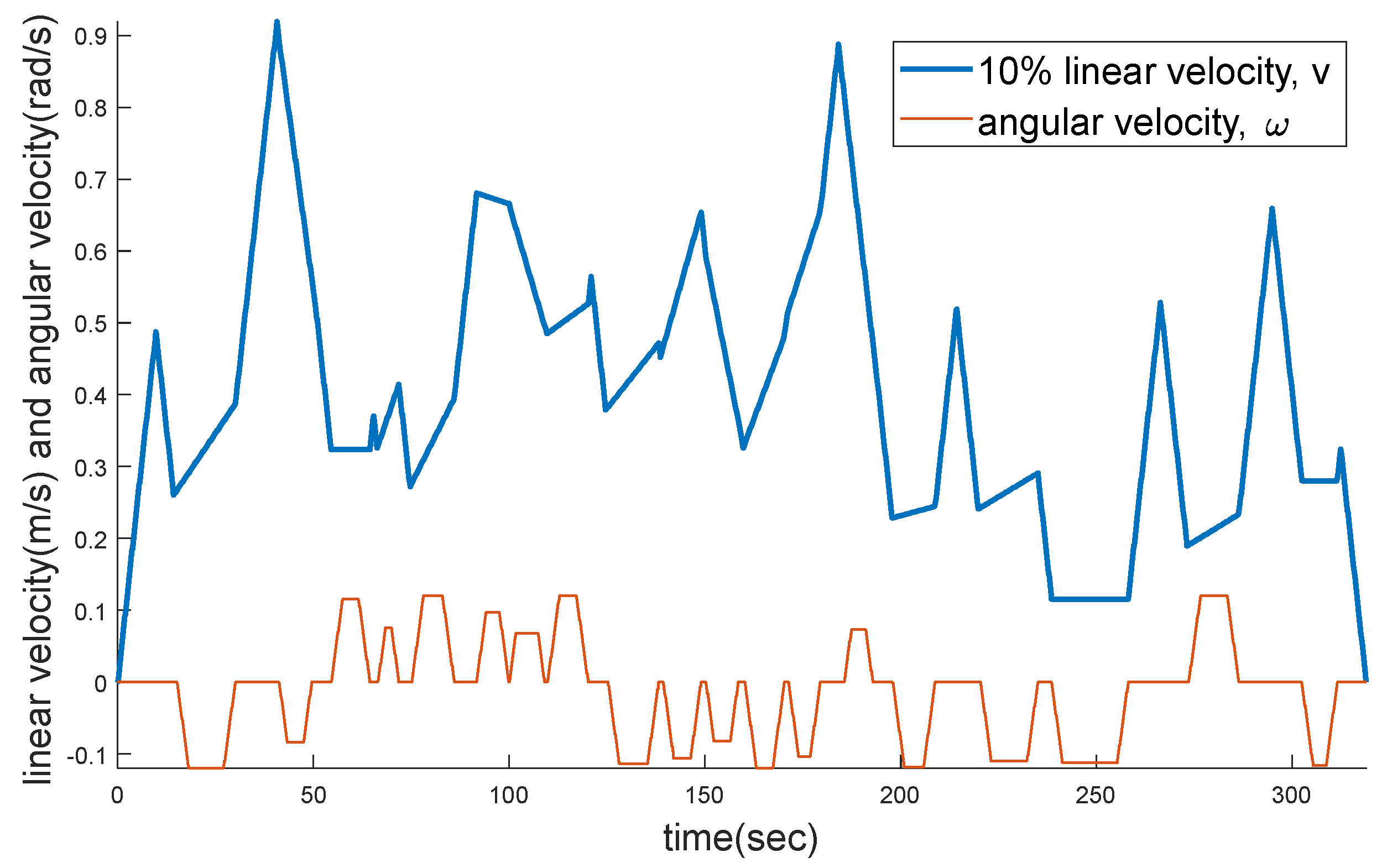
Figure 8b, including the original path by BRRT, path pruning, and path smoothing. The minimum and maximum extension distance of BRRT is set between 3 to 10. The linear and angular velocities of the smoothed path are shown in
Figure 9. The parameters of path smoothing are given in
Table 2.
In
Table 3, a 100-times test is proposed to compare the paths in different stage, which are the original path, pruned path, and smoothed path. With the mechanism of path pruning, the average length is reduced from 1640.3 m to 1357.8 m, and the number of turns is reduced from 269.69 to 22.210. Data show that a lot of unnecessary turns are removed in path pruning. Although the mechanism of path smoothing does not change the number of turns required, the continuity of the path angle is improved, and the average length is further reduced to 1284.8 m.
The proposed controller is compared with P controller, which is a simple but widely used feedback control algorithm. The controller is designed as (41). Two errors, which are expected to be suppressed by the P controller, are defined as the position error
e0 and the orientation error
e1. The controller value
ub(0) and
ub(1) are designed proportional to the error
e0 and
e1, respectively. Both
kp0 and
kp1 are the positive gains of the P controller. Just like the design of
and
, a converter is required to convert
ub to
u in (40) according to the geometric relationship between the motor angle and the robot position.
The gains of the P controller are choosing as
kp0 = 6 and
kp1 = 8. The parameters of the robot and the gains of proposed controller are given in
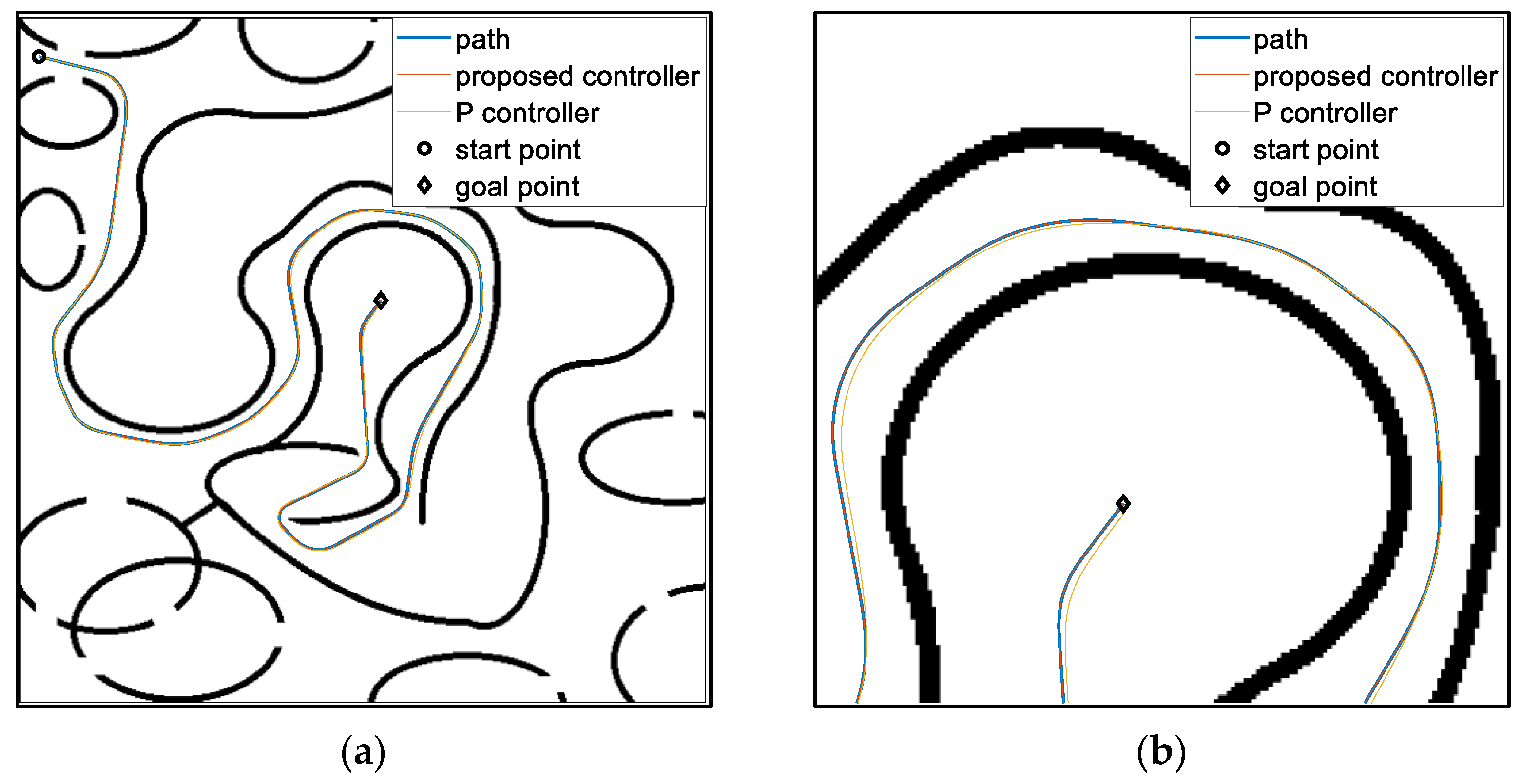
Table 4. The tracking results are shown in
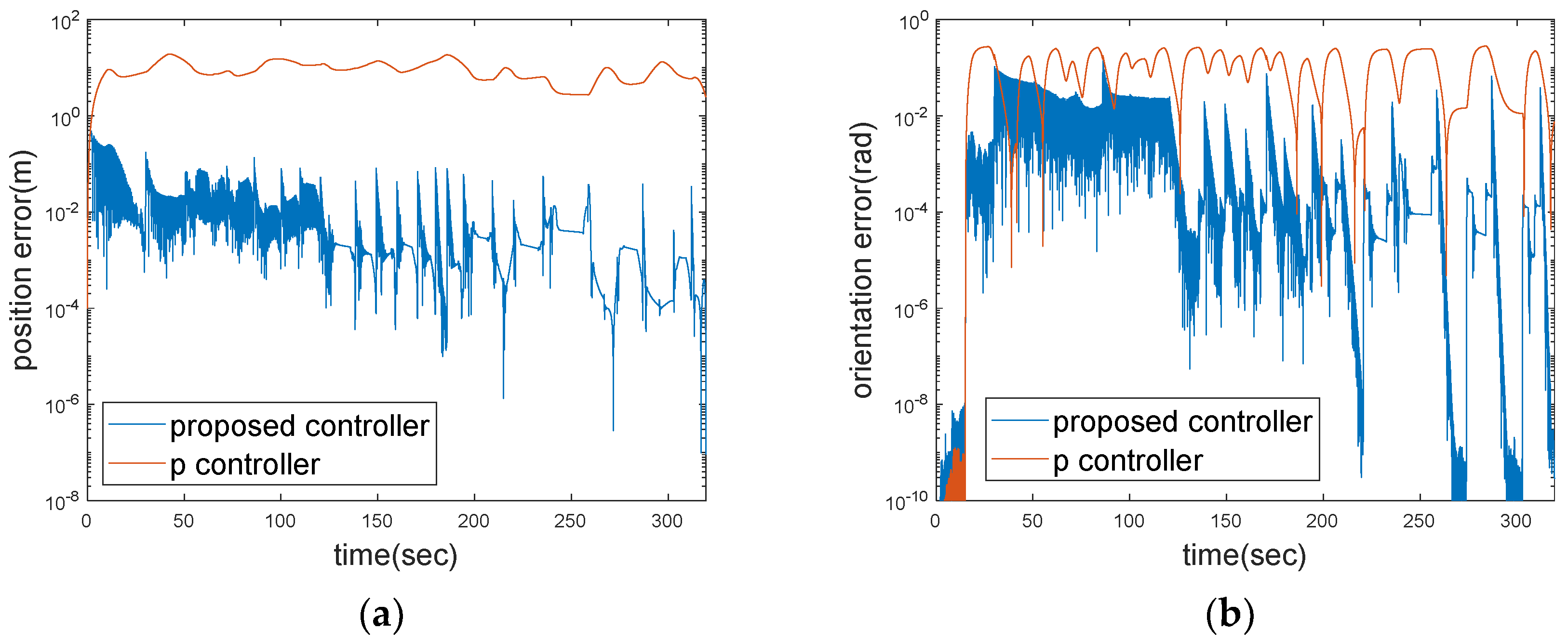
Figure 10, the tracking errors are shown in
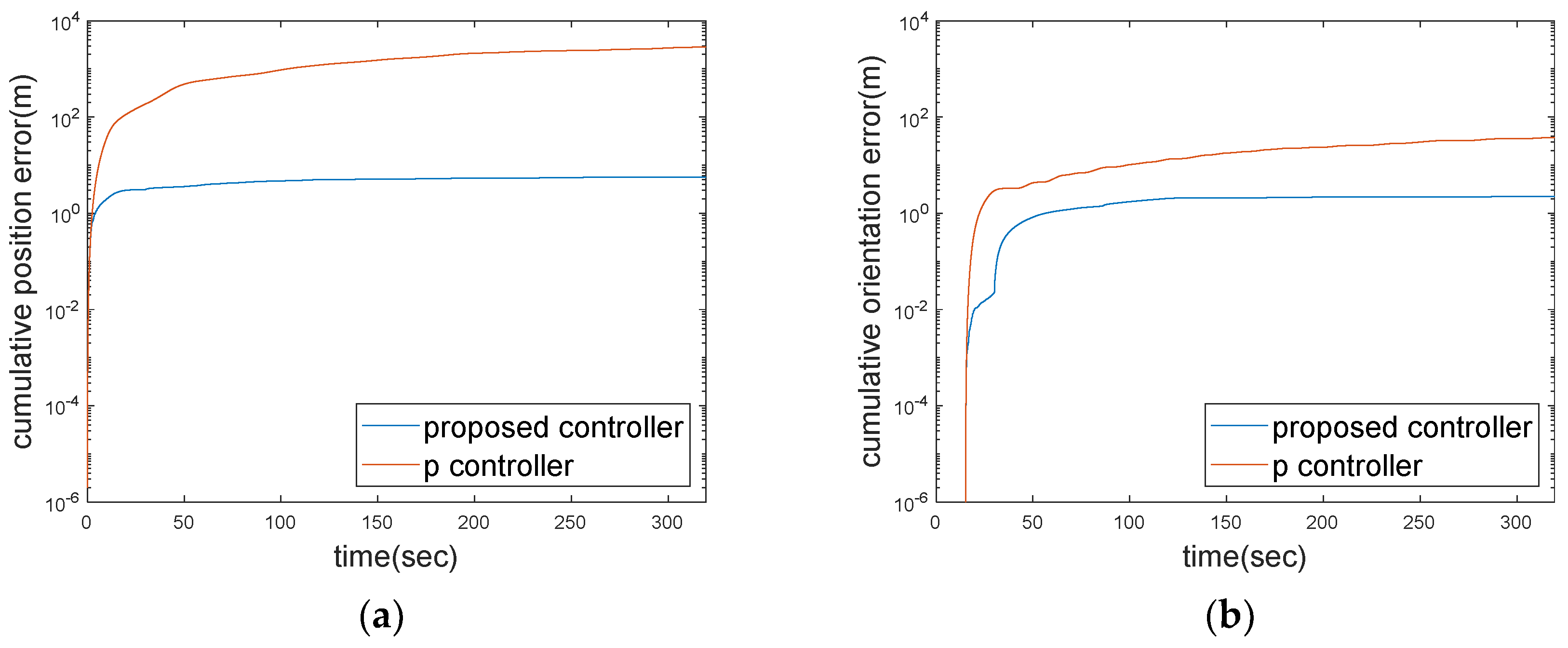
Figure 11, and the cumulative errors are shown in
Figure 12. The tracking error is defined as
e0 in (40), and the orientation error is defined as the absolute value of
e1.
Table 5 shows the average tracking errors. The results show that the controller proposed in this paper outperforms the P controller in both position and orientation errors.