

NF-κB as an Important Factor in Optimizing Poxvirus-Based Vaccines against Viral Infections

Abstract
1. Introduction
2. Poxviruses as Candidates for Vaccine Vector Design
3. Poxviral Vectors for Vaccine Applications
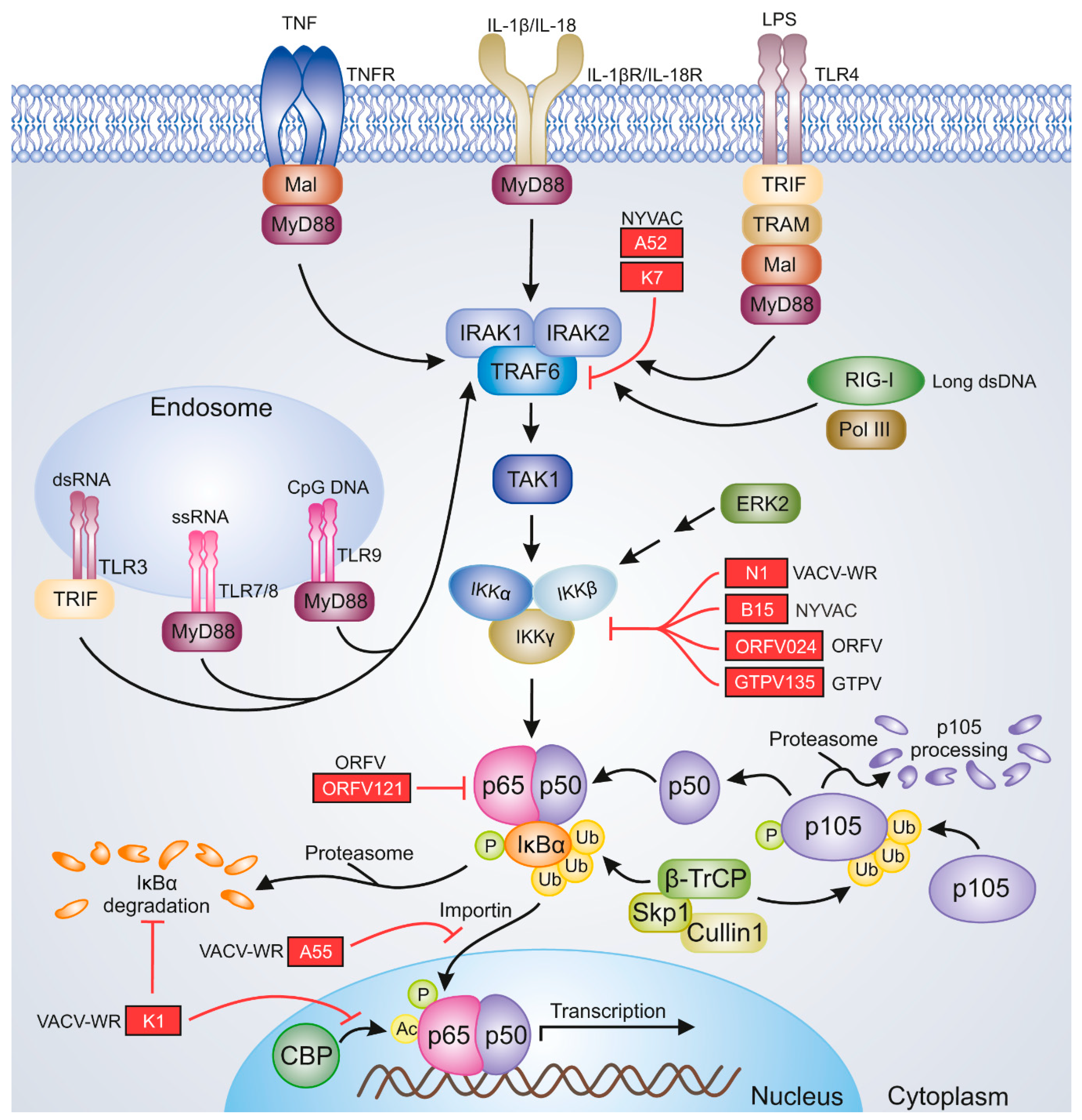
4. NF-κB Signaling
5. NF-κB in Optimization of Poxviral Vaccines
5.1. Vaccinia Virus
5.1.1. Modified VACV Ankara
5.1.2. New York VACV
5.1.3. VACV Western Reserve
5.2. Orf Virus
ORFV-IA82
5.3. Goatpox Virus
GTPV-AV41
6. Conclusions
Author Contributions
Funding
Conflicts of Interest
Abbreviations
| VARV | variola virus |
| VACV | vaccinia virus |
| ORFV | orf virus |
| GTPV | goatpox virus |
| MV | mature virus |
| EV | extracellular virus |
| ORF | open reading frame |
| TK | thymidine kinase |
| ITR | inverted terminal repetition |
| IFN | interferon |
| STING | stimulator of IFN genes |
| cGAS | cyclic GMP-AMP synthase |
| DNA-PK | DNA-dependent protein kinase |
| IFI16 | IFN-γ-inducible protein 16 |
| TNF | tumor necrosis factor |
| TNFR | TNF receptor |
| TRAF | TNFR-associated factor |
| NF-κB | nuclear factor kappa-light-chain-enhancer of activated B cells |
| TANK | TRAF family member-associated NF-κB activator |
| TBK1 | TANK-binding kinase |
| IRF3 | IFN regulatory factor 3 |
| IκB | inhibitor κB |
| IKK | IκB kinase |
| CTL | cytotoxic T lymphocyte |
| NYCBH | New York City Board of Health |
| VACV-COP | VACV Copenhagen strain |
| cESC | chicken embryonic stem cell |
| MVA | modified VACV Ankara |
| MVA-BN | modified VACV Ankara - Bavarian Nordic |
| MPXV | monkeypox virus |
| CPXV | cowpox virus |
| CMLV | camelpox virus |
| BPSV | bovine papular stomatitis virus |
| PCPV | pseudocowpox virus |
| YMTV | Yaba monkey tumor virus |
| TPV | tanapox virus |
| RABV | rabies virus |
| V-RG | RABV glycoprotein gene |
| CHIKV | chikungunya virus |
| SCV | Sementis Copenhagen Vector |
| Ad | adenovirus |
| Ad26 | Ad serotype 26 |
| Ad26.HPV16 | Ad26 HPV16 vaccine |
| Ad26.HPV18 | Ad26 HPV18 vaccine |
| Ad26.Mos.HIV | Ad26-mosaic-HIV vaccine |
| Ad26.Mos4.HIV | Ad26-mosaic 4-HIV vaccine |
| Ad26.ZEBOV | human Ad26 expressing the Ebola virus Mayinga variant gp |
| AIDS | acquired immune deficiency syndrome |
| ATI | analytical treatment interruption |
| bNAbs | broadly neutralizing HIV-1 antibodies |
| ChAd | Chimpanzee adenovirus |
| ChAd155 | ChAd serotype 155 |
| ChAd155-hIi-HBV | ChAd HBV vaccine |
| ChAd3-hliNSmut | ChAd3 encoding NSmut linked to hli |
| ChAdOx1 | replication-deficient ChAd vector derived from isolate Y25 |
| ChAdOx1.HTI | ChAdOx1 expressing HTI |
| ChAdV63 | ChAd serotype 63 |
| ChAdV63.HIVconsv | ChAdV63 expressing HIVconsv |
| CMV | cytomegalovirus |
| DNA.HTI | plasmid DNA expressing HTI |
| gp | glycoprotein |
| gp140 DP | gp140 drug product |
| GS-9620 | vesatolimod |
| HBc | hepatitis B core antigen |
| HBc-HBs/AS01B-4 | HBV vaccine |
| HBs | hepatitis B surface antigen |
| HBV | hepatitis B virus |
| HCT | hematopoietic cell transplantation |
| HIV | human immunodeficiency virus |
| HIV-1 | HIV type 1 |
| HIVcons | HIV conserved antigenic regions |
| hli | human invariant chain |
| HPV | human papillomavirus |
| HPV16/18 | human papillomavirus type 16/18 |
| HTI | HIVACAT T cell immunogen |
| IL-12 | interleukin-12 |
| M1 | matrix protein |
| MenACWY | meningococcal ACWY-tetanus toxoid conjugate vaccine |
| MVA.HIVconsv | MVA expressing HIVconsv |
| MVA.HPV16/18 | MVA HPV16/18 vaccine |
| MVA.HTI | MVA expressing HTI |
| MVA.tHIVconsv3 | MVA-based T-cell vaccine expressing novel HIV-1 immunogens |
| MVA.tHIVconsv4 | MVA-based T-cell vaccine expressing novel HIV-1 immunogens |
| MVA62B | MVA component—encoding HIV-1 Gag, protease, reverse transcriptase, and envelope gp160 |
| MVA-BN-Filo | MVA-BN-Filo vector |
| MVA-HBV | MVA HBV vaccine |
| MVA-hliNSmut | MVA encoding NSmut linked to hli |
| MVA-mosaic | MVA mosaic HIV vaccine |
| MVA-NP + M1 | MVA encoding NP and M1 |
| NP | nucleoprotein |
| NSmut | HCV nonstructural immunogen |
| p24CE + p55gag | DNA vaccines expressing p24CE and p55gag immunogens |
| rVSVΔG-ZEBOV-GP | recombinant VSV–Zaire Ebola virus gp |
| TLR9 | Toll-like receptor 9 |
| VRC07, 10-1074 | anti-HIV-1 bNAbs |
| VSV | vesicular stomatitis virus |
| NLS | nuclear localization sequence |
| IL-1β | interleukin-1β |
| IL-18 | interleukin-18 |
| TNF-α | tumor necrosis factor-α |
| PRR | pattern recognition receptor |
| RIG-I | retinoic acid-inducible gene-I |
| TGF-β | transforming growth factor-β |
| TAK1 | TGF-β-activated kinase 1 |
| Skp1 | S-phase kinase-associated protein 1 |
| SCF | Skp1-Cul1-F-box |
| β-TrCP | β-transducin repeat-containing protein |
| NIK | NF-κB-inducing kinase |
| Ac | acetyl group |
| CBP | CREB-binding protein |
| CpG | cytosine–guanine dinucleotide |
| ERK2 | extracellular signal-regulated kinase 2 |
| IKKα | IκB kinase α |
| IKKβ | IκB kinase β |
| IKKγ | IκB kinase γ |
| IL-18R | IL-18 receptor |
| IL-1βR | IL-1β receptor |
| IRAK1 | IL-1R-associated kinase 1 |
| IRAK2 | IL-1R-associated kinase 2 |
| LPS | lipopolysaccharide |
| Mal | MyD88-adapter-like |
| MyD88 | myeloid differentiation primary response gene 88 |
| P | phosphate group |
| Pol III | polymerase III |
| TLR3 | Toll-like receptor 3 |
| TLR4 | Toll-like receptor 4 |
| TLR7 | Toll-like receptor 7 |
| TLR8 | Toll-like receptor 8 |
| TRAM | TRIF-related adapter molecule |
| TRIF | Toll-IL-1R-domain-containing adapter-inducing interferon-β |
| Ub | Ub-ubiquitin moieties |
| VACV-WR | VACV Western Reserve strain |
| β-TrCP | β-transducin repeat-containing protein |
| CVA | chorioallantois VACV Ankara strain |
| IL-1BP | IL-1 binding protein |
| Bcl-2 | B-cell lymphoma 2 |
| VGF | VACV growth factor |
| EGFR | epidermal growth factor receptor |
| HEK 293T | human embryonic kidney 293 cells transformed with large T antigen |
| CHO | Chinese hamster ovary cells |
| RK13 | rabbit kidney 13 cells |
| CPXV-BR | CPXV Brighton Red strain |
| ANK | ankyrin repeat |
| MYXV | myxoma virus |
| MEFs | mouse embryonic fibroblasts |
| PKR | protein kinase R |
| MEK | mitogen-activated protein kinase kinase |
| APC | antigen presenting cell |
| ATF3 | activating transcription factor 3 |
| MDDC | monocyte-derived dendritic cell |
| gp120 | glycoprotein 120 |
| GPN | Gag-Pol-Nef |
| MHCII | major histocompatibility complex class II |
| NK | natural killer cell |
| BBK | BTB-BACK-Kelch |
| PRV | pseudorabies virus |
| RHDV | rabbit hemorrhagic disease virus |
| D1701-V-RabG | recombinant D1701 ORFV strain expressing RABV glycoprotein |
| D1701-V-HAh5n | recombinant D1701 ORFV strain expressing H5 hemagglutinin |
| VIR | viral IFN resistance |
| PEDV | porcine epidemic diarrhea virus |
| S | spike protein |
| ORFV-PEDV-S | |
| ORFVΔ024RABV-G | ORFV Δ024 mutant expressing RABV glycoprotein |
| ORFVΔ121RABV-G | ORFV Δ121 mutant expressing RABV glycoprotein |
| PPRV | peste des petis ruminants virus |
References
- Virus Taxonomy: 2019 Release. Available online: https://talk.ictvonline.org/ (accessed on 20 November 2020).
- Babkin, I.V.; Babkina, I.N. The origin of the variola virus. Viruses 2015, 7, 1100–1112. [Google Scholar] [CrossRef] [PubMed]
- Shchelkunova, G.A.; Shchelkunov, S.N. 40 Years without Smallpox. Acta Naturae 2017, 9, 4–12. [Google Scholar] [CrossRef] [PubMed]
- Buller, R.M.L. Poxviruses. In Infectious Diseases, 4th ed.; Cohen, J., Powderly, W.G., Opal, S.M., Eds.; Elsevier: Amsterdam, The Netherlands, 2017; pp. 1452–1457.e1. [Google Scholar] [CrossRef]
- Burrell, C.J.; Howard, C.R.; Murphy, F.A. (Eds.) Poxviruses. In Fenner and White’s Medical Virology, 5th ed.; Academic Press: London, UK, 2017; pp. 229–236. [Google Scholar] [CrossRef]
- Condit, R.C.; Moussatche, N. The vaccinia virus E6 protein influences virion protein localization during virus assembly. Virology 2015, 482, 147–156. [Google Scholar] [CrossRef] [PubMed]
- El-Jesr, M.; Teir, M.; Maluquer de Motes, C. Vaccinia virus activation and antagonism of cytosolic DNA sensing. Front. Immunol. 2020, 11, 568412. [Google Scholar] [CrossRef] [PubMed]
- Lu, Y.; Zhang, L. DNA-sensing antiviral innate immunity in poxvirus infection. Front. Immunol. 2020, 11, 1637. [Google Scholar] [CrossRef] [PubMed]
- Reynolds, M.G.; Guagliardo, S.A.J.; Nakazawa, Y.J.; Doty, J.B.; Mauldin, M.R. Understanding orthopoxvirus host range and evolution: From the enigmatic to the usual suspects. Curr. Opin. Virol. 2018, 28, 108–115. [Google Scholar] [CrossRef]
- McFadden, G. Poxvirus tropism. Nat. Rev. Microbiol. 2005, 3, 201–213. [Google Scholar] [CrossRef]
- Haller, S.L.; Peng, C.; McFadden, G.; Rothenburg, S. Poxviruses and the evolution of host range and virulence. Infect. Genet. Evol. 2014, 21, 15–40. [Google Scholar] [CrossRef]
- Okeke, M.I.; Okoli, A.S.; Diaz, D.; Offor, C.; Oludotun, T.G.; Tryland, M.; Bøhn, T.; Moens, U. Hazard characterization of modified vaccinia virus Ankara vector: What are the knowledge gaps? Viruses 2017, 9, 318. [Google Scholar] [CrossRef]
- García-Arriaza, J.; Esteban, M. Enhancing poxvirus vectors vaccine immunogenicity. Hum. Vaccines Immunother. 2014, 10, 2235–2244. [Google Scholar] [CrossRef]
- Prow, N.A.; Jimenez Martinez, R.; Hayball, J.D.; Howley, P.M.; Suhrbier, A. Poxvirus-based vector systems and the potential for multi-valent and multi-pathogen vaccines. Expert Rev. Vaccines 2018, 17, 925–934. [Google Scholar] [CrossRef] [PubMed]
- Walsh, S.R.; Wilck, M.B.; Dominguez, D.J.; Zablowsky, E.; Bajimaya, S.; Gagne, L.S.; Verrill, K.A.; Kleinjan, J.A.; Patel, A.; Zhang, Y.; et al. Safety and immunogenicity of modified vaccinia Ankara in hematopoietic stem cell transplant recipients: A randomized, controlled trial. J. Infect. Dis. 2013, 207, 1888–1897. [Google Scholar] [CrossRef] [PubMed]
- Moss, B. Poxviridae: The viruses and their replication. In Fields Virology, 5th ed.; Knipe, D.M., Howley, P.M., Griffin, D.E., Lamb, R.A., Martin, M.A., Roizman, B., Straus, S.E., Eds.; Lippincott Williams & Wilkins: Philadelphia, PA, USA, 2007; pp. 2905–2946. [Google Scholar]
- Van Vliet, K.; Mohamed, M.R.; Zhang, L.; Villa, N.Y.; Werden, S.J.; Liu, J.; McFadden, G. Poxvirus proteomics and virus-host protein interactions. Microbiol. Mol. Biol. Rev. 2009, 73, 730–749. [Google Scholar] [CrossRef] [PubMed]
- Smith, G.L.; Talbot-Cooper, C.; Lu, Y. How does vaccinia virus interfere with interferon? Adv. Virus Res. 2018, 100, 355–378. [Google Scholar] [CrossRef]
- Meade, N.; DiGiuseppe, S.; Walsh, D. Translational control during poxvirus infection. Wiley Interdiscip. Rev. RNA 2019, 10, e1515. [Google Scholar] [CrossRef]
- Mercer, J.; Knébel, S.; Schmidt, F.I.; Crouse, J.; Burkard, C.; Helenius, A. Vaccinia virus strains use distinct forms of macropinocytosis for host-cell entry. Proc. Natl. Acad. Sci. USA 2010, 107, 9346–9351. [Google Scholar] [CrossRef]
- Odom, M.R.; Hendrickson, R.C.; Lefkowitz, E.J. Poxvirus protein evolution: Family wide assessment of possible horizontal gene transfer events. Virus Res. 2009, 144, 233–249. [Google Scholar] [CrossRef]
- Laliberte, J.P.; Moss, B. Lipid membranes in poxvirus replication. Viruses 2010, 2, 972–986. [Google Scholar] [CrossRef]
- Schmidt, F.I.; Bleck, C.K.; Mercer, J. Poxvirus host cell entry. Curr. Opin. Virol. 2012, 2, 20–27. [Google Scholar] [CrossRef]
- Moss, B. Poxvirus DNA replication. Cold Spring Harb. Perspect. Biol. 2013, 5, a010199. [Google Scholar] [CrossRef]
- Liu, L.; Cooper, T.; Howley, P.M.; Hayball, J.D. From crescent to mature virion: Vaccinia virus assembly and maturation. Viruses 2014, 6, 3787–3808. [Google Scholar] [CrossRef] [PubMed]
- Giotis, E.S.; Montillet, G.; Pain, B.; Skinner, M.A. Chicken embryonic-stem cells are permissive to poxvirus recombinant vaccine vectors. Genes 2019, 10, 237. [Google Scholar] [CrossRef] [PubMed]
- Hughes, A.L.; Irausquin, S.; Friedman, R. The evolutionary biology of poxviruses. Infect. Genet. Evol. 2010, 10, 50–59. [Google Scholar] [CrossRef] [PubMed]
- Pittman, P.R.; Hahn, M.; Lee, H.S.; Koca, C.; Samy, N.; Schmidt, D.; Hornung, J.; Weidenthaler, H.; Heery, C.R.; Meyer, T.P.H.; et al. Phase 3 efficacy trial of modified vaccinia Ankara as a vaccine against smallpox. N. Engl. J. Med. 2019, 381, 1897–1908. [Google Scholar] [CrossRef]
- Voigt, E.A.; Kennedy, R.B.; Poland, G.A. Defending against smallpox: A focus on vaccines. Expert Rev. Vaccines 2016, 15, 1197–1211. [Google Scholar] [CrossRef]
- Nagata, L.P.; Irwin, C.R.; Hu, W.G.; Evans, D.H. Vaccinia-based vaccines to biothreat and emerging viruses. Biotechnol. Genet. Eng. Rev. 2018, 34, 107–121. [Google Scholar] [CrossRef]
- Shchelkunov, S.N. An increasing danger of zoonotic orthopoxvirus infections. PLoS Pathog. 2013, 9, e1003756. [Google Scholar] [CrossRef]
- Albarnaz, J.D.; Torres, A.A.; Smith, G.L. Modulating vaccinia virus immunomodulators to improve immunological memory. Viruses 2018, 10, 101. [Google Scholar] [CrossRef]
- Beer, E.M.; Rao, V.B. A systematic review of the epidemiology of human monkeypox outbreaks and implications for outbreak strategy. PLoS Negl. Trop. Dis. 2019, 13, e0007791. [Google Scholar] [CrossRef]
- Yinka-Ogunleye, A.; Aruna, O.; Dalhat, M.; Ogoina, D.; McCollum, A.; Disu, Y.; Mamadu, I.; Akinpelu, A.; Ahmad, A.; Burga, J.; et al. Outbreak of human monkeypox in Nigeria in 2017–18: A clinical and epidemiological report. Lancet Infect. Dis. 2019, 19, 872–879. [Google Scholar] [CrossRef]
- de Assis, F.L.; Vinhote, W.M.; Barbosa, J.D.; de Oliveira, C.H.; de Oliveira, C.M.; Campos, K.F.; Silva, N.S.; Trindade Gde, S.; Abrahão, J.S.; Kroon, E.G. Reemergence of vaccinia virus during zoonotic outbreak, Pará State, Brazil. Emerg. Infect. Dis. 2013, 19, 2017–2020. [Google Scholar] [CrossRef] [PubMed]
- Abrahão, J.S.; Campos, R.K.; Trindade Gde, S.; Guimarães da Fonseca, F.; Ferreira, P.C.; Kroon, E.G. Outbreak of severe zoonotic vaccinia virus infection, Southeastern Brazil. Emerg. Infect. Dis. 2015, 21, 695–698. [Google Scholar] [CrossRef] [PubMed]
- Peres, M.G.; Bacchiega, T.S.; Appolinário, C.M.; Vicente, A.F.; Mioni, M.S.R.; Ribeiro, B.L.D.; Fonseca, C.R.S.; Pelícia, V.C.; Ferreira, F.; Oliveira, G.P.; et al. Vaccinia virus in blood samples of humans, domestic and wild mammals in Brazil. Viruses 2018, 10, 42. [Google Scholar] [CrossRef] [PubMed]
- Antwerpen, M.H.; Georgi, E.; Nikolic, A.; Zoeller, G.; Wohlsein, P.; Baumgärtner, W.; Peyrefitte, C.; Charrel, R.; Meyer, H. Use of Next Generation Sequencing to study two cowpox virus outbreaks. PeerJ. 2019, 7, e6561. [Google Scholar] [CrossRef] [PubMed]
- Khalafalla, A.I.; Abdelazim, F. Human and dromedary camel infection with camelpox virus in Eastern Sudan. Vector Borne Zoonotic Dis. 2017, 17, 281–284. [Google Scholar] [CrossRef] [PubMed]
- Oliveira, G.P.; Rodrigues, R.A.L.; Lima, M.T.; Drumond, B.P.; Abrahão, J.S. Poxvirus host range genes and virus-host spectrum: A critical review. Viruses 2017, 9, 331. [Google Scholar] [CrossRef] [PubMed]
- Prow, N.A.; Liu, L.; McCarthy, M.K.; Walters, K.; Kalkeri, R.; Geiger, J.; Koide, F.; Cooper, T.H.; Eldi, P.; Nakayama, E.; et al. The vaccinia virus based Sementis Copenhagen Vector vaccine against Zika and chikungunya is immunogenic in non-human primates. NPJ Vaccines 2020, 5, 44. [Google Scholar] [CrossRef]
- Zhang, Y.; Han, J.C.; Jing, J.; Liu, H.; Zhang, H.; Li, Z.H.; Jin, N.Y.; Lu, H.J. Construction and immunogenicity of recombinant vaccinia virus vaccine against Japanese encephalitis and chikungunya viruses infection in mice. Vector Borne Zoonotic Dis. 2020, 20, 788–796. [Google Scholar] [CrossRef]
- Julander, J.G.; Testori, M.; Cheminay, C.; Volkmann, A. Immunogenicity and protection after vaccination with a modified vaccinia virus Ankara-vectored yellow fever vaccine in the hamster model. Front. Immunol. 2018, 9, 1756. [Google Scholar] [CrossRef]
- Garanzini, D.; Del Médico-Zajac, M.P.; Calamante, G. Development of recombinant canarypox viruses expressing immunogens. Methods Mol. Biol. 2017, 1581, 15–28. [Google Scholar] [CrossRef]
- Townsend, D.G.; Trivedi, S.; Jackson, R.J.; Ranasinghe, C. Recombinant fowlpox virus vector-based vaccines: Expression kinetics, dissemination and safety profile following intranasal delivery. J. Gen. Virol. 2017, 98, 496–505. [Google Scholar] [CrossRef] [PubMed]
- Liu, F.; Zhang, H.; Liu, W. Construction of recombinant capripoxviruses as vaccine vectors for delivering foreign antigens: Methodology and application. Comp. Immunol. Microbiol. Infect. Dis. 2019, 65, 181–188. [Google Scholar] [CrossRef] [PubMed]
- Reemers, S.; Peeters, L.; van Schijndel, J.; Bruton, B.; Sutton, D.; van der Waart, L.; van de Zande, S. Novel trivalent vectored vaccine for control of myxomatosis and disease caused by classical and a new genotype of rabbit haemorrhagic disease virus. Vaccines 2020, 8, 441. [Google Scholar] [CrossRef] [PubMed]
- Reguzova, A.; Ghosh, M.; Müller, M.; Rziha, H.J.; Amann, R. Orf virus-based vaccine vector D1701-V induces strong CD8+ T cell response against the transgene but not against ORFV-derived epitopes. Vaccines 2020, 8, 295. [Google Scholar] [CrossRef] [PubMed]
- Fan, H.J.; Lin, H.X. Recombinant swinepox virus for veterinary vaccine development. In Vaccine Technologies for Veterinary Viral Diseases. Methods in Molecular Biology; Brun, A., Ed.; Humana Press: New York, NY, USA, 2016; Volume 1349, pp. 163–175. [Google Scholar] [CrossRef]
- Zhang, Q.; Lenardo, M.J.; Baltimore, D. 30 Years of NF-κB: A blossoming of relevance to human pathobiology. Cell 2017, 168, 37–57. [Google Scholar] [CrossRef]
- Beg, A.A.; Ruben, S.M.; Scheinman, R.I.; Haskill, S.; Rosen, C.A.; Baldwin, A.S., Jr. IκB interacts with the nuclear localization sequences of the subunits of NF-κB: A mechanism for cytoplasmic retention. Genes Dev. 1992, 6, 1899–1913. [Google Scholar] [CrossRef]
- Brady, G.; Bowie, A.G. Innate immune activation of NFκB and its antagonism by poxviruses. Cytokine Growth Factor Rev. 2014, 25, 611–620. [Google Scholar] [CrossRef]
- Traenckner, E.B.; Pahl, H.L.; Henkel, T.; Schmidt, K.N.; Wilk, S.; Baeuerle, P.A. Phosphorylation of human IκB-α on serines 32 and 36 controls IκB-α proteolysis and NF-κB activation in response to diverse stimuli. EMBO J. 1995, 14, 2876–2883. [Google Scholar] [CrossRef]
- Collins, P.E.; Mitxitorena, I.; Carmody, R.J. The ubiquitination of NF-κB subunits in the control of transcription. Cells 2016, 5, 23. [Google Scholar] [CrossRef]
- Sun, S.C. The non-canonical NF-κB pathway in immunity and inflammation. Nat. Rev. Immunol. 2017, 17, 545–558. [Google Scholar] [CrossRef]
- Liu, T.; Zhang, L.; Joo, D.; Sun, S.C. NF-κB signaling in inflammation. Signal Transduct. Target. Ther. 2017, 2, 17023. [Google Scholar] [CrossRef] [PubMed]
- Gray, C.M.; Remouchamps, C.; McCorkell, K.A.; Solt, L.A.; Dejardin, E.; Orange, J.S.; May, M.J. Noncanonical NF-κB signaling is limited by classical NF-κB activity. Sci. Signal. 2014, 7, ra13. [Google Scholar] [CrossRef] [PubMed][Green Version]
- Mohamed, M.R.; McFadden, G. NFκB inhibitors: Strategies from poxviruses. Cell Cycle 2009, 8, 3125–3132. [Google Scholar] [CrossRef] [PubMed]
- Lima, M.T.; Oliveira, G.P.; Afonso, J.; Souto, R.; de Mendonça, C.L.; Dantas, A.; Abrahao, J.S.; Kroon, E.G. An update on the known host range of the Brazilian vaccinia virus: An outbreak in buffalo calves. Front. Microbiol. 2019, 9, 3327. [Google Scholar] [CrossRef]
- Silva, D.C.; Moreira-Silva, E.A.; Gomes, J.D.A.S.; Fonseca, F.G.; Correa-Oliveira, R. Clinical signs, diagnosis, and case reports of Vaccinia virus infections. Braz. J. Infect. Dis. 2010, 14, 129–134. [Google Scholar] [CrossRef]
- Meisinger-Henschel, C.; Schmidt, M.; Lukassen, S.; Linke, B.; Krause, L.; Konietzny, S.; Goesmann, A.; Howley, P.; Chaplin, P.; Suter, M.; et al. Genomic sequence of chorioallantois vaccinia virus Ankara, the ancestor of modified vaccinia virus Ankara. J. Gen. Virol. 2007, 88, 3249–3259. [Google Scholar] [CrossRef]
- von Sonnenburg, F.; Perona, P.; Darsow, U.; Ring, J.; von Krempelhuber, A.; Vollmar, J.; Roesch, S.; Baedeker, N.; Kollaritsch, H.; Chaplin, P. Safety and immunogenicity of modified vaccinia Ankara as a smallpox vaccine in people with atopic dermatitis. Vaccine 2014, 32, 5696–5702. [Google Scholar] [CrossRef]
- Zitzmann-Roth, E.M.; von Sonnenburg, F.; de la Motte, S.; Arndtz-Wiedemann, N.; von Krempelhuber, A.; Uebler, N.; Vollmar, J.; Virgin, G.; Chaplin, P. Cardiac safety of Modified Vaccinia Ankara for vaccination against smallpox in a young, healthy study population. PLoS ONE 2015, 10, e0122653. [Google Scholar] [CrossRef]
- Overton, E.T.; Stapleton, J.; Frank, I.; Hassler, S.; Goepfert, P.A.; Barker, D.; Wagner, E.; von Krempelhuber, A.; Virgin, G.; Meyer, T.P.; et al. Safety and immunogenicity of modified vaccinia Ankara-Bavarian Nordic smallpox vaccine in vaccinia-naive and experienced human immunodeficiency virus-infected individuals: An open-label, controlled clinical phase II trial. Open Forum Infect. Dis. 2015, 2, ofv040. [Google Scholar] [CrossRef]
- Mothe, B.; Climent, N.; Plana, M.; Rosàs, M.; Jiménez, J.L.; Muñoz-Fernández, M.Á.; Puertas, M.C.; Carrillo, J.; Gonzalez, N.; León, A.; et al. Safety and immunogenicity of a modified vaccinia Ankara-based HIV-1 vaccine (MVA-B) in HIV-1-infected patients alone or in combination with a drug to reactivate latent HIV-1. J. Antimicrob. Chemother. 2015, 70, 1833–1842. [Google Scholar] [CrossRef]
- Jackson, L.A.; Frey, S.E.; El Sahly, H.M.; Mulligan, M.J.; Winokur, P.L.; Kotloff, K.L.; Campbell, J.D.; Atmar, R.L.; Graham, I.; Anderson, E.J.; et al. Safety and immunogenicity of a modified vaccinia Ankara vaccine using three immunization schedules and two modes of delivery: A randomized clinical non-inferiority trial. Vaccine 2017, 35, 1675–1682. [Google Scholar] [CrossRef] [PubMed]
- Ryerson, M.R.; Shisler, J.L. Characterizing the effects of insertion of a 5.2 kb region of a VACV genome, which contains known immune evasion genes, on MVA immunogenicity. Virus Res. 2018, 246, 55–64. [Google Scholar] [CrossRef] [PubMed]
- Volz, A.; Sutter, G. Modified vaccinia virus Ankara: History, value in basic research, and current perspectives for vaccine development. Adv. Virus Res. 2017, 97, 187–243. [Google Scholar] [CrossRef] [PubMed]
- McCoy, L.E.; Fahy, A.S.; Chen, R.A.; Smith, G.L. Mutations in modified virus Ankara protein 183 render it a non-functional counterpart of B14, an inhibitor of nuclear factor κB activation. J. Gen. Virol. 2010, 91, 2216–2220. [Google Scholar] [CrossRef]
- Martin, S.; Shisler, J.L. Early viral protein synthesis is necessary for NF-κB activation in modified vaccinia Ankara (MVA)-infected 293 T fibroblast cells. Virology 2009, 390, 298–306. [Google Scholar] [CrossRef][Green Version]
- Martin, S.; Harris, D.T.; Shisler, J. The C11R gene, which encodes the vaccinia virus growth factor, is partially responsible for MVA-induced NF-κB and ERK2 activation. J. Virol. 2012, 86, 9629–9639. [Google Scholar] [CrossRef]
- Lynch, H.E.; Ray, C.A.; Oie, K.L.; Pollara, J.J.; Petty, I.T.; Sadler, A.J.; Williams, B.R.; Pickup, D.J. Modified vaccinia virus Ankara can activate NF-κB transcription factors through a double-stranded RNA-activated protein kinase (PKR)-dependent pathway during the early phase of virus replication. Virology 2009, 391, 177–186. [Google Scholar] [CrossRef]
- Chang, S.J.; Hsiao, J.C.; Sonnberg, S.; Chiang, C.T.; Yang, M.H.; Tzou, D.L.; Mercer, A.A.; Chang, W. Poxvirus host range protein CP77 contains an F-box-like domain that is necessary to suppress NF-κB activation by tumor necrosis factor α but is independent of its host range function. J. Virol. 2009, 83, 4140–4152. [Google Scholar] [CrossRef]
- Islam, Z.; Nagampalli, R.S.K.; Fatima, M.T.; Ashraf, G.M. New paradigm in ankyrin repeats: Beyond protein-protein interaction module. Int. J. Biol. Macromol. 2018, 109, 1164–1173. [Google Scholar] [CrossRef]
- Herbert, M.H.; Squire, C.J.; Mercer, A.A. Poxviral ankyrin proteins. Viruses 2015, 7, 709–738. [Google Scholar] [CrossRef]
- Bravo Cruz, A.G.; Shisler, J.L. Vaccinia virus K1 ankyrin repeat protein inhibits NF-κB activation by preventing RelA acetylation. J. Gen. Virol. 2016, 97, 2691–2702. [Google Scholar] [CrossRef] [PubMed]
- Camus-Bouclainville, C.; Fiette, L.; Bouchiha, S.; Pignolet, B.; Counor, D.; Filipe, C.; Gelfi, J.; Messud-Petit, F. A virulence factor of myxoma virus colocalizes with NF-κB in the nucleus and interferes with inflammation. J. Virol. 2004, 78, 2510–2516. [Google Scholar] [CrossRef] [PubMed]
- Li, Y.; Meng, X.; Xiang, Y.; Deng, J. Structure function studies of vaccinia virus host range protein K1 reveal a novel functional surface for ankyrin repeat proteins. J. Virol. 2010, 84, 3331–3338. [Google Scholar] [CrossRef] [PubMed]
- Shisler, J.L.; Jin, X.L. The vaccinia virus K1L gene product inhibits host NF-κB activation by preventing IκBα degradation. J. Virol. 2004, 78, 3553–3560. [Google Scholar] [CrossRef]
- Ryerson, M.R.; Richards, M.M.; Kvansakul, M.; Hawkins, C.J.; Shisler, J.L. Vaccinia virus encodes a novel inhibitor of apoptosis that associates with the apoptosome. J. Virol. 2017, 91, e01385-17. [Google Scholar] [CrossRef]
- Guerra, S.; López-Fernández, L.A.; Pascual-Montano, A.; Nájera, J.L.; Zaballos, A.; Esteban, M. Host response to the attenuated poxvirus vector NYVAC: Upregulation of apoptotic genes and NF-κB-responsive genes in infected HeLa cells. J. Virol. 2006, 80, 985–998. [Google Scholar] [CrossRef]
- Guerra, S.; Nájera, J.L.; González, J.M.; López-Fernández, L.A.; Climent, N.; Gatell, J.M.; Gallart, T.; Esteban, M. Distinct gene expression profiling after infection of immature human monocyte-derived dendritic cells by the attenuated poxvirus vectors MVA and NYVAC. J. Virol. 2007, 81, 8707–8721. [Google Scholar] [CrossRef]
- Di Pilato, M.; Mejías-Pérez, E.; Zonca, M.; Perdiguero, B.; Gómez, C.E.; Trakala, M.; Nieto, J.; Nájera, J.L.; Sorzano, C.O.; Combadière, C.; et al. NFκB activation by modified vaccinia virus as a novel strategy to enhance neutrophil migration and HIV-specific T-cell responses. Proc. Natl Acad. Sci. USA 2015, 112, E1333–E1342. [Google Scholar] [CrossRef]
- Di Pilato, M.; Mejías-Pérez, E.; Sorzano, C.O.S.; Esteban, M. Distinct roles of vaccinia virus NF-κB inhibitor proteins A52, B15, and K7 in the immune response. J. Virol. 2017, 91, e00575-17. [Google Scholar] [CrossRef]
- Sumner, R.P.; Ren, H.; Ferguson, B.J.; Smith, G.L. Increased attenuation but decreased immunogenicity by deletion of multiple vaccinia virus immunomodulators. Vaccine 2016, 34, 4827–4834. [Google Scholar] [CrossRef]
- Maluquer de Motes, C.; Cooray, S.; Ren, H.; Almeida, G.M.; McGourty, K.; Bahar, M.W.; Stuart, D.I.; Grimes, J.M.; Graham, S.C.; Smith, G.L. Inhibition of apoptosis and NF-κB activation by vaccinia protein N1 occur via distinct binding surfaces and make different contributions to virulence. PLoS Pathog. 2011, 7, e1002430. [Google Scholar] [CrossRef] [PubMed]
- Ren, H.; Ferguson, B.J.; Maluquer de Motes, C.; Sumner, R.P.; Harman, L.E.; Smith, G.L. Enhancement of CD8(+) T-cell memory by removal of a vaccinia virus nuclear factor-κB inhibitor. Immunology 2015, 145, 34–49. [Google Scholar] [CrossRef] [PubMed]
- Bravo Cruz, A.G.; Han, A.; Roy, E.J.; Guzmán, A.B.; Miller, R.J.; Driskell, E.A.; O’Brien, W.D., Jr.; Shisler, J.L. Deletion of the K1L gene results in a vaccinia virus that is less pathogenic due to muted innate immune responses, yet still elicits protective immunity. J. Virol. 2017, 91, e00542-17. [Google Scholar] [CrossRef] [PubMed]
- Pallett, M.A.; Ren, H.; Zhang, R.Y.; Scutts, S.R.; Gonzalez, L.; Zhu, Z.; Maluquer de Motes, C.; Smith, G.L. Vaccinia Virus BBK E3 ligase adaptor A55 targets importin-dependent NF-κB activation and inhibits CD8+ T-cell memory. J. Virol. 2019, 93, e00051-19. [Google Scholar] [CrossRef] [PubMed]
- da Costa, R.A.; Cargnelutti, J.F.; Schild, C.O.; Flores, E.F.; Riet-Correa, F.; Giannitti, F. Outbreak of contagious ecthyma caused by Orf virus (Parapoxvirus ovis) in a vaccinated sheep flock in Uruguay. Braz. J. Microbiol. 2019, 50, 565–569. [Google Scholar] [CrossRef]
- Wang, R.; Wang, Y.; Liu, F.; Luo, S. Orf virus: A promising new therapeutic agent. Rev. Med. Virol. 2019, 29, e2013. [Google Scholar] [CrossRef] [PubMed]
- Bergqvist, C.; Kurban, M.; Abbas, O. Orf virus infection. Rev. Med. Virol. 2017, 27, 1–9. [Google Scholar] [CrossRef]
- Bala, J.A.; Balakrishnan, K.N.; Abdullah, A.A.; Mohamed, R.; Haron, A.W.; Jesse, F.F.A.; Noordin, M.M.; Mohd-Azmi, M.L. The re-emerging of orf virus infection: A call for surveillance, vaccination and effective control measures. Microb. Pathog. 2018, 120, 55–63. [Google Scholar] [CrossRef]
- Small, S.; Cresswell, L.; Lovatt, F.; Gummery, E.; Onyango, J.; McQuilkin, C.; Wapenaar, W. Do UK sheep farmers use orf vaccine correctly and could their vaccination strategy affect vaccine efficacy? Vet. Rec. 2019, 185, 305. [Google Scholar] [CrossRef]
- Rziha, H.J.; Rohde, J.; Amann, R. Generation and Selection of Orf Virus (ORFV) Recombinants. Methods Mol. Biol. 2016, 1349, 177–200. [Google Scholar] [CrossRef]
- Cottone, R.; Büttner, M.; Bauer, B.; Henkel, M.; Hettich, E.; Rziha, H.J. Analysis of genomic rearrangement and subsequent gene deletion of the attenuated Orf virus strain D1701. Virus Res. 1998, 56, 53–67. [Google Scholar] [CrossRef]
- Amann, R.; Rohde, J.; Wulle, U.; Conlee, D.; Raue, R.; Martinon, O.; Rziha, H.J. A new rabies vaccine based on a recombinant ORF virus (parapoxvirus) expressing the rabies virus glycoprotein. J. Virol. 2013, 87, 1618–1630. [Google Scholar] [CrossRef] [PubMed]
- Rziha, H.J.; Büttner, M.; Müller, M.; Salomon, F.; Reguzova, A.; Liable, D.; Amann, R. Genomic characterization of orf virus strain D1701-V (Parapoxvirus) and development of novel sites for multiple transgene expression. Viruses 2019, 11, 127. [Google Scholar] [CrossRef] [PubMed]
- Fischer, T.; Planz, O.; Stitz, L.; Rziha, H.J. Novel recombinant parapoxvirus vectors induce protective humoral and cellular immunity against lethal herpesvirus challenge infection in mice. J. Virol. 2003, 77, 9312–9323. [Google Scholar] [CrossRef]
- van Rooij, E.M.; Rijsewijk, F.A.; Moonen-Leusen, H.W.; Bianchi, A.T.; Rziha, H.J. Comparison of different prime-boost regimes with DNA and recombinant Orf virus based vaccines expressing glycoprotein D of pseudorabies virus in pigs. Vaccine 2010, 28, 1808–1813. [Google Scholar] [CrossRef]
- Rohde, J.; Schirrmeier, H.; Granzow, H.; Rziha, H.J. A new recombinant Orf virus (ORFV, Parapoxvirus) protects rabbits against lethal infection with rabbit hemorrhagic disease virus (RHDV). Vaccine 2011, 29, 9256–9264. [Google Scholar] [CrossRef]
- Rohde, J.; Amann, R.; Rziha, H.J. New Orf virus (Parapoxvirus) recombinant expressing H5 hemagglutinin protects mice against H5N1 and H1N1 influenza a virus. PLoS ONE 2013, 8, e83802. [Google Scholar] [CrossRef]
- Zhao, K.; He, W.; Gao, W.; Lu, H.; Han, T.; Li, J.; Zhang, X.; Zhang, B.; Wang, G.; Su, G.; et al. Orf virus DNA vaccines expressing ORFV 011 and ORFV 059 chimeric protein enhances immunogenicity. Virol. J. 2011, 8, 562. [Google Scholar] [CrossRef]
- Diel, D.G.; Delhon, G.; Luo, S.; Flores, E.F.; Rock, D.L. A novel inhibitor of the NF-κB signaling pathway encoded by the parapoxvirus orf virus. J. Virol. 2010, 84, 3962–3973. [Google Scholar] [CrossRef]
- Diel, D.G.; Luo, S.; Delhon, G.; Peng, Y.; Flores, E.F.; Rock, D.L. A nuclear inhibitor of NF-κB encoded by a poxvirus. J. Virol. 2011, 85, 264–275. [Google Scholar] [CrossRef]
- Ning, Z.; Zheng, Z.; Hao, W.; Duan, C.; Li, W.; Wang, Y.; Li, M.; Luo, S. The N terminus of orf virus-encoded protein 002 inhibits acetylation of NF-κB p65 by preventing Ser(276) phosphorylation. PLoS ONE. 2013, 8, e58854. [Google Scholar] [CrossRef] [PubMed]
- Diel, D.G.; Luo, S.; Delhon, G.; Peng, Y.; Flores, E.F.; Rock, D.L. Orf virus ORFV121 encodes a novel inhibitor of NF-κB that contributes to virus virulence. J. Virol. 2011, 85, 2037–2049. [Google Scholar] [CrossRef] [PubMed]
- Khatiwada, S.; Delhon, G.; Nagendraprabhu, P.; Chaulagain, S.; Luo, S.; Diel, D.G.; Flores, E.F.; Rock, D.L. A parapoxviral virion protein inhibits NF-κB signaling early in infection. PLoS Pathog. 2017, 13, e1006561. [Google Scholar] [CrossRef] [PubMed]
- Nagendraprabhu, P.; Khatiwada, S.; Chaulagain, S.; Delhon, G.; Rock, D.L. A parapoxviral virion protein targets the retinoblastoma protein to inhibit NF-κB signaling. PLoS Pathog. 2017, 13, e1006779. [Google Scholar] [CrossRef] [PubMed]
- Karki, M.; Kumar, A.; Arya, S.; Ramakrishnan, M.A.; Venkatesan, G. Poxviral E3L ortholog (Viral Interferon resistance gene) of orf viruses of sheep and goats indicates species-specific clustering with heterogeneity among parapoxviruses. Cytokine 2019, 120, 15–21. [Google Scholar] [CrossRef]
- Hain, K.S.; Joshi, L.R.; Okda, F.; Nelson, J.; Singrey, A.; Lawson, S.; Martins, M.; Pillatzki, A.; Kutish, G.F.; Nelson, E.A.; et al. Immunogenicity of a recombinant parapoxvirus expressing the spike protein of Porcine epidemic diarrhea virus. J. Gen. Virol. 2016, 97, 2719–2731. [Google Scholar] [CrossRef]
- Joshi, L.R.; Okda, F.A.; Singrey, A.; Maggioli, M.F.; Faccin, T.C.; Fernandes, M.H.V.; Hain, K.S.; Dee, S.; Bauermann, F.V.; Nelson, E.A.; et al. Passive immunity to porcine epidemic diarrhea virus following immunization of pregnant gilts with a recombinant orf virus vector expressing the spike protein. Arch. Virol. 2018, 163, 2327–2335. [Google Scholar] [CrossRef]
- Martins, M.; Joshi, L.R.; Rodrigues, F.S.; Anziliero, D.; Frandoloso, R.; Kutish, G.F.; Rock, D.L.; Weiblen, R.; Flores, E.F.; Diel, D.G. Immunogenicity of ORFV-based vectors expressing the rabies virus glycoprotein in livestock species. Virology 2017, 511, 229–239. [Google Scholar] [CrossRef]
- Tulman, E.R.; Afonso, C.L.; Lu, Z.; Zsak, L.; Sur, J.H.; Sandybaev, N.T.; Kerembekova, U.Z.; Zaitsev, V.L.; Kutish, G.F.; Rock, D.L. The genomes of sheeppox and goatpox viruses. J. Virol. 2002, 76, 6054–6061. [Google Scholar] [CrossRef]
- Bowden, T.R.; Babiuk, S.L.; Parkyn, G.R.; Copps, J.S.; Boyle, D.B. Capripoxvirus tissue tropism and shedding: A quantitative study in experimentally infected sheep and goats. Virology 2008, 371, 380–393. [Google Scholar] [CrossRef]
- Tuppurainen, E.S.M.; Venter, E.H.; Shisler, J.L.; Gari, G.; Mekonnen, G.A.; Juleff, N.; Lyons, N.A.; De Clercq, K.; Upton, C.; Bowden, T.R.; et al. Review: Capripoxvirus diseases: Current status and opportunities for control. Transbound. Emerg. Dis. 2017, 64, 729–745. [Google Scholar] [CrossRef] [PubMed]
- Biswas, S.; Noyce, R.S.; Babiuk, L.A.; Lung, O.; Bulach, D.M.; Bowden, T.R.; Boyle, D.B.; Babiuk, S.; Evans, D.H. Extended sequencing of vaccine and wild-type capripoxvirus isolates provides insights into genes modulating virulence and host range. Transbound. Emerg. Dis. 2019. [Google Scholar] [CrossRef] [PubMed]
- Gari, G.; Abie, G.; Gizaw, D.; Wubete, A.; Kidane, M.; Asgedom, H.; Bayissa, B.; Ayelet, G.; Oura, C.A.; Roger, F.; et al. Evaluation of the safety, immunogenicity and efficacy of three capripoxvirus vaccine strains against lumpy skin disease virus. Vaccine 2015, 33, 3256–3261. [Google Scholar] [CrossRef] [PubMed]
- Zheng, M.; Jin, N.; Liu, Q.; Huo, X.; Li, Y.; Hu, B.; Ma, H.; Zhu, Z.; Cong, Y.; Li, X.; et al. Immunogenicity and protective efficacy of Semliki forest virus replicon-based DNA vaccines encoding goatpox virus structural proteins. Virology 2009, 391, 33–43. [Google Scholar] [CrossRef] [PubMed]
- Burles, K.; Irwin, C.R.; Burton, R.L.; Schriewer, J.; Evans, D.H.; Buller, R.M.; Barry, M. Initial characterization of vaccinia virus B4 suggests a role in virus spread. Virology 2014, 456–457, 108–120. [Google Scholar] [CrossRef] [PubMed]
- Burles, K.; van Buuren, N.; Barry, M. Ectromelia virus encodes a family of Ankyrin/F-box proteins that regulate NFκB. Virology 2014, 468–470, 351–362. [Google Scholar] [CrossRef]
- Zhang, M.; Sun, Y.; Chen, W.; Bu, Z. The 135 Gene of goatpox virus encodes an inhibitor of NF-κB and apoptosis and may serve as an improved insertion site to generate vectored live vaccine. J. Virol. 2018, 92, e00190-18. [Google Scholar] [CrossRef]
- Zhu, Y.; Li, Y.; Bai, B.; Fang, J.; Zhang, K.; Yin, X.; Li, S.; Li, W.; Ma, Y.; Cui, Y. Construction of an attenuated goatpox virus AV41 strain by deleting the TK gene and ORF8-18. Antivir. Res. 2018, 157, 111–119. [Google Scholar] [CrossRef]

| Interventions | Conditions | Status | Study ID Number |
|---|---|---|---|
| Vaccination with ACAM2000 | Smallpox vaccine adverse reaction | Phase 4 | NCT02443623 |
| Imvamune | MPXV infection | Phase 3 | NCT02977715 |
| MVA-NP+M1 | Influenza | Phase 2 | NCT03880474 |
| Ad26.Mos.HIV MVA-mosaic gp140 DP | Healthy (HIV prevention) | Phase 1 Phase 2 | NCT02315703 |
| DNA.HTI + MVA.HTI | HIV | Phase 1 | NCT03204617 |
| ChAdOx1.HTI + MVA.HTI | |||
| Ad26.Mos4.HIV | HIV | Phase 1 | NCT03307915 |
| MVA-mosaic | |||
| Clade C gp140 + Mosaic gp140 | |||
| MVA.tHIVconsv3 | HIV-1 | Phase 1 | NCT03844386 |
| MVA.tHIVconsv4 | |||
| DNA.HTI | HIV-1 | Phase 1 | NCT04385875 |
| MVA.HTI | |||
| ChAdOx1.HTI | |||
| IL-12 adjuvanted p24CE DNA prime | HIV/AIDS | Phase 1 Phase 2 | NCT04357821 |
| IL-12 adjuvanted DNA boost (p24CE + p55gag) | |||
| MVA/HIV62B (MVA62B) boost | |||
| single dose of two bNAbs with a TLR9 agonist | |||
| ATI with single dose of VRC07 and 10-1074 | |||
| Raltegravir | HIV | Phase 2 | NCT02336074 |
| Vorinostat | |||
| ChAdV63.HIVconsv | |||
| MVA.HIVconsv | |||
| ChAdOx1.HTI | HIV/AIDS | Phase 2 | NCT04364035 |
| MVA.HTI | |||
| GS-9620 | |||
| Ad26.HPV16 | HPV | Phase 1 Phase 2 | NCT03610581 |
| Ad26.HPV18 | |||
| MVA.HPV16/18 | |||
| ChAd155-hIi-HBV | Hepatitis B, chronic | Phase 1 | NCT03866187 |
| HBc-HBs/AS01B-4 | |||
| MVA-HBV | |||
| ChAd3-hliNSmut | Hepatitis C | Phase 1 | NCT03688061 |
| MVA-hliNSmut | |||
| Multi-peptide | HCT patients previously infected with CMV | Phase 2 | NCT02506933 |
| CMV-MVA vaccine | |||
| Multi-antigen | CMV-positive | Phase 1 | NCT03354728 |
| CMV-MVA vaccine | HCT recipient | Phase 2 | |
| Multi-peptide | Stem cell donors vaccination | Phase 2 | NCT03560752 |
| CMV-MVA vaccine | |||
| Multi-peptide | CMV-positive | Phase 2 | NCT04060277 |
| CMV-MVA vaccine | HCT recipient | ||
| Ad26.ZEBOV | Ebola | Phase 2 | NCT02876328 |
| MVA-BN-Filo | |||
| rVSVΔG-ZEBOV-GP | |||
| rVSV boost | |||
| Ad26.ZEBOV/MVA-BN-Filo | Ebola | Phase 2 | NCT04028349 |
| Ad26.ZEBOV | Ebola | Phase 2 | NCT03929757 |
| MVA-BN-Filo | |||
| MenACWY | |||
| Ad26.ZEBOV vaccine | Ebola | Phase 2 | NCT04186000 |
| Ad26.ZEBOV | Hemorrhagic fever | Phase 3 | NCT02661464 |
| MVA-BN-Filo | Ebola | ||
| Ad26.ZEBOV | Ebola | Phase 3 | NCT04152486 |
| MVA-BN-Filo | |||
| Ad26.ZEBOV | Ebola | Phase 3 | NCT04228783 |
| MVA-BN-Filo |
Publisher’s Note: MDPI stays neutral with regard to jurisdictional claims in published maps and institutional affiliations. |
© 2020 by the authors. Licensee MDPI, Basel, Switzerland. This article is an open access article distributed under the terms and conditions of the Creative Commons Attribution (CC BY) license (http://creativecommons.org/licenses/by/4.0/).
Share and Cite
Struzik, J.; Szulc-Dąbrowska, L. NF-κB as an Important Factor in Optimizing Poxvirus-Based Vaccines against Viral Infections. Pathogens 2020, 9, 1001. https://doi.org/10.3390/pathogens9121001
Struzik J, Szulc-Dąbrowska L. NF-κB as an Important Factor in Optimizing Poxvirus-Based Vaccines against Viral Infections. Pathogens. 2020; 9(12):1001. https://doi.org/10.3390/pathogens9121001
Chicago/Turabian StyleStruzik, Justyna, and Lidia Szulc-Dąbrowska. 2020. "NF-κB as an Important Factor in Optimizing Poxvirus-Based Vaccines against Viral Infections" Pathogens 9, no. 12: 1001. https://doi.org/10.3390/pathogens9121001
APA StyleStruzik, J., & Szulc-Dąbrowska, L. (2020). NF-κB as an Important Factor in Optimizing Poxvirus-Based Vaccines against Viral Infections. Pathogens, 9(12), 1001. https://doi.org/10.3390/pathogens9121001

