

Migration, Motherhood, and Maternal Health: Brazilian Women’s Encounters with the Portuguese Healthcare System



Abstract
1. Introduction
1.1. Motherhood in Portugal: Challenges Faced by Brazilian Immigrants
1.2. Maternal Healthcare, Migration, and Obstetric Violence in Portugal
1.3. Present Study
2. Materials and Methods
3. Results and Discussion
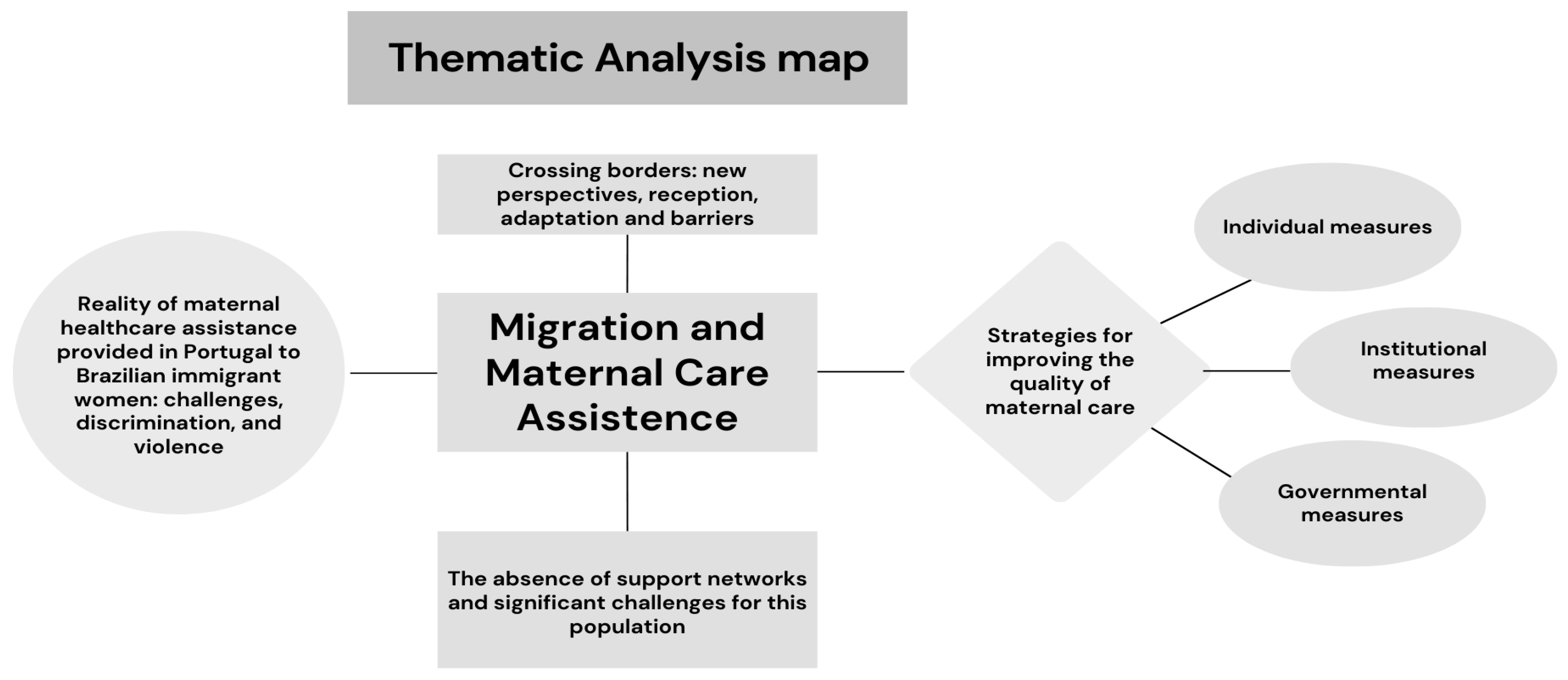
3.1. Migration and Maternal Care Assistance
3.1.1. Crossing Borders: New Perspectives, Reception, Adaptation and Barriers
“It was really about changing our lifestyle, providing experiences for my daughter, for the baby who was about to be born, a safer life, because the area where we lived in Brazil was really unsafe.”(P1)
“(…) we came seeking new opportunities and a better future for our children (…)”(P8)
“(…) a friend of mine in Ireland, who was here (…) guided me, gave me some tips. I did a lot of research, and I also had a friend who wanted to come here too. She lived near me but not in the same place, and we came together.”(P1)
“My aunt said, ‘Come here,’ because in Brazil, even though we had qualifications… it was really hard to find work (…) I came alone, but I have family here.”(P3)
“(…) our accent was hard to understand, and it was difficult for us to understand them, even though it was the same language. The first month, maybe the second, was a bit tough. The culture itself is very different (…)”(P2)
“The biggest challenge, which was actually a big surprise, was thinking that because we speak Portuguese, everything would be fine. So, I think the biggest difficulty was the language. You have a very fast linguistic pace. When I first went out in Porto, it felt like everyone was speaking English (…)”(P6)
“The issue of legalisation (…) the time it takes, from filing the declaration of interest to actually obtaining a residence permit, is very lengthy. I waited from September 2018 to February 2020 without a residence permit.”(P1)
“The main difficulty, I think, was the documentation. It takes a long time; we spend years waiting for a document. (…) we are often exploited.”(P3)
3.1.2. Reality of Maternal Healthcare Assistance Provided in Portugal to Brazilian Immigrant Women: Challenges, Discrimination, and Violence
“I had to insist in many ways to get my first obstetrics appointment. (…) I went to the parish council president to see if he could do something because I had already sent numerous emails to the health centre, I had gone there several times and still couldn’t get my first obstetrics appointment”(P2)
“I arrived here at 22 weeks and only got my first appointment at 33 weeks. (…) I had cancer when I was 20, and they said they couldn’t prioritise me, even though I was pregnant. I only had one appointment.”(P8)
“When I discovered I was pregnant, I didn’t have a residence permit yet (…) they referred me to the health centre here in the city, but they didn’t see me”(P9)
“During pregnancy, I didn’t have any psychological issues, but in the postpartum period, I did. (…) I told the family doctor at the time because I really felt I wasn’t okay (…) I wouldn’t leave the house, I didn’t want to go out at all. (…) My baby didn’t sleep well, and I wasn’t sleeping well either, and that started leading me to a depressive process (…) I was extremely pessimistic, and I told this to the family doctor. She prescribed me antidepressants, which I took, but nothing else, no psychological support, which I thought I needed. (…)”(P2)
“I sought help because I had depression during pregnancy. It was a process where I was newly arrived in the country, newly in a relationship, and I never thought I could get pregnant. At the time, I only managed one consultation with a psychiatrist, who prescribed me medication.”(P9)
“You Brazilians are all crazy; you like to exaggerate the pain. We ask you to rate it from 0 to 10, and you already want to say it’s 100.”(P4)
“It’s very heavy; we suffer for being women, for being Black, and for being Brazilian. Oh, she’s Brazilian, she’s a prostitute.”(P5)
“(…) at the health centre, they told my daughter to go back to Brazil, ‘Oh, go back to Brazil.’”(P10)
“I think at the beginning, a doctor who attended to me to insert that catheter was not very humane. She just came in, and we are super sensitive there, and some people have a rough touch. I was screaming in pain, and even so, she didn’t stop.”(P3)
“I felt that I wasn’t being heard.”(P6)
“I had pain during sexual intercourse for almost a year and a half because of the stitches they made internally.”(P8)
3.1.3. The Absence of Support Networks and Significant Challenges for This Population
“It’s a more solitary experience. Everyone lives their own lives; you can’t expect people to say, ‘Oh, I’ll look after your child to help you out.’ No, here it’s just you, your child, and your partner. And if your partner works, then it’s just you and your child.”(P3)
“What I really missed was the support of my mother and grandmother and how they cared for me and helped with the birth of my first child”(P10)
“I faced some difficulties because sometimes I had to lift an elderly person weighing nearly 100 kg. There was no one to say, ‘Look, don’t lift that.’ I had to do it. They treated me as if I wasn’t pregnant (…)”(P3)
“(…) as soon as they found out I was pregnant, they fired me. I thought it was awful. I don’t think this sort of thing happens in Brazil. They claimed it was a temporary contract, so they could terminate it. But I didn’t even bother to complain because the pregnancy had already been so difficult”(P7)
3.1.4. Strategies for Improving the Quality of Maternal Care
Individual Measures
“Do your own research on everything, (…) like what a humanized birth would be, the stages of pregnancy, then the postpartum, (…) and have those questions ready to ask health teams. I think that’s a good recommendation. (…) also research hospitals and find out which one you want to give birth at.”(P2)
“Seek information about the rights you have. Look for hospitals that respect your wishes, there are good hospitals in Portugal, though few. Most people don’t know, but you can choose where to give birth.”(P5)
“I recommend getting health insurance so you can be followed, and if possible, get more than one opinion. Even if you don’t have money for the birth, at least be followed”(P9)
Institutional Measures
“I think Portugal has experienced, and continues to experience, a large wave of immigration, and I think healthcare professionals need to take this into account (…) there’s a lack of respect towards immigrants, so if there was specific training in this area for health teams, it might be a very positive step (…).”(P2)
“Regarding psychological care, for example, (…). I think maybe this area could improve. Connecting psychological work with pregnant women, or even with those who have children or are trying to, would be important.”(P3)
“I only managed to get my IUD inserted 11 months later. I went 11 months without having relations with my husband because I was afraid of getting pregnant. (…) I believe it’s a lack of organization.”(P10)
Governmental Measures
“I think, first, they should make it easier for pregnant women to register at health centers because I think that’s the biggest difficulty they face.”(P1)
“People arrive at the health center but don’t have a family doctor, or don’t have documents. Pregnant women shouldn’t be in a situation where they are told ‘You don’t have the right because you don’t have documents or a family doctor.’ If you’re pregnant, you have the right. Make it more practical, because it’s too bureaucratic.”(P6)
4. Conclusions
5. Limitations and Future Research
Author Contributions
Funding
Institutional Review Board Statement
Informed Consent Statement
Data Availability Statement
Conflicts of Interest
Abbreviations
| AIMA | Agência para a Integração, Migrações e Asilo |
| OV | Obstetric Violence |
References
- Agência para a Integração, Migrações e Asilo (AIMA). 2025. Relatório de Migrações e Asilo 2024; Lisboa: Agência para a Integração, Migrações e Asilo. Available online: https://aima.gov.pt/media/pages/documents/fec4d6a712-1760603125/relatorio-migracoes-e-asilo-2024.pdf (accessed on 20 October 2025).
- Alarcão, Violeta, and Sónia Pintassilgo. 2025. Acesso à Saúde para Migrantes: Justiça Social e Reprodutiva em Portugal. Nascer em Portugal (blog). January 7. Available online: https://nascer.pt/2025/01/07/acesso-a-saude-para-migrantes-justica-social-e-reprodutiva-em-portugal/ (accessed on 6 October 2025).
- Alarcão, Violeta, Fernando Machado, Pedro Candeias, Ana Virgolino, Osvaldo Santos, Sónia Pintassilgo, Patrícia Pascoal, and Andreia Costa. 2022. Cidadania e Direitos Sexuais de Populações Imigrantes em Portugal. Lisboa: Observatório das Migrações. [Google Scholar]
- Almeida, Lígia, and José Caldas. 2013. Migração e saúde materna: Experiências da mulher brasileira em Portugal. Revista Brasileira de Saúde Materna e Infantil 13: 309–16. [Google Scholar] [CrossRef] [Scilit]
- Andrade, Alejandra, Josefina Roca, and Sara Pérez. 2023. Children’s emotional and behavioral response following a migration: A scoping review. Journal of Migration and Health 7: 100176. [Google Scholar] [CrossRef] [Scilit]
- Annoni, Danielle. 2020. Mulheres Migrantes e Pandemia: Vulnerabilidades Sobrepostas Diante da Securitização Internacional de Fronteiras. In Migrações Internacionais e a Pandemia de COVID-19. Edited by Rosana Baeninger, Luis Renato Vodovato, Shailen Nandy, Luís Felipe Magalhães, Catarina von Zuben, Paolo Parise, Natália Belmonte Demétrio and Jóice Domeniconi. Campinas: Núcleo de Estudos de População “Elza Berquó” (NEPO/Unicamp). [Google Scholar]
- Associação Portuguesa pelos Direitos da Mulher na Gravidez e Parto (APDMGP). 2020. Inquérito Experiências de Parto em Portugal, 2nd ed. Available online: https://associacaogravidezeparto.pt/wp-content/uploads/2020/12/Experie%CC%82ncias-de-Parto-em-Portugal_2edicao_2015-19-1.pdf (accessed on 21 October 2025).
- Álvares, Sílvia. 2022. Nascer e Crescer/Birth and Growth Medical Journal-30 Years’ Publication. Nascer e Crescer-Birth and Growth Medical Journal 31: 5–8. [Google Scholar]
- Badinter, Elisabeth. 1985. Um Amor Conquistado: O Mito do Amor Materno. Translated by Waltensir Dutra. Rio de Janeiro: Nova Fronteira. [Google Scholar]
- Barata, Catarina. 2022a. Mix of Races, Bad Uterus’: Obstetric Violence in the Experiences of Afro-Brazilian Migrants in Portugal. Societies 12: 78. [Google Scholar] [CrossRef] [Scilit]
- Barata, Catarina. 2022b. Body Broken in Half: Tackling an Afro-Brazilian Migrant’s Experience of Obstetric Violence and Racism in Portugal Through Art Making. Revista D’Antropologia I Investigação Social—(Con)textos 10: 65–84. [Google Scholar]
- Begonha, Ana. 2024. Migrantes em Situação Irregular Vão Deixar de Ser Beneficiários do SNS. Público. December 19. Available online: https://www.publico.pt/2024/12/19/politica/noticia/ad-quer-migrantes-situacao-irregular-pagar-sns-ps-inconstitucional-2116290 (accessed on 2 August 2025).
- Bowser, Diana, and Kathleen Hill. 2010. Exploring Evidence for Disrespect and Abuse in Facility-Based Childbirth: Report of a Landscape Analysis. Cambridge: Harvard School of Public Health, University Research Co. [Google Scholar]
- Braun, Virginia, and Victoria Clarke. 2006. Using Thematic Analysis in Psychology. Qualitative Research in Psychology 3: 77–101. [Google Scholar] [CrossRef] [Scilit]
- Braun, Virginia, and Victoria Clarke. 2020. One Size Fits All? What Counts as Quality Practice in (Reflexive) Thematic Analysis? Qualitative Research in Psychology 18: 328–52. [Google Scholar] [CrossRef] [Scilit]
- Carvalho, Joana Mourão. 2025. O que muda para os imigrantes em Portugal com a nova Lei dos Estrangeiros? Euronews. October 16. Available online: https://pt.euronews.com/my-europe/2025/10/16/o-que-muda-para-os-imigrantes-em-portugal-com-a-nova-lei-dos-estrangeiros (accessed on 11 December 2025).
- Castañeda, Heide, Seth Holmes, Daniel Madrigal, Maria-Helena Young, Naomi Beyeler, and James Quesada. 2015. Immigration as a Social Determinant of Health. Annual Review of Public Health 36: 375–92. [Google Scholar] [CrossRef] [Scilit]
- Castles, Stephen, and Mark Miller. 1998. The Age of Migration: International Population Movements in the Modern World, 2nd ed. London: Macmillan Press. [Google Scholar]
- Correia, Tiago. 2023. A crise do SNS em 10 pontos. SIC Noticías. March. Available online: https://sicnoticias.pt/pais/2023-03-21-A-crise-do-SNS-em-10-pontos-b785eb2d (accessed on 9 September 2025).
- Council of Europe. 2017. Women’s Sexual and Reproductive Health and Rights in Europe. Estrasburgo: Council of Europe. Available online: https://rm.coe.int/women-s-sexual-and-reproductive-health-and-rights-in-europe-issue-pape/168076dead (accessed on 12 September 2025).
- Coutinho, Emília, Ana Rocha, Carlos Pereira, Alcione Silva, João Duarte, and Vitória Parreira. 2014. Experiences of Motherhood: Unmet Expectations of Immigrant and Native Mothers About the Portuguese Health System. Atención Primaria 46: 140–44. [Google Scholar] [CrossRef] [Scilit]
- de Haas, Hein. 2023. How Migration Really Works. Londres: Penguin Viking. [Google Scholar]
- Direção-Geral da Saúde. 2015. Plano Nacional de Saúde: Revisão e Extensão a 2020. Lisboa: Direção-Geral da Saúde. [Google Scholar]
- European Parliament. 2022. European Parliament Resolution of 5 July 2022 Towards a Common European Action on Care (2021/2253(INI)) (P9_TA(2022)0278). European Parliament. July 5. Available online: https://eur-lex.europa.eu/legal-content/EN/TXT/?uri=CELEX%3A52022IP027 (accessed on 12 September 2025).
- Fontes, Manoelle, and Ana Pacheco. 2022. Mulheres racializadas no Sul da Bahia: Mapeando colonialidades de gênero, raça/etnia e sexualidade. Dossiê: Horizontes do pós-colonial 19: 68–86. [Google Scholar] [CrossRef] [Scilit]
- Fragata, Joana, and Hugo Almeida. 2024. Novo Modelo de Urgências de Obstetrícia É um ‘Penso Rápido. SIC Notícias. December 15. Available online: https://sicnoticias.pt/pais/2024-12-15-video-novo-modelo-de-urgencias-de-obstetricia-e-um-penso-rapido-8b86727b (accessed on 15 December 2024).
- Giraud, François, and Marie Rose Moro. 2004. Parentalidade e migrações. In Ser pai, ser mãe—Parentalidade: Um desafio para o terceiro milênio. Edited by Lya Solis-Ponton. São Paulo: Casa do Psicólogo, pp. 203–9. [Google Scholar]
- Inspeção-Geral das Atividades em Saúde (IGAS). 2024. Assistência a Pessoas Estrangeiras Não Residentes em Portugal nos Serviços de Urgência de Natureza Hospitalar do Serviço Nacional de Saúde 2024: Recolha de Dados e Informação. Lisboa: Inspeção-Geral das Atividades em Saúde. [Google Scholar]
- Instituto Nacional de Estatística (INE). 2024. Estatísticas Demográficas 2023: População Residente em Portugal Aumenta pelo Quinto ano Consecutivo em Resultado do crescimento Migratório POSITIVO. Available online: https://www.ine.pt/ngt_server/attachfileu.jsp?look_parentBoui=697596009&att_display=n&att_download=y (accessed on 12 December 2024).
- Kilomba, G. 2019. Memórias da Plantação: Episódios de Racismo Quotidiano. Lisbon: Orfeu Negro. [Google Scholar]
- Kofman, Eleonore, and Parvati Raghuram. 2015. Gendered Migrations and Global Social Reproduction. New York: Springer. [Google Scholar]
- Lazzerini, Marzia, Benedetta Covi, Ilaria Mariani, Zalka Drglin, Maryse Arendt, Ingvild Nedberg, Helen Elden, Raquel Costa, Daniela Drandić, Jelena Radetić, and et al. 2022. Quality of Facility-Based Maternal and Newborn Care Around the Time of Childbirth During the COVID-19 Pandemic: Online Survey Investigating Maternal Perspectives in 12 Countries of the WHO European Region. The Lancet Regional Health 13: 100268. [Google Scholar] [CrossRef] [Scilit]
- Lim, Mona, Andrea Van Hulst, Sarah Pisanu, and Lisa Merry. 2022. Social Isolation, Loneliness and Health: A Descriptive Study of the Experiences of Migrant Mothers with Young Children (0–5 Years Old) at La Maison Bleue. Frontiers in Global Women’s Health 3: 823632. [Google Scholar] [CrossRef] [Scilit]
- Lusa. 2024a. Nova Linha SNS ‘Grávida’ Funcionará Através do 808 24 24 24. Público, June 1.
- Lusa. 2024b. Sete Urgências de Obstetrícia, Ginecologia e Uma de Pediatria Encerradas Hoje. Expresso, September 2.
- Machado, Maria do Céu, Paula Santana, Maria Helena Carreiro, Helena Nogueira, Maria Rosalina Barroso, and Alexandra Dias. 2006. Iguais ou diferentes? Cuidados de saúde materno-infantil a uma população de imigrantes. Lisboa: Laboratórios Bial. [Google Scholar]
- Marques, José, and Pedro Góis. 2012. A emergência das migrações no feminino—Feminização das migrações de (e para) Portugal e suas consequências sociopolíticas. Lisboa: Princípia. [Google Scholar]
- Mendes, José, Ana Santos, and Márcio Tavares. 2022. Perceções da violência obstétrica pelas parturientes e profissionais de saúde: Uma revisão scoping. Revista Portuguesa de Investigação Comportamental e Social 8: 1–15. [Google Scholar] [CrossRef] [Scilit]
- Morais, Marie, Beatriz Padilla, Camila Rosseto, and Margareth Almeida. 2021. Migração: Saúde reprodutiva e estereótipo. Cadernos de Saúde Coletiva 29: 86–91. [Google Scholar] [CrossRef] [Scilit]
- Moro, Marie. 2017. Parentalidade e diversidade cultural. Revista Brasileira de Psicanálise 51: 137–49. [Google Scholar]
- Neves, Sofia, Conceição Nogueira, Joana Topa, and Estefânia Silva. 2016. Mulheres imigrantes em Portugal: Uma análise de gênero. Estudos de Psicologia 33: 723–33. [Google Scholar] [CrossRef] [Scilit]
- Neves, Sofia, Joana Topa, Helena Velho, Márcia Machado, and Conceição Nogueira. 2015. Mulheres imigrantes grávidas: Saúde e violências de género. In Violências na contemporaneidade no Brasil e em Portugal. Edited by Sofia Neves, Vera Duarte, Regina Célia Barbosa and Nilton Formiga. Maia: Edições ISMAI, pp. 57–72. [Google Scholar]
- Oliveira, Catarina. 2023. Indicadores de Integração de Imigrantes—Relatório Estatístico Anual 2023. Lisboa: Alto Comissariado para as Migrações. [Google Scholar]
- Oliveira, Catarina, and N. Gomes. 2018. Migrações e Saúde em Números: O Caso Português. Lisboa: Observatório das Migrações, ACM, IP. [Google Scholar]
- Padilla, Beatriz. 2008. Saúde dos imigrantes: Protegendo direitos e assumindo responsabilidades. In Migrações: Oportunidade ou Ameaça? A Habitação e a Saúde na Integração dos Imigrantes. Edited by António Vitorino. Lisboa: Princípia. [Google Scholar]
- Padilla, Beatriz. 2013. Saúde dos Imigrantes: Multidimensionalidade, Desigualdades e Acessibilidade em Portugal. REMHU: Revista Interdisciplinar da Mobilidade Humana 21: 49–75. [Google Scholar] [CrossRef] [Scilit]
- Padilla, Beatriz, Sonia Plaza, Elsa Rodrigues, and Alessandra Ortiz. 2014. Saúde e Cidadania: Equidade nos Cuidados de Saúde Materno–Infantil em Tempos de Crise. Braga: Centro de Investigação em Ciências Sociais, Universidade do Minho. [Google Scholar]
- Pinho, Filipa. 2007. A imprensa na construção do processo migratório: A constituição de Portugal como destino plausível da emigração brasileira. In A Imigração Brasileira em Portugal. Edited by Jorge Malheiros. Lisboa: ACIDI, pp. 59–86. [Google Scholar]
- Ramos, Natália. 2010. Gênero e migração: Questionando dinâmicas, vulnerabilidades e políticas de integração e saúde da mulher migrante. Anais do Congresso Fazendo Gênero. Santa Catarina. vol. 9. Available online: https://repositorioaberto.uab.pt/bitstream/10400.2/5843/1/fazendo%20genero_ARQUIVO_NataliaRamosFG9.pdf (accessed on 12 October 2025).
- Ramos, Natália. 2015. Famílias migrantes nas cidades interculturais: Acolhimento, solidariedade e saúde. In Livro de Atas do 1.º Congresso da Associação Internacional de Ciências Sociais e Humanas em Língua Portuguesa. Lisboa: CONLAB, pp. 2956–68. Available online: https://repositorio.ulisboa.pt/bitstreams/420a5c6a-b3d2-4ed5-bd09-937bd838d279/download (accessed on 11 December 2024).
- Rapoport, Andrea, and Cesar Piccinini. 2006. Apoio social e experiência da maternidade. Journal of Human Growth and Development 16: 85–96. [Google Scholar] [CrossRef] [Scilit]
- Rattner, Jair. 2024. AIMA Quebra Lei e Bloqueia Acesso ao Sistema de Agendamentos de Advogados. Público. October 31. Available online: https://www.publico.pt/2024/10/31/publico-brasil/noticia/aima-quebra-lei-bloqueia-acesso-sistema-agendamentos-advogados-2110049 (accessed on 10 December 2024).
- Redin, Giuliana, Luis Minchola, and Alessandra Almeida. 2020. O papel da academia na proteção e promoção dos direitos humanos de migrantes e refugiados no Brasil: A prática extensionista do MIGRAIDH UFSM. In Migrações Internacionais: Experiências e Desafios para a Proteção e Promoção de Direitos Humanos No Brasil. Edited by Giuliana Redin. Santa Maria: Fundação de Apoio à Tecnologia e Ciência—Editora UFSM. [Google Scholar]
- Rusu, Mariana, Conceição Nogueira, and Joana Topa. 2024. Pregnancy, childbirth, and postpartum experiences of racialised Brazilian women in Portugal: An analysis of obstetric violence as gender-based violence. Sexes 5: 611–37. [Google Scholar] [CrossRef] [Scilit]
- Rusu, Mariana Holanda, Conceição Nogueira, and Joana Topa. 2025. Obstetric Violence: Reproductive and Sexual Health Trajectories of Racialised Brazilian Women in Portugal. Social Sciences 14: 109. [Google Scholar] [CrossRef] [Scilit]
- Scavone, Lucila. 2001. Maternidade: Transformações na família e nas relações de gênero. Interface: Comunicação, Saúde e Educação 5: 47–60. [Google Scholar] [CrossRef] [Scilit]
- Sesia, Paola. 2020. Naming, framing, and shaming through obstetric violence: A critical approach to the judicialisation of maternal health rights violations in Mexico. In Critical Medical Anthropology: Perspectives in and from Latin America. Edited by Jennie Gamlin, Sahra Gibbon, Paola M. Sesia and Lina Berrío. Londres: UCL Press, pp. 222–47. [Google Scholar]
- Teixeira, Cristina, Sofia Correia, César Victora, and Henrique Barros. 2013. The Brazilian Preference: Cesarean Delivery Among Immigrants in Portugal. PLoS ONE 8: e60168. [Google Scholar] [CrossRef] [Scilit] [PubMed]
- Teodorescu, Loredana. 2024. Women on the move: Understanding the female face of migration to develop targeted policies. European View 23: 55–63. [Google Scholar] [CrossRef] [Scilit]
- Topa, Joana. 2016. Cuidados de Saúde Materno-Infantis a Imigrantes na Região do Grande Porto: Percursos, Discursos e Práticas. New York: ACM. [Google Scholar]
- Topa, Joana, Conceição Nogueira, and Sofia Neves. 2013. Imigração e Saúde: A (In)acessibilidade das Mulheres Imigrantes aos Cuidados de Saúde. Saúde e Sociedade 22: 328–41. [Google Scholar] [CrossRef] [Scilit]
- Topa, Joana, Conceição Nogueira, and Sofia Neves. 2016. Vivências de Mulheres Brasileiras nos Serviços de Saúde Materna. Gênero & Direito 5: 25–51. [Google Scholar] [CrossRef] [Scilit]
- World Health Organization (WHO). 2018. WHO Recommendations on Intrapartum Care for a Positive Childbirth Experience. Geneva: World Health Organization. [Google Scholar]
- World Health Organization (WHO). 2022. World Report on the Health of Refugees and Migrants. Geneva: World Health Organization. [Google Scholar]
- Yin, Robert. 2016. Qualitative Research from Start to Finish, 2nd ed. New York: The Guilford Press. [Google Scholar]


| Participants | Age | Marital Status | Academic Qualifications | Employment Situation | Region of the Country | Number of Kids | Time Living in Portugal (Years) |
|---|---|---|---|---|---|---|---|
| P1 | 33 | married | graduated | unemployed | South | 2 | 4 |
| P2 | 35 | married | pos-graduated | employed | North | 2 | 2 |
| P3 | 32 | single | graduated | unemployed | South | 1 | 5 |
| P4 | 41 | married | graduated | unemployed | South | 2 | 6 |
| P5 | 36 | married | graduated | employed | Centre | 1 | 5 |
| P6 | 41 | married | high school | employed | Centre | 2 | 5 |
| P7 | 38 | married | graduated | employed | Centre | 2 | 3 |
| P8 | 36 | married | graduated | unemployed | South | 2 | 2 |
| P9 | 42 | single | pos-graduated | unemployed | Centre | 1 | 4 |
| P10 | 39 | married | pos-graduated | unemployed | West | 2 | 4 |
Disclaimer/Publisher’s Note: The statements, opinions and data contained in all publications are solely those of the individual author(s) and contributor(s) and not of MDPI and/or the editor(s). MDPI and/or the editor(s) disclaim responsibility for any injury to people or property resulting from any ideas, methods, instructions or products referred to in the content. |
© 2025 by the authors. Licensee MDPI, Basel, Switzerland. This article is an open access article distributed under the terms and conditions of the Creative Commons Attribution (CC BY) license.
Share and Cite
Sousa, H.; Rusu, M.; Neves, S.; Topa, J. Migration, Motherhood, and Maternal Health: Brazilian Women’s Encounters with the Portuguese Healthcare System. Soc. Sci. 2026, 15, 6. https://doi.org/10.3390/socsci15010006
Sousa H, Rusu M, Neves S, Topa J. Migration, Motherhood, and Maternal Health: Brazilian Women’s Encounters with the Portuguese Healthcare System. Social Sciences. 2026; 15(1):6. https://doi.org/10.3390/socsci15010006
Chicago/Turabian StyleSousa, Helena, Mariana Rusu, Sofia Neves, and Joana Topa. 2026. "Migration, Motherhood, and Maternal Health: Brazilian Women’s Encounters with the Portuguese Healthcare System" Social Sciences 15, no. 1: 6. https://doi.org/10.3390/socsci15010006
APA StyleSousa, H., Rusu, M., Neves, S., & Topa, J. (2026). Migration, Motherhood, and Maternal Health: Brazilian Women’s Encounters with the Portuguese Healthcare System. Social Sciences, 15(1), 6. https://doi.org/10.3390/socsci15010006