


Abstract
This article explores how people with intellectual disabilities can be more involved in evaluating and regulating the services they use and the quality of their lives. Traditionally, these evaluations have been performed by professionals, but we argue that people with lived experience of intellectual disabilities bring unique insights and should be part of the process. The idea builds on ‘inclusive research’, where people with intellectual disabilities are not just subjects of research but active researchers. We use the term ‘inclusive evaluation’, to describe the active engagement of people with intellectual disabilities in inspecting and assessing services to ensure they meet standards and respect human rights. The paper describes a small exploratory study involving interviews with regulators, professionals, and people with intellectual disabilities across Ireland, Northern Ireland, Australia, and New Zealand who had been involved in inclusive evaluations. It found strong support for it, highlighting benefits such as greater trust and empathy during evaluations with users of services, more meaningful feedback for service providers, and increased confidence and employment opportunities for evaluators with disabilities. However, challenges remain, including funding and fair pay for the engagement of people with intellectual disabilities, training opportunities that meet the support needs of all stakeholders, and changing the cultural attitudes in support services that underestimate the abilities of people with intellectual disabilities. Steps to overcome these challenges are proposed such as piloting inclusive evaluation programmes, providing inclusive evaluation training to all involved, and lobbying governments to fund these roles. We conclude with a proposed implementation framework and a set of guiding principles that will nurture a spirit of inclusion and respect in service evaluations.
1. Introduction: Our Journey from There (Inclusive Research) to Here (Inclusive Evaluation)
1.1. Inclusive Research
The term inclusive research was introduced by Walmsley and Johnson (2003) building on the paradigms of both participatory and emancipatory research (Zarb 1992; Barnes and Mercer 1997; Stone and Priestly 1996; Oliver 1996, 1997, 1999) where people with disabilities were no longer ‘being researched’ but ‘doing the research’. However, people with intellectual disabilities were largely ignored by these paradigms. As a result, Walmsley and Johnson’s five principles of inclusive research had, at their core, people with intellectual disabilities having ownership over what was researched, and how it was researched, in keeping with the motto of the disability movement of “Nothing About Us Without Us” (Charlton 2000).
The development of inclusive research over the last twenty years has been well captured in various scoping reviews (Di Lorito et al. 2018; Jones et al. 2020; Hewitt et al. 2023), alongside outlining the added value it has brought to projects, albeit with some unresolved challenges. In her commentary on the review by Jones, O’Brien (2020) identified that inclusive research had been conducted in areas covering “community and independent living, employment, education, health, and wellbeing” (p. 121). Similarly, a range of methodologies was documented “covering traditional activities, such as, focus groups, interviews, member checking, and reflection, combined with more accessible ones of photo voice, role play, poetry, drama, storytelling, reflection, facilitated discussion, conversational interviewing” (p. 121).
Furthermore, the impact of inclusive research has gone beyond reports and academic publications. Research teams have been invited to present on inclusive research at national and international conferences and have been requested by governments to join steering groups to develop or change legislation that relates to intellectual disability (Hopkins et al. 2022) as well as being funded to co-produce and disseminate research outcomes (Puyaltó et al. 2022; Rojas-Pernia and Haya-Salmón 2022). In effect, being an inclusive researcher is intertwined with being an advocate and spokesperson (Hopkins et al. 2022). Consequently, there is now much greater awareness of the need to co-design policy and practice with people with intellectual disabilities who work as partners “in a wide range of circumstances such as planning an event, constructing or renovating a building or facility, developing or reviewing a policy or program, along with conducting research or delivering services” (JFA Purple Orange 2021, p. 6).
1.2. Advocates for Change
Fifteen years on from introducing inclusive research, Walmsley et al. (2018) reframed it as contributing to social change that was based on the lived experiences of people with intellectual disabilities. Moreover, research teams need to stand alongside the persons whose issues are being reported both within and after the completion of the projects. Hence academic researchers have to stand with advocates and agents for change.
Article 4(3) General Obligations of the United Nations Convention on the Rights of Persons with Disabilities (UNCRPD) places emphasis upon involving people with disabilities in all decision-making associated with their lives and, by extension, those for whom they advocate (United Nations 2006). The co-design of support services presents opportunities for the involvement of people with intellectual disabilities in decision-making. For example, through the National Disability Insurance Scheme (NDIS) in Australia (National Disability Insurance Scheme n.d.), the government has committed to co-design, consultation, and engagement of people with disabilities across a range of NDIS activities, such as understanding the scheme and how it works, making plans for how they want to live their lives, making decisions on support, recruiting the right staff, and making a home in the right place with the right people.
Also the NDIS Quality and Safeguards Commission (NDIS Quality and Safeguards Commission n.d.) has responsibilities for monitoring the NDIS funding scheme for over 700,000 people with disabilities to ensure that their needs and aspirations are being met. Effective monitoring of service provision means researching information, and so the question arises: how can trained inclusive researchers bring added value not just to co-designing services but also to their evaluation?
1.3. Service Failures
The lived experience of many people with intellectual disabilities includes contact with various support services, of which residential care has been the most significant in terms of its cost and impact on people’s lives. Sadly though, these settings—particularly where people are congregated together—have often heightened their risk to various inequitable and sometimes abusive situations (Codina et al. 2024). In Australia, New Zealand, UK, and Ireland, public enquiries have investigated serious shortcomings in residential services, especially the physical abuse of residents by nursing and care staff. Their reports make disturbing reading: in Australia (Disability Royal Commission 2023); in England (Winterborne View Hospital Review, Department of Health (UK) 2013); in Northern Ireland (Muckamore Abbey Hospital Inquiry 2025); in the Republic of Ireland, (What Matters Most Report, Health Service Executive Ireland n.d.); and in New Zealand (Whanaketia, Royal Commission of Inquiry into Abuse in Care 2024).
As in other countries worldwide, these inquiries have often been triggered by media reports allied to whistleblowing by staff and the advocacy of family carers. By contrast, the reports cited above document the failure of the statutory regulatory inspection bodies and internal/external quality evaluation groups to initially identify even long-standing abusive practices. Why this failure? Could it be that inspectors and professionals do not spend enough time observing and listening to service users in their everyday settings? Equally could it be a lack of insider knowledge and hence not knowing the signs to look for (Fraser-Barbour et al. 2025)?
By contrast, inclusive researchers with the lived experience of intellectual disabilities, who are also often recipients of services, could be mobilised to draw upon their own personal experience and ‘insider knowledge’ to detect ongoing abuse of residents that outsiders do not see, notably low-level and well-disguised abusive practices. This is surely a primary reason for their inclusion in the monitoring and evaluation of services and better still if they have the experience in undertaking research. As Araten-Bergman and Bigby (2023) have argued, their deployment can form part of a safeguarding and prevention strategy in service settings.
For this paper, the involvement of people with intellectual disabilities as evaluators will be referred to as ‘inclusive evaluation’ to distinguish it from inclusive research. Similarly, government regulatory and inspection activities that include people with the lived experience of intellectual disabilities as regulators could be referred to as ‘inclusive regulation and inspections’. For brevity though, we will subsume this term within inclusive evaluation.
1.4. Inclusive Evaluation
A combination of human rights, quality of life, and public and patient involvement frameworks provides a new paradigm for service planning, design, delivery, and, crucially, evaluation (Gómez et al. 2021). Inclusive evaluation finds a strong foundation in the UNCRPD, which states that people with disabilities “should have the opportunity to be actively involved in decision-making processes about policies and programmes, including those directly concerning them” (Article 12, United Nations 2006). Moreover, it places obligations on members to overcome discrimination towards people with disabilities (Article 4) and to support the right to work and to gain meaningful employment (Article 27), which authors 3 and 4 personally endorsed. Article 33 also outlines the requirement on member states to monitor their obligation to progress all 50 articles of the CRPD. These articles gave us a further rationale for involving people with intellectual disabilities in evaluation teams.
Furthermore, modern service supports increasingly use quality of life as a personalised framework for their assessment of needs and identifying the aspirations of individuals (Lombardi et al. 2019). This is coupled with an increasing uptake of ‘Public and Patient Involvement’ approaches to co-designing and monitoring health and social care services (Ocloo et al. 2021). Public and patient involvement has received increased attention in governmental policies within the United Kingdom, for example, albeit its implementation has been variable (Stuttaford et al. 2017).
Nevertheless, persons with intellectual disabilities are often excluded in these initiatives and instead represented by other advocates—family carers or paid support staff—if at all. Yet, as noted above, researchers with intellectual disabilities, when teamed up with university researchers, are effective in advising, interviewing, and listening to participants, facilitating their involvement in the co-designing of service policies and practice (Garratt et al. 2022; Ghaderi et al. 2023).
Inspired by the growing acceptance of inclusive research in academia, policy, and service provision, this paper examines the potential for researchers with the lived experience of intellectual disabilities to move outside of the partnership with academia and to become engaged as evaluators in service inspections and evaluations. Given the scarcity of published material on this topic, we embarked on an exploratory investigation to discover the perspectives of various stakeholders on the inclusion of people with intellectual disabilities as team members in both service evaluation and regulatory activities. These included people with intellectual disabilities, service managers, support staff, and officials from regulatory and inspection authorities. As our team spanned three different jurisdictions, we were keen to know if the same issues arose across them irrespective of their differing service histories and funding arrangements. Moreover, we had personal contacts with stakeholders in each who had experience of undertaking inclusive evaluations of services.
1.5. Aims of the Study
The aims of our descriptive study were:
- To identify where and how persons with the lived experience of intellectual disabilities were involved in inclusive evaluation activities.
- To discover, from various perspectives, the advantages and the challenges of taking an inclusive evaluation approach.
- To explore the prospects of inclusive evaluation activities being undertaken within service and regulatory organisations.
2. Method: The Stages in the Journey
2.1. Planning
The authors of this article first came together in 2023 via zoom from Australia, Northern Ireland (UK), and the Republic of Ireland, to discuss if we would like to work on a project that expanded our interest in inclusive research to inclusive evaluation and regulation activities. We are a group of three university researchers (traditionally employed by our respective universities) and two researchers who identify as having lived experience. All five of us have had experience and membership of different inclusive research networks. We had previously collaborated on an article published in the Social Sciences first Special Issue on inclusive research (https://doi.org/10.3390/socsci11100483 (accessed on 26 September 2025)). For this current article we agreed to write up the lessons learned by collaborating on what we called the inclusive evaluation project.
Initially as a team, our discussions were guided by a set of accessible slides where the following questions were covered: Are there articles we should read before we start? Who should be interviewed and by whom? How will we go about discussing what people tell us? How will we write up what people say?
Authors 1, 2, 3, and 4 also met face-to-face in Sydney before the interviewing began and after ethics applications drafted by authors 1 and 5 had been approved in 2024 by University of Sydney Human Ethics Committee, 2024/037, approved on 30 January 2024 and Trinity College Dublin Ethics Committee, 1130, Approved on 2 April 2024.
2.2. Checking the Literature
Preliminary scanning by the first author in 2023, at the outset of the project, indicated that a formal review of the literature on inclusive service evaluation activities would not be fruitful. We used Scopus, Web of Science, and Google Scholar for the peer-reviewed literature. We applied a range of descriptors that focused on people with intellectual disabilities being included as evaluators/regulators in service settings, including search terms such as “people with disability and human services; people with intellectual disabilities and service evaluators; people with disabilities and evaluation and human services; evaluation of services for people with intellectual disabilities and consumers as evaluators; adults with intellectual disabilities and service evaluation teams and human services.”
Three articles of interest emerged, with one describing a system in New Zealand where consumers of services, including people with intellectual disabilities, had been trained by the Standards and Monitoring Services (SAMS) (n.d.), a non-governmental agency to join integrated evaluation teams (Capie and Ahrens 1996). Using a set of standards developed by SAMS, people with intellectual disabilities joined family members and professional SAMS staff to visit a disability service, observing, interviewing, and feeding back outcomes of the evaluation to management as recommendations for change. The work of SAMS was developmental in New Zealand, with other auditing groups, in more recent times, including team members of people with disabilities and family/whānau working in partnership with professional evaluation staff (New Zealand Ministry of Health n.d.).
A second article by Meas (2003) challenged organisations to involve people with intellectual disabilities in the evaluation of services beyond being a source of information, through undertaking interviews and identifying service improvements.
In 2003, Inclusion Europe published a document on how to achieve quality in service evaluation that advocated for service users to no longer be viewed in a passive role but one where they would be “viewed as strong consumers who actively evaluate and influence the quality of their support—of which they expect that it meets their needs and wishes” (Inclusion Europe 2003, p. 1). They argued that service systems needed to be built on the perspectives of their users.
Of note was that all three articles were published over 20 years ago and preceded the United Nations Convention for the Rights of Persons with Disabilities (United Nations 2006).
The ‘grey literature’ was more forthcoming in terms of documenting the involvement in evaluation/regulation of services by people with the lived experience of intellectual disabilities. For example, a system of Quality Checking was evident in the UK, where people with intellectual disabilities were trained, supported, and partnered on a one-to-one basis with people without disabilities to check the quality of people’s lives.
Quality Checkers, as an evaluation system with its related tools, was developed by Choice Support, a UK Not-For-Profit (NFP) service (Choice Support n.d.), and then commissioned by the Care Commission, UK, to run the evaluation programme throughout designated parts of the UK. In 2018, Choice Support was contracted to work with Achieve Australia to pilot a Quality Checker Programme for use locally (Achieve Australia n.d.). A predominance of those trained as Quality Checkers had been previously trained as inclusive researchers through the Centre for Disability Studies at the University of Sydney. Following the outcomes of the pilot phase in 2021, Achieve Australia revised the programme, aligning it closer to Australian culture and the Australian Disability Standards (Australian Human Rights Commission n.d.) and rebranding it as Quality Champions (Achieve Australia 2024, DSC panel).
Overall, the initial search for documentation of people with intellectual disabilities acting as service evaluators and/or service regulators was thin, increasing the need for an exploratory study. However, several studies of relevance have been published from 2023 onwards and are spotlighted later in the discussion.
2.3. Inviting People to Join Us for a Conversation
We aimed to obtain a purposeful sample with a representative in each of the four categories outlined below, which was achieved through the authors’ own networks across four jurisdictions. A total of 13 informants agreed to participate (see Table 1). (Note: The codes will be used to identify their quotations, which are cited in the Findings section.)
Table 1.
Participants.
Overall, 11 of the 13 participants had had some involvement in an aspect of inclusive evaluation, ranging from being on an evaluation team, organising such teams, inviting critique of disability resources/projects by people with intellectual disabilities, and providing funding for inclusive evaluation activities. Two of the thirteen participants had only been involved in research with people with intellectual disabilities as part of an inclusive research team.
In terms of categories of participants, the breakdown was as follows: people with intellectual disabilities who had been involved in research and/or evaluation (n = 2); professionals who had supported people with intellectual disabilities performing either inclusive research and/or evaluation (n = 4); regulators (n = 3); and support service directors/managers (n = 4).
2.4. Procedure
The interviews were online and mostly with one interviewee, except for one group interview with three managers of different support services and one duo where a support professional with a research background and a researcher/evaluator with intellectual disabilities were interviewed together. The interviews were semi-structured, covering any examples known of where people with intellectual disabilities had been involved in evaluation/regulation activities; the advantages, challenges, and risk of inclusive evaluator/regulatory roles being filled by people with intellectual disabilities; and first steps in getting government/Not for Profit (NFP) services to fund inclusive evaluation. In total eight individual interviews, one duo, and one focus group were spread across four countries as follows: 4 interviews and 1 focus group in Northern Ireland; 3 interviews in Australia; 1 in New Zealand; and 1 in the Republic of Ireland. Interviews were conducted by the authors mainly within their geographic base. They took place from mid-2024 to early 2025. The two researchers with lived experience of intellectual disabilities were Sydney-based and shared the task of asking the interview questions across three interviews alongside the first author and, similarly, in one interview with the second author.
2.5. Analysis
Each conversation was audio recorded and transcribed, and elements of grounded theory were used to inform the thematic content analysis that was undertaken under the three main aims of the study (Corbin and Strauss 2015). Through the use of open and axial coding, major themes were identified across the interview and focus group data, covering the perspectives of the 13 informants. Authors 1 and 2 met to discuss the themes and their credibility. Author 1 prepared an easy-read version of the identified themes for a zoom discussion with authors 3 and 4, and author 5 gave digital feedback. A consensus was achieved on the main themes, relating to each research question that are now described.
3. Findings
In this section, the experiences reported by our informants are grouped in line with the aims and structure of the interviews, namely how people with intellectual disabilities were involved in inclusive evaluation and regulation activities; the advantages of their involvement; the expected challenges and risks; and how these could be mitigated, leading to recommendations for extending and sustaining inclusive evaluation and regulation activities.
3.1. Involvement of People with Intellectual Disabilities in Evaluation/Regulation
Table 2 summarises the three ways in which people in our sample had been involved with inclusive evaluations.
Table 2.
The types of involvement in inclusive evaluations.
3.1.1. Membership of Evaluation Teams
Our informants described different forms of teams in which people with intellectual disabilities were members. Some joined a team of evaluators for large-scale evaluations being undertaken by statutory bodies or commissioned by non-governmental providers. The evaluation team might also include family members of persons who were in receipt of similar services. Sometimes the team consisted of two persons who worked together but with distinct roles, as an inspector described:
I was an inspector in (Name) and we undertake inspections of inpatient mental health and learning disability hospitals. During visits to those (facilities), we determined that we required some experts by experience. At that time, we called them lay assessors, it just would have been one inspector and the lay assessor, and then we may have had one of our session consultants (join us). I always like a lay assessor to walk around a ward and pick up anything,…you inspect services for so long, you could walk past something. Every day they picked up on things that I missed, well, I mean, I don’t have a learning disability and I’ve never used a service, so they were ideal for the job”(R1).
The visit to the service could take between two to three days, with a formal report and recommendations being forwarded to the organisation in the week after. There was a variety of ways that the implementation of recommendations was monitored and followed up.
3.1.2. Consultants on Service Design and Delivery
A second approach was acting as consultants, where organisations or government divisions employed people with the lived experience of intellectual disabilities to give feedback on service models, platforms, policy, and resources. One such example was where members of a self-advocacy organisation were contracted by a disability service organisation to check on how well they were upholding the rights of those who use their services:
We now employ a team of people who work on our customer experience and our quality team, and they’re people with a range of disabilities, including people with intellectual disability. They interview the people that we support about their experience using the services, about any problems that they might have, any policy issues that they might come up, any service improvements that they might suggest. And then they work directly with the local manager to make those changes, and where there are issues that come up that really are about things that are pertinent across our services, they come to the executive for suggestions around change and report regularly to the board about their findings(SM4).
Less formal evaluation approaches were described, where the sharing of the lived experience of a person with intellectual disabilities was considered a form of self-evaluation—for instance, planning a move from the family home to supported accommodation and being asked to comment on how their participation in co-design was evident in the outcomes of the move. The same applied to their membership in advisory groups for broader service development and the evaluation of the impact their contribution had on the process:
All of the people we support live at home with their family carers. When we do our independent evaluations, we bring them inside to do that with both the families, the staff and the service users (people with intellectual disabilities) who give their feedback about what’s good about…what’s bad…what we could do differently. We get other wonderful ideas of what they’d like us to do better(SM1).
3.1.3. Activities Undertaken to Support the Development of Evaluations
Informants were asked to speak about the activities they had undertaken to support the inclusion of people with intellectual disabilities in the evaluations they had undertaken. Those that were commonly mentioned across all three types of evaluations included training, development of accessible materials, participating as team members, mentoring, adaptation of evaluation materials, provision of feedback, and follow up (see Table 3 for more detail on these activities).
Table 3.
Activities to support inclusive evaluations.
The first four features above are commonly found in inclusive research studies (O’Brien 2023) and mirror the supports provided for researchers with intellectual disabilities. In this study, the interviewees placed particular emphasis on ensuring that the training was attuned to the needs of the evaluator with intellectual disabilities.
After he had done the (evaluator) training we went through a lot of the training that took place…there were things they had not made clear. If somebody tells you something (sensitive), you can’t ask too many questions. By doing scenarios—so by me pretending to be a patient and telling him things that could happen—for him to see how he could respond and know how to deal with it(S2).
Likewise, the checklist of standards used in evaluations needed to match the national standards geopolitically for disability; for example, in Australia it would be the Australian Disability Standards (Australian Human Rights Commission n.d.) But the checklists may need to be adapted for language accessibility:
We have patient questionnaires which an inspector can use to ask patients questions, but together we developed a questionnaire that they (co-evaluators) could use to interview patients. So it was like using their language(R2).
3.2. Advantages of Having People with Intellectual Disabilities Involved in Evaluation
Our informants were asked about their perceptions of the advantages of having persons with intellectual disabilities as co-evaluators. The main advantages identified across participant groups were embedding respect for people with intellectual disabilities in the evaluation, increased empathy and trust, more accurately capturing the lived experience of support, and paid employment opportunities (see Table 4).
Table 4.
The main advantages of having people with intellectual disabilities involved in evaluations.
3.2.1. Respecting the Rights of People with Intellectual Disabilities
Involving people with intellectual disabilities within evaluation teams was seen as a way of organisations meeting their obligations as a member country that had ratified the United Nations Convention on the Rights of Person with Disabilities (United Nations 2006):
If you want to make [it] real, the Convention on the Rights of Persons with Disabilities…and the saying “Nothing about us without us”, it will bring to life our own international obligation to an international treaty to include people with disability into all aspects of the government’s work. I would say that there is advantage in having that experience as part of an evaluation in house team, people with the lived experience of disability can bring in insight(R3).
3.2.2. Greater Empathy and Trust
The lived experience of those with intellectual disabilities being on evaluation teams or performing regulation activities was credited with bringing more empathy and trust to the process, while at the same time making it easier and quicker for the interviewee with intellectual disabilities to connect to the process:
So, I tell them (the people in the residential service)…I’m here as one of yous (sic), because I’ve been through this. Because I’ve got that more of the t-shirt, you know. So that helped them, because they knew I understood what (their place) was like. I could have empathy. Is that the right word? I know what they’re going through(P1).
When they see trained evaluators with intellectual disability come in they trust them more to tell them things. They can see things that really matter to people with intellectual disability which often people who haven’t been in services can’t do. So, it’s that consciousness of the important matters that are relevant in the lives of people with intellectual disability(S4).
Invariably puts people at ease in being able to talk to someone who they consider is not a person who’s caring for them day to day, not a person who’s in charge of the organisation but someone that they really have the opportunity to connect with and to talk about their own experience and to share their experience with(SM4).
3.2.3. Capturing the Lived Experience of Being Supported
The evaluators with intellectual disabilities could speak from their common experience as users of services to those receiving the services that were being inspected. And the service users would have more confidence to confide in them and talk to them about shortcomings and any sensitive matters, which they might not do with professional inspectors or their support staff:
One of the ladies I spoke to about abuse—she was very open and honest, and I ended up going to her after and going, are you OK? Yes, yes(P1).
Having evaluators with intellectual disabilities on the team was thought to overcome difficulties encountered previously:
When we do our (own) evaluations and we’re asking for their opinions …, we find that we had to work a lot with them to get them to open up on what their opinions are, what their thoughts were, because they’re not used to being asked those things(SM3).
When evaluators with intellectual disabilities were involved in giving feedback, greater attention was paid by the service, as they focused more on the life of the people being supported rather than procedural issues:
We also find that giving feedback to the providers, the presentations by lay assessors seemed to hit home much more and it brought the reality of user experience and what could be improved(R2).
Recognising lived experience within an organisation and employing people with lived experience of intellectual disability improves everything about that organisation. The communication, the dynamics and outputs and…the evaluation process(S3).
Equally, the co-evaluators with intellectual disabilities gained more confidence from having value attributed to their opinion and being credited with staff taking action:
(We were) going through the process to make sure that services that people like are on track to get some good support…(they were) doing what they are supposed to do(P2).
3.2.4. Opportunity for Paid Employment
Being on an evaluation team was also acknowledged as leading to employment opportunities:
We made a deliberate decision that this was a paid job…we were asking people to be professionals. They were doing the kinds of jobs that we would normally employ people without a disability to do and so we paid them an award wage…It’s given them gainful employment, professional employment and award wages. So, I think they’ve been advantages all around in doing things like this for our board, hearing from people with lived experience about the experience of our service users(SM4).
The inequity in not paying evaluators with intellectual disabilities was highlighted too by another of our informants:
We need to make sure that they were getting paid correctly and not being under paid because we are still facing that problem in 2024(P2).
However, payments did not happen with all participants.
No (they did not get paid), no, just expenses, travel expenses and food and, you know, a meal allowance. That’s a strategic decision (because) of the employment type restrictions that would be around. I think that comes in under the volunteer policy(R1).
And for some participants doing the job was enough payment
I personally do it because I’m passionate about it. It depends where you come across. It’s just like, well, I’m just doing this as a job. I want to give them hope. But if you’re doing it as a passion, that’s enough of a payment. Maybe I’m being stupid(P1).
3.3. Challenges and Mitigations
Our informants recognised that there were some major challenges and risks they had faced and continued to face in undertaking inclusive evaluations (see Table 5). We also explored how they had tried to mitigate the challenges and risks.
Table 5.
The main challenges and mitigation of having people with intellectual disabilities involved in evaluations.
3.3.1. Resources Needed for Inclusive Evaluations
Among our informants, resource issues were among the biggest challenge, covering the need for suitable training materials and the time to provide training and ongoing support, evaluation resources to reflect universal design, including the use of easy-read and plain English materials, transport for people with intellectual disabilities to get to evaluation/inspection locations, and timetable flexibility from their employers to schedule follow-up meetings to check on implementation of recommendations.
Additionally, funding to pay people with intellectual disabilities to join evaluation or regulation teams, or even to cover their expenses, was raised as an ongoing challenge. It was suggested that government departments and Not for Profit organisations must secure a stream of funding for reimbursement. According to a participant, this is where policy and its resourcing are needed:
To be built in right from the beginning when organisations put up the proposal for the contracts(SM4).
3.3.2. Valuing Lived Experiences
At the core of working to solve practice and resource issues was a cultural issue within services, as well as in wider society, where people with intellectual disabilities have a history of being seen aa needing care and protection and lacking the competence to make judgements about their supports:
There are several challenges, the first being a cultural challenge, not of the people with disability but of the professionals(R3).
Valuing the lived experience of disability is central to the successful inclusion of people with intellectual disabilities as competent informers and evaluators.
With respect to how seriously the individual is taken, because a lot of people that don’t work within this field take the disability before the person. And that is a barrier that we are continually striving to overcome with respect to the general population. But people need to listen with more respect to people with intellectual disabilities throughout life in general. And I think that’s going to be a huge barrier still. We have progressed, but yeah, we have made progress, but it’s so slow(SM4).
3.3.3. Systems Change
The whole of a service organisation, and not just the section involved in evaluation or regulation, needs to be both accessible and inclusive attitudinally:
Some of the processes and systems even for our staff without disability is really challenging, so in becoming an accessible workplace, we had to do a whole lot of work around that and it’s still a work in progress. We have to keep challenging ourselves about (it)(SM4).
There needs to be inclusive systems …organisations need to change how they do things, whether that’s day-to-day communication and/or online…I feel strongly that people with lived experience need to be brought into the centre of the evaluation process not as a separate side piece(S3).
A systems challenge also arises for people with intellectual disabilities to be able to negotiate flexible working hours for evaluation activities in order to protect their other working positions:
Some of them have jobs, freeing them up from the job (is needed) so that they can do it (evaluation)(S4).
3.3.4. Handling Disclosure of Sensitive Information
The need for training in understanding and managing risks for those engaged in inclusive evaluation was a particular concern:
Some of the discussions and indeed the training was around how do we equip and enable an individual and expert by experience to feel equipped to respond to any potential safeguarding disclosures, to be emotionally supported post-disclosure, and knowledgeable and confident enough in what to do should it happen. (Even so) the peer researchers themselves always had, if you like, support in the interviews That was one of the mitigations(R2).
3.4. Mitigating the Challenges
We probed how our informants had tried to mitigate challenges and risks, but the impression we gained was that it continued to be a struggle, which some opted not to take on:
Oh yeah, it’s a great idea. What you’re doing is really great, and then we sort of ran up against a bit of a yeah, we’ll have to think about that. It’s certainly something we’ve considered, but nothing came back(P2).
The main strategies used to overcome some of the challenges are listed in Table 6 above.
Table 6.
Recommendations for extending and sustaining inclusive evaluations.
3.4.1. Awareness Raising
Foundational to a whole-of-organisation approach was that staff were supported to let go of their assumptions and beliefs about people with intellectual disabilities as evaluators, such as the following:
They would only be able to do half the job, and they (as support staff) would have to put down their jobs to help the person(SM4).
Raising awareness about the potential of people with the lived experience of intellectual disabilities to join regulation and/or evaluation teams was needed to overcome the lack of belief in what they can achieve. The need to raise awareness was approached by one organisation in what they referred to as
A really purposeful approach. It’s not just making things better for the people on that particular (evaluation) team, but also every other person in the organisation has benefitted from this. So, we’re employing people with disability in other parts of the organisation, not just in these evaluation teams, because the organisation is more inclusive now(SM4).
3.4.2. Training Needs
The need for specific training opportunities was stressed, especially for evaluators with intellectual disabilities. Training in communication, confidentiality, the scope of what can be said in public, observational skills, and the use of specific tools and questionnaires to gather information was commonly considered as enhancing the inspection/evaluation process.
A feature of group evaluation training was that it would be delivered inclusively, with both people with intellectual disabilities and without disabilities attending the same facilitated sessions. However, for some evaluators with intellectual disabilities, this had its drawback. They found the pace was too fast, they were reluctant to ask questions, the language used was too complicated, and important issues were skimmed over. More individual tuition that was needed to hold down a job was expressed as follows:
So are people really able to do it for a job? And then if you’re talking about a job, do you get a job description and you apply for the job and do you show that you have the ability because you’re done some training? Or could you be observed on the job and given feedback?(S.1).
Aligned with group training, the need for a more customised approach in preparation for some aspects of performing evaluation activities was reported. For example, government regulation teams need to react quickly to high-level complaints and thus require a customised approach, including individualised coaching and the provision of individual support through a buddy system. It was also argued that opening regulatory activities to people with intellectual disabilities needed piloting within both the government and NGOs rather than launching it as a ‘ready-made’ programme. Ongoing reflective reviews of all elements of the evaluation and regulation process, including training packages, field work, and report writing and follow-up activities, were favoured and reasonable adjustments, made in relation to both the physicality of locations and accessible resource materials.
Training was also stressed for those skilled in evaluation and regulation to enable them:
to provide a support mechanism, in terms of training and development, coaching, opportunities to buddy, and support the person with lived experience so that they can act as an evaluator and bring value to the team(R3).
Indeed, our small-scale study was an example of how elements of reflective reviews could be implemented within ongoing training sessions, and the use of an external inclusive evaluation team to evaluate the impact of the training could be beneficial.
3.4.3. Managing Risks
Awareness raising and training, as noted previously, were also the bedrock on which mitigations around hearing disclosure of abuse or trauma could be managed. A whole-organisation approach, with staff and service users, was needed, and not just for those undertaking evaluations:
It’s the same for anybody who hears some of those stories who might go in and hear that somebody’s experiencing abuse or experiencing, you know, some pretty unpleasant things. And so, you know, I need to make sure that as an employer that I’m giving them the right support and I’m giving them the opportunity to be able to debrief, to be able to, you know, hand that information on to someone who can do something about it(SM3).
(In the training) we talked too about the boundaries of what would be acceptable topics and issues to talk to service users about, and if there was any suspicion of abuse or there been any disclosures of abuse, that this should be reported to the inspectors (without intellectual disabilities}, who would then would deal with that(R1).
3.5. Extending and Sustaining Inclusive Evaluations
Our third aim was to gather insights from our informants as to how inclusive evaluations could be extended and sustained. Table 6 lists their recommendations, but not necessarily in an order of importance, with the caution that they come from a very small sample of persons. We will examine these further in the discussion.
As we had commenced our study in 2023, we re-ran the literature search while writing this paper in mid-2025 and discovered that a number of articles had been published in peer-reviewed journals, describing the experience of other admittedly small-scale studies that could qualify as inclusive evaluations. In the main, they confirm and extend many of the insights documented here, so we urge readers to use them as additional resources on this topic. For example, service commissioners are willing to involve experts based on experience in health sector organisations, but practical challenges hinder them from actually doing so (van den Bogaard et al. 2023); there is a need to involve individuals with disabilities in every part of project planning processes (Douglas et al. 2024); tangible improvements are needed in the accessibility of information (Berg et al. 2024); the inclusion of adults with intellectual disabilities as co-researchers benefits investigators, co-researchers themselves, and project outcomes (Buck et al. 2024); ethics committees appear reluctant to include people with cognitive deficits in order to ‘protect’ them (Bishop et al. 2024); and an accessible research ethics training that leads to certification has been produced (Schwartz et al. 2025).
Hopefully in future years, the number of published articles will grow, as has happened with respect to inclusive research, as evidenced by this Special Issue and recent literature reviews (Garratt et al. 2022). A body of literature adds credence, as well as practical guidance, on how inclusive evaluation can become an established part of support services. We depend on others to overcome the limitations of the efforts we report in this paper. These findings are by no means the last word, but perhaps they qualify as being among the first words on this topic.
4. Discussion: Where to from Here?
The rationale for inclusive evaluation within support services for persons with disabilities—and indeed all recipients in need of social supports—has been clearly articulated within Human Rights and Quality of Life frameworks. Moreover there is greater recognition in democratic governments that fund social services of giving persons in receipt of these services a stronger voice in ensuring that their support meets their needs. These conceptual frameworks have seen growing acceptance internationally, especially with respect to ensuring that health and social services, which are funded through national taxation, are equitable, efficient, and effective. Nonetheless the rhetoric has been slow in becoming a reality in even the most affluent countries, especially for the most marginalised of their citizens, among whom people with intellectual disabilities prominently feature (World Health Organization 2011). Thus far, efforts to implement changes in mindsets and long-established practices are often driven more by the passion of individuals rather than commitment of senior managers who commission and deliver services (Scourfield 2015).
The challenge now is to translate these visions into practice. This small study, with its three main aims and allied with the emerging literature, confirms that people with intellectual disabilities have brought added value to service evaluations and the processes required in the inspection and regulation of support services. We are more aware also of the extra training and supports that they may require to enhance their engagement as team members undertaking inclusive evaluations. Nonetheless significant challenges have to be overcome, but a range of mitigation strategies have been identified and tested. Recommendations have also emerged to guide future actions aimed at extending and sustaining inclusive evaluations.
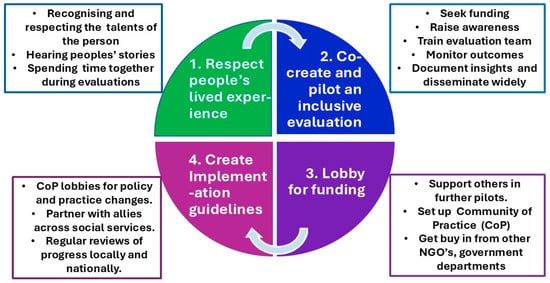
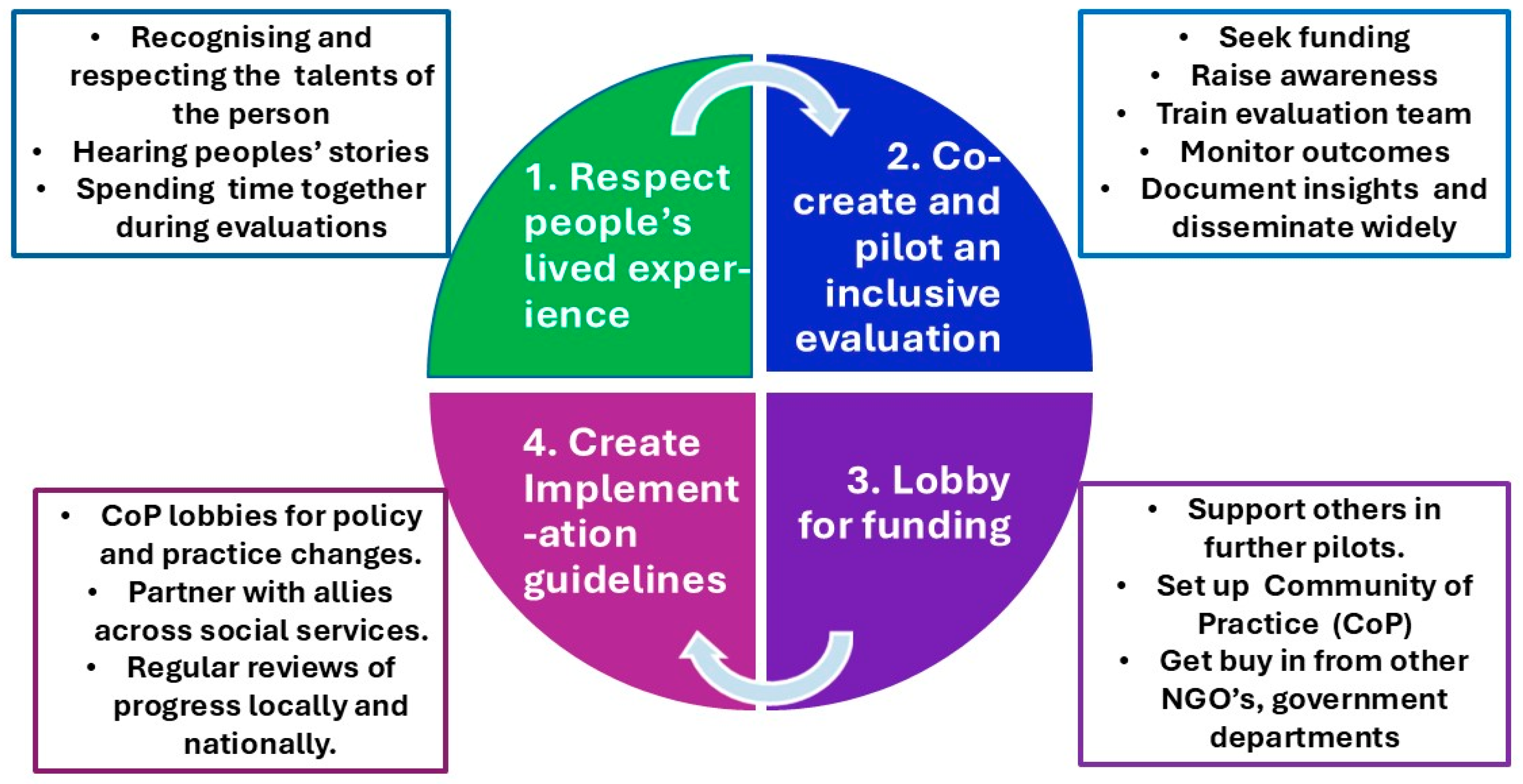
Even so, these are early days in this new venture, but they are reminiscent of the early emergence of inclusive research. Looking back, its growth was fuelled more by academic researchers striving to put inclusive research into practice rather than engaging in scholarly debates about it (O’Brien 2023). Hence, we end by identifying what we perceive to be the core actions needed to nurture inclusive evaluations. We offer for discussion an initial implementation plan with indicative activities, as shown in Figure 1, for those interested in undertaking inclusive evaluation activities. It combines the actions described in this article and the wider inclusive research literature, to which this Special Issue is a valuable addition (https://www.mdpi.com/journal/socsci/special_issues/GF4S06N1TC (accessed on 26 September 2025)). Our hope is that others will expand the plan in the years ahead.
Figure 1.
A plan for setting up inclusive evaluations.
The plan starts with actions in Stage 1, which value the lived experience of people with intellectual disabilities (Curryer et al. 2024; Kelly et al. 2024; Koning et al. 2024; Love 2023) and build respect for their capacity to be informed and competent evaluators. This stage embraces all the stakeholders involved in evaluations, from frontline staff to senior managers of services and advocacy groups, as well as professional evaluators in regulatory agencies and academia (O’Brien et al. 2025).
This leads into Stage 2, co-designing (JFA Purple Orange 2021) and piloting a small-scale inclusive evaluation, possibly emulating the approaches that our informants have described. This ‘proof-of-concept’ stage will yield valuable insights into unique and common challenges and find ways round them (Moxley et al. 2013). It is likely that each evaluation will need to be attuned to the particular service context and culture in any case, so there is little to be gained by waiting for the ‘perfect’ inclusive evaluation model to be discovered.
Stage 3 works towards extending inclusive evaluations, primarily through building solidarity with others committed to inclusive evaluations through communities-of-practice approaches (Ranmuthugala et al. 2011; Wenger-Trayner n.d.) and seeking funds to support this new style of evaluation. Communities of practice encourage the exchange of knowledge and good practices and will also assist with lobbying government agencies for the necessary funding, primarily to cover the cost of training and resourcing of co-evaluators with intellectual disabilities. These practices have proven successful in promoting inclusive research. It remains to be seen if they can transfer to inclusive evaluations.
In Stage 4 the focus shifts to making changes within systems. It may be desirable that leadership for change should come from the top, but in our judgement, this is very unlikely to happen in statutory systems. It is better to build from the bottom-up (Green 2016; Sergeant et al. 2022). The goal is not just to ensure that financial resources are available for more effective monitoring and evaluations of services but that the policy and procedures that guide them are redesigned to make them inclusive (Dew et al. 2018).
We envisage the plan spiralling into a further round of the same stages, as we anticipate that the first four-stage cycle we have outlined is likely to be only partially achieved in certain locations, for particular services, or for some of their users. For example, a further Stage 1 would widen the recognition of the lived experiences of people with intellectual disabilities among service commissioners, before moving forward again to pilot inclusive evaluation in other parts of the geographic service ecosystem, and so on.
Two further points of note: although we present the stages in order, it is possible for them to be worked on simultaneously or in a different order, depending on local contexts. Arguably there could be further sub-stages that may become apparent as the plan gets used in a variety of settings. This is only its beginning.
Finally, we end by summarising the key values that we believe need to drive frameworks for inclusive evaluation in Table 7, just as Walmsley and Johnson (2003) did for inclusive research. The fact that these values overlap is no surprise, although we have adapted the wording from the insights we gained from our informants and the recent literature.
Table 7.
The key values driving Inclusive Evaluation.
5. Conclusions
As inclusive research becomes more widely accepted, the time has come to explore how it might grow out from academia and extend into the monitoring and evaluation of services and allied functions such as their regulation and inspection, inquiries into malpractices, and the design of new support services. The informants across four jurisdictions confirmed its feasibility and voiced strong support for it, highlighting benefits such as greater trust and empathy during evaluations with users of services, more meaningful feedback for service providers, and increased confidence and employment opportunities for evaluators with disabilities. However, challenges remain, including funding and fair pay for the engagement of people with intellectual disabilities, training opportunities that meet the support needs of all stakeholders, and changing the cultural attitudes in support services that underestimate the abilities of people with intellectual disabilities. Steps to overcome these challenges are proposed, such as piloting inclusive evaluation programmes, providing inclusive evaluation training to all involved, and lobbying governments to fund these roles. We created an implementation plan to guide practitioners wishing to undertake inclusive evaluation. We conclude with a set of guiding principles that will nurture a spirit of inclusion and respect. Finally, threaded through the information we garnered was the theme of acceptance—accepting the competence and experience of people with intellectual disabilities and how they grow through being valued within inclusive programmes. Gaining acceptance of difference by others is the primary and arguably the more daunting challenge to be faced in making inclusive evaluations a reality.
Author Contributions
Conceptualization, P.O., R.M., E.G.I.; methodology, P.O., E.G.I., R.M., S.B. and B.O.; validation, S.B. and B.O.; formal analysis, P.O., R.M., E.G.I.; investigation, P.O., E.G.I., R.M., S.B. and B.O.; writing—original draft preparation, P.O., R.M.; writing—review and editing P.O., R.M., E.G.I., S.B. and B.O.; project administration, P.O. All authors have read and agreed to the published version of the manuscript.
Funding
The research received no external funding.
Institutional Review Board Statement
The study was conducted in accordance with the Declaration of Helsinki and approved by the Trinity College Dublin Ethics Committee (protocol code 1130, approved on 2 April 2024) and University of Sydney Human Ethics Committee (2024/037, approved on 30 January 2024).
Informed Consent Statement
Informed consent was obtained from all subjects involved in the study.
Data Availability Statement
The original contributions presented in this study are included in the article. Further inquiries can be directed to the corresponding author.
Acknowledgments
Our grateful thanks to all the participants for agreeing to be interviewed and for their openness in sharing their experiences and perspectives.
Conflicts of Interest
The authors declare no conflict of interest.
References
- Achieve Australia. 2024. Achieve Takes Centre Stage to Share the Work of Quality Champions. Available online: https://www.achieveaustralia.org.au/en/stories/dsc-panel-quality-champions (accessed on 15 August 2025).
- Achieve Australia. n.d. Quality Champions. Available online: https://www.achieveaustralia.org.au/quality-champions (accessed on 15 August 2025).
- Araten-Bergman, Talia, and Christine Bigby. 2023. Violence Prevention Strategies for People with Intellectual Disabilities: A Scoping Review. Australian Social Work 76: 72–87. [Google Scholar] [CrossRef] [Scilit]
- Australian Human Rights Commission. n.d. Disability Standards. Available online: https://humanrights.gov.au/know-your-rights/rights-of-individuals/disability-rights/guides,-tools-and-resources/standards-and-guidelines-under-the-disability-discrimination-act (accessed on 15 August 2025).
- Barnes, Colin, and Geof Mercer, eds. 1997. Doing Disability Research. Leeds: The Disability Press. [Google Scholar]
- Berg, K. L., Deana Herrman, Leah Bernard, Cheng-Shi Shiu, Iulia Mihaila, C. Arnold, Kruti Acharya, Tracy R. G. Gladstone, Christianna Danguilan, Hélène A. Gussin, and et al. 2024. Involving Youth with Intellectual and/or Developmental Disabilities as Collaborators in a Comparative Effectiveness Trial: A Community-Engaged Research Approach. Contemporary Clinical Trials Communications 42: 101395. [Google Scholar] [CrossRef] [Scilit]
- Bishop, Ruth, Richard Laugharne, Nicky Shaw, Alison M. Russell, Dan Goodley, Shib Shankar Banerjee, Emma Clack, CHAMPS, SpeakUp, and Rohit Shankar. 2024. The Inclusion of Adults with Intellectual Disabilities in Health Research–Challenges, Barriers and Opportunities: A Mixed-Method Study among Stakeholders in England. Journal of Intellectual Disability Research 68: 140–49. [Google Scholar] [CrossRef] [Scilit]
- Buck, Andrew, Richard Chapman, Gloria L. Krahn, Christine Brown, Braden Gertz, Susan Marie Havercamp, and Ohio State University Nisonger RRTC on Health and Function. 2024. Research About Us, With Us: An Inclusive Research Case Study. Intellectual and Developmental Disabilities 62: 260–73. [Google Scholar] [CrossRef] [Scilit] [PubMed]
- Capie, Angus, and Michael Ahrens. 1996. A Strategy for Training and Involving Consumers with an Intellectual Disability in the Evaluation of Their Community Services. British Journal of Developmental Disabilities 42: 36. [Google Scholar]
- Charlton, James. 2000. Nothing about Us without Us: Disability Oppression and Empowerment. Los Angeles: University of California Press. [Google Scholar]
- Choice Support. n.d. Checking Our Quality. Available online: https://choicesupport.org.uk/about-us/what-we-do/checking-our-quality (accessed on 15 August 2025).
- Codina, Mireia, Daniel A. Díaz-Faes, and Noemí Pereda. 2024. Better at Home or in Residential Care? Victimization of People with Intellectual Disabilities at the Hands of Caregivers. Research in Developmental Disabilities 146: 104689. [Google Scholar] [CrossRef] [Scilit]
- Corbin, Juliet, and Anselm Strauss. 2015. Basics of Qualitative Research Techniques and Procedures for Developing Grounded Theory, 4th ed. London: Sage. [Google Scholar]
- Curryer, Bernadette, Michelle Donelly, and Kim Roots. 2024. Exploring the Disability Royal Commission’s Views on the Inclusion of People with Intellectual Disabilities in the Decision-Making and Governance of Disability Services. Research and Practice in Intellectual and Developmental Disabilities 11: 133–44. [Google Scholar] [CrossRef] [Scilit]
- Department of Health (UK). 2013. Winterbourne View Hospital: Review and Response. Available online: https://www.gov.uk/government/publications/winterbourne-view-hospital-department-of-health-review-and-response (accessed on 22 August 2025).
- Dew, Angela, Ulrika Athanassiou Leanne Dowse, and Julian Troller. 2018. Current Representation of People with Intellectual disability in Australian Mental Health Policy: The Need for inclusive Policy Development. Journal of Policy and Practice in Intellectual Disabilities 15: 2. [Google Scholar] [CrossRef] [Scilit]
- Di Lorito, Caterina, Linda Birt Alessia Bosco, and Angela Hassiotis. 2018. Co-Research with Adults with Intellectual Disability: A Systematic Review. Journal of Applied Research in Intellectual Disabilities 31: 669–86. [Google Scholar] [CrossRef] [Scilit]
- Disability Royal Commission. 2023. Final Report. Available online: https://disability.royalcommission.gov.au/ (accessed on 15 August 2025).
- Douglas, Tamara Marie, Marlene Ann Attla, Nathan James Rabang, Tasha Boyer, and Vanessa Hiratsuka. 2024. Inclusion in Disability Evaluation and Surveillance Projects: Reflections and Recommendations for Inclusive Project Teams. Developmental Disabilities Network Journal 4: 7. [Google Scholar] [CrossRef] [Scilit]
- Fraser-Barbour, Emily, Sally Robinson, Sonja Gendera, Ian Burton-Clark, Karen Raewyn Fisher, Jenny Alexander, and Kristy Howe. 2025. Shifting Power to People with Disability in Co-Designed Research. Disability & Society 40: 259–80. [Google Scholar] [CrossRef] [Scilit]
- Garratt, Danielle, Kelley Johnson, Amanda Millear, Shaun Picken, Janice Slattery, and Jan Walmsley. 2022. Celebrating Thirty Years of Inclusive Research. Social Sciences 11: 385. [Google Scholar] [CrossRef] [Scilit]
- Ghaderi, Golnaz, Peter Milley, Rosemary Lysaght, and Virginia Cobigo. 2023. Including People with Intellectual and Other Cognitive Disabilities in Research and Evaluation Teams: A Scoping Review of the Empirical Knowledge Base. Journal of Intellectual Disabilities 29: 706–26. [Google Scholar] [CrossRef] [Scilit]
- Gómez, Laura E., Robert L. Schalock, and Miguel Ángel Verdugo. 2021. A New Paradigm in the Field of Intellectual and Developmental Disabilities: Characteristics and Evaluation. Psicothema 33: 28–35. [Google Scholar] [CrossRef] [Scilit]
- Green, Duncan. 2016. How Change Happens. Oxford: Oxford University Press. Available online: https://library.oapen.org/bitstream/id/a2d96f5a-5189-4cf8-a876-d44eda71545f/618650.pdf (accessed on 29 October 2025).
- Health Service Executive Ireland. n.d. What Matters Most. Available online: https://www.hse.ie/eng/services/publications/disability/aasrgwhatmattersmost.pdf (accessed on 22 August 2025).
- Hewitt, Olivia, Patricia E. Langdon, Katie Tapp, and Michael Larkin. 2023. A Systematic Review and Narrative Synthesis of Inclusive Health and Social Care Research with People with Intellectual Disabilities: How Are Co-Researchers Involved and What Are Their Experiences? Journal of Applied Research in Intellectual Disabilities 36: 681–701. [Google Scholar] [CrossRef] [Scilit]
- Hopkins, Robert, Joseph McGrath Gerard Minogue, Pauline Concepta Skehan Lisa Jayne Acheson, Orla Marie McMahon, and Brian Hogan. 2022. Digging Deeper’: Advocate Researchers’ Views on Advocacy and Inclusive Research. Social Sciences 11: 506. [Google Scholar] [CrossRef] [Scilit]
- Inclusion Europe. 2003. Achieving Quality: Consumer Involvement in Quality Evaluation Services. Brussels: Inclusion Europe. [Google Scholar]
- JFA Purple Orange. 2021. Guide to Co-Design with People Living with Disability. Available online: https://www.purpleorange.org.au/ (accessed on 20 September 2025).
- Jones, Katherine Elisabeth, Shelley Ben-David, and Rachelle Hole. 2020. Are Individuals with Intellectual and Developmental Disabilities Included in Research? A Review of the Literature. Research and Practice in Intellectual and Developmental Disabilities 7: 99–119. [Google Scholar] [CrossRef] [Scilit]
- Kelly, Jack, Phillippa Carnemolla Leigh Creighton, and Linda Steele. 2024. Looking Back When Moving Forward: Researching Sites of Former Disability Institutions. Social Sciences 13: 546. [Google Scholar] [CrossRef] [Scilit]
- Koning, Mark, Geert Van Hove, Miriam Zaagsma, and Alice Schippers. 2024. ‘The Ball of Cooperation Rolls on’: Some Personal Reflections on My Experiences as a Researcher. Social Sciences 13: 213. [Google Scholar] [CrossRef] [Scilit]
- Lombardi, Marco, Claudia Claes Hanne Vandenbussche, Jessica De Maeyer Robert L. Schalock, and Stijn Vandevelde. 2019. The concept of quality of life as framework for implementing the UNCRPD. Journal of Policy and Practice in Intellectual Disabilities 16: 180–90. [Google Scholar] [CrossRef] [Scilit]
- Love, Laufrey. 2023. Exclusion to Inclusion: Lived Experience of Intellectual Disabilities in National Reporting on the CRPD. Social Inclusion 11: 94–103. [Google Scholar] [CrossRef] [Scilit]
- Meas, Bopha. 2003. Evaluating Quality of Support from the Perspective of Persons with Intellectual Disabilities: A Review. Scandinavian Journal of Disability Research 5: 224–43. [Google Scholar] [CrossRef] [Scilit]
- Moxley, David P., Zermarie Deacon, and Valerie R. Thompson. 2013. Action research and development for intrinsic innovation in social service administration: Prototyping and proof of concept in small scale start-ups. ALAR: Action Learning and Action Research Journal 18: 37–68. [Google Scholar]
- Muckamore Abbey Hospital Inquiry. 2025. Home. Available online: https://www.mahinquiry.org.uk/ (accessed on 22 August 2025).
- National Disability Insurance Scheme. n.d. How the NDIS Works. Available online: https://www.ndis.gov.au/ (accessed on 20 September 2025).
- NDIS Quality and Safeguards Commission. n.d. About Us. Available online: https://www.ndiscommission.gov.au/ (accessed on 15 August 2025).
- New Zealand Ministry of Health. n.d. Lead Auditors and Evaluators. Available online: https://www.disabilitysupport.govt.nz/providers/audits-and-evaluation/lead-auditors-and-evaluators/ (accessed on 6 September 2025).
- O’Brien, Patricia. 2020. No Researching about Us without Us as Decision Makers. Research and Practice in Intellectual and Developmental Disabilities 7: 120–25. [Google Scholar] [CrossRef] [Scilit]
- O’Brien, Patricia. 2023. Inclusive Research: Is the Road More or Less Well Travelled? Edited by Patricia O’Brien. Basel: MDPI. [Google Scholar]
- O’Brien, Patricia, Bruce O’Brien, and Sarah Butler. 2025. Involving people with lived experience of intellectual disability-In reviewing and monitoring services. Paper presented at the ASID 2025 Conference, Learning from the Past and Shaping the Future, Sydney, Australia, November 12–14. [Google Scholar]
- Ocloo, Josephine, Bryony Dean Franklin Sara Garfield, and Shoba Dawson. 2021. Exploring the theory, barriers and enablers for patient and public involvement across health, social care and patient safety: A systematic review of reviews. Health Research Policy and Systems 19: 8. [Google Scholar] [CrossRef] [Scilit] [PubMed]
- Oliver, Michael. 1996. Understanding Disability: From Theory to Practice. London: Macmillan. [Google Scholar]
- Oliver, Michael. 1997. Emancipatory Disability Research: Realistic Goal or Impossible Dream. In Doing Disability Research. Edited by Colin Barnes and Geoff Mercer. Leeds: The Disability Press, pp. 1–14. [Google Scholar]
- Oliver, Michael. 1999. Final Accounts with the Parasite People. In Disability Discourse. Edited by Mairian Corker and Sally French. Buckingham: Open University Press, pp. 125–38. [Google Scholar]
- Puyaltó, Carolina, Tània Coll Maialen Beltran, Marta Figueras Gemma Diaz-Garolera, Cristina González Judit Fullana, Joan Pujolar Maria Pallisera, and Ana Rey. 2022. Relationships of People with Intellectual Disabilities in Times of Pandemic: An Inclusive Study. Social Sciences 11: 198. [Google Scholar] [CrossRef] [Scilit]
- Ranmuthugala, Geetha, Jennifer J. Plumb, Frances C. Cunningham, Andrew Georgiou, Johanna I. Westbrook, and Jeffrey Braithwaite. 2011. How and why are communities of practice established in the healthcare sector? A systematic review of the literature. BMC Health Services Research 11: 273. [Google Scholar] [CrossRef] [Scilit] [PubMed]
- Rojas-Pernia, Susana, and Ignacio Haya-Salmón. 2022. Inclusive Research and the Use of Visual, Creative and Narrative Strategies in Spain. Social Sciences 11: 154. [Google Scholar] [CrossRef] [Scilit]
- Royal Commission of Inquiry into Abuse in Care. 2024. Whanaketia—Through Pain and Trauma, From Darkness to Light. Wellington: Royal Commission of Inquiry. Available online: https://www.abuseincare.org.nz/reports/whanaketia (accessed on 23 September 2025).
- Schwartz, Ariel E., Katherine McDonald, Kaitlyn Ahlers, Emily Anderson, Karla Ausderau, Jesse Corey, Brendan Durkin, Micah Fialka-Feldman, Dena Gassner, Karen Heath, and et al. 2025. Social validity of Research Ethics for All: Social-behavioral research ethics education for community research partners with developmental disabilities. Disability and Health Journal 18: 101762. [Google Scholar] [CrossRef] [Scilit]
- Scourfield, Peter. 2015. Implementing co-production in adult social care: An example of meta-governance failure? Social Policy and Society 14: 541–54. [Google Scholar] [CrossRef] [Scilit]
- Sergeant, Sofie, Geert Van Hove Henriëtte Sandvoort, Kim van den Bogaard Petri Embregts, Elsbeth Taminiau, and Alice Schippers. 2022. On the Road Together: Issues Observed in the Process of a Research Duo Working Together in a Long-Term and Intense Collaboration in an Inclusive Research Project. Social Sciences 11: 185. [Google Scholar] [CrossRef] [Scilit]
- Standards and Monitoring Services (SAMS). n.d. About Us. Available online: https://www.sams.org.nz/ (accessed on 18 September 2025).
- Stone, Emma, and Mark Priestly. 1996. Parasites, Pawns, pawns, and partners: Disability research and the role of non-disabled researchers. British Journal of Sociology 47: 699–716. [Google Scholar] [CrossRef] [Scilit]
- Stuttaford, Maria C., Hanne Jensen Haricharan Tamlyn Boulle, and Zaynab Sofayiya. 2017. Public and Patient Involvement and the Right to Health: Reflections from England. Frontiers in Sociology 2: 5. [Google Scholar] [CrossRef] [Scilit]
- United Nations. 2006. Convention on the Rights of Persons with Disabilities. New York: United Nations. [Google Scholar]
- van den Bogaard, Kim J. H. M., Mireille G. D. de Beer, Noud Frielink, and Petronella Johanna Catharina Maria “Petri” Embregts. 2023. The Perspectives of Agents Working in Positions of Authority within Health Sector Organisations Regarding the Involvement of Experts by Experience with an Intellectual Disability: An Exploratory Study. Journal of Intellectual & Developmental Disability 49: 276–85. [Google Scholar] [CrossRef] [Scilit]
- Walmsley, Jan, and Kelley Johnson. 2003. Inclusive Research with People with Learning Disabilities: Past, Present and Futures. London: Jessica Kingsley Publishers. [Google Scholar]
- Walmsley, Jan, Iva Strnadová, and Kelley Johnson. 2018. The Added Value of Inclusive Research. Journal of Applied Research in Intellectual Disabilities 31: 751–59. [Google Scholar] [CrossRef] [Scilit] [PubMed]
- Wenger-Trayner. n.d. Introduction to Communities of Practice. Available online: https://www.wenger-trayner.com/introduction-to-communities-of-practice/ (accessed on 18 September 2025).
- World Health Organization. 2011. World Report on Disability (2011). Geneva: World Health Organization. [Google Scholar]
- Zarb, Gerry. 1992. On the road to Damascus: First steps towards changing the relations of disability research production. Disability, Handicap & Society 7: 125–38. [Google Scholar] [CrossRef] [Scilit]

Disclaimer/Publisher’s Note: The statements, opinions and data contained in all publications are solely those of the individual author(s) and contributor(s) and not of MDPI and/or the editor(s). MDPI and/or the editor(s) disclaim responsibility for any injury to people or property resulting from any ideas, methods, instructions or products referred to in the content. |
© 2025 by the authors. Licensee MDPI, Basel, Switzerland. This article is an open access article distributed under the terms and conditions of the Creative Commons Attribution (CC BY) license.