


Workplace-Related Socioeconomic Issues Associated with Job Performance and Productivity among Employees with Various Impairments: A Systematic Literature Review

 , and
, and
Abstract
1. Introduction
2. Methodology
2.1. Search Strategy
2.2. Eligibility Criteria
3. Results
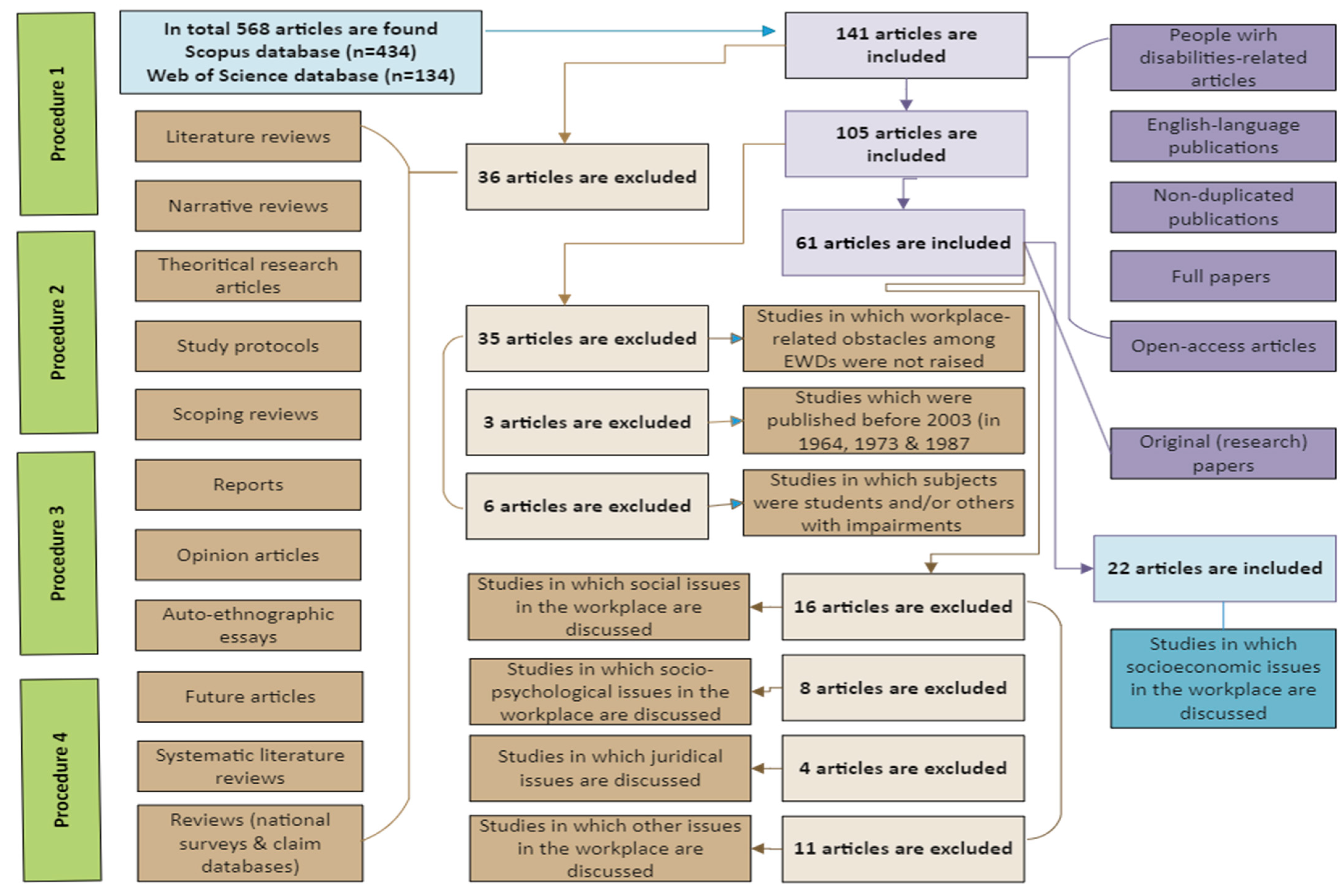
3.1. Study Selection
3.2. General Description of the Identified Studies
3.3. Participants
3.4. Instruments and Measurements
3.4.1. Instruments Used to Measure Headache and Migraine-Related Issues
3.4.2. Instruments Used to Measure Depression-Related Issues
3.4.3. Instruments Used to Measure Arthritis-Related Issues
3.4.4. Instruments Used to Measure Musculoskeletal-Disorder-Related Issues
3.4.5. Instruments Used to Measure Multiple-Sclerosis-Related Issues
4. Discussion and Key Findings
4.1. Employee Productivity
4.2. Workplace Absenteeism and Presenteeism
4.3. Productivity Loss (PL)/Productivity Time Loss (PTL)
4.4. Costs
5. Research Significance
6. Conclusions
Author Contributions
Funding
Institutional Review Board Statement
Informed Consent Statement
Data Availability Statement
Acknowledgments
Conflicts of Interest
Abbreviations
| ADA | Americans with Disabilities Act |
| ASD | Autism spectrum disorder |
| BASDAI#1 | Question 1 from the Bath Ankylosing Spondylitis Disease Activity Index |
| CCI | The Carlson Comorbidity Index |
| CDOMD | Chronic disabling musculoskeletal disorder |
| COPD | Chronic obstructive pulmonary disease |
| CVD | Cardiovascular disease |
| CVERP | Cardiovascular events and related clinical procedures |
| DLQI#4 | Question 4 from the Dermatology Life Quality Index |
| DMT | Disease-modifying therapy |
| EBC | Early-stage breast cancer |
| EDSS | The Expanded Disability Status Scale |
| EuroQol-5d | The Euro Quality of Life 5-dimension Questionnaire |
| EWDs | Employees with disabilities |
| GAD-7 | The seven-item Generalised Anxiety Disorder |
| HA | A group that does not meet the diagnostic criteria for migraine or tension-type headache |
| HFASD | High-functioning autism spectrum disorders |
| HR | Human resources |
| HRQoL | Health-related quality of life |
| IDD | Intellectual and developmental disabilities |
| IPAQ | The International Physical Activity Questionnaire |
| LPT | Lost productive time |
| LTD | Long-term disability |
| M | Migraine group; migraine |
| MBC | Metastatic breast cancer |
| MFIS | The Modified Fatigue Impact Scale |
| MIDAS | The Migraine Disability Assessment Score Questionnaire |
| MM | Multiple myeloma |
| MS | Multiple sclerosis |
| M/TTH | Migraine and tension-type headache group |
| N.A. | Not available |
| NHA | A group that does not have headaches (no headaches) |
| PC-SAD | The patient-administered depression screening instrument |
| PGA | Physician Global Assessment |
| PHQ-9 | The Patient Health Questionnaire (Depression Scale) |
| PRIME-MD | The Primary Care Evaluation of Mental Disorders—Mood Model |
| PsA | Psoriatic arthritis |
| PsAQOL#1 | Question 1 from the Psoriatic Arthritis Quality of Life Questionnaire |
| PsAQOL#4 | Question 4 from the Psoriatic Arthritis Quality of Life Questionnaire |
| PWDs | People with disabilities |
| pwMS | People with multiple sclerosis |
| RTW | Return-to-work |
| SAS | Statistical Analysis System |
| SAW | Stay-at-work |
| SF-12 | The 12-Item Short-Form Health Survey |
| SF-36 | Short Form-36 |
| SF-12x2 | The 12-item Short-Form Health Survey Second Edition |
| SL | Sick leave |
| SLR | Systematic literature review |
| SPSS | Statistical Package for the Social Sciences |
| SSI | Somatic Symptom Inventory |
| STD | Short-term disability |
| TTH | Tension-type headache group |
| UKM | Universiti Kebangsaan Malaysia |
| VOLP | The Valuation of Lost Productivity Questionnaire |
| WA/WAB | Workplace absenteeism |
| WLQ | The Work Limitations Questionnaire |
| WOS | Web of Science |
| WPAI | The Work Productivity and Activity Impairment Questionnaire |
| WPAI-GH | The Work Productivity and Activity Impairment Questionnaire—General Health |
| WPL | Work Productivity Loss/Workplace productivity loss |
| QoL | Quality of life |
| QoWL | Quality of work life |
Appendix A

| Reference | Workplace Absenteeism | Workplace Presenteeism | |
|---|---|---|---|
| 2003–2005 | Stewart et al. (2003b) | “The sum of hours per week absent from work for a health-related reason” (p. 3136). | “The hour-equivalents per week of health-related reduced performance on workdays” (p. 3136). “Reduced work performance during the recall period” (p. 3136). |
| Stewart et al. (2003a) | “The sum of hours per week absent from work for a health-related reason” (p. 2445). “Missed workdays and reduced work hours on days at work during the recall period” (p. 2445). | “The hour equivalent of health-related reduced performance on days at work” (p. 2445). | |
| Lerner et al. (2004) | “Missed work time and productivity loss caused by missed work time” (p. 1371). | “Diminished on-the-job performance and productivity” (p. 1371). | |
| Lötters et al. (2005) | N.A. | “Reduced productivity while the worker is still on the job” (p. 367). | |
| 2006–2010 | Ciconelli et al. (2006) | “Days or hours of work are missed due to a health problem” (p. 325). “Percentage of work time missed due to health” (p. 325). | “Reduction of the effectiveness of a person while working, due to a health problem” (p. 325). “Percentage impairment at work due to health” (p. 325). |
| Kleinman et al. (2007) | “Sick leave, short-and-long term disability, and worker’s compensation” | N.A. | |
| Dall et al. (2008) | N.A. | “Reduced performance at work” (p. 602). | |
| Howard et al. (2009) | “Commonly recognized as employees not showing up for work” (p. 724). “An absentee is one who ceased working” (p. 726). | “The way productivity is affected while the ill employee continues to ‘punch the clock’” (p. 724). “Presentee is who continued to work” (p. 726). | |
| 2011–2015 | Meijster et al. (2011) | N.A. | “Productivity losses due to sick workers continuing to work” (p. 741). “Ill workers are less productive at work” (p. 744). |
| Henderson et al. (2011) | N.A. | “A situation where an employee is symptomatic and underperforming but remains at work” (p. 200). “Being less productive due to ill health” (p. 200). | |
| Gussenhoven et al. (2012) | N.A. | “Being present at work but not functioning at full capability” (p. 2/11). | |
| Reavley et al. (2012) | N.A. | “Being unproductive at work” (p. 1/7). | |
| Selekler et al. (2013) | N.A. | “Impaired effectiveness at work” (p. 1/6). | |
| Wan et al. (2013) | “The paid time when absent from work” (p. 1170). | N.A. | |
| Hutting et al. (2013) | “Sickness absence”. | “Decreased work productivity while at work”. | |
| Sears et al. (2013) | “Being away from work” (pp. 397–98). | “Not being fully productive in meeting expectations while at work” (p. 398). | |
| Walsh et al. (2014) | “Time away from work” (p. 1670). | “Reduced effectiveness at work” (p. 1670). | |
| Wang and Gorenstein (2014) | “Missed workdays”. | “Non-quantifiable low performance while at work”. | |
| Noben et al. (2014) | “A person is not at work due to health complaints” (p. 19/21). | “Reduced productivity while still at work” (p. 2/21). “A person is not productive while at work due to health complaints” (p. 19/21). | |
| Lewis et al. (2015) | “Enquiring about time off work” (p. 580). | N. A. | |
| Robroek et al. (2015) | “Time away from work” (p. 1670). | “Reduced effectiveness at work” (p. 1670). | |
| 2016–2020 | Zhang et al. (2016) | “Short-term absence from work” (p. 413). | “Reduced performance while working” (p. 413). |
| Young et al. (2016) | N. A. | “Productivity focuses on what a person at work can do, presenteeism focuses on what a person at work cannot do” (p. 438). | |
| Brandford and Reed (2016) | N. A. | “The productivity loss that occurs when workers are present at work but are not functioning at peak performance because of health problems” (p. 489). | |
| Nakata et al. (2018) | “Time off from work caused by health-related non-attendance, disability and/or workers’ compensation” (p. 2/11). “The percentage of work time missed because of one’s health in the past 7 days” (p. 3/11). | “Health-related productivity losses occur while employees are at work” (p. 2/11). “The percentage of impairment experienced while at work in the past 7 days because of one’s health” (p. 3/11). | |
| Sruamsiri et al. (2018) | “Percentage of work time missed due to health problems” (p. 584). “Sick leave” (p. 584). | “Percentage of impairment while working due to health problems” (p. 584). “Reduced work performance” (p. 584). | |
| Fløvik et al. (2019) | N. A | “Lower performance and productivity while at work” (p. 135). | |
| Domingues et al. (2020) | “Work time missed” (pp. 468, 469). | “Impairment at work” (pp. 468, 469). | |
| Behrens et al. (2020) | “Work time missed due to illness (% of missed work hours due to health problems in the past 7 days” (p. 2584). “Missed hours of work” (p. 2588). | “Impairment at work” (p. 2584). “Percentage impairment while at work” (pp. 2584–85). “On-the-job effectiveness” (p. 2588). “Reduced productivity at work” (p. 2588). | |
| Haw et al. (2020) | “The number of workdays lost due to migraine” (p. 4/11). | “Number of workdays with impaired work productivity due to migraine” (p. 4/11). | |
| Wong et al. (2020) | “The mean per cent work time missed due to migraine” (p. 1/11). “Per cent work time missed due to migraine” (pp. 3, 5//11). | “The mean per cent productivity loss at work” (p. 1/11). “Per cent impairment while working due to migraine” (pp. 3, 5/11). | |
| 2021–2022 | Gennep et al. (2021) | “The percentage of hours missed due to Inflammatory Bowel Disease (IBD) during the past week” (p. 2917). | “Work impairment due to Inflammatory Bowel Disease (IBD) while working” (p. 2917). |
| Shimizu et al. (2021) | N.A. | “Working while sick leads to more lost work than absenteeism” (p. 2/11). “An individual’s loss of work productivity due to health conditions and the symptoms of a disease” (p. 6/11). “Reduced productivity” (p. 7/11). | |
| Smith et al. (2021) | “A patient’s reported hours of missed work relative to his or her total typical work hours” (p. 321). | “The extent to which an employee is not fully functional at work” (p. 319). “A patient’s perceived change in work quality compared with his or her usual work quality” (p. 321). | |
| Rotaru et al. (2021) | N.A. | “Loss of productivity during working hours” (p. 312). | |
| Vornholt et al. (2021) | N. A | “The condition of being present at work without being productive” (p. 141). | |
| Iragorri et al. (2021) | “Staying home while sick” (p. 338). | N.A. | |
| Rodriguez Llorian et al. (2022) | “Time missed from work” (p. 1414). | “Reduced productivity while working” (p. 1414). |
References
- Alkaabi, Faisal Armulbahani. 2022. Predicting Disability Retirement among Abu Dhabi Police Using Multiple Measure of Sickness Absence. BMC Public Health 22: 1318. [Google Scholar] [CrossRef]
- Amin, Aizan Sofia, Azianura Hani Shaari, and Khairul Farhah Khairuddin. 2020. Barriers to Marriage and Motherhood: The experience of Disabled Women in Malaysia. The History of the Family 25: 246–64. [Google Scholar] [CrossRef]
- Anderson, Connie, Catherine Butt, and Clare Sarsony. 2021. Young Adults on the Autism Spectrum and Early Employment-Related Experiences: Aspirations and Obstacles. Journal of Autism and Developmental Disorders 51: 88–105. [Google Scholar] [CrossRef] [PubMed]
- Asmah, Johari, Ahmad Norfazilah, Ismail Aniza, Rohaizat Hassan Mohd, and Hod Rozita. 2011. Healthy Lifestyle Satisfaction among Adults in Sabak Bernam, Selangor. Medicine and Health 6: 169–78. [Google Scholar]
- Bastas, Meryem, and Zehra Altinay. 2019. Employment for Disability: Human Resources Management in Higher Education for Quality. International Journal of Disability, Development and Education 66: 610–15. [Google Scholar] [CrossRef]
- Behrens, Frank, Hans-Peter Tony, Michaela Koehm, Eva C. Schwaneck, Holger Gnann, Gerd Greger, Harald Burkhardt, and Marc Schmalzing. 2020. Sustained Improvement in Work Outcomes in Employed Patients with Rheumatoid Arthritis during 2 years of Adalimumab Therapy: An Observational Cohort Study. Clinical Rheumatology 39: 2583–92. [Google Scholar] [CrossRef] [PubMed]
- Birau, Felicia Ramona, Daniela-Emanuela Dănăcică, and Cristi Marcel Spulbar. 2019. Social Exclusion and Labor Market Integration of People with Disabilities. A Case Study for Romania. Sustainability 11: 5014. [Google Scholar] [CrossRef]
- Bonafede, Machaon, Rina Mehta, Gilwan Kim, Ila Sruti, Marc Tian, Corey Pelletier, and Noil Goldfarb. 2021. Productivity Loss and Associated Costs among Employed Patients Receiving Disease-Modifying Treatment for Multiple Sclerosis. PharmacoEconomics—Open 5: 23–34. [Google Scholar] [CrossRef]
- Brandford, A. Arica, and Deborah B. Reed. 2016. Depression in Registered Nurses: A State of the Science. Workplace Health and Saf 64: 488–511. [Google Scholar] [CrossRef]
- Butterworth, John, Alberto Migliore, Kelly Nye-Lengerman, Oliver Lyons, Ami Gunty, Jill Eastman, and Paul Foos. 2020. Using data-enabled performance feedback and guidance to assist employment consultants in their work with job seekers: An experimental study. Journal of Vocational Rehabilitation 53: 219–25. [Google Scholar] [CrossRef]
- Cavanagh, Jillian, Timothy Bartram, Hannah Meacham, Christine Bigby, Jodi Oakman, and Ellie Fossey. 2017. Supporting Workers with Disabilities: A Scoping Review of the Role of Human Resource Management in Contemporary Organizations. Asian Pacific Journal of Human Resource 55: 6–43. Available online: https://onlinelibrary.wiley.com/doi/10.1111/1744-7941.12111 (accessed on 16 August 2022). [CrossRef]
- Chajduga, Tomasz, and Manuela Ingaldi. 2021. Hiring Disabled People to Avoid Staff Turnover and Enhance Sustainability of Production. Sustainability 13: 10577. [Google Scholar] [CrossRef]
- Chao, Pie-Ju, Ying-Ting Huang, Juliet H. Fried, Tsu-Hsuan Hsu, and Joseph N. Ososkie. 2018. Attitudes and Reflections of Vietnamese Managers Toward Their Employees with Disabilities. Journal of Rehabilitation 84: 14–27. [Google Scholar]
- Chi, Christina Geng-qing, and Hailin Qu. 2004. A Study of Differential Employers’ Attitude towards Hiring People with Physical, Mental, and Sensory Disabilities in Restaurant Industry. Journal of Human Resources in Hospitality and Tourism 3: 1–31. [Google Scholar] [CrossRef]
- Choi, Yun-Ju, Byung-Kun Kim, Pil-Wook Chung, Mi Ji Lee, Jung-Wook Park, Min Kyung Chu, Jin-Young Ahn, Byung-Su Kim, Tae Jin Song, Jonh-Hee Sohn, and et al. 2018. Impact of Cluster Headache on Employment Status and Job Burden: A Prospective Cross-ectional Multicenter Study. Journal of Headache and Pain 19: 78. [Google Scholar] [CrossRef]
- Ciconelli, Rozana Mesquita, Clarissa Campos, Guaragna Kowalski, and Marcos Bosi Ferraz. 2006. The Brazilian Portuguese Version of the Work Productivity and Activity Impairment-General Health (WPAI-GH) Questionnaire. São Paulo Med 124: 325–32. [Google Scholar] [CrossRef]
- Dall, Tim, Sarah Edge Mann, Yiduo Zhang, Jaana Martin, Yaozhu Chen, Paul Hogan, and Matt Petersen. 2008. Economic Costs of Diabetes in the U.S. in 2007. Diabetes Care 31: 596–615. [Google Scholar] [CrossRef]
- Domingues, Renan Barros, Isabella Silva Picon, Julia Vescovi, Gabriel Chung, Felipe Teijeira Cabral, Ayrton Piassi Bertelli, Annelise Akemi Higa Lee, and Paulo Diego Santos Silva. 2020. Assessment of Work Productivity and Activity Impairment (WPAI) Questionnaire for Migraine with the Help of a Smartphone App. Arquivos de Neuro-Psiquiatria 78: 468–72. [Google Scholar] [CrossRef]
- Fløvik, Lise, Stein Knardahl, and Jan Olav Christensen. 2019. Organizational Change and Employee Mental Health: A Prospective Multilevel Study of the Associations between Organizational Changes and Clinically Relevant Mental Distress. Scandinavian Journal of Work, Environment and Health 45: 134–45. Available online: https://pubmed.ncbi.nlm.nih.gov/30334062/ (accessed on 16 August 2022). [CrossRef]
- Gennep, Sara, Nanne K. H. Boer, Marieke E. Gielen, Svend T. Rietdijk, Krisztina B. Gecse, Cyriel Y. Ponsioen, Marjolijn Duijvestein, Geert R. D’Haens, Mark Löwenberg, and Angela G. E. M. de Boer. 2021. Impaired Quality of Working Life in Inflammatory Bowel Disease Patients. Digestive Diseases and Sciences 66: 2916–24. [Google Scholar] [CrossRef]
- Gussenhoven, Arjenne H. M., Johannes R. Anema, S. Theo Goverts, Judieth E. Bosmans, Joost M. Festen, and Sophia E. Kramer. 2012. Cost-effectiveness of a Vocational Enablement Protocol for Employees with Hearing Impairment; Design of a Randomized Controlled Trial. BMC Public Health 12: 151. [Google Scholar] [CrossRef] [PubMed]
- Hairodin, Khairul Rafizah Hairodin, Aniza Ismail, Khadijah Shamsuddin, and Hazlina Mohd Miskam. 2021. Determinants of Successful Ageing among Preretirement Public Servants in Klang Valley, Malaysia. Malaysian Journal of Public Health Medicine 21: 124–32. [Google Scholar] [CrossRef]
- Haw, Nel Jason, Ian Theodore Cabaluna, Germanie Erika Kaw, Joanna Feliz Cortez, Maria Pamela Chua, and Kristel Guce. 2020. A Cross-sectional Study on the Burden and Impact of Migraine on Work Productivity and Quality of Life in Selected Workplaces in the Philippines. Journal of Headache and Pain 21: 125. [Google Scholar] [CrossRef] [PubMed]
- Henderson, M., S. B. Harvey, S. Øverland, A. Mykletun, and M. Hotopf. 2011. Work and Common Psychiatric Disorders. Journal of the Royal Society of Medicine 104: 198–207. [Google Scholar] [CrossRef] [PubMed]
- Hernandez, Brigda, and Katheríne McDonald. 2010. Exploring the Costs and Benefits of Workers with Disabilities. Journal of Rehabilitation 76: 15–23. [Google Scholar]
- Howard, Krista J., Tom G. Mayer, and Robert J. Gatchel. 2009. Effects of Presenteeism in Chronic Occupational Musculoskeletal Disorders: Stay at Work is Validated. Journal of Occupational and Environmental Medicine 51: 724–31. [Google Scholar] [CrossRef] [PubMed]
- Hutting, Nathan, J. Bart Staal, Yvonne F. Heerkens, Josephine A. Engels, and Maria W. Nijhuis-van der Sanden. 2013. A Self-management Program for Employees with Complaints of the Arm, Neck, or Shoulder (CANS): Study Protocol for a Randomized Controlled Trial. Trials 14: 258. [Google Scholar] [CrossRef]
- Iragorri, Nicolas, Claire de Oliveira, Natalie Fitzgerald, and Beverley Essue. 2021. The Indirect Cost Burden of Cancer Care in Canada: A Systematic Literature Review. Applied Health Economics and Health Policy 19: 325–41. [Google Scholar] [CrossRef]
- Jammaers, Eline, Patrizia Zanoni, and Stefan Hardonk. 2016. Constructing Positive Identities in Ableist Workplaces: Disabled Employees’ Discursive Practices Engaging with the Discourse of Lower Productivity. Human Relations 69: 1365–86. [Google Scholar] [CrossRef]
- Katz, Noomi, Ifat Dejakb, and Eynat Galc. 2015. Work Performance Evaluation and QoL of Adults with High Functioning Autism Spectrum Disorders (HFASD). Work 51: 887–92. Available online: https://pubmed.ncbi.nlm.nih.gov/25735411/ (accessed on 16 August 2022). [CrossRef]
- Kensbock, Julia M., and Stephan A. Boehm. 2016. The Role of Transformational Leadership in the Mental Health and Job Performance of Employees with Disabilities. The International Journal of Human Resource Management 27: 1580–609. Available online: https://www.tandfonline.com/doi/abs/10.1080/09585192.2015.1079231?journalCode=rijh20 (accessed on 16 August 2022). [CrossRef]
- Keramat, Syed Afroz, Khorshed Alam, Jeff Gow, and Stuart J. H. Biddle. 2020. Gender differences in the Longitudinal Association between Obesity, and Disability with Workplace Absenteeism in the Australian Working Population. PLoS ONE 15: e0233512. [Google Scholar] [CrossRef] [PubMed]
- Kim, Ki Hyun. 2015. Moving toward a Better Understanding of Job Satisfaction of South Korean Masseurs with Visual Impairments. Doctoral dissertation, University of Iowa, Iowa City, IA, USA. Available online: https://iro.uiowa.edu/esploro/outputs/doctoral/Moving-toward-a-better-understanding-of/9983776879902771?skipUsageReporting=true&recordUsage=false&institution=01IOWA_INST (accessed on 16 August 2022).
- King, Joanne, and Geoffrey Waghorn. 2018. How Higher Performing Employment Specialists Support Job-seekers with Psychiatric Disabilities Retain Employment. Journal of Rehabilitation 84: 22–28. Available online: https://go.gale.com/ps/i.do?id=GALE%7CA567426013&sid=googleScholar&v=2.1&it=r&linkaccess=abs&issn=00224154&p=AONE&sw=w&userGroupName=anon%7E4da8d5d4 (accessed on 16 August 2022).
- Kleinman, Nathan L., Richard A. Brook, Pankaj A. Patel, Arthur K. Melkonian, Truman J. Brizee, James E. Smeeding, and Nancy Joseph-Ridge. 2007. The Impact of Gout on Work Absence and Productivity. Value in Health 10: 231–37. [Google Scholar] [CrossRef]
- Lerner, Debra, David A. Adler Chang Hong, Lapitsky Leueen, Maggie Y. Hood, Perissinotto Carla, Reed John, Thomas J. McLauhlin, Ernst R. Berndt, and William H. Rogers. 2004. Unemployment, Job Retention and Productivity Loss among Employees with Depression. Psychiatric Services 55: 1371–78. Available online: https://pubmed.ncbi.nlm.nih.gov/15572564/ (accessed on 16 August 2022). [CrossRef] [PubMed]
- Lewis, M., G. Wynne-Jones, P. Barton, D. G. T. Whitehurst, S. Wathall, N. E. Foster, E. M. Hay, and D. van der Windt. 2015. Should General Practitioners Issue a Sick Certificate to Employees Who Consult for Low Back Pain in Primary Care? Journal of Occupational Rehabilitation 25: 577–88. [Google Scholar] [CrossRef]
- Lötters, Freek, WillemJan Meerding, and Alex Burdorf. 2005. Reduced Productivity after Sickness Absence due to Musculoskeletal Disorders and its Relation to Health Outcomes. Scandinavian Journal of Work, Environment and Health 31: 367–74. [Google Scholar] [CrossRef]
- Lysaght, Rosemary, Jami Petner-Arrey, Angela Howell-Moneta, and Virginie Cobigo. 2017. Inclusion through Work and Productivity for Persons with Intellectual and Developmental Disabilities. Journal of Applied Research in Intellectual Disabilities 30: 922–35. [Google Scholar] [CrossRef]
- Meijster, Tim, Birgit van Duuren-Stuurman, Dick Heederik, Remko Houba, Ernst Koningsveld, Nicholas Warren, and Erik Tielemans. 2011. Cost-Benefit Analysis in Occupational Health: A Comparison of Intervention Scenarios for Occupational Asthma and Rhinitis among Bakery Workers. Occupational and Environmental Medicine 68: 739–45. [Google Scholar] [CrossRef]
- Merola, David, Cardice Yong, Stephen J. Noga, and Kenneth M. Shermock. 2018. Costs Associated with Productivity Loss Among U.S. Patients Newly Diagnosed with Multiple Myeloma Receiving Oral Versus Injectable Chemotherapy. Journal of Managed Care and Specialty Pharmacy 24: 1019–26. Available online: https://pubmed.ncbi.nlm.nih.gov/30247101/ (accessed on 16 August 2022). [CrossRef]
- Nakata, Ken, Toshinaga Tsuji, Jeffrey Vietri, and Dena H. Jaffe. 2018. Work Impairment, Osteoarthritis, and Health-related Quality of Life among Employees in Japan. Health and Quality of Life Outcomes 16: 64. [Google Scholar] [CrossRef]
- Noben, Cindy. YG., Silvia MAA. Evers, Frans J. Nijhuis, and Angelique E. De Rijk. 2014. Quality Appraisal of Generic Self-reported Instruments Measuring Health-related Productivity Changes: A Systematic Review. BMC Public Health 14: 115. [Google Scholar] [CrossRef]
- Ochrach, Chase, Kathryn Thomas, Brian Phillips, Ngonidzashe Mpofu, Tim Tansey, and Stacie Castillo. 2022. Case Study on the Effects of a Disability inclusive Mindset in a Large Biotechnology Company. Journal of Work-Applied Management 14: 113–25. [Google Scholar] [CrossRef]
- Pihlajamäki, Minna, Heikki Arola, Heine Ahveninen, Jyrki Ollikainen, Mikko Korhonen, Tapio Nummi, Jukka Uitti, and Simo Taimela. 2020. Subjective Cognitive Complaints and Sickness Absence: A Prospective Cohort Study of 7059 Employees in Primarily Knowledge-intensive Occupations. Preventive Medicine Reports 19: 101103. [Google Scholar] [CrossRef] [PubMed]
- Ramakrishnan, Shanthi, and Lawrence Arokiasamy. 2019. Flexible Working Arrangements in Malaysia: A Study of Employer’s Performance on White Collar Employees. Global Business and Management Research: An International Journal 11: 551–59. [Google Scholar]
- Reavley, Nicola J., Anna Ross, Eoin J. Killackey, and Anthony F. Jorm. 2012. Development of Guidelines to Assist Organizations to Support Employees Returning to Work after an Episode of Anxiety, Depression or a Related Disorder: A Delphi Consensus Study with Australian Professionals and Consumers. BMC Psychiatry 12: 135. Available online: http://www.biomedcentral.com/1471-244X/12/135 (accessed on 16 August 2022). [CrossRef] [PubMed]
- Robroek, Suzan J. W., Anne Rongen, Coos H. Arts, Ferdy W. H. Otten, Alex Burdorf, and Merel Schuring. 2015. Educational Inequalities in Exit from Paid Employment among Dutch Workers: The Influence of Health, Lifestyle and Work. PLoS ONE 10: e0134867. [Google Scholar] [CrossRef] [PubMed]
- Rodriguez Llorian, Elisabet, Wei Zhang, Amir Khakban, Scott Patten, Anthony Traboulsee, Jiwon Oh, Shannon Kolind, Alexandre Prat, Roger Tam, and Larry D. Lynd. 2022. Productivity Loss among People with Early Multiple Sclerosis: A Canadian Study. Multiple Sclerosis Journal 28: 1414–23. [Google Scholar] [CrossRef]
- Rotaru, Tatiana, Natalia Loghin-Oprea, Lucia Mazur-Nicorici, Virginia Salaru, Maria Garabajiu, Victoria Sadovici-Bobeica, and Minodora Mazur. 2021. The Medical and Social Impact of the Disease in Patients with Psoriatic Arthritis. Archives of the Balkan Medical Union 56: 309–16. [Google Scholar] [CrossRef]
- Sears, Lindsay E., Yuyan Shi, Carter R. Coberley, and James E. Pope. 2013. Overall Well-being as a Predictor of Health Care, Productivity, and Retention Outcomes in a Large Employer. Population Health Management 16: 397–405. [Google Scholar] [CrossRef]
- Selekler, Macit H., Gursel Gökmen, and Timothy J. Steiner. 2013. Productivity Impact of Headache on a Heavy-Manufacturing Workforce in Turkey. The Journal of Headache and Pain 14: 88. [Google Scholar] [CrossRef] [PubMed]
- Shi, Yuyan, Lindsay E. Sears, Carter R. Coberley, and James E. Pope. 2013. Classification of Individual Well-Being Scores for the Determination of Adverse Health and Productivity Outcomes in Employee Populations. Population Health Management 16: 90–98. [Google Scholar] [CrossRef]
- Shimizu, Toshihiko, Fumihiko Sakai, Hitoshi Miyake, Tomofumi Sone, Mitsuhiro Sato, Satoshi Tanabe, Yasuhiro Azuma, and David W. Dodick. 2021. Disability, Quality of Life, Productivity Impairment and Employer Costs of Migraine in the Workplace. Journal of Headache and Pain 22: 29. [Google Scholar] [CrossRef]
- Smith, Grace L., Shuangshuang Fu, Matthew S. Ning, Diem-Khanh Nguyen, Paul M. Busse, Robert L. Foote, Adam S. Garden, Gary B. Gunn, Clifton D. Fuller, William H. Morrison, and et al. 2021. Work Outcomes after Intensity-Modulated Proton Therapy (IMPT) Versus Intensity-Modulated Photon Therapy (IMRT) for Oropharyngeal Cancer. International Journal of Particle Therapy 8: 319–27. [Google Scholar] [CrossRef] [PubMed]
- Smith, Kaye, Lynne Webber, Joseph Graffam, and Carlene Wilson. 2004. Employer Satisfaction with Employees with a Disability: Comparisons with Other Employees. Journal of Vocational Rehabilitation 21: 61–69. [Google Scholar]
- Song, Xue, Ruben G. W. Quek, Shravanthi R. Gandra, Katherine A. Cappell, Robert Fowler, and Ze Cong. 2015. Productivity Loss and Indirect Costs Associated with Cardiovascular Events and Related Clinical Procedures. BMC Health Services Research 15: 245. [Google Scholar] [CrossRef] [PubMed]
- Sruamsiri, Rosarin, Yasuhiro Mori, and Jorg Mahlich. 2018. Productivity Loss of Caregivers of Schizophrenia Patients: A Cross-Sectional Survey in Japan. Journal of Mental Health 27: 583–87. [Google Scholar] [CrossRef]
- Stewart, Walter F., Judith A. Ricci, Elsbeth Chee, David Morganstein, and Richard Lipton. 2003a. Lost Productive Time and Cost Due to Common Pain Conditions in the US Workforce. JAMA 290: 2443–54. Available online: https://pubmed.ncbi.nlm.nih.gov/14612481/ (accessed on 16 August 2022). [CrossRef]
- Stewart, Walter F., Judith A. Ricci, Elsbeth Chee, Steven R. Hahn, and David Morganstein. 2003b. Cost of Lost Productive Work Time among US Workers with Depression. JAMA 289: 3135–44. Available online: https://pubmed.ncbi.nlm.nih.gov/12813119/ (accessed on 16 August 2022). [CrossRef]
- Subhi, Nasrudin Subhi, Khatijah Sulaiman, and Daniella M. Mokhtar. 2020. Effectiveness Assessment of the Economic Empowerment Program (EEP): A Case Study among Disabled Trainers at Cheshire Home Selangor. International Journal of Psychosocial Rehabilitation 24: 4323–36. [Google Scholar] [CrossRef]
- Vornholt, Katharina, Sjir Uitdewilligen, Gemma Van Ruitenbeek, and Fred Zijlstra. 2021. The Development and Validation of the Workplace Acceptance Scale: Evidence from a Sample of Workers with Disabilities. Journal of Vocational Rehabilitation 54: 135–49. [Google Scholar] [CrossRef]
- Walsh, Jessica A., Molly L. McFadden, Michael D. Morgan, Allen D. Sawitzke, Kristina C. Duffin, Gerald G. Krueger, and Daniel O. Clegg. 2014. Work Productivity Loss and Fatigue in Psoriatic Arthritis. Journal of Rheumatology 41: 1670–74. [Google Scholar] [CrossRef] [PubMed]
- Wan, Yin, Xin Gao, Sonam Mehta, Zhixiao Wang, Claudio Faria, and Lee Schwartzberg. 2013. Indirect Costs Associated with Metastatic Breast Cancer. Journal of Medical Economics 16: 1169–78. [Google Scholar] [CrossRef] [PubMed]
- Wang, Yuan-Pang, and Clarice Gorenstein. 2014. Attitude and Impact of Perceived Depression in the Workplace. International Journal of Environmental Research and Public Health 11: 6021–36. [Google Scholar] [CrossRef]
- Werner, Shirli, and Yael Hochman. 2019. “It opened up a whole new world for me”: Experiences of military commanders in employing individuals with intellectual disabilities. Journal of Applied Research in Intellectual Disabilities 32: 648–56. [Google Scholar] [CrossRef] [PubMed]
- Wong, Li Ping, Haridah Alias, Nirmala Bhoo-Pathy, Ivy Chung, Yew Ching Chong, Sonesh Kalra, and Zia U. Bahkt. Sultan Shah. 2020. Impact of Migraine on Workplace Productivity and Monetary Loss: A Study of Employees in Banking Sector in Malaysia. Journal of Headache and Pain 21: 68. [Google Scholar] [CrossRef]
- Young, Amanda E., Eira Viikari-Juntura, Cecile R. L. Boot, Chetwyn Chan, David Gimeno Ruiz de Porras, Steven J. Linton, and Hopkinton Conference Working Group on Workplace Disability Prevention. 2016. Workplace Outcomes in Work-Disability Prevention Research: A Review with Recommendations for Future Research. Journal of Occupational Rehabilitation 26: 434–47. [Google Scholar] [CrossRef] [PubMed]
- Yuen, Kevin C. J., Kathryn A. Munoz, Richard A. Brook, Ian A. Beren, John D. Whalen, Nicholas J. Rohrbacker, and Antonio Ribeiro-Oliveira. 2021. Health Benefit Costs and Absenteeism Among Employed Patients with Acromegaly. Endocrine Practice 27: 1034–39. [Google Scholar] [CrossRef]
- Zahari, Nur Fatin, Adi Ifran Che Ani, and Robiah Abdul Rashid. 2020. Profiling Disabled Facilities and Accessibility Provided in National Heritage Buildings in Malaysia. Journal of Critical Reviews 7: 109–15. [Google Scholar]
- Zhang, Wei, Christopher McLeod, and Mieke Koehoorn. 2016. The Relationship between Chronic Conditions and Absenteeism and Associated Costs in Canada. Scandinavian Journal of Work, Environment and Health 42: 413–22. [Google Scholar] [CrossRef]
| Author/Year of Publication/Country | Purpose of the Study | Design/Approach/Software | Sample Size/Participants/Sampling Method | Instruments/Measurements | Mean Age/Percentage in Terms of Gender | Key Findings |
|---|---|---|---|---|---|---|
| (Stewart et al. 2003b) The U.S. | To estimate the impact of depression on labour costs (work absenteeism and reduced performance while at work) among US workers. | Cross-sectional. Quantitative. Wesvar, version 4 and SAS, version 8.2. | 219 employees with depression and 908 employees without depression. Random sampling. | PRIME-MD (mood). The 26-item SSI (26 physical symptoms). The DSM-III-R (the diagnosis of a specific depressive disorder). A 7-factor solution (1-pain, weakness and fatigue (7 items), 2-gastrointestinal complaints (3 items), 3-panic or anxiety (3 items), 4-faintness or dizziness (4 items), 5-autonomic instability with anxiety (2 items), 6-ringing in the ears, or head or nose fullness (2 items) and 7-sensory or nerve impairment (2 items). | 66%—between 35 and 65 years. 65.6%—female. | A majority of the LPT costs that employers face from employee depression are invisible and explained by reduced performance while at work. |
| (Lerner et al. 2004) The U.S. | To comprehensively assess work outcomes among employees with depression. | Longitudinal. Quantitative. Stata, version 7.0. | 229 employees with depression, 87 employees with rheumatoid arthritis, and 173 healthy employees in the control group. N. A. | CAGE questionnaire (alcoholism). PC-SAD (dysthymia and major depressive disorder). PHQ-9 scale (depressive symptom severity). WLQ (presenteeism). Two items from the WLQ (absenteeism). The Medical Outcomes Study SF-12 (health status). | 41.1 years—dysthymia, 38.7 years—major depression, 39.8 years—both dysthymia and major depression, 47.7 years—rheumatoid arthritis, 41.4 years—control group. 81%—female. | In addition to helping employees with depression obtain high-quality depression treatment, new interventions may be needed to help them to overcome the substantial job upheaval. |
| (Lötters et al. 2005) The Netherlands | To quantify the reduced productivity of workers on full duty after sickness absence from a musculoskeletal disorder and determine the effect of health parameters such as perceived pain, functional disability, and general health on reduced productivity. | Longitudinal. Quantitative. N.A. | 253 occupational physicians with musculoskeletal disorders. N.A. | The Job Content Questionnaire (psychological factors at work: work demands (11 items), skill discretion (6 items), and discussion authority (11 items); The Ronald Morris Disability Questionnaire for back complaints (functional disability). The physical dimension of the Sickness Impact Profile (low back pain). SF-12 (general health, functioning, role—physical, bodily pain, vitality, role—emotional, social functioning, and mental health). EuroQol-5d (mobility, self-care, daily activity, pain, and anxiety or depression). EuroQol visual analogue scale (thermometer). | 43 years. 73%—male. | Reduced productivity was prevalent for 60% of the workers after they returned to work and for 40% still at the 12-month follow-up. Worsening physical health, more functional disability, and poorer relations with the supervisor were associated with productivity loss shortly after RTW, whereas recurrent sick leave was the greatest predictor of productivity loss at the follow-up. |
| (Kleinman et al. 2007) The U.S. | To evaluate the impact of gout, a painful inflammatory arthritis condition, on an employed population’s health-related work absence and to objectively measure productivity output. | Cross-sectional. Quantitative. SAS, version 9.1. | 86 employees with gout and 27,632 employees without gout. N.A. | N.A. | 45.91 years—employees with gout, 40.41 years—employees without gout. 85.0%—male employees with gout, 54.3%—male employees without gout. | Gout has a substantial impact on work absence and may negatively affect productivity. |
| (Howard et al. 2009) The U.S. | To take a new approach to understand how presenteeism relates to chronic pain or disability patient outcomes. | Longitudinal. Quantitative. N.A. | 2191 CDOMD patients (presentees—n = 704 and absentees—n = 1487). N.A. | The Pain Intensity Analog. The Million Visual Analog Scale. A measurement for assessing perceived disability. The Beck Depression Inventory. The Minnesota Multiphasic Personality Inventory. The Structured Clinical Interview for DSM-IV Axis I and Axis II diagnoses. | 46.4 years—presentees, 45.4 years—absentees. 46.7%—male presentees, 55.9%—male absentees. | Presentees are significantly more likely to complete the prescribed functional restoration treatment program, return to work, retain work 1-year post-treatment, and not to have a decrease in job demand from preinjury to post-treatment. Both employers and employees will benefit if the ill or injured employee SAW post-injury instead of taking short- or long-term disability leave. |
| (Hernandez and McDonald 2010) U.S. | To examine the costs and benefits of workers with and without disabilities within three sectors: healthcare, retail, and hospitality. | Cross-sectional. Quantitative. SPSS. | 314 employees with hearing loss, cognitive impairments, physical disabilities, and chronic illnesses (95 with and 219 without disabilities). N.A. | The Business Survey (the company’s duration of operation, size and makeup of the workforce): from employers. The Employee Survey (disability status, job title, and department): from employees. The Cost–Benefit Survey (cost–benefit information on workers with disabilities). | N.A. N.A. | Job performance and supervision were similar for both groups of employees. However, findings were mixed when tenure, absenteeism, and worker’s compensation claims were considered. Lastly, the costs of accommodation were minimal. EWDs across the three sectors were nearly equivalent to those without disabilities in overall job performance. |
| (Meijster et al. 2011) The Netherlands | To evaluate cost–benefit ratios for different stakeholders (employers, employees, and society (taxpayers)). | Cross-sectional. Quantitative (the human capital method). Excel. | Bakery workers with occupational asthma and rhinitis. N.A. | N.A. | N.A. | The use of the model-based approach enables investigation of those parameters most likely to impact the effectiveness and costs of interventions for work-related diseases. |
| (Wan et al. 2013) The U.S. | To compare the indirect costs of productivity loss between MBC and EBC patients, as well as their respective family members. | Longitudinal. Quantitative. SAS, version 9.2 | 139 MBC, 432 EBC, and 820 controls (for sick leave). 432 MBC, 1552 EBS, and 4682 controls (for STD). N.A. | CCI. | 49 years—MBC patients, 51 years—EBC patients, 50 years—controls, 51 years—family population. 100%—female MBC patients, EBC patients, controls, 99.9%—male from the family population (spouse). | MBC patients had significantly higher STD costs than EBC patients and the control groups. They had more sick leave costs than the control groups. Productivity loss and associated costs in MBC patients were substantially higher than in EBC patients or the general population. |
| (Selekler et al. 2013) Turkey | To measure productivity losses from absenteeism and presenteeism caused at a heavy manufacturing company. | Cross-sectional. Quantitative. SPSS, version 15.0. | 7.200 employees with headache problems in a heavy manufacturing company. N.A. | The HALT Index was translated into the Turkish language (the existence of headaches as a health problem). | 32.7 years (range 20-55). 94.4%—male. | Possible factors were the nature of the work—manual labour for two-thirds, often heavy—and the recurring schedule disturbances of shift work. |
| (Walsh et al. 2014) The U.S. | To explore and characterise the relationship between fatigue and presenteeism among employed participants of the Utah Psoriasis Initiative Arthritis (UPI Arthritis) registry. | Cross-sectional. Quantitative. N.A. | 107 employees with a diagnosis of PsA. N.A. | The 8-item WLQ (a shortened version of the original 25-item WLQ) (WPL and Presenteeism). Question 1 from BASDAI#1: “How would you describe the overall level of fatigue/tiredness you have experienced?” (Fatigue). Question 1 from the PsAQOL#1: “I feel tired whatever I do” (fatigue). PGA (cutaneous psoriasis severity). Question 4 from the DLQI#4: “Over the past week, how itchy, painful, sore or stinging has your skin been?” (Psoriasis pain and itch). Question 4 from PsAQOL#4: “I feel there is no enjoyment in my life” (depressed mood). | 47.0 years—no fatigue, 48.4 years—fatigue, 47.5 years—low fatigue, 48.0 years—high fatigue. 60.4%—males with no fatigue, 51.9% —males with fatigue, 62.8%— males with low fatigue, and 51.6%— males with high fatigue. | WPL was associated with fatigue. The association was not entirely explained by the evaluated musculoskeletal, cutaneous, or psychiatric manifestations of PsA. |
| (Song et al. 2015) The U.S. | To quantify WA and STD hours and costs associated with CVERP in U.S. employees with high cardiovascular risk. | Longitudinal. Quantitative. N.A. | 5,808 WA-eligible, 21,006 STD-eligible, and 3,362 combined WA- and STD-eligible patients with CVERP and patients without CVERP. N.A. | N.A. | 52.2-53.1 years. 81.3-86.8%—male. | During the first month of follow-up, patients with CVERP had more WA/STD-related hours lost compared with patients without CVERP. CVERP was associated with substantial work loss and indirect costs. Prevention or reduction of CVERP could result in WA- and STD-related cost savings for employers. |
| (Zhang et al. 2016) Canada | To measure and compare the relationship between chronic diseases and the number of absent workdays due to health problems and the associated costs. | Cross-sectional. Quantitative (the human capital approach). SAS, version 9.4. | 28,678 employees with 16 chronic conditions (asthma, fibromyalgia, arthritis, back problems, migraine, COPD, diabetes, heart disease, cancer, intestinal or stomach ulcers, urinary incontinence bowel disorders, chronic fatigue syndrome, multiple chemical sensitivities, mood disorders, and anxiety disorders). N.A. | How many days of work have you missed because of a chronic condition? How many days … because of an injury? How many days … because of an infectious disease? How many days … because of another reason related to your own physical or mental health? | 40.94 years. 45.4%—female. | The average number of absent workdays due to health problems was 1.35 days over 3 months. The 3 conditions with the greatest association with absent workdays were mood disorders, heart disease, and bowel disorders. |
| (Jammaers et al. 2016) Belgium | To get a fine-grained understanding of how disabled employees engage with the institutionalised discourse of disability as lower productivity. | Cross-sectional. Qualitative (in-depth semi-structured interviews). N.A. | 30 disabled employees with chronic illnesses (chronic depression, fibromyalgia, dyslexia), hearing impairments, visual impairments, mobility impairments, wheelchair users, and 3 disability/diversity experts. Purposive sampling. | Could you describe how your disability affects your job? Would you say you have similar productivity compared with other colleagues performing a similar job? Do you think others in this organisation (colleagues/supervisor) believe that you are less productive? | N.A. 50%—male | Disabled employees performed their job welland even better than some other colleagues. |
| (Lysaght et al. 2017) Canada | To understand inclusion through work and productivity for persons with IDD. | Cross-sectional. Qualitative (semi-structured interviews). NVIVO (Grounded Theory approach). | Employees with IDD (Down’s syndrome, ASD, Asperger syndrome, a concurrent physical disability, Fragile X, mental health disability, foetal alcohol syndrome) and their caregivers (parents, siblings, support workers and a spouse). Purposive sampling. | The Scales of Independent Behaviour-Short Form (the level of independent functioning). Questions (participant’s experience of working, his/her attitudes toward work, choice of work, job satisfaction, and preferences, experiences at work). | 34 years. 59.5%—male. | Productivity, whether paid or unpaid, can be an avenue to social inclusion. The experience of inclusion, particularly of belonging, depends on a successfully negotiated congruence between worker attributes and the social features and demands of the work environment. |
| (Merola et al. 2018) The U.S. | To compare the extent of disability benefits, use and resultant workplace productivity loss among U.S. adult patients with newly diagnosed MM who received oral versus injectable MM therapy. | Longitudinal. Quantitative. Stata MP, version 14.1. | 299 patients with newly diagnosed MM (73 received oral therapy and 226 received injectable therapy). N.A. | CCI (comorbidity burden before each subject’s index date). WAB, STD, and LTD claim files (productivity loss). | 52 years—patients who used oral chemotherapy, 51 years—patients who used injectable chemotherapy. 66%—male patients who used oral chemotherapy, 71%—male patients who used injectable chemotherapy. | Patients newly diagnosed with MM faced significant losses in productivity. Patients receiving injectable MM therapy used significantly more disability benefits and incurred higher production costs, compared with those receiving oral MM therapy. |
| (Wong et al. 2020) Malaysia | To determine the impact of migraine on productivity and monetary loss among employees in the banking sector. | Cross-sectional. Quantitative. SPSS, version 20.0. | 598 employees with migraine in 2 multinational banking sectors. N.A. | IPAQ (demographic characteristics, anthropometric measurements and physical activity). ID Migraine Questionnaire (migraine). MIDAS (impact of migraine on work productivity and activities). WPAI Questionnaire. | 39.7%—between 31 and 40 years of age. 71.9%—female. | The costs related to presenteeism were 3.5 times higher than with absenteeism. |
| (Keramat et al. 2020) Australia | To examine gender differences in the longitudinal association between obesity and disability with absenteeism in the workplace. | Longitudinal. Quantitative. Stata, version 14.0. | 117,769 observations for 19,851 obese, overweight, and/or disabled workers. N.A. | The guidelines of the International Classification of Functioning, Disability and Health (ICF) under the WHO framework (the disability of an adult). | N.A. (in total). 51.1%—male. | Disability was positively associated with longer days of absence among male workers. The rate of absenteeism was 1.82, 1.61, and 2.63 times higher among overweight, obese, and female workers with disabilities, respectively, compared with their lower-weight counterparts. |
| (Haw et al. 2020) Philippines | To evaluate the burden and impact of migraine on work productivity in selected workplaces. | Cross-sectional. Quantitative. Stata IC, version 15.1. | 511 employees who were suspected or diagnosed with migraine. N.A. | The ID-Migraine test (migraine). MIDAS questionnaire (migraine severity and impact on work productivity). SF-36 Questionnaire (QoL). | 31.6 years. 67.5%—female. | Migraine poses a significant threat to work productivity. Many opportunities such as disease management and the introduction of alternative options for migraine treatment, may be introduced to help address these issues. |
| (Yuen et al. 2021) The USA | To assess the impact of acromegaly on employees’ health benefit (direct and indirect) costs and absenteeism. | Longitudinal. Quantitative. SAS Enterprise, version 7.15. | 47 employed patients with an acromegaly diagnosis and 940 controls. N.A. | N.A. | 47.8 years—employees with acromegaly, 45.7 years—employees without acromegaly. 40.4%—female employees with acromegaly, 46.7%—female employees without acromegaly. | The presence of acromegaly is associated with increased direct and indirect employee health benefit costs and increased work absenteeism. |
| (Shimizu et al. 2021) Japan | To assess the impact of migraine and other headache disorders and the cost and productivity losses in the workplace. | Cross-sectional. Quantitative. Stata, version 15.0. | 2458 employees in IT companies with M, TTH, M/TTH, HA, and NHA. N.A. | SF-12x2 Japanese version (HRQoL). MIDAS (the severity of impact on work and daily life). WPAI Questionnaire (the severity of impact on work and daily life). | 44.5 years—M, 46.9 years—TTH, 45.5 years—M/TTH, 44.2 years—HA, 46.0 years—NHA. N = 205—male with M, N = 1093—male with TTH, N = 61—male with M/TTH, N = 265—male with HA, N = 339—male with NHA. | This study revealed a high prevalence and disease burden among employees with migraine that is associated with substantial losses in productivity and employer cost. Presenteeism causes more economic losses than absenteeism. |
| (Bonafede et al. 2021) The USA | To examine the indirect burden of employed MS patients initiating DMT. | Longitudinal. Quantitative. WPS, version 4.1 and R, version 3.5.1. | DMT-treated MS patients (DMT users) and Direct-matched controls without MS. N.A. | N.A. | 41.4 years—DMT users. 62.1%—female DMT users. | Compared with injectable DMT users, oral DMT users took twice as long to initiate therapy but had numerically lower absenteeism costs and significantly lower long-term disability costs in the first year after DMT initiation. Employed DMT users in the U.S. incurred an incremental increase in indirect burden compared with the matched control groups. |
| (Rodriguez Llorian et al. 2022) Canada | To analyse work productivity loss and costs, including absenteeism, presenteeism and unpaid work loss, as well as its association with clinical, sociodemographic, and work-related factors. | Cross-sectional. Quantitative. N.A. | 512 employed people with MS. N.A. | VOLP Questionnaire (productivity loss components. EDSS (the severity of disease). MFIS (fatigue. PHQ-9 (depression). GAD-7 (anxiety). EQ-5D-5L (HRQoL utility). | 39 years. 71%—female. | Total productivity time loss over 3 months averaged 60 hours per patient, with an hourly paid productivity loss that was greater than the wage loss. Fatigue retained significant associations with all productivity loss outcomes. |
Disclaimer/Publisher’s Note: The statements, opinions and data contained in all publications are solely those of the individual author(s) and contributor(s) and not of MDPI and/or the editor(s). MDPI and/or the editor(s) disclaim responsibility for any injury to people or property resulting from any ideas, methods, instructions or products referred to in the content. |
© 2023 by the authors. Licensee MDPI, Basel, Switzerland. This article is an open access article distributed under the terms and conditions of the Creative Commons Attribution (CC BY) license (https://creativecommons.org/licenses/by/4.0/).
Share and Cite
Gulyamova, S.T.; Abdul Aziz, S.F.; Omar, N.H.; Mohd, R.H. Workplace-Related Socioeconomic Issues Associated with Job Performance and Productivity among Employees with Various Impairments: A Systematic Literature Review. Soc. Sci. 2023, 12, 275. https://doi.org/10.3390/socsci12050275
Gulyamova ST, Abdul Aziz SF, Omar NH, Mohd RH. Workplace-Related Socioeconomic Issues Associated with Job Performance and Productivity among Employees with Various Impairments: A Systematic Literature Review. Social Sciences. 2023; 12(5):275. https://doi.org/10.3390/socsci12050275
Chicago/Turabian StyleGulyamova, Saodat Tolibovna, Siti Fardaniah Abdul Aziz, Nik Hairi Omar, and Rusyda Helma Mohd. 2023. "Workplace-Related Socioeconomic Issues Associated with Job Performance and Productivity among Employees with Various Impairments: A Systematic Literature Review" Social Sciences 12, no. 5: 275. https://doi.org/10.3390/socsci12050275
APA StyleGulyamova, S. T., Abdul Aziz, S. F., Omar, N. H., & Mohd, R. H. (2023). Workplace-Related Socioeconomic Issues Associated with Job Performance and Productivity among Employees with Various Impairments: A Systematic Literature Review. Social Sciences, 12(5), 275. https://doi.org/10.3390/socsci12050275

