


The author wishes to add the following paragraph to his paper published in Arts [1], doi:10.3390/arts3020190, website: http://www.mdpi.com/2076-0752/3/2/190.
The most recent claim of Pleistocene rock art in the Americas concerns a spectacular petroglyph site at Winnemucca Lake (Figure 1), Nevada, comprising cupules and complex reticulate and repetitive patterns occurring on tufa formations of the Final Pleistocene (Benson et al. 2013) [2].
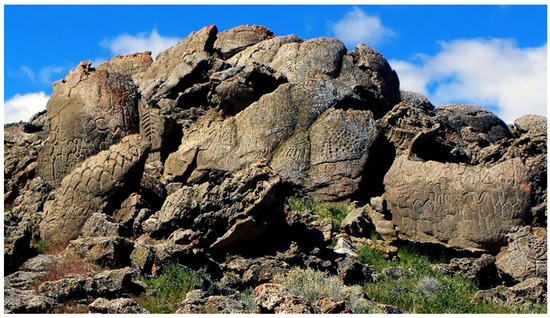
Figure 1.
Final Pleistocene petroglyphs on tufa deposit at Winnemucca Lake, western Nevada (photograph by L. Benson).
Figure 1.
Final Pleistocene petroglyphs on tufa deposit at Winnemucca Lake, western Nevada (photograph by L. Benson).
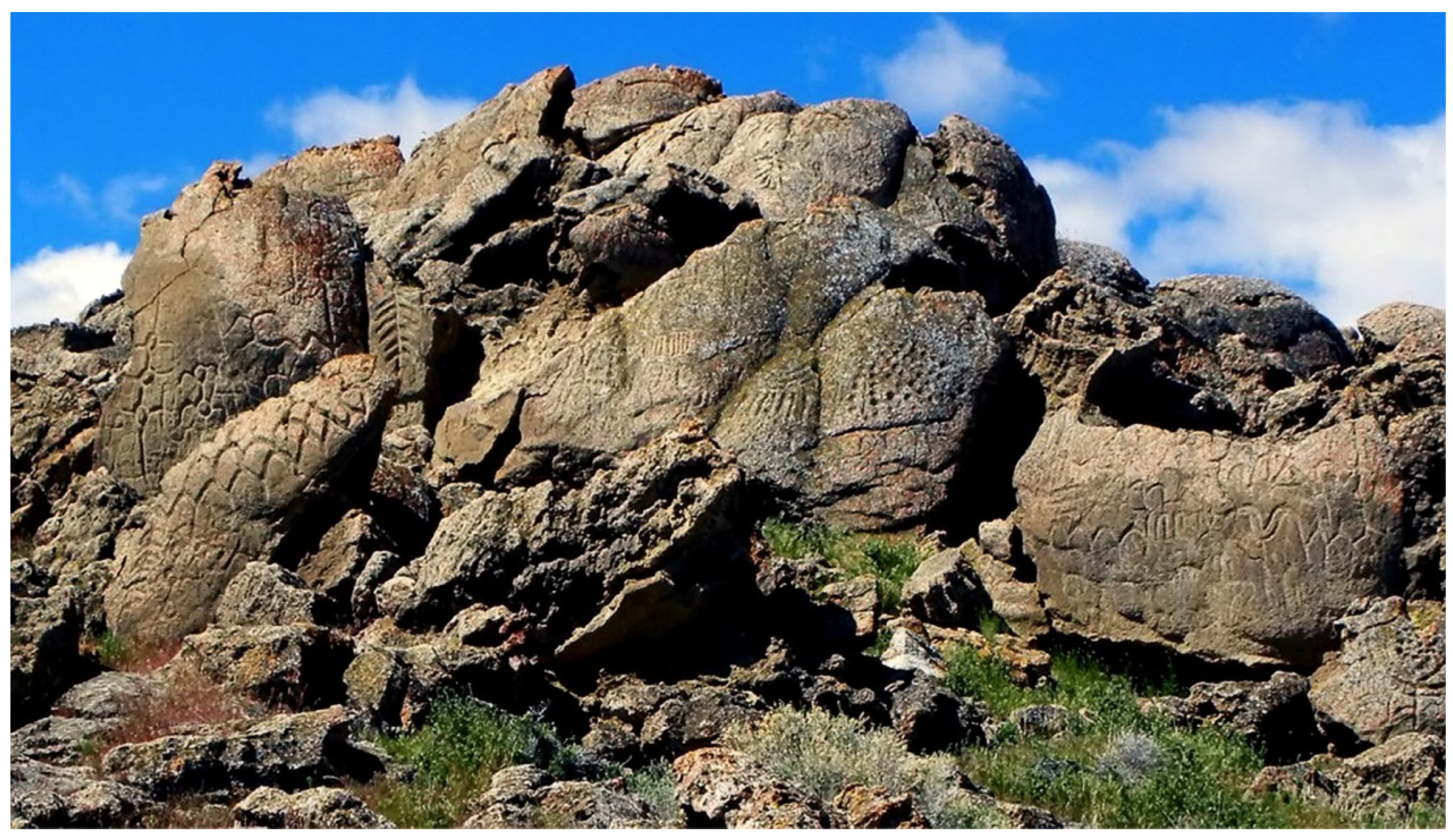
Based on the radiocarbon age of the tufa of 14.8 ± 0.2 ka and that of a superimposed carbonate crust of about 10 ka, and on information about lake level fluctuations, this entirely non-figurative rock art tradition is assumed to date from one of two possible intervals: either from 14.8–13.2 ka or from 11.3–10.5 ka bp. The occurrence nearby of artefacts in the latter interval renders this the most likely interpretation. Therefore, the Winnemucca Lake petroglyphs appear to be the earliest dated rock art, at least in North America.
Reference and Notes
- R.G. Bednarik. “Pleistocene Palaeoart of the Americas.” Arts 3 (2014): 190–206. [Google Scholar] [CrossRef]
- L.V. Benson, E.M. Hattori, J. Southon, and B. Aleck. “Dating North America’s oldest petroglyphs, Winnemucca Lake subbasin, Nevada.” J. Arch. Science 40 (2013): 4466–4476. [Google Scholar] [CrossRef]
© 2014 by the authors; licensee MDPI, Basel, Switzerland. This article is an open access article distributed under the terms and conditions of the Creative Commons Attribution license (http://creativecommons.org/licenses/by/3.0/).