Skip to Content
BuildingsBuildings
  • Article
  • Open Access

3 May 2026

Evaluating the Strength Behavior and Preliminary Mechanical Suitability of Foam Concrete for Tunnel Inverted Arch Backfilling Under Reduced Atmospheric Pressure

,
,
,
,
,
and
1
School of Intelligent Transportation and Intelligent Construction Engineering, Huanghe Jiaotong University, Jiaozuo 454000, China
2
School of Highway, Chang’an University, Xi’an 710064, China
3
School of Mechanics and Civil Engineering, China University of Mining and Technology, Xuzhou 221116, China
*
Author to whom correspondence should be addressed.
This article belongs to the Section Building Structures

Abstract

The safe service of tunnel inverted arch structures in high-altitude cold regions is heavily restricted by the performance of backfilling materials, which need to simultaneously adapt to low-temperature, low-pressure extreme environments and meet the long-term mechanical requirements of underground building structures. However, the strength development and preliminary mechanical applicability of foam concrete for tunnel inverted arch backfilling under reduced atmospheric pressure remain insufficiently understood. To this end, this paper carries out mix proportion optimization and mechanical performance testing of foam concrete, focusing on the strength behavior under different dry densities and simulated high-altitude low-pressure conditions. The test results show that the compressive strength of foam concrete is positively correlated with dry density, and the growth rate accelerates when the dry density is above 1000 kg·m−3. Specifically, the developed high-performance foam concrete with a dry density of 1200 kg·m−3 achieves a 28-day compressive strength of 27.1 ± 1.2 MPa under 60 kPa atmospheric pressure, indicating stable mechanical performance with low variability. The results indicate that, within the tested dry-density range and under the adopted curing and pressure conditions, the developed foam concrete can meet the basic compressive-strength requirement for tunnel inverted arch backfilling. This study provides a reference for material selection and structural design in high-altitude cold-region tunnel engineering and highlights the potential applicability of lightweight foam concrete in underground structures.

1. Introduction

Plateau cold regions are characterized by high altitude and low temperatures. Within tunnels, cold air readily induces intense convective heat transfer with the lining and surrounding rock, resulting in a rapid decrease in their temperatures. When a significant amount of water accumulates in the lining, surrounding rock, or drainage system, it can easily trigger severe frost-related distresses, such as lining cracking, ice formation from seepage, and freezing blockage of drainage structures. These issues pose substantial threats to the structural safety and long-term durability of tunnels. Influenced by harsh climatic conditions and, in some cases, inadequately designed drainage systems, it has been reported that approximately 80% of operating tunnels in cold regions suffer from varying degrees of frost damage. Fundamentally, this reflects the severe challenges to structural stability and durability under extreme environments characterized by low temperature and low atmospheric pressure [1,2,3,4]. Traditional engineering approaches typically mitigate frost damage by installing internal insulation layers or utilizing materials with low thermal conductivity. However, these methods generally suffer from limitations such as a narrow temperature adaptability range, high maintenance costs, and incomplete frost protection [5]. Therefore, it is essential to develop more scientific and rational strategies for thermal insulation and waterproofing/drainage design in cold-region tunnels, with particular emphasis on understanding the evolution of the surrounding temperature field to effectively prevent and control frost damage. Although innovative technologies such as solar-powered air curtains [6] and optimized insulation layouts at tunnel vaults [7] have emerged in recent years, the invert remains a critical yet vulnerable component in cold-region tunnels, serving multiple functions, including load-bearing, drainage, and thermal insulation. Consequently, the rational selection of invert backfill materials is of great significance for enhancing the structural safety and service performance of tunnels in cold regions [8,9,10,11]
Foam concrete (FC), owing to its adjustable density, excellent thermal insulation properties, and porous internal structure, has been widely recognized in recent years as a multifunctional engineering material with promising application potential [12,13,14,15,16,17]. Previous studies have demonstrated that incorporating modified components such as expanded polystyrene (EPS) particles [18], supplementary cementitious materials [19], and polypropylene fibers can effectively optimize mix design and mechanical properties, thereby expanding its applicability in structural engineering. Regarding its mechanical performance and underlying mechanisms, Kearsley et al. reported that the compressive strength of foam concrete is closely related to porosity and pore distribution characteristics, and established quantitative relationships between compressive strength and parameters such as porosity, dry density, and fly ash content [20]. The Balshin model systematically revealed the intrinsic relationship between compressive strength and porosity, proposing a functional correlation between variable coefficients and strength. Furthermore, Nambiar et al. [21] developed a quantitative model describing the relationship between compressive strength and porosity, expressed as σ = 321(1 − p)3.6, with a correlation coefficient exceeding 0.92, indicating the significant control of pore structure parameters on the strength of foam concrete. Meanwhile, with the advancement of high-performance cement-based materials, advanced cementitious additives such as nano-silica and silica fume have attracted considerable attention for their ability to enhance compressive strength and durability [22]. These materials improve early strength, impermeability, and long-term durability by accelerating hydration reactions, refining pore structure, and densifying the matrix [23].
From an engineering application perspective, freeze–thaw cycles can significantly deteriorate the toughness and fracture properties of concrete. In contrast, foam concrete has demonstrated favorable energy absorption capacity and stress buffering performance in high in situ stress soft rock tunnels [24,25]. Additionally, studies based on Split Hopkinson Pressure Bar (SHPB) tests and triaxial compression tests have further revealed its dynamic mechanical behavior and damage constitutive characteristics under seismic and high-stress conditions [26,27]. However, existing research is predominantly based on laboratory tests conducted under normal atmospheric pressure, and systematic investigations under coupled low-pressure and low-temperature freeze–thaw conditions representative of high-altitude engineering environments remain limited [28]. In particular, for tunnel invert structures, backfill materials are required to provide sufficient mechanical resistance while also contributing to frost protection. However, existing studies have not sufficiently clarified the strength development of foam concrete prepared under reduced atmospheric pressure, especially considering the influence of dry density.
Although previous studies have examined foam concrete under extreme environmental conditions, most focus on normal atmospheric pressure or general factors, with limited attention to the combined effects of low atmospheric pressure and dry density on strength development. In particular, the influence of low pressure on pore structure stability and strength evolution remains unclear. To address this gap, this study investigates the compressive strength behavior of foam concrete under simulated low-pressure conditions (60 kPa) and analyzes its interaction with dry density. A comparative study with ordinary concrete is also conducted to reveal different response characteristics under varying pressures. The results provide new insights into the density-dependent strength evolution of foam concrete under reduced atmospheric pressure and offer a preliminary strength-based reference for its use as tunnel inverted arch backfilling material in high-altitude regions.

2. Foam Concrete Specimen Preparation

2.1. Material Performance and Experimental Equipment

The experiment was designed to investigate the mechanical properties of foam concrete and ordinary concrete prepared under high-altitude reduced atmospheric pressure conditions. To reflect the construction background of plateau tunnel engineering as closely as possible, specimen preparation and molding were carried out in the Yangbajing area of Damxung County, Lhasa, Tibet Autonomous Region. After demolding, all specimens were cured under standard laboratory curing conditions for subsequent strength evaluation. The experimental site was chosen in the Yangbajing area of Damxung County, Lhasa, in the Tibet Autonomous Region, located along the section of National Highway 109 running from Nagqu to Lhasa. This site was primarily used for tunnel and associated engineering constructions [29]. The selected coarse aggregate was continuously graded crushed stone with particle sizes ranging from 5 to 20 mm, while the fine aggregate was natural medium sand, tested to have a fineness modulus of 2.6. The composition and performance indicators of fly ash are shown in Table 1 and Table 2.
Table 1. Chemical composition of fly ash.
Table 2. Performance indicators of fly ash.
The water reducer used was the KDSP Poly carboxylic acid high-performance water reducer (retarding type), which is liquid without sedimentation, with a water reduction rate of 26%, a bleeding rate of 41%, and an air content of 3.3%. The air-entraining agent chosen was a saponin-type air-entraining agent (Triterpenoid saponin), which is a non-ionic surfactant [30]. The addition of Triterpenoid saponin significantly improved the freeze resistance of the pumped concrete, making it suitable for cold-region highway tunnel concrete projects.
The primary instruments and equipment needed for this experiment included a pressure testing machine, a bending testing machine, an electronic scale, a cement mortar mixer, an electric hot air-drying oven, a foaming machine, and concrete molds.

2.2. Mix Design

(1)
Foam Concrete Mix Design
To apply foam concrete to the filling layer of tunnel inverted arches, it was necessary to develop high-performance foam concrete that met the strength requirements. To calculate the mass ratios of the various components in high-performance foam concrete, the study used the Kearsley formula to first calculate the density of the foam concrete slurry. Since the mass of the foam was much less than that of cement and water, the formula ignored the mass of the foam component.
The calculation formula is as follows:
ρ s v s = M c + M w + M f
where ρs—Density of foam concrete slurry, kg·m−3; vs—Volume of foam concrete slurry, m3; Mw—Mass of water, kg; Mc—Cement content, kg; Mf—Fly ash content, kg.
The Kearsley formula is primarily developed for use under normal atmospheric conditions; therefore, in this study, it is mainly used for the preliminary mix design, and the final mix proportions are determined based on experimental results under low-pressure conditions.
Three representative dry density levels, namely 800, 1000, and 1200 kg·m−3, were selected to cover the practical density range of lightweight foam concrete for tunnel inverted arch backfilling and to allow a preliminary evaluation of the density-dependent strength variation. The mix proportions were determined using the volume control method, as shown in Table 3. The specimens were prepared, mixed, and molded under reduced atmospheric pressure in the Tibetan Plateau area, and were subsequently cured under standard conditions for strength evaluation.
Table 3. Design mix ratio of foam concrete.
During specimen preparation, a certain deviation was observed between the measured dry density and the designed density of foam concrete. This discrepancy may be related to multiple factors, including cement hydration [31], foam instability, slurry settlement, and the difference between theoretical mix design and actual molding conditions [32]. Therefore, the actual dry density was determined experimentally, and the deviation from the designed value was controlled within an acceptable range according to empirical practice and relevant literature.
ρ t = ( 1.15 ~ 1.26 ) ρ d
where ρt—actual dry density of foam concrete, kg·m−3; ρd—design density, kg·m−3.
(2)
Ordinary Concrete Mix Design
In connection with the on-site research, this study investigates the mechanical properties of concrete under reduced atmospheric pressure and subsequent standard curing. In line with this, the concrete mix design for tunnel lining is proposed with a target strength grade of C35. The ordinary concrete maintains a constant water–cement ratio, including 15% fly ash by weight of cement, 1.2% water reducer by weight of cement after experimental verification, and 0.02% air-entraining agent by weight of cement [33]. The specific ratio is shown in Table 4. Overall, three different concrete mix proportions are designed [34]. Parallel experiments will be conducted under the standard atmospheric pressure of 95.92 kPa in Xi’an, China, as a reference design, to compare the research on their strength performance differences.
Table 4. Ordinary concrete mix ratio.

2.3. Foam Concrete Specimen Preparation and Curing Methods

(1)
Foam Concrete Specimen Fabrication
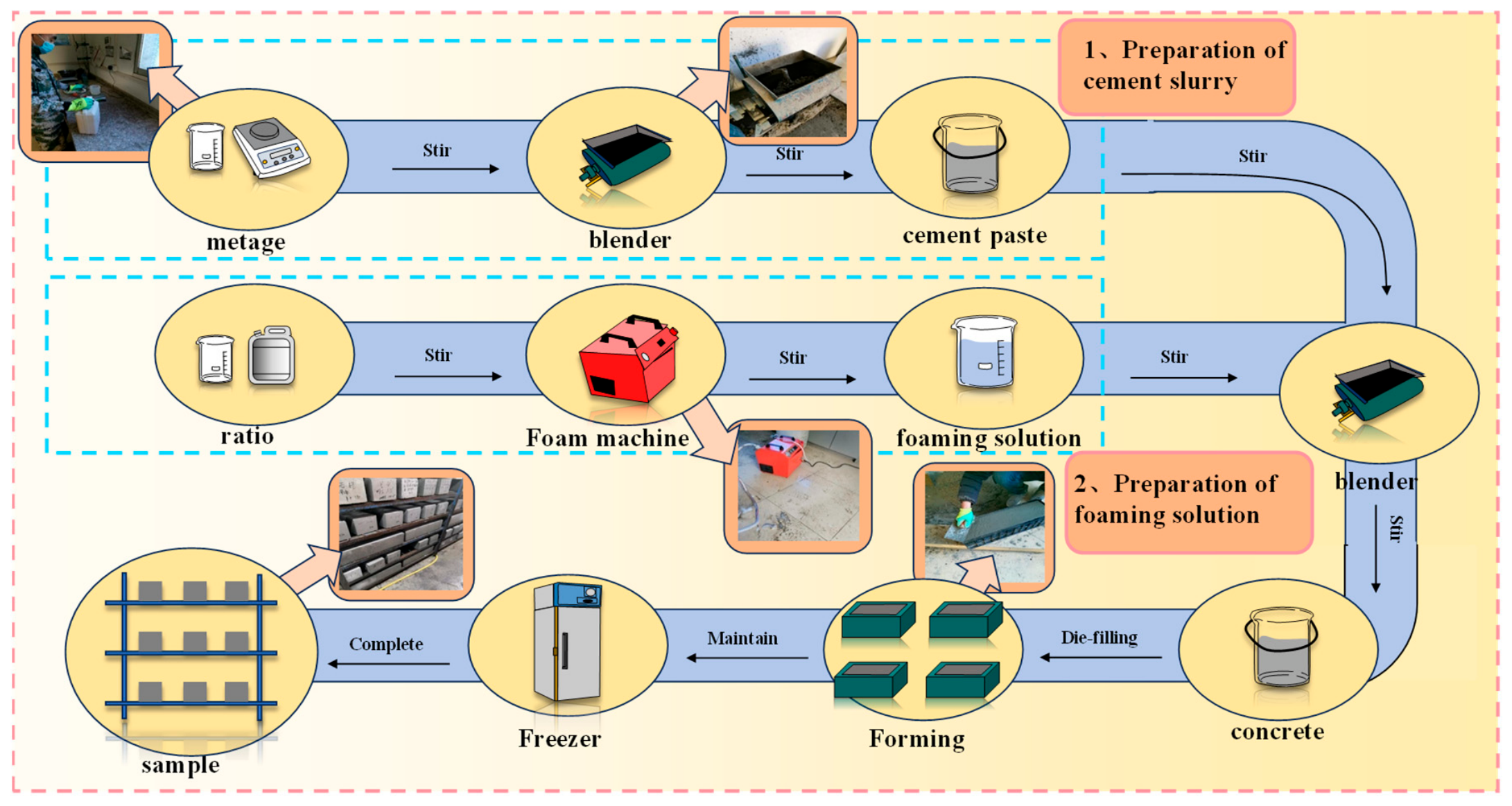
Before mixing, the cement shall be pre-treated to remove lumps. The foaming agent shall be diluted with water at a mass ratio of 1:60 and stirred evenly to prepare a foaming solution, which is then fed into a foaming machine to generate foam. With a water–cement ratio of 0.5, the cement and water are stirred for about 3 min to produce a uniform cement paste. The prepared foam is added to the paste in two batches and fully stirred until uniform. The fresh foamed concrete slurry is poured into the mold, and the side wall of the mold is gently tapped to expel large air bubbles inside. Then the surface of the test piece is smoothed with a trowel. For each group, 150 mm × 150 mm × 150 mm cubic test pieces are prepared for compressive strength testing, and 150 mm × 150 mm × 550 mm prismatic test pieces are prepared for flexural strength testing. Each group is provided with 3 sets of parallel tests to ensure the consistency of the test process.
(2)
Conventional Concrete Specimen Fabrication
For the conventional concrete group, fresh concrete was poured into molds in two layers. Each layer was compacted by rodding more than 15 times, followed by surface leveling with a trowel and gentle tapping of the mold sides to improve compactness.
(3)
Concrete Specimen Curing Methods
After molding, specimens are moistured with a film-covering technique. Concrete specimens are left in ambient conditions for 24 to 48 h before demolding. After initial setting and marking, the next stage of curing begins. For specimens under low-pressure curing, they are immediately placed in a standard curing room with a temperature of about 23 °C and a relative humidity of 96% after demolding. The standard curing duration is computed from the start of aggregate mixing, lasting 28 d. The specific experimental process is shown in Figure 1.
Figure 1. The process of sample production and molding.
It should be noted that reduced atmospheric pressure was mainly involved during specimen preparation and early molding in the high-altitude test area. After demolding, the specimens were cured under standard laboratory conditions to ensure comparability of strength development. This curing protocol enables the influence of reduced-pressure preparation on strength behavior to be evaluated under controlled conditions and provides a useful experimental reference for high-altitude tunnel engineering. Nevertheless, the long-term performance of foam concrete under coupled low atmospheric pressure, low temperature, freeze–thaw cycles, moisture migration, and structural loading deserves further investigation.

2.4. Foam Concrete Strength Characteristic Test Method

The determination methods for the compressive strength and flexural strength tests follow the requirements of the “Standard Test Methods for Long-Term Performance and Durability of Ordinary Concrete” [35] and “Foam Concrete” [36]. The specimen size is set at 150 mm × 150 mm × 150 mm, with curing ages being 3 d, 7 d, 14 d, and 28 d.
The specific test steps are as follows: (1) Inspect the integrity of the specimen, ensure it is clean and kept dry. (2) Weigh and record the specimen’s weight. (3) Place the specimen on the press, making sure it is centered. (4) Apply pressure slowly and evenly: If the strength grade is <C30: 0.3~0.5 MPa.s−1/If the strength grade is ≥C30 and <C60: 0.5~0.8 MPa.s−1. (5) Monitor the deformation of the specimen, reduce the rate of pressure application until the specimen fails, and record the load at failure.

3. Results and Discussion: Compressive Strength Performance

3.1. Compressive Strength Evolution of Developed Foam Concrete (FC)

Foam concrete specimens were mixed, cast, and demolded under a low atmospheric pressure of 60 kPa in the high-altitude test area and were subsequently transferred to a standard curing room for curing. The curing conditions were maintained at a temperature of 22 °C and a relative humidity of 95%, and the curing ages were 3 d, 7 d, 14 d, and 28 d. Therefore, the measured compressive strength in this study reflects the combined effect of specimen preparation under reduced atmospheric pressure and subsequent standard curing, rather than full-age curing entirely under low-pressure conditions. In this context, the reduced atmospheric pressure mainly affected the fresh-state behavior, foaming stability, pore structure formation, and early hardening process of the foam concrete. The obtained results can provide a preliminary strength-based reference for evaluating foam concrete used in high-altitude tunnel inverted arch backfilling, while further studies are needed to examine its strength evolution under long-term coupled service conditions involving temperature fluctuation, freeze–thaw cycles, water migration, and sustained loading. After curing, the specimens were tested for compressive strength using a pressure testing machine, and the results are presented in Table 5.
Table 5. Compressive strength of foam concrete at different dry densities.
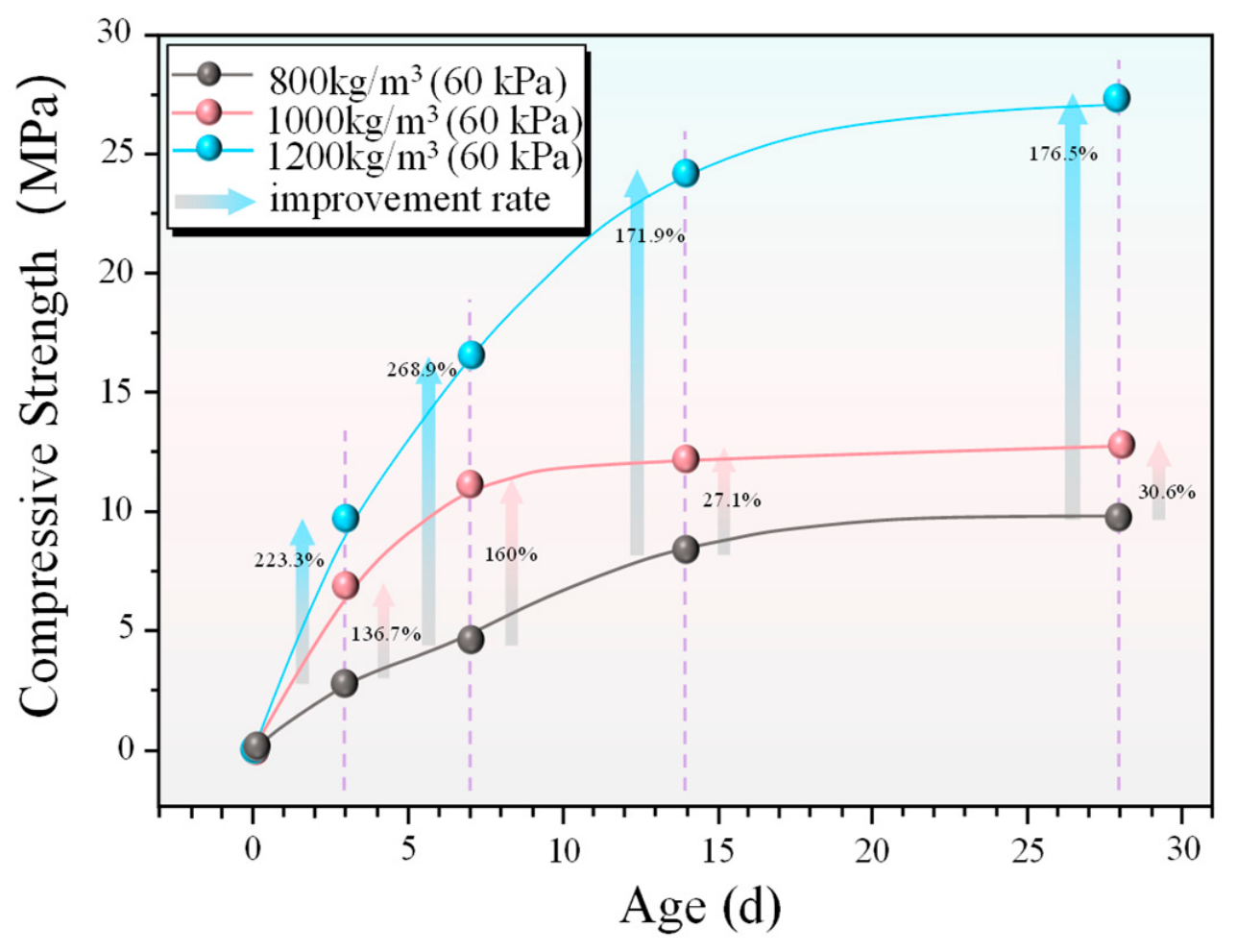
The compressive strength growth curves of foam concrete with different dry densities at 60 kPa under standard curing conditions for 3 d, 7 d, 14 d, and 28 d are shown in Figure 2.
Figure 2. Evolution of compressive strength and strength improvement rate of foam concrete at different dry densities with curing age.
The strength growth curves of foam concrete with three different dry densities indicate that the strength of foam concrete is relatively low due to its low density and large porosity, and the rate of strength increase slows as the curing time is extended. Under low temperature and low-pressure conditions, the strength of foam concrete increases rapidly within the first 14 d, after which the growth rate significantly decreases.
As indicated in Figure 2, the compressive strength of Specimen 2 foam concrete after curing for 3 d, 7 d, and 28 d increased by 136.7%, 160%, and 30.6%, respectively, compared to Specimen 1. Meanwhile, Specimen 3 foam concrete showed increases of 223.3%, 268.9%, and 176.5%, respectively, in the same time frame compared to Specimen 1 [37]. This suggests that the compressive strength of foam concrete is positively correlated with its dry density, and the performance of Specimen 3 is significantly superior to that of Specimens 1 and 2.
Under low pressure, the strength of foam concrete increases with the rise in dry density, with the strengths at 800 and 1000 kg·m−3 being similar, and a significant enhancement observed at 1200 kg·m−3.
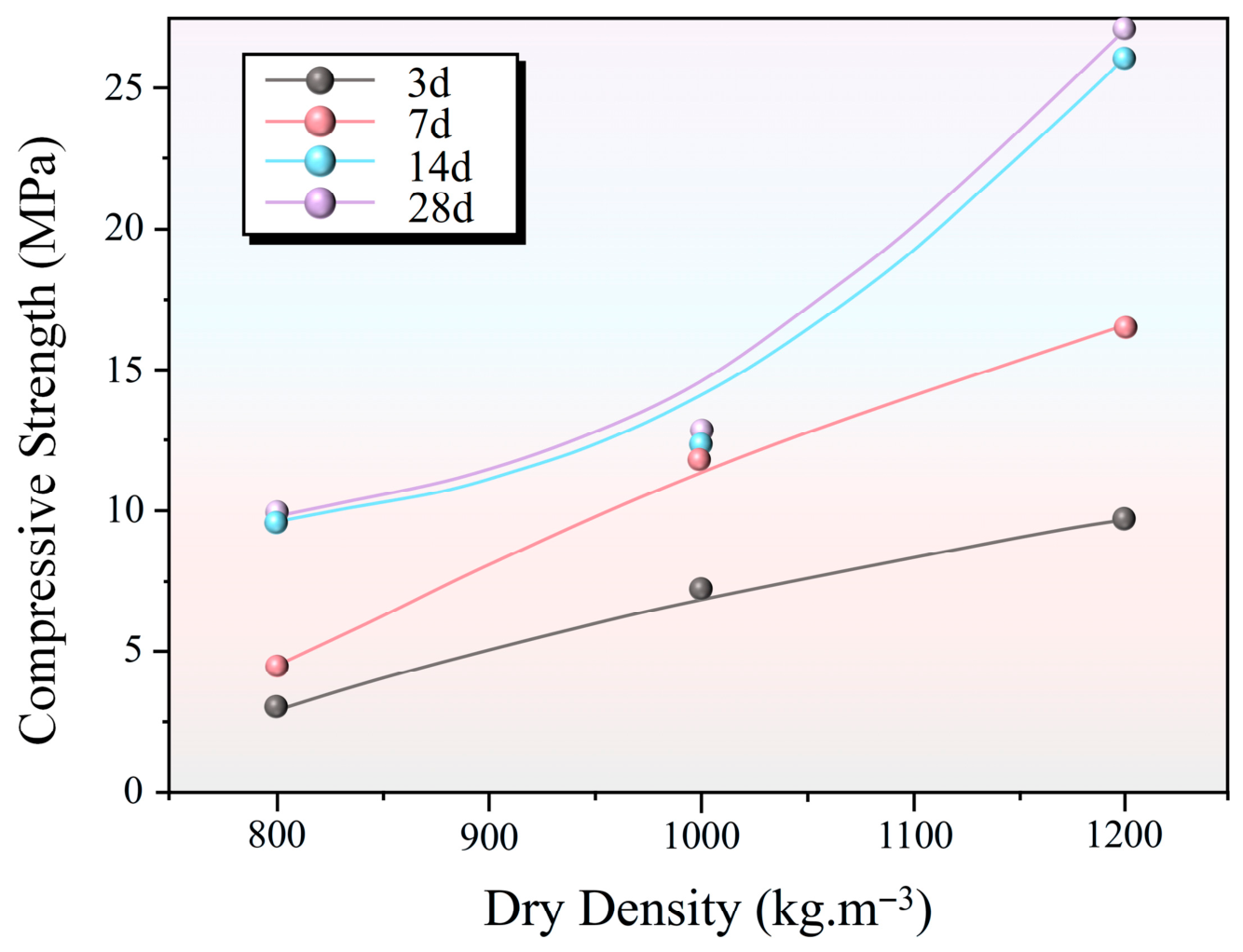
According to Figure 3, it is evident that during the curing period, the compressive strength of foam concrete increases with the increase in dry density, with the strength increase being more significant when the dry density exceeds 1000 kg·m−3. At 3 d and 7 d, the compressive strength shows an approximate linear relationship with dry density. For foam concrete aged 14 d and 28 d, their compressive strengths display an approximate parabolic relationship with dry density. This trend may be tentatively associated with possible differences in air-void characteristics and the proportion of the solid phase in foam concrete with different dry densities. Previous studies have indicated that pore characteristics, including pore size and shape, may influence the mechanical properties of foamed concrete [38]. Since direct pore-structure or microstructural characterization was not conducted in this study, the above explanation is proposed as a possible interpretation based on the strength results and relevant literature. Liu [39] has pointed out that at ambient pressure, the 28 d compressive strength of foam concrete does not have a purely linear relationship with dry density, and provided a fitting formula for the strength curve of foam concrete with a dry density range of 200~600 kg·m−3, with a correlation coefficient R2 of 0.99058. Under a reduced atmospheric pressure of 60 kPa, the foam concrete developed in this study exhibited a dry density range of 800–1200 kg·m−3. Based on the experimental results, a preliminary empirical relationship between the 28-day compressive strength and dry density was obtained using linear regression. Since the present study selected three representative dry density levels, the fitted relationship is mainly used to characterize the strength–density variation trend within the tested range, rather than to serve as a universal prediction equation for all foam concrete mixtures. The fitting results yielded a coefficient of determination (R2) of 0.884 and a root mean square error (RMSE) of 3.05 MPa, indicating that the regression provides a reasonable description of the observed trend under the adopted experimental conditions. Future work with more density levels and expanded test data would help further improve the applicability and predictive accuracy of the relationship.
σ p = 0.04325 ρ f 26.53
where σ p —compressive strength of foam concrete, MPa; ρ f —the dry density of foam concrete, kg·m−3.
Figure 3. Approximate relationship between compressive strength and dry density of foam concrete within the tested density range at 60 kPa.

3.2. Strength Characteristics of Reference Ordinary Concrete (OC)

Ordinary concrete blocks were manufactured in the Yangbajain area of Damxung County, Lhasa City on the Tibetan Plateau and cured in a standard curing chamber with a temperature of 22 °C and a humidity of 95%. The periods of curing were 3 d, 7 d, 14 d, and 28 d, respectively. After the curing period, the concrete blocks were removed for compression strength tests. The results of these tests are shown in Figure 4.
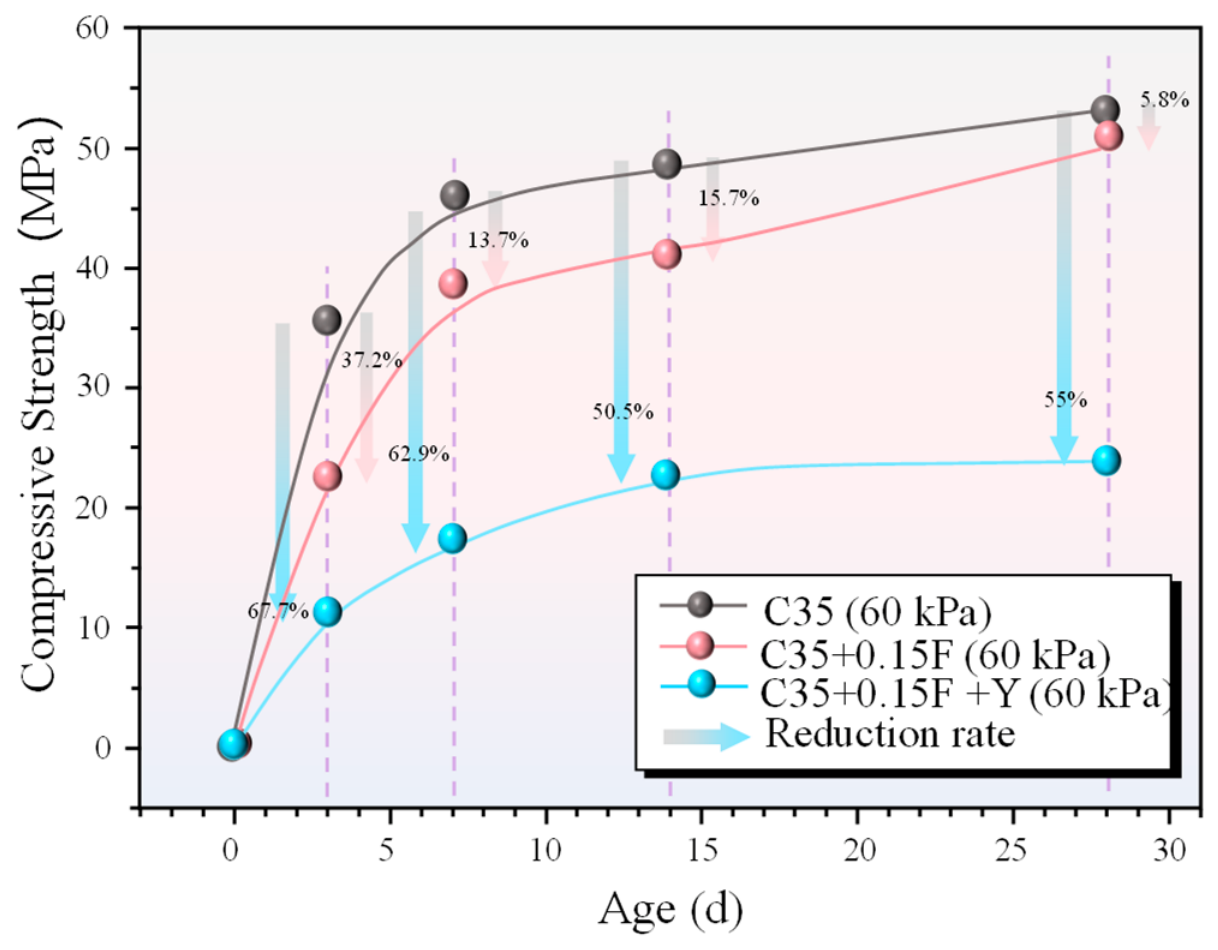
Figure 4. Compressive strength growth curve of concrete with three mix ratios at 60 kPa.
The compressive strength curves of three types of concrete mixes show that the strength of concrete increases rapidly within the first 7 d and then slows down from 7 d to 28 d. The addition of fly ash and air-entraining agents reduces the strength, with the greatest reduction occurring at 3 d. Among these, Specimen 5 (containing 15% fly ash) shows a 37.2% reduction in strength at 3 d and Specimen 6 (combining fly ash and air-entraining agent) shows a 67.7% reduction at the same time point. By 28 d, the rate of strength reduction decreases. Ultimately, Specimen 4 (ordinary concrete) attains the highest strength, Specimen 6 the lowest (approximately 24 MPa), and Specimen 5 has an intermediate strength.
To enhance the frost resistance and durability of concrete, Specimen 6 incorporates both 15% fly ash and 0.02% triterpene saponin air-entraining agent, resulting in a notably lower compressive strength compared to Specimens 4 and 5 [40]. The reduction in compressive strength associated with the air-entraining agent may be related to changes in the internal air-void system, which can influence the continuity of the matrix and consequently affect the mechanical properties, as also reported in previous studies on concrete prepared under low atmospheric pressure conditions [41]. Under the reduced atmospheric pressure condition of 60 kPa, the air-entraining behavior may be affected, which could reduce the number and uniformity of introduced air bubbles and consequently influence the compressive strength of the concrete specimen [42]. At 28 d, the compressive strength of Specimen 6 is only 24 MPa, representing a 55% decrease compared to Specimen 4. In real-world engineering projects, particularly in high-altitude, cold regions, the inclusion of air-entraining agents is often utilized to improve the durability and frost resistance of poured concrete, albeit with a significant loss in strength. Engineering construction should therefore conduct strict testing and properly adjust the dosage of air-entraining agents.

3.3. Comparative Analysis and Mechanisms of Strength Discrepancies

The following comparison is intended to provide comparative observations under the adopted experimental conditions, rather than to isolate the independent effect of atmospheric pressure. To further understand the strength characteristics of concrete prepared under low-temperature and low-pressure conditions, comparative tests were carried out to examine the differences in concrete performance between the high-altitude test environment and the normal-temperature and normal-pressure environment. Accordingly, parallel control specimens with the same mix design were prepared in Xi’an, Shaanxi Province.
(1)
The Compressive Strength Characteristics of Concrete under Normal Temperature and Pressure
Concrete blocks are made under normal atmospheric pressure (95.92 kPa) and are cured in natural environmental conditions with a daily average temperature of 20 °C. After the curing period, the compressive strength of the concrete is tested using a compression testing machine.
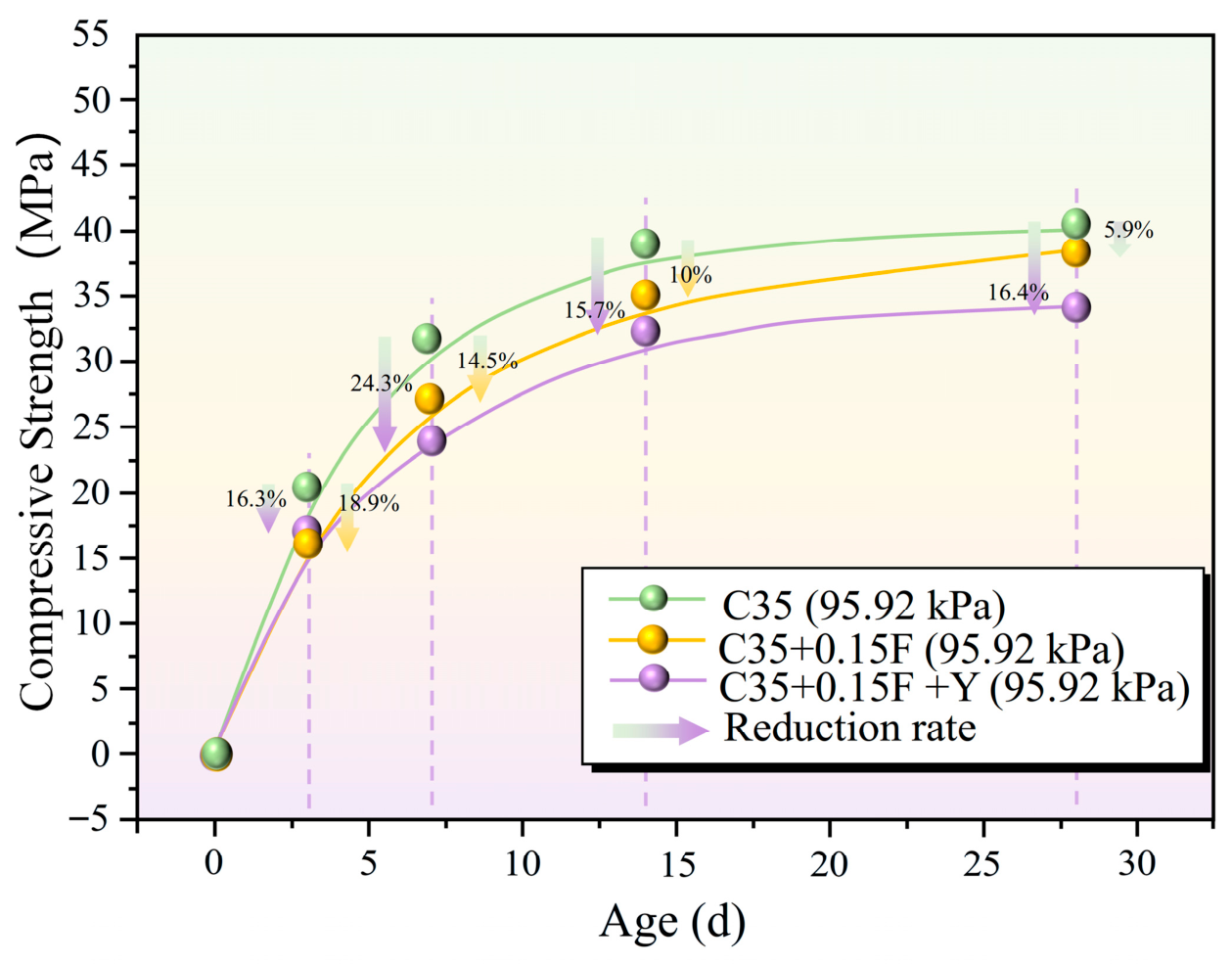
Under the atmospheric pressure of 95.92 kPa, the strengths of the three types of concrete initially increase rapidly and then the growth rate slows down. As shown in Figure 5, the strength of Specimen 5 (fly ash concrete) is consistently lower than that of Specimen 4 (unmodified concrete), but the gap decreases over time. The compressive strength of Specimen 6 (air-entrained concrete) increases more slowly throughout the curing period, and its compressive strength at 28 d decreases significantly compared to Specimen 4 and 5. It is evident that the addition of air-entraining agents significantly reduces its compressive strength. Different from the strength curve of concrete under low pressure, the strength value of concrete with additives at 7 d shows the greatest decrease compared to the unmodified concrete, indicating that the compressive strength of concrete with additives grows more rapidly under low atmospheric pressure of 60 kPa.
Figure 5. Compressive strength growth curve of concrete with three mix ratios at 95.92 kPa.
Under an atmospheric pressure of 95.92 kPa, the compressive strength of Specimen 5 (fly ash concrete) was 18.9% lower than that of Specimen 4 (unmodified concrete) at 3 d. By 7 d, this reduction rate had reached 31.5%. However, as the period increased, the compressive strength gradually increased, and the gap in compressive strength between Specimen 5 and Specimen 4 gradually narrowed, with a 5.9% reduction for Specimen 5 compared to Specimen 4 at 28 d [43]. The compressive strength of Specimen 6 (air-entrained concrete) was significantly reduced, being lower than that of Specimen 4 by 24.3% at 7 d and 16.4% at 28 d, showing that under an atmospheric pressure of 95.92 kPa, air-entraining agents also significantly reduce the concrete’s compressive strength value, similar to the effect in a high-altitude, low-temperature, and low-pressure environment.
(2)
Study on the difference in compressive strength characteristics of concrete
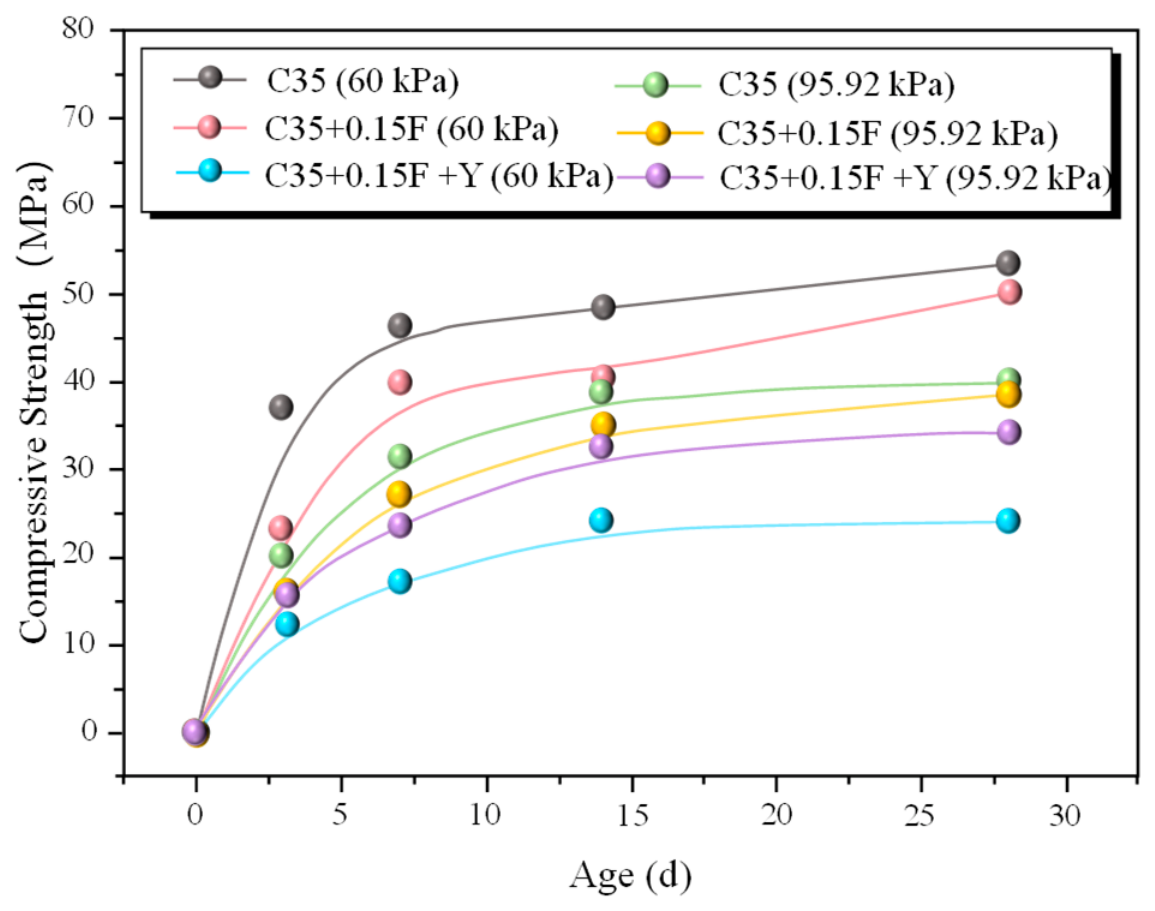
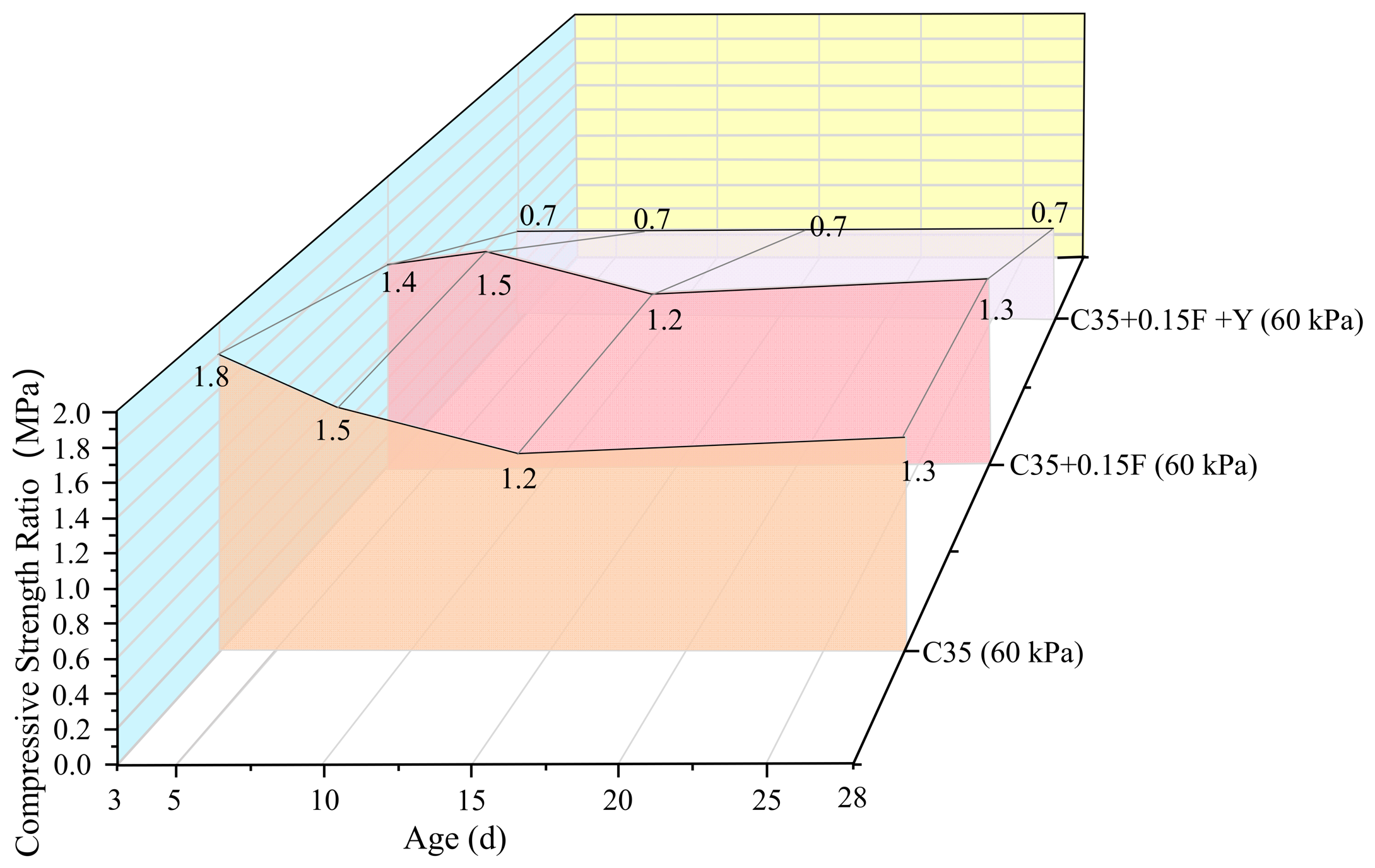
The comparative results of concrete tests under atmospheric pressure of 95.92 kPa and low pressure of 60 kPa are shown in Figure 6 and Figure 7. The compressive strengths of Specimens 4 and 5 prepared under the reduced atmospheric pressure condition were higher than those of the corresponding specimens prepared under 95.92 kPa atmospheric pressure. In contrast, sample 6 is aerated concrete, and its compressive strength under low pressure has decreased compared to normal pressure. The consistent strength growth trends of the three types of concrete suggest that specimen preparation under reduced atmospheric pressure conditions was associated with differences in the rate of compressive strength development and the ultimate strength. However, the present experimental design does not allow the independent effect of atmospheric pressure to be completely separated from other influencing factors.
Figure 6. Compressive strength growth curve of concrete at 60 kPa and 95.92 kPa.
Figure 7. Comparison of the compressive strength of concrete produced under 60 kPa and 95.92 kPa pressure.
At 60 kPa pressure, Specimen 4 (unmodified concrete) and Specimen 5 (fly ash concrete) showed increases of 80% and 40% in compressive strength after 3 d compared to the compressive strength at 95.92 kPa atmospheric pressure. At 7 d, 14 d, and 28 d, Specimens 4 and 5 exhibited increases in compressive strength of 50%, 20%, and 30%, respectively. This indicates that, in the absence of air-entraining agents, reduced atmospheric pressure conditions during specimen preparation were associated with a faster rate of strength gain and a higher final compressive strength of the concrete. In the case of Specimen 6 (air-entrained concrete), under 60 kPa pressure compared to 95.92 kPa atmospheric pressure, there was a consistent reduction in compressive strength of 30% at 3 d, 7 d, 14 d, and 28 d. Compared with the corresponding specimens prepared at 95.92 kPa, the air-entrained concrete prepared under reduced atmospheric pressure exhibited lower compressive strength throughout the tested ages. This result suggests that air-entrained concrete is more sensitive to reduced atmospheric pressure conditions than the other two mixtures under the present experimental conditions [40]. The study shows that air-entrained concrete is much more sensitive to changes in air pressure compared to Specimen 4 (unmodified concrete) and Specimen 5 (fly ash concrete).
Considering the significant density difference between foam concrete and ordinary concrete, the compressive strength-to-density ratio was introduced as a normalized index to evaluate mechanical efficiency. Based on the 28 d results, the ratios of foam concrete with dry densities of 800, 1000, and 1200 kg·m−3 were 0.01225, 0.01280, and 0.02258, respectively, indicating that the mechanical efficiency increased with dry density and highlighting the potential of foam concrete for lightweight tunnel inverted arch backfilling applications.
λ c = f c ρ
where λ c —compressive strength-to-density ratio; f c —compressive strength; ρ —dry density.
In tunnel inverted arch structures, the backfilling material is required to fulfill multiple functions, including load-bearing capacity, deformation coordination with the lining structure, and long-term stability under complex environmental conditions. In high-altitude regions, these requirements are further complicated by low atmospheric pressure and freeze–thaw effects. The experimental results indicate that the compressive strength of foam concrete is strongly dependent on dry density, with a significant increase observed when the density exceeds 1000 kg·m−3. Notably, the foam concrete with a dry density of 1200 kg·m−3 achieved a compressive strength greater than 20 MPa under 60 kPa atmospheric pressure, which is comparable to or even exceeds the strength level of conventional backfilling materials used in tunnel engineering. From a strength-based perspective, the 1200 kg·m−3 foam concrete showed a favorable compressive-strength level under the tested 60 kPa condition, suggesting its preliminary mechanical feasibility as an inverted arch backfilling material. However, the present results should not be interpreted as a complete verification of structural suitability. Key factors such as elastic modulus, deformation compatibility with the lining, interface bonding, freeze–thaw durability, thermal insulation performance under service conditions, and field-scale load transfer still require further investigation. In addition, the porous structure of foam concrete provides inherent thermal insulation, which is beneficial for mitigating frost-related damage in inverted arch zones. Therefore, the developed foam concrete demonstrates preliminary potential for use as a lightweight backfilling material in tunnel inverted arches, particularly from the viewpoint of compressive and flexural strength under the tested conditions.

4. Flexural Performance and Failure Mechanisms

4.1. Flexural Strength and Crack Evolution of Foam Concrete (FC)

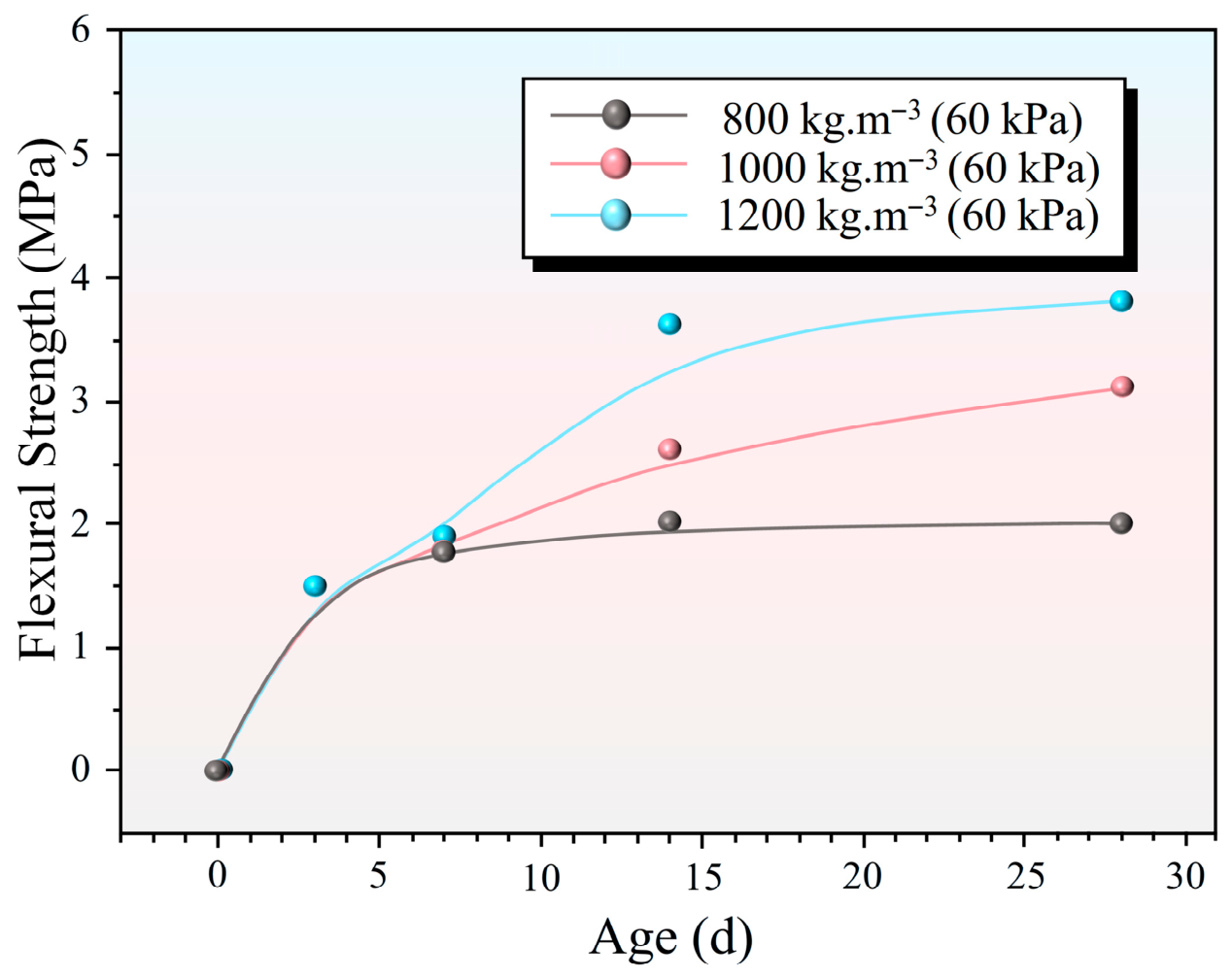
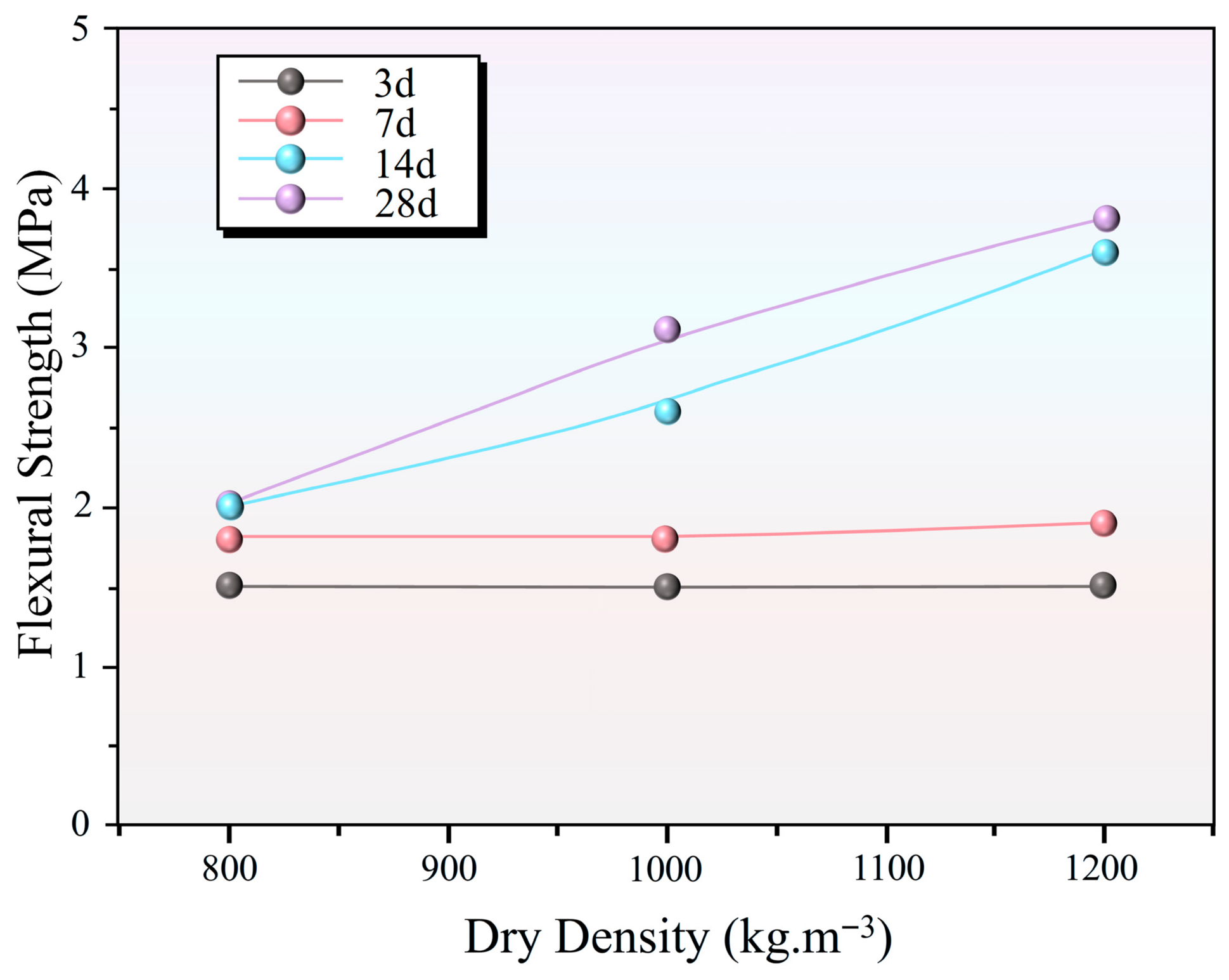
Foam concrete specimens were produced under a low-pressure environment of 60 kPa atmospheric pressure in the high-altitude Tibetan region and were cured in a standard curing room. After the curing period, flexural strength tests were conducted, with results shown in Table 6. The flexural strength curves are depicted in Figure 8.
Table 6. Flexural strength of foam concrete at different dry densities under 60 kPa.
Figure 8. Flexural strength growth curve of foam concrete at different dry densities under 60 kPa.
After curing foam concrete under the low atmospheric pressure of 60 kPa in the plateau region for 28 d, the curve of its flexural strength increasing with age is shown above. The flexural strength of foam concrete of three dry densities grows quickly in the early stages and gradually slows down later. When the curing time is less than 7 d, the flexural strengths of foam concrete are basically the same. After 7 d, the flexural strength increases with the increase in dry density, and the rate of increase accelerates. At 14 d, the flexural strengths of Specimen 2 and Specimen 3 are respectively 30% and 80% higher than that of Specimen 1. At the end of 28 d, the flexural strengths of Specimen 2 and Specimen 3 are increased by 66.7% and 85.7%, respectively. The trend of flexural strength of foam concrete at 28 d is the same as that of compressive strength, which increases with the increase in dry density [44].
This may be associated with differences in pore characteristics in higher-density foam concrete, which could be beneficial to its mechanical properties, as suggested by previous studies. Since no direct pore-structure characterization was conducted in this study, this explanation should be considered a possible mechanism rather than direct evidence from the present experiments [45]. Similar to the compressive strength results, the flexural strength obtained in this study reflects the response of specimens prepared under reduced atmospheric pressure and subsequently cured under standard laboratory conditions. The results provide an experimental basis for understanding the flexural behavior of foam concrete prepared in high-altitude regions, while its long-term flexural performance under coupled environmental actions requires further investigation.
Based on Figure 8, it can be known that the flexural strength of Specimen 1 increased rapidly within the first 3 d of curing, then the trend slowed down until there was no further increase, ending at a strength of 2.1 MPa after 28 d of curing. For Specimens 2 and 3, with dry densities of 1000 kg·m−3 and 1200 kg·m−3, respectively, their flexural strength growth trend continues even after 28 d, indicating a potential for continuous strengthening.
The relationship between the flexural strength of foam concrete and its dry density is depicted in Figure 9. There is no significant correlation between flexural strength and dry density at 3 d and 7 d curing, and the strength remains constant. However, at 14 d and 28 d curing, the flexural strength increases linearly with dry density. This indicates that the initial flexural strength is less affected by dry density [37]. However, as the curing time increases, the higher-density specimens tend to exhibit better compressive and flexural strength, which may be associated with corresponding differences in their internal structure.
Figure 9. Fitted curve of flexural strength of foam concrete vs. dry density at 60 kPa.

4.2. Flexural Behavior of Ordinary Concrete (OC) Control Group

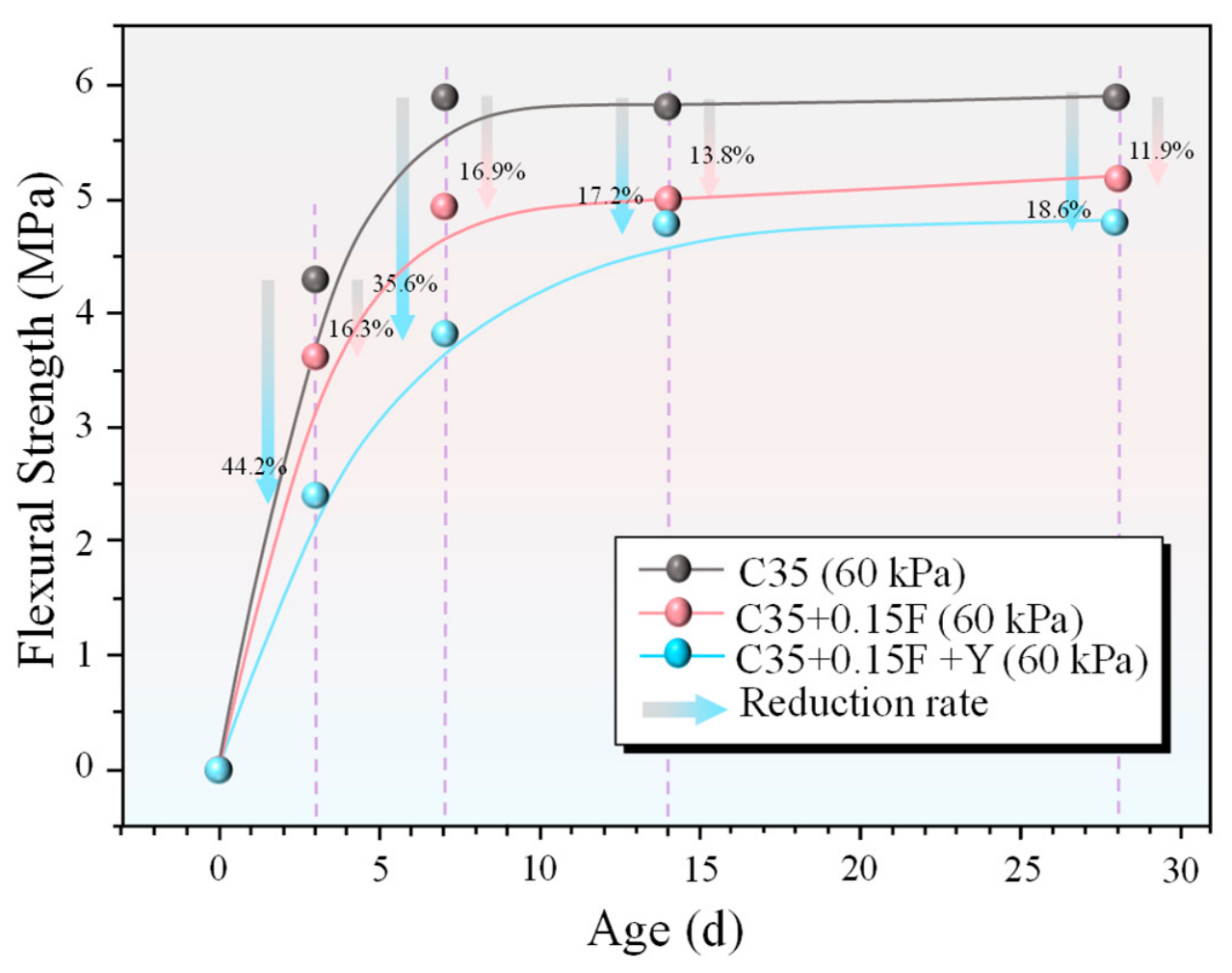
The concrete was prepared under a low-pressure environment of 60 kPa and cured in a standard curing room. After the curing process, flexural strength tests were conducted. The test results and corresponding flexural strength curves are shown in Figure 10.
Figure 10. Flexural strength growth curve of concrete with three mix ratios at 60 kPa.
Under an atmospheric pressure of 60 kPa, the flexural strength of all three types of concrete showed a similar overall development trend, with rapid growth at early ages followed by gradual stabilization. Specimens 4 and 5 (unmodified concrete and fly ash concrete) exhibited most of their flexural strength growth within the first 7 d, whereas Specimen 6 (air-entrained concrete) continued to increase up to 14 d before approaching stability. Compared with Specimen 4, the flexural strength of Specimen 5 decreased by 16.3%, 16.9%, 13.8%, and 11.9% at 3, 7, 14, and 28 d, respectively, indicating that the incorporation of fly ash may have an adverse effect on flexural strength under the tested condition [32]. This may be related to the relatively limited early reactivity of fly ash, which can delay the formation of a sufficiently dense and continuous cementitious matrix. In contrast, Specimen 6, containing 0.02% air-entraining agent, showed larger reductions of 44.2% and 35.6% at 3 and 7 d, while the reductions at 14 and 28 d were smaller (17.2% and 18.6%). This suggests that the air-entraining agent may have a more pronounced influence on early-stage flexural strength, possibly because the introduced air voids weaken the continuity of the matrix and increase the sensitivity of the material to bending-induced tensile stress [46].

4.3. Comparative Analysis of Flexural Resistance and Ductility Characteristics

(1)
Study on the Flexural Strength Characteristics of Concrete Under Normal Temperature and Pressure
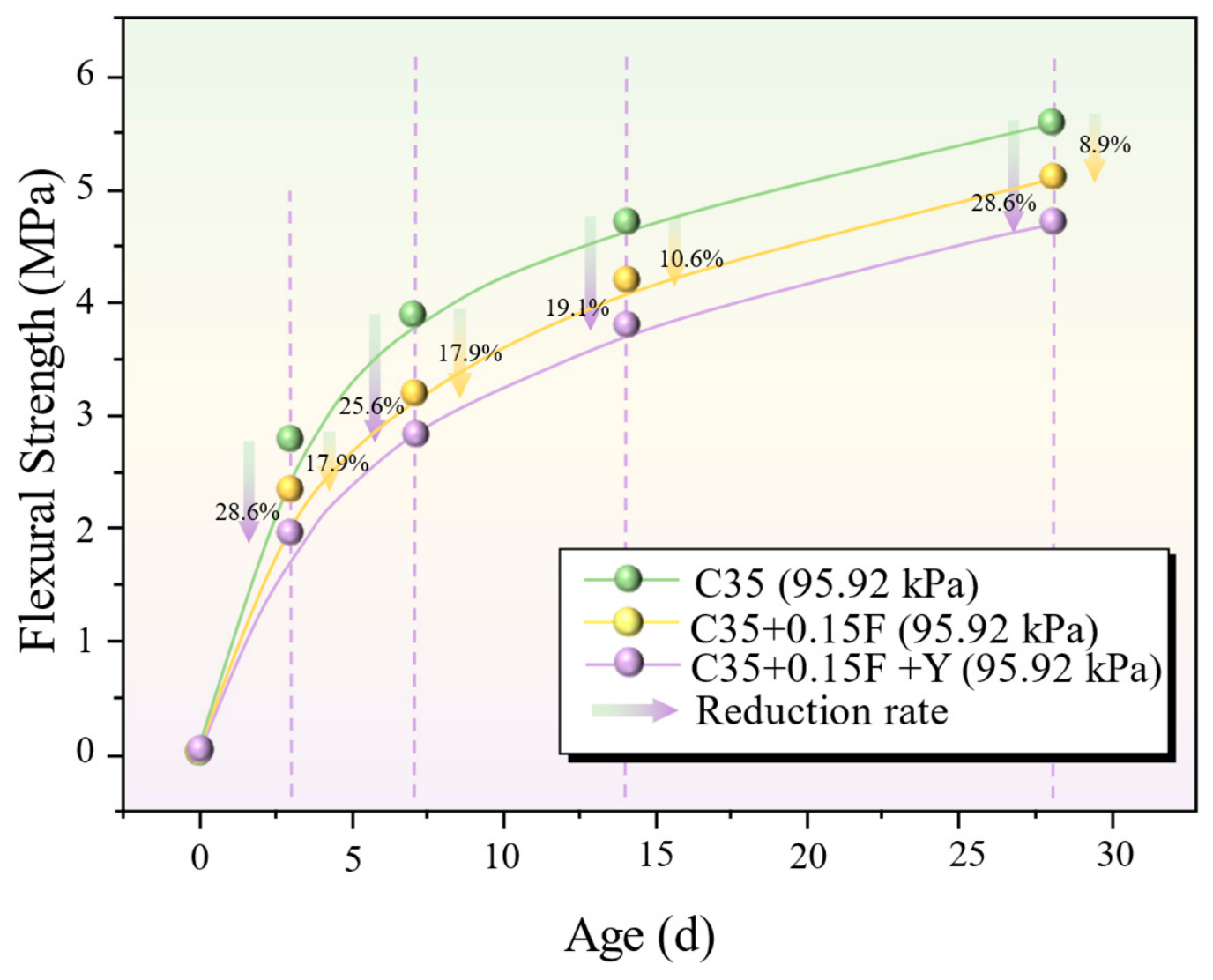
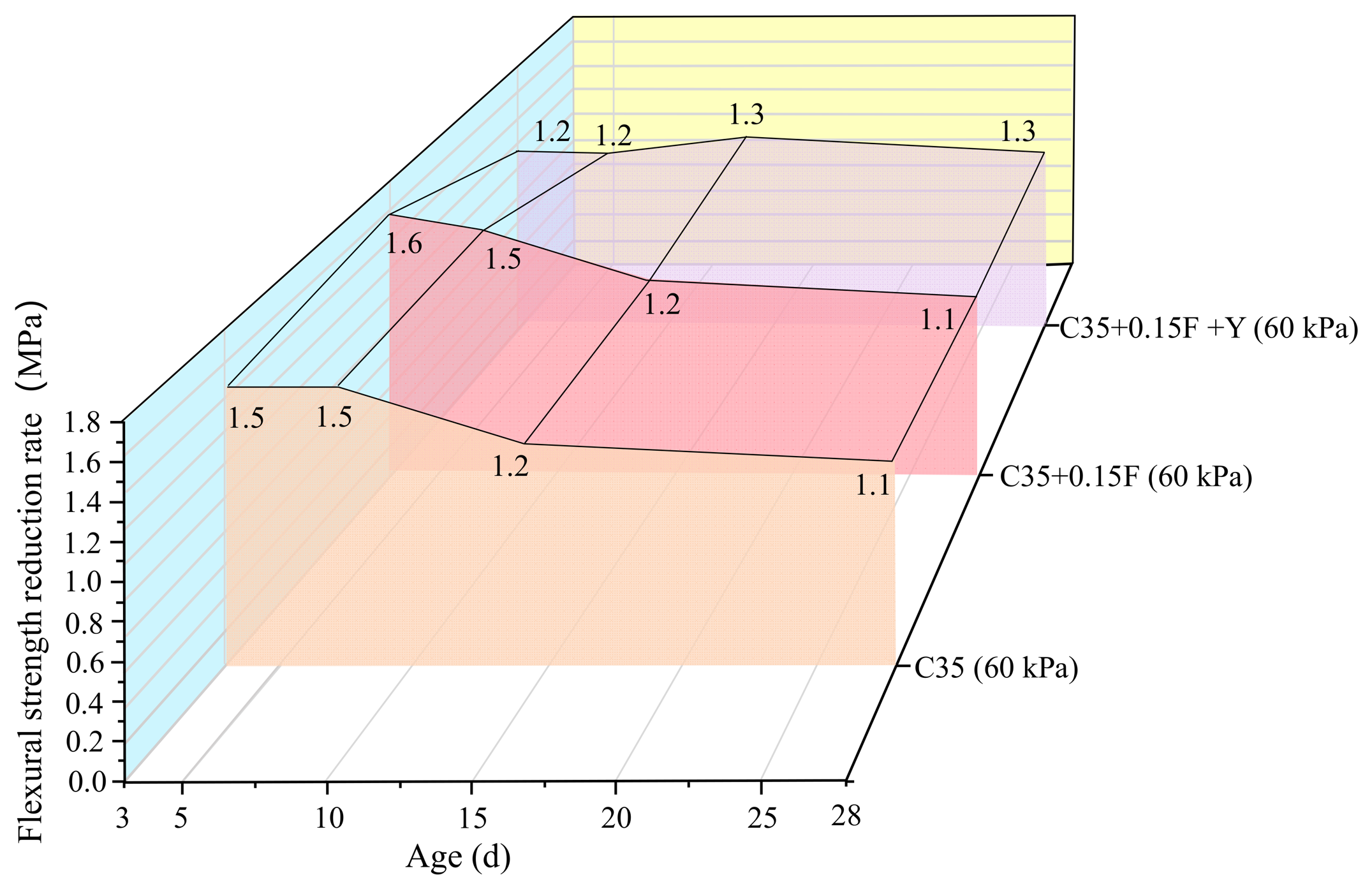
Concrete specimens were produced in Xi’an, Shaanxi Province, under the atmospheric pressure of 95.92 kPa, and were cured under natural environmental conditions with a daily average temperature of 20 °C. After the curing period, a pressure test was conducted to examine the flexural strength of the concrete. The results are presented in Figure 11.
Figure 11. Flexural strength growth curve of concrete with three mix ratios at 95.92 kPa.
At an atmospheric pressure of 95.92 kPa, the flexural strength curves of the three types of concrete mixtures are similar, with rapid strength growth in the first 7 d and a slowed but continued growth from 7 d to 28 d. The unmodified concrete (Specimen 4) shows the highest flexural strength and the fastest growth rate; the air-entrained concrete has the weakest strength and slowest growth rate. Under 95.92 kPa atmospheric pressure, Specimen 4 unmodified concrete exhibits the highest flexural strength. Specimen 5, the fly ash concrete, shows a reduction in flexural strength by 17.9% at 3 d and 7 d, with the rate of strength decrease gradually diminishing, reaching reductions of 10.6% and 8.9% at 14 d and 28 d, respectively. Specimen 6 air-entrained concrete shows reductions in flexural strength by 28.6% and 25.6% compared to Specimen 4 concrete at 3 d and 7 ds, respectively, with a final reduction rate of 28.6% at 28 d. As depicted in Figure 11, at an atmospheric pressure of 95.92 kPa, incorporating fly ash and air-entraining agent both result in reduced flexural strength of concrete, though the growth trends remain the same [47]. Specimen 6 concrete, based on on-site mixing trials, included 0.02% air-entraining agent. Previous studies have indicated that the entraining capacity of air-entraining agents may vary with atmospheric pressure, thereby affecting the mechanical properties of concrete to different degrees. In this study, this interpretation is used as a possible explanation for the observed strength variation, while direct verification through air-void analysis remains necessary [48].
(2)
Study on the Variability of Flexural Strength Characteristics in Concrete
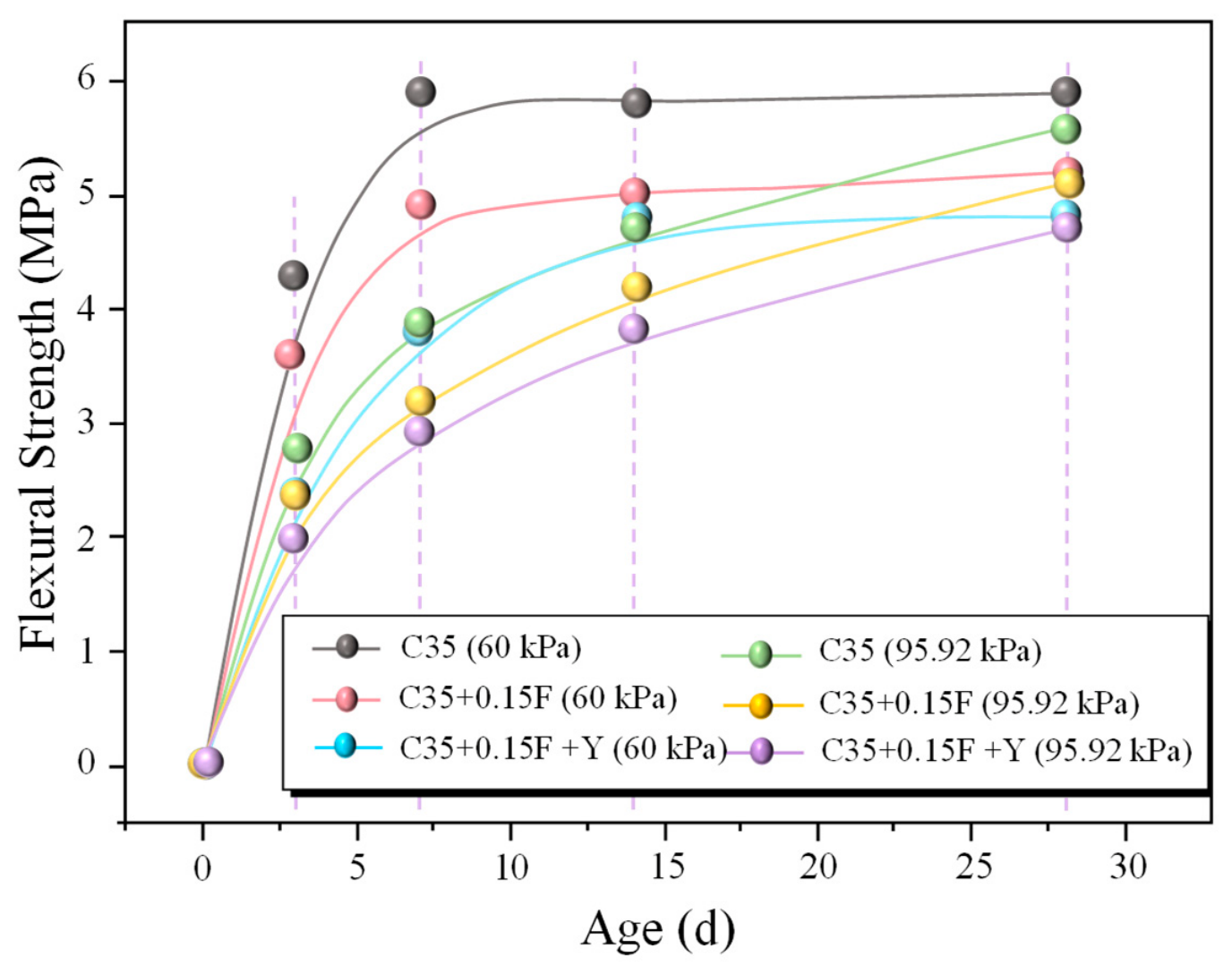
At an atmospheric pressure of 95.92 kPa, the flexural strength curves of the three concrete mixtures are similar, as shown in Figure 12 and Figure 13. The strength increases rapidly in the first 7 days and slowly but continuously from 7 to 28 days. The unmodified concrete (sample 4) showed the highest flexural strength and the fastest growth rate; air-entraining concrete has the weakest strength and the slowest growth rate.
Figure 12. Flexural strength growth curve of test concrete at different atmospheric pressures.
Figure 13. Comparison of flexural strength decline in concrete at 60 kPa and 95.92 kPa loading conditions.
When Specimen 4 and Specimen 5 were cured under a 60 kPa atmospheric pressure for 3 d, their strength increased by 50% and 60%, respectively, compared to curing under a 95.92 kPa atmospheric pressure. For the 7 d, 14 d, and 28 d aged specimens, the increase in the flexural strength of concrete was respectively 50%, 20%, and 10%. It is evident that, without the incorporation of air-entraining agents, a low-pressure environment accelerates the early strength development rate of concrete, but the later growth rate is slower compared to that under 95.92 kPa atmospheric pressure, and the maximum flexural strength of concrete is not as high as that under 95.92 kPa. In comparison with Specimens 4 and 5, the air-entrained concrete Specimen 6 exhibited minor changes under low pressure conditions [49]. The effectiveness of air-entraining agents in high-altitude environments is more pronounced than that of fly ash and unmodified concrete [50].
The growth curves of concrete’s flexural strength under different atmospheric pressures reveal that the trend of strength increase in a low-pressure environment is still significant, whereas under 95.92 kPa atmospheric pressure, the increase in strength essentially ceases. The low-pressure environment reduces the early growth rate but enhances the later growth rate, prolonging the period of strength development and making the growth trend more apparent.

5. Conclusions

For the thermal insulation structure of the inverted arch in high-altitude cold-region tunnels, this chapter proposes a research approach utilizing foam concrete as a thermal insulation filling material. Considering the characteristics and research status of foam concrete, a feasibility analysis of using new foam concrete materials as a filling layer and a study on the strength characteristics of foam concrete were conducted.
(1)
Foam concrete is a lightweight material with low density, adjustable strength, and potential thermal insulation advantages. Based on the strength tests conducted in this study, it shows preliminary mechanical potential for use as a tunnel inverted arch backfilling material in high-altitude regions.
(2)
The compressive strength of foam concrete increases significantly with dry density, and the strength enhancement becomes more pronounced when the dry density exceeds 1000 kg·m−3.
(3)
Under an atmospheric pressure of 60 kPa, Specimen 4 exhibited the highest compressive strength, whereas Specimen 6, the air-entrained concrete, showed the lowest value, with a 28-day compressive strength of approximately 24 MPa, indicating that the tested concrete mixtures still maintained a relatively high strength level under the present experimental conditions.
(4)
Differences were observed in the strength development of concrete between the 60 kPa and 95.92 kPa series, providing useful comparative observations for understanding the behavior of concrete under different pressure-related preparation environments. Considering the differences in preparation and curing conditions between the two series, further controlled studies are still needed to more clearly identify the independent contribution of atmospheric pressure to strength development. Among the tested mixtures, the air-entrained concrete showed a more pronounced difference between the two series than the unmodified concrete and fly ash concrete.
(5)
Under a reduced atmospheric pressure of 60 kPa, the foam concrete with a dry density of 1200 kg·m−3 achieved a 28-day compressive strength exceeding 20 MPa, indicating that it can satisfy the basic compressive-strength requirement for tunnel inverted arch backfilling under the tested conditions.

6. Limitations and Future Research Directions

Although this study demonstrates the potential of foam concrete for tunnel inverted arch backfilling in high-altitude environments, several limitations remain. The work focuses on strength behavior under reduced atmospheric pressure, without considering long-term durability, freeze–thaw resistance, or field-scale applicability. In the adopted experimental procedure, reduced atmospheric pressure was mainly involved during specimen preparation and early molding, while the specimens were subsequently cured under standard laboratory conditions. Therefore, the obtained results should be understood as a useful strength-based experimental reference for foam concrete prepared under reduced-pressure conditions, rather than as a complete representation of its long-term service performance in actual high-altitude tunnel environments. The extension of these findings to coupled service conditions involving continuous low atmospheric pressure, low temperature, freeze–thaw cycles, moisture migration, and sustained or cyclic loading still requires further investigation. In addition, atmospheric pressure was not fully isolated as an independent variable, and its interaction with temperature and humidity may affect strength development. Furthermore, the lack of direct microstructural evidence (e.g., pore structure or microscopic observations) limits the validation of the proposed mechanisms.
In future research, direct pore-structure and microstructural characterization techniques, such as microscopic observation, image-based air-void analysis, and micro-CT testing [51], should be introduced to further verify the possible mechanisms proposed in this study and deepen the understanding of the microstructural evolution and damage behavior of foam concrete under complex environmental conditions. In particular, computer vision-based approaches provide a promising pathway for quantitatively analyzing pore structure, bubble distribution, crack propagation, and surface defects from specimen images. Recent studies have shown that deep learning models such as DeepLab [52], a semantic segmentation framework, can effectively extract fine-scale structural features from material images, while EfficientNet [53], an efficient convolutional neural network architecture, enables accurate feature recognition with reduced computational cost. The integration of these vision-based methods is expected to significantly enhance the precision and efficiency of microstructural analysis, thereby offering deeper insights into the strength development and failure mechanisms of foam concrete.

Author Contributions

W.G.: Writing—original draft, Investigation; Y.L.: Data curation, Validation; Y.T.: Investigation, Methodology; L.H.: Data curation, Formal analysis; L.L.: Writing—original draft, Funding acquisition; Y.Z.: Validation, Supervision; C.F.: Investigation, Data curation. All authors have read and agreed to the published version of the manuscript.

Funding

This work was supported by the following project grant: National Natural Science Foundation of China (Grant No. 42477209, 42302320) and Jiangsu Natural Science Foundation (BK20250207); Henan Provincial Science and Technology Research Project: Research and Application of Key Technologies for Intelligent Construction of Open-Cut Prefabricated Metro Stations (NO. 262102320179); Henan Provincial Key Research Project in Higher Education Institutions: Heat-Mass Transfer Evolution in Subgrade under Traffic Loading & Polymer Grouting Toughness Improvement (NO. 25A580010). Key Laboratory of Rapid Maintenance New Materials and Trenchless Technology for Transportation Infrastructure in Jiaozuo City. Multi-dimensional Analysis of Mesostructure Evolution Law of Cement-Soil under Different Confining Pressures in Freezing Method Construction (NO. 26B410002).

Data Availability Statement

All data, models, and code generated or used during the study appear in the published article.

Conflicts of Interest

We declare that we have no financial and personal relationships with other people or organizations that can inappropriately influence our work, there is no professional or other personal interest of any nature or kind in any product, service and/or company that could be construed as influencing the position presented in, or the review of, the manuscript entitled.

References

  1. Chen, Y.; Guan, L.; Zhu, S.; Chen, W.J. Foamed concrete containing fly ash: Properties and application to backfilling. Constr. Build. Mater. 2021, 273, 121685. [Google Scholar] [CrossRef] [Scilit]
  2. Li, C.; Yang, L.; Luo, C.; Liu, H.; Wan, X. Frost Heaving Strain Monitoring for Lining Structure in Extreme Cold and High-Altitude Area with FBG Strain Sensors. Measurement 2022, 196, 110918. [Google Scholar] [CrossRef] [Scilit]
  3. Xing, R.; Jiang, S.; Xu, P. Long-Term Temperature Monitoring of Tunnel in High-Cold and High-Altitude Area Using Distributed Temperature Monitoring System. Measurement 2017, 95, 456–464. [Google Scholar] [CrossRef] [Scilit]
  4. Wang, L.; Zhou, X.; Tao, L.; Zeng, Y.; Ren, X. Anti-Freezing System of High Altitude and High Geothermal Tunnel Based on Air-Source Heat Extraction and Case Analysis. Case Stud. Therm. Eng. 2022, 32, 101832. [Google Scholar] [CrossRef] [Scilit]
  5. Ai, Q.; Yuan, Y.; Jiang, X.; Wang, H.; Han, C.; Huang, X.; Wang, K. Pathological diagnosis of the seepage of a mountain tunnel. Tunn. Undergr. Space Technol. 2022, 128, 104657. [Google Scholar] [CrossRef] [Scilit]
  6. Pásztory, Z. An overview of factors influencing thermal conductivity of building insulation materials. J. Build. Eng. 2021, 44, 102604. [Google Scholar] [CrossRef] [Scilit]
  7. Zhang, M.; Wang, T.; Wang, X.; Wu, W.; Guo, J. Analysis on the Laying Method and Thermal Insulation Effect of Tunnel Insulation Layer in High-Altitude Cold Regions. Electron. J. Struct. Eng. 2023, 23, 66–74. [Google Scholar] [CrossRef] [Scilit]
  8. Tinti, F.; Spaggiari, C.; Lanconelli, M.; Voza, A.; Boldini, D. Exploitation of Drainage Water Heat: A Novel Solution Experimented at the Brenner Base Tunnel. Tunn. Undergr. Space Technol. 2023, 137, 105131. [Google Scholar] [CrossRef] [Scilit]
  9. Xuefu, Z.; Jianzhang, X.; Yaonan, Z.; Shengxie, X. Study of the Function of the Insulation Layer for Treating Water Leakage in Permafrost Tunnels. Appl. Therm. Eng. 2007, 27, 637–645. [Google Scholar] [CrossRef] [Scilit]
  10. Asadi, I.; Shafigh, P.; Hassan, Z.F.B.A.; Mahyuddin, N.B. Thermal conductivity of concrete–A review. J. Build. Eng. 2018, 20, 81–93. [Google Scholar] [CrossRef] [Scilit]
  11. Cui, G.; Ma, J.; Wang, L.; Wang, X.; Wang, D. A New Off-Wall Insulation Liner for High-Speed Railway Tunnels in Cold Regions. Case Stud. Therm. Eng. 2021, 28, 101652. [Google Scholar] [CrossRef] [Scilit]
  12. Laukaitis, A.; Kunskaitė, L.J. Investigation into Low Density Porous Concrete Penetrability by Air/Mažo Tankio Akytojo Betono Oro Laidumo Tyrimai. J. Civ. Eng. Manag. 1996, 2, 41–45. [Google Scholar] [CrossRef] [Scilit]
  13. Gencel, O.; Sarı, A.; Kaplan, G.; Ustaoglu, A.; Hekimoğlu, G.; Bayraktar, O.Y.; Ozbakkaloglu, T. Properties of eco-friendly foam concrete containing PCM impregnated rice husk ash for thermal management of buildings. J. Build. Eng. 2022, 58, 104961. [Google Scholar] [CrossRef] [Scilit]
  14. Lesovik, V.; Voronov, V.; Glagolev, E.; Fediuk, R.; Alaskhanov, A.; Amran, Y.H.M.; Murali, G.; Baranov, A. Improving the behaviors of foam concrete through the use of composite binder. J. Build. Eng. 2020, 31, 101414. [Google Scholar] [CrossRef] [Scilit]
  15. Ma, S.; Chen, W.; Zhao, W. Mechanical properties and associated seismic isolation effects of foamed concrete layer in rock tunnel. J. Rock Mech. Geotech. Eng. 2019, 11, 159–171. [Google Scholar] [CrossRef] [Scilit]
  16. Zhao, W.S.; Chen, W.Z.; Ma, S.S.; Zhao, K.; Song, W.P.; Li, C. Isolation effect of foamed concrete layer on the seismic responses of tunnel. Rock Soil Mech. 2018, 39, 1027–1036. [Google Scholar]
  17. Wang, H.; Chen, W.; Tan, X.; Tian, H.M.; Cao, J.J. Development of a New Type of Foam Concrete and Its Application on Stability Analysis of Large-Span Soft Rock Tunnel. J. Cent. South Univ. 2012, 19, 3305–3310. [Google Scholar] [CrossRef] [Scilit]
  18. Dawood, E.T.; Hamad, A.J. Proportioning of Lightweight Concrete by the Inclusions of Expanded Polystyrene Beads (EPS) and Foam Agent. Tikrit J. Eng. Sci. 2016, 23, 65–73. [Google Scholar] [CrossRef] [Scilit]
  19. Namsone, E.; Šahmenko, G.; Korjakins, A. Durability Properties of High Performance Foamed Concrete. Procedia Eng. 2017, 172, 760–767. [Google Scholar] [CrossRef] [Scilit]
  20. Kearsley, E.P.; Wainwright, P.J. The effect of porosity on the strength of foamed concrete. Cem. Concr. Res. 2002, 32, 233–239. [Google Scholar] [CrossRef] [Scilit]
  21. Nambiar Nambiar, E.K.K.; Ramamurthy, K. Airvoid characterization of foam concrete. Cem. Concr. Res. 2007, 37, 221–230. [Google Scholar] [CrossRef] [Scilit]
  22. Pishro, A.A.; Zhang, S.; Hu, Q.; Zhang, Z.R.; Amini Pishro, M.; Zhang, L.L.; L’Hostis, A.; Hejazi, F.; Liu, Y.T.; Zhao, Y.D. Advancing ultimate bond stress–slip model of UHPC structures through a novel hybrid machine learning approach. Structures 2024, 62, 106162. [Google Scholar] [CrossRef] [Scilit]
  23. Arif, M.; Hasan, S.D.; Siddiqui, S. Effect of nano silica on strength and permeability of concrete. Mater. Today Proc. 2023; in press.
  24. Zhang, C.; Tan, X.; Tian, H.; Chen, W. Lateral compression and energy absorption of foamed concrete-filled polyethylene circular pipe as yielding layer for high geo-stress soft rock tunnels. Int. J. Min. Sci. Technol. 2022, 32, 1087–1096. [Google Scholar] [CrossRef] [Scilit]
  25. Zhou, H.; Zhang, X.; Wang, X.; Zhang, H.; Song, T. Improving Energy Absorption Capacity of Foam Concrete with Gradient and Layered Architecture. Constr. Build. Mater. 2022, 319, 126140. [Google Scholar] [CrossRef] [Scilit]
  26. Brito, F.M.S.; Paes, J.B.; Oliveira, J.T.D.S.; Arantes, M.D.C.; Vidaurre, G.B.; Brocco, V.F. Physico-Mechanical Characterization of Heat-Treated Glued Laminated Bamboo. Constr. Build. Mater. 2018, 190, 719–727. [Google Scholar] [CrossRef] [Scilit]
  27. Schwalt, M.; Stolz, D. Kraftwerk Witznau. Verpressversuche zur Ertüchtigung des Druckstollens. Geomech. Tunn. 2022, 15, 502–514. [Google Scholar] [CrossRef] [Scilit]
  28. Wu, K.; Shao, Z.; Qin, S. A Solution for Squeezing Deformation Control in Tunnels Using Foamed Concrete: A Review. Constr. Build. Mater. 2020, 257, 119539. [Google Scholar] [CrossRef] [Scilit]
  29. Lu, H.; Bao, W.; Yin, Y. Durability deterioration mechanism and carbonation depth prediction model of tunnel lining concrete in high-altitude cold area under low-pressure-freeze-thaw conditions. Constr. Build. Mater. 2024, 456, 139259. [Google Scholar] [CrossRef] [Scilit]
  30. Wang, Z.; Niu, F.; Lin, Z.; Wang, Y.; Du, X.; Du, W. Study on the durability and microstructure evolution of modified concrete in high altitude cold region. Cold Reg. Sci. Technol. 2025, 241, 104670. [Google Scholar] [CrossRef] [Scilit]
  31. Tarasov, A.S.; Kearsley, E.P.; Kolomatskiy, A.S.; Mostert, H.F. Heat evolution due to cement hydration in foamed concrete. Mag. Concr. Res. 2010, 62, 895–906. [Google Scholar] [CrossRef] [Scilit]
  32. Raj, A.; Sathyan, D.; Mini, K.M. Physical and functional characteristics of foam concrete: A review. Constr. Build. Mater. 2019, 221, 787–799. [Google Scholar] [CrossRef] [Scilit]
  33. Ren, J.; Lai, Y.; Zhang, J.; Pei, W. Whether mixed using polypropylene fiber and air-entraining agent can further improve the macro and micro durability of concrete in cold and sulfate regions. Cold Reg. Sci. Technol. 2023, 212, 103891. [Google Scholar] [CrossRef] [Scilit]
  34. Li, H.; Wu, Y.; Zhou, A.; Zhao, C.; Deng, L.; Lu, F. Experimental study on self-healing performance of tunnel lining concrete based on response surface methodology. Constr. Build. Mater. 2024, 425, 136105. [Google Scholar] [CrossRef] [Scilit]
  35. GB/T 50082-2009; Standard for Test Methods of Long-Term Performance and Durability of Ordinary Concrete. China Architecture & Building Press: Beijing, China, 2009.
  36. JG/T 266-2011; Foamed Concrete. Ministry of Housing and Urban-Rural Development of the People’s Republic of China: Beijing, China, 2011.
  37. Falliano, D.; De Domenico, D.; Ricciardi, G.; Gugliandolo, E. Key Factors Affecting the Compressive Strength of Foamed Concrete; IOP Conference Series: Materials Science and Engineering; IOP Publishing: Bristol, UK, 2018; Volume 431, p. 062009. [Google Scholar]
  38. Chung, S.Y.; Lehmann, C.; Abd Elrahman, M.; Stephan, D. Pore characteristics and their effects on the material properties of foamed concrete evaluated using micro-CT images and numerical approaches. Appl. Sci. 2017, 7, 550. [Google Scholar] [CrossRef] [Scilit]
  39. Liu, M.Y.J.; Alengaram, U.J.; Jumaat, M.Z.; Mo, K.H. Evaluation of thermal conductivity, mechanical and transport properties of lightweight aggregate foamed geopolymer concrete. Energy Build. 2014, 72, 238–245. [Google Scholar] [CrossRef] [Scilit]
  40. Zeyad, A.M.; Amin, M.; Agwa, I.S. Effect of air entraining and pumice on properties of ultra-high performance lightweight concrete. Arch. Civ. Mech. Eng. 2023, 24, 11. [Google Scholar] [CrossRef] [Scilit]
  41. Zeng, X.; Lan, X.; Zhu, H.; Long, G.C.; Xie, Y.J. Investigation on air-voids structure and compressive strength of concrete at low atmospheric pressure. Cem. Concr. Compos. 2021, 122, 104139. [Google Scholar] [CrossRef] [Scilit]
  42. Chu, H.; Qin, J.; Gao, L.; Jiang, J.; Wang, F.; Wang, L. A cost-effective approach to manufacturing ultra-high-performance lightweight concrete via air-entraining. Arch. Civ. Mech. Eng. 2023, 23, 210. [Google Scholar] [CrossRef] [Scilit]
  43. Liu, X.; Chen, X.; Li, H.; Zhang, A.; Li, L.; Tian, B.; Ge, Y. Air-void characteristics and freeze-thaw cycling resistance of air-entrained concrete under low atmospheric pressure of highland regions. J. Build. Eng. 2025, 106, 112629. [Google Scholar] [CrossRef] [Scilit]
  44. Ghahremani, G.; Bagheri, A.; Zanganeh, H. The effect of size and shape of pores on the prediction model of compressive strength of foamed concrete. Constr. Build. Mater. 2023, 371, 130720. [Google Scholar] [CrossRef] [Scilit]
  45. Munkholm, L.J.; Heck, R.J.; Deen, B. Soil pore characteristics assessed from X-ray micro-CT derived images and correlations to soil friability. Geoderma 2012, 181, 22–29. [Google Scholar] [CrossRef] [Scilit]
  46. Huo, J.; Wang, Z.; Chen, H.; He, R. Impacts of low atmospheric pressure on properties of cement concrete in plateau areas: A literature review. Materials 2019, 12, 1384. [Google Scholar] [CrossRef] [Scilit]
  47. Shi, Y.; Yang, H.; Zhou, S.; Wang, A.; Lv, X. Effect of atmospheric pressure on performance of AEA and air entraining concrete. Adv. Mater. Sci. Eng. 2018, 2018, 6528412. [Google Scholar] [CrossRef] [Scilit]
  48. Li, Y.; Wang, Z.; Wang, L. The influence of atmospheric pressure on air content and pore structure of air-entrained concrete. J. Wuhan Univ. Technol.-Mater. Sci. Ed. 2019, 34, 1365–1370. [Google Scholar] [CrossRef] [Scilit]
  49. Zhang, M.; Shen, J.; Yang, R.; Ji, H.; Ding, J. Effect of curing age on the microstructure and hydration behavior of oil well cement paste cured at high temperature. J. Mater. Civ. Eng. 2021, 33, 04021006. [Google Scholar] [CrossRef] [Scilit]
  50. Liu, L.; Liu, T.; Liu, X.; Li, Z.; Cai, G. Key influencing factors and prediction model for the tensile strength of compacted clayey loess. Bull. Eng. Geol. Environ. 2025, 84, 404. [Google Scholar] [CrossRef] [Scilit]
  51. Agofack, N.; Ghabezloo, S.; Sulem, J.; Garnier, A.; Urbanczyk, C. Experimental investigation of the early-age mechanical behaviour of oil-well cement paste. Cem. Concr. Res. 2019, 117, 91–102. [Google Scholar] [CrossRef] [Scilit]
  52. Luo, D.; Qiao, X.; Niu, D. A predictive model for the freeze-thaw concrete durability index utilizing the deeplabv3+ model with machine learning. Constr. Build. Mater. 2025, 459, 139788. [Google Scholar] [CrossRef] [Scilit]
  53. Kabir, H.; Wu, J.; Dahal, S.; Joo, T.; Garg, N. Automated estimation of cementitious sorptivity via computer vision. Nat. Commun. 2024, 15, 9935. [Google Scholar] [CrossRef] [Scilit]
Disclaimer/Publisher’s Note: The statements, opinions and data contained in all publications are solely those of the individual author(s) and contributor(s) and not of MDPI and/or the editor(s). MDPI and/or the editor(s) disclaim responsibility for any injury to people or property resulting from any ideas, methods, instructions or products referred to in the content.

Article Metrics

Citations

Article Access Statistics

Multiple requests from the same IP address are counted as one view.