Skip to Content
BuildingsBuildings
  • Article
  • Open Access

2 March 2026

Multi-Objective Topological Optimization of 3D Multi-Material Structures Using the SESO Method with FORM

,
,
and
1
Department of Mechanics, Federal Center for Technological Education of Minas Gerais (CEFET), Rua José Peres 558 Centro, Leopoldina 36700-001, MG, Brazil
2
Department of Mathematics, Federal Institute of Minas Gerais (IFMG), Rua Iguaçú, 595, Betim 32677-562, MG, Brazil
3
Department of Civil Engineering, Federal University of Ouro Preto (UFOP), Ouro Preto 35400-000, MG, Brazil
*
Author to whom correspondence should be addressed.

Abstract

Topological optimization has established itself as an efficient tool for the design of highly complex structures and the rational use of materials, especially in problems involving multiple constraints and conflicting objectives. This work presents a new multi-material topological optimization approach based on the ESO smoothing method (SESO), formulated as a multi-objective optimization problem in a MATLAB R2021a environment. The multi-objective formulation simultaneously considers the minimization of the maximum von Mises equivalent stress (or minimum principal stress) and the maximum displacement, which are fundamental criteria for structural engineering design. The proposed methodology also incorporates a reliability analysis using the First-Order Reliability Method (FORM), modeling uncertainties associated with the applied force, volume fraction, and modulus of elasticity through normal and lognormal probability distributions, with a target reliability index of β t a r g e t = 3.0 . The consistency of the reliability analysis was evaluated using Monte Carlo simulations, validating the reliability indices obtained via FORM. The approach was applied to two classical three-dimensional numerical examples: a cantilever beam under base and center loads and an MBB beam, considering two widely used engineering materials, steel and concrete. The results indicate improved multi-material distribution in the design domain and greater structural robustness against unfavorable loading planes, variations in the modulus of elasticity, and volume constraints imposed by FORM. Furthermore, the minimum yield stress of steel ( σ y m i n ) and the compressive strength of concrete ( f c k m i n ) were calibrated, representing the minimum material strengths required to resist the maximum von Mises stress in steel and the minimum principal stress ( σ 3 ) in concrete, ensuring the target reliability index is achieved. This method, thus, highlights the integration of SESO with multi-material, multi-objective, and reliability-based optimization as a consistent, robust, and practically relevant strategy with potential for future applications in structural engineering projects.

1. Introduction

The development of high-performance structural designs has become a necessity given current technological advancement. Structural engineering requires increasingly lightweight and efficient solutions capable of meeting more stringent functional and economic requirements. In this context, the pursuit of greater structural efficiency has driven the use of systematic design improvement methods.
Among these approaches, Topology Optimization (TO) stands out as a suitable technique for structural optimization, based on robust criteria and the efficient distribution of material in the design domain, enabling the creation of lighter structures with significant cost reductions, without compromising mechanical performance [1,2]. The increasing use of TO demonstrates its ability to integrate structural performance, material economy, and optimized geometries [3,4]. In this context, the overall stiffness of a structure is directly associated with its topology, that is, the way the material is distributed along the dominant stress transfer paths. When this distribution occurs efficiently, the system tends to exhibit greater stiffness and better overall performance, making the optimal configuration an important factor in meeting the current demands of structural engineering.
Furthermore, TO has been continuously improved, with recent advances highlighting the use of multiple materials in defining the desired structure. This extension, called Multi-Material Topology Optimization (MMTO), has become increasingly relevant, with several studies demonstrating its potential to produce more efficient and realistic solutions in engineering applications [5,6,7,8,9]. In parallel, contemporary structural designs often involve multiple objectives, such as reducing structural weight and limiting maximum displacement [10]. These objectives, however, are generally conflicting, since minimizing weight generally leads to greater displacements, making multi-objective approaches indispensable for defining optimal solutions.
This article proposes an extension of the Smoothing Evolutionary Structural Optimization (SESO) method for the context of MMTO, considering the simultaneous minimization of the maximum von Mises stress and the maximum displacement of the structure. However, reducing displacements generally requires a greater concentration of material in specific regions, which, while contributing to increased overall stiffness, can restrict the dominant stress transfer paths and intensify local stresses. Consequently, maximum stress and displacement do not vary independently, frequently exhibiting conflicting behaviours throughout the optimization process, which reinforces the need for a multi-objective approach to balance the evaluation of structural performance. Additionally, the proposed method incorporates a reliability analysis into the MMTO process, with a reliability index of 3.0, corresponding to a failure probability of 0.0013 [11].
In addition to proposing a calibration of the minimum yield strength of the material, whose consistency is verified through Monte Carlo simulations, enabling a robust statistical evaluation of the performance and structural safety of the solutions obtained.

2. Multi-Material Topology Optimization

Multi-material topological optimization (MMTO) has been generating increasing interest from the scientific community, driven mainly by recent advances in multi-material additive manufacturing. According to Bandyopadhyay et al. [12] and Han and Lee [13], this type of manufacturing enables the direct production of multi-material structures from computational models, in a point-by-point and layer-by-layer manner, significantly expanding the possibilities of structural design.
Among existing approaches to MMTO, the Level Set Method (LSM) stands out for its ability to implicitly represent complex geometries, naturally handle topological changes, and facilitate the incorporation of multiple materials. The classic LSM formulation was extended to MMTO problems by Wang and Wang [14], in which, for a total of m materials, multiple level set functions are used, and the evolution of the structure is described by a system of Hamilton–Jacobi equations. Subsequently, the LSM was extended to MMTO problems with stress constraints in Guo et al. [15] and Chu et al. [16]. A modified multi-material description of the multi-material Level Set (MM-LS) method was presented by Wang et al. [17], in which each material phase is represented by a combination of different level set functions, thereby providing greater flexibility in modeling.
In the context of finite element-based approaches, a SIMP-type multi-material interpolation model was proposed by Bendsøe and Sigmund [18], in which interpolation initially occurs between two non-zero material phases and then between the solid material and the void. Another strategy for MMTO was presented by Tavakoli and Mohseni [19], in which the multi-material problem is decomposed into a sequence of binary topological optimization (0–1) subproblems. Along the same lines, the SIMP model was applied between adjacent materials, and a multi-material extension of the BESO method was developed by Huang and Xie [20].
More recently, the work of Zheng et al. [21] and Simonetti et al. [22] employed mapping-based interpolation functions, using, respectively, the hyperbolic tangent and sigmoid functions. These approaches were proposed as alternatives to polynomial interpolations and the SIMP model, guaranteeing well-defined discrete solutions (0–1) for each material and eliminating intermediate regions. As a result, smoother and clearly delimited transitions are obtained between the different materials in the optimized topology, which contributes to the feasibility of the manufacturing process.
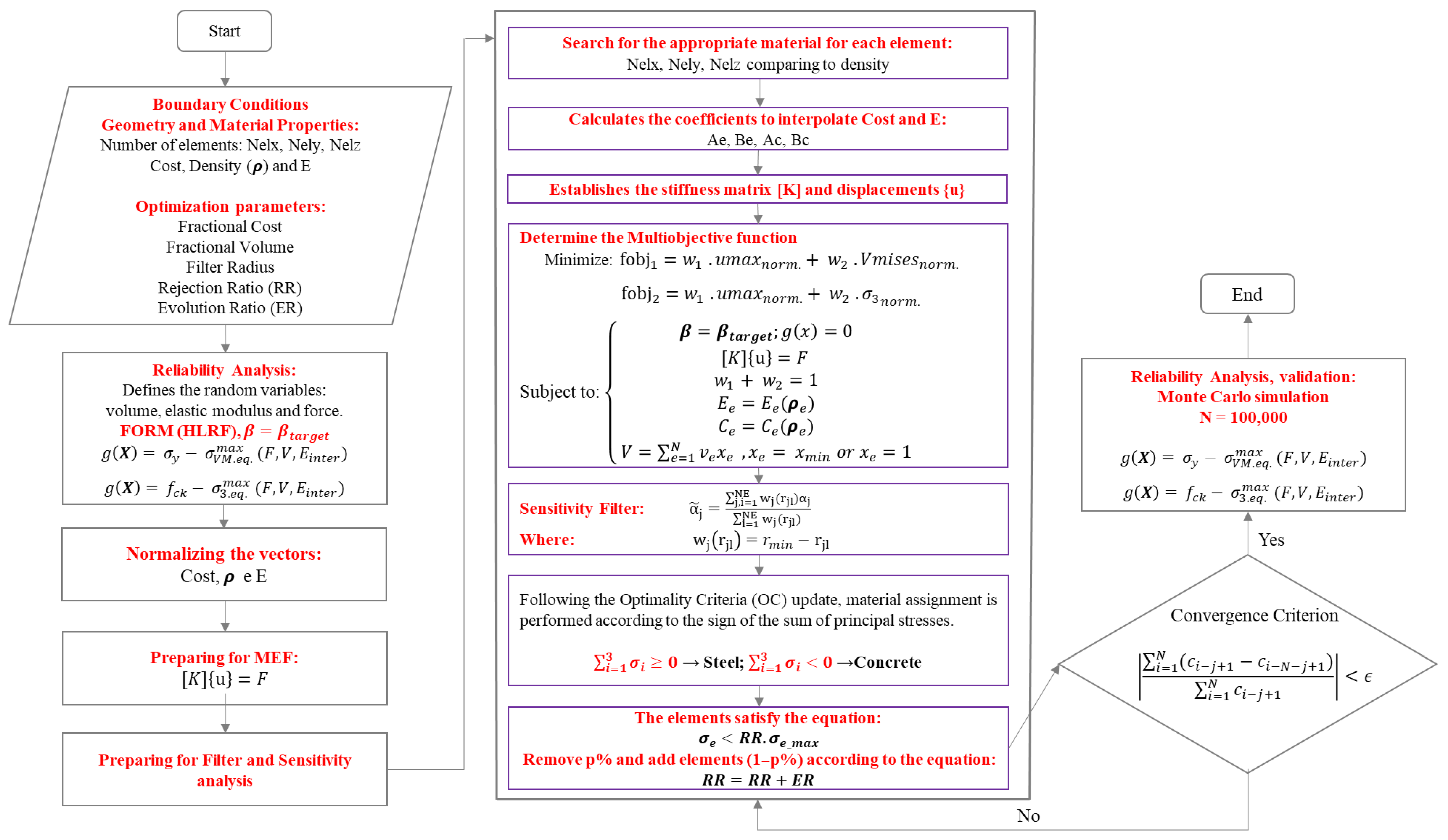
The flowchart in Figure 1 shows the implementation of multi-objective MMTO considering reliability for three-dimensional structures using the SESO method with reliability analysis through FORM (HLRF).
Figure 1. SESO–MMTO multi-objective optimization flowchart.
Where E e and C e are the elastic modulus and cost of the e -th element, respectively.
f o b j 1 and f o b j 2 are the multi-objective functions associated with the normalized maximum.
Displacement combined with the normalized von Mises stress and the normalized.
Minimum principal stress, respectively.

2.1. Multi-Objective Formulation of Multi-Material Topology Optimization

Currently, many engineering problems are formulated and treated as multi-objective optimization problems. This approach allows for obtaining solutions capable of simultaneously meeting different performance criteria, enabling the identification of more suitable alternatives for the challenges inherent in engineering systems. Recent studies, such as those by Azevêdo et al. [23], Zhang et al. [24] and Chen et al. [25], demonstrate the effectiveness of this methodology in the search for more balanced and efficient solutions.
This article uses the weighted sum (WS) method, which combines multiple objective functions into a single scalar function using weighting coefficients, allowing control over the trade-off between conflicting objectives. This approach is widely used in multi-objective optimization problems due to its simplicity of implementation, computational efficiency, and ease of integration with evolutionary and gradient-based methods. Furthermore, in this work, the proposed algorithm enables the automatic construction of the Pareto frontier from the systematic variation of weights, simultaneously generating the optimal topology corresponding to each set of weightings. This provides a comprehensive and consistent view of the trade-off solutions between the objectives considered.
MMTO has been applied in different engineering structures, as it allows achieving structural performance compatible with stringent mechanical requirements, while promoting cost reduction and efficient use of materials, contributing to the sustainability of the project. Among the available topological optimization techniques, the SESO method [26] has stood out for presenting consistent results, leading to the achievement of more rigid structures with lower material consumption. For this reason, SESO is adopted in the numerical examples of this work, in conjunction with the WS method for the treatment of the multi-objective problem, considering the minimization of the maximum displacement ( f 1 ) and the von Mises equivalent stress or minimum principal stress ( f 2 ).
M i n i m i z e             f o b j x = w 1   ·   f 1 x + w 2   ·   f 2 x                                 s u b j e c t   t o :       K u = F                                                                                                                                                         w 1 + w 2 = 1                                                                                                                         V = e = 1 N   v e x e ,   x e = x m i n   o r   x e = 1                  
where w 1 and w 2 are the weights for the functions corresponding to the von Mises stress and maximum displacement, respectively, x e represents the element density variable, if x e = 1 it represents solid elements and x m i n = 10 9 denotes empty elements, K, u and f are, respectively, the global stiffness matrix, the displacement vector and the force vector. V is the volume of the structure, v e is the volume of the e-th element, and N is the total number of elements in the structure.

2.2. Weighted Sum Method

The multi-objective optimization method is characterized by several functions that describe an optimization problem. Thus, a common approach to deal with conflicting objective functions is to construct a single function that encompasses all the functions, from linear combinations between the objective functions, transforming them into a single scalar function. This method is known as the weighted sum method (Rao, [27]).
Thus, given two objective functions, f 1 ( x ) and f 2 ( x ) , a new objective function for optimization could be expressed as
f o b j x = w 1 f 1 x + w 2 f 2 x
In general terms, the weighted sum method consists of
m i n     f o b j ( x ) = i = 1 m w i f i x ,           w i 0 ,           i = 1 m w i = 1
where f i ( x ) are the objective functions, w i are the assigned weights, representing the relative importance of each objective, m represents the total number of objective functions considered in the multi-objective optimization problem.

2.3. Pareto Frontier

Multi-objective optimization problems have been extensively investigated in the literature and are commonly analyzed using the concept of the Pareto frontier. Introduced by Pareto in 1896, this approach seeks to identify a set of compromise solutions, rather than a single optimal point. A solution vector x belongs to the Pareto frontier if none of the objective functions can be improved without causing the deterioration of at least one of the other objectives (Pareto, 1896) [28].
In engineering applications, it is generally not possible to determine a single vector x capable of simultaneously minimizing all the objective functions involved. For this reason, the concept of Pareto optimality has become central to multi-objective optimization formulations, especially in structural optimization problems, as discussed by Simonetti et al. (2021) [29]. The Pareto frontier defines the set of globally efficient solutions that satisfy all the problem constraints.
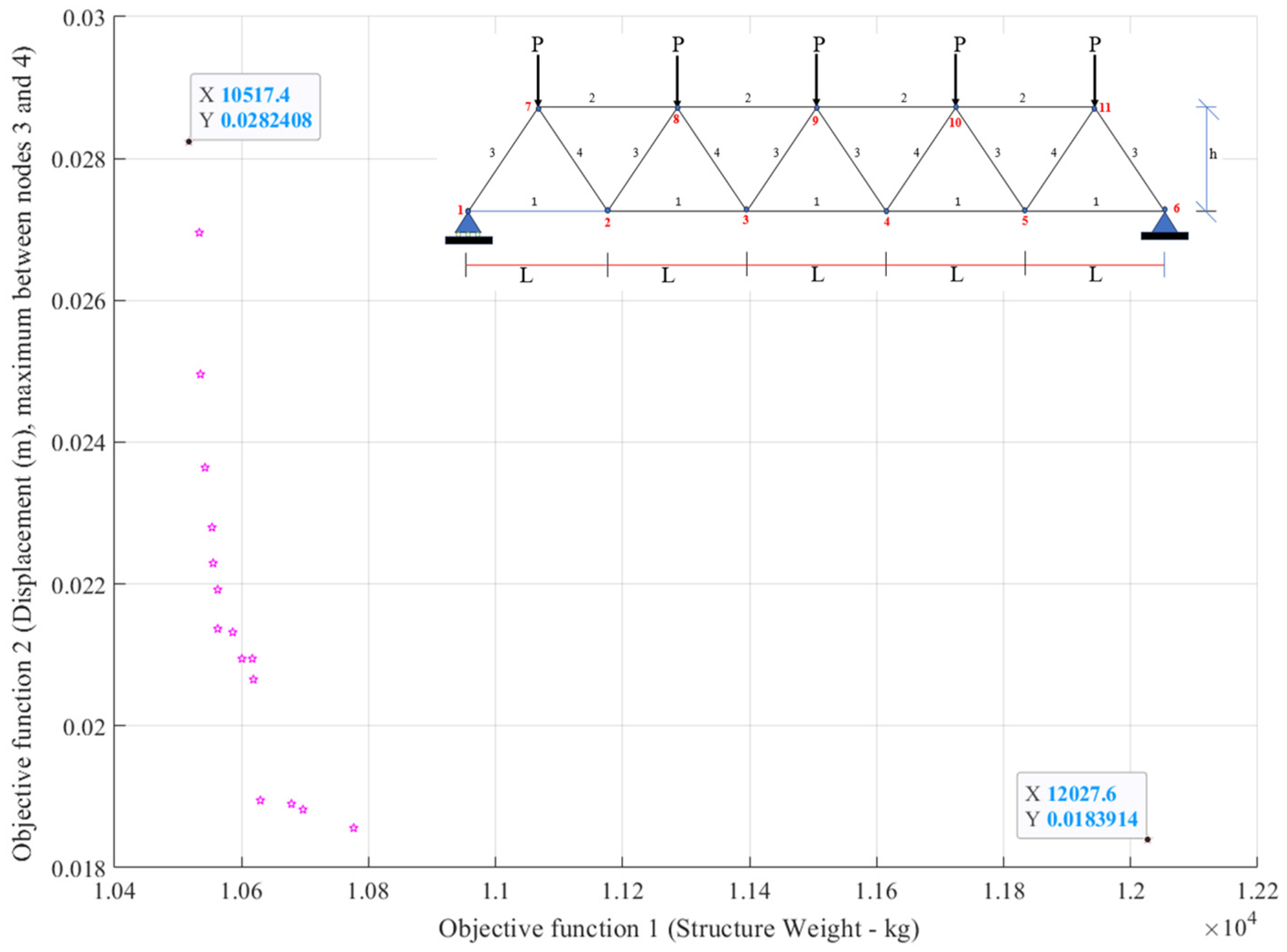
Figure 2 shows the Pareto frontier obtained from the parametric optimization of a truss structure with 19 bars. The design variations considered were the external diameters and thicknesses of the bars, aiming to minimize the structural weight and maximum displacement. The truss has a length L = 6.0 m and a height h = 3.984 m, with the following material properties imposed: modulus of elasticity of 210,000 MPa, yield strength f y = 355 MPa, density of 7850 kg/m3, and ultimate tensile strength of 510 MPa. The applied loads are P = 10 6 N, participating in nodes 7, 8, 9, 10, and 11. All nodes are highlighted in red in the figure. Note that the objective functions are mutually conflicting [10].
Figure 2. Pareto frontier: 19-bar Truss (adapted from [10]).
By clearly outlining the trade-offs between conflicting objectives, the Pareto frontier provides relevant information for the decision-making process in engineering design. This approach has been widely adopted in recent multi-objective optimization studies, such as those by Xu et al. [30], Yin et al. [31], and Crescenti et al. [32]. Thus, the multi-objective problems addressed in this work also resulted in their respective Pareto frontiers, as presented later in the numerical examples.

2.4. Pareto Dominance

The concept of Pareto dominance is fundamental in solving multi-objective optimization problems. In these problems, the goal is to simultaneously minimize or maximize a set of objective functions, which can be represented by
z = f 1 x , f 2 x , , f n x
subject to the decision vector x X . The set X corresponds to the decision space in which x = x 1 , x 2 , , x n and x represents the vector of design variables, z is the objective vector X is such that
X = x X / g ( x ) b
defining the set of feasible solutions, where g ( x ) is the set of constraints and b R m is the vector of associated limits.
A feasible solution x is considered Pareto optimal when there is no other solution capable of improving at least one objective function without simultaneously worsening some other. Equivalently, any attempt to improve one objective necessarily implies the deterioration of at least one of the others. Consider two objective vectors, u and v; u is said to dominate v if u i v i for all i and u j < v j for at least one index j.
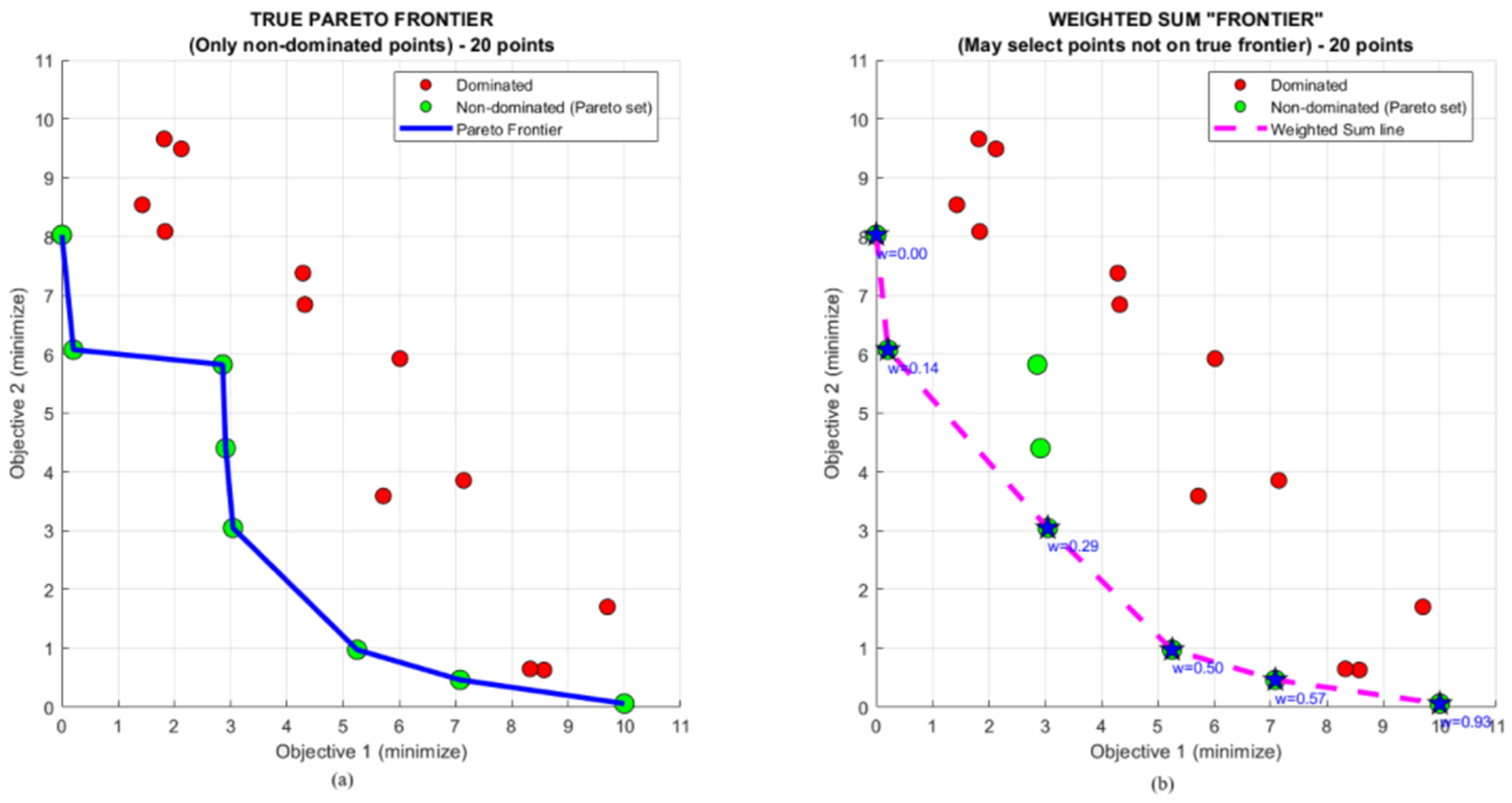
Figure 3 shows that the red points are dominated, as there is at least one other solution that is better (or equal) in both objectives and strictly better in at least one of them. The green points are non-dominated and form the Pareto set, representing solutions where it is not possible to improve one objective without worsening the other.
Figure 3. (a) Pareto frontier and (b) approximating the frontier via the weighted sum method.
The curve connecting the green points in the graph on the left represents the Pareto frontier. In the graph on the right, the weighted sum combines the objectives with different weights, generating solutions along a straight line (dashed line), which may or may not coincide with the actual frontier. However, this method may not capture non-convex parts of the Pareto frontier, as discussed in Coello et al. [33].

3. Reliability Analysis

Reliability analysis applied to structural optimization constitutes a fundamental approach for considering uncertainties in engineering design, aiming to reduce the probability of failure and, consequently, increase the safety levels of the optimized structure. Recent studies have demonstrated the efficiency of this approach [34,35,36]. Thus, the numerical examples presented in this work were subjected to a reliability analysis using the FORM method.

3.1. FORM Method

The method adopted to integrate reliability analysis into the TO process was the First-Order Reliability Method (FORM). This method is based on the first-order Taylor series expansion of the limit state function (performance function), which is iteratively linearized around the current design point. The process converges to the so-called most probable point (MPP), the point of highest probability of failure on the limit-state surface, thus allowing an efficient estimate of the reliability index. The reliability index (β) is then defined as the minimum distance, d β , between the origin and the limit-state surface in the transformed space [37,38,39].
The random variables involved in the reliability process, if they do not have a normal distribution, undergo a transformation of the variable into an equivalent normal distribution, defined by the expressions [40]
σ x N = ϕ Φ 1 F i X i f i ( X i )
μ x N = X i Φ 1 F i X i σ i N
where σ x N and μ x N are, respectively, the standard deviation and the mean of the equivalent normal distribution; F i ( ) and f i represent, respectively, the cumulative distribution function (CDF) and the probability density function (PDF) of the non-normal random variable; Φ (⋅) is the cumulative distribution function of the standard normal distribution; ϕ (⋅) is the probability density function of the standard normal variable.
For the reliability analysis, the HLRF algorithm, developed by Hasofer and Lind [38] and later improved by Rachwitz and Fiessler [41], was implemented, in which a new design point in the reduced space X i + 1 is evaluated. This is an iterative procedure based on the Newton–Raphson method, as presented in Equation (7).
X i + 1 = 1 G X i 2 G X i T X i G X i G X i
where X is the random variable transformed into a statistically independent standard normally distributed random variable, and ∇G represents the gradient vector of the limit state function.
Once the new design point, X , is determined through iterations until convergence within the specified tolerance, the probability of failure P f is then obtained from the reliability index β [11]
β = X ( i + 1 )
P f = Φ β
Thus, the RBTO method was implemented considering the applied force (F), fractional volume (Volfrac), and elastic modulus (E) as random variables. For each variable, normal (N) or lognormal (LN) probability distributions were adopted, using their respective statistical parameters, such as mean (μ) and coefficient of variation (V), as presented in Table 1.
Table 1. Statistical parameters of random variables.
This work investigates structural reliability under two complementary approaches: (i) the reliability associated with the final deterministic topology optimization (DTO) obtained through the optimization process; and (ii) the reliability of the reliability-based topology, in which the maximum von Mises stress is modeled as a variable dependent on the topological evolution and the uncertainties inherent in the random variables considered. Thus, in order to verify if the maximum acting stress is compatible with the structure’s resistance capacity, the limit state function adopted in this article is defined by
g X = σ y σ V M , e q . m a x   ( F , V , E i n t e r )
where σ y represents the yield stress of the material and σ V M , e q m a x corresponds to the maximum equivalent von Mises stress, expressed as
  i σ V M , e q . = σ V M ( D T O ) m a x   ·   η   ·   γ   ·   φ ; i i   σ V M , e q . = σ V M ( F O R M ) m a x   ·     η   ·   γ   ·   φ ;
η = F F 0   ;   γ = V 0 V ;   φ = E 0 E i n t e r
where σ V M ( D T O ) m a x is the maximum von Mises stress obtained through deterministic analysis, while σ V M ( F O R M ) m a x corresponds to the maximum von Mises stress initially calculated deterministically in the first iteration and, in subsequent iterations, updated by reliability analysis using the FORM procedure. The quantities F 0 , V 0 , E 0 denote, respectively, the initial applied forces, fractional volume, and elastic modulus. In turn, F, V, and E i n t e r represent the random variables associated with the force, volume, and elastic modulus interpolation coefficient considered in the reliability analysis.
For the approach in which concrete is considered the governing material in predominantly compressive regions, the minimum principal stress (σ3) was adopted as the evaluation parameter, and the characteristic compressive strength ( f c k ) was calibrated consistently with this stress criterion.
g X = f c k σ 3 .   e q . m a x   ( F , V , E i n t e r )   ( i )   σ 3 .   e q . m a x = σ 3   ( D T O ) m a x   ·   η   ·   γ   ·   φ ; ( i i )   σ 3 .   e q . m a x = σ 3   ( F O R M ) m a x   ·   η   ·   γ   ·   φ ;
In approach (i), throughout the iterative process, the maximum von Mises stress is kept equal to that obtained in the deterministic model, since the objective of this step is to calibrate the minimum yield stress to be adopted, so that the deterministic structure reaches the target reliability index, β t a r g e t = 3.0. In approach (ii), the maximum von Mises stress begins to evolve progressively throughout the iterations, allowing the capture of the stress redistribution effects resulting from the modifications in the structural topology, until the solution converges to a stable configuration compatible with the previously established target reliability index.
Since the problem presents a multi-material character, being a structure composed of steel and concrete materials, it should be noted that the concrete can present significant variations in resistance depending on its composition. Therefore, the minimum yield strength of the material was considered, with the objective of determining the minimum stress necessary for the material supplier to guarantee the reliability of the structure, considering a target reliability index of β t a r g e t = 3.0 .
Finally, a lower tolerance of 0.1 was established in relation to the target value of the reliability index β t a r g e t , while, as an upper limit, the condition β > β t a r g e t was admitted, provided that it was associated with the minimum yield stress necessary for this value to be reached. The yield stress was controlled by means of a tolerance of 0.5 MPa, ensuring numerical consistency and stability to the iterative process. In order to verify whether the reliability index remains close to the reference value β = 3.0 throughout the process of obtaining the final structure, a Monte Carlo simulation was conducted, allowing the statistical evaluation and validation of the structural response to the uncertainties considered.

3.2. Monte Carlo

Monte Carlo (MC) simulation stands out as one of the most widely used methods for reliability analysis in engineering, due to its conceptual simplicity and relative ease of implementation. The method is based on the generation of a large number of random samples, which numerically reproduce multiple virtual experiments. From these results, it is possible to statistically estimate the probability of failure of the system or component under study. The samples are generated according to the type of probability distribution specified for each random variable involved, respecting their respective statistical parameters, such as mean and standard deviation [37,39].
Random variables with lognormal probability distributions were modeled, and variable transformation was used to generate samples via Monte Carlo simulation. In this procedure, a lognormal random variable X, with mean μ and standard deviation σ, is used to define the variable Y = l n ( X ) . The variable Y follows a normal distribution with mean μ Y and standard deviation σ Y , defined by [37]
σ Y = l n 1 + σ μ 2
µ Y = l n   l n   µ 1 2   σ Y 2
Next, after defining the samples according to the type of probability distribution, the probability of failure P f is then determined by the ratio between the number n of simulations in which the limit state function is violated, g(x) ≤ 0, and the total number N of simulations performed, as shown in Equation (14) [38].
P f = n g x   0 N
To verify and validate the results of the reliability analysis conducted using the proposed FORM methodology, the Monte Carlo method was applied to all numerical examples in this work, using the limit-state function defined in Equation (10). The objective was to compare the reliability levels obtained and ensure their conformity with the established target values.

4. Results

In the design of the analyzed structures, two materials were considered: steel and concrete, and their properties are presented in Table 2.
Table 2. Material properties adopted in the MMTO.
Material allocation in the optimized structure was guided by the local stress state. Following Li et al. [42], the sum of the principal stresses, σ 1 + σ 2 + σ 3 , serves as an indicator of whether a region is under predominantly tensile or compressive loading, where σ 1 σ 2 σ 3 are the ordered principal stresses. Regions with σ 1 + σ 2 + σ 3 > 0 were assigned steel, reflecting a tensile-dominated state, while regions with σ 1 + σ 2 + σ 3 < 0 were assigned concrete, reflecting a compressive-dominated state. This criterion provides a physically consistent and engineering-relevant multi-material distribution throughout the structure.

4.1. Bottom-Loaded Cantilever Beam

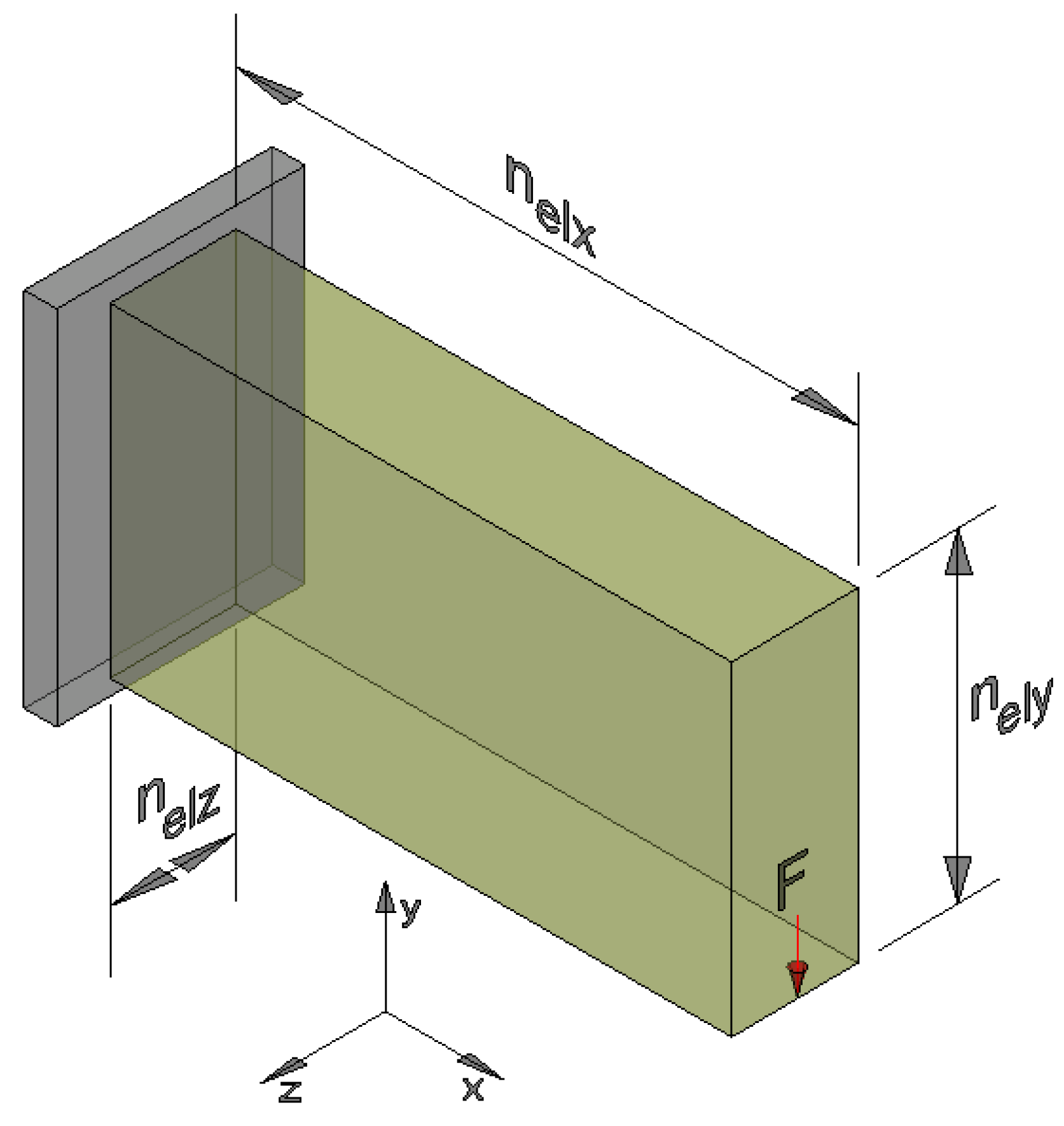
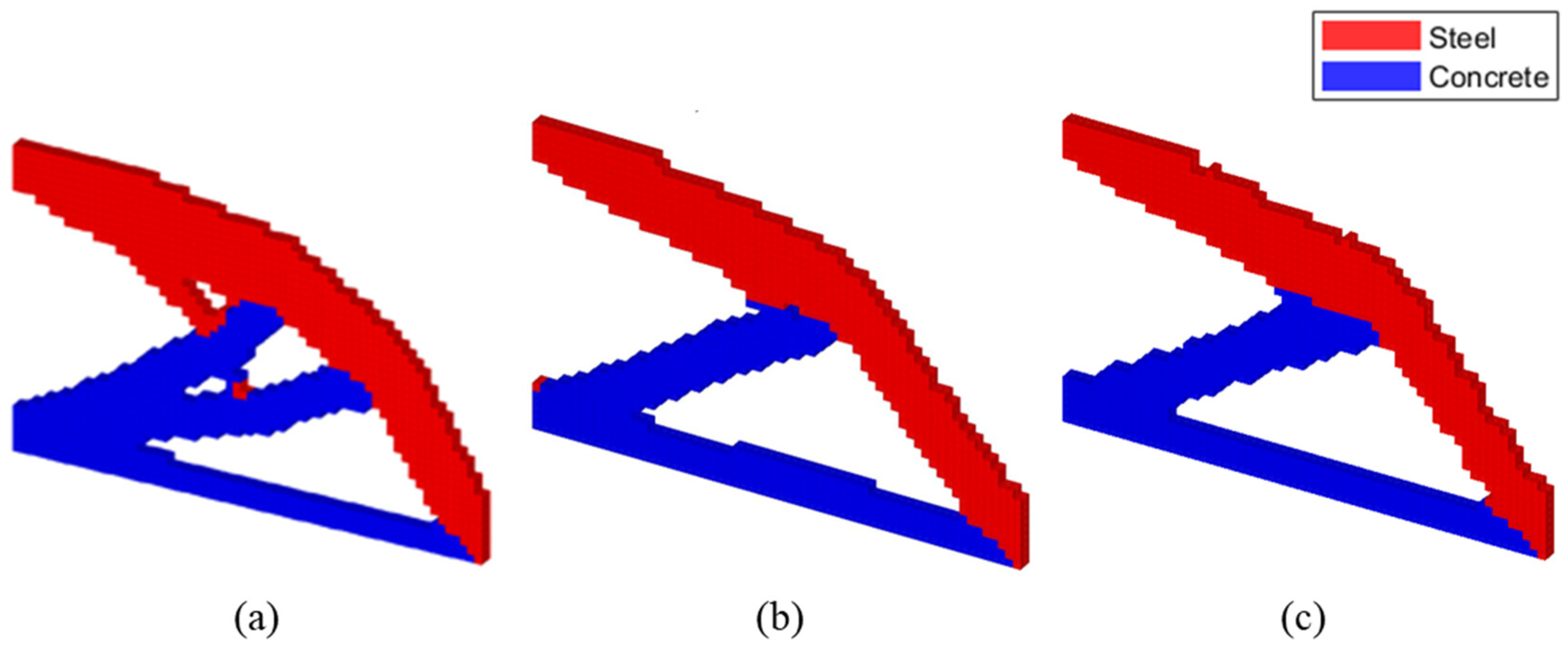
The first numerical example is a cantilever beam with a fixed support at the left end and a concentrated, vertical downward load of magnitude 100 kN applied to the lower edge of the free (right) end, as shown in Figure 4. The design domain was discretized into N e l x = 64 dm, N e l y = 40 dm, and N e l z = 2 dm.
Figure 4. Design domain and boundary conditions.
Figure 5 shows the optimal settings for the procedures: (a) deterministic (DTO), (b) with reliability analysis ( σ V M ( D T O ) m a x ) and (c) with reliability analysis ( σ V M ( F O R M ) m a x ), considering the optimization parameters given by volume fraction, cost and minimum radius use are V f r a c . = 0.48 , C f r a c . = 0.383 and R m i n . = 2.5 .
Figure 5. Optimal configurations: (a) SESO-DTO, (b) SESO-FORM ( σ V M ( D T O ) m a x ) and (c) SESO-FORM ( σ V M ( F O R M ) m a x ).
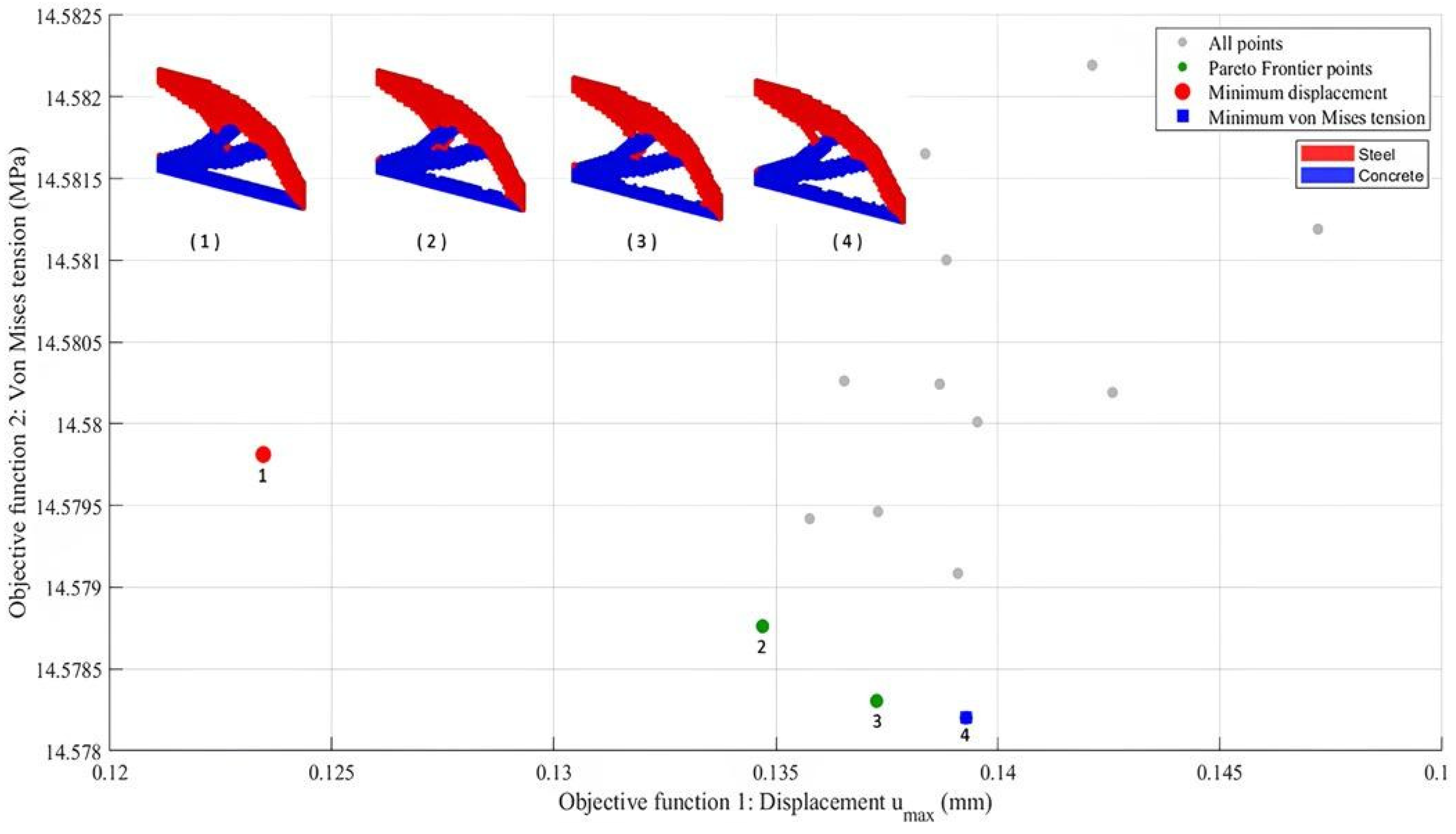
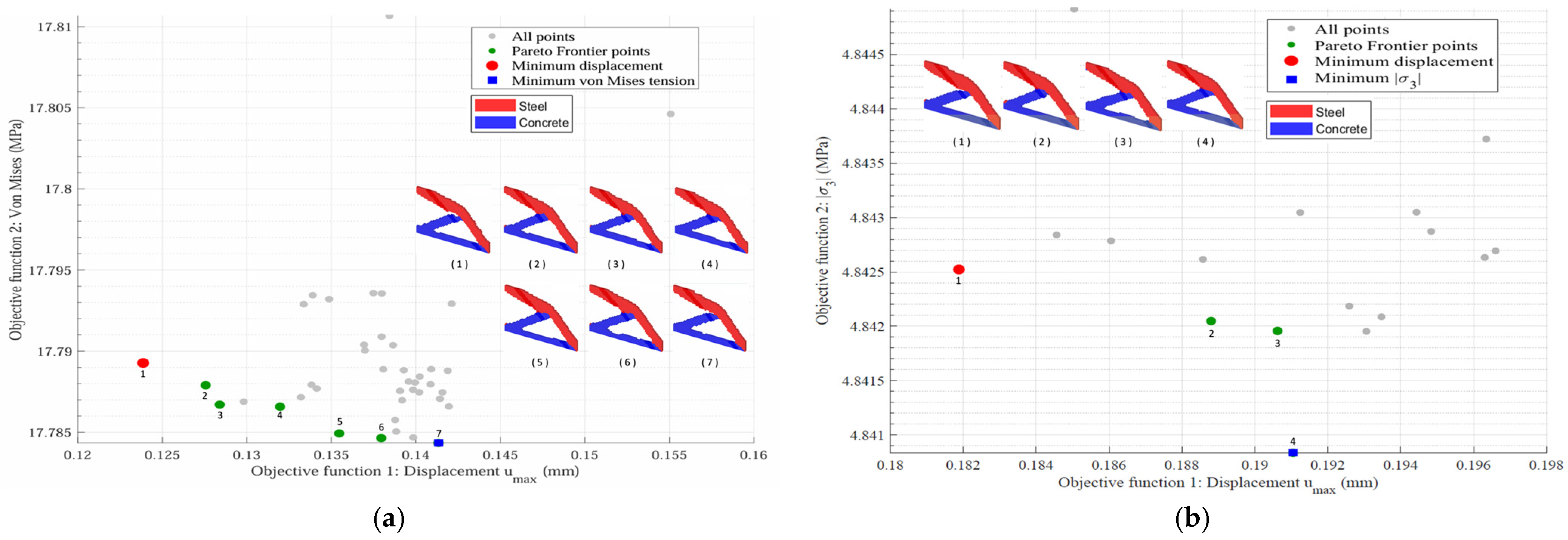
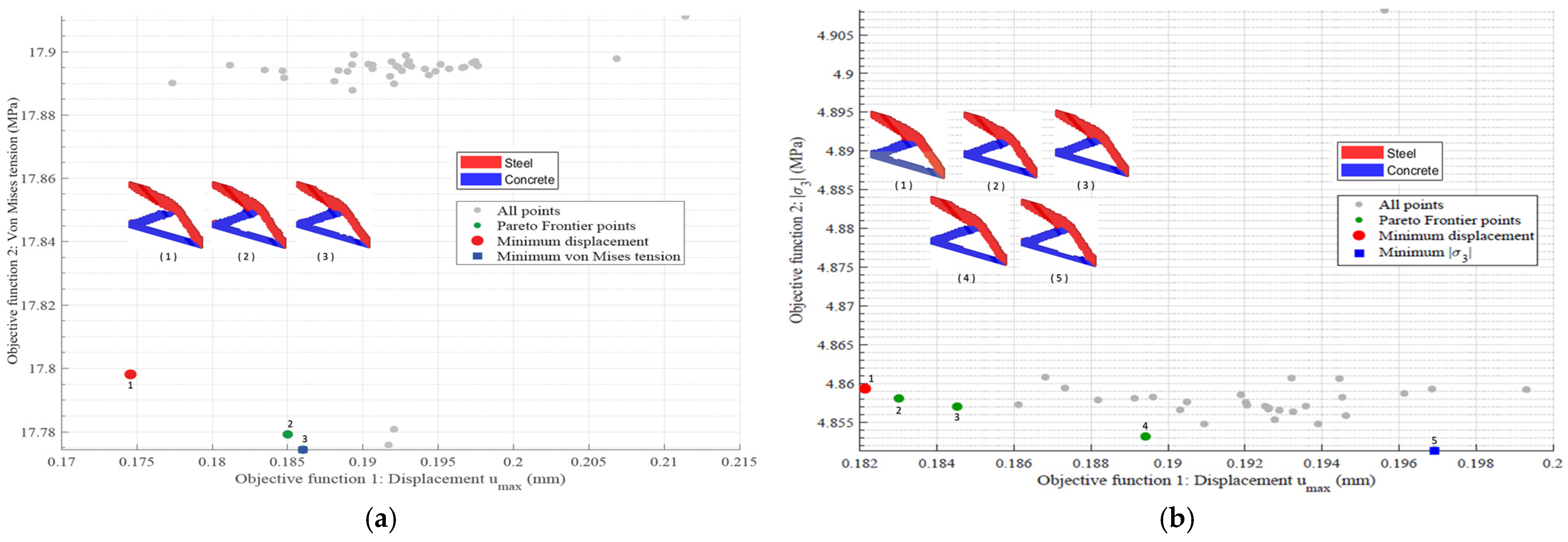
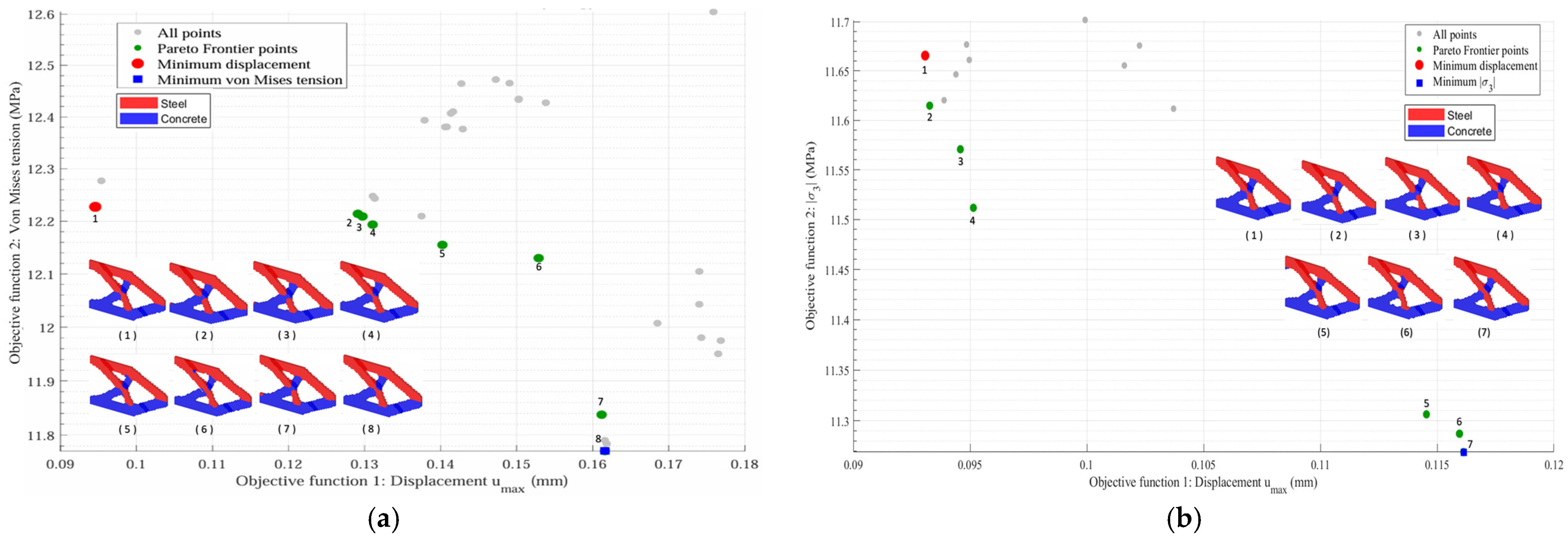
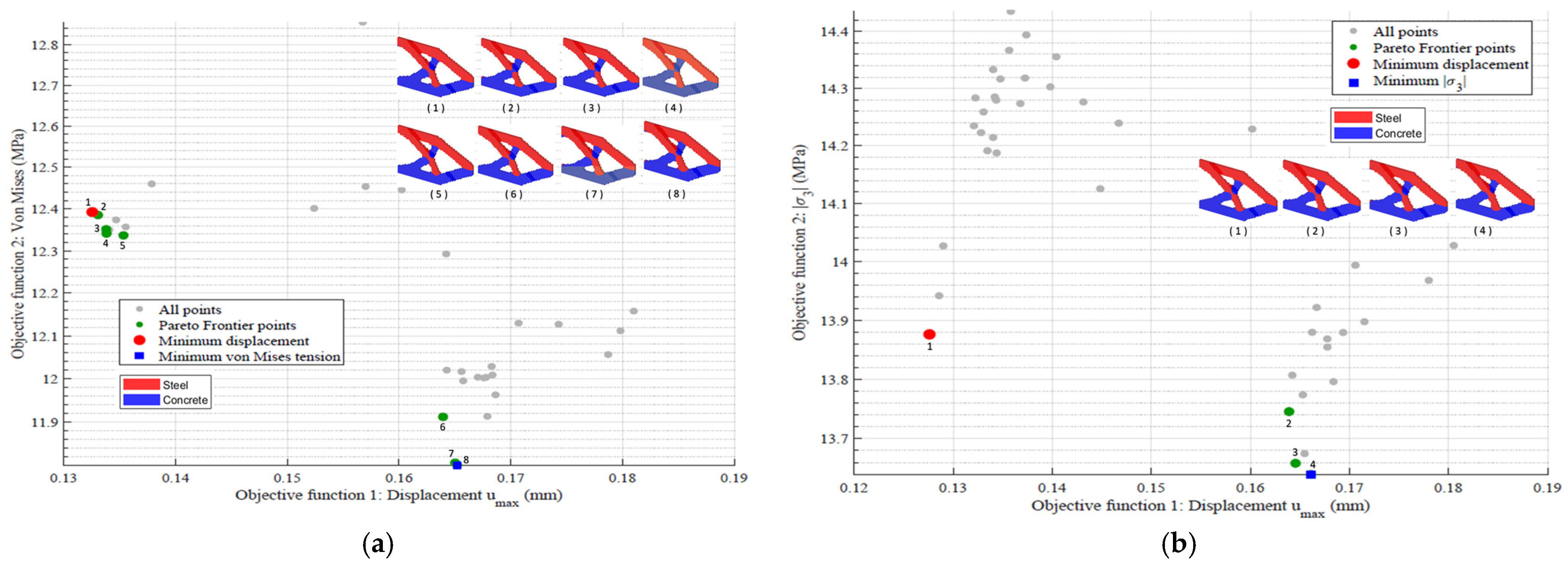
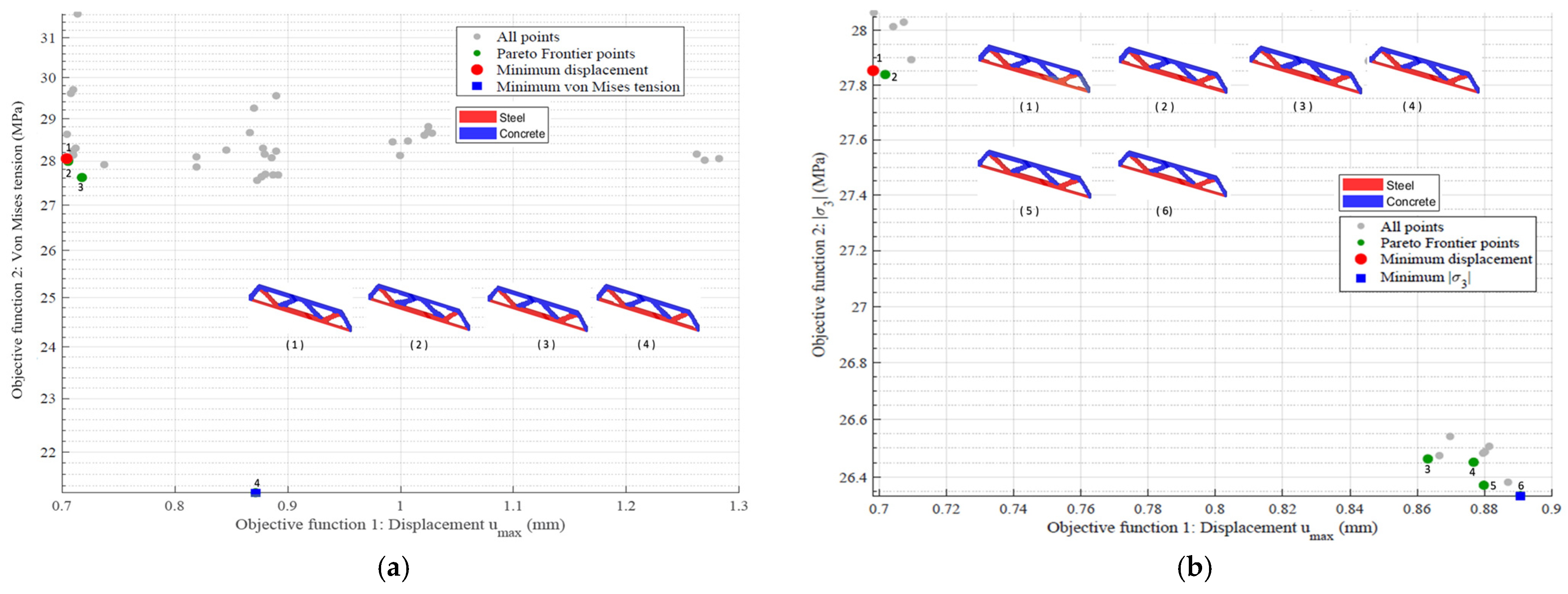
Figure 6, Figure 7 and Figure 8 present graphical representations of the Pareto frontier, relating the objective functions maximum displacement with equivalent von Mises stress or minimum principal stress, as well as the optimal topologies associated with each point of the frontier, obtained, respectively, through the deterministic approach (DTO), reliability-based optimization ( σ V M ( D T O ) m a x ,   σ 3 ( D T O ) m a x ), and reliability-based optimization ( σ V M ( F O R M ) m a x ,   σ 3 ( F O R M ) m a x ). It can be observed that the solutions obtained via FORM generally present a smaller structural volume when compared to the corresponding deterministic solutions.
Figure 6. Pareto frontier: optimal SESO-DTO.
Figure 7. Pareto frontier-optimal SESO-FORM: (a) ( σ V M ( D T O ) m a x ) and (b) ( σ 3 ( D T O ) m a x ).
Figure 8. Pareto frontier-optimal SESO-FORM: (a) ( σ V M ( F O R M ) m a x ) and (b) ( σ 3 ( F O R M ) m a x ).
Table 3, Table 4 and Table 5 present a summary of the objective function values and the weighting factors w 1 (maximum displacement) and w 2 (von Mises equivalent stress or minimum principal stress) used in the composition of the optimal solutions for the cantilever structure, obtained, respectively, by the deterministic (DTO), reliability-based ( σ V M ( D T O ) m a x ), and reliability-based ( σ V M ( F O R M ) m a x ) approaches. In general, it is observed that the solutions obtained via DTO present lower von Mises stress and maximum displacement values when compared to the corresponding solutions obtained by FORM. While in the deterministic case the stresses remain practically constant around 14.580 MPa, with displacements varying between approximately 0.1234 mm and 0.1393 mm, the FORM model results in higher stresses, close to 17.7744 MPa and 17.7981 MPa, and maximum displacements between 0.123 mm and 0.141 mm, and 0.174 mm to 0.186 mm, considering ( σ V M ( D T O ) m a x ) and ( σ V M ( F O R M ) m a x ), respectively.
Table 3. Objective function values and weighting factors—(DTO).
Table 4. Objective function values and weighting factors: ottom-loaded cantilever beam ( σ V M ( D T O ) m a x ) and ( σ 3 ( D T O ) m a x ).
Table 5. Objective function values and weighting factors: bottom-loaded cantilever beam ( σ V M ( F O R M ) m a x ) and ( σ 3 ( F O R M ) m a x ).
This behavior was expected, since the RBTO approach explicitly incorporates the uncertainties associated with the problem, leading to more conservative solutions from the point of view of structural response. Conversely, as discussed earlier, solutions with reliability tend to have a smaller structural volume, highlighting a distinct trade-off between mechanical performance and reliability. Thus, from the strictly deterministic perspective of the objective function values (stress and displacement), the DTO model presents better structural performance. However, from the point of view of robustness and the consideration of uncertainties, models with reliability prove to be more suitable, offering structurally more efficient solutions in terms of volume, but with more conservative mechanical responses.
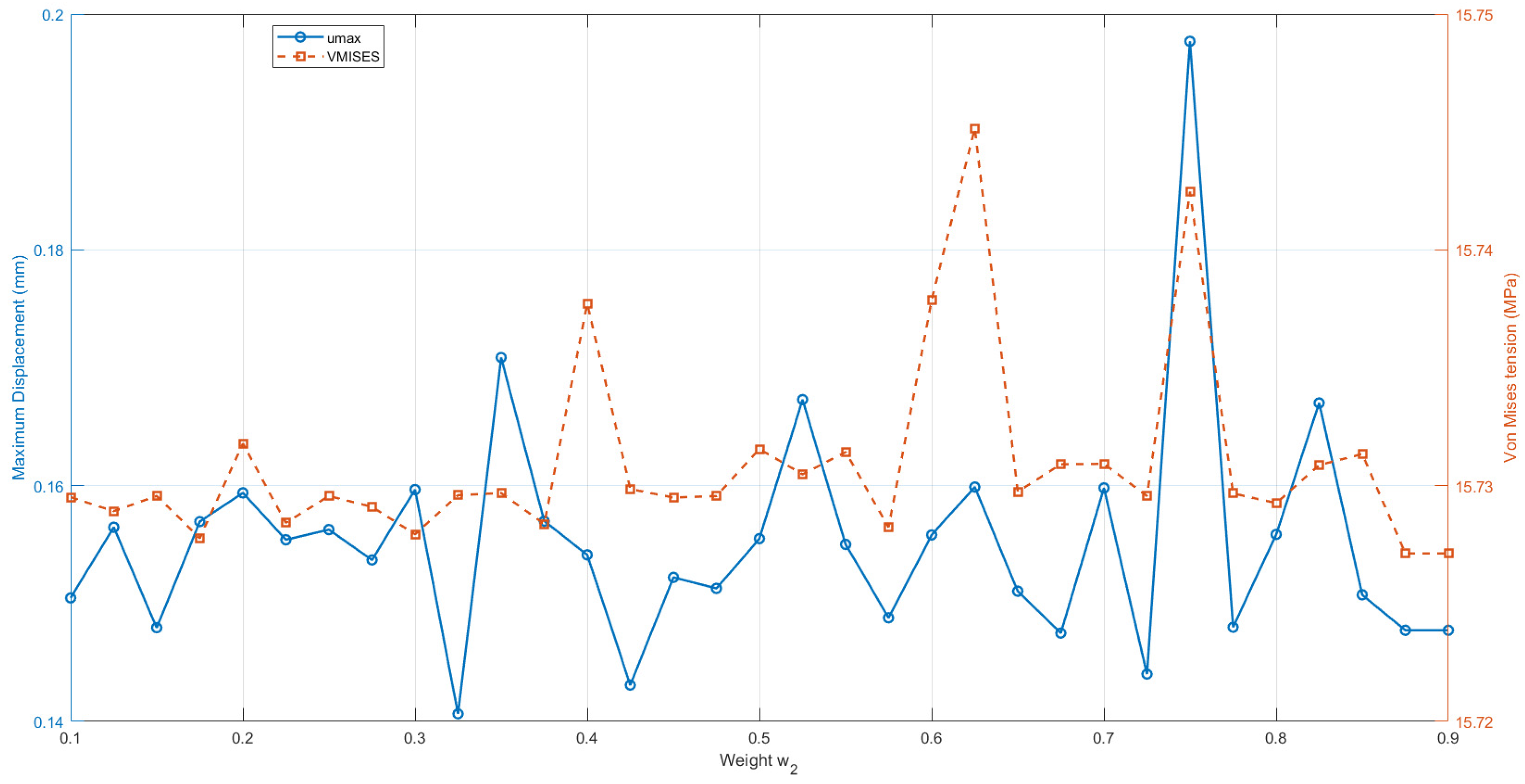
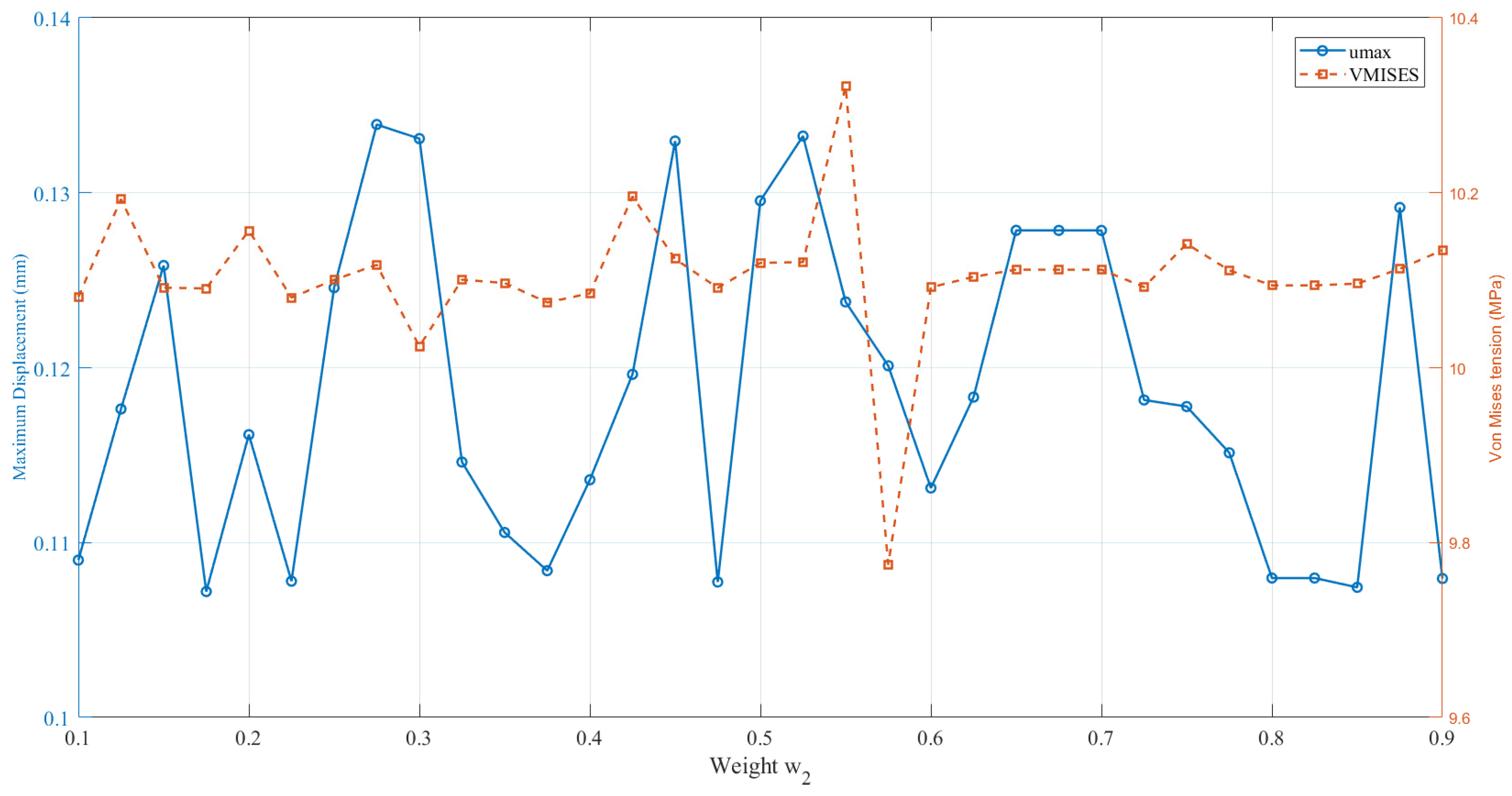
Figure 9 shows the variation in the maximum displacement ( u m a x ) and the equivalent von Mises stress ( σ V M I S E S ) as a function of the weight w 2 , associated with the displacement objective, for the cantilever in deterministic mode. It can be observed that, for reduced values of w 2 , the structure tends to exhibit smaller maximum displacements, but accompanied by relatively higher levels of von Mises stress. As w 2 increases, assigning greater importance to minimizing displacement in the optimization process, a gradual reduction in σ V M I S E S is observed, while u m a x assumes higher values. This behavior highlights a clear conflict between the structural objectives, since the reduction of displacement occurs at the cost of increased stresses, and vice versa, making it impossible to identify a value of w 2 that simultaneously minimizes both responses in the deterministic context.
Figure 9. Bottom-loaded cantilever beam. Variation in displacement and von Mises stress as a function of weight w 2 : DTO.
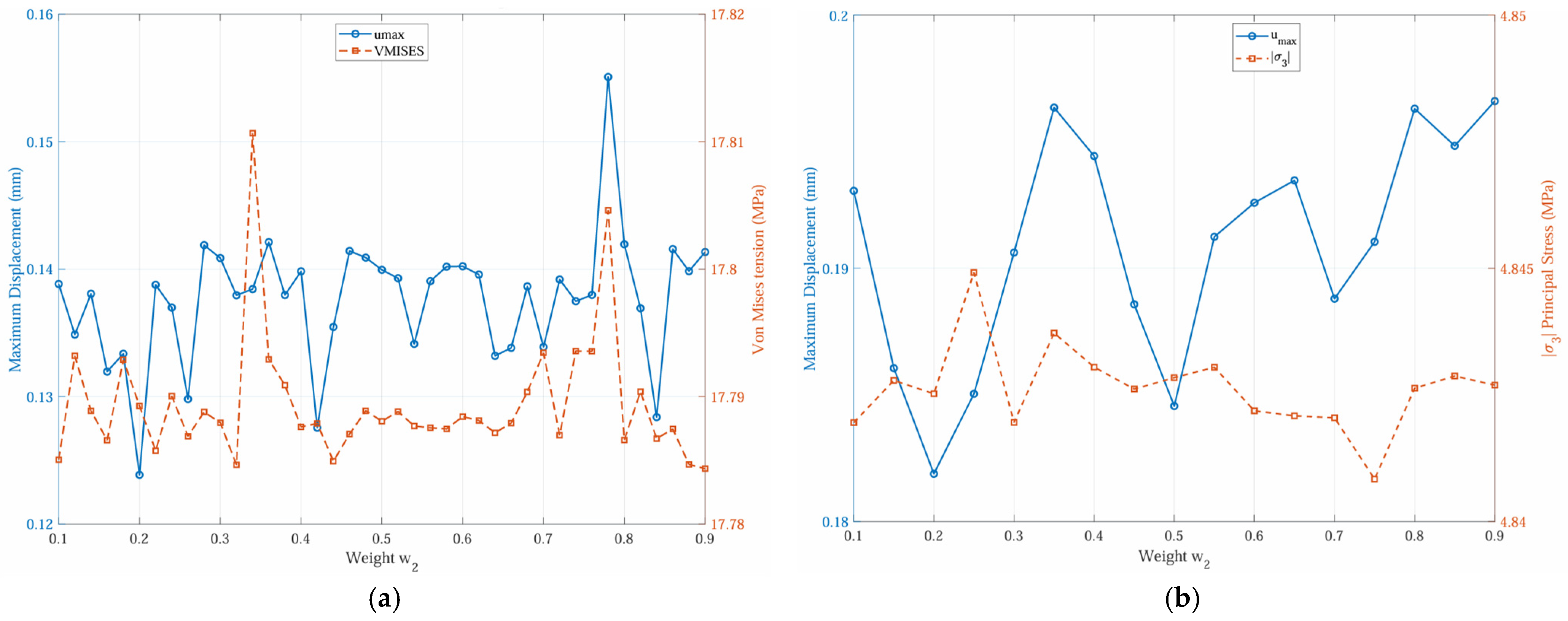
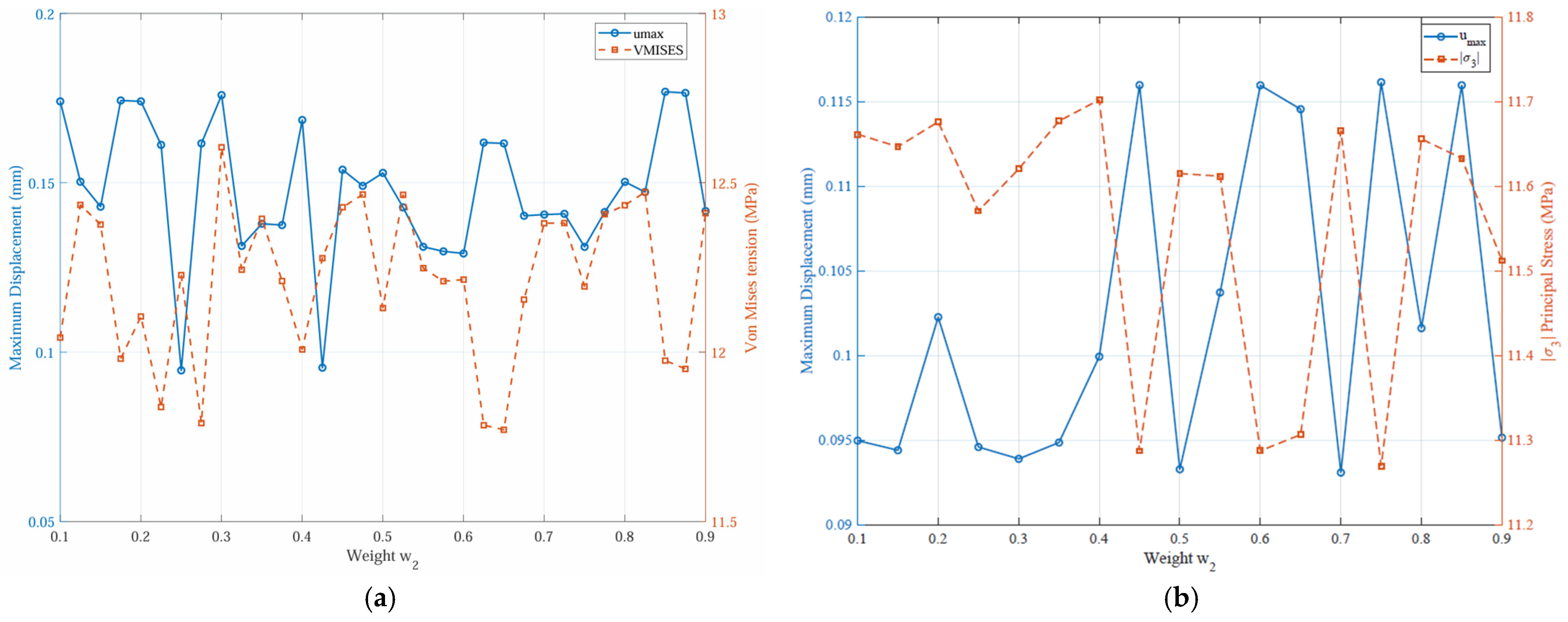
Figure 10 presents the results obtained for the case with reliability, considering the maximum von Mises stress fixed or minimum principal stress and equal to that from the deterministic model, ( σ V M ( D T O ) m a x ,   σ 3 ( D T O ) m a x ). It is noted that the introduction of reliability analysis modifies the sensitivity of the structural responses in relation to the weight w 2 , but preserves the general tendency for conflict between displacement and stress. For smaller values of w 2 , solutions with lower u m a x predominate, associated with higher levels of ( σ V M I S E S ,   σ 3 ), while an increase in w 2 leads to a reduction in stresses, accompanied by an increase in the maximum displacement. This behavior indicates that, even under reliability constraints, the improvement of one structural criterion necessarily implies the deterioration of the other, reinforcing the multi-objective nature of the problem.
Figure 10. Bottom-loaded cantilever beam. Variation in displacement and von Mises tension or minimum principal stress as a function of weight w 2 : SESO-FORM: (a) σ V M ( D T O ) m a x and (b) ( σ 3 ( D T O ) m a x ).
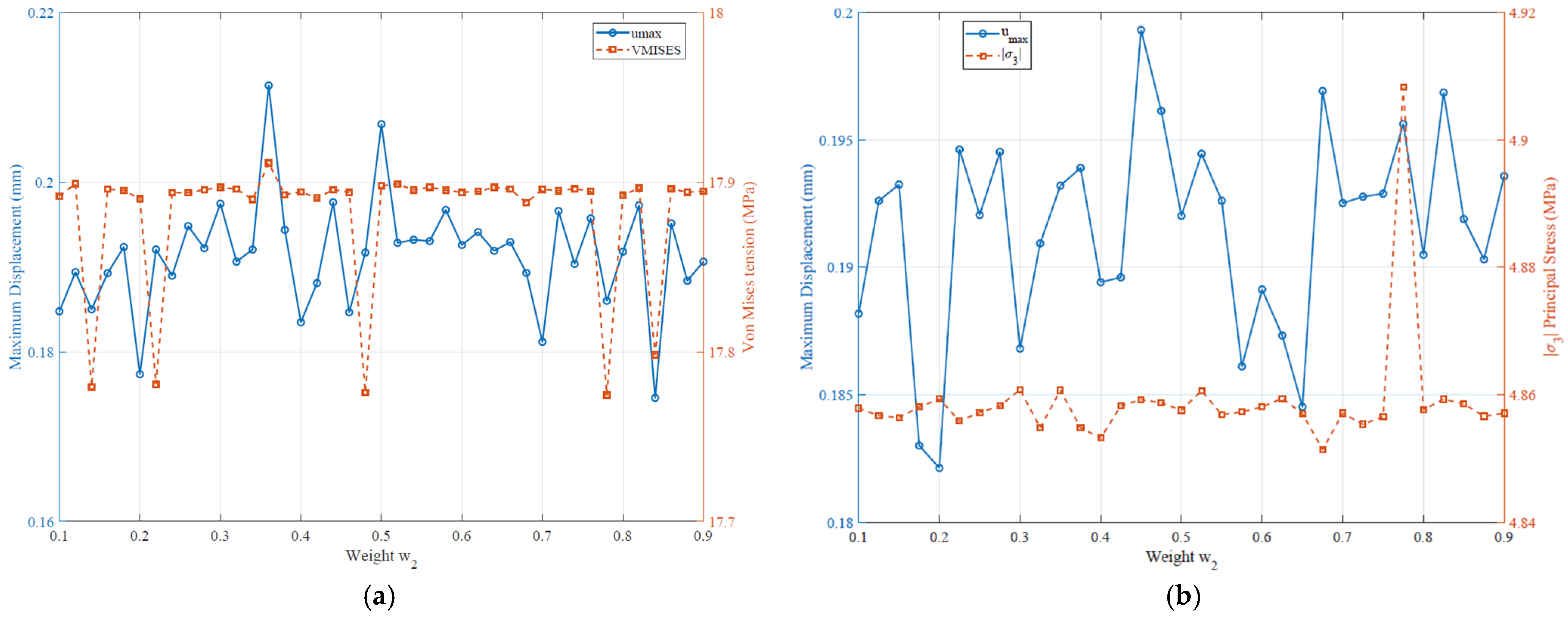
Figure 11 illustrates the variation of u m a x and ( σ V M I S E S ,   σ 3 ) considering the maximum von Mises stress or minimum principal stress updated iteratively through the FORM procedure, ( σ V M F O R M m a x ,   σ 3 F O R M m a x ). It can be observed that the evolution of the responses is more pronounced, reflecting the combined effects of the redistribution of stresses resulting from topological modifications and the probabilistic update of the maximum stress. Even so, the characteristic tendency of conflict between the objectives remains: lower values of w 2 lead to stiffer structures with smaller displacements, but subjected to higher stresses, while higher values of w 2 result in stress relief at the cost of greater displacements. The lack of a solution that simultaneously minimizes u m a x and σ V M I S E S unequivocally confirms the antagonism between the criteria and justifies the adoption of the Pareto frontier as an appropriate tool to identify compromise solutions in the context of reliable topological optimization.
Figure 11. Bottom-loaded cantilever beam. Variation in displacement and von Mises tension as a function of weight w 2 , SESO-FORM: (a) σ V M ( F O R M ) m a x and (b) ( σ 3 ( F O R M ) m a x ).
This trend clearly characterizes a conflict between the objectives of maximum displacement and von Mises stress or minimum principal stress, since there is no value of w 2 capable of simultaneously minimizing both structural responses. Each point on the graph, therefore, represents a compromise solution, in which a reduction in displacement generally implies an increase in stress, or vice versa. Thus, the observed behavior confirms the multi-objective nature of the problem analyzed and justifies the use of the Pareto frontier as a suitable tool to identify optimal compromise solutions between the structural performance criteria considered.
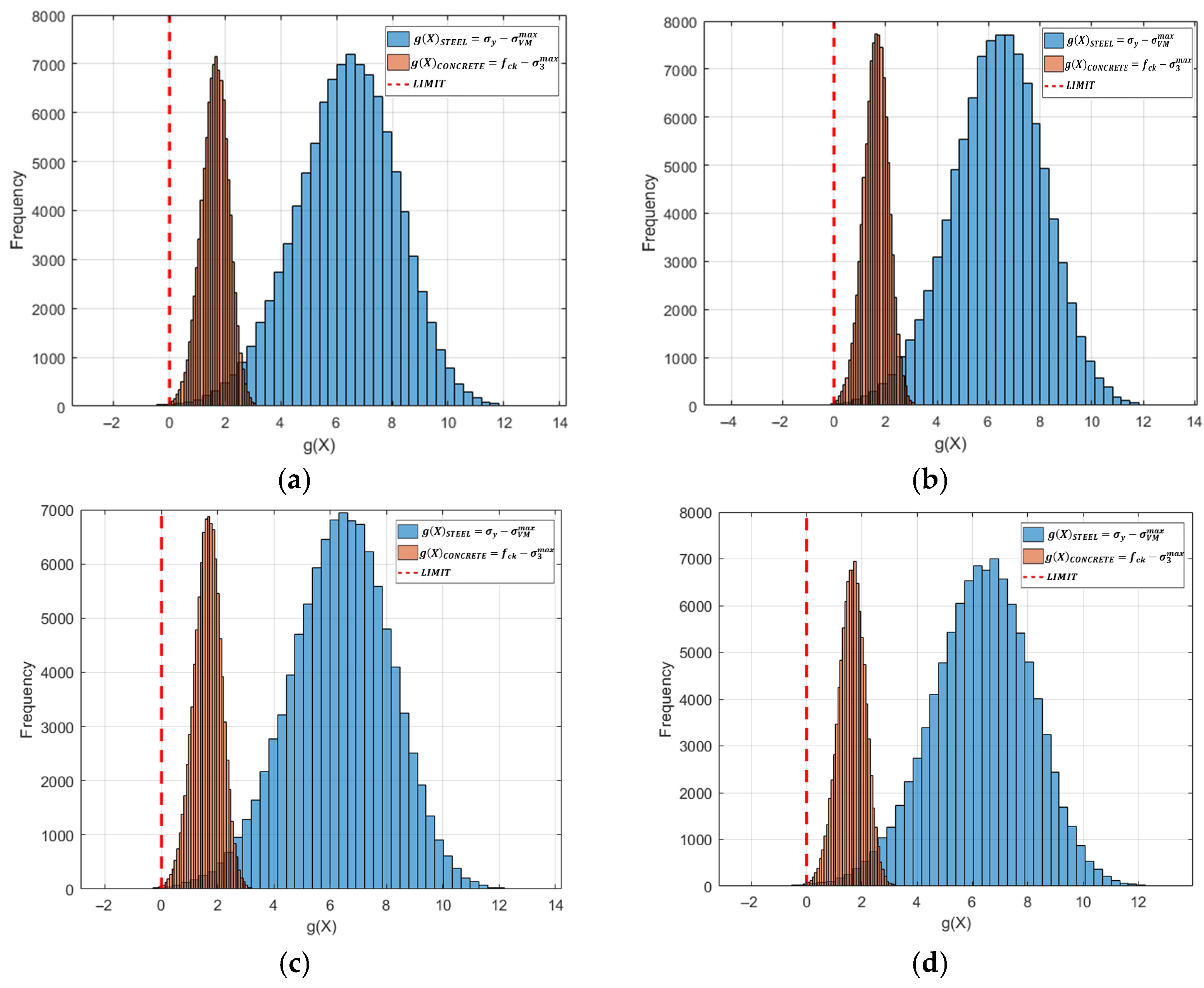
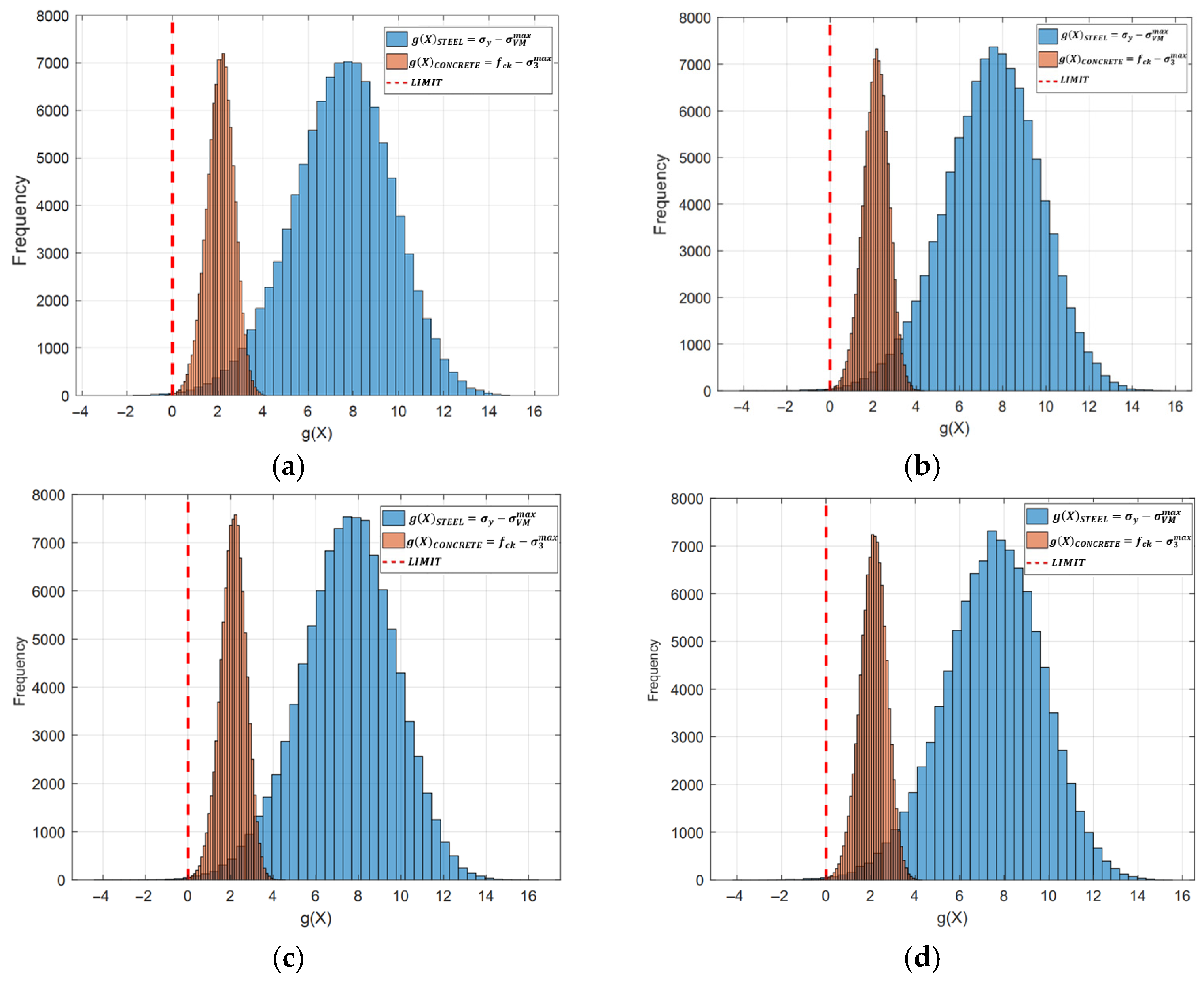
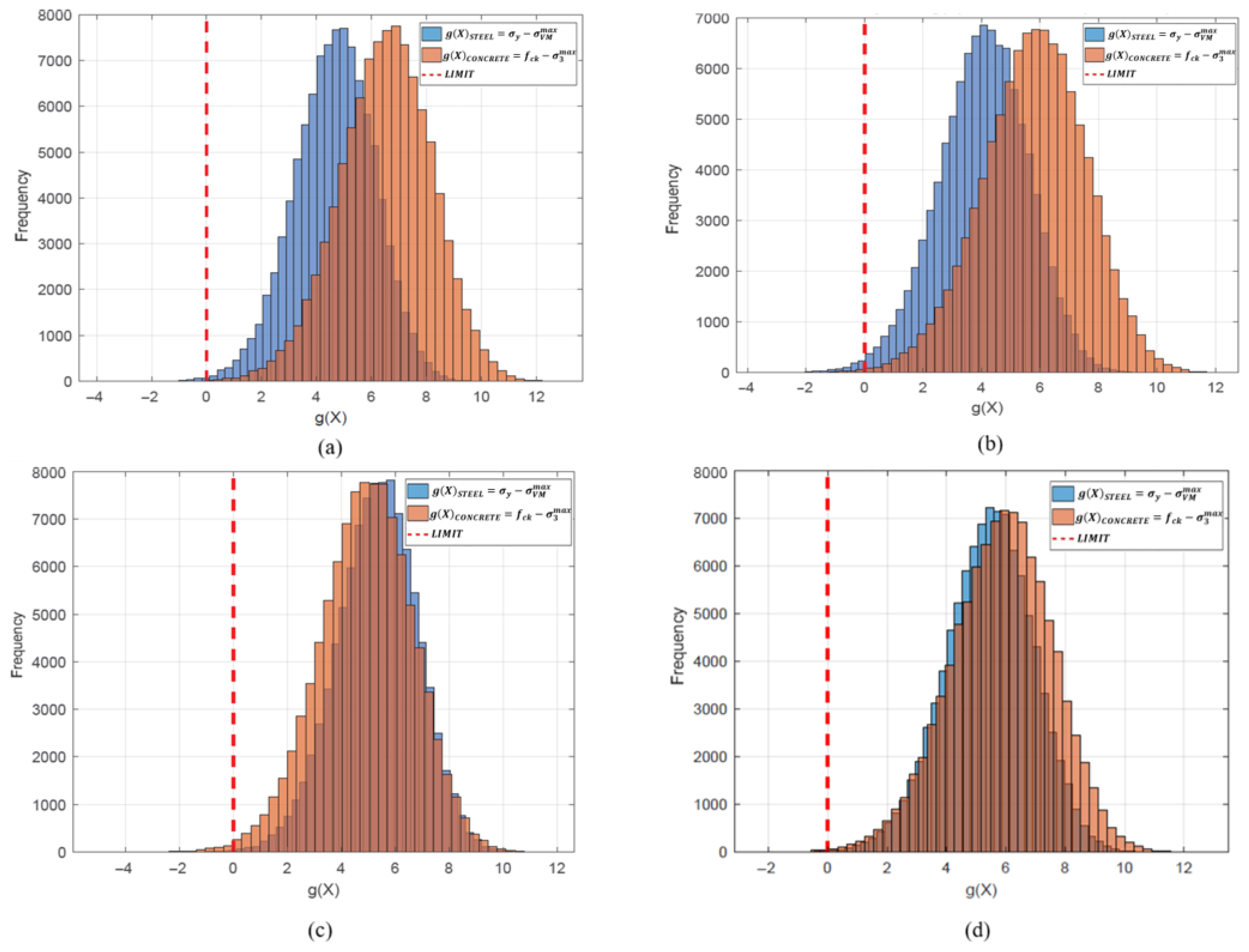
Figure 12 and Figure 13 show the histograms obtained from the Monte Carlo simulation, implemented to validate the adopted limit state functions, as well as the target reliability index β = 3.0. It can be observed that the FORM method achieved adequate convergence, as the reliability index β estimated via Monte Carlo simulation, considering 100,000 samples and a σ y = 21 MPa and σ y = 25.5 MPa, for the minimum displacement point, resulted in values of β = 3.18 and β = 3.19, for the optimization with reliability ( σ V M ( D T O ) m a x ) and ( σ V M ( F O R M ) m a x ), respectively, and the other points were above the target reliability.
Figure 12. Monte Carlo simulation histogram of the bottom-loaded cantilever beam. SESO-FORM ( σ V M ( D T O ) m a x ): (a) Von Mises minimum stress point ( w 2 =   0.900) and (b) minimum displacement point ( w 2 =   0.200); (c) σ 3 minimum stress point ( w 2 =   0.750) and (d) minimum displacement point ( w 2 =   0.200).
Figure 13. Monte Carlo simulation histogram of the bottom-loaded cantilever beam. SESO-FORM ( σ V M ( F O R M ) m a x ): (a) Von Mises minimum stress point ( w 2 =   0.780) and (b) minimum displacement point ( w 2 =   0.840); (c) σ 3 minimum stress point ( w 2 =   0.675) and (d) minimum displacement point ( w 2 =   0.200).

4.2. Center-Loaded Cantilever Beam

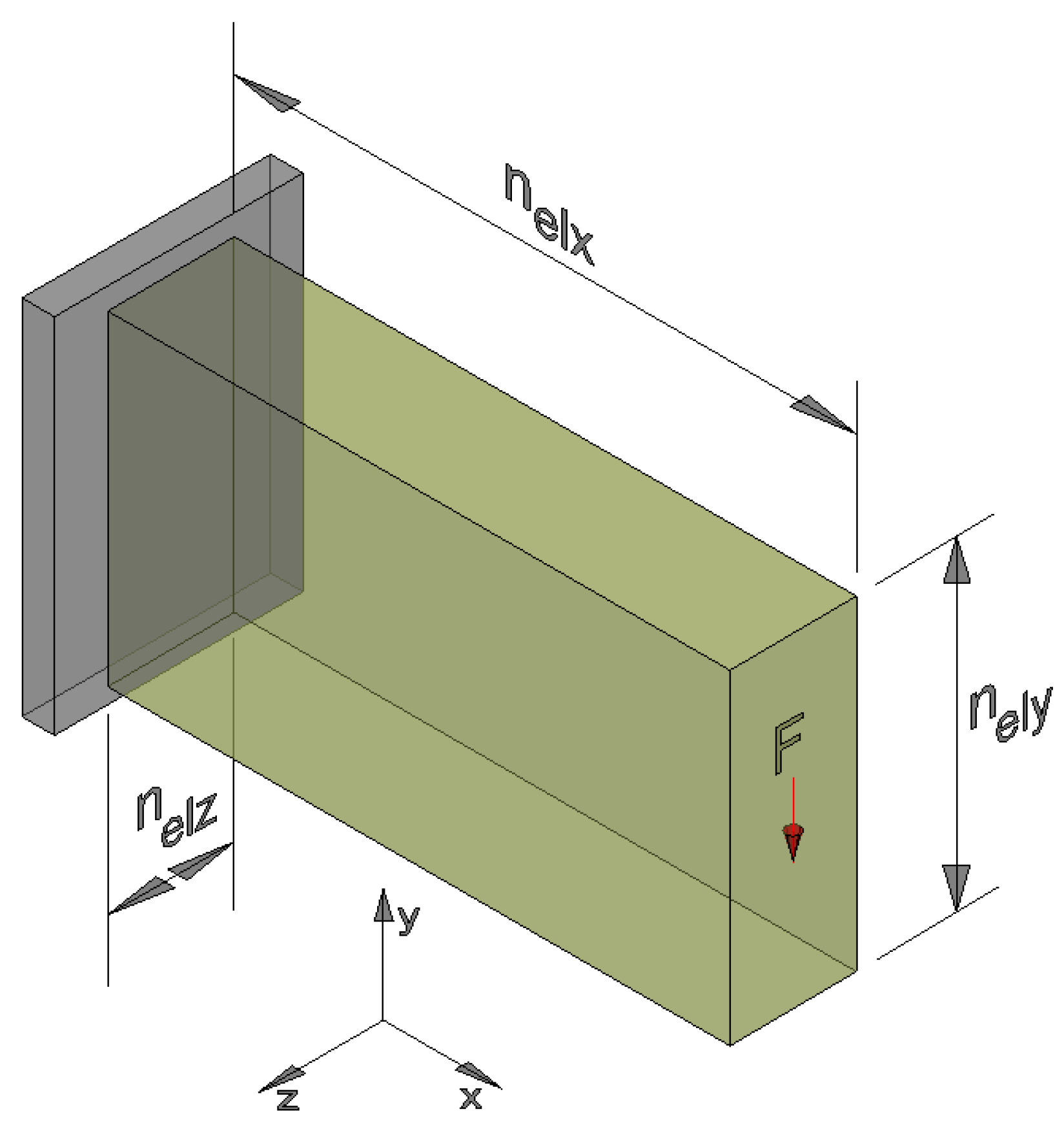
The second optimized numerical example consists of a cantilever beam, modeled with a rigid support at one end and a free end at the opposite end. The domain was discretized with dimensions of N e l x = 64   d m , N e l y = 40   d m , and N e l z = 2   d m . A concentrated load of F = 100 kN was applied, located in the central part at the free end, as shown in Figure 14. The optimization parameters were kept the same as in the previous example.
Figure 14. Design domain and boundary conditions.
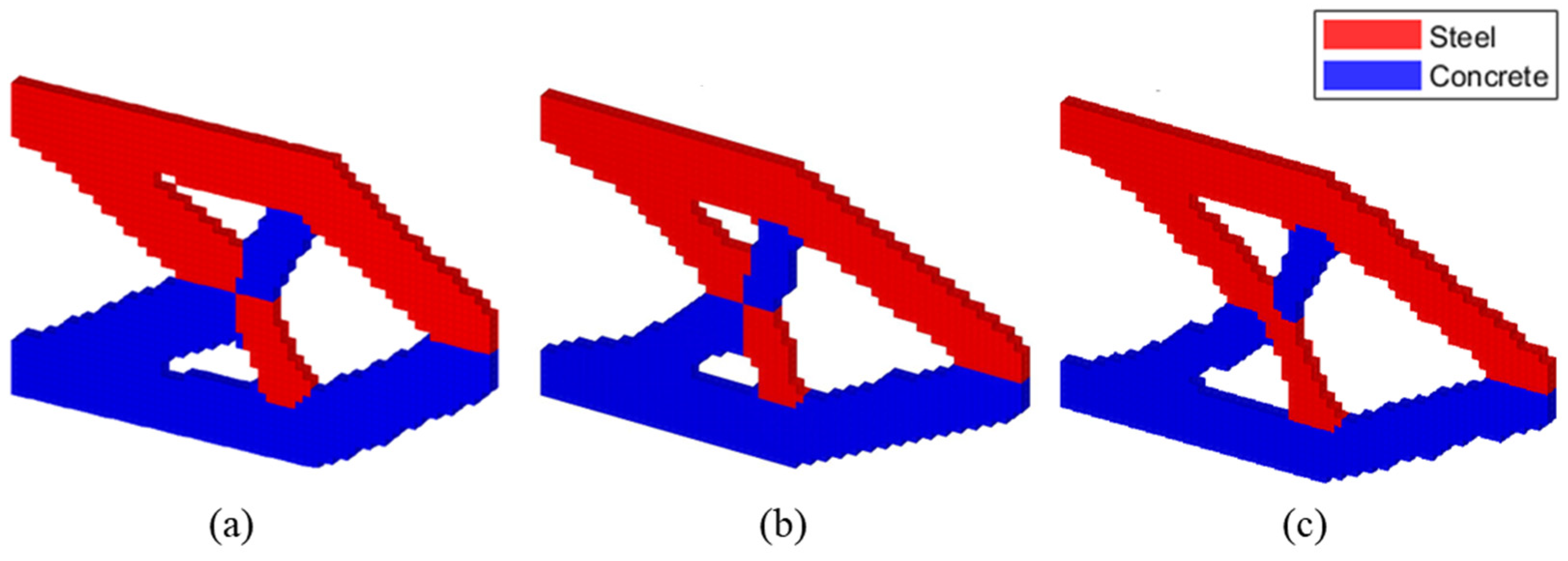
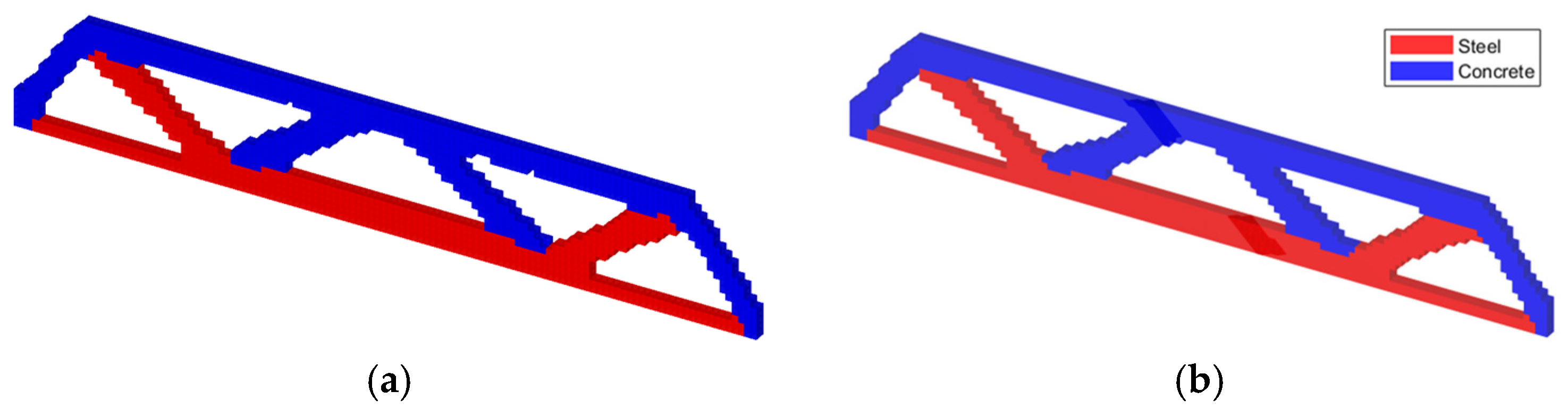
Figure 15 shows the optimal settings for the deterministic procedure (DTO), the procedure with reliability analysis ( σ V M ( D T O ) m a x ) and with reliability analysis ( σ V M F O R M m a x ).
Figure 15. Optimal settings: (a) SESO-DTO, (b) SESO-FORM ( σ V M ( D T O ) m a x ) and (c) SESO-FORM ( σ V M ( F O R M ) m a x ).
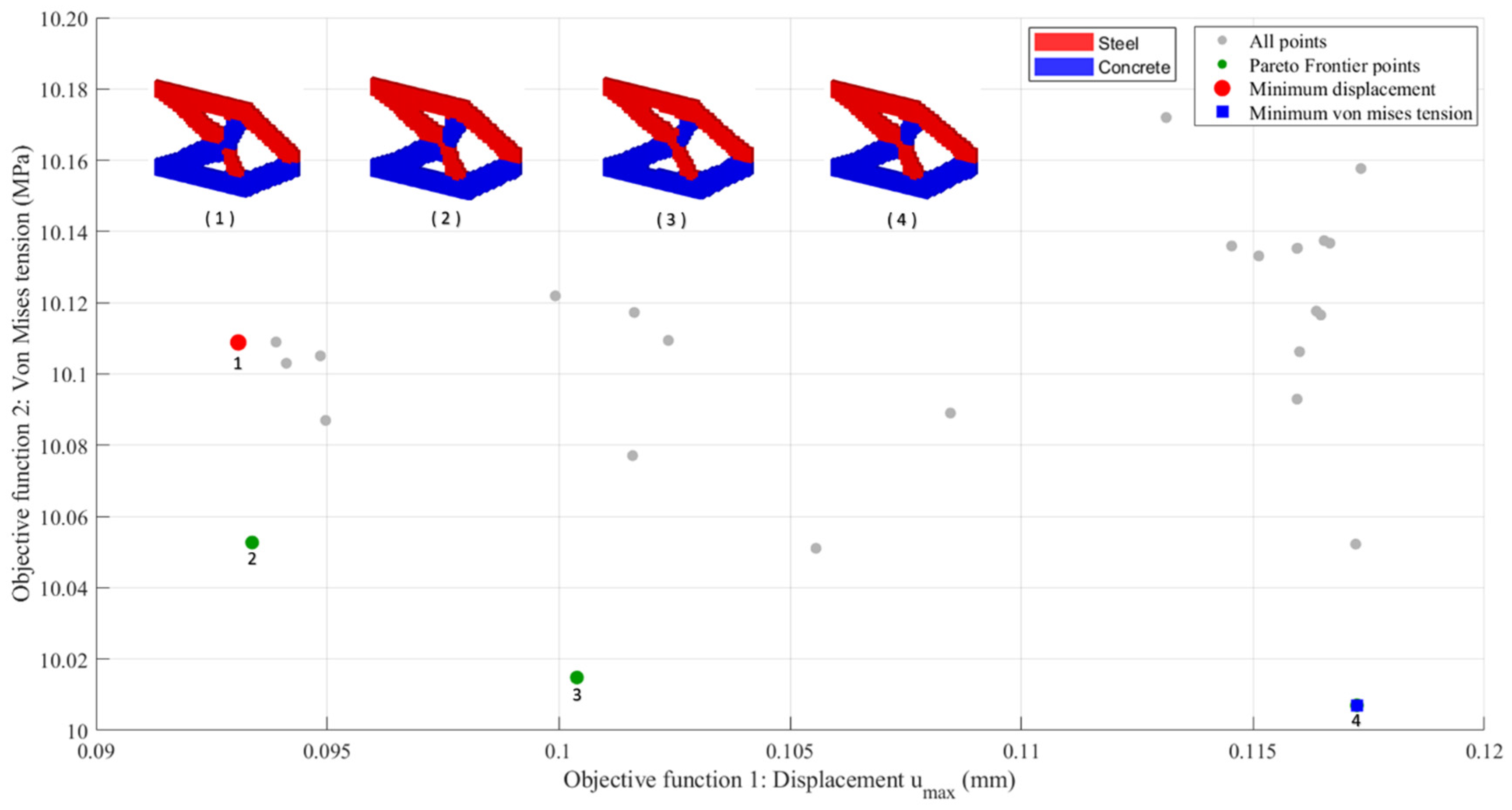
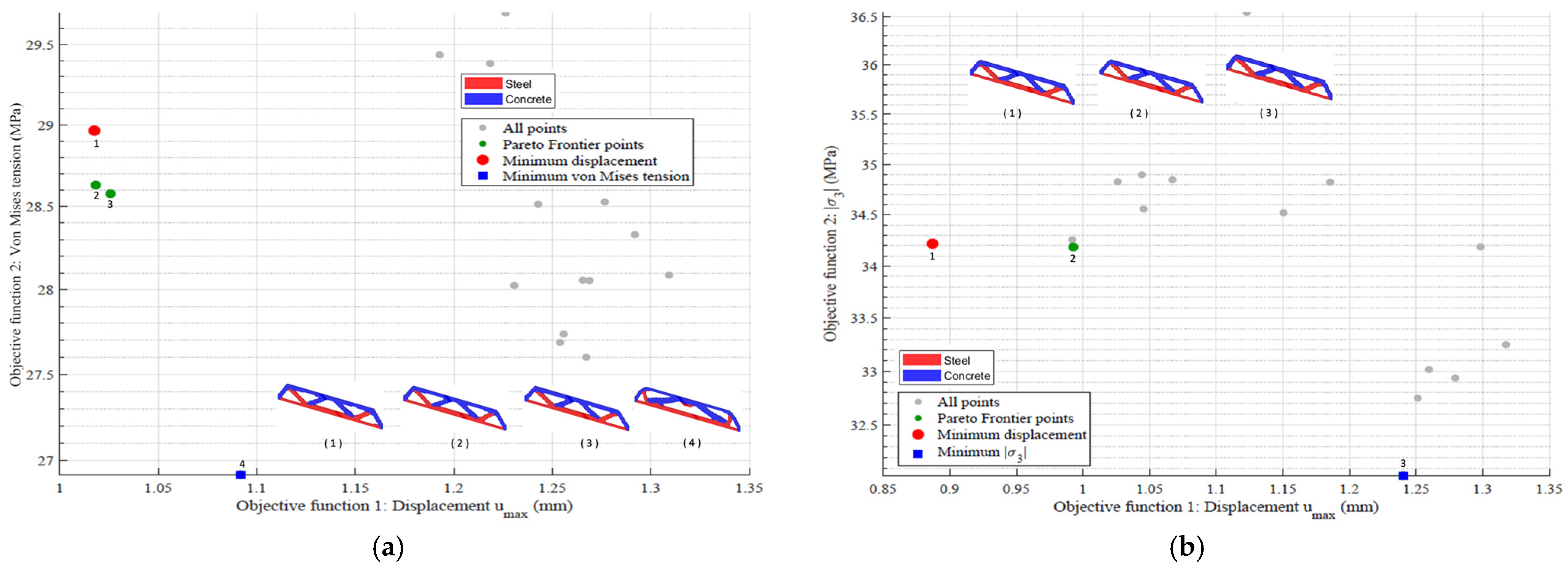
Figure 16, Figure 17 and Figure 18 show the optimal configurations from the multi-objective MMTO with two materials (steel and concrete), considering ( u m a x ) and ( σ V M I S E S m a x ,   σ 3 m a x ) as conflicting objectives. Figure 16 shows the results of the deterministic analysis (DTO), in which the Pareto frontier exclusively reflects the redistribution of materials as a function of the relative prioritization between stiffness and strength. Figure 17 illustrates the optimal configurations obtained via Reliability-Based Topological Optimization ( σ V M ( D T O ) m a x ,   σ 3 ( D T O ) m a x ), and Figure 18 shows the Reliability-Based Topological Optimization ( σ V M ( F O R M ) m a x ,   σ 3 ( F O R M ) m a x ), which explicitly incorporates the uncertainties in the problem parameters.
Figure 16. Pareto frontier: optimal SESO-DTO.
Figure 17. Pareto frontier-optimal SESO-FORM: (a) ( σ V M ( D T O ) m a x ) and (b) ( σ 3 ( D T O ) m a x ).
Figure 18. Pareto frontier-optimal SESO-FORM: (a) ( σ V M ( F O R M ) m a x ) and (b) ( σ 3 ( F O R M ) m a x ).
In this case, the solutions are evaluated not only by their structural performance but also by their robustness. A shift in the Pareto frontier toward more conservative solutions is observed. This behavior represents the additional structural cost necessary to guarantee adequate levels of reliability. This comparison between the figures highlights the influence of reliability both in the objective function space and in the final topologies obtained.
Table 6 shows that varying the weights results in an efficient compromise between stress reduction and displacement control, with von Mises stress values ranging from 10.007 MPa to 10.109 MPa and displacements from 0.0931 mm to 0.1173 mm. The solutions exhibit good structural efficiency, but reflect an idealized scenario in which system uncertainties are not considered.
Table 6. Objective function values and weighting factors: center-loaded cantilever beam (DTO).
On the other hand, Table 7 shows a systematic increase in the values of the objective functions, with stresses between 11.7705 MPa and 12.2272 MPa and displacements between 0.094 mm and 0.162 mm, and Table 8 shows stresses between 11.8013 MPa and 12.3925 MPa and displacements between 0.132 mm and 0.165 mm. This behavior indicates more conservative solutions, a direct result of incorporating uncertainties and the requirement for adequate levels of structural reliability. A lower sensitivity of displacements to weight variations is also noted, suggesting a stabilization of the structural response under probabilistic criteria.
Table 7. Objective function values and weighting factors: center-loaded cantilever beam ( σ V M ( D T O ) m a x ) and ( σ 3 ( D T O ) m a x ).
Table 8. Objective function values and weighting factors: center-loaded cantilever beam ( σ V M ( F O R M ) m a x ) and ( σ 3 ( F O R M ) m a x ).
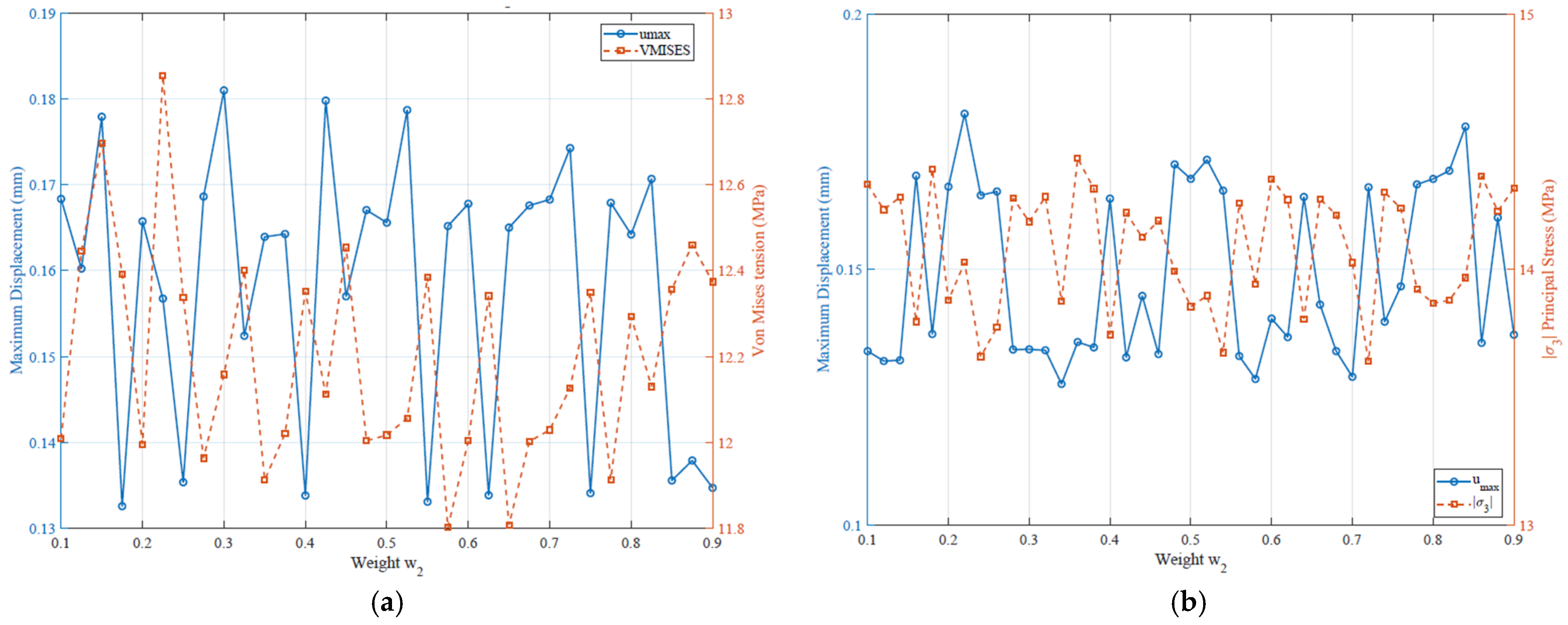
The graphs shown in Figure 19, Figure 20 and Figure 21 highlight the trade-off between displacement and von Mises stress or minimum principal stress as a function of weight w 2 . When this weight increases, prioritizing maximum displacement, a reduction in or stabilization of the maximum displacement ( u m a x ) is observed, while the von Mises stress or minimum principal stress tends to increase or lose efficiency, and vice versa. This opposing behavior between the structural responses indicates that the improvement of one criterion generally occurs at the expense of the degradation of the other. The non-monotonic oscillations reinforce that there is no solution that simultaneously minimizes both functions, characterizing a typical trade-off in multi-objective problems. Therefore, the results confirm that maximum displacement and von Mises stress or minimum principal stress are conflicting objectives for the problem analyzed.
Figure 19. Center-loaded cantilever beam. Variation in displacement and von Mises stress as a function of weight w 2 : DTO.
Figure 20. Center-loaded cantilever beam. Variation in displacement and von Mises stress as a function of weight w 2 , SESO-FORM: (a) ( σ V M ( D T O ) m a x ) and (b) ( σ 3 ( D T O ) m a x ).
Figure 21. Center-loaded cantilever beam. Variation in displacement and von Mises stress as a function of weight w 2 , SESO-FORM: (a) ( σ V M ( F O R M ) m a x ) and (b) ( σ 3 ( F O R M ) m a x ).
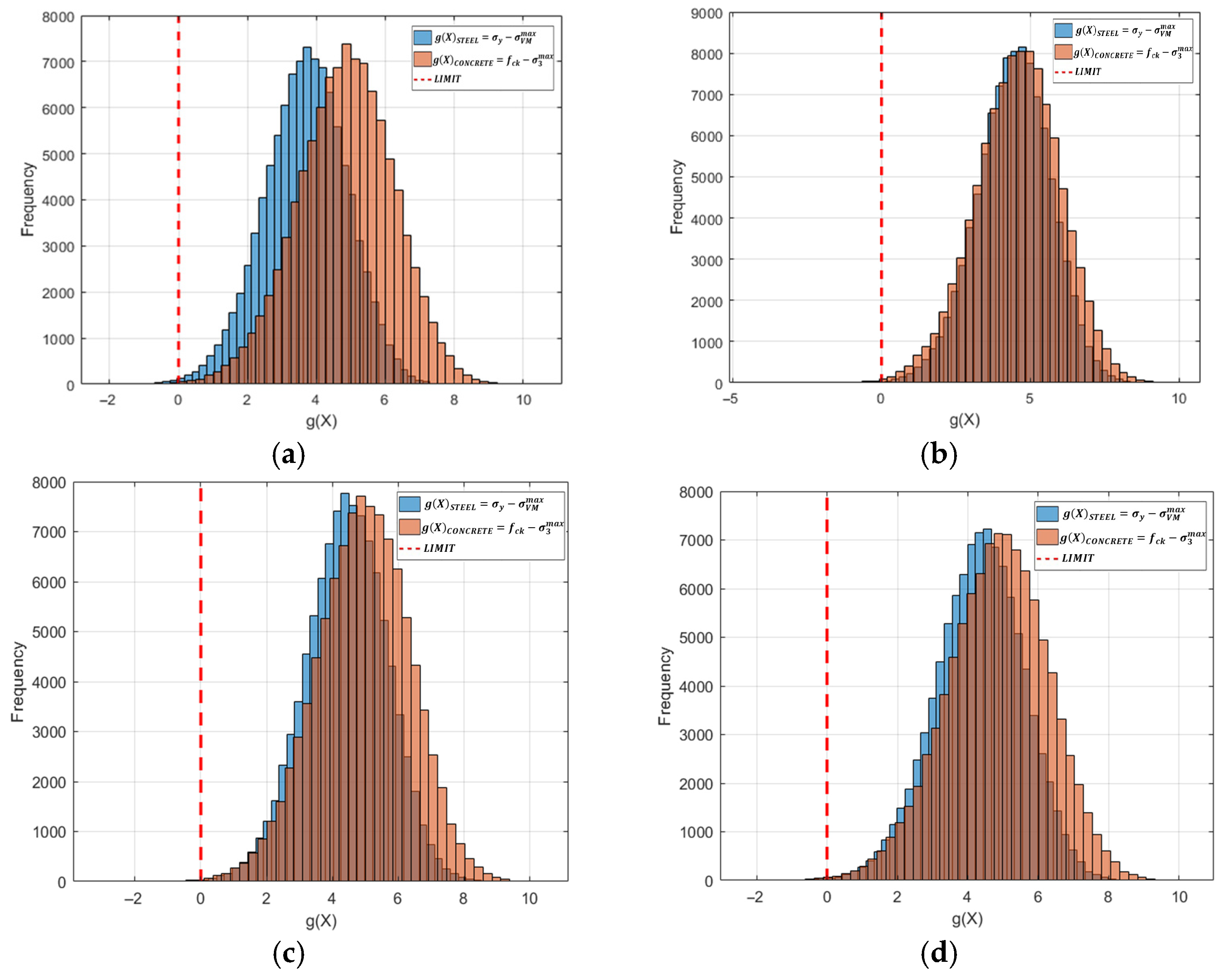
Figure 22 and Figure 23 show the histograms obtained from the Monte Carlo simulation, implemented to validate the adopted limit state functions, as well as the target reliability index β = 3.0. It can be observed that the FORM method employed showed adequate convergence in terms of reliability, since the β index estimated through the Monte Carlo simulation, considering 100,000 samples and a σ y = 14.5 MPa and σ y = 17.0 MPa, for the minimum displacement point, resulted in β = 2.98 and β = 2.92, for the optimization with reliability ( σ V M ( D T O ) m a x ) and ( σ V M ( F O R M ) m a x ), respectively, and the other points were above the target reliability.
Figure 22. Monte Carlo simulation histogram of the center-loaded cantilever beam. SESO-FORM ( σ V M ( D T O ) m a x ): (a) Von Mises minimum stress point ( w 2 = 0.650 ) and (b) minimum displacement point ( w 2 = 0.250 ); (c) σ 3 minimum stress point ( w 2 =   0.750) and (d) minimum displacement point ( w 2 =   0.700).
Figure 23. Monte Carlo simulation histogram of the center-loaded cantilever beam. SESO-FORM ( σ V M ( F O R M ) m a x ): (a) Von Mises minimum stress point ( w 2 = 0.575 ) and (b) minimum displacement point ( w 2 = 0.175 ); (c) σ 3 minimum stress point ( w 2 =   0.720) and (d) minimum displacement point ( w 2 =   0.340).

4.3. MBB Beam

With the aim of expanding the applicability of the proposed approach, we performed the OTMM with reliability analysis on an additional reference problem. This extension reinforces the robustness and generality of the methodology presented, especially since it is a structure widely investigated in the literature, as in Murat et al. [43].
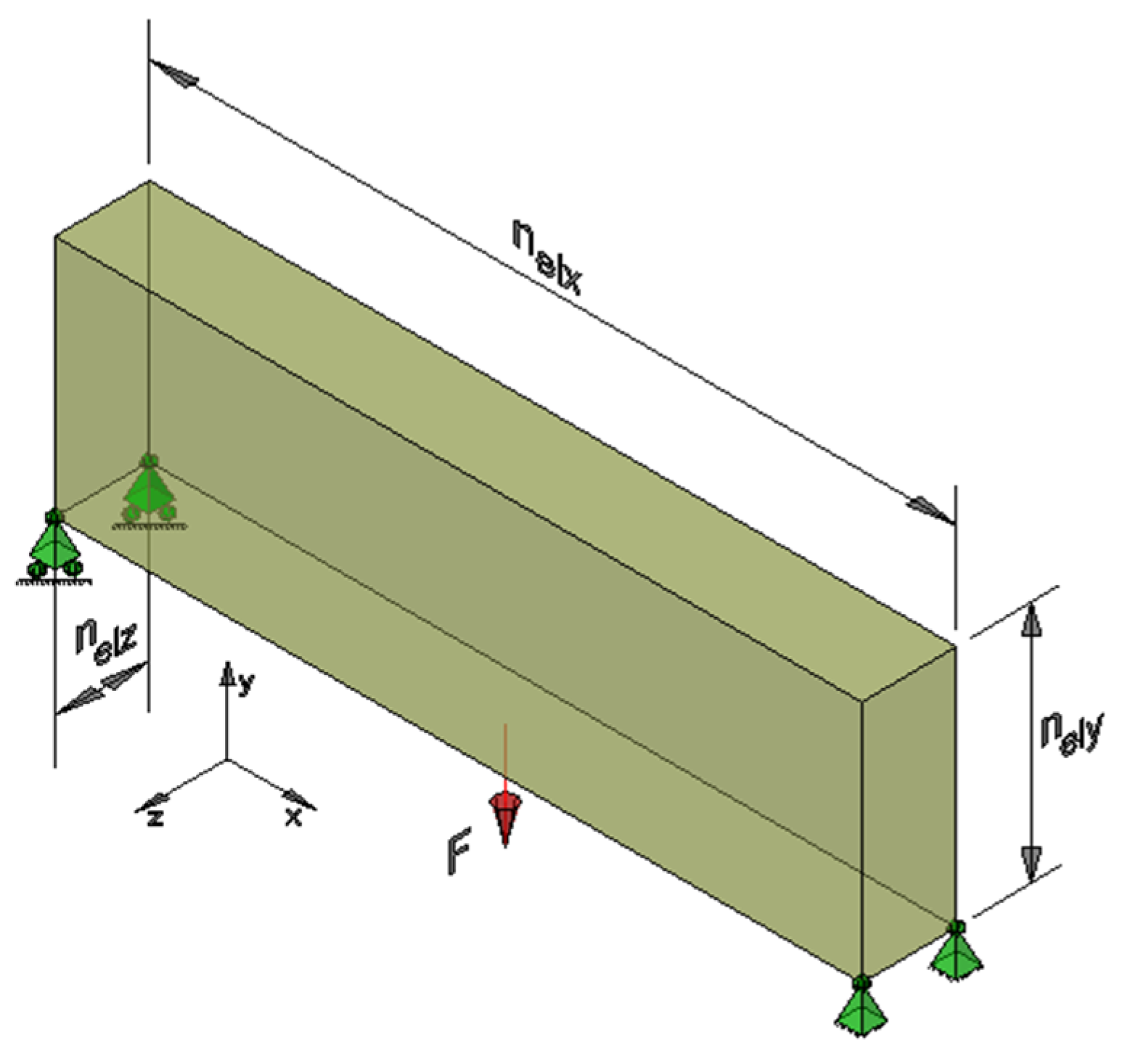
The optimized MBB beam consists of a simply supported beam, modeled with a first-order support (roller) at one end and a second-order support (pin) at the opposite end. The design domain was discretized with N e l x = 120 , N e l y = 20 and N e l x = 2 dm. A specific load of F = 100 kN was applied in the middle of the span, on the lower face of the beam, as illustrated in Figure 24. The optimization parameters were defined with a prescribed volume fraction of V f r a c = 0.50 , cost of C f r a c . = 0.383 and a filter radius R m i n = 2.5 .
Figure 24. Design domain and boundary conditions.
Figure 25 shows the optimal settings for the procedure with reliability analysis ( σ V M ( D T O ) m a x ) and with reliability analysis ( σ V M F O R M m a x ).
Figure 25. Optimal settings: (a) SESO-FORM ( σ V M ( D T O ) m a x ) and (b) SESO-FORM ( σ V M ( F O R M ) m a x ).
Figure 26 and Figure 27 show the optimal configurations from the multi-objective MMTO with two materials (steel and concrete), considering ( u m a x ) and ( σ V M I S E S m a x ,   σ 3 m a x ) as conflicting objectives. Figure 26 illustrates the optimal configurations obtained via Reliability-Based Topological Optimization ( σ V M ( D T O ) m a x ,   σ 3 ( D T O ) m a x ), and Figure 27 shows the reliability-based topological optimization ( σ V M ( F O R M ) m a x ,   σ 3 ( F O R M ) m a x ), which explicitly incorporates the uncertainties in the problem parameters.
Figure 26. Pareto frontier-optimal SESO-FORM: (a) ( σ V M ( D T O ) m a x ) and (b) ( σ 3 ( D T O ) m a x ).
Figure 27. Pareto frontier-optimal SESO-FORM: (a) ( σ V M ( F O R M ) m a x ) and (b) ( σ 3 ( F O R M ) m a x ).
Table 9 and Table 10 present the results of the von Mises stress and minimum principal stress objective functions under the minimum displacement constraint, as well as the corresponding weighting factors for the MBB beam structure, considering DTO and FORM reliability approaches, respectively.
Table 9. Objective function values and weighting factors: MBB beam ( σ V M ( D T O ) m a x ) and ( σ 3 ( D T O ) m a x ).
Table 10. Objective function values and weighting factors: MBB beam ( σ V M ( F O R M ) m a x ) and ( σ 3 ( F O R M ) m a x ).

5. Conclusions

The application of the SESO method to the topological optimization of multi-material structures proved effective in obtaining efficient and stable structural configurations. The results obtained are consistent with well-established studies in the literature, such as Sigmund [44] and Belytschko et al. [45], but present a multi-material approach, showing that the combination of different materials constitutes an effective strategy to improve the overall performance of the structure without compromising its mechanical integrity.
Three-dimensional multi-material topological optimization, formulated as a multi-objective problem, proved suitable for exploring different design solutions from the same structural domain. Depending on the prioritized criterion, it was possible to obtain reductions of up to 2.1% in the maximum von Mises stress or 20.6% in the maximum displacements. The numerical examples of the bottom-loaded cantilever beam and center-loaded cantilever beam, and MBB beam confirmed the consistency of the methodology, demonstrating its applicability.
The incorporation of reliability analysis using the FORM method into multi-material and multi-objective topological optimization produced satisfactory results, meeting the established reliability indices. Validation through Monte Carlo simulations showed maximum differences of less than 9.1%, corroborating the accuracy and robustness of the proposed approach.
Thus, two strategies for handling the maximum von Mises stress or minimum principal stress were analyzed. In the first, the stress is fixed from the deterministic solution and used in the calibration of the minimum yield stress associated with the steel or f c k associated with the concrete with the target reliability index. This strategy reflects the typical design procedure, in which the deterministic analysis serves as the basis for defining the resistance parameters, resulting in yield strengths 30.6% and 30.3% higher than the applied stress for the bottom-loaded cantilever beam and center-loaded cantilever beam, respectively, with lower computational cost. In the second strategy, the maximum von Mises stress evolves simultaneously with the structural topology, leading to resistance values 42.8% and 51.8% higher than the ap-plied stress for the bottom-loaded cantilever beam and center-loaded cantilever beam, respectively, resulting in structurally more conservative solutions. For the MBB beam, the Pareto frontier exhibited differences of 24.2% for the maximum von Mises stress, 7.1% for the minimum principal stress, and 21.6% for the maximum displacement, providing a range of trade-off solutions from which the engineer can select the most suitable design according to project requirements.
Therefore, the calibration of the minimum yield strength allowed the establishment of design parameters compatible with the specified reliability index. In all three examples, bottom-loaded cantilever beam, center-loaded cantilever beam, and MBB beam, both the maximum von Mises stress (for the steel phase) and the minimum principal stress (for the concrete phase) were considered. Two sets of results are reported: the first corresponds to a deterministic reliability-based analysis, and the second to a FORM-based reliability formulation.
For the bottom-loaded cantilever beam, values of σ y = 21 MPa (deterministic reliability-based) and σ y = 25.5 MPa (FORM-based reliability) were obtained, with corresponding concrete strengths of f c k = 5.6 MPa and f c k = 7.0 MPa, respectively. Similarly, for the center-loaded cantilever beam, σ y = 14.5 MPa and σ y = 17.5 MPa were obtained, with f c k = 16.2 MPa and f c k = 20.2 MPa, respectively.
For the MBB beam, σ y = 31 MPa (deterministic reliability-based) and σ y = 40 MPa (FORM-based reliability) were obtained, while the concrete strengths were f c k = 39.4 MPa and f c k = 47.1 MPa, respectively.
Although mesh convergence analysis was not the central focus of this study, its importance in topology optimization is fully acknowledged. The main contribution of this work lies in the consistent integration of SESO, MMTO, multi-objective optimization, and structural reliability. Future investigations will systematically assess the effects of mesh refinement on the Pareto frontier, material layout, and reliability measures. This planned extension will further consolidate the robustness and applicability of the proposed methodology.
The study advances beyond the mere combination of existing techniques by proposing an integrated SESO-based algorithm with structural modifications that enable the simultaneous treatment of multi-material topology optimization, multi-objective formulation and probabilistic constraints directly within the evolutionary process. Furthermore, the calibration of material strength parameters, including the yield stress of steel and the compressive strength of concrete, f c k , allowed the determination of the minimum resistance levels required to achieve the target reliability index β = 3.0, reinforcing both the methodological contribution and the practical engineering relevance of the proposed framework.

Author Contributions

M.M.d.S.: Conceptualization, software, validation, formal analysis, investigation, resources, data curation, writing—original draft preparation, and visualization. H.L.S.: Conceptualization, software, validation, formal analysis, investigation, resources, data curation, writing—review and editing, supervision, and project administration. F.d.A.d.N.: Conceptualization, methodology, investigation, resources, writing—review and editing, supervision, and project administration. M.S.d.R.F.: resources, writing—review and editing, supervision, and project administration. All authors have read and agreed to the published version of the manuscript.

Funding

This research was funded in part by the Coordination for the Improvement of Higher Education Personnel-Brazil (CAPES)-Finance Code 001, CNPq (National Council of Scientific and Technological Development) under Grant Number 316771/2023-6, FAPEMIG and Federal University of Ouro Preto (UFOP), the IFMG for their financial support of this research and the CEFET-MG for their financial support of this research.

Data Availability Statement

The data presented in this study are available on request from the corresponding author.

Conflicts of Interest

The authors declare no conflicts of interest. The funders had no role in the design of the study; in the collection, analyses, or interpretation of data; in the writing of the manuscript; or in the decision to publish the results.

References

  1. Zuo, W.; Saitou, K. Multi-material topology optimization using ordered SIMP interpolation. Struct. Multidiscip. Optim. 2016, 55, 477–491. [Google Scholar] [CrossRef]
  2. Silva, M.M.; Assis, F.N.; Simonetti, H.L.; Freitas, M.S.R. Reliability-Based Multi-Material 3D Topology Optimization: A Comparative Study Between SIMP and SESO Methods. In Proceedings of the Ibero-Latin American Congress on Computational Methods in Engineering, Vitória, Brazil, 24–27 November 2025. [Google Scholar]
  3. Yu, D.; Wu, Y.; Zhao, Z.; Zhu, Q. Topology optimization method of truss structures considering length constraints. Structures 2025, 77, 109079. [Google Scholar] [CrossRef]
  4. Cool, V.; Aage, N.; Sigmund, O. A practical review on promoting connectivity in topology optimization. Struct. Multidiscip. Optim. 2025, 68, 73. [Google Scholar] [CrossRef]
  5. Özcakar, E.; Simsek, U.; Kiziltas, G. Ordered multi-material SIMP approach applied to 3D topology optimization. J. Addit. Manuf. Technol. 2021, 1, 544. [Google Scholar] [CrossRef]
  6. Renz, R.; Niklas, F.; Albert, A. Multi-Material Topology Optimization Taking into Account the Position of Material Interfaces in 3D. Appl. Sci. 2025, 15, 7612. [Google Scholar] [CrossRef]
  7. Kundu, R.D.; Zhang, X.S. Sustainability-oriented multimaterial topology optimization: Designing efficient structures incorporating environmental effects. Struct. Multidiscip. Optim. 2025, 68, 17. [Google Scholar] [CrossRef]
  8. Gao, X.; Li, L.; Chen, J.; Li, Y. Robust topology optimization of multi-material structures with overhang angle constraints using the material field series-expansion method. Structures 2024, 69, 107359. [Google Scholar] [CrossRef]
  9. Silva, M.M.; Neves, F.A.; Simonetti, H.L.; Freitas, M.S.R. Multi-material topology optimization for three-dimensional structures based on the SIMP and SESO method through a new interpolation coupled with reliability. J. Mech. Sci. Technol. 2026, 40, 1243–1257. [Google Scholar] [CrossRef]
  10. Silva, M.M.; Assis, F.N.; Simonetti, H.L.; Freitas, M.S.R. Automated Approach For Multi-objective Optimization Of Steel Trusses Using Genetic Algorithms and Reliability. In Proceedings of the XLIV Ibero-Latin American Congress on Computational Methods in Engineering, Porto, Portugal, 13–16 November 2023. [Google Scholar]
  11. Galambos, T.V.; Ellingwood, B.; Macgregor, J.G.; Cornell, C.A. Probability based load criteria: Assessment of current design practice. J. Struct. Div. 1982, 108, 959–977. [Google Scholar] [CrossRef]
  12. Bandyopadhyay, A.; Heer, B. Additive manufacturing of multi-material structures. Mater. Sci. Eng. R. Rep. 2018, 129, 1–16. [Google Scholar] [CrossRef]
  13. Han, D.; Lee, H. Recent advances in multi-material additive manufacturing: Methods and applications. Curr. Opin. Chem. Eng. 2020, 28, 158–166. [Google Scholar] [CrossRef]
  14. Wang, M.Y.; Wang, X. Color level sets: A multi-phase method for structural topology optimization with multiple materials. Comput. Methods Appl. Mech. Eng. 2004, 193, 469–496. [Google Scholar] [CrossRef]
  15. Guo, X.; Zhang, W.; Zhong, W. Stress-related topology optimization of continuum structures involving multi-phase materials. Comput. Methods Appl. Mech. Eng. 2014, 268, 632–655. [Google Scholar] [CrossRef]
  16. Chu, S.; Gao, L.; Xiao, M.; Luo, Z.; Li, H. Stress-based multi-material topology optimization of compliant mechanisms. Int. J. Numer. Methods Eng. 2018, 113, 1021–1044. [Google Scholar] [CrossRef]
  17. Wang, Y.; Luo, Z.; Kang, Z.; Zhang, N. A multi-material level set-based topology and shape optimization method. Comput. Methods Appl. Mech. Eng. 2015, 283, 1570–1586. [Google Scholar] [CrossRef]
  18. Bendsøe, M.P.; Sigmund, O. Material interpolation schemes in topology optimization. Arch. Appl. Mech. 1999, 69, 635–654. [Google Scholar] [CrossRef]
  19. Tavakoli, R.; Mohseni, S.M. Alternating active-phase algorithm for multimaterial topology optimization problems: A 115-line MATLAB implementation. Struct. Multidiscip. Optim. 2014, 49, 621–642. [Google Scholar] [CrossRef]
  20. Huang, X.; Xie, Y.M. Bi-directional evolutionary topology optimization of continuum structures with one or multiple materials. Comput. Mech. 2009, 43, 393–401. [Google Scholar] [CrossRef]
  21. Zheng, R.; Yi, B.; Peng, X.; Yoon, G.-H. An Efficient Code for the Multi-Material Topology Optimization of 2D/3D Continuum Structures Written in Matlab. Appl. Sci. 2024, 14, 657. [Google Scholar] [CrossRef]
  22. Simonetti, H.L.; Neves, F.A.d.; Almeida, V.S.; da Silva, M.M.; Neto, L.d.O. Three-Dimensional Multi-Material Topology Optimization: Applying a New Mapping-Based Projection Function. Materials 2025, 18, 997. [Google Scholar] [CrossRef]
  23. Azevêdo, A.S.D.C.; Moscatelli, E.; Ribeiro, L.N.B.S.; Sá, L.F.N.D.; Silva, E.C.N.; Picelli, R. A multi-objective function for discrete topology optimization in labyrinth seal design problems. Adv. Eng. Softw. 2025, 204, 103. [Google Scholar] [CrossRef]
  24. Zhang, L.; Alizadeh, A.A.; Baghoolizadeh, M.; Salahshour, S.; Ali, E.; Escorcia-Gutierrez, J. Multi-objective optimization of vertical and horizontal solar shading in residential buildings to increase power output while reducing yearly electricity usage. Renew. Sustain. Energy Rev. 2025, 215, 115578. [Google Scholar] [CrossRef]
  25. Chen, Y.; Xiao, Z.; Yang, Y.; Wang, H.; Wang, H.; Bi, Y. Multi-objective optimization for impact resistance of composite laminates with non-conventional ply orientations: An integrated finite element and machine learning framework. Thin-Walled Struct. 2025, 216, 113687. [Google Scholar] [CrossRef]
  26. Simonetti, H.L.; Almeida, V.S.; Neto, L.d.O. A smooth evolutionary structural optimization procedure applied to plane stress problem. Eng. Struct. 2014, 75, 248–258. [Google Scholar] [CrossRef]
  27. Rao, S.S. Engineering Optimization; Wiley: Coral Gables, FL, USA, 2020. [Google Scholar]
  28. Pareto, V. Cours D’ Economie Politique; F. Rouge: Lausanne, Switzerland, 1896. [Google Scholar]
  29. Simonetti, H.L.; das Neves, F.D.A.; Almeida, V.S. Multiobjective topology optimization with stress and strain energy criteria using the SESO method and a Multicriteria Tournament Decision. Structures 2021, 30, 188–197. [Google Scholar] [CrossRef]
  30. Xu, Y.; Ma, Z.; Lin, W. Multi-objective topology optimization and mechanical performance of AMAH joints in spatial structures. J. Constr. Steel Res. 2025, 226, 109294. [Google Scholar] [CrossRef]
  31. Yin, Q.; Guo, J.; Kan, Y.; Ma, J.; Deng, C. Multi-Objective Topology Optimization of Thin-Plate Structures Based on the Stiffener Size and Layout. Electronics 2024, 13, 4968. [Google Scholar] [CrossRef]
  32. Crescenti, F.; Kipouros, T.; Munk, D.J.; Savill, M.A. Generating minimal Pareto sets in multi-objective topology optimisation: An application to the wing box structural layout. Struct. Multidiscip. Optim. 2021, 63, 1119–1134. [Google Scholar] [CrossRef]
  33. Coello, C.A.C.; Lamont, G.B.; Veldhuizen, D.A.V. Evolutionary Algorithms for Solving Multi-Objective Problems; Springer: Boston, MA, USA, 2007. [Google Scholar] [CrossRef]
  34. da Silva, G.A.; Beck, A.T.; Cardoso, E.L. Topology Optimization of continuum structures with stress constraints and uncertainties in loading. Int. J. Numer. Methods Eng. 2017, 113, 153–178. [Google Scholar] [CrossRef]
  35. Simonetti, H.L.; Almeida, V.S.; Neves, F.A.; Azar, S.Z.; Silva, M.M. BESO and SESO: Comparative Analysis of Spatial Structures Considering Self-Weight and Structural Reliability. Appl. Sci. 2024, 14, 6465. [Google Scholar] [CrossRef]
  36. Simonetti, H.L.; Almeida, V.S.; Neves, F.A.; Del, D.A.V.; Oliveira, N.L. Reliability-Based Topology Optimization: An Extension of the SESO and SERA Methods for Three-Dimensional Structures. Appl. Sci. 2022, 12, 4220. [Google Scholar] [CrossRef]
  37. Melchers, R.E.; Beck, A.T. Structural Reliability Analysis and Prediction, 3rd ed.; John Wiley & Sons: Hoboken, NJ, USA, 2018; p. 506. [Google Scholar] [CrossRef]
  38. Hasofer, A.M.; Lind, N.C. Exact and invariant second moment code format. J. Eng. Mech. Div. 1974, 100, 111–121. [Google Scholar] [CrossRef]
  39. Haldar, A.; Mahadevan, S. Probability, Reliability and Statistical Methods in Engineering Design; John Wiley & Sons: Hoboken, NJ, USA, 2000. [Google Scholar]
  40. Rosowsky, D.V. Structural Reliability; CRC Press: Boca Raton, FL, USA, 1999. [Google Scholar]
  41. Rackwitz, R.; Fiessler, B. Structural reliability under combined random load sequences. Comput. Struct. 1978, 9, 489–494. [Google Scholar] [CrossRef]
  42. Li, Y.; Yuan, P.F.; Xie, Y.M. A strategy for improving the safety and strength of topologically optimized multi-material structures. Acta Mech. Sin. 2023, 39, 422134. [Google Scholar] [CrossRef]
  43. Murat, F.; Kaymaz, I.; Şensoy, A.T. Reliability-Based Topology Optimization Considering Overhang Constraints for Additive Manufacturing Design. Appl. Sci. 2025, 15, 6250. [Google Scholar] [CrossRef]
  44. Sigmund, O. A 99 line topology optimization code written in Matlab. Struct. Multidiscip. Optim. 2001, 21, 120–127. [Google Scholar] [CrossRef]
  45. Belytschko, T.; Xiao, S.P.; Parimi, C. Topology optimization with implicit functions and regularization. Int. J. Numer. Methods Eng. 2003, 57, 1177–1196. [Google Scholar] [CrossRef]
Disclaimer/Publisher’s Note: The statements, opinions and data contained in all publications are solely those of the individual author(s) and contributor(s) and not of MDPI and/or the editor(s). MDPI and/or the editor(s) disclaim responsibility for any injury to people or property resulting from any ideas, methods, instructions or products referred to in the content.

Article Metrics

Citations

Article Access Statistics

Multiple requests from the same IP address are counted as one view.